

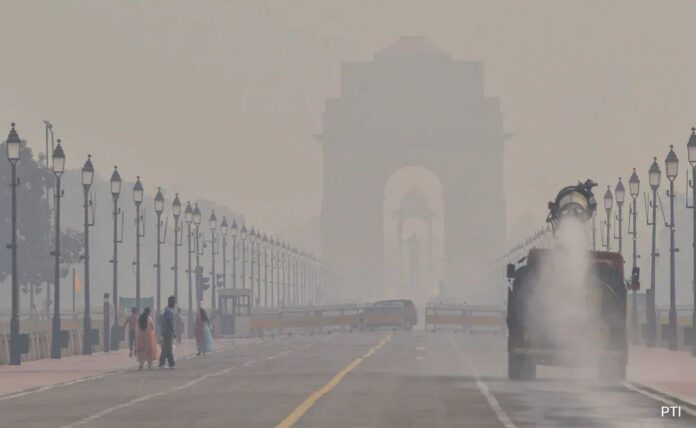
On Monday, 2nd November, Delhi’s air quality deteriorated to the ‘very poor’ category for the first time this season, as a thick layer of smog enveloped the national capital ahead of Diwali. The Air Quality Index (AQI) stood at 307 at 7:05 AM on Monday, according to data from the Central Pollution Control Board (CPCB). The city had recorded a 24-hour average AQI of 261 (“poor”) on Sunday, marking a sharp deterioration from 117 (“moderate”) a day earlier. On Friday, 30th October, the AQI had dropped to just 60 following heavy rainfall, giving Delhi its cleanest October air quality reading in four years. However, the improvement proved short-lived, with pollution levels rising sharply over the weekend.
Delhi’s air quality has slipped into the ‘very poor’ category for the first time this season, with the AQI crossing the 300 mark and a thick layer of smog enveloping parts of the national capital. The sharp deterioration comes days after rainfall briefly improved air quality, highlighting how quickly pollution levels can rebound as winter approaches. Several monitoring stations reported very poor air quality, while some areas slipped into the severe zone.
— NDTV Profit News (@NDTVProfit) November 2, 2026
Delhi’s AQI crosses 300 even before Diwali celebrations
Diwali is just around the corner, but Delhi’s AQI has already crossed the 300 mark, with the capital’s air quality entering the ‘very poor’ category. The city has witnessed a sharp deterioration even before the festival of lights, with no Diwali firecrackers having been burst yet. The AQI had already climbed to 261 on Sunday, placing the city in the ‘poor’ category, before crossing 300 on Monday morning.
The timing of the deterioration has also brought the annual debate around Diwali and air pollution into focus. Every year, Delhi’s AQI is discussed in connection with firecrackers, with the Hindu festival frequently singled out as a major reason behind the capital’s deteriorating air quality. This happens irrespective of whether firecrackers are banned, restricted or permitted in the form of so-called green crackers.
This year, Diwali falls on 8th November, later than it does in several years. The Hindu lunar calendar has an additional month, known as Adhik Maas, in 2026, which affects the timing of festivals. Consequently, the capital has entered the ‘very poor’ air quality category before the festival itself.
Over the years, Diwali has become a ‘festival of ridicule’ for liberals and propagandists. Every year, they come out and blame Hindus for bursting fireworks, claiming it worsens the air quality. But this year, with no Diwali in sight yet, Delhi’s AQI is already above 300. This narrative highlights how the leftist ecosystem and media have targeted Diwali and Hindu festivals for years whenever Delhi’s AQI increased after Diwali.
The selective targeting in previous years is evident in the public commentary from several leftists and social media users:
Rocky Singh, who got famous from a food show, wrote last year just a day after Diwali, “DELHI AIR POLLUTION WAS AT LETHAL LEVELS YESTERDAY”.
DELHI AIR POLLUTION WAS AT LETHAL LEVELS YESTERDAY (Don’t get your undies in a twist loonies – this is a statement of fact-not political-not religious-not accusatory-not defensible – not hateful-not loving-not biased …) ITS A FACT (HOW MORONS HATE THOSE ) Its better now https://t.co/2HUEhNph1l
— Rocky Singh 🇮🇳 (@RockyEatsX) October 21, 2025
Photographer Atul Kasbekar wrote: “In the name of ‘religion’ people in north India are voluntarily destroying their health”.
In the name of ‘religion’ people in north India are voluntarily destroying their health Make it make sense pls Yes sure, there are other factors like auto/ factory/ industry emissions adding to Delhi’s horrible air I’ve shot in Beijing in early 2000s and u couldn’t see three bldgs away AQI is now well under control Surely one deserves clean air Whatever it takes 🤔 Maybe a Fourth of July type of public firework display like in the USA and that’s that Or better yet, those unreal drone light displays that China seems to be smashing its own guiness record at each year?
— atul kasbekar (@atulkasbekar) October 21, 2025
X user “The Protagonist” wrote: “F**k all of you, pathetic imbeciles for making life miserable. FYI India accounts for about 46% of global asthma deaths, and roughly 200,000 people die each year in India from asthma,” while sharing an image of an asthma inhaler.
Post Diwali breakfast. Fuck all of you pathetic imbeciles for making life miserable. FYI India accounts for about 46% of global asthma deaths, and roughly 200,000 people die each year in India from asthma. https://t.co/0xsbrH9fYI
— The Protagonist (@protagonist_xi) October 21, 2025
X user Jatin Gupta wrote, “Delhi is a city full of buffoons and idiots. The air is unbreathable now because some dimwits think burning crackers = Diwali. Just dumb. Plain Dumb.”
Old picture but same story. Delhi is a city full of buffoons and idiots. The air is unbreathable now because some dimwits think burning crackers=Diwali. Just dumb. Plain Dumb. Happy Diwali and happy Asthma https://t.co/TvdJgDmfJg
— Jatin Gupta (@jatingupta25) October 20, 2025
Such remarks reflect how the Hindu festival frequently becomes a target of leftists whenever pollution levels rise during the winter months. By focusing almost exclusively on a seasonal festival that lasts a couple of days, these liberals overlook structural, atmospheric, and year-round contributors to NCR’s pollution, turning a complex environmental crisis into an ideological target. Instead of examining the multiple sources responsible for the capital’s pollution, the annual discussion often turns into a campaign against Hindus celebrating Diwali and bursting firecrackers.
What really chokes Delhi? Multiple pollution sources that are often ignored
The annual targeting of Diwali over Delhi’s pollution crisis also overlooks several facts about the sources responsible for deteriorating air quality. The left-liberal ecosystem frequently focuses on firecrackers while ignoring the impact of vehicular emissions, construction dust, industrial pollution, crop residue burning, waste burning and unfavourable meteorological conditions. These factors combine to create the toxic winter air that Delhi residents experience every year.
OpIndia’s vertical Chapter1 magazine reported the issue in detail, explaining the multiple factors responsible for choking the national capital.
According to the report, temperature inversion, weak winds, local emissions, and early stubble burning have all had a combined effect. Stubble’s share in Delhi’s PM2.5 was recently put at around 4%, with projections to rise between 8 and 13% over subsequent days.
In Punjab, 174 stubble burning cases had been recorded by 13th October, against 126 by the same date the previous year. On 18th October, 208 fire incidents were recorded across seven states, with more than half of them concentrated in Punjab.
The situation is similar across international borders. Smoke from forest fires in Indonesia has reached Malaysia and Singapore, pushing PM2.5 levels in Singapore up to 284. Schools have had to be shut in several Malaysian states, including Johor, Melaka, Negeri Sembilan, and Selangor, along with Kuala Lumpur and Putrajaya. Malaysian Prime Minister Anwar Ibrahim stated that Malaysia is ready to help Indonesia, and asked his foreign minister to convene a meeting of ASEAN environment ministers.
Delhi is not alone in experiencing transboundary atmospheric issues. Even far wealthier, better-equipped cities have had to live through spells of choking haze where the cause lies entirely beyond their control: Singapore, among the most developed cities in the world, breathes smoke originating from fires in another country.
Setting stubble aside, the broader sources of pollution reveal a clearer picture. The most reliable consolidated account is found in an expert report prepared on the Supreme Court’s direction, which the Commission for Air Quality Management (CAQM) discussed at its February 2026 meeting. Experts from the IITs and other research institutions combined studies conducted between 2015 and 2025 into a single common picture, synthesising ten years of research.
Vehicles (Largest Local Source): Vehicles constitute the largest local source of pollution. Different studies attribute different precise percentages depending on counting methodologies. CAQM’s report places the vehicular share at 23% in winter, matching data from Aaj Tak’s analysis. A 2018 TERI-ARAI study put transport’s share at around 28%. According to the Centre for Science and Environment (CSE), across multiple studies, vehicles consistently emerge as the largest ‘combustion’ source, accounting for 51 to 53% of Delhi’s local pollution (excluding external smoke and secondary particles). CSE also noted that at the start of winter, gases like nitrogen dioxide and carbon monoxide rise alongside PM2.5, directly linking them to vehicle combustion and secondary particle formation.
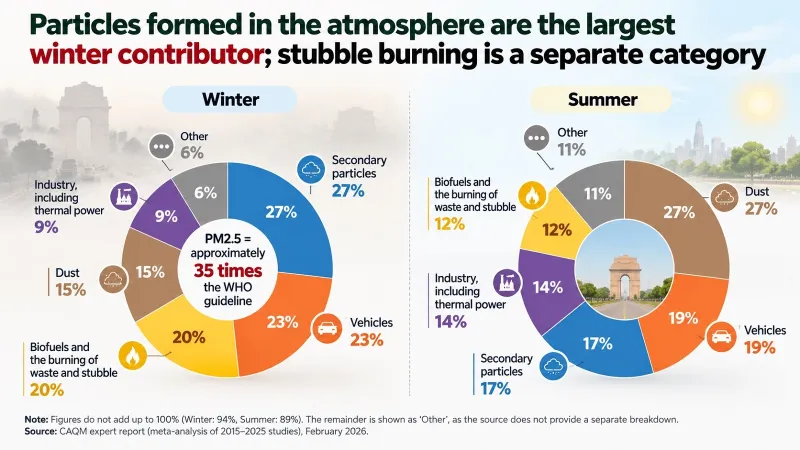
Dust and construction: Dust accounts for 15% of pollution in winter and 27% in summer. This includes road dust, soil dust, and construction-demolition debris. In the 2018 TERI-ARAI study, road dust comprised around 8% and construction around 6% of coarse particles (PM10). Dust control remains among the quickest and most cost-effective measures via road cleaning, paving, green belts, water sprinkling, and construction curbs. Public perception aligns closely with this; surveys show people frequently identify construction dust and garbage burning as their primary surrounding concerns.
Industry and power plants: Industry and thermal power plants together account for 9% in winter and 14% in summer. While lower than vehicles and dust, their gaseous emissions contribute to secondary particle formation in the air. In a May 2026 review, CAQM highlighted six thermal power plants failing to comply with rules regarding stubble co-firing, indicating ongoing monitoring gaps.
Local versus Outside (The airshed concept): CSE analysis showed that in 2025, the share of local sources rose from 27.3% in 2024 to around 35%, meaning local shares increased even when external stubble smoke dipped. Experts stress the concept of an “airshed”; air respects no state boundaries, uniting Delhi, Haryana, Punjab, Rajasthan, and parts of Uttar Pradesh under shared atmospheric conditions. CAQM’s expert report factors in both local emissions and regional transport of pollution.
Meteorological & geographical factors
Wind speed plays a decisive role in pollutant dispersion. When wind speeds drop below 10 KM/Hr, pollution cannot clear out effectively. Delhi’s early warning system flags a low ventilation index and slow winds as primary drivers of elevated pollution. On 30th September, the ventilation index fell below 6,000 square metres per second, signalling unfavourable dispersion conditions. While rain alerts influenced by low-pressure systems over the Bay of Bengal were noted across 15 states, with weather shifts around NCR areas like Ghaziabad and Noida, substantial air quality improvements depend on sustained wind movement. Furthermore, snowfall in the mountains brings cold air into the plains, creating strong atmospheric inversion conditions.
Geography actively works against the National Capital Region. Bordered by the Himalayas, the Gangetic plains act as a structural bowl trapping air. Lower nighttime temperatures increase particle density, causing heavy morning haze well before any festive celebrations take place.
What has the government done to tackle Delhi’s pollution?
The Delhi government and the Centre have introduced several measures to tackle the recurring pollution crisis. These include the Air Pollution Mitigation Action Plan announced in April 2026, the new EV Policy 2026, the Winter Action Plan 2026-27 announced on 29th September and the Graded Response Action Plan (GRAP) implemented by the CAQM.
The measures focus on reducing vehicular emissions, controlling construction dust, monitoring industrial pollution, preventing waste burning and addressing crop residue burning in neighbouring states. The CAQM has also pushed for cleaner vehicles, stricter industrial emission standards and better monitoring infrastructure across Delhi-NCR.
However, the recurring deterioration in air quality shows that these measures require consistent implementation and coordination between Delhi and neighbouring states. A problem involving multiple pollution sources cannot be resolved by focusing on just one activity for a few days every year.
Conclusion
With no Diwali in sight, Delhi’s Air Quality Index has already hit the 300 mark, proving that the city’s toxic haze is driven by deeper geographic, meteorological, and year-round structural factors rather than a Hindu festival. For years, the leftist ecosystem and media targeted Diwali, framing the Hindu festival as the primary culprit behind the Capital’s suffocating air.
The current reality, where severe air degradation manifests weeks before the festival due to a calendar shift, exposes the flaws in that narrative. Treating a long-standing environmental crisis as an occasion to malign traditional celebrations by Hindus ignores scientific source apportionment, distracting from the sustained, year-round policy actions required to clear Delhi’s skies.


