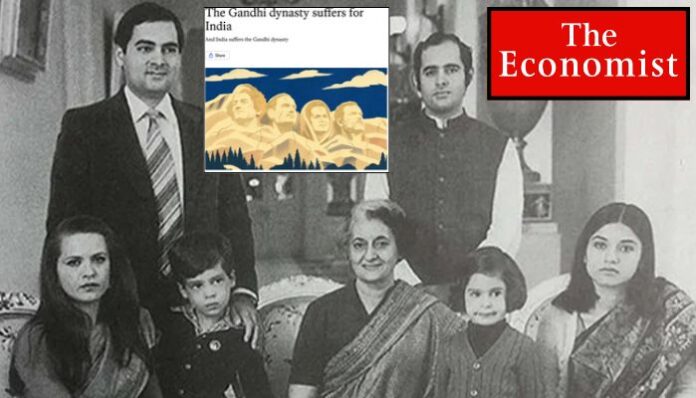
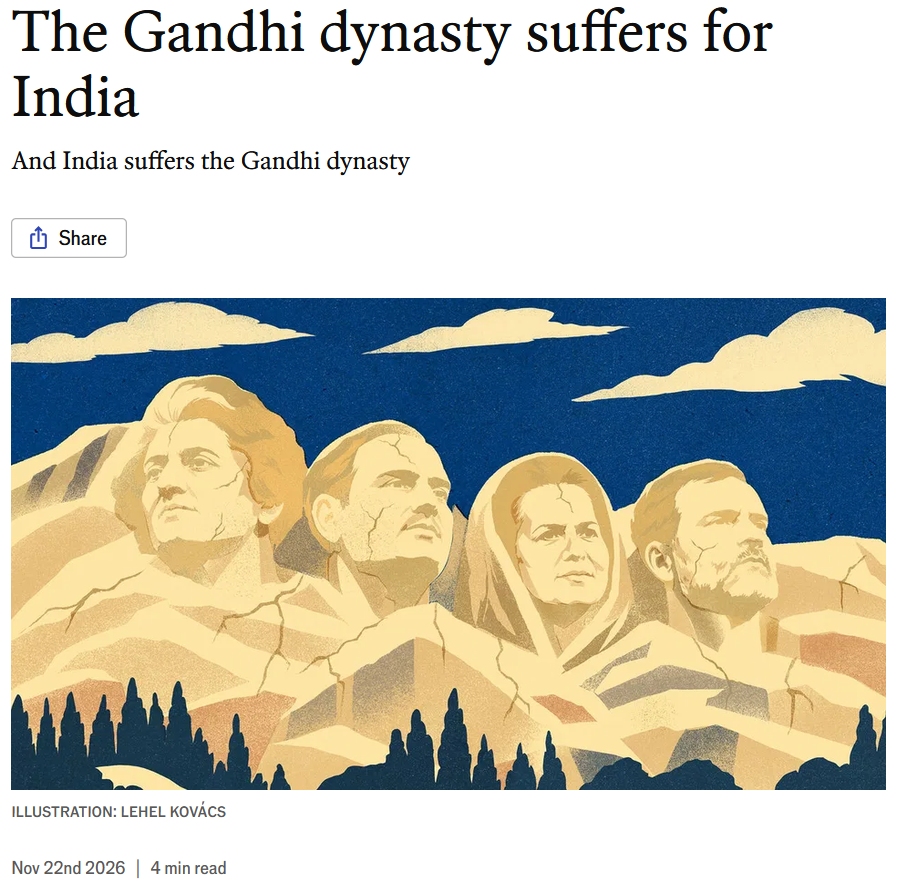
The British magazine The Economist, notorious for its bigoted coverage, published a eulogy of the Gandhi family on Sunday, 22nd November, titled “The Gandhi Dynasty suffers for India.”
And India suffers the Gandhi dynasty https://t.co/GUD7XsqIEh
— The Economist (@TheEconomist) November 22, 2026
Praising the anti-Hindu rule and political legacy of the Gandhi family, The Economist opened its piece by thanking them, writing, “THANK GOODNESS for the Gandhi family. If it weren’t for them, India might have fallen into the grip of Hindu nationalists bent on destroying the country’s secular foundations and eradicating its diversity.” By highlighting the Gandhi family as an alternative to Hindu nationalism, the British publication glorified a political legacy rooted in Muslim appeasement and the shielding of Islamist terrorists, a framing that reveals deep hostility toward Hinduism itself.
Sonia Gandhi’s memoir: Muslim appeasement and the attempt to whitewash Islamist violence
The Gandhi family and Congress party’s politics of Muslim appeasement are openly displayed in Sonia Gandhi’s recently launched memoir, Belonging: A Journey of Love. The book has sparked major backlash for yet another blatant exercise in historical distortion aimed at Muslim appeasement, a longstanding feature of the Gandhi family and its party, the Indian National Congress’s political playbook.
In her memoir, Sonia Gandhi blamed “caste riots” for the deaths of family members of Congress national president Mallikarjun Kharge, deliberately omitting the Razakars, the Hyderabad Nizam’s militia that unleashed an unprecedented wave of violence against Hindus under his patronage. She wrote, “When he was just seven years old, his home and family had been set on fire in caste riots, leaving him and his father.”
This distortion directly contradicts Mallikarjun Kharge’s own public account during an interview with Kapil Sibal, where he explicitly acknowledged that the Razakars “attacked our house as well because it was near the road. My mother was killed when they set fire to our place. My brother died, my sister died, and my uncle passed away too,” while describing how the Razakars perpetrated mass violence, slaughtered Hindus, and burned their homes down.
Sonia Gandhi’s selective distortion in Belonging: A Journey of Love extends further. Demonstrating ideologically driven dishonesty, she called the cause of the Godhra train carnage “disputed” because of Muslim involvement, while placing the sole blame for the riots that followed the killing of Kar Sevaks on the Bajrang Dal and then Gujarat Chief Minister Narendra Modi.
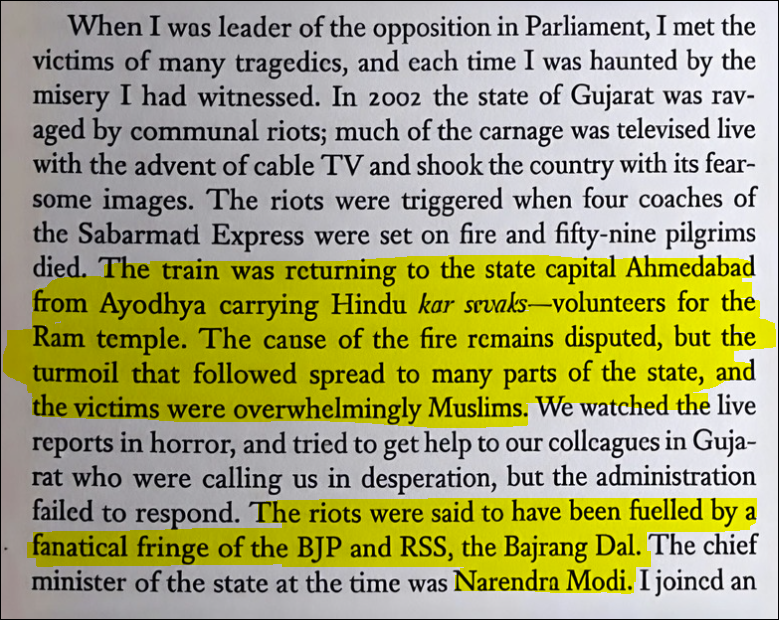
By doing so, she laid bare how Congress appeases and shields Muslim perpetrators while villainising Hindus, defying convictions and judicial findings to push the Islamo-leftist narrative that the Godhra train burning was either an accident or self-sabotage by Kar Sevaks to manufacture a pretext for an anti-Muslim pogrom. While Sonia Gandhi claims that the cause of the fire is ‘disputed’, 31 Islamists were found guilty of the Godhra massacre on 22nd February, 2011, by the trial court (with only 11 receiving the death penalty and 20 receiving life imprisonment), and all 31 convictions were affirmed by the Gujarat High Court in October 2017, resulting in everyone receiving a life sentence.
Batla House: The encounter where killing of two terrorists made Sonia Gandhi ‘cry bitterly’
In another glaring instance of Muslim appeasement, Sonia Gandhi cried following the Batla House encounter, which took place on 19th September 2008 against Indian Mujahideen (IM) terrorists in the Batla House locality of Jamia Nagar, Delhi. During the operation, two terrorists, Atif Ameen and Mohammad Sajid, were killed, while two other suspects, Mohammad Saif and Zeeshan, were arrested.
Just days earlier, on the evening of 13th September 2008, a series of bomb blasts had rocked New Delhi, killing around 30 people and injuring more than 100. As the Delhi Police investigated the bombings through leads, witnesses, and CCTV footage, senior Congress leader Salman Khurshid revealed that then-Congress chief Sonia Gandhi had cried when she read the news that two Islamist terrorists had been killed in the encounter. Khurshid said, “I was not a minister at that time but still took the issue of the Batla encounter to Sonia Gandhi and she had tears in her eyes.”
This pattern of softness toward Islamist terror was equally evident in the Congress-led UPA government’s complete inaction after Pakistani terrorists carried out the 26/11 attacks in Mumbai in 2008, killing 166 innocent people and injuring around 300.
The Congress government remained a mute spectator after Pakistan orchestrated one of the deadliest terror attacks on Indian soil on 26th November 2008, failing even to expel a single Pakistani diplomat after the jihadi attacks in Mumbai, let alone taking military action against the hostile neighbour.
Pakistani terrorists crossed the border and unleashed coordinated attacks across Mumbai at Chhatrapati Shivaji Terminus, Mumbai Chabad House, The Oberoi Trident, The Taj Palace & Tower, Leopold Cafe, Cama Hospital, The Nariman House, Metro Cinema, a lane behind the Times of India building, and St. Xavier’s College, alongside an explosion at Mazagaon in Mumbai’s port area and another in a taxi at Vile Parle.
WikiLeaks and the “Saffron Terror” conspiracy
Driven by their hostility toward Hinduism, Rahul Gandhi told US Ambassador Timothy Roemer that radicalised Hindus posed a greater threat than the support of some Indian Muslims for terrorist organisations such as Lashkar-e-Taiba, according to the whistleblower website WikiLeaks’ first India report published in 2010.
The “saffron terror” conspiracy was not limited to Rahul Gandhi alone. While the world condemned Pakistan for perpetrating the 26/11 attacks through its non-state actors, Congress leaders such as Digvijay Singh floated conspiracy theories to frame the Rashtriya Swayamsevak Sangh (RSS) for the terror attacks and push the bogey of “saffron terrorism.”
Aziz Burney, known for his anti-Hindu rants and serving as Group Editor of Sahara Publications, including Roznama Rashtriya Sahara, Bazm-e-Sahara, and Aalami Sahara, actively amplified the Congress party’s conspiracies against the RSS, publishing a book titled “26/11 RSS Ki Saazish?” (26/11, An RSS Conspiracy?) to pin the blame on the RSS for the Mumbai terror attacks carried out by the Pakistan-based Islamic terror group Lashkar-e-Taiba.
The Economist whitewashes the Emergency
Despite this record, The Economist claimed in its piece, “Liberal values, constitutional rights, even basic electoral norms might have come under attack.” According to the magazine, basic electoral norms would have been endangered without the Gandhi family in India. It went on to write, “When a court found India’s third prime minister (Indira Gandhi) guilty of electoral malpractice in 1975, she considered doing the honourable thing. No, too dangerous. To resign would have been to play into the hands of the Hindu-nationalist opposition and its ideological backers.”
Dismissing the brutal authoritarianism of the Emergency era, the British magazine justified Indira Gandhi’s suspension of democracy as a measure to keep the nation away from the Hindu-nationalist opposition and its ideological backers, writing, “So instead she imposed a state of emergency, suspended civil liberties, censored the press and locked up the opposition.”
How Indira Gandhi’s government crushed democracy and silenced opponents
What The Economist casually brushes aside was a ruthless assault on Indian democracy and Hindu political opposition when Indira Gandhi was convicted of electoral malpractice in 1975.
On 25th June 1975, Indira Gandhi declared a National Emergency under Article 352 of the Constitution, citing internal disturbance. The declaration came shortly after the Allahabad High Court invalidated her 1971 election victory and disqualified her from holding elected office for six years.
Within hours, opposition leaders across the country were arrested in coordinated late-night raids. Fundamental rights were curtailed, political activities were restricted and the government assumed extraordinary powers to silence dissent.
Prominent opposition leaders, including Jayaprakash Narayan, Atal Bihari Vajpayee, LK Advani, Morarji Desai and Chaudhary Charan Singh, were detained. Socialist leader George Fernandes was also arrested in connection with the Baroda Dynamite Case after going underground to organise resistance against the government.
The Maintenance of Internal Security Act (MISA) became one of the principal instruments used to detain political opponents without trial. According to the Shah Commission’s findings, nearly 35,000 people were detained under preventive detention without trial during the Emergency.
The government also imposed strict censorship on the media. From 26th June 1975, newspapers were subjected to pre-censorship, requiring prior government clearance for publishing news, editorials and photographs. The Press Council of India was abolished, while four major news agencies were merged into a single government-controlled entity called Samachar.
The suppression was not limited to politicians and journalists. Student activists who participated in the movement led by Jayaprakash Narayan were also subjected to arrests and custodial torture.
Delhi University student leader Hemant Kumar Bishnoi recalled being stripped, beaten with leather belts and suspended upside down between two chairs. Police allegedly poured water mixed with chilli powder into his nose in an attempt to extract information from him.
Other student activists were subjected to similar third-degree methods. Historical accounts document incidents of beatings, custodial abuse and torture involving students from Delhi University and Jawaharlal Nehru University. These incidents exposed the extent to which the government was willing to use state machinery to suppress opposition.
In several areas, people were reportedly denied access to essential services, including rations, housing and employment, if they refused to undergo sterilisation. Poor and vulnerable citizens were particularly affected by the coercive campaign.
The Emergency continued until 21st March 1977, when Indira Gandhi lifted it and called general elections. The Congress party subsequently suffered a decisive defeat, and the Janata Party formed the first non-Congress government at the Centre.
The Shah Commission of Inquiry was later established to investigate the excesses committed between June 1975 and March 1977. Its findings documented the misuse of executive power, arbitrary detentions, press censorship and the forced sterilisation campaign.
Beyond prisons and campuses, the regime targeted ordinary citizens through an unconstitutional forced sterilisation drive led by Sanjay Gandhi under target-based quotas and foreign development grants. Police surrounded entire villages and dragged poor, uneducated men to makeshift surgical camps, forcibly sterilising approximately 6.2 million men in a single year, more than 15 times the number sterilised under Nazi rule, amid complete lawlessness that even saw regime sycophants hijack a commercial airliner, an act later defended in Parliament.
‘Her intentions had been pure’: The Economist’s defence of Indira Gandhi
Despite the extensive record of political repression, censorship, custodial torture and forced sterilisation during the Emergency, The Economist offered a remarkably sympathetic description of Indira Gandhi’s intentions.
After recounting how she imposed the Emergency rather than allow the Hindu-nationalist opposition to gain power, the magazine wrote, “Her intentions, though, had been pure. She had wanted to defend democracy. She had shouldered the burden.”
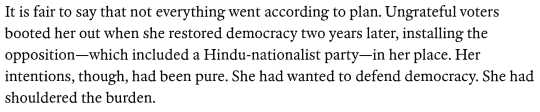
That closing exoneration exposes the core agenda behind the eulogy: the bigoted British magazine views the Gandhi family as its natural ally whenever the goal is challenging Hinduism, willingly whitewashing authoritarian brutality, historical distortion, and decades of appeasement politics so long as the dynasty stands in opposition to Hindu resurgence.