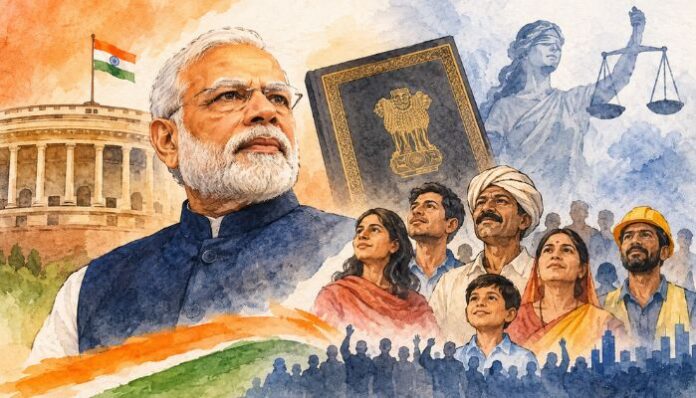
On Thursday, 26th November, Prime Minister Narendra Modi penned a hard-hitting op-ed on the Indian Constitution, titled “The Constitution – Our guiding force,” coinciding with Constitution Day. In the article, PM Modi paid tribute to the Constitution’s framers and reflected on how the sacred document has transformed his life. He also slammed the Opposition for its anti-constitutional mindset.
From recalling his humble beginnings to exposing the Congress party’s repeated misuse of Article 356, the Prime Minister’s article is a comprehensive critique of those who have historically undermined constitutional values. Here are the 10 biggest takeaways from PM Modi’s op-ed.
A tribute to the framers and the civilisational Roots
The Prime Minister opened his piece by honouring the visionaries of the Constituent Assembly, including Dr. Rajendra Prasad and Dr. Babasaheb Ambedkar. He emphasised that the genius of these leaders lay in their ability to draw from India’s ancient civilisational wisdom while simultaneously crafting a modern, forward-looking document. For a nation as incredibly diverse as Bharat, the Constitution was envisioned not just as a legal framework, but as a document that resonates with the collective consciousness of its people, far beyond the confines of Parliament and the courts.
Birth no longer determines the limits of one’s future
In a deeply personal reflection, PM Modi recalls growing up in a family of modest means, with “no privileges or advantages of birth.” PM Modi stated that the Constitution is an “inseparable part” of his life journey. He states that it is the Constitution that made it possible for a child like him to one day be entrusted with the responsibility of serving the world’s largest democracy. The Prime Minister asserts that the extraordinary nature of the Indian Constitution lies in the fact that the circumstances of one’s birth no longer determine the limits of one’s future.
Social and economic justice is becoming a lived reality
The Prime Minister cited renowned constitutional scholar Granville Austin. He described the Indian Constitution as “first and foremost a social document.” He highlighted that the quest for social and economic justice is woven into the very fabric of the Constitution. This vision, he asserted, is being realised through transformative welfare schemes. He cited the World Bank’s finding that nearly 50 crore Indians have moved out of poverty. He illustrated how the constitutional promise of dignity acquires meaning through initiatives like PM Awas Yojana, Ujjwala Yojana, Ayushman Bharat, and MUDRA loans, which provide tangible economic justice and healthcare security.
Landmark amendments that addressed long-standing demands
The op-ed highlighted several landmark amendments that have strengthened the constitutional framework. The 101st Amendment ushered in GST, the 102nd granted constitutional status to the National Commission for Backward Classes, and the 103rd provided reservation for Economically Weaker Sections (EWS). He addressed the long-overlooked aspirations of economically disadvantaged families outside the existing reservation framework.
Furthermore, the Prime Minister noted that for the first time since 1950, the Constitution is available in all 22 languages of the Eighth Schedule. He also underscored a fundamental shift in the criminal justice system with the Bharatiya Nyaya Sanhita, moving from a colonial emphasis on punishment (Dand) to a citizen-centric pursuit of justice (Nyay).
The Constitution is now closer to every Indian
For the first time since 1950, an updated version of the Constitution is now available in all 22 languages listed in the Eighth Schedule. IT brings this sacred document closer to the people and makes it more accessible across India. Prime Minister Narendra Modi has noted that the Bharatiya Nyaya Sanhita has brought about a fundamental shift in the criminal justice system. It moves away from the colonial emphasis on punishment (Dand) and towards a citizen-centric pursuit of justice, or Nyay. This change reflects a broader vision of governance in which laws are not merely instruments of retribution but tools for delivering fairness, dignity and timely justice to citizens.
Power-hungry Congress, Muslim appeasement and onslaught against OBC reservation
In a sharp attack on the Congress, PM Modi criticises how the First Amendment of 1951 restricted fundamental freedoms and how the 42nd Amendment curtailed judicial review. He urges youngsters to study the 38th and 39th Amendments to understand “what a power-hungry and anti-constitutional leadership can do.” The Prime Minister also cites the repeated misuse of Article 356, noting that one party has imposed President’s Rule almost 100 times, with one former Prime Minister alone using the provision more than 50 times to dismiss elected state governments. He said that the Congress party wants to reduce OBC reservation and introduce Muslim reservations. The framers of the Constitution. notably Dr Ambedkar, were strongly opposed.
Correcting historical wrongs: Article 370 and the fight against Naxalism
The Prime Minister described the abrogation of Articles 370 and 35A in 2019 as the correction of a historical wrong. For over 70 years, Article 370 denied the full Constitution to the people of Jammu and Kashmir, particularly trampling over the rights of SC, ST, OBC communities, and women. He also celebrated the successful elimination of Naxalism this year. He stated it has ensured that the poorest of the poor can finally exercise their constitutional rights without fear, while warning against the persistent efforts of “Dimagi Naxals” to derail the nation’s growth.
The opposition as an “Avrodh Paksh,” Not a “Virodh Paksh”
The Prime Minister articulated the constitutional role of the Opposition but lamented that the leading Opposition party has become more of an “Avrodh Paksh” (obstructionist) rather than a “Virodh Paksh” (opposition). He asserted that disrupting democratic processes is no substitute for discharging constitutional responsibilities, signalling a strong rebuke of the disruptive tactics employed by the Opposition in Parliament. He also held the opposition responsible for disallowing legislation aimed at giving women adequate representation in legislative bodies, assuring the “Nari Shakti” of India that no force can prevent justice from being delivered to them.
The duty to vote and the celebration of first-Time voters
In a direct appeal to citizens, PM Modi emphasised the responsibility of strengthening democracy by exercising the right to vote. He urged citizens to never miss the opportunity to vote in national, state, and local elections. To instil this sense of duty early on, he suggested that schools and colleges celebrate Constitution Day by honouring first-time voters turning 18, making them feel like active participants in the process of nation-building.
“India First” in thought and “Kartavya” in action
Concluding his article, PM Modi calls upon citizens to embrace two simple yet powerful principles to build a Viksit Bharat by 2047: “India First” in thought and “Kartavya” (duties) in action. He emphasises that the spirit of Kartavya has already found expression in mass movements from Swachh Bharat to environmental protection, and that with the Constitution as the source of strength, these guiding principles can secure a bright future for generations to come.