

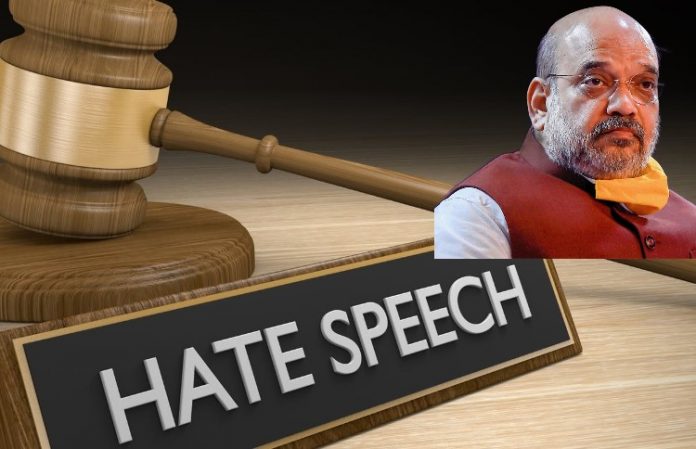
The Union Home Ministry has entrusted the Committee for Reforms in Criminal Laws to define what constitutes ‘hate speech’. The panel which was originally constituted to suggest reforms in the Indian Penal Code (IPC), will soon submit the report to the ministry which would have a comprehensive definition of ‘hate speech’.
The committee constituted by Home Ministry may propose a separate section of offences
According to reports, the committee may also propose a separate section on “offences relating to speech and expression”.
The committee is examining a gamut of subjects pertaining to reforms in the IPC. Instead of ad hoc changes, it was decided that all the pending issues such as those on hate speech as recommended by the Viswanathan committee can be examined and comprehensive changes are brought in,” said a Home Ministry official.
The Viswanathan committee proposed including Sections 153 C (b) and Section 505 A in the IPC for incitement to commit an offence on grounds of religion, race, caste or community, sex, gender identity, sexual orientation, place of birth, residence, language, disability or tribe. It proposed punishment by up to two years along with a Rs 5,000 fine.
Home Ministry mulling to define ‘hate speech’ for a few years now
In it pertinent to note here that earlier in 2018, the Home Ministry had asked the Law Commission to prepare a distinct law for online “hate speech” acting on a report by a committee headed by former Lok Sabha Secretary General TK Viswanathan who recommended stricter laws. The committee was formed in the wake of Section 66A of the Information Technology Act, 2000, which provided punishment for sending offensive messages through communication services being scrapped by the Supreme Court in 2015.
In 2019, the Ministry decided to reexamine the IPC sections, framed in 1860 and the Code of Criminal Procedure (CrPC) after seeking suggestions from States, the Supreme Court, High Courts, the Bar Council of India, Bar Councils of States, universities and law institutes on comprehensive amendments to criminal laws.
However, until now there was no clear definition of what constitutes “hate speech” in the IPC. In absence of a comprehensive definition, it’s difficult for the investigating agencies to identify and prosecute the offenders. Therefore, the Committee for Reforms in Criminal Laws, constituted by the Home Ministry, is attempting for the first time to define such speech, reports The Hindu.
“Who will decide what constitutes a hate speech? Legally speaking, for criminal Sections to be invoked, any such speech has to lead to violence or disturbance of law and order. We will refrain from using the word ‘hate speech’ as it is a loaded term, merely criticising someone is not hate speech,” G.S. Bajpai, Chairperson of the Criminology Centre at National Law University (NLU), Delhi, one of the members of the committee, told The Hindu.


