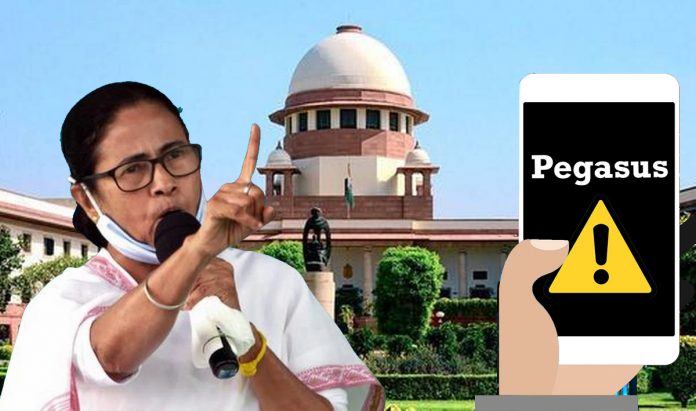
The Supreme Court on Friday stayed the enquiry into the Pegasus case by a judicial constituted by the West Bengal government. A bench headed by the Chief Justice of India expressed unhappiness that the commission constituted by the state govt started working even after the Supreme Court has constituted an independent committee to probe the matter. Moreover, the West Bengal government had assured the Supreme Court that the Inquiry Commission will not proceed with the probe until the apex court hears several petitions filed in the case.
The Supreme Court was hearing an urgent petition filed by NGO Global Village Foundation Charitable Trust, challenging the proceedings of the two-member Judicial Enquiry Commission led by former Supreme Court judge Justice Madan B Lokur. The SC asked West Bengal govt’s lawyer Abhishek Manu Singhvi what happened to the assurance given by the state govt.
“Mr Singhvi, what is this? Last time you gave the undertaking. We wanted to record you said don’t record. Again you started the inquiry?”, CJI N. V. Ramana asked Singhvi. However, Singhvi replied that the state govt can’t control the commission.
“I said I don’t control the Commission and I’ll convey the constraint. I did. The commission started. Please call their counsel and pass orders. As a State, I can’t restrain the Commission”, he told the court.
The Supreme Court said that it understands the predicament, and ordered a stay on the proceedings of the commission. The court also issued notices to all the parties.
The petitioner NGO was represented by Senior Advocate Harish Salve. The petition was filed on Thursday seeking urgent intervention saying that the West Bengal govt appointed commission is going ahead with the probe after the Supreme Court constituted an independent expert committee to examine the Pegasus allegations, and after the state govt had assured that the committee will not function when the apex court is dealing with the matter.
In August, the West Bengal government had submitted an undertaking with the SC that the commission will not go ahead with the inquiry till the court hears the bunch of pleas on the issue. The state govt had assured this after the apex court had asked them to maintain restrain as the court was already hearing the allegations into the use of Pegasus software.
The court had said that issue is connected with several other issues, and they likely have pan Indian impact, therefore the state govt should wait before the court hears the matter first. The court had not passed on order staying the commission as the state govt had assured that the commission will not start working.
But despite the assurance, the commission started the probe, forcing the Supreme Court to stay its functioning.