

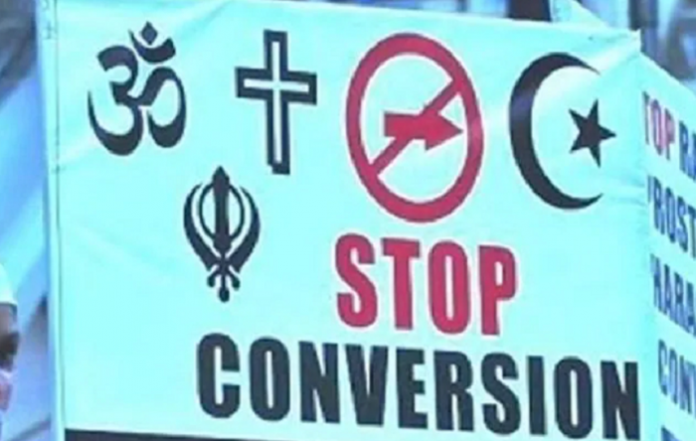
In a written petition submitted on Monday, December 12, before the Supreme Court’s bench of Justices M R Shah and C T Ravikumar, advocate Ashwini Upadhyay asked the court for the seizure of benami properties of people involved in illegal conversions. Upadhyay asked the court to direct the central government and the states to seize “benami” properties and disproportionate assets owned by people and organisations involved in “fraudulent religious conversion.”
#SupremeCourt bench led by Justice MR Shah to continue hearing plea by BJP leader and advocate Ashwini Upadhyay seeking stringent steps to tackle forceful religious conversions.#religion #SupremeCourtOfIndia #law #conversion @AshwiniUpadhyay pic.twitter.com/DXPkQhqvpU
— Bar & Bench (@barandbench) December 12, 2022
The advocate stated in court that women and children are the primary targets of this “foreign-funded” religious conversion in the nation. He added that a legal vacuum on the subject has allowed the use of “unethical predatory conversion strategies” to convert the country’s socially and economically underprivileged citizens.
The SC bench has been hearing the petition filed by Upadhyay seeking direction to the centre and states to take stringent steps to control fraudulent religious conversions through intimidation, and luring through gifts and monetary benefits.
“Petitioner submits that women and children are the main targets of foreign-funded missionaries and conversion groups but the Centre and the States have not taken appropriate steps to control religious conversion in the spirit of Article 15(3)”, the petition said.
“Call upon the Law Commission of India to suggest suitable legislation and Guidelines to check unlawful fraudulent religious conversion,” the plea added.
Upadhyay further told the Supreme Court that the situation is concerning since numerous people and groups are converting SCs and STs in significant numbers, either through coercion or allurement or by taking advantage of their socioeconomic disadvantage.
Citing IPC rules, the petitioner added, “However, religious conversion by intimidation, threats, luring through gifts, monetary benefits and by inducement, which are more serious offences relating to religion are not covered under Chapter-XV of the IPC.”
Wrongful religious conversion directly offends the right to life, liberty, and dignity guaranteed under Article 21, it said.
“But, due to a legal vacuum, unethical predatory conversion strategies are commonly used in Delhi to convert socially and economically backward citizens. One method is material enticement by which economic, educational, medical or social assistance is offered on the condition that the person converts. Another is the denigration of the person’s religion to make a new religion appear superior. Predatory proselytization tears apart the fabric of the communities where it occurs and has led to social disorder and unrest,” the petition said.
‘Cannot convert on the pretext of help’: SC slams NGOs for carrying out religious conversion
Notably, during the last hearing, the Supreme Court criticised missionaries and non-governmental organisations (NGOs) for carrying out the forced religious conversion of individuals under the guise of helping them.
“The purpose of charity should not be conversion; every charity or good work is welcome, but what is required to be considered is the intention,” the court said as it rejected the plea challenging maintainability of the PIL filed by advocate Ashwini Upadhyay.
Reiterating that forced religious conversion is a very serious matter, the court also called it unconstitutional. The bench of Justices M R Shah and C T Ravikumar asked the Centre and States to file a detailed affidavit on the issue of forceful conversions.
SC terms forced religious conversion a ‘very serious’ issue, warns difficult situation may emerge if practice not stopped
It may be recalled that during the hearing on this matter on November 14, the SC termed the practice of forced religious conversions a ‘very serious’ issue. Supreme Court directed the Central Government to step in and make sincere efforts to check the practice. The Court also issued a warning saying that a very difficult situation might emerge if the practice of forced religious conversion is not stopped.


