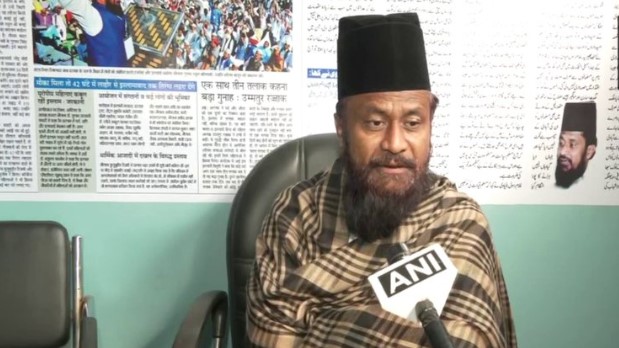
Gulam Rasool Balyavi, a Janata Dal (United) MLC Thursday, vowed that Islamists would wage a war and turn every city into a ‘Karbala’ if any finger was pointed at Prophet Muhammad. Balyavi made the remark while addressing a crowd in Hazaribagh, Jharkhand.
During his address, he alluded to the benign remark made by former BJP politician Nupur Sharma last year about Prophet Muhammad and Islam, which triggered a sequence of death and rape threats directed at her by Islamists across the world. He stated that Muslims will not tolerate insults to their master.
“We are in Karbala ground…if you disrespect our Prophet, we will turn cities into Karbala,” The JDU leader said, essentially calling upon Islamists to kill anyone who is branded a blasphemer by Islamic fundamentalists.
He further went on to slam the ‘secular’ political parties for not demanding an arrest of Nupur Sharma. “I don’t want to name any party. Not a single so-called secular leader demanded the arrest of this crazy woman,” the JDU leader said.
Gulam Rasool Balyavi stated that Muslims will not hesitate because their life and breath belong to the Prophet. He stated that Muslims believe that there would be a day when only the Prophet and no other people will be alive.
According to reports, the JDU leader instructed his supporters to block Ranchi’s highways. He exhorted Muslims to demonstrate to the authorities that they may be buried beneath the ashes, but they are not extinguished.
After facing backlash for openly threatening Hindus with violence, the JDU leader defended his vile statement by saying that ‘Karbala’ refers to sacrificing everything for the sake of humanity and brotherhood. He said people from the Muslim community are being kept behind bars after being labelled as terrorists and called for a “Muslim safety act” to be brought for the community’s safety.
Bihar | I admit that I said we will turn (cities) into Karbala & I stand by it. Karbala is to give away everything, sacrifice everything, but not let humanity & brotherhood be sacrificed: JDU leader Gulam Rasool Balyavi on his ‘har shehar ko Karbala bana denge’ statement pic.twitter.com/PbqNpEpTra
— ANI (@ANI) January 20, 2023
Kabala battle was fought between Shia and Sunni Muslims
For the uninitiated, the Battle of Karbala was a conflict in which adherents of Islam’s two main sects, Shias and Sunnis, bayed for each other’s blood in order to establish religious authority. Shias were considered heretics and apostates by Sunnis. The Battle of Karbala was fought between the army of the second Umayyad Caliph Yazid I, representing the Sunni sect and a small army led by Husayn ibn Ali, Prophet Muhammad’s grandson. Sunni and Shia Muslims have distinct perspectives on the Battle of Karbala. For Shia, it represents the irrevocable split with Sunni Islam.