Home Blog Page 1125

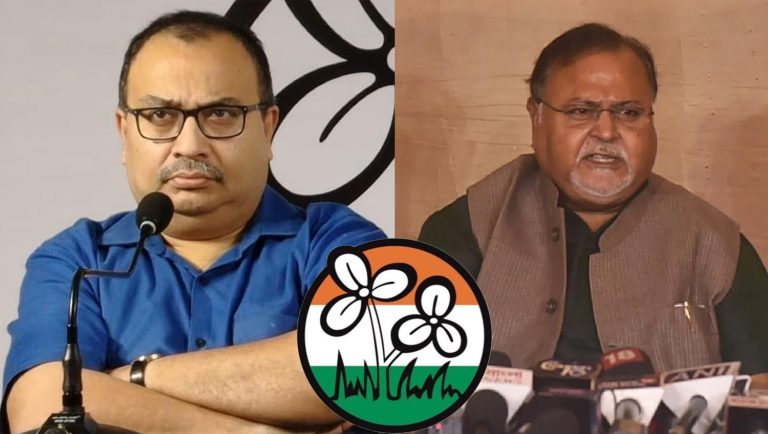
Kunal Ghosh caused more damage than opposition: TMC leader Partha Chatterjee after Ghosh said TMC was aware of the recruitment scam

Former West Bengal Education Minister Partha Chatterjee on Friday launched a scathing attack on TMC leader Kunal Ghosh, saying that the latter has caused more damage than the opposition and should have been expelled from the party much earlier.

“Kunal Ghosh should have been expelled from the party long ago. He has caused much more damage than the opposition. After coming to jail, I came to know about the heinous activities done by Kunal,” he said.

Partha Chatterjee’s comment comes after Trinamool Congress leader Kunal Ghosh on Thursday said that the TMC was “aware” of the school recruitment scam, adding that that is the main reason why the TMC party removed Partha Chatterjee from the Education Department in 2021.

“One month ago, I had asked the party to release me from my duties. I was also on the star campaigners’ list, but now I am not. The party has given a chance to new faces, this is a good thing… The party had information for a long time that something was wrong in the job recruitment case. This is why Partha Chatterjee was removed from the Education Department in 2021. If the party had seriously intervened in the matter, job seekers wouldn’t have to face any trouble. We could have stopped the system from going uneasy,” Ghosh told ANI.

In 2022, the Enforcement Directorate (ED) arrested the West Bengal Education Minister and TMC leader Partha Chatterjee in connection with the West Bengal School Service Commission (SSC) teacher recruitment scam. Chatterjee is currently lodged at the Presidency Correctional Home.

After being spotted at a blood donation camp alongside the BJP’s Kolkata Uttar candidate Tapas Roy, where he sang his praises, Kunal was promptly removed as the TMC general secretary. An official communication to this effect was issued by the Mamata Banerjee-led party on Thursday.

In the official communication following his removal as general secretary, the TMC said the views he expressed at the public event did align with the party’s position and shouldn’t be attributed to it.


(This news report is published from a syndicated feed. Except for the headline, the content has not been written or edited by OpIndia staff)

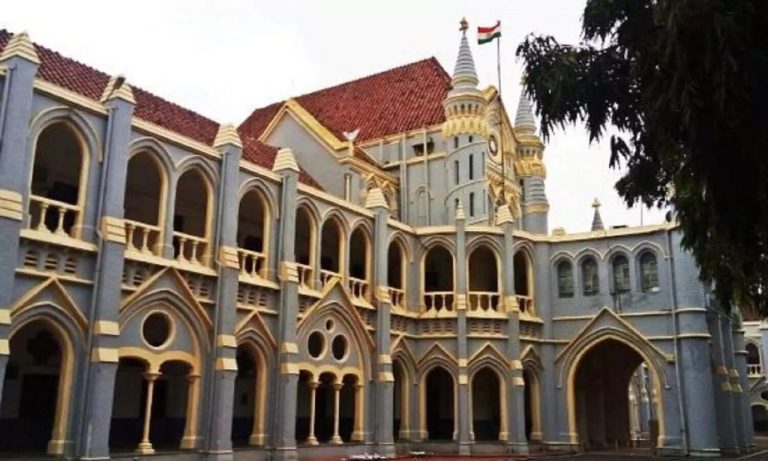
‘Unnatural sex by a man with his wife is not rape, absence of consent irrelevant’: MP High Court

The Madhya Pradesh High Court observed that despite ‘Marital rape’ not being recognized as an offence in India, any sexual intercourse, including unnatural sex by a husband with his wife, does not constitute rape, as the wife’s consent is deemed irrelevant in such instances.

Justice Gurpal Singh Ahluwalia’s bench affirmed that as long as a wife resides with her husband in a valid marriage and is not below fifteen years of age, any sexual intercourse or act by the husband with his wife does not qualify as rape.

“…insertion of penis in the anus of a woman has also been included in the definition of ‘rape’ and any sexual intercourse or sexual act by the husband with her wife, not below the age of fifteen years is not a rape, then under these circumstances, absence of consent of wife for unnatural act loses its importance“, the judge observed.

However, the Court specified that the sole exception to this legal stance is outlined in Section 376-B of the Indian Penal Code (IPC), wherein engaging in sexual activity with one’s own spouse during a period of separate living due to judicial separation or other circumstances would constitute rape.

Referring to Exception 2 of Section 375, the Court highlighted that sexual intercourse or sexual acts by a husband with his wife provided she is not under fifteen years of age, do not meet the criteria for rape.

These observations arose in the context of quashing an FIR filed by a wife against Manish Sahu, which included allegations such as the commission of an unnatural offence under Section 377 of the IPC.

It’s important to note that under Section 375 of the Indian Penal Code (IPC), rape encompasses all forms of sexual assault involving non-consensual intercourse with a woman. However, Exception 2 to Section 375 IPC exempts sexual intercourse between a husband and a wife aged over 15 years from being classified as “rape,” thereby shielding such acts from prosecution.

It’s worth noting that in October 2017, the Supreme Court, in the case of Independent Thought vs. Union of India (2017), interpreted ’15 years’ in Exception 2 to Section 375 as ’18 years,’ thereby extending the scope of the rape offence to include sexual relations with a minor wife.

In the case at hand, the wife/respondent No.2 filed an FIR against her husband, alleging that after their marriage, during her second visit to her matrimonial home, her husband/applicant engaged in unnatural sexual acts with her on the night of June 06, 2019, and June 07, 2019. Subsequently, he continued to engage in such acts on multiple occasions.

In response to the FIR, the applicant-husband contested that as husband and wife, any unnatural sexual activity between them does not constitute an offence under Section 377 of the IPC. He challenged the FIR in the High Court.

While American university succumbs to demands of pro-Palestine protestors, Sciences Po University in Paris rejects the demands and removes the occupiers

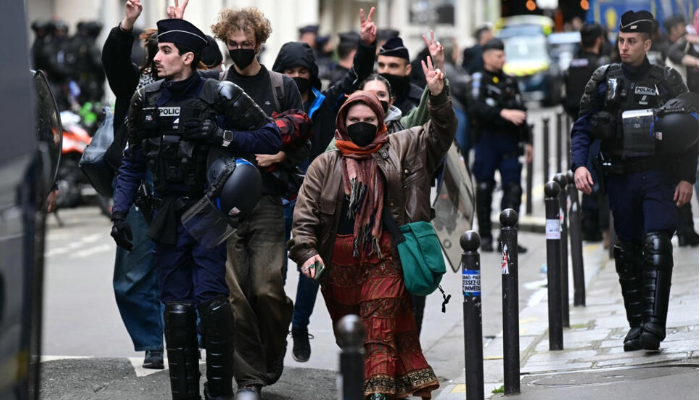
Hundreds of students who had congregated in support of Palestinians at the Paris Institute of Political Studies, popularly known as Sciences Po, were removed by French police on 3rd May after it was occupied since the night of 2nd May. The university rejected the demands of the protesters to cut ties with Israel and removed them without violence.

The administration of the university shifted classes online and closed the main buildings. The action was in line with similar demonstrations and encampments that have transpired across the country, after massive protests in American universities by pro-Palestine groups. The university was shuttered for the day and its main building was heavily guarded by police.

Students supported Gaza residents by waving Palestinian flags and chanting pro-Hamas slogans as Israel continued its offensive in the wake of the fatal strike led by Hamas on 7th October that ignited the Israeli-Hamas conflict. Pro-Palestinian students intended to demonstrate later in the day to demand a halt to Israel’s offensive in Gaza in front of the Pantheon monument, which is close to the prestigious Sorbonne University. Similar demonstrations were held at a few other campuses around the nation, a day earlier including those in Lille and Lyon.

One student told reporters that “around 50 students were still inside the rue Saint-Guillaume site” when police entered. Administrators reported that “between 70 and 80 people” were gathered in the central Paris building’s foyer. A spokesman for Sciences Po stated that the university was looking for a “negotiated solution to end the standoff” with its students and that protests were also occurring at some of its satellite campuses which are located in Reims, Le Havre and Poitiers. This was mentioned before the police intervention.

On 2nd May, the Prime Minister’s Office declared that students had been asked to leave twenty-three places on French campuses by police and “all were evacuated within a few hours.” He promised to use “total rigour” in dealing with such protests. Reporters had earlier been informed by university students involved in the Palestine Committee that they were facing a “disproportionate” response from the police, who had barred entry to the location before their arrival. A lack of “medical assistance” for seven students who had begun a hunger strike “in solidarity with Palestinian victims” was another issue they raised.

According to a statement, police will continue to be stationed close to Sciences Po to prevent any more blockades. Tensions erupted last week close to the prestigious university, whose numerous prominent graduates include Prime Minister Gabriel Attal and President Emmanuel Macron. A confrontation broke out between pro-Israeli and pro-Palestinian protestors in the street outside Sciences Po. Riot cops rushed to keep the groups apart. As pro-Palestinian students decided to depart, the demonstration came to a peaceful close.

The French student protests over the war and academic links to Israel have taken root at Sciences Po and expanded throughout the country, although they have not reached the same magnitude as those in the United States. Sciences Po should “take a principled stance by sending an official communication condemning the actions of Israel that infringe upon the rights and well-being of Palestinians,” per the activist organization, and the university should sever ties with “institutions or entities that uphold Zionist ideologies.”

The Lille School of Journalism and Sciences Po Lyon, an unaffiliated institution in the third largest city in France was also shut down on 3rd May by agitating students. According to a student speaking on behalf of the protestors, Sciences Po’s director Jean Basseres on 2nd May rejected their demands to reassess the university’s relationships with Israeli universities. This prompted the demonstrators to continue their action, with at least one individual going on a hunger strike.

French student protests have been more peaceful than those in the US, according to Samuel Lejoyeux, head of the Union of Jewish Students of France, since there is a stronger desire for dialogue in France. He added, “With the overwhelming majority of students at French universities, including Sciences Po, it is still possible to have a debate. I even think there is an increased hunger for debate.”

Meanwhile, on 2nd May, the administration of Rutgers University in New Jersey and the University of Minnesota in Minneapolis reached a settlement with the anti-Israeli protesting students to end their conflict and remove their Gaza solidarity campsite demonstration from the university’s property. The agreement was reached at Rutgers University following a meeting between the administration and students.

According to the protesters, the Rutgers University administration accepted 8 of their 10 demands to lift the encampment. The demands included divesting from companies that support or do business with Israel, ending Rutgers’ affiliation with Tel Aviv University, welcoming ten or more displaced Gaza students and displaying the flags of “occupied societies” including Palestinians, Kurds and Kashmiris alongside other existing international flags on campus.

Northwestern University and Brown University have also announced agreements with the protestors to end the protests.

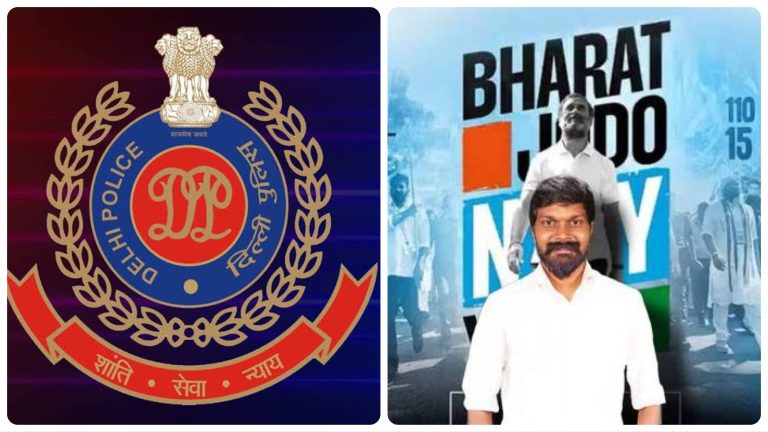
Congress troll Arun Reddy who ran the ‘Spirit of Congress’ account on X arrested in the Amit Shah doctored video case

The Delhi Police on Friday arrested a Congress online troll named Arun Reddy in connection with the manipulated video case involving Union Home Minister Amit Shah. Reddy handled the “Spirit of Congress” X account, which had shared the doctored video of Union Minister Amit Shah.

Previously, the Delhi Police had summoned Telangana Chief Minister and Congress leader Revant Reddy, along with four members of the Telangana Pradesh Congress Committee (TPCC) – Shiva Kumar Ambala, Asma Tasleem, Satish Manne, and Naveen Pettem – about the “deepfake” video case. The summonses were issued under sections 91 and 160 of the Code of Criminal Procedure (CrPC).

As per police sources, individuals served notice under section 160/91 of the CrPC have the option to either appear physically before the Investigating Officer (IO) or send a legal representative.

In a major crackdown on misinformation/disinformation, a man named Reetam Singh, who is the “war room coordinator” in Congress’ Assam unit, was arrested on 29th April for circulating a fake video of Union Home Minister Amit Shah. 

Taking to X, Assam Chief Minister Himanta Biswa Sarma informed about Singh’s arrest as he wrote, “Assam police have arrested an individual named Sri Reetom Singh in connection with the fake video involving Honorable Home Minister Sri @Amit Shah.”

Brij Bhushan Singh, former WFI chairman, reveals Congress leader approached him to contest elections on the party ticket

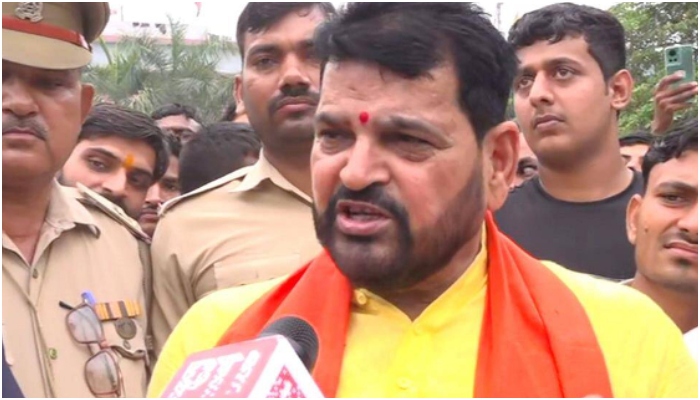
Brij Bhushan Singh, the former Wrestling Federation of India (WFI) chairman and BJP MP from Uttar Pradesh’s Kaiserganj, asserted on Friday (3rd May) that the Congress party approached him about contesting in the Lok Sabha elections using its ticket. “One senior leader of the congress party approached me and told me to contest from Congress,” he said as quoted by the New18 media network.

Brij Bhushan Singh’s revelation comes on the same day when his son, Karan Bhushan Singh, applied for the Kaiserganj seat from the BJP. On Thursday (2nd May), the BJP announced Brij Bhushan Singh’s younger son, Karan Bhushan Singh, as a candidate for the Kaiserganj Lok Sabha constituency.

On Karan’s candidacy for the Kaiserganj seat, Brij Bhushan stated that party workers “wanted my son, if not me, to contest”.

Brij Bhushan Singh is a three-term MP representing Kaiserganj. The BJP leader who had been accused of sexual assault by the women wrestlers also thanked the BJP for his son’s candidacy. Karan, on the other hand, went to the Hanuman Garhi temple in Ayodhya to pray after announcing his candidacy. He explained, “I came here to seek the blessings of Bajrang Bali. He’s my Guru…”

The BJP’s decision to field Karan from the Kaiserganj constituency comes just days after a Delhi court refused MP Brij Bhushan Singh’s request for a further investigation into the sexual harassment case lodged against him by female wrestlers.

On May 7, Additional Chief Metropolitan Magistrate (ACMM) Priyanka Rajpoot of Rouse Avenue Courts would issue an order to establish charges in the case.

This case was filed based on six complaints filed by six female wrestlers. Delhi police have already filed a charge sheet against BJP MP Singh.

The matter has been argued afresh as the predecessor judge who heard the parties on the point of framing of charge has been transferred.

Kazakhstan: Former minister Kuandyk Bishimbayev kicked, punched wife Saltanat Nukenova to death, CCTV footage goes viral

The trial of a former economy minister in Kazakhstan accused of murdering his wife has sparked a debate in the country. A 31-year-old woman Saltanat Nukenova was found dead in November last year in a restaurant owned by a relative of her husband Kuandyk Bishimbayev, where the couple had spent nearly the whole day and the night before. For hours, Nukenova was there unconscious. 

In a recent hearing, the court was shown an 8-hour-long video showing 44-year-old Kuandyk Bishimbayev, a former economy minister, hitting his wife Saltanat Nukenova. The CCTV footage shows Bishimbayev repeatedly kicking and punching his 31-year-old wife in the family-owned restaurant.

The incident took place on 9 November last year in a VIP room of a restaurant in Almaty, Kazakhstan’s largest city.

He is then seen taking her by her hair into somewhere else with no cameras. When she attempted to flee by hiding in the toilet, Bishimbayev “broke down the door, pulled her out, and continued beating her. He grabbed her by the throat after hauling her from the toilet. This is when she lost consciousness,” the prosecutor stated during the trial.

As she lay on the floor, drenched in blood, Bishimbayev called a fortune teller on phone, who told him that his wife would be all right. The ambulance came 12 hours later, and medical personnel confirmed her dead on the spot. Saltanat Nukenova reportedly died of cerebral trauma. One of her nasal bones had broken and there were several bruises on her face, head, arms, and hands.

Bishimbayev has admitted to the crime, acknowledging that he caused his wife’s death. But he has denied that he acted “with exceptional cruelty”, the charge levelled against him. Initially he had maintained innocence but last month he admitted that he had beaten her and “unintentionally” caused her death. His lawyers had also claimed that his wife had also attacked him during the confrontation, but surveillance footage proved that claim wrong.

The trial in the murder case is being live-streamed online, a first time in the country. The trial has now reached its final stage with the prosecution presenting their summation of the case on 2 May. They have asserted that Nukenova wasn’t just murdered, she was systematically abused. 

Notably, a jury is hearing the case, an uncommon practice in Kazakhstan. Jury trials were introduced in Kazakhstan only in 2007, and have been used in only a handful of cases.

Reports say that Bishimbayev is a typical member of the country’s wealthy governing elite, and they are concerned that even if he is found guilty, he will be able to avoid proper punishment, as was the case with a prior conviction. Bishimbayev was arrested in 2017 on bribery accusations and sentenced to ten years in jail, however, he was released after less than three years due to an amnesty and parole.

Bhima Koregaon case: DU professor Hany Babu withdraws bail petition from Supreme Court

Delhi University Professor Hany Babu, a defendant in the 2018 Bhima Koregaon violence case, withdrew his bail petition from the Supreme Court on Friday, citing a shift in case circumstances. The Supreme Court acknowledged this decision and granted his request.

Representing Babu, his lawyer informed the Supreme Court’s two-judge panel, led by Justice Bela M Trivedi and Justice Pankaj Mithal, of their intention to pursue bail anew in the High Court.

Previously, Babu had appealed to the Supreme Court after the Bombay High Court rejected his bail plea in September of the preceding year.

The High Court had denied Babu’s bail based on the National Investigation Agency’s assertion that he is affiliated with the banned Communist Party of India (Maoist).

In January of this year, the Supreme Court granted the NIA an additional two weeks to respond to Prof Babu’s bail application. He stands accused of instigating violence and disturbing peace among other charges.

Prof Babu, maintaining his innocence, had informed the High Court earlier that the letters presented by the NIA as evidence in the Bhima Koregaon case did not implicate him.

According to the NIA’s chargesheet, a letter discovered on Babu’s computer outlined a conspiracy against Prime Minister Modi. Babu refuted this, asserting that the letter was neither authored nor addressed to him. He contended that it made no mention of his involvement in the conspiracy.

What is the Bhima Koregaon Elgar Parishad Case?

The event by the name of “Elgar Parishad” was organised to commemorate the Battle of Bhima Koregaon of 1818, wherein the Peshwas fought against the East India Company. In the war, an army of Dalit soldiers had fought under the British forces against the Peshwa, the reason for the celebration by Dalits. In 2018, it was the 200th anniversary of the war and extreme violence erupted over the matter.

Soon after, the case was transferred to the NIA. The Pune police had arrested a total of nine supposed “intellectuals” such as Sudha Bharadwaj, Rona Wilson, Surendra Gadling, Mahesh Raut, Shoma Sen, Arun Ferreira, Vernon Gonsalves, and Varavara Rao for inciteful speeches.

As Pakistani journalists desperately beg the USA to act against India on ‘press freedom’, this is how media persons are killed, and rights are snatched in their own country

Pakistani journalists including Jahanzaib Ali were recently heard casting aspersions on the freedom of the press in India as they claimed that Australian journalist Avani Dias was denied her visa renewal by the Modi government. However, it turned out that she returned to Australia after she was granted a visa extension, and Australian media also reported that her reason for returning to the country was not intimidation by the Indian government, but rather a new job and her wedding.

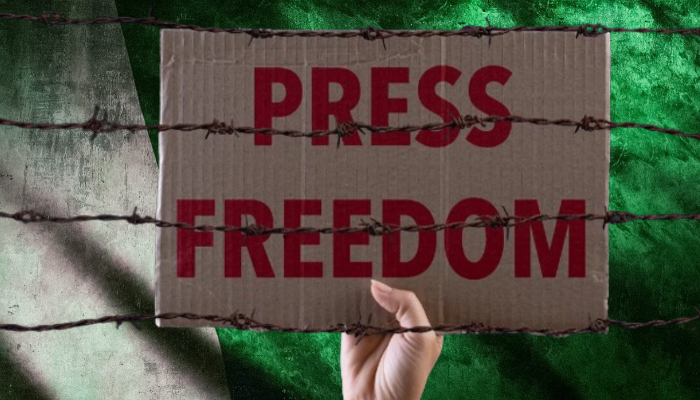
Now, it is not unusual for India’s hostile neighbour to meddle in her internal matters and pontificate as their own country rapidly devolves into a hell hole. This unabashed hypocrisy is ingrained in their national character. A recent instance of this is the annual “Pakistan Freedom of Expression and Media Report 2024” by Adnan Rehmat, which was produced by Islamabad-based Freedom Network and titled “Erosion of free speech: The silencing of citizens, political parties, and media.” It was published on the occasion of World Press Freedom Day on May 3rd and covers the period from May 2023 to April 2024.

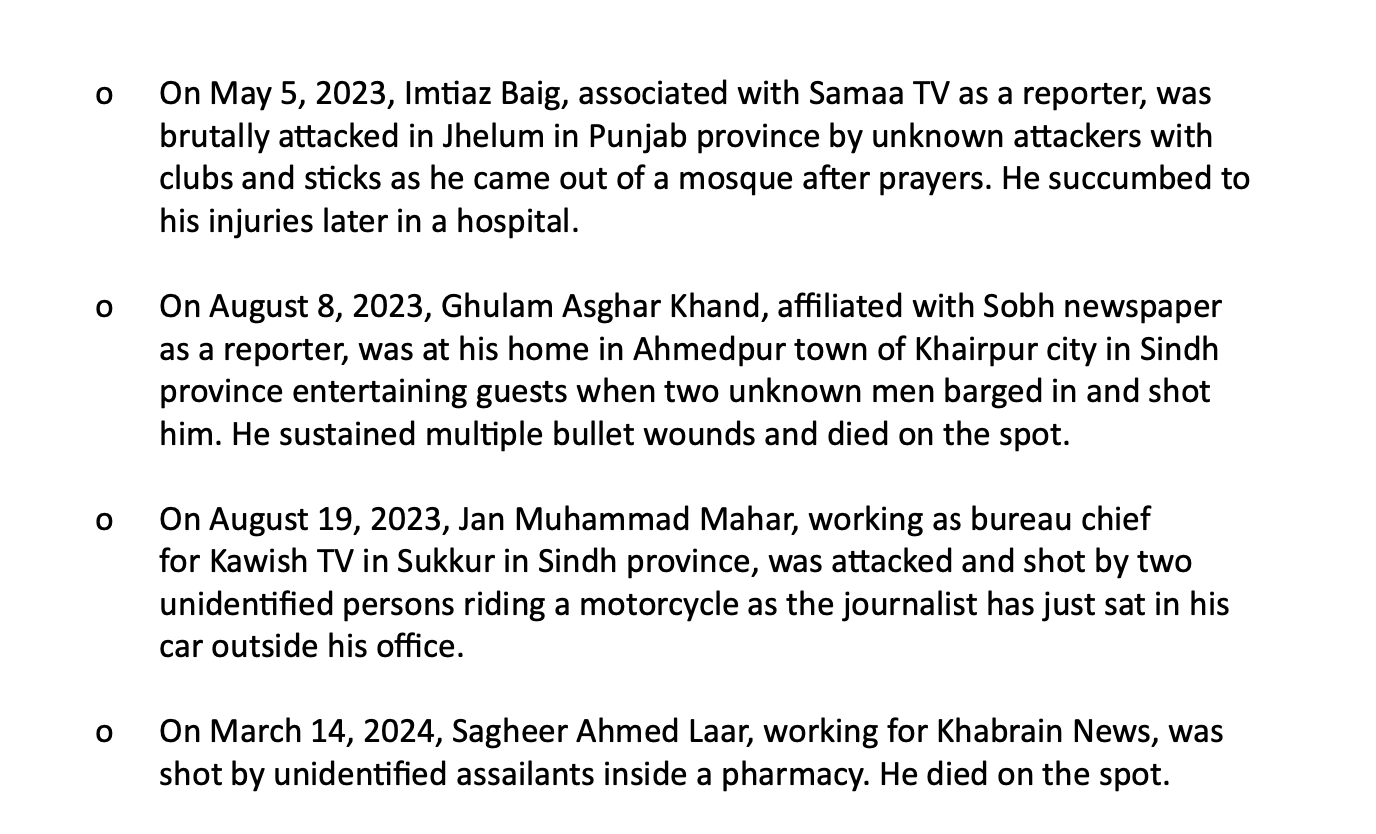
The report addressed significant concerns about the threats that media professionals and journalists confront as well as the narrowing margins of dissent in the Islamic Republic. Four journalists were killed during this time, according to the report, underscoring the perilous conditions in which the media operates there. Three journalists were assassinated in the last year and one was killed in March 2024. Freedom Network data showed that between January 2018 and December 2023, two journalists were killed annually on average in Sindh.

The report highlighted the names of the journalists who were killed. (Source: Erosion of free speech: The silencing of citizens, political parties, and media.)

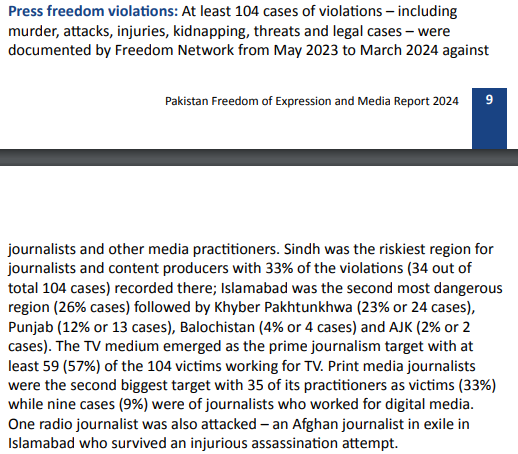
It contained information on 104 incidents of violations against media professionals, including threats, kidnappings, murders, assaults, injuries and court cases. Sindh was the most dangerous area for journalists and content creators, accounting for 33% of the breaches (34 out of 104 incidents) that were reported there. Islamabad came in second place with 26% of the cases right above Khyber Pakhtunkhwa (23% or 24 cases).

Erosion of free speech: The silencing of citizens, political parties, and media.

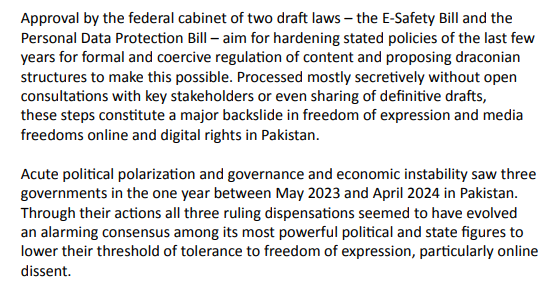
The research described a pattern of crackdowns on political activists, bloggers, and journalists. Legal notifications, arrests, assaults, and intimidation were all part of this. According to the research, in addition to harassment by state actors, predatory acts by certain non-state actors resulted in over 200 online information practitioners, including journalists and bloggers being targeted by more than 70 legal notifications served to them. It also expressed concerns about proposed laws including the Personal Data Protection Bill and the E-Safety Bill, which could further stifle free speech in the media and impose restrictions on online material. The lack of public consultations on these bills is also a point of contention.

Erosion of free speech: The silencing of citizens, political parties, and media.

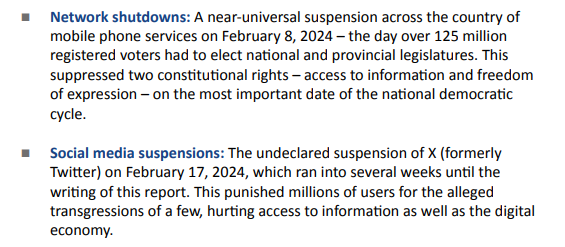
The analysis pointed out that as voters in Pakistan, the fifth most populous country in the world, prepared to cast ballots in a turbulent general election which was carried out in February of this year tainted by violence and allegations of improper behaviour, mobile phone services were suspended across the country. Internet outages were reported in several parts of the nation as 128 million registered voters prepared to exercise their democratic rights, according to international online freedom group NetBlocks, which also observed that the disruptions came after “months of digital censorship targeting the political opposition.” Amnesty International called the suspension “a blunt attack on the rights to freedom of expression and peaceful assembly.”

Erosion of free speech: The silencing of citizens, political parties, and media.

Likewise, mobile communications and internet access were shut down nationwide in the wake of former Prime Minister Imran Khan’s arrest. NetBlocks and Open Observatory asserted that the action affected people who depend on mobile data for communication and their daily lives, including businesses and daily wage earners. After the suspension, every major social media platform including Facebook, WhatsApp, YouTube, TikTok, Facebook, X/Twitter, and Telegram remained unavailable for several hours.

A Pakistan People’s Party senator named Bhehramand Tangi even moved the upper house of parliament in March 2024, seeking a comprehensive ban on access to all social media platforms allegedly in the desire to protect the youth from harmful influences. However, the resolution was withdrawn in a matter of days after being criticized by members of his party, other lawmakers and advocates for digital rights.

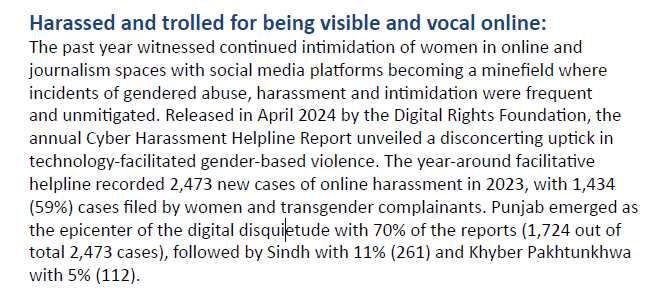
Pakistan remains a generally hostile environment for women, both in terms of their inclusion as journalists and the manner in which they are portrayed in the media. Women make up a very small percentage of working journalists, media professionals and content creators. which holds true for both independent digital news media, an ecosystem that has expanded recently and traditional media outlets. The ideas and experiences of genders other than men are glaringly underrepresented in media coverage as well.

Women who are not necessarily journalists but are active in the digital world, such as advocates for free speech and users of social media platforms, often experience harassment and trolling that extends into spaces frequented by female journalists. Gender bias, harassment in journalism, and lack of representation in newsrooms, unions, and press clubs are still common issues. Press clubs, unions, and newsrooms continue to be hotbeds of gender-based discrimination, intimidation connected to journalism employment and a lack of representation.

Erosion of free speech: The silencing of citizens, political parties, and media.

Like everything else in Pakistan, the study stands as a stark reminder of the disorganized state in which journalistic freedom exists. These are only a few of the challenges raised in the research, which is plagued by the country’s inability to provide its journalists with a safe and secure environment. However, Pakistanis are slaves to their habits, willing to poke their noses into India’s business while ignoring the chaos at home. Pakistan, which is de facto a military state ruled by its armed forces, clearly has no regard for media, either within its own borders or outside. Its sole purpose is to degrade us and portray a fabricated image of how “intolerant” India is.

While Pakistanis, devoid of any due diligence, support anti-Indian factions in their pitiful attempt to attack us internationally, reports from their own land show how antiquated laws and regulations beset their country, and media is crumbling there. Nevertheless, it would be unrealistic to believe that a report will force Pakistan to face its internal problems. As their consistent behaviour has proven, Pakistanis are unlikely to self-reflect and will instead choose to make unfounded accusations against India whenever they get another opportunity.

Gandhi family keeps failing their party workers again and again, yet, Congress wants people to believe that Rahul can challenge Modi

Ending months of suspense over the Amethi Lok Sabha seat, the Congress has chosen Gandhi family loyalist Kishori Lal Sharma as its candidate against the incumbent BJP MP, Smriti Irani. The Amethi Lok Sabha election has been scheduled for May 20 in the fifth phase.

The Amethi Lok Sabha constituency has for decades been the ‘family bastion’ for Congress, having stayed with the party since the first election in 1967. Except for two brief terms (1977-80 and 1998-99), the seat was held by the Grand Old Party until Smriti Irani of the BJP grabbed it from Rahul Gandhi. Irani had already challenged Gandhi to seek only the Amethi seat if he felt confident enough. However, the Congress initially fielded Gandhi from Wayanad in Kerala, claiming that the constituency supported him in times of distress and that he was not one to neglect the people.

Smriti Irani defeated Rahul Gandhi in 2019 by more than 55,000 votes. Gandhi held the seat for three consecutive terms from 2004 to 2019. However, on the other hand, he managed to retain his Lok Sabha seat by winning from Wayanad.

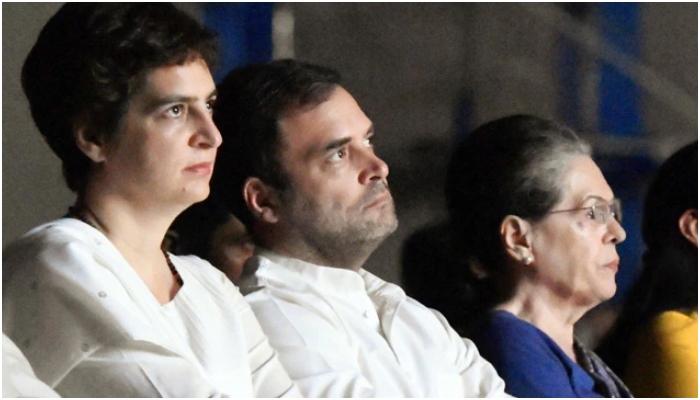
This year, there was much speculation that Rahul Gandhi would plan to reclaim his seat. Congress supporters wanted Rahul Gandhi to contend for the Amethi seat and Priyanka Gandhi for Raebareli. However, the duo became hesitant about competing in UP. Former Congress president and the duo’s mother, Sonia Gandhi is said to have intervened to persuade them to do the same.

The BJP meanwhile has criticized the Congress party for not fielding Rahul Gandhi from Amethi seat. The party said that the Wayanad MP has abandoned the Amethi Lok Sabha seat, adding that it is an admission by Gandhi that he cannot win the seat he held for two terms till 2019.

From Amethi, the Congress party has fielded Kishorilal Sharma, an influential Nehru-Gandhi family loyal representing Amethi and Rae Bareli for more that two decades now.

Amethi’s importance in the Congress party

It is important to note that the Amethi seat is a very crucial constituency for the Gandhi family leading the Congress party. Sonia Gandhi made her election debut here in 1999 and a year later she took over as the party president. In 2004, she shifted to Rae Bareli, allowing Rahul, her son to make his electoral debut from here.

According to reports, Rahul’s decision to move to Rae Bareli this time stems from the fact that Amethi has no longer remained a family seat for the Congress party following the 2019 loss. Furthermore, the party members as quoted by the media indicate that if Rahul wins both Wayanad (the second seat he is contending for) and Rae Bareli, it will be simpler to give up the Kerala constituency, citing the family’s even deeper connection to Rae Bareli. 

Amethi, of course, has an unstated fear of providing losses again to the Congress party. However, Rahul’s decision not to contend for the seat is certain to be met with accusations that he is scared of Irani.

PM Modi takes a dig at Rahul Gandhi, says ‘Daro Mat’

Earlier, in the month of March, Union minister Smriti Irani had slammed the Congress leader Rahul Gandhi and had said that he was scared of being defeated in Amethi.

Today, after Congress’ decision to not field Gandhi from Amethi, PM Modi mocked the Congress leader using his own words. While addressing a rally in Bengal, PM Modi said that Rahul Gandhi had run away from Amethi for fear of defeat. “Today I also want to tell him, Daro Mat (don’t be afraid), Bhaago Mat (don’t run),” he said.

PM Modi did not even spare Sonia Gandhi, claiming that he had anticipated that both mother and son would avoid contesting their seats out of fear. “I had said, their biggest leader will not dare to contest. She will run away out of fear. She ran to Rajasthan and from there entered Rajya Sabha. That is exactly what happened. I had said that shehzade (Rahul Gandhi) is afraid of losing in Wayanad, and the moment voting ends, he will start looking for a third seat. Now even from Amethi, despite all his loyalists saying it, he panicked so much, that he ran from there and is now looking towards Raebareli. These people keep going around telling people Daro Mat. Today I will also tell them… ji bhar ke kehta hoon. Arey daro mat, bhaago mat,” he said.

Congress loses party bastion Amethi in 2019 elections

Despite undertaking combative campaigns in Amethi, the party including the senior Congress leaders could not garner enough support for Rahul Gandhi who lost to Bhartiya Janata Party’s Smriti Irani in the year 2019. The BJP leader defeated the Gandhi scion in his bastion with Priyanka Gandhi leading the campaign. Smriti Irani’s spectacular win, with a margin of 55,120 votes in a Gandhi stronghold, was a major blow to the party and reflected the state’s mood against Congress. Both Priyanka and Rahul failed to sense the resentment prevailing in the people of Amethi back then.

While Rahul Gandhi more or less forgot Amethi after his 2014 win against Irani, she continued to visit Amethi to establish connections with the people and make her place in their hearts. Irani’s painstaking efforts helped her carve a path to victory in the 2019 Lok Sabha elections emerging as a “giant slayer”.

Not only this, but the Congress party fielded 67 candidates from the state and lost security deposit in 63 of them. The Congress only won one seat from Rae Bareli and the deposits of the 63 candidates were not refunded.

In spite of this, the leftists, liberals, and the secular have been extending support to Rahul Gandhi claiming that he is the strongest opponent of PM Modi amid the Lok Sabha elections 2024.

The Amethi fiasco of the Gandhi family has cemented what the Left liberals and many ‘darbari’ political commentators have been avoiding to admit before the public: the Gandhi family is no longer politically strong. The brother and sister are hailed as political heirs of Indira Gandhi. Tons of media reports, foreign media articles are written about them. Everything from their looks, to daily habits, to their outfits is praised to the high heavens by the family loyals in India and around the world, but the truth is, Rahul Gandhi and Priyanka Gandhi are political flops.

Not only the Gandhi family has let down their supporters and party workers by refusing to face Smriti Irani in Amethi, they have also exposed the hollowness of the media hype around themselves.

If one looks at the PR behind Rahul Gandhi, one would believe he is the strong, powerful Congress leader challenging the political behemoth called Modi. In reality, Rahul Gandhi is a paper tiger who can’t even face a young member of the Modi cabinet.

Rahul Gandhi has been in the news in the past for spreading anti-India and anti-Modi agenda even on the global platforms. He has criticized the BJP-led govt and accused it of unnecessarily targeting the opposition parties, tapping their phones, etc. Reportedly, all of these allegations were exposed to be a lie as Gandhi had refused to give up his phone for examination back then.

Eager to swallow any bait against Modi, the foreign media continues to project Rahul Gandhi as some brave hero who is daring to challenge Modi. But the truth is despite carrying the political legacy of 3 generations of India’s former Prime Minister’s, getting power and influence on a silver platter, and with the larger section of media eager to please him, Rahul Gandhi still failed to pose any challenge to Modi.

Rahul Gandhi was rejected by his own I.N.D.I. Alliance partners

The opposition parties in India boasted about fighting together against PM Modi in the 2024 Lok Sabha Elections but eventually the I.N.D.I. Alliance party members backed out of supporting the leading Congress party resulting in the latter’s lack of confidence.

The Alliance initially failed to field joint candidates and later several parties like JDU, TMC, AAP, etc decided to fight individually from their respective states. In an unexpected turn of events, Janata Dal (United) chief Nitish Kumar quit as the Bihar Chief Minister on 28th January and decided to form the state government in alliance with the Bharatiya Janata Party (BJP) and its National Democratic Alliance (NDA) partners in Bihar.

Mamata Banerjee’s TMC also parted ways with Congress, primarily over disagreement on leadership issues. Mamata, a strong regional leader herself, seemed unwilling to cede her position to Rahul Gandhi, a mere MP who didn’t even want to become his party’s president.

Interestingly, a similar situation emerged in the state of Kerala where the CPIM and the Congress who are allies nationally played a blame game and accused each other of having an ‘understanding’ with the BJP. 

Even the Aam Aadmi Party after the JDU and TMC, decided that it would fight alone from the state of Punjab and that it wouldn’t ally with the Indian National Congress in the Lok Sabha Elections 2024.

The broken pan-India alliance failed to produce a multiplier effect, demonstrating that the nationwide alliance was counter-intuitive. Except for Congress, which is rapidly losing its political relevance, the alliance partners wielded little power outside of their home districts further crippling the party that dreams of throwing the BJP-led govt out of power.

The alliance partners even failed to add to each other’s strength, instead directly or indirectly leveling significant accusations against each other on their turf, tarnishing their partners, including CPI(M)-Congress, AAP-Congress, and TMC-Congress, among others. 

These factors have done nothing but weaken the Congress resulting in a loss of confidence of even its party members in its leaders.

Congress says Rahul Gandhi contesting from Rae Bareli is ‘strategy’

Earlier the week, the Amethi unit of the Congress, weary of the prolonged wait for a candidate announcement held a sit-in protest in the long-standing VIP constituency of Uttar Pradesh. Congress workers voiced their demands with chants of “Amethi demands the Gandhi family.” However, the party by announcing Kishori Lal from Amethi disappointed its own workers and forced them to stay happy claiming that Gandhi’s contesting from Rae Bareli was part of a “larger strategy.”

“Rae Bareli has not only been Sonia Ji’s seat but also Indira Gandhi’s seat. This is not a legacy but a responsibility, a duty”, he added. On Priyanka Gandhi’s absence from the Congress list of candidates for Lok Sabha elections 2024, he said that she can reach the house by contesting any by-election.

This incident will be marked in the pages of history given the Gandhi family’s decision to abandon the Amethi constituency out of fear and under the guise of ‘being part of a larger strategy’. The relevance of the Congress party is anyway diminishing. A lot has been said about the Congress party’s decline with the Gandhi family at the helm. The top leadership of the party has strategically sidelined other emerging leaders and even alienated promising young leaders who might pose a threat to Rahul’s alleged royal right. Election after election, loss after loss, the party keeps sinking slowly, still declaring how it is privileged to be steered by the Gandhi family.


‘Rohith Vemula was not Dalit’: Telangana Police close the case, find no fault of any BJP leader, the entire ecosystem had used the death to target BJP

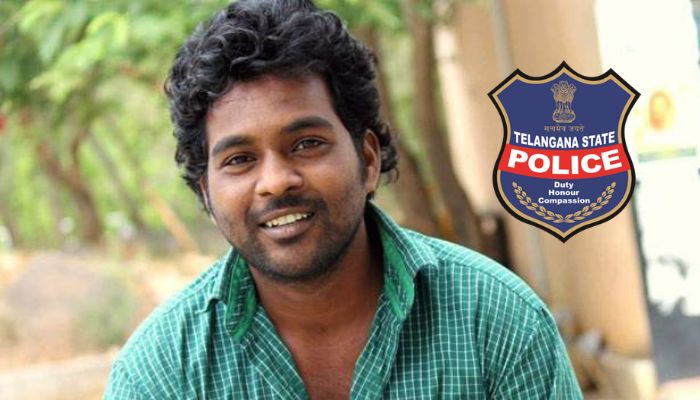
In the 2016 Rohith Vemula death case, the Telangana Police filed a closure report and submitted the same before the Telangana High Court on the 3rd of May. In the closure report, the police said that Rohith Vemula, a PhD scholar at the University of Hyderabad who died by suicide, did not belong to the Scheduled Caste category. The police said Rohith Vemula died by suicide fearing that his real caste identity would be discovered.

The Telangana Police also cleared former Secunderabad MP Bandaru Dattatreya, Legislative Council Member N Ramachander Rao, Vice Chancellor Appa Rao, ABVP leaders, and union minister Smriti Irani.

“There is no evidence of any fact or circumstance available on the record which dragged him to commit suicide and no one is responsible for his death,” the report reads. The report says that Rohith Vemula committed suicide because “he had his own problems and was not happy with worldly affairs. If he would have been angry with the decision of the University, certainly either he would have written in specific words or would have indicated in this regard. But he did not do the same. It shows that the circumstances prevailing in the university at the time were not the reason for Rohith’s death.”

According to the closure report, Rohith Vemula was “aware that he does not belong to the Scheduled Caste” and received the SC certificate from his mother. It adds that this could have been one of Rohith Vemula’s continuous fears, as disclosing it could have ended in the loss of academic degrees and perhaps prosecution.

Rohith Vemula was made the symbol of ‘upper-caste’ vengeance against Dalits, even though he was not a Dalit

As the police have confirmed that Rohith Vemula was not a Dalit and absolved the abovementioned BJP leaders in the case, it is pertinent to recall the Congress and other political parties as well as their media allies launched a scathing attack on the so-called upper caste Hindus, the BJP and Prime Minister Modi over the death. The opposition and the ‘ecosystem’ used a young and bright Rohith Vemula’s death for its own gains.

The assertion that he was a Dalit, which was later disputed and now confirmed by the police that he was not a member of the Scheduled Caste category, prompted opposition political parties and liberals to raise the caste discrimination bogey and build a narrative accusing the Modi government of oppressing lower caste groups of society. This came, even though his suicide note expressed his dissatisfaction with the Students Federation of India (SFI).

Congress leader Rahul Gandhi had gone a step ahead and even questioned if PM Modi’s tears were real when in expressed grief over Rohith’s death. “The PM gave a speech where he expressed grief and agony over the death of the scholar. People say he even had tears…I would ask him..If you are saddened, if your tears are real, then act against the V-C who crushed and intimated that boy and sack him. The nation’s poor and Dalit are looking up at Mr. Modi seeking answers, will our PM take action.”

Rahul Gandhi and many other opposition leaders continued to peddle the narrative that a “Dalit” student was oppressed and coerced into committing suicide claiming that the reality was being strangulated, even though reality was far from what Gandhi and the ecosystem were peddling.

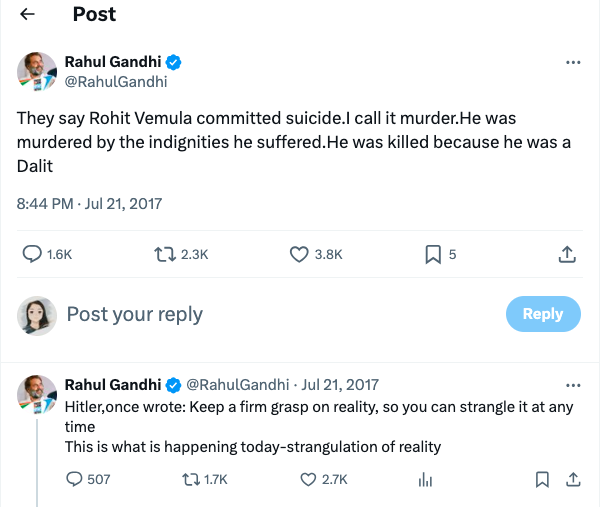
“They say Rohit Vemula committed suicide.I call it murder.He was murdered by the indignities he suffered. He was killed because he was a Dalit. Hitler, once wrote: Keep a firm grasp on reality, so you can strangle it at any time. This is what is happening today-strangulation of reality,” Rahul Gandhi posted back in 2017.

Rohith Vemula’s death was dishonestly turned into a political conflict between Dalits and Non-Dalits. Besides Rahul Gandhi, now-jailed AAP supremo and Delhi CM Arvind Kejriwal had wasted no time in exploiting the incident and pulling the Modi government into disrepute. An online mob of leftists posing as custodians of Dalits engaged in vulture activism to discredit the Modi government. They stated that the University’s discriminatory treatment of him in comparison to students belonging to the general category prompted him to take the extreme step.

Attacking the Modi government over Rohith’s death, Kejriwal had claimed that the PhD scholar was forced to commit suicide as he was “talking about Baba Saheb Ambedkar”. Kejriwal also tried to exploit Rohith’s disputed Dalit identity to gain political points against PM Modi and the BJP.

“Rohith Vemula was forced to commit suicide for talking about Babasaheb among students. Why people who are holding constitutional offices not acting against those who forced him to commit suicide? Will Babasaheb’s dream be fulfilled by the Prime Minister going to Mhou and garlanding his portrait? I just want to say, Modi is not country, RSS is not Parliament and Manusmriti is not the Constitution,” Kejriwal said in April 2016.

Justice Ashok Kumar Roopanwal (retired), who investigated the events at the University of Hyderabad that led to the suicide of student Rohith Vemula, stated in his report that “the suicide did not relate to any activities of the university administration or the above political leaders, including the vice-chancellor, Prof. Appa Rao Podile. It was wholly a decision of his own…”

Even as authorities confirmed that Rohit Vemula was not a Dalit, politicians and the ‘ecosystem’ used his death to vilify non-Dalit Hindus and attack the Modi government

Earlier, Rohith Vemula’s father had stated that he and his wife belong to the Veddera caste and not the Mala of Madigas (SC/ST). This contradicted the reports which indicated that, while Rohith’s father was a Veddera, his mother was a Dalit (SC or ST), and Rohith chose his mother’s caste following her separation from her spouse. His father claimed that his son was murdered and blasted leftists for using his son’s death as a basis for an attack on the Modi government. Notably, Rohith’s mother Radhika Vemula had claimed that she was born into a Mala caste (SC) family and was raised by a Veddera caste family, the police report, however, has now confirmed that Rohith was not a Dalit.

Back in 2017, it was reported that the Andhra Pradesh government had cancelled Rohith Vemula’s scheduled caste certificate and declared that he was a member of the OBC. The government said that the SC certificate was “fraudulently” obtained.

Years passed but Rohith’s death was exploited to foment hatred against the non-Dalit Hindus and adherents of Rashtriya Swayamsevak Sangh. In 2020, a programme was organized in memory of Rohith Vemula in Mumbai’s Dadar. This programme, however, was more of an anti-CAA event than about remembering Rohith Vemula. As OpIndia reported back then, here were chants of Azaadi and the protesters also sang songs against the RSS. Inciting violence, the protestors also chanted slogans like ‘Joote Maro Sanghiyon Ko’. Anti-BJP/RSS songs were also sung. The Joint Action Committee For Social Justice had distributed pamphlets calling for demolishing the “Hindu Rashtra”. It also vilified Brahmins urged to “intensify struggle against Brahminical Hindutva fascism”, reject CAA-NRC-NPR etc.

In addition to calling up people to hit “Sanghis” with shoes, the protestors including one Christian pastor even raised slogans against “Brahmanvadis” and “Sanatanis” (Hindus).

Rohit Vemula has long been portrayed as a symbol of upper-caste retribution against Dalits by the left-liberal and Hindu-hating milieu, despite the fact that the truth is quite different. Ironically, the leftists used Vemula’s unfortunate death to their political ideological interests while Rohith, in his suicide note had expressed his anguish and frustration with the leftist student organisations.

“ASA, SFI, anything and everything exist for their own sake. Seldom the interest of a person and this organisation match. To get power, to become famous or to be important in between boundaries and to think we are up to changing the system. Very often we overestimate the acts and find solace in traits,” Rohith wrote.

Rohith’s words were echoed by another student leader from leftists student organization SFI (Student Federation of India), Raju Kumar Sahu who had alleged that the leftist student bodies were using Rohith’s death for political gains.

From an average Hindu-hating social media troll to various opposition parties, and their ‘friendly’ media has used and politicised Rohith Vemula’s death, no one has been as consistent as the Congress party. In spite of being aware of the case’s findings, the Congress party has decided to keep the issue alive by dragging Vemula’s suicide in its 2024 election manifesto. Page 7 of the Congress manifesto reads, “We will enact the Rohith Vemula Act to address discrimination faced by students belonging to the backward and oppressed communities in educational institutions.”