Home Blog Page 1321

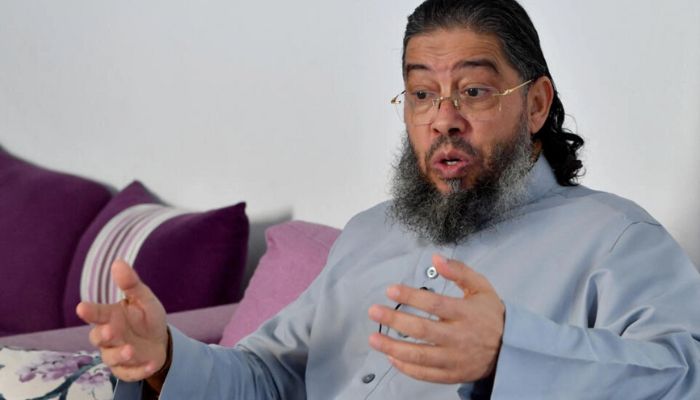
Backward, intolerant: France deports radical Tunisian Imam for referring to French flag as “Satanic” and “of no value to Allah”

France recently expelled a Tunisian Muslim cleric after he was arrested over allegations of radicalism, and making unacceptable remarks about the French flag. Taking to X, French Interior Minister Gerald Darmanin, on Thursday, announced the deportation of Tunisian cleric Mahjoub Mahjoubi, referring to him as a “Radical Imam”. 

Interior Minister Darmanin tweeted, “The radical Imam Mahjoub Mahjoubi has just been expelled from the national territory, less than 12 hours after his arrest. We will not let people get away with anything.”

Mahjoubi’s deportation came after he made a social media post where he referred to the French tricolour flag as “satanic” and of “no value to Allah“. Notably, the French flag has three colours – blue, white, and red.   

According to France 24, the 52-year-old Tunisian Imam was arrested on Thursday, and subsequently deported to Tunisia. He arrived in Tunisia shortly before midnight on a flight from Paris. Mahjoubi resided in France since the 1980s, and is a father of five. Although all his children hold French citizenship, Mahjoubi held a residency permit in France, which the French Interior Minister, Darmanin, has revoked. Until his deportation, Mahjoubri served at the Ettaouba mosque in Bagnols-sur-Ceze in the South of France. 

According to the French government, Mahjoubi’s ideology could potentially incite behaviours contrary to the Republic’s values. This includes discrimination against women, withdrawal into identity, tensions with the Jewish community, and encouragement of jihadist radicalisation.

The expulsion order stated that Mahjoubi had “conveyed a literal, backward, intolerant, and violent conception of Islam, likely to encourage behaviours contrary to the values of the Republic, discrimination against women, identity retreat, tensions with the Jewish community, and jihadist radicalisation”.

According to the deportation order, the Tunisian imam also referred to the Jewish people as the enemy, and called for the destruction of Western society.

Meanwhile, the Muslim cleric defended himself claiming it had been a “slip of the tongue”. He claimed that his statements were misconstrued and asserted that he never intended to disrespect the French flag, Reuters reported. Additionally, his lawyer announced that they would appeal the expulsion procedure and argue against the decision.

Nonetheless, the French government has adopted a stern policy against radicalism and toughened its immigration law to make France stronger. 

In another post on X on Thursday, French Interior Minister Darmanin stressed that the expulsion was a “demonstration” that a recently approved immigration law “makes France stronger”. He added, “Firmness is the rule.” 

Pertinent to note that with the rising popularity of right-wing leaders in France, there has been widespread demand to make tough migration laws and the government’s response is being seen in line with that. In the past, it has also taken action against practices/customs/activities that go against French values.

Earlier in January this year, France Foreign Minister Gerald Darmanin had announced that the country would stop foreign imams paid from abroad from entering France starting 1st January. The move was aimed at reducing foreign interference among the French Muslim community, to combat radicalism and separatist sentiments. Incidentally, a similar policy was also implemented by Germany. 

Last year in August, the country banned Islamic attire in Abaya in schools to implement a stricter dress code. Further, it has firmly dealt with cases of Islamist attacks in the country to protect its society from radical Islam.
No Mann Ki Baat for next three months due to Lok Sabha elections, announces PM Narendra Modi

0

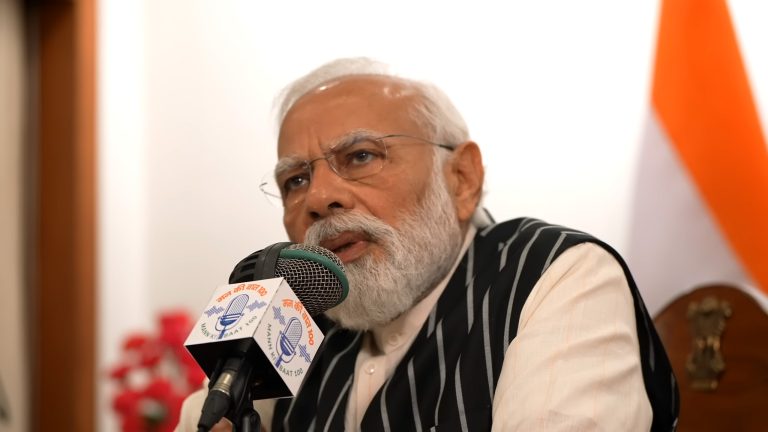
‘Mann Ki Baat’, a monthly radio programme of Prime Minister Narendra Modi, will not be broadcast for the next three months in the view of upcoming Lok Sabha elections, the PM said on Sunday.

“Mann ki Baat will not be broadcast for the next three months in view of upcoming Lok Sabha polls,” PM Modi said while addressing the nation in his 110th edition of the programme.

The 110th episode of Prime Minister Narendra Modi’s monthly radio broadcast, Mann Ki Baat, aired on Sunday, at 11 am, marking his second programme of the year.

The programme is broadcast on the last Sunday of every month.

Launched on October 3, 2014, Mann Ki Baat aims to connect with various segments of Indian society, encompassing women, the elderly, and the youth.

Through this platform, PM Modi disseminates information about government initiatives, policies, and welfare schemes.

Apart from 22 Indian languages and 29 dialects, ‘Mann Ki Baat’ is broadcast in 11 foreign languages, including French, Chinese, Indonesian, Tibetan, Burmese, Baluchi, Arabic, Pashtu, Persian, Dari, and Swahili. Mann Ki Baat was broadcast by more than 500 broadcast centres of All India Radio.

A study conducted regarding the impact of ‘Mann Ki Baat’ on the lives of the people showed that over 100 crore people have connected to ‘Mann Ki Baat’ at least once, it speaks directly to people, celebrates grassroots-level changemakers and achievements of people, and has influenced people towards positive actions.

Notably, in his 110th edition of ‘Mann ki Baat’ on Sunday, the PM said that women’s power in the country is touching new heights of progress in every field.

“After a few days on March 8, we will celebrate Women’s Day. This special day is an opportunity to salute the contributions of women’s power in the developmental journey of the country. The great poet Bharathiyar Ji has said that the world will prosper only when women get equal opportunities. Nari Shakti (women power) is touching new heights of progress in every field,” the PM said.

The PM also highlighted the ‘NaMo Drone Didi’ scheme, launched by PM Modi last year, and said that the initiative has brought changes in the lives of women living in rural areas.

“Who would have thought till a few years ago that in our country, women living in villages would also fly drones? But today this is becoming possible. Today, there is so much discussion about Drone Didi in every village, Namo Drone Didi, Namo Drone Didi is on everyone’s lips. Everyone is talking about them,” he said.

Prime Minister Narendra Modi launched the Namo Drone Didi scheme last year. Since then, apart from IFFCO, many fertilizer companies have come forward to empower women working in self-help group schemes such as ‘Lakhpati didi’.

A landmark effort to empower women working in the agriculture sector involves the deployment of 15,000 drones and making ‘drone didis’ out of women–(SHGs) under the Pradhan Mantri Mahila Kisan Drone Kendras initiative.

Under this ‘Drone Ki Udaan’ program, these SHGs undergo training on drone operation and maintenance.


(This news report is published from a syndicated feed. Except for the headline, the content has not been written or edited by OpIndia staff)

TMC distances itself from Sheikh Shahjahan’s brother after angry villagers set his property on fire, cops stop fact-finding committee from reaching Sandeshkhali

A day after angry villagers of Sandeshkhali in West Bengal set fire to the property of Sheikh Shahjahan’s brother Sirajuddin, the Trinamool Congress (TMC) is attempting to distance itself from him.

The matter became evident when West Bengal Cabinet Minister Partha Bhowmik went to Sandeshkhali on Saturday (24th February) and claimed that Sheikh Sirajuddin had been removed as the ‘head of the Panchayat’ a long time ago.

He however did not specify when the brother of Sheikh Shahjahan was relieved from the position. “Ajit Majhi has replaced Sirajuddin,” Bhowmik was heard saying.

While speaking about the matter, a BJP leader said, “Once a controversy comes to light, so-called suspension or removal from party posts is announced. However, as soon as the controversy dies down, the same leaders come to spotlight again”.

The Sandeshkhali protests in West Bengal turned violent on Friday (23rd February) as angry people torched the properties of Sheikh Sirajuddin.

Armed with sticks, the protesters set ablaze thatched structures near a fishing yard in Sandeshkhali’s Belmajur area and vented their anger against TMC leader Shahjahan Sheikh and his brother Siraj.

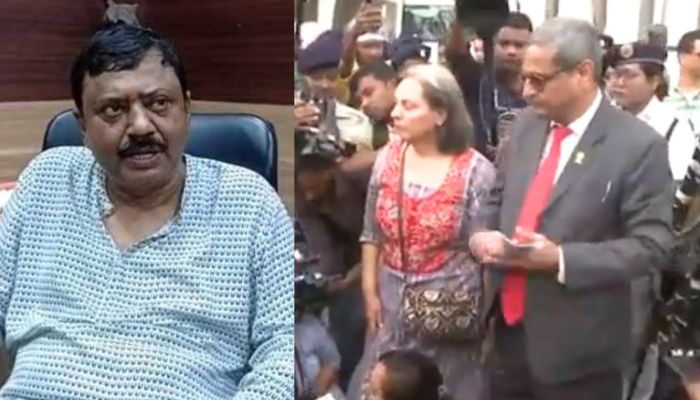
On Sunday (25th February), the members of a fact-finding committee protested against the West Bengal police and government after they were stopped from meeting the victims in Sandeshkhali village.

While speaking about the matter, a member said, “We are sitting here obediently to oppose as they (police) have stopped us illegally which is against our rights. We’ll complain about it to the CM, Governor, Union HM and even to the PM. During Ram Navami, they did the same and stopped us because they were hiding something… I don’t understand what kind of picture this state govt wants to portray before the world”.

The fact-finding committee added, “Constitutional machinery is collapsed in the state. Unfortunately, Police are executing illegal orders and taking the law in hands. We want to meet victims of Sandeshkhali…”

The committee consists of ex-Chief Justice of the Patna High Court, Justice L Narasimha Reddy, ex-IPS officer Raj Pal Singh, ex- NCW member Charu Wali Khanna, journalist Sanjeev Nayak, advocates OP Vyas and Bhavna Bajaj.

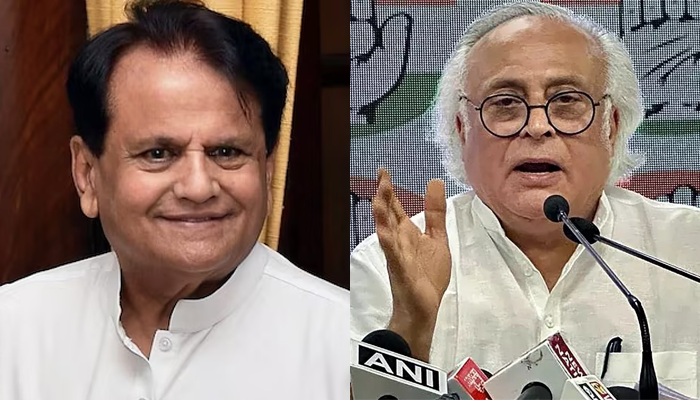
Decisions are taken for the party, not a person – Senior Congress leader Jairam Ramesh justifies giving away Ahmed Patel’s bastion Bharuch to AAP in Lok Sabha polls

On Sunday, 25th February, Congress leader Jairam Ramesh justified giving away late Congress leader Ahmed Patel’s bastion, Bharuch, to the Aam Aadmi Party (AAP) for the 2024 Lok Sabha Elections. His statement came after Ahmed Patel’s daughter Mumtaz shared her disappointment at the party’s decision to give the ticket away to AAP.

Speaking to news agency ANI, Ramesh said, “The party has to make some tough decisions considering the bigger picture. Even I was a little disappointed, but decisions are made for the party, not a particular person.”

Earlier, on 24th February, Congress and AAP announced seat sharing in several states, including Gujarat and Punjab, for the upcoming Lok Sabha elections. Ahmed Patel, Congress’s veteran leader who died in 2020 of COVID-19-related complications, had started his political career in Bharuch in 1976, contesting the local body polls. Since then, he climbed the stairs to become one of the most prominent leaders in the party, and Bharuch became his bastion. However, Congress and AAP came to an understanding that the AAP candidate would contest the seat in the upcoming Lok Sabha elections, which led to waves of criticism from several Congress leaders, and Ahmed Patel’s children.

Bharatiya Janata Party (BJP) also reacted to the development and hit out at Congress for not treating its leaders equally. In a post on X, BJP’s IT Cell head Amit Malviya said, “In the Congress, one dynasty is more equal than the others. Everyone knows of the differences between the late Ahmed Patel and Rahul Gandhi. Giving away Bharuch to AAP is Rahul Gandhi’s attempt to erase his legacy and humiliate the family. Gandhis believe in use and throw,” while sharing a post of Ahmed’s daughter Mumtaz.

In an emotional post on X, Ahmed Patel’s daughter Mumtaz apologised to the Congress cadre for being unable to secure the Bharuch seat. She wrote, “We won’t let Ahmed Patel’s 45 years of legacy go in vain.” She used the hashtag “Bharuch ki beti (daughter of Bharuch)” in the post.

Ahmed Patel was a close aide of Sonia Gandhi and was often seen as a troubleshooter for the top Congress leader.

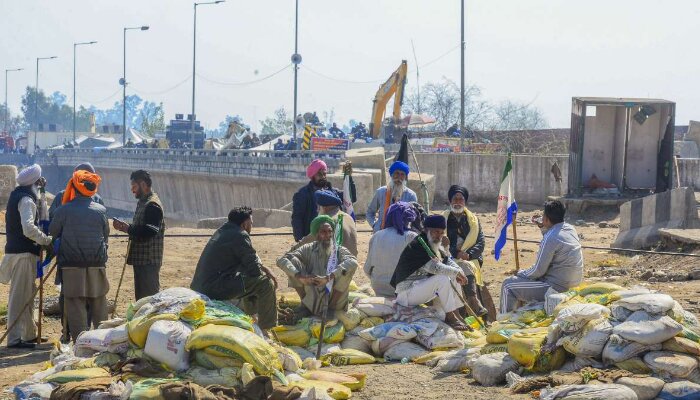
Farmer protests: 34 cops injured in Hisar clash, Singhu and Tikri borders to partially reopen, mobile internet restored, ‘Delhi Chalo’ march on hold

0

The Haryana government has started to resume the amenities that were snapped due to the farmer protests. Internet services which were suspended from 13th February in seven districts of the state including Kaithal, Kurukshetra, Ambala, Fatehabad, Sirsa, Jind and Hisar were restored after 24th February midnight. Mobile internet and bulk SMS services were first discontinued on 11th February which was then extended on 13, 15, 17, 19, 20, 21, and 23 February.

The process of partially opening the borders between Tikri and Singhu has also been commenced by Delhi Police. Five of the six layers of barricading have been removed by the cops. They worked through the night to tear down the concrete barricades. A police source revealed, “We have started removing barricades from the Singhu border and intend to open two lanes for both incoming and outgoing traffic by Sunday evening.”

The border serves as the entry point to Punjab and Haryana. One lane has been unblocked in Tikri, according to a senior officer. He added, “We are planning to open more lanes, but it will take some time.” Bahadurgarh borders Tikri on one side and Mundka on the other. The two borders were sealed on 13th February as agitators from Punjab began their ‘Delhi Chalo’ march.

Furthermore, other districts which shared their borders with Punjab were also barred. The Tukar border in the Pehowa area and the Kumhar Majra border in Isma Allahabad were closed off along with National Highway 44 near the Markanda River in Shahabad till late 24th February night. However, some respite is anticipated on the national highway in addition to the secured borders as well.

Meanwhile, the farmers have once again announced a march to Delhi on 26th February in response to calls from the Bharatiya Kisan Union (Tikait) and Samyukt Kisan Morcha. Tractor marches by farmers will head down the Yamuna Expressway towards Delhi. A meeting of the Bharatiya Kisan Union was held on 24th February to make this tractor march a success. It was chaired by Ranveer Mukhia and moderated by Robin Nagar.

According to Bharatiya Kisan Union (Tikait) Western Uttar Pradesh president Pawan Khatana, all labourers and farmers will congregate at the Dankaur Salarpur underpass on 26th February at 10:00 am with tractor-trolleys. They will then proceed along the Yamuna Expressway in the direction of Delhi. A peaceful tractor march has been called for by the organization.

After the development, the authorities started to convince the farmers. In light of the declaration and ‘Shab-e-Barat’ on 25th February, Section 144 has been implemented in the district. Farmers in the district will not take part in the tractor march, per police officials. However, discussions are being held with the office bearers of all farmer organizations.

More police officers will be stationed at all Delhi and Noida entry and departure points from 25th February. Anil Yadav, Deputy Commissioner Of Police (DCP) Traffic, pointed out that route diversion is another option and a decision in this regard will be taken following the meeting. Traffic-related information will be published on multiple platforms frequently to prevent inconvenience to individuals.

The Bharatiya Kisan Union (BKU) will also stage a demonstration with tractors on the Eastern Peripheral and Meerut Expressway on 26th February demanding legislation on Minimum Support Price (MSP) and other demands. Rakesh Tikait, BKU’s spokesperson made the announcement. Ompla Singh, another BKU leader claimed that the traffic would not be stopped during the march. Farmers will only protest and march some distance with tractors on the expressway. They intend to employ a single-side lane. Traffic will not be stopped during this time. He threatened that the government would have to fulfil the demands of the farmers otherwise farmers would go to Delhi on 14th March.

On the other hand, Sarwan Singh Pandher earlier noted on 23rd February that they will remain at the two protest locations on the Punjab-Haryana border till 29th February when the next course of action will be determined. The decision was taken by Samyukta Kisan Morcha (Non-Political) and Kisan Mazdoor Morcha (KMM), who are leading the current agitation at the Shambhu and Khanauri borders. Sarwan Singh Pandher mentioned, “The next announcement about the agitation will be made on February 29,” while talking to the media at the Khanauri protest site.

He also provided information about the activities the farmers will be participating in over the next few days including the candle march on 24th February, seminars on topics pertaining to farmers on 25th February, effigies of the World Trade Organization and the Center will be burned on 26th February and over the next two days, there will be multiple meetings of SKM (Non-Political) and KMM. On 21st February, farmer leaders decided to postpone the ‘Delhi Chalo’ march for two days following the death of a protestor and the injuries of around twelve police officers during altercations in Khanauri.

Meanwhile, Hansi Superintendent of Police (SP) Maqsood Ahmed reported on 24th February that at least 34 police personnel, including him and two Deputy-Superintendent of Police (DSP) rank officials, suffered injuries following a confrontation that broke out between the Haryana Police and farmers at Kheri Chopta village in Hisar one day earlier. Speaking at a press conference in Hansi, he remarked that the police had used tear gas shells and water cannons to contain the farmers as they tried to stop them from advancing from Kheri Chopta village when the latter pelted stones on them. He requested the farmers to uphold peace and not violate law and order.

The dispute started on 23rd February when the farmers from Kheri Chopta hamlet declared they were going to Khanauri. Around 2:30 pm, when they began making their way to their tractor-trailers, the police placed heavy security in place to halt their movement. Cops used water cannons and tear gas shells to scatter farmers as they began going from the protest site and the latter hurled stones on them.

The top cop added, “No first information report (FIR) was registered against farmers. We held a meeting with farmer leaders and urged them to restore peace. We had released 16 farmers, who were detained during the clash.” Farmer leader Vikas Sisar declared that they would not stop protesting at Kheri Chopta village until their demands were fulfilled.

Gujarat: As PM Narendra Modi inaugurates Sudarshan Setu in Gujarat, read key features of the longest cable-stayed bridge in India

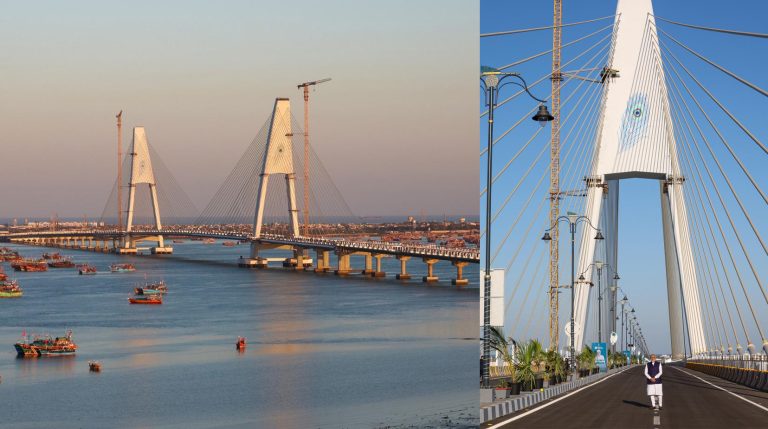
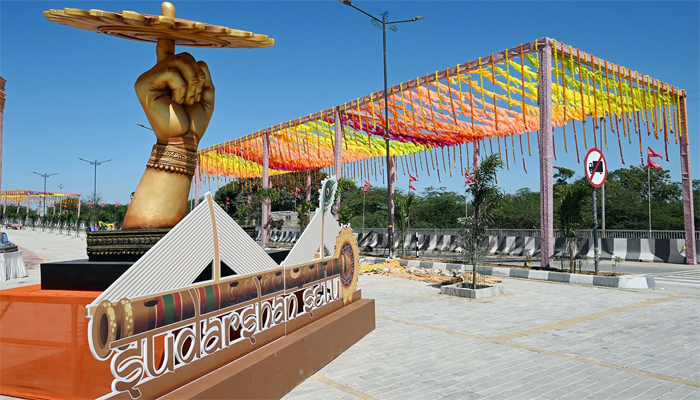
On Sunday, 25th February, Prime Minister Narendra Modi dedicated Sudarshan Setu, connecting Okha mainland and Beyt Dwarka island, to the nation. The bridge has been built at a cost of around Rs 980 crores. It is the longest cable-stayed bridge in India, with a length of 2.32 kilometres. PM Modi also laid the foundation for multiple development projects in Dwarka. These projects are estimated to see investment of more than Rs 4,150 crores. 

Sudarshan Setu is the signature bridge connecting Okha and Dwarka

The inauguration of India’s longest cable-stayed bridge in India, originally known as ‘Signature Bridge’, has been renamed as ‘Sudarshan Setu’. Prime Minister Narendra Modi, fulfilling one of his dream projects, officially opened the bridge on February 25th. Spanning a length of 2.32 km, this bridge connects Okha to Beyt Dwarka and boasts numerous features. It is expected to greatly benefit pilgrims visiting the Dwarkadhish Temple, serving as a significant asset for their journey.

Previously, pilgrims travelling from Okha to Dwarka relied on boats, exposing them to the dangers of overloaded vessels and risking their lives. Recent incidents in Morbi and Vadodara underscored these risks. The construction of the Sudarshan Setu by the Modi government has alleviated these concerns significantly. Additionally, the lengthy process of boarding boats and reaching the temple has been streamlined, reducing the journey time to just three hours. This remarkable bridge offers not only modern conveniences but also embodies symbols of spiritual significance, catering to the needs of both travellers and devotees alike. The bridge will help ease transportation and significantly reduce the travel time between Dwarka and Beyt-Dwarka. Before the bridge, the devotees relied on boat transport to reach Beyt Dwarka.

The state-of-the-art bridge is built for Rs 980 crores

Built for Rs 980 crore, the Sudarshan Setu stretches over 2320 meters, realising Prime Minister Modi’s visionary initiative. Commencing its construction in 2018, the bridge features 38 pillars strategically erected in the sea, culminating in its completion today. Renowned for its sleek and contemporary design, the bridge not only enhances the region’s aesthetics but also promises substantial benefits for pilgrims and locals alike. During emergencies, such as hospital crises, Dwarka relied on emergency boats, often resulting in time constraints and compromised healthcare access. However, with the Sudarshan Setu now operational, swift vehicular access to urban centres during emergencies ensures timely and efficient assistance, bridging essential services to those in need.

Verses of Shrimad Bhagwad Gita on both sides of the Sudarshan Setu

The Sudarshan Setu boasts a distinctive design adorned with sacred verses from the Shrimad Bhagwad Gita and teachings of dharma, alongside captivating depictions of Lord Krishna. Enhancing its allure further, solar panels line the upper portion of the bridge’s footpath, shielding travellers from the sun while generating up to one megawatt of electricity. This sustainable energy source will illuminate the bridge, ensuring safety and visibility, while also serving as a testament to modern eco-friendly infrastructure.

Beyond its aesthetic appeal, the bridge significantly streamlines transportation, providing pilgrims and tourists with expedited travel routes and saving valuable time. As a focal point of Dwarka, the Sudarshan Setu stands not only as a symbol of connectivity but also as a beacon of cultural and spiritual significance.

Stretching 2320 meters in length, with 900 meters supported by cables, the bridge incorporates extensive features for convenience and aesthetics. Additionally, a spacious parking facility has been built to accommodate visitors. Adorning the main area of the bridge are ornate torans spanning up to 130 meters. With a width of 27.20 meters and four lanes, the bridge also includes 2.50 meters of footpath on either side. Along these footpaths, captivating depictions of Lord Krishna grace the walls, adding to the bridge’s charm and cultural significance.

In addition to its practical features, the bridge offers tourists breathtaking views of natural landscapes and the sea. Throughout the structure, viewing galleries have been strategically placed at 12 locations, providing pilgrims and visitors with optimal vantage points to admire the scenic beauty of the sea and Dwarka.

Furthermore, the bridge is set to dazzle during the evening hours, thanks to state-of-the-art lighting installations that enhance its allure and visibility. Adding to its aesthetic appeal, the pillars of the bridge are adorned with designs resembling peacock feathers, which will be seen both day and night.

Madhya Pradesh: Sultan poses as Raj to entrap minor Hindu girl online, booked under POCSO Act

0

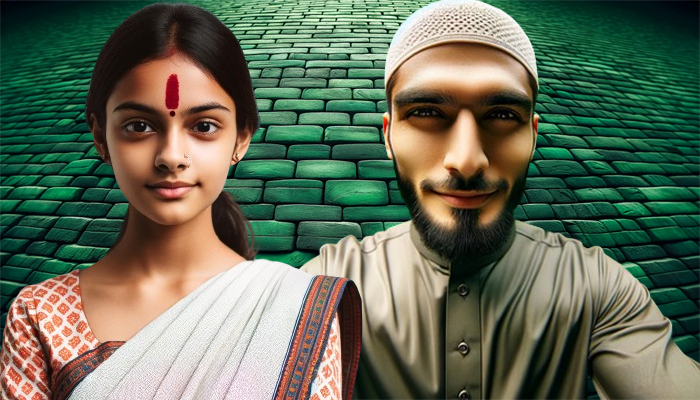
A young man identified as Sultan, son of Aslam, has been booked by Sarangpur Police in Madhya Pradesh for allegedly entrapping a minor Hindu girl using a fake identity on social media. Sultan posed as a Hindu man named Raj on Instagram to lure the girl into a relationship.

The incident took place in Ward Number 7 of the city. Sultan is resident of Sidhakhal, Sarangpur. As per reports, he misled a minor girl from the city while posing as a Hindu man named Raj on social media. He created a fake account named Raj and engaged in a relationship with a minor girl from the city.

After chatting on Instagram with the girl for some time, Sultan arranged a meeting with her under false pretense. Hindu organisations learned about their meeting and Sultan’s malicious intentions. They apprehended the duo, preventing a potential mishap.

The minor Hindu girl was shocked to learn about Sultan’s real identity. On the other hand, Sultan tried to flee the scene but was caught by the members of Hindu organisations and subsequently handed over to the police.

The police also detained the girl. During counselling at the women’s police station, the girl narrated how the accused befriended her with a fake identity and got into a love affair. Based on her statement, Sultan was booked under Sections 354 and 366 of the Indian Penal Code (IPC) and relevant sections of the POCSO Act.

Sarangpur Police Station in-charge Santosh Banghela said the accused was presented to the court and later sent to custody.

There has been a spike in the cases of grooming jihad in the country in recent times. Recently, OpIndia reported 15 cases of forced conversion, rape, assault and torture in Mira-Bhayander of Mumbai along similar lines.

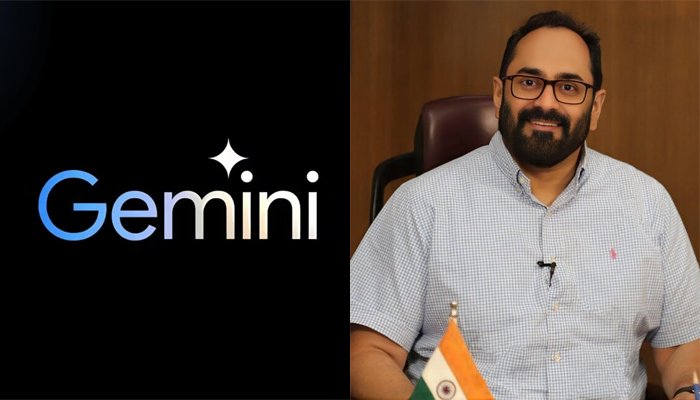
‘Sorry unreliable’ does not exempt one from law – Union Minister Rajeev Chandrasekhar hits out at Google for ‘malicious’ responses in Gemini AI

0

On 24th February, Union Minister Rajeev Chandrasekhar warned Google over malicious responses its AI chatbot Gemini is generating. In a post on X, Chandrasekhar warned the tech giant not to run experiments of India’s ‘Digital Nagriks’ with “unreliable” platforms, algorithms and models. He emphasised that safety and trust are the legal obligations of a digital platform, and saying, “Sorry, AI tool is not reliable”, will not exempt the company from the law.

The minister’s response came to a post published by X users Sreemoy Talukdar and Arnab Ray, where they drew attention towards biased responses generated by Gemini AI. Ray published three screenshots where he asked if Prime Minister Narendra Modi, Ukraine’s President Zelenskyy and former US President Donald Trump were fascists. While Gemini gave a diplomatic answer in the case of Zelenskyy and Trump; the AI chatbot downright called PM Modi a “fascist” leader.

Responding to Talukdar, Chandrasekhar said, “These are direct violations of Rule 3(1)(b) of Intermediary Rules (IT rules) of the IT act and violations of several provisions of the Criminal code,” and later warned the company that platform being “unreliable” would not save them from consequences. As reported, MeitY has demanded an explanation from Google for the biased responses.

Recently, Google faced severe criticism for its AI chatbot Gemini (formerly Brad) as it failed to generate images of White persons and generated distorted pictures of historical figures. Responding to criticism, Google apologised and stopped image generation capabilities. In a blog post, the senior vice president of Goole, Prabhakar Raghavan, acknowledged that Gemini was not responding with the desired results and that the images generated were inaccurate or “even offensive”. He wrote, “We’ve acknowledged the mistake and temporarily paused image generation of people in Gemini while we work on an improved version.”

He added, “One thing to remember: Gemini is built as a creativity and productivity tool, and it may not always be reliable, especially when generating images or text about current events, evolving news or hot-button topics. It will make mistakes.”

AI tools bias towards India and Hindus

This is not the first time AI tools have been scrutinised for bias. In January 2023, ChatGPT faced criticism when the platform happily made jokes about Hindu Gods but refused to do the same with Christianity and Islam.

‘Sheikh Shahjahan took MNREGA wages of villagers for voting against TMC, police did not take action’: NCST team in Sandeshkhali

Amid the ongoing unrest in Sandeshkhali village in North 24 Parganas district of West Bengal, it has come to light that poor tribal families were being denied MNREGA wages for voting against the ruling Trinamool Congress (TMC) dispensation.

The development was confirmed by a three-member team of the National Commission for Scheduled Tribes (NCST).

Led by Vice-Chairperson Ananta Nayak, NCST also learnt from the locals that the police ‘protected’ TMC goon Sheikh Shahjahan and his accomplices in exploiting the tribal community in Sandeshkhali.

“The NCST team learned that Shahjahan would instruct poor tribal people to give him their MNREGA earnings. And in case they had already exhausted it, he would ask them to borrow money from lenders and give it to him,” Nayak informed.

“If the victim approached the police, they would not file an FIR or a complaint and instead ask the complainants to ‘negotiate’ with Shahjahan. The police backed the accused in this case,” the NCST vice-chairperson further emphasised.

Earlier on 20th February this year, the National Commission for Scheduled Tribes issued a notice to the West Bengal police Head and the Chief Secretary of the State. It has sought factual reports within a span of 3 days.

Women expose rampant vote rigging by TMC in Sandeshkhali

Earlier, several women narrated the large-scale vote rigging orchestrated by Trinamool Congress (TMC) goons in the Sandeshkhali village.

During an interview with TV9 Bangla, at least 7 women spoke on camera against the election fraud carried out by TMC workers in cahoots with polling officers and the police.

“Before I go to the polling station, they tell me that my vote has been cast,” a woman recounted. “If we go to the polling station, the polling officers put ink on our fingers and say that our vote has already been cast…”, another woman informed.

She added, “Men in the village cannot stay here at least 6 months (during to intimidation) before elections…Men dressed in police uniform have even threatened to destroy our homes if we cast votes.”

“They do not allow us to cast our votes,” one victim lamented. Another woman narrated, “Casting votes here is same as not casting your votes.”

Aarati Patra, who had filed nomination papers from the BJP, informed TV9 Bangla, “They warned me that if I contest elections, then, they will beat me with sticks and spades. There are 3 primary goons (Sheikh Shahjahan, Uttam Sardar, Shibu Hazra) but they have a lot of followers.”

“There is no voting here. They would threaten people and forcibly take them to the polling station and put ink on their fingers,” she added.

One woman informed, “Even if police are present at the polling station, they do not tell them (TMC goons) anything. They instead work as cadres of the party,”

Another woman said that her family members were sent ‘funeral essentials’ after deciding to contest the Panchayat elections. “One of my uncles contested in the election. On the same evening, they (TMC goons) sent us flower beads, a white saree, and sweets,” she narrated her ordeal.

PM Modi inaugurates Sudarshan Setu, longest cable-stayed bridge in India; lays foundation of multiple other projects

On Sunday, 25th February, Prime Minister Narendra Modi dedicated, and laid the foundation for multiple development projects in Dwarka. These projects are estimated to see investment of more than Rs 4,150 crores. PM Modi also dedicated Sudarshan Setu, connecting Okha mainland and Beyt Dwarka island, to the nation. The bridge has been built at a cost of around Rs 980 crores. It is the longest cable-stayed bridge in India, with a length of 2.32 KM.

Following his visit to Dwarka, PM Modi will visit Rajkot, where he will dedicate and lay the foundation stone of multiple projects worth over Rs 48,100 crores.

Sudarshan Setu – the longest cable-stayed bridge in India

Sudarshan Setu is a 2.32 KM long cable-stayed bridge built for Rs 980 crores. It has a unique design that features a footpath adorned with verses of the Shrimad Bhagavad Gita and images of Bhagwan Krishna on both sides. Furthermore, solar panels that will generate one megawatt of electricity have been installed above the footpath.

The bridge will help ease transportation and significantly reduce the travel time between Dwarka and Beyt-Dwarka. Before the bridge, the devotees relied on boat transport to reach Beyt Dwarka.

Apart from the bridge, PM Modi will dedicate a pipeline project at Vadinar involving the replacement of existing offshore lines, abandoning the existing Pipeline End Manifold (PLEM), and relocating the entire system (pipelines, the PLEMs and the interconnecting loop line) at a nearby new location. Prime Minister will also dedicate Rajkot-Okha, Rajkot-Jetalsar-Somnath and Jetalsar-Wansjaliya Rail Electrification projects to the nation.

Furthermore, he will lay the foundation stone for the widening of the Dhoraji-Jamkandorna-Kalavad section of NH-927D, the Regional Science Center at Jamnagar and the Flue Gas Desulphurization (FGD) system installation at Sikka Thermal Power Station, Jamnagar among others.

PM Modi’s visit to Rajkot

In Rajkot, PM Modi will dedicate five All India Institute of Medical Sciences (AIIMS) at Rajkot (Gujarat), Bathinda (Punjab), Raebareli (Uttar Pradesh), Kalyani (West Bengal) and Mangalagiri (Andhra Pradesh) to the nation. He will also lay the foundation stone of over 200 Health Care Infrastructure Projects worth Rs 11,500 crore across 23 states and UTs.

PM Modi will dedicate multiple medical facilities to the nation across states, including Puducherry, Punjab, Bihar, Kerala, Tamil Nadu, and Jharkhand.

PM Modi will also inaugurate the  National Institute of Naturopathy named ‘Nisarg Gram’ at Pune, which comprises Naturopathy Medical College, along with a 250-bed hospital with a Multi-disciplinary Research and Extension Centre. A yoga and naturopathy research centre will be inaugurated in Haryana as well.

PM Modi will also lay the foundation stone for various renewable energy projects, including the 300 MW Bhuj-II Solar Power project, Grid Connected 600 MW Solar PV Power Project, Khavda Solar Power Project, and the 200 MW Dayapur-II Wind Energy Project. Furthermore, he will be the foundation stone of the New Mundra- Panipat pipeline project worth over Rs. 9000 crore. The 1194 km long Mundra- Panipat Pipeline installed at 8.4 MMTPA was commissioned to transport crude oil from Mundra on the Gujarat coast to Indian Oil’s refinery at Panipat in Haryana. He will also lay the foundation stone of six laning with paved shoulder of Samakhiyali to Santalpur section of NH-27, among others and dedicate doubling of Surendranagar- Rajkot Rail line, four laning of Bhavnagar- Talaja (Package-I) of old NH-8E and Pipli-Bhavnagar (Package-I) of NH-751.