Home Blog Page 1351

TMC-97%, DMK-86%: Opposition parties welcome SC judgement striking down electoral bond scheme, the same parties getting almost all of their donations through it

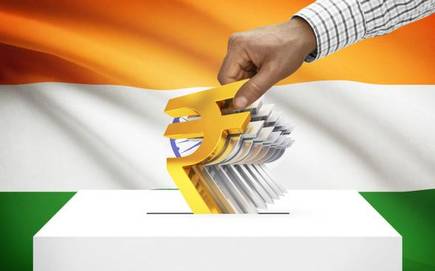
In a major decision, the Supreme Court of India on 15th February struck down the electoral bonds scheme saying that it violates Article 19(1)(a) of the constitution and the Right to Information Act. Ruling the scheme as unconstitutional, the court said that the objective of curbing black money in politics can’t justify the scheme where the identity of donors to the political parties are kept confidential.

Notably, opposition parties have been opposing the electoral bond scheme, alleging that BJP is the biggest beneficiary of the scheme as it favours them. Several opposition leaders today welcomed the Supreme Court verdict.

TMC leader Sushmita Dev tweeted, “Heard many BJP people bragging that electoral bonds was one of the biggest reforms by NDA government. Now what!”

TMC MP Saket Gokhale called it “the most HISTORIC judgment & intervention in the last 5 years” by the Supreme Court.

DMK chief and Tamil Nadu CM MK Stalin said that Supreme Court has rightly held that the #ElectoralBonds are unconstitutional.

He added, “This will ensure transparent electoral process and the integrity of the system. This judgement has restored the #democracy and level playing field for all political parties. It has also ensured the common man’s faith in the system.”

The Congress party has also called it a historic verdict, with Randeep Surjewala alleging that it was BJP’s ‘black money conversion scheme’

Jairam Ramesh said that the electoral bond scheme was illegal and unconstitutional, welcoming the judgement.

While the opposition parties are welcoming the judgement and terming the scheme illegal and unconstitutional, the same parties are also some of the biggest beneficiaries of the scheme. In fact, for some parties, almost all donations came through the electoral bond scheme.

As per the latest audited financial reports for the year 2022-23 of national and regional parties submitted with the Election Commission, while BJP received far more amount through the scheme then the others, for many parties the share of the scheme in income was very high, nearing 100%.

In terms of the share of the scheme in total income, the biggest beneficiary of the scheme was Trinamool Congress. In FY 2022-23, the party’s income was ₹333.45 crore, out of which ₹315.10 crore came from electoral bonds only, a whopping 97.49%.

The next was another opposition party DMK, which received ₹185 crore in bonds, out of ₹214.35 crore total income. The ruling party in Tamil Nadu received 86.31% of its income from electoral bonds alone. BJD, the ruling party in Odisha, received ₹152 crore in bonds, which is 83.95% of the total income of ₹181.05 crore.
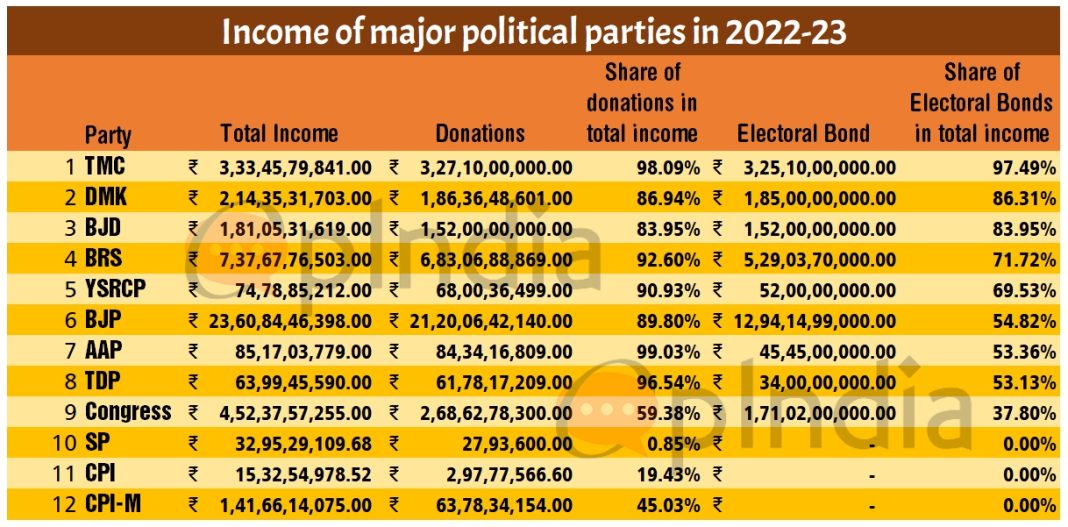
Similarly, the share of electoral bonds in total income for BRS was 71.7%, it was 69.53% for YSRCP, the ruling parties in Telangana and Andhra Pradesh.

The share of electoral bonds in the total income for BJP was 54.82%, which means while BJP received almost of half of its income from other sources, the share was much higher for regional non-NDA parties. AAP and TDP had shares similar to BJP, at 53% each. However, AAP’s share is not confirmed, as the party didn’t disclose the figure for electoral bonds. Instead, the party gave a combined figure of Electoral Bonds and Electoral Trust.

The Congress party received ₹171 crore from the scheme, which is 37.8% of its total income 452.38 crore. Some major parties like SP, CPI and CPI-M didn’t receive any donation under the electoral bond scheme in the year 2022-23.

This is not the first time for the opposition parties to receive majority of their donations using bonds, the trend is going on for last several years. A report on analysis of sources of funding of national parties in 2021-22, prepared by Association of Democratic Reforms, show that TMC led the chart in that year also, with 96.77% share of electoral bonds in total receipts. The share for the party has gone up to 97.49% this year.

However, in monetary terms, BJP remains the biggest beneficiary, with a total receipt of ₹1,294.15 crore through electoral bonds in the year 2022-23. BRS was second highest recipient with ₹529 crore. TMC and DMK were third and fourth positions. As the total amount of electoral bond sold for the year 2022-23 is not known, the share of parties in the scheme is known for the year. But reports have emerged on total amounts since the launch of the scheme.

As per reports, since the launch of the scheme in 2018, bonds worth around ₹16,000 crore were sold by the State Bank of India. BJP’s share in it was around 55% or approximately ₹6,565 crore. Congress received around 1,123.3 crore, or around 7%. TMC received around ₹1,101.33 crore, around 7%.

Therefore, while opposition parties like TMC and DMK are welcoming the SC verdict striking down the electoral bond scheme, the same parties are major beneficiaries of the scheme. In fact, they received most of their donations through bonds only, which was as high as 97.49% for TMC and 86.31% for DMK.
West Bengal: Amidst Sandeshkhali protests, half-naked body of a woman found in Malda; family suspects rape and murder

0

West Bengal’s Sandeshkhali district has been on the boil after several women victims have accused TMC leader Shahjahan Sheikh and his aides of sexually assaulting them. Now, another disturbing event has unfolded in the Mothabari area in West Bengal’s Malda district. Today (Thursday, February 15) the half-naked body of a 25-year-old woman has been discovered in a maize field just a few hundred meters away from her house in the area.

The victim, identified as Kalpana Mondal, went missing on the evening of Saraswati Puja (14th February), leaving her family frantic with worry. Her family members suspect that she was raped and brutally murdered, as her body bore several stab wounds and showed signs of assault.

According to local sources, Kalpana left her home in the Sreepur Colony area of Mothabari on the morning of Saraswati Puja to bring vegetables. However, when she failed to return home, a search was initiated, leading to the grim discovery on Thursday morning. Her grieving family members recounted the events leading up to her disappearance.

Her mother said, “Saraswati Puja festivities were in full swing in our village yesterday. Amidst the joyous celebration and music, my daughter was enjoying herself too. She mentioned to one of my granddaughters in the evening that she was going to the bathroom, but she never returned. As the night wore on, my son searched for his sister to prepare dinner, but she was nowhere to be found. That’s when we began to worry and searched tirelessly throughout the night. Despite our efforts, her lifeless body was discovered this morning. My daughter had been married for a few years, but due to issues with her husband, she returned to live with us. She had no other affairs. I don’t know who killed her or why.”

Her brother said, “On the night of Saraswati Puja, I wanted to eat khichdi and curry. I went out in the evening and when I was looking for my sister, I heard that she was missing. We immediately started searching. I was searching this morning. Then I came to know that Didi’s body was lying in the cornfield. The body was almost naked. We suspect that she was murdered by rape or gang rape. The police took the body. We have lodged a written complaint with the Mothabari police station.”

BJP IT Cell chief Amit Malviya said in an X post, “West Bengal, under Mamata Banerjee, has become hell for women… Not a day goes when a woman is not raped and murdered. The brutality of the crime is often so spine-chilling that one can’t sleep for days. But nothing affects Mamata Banerjee, as long as she keeps getting votes. No criminal is ever prosecuted because they are almost always affiliated with the ruling TMC. Last night, another young woman was possibly raped and murdered in Mothabari, Malda. Her naked mutilated body was found in a cornfield in Sripur village. Bengal is witnessing anarchy, where the Chief Minister, and her criminal police force, have not only failed to provide any sense of security to women but are also actively working to deny justice to the victims. Mamata Banerjee is a curse for the women of West Bengal.”

BJP leader Shehzad Poonawalla posted on his X handle, “After Sandeshkhali now Malda Mutilated half-naked body of a woman now found Talibani state of affairs thanks to TMC!”

Notably, for the last week, women in several areas in Sandeshkhali of North 24 Parganas district in West Bengal have been protesting, demanding the arrest of TMC leader Sheikh Shahjahan and others, narrating how the women in the area have been sexually exploited for a long time. The protests led to violence in the area, after which heavy police force have been deployed in the area.

Several women from Sandeshkhali have come forward to narrate how the women in the area are being raped by Sheikh Shahjahan, the mastermind behind the attack on the ED team, and other TMC workers and their aides. As per them, TMC workers regularly visit the area and pick out ‘beautiful women’ to exploit them. Some women said that they were taken to the party office in the night, and were released only after the men in the gang were ‘fully satisfied’.

On January 31, an 11-year-old girl was found beheaded in Malda town. According to a police official, her head and torso were discovered in separate locations in the city. Now, the half-naked body of a young woman is found in Mothabari near Malda in this incident. Repeated incidents of rape and atrocities on women have become a matter of concern in West Bengal.

‘They threatened to kill and bury us’: Sadruddin, Shamim and two others attack a Hindu youth and his kins in UP; Sadhus step in to save their lives

0

A Hindu youth named Vikas Rajput, his mother and his sisters were reportedly attacked in the Uttar Pradesh region of Farrukhabad. The incident transpired on 12th February at the Kadrigate police station area. The accused have been identified as Shamim, son of Yusuf and Sadruddin, son of Shakir along with two other unidentified accomplices. Authorities have opened an investigation, arrested two persons and filed a case in this regard.

The victim and his family had gone to visit a fair where the accused launched a vicious attack on him, his mother and sisters. The victim told OpIndia that the accused threatened to kill them and bury them in the graveyard. A few sages who were present at the scene intervened and saved them.

Vikas Rajput submitted a police complaint on 13th February. According to the complaint, he and his family attended Mela Ramnagariya on the day of the incident. At around 10.15 pm, Vikas along with his sisters, mother and brother visited a shop selling bangles. He went and sat on a cot laid before the shop when the perpetrators came and started hurling abuses at him.

When Vikas Rajput raised objections to their offensive remarks, the culprits started hitting him. They also beat up and mistreated his mother and siblings when they intervened. They sustained serious wounds due to the assault.

Due to the ensuing commotion, when the public started gathering the accused fled from the location while issuing death threats to the youngster.

The Farukkabad police, meanwhile, took cognisance of the incident and filed a First Information Report (FIR) against Sadruddin, Shamim and two other unknown individuals under sections 323, 504 and 506 of the Indian Penal Code (IPC) in the matter. OpIndia has a copy of the FIR.

According to a Newsline Network article, two culprits have been arrested while efforts are on to identify and nab the other two.

A video of the sages who were present there when the incident took place has also surfaced online in which they can be heard recounting the brutal thrashing of Vikas Rajput and his family at the hands of the Muslim males. They unveiled that the females were kicked in their stomachs. The sages added that they believed the assailants would have killed the victims if they had not come together to rescue them. They have also hoped for strict action against the attackers.

Shiv Nadar School introduces ‘non-binary’ as child’s gender, parents say, ‘don’t shove woke politics down our throat’

Delhi-NCR-based Shiv Nadar School has come up with a parent feedback form that has caused a stir among the parents. The feedback form asks the parents about their views on various aspects of the school, its programs, and the child’s journey there.

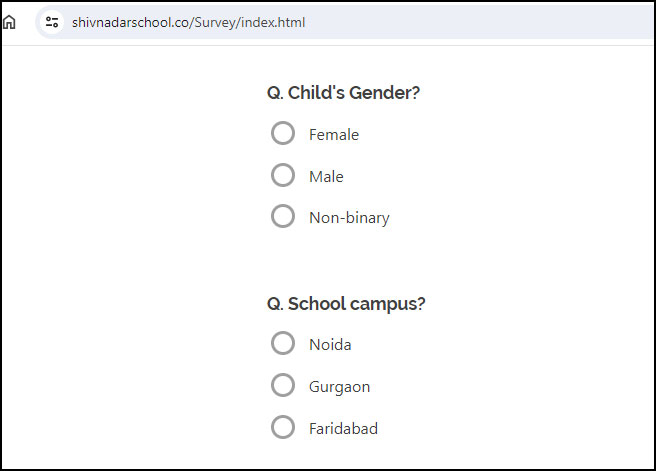
The parent feedback form is meant to be filled out by all parents of children across all grades on all campuses. The Shiv Nadar school has campuses in Noida Faridabad and Gurgaon.

Source: Shiv Nadar School’s feedback form

Notably, in the first section, which asks for the essential details about the child, there is a section on gender that asks the parent to choose between “Male”, “Female”, and “Non-Binary”. While “other” and “third gender” are common in feedback forms across platforms, specifying non-binary brings a different approach. Notably, there is no guideline from NCERT on adding such a gender option for the school forms.

In the form, there is an option to select the child’s grade. It is evident that this form is to be filled even for kids as young as 3 or 4 years of age since selecting ‘Foundation year’ and ‘Nursery’ is also an option.

Non-binary is used to describe people who feel their gender cannot be defined within the margins of a gender binary. Instead, they understand their gender in a way that goes beyond simply identifying as either a man or woman. It would, therefore, mean that Shiv Nadar is going down a slippery slope of elected pronouns and gender politics of the West.

Until even a decade ago, the terms ‘gender’ and ‘sex’ was used interchangeably and it was widely understood that there are only two genders that could be considered normal, while transgenders are considered a deviation from the norm and were understood as an anomaly and rightly so. But as it turns out, a certain bunch of ‘intellectuals’ in their echo chambers had conjured the hypothesis that gender identity is completely independent of biological.

When it is claimed that gender identity is independent of biological sex, one goes down a slippery slope of elective gender politics. Essentially, this would mean that a boy could claim that he is ‘non-binary’ and ‘gender fluid’ since he feels like a boy one day, a girl the next, and like an individual with no gender at all on the third. This ‘non-binary’ individual could also then claim that they are not comfortable with conventional pronouns since they are attributable to gender identities, and therefore, he would want to be referred to as “They/Them” or Xe/Xhrer or some other made up pronoun.

We also noticed that the school has a “Gender Sexuality Alliance” to provide “a safe and free space to express and allow the germination of new ideas”. The school’s website page about School Councils reads, “The Shiv Nadar School is a safe and free space to express and allow the germination of new ideas. The Gender Sexuality Alliance is a club that hopes to start conversations about gender neutrality and open acceptance of sexuality. Earlier the IBDP students had initiated the Gay-Straight Alliance club, taking it forward this year, not only was it renamed but also opened to all the students. The aim of this club is to facilitate activism in the form of open discussions without any prejudices to provide a welcoming environment for all the students.”

The Harmful Effects of Gender Politics on Children

The normalization of such toxic politics has led to a situation where countries in the West are suddenly seeing a spike in the number of teenage girls who want to transition to male. Lisa Littman, an American Academic, said that ‘socially-awkward’ girls self-identified as transgender after being drawn together in chat rooms where they reinforced each other’s beliefs about their identity. She was ostracised by the academia for observing this particular trend.

Furthermore, gender identity overlords advocate the use of puberty blockers for underage children. Puberty blockers are drugs that postpone or inhibit puberty in children who feel they are of a different gender. This is not to say that gender dysphoria is not a real issue but it’s particularly concerning because research indicates that over 90 percent of the children (94% to be precise) grow out of it by the time they reach puberty.

Thus, gender identity overlords are irrevocably altering the natural growth of children and scarring them for life due to their petty politics when most of the children would go on to have a completely normal life without it. Their justification for such life-altering events at such a tender age is that children ‘feel’ that they are a ‘boy trapped in a girl’s body’ or vice versa.

Children are children at that age. They might say a lot of things and do a lot of things but it is the responsibility of adults to ensure that they do not let them harm themselves. But hundreds of children under the age of fourteen, many as young as 10 years old, have been injected with these life-altering drugs merely because of their feelings, something that the children could come to regret later.

Shiv Nadar’s inclusion of ‘non-binary’ as a gender identification for children is being viewed as an extension of the normalization of such toxic politics at an early age.

OpIndia tried to speak to the parents of a few wards studying at Shiv Nadar. While some parents we reached out to refused to speak to us saying that it would unnecessarily affect the progress of their ward, a few parents, on the condition of anonymity, expressed outrage about the school’s decision to force all parents to subscribe to gender politics. “I think the decision about what the children should learn about such sensitive and politically charged subjects should be left to the parents. The school can’t enforce their own woke ideology on the students and their parents”, one parent said. The other said, “Most parents don’t speak up because they fear the repercussions the child might face, but this was simply not expected. We don’t want such fantasy being fed to our children”.

Not the first time

This is not the first time that a school has attempted to normalize dangerous gender politics. In 2020, there was great outrage on social media after Harish Iyer, a prominent LGBT activist, said on the micro-blogging site Twitter that he had conducted a workshop on sex, orientation, gender identity, and gender expression at a school in Mumbai. Several sessions of the same were conducted on the same day and in the tweet, he mentioned that it was the 4th session that was then underway. After the tweet caused outrage among users on social media, Harish Iyer proceeded to delete the tweet.

What caught people’s attention in Harish Iyer’s tweet was the reference to a ‘gender identity class video’ composed by Abish Mathew of All India Bakchod fame and one Anuya Jakatdar. One social media user soon discovered the video that the LGBT activist was referring to in his tweet where he announced his workshop in a Mumbai school.

The video in question is titled on YouTube as the ‘Gender Identity Song’ and is quite disturbing, to put it mildly. It is tailor-made to target its intended constituency, that is, children, and is entirely a tool for brainwashing. There is not even an attempt made to make it seem anything other than a propaganda tool.

In the video, there is an entity that calls itself ‘Angel’ and claims it is gender fluid. He is, apparently, sometimes a boy and sometimes a girl, both and sometimes neither: That is my gender identity. It could be different from my gender expression and my biological sex,” Angel says.

Then, Angel proceeds to sing. “If it hangs between your legs, it’s your sex. It physically manifests, it’s your sex. But society thinks in two’s, doesn’t mean that it is true, Gender Identity is what’s inside of you.” The song continues, “If you want to be a boy or a girl, or you want your special fashion to unfurl, you get to choose how you and the way you want to dress. You get to choose how you would like to be addressed.”

Then, the person proceeds to brainwash the children with the concept of gender pronouns. There is also a point in the video where it speaks of ‘gender-neutral toilets’. The core message of the sermon is, “You don’t have to get it. You just have to respect it.”

NCERT does not prescribe the inclusion of ‘non-binary’ as a gender identification

In 2021, the Department of Gender Studies at NCERT had earlier published a document titled ‘Inclusion of Transgender Children in School Education: Concerns and Roadmap’ where it said that toilets were used to brainwash children into believing that there were only two sexes, men and women. Besides that, the training manual appeared to give its support for puberty blockers, a medication that has gained widespread notoriety in recent times. The medicines were used to block the development of puberty in children which permanently alters their natural course of development. Following public outrage over the manual, NCERT had removed the document from public access.

Another draft was issued in 2023, which was later pulled down after receiving feedback from the stakeholders. That document did not talk about adding “non-binary” to school forms in the name of inclusivity. NCERT has no guidelines for schools to use “non-binary” in any form.

OpIndia reached out to Shiv Nadar for their comments on the inclusion of ‘non-binary’ as a gender identification for students. The school wasn’t forthright in answering the specific questions and chose to prevaricate. As and when the school chooses to respond, their statement will be added to this story as an addendum.

Indian wrestlers threaten fresh protest after world wrestling body lifts suspension of Wrestling Federation of India

0

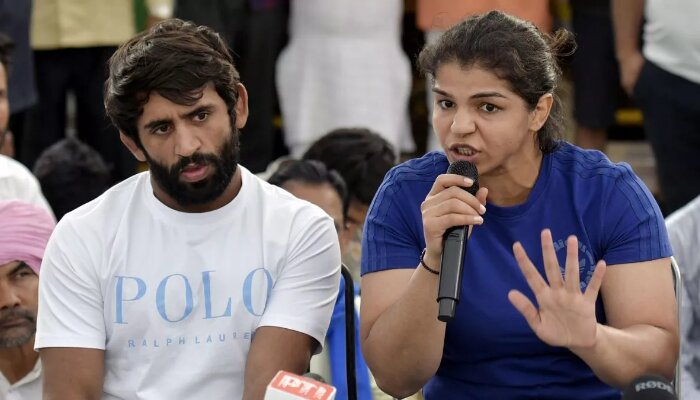
On Wednesday, 14th February, wrestlers Bajrang Punia and Sakshi Malik accused national federation of India chief Sanjay Singh of employing fraudulent methods to get United World Wrestling (UWW) to revoke the suspension on the Wrestling Federation of India (WFI). Furthermore, they have threatened to recommence their agitation after the election of former WFI President Brij Bhushan Sharan Singh’s son Karan Bhushan Singh as the president of the Uttar Pradesh Wrestling Association.

A day earlier, UWW removed India’s temporary ban but instructed the national federation to give written assurances that the three protesting wrestlers, Bajrang Punia, Sakshi Malik and Vinesh Phogat would not face discrimination. The world body placed the suspension in August 2023 as a result of the Indian federation’s inability to hold elections on schedule. Sanjay Singh, a close associate of Brij Bhushan, took over the WFI leadership in the elections that took place in December 2023 which enraged the wrestlers.

“You all know about our protest. The government suspended Sanjay Singh on 21st December after witnessing the abuse of power at the hands of Brij Bhushan following which the Sports Ministry and Indian Olympic Association (IOA) formed a committee and we welcomed the decision. The ad hoc committee hosted a great senior national tournament and we appreciated it. Afterwards, Brij Bhushan and Sanjay Singh made a mockery of the administration and legal system. They organised parallel national tournaments, threatened coaches and referees as well as misused the federation funds. The two left no stone unturned to demonstrate their superiority over the state and the law,” Sakshi Malik voiced in a video posted on social media.

Malik added, “We came to know yesterday that Sanjay Singh has done some setting with the UWW and got the suspension lifted. I have retired from wrestling but I won’t allow Brij Bhushan and his people to run the federation and also trouble women wrestlers. In the next few days, we will talk to everyone who was involved in the protest and decide the future course of action. I request the government to remove people connected to Brij Bhushan from the WFI and place someone who is clean and capable at the top otherwise we will have to take the path of protest immediately.”

Meanwhile, Bajrang Punia also posted a video message on social media and conveyed, “You all are aware of our protest to provide justice to the daughters and sisters of the country. You all supported us. Yesterday, we learned that Sanjay Singh broke some deal with UWW and managed to remove the suspension and install himself as the president. I want to tell the government that after IOA prohibited him, he is hosting the national championship to project himself above the administration. He is now conducting elections in states and misusing the federation’s money which no official should be allowed to access after the body was dissolved.”

The wrestler mentioned, “He wants to assert his dominance in the wrestling federation because he doesn’t want the scared victim to come up and speak. That is why they want their control over the federation. Just 2-3 days back, Brij Bhushan’s son became the president of the UP wrestling body despite him saying no one from his family would come into wrestling administration. The government had promised that Brij Bhushan or his relatives or associates would not govern the sport.”

Punia further remarked, “I request the government to take a quick decision. Even though the IOA (ministry) has suspended the WFI, the WFI conducted its nationals in Pune, elections are happening in states. The WFI thinks it is bigger than the government. We wrestlers will talk to all those who support us, farmer groups, khap panchayats, labour unions as well as women organisations and make a decision in the next two to three days. I request the government not to force us to start the protests again.”

Bajrang Punia, Sakshi Malik and Vinesh Phogat along with other wrestlers have been protesting for over a year, demanding the arrest of former WFI chief Brij Bhushan Sharan Singh for allegedly harassing women wrestlers. Six female wrestlers have charged the 67-year-old with sexual harassment. He has served as the head of WFI from 2012 until 2023. Prominent wrestlers like Bajrang Punia and Ravi Dahiya have also condemned the six-time parliamentarian’s alleged ‘dictatorial’ leadership style in addition to sexual exploitation and mental torture.

‘Sandeshkhali is an RSS bunker’: Mamata gives clean chit to aide Shahjahan Sheikh, claims women victims sharing their plight with media are BJP workers

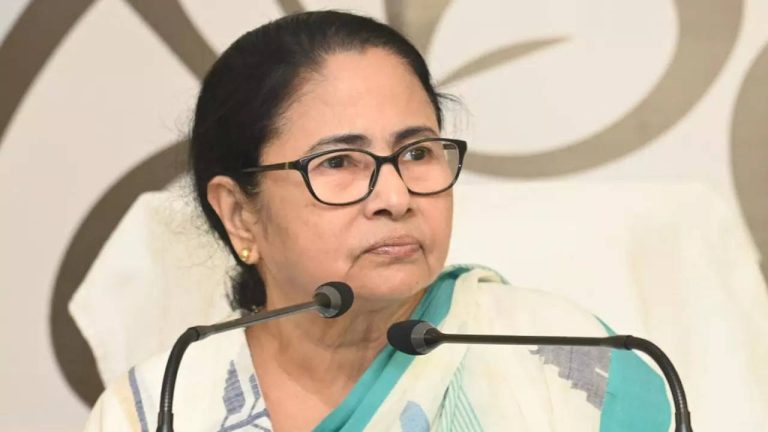
After being criticised for acting as a mute spectator to sexual violence against Hindu women in Sandeshkhali by her party leader Shahjahan Sheikh and his aides, Mamata Banerjee has broken her silence over the issue. Speaking at the State Assembly on Thursday, February 15, the TMC supremo gave a clean chit to her aide Shahjahan Sheikh and instead pinned the blame on the BJP and the RSS.

The chief minister targeted the BJP saying Sandeshkhali has become a bunker of (Rashtriya Swayamsevak Sangh) RSS. 

Further displaying complete apathy towards the women victims who have come on camera and spoken about the atrocities meted out to them by the TMC goons, Mamata Banerjee claimed that those who are covering their faces and are speaking to the media are BJP workers and she would get them arrested.

Giving a clean chit to her aide Shahjahan Sheikh and his supporters whom the local women of Sandeshkhali have accused of land-grabbing and sexually assaulting them under coercion, Mamata added that there are no records of rape with the West Bengal police. She hinted that the women of Sandheskhali have not been wronged and that this is a conspiracy hatched by the BJP to target TMC’s leader Shahjahan Sheikh.

“We are looking into the Sandeshkhali situation, no one involved in any wrongdoing will be spared, the BJPs’ target was a leader of the Trinamool Congress (Shajahan Sheikh),” Mamata Banerjee told the state Assembly.

Further attacking the media, Banerjee stated that fake media should be shut down and real media should function.

The BJP is spreading lies on Sandeshkhali and the police are taking action against people who are spreading lies, the CM said.

The WB CM further stated during the assembly that she has never tolerated injustice towards anyone and she never will. “We are looking into the Sandeshkhali situation; no one involved in any wrongdoing will be spared. I have sent the state women’s commission there and formed a police team for Sandeshkhali,” she said.

“A sinister design is at play to foment trouble in the area and the state government has taken all necessary actions to control the situation,” Banerjee added.

The West Bengal CM further said, “Our women’s team is present there. A police team is visiting people at their doorsteps to listen to their grievances. We will definitely address the issues that will be reported. I need to know the matter to act on it. RSS has a base there. Riots took place there 7-8 years back. It is one of the vulnerable riot spots. We handled the situation strongly during Saraswati Puja or else there were other plans.”

Mamata Banerjee’s statement came hours after the BJP MLAs staged a walkout from the assembly demanding a statement from the Chief Minister on Sandeshkhali, which has been on the boil over alleged atrocities on local, especially women, by ruling Trinamool leaders.

It is important to note that since the Sandeshkhali controversy erupted, the BJP has been questioning the lawlessness under Mamata Banerjee’s regime and why the woman Chief Minister of the state has turned her back on the victims. It has also raised fingers at Mamata Banerjee’s minister’s callous indifference towards the plight of the women victims and the high-handedness of the police in handling the issue.

Given the seriousness of the allegations, Mamata Banerjee’s police response has also been egregiously inadequate. The West Bengal police have sought to downplay the severity of the situation by blatantly denying the allegations of sexual assault and rape, calling them “misinformation.”

On Wednesday (14th February), West Bengal Police shared from their X handle that no allegations about the rape and sexual exploitation of women have so far been received in connection to the events in Sandeshkhali. The West Bengal Police also warned that “strict legal action will be initiated against sections of the media for spreading unfounded misinformation” in this regard. The police received multiple replies to this post criticising police handling of the Sandeshkhali issue. The police hid all these replies.

Besides, the West Bengal police, working at the behest of TMC supremo and CM Mamata Banerjee has been accused of shielding the accused TMC leaders, instead of taking action. Reportedly, during the protests, police accompanied the Trinamool Congress workers and harassed the protesting women.

Moreover, it emerged that instead of taking action against the accused, the WB police filed cases against relatives of victims for making complaints. This was revealed by Rekha Sharma, the chairperson of the National Commission for Women. 

UP: Five illegal under-construction colonies demolished in Bareilly, Rizwan Khan, Taufiq, Jagannath Rathore and others issued warnings

0

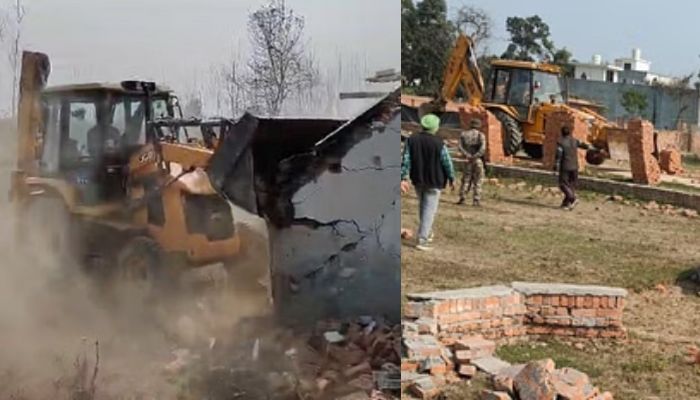
On Wednesday (14th February), the Bareilly Development Authority (BDA) conducted a demolition drive to clear illegal colonies in the area. Five illegal colonies were being constructed in Zulfikar village near Pilibhit road. The BDA team arrived at the encroachment site and bulldozed the illegal colonies.

According to BDA VC Manikandan A, two persons named Rizwan Khan and Taufiq were constructing a road to build a colony on around 12 bighas of land at Khajuriya Ghat. In addition to this, earth-filling work was underway. Another person named Munna Khan was constructing a road and boundary wall on 3,000 square metres of land, AmarUjala reported.

The report says that one Jagannath Rathore was constructing a road, drain, and office on 20 bigha of land in Rajpura Mafi village. When asked for the map, these persons failed to do so. Following this, the illegal constructions were razed. Moreover, road and boundary wall construction was underway on six bigha land in the Kamhara village.

Behind the village’s primary school, road and boundary wall construction was underway. A colony was being built here, however, the map for the same was not provided. All these constructions were demolished, and a warning was issued that if this happened again, a case would be registered against the involved persons. The demolition action was taken in the presence of Assistant Engineer Harish Chaudhary, Junior Engineer Sunil Gupta, and Raman Aggarwal.

BDA Vice President has urged the public to obtain documents from the coloniser while purchasing the land. The BDA officer advised people not to buy land in this area if the map is not approved adding that bulldozer action against illegal colonies will be taken in the future as and when required.

On 3rd February, action was initiated against the unlawful colonies being constructed along the Badaun Road. On 4th January, action was taken against illegal colonies near the Mahanagar Colony. Simra Ajuba Begum, Faridapur Inayat Khan, and Udla Jagir were colonised without first obtaining approval for the site plan and map. The unauthorised construction was destroyed.

Moreover, an illegal colony was being built on approximately 40 bighas of land in Chandrapur Bichpuri village, near the Ramganga Sector Housing Scheme. Demolition action was taken here on 18th December last year after a map was not provided. On 12th December, the authorities took action against eight unlawful colonies constructed on 106 bighas in the Bhojipura area.

Electoral Bonds Scheme: Whom did it benefit most, What does the SC verdict mean; All you need to know

The Supreme Court on Thursday (15th February) struck down the electoral bonds scheme which was notified in 2018.

The 5-judge bench ruled that the Electoral Bonds Scheme is violative of Article 19(1)(a) and the Right to Information Act and has to be struck down as unconstitutional.

The Supreme Court has called for the disclosure of funding to political parties “as it curbs corruption whereas non-disclosure affects exercise of electoral vote”.

What is the Electoral Bonds Scheme?

The scheme was announced in 2017 by then Finance Minister Arun Jaitley during the Budget Session.

In 2018, the Central Government notified the scheme of Electoral Bonds to “cleanse the system of political funding in the country”.

The scheme allows any Indian citizen and entity to buy electoral bonds by way of donating to a political party of their choice.

As per the scheme, the Electoral Bonds can be issued/purchased for any amount in multiples of Rs 1,000; Rs 10,000; Rs 1,00,000; Rs 10,00,000 and Rs 1,00,00,000 from the specific branches of the State Bank of India (SBI).

The scheme mandated political parties to withdraw the bonds within 15 days and only such political parties which hate a vote share of a minimum of one per cent.

Eligible political parties could encash the bonds only through a designated bank account with the authorised bank.

What were the arguments against Electoral Bonds Scheme?

While the Centre stated that the scheme would allow scope for transparency and curb black money, it came under criticism for its anonymity.

Under the scheme, the purchaser of the bonds was not required to reveal their identity which essentially made donors and donations anonymous.

Petitions were filed in the Supreme Court challenging the Constitutional validity of the scheme, its legality and alleged violation of the right to information. Petitioners argued that this could pave way for kickbacks.

The petitioners also argued that the anonymity in donations would promote corruption and open doors to shell companies.

What did the Supreme Court verdict state?

The Supreme Court began delivering its verdict by stating that voters have a right to information which is essential for them to cast their votes.

“There is a legitimate possibility that financial contribution to a political party would lead to quid pro quo arrangements because of the close nexus between money and politics,” the bench stated.

The SC ruled that the “Electoral Bonds Scheme and the impugned provisions to the extent that they infringe upon the rights to information of the voter by anonymising contributions through electoral bonds are violative of Article 19(1)(a)”.

The Supreme Court also delivered its verdict in response to the Centre’s argument that the right to information is limited in regards to the scheme to curb the flow of black money.

“Providing anonymity to the contributor incentivises them to contribute through banking channels,” the Centre had argued.

To this, the bench stated in its verdict, “The electoral bonds scheme is not the only means for curbing black money in electoral financing. There are other alternatives which substantially fulfil the purpose.”

The SC ruled that the infringement of the right to information is not proportionately justified to curb black money in electoral financing.

On the issue of donor privacy, the Supreme Court ruled that the right to informational privacy extends to contributions to political parties and is a facet of political affiliation.

The court said that it would be impermissible to not grant the umbrella of privacy to political contributions only because a portion of the contributions (corporate donors) is made for other reasons.

It further stated that the right to privacy of political affiliation does not extend to those contributions which may be made to influence policies.

The bench also ruled that unlimited political contributions by companies cannot be permitted for fear of influencing the political process through contributions which is much higher as compared to individuals.

The CJI while pronouncing the judgment, stated that the Union of India had “failed to establish least restrictive measures of the electoral bonds scheme for political funding.”

The bench ruled that the Electoral Bonds Scheme vis a vis the Companies Act, Finance Act and Representation of the People’s Act is violative of Article 19(1)(a).

In this context, the Supreme Court directed banks to stop the issuance of Electoral Bonds and ordered the State Bank of India (SBI) to disclose information on electoral bonds issued and cashed out and share it with the ECI within three weeks.

The ECI has been ordered to publish the said details on the website by 31st March 2024.

Following are the directions given by the Supreme Court:

a) SBI shall stop the issuance of Electoral Bonds

b) SBI shall submit the details of electoral bonds purchased since the interim order of SC dated 12 April 2019 to date to the ECI. The details shall include the date of purchase of each electoral bond, name and purchaser of the bond and denomination of the bond purchased

c) SBI shall submit details of political parties which have received contributions through electoral bonds since the interim order of SC on 12 April 2019 till date to ECI. SBI is to disclose details of each electoral bond encashed by political parties which shall include the date of encashment and denomination of EB

d) SBI shall submit the above info to ECI within three weeks i.e. by 6 March 2024

e) ECI shall publish the said information within six days of receiving that is by 13 March 2024

f) Electoral Bonds within the validity period of 15 days but not encashed by political parties yet shall be returned to the purchaser through the issuing bank. The issuing bank shall refund the amount to the purchaser’s account.

What does the Supreme Court judgment mean?

Essentially, the Supreme Court has limited its ruling to the nature of the scheme rather than the scheme itself.

On 2nd November 2023, the Supreme Court while reserving its verdict had reportedly stated that the scheme suffers from “serious deficiencies”.

In this context and going by the details of the judgement, it can be assumed that with required amendments to the problem areas identified by the SC, the scheme can still be reintroduced.

To this effect, the SC while reserving its order had suggested that a new system could be put into place and that it was not preventing the government from introducing a transparent scheme.

So while the SC has struck down the existing electoral bonds scheme, it has also pointed out through its judgment very specific loopholes that could allow the Centre to come up with an alternative scheme or system for electoral donations to political parties.

How much did political parties benefit from the electoral bonds?

As per reports, the BJP has received Rs 5,271.97 crore through electoral bonds between 2017-2022 followed by the Congress which has received Rs 952.29 crore; AAP Rs 50 crore; TDP Rs 113 crore; YSRCP Rs 330 crore; JD(S) Rs 43 crore; JD(U) Rs 24 crore; RJD Rs 2.5 crore; Shiv Sena Rs 101 crore; NCP Rs 64 crore; BJD Rs 622 crore; DMK Rs 46 crore; AIADMK Rs 6 crore.

In 2022-23, the BJP received nearly Rs 1,300 crore through electoral bonds followed by the Congress which received Rs 171 crore.

The Samajwadi Party reportedly received no contributions through electoral bonds in 2022-23 where as the Telugu Desam Party received Rs 34 crore in this period.

With Rs 325 crore, the Trinamool Congress (TMC) received 99.4 per cent of its contributions through electoral bonds in 2022-23.

Electoral Bonds contributed over 99 per cent to the DMK with Rs 186 crore; 84 per cent to the BJD with Rs 152 crore and 70 per cent to the YSR Congress with Rs 52 crore in 2022-23.

The BRS received 71 per cent through electoral bonds with Rs 529 crore in the same time period. The Aam Aadmi Party (AAP) received Rs 36.4 crore in electoral bonds.

This shows that the regional parties have been the biggest beneficiaries of electoral bonds.

Notably, in 2021-22, the TMC received 97 per cent of its contributions from unknown sources with Rs 528 crore; Congress received 72 per cent with Rs 389 crore; the BJP received 60.56 per cent with Rs 1,161 crore and CPM’s income was 48 per cent with Rs 79 crore.

TMC’s contributions through electoral bonds increased from ₹42 crore in 2020-21 to ₹528 crore in 2021-22.

In November 2023, Solicitor General Tushar Mehta pointed out to the SC that the CPM had more than 50% of its income through unknown sources despite not accepting electoral bonds since 2017-18.

Farmer leader Jagjit Singh Dallewal reveals true intention of ‘farmer’ protest, says PM Modi’s popularity graph rose due to Ram Mandir and it has to brought down

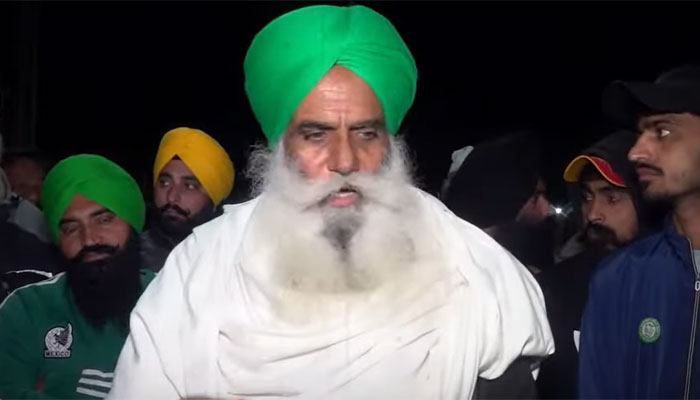
On 14th February, farmer leader Jagjit Singh Dallewal targeted Prime Minister Narendra Modi and said the government would agree to anything if his popularity graph went down. Speaking to The Unmute, Dallewal cited a scuffle between police and protesters and claimed it was a sign of the downfall of PM Modi and the Bharatiya Janata Party (BJP) ‘s tenure.

He further added that there is no democracy in the country as protesters were stopped from marching towards Delhi. Citing the barricades raised by the police and administration in Haryana, he claimed the police attacked the protesters, and several protesters were injured, but no one pelted stones at the police. However, there have been videos of protesters indulging in stone pelting at police personnel, leading to injuries.

Dallewal claimed BJP promised to implement Swaminathan’s recommendations in the manifesto

Dallewal claimed that the BJP promised to implement the recommendations of the Swaminathan Commission on Minimum Support Price (MSP). He claimed that despite the promise in the manifesto, BJP stepped back from implementing it. In reality, there was no specific mention of the Swaminathan Commission report or recommendations in the BJP’s manifesto from 2014. The “Agriculture – Productivity, Scientific and Rewarding” section of the manifesto mentioned that the party would “take steps to enhance profitability in agriculture, by ensuring a minimum of 50% profits over the cost of production, cheaper agriculture inputs and credit.”

Prime Minister Narendra Modi also suggested a similar formula that the Swaminathan Commission gave to calculate MSP during his political speeches before the Lok Sabha Elections 2014. However, he did not explicitly mention that his party would implement the recommendations of the Swaminathan Commission.

Notably, since PM Modi came to power, the central government has consistently increased the MSP yearly, which was revealed in reply to an RTI filed by OpIndia. Furthermore, relevant data shows that the gap between the MSP by Swaminathan formula and the formula used by the government is decreasing with time. For example, the current MSP for wheat is Rs 2,275 per quintal, and with the Swaminathan Commission’s recommendations, it would be Rs 2,478. However, in some cases, the gap is much higher. For example, in the case of Safflower, the gap is around Rs 2,321. While the government is trying to fill the gap and increase the farmers’ income, the protesters want immediate implementation of the Swaminathan Commission’s recommendations, which will have grave economic consequences. Data shows it will severely impact the government’s spending structure and push the government to cut down funding of projects, including infrastructure and defense.

Furthermore, it is also essential to learn how MSP is calculated. The Central Government determines the minimum support price (MSP) using a formula that considers production costs and sets the price at one-and-a-half times these expenses. This approach finds explicit costs (A2), which include payments for goods such as seeds, fertilizer, pesticides, fuel, irrigation, hired labor, and leased-in land and the estimated value of unpaid labour done by family members (FL). Notably, the government determines MSP for 22 mandated crops based on recommendations from the Commission for Agricultural Costs and Prices (CACP), as well as the views of state governments and concerned Central Ministries/Departments.

Dallewal vouched for lowering PM Modi’s graph

Dallewal pointed out that the protesters have to get the commitment made by the current government fulfilled if the regime changes after the elections; they may say they did not make the commitments, and the farmers have to restart the efforts. The way of doing it was to hit the popularity of PM Modi in the country. He said, “Modi’s popularity graph has risen due to the Mandir (referring to Ram Mandir in Ayodhya). I keep telling everyone we must find a way to lower his graph. He will not do anything till his graph is high. However, he will agree to anything if the government feels his graph is falling”.

The statement about PM Modi’s popularity graph indicates there is a political vendetta behind the farmer protests. It can be seen as an attempt to give political benefit to opposition parties for the upcoming elections.

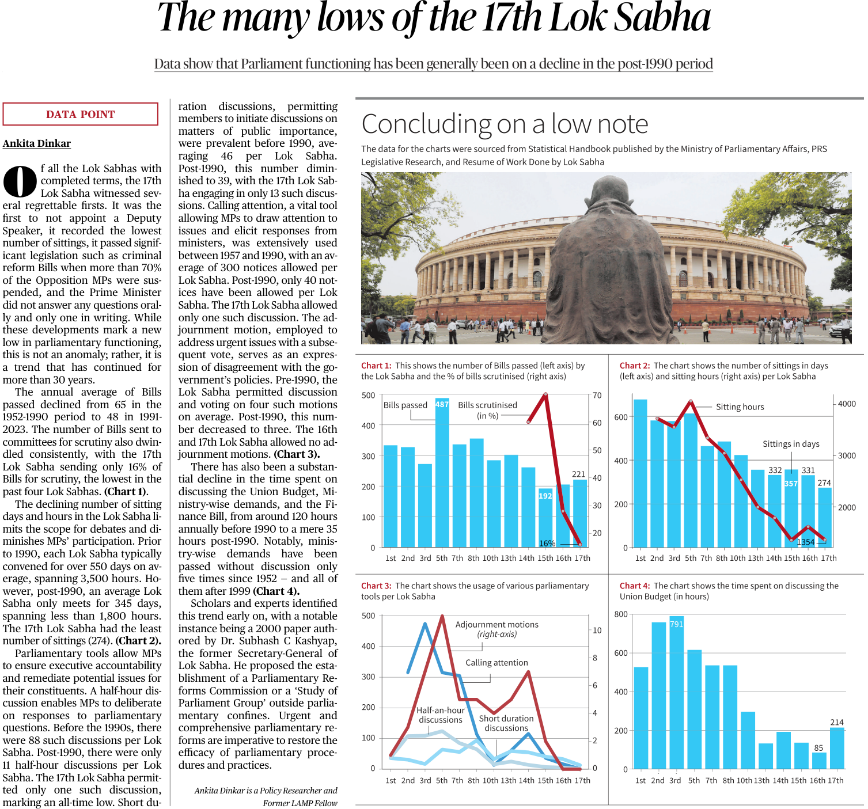
‘The Hindu’ talks about “many lows” of 17th Lok Sabha, here is why the 17th Lok Sabha was only about many highs, not lows

The Hindu published an article on Wednesday (February 14th, 2024) pompously titled “The many lows of the 17th Lok Sabha”. They frequently used the terms “a new low”, “all time low”, “the lowest”, to quantify certain data points that suit this false narrative. For even non-serious students of policy, law, politics and legislation, it is as evident as daylight that the 17th Lok Sabha is the most historic Lok Sabha that transformed an archaic Indian law into a modern, relevant and long lasting one.

Did you know that in the year 2019, for the first time ever in our independent history, the Modi government in the 17th Lok Sabha enacted a law that gives special protection to Transgenders? The Transgender Persons (Protection of Rights) Act 2019 prohibits unfair treatment to transgenders and makes them equal in law to the other two genders. Normally, you would have seen the woke crowd celebrating this Act but instead they would rather call this a “new low”.

Did you know that India did not have any law against doping in sports, until the 17th Lok Sabha passed the National Doping Act? While of course the act lists out punishments for doping (I still can’t believe we didn’t have a law before 2021!) and establishes an agency that will oversee this, this act also ensures that we do not have to depend on foreign agencies for doping related results/actions. Surely, an act that establishes punishment for getting “high” cannot be a “new low” for the 17th Lok Sabha!

Male and Female infertility is on the rise. Therefore, medical institutes offering various solutions to this problem are also on the rise. Did you know that India did not have a law that governs both surrogacy and assisted reproduction until the 17th Lok Sabha passed the Surrogacy Regulation Act, 2020 and Assisted Reproductive Technology Regulation Act, 2020. It is fairly common knowledge to understand how women can be taken advantage of, and how this will impact their health. Yet, it took a Modi government to bring in laws to regulate unethical practices and provide a legal backing to women. An “all time low”, eh?

Until the 17th Lok Sabha stepped up to achieve a “new low”, the law in India was that you can only enroll as a voter if you complete 18 years on or before January 1st. Meaning, if you complete 18 years on Jan 2, 2020 – you will be eligible to vote only next year, and not in the current year. That silly law has now been changed, again by the 17th Lok Sabha!

The 17th Lok Sabha strengthened the rights and lives of both employers and employees, by enacting Code for Social Security 2020, Code of Wages 2019, Industrial Relations code 2020, Occupational Safety, Health and Working Conditions Code 2020. You may wonder how these laws will impact lives of normal people? While stooping to an “all time low”, the 17th Lok Sabha has ensured that minimum wage has been generalised for all sectors now; overtime pay is mandatory; more money saved for your future. There is also clarity on fixed-term employment & trade union rules; there is gratuity eligibility for short periods; eases rules for lay-offs; allows for more flexibility in eligibility for leaves; special provisions for certain worker types; and increased focus on health of workers!

The English media never focussed on such game changing laws that were enacted by the 17th Lok Sabha. You may have noticed that I haven’t even touched about the much bigger and much larger generational transforming laws that the 17th Lok Sabha witnessed and enacted. Who can ever forget that the impeccable manner in which the dreaded Article 370 was abolished in August 2019, during the 17th Lok Sabha? The transformation that is brought to the lives of people in J&K and Ladakh, and more importantly the transformation it bought to the psyche of our country can never be quantified, much less classify it as a “new low”!

The 17th Lok Sabha increased the age of marriage from 18 to 21. Surely, a “new low”. The 17th Lok Sabha enacted the modern Telecommunications Act 2023, and the Digital Data Protection Act – something that is very relevant to this century at least. The 17th Lok Sabha enacted the much awaited, much delayed Women’s Reservation Bill. Post the next delimitation exercise we will have 1/3rd of seats reserved for women and therefore see an increased participation of women in law making. How can anything that increases participation get classified as a “new low”?

The 17th Lok Sabha rewrote our entire Indian Penal Code, Criminal Procedure Code and the Evidence Act – and enacted the brand new, fully relevant and modern criminal laws Bharatiya Nyaya Sanhita 2023, and the Bharatiya Nagarik Suraksha Sanhita 2023. The Bharatiya Sakshya Bill 2023, equally transformational in nature, has been referred to a standing committee for now. In a couple of years, all these three pivotal laws will be implemented and used for generations to come. How is it possible to reduce the passing of such transformational acts to a mere statistic?

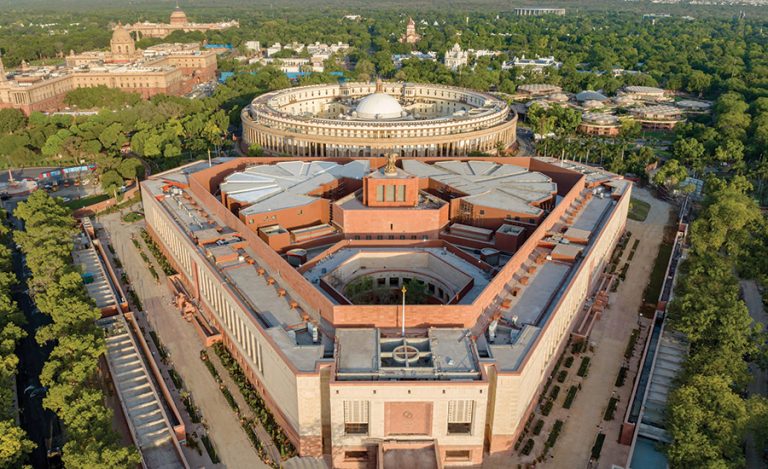
And the largest of all reforms – India’s Parliament moved into a much bigger, spacious and better building. The pride with which the nation watched the Prime Minister of India take the Sengol and install it on the Lok Sabha Speaker’s podium can never be quantified into mere statistics. It is very evident that the “new lows” that The Hindu wanted to paint pale in comparison to the “multiple highs” that the 17th Lok Sabha has achieved. No one anticipated that the 17th Lok Sabha will transform not just the 5 years of its term, but will rewrite laws that will transform generations. The Hindu’s article though, can easily be classified as a “new low” even by the low standards of The Hindu!