Home Blog Page 1495

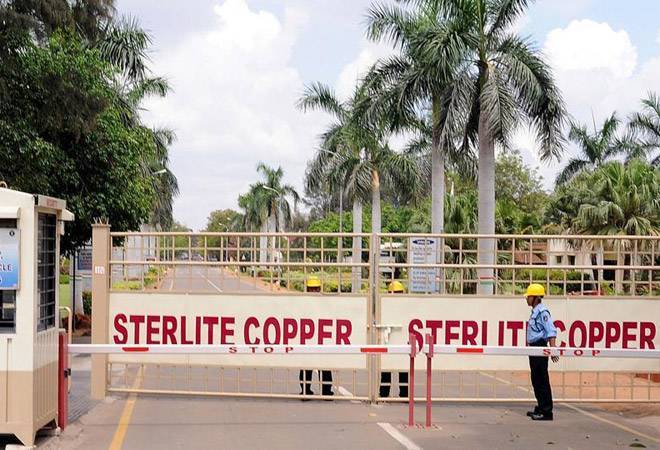
SC agrees to hear Vedanta Group’s plea over the closure of the Sterlite Copper Unit in Tamil Nadu

On Tuesday, the Supreme Court agreed to entertain the plea from the Vedanta group concerning the shutdown of its Sterlite copper unit in Tuticorin, Tamil Nadu.

Chief Justice of India D Y Chandrachud along with Justices J B Pardiwala and Manoj Misra, acknowledged the arguments presented by senior advocate Shyam Divan, representing the Vedanta group firm. Divan emphasized the necessity for the matter to be heard.

The Chief Justice of India said that he would notify the counsels involved once he confirms whether any constitutional bench matters are scheduled for a hearing during the day.

Previously, the Supreme Court had mentioned that it instructed the registrar to assign “two specific dates” for the hearing of the Vedanta group’s plea.

In May of the previous year, the Supreme Court had directed the Tamil Nadu government to make suitable decisions in compliance with its April 10 directive. This directive permitted the Vedanta group to undertake maintenance activities for its Sterlite copper unit in Tuticorin under the oversight of a local-level monitoring committee.

In its order dated April 10, 2023, the Supreme Court additionally granted permission for the removal of the remaining gypsum at the plant and facilitated the provision of necessary manpower as per the company’s request.

It was observed that the district collector had not endorsed actions such as conducting a civil and structural safety integrity assessment study within the plant premises, the removal and transportation of spares and equipment, and the evacuation of in-process reverts and other raw materials left idle.

The Supreme Court observed in its order dated April 10 that concerning actions not endorsed by the district collector, C S Vaidyanathan, senior counsel representing the State of Tamil Nadu, asserted that the state government would reevaluate whether additional or supplementary directions should be issued in that regard.

In a previous hearing, the representative for Tamil Nadu mentioned that measures had been initiated to execute the directives outlined in a specific paragraph of the April 10 order. This paragraph stipulated, “As regards those actions which have been permitted to be carried out by the communication dated March 6, 2023, we allow necessary consequential steps to be taken.”

“We instruct that the state of Tamil Nadu must make all necessary decisions in accordance with the observations outlined in paragraphs four and five of the order dated April 10, 2023, on or before June 1, 2023,” stated the bench.

The highest court had subsequently scheduled the hearing for final resolution on August 22 and 23 of the preceding year.

On May 22, 2018, a tragic incident occurred where at least 13 individuals lost their lives, and many others were injured as the police fired upon a large gathering protesting pollution allegedly stemming from the copper smelting unit.

Responding to the violent protests regarding pollution concerns, the Tamil Nadu government, on May 28, 2018, directed the state pollution control board to seal and “permanently” close the mining group’s plant.

Bangladeshi Nobel Peace Prize winner Muhammad Yunus sentenced to 6 months in prison: What happened

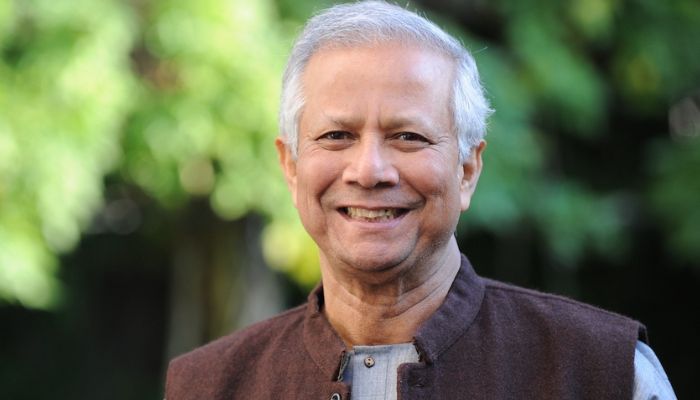
On Monday (1st January), a labour court in Dhaka found Nobel Peace Prize winner Muhammad Yunus guilty of violating the labour laws of Bangladesh. He was convicted, sentenced to 6 months of simple imprisonment and fined Tk 30000 (~$260).

As per reports, Yunus and three other directors at ‘Grameen Telecom’ violated labour laws by failing to create a welfare fund for the workers in the company. The 83-year-old economist is known for pioneering microfinancing (giving loans less than $100) to the poor in Bangladesh.

The labour court Judge, Sheikh Merina Sultana, noted that 67 Grameen Telecom employees were supposed to be made permanent in the company which did not happen. As per the company’s stated policy, it is supposed to share 5% of the dividends with the staff, which failed to materialise.

Yunus and his colleagues were each sentenced to 6 months of simple imprisonment. However, they managed to secure immediate bail from the court. They have 30 days to appeal against the labour court verdict.

It must be mentioned that the Nobel laureate is currently facing 100 other charges for graft and labour law violations in Bangladesh. While speaking to the media, Muhammad Yunus said, “We are being punished for a crime we did not commit.”

“It was my fate, the nation’s fate. We have accepted this verdict, but will appeal this verdict and continue fighting against this sentence,” he emphasised. Lawyers of Yunus have described the case as ‘meritless, false and ill-motivated.’

While speaking about the matter, prosecutor Khurshid Alam Khan said, “We think business owners will now be more cautious about violating labor laws. No one is above the law.”

Past corruption allegations against Muhammad Yunus

The 2006 Nobel Peace Prize winner founded Grameen Bank in 1983 to lend small loans to the poor. He had previously drawn the ire of Bangladeshi PM Sheikh Hasina for ‘sucking blood’ of the poor.

Yunus is being investigated over charges of corruption and fund embezzlement for more than a decade. He was earlier fired as Managing Director of his bank for violating retirement regulations of the Bangladeshi government.

He was also on trial for receiving money in 2013 for receiving money without government permission.

OpIndia impact: Proposed plan for Qabristan in Hindu locality canceled in Pune’s Kondhwa. Read details

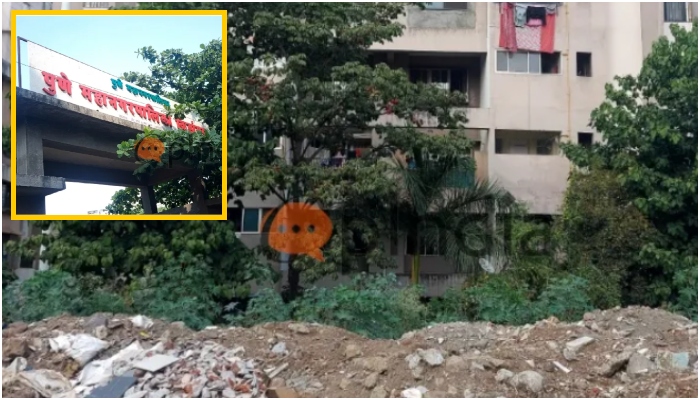
In an update to the case from Pune’s Kondhwa region where a government plot was being converted into a Muslim burial ground in the middle of a Hindu residential area, it has come to the fore that the Pune Municipal Corporation (PMC) has canceled the permission for the construction of the proposed Qabristan.

This is days after OpIndia exclusively reported the matter detailing the concerns of local residents after NCP MLA Chetan Tupe and BJP’s Yogesh Tilekar who had earlier requested the PMC to allow the construction of a burial ground for the minority community in a Hindu crowded locality.

BJP’s Yogesh Tilekar, after realising the concerns of the residents, pursued the matter and appealed to the PMC to cancel the proposed construction of the Qabristan in a Hindu-majority residential area.

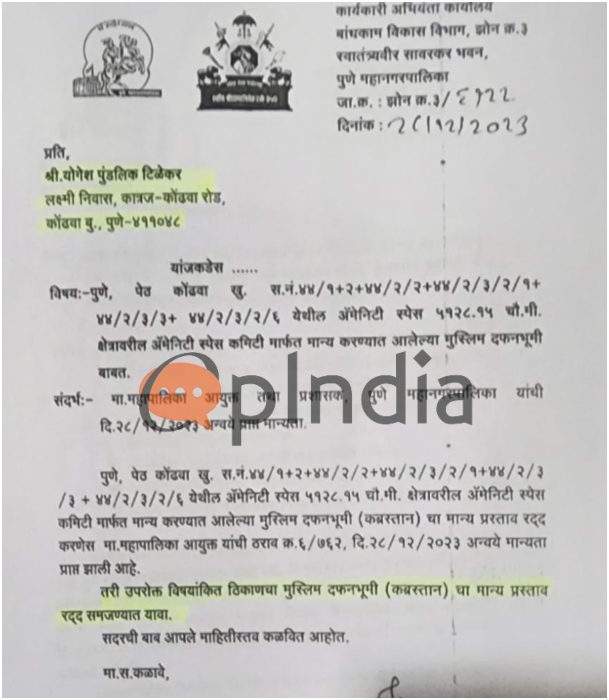
In an official letter copy to the BJP’s Tilekar who has served as the former MLA of the locality, PMC on 28th December stated that the amenity space on survey no. 44 plot which houses a jogging track at present shall not be converted into a Muslim burial ground. “The permission allotted to construct a burial ground in the given space stands canceled,” the official letter read.

Copy of the official letter obtained by OpIndia

Tilekar in May 2023 had submitted a letter to the PMC advocating for the construction of a ‘Qabristan’ on survey no. 44 land. The letter had stated that making a burial ground on survey no. 44 space would be feasible for the Muslim community given the maximum population that resides in the Kondhwa region of Pune is Muslims. The leader had failed to realize that the said space was in a crowded area and that around 12000 to 15000 Hindu families resided in apartments built around the space. The PMC on 16th May 2023 then approved the proposal based on the letter submitted by Tilekar.

However, Tilekar later backtracked from the suggestion, reportedly after realizing the problems of the Hindu locals and after he was informed about the issues in the area. Several Hindu residents residing in the locality raised objections against the construction of a burial ground for the minority community and said that the said space was allotted by the PMC for the construction of a playground. The Hindu residents also stated that there were several temples in the locality and that a ‘Qabristan’ being established very close to these temples might cause harm to the religious sentiments of the residents.

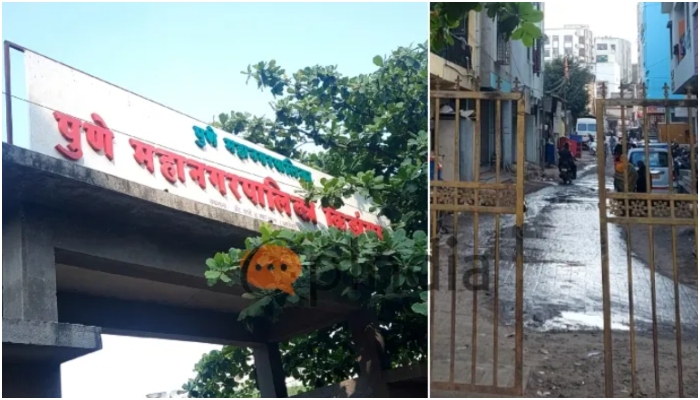
The residents also complained that the construction of burial grounds in a crowded locality would pose a threat to the health of residents residing near the said government land. There are several residential apartments close to the ground and many of them have windows and balconies opening towards the plot that was going to be converted into a Muslim burial ground.

Tilekar, after learning this, wrote to the PMC in October 2023 and requested the authorities to cancel the permission for the construction of the burial ground. The PMC is said to have taken the final decision on 28th December, canceling the permission for the construction of Qabristan in the Kondhwa region of Pune.

BJP’s Yogesh Tilekar exclusively talked to OpIndia and confirmed that the permission for the Muslim burial ground had been denied by the PMC. “I was anyway going to get it done. I am happy that I could be of help to the Hindu residents here,” he said.

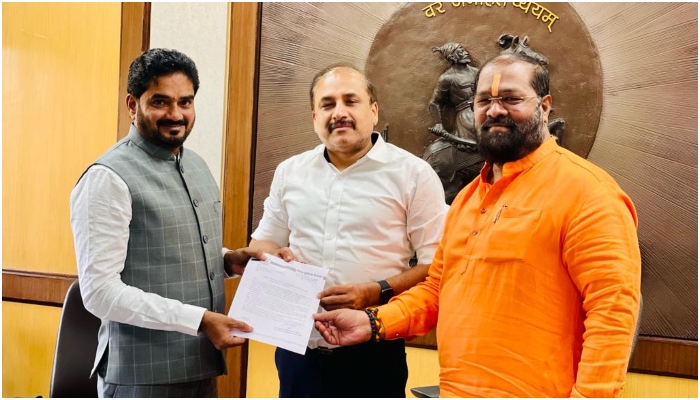
BJP’s Yogesh Tilekar (L) submitting letter to PMC demanding cancellation of permission for Qabristan (Image obtained by OpIndia)

Earlier, he had told OpIndia that he was misinformed about the survey no. 44 spaces and the ongoing project of playground construction on the land. “I didn’t know the land was already allotted by the PMC for a playground construction. Neither did the local Muslim representatives tell me nor the PMC. The letter I sent in May 2023 pressed for a burial ground on survey no. 44 space. However, after I learned that the maximum of population residing around the survey no. 44 space is Hindu, I sent another letter demanding the cancellation of the allotment of the land for a Muslim burial ground,” Tilekar said while talking to OpIndia.

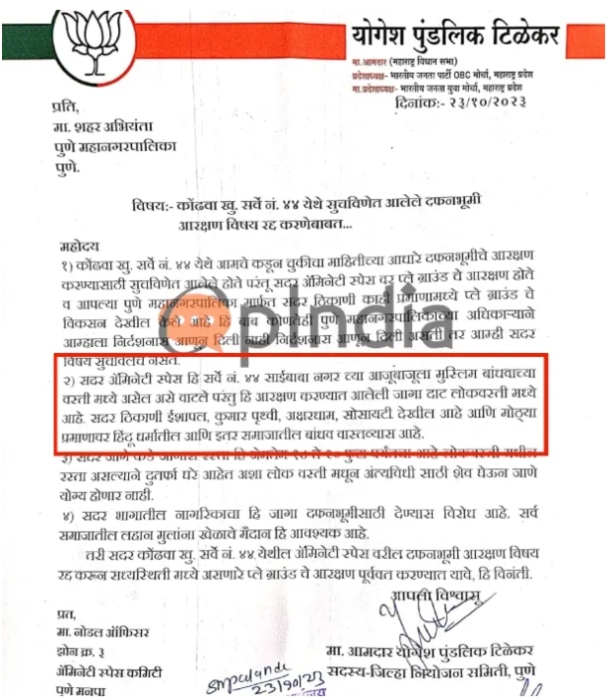
The letter of cancellation that Tilekar sent to the PMC on 23rd October 2023 clearly states that the survey no. 44 amenity space is located in a crowded area and most of the population that resides in the societies around the space is Hindu. “I first thought that the area housed a large Muslim population but I was misinformed. Most of the population residing in the locality is Hindu,” the letter reads.

Letter exclusively obtained by OpIndia

Rs 49 lakhs already spent for construction of playground, space still vacant

The entire incident was exposed after an RTI activist Dr Paritosh Zaware Patil residing in the Raviraj Colorado Co-op Housing Society (next to survey no 44 amenity space) filed an RTI demanding details of the location. It came to the fore that the PMC had already allotted the land for the construction of a playground and that the government had already spent Rs 43 lakhs for construction. Surprisingly, the land still is vacant and so had been trapped under the controversy over the Muslim burial ground construction.

The land was allotted for the construction of the playground in the year 2017 and in 2019 grant of Rs 43 lakhs for the purpose was also obtained. The project of construction of the playground was given to some Salim Construction in the year 2019 and Rs 49 lakhs had been spent for the purpose. “The land is still vacant and no playground has been constructed here. There’s just a jogging track inside. They want to make a Muslim burial ground here. This is a crowded locality and we don’t want our children to see things that are inappropriate for them,” Dr Patil had confirmed.

However, Patil talked to OpIndia on 2nd January and confirmed that the PMC had taken back its decision to allot the land for the Muslim burial ground. “We are happy that the decision has been taken back. We are not against the Muslim community. All we want is to keep our health and our children safe. Even if there was a request to build a Hindu burial ground there, we would have opposed similarly,” he reiterated.

Patiil and the other Hindu residents called OpIndia specifically and thanked us for highlighting the voice of residents in the issue. The community also hailed Tilekar listening to the residents, and being considerate of their concerns.

The detailed report filed on 14th December 2023 explaining the entire case can be read here.

Maharashtra ISIS module: How ‘Educated’ radicals with good jobs wanted to spread terrorism in India, NIA chargesheet reveals

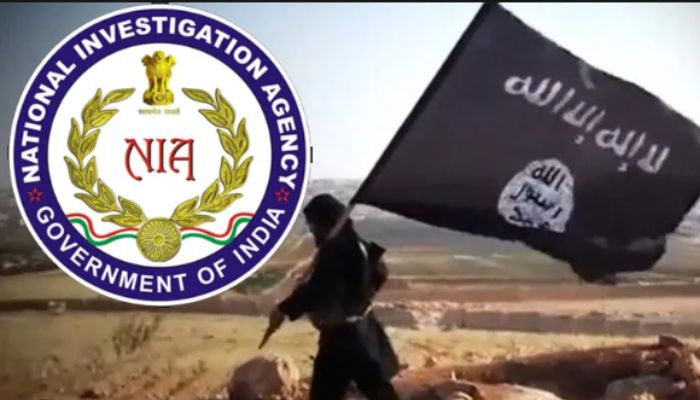
Shocking details have been revealed by the National Investigation Agency (NIA) in its charge sheet filed against six ISIS terrorists. The 4000-page charge sheet has been filed in the court of NIA Special Judge AK Lahoti.

In the charge sheet based on statements of 16 witnesses, the NIA detailed the activities of six arrested ISIS terrorists namely Tabish Siddiqui, Zulfikar Ali Barodawala, Sharjeel Shaikh, Aakif Nachan, Zubair Shaikh and Dr Adnanali Sarkar.

All six were arrested during NIA’s crackdown at different days on the Maharashtra ISIS module operating in Pune and Thane.

Accused are well-educated, had plush jobs & are “technically sound”

According to the charge sheet, the arrested terrorists are “technically sound”. Two of them were employed at senior positions in corporate firms.

Barodawala worked as a senior project manage in a multinational company with an annual package of Rs 31 lakh, Zubair Shaikh worked as a senior associate, technology angular on RPA (Robotics Process Automation) with a tech-based company. Sharjeel worked as a retainer in an IT firm.

This detail bears a scary resemblance to arrests made in the Hizb-u-Tahrir terror case too. Of the over 10 terrorists arrested by the Madhya Pradesh anti-terror squad (ATS), one was a gym trainer, a teacher, an auto driver, tailor, computer technician, businessman and software engineer.

Tabish Siddiqui

In 2015, Tabish came in contact with Barodawala. As per the charge sheet, the NIA first found access to an ISIS email ID was through the ISIS magazine.

Tabish sent an email to the terrorist group on 31st July 2016. On 25th February 2017, a reply was received that read, “good job update your contact details number and address we will be in touch.”

Between 2015 and 2017-18, Tabish and Barodawala had many meetings. They later took “Bayath” (pledge of allegiance) towards the Khalifa of ISIS.

ISIS eyeing Kashmir

The NIA has said that Tabish (33) visited Kupwara in Jammu and Kashmir in 2018 and stayed there for a week. Tabish sent an email to ISIS to update the latter on the situation in Kashmir and elaborated to them the plan to establish ISIS in Kashmir.

“Do It Yourself (DIY)” kits

Tabish, as per the NIA charge sheet, had shared a PDF file of a “do it yourself (DIY)” kit titled “efficincy pdf” with an email ID belonging to ISIS.

Tabish shared information on how to achieve the efficient intensity for a particular volume of white powder or any good explosive substance.

“Tabish was using virtual number and Virtual Private Network (VPN) for communication with co-accused and Islamic State contacts on Telegram, WhatsApp etc,” the NIA said.

Tabish also sent ISIS content to his contacts through Telegram app and Facebook messenger. He was in touch with his ISIS handlers including a “Formula One” from February 2023.

Tabish had plans to travel to join ISIS. He had reporedly prepared content and Urdu translations for publication in a magazine run by ISIS.

Another piece of content titled “Istishadi Operation” was prepared claiming that it denotes a suicide operation. His targets were mostly gullible Muslims.

Terrorist magazines including “Voice of Hind” and “Voice of Khurasan” were also recovered from the arrested accused.

Several meetings held to hatch violent conspiracies

As per the NIA, the accused planned to commit terrorist activities across India in support of ISIS. Meetings were held for this purpose in Padgha-Borivali of Thane district between 2021-22.

The NIA said, “It is evident from the statement of witness that accused A-2, A-4 and A-6 (Zulfikar Barodawala, Sharjeel Shaikh and Akif Nachan) and others (including Shamil Nachan, who is accused in another NIA case) had several meetings in Chhoti Masjid, Padgha-Borivali, wherein they used to plan recruitment of gullible Muslim youth for the Islamic State (ISIS), furthering the activities of Islamic State propagating the ideology of Daesh i.e. ISIS and to carry out violent jihad on the land of Al-Sham.”

Investigations have reportedly exposed a complex web of individuals committed to propagate the extremist and violent ISIS ideology in India. The accused intended to strike fear among the people of India.

Funds were also being raised and the accused were recruiting and training some youth to make IEDs and small arms.

Poor youth targeted to make them join ISIS

One of the most sensational arrests in the Pune ISIS module case was that of Dr. Adnan Ali Sarkar, who was a practicing anaesthesiologist.

He was arrested on 27th July 2023 after an NIA team conducted a raid at his Kondhwa residence in Pune, just weeks after the arrest of Tabish Nasser Siddiqui of Mumbai, Zubair Noor Mohammed Shaikh alias Abu Nusaiba of Pune, and Sharjeel Shaikh and Zulfikar Ali Barodawala of Thane.

Documents recovered from his flats revealed that Adnan was recruiting vulnerable youths. It had details of linking poor youth with terrorist organisations.

Was the Jewish Community Center on target?

Photographs of Jewish Community Center in Mumbai were recovered from four accused exposing that Jews in India were also under the target of Islamic Sate.

Security of Chabad House in Colaba was increased by the Mumbai Police. The Chabad House was one of the targets attacked in he 26/11 terror attack.

The terrorists intended to conduct aerial blasts through drones, conducted mock bomb blasts

One of the most shocking revelations is that the terrorists conducted bomb blast tests in the forests of Pune, Kolhapur and Satara. They lived in tents in the forest and learned the technique of aerial blast through drones.

The web of the Pune ISIS module case

In July 2023, the Pune Police arrested Shahnawaz and two people from MP, Mohammad Imran Khan and Mohammad Saki in connection with the theft of a two-wheeler in Pune. Shahnawaz managed to escape.

Further probe revealed a larger Pune ISIS terror module case. Three terrorists namely Talha Liaquat Khan of Pune and Rizwan Abdul Haji Ali and Abdullah Faiyaz Shaikh of Delhi were in the Pune Police’s most wanted list.

Shahnawaz was then caught by the Delhi Police in October last year. It was revealed that Shahnawaz’s wife was a Hindu named Basanti Patel who converted to Islam and was known as Mariyam. The search for Mariyam and her sister is ongoing.

Shahnawaz too was a graduate from Nagpur’s NIT with a Btech in mining. According to the NIA, Shahnawaz has links with the Barodawala, who is reportedly the mastermind and financer of the Pune ISIS terror module.

Barodawala provided training and money to Mohammad Imran, Yunus and Shahnawaz. Moreover, Akif Atiq Nachan, the IED expert, had hidden Imran and Yunus. Mohammad Imran is a graphic designer.

Akid had stayed in the Kondwa flat of Imran and Yunus for several days in order to train them. He gave bomb-making training in 2022 and showed how an IED is made. Agencies are on the lookout for some other people who were part of the training too.

A reward of Rs 5 lakh was put on Imran’s head by the NIA in the case registered in Chittorgarh, Rajasthan. Additionally, a case was filed against Imran and his two associates at the Kothrud police station. Later, a case was filed against all accused under UAPA.

The extensive charge sheet exposes how ISIS has been launching all-out operations in India by consolidating all terrorist groups. It has also unleashed a web of darker radicals who are pursuing the dangerous trend of self-radicalisation.

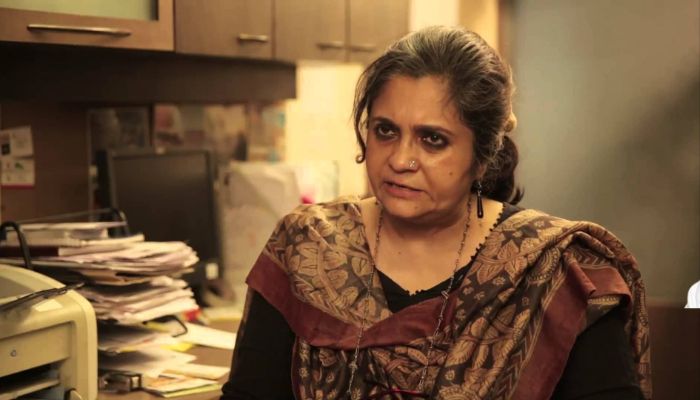
I am not inclined: Gujarat High Court indicates no relief for ‘activist’ Teesta Setalvad, who manufactured the narrative of ‘mass graves’ after Gujarat riots

On Monday (1st January), the Gujarat High Court indicated that it was not inclined to grant any relief to controversial ‘activist’ Teesta Setalvad in the 2005 mass grave digging case.

The matter came up for hearing before Justice Sandeep Bhatt. He noted, “After going through the record, I am not inclined. You have to satisfy (the court).”

Advocate Yogesh Ravani, representing Teesta Setalvad, claimed that it was a case of ‘political victimisation.’ He said, “It is the prerogative of the lordship. We will try to convince the court because no offence is made out. Ultimately, it is political victimisation.”

Justice Sandeep Bhatt then pointed out, “It is a very broad word used nowadays (sic). The case has been adjourned till 9th January 2023.

The Background of the Case

In December 2005, media reports stated that a mass grave purportedly comprising the human remains of 21 Gujarat riot victims had been dug up along a riverbank in Lunawada village in Gujarat’s Panchmahal district.

Rais Khan, an activist with Teesta Setalvad’s NGO Citizens for Justice and Peace, allegedly unearthed the graves without authorisation from officials on the morning of December 27. Some of the victims’ families were also present with him.

Following the discovery of the remains, Teesta Setalvad appeared on CNN IBN to disclose the finding, causing a sensation across the country. Following that, the National Human Rights Commission took cognizance of the discovery and requested a report from the state government.

An FIR was also filed against twelve people for unlawfully exhuming remains from the municipality’s “official” burial place. Rais Khan was also named in the FIR for assisting locals in excavating these dead bodies. The other 11 accused were local tribals and victims’ families who had commenced the digging.

Khan later informed the police that the exhumation took place on the directive of Teesta Setalvad, following which the latter’s name was included in the FIR. The controversial ‘activist’ had filed a petition in the case in 2017.

It must be mentioned that the unveiling of the mass grave site caused a stir across the nation. According to an affidavit from a journalist cited in the book ‘The Truth About Teesta Setalvad,’ Setalvad manufactured the narrative of the mass graves to create a sensation.

She immediately used her media contacts and leveraged them to advance her goal. According to the book, Teesta led the public into believing that the Gujarat government was involved in the mass burial of religious minority group members.

An excerpt from an affidavit submitted by a journalist who was present during the exhumation of the graves is cited. The Journalist’s words show how far Teesta went to twist facts and manufacture lies in order to back her bogus claims.

‘We lost our masjid and you can see what they are doing there’: Asaduddin Owaisi incites Muslims ahead of the Ram Mandir consecration ceremony

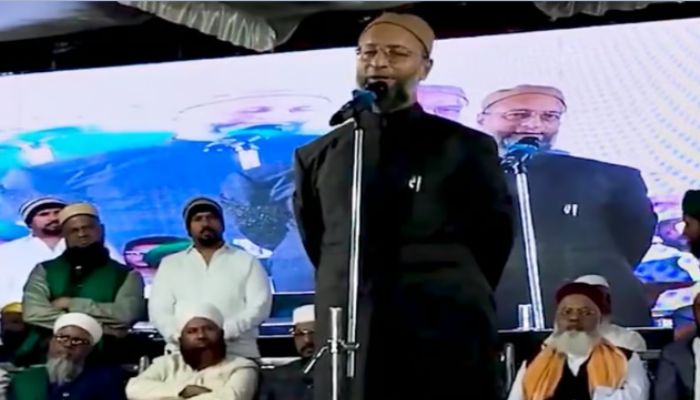
While the preparations for the grand consecration ceremony of Ram Mandir in Ayodhya are in full swing, AIMIM Chief Asaduddin Owaisi has given a provocative speech at an event organised at Madrasa-e-Arabiya Anwar-ul-Uloom in Hyderabad on 1st January (Monday). 

In his communally charged speech, he was heard inciting the Muslims against the central government and Ayodhya’s Bhavya Ram Mandir, the consecration ceremony of which is scheduled to take place on January 22, 2023.

His speech is going viral on social media. In the viral video, inciting the Muslim youth, Owaisi issued an appeal to the youngsters of the community to galvanise and inhabit mosques. Referring to the demolition of the disputed Babri structure at Ayodhya, he alleged that otherwise, Muslims would be bereft of Mosques and their mosques would be snatched away from them. 

In the viral video, Owaisi could be heard appealing to the Muslim youth to maintain their Milli Hamiyat (concern for community) and strength and keep their mosques populated (offer prayers in the Mosque). 

Inciting the youths of his community against the Modi-led BJP government at the Centre, he said, “Youngsters, I am telling you, we have lost our mosque and you are seeing what is being done there. Youngsters, don’t you feel any pain in your hearts?”

He added, “The place where we sat and recited Quran-e-Kareem for 500 years is not in our hands today. Youngsters, don’t you see that a conspiracy is taking place regarding three-four more mosques? In which the Sunhari Mosque of Delhi is also there. These forces want to drive you out of here. Want to finish you off.”

“These forces want to remove unity from your hearts. Why do they want this? Because Milli Geeraat should be abolished, Milli Hamiyat should be abolished. After years of hard work, we have arrived at our position today. You have to pay attention to these things,” Owaisi brazened it out. 

Addressing the gathering, Asaduddin Owaisi appeals to the youth of the Muslim community, ‘Maintain your Milli Hamiyat, your strength. Keep your mosques populated. It may happen that these mosques are taken away from us. I hope, Inshallah… these young men of today who will be the old men tomorrow… will keep their eyes ahead and think hard about how they can help themselves, their families, and their city, and save their neighbourhood. Unity is a strength, unity is a blessing.”

Owaisi emphasized that he hoped that today’s youth would think carefully about how to save the mosques. Owaisi also appealed to save madrassas. He said that our Ulemas were such that even when their funeral was held, people would accept Islam. What is happening today?

Further in his speech, Owaisi incited fear among the Muslim community and claimed that Muslims would have to answer Allah when doomsday arrived. He said, “Doomsday will come one day. Everyone will die but what answer will you give after death?”

Instigating the Muslim youth, he added that they should remember what face they will show to Allah after death. He asked youngsters to identify who wanted to destroy them.

Earlier, the New Delhi Municipal Council (NDMC) had sought public opinion on its proposal to remove the Sunhari Masjid in Delhi by January 1 adding that the mosque was causing traffic jams in the area. Referring to NDMC’s proposal, Owaisi claimed that the notification violates Article 25 of the Indian Constitution, which grants the fundamental rights to freedom and religion. 

According to the AIMIM Chief Owaisi, it is both a heritage place and a place of worship.

He added that the notification violates Article 29 citing that the Article says that culture should be protected, it has been a part of the culture. Fanning the narrative of Muslim victimhood and alleging the government to be anti-Muslim, Owaisi asked why does BJP and Narendra Modi government hate Muslims so much? Why do they hate mosques? Why do you hate the sound coming from mosques?

BJP retorts sharply to Asaduddin Owaisi’s communal speech

Launching a scathing attack on Owaisi’s communally charged speech, BJP spokesperson Prem Shukla said that Owaisi’s statement is inflammatory and shows a feeling of betrayal towards Hindus. He said that the construction of Ram temple in Ayodhya is being done completely under the constitutional system. He added that based on the decision of the Supreme Court, the birthplace of Shri Ram has been handed over to Hindus.

Meanwhile, the consecration ceremony of the Bhavya Ram Temple in Ayodhya is scheduled to take place on January 22. Preparations are underway in full swing for the event, which is expected to be attended by thousands of dignitaries and people from all sections of society. Vedic rituals for the Pran-Pratishtha (consecration) ceremony of Ram Lalla (infant Lord Ram) in Ayodhya will begin on January 16, a week before the main ceremony.

Over 7,000 guests comprising 3,000 VIPs have received invites from the Ram Mandir Trust. There will also be an invitation sent to the families of the karsevaks who lost their lives in the temple movement.

Further invitees consist of 4,000 seers, writers, journalists, scientists, Rashtriya Swayamsevak Sangh (RSS) president Mohan Bhagwat, yoga guru Ramdev and esteemed figures from all around the nation.

With the 7th January elections approaching, should Hindus in Bangladesh prepare for far worse persecution? BNP, Jamaat-e-Islami and challenge for Hasina

After 9-month’s bloody war, where three million Bengalis were butchered and 400,000 girls and women raped by the Pakistani occupation forces, on December 16, 1971, Bangladesh was born with the firm determination of being a secular country. Unfortunately, during the last 52 years, Bangladesh has been gradually slipping towards the identity of an ultra-Islamist country while there is growing fear of this South Asian nation becoming a neo-Taliban state. It may be mentioned here that, during the war of independence, Bengali Hindus were the worst-ever victims, as Pakistani occupation forces considered them as Kafir or infidels.

As the January 7, 2024 election approaches, there is growing fear within the Hindu populace in Bangladesh, as BNP, Jamaat and Islamist-jihadist forces in the country accuse Hindus of being supportive of Awami League and being its key driving force. Unfortunately, Awami League, which is supposed and expected to be protecting the Hindus in Bangladesh has also been accused of allowing persecution of Hindus, while according to several media outlets in India, Hindus in Bangladesh are “facing genocide” while the notorious Digital Security Act (now named as Cyber Security Act) has been used to “trap and jail many innocent Hindus”.

While the terminology “genocide” may be overstated – there is no argument about continuous persecution of Hindus in Bangladesh – irrespective of whichever party or force be in power. To understand the gravity of such continuous cruelty on Hindus in Bangladesh and how the country has been gradually heading towards ultra-Islamism, and antisemitism thus destroying its secularist fabric, it is important to understand the exact scenario that deserves the attention of the international media in particular.

A gruesome and horrible picture of Hindu repression is presented to the members of the media by a rights group in Bangladesh. The information said the members of the Hindu religious community have been subjected to various forms of torture and cruel persecution. This time, the ultra-Islamist Bangladesh Nationalist Party (BNP) and their ideological partner and ally – Jamaat-e-Islami (Jamaat) and pro-Islamist and jihadist forces including Hefazat-e-Islami (Hei) are trying to prevent the election and unseat Awami League government from power with visible blessings of Biden Administration. Since these ultra-Islamist and Hindu-hating forces cannot stop the elections, it is anticipated that they will start vandalism and terrorist acts targeting Hindus as had done in the past.

The statistics said, only in 2022, 154 members of the Hindu communities were killed, 849 have received life threats, and 424 have been attempted to murder while 360 have been seriously injured and 39 girls and women were raped in Bangladesh. At least 89,990 acres of land belonging to minority communities – mainly Hindus have been encroached on in the last year while 572 families were evicted from their homes and 445 families were forced to migrate to India.

Apart from this, a total financial loss of BDT 220 crore 89 lakh has been done to the minority community throughout the year.

Islamists have extorted BDT 27 crore 46 lakh and 33 thousand takas from Hindus. During this time, the minorities have suffered a total loss of BDT 22 crores and 89 lakhs of taka.

In 2022 alone, 319 Hindu families and temples were looted, 891 attacks on homes, 519 cases of arson and 173 attacks and vandalism on Hindu businesses took place. Around 57 Hindu houses, 50 business establishments and 51 temple lands were also encroached.

Despite Bangladesh’s one of the fundamental principles is secularism, the country has been inclining towards Islamism, Hindu-hatred and anti-Semitism.

Meanwhile, Bangladesh Nationalist Party (BNP) and its ideological ally Jamaat-e-Islami (JeI) and other Islamist forces in Bangladesh have chosen to boycott the upcoming election and resorted to destructive acts including blockades and terrorist attacks to destabilize the country’s law and order situation with the desire of toppling Sheikh Hasina and capturing power through undemocratic process.

As BNP’s anti-election attempts are faltering and there are speculations of the party being isolated and even going extinct, top brasses of the party are expressing anger at India for supporting Sheikh Hasina and ruling Awami League in holding the upcoming general election and ensuring its straight fourth term. This frustration is leading to a reassessment of BNP’s relationship with India, with instructions to mobilize anti-India and anti-Hindu sentiments to attract support from the Muslim masses.

According to media reports, BNP has decided to reevaluate its relationship with India as the neighbouring country is openly supporting the ruling Awami League in connection to the January 7 general election. BNP’s acting chairman Tarique Rahman has already instructed party leaders to mobilize anti-India and anti-Hindu sentiment in Bangladesh, as Tarique believes, such a move would help BNP attract enhanced support from the Muslim masses in the country.

BNP Senior Joint Secretary General Ruhul Kabir Rizvi told reporters that “with the unilateral support of India, Awami League is heading towards holding another voter-less election in Bangladesh. Delhi has snatched away the fate of Bangladeshi citizens and played a key role in killing democracy for its interest”.

He further said, “in the name of stability, India has extended its support to dictatorship”.

Reports suggest that BNP plans to launch a massive campaign targeting Indian Prime Minister Narendra Modi, the ruling Bharatiya Janata Party (BJP), and Rashtriya Swayamsevak Sangh (RSS), using religious and nationalist sentiments to brand them as enemies of Islam and Bangladesh.

With such a nefarious agenda of the Bangladesh Nationalist Party (BNP) and its Islamist allies, Hindus in Bangladesh may face extreme cruelties following the January 7 general elections, while BNP-Islamist cohorts and propagandists in the West may further intensify their notorious activities targeting Hindus and India.

According to media reports, a pro-Islamist individual and BNP propagandist named Zulkarnain Saer Sami, alias Zulkarnain Saer, alias Zulkarnain Saer Khan Sami alias Tanvir Md. Sadat, who after being deported from Hungary landed in the United Kingdom and sought asylum has been running activities against India, Hindus and Israel and in the recent past threatened to behead a Bangladeshi Hindu rights activist and professor named Kushal Baran Chakraborty and termed Rashtriya Swamsevak Sangh (RSS) as “top terrorists”. Prominent media outlet EuroNews reported that this notorious jihadist terrorist has been plotting attacks on the Israeli embassy as well as Jewish synagogues, homes and business establishments, while he also reportedly is plotting attacks on Jewish community members in Britain.

Zulkarnain Saer’s criminal activities are not confined to Bangladesh and Britain – he has also been implicated in transnational drug trafficking networks. He was expelled from Hungary due to his involvement in a series of illegal activities, which he conducted under the façade of running a restaurant business in Budapest. This establishment served as a nexus for individuals engaged in unlawful activities, including connections with the Lebanese terrorist group Hezbollah and the Palestinian terrorist outfit Hamas.

According to the Terrorism Research & Analysis Consortium (TRAC), which is one of the most comprehensive compendiums of information and analysis of terrorist groups and activities in the world, jihadist Zulkarnain Saer Khan threatened to behead a Hindu rights activist and professor Kushal Baran Chakraborty in Chittagong, Bangladesh. It may be mentioned here that TRAC has listed Zulkarnain Saer as a jihadist terrorist.

Describing the notoriety of Zulkarnain Saer Khan, on June 25, 2022, Rashmi Samant, Hindu human rights activist and former president of the Oxford University student union tweeted stating: “Kushal Baran Chakraborty ji is a good friend and a well-known Bangladeshi Hindu Activist who is currently being dog-whistled by one the biggest Jihadi Pages of Bangladesh. They are posting everything from his address to his occupation to his regular routes”.

Reshmi Samant further wrote: “His crime? He has an old photo with @myogiadityanath ji and that is worthy of a death sentence in Bangladesh. One of the biggest jihadi pages of the country “Basherkella” has posted a long thread making blasphemous accusations”.

In a Facebook post dated June 27, 2022, pro-jihadist culprit Zulkarnain Saer Khan wrote:

The best thing about posting about Kushal Baran Chakraborty, a teacher at Chittagong University, about his involvement with the top cadres of the extremist organization RSS in India and its Hindutva propaganda is that it has become clear that Kushal is in fact their best friend.

Kushal is now giving “dharna” to people who are involved in RSS and Hindutva propaganda in different places and sharing various news about me published with the help of Bangladesh government and asking people to post them again.

With such intelligence, it is difficult to come up with RSS propaganda. He has approached an individual who had to resign as president of the Oxford University Student Union over racist posts. The woman [Rashmi Samant] is so smart that she is sharing the news of the propaganda newspaper Blitz on her verified Twitter [account] stating I have threatened Kushal!

Mr. Kushal can meet individuals like Yogi Adityanath, RSS hoodlum Keshab Prasad, Sanatan Vidyarthi with the secret plot of spreading Hindutva propaganda in Bangladesh and writing about this causes problem?

It may be mentioned here that, Sami maintains links with several jihadist outfits including Hizbul Mujahedin, Lashkar-e-Toiba and Pakistani spy agency Inter-Service Intelligence (ISI).

For the last several weeks, BNP propagandist Zulkarnain Saer Khan has been continuously publishing anti-India posts giving instigation to attacking Hindus in Bangladesh for “supporting Awami League” and serving “New Delhi’s agenda”.

Commenting on the persecution of Hindus in Bangladesh, Sumit Ganguly in an article in Foreign Policy magazine wrote, “Bangladesh’s Muslim majority has long had a divided identity. On the one hand, Bangladeshis are attached to the Bengali language, which is largely seen as a source of shared cultural pride. Linguistic discrimination more than any other factor led the nation into its 1971 independence war. (People in Pakistan, then West Pakistan, predominantly speak Urdu and Punjabi.) On the other hand, Islam has uniquely permeated present-day Bangladesh. It arrived in what was then the province of Bengal relatively late: around the 13th century, well after the Muslim conquests of present-day Pakistan and northwestern India. Unlike elsewhere on the subcontinent, Muslim rulers in Bengal introduced their religion slowly. The peasantry adopted their agricultural technology, their values, and eventually their faith—absent the orthodox norms common in other parts of the Islamic world.

However, Bangladesh’s moderate version of Islam began to shift in the 1980s, in part because of the growing influence of Wahhabism. Saudi funds enabled the building of madrassas (religious schools) and mosques, as well as supported radical imams. At the same time, many Bangladeshis travelled to the Persian Gulf in the wake of the 1970s oil boom, becoming exposed to a more rigid version of Islam. They returned to Bangladesh flush with their earnings and newfound religious zeal. The country’s largest Islamist political party, Bangladesh Jamaat-e-Islami, likely courted these returning expatriates.

Against this backdrop, several radical Islamist organizations emerged, particularly in the last two decades. Among the most prominent are Ansarullah Bangla Team, Hizb ut Tahrir, and Jamaat-ul-Mujahideen Bangladesh (JMB). These groups have attacked secular intellectuals, terrorized the Hindu community, and launched dramatic terrorist attacks, including in Dhaka, the capital. They have sought to intimidate those who dare to challenge their vision of Islam, including educators, journalists, and even politicians. Although the government has spoken out against Islamist extremism, its willingness and ability to crack down on these organizations has not been sufficient.

The Bangladeshi government’s track record does not offer much comfort in the wake of the recent violence. When the centre-right Bangladesh Nationalist Party ruled in an alliance with the Bangladesh Jamaat-e-Islami party from 2001 to 2006, the government was widely seen as unsympathetic to ethnic and religious minorities. Despite its secular values, the ruling Awami League party has not demonstrated any great commitment to protecting the Hindu community and other minorities. Barring a few constituencies, neither major party relies on minority electoral support.

Unfortunately, Hindus in Bangladesh do not have much choice. They cannot align with the ultra-Islamist and pro-Pakistan Bangladesh Nationalist Party (BNP) or its jihadist cohorts Jamaat-e-Islami, Hefazat-e-Islam etcetera. On the other hand, though they cannot have confidence in the Awami League, still they remain in the frying pan instead of jumping into the fire. Politicians continue to shed crocodile tears in favour of Hindus, despite the fact, that a large number of them are directly or indirectly responsible for grabbing Hindu properties and or remained silent on ongoing Hindu persecution in Bangladesh. Still, Hindus in Bangladesh shall vote on January 7, without knowing – what fate awaits them following this election.

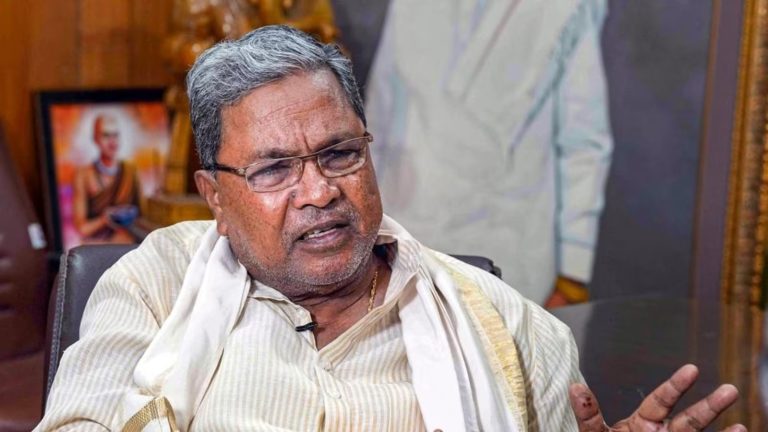
‘Ayodhya’s Ram is BJP’s Ram, our Ram is CM Siddaramaiah’: Congress leader in Karnataka

Congress leader and former Karnataka minister, H Anjaneya, stoked a major controversy on Monday, equating Chief Minister Siddaramaiah with Lord Ram.

Further ruffling feathers in the saffron camp amid the feverish anticipation around the grand opening of the Ram Temple on January 22, the Congress leader said the idol to be installed inside the sanctum sanctorum in Ayodhya would be ‘BJP’s Ram’.

The minister’s remarks close on the heels of the CM’s statement earlier this week that since he hasn’t received a formal invitation to the consecration ceremony at the Ram Temple this month, he has yet to decide on attending the event.

Speaking to reporters on Tuesday, Anjaneya said, “He (Siddaramaiah) is our Ram. Why should he visit Ayodhya for the consecration event? He could pay obeisance at his native village which has a Ram temple.”

“Why should he go there (Ram Temple in Ayodhya)? The idol that is to be installed there is the BJP’s Ram. They are only sending out invites to BJP people and singing bhajans (devotional songs). So, let them do that. Our Ram is everywhere, he’s in our hearts,” the Congress leader added.

Further accusing the BJP of dividing people along the lines of religion and communities, the Congress leader said the ruling party wasn’t prioritising the larger ‘social issues’ that the country is grappling with.

“The BJP always does this, dividing people on the lines of religion and community. They are aggressively wooing a particular community for votes at the expense of others,” Anjaneya said.

“They are talking big about raising the Ram Temple when homeless people in the country are literally living in the gutter. They are spending days and nights under trees. They should build affordable homes for them, give them a better life. Those would be the ideal Ram temples, as opposed to raising a shrine for votes,” the Congress leader said while speaking to reporters in Chitradurga on Monday.

Hitting back at the Congress leader over his statement, BJP leader Basanagouda Patil Yatnal cautioned him to speak of Lord Ram and other Hindu deities with respect and dignity.

“It is our misfortune that such idiots, anti-Hindu (leaders) have been our ministers,” Yatnal posted on X.

Prime Minister Narendra Modi is set to attend the consecration ceremony of the Ram Temple on January 22.

Preparations are underway in full swing for the event, which is expected to be attended by thousands of dignitaries and people from all sections of society.

The idol carved by sculptor Yogiraj Arun from Karnataka has been finalised for the consecration at the Ram Temple on January 22.

Vedic rituals for the Pran-Pratishtha (consecration) ceremony of Ram Lalla (infant Lord Ram) in Ayodhya will begin on January 16, a week before the main ceremony.

According to the Sri Ram Janambhoomi Trust, arrangements will be made for 10,000-15,000 people. 

(This news report is published from a syndicated feed. Except for the headline, the content has not been written or edited by OpIndia staff)

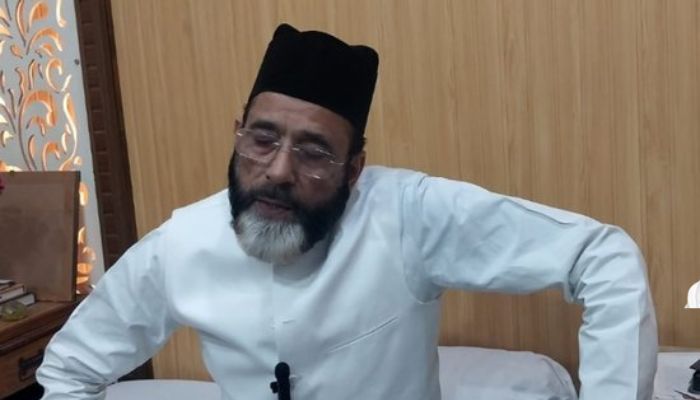
Maulana Tauqeer Raza, who made genocidal speeches against Hindu community, oversees preparations for ‘All India Muslim Mahapanchayat’

On Monday (1st January), radical Islamic preacher Maulana Tauqeer Raza Khan reached Gajraula city in Amroha district of Uttar Pradesh to oversee preparations for the ‘All India Muslim Mahapanchayat.’

As per reports, the communal event is scheduled to take place in the first week of February this year at the Ramlila Maidan in New Delhi. When Maulana Tauqeer Raza reached Gajraula, he was welcomed by his fellow co-religionists.

The Islamic hate preacher claimed that Dalits and other ‘marginalised groups’ would participate in the ‘All India Muslim Mahapanchayat.’ He said that efforts would be undertaken to end the atmosphere of hate in the country.

Maulana Tauqeer Raza lamented that all political parties have supposedly distanced themselves from the ‘Muslim society.’ Interestingly, the Islamic preacher who was mouthing platitudes about uniting the Indian society had previously made genocidal speeches against the Hindu community.

During a public meeting in Bareilly in January 2022, he was heard saying, “I want to warn my Hindu brothers that I’m scared that the day my Muslim youths are forced to take the law into their hands, you will not find a place to hide anywhere in India.”

Maulana Tauqeer Raza was seen issuing veiled threats over the death of two cow smugglers. He had also hinted that Muslims in India could start demanding a separate nation along religious lines.

The radical Islamic preacher had also warned of ‘street fight’ with Hindus over Gynavpai mosque, which has been built atop a Hindu Shiva temples in Varanasi. He had also sided with gangster Atiq Ahmed and falsely blamed Uttar Pradesh CM Yogi Adityanath for his assassination.

Timeline of the proposed ‘All India Muslim Mahapanchayat’

A large congregation of Muslims was scheduled to take place at Ramlila Madian on the 29th Oct this year. Initially, the organisers of the communal event ‘All India Muslim Mahapanchayat’ even succeeded in getting permission from the Delhi police by dubbing it as ‘education about constitutional rights.’

When the police discovered the communal nature of the ‘All India Muslim Mahapanchayat,’ they revoked the permission granted to MSC. The organisers then moved the Delhi High Court, only to be told to re-schedule his event after the Hindu festive season was over.

The event was then rescheduled from 29th Oct to 4th Dec. Delhi police turned down the request, highlighting that it had already granted permission to an organisation named ‘Maha Tyagi Sewa Sansthan’ (which sought NOC two days before MSC).

The organisersyet again moved the Delhi HC, following which the court asked the MCD and the Delhi police to provide a date that is convenient for organising the ‘All India Muslim Mahapanchayat.’ As such, the event was postponed to 18th December, 2023.

But it was deferred yet again after the organisers failed to provide a written assurance to the Delhi Police about the safe and smooth conduct of the event. ‘All India Muslim Mahapanchayat’ is now scheduled to take place in first week of February 2024.

Saudi Arabia, UAE, Egypt, Ethiopia and Iran officially become BRICS members, 2024 summit to be held in Russia’s Kazan

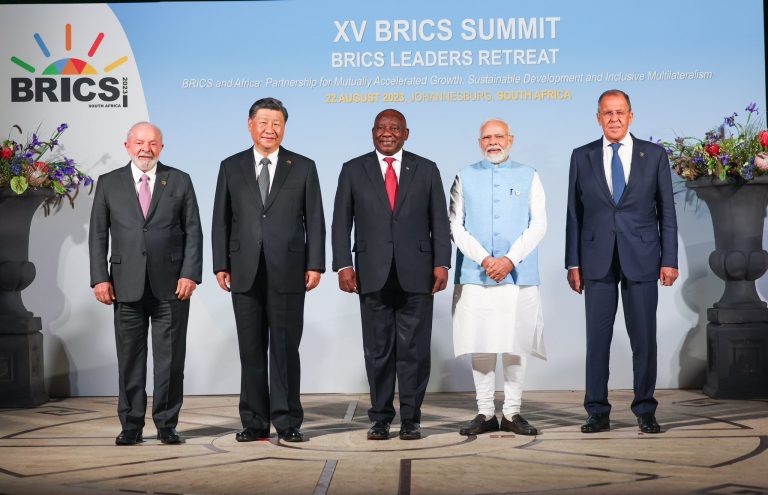
5 new countries, Saudi Arabia, UAE, Egypt, Iran, and Ethiopia have officially joined BRICS on 1 January 2024, as per reports. The membership initiation process started in August 2023 in South Africa and was formalized on Monday and the 5 new nations were welcomed into the bloc has Brazil, Russia, India, China, and South Africa as initial members.

At the South Africa BRICS summit in August this year, invitations were extended to some nations and some nations had expressed interest in joining the group of emerging powerful economies. The Johannesburg summit had formally invited these 5 nations to join, as per reports, registering their economic potential and geostrategic positions.

It is notable here that in the Johannesburg summit, Argentina was also invited to join, as Argentina’s former government had expressed an interest in making the country a BRICS member. However, Javier Milei, the new President of Argentina, had decided to withdraw the BRICS application. Milei’s policies are more USA-centric.

It is notable here that with the beginning of 2024, President Vladimir Putin of Russia has taken over the rotating leadership of BRICS. this year. The next BRICS summit is going to be held in Kazan, Russia in October 2024, and Russia has planned to host over 200 economic, social and political events around it.

The BRICS leaders have been assertive about the fact that the world is becoming multipolar, and a growing number of nations are seeking alternatives to the current order where the West, led by the USA, seeks dominance.

Speaking in the Johannesburg summit in August, PM Modi stated that with the inclusion of the new members, BRICS will be able to infuse new momentum and new energy into the bloc’s cooperation. He noted that India has had very deep and historic relations with the new BRICS members, adding that new dimensions will be also added to the bilateral cooperation.

Together the BRICS nations account for 42% of the global population, more than 3 billion people. They account for over 26% of the global economy and have a combined GDP of over 23 trillion USD. The BRICS nations control over 30% of the world’s territory and 18% of global trade.

With Saudi Arabia and UAE as members, the BRICS now includes the largest and strongest economies of the Arab world in its sphere.

It is notable here that over 40 nations had applied to join BRICS this year. A detailed explainer of the group’s founding, goals, and strategies in the current geopolitical scenario can be read here.