Home Blog Page 1637

‘Carrying out precise operation against Hamas in Al Shifa hospital, providing incubators, medical supplies to patients’: IDF says

0

Israel Defence Forces have confirmed that they are carrying out precise, and targeted operation in a specific region in Al-Shifa Hospital in Gaza. The operation is being carried out based on intelligence information and an operational necessity.

“The IDF is conducting a ground operation in Gaza to defeat Hamas and rescue our hostages. Israel is at war with Hamas, not with the civilians in Gaza. Forces include medical teams and Arabic speakers, who have undergone specified training to prepare for this complex and sensitive environment, with the intent that no harm is caused to the civilians being used by Hamas as human shields,” the IDF said in an official statement.

In recent weeks, the IDF has publicly warned time and again that Hamas’ continued military use of the Shifa hospital jeopardizes its protected status under international law, and enabled ample time to stop this unlawful abuse of the hospital.

“Yesterday, the IDF conveyed to the relevant authorities in Gaza once again that all military activities within the hospital must cease within 12 hours. Unfortunately, it did not,” the IDF statement added.

In addition, the IDF coordinated large-scale hospital evacuations and kept lines of communication open with hospital administration.
“We call upon all Hamas terrorists present in the hospital to surrender,” the IDF said.

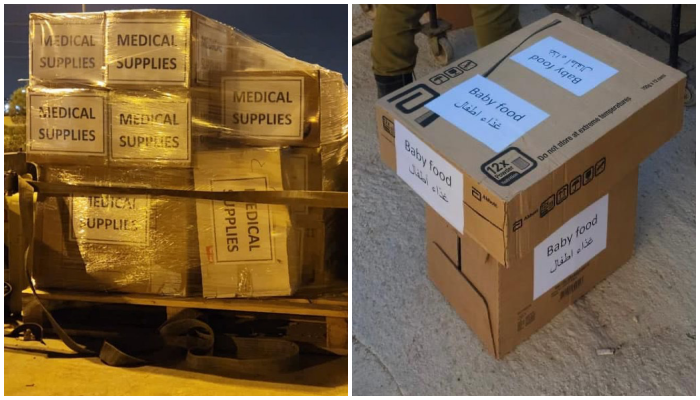
The Israel Defence Forces on Tuesday announced that it is coordinating the transfer of incubators, baby food, and medical equipment from Israel to hospitals in the Gaza Strip, reported The Times of Israel. Arabic-speaking personnel have been deployed to ensure the supplies reach patients and are not misused by Hamas.

Shifa and other hospitals in Gaza City have complained of fewer supplies and patient deaths due to the Israel-Hamas war, which has pressured Israel to put more effort into protecting Gazan civilians caught in the crossfire, The Times of Israel reported.

The IDF has also shared a video of the Coordination of Government Activities in the Territories (COGAT’s) spokesperson on X, stating that the war is against Hamas and not the people of Gaza. “The pediatric ward at Shifa Hospital in Gaza City needs assistance. Israel is ready to assist,” she said.

The spokesperson further said, “We made a formal offer to health officials in Gaza to transfer incubators into the Gaza Strip to assist the pediatric ward of Shifa Hospital. Extensive efforts are underway to ensure that these incubators can reach babies in Gaza without delay.”

The IDF further stated in its post that Israel is doing everything to minimize harm to civilians and facilitate the transfer of medical supplies and food.

Moreover, according to the latest development, the Israeli troops of the 7th Armored Brigade and Golani Infantry Brigade have captured several Hamas governmental buildings in the Gaza City neighbourhoods of Sheikh Ijlin and Rimal.

Among the sites captured by the troops are the Hamas parliament, its government complex, and the police headquarters.

(This news report is published with inputs from ANI)

Andhra Pradesh: Sacred tank of Venugopala Swamy temple in Chittoor used for the conversion of Hindus to Christianity, local church members booked

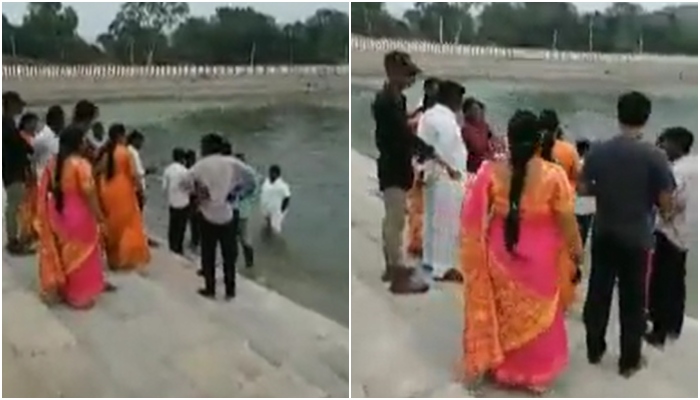
On Tuesday (14th November), the Andhra Pradesh Police filed a police complaint against members of local churches in the city of Chittoor for using the sacred Hindu Temple tank to convert local Hindus to Christianity. The complaint was filed after some of the locals complained that the church authorities had performed baptism on Hindus at the Pushkarini of Venugopala Swamy temple on Monday (13th November).

The incident is said to have happened in the Karvetinagaram village of Chittoor district. The video of the said incident has gone viral over the internet in which people can be seen gathered around the Skanda Pushkarini of Venugopala Swamy Temple. Notably, the temple is administered by Tirumala Tirupati Devasthanams (TTD).

Bharatiya Janata Party (BJP) state spokesperson P. Bhanuprakash Reddy took cognizance of the incident and demanded appropriate legal action against the church authorities. The leader directed the local police to identify the church individuals who were seen performing baptism on Hindus in the sacred Hindu temple tank while converting them to Christianity.

According to a report by Deccan Chronicle, Reddy visited the temple on 14th November and sought action against the accused. He suggested that pastors be prosecuted under GOs 746 and 747 for violating the sacredness of religious places. He demanded that all TTD and Hindu shrines undergo a comprehensive security audit. “Stringent security measures must be implemented to maintain public order and communal harmony,” he said. 

According to Bhanuprakash Reddy, the BJP has filed a complaint with TTD executive officer A.V. Dharma Reddy in this matter. He emphasized that the EO has assured them that those accountable for the attempted religious conversion at the Devasthanam temple will face legal action.

At present, the Karvetinagaram police have filed an FIR (Cr. No: 87/2023) against the local church authorities based on the complaint filed by the local Hindus. Further investigations in the case are underway.

‘I am greatly relieved that 400+ Hindu peasants gunned down, balance slightly righted’: How Nehru justified killing of Hindus protesting against Noakhali massacre

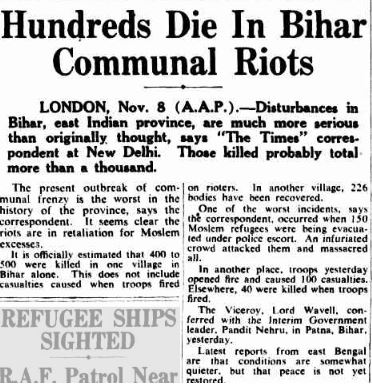
In November 1946, over 400 Hindu peasants in Bihar were killed in an indiscriminate Police firing. The peasants had been protesting against Muslim excesses in West Bengal’s Noakhali where according to documented evidence Hindus were massacred, thousands in number. According to International media reports of that time, the Hindu pogrom which was covered as ‘Bihar Communal Riots’ claimed the lives of thousands of Hindu peasants, hundreds of whom were killed in Police firing. 

As per an Australian media report available (notably several documents, reports, and letters have been concealed or erased from records), officials estimated that more than 400-500 people were killed in one village in Bihar alone which excluded casualties from police firing. However, the media reports added that some Muslim refugees were also killed in some places. 

The report added that the Viceroy Wavell had conferred the Interim government leader, Jawaharlal Nehru, the same day when hundreds of Hindu peasants were massacred in Police firing.

(Australian media report about Hindu peasants death in Police firing)

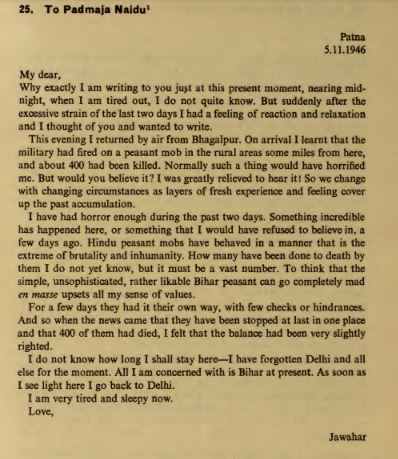
However, letters (pdf) exchanged among the top government functionaries of that time reveal that the Prime Minister of the Interim government Jawaharlal Nehru, who went on to become the First Prime Minister of India, was particularly “relieved” by the fact that more than 400 Hindus were shot point blank by Police. 

In one such letter that he wrote to Padmaja Naidu, dated 5th November 1946, he expressed strange relief. Notably, Padmaja Naidu was the daughter of Sarojini Naidu and went on to serve as the 4th Governor of West Bengal from November 1956 to June 1967. 

Nehru initiated his letter by stating, “..After the excessive strain of the last two days I had a feeling of reaction and relaxation…”

Explaining the entire episode, he wrote, “This evening I returned by air from Bhagalpur. On arrival I learnt that the military had fired on a peasant mob in the rural areas some miles from here, and about 400 had been killed. Normally such a thing would have horrified me. But would you believe it? I was greatly relieved to hear it! So we change with changing circumstances as layers of fresh experience and feeling cover up the past accumulation.”

While speculating about the crimes of Hindus, the Interim government’s PM Nehru blamed Hindu peasants of Bihar for their deaths by hundreds in firing by security forces. 

(Credits – Jawaharlal Nehru Memorial Fund, Volume 15 Series 1, page 65 in print, 104 in pdf)

He added, “I have had horror enough during the past two days. Something incredible has happened here, or something that I would have refused to believe in, a few days ago. Hindu peasant mobs have behaved in a manner that is the extreme of brutality and inhumanity. How many have been done to death by them I do not yet know, but it must be a vast number. To think that the simple, unsophisticated, rather likable Bihar peasant can go completely mad en masse upsets all my sense of values.”

Without mentioning the Hindu pogrom in West Bengal’s Noakhali, he claimed that Hindus had had an unabated run in Bihar to retaliate. In the letter, he further stressed that a right balance has been struck by giving go ahead for security forces to kill Hindus en masse. He continued saying, “For a few days they had it their own way, with few checks or hindrances. And so when the news came that they have been stopped at last in one place and that 400 of them had died, I felt that the balance had been very slightly righted.”

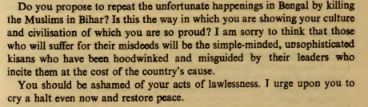
In another reference to the incidence, he tried to guilt trip Hindu peasants and called on them to give up self-defence by invoking their righteousness, as per excerpts from his speech at a public meeting at Monghyr dated 5 November 1946 which was published in ‘The Searchlight’ on 9th November 1946. 

He said, “Do you propose to repeat the unfortunate happenings in Bengal by killing the Muslims in Bihar? Is this the way in which you are showing your culture and civilisation of which you are so proud? .. You should be ashamed of your acts of lawlessness. I urge upon you to cry a halt even now and restore peace.”

Credits – Jawaharlal Nehru Memorial Fund, page 61 in print and 100 in pdf

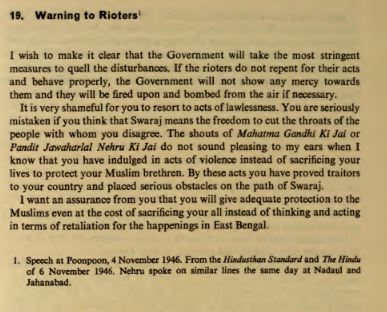
His earlier warnings for example one issued on 4th November underscores the allegations that the police firing on Hindu peasants was carried out at the behest of the Interim government which was led by Nehru himself. 

While delivering a Speech at Poonpoon on 4th November 1946, he said, “I wish to make it clear that the Government will take the most stringent measures to quell the disturbances. If the rioters do not repent for their acts and behave properly, the Government will not show any mercy towards them and they will be fired upon and bombed from the air if necessary.”

He added, “It is very shameful for you to resort to acts of lawlessness.” He argued that instead of slogans like ‘Mahatma Gandhi ki Jai’ or ‘Pandit Jawaharlal Nehru Ki Jai’, Hindus should sacrifice their own lives to protect their Muslim brethren. 

Credits – Selected Works of Jawaharlal Nehru, Vol 15 series 1, page 59 in Print and 98 in pdf 

He went further to call Hindu peasants traitors for speaking against atrocities of Muslims in the wake of Noakhali massacre and putting up hindrance to not let Noakhali repeat in Bihar’s Patna or elsewhere. 

He further sermonised, “By these acts you have proved traitors to your country and placed serious obstacles on the path of Swaraj. I want an assurance from you that you will give adequate protection to the Muslims even at the cost of sacrificing your all instead of thinking and acting in terms of retaliation for the happenings in East Bengal.”

According to the Hindustan Standard and The Hindu newspapers of 6th November 1946, he made similar kind of remarks humiliating and guilt tripping Hindus in the wake of Noakhali massacre on the same day at Nadaul and Jahanabad.

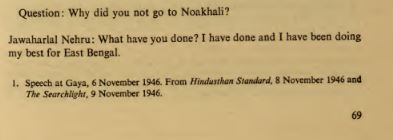
In one of his speeches at Gaya, he was asked a question “Why did you not go to Noakhali?”He responded by counter questioning saying that he had done his part and was doing his best for East Bengal, but what have the public and others done about it?  

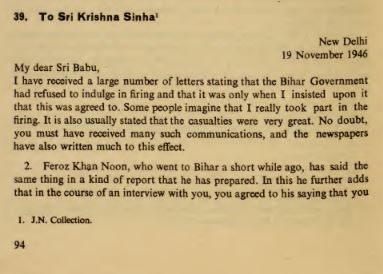
Conspicuously, two weeks after his open admission and expressing relief about police firing on hundreds, if not thousands of Hindu peasants in Bihar, he sent a letter to then Bihar CM Krishna Sinha aka Sri Babu (he remained Bihar CM till 1961). In this letter, he dictated to the Bihar government to clear his name and assume responsibility for asking forces to open fire on Hindu peasants and also peddle that the casualties were on “limited scale” considering what had been transpiring back then. 

He said, “I have received a large number of letters stating that the Bihar Government had refused to indulge in firing and that it was only when I insisted upon it that this was agreed to. Some people imagine that I really took part in the firing. It is also usually stated that the casualties were very great. No doubt, you must have received many such communications, and the newspapers have also written much to this effect.” 

Page – 94 in Print and 134 in Pdf

Regarding his visits to Noakhali and Patna, Bihar and differing responses, Nehru rationalised it by arguing that he went to Bihar to meet his colleagues in personal capacity but had none in Noakhali to visit there in person. 

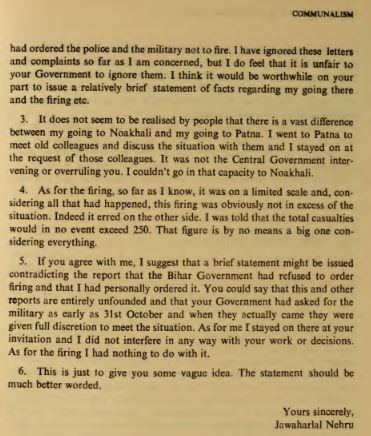
He said, “It does not seem to be realised by people that there is a vast difference between my going to Noakhali and my going to Patna. I went to Patna to meet old colleagues and discuss the situation with them and I stayed on at the request of those colleagues. It was not the Central Government inter-vening or overruling you. I couldn’t go in that capacity to Noakhali.” 

Dictating the Bihar government on what to do to absolve him, he said, “As for the firing, so far as I know, it was on a limited scale and, considering all that had happened, this firing was obviously not in excess of the situation. Indeed it erred on the other side. I was told that the total casualties would in no event exceed 250. That figure is by no means a big one considering everything.” 

Explaining in detail, he further added, “If you agree with me, I suggest that a brief statement might be issued contradicting the report that the Bihar Government had refused to order firing and that I had personally ordered it. You could say that this and other reports are entirely unfounded and that your Government had asked for the military as early as 31st October and when they actually came they were given full discretion to meet the situation. As for me I stayed there at your invitation and I did not interfere in any way with your work or decisions. As for the firing I had nothing to do with it.” 

Page – 95 in Print and 136 in print

However, the liberal leader allowed the Bihar government to not remain bound by his word but rather to use their own statements, better-worded ones. 

Former Pakistan cricketer Ramiz Raja seen laughing at racist, derogatory comments against Neena Gupta and cricket legend Viv Richards

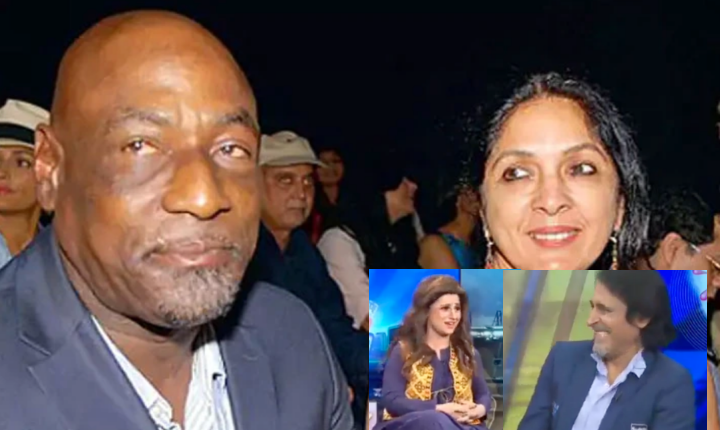
Pakistani cricketers have been making headlines for all the wrong reasons recently. Following the harsh criticism Pakistani cricket coach and former player Abdul Razzaq received for making disparaging remarks about Indian actress Aishwarya Rai Bachchan and her daughter, another video that has gone viral on social media features racist remarks made against West Indies cricket legend Vivian Richards in the presence of ex-cricketer and former Pakistan Cricket Board chairman Ramiz Raja.

The clip was from a cricket-based program broadcasted on Suno News in Pakistan. It showed two hosts, a male and a female, and two panellists including Ramiz Raja along with a pair of comedians one of whom was attempting to mimic the country’s journalist Hasan Nisar while the other was trying to imitate Lollywood actress Bushra Ansari.

When the female host asked the woman comic if she followed cricket or not, she answered, “I do watch cricket matches and my heart broke when Vivian Richards went into a relationship with Neena Gupta. I wrote a couplet then. “Jo ladkiyan khud ko kehti hain malika-e-aliya, Unko fir milta hai Mr Kaliya.” The lines roughly mean “the girls who consider themselves the queen, eventually end up with a black man.”

The hosts and the comics then laugh like idiots on the racist and stupid statement. One host says on the issue, “But this is old news”.

Notably, Pakistan TV shows are infamous for their offensive and outrageous content where celebrities particularly those from India are humiliated and mocked amidst the appreciation and loud cheer from the audience.

Abdul Razzaq apologised and claimed that his “tongue slipped” after his comment where he drew a shocking parallel between marrying Aishwarya Rai and the Pakistan Cricket Board drew intense backlash recently. He charged, “I’m talking about their (PCB’s) intention here. When I was playing, I knew that my captain, Younis Khan’s intentions were good. I took confidence and courage from that, and thanks to Allah, I could deliver for Pakistan cricket.”

He added, “Right now, a lot of talk here is surrounding the Pakistan team and the players’ performances in the World Cup. I think we do not have the intention to polish and develop the players. If you think that I will get married to Aishwarya Rai and then have good and virtuous kids, then that can never happen. So you have to correct your intentions first.” Meanwhile, other Pakistan cricketers including Shahid Afridi and Umar Gul were amusing themselves with his offensive words.

Abdul Razzaq was witnessed boasting about his multiple extramarital affairs on a TV show in another viral footage. “All my relations have been from both sides. It is not like only I proposed. I had five or six affairs. Such relationships come with validity. They expire after a year or two. It feels amazing in the beginning, but the results are not great.” When asked whether it was before he tied the knot, he very smoothly answered, “Even after the marriage,” to an applauding audience.

Nenna Gupta was in a relationship with former West Indies cricketer Vivian Richards in the late 1980s. Though they never married, they have a daughter named Masaba Gupta born in 1989 who is a successful fashion designer and has her own brand of apparel and cosmetics.

Rohit Sharma becomes the first batsman to hit 50 sixes in ODI World Cup history

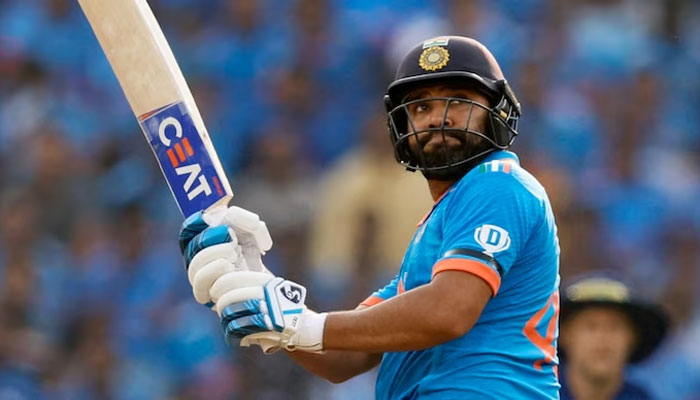
On 15th November, Rohit Sharma displayed exceptional skills and became the first batsman to hit 50 sixes in ODI World Cup history. During the high-stakes semi-final match between India and New Zealand at Mumbai’s Wankhede Stadium, Sharma scored 47 off 29 balls. The previous record was held by Chris Gayle, who had 49 sixes in the World Cup. Sharma has already hit 27 sixes in the 2023 edition of the World Cup.

In his 29-ball innings, Rohit dominated the Kiwi bowlers, especially Trent Boult and Tim Southee, during the initial overs. He played aggressively and used his powerful strokes to significant effect. Sharma hit 4 sixes and 4 boundaries in his score of 47, giving India a blistering start and becoming the first batsman to hit 50 sixes in ODI World Cup history.

Rohit hit boundaries over covers and fine leg, giving India a strong start. Despite the Kiwis being recognized as one of the most consistent teams globally, Rohit expressed confidence in India’s unchanged playing XI. India chose to bat first on what Sharma described as a good but slower pitch, emphasising the importance of “controlling the controllable” in this crucial fixture. He recalled the significance of turning up on such decisive occasions.

Having accumulated 60 sixes this year before this match, Rohit Sharma, the captain of the Indian cricket team, has also secured the record for the highest number of sixes in a calendar year. This achievement surpasses AB de Villiers, who previously held the record with 58 sixes in 2015. With 4 sixes in the match against New Zealand, Sharma has taken that tally to 64, with a month and a half still to go till the end of the year.

In the last few months, Sharma has markedly shifted the way he approached his batting, notably in ODIs, going hard at the start and scoring at an intimidating 140+ strike rate, which has, in turn, provided a cushion to the incoming batters to have eyes in and yet not significantly impact the team’s overall run-rate.

India is playing New Zealand in the first semi-final of the 2023 World Cup at Wankhede Stadium, Mumbai. In the previous World Cup league match against New Zealand, India defeated New Zealand by four wickets. While chasing 273 runs scored by New Zealand in 50 overs, India won the match with 12 balls left.

Jammu and Kashmir: 36 dead, 19 injured after bus falls into gorge in Doda

0

 Thirty-six people died and 19 others were injured after a bus fell into a gorge in Jammu and Kashmir’s Doda on Wednesday.

Union Minister Jitendra Singh confirmed in a post on X about the 36 deaths and said that out those injured six people were said to be in a critical condition.

Home Minister Amit Shah expressed his condolences and in a statement on ‘X’ said that the local administration is actively engaged in the rescue operation at the site of the accident.

The mishap took place as the bus carrying 55 passengers and on its way from Kishtwar to Jammu veered off the road and rolled down the steep slope near Trungal in the Assar area on the highway.

“Saddened to share the update from DC Doda Harvinder Singh from the spot of the accident. Unfortunately, 36 persons have died and 19 injured, out of whom 6 injured are serious,” Minister Singh posted on X. The Union Minister said that he had spoken to the Doda District Commissioner, Harvinder Singh and that the injured are being shifted to Government Medical College Doda.

Singh said, “Helicopter service to be arranged for shifting the more injured ones. All possible help, as required being provided. I am in constant touch”.

Lt Governor Manoj Sinha expressed deep sorrow over the loss of lives.

“Extremely pained by the loss of lives in a tragic bus accident in Assar, Doda. My heartfelt condolences to the bereaved families & wishing for a speedy recovery of those injured in the accident. Directed Div Com & Dist Admin to provide all necessary assistance to affected persons,” Sinha tweeted.

Former Jammu and Kashmir Chief Minister Mehbooba Mufti condoled the loss of lives in a post on X.

“Deeply shocked & saddened about the tragic road accident at Assar in Doda. Deepest condolences to the families of those feared dead & hope the administration expedites rescue operations,” Muft posted on X. 

(This news report is published from a syndicated feed. Except for the headline, the content has not been written or edited by OpIndia staff)

PM Modi launches ‘Viksit Bharat Sankalp Yatra’ by flagging of IEC vans in Jharkhand, guarantees time-bound saturation of flagship schemes

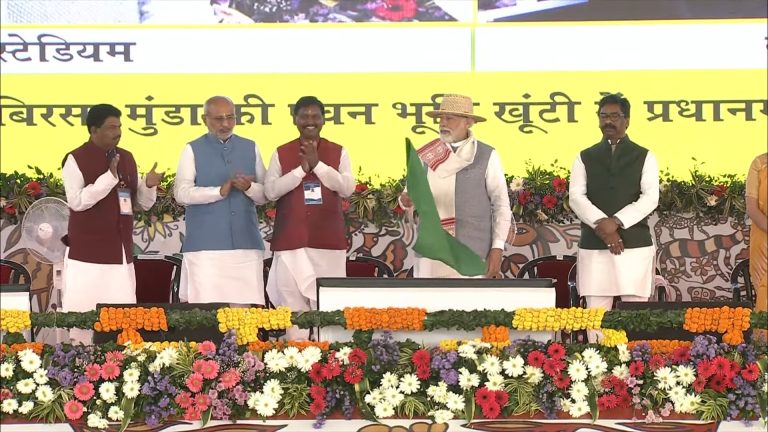
With an eye on attaining saturation of flagship schemes of the government and taking to beneficiaries in a time-bound manner, Prime Minister Narendra Modi on the occasion of Janajatiya Gaurav Divas on Wednesday launched a special initiative.

Through the initiative called ‘Viksit Bharat Sankalp Yatra’, the focus would be to reach out to people and create awareness and provide benefits of welfare schemes like sanitation facilities, essential financial services, electricity connections, access to LPG cylinders, housing for the poor, food security, proper nutrition, reliable healthcare, clean drinking water.

Enrolment of potential beneficiaries will be done through details ascertained during the Yatra.

Prime Minister flagged off IEC (Information, Education and Communication) vans in Khunti, Jharkhand, marking the launch of ‘Viksit Bharat Sankalp Yatra’. The Yatra will start from districts with significant tribal populations initially and by January 26, 2024, will cover all districts across the country.

PM Modi said that his guarantee means a guarantee of fulfilment of every guarantee. “Vikas Bharat Sankalp Yatra is in a way Modi’s guarantee to the poor, mothers and sisters, youth and farmers of the country.”

“Developed India Sankalp Yatra is starting from today. This yatra will start today on 15th November, the birth anniversary of Lord Birsa Munda and will continue till 26th January next year. In this journey, the government will go to every village of the country in a mission mode, every poor and every deprived person will be made the beneficiary of government schemes,” PM Modi said.

“There are 4 pillars of developed India – First – Women of India, our women power Second – Indian farmers, our cattle rearers, fish farmers, our food providers. Third – Youth of India, our youth power Fourth – India’s middle class, India’s poor. The stronger we strengthen these 4 pillars, the higher the pillars of developed India will rise,” he said.

PM Modi added social justice can be assured only when everyone gets the benefits of government schemes equally, and in the same spirit.

“For decades, there was a lot of talk in our country about social justice and secularism. But true secularism comes only when all possibilities of discrimination against any citizen of the country are eliminated,” PM Modi said.

During the Khunti event, PM Modi also launched the first of its kind initiative – ‘Pradhan Mantri Particularly Vulnerable Tribal Groups (PM PVTG) Development Mission’.

There are 75 PVTGs in 18 States and UTs living in 22,544 villages (220 districts) having a population of around 28 lakhs.

These tribes stay in scattered, remote and inaccessible habitations, often in forest areas. The mission with a budget of about Rs 24,000 crore, is planned to saturate PVTG families and habitations with basic facilities such as road and telecom connectivity, electricity, safe housing, clean drinking water and sanitation, improved access to education, health and nutrition and sustainable livelihood opportunities.

In addition, separately, saturation will be ensured for PMJAY, Sickle Cell Disease Elimination, TB Elimination, 100% immunisation, PM Surakshit Matritva Yojana, PM Matru Vandana Yojana, PM Poshan, PM Jan Dhan Yojana.

Earlier in the day, PM Modi on paid floral tributes to Indian tribal activist and folk hero Birsa Munda on his birth anniversary at his native village Ulihatu in the Khunti district of Jharkhand. The Prime Minister garlanded the statue of Birsa Munda and paid obeisance to the late tribal hero.

He too visited the Bhagwan Birsa Munda Memorial Park and Freedom Fighter Museum in Ranchi and paid tributes to the late tribal leader this morning.

(This news report is published from a syndicated feed. Except for the headline, the content has not been written or edited by OpIndia staff)

‘Indians are warriors at heart; for centuries, we fought off invaders to protect our homeland’: What Indian MMA fighter Varun Sanyal said about fighting

0

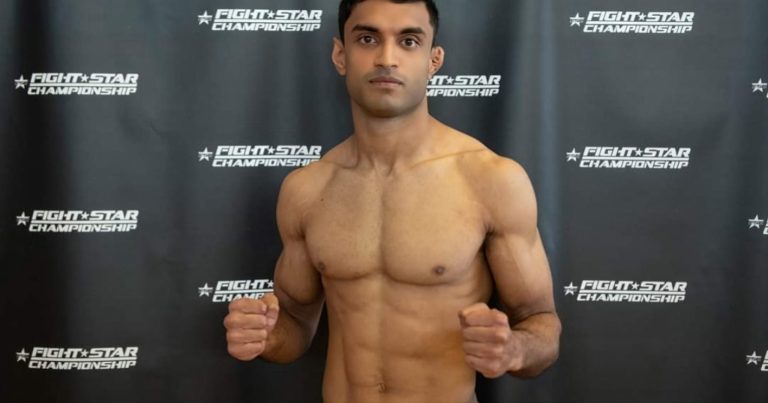
Some fight for fame, for money and recognition but there is one warrior who fights because it is in his blood. One such warrior is Mixed Martial Arts (MMA) fighter Varun Sanyal, who is set to represent India at the International Mixed Martial Arts Federation World Championship 2023. The IAMMF World Championship is scheduled to be held from November 20 to November 25 in Tirana, Albania.

In a video shared on his X profile on Tuesday (November 14), MMA fighter Varun Sanyal said, “I fight because it’s in my blood. Typically you see Indians as lawyers, doctors, engineers and stereotypical jobs. What people forget is that we are actually warriors at heart. For centuries we had to fight out invaders and protect our homeland. That’s why I fight to feel like going back to my roots and doing what I was born to do,” Varun said.

“Navigating cultural and societal expectations about your life is a complex task, but I’ve chosen to stray from the common path and devote myself to the violent art of fighting. Some of us fight for fame, recognition, and money. I fight because it’s in my blood,” Varun wrote in his X post.

The 2023 IMMAF World Championships will be held at the Tirana Olympic Park beginning on November 20th, with ten weight classes for male fighters ranging from Strawweight to Super Heavyweight and six for female fighters ranging from Atomweight to Lightweight.

The 24-year-old MMA fighter’s mother, Smita Barooah, took to X to share a post on her son’s coming endeavour at the 2023 IMMAF World Championships. Smita Barooah expressed her complete support for her son, even though she is not quite fond of the MMA fights. 

Indeed it is in Varun Sanyal’s blood to fight coming from a family of freedom fighters like his great granduncle Sachindranath Sanyal who devoted his life to freeing India from British colonialism and was sentenced to the infamous Port Blair Cellular Jail in Andaman and Nicobar Islands twice. A pioneer of armed resistance against British hegemony, Sachindranath Sanyal co-founded a branch of Anushilan Samiti in Patna in 1913.

Sachindranath Sanyal was a key figure in the Gadar party conspiracy. The conspiracy began to take mould at the commencement of World War I, between the Ghadar Party in the United States, the Berlin Committee in Germany, and the Indian revolutionaries in British India. Large quantities of weaponry and ammunition were expected to be smuggled into India to spark a pan-India anti-British revolt. However, because of organised intelligence input and a spy network, the British learned of the movement and repressed it in February 1915. Key figures were arrested, revolts in smaller units and agitated armed groups within India were also crushed.

Sanyal went underground to avoid British action and to continue the revolution. However, he was caught and sentenced to Cellular Jail, where he wrote the popular book “Bandi Jeevan” documenting his life and times as a prisoner in 1922. Following his release for a brief timeframe, Sanyal along with other revolutionaries founded the Hindustan Republican Association in October 1924. Sanyal was once again incarcerated in 1925 and sent to the Cellular prison in the Andamans for being allegedly involved in a Kakori conspiracy involving train robbery on August 9, 1925, to gain funds and support from Indians for the HRA. Following his incarceration, Sanyal’s ancestral home in Varanasi was seized by the British authorities.

Other than Sachindranath Sanyal many of his family members continued to struggle for Bharat’s freedom and even went to jail while doing so. As mentioned on the memorial to martyred freedom fighters from Bengali Tola Inter-College in Varanasi, Sachindrnath Sanyal, Jitendra Nath Sanyal and Rabindranath Sanyal were sentenced to jail for involvement in various armed conspiracies against the British oppressors. Nalinaksha Sanyal and his elder brother Anadi Kant Sanyal had also devoted their life to the freedom struggle.

Notably, MMA fighter Varun Sanyal is the son of economist and author Sanjeev Sanyal. Sanjeev Sanyal has authored many best-selling books and also served as the Principal Economic Advisor to the Indian government. Several noted works of Sanjeev Sanyal include Revolutionaries: The Other Story of How India Won Its Freedom and Ocean of Churn: How the Indian Ocean Shaped Human History.

Tahreek Muslim Shabban, which believes ‘Sharia is above life’, supports Congress in Telangana to defeat T Raja: Demands, protest against Nupur Sharma and more

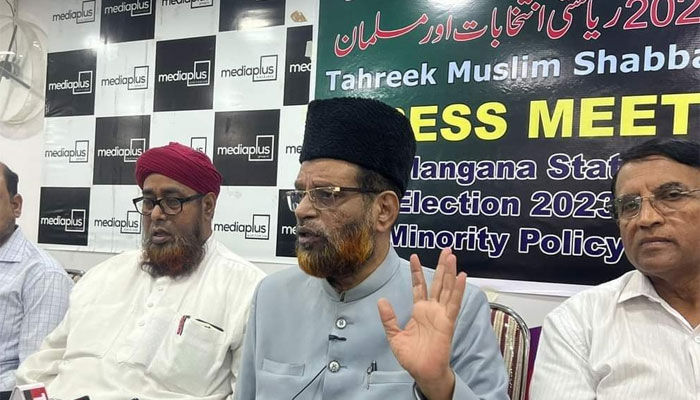
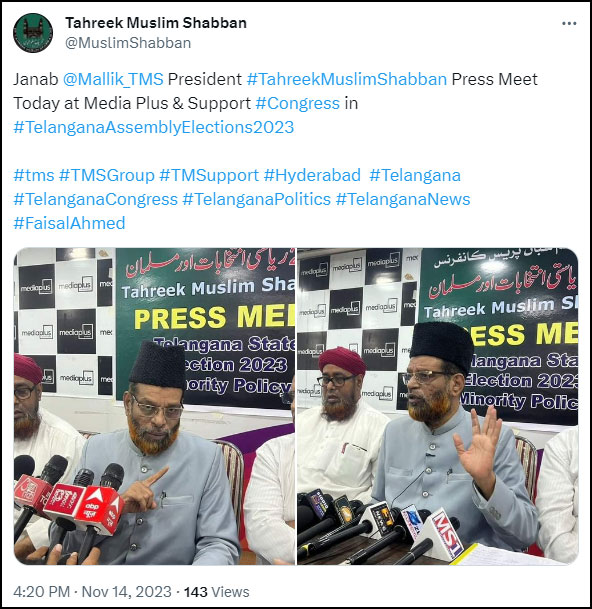
On 14th November, Hyderabad-based Muslim organisation Tahreek Muslim Shabban (TMS) officially announced its support for Congress in the upcoming 2023 Telangana Assembly Elections. The organisation’s president, Mushtaq Mallik, extended support to the Congress party at a press conference and tabled a 13-point “Charter of Demands of Muslims of Telangana” to the state’s political parties. The organisation first released the charter in August 2023.

Source: X

Reports suggest that Telangana Congress in-charge Manikarao Thakre, Secretary Mansoor Ali Khan and others met the organisation’s leaders to discuss the charter. The organisation said it would not support Congress in six constituencies: Bodhan, Bahadurpura, Yakutpura, Chandrangutta, Goshamahal and Charminar.

Furthermore, the organisation desired to “defeat the hatred” and “blasphemous” candidate of the BJP from Goshamahal. Bharatiya Janata Party (BJP) firebrand MLA T Raja Singh is from Goshamahal. He will contest the elections from the same seat in the 2023 elections. In 2022, he was suspended from the party pending inquiry after an alleged speech against Prophet Mohammed. However, his suspension was revoked before announcing candidates for the assembly elections in Telangana. T Raja Singh is one of the most famous leaders of BJP in the poll-bound southern state and the most vocal against Islamist violence.

The Charter of demands

As per media reports, the list of demands includes various requests such as the restoration of the reimbursement scheme, implementation of overseas scholarships for Muslims, a budget of Rs 500 for the economic development of Muslims by Minority Finance Corporation, the establishment of Waqf Commissionerate and its Judicial powers, economic empowerment of Muslim women, development of slums in Old City, 8% reservation for Muslims in education and employment, protection of mosques and graveyards, monthly honorarium to imams and muezzins, appointment of Muslims in government jobs including police, judiciary, revenue, health and universities, promotion and development of Urdu language, and development of the Urdu academy. Furthermore, the organisation has also demanded the preservation of the heritage building of Osmania General Hospital Nizamia Medical College and the implementing of the Muslim Bandhu scheme.

The controversial history of Tahreek Muslim Shabban

TMS has a controversial history. The organisation has organised several pro-Hamas protests since the Israel-Hamas war broke out. Furthermore, it has opposed the Uniform Civil Code (UCC), CAA and NRC.

In October 2023, Mallik was put under house arrest after calling for a rally against Israel’s attack on Hamas. The rally was scheduled from Yakutpura Bada Bazaar to Darulshufa Ground on 27th October. However, Mallik was put under house arrest on the morning of the rally. TMS later called off the rally.

A few days before the call for a protest march, TMS said in a post on Facebook that Israel was killing innocent Palestinians and in future if someone picked up weapons against Israel, he would be called a terrorist. Interestingly, there was not even a single post by TMS condemning the terrorist attack of Hamas on Israel on 7th October in which at least 1,300 Israelis and foreign nationals were killed.

In July 2023, TMS organised an all-party roundtable meeting in Hyderabad against UCC. They called Muslim organisations and other civil society groups to join hands against the UCC. In a statement, Mallik claimed that the central government was stereotyping Muslims and called for intensive movement against UCC. He also gave the slogan “Jaan Se Badh Kar Shariat”, which literally translates to “Shariah above life”. He claimed that UCC was against all communities except certain sections with vested interests.

In June 2022, Mallik was booked by Chaderghat Police for promoting enmity and hatred. The suo moto case was filed against him over a social media post where he had appealed to Muslims to join a protest at Dharna Chowk. The FIR against Mallik was registered under Sections 153A, 295A and 505(2) of the Indian Penal Code (IPC). Mallik had called for a protest against former BJP spokesperson Nupur Sharma’s alleged remarks against Prophet Mohammed. Following the case registered against him, Mallik converted the protest into a public meeting at Chanchalguda Junior College.

TMS ran a campaign against Nupur Sharma and organised several rallies and protests. The organisation called for her arrest and deemed the statement as “Gustakhi Na Khabil-e-Bardash” that translates to “Mistake that cannot be forgiven”.

In January 2020, TMS called for protests against CAA-NPR-NRC. During a press conference following an all-party meeting in Hyderabad, Mallik announced that Muslims would never submit documents to prove their origin or domicile. He said, “We are Indians. The Constitution and law have bestowed liberty, for its strength, we will strive constantly. We will never file NPR and NRC forms at any cost. We are citizens of this country, and a communal government cannot seek evidence of our citizenship. We announce that we will not file the forms. May Almighty help us and protect us.”

Provoking Muslims against NRC, Mallik said, “If someone thinks that if he files a ‘form’ or provides family lineage information, he will be secure, he should analyse the NRC exercise. He will be astonished to see that a father’s name appeared in the register while his son could not find his name. Wives of many people could not prove their domicile. In many cases, fathers are in detention centres, and their children are freed or vice versa.”

TMS, just like other Muslim organisations and left-liberals, provoked Muslims against CAA, NPR and NRC. Interestingly, CAA has nothing to do with Indian Muslims. It was passed by the Central Government to fast-track citizenship of Hindus, Sikhs, Christians and Buddhists who took shelter in India before 2014 to save themselves from religious prosecution in neighbouring Islamic countries like Pakistan, Bangladesh and Afghanistan. Furthermore, the Government of India did not issue drafts for NPR and NRC during that period. Without the draft, Muslim organisations like TMS provoked Muslims based on their imaginations. The unnecessary provocation against CAA-NRC led to anti-Hindu riots in Delhi in February 2020.

Interestingly, Mallik calls AIMIM’s chief, Asaduddin Owaisi, a BJP agent. It is evident that the reason behind such categorisation is because of his leaning towards Congress. During the Hijab controversy in Karnataka, Mallik attacked AIMIM for campaigning in the UP while the controversy was at its peak in Karnataka. He claimed that is was because of Owaisi that BJP won in UP as he divided votes in the voters-wise largest state of the country.

Not a pin was manufactured? Indians remind Congress leader how Nehru destroyed Indian industries in his socialism zeal after Independence

0

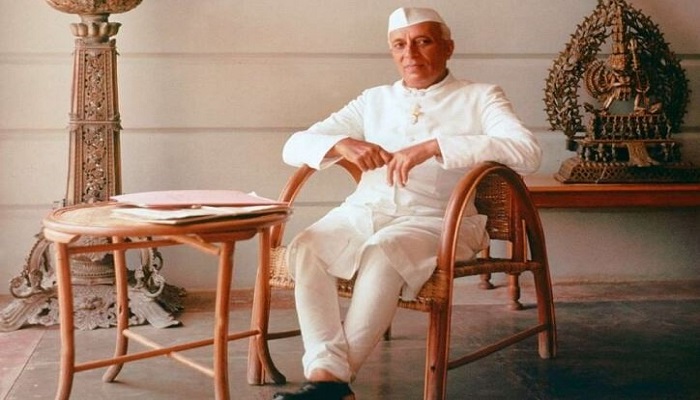
On the occasion of India’s first Prime Minister Jawaharlal Nehru‘s birth anniversary on Tuesday (14th November), Congress MP KC Venugopal sang praises of the leader saying that he was the one who built a ‘modern India’. He said that before Nehru took over the regime, India was struggling with industrial growth and that Nehru was the one who boosted the industrial and manufacturing sector in India post-independence.

“Pandit Jawaharlal Nehru is the architect of modern India. When he took over the reins of India’s destiny, not a pin was manufactured in India. But instead of blaming the past, cursing his predecessors, and making excuses, he rolled up his sleeves and built our modern republic,” KC Venugopal said on Twitter.

The leader was so engrossed in praising Nehru on his birth anniversary that he falsely credited the latter for executing several developmental strides be it through PSUs, the Green Revolution, or modern educational institutions. “In a neighborhood where ethnic conflict and authoritarian rule is commonplace when many in the West doubted whether we would survive as a democratic and secular republic, it was Nehru ji’s efforts of building a democratic ethos that stood the test of time. Today, as India is in a difficult place with a fascist regime in power in New Delhi, it is Nehru’s path that we must always walk on,” the MP added.

The post written by Congress MP KC Venugopal was, however, criticized by several netizens who said that crediting Nehru for the things he has not done was inappropriate. One of the users mentioned that Nehru was never the architect of India, instead, he was the architect of the license-quota Raj that stifled entrepreneurship and encouraged crony capitalism.

“Nehru was the architect of license-quota Raj that stifled entrepreneurship & encouraged crony capitalism India was the richest country in Asia in 1947 after the War By 1964, India was left behind by others in Asia & by 1980 poorer than others, all due to Nehru’s PanchBhool policies (5-year plans),” the user added.

Meanwhile, another user listed several leading industries in India that had been established in the 19th century, like Birla, Tata, Dabur, Britania, Godrej, Bajaj and Dalmia, years before Nehru became the Prime Minister of India for the first time in the year 1947. He said that the industries were leading the economy and that Nehru had hardly done anything to boost industrial growth.

Another user pointed out that the Congress MP was giving unnecessary credit to Nehru for bringing the Green Revolution to India. She said that the Green Revolution started and gained momentum in India years after Nehru had died and that the Congress’s 41 years of rule in India had led the country to become almost bankrupt in the 20th century. “His socialist policies screwed our industry and after 41 years of his and his family’s rule India was on the verge of bankruptcy in 1991,” the user was quoted as saying.

Green Revolution started in India in 1965-66, during the tenure of Lal Bahadur Shastri as the Prime Minister, after the death of Jawaharlal Nehru. The modernisation of agriculture was continued during the term of PM Indira Gandhi after Shashtri.

Some users also wished that Nehru should never have become the first, unelected Prime Minister of the country. They said that Nehru has been the root cause of all the problems that are faced by India even today.

How Nehru became the first Prime Minister of India

Notably, 134 years since his birth, Nehru remains a pertinent, contentious, and frequently mentioned figure in contemporary Indian politics. He was the first, unelected Prime Minister of India and that happened only because of the interference of MK Gandhi. After India gained independence, the Congress party was set to dissolve as its only purpose back then was to liberate India from British rule. Once that goal was accomplished, the organization had no existential purpose. 

The dissolution of the party was suggested by Gandhi but his advice was ignored by Nehru. He believed that the Congress party had a brand value and that it could be used for the ‘betterment’ of the country. In the year after the independence, Nehru, Sardar Patel, and Acharya Kripalani were candidates for the internal elections held by the Congress to elect India’s Prime Minister. While Sardar Patel was about to be elected as India’s first Prime Minister, Gandhi interfered and asked him to withdraw from the election, extending support to Nehru. Later Kripalini also withdrew and this is how Nehru became the first, unelected Prime Minister of the independent India.

Later, several Congress leaders including Maulana Azad, C. Rajagopalachari, etc publicly mentioned that it would have been better if Nehru had been asked to be the Foreign Minister and Patel was made the Prime Minister. The following are some of Nehru’s failures as Prime Minister, the consequences of which India suffers to this very day.

Creation of the Kashmir issue

After India’s partition, Pakistan established a tribal militia attack to annex Kashmir. While the Indian army was on track to force the Pakistani intruders out of Kashmir, Nehru walked towards the United Nations, disregarding all the local advice. He thus snatched defeat from the jaws of success. Pakistan continues to claim that the very fact that Nehru had referred to the UN indicates that Kashmir is a disputed territory. The issue is still unresolved and has resulted in significant bloodshed to this day. 

Rejected a permanent seat at the UN

To avoid conflict with China, Nehru turned down offers from the United States and the Soviet Union to replace China on the UN Security Council. Having a permanent seat at the UN would have improved India’s global standing. The fact that it was offered without reservations but rejected makes this a disastrous blunder. Notably, Nehru’s goal of cordial relations with China remains unachieved to this day.

43,000 sq km of land captured by China in Aksai Chin

According to classified documents, Nehru’s friendship with China was not reciprocated. China referred to Nehru as a “lackey” of the British and Americans and used derogatory language against India at the United Nations. Nehru misread China’s intentions and did not anticipate Mao’s invasion of India in 1962.

Worse, he allowed his incorrect assumption to have an impact on India’s defense preparedness, breaking a simple life principle of hoping for the best but preparing for the worst. Over 3,250 Indian soldiers were killed. In Aksai Chin, India lost approximately 43,000 square kilometers to China. China remains a significant issue for India even today. 

Nehru did not implement universal primary education

The first IIT was established by Nehru in the year 1950. Despite the establishment of institutes such as the IIT and IIM during his tenure, Nehru did not prioritize universal literacy and mass education. This is noteworthy given the widespread illiteracy in the country at the time. A lack of education is frequently an impediment to economic and social advancement. According to his biographer Judith Brown, this was his greatest failure.

Notably, till the year 2014, India had only 16 IITs, 9 Indian Institutes of Information Technology (IIITs) and 13 IIMs. However, after the Modi government came into power in the year 2014, 6 new IIT institutes, 16 new IIITs, and 7 new IIMs were established giving a major boost to the promoting and implementation of universal primary education in India.

Favoured socialism

For centuries, India has had a free-market economy based on trade and private enterprise. Nehru, on the other hand, famously stated that “profit is a dirty word.” Nehru followed the Soviet model of economic policies, in which the government ran businesses ranging from industries to hotels. Taxes were high to ensure that ordinary citizens had little wealth and were reliant on the state. The entrepreneurial spirit was also discouraged.

These policies increased income inequality and supported crony capitalism. They were also responsible for poisoning the minds of ordinary Indians, leading them to believe that entrepreneurs were immoral. It also resulted in the demonization of wealth and success.

Rejected Nepal’s and Balochistan’s offer to join India

Nehru rejected Nepal’s King Bikram Shah’s offer of making Nepal a province of India. Nehru’s ground for rejection was that Nepal was an
independent nation and must remain so. He also turned down an offer from Mir Ahmadyar Khan, the “King” or Khan of Kalat, for Balochistan to join India. Once again, Nehru failed to recognize the strategic significance of Balochistan, which continues to suffer from severe human rights violations under Pakistan.

Further, some of the claims made by KC Venugopal regarding giving credit to Nehru for the Green Revolution and the manufacturing sector seem dubious as several leading manufacturing companies were established in India years before Nehru became the unelected, first Prime Minister of India. The Birla, now the Aditya Birla Group, a conglomerate company was founded in the year 1857, the Tata Group was founded as a private trading firm in 1868, Dabur India Ltd. in 1884, Britannia in the year 1892, Godrej in 1897 and Bajaj group in 1926, etc.

These companies were a prominent part of the Indian economy back then and continue to rule over the markets even today. KC Venugopal even mentioned that “we owe much of our developmental strides to Nehru that happened through PSUs, Green revolution and modern education.”

Green revolution spanned after Nehru’s death

It is worth noting that in India, the Green Revolution was led by M. S. Swaminathan who was an Indian agronomist and agricultural scientist. Beginning in the mid-20th century, the introduction of new, high-yielding variety seeds into developing countries resulted in a significant increase in food grain production (particularly wheat and rice). The Green Revolution transformed India from a food-deficient country to one of the world’s leading agricultural nations.

Notably, the revolution spanned from year 1967-68 to 1977-78 which was almost three years after Nehru’s death. Jawaharlal Nehru died in the year 1964 and the Green Revolution is said to have spanned from the year 1967. In such circumstances, KC Venugopal crediting Nehru for the things he was hardly any part of is bound to attract criticism.

Jawaharlal Nehru may be remembered as one of the country’s ‘most capable and ablest’ leaders. But his grave mistakes of creating the Kashmir issue, ignoring corruption, abolishing Hindu personal laws, supporting China, rejecting support to Nepal, and Balochistan, opposing the restoration of Somnath Temple, and leading India to bankruptcy by 1991 can never be forgotten.

Therefore, the current Congress praising and lauding Nehru for furthering India’s economic, social, and industrial growth is factually incorrect. Moreover, the Congress leaders at present pledging to walk on the path of Nehru could prove disastrous for India’s future given the upcoming elections scheduled in the year 2024.