Home Blog Page 2639

‘It is not a park’: Srinagar Jamia Masjid bans men and women from sitting together on its lawns, prohibits photography

0

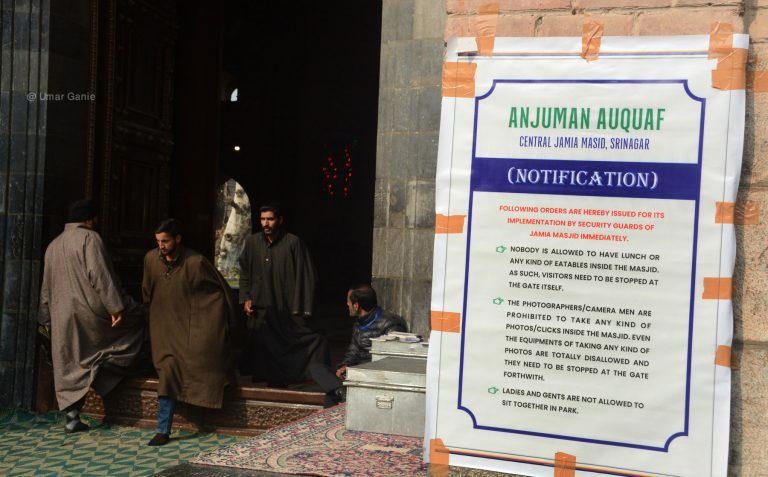
On Friday, December 17, the Jamia Masjid Srinagar management committee issued a notification prohibiting photography inside the 14th-century mosque and men and women from sitting together in the mosque’s lawns. Usually, women are not allowed inside mosques, however, separate arrangements are present in Jamia Masjid for both men and women to offer prayers.

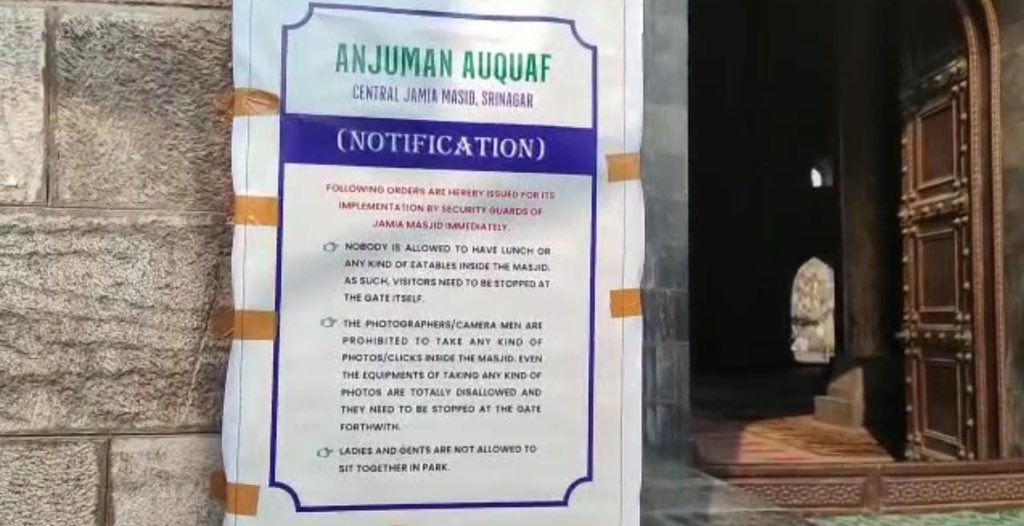
The entry of photography equipment is also prohibited, according to a notice posted around the mosque complex by the Anjuman Auquaf Central Jamia Masjid.

“Photographers and camerapersons are not permitted to take any photos or clicks inside the mosque. “Even equipment used to take photographs of any kind is strictly prohibited and needs to be stopped at the gate immediately,” it stated.

It also prohibited the bringing of food into the mosque. “No one is permitted to have eatables inside the mosque. In such case visitors must be stopped at the gate,” the notification stated.

As the notice says that ‘equipment used to take photographs of any kind is strictly prohibited’, it seems that mobile phones will also be banned in the mosque premises, as almost all phones nowadays have build-in cameras.

Notification issued by Jamia Masjid’s management committee Anjuman Auguaf (Image via ABP News)

The management of the 14th-century mosque directed its security guards to implement the instructions with immediate effect.

Meanwhile, Anjuman Auqaf said in a statement that as a place of worship, visitors are asked to respect its sanctity as a mosque and maintain decorum.

“It is not a park or a recreational facility. Visitors, both locals and visitors from other areas should keep this in mind when taking photographs. Before taking any photographs or videos of Jamia Masjid for professional purposes, permission must be obtained from Anjuman Auquaf,” according to the statement. “Being a place of worship, the visitors are requested to respect its sanctity as a mosque and observe decorum while visiting the mosque. It is not a public park or a recreational facility,” they further added.

The management also asked men and women to use the separate places designated for them to pray.  “The worshippers both men and women, should use their specific spaces while praying in the mosque designated for both the genders,” the said.

Notably, on November 24, Jama Masjid in Delhi had issued a notification prohibiting the entry of women without male companions sparking outrage. This order, however, was later withdrawn after Delhi LG VK Saxena intervened. 

Muslims in India are ‘far more secure’ than in the ‘unstable country’ Pakistan: Ajmer Dargah cleric lambasts Pakistani minister for personal attack on PM Modi

0

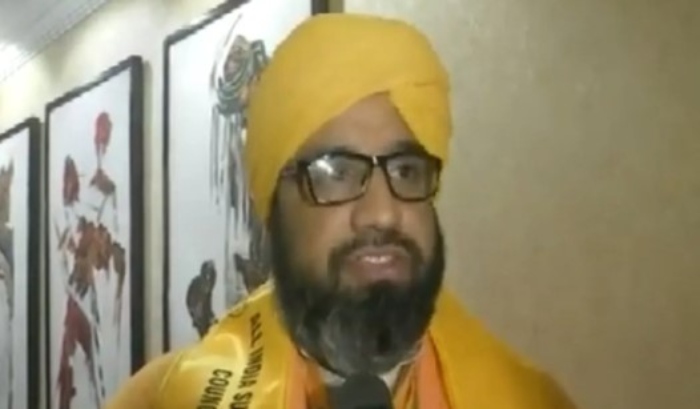
Hazrat Syed Naseeruddin Chishty, chairman of the All India Sufi Sajjadanshin Council and the successor of the spiritual leader of the Ajmer Dargah, has slammed Pakistan Foreign Minister Bilawal Bhutto Zardari for the ‘venomous language’ he used against India’s PM Narendra Modi.

“I strongly condemn the venomous language used by the Pakistani foreign minister and deputy foreign minister against our Prime Minister and our motherland,” Hazrat Syed Naseeruddin Chishty said.

Hitting out at the Pakistani minister for having the temerity to disparage India’s PM, Chisty warned the Pakistani minister against comparing “great country” India with his “unstable country”, stating that the Constitution of India guarantees freedom of religion to all. He reminded him how Muslims in India are “far more secure” and in “much better condition” than those in Pakistan.

Further, the Muslim cleric said that Bhutto degraded not just the status of his portfolio but also of his entire country. “Pakistan should keep this in mind that Indian Muslims are far more secure and in much better condition than Pakistani Muslims….Bilawal Bhutto has forgotten that terrorist Osama bin Laden didn’t die but was killed in Pakistan by American forces right under the nose of the Pakistani government,” he added.

Pakistan FM calls PM Narendra Modi the‘ butcher of Gujarat’, India takes strong offence

It is notable that two days ago in New York, Bilawal Bhutto Zardari called PM Narendra Modi the‘ butcher of Gujarat’. He also accused India of carrying out terror attacks in Pakistan and denied that Pakistan is sponsoring terrorism. He made the comments responding to remarks of Indian foreign minister S Jaishankar at the UNSC, where he had pointed out that Osama Bin Laden was found hiding in Pakistan.

Addressing a press conference after S Jaishankar directly slammed Pakistan for being a pro-terrorism country, Bilawal Bhutto said, “I will like to remind the honourable minister of external affairs of India, that Osama Bin Laden is dead, but the butcher of India lives. And he is the prime minister of India. He was banned from entering this country until he became the Prime Minister. This is the Prime Minister of the RSS and the Foreign Minister of the RSS. What is the RSS? The RSS takes inspiration from Hitler’s SS.”

The Pakistan Foreign Minister came under fire after he resorted to a personal attack against PM Modi and hit out at the RSS. The government of India strongly reacted stating that the comments of Bhutto are new low even for Pakistan. Calling it an uncivilised outburst of the Pakistan foreign minister, the statement said, “Pakistan FM’s uncivilised outburst seems to be a result of Pakistan’s increasing inability to use terrorists and their proxies.”

Saying how several cities across the city have faced the effects of Pakistan-sponsored terrorism, MEA said that “Make in Pakistan” terrorism has to stop. The statement also added that Pakistan not only sheltered Osama Bin Laden, but is still giving shelter to other terrorists like Lakhvi, Hafiz Saeed, Masood Azhar, Sajid Mir and Dawood Ibrahim.

The BJP has also condemned the “highly shameful and derogatory” remarks of Pakistan Foreign Minister Bilawal Bhutto Zardari against Prime Minister Narendra Modi and has decided to hold nationwide protests on Saturday.

Supreme Court dismisses review plea filed by Bilkis Bano against court judgement allowing remission of 11 convicts in her rape case

0

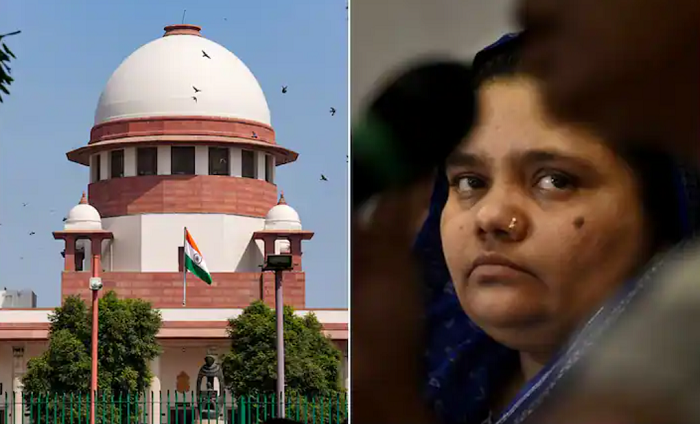
The Supreme Court dismissed a review plea filed by Bilkis Bano against its May 2022 decision giving the go-ahead for the remission of convicts who had raped her. She had pleaded with the apex court to review its verdict where it had held that remission of the convicts who raped her should be considered as per the policy existing at the time of the crime in Gujarat, where the crime took place.

On December 13, a bench of Justices Ajay Rastogi and Vikram Nath dismissed the review plea filed by Bilkis Bano.

The Gujarat government released all 11 people convicted to life in prison in the 2002 case of Bilkis Bano’s gang rape and murder of her seven family members after the Supreme Court bench led by Justice Ajay Rastogi and Vikram Nath directed it to review their appeal for relief under the state’s 1992 remission policy.

“I am directed to inform you that the review petition above mentioned filed in Supreme Court was dismissed by the court on December 13, 2022,” a ruling sent to Bano’s lawyer by Supreme Court assistant registrar said.

According to reports, Bilkis filed a review of the ruling through Advocate Shobha Gupta, arguing that it was counter to the explicit text of Section 432(7)(b) of the CrPC, which provides that the competent authority to decide remission is the government of the State where the trial was held. She had argued that even being the victim of the crime, she had no clue about any such process of remission or premature release of the convicts.

The Supreme Court issued its decision in response to a writ petition brought by one of the prisoners. Bilkis also contended that arrested persons had clearly hid the information that the case was connected to the Gujarat riots.

On January 21, 2008, a special CBI court in Mumbai had convicted 11 persons in the case to life imprisonment for the alleged murder of seven family members of Bilkis Bano and her gang rape. The Bombay High Court later affirmed their conviction.

After serving more than 15 years in jail, one of the inmates petitioned the Supreme Court for an early release. The Supreme Court had instructed the Gujarat government to investigate the possibility of remission of his sentence under its 1992 policy based on the date of his conviction. Following that, the government organized a committee that decided to free all of the 11 imprisoned. 

United Nations awards Namami Gange initiative as one of the top 10 World Restoration Flagships programmes

The National Mission for Clean Ganga initiative, also called as Namami Gange initiative has been recognised by the United Nations (UN) as one of the Top 10 World Restoration Flagships programmes aimed at reviving the natural world.

The award was received by G. Asok Kumar, the Director General of the Namami Gange project during a function at the 15th Conference of Parties (COP15) to the Convention on Biodiversity (CBD) in Montreal, Canada on World Restoration Day on Wednesday. “The recognition of Namami Gange as one of the top-10 ecosystem restoration initiatives in the world bears testimony to the concerted efforts being made by the National Mission for Clean Ganga, Government of India for the restoration of the riverine ecosystem. I hope that our endeavours provide a roadmap for other similar interventions across the globe,” G. Asok Kumar said after receiving the award for initiative Namami Gange, which was selected from over 150 such initiatives from 70 countries across the globe.

These initiatives were selected under the United Nations Decade on Ecosystem Restoration, a global movement coordinated by the United Nations Environment Programme (UNEP) and the United Nations Food and Agriculture Organization (FAO).

It is designed to prevent and reverse the degradation of natural spaces across the planet. An official statement said that the recognized initiatives, including Namami Gange, will now be eligible to receive UN support, funding or technical expertise.

Asok Kumar had also participated in a session in Montreal, Canada, organised by the UN Decade on Ecosystem Restoration Youth Task Force during the occasion.

“This has come at a very opportune moment for us as India has taken over the Presidency of the G20 group of nations. While taking over the Presidency, our Prime Minister reinforced his commitment for the protection of environment ‘One Earth One Family One Future’ in the true spirit of Vasudhaiva Kutumbakam,” Asok Kumar said while expressing his gratitude to the World Restoration Forum, United Nations Environment Programme (UNEP) and Food and Agriculture Organization for giving the honour to India by selecting Namami Gange in the top 10 restoration programmes.

He informed that Namami Gange Programme was started in 2014 after Prime Minister Narendra Modi took over as the Prime Minister after recognizing the need to rejuvenate River Ganga and committed over 5 billion dollars to ensure that the river gets clean.

“Ganga is important for India as it is home to 40 per cent of India’s population, 2500 species of flora and fauna and 8.61 billion sq. km. basin, which is home to over 520 million people. Ganga is also very important from spiritual point of view,” he said, adding that the river is closely associated with India’s tradition and civilization and symbolized the faith, sentiments and collective consciousness of the people here.

He further said that the NMCG adopted a holistic and multi-sectoral approach, which introduced innovative models for the comprehensive conservation of the riverine ecology and its health.

“Our projects are designed to ensure that no untreated water- sewage or industrial effluent flows to the Ganga river. 176 STPs (Sewage Treatment Plants) with the capacity to treat over 5000 Million Litres per Day are being constructed. The concerted efforts of the Mission have resulted in significantly enhanced capacity for treatment of sewage and industrial effluents in the Ganga basin; improvement in river water quality and biodiversity, manifested as an increased population of Dolphins and their juveniles, Turtles, Otters, Gharials and fishes like Hilsa; and over 30000 hectares afforested among others,” he added.

Kumar also said that an integral component of Namami Gange is Arth Ganga for strengthening the socio-economical- river people connect. This has transformed the Mission into a Jan- Andolan or people’s movement. With many innovative project management practices like HAM and One City One Operator successfully evolving, NMCG is preparing the road map for cleaning other rivers in the country and the world.

He added that the Namami Gange programme is driven by full commitment from the top political executives. The unwavering commitment to the Namami Gange program is such that it is closely monitored by the National Ganga Council chaired by PM Modi and is regularly reviewed by Union Minister for Jal Shakti Gajendra Singh Shekhawat.

“The gifts received by Hon’ble PM is annually put to public auction, all proceeds of which is given to the Clean Ganga Fund specially set up to encourage public contribution in Government’s endeavour to clean river Ganga,” Kumar said.

Further speaking about the importance of connecting with youth for the programme, he said: “India is the youngest country with the largest young population and we have to connect with the youth and women to ensure that the problem of bad water management is addressed.”

He said that the youth and women here are aware of the water security issues and are being taught to respect the water. “If we can get the youth to respect water, it will automatically stop misuse and mismanagement of our water resources,” he said mentioning that the recycling of water is being pushed very hard as part of the circular economy and steps are being taken conserve biodiversity and protect spring sheds etc.

“The youth are engaged in diverse activities through trained volunteer cadres like Ganga Praharis, Ganga Doots, Ganga Quest etc. who through their sheer passion have joined us in protecting the biodiversity of River Ganga. The rescue of Dolphins by these volunteers in the Ganga Basin is a case in point which has resulted in the increased sighting of the aquatic species in the river,” he said.

Kumar added that various activities like rafting expeditions, cyclathons, hackathons, webinars on ‘Igniting Young Minds: Rejuvenating Rivers’ are also taken up to rope in the younger generation and said, “under Namami Gange we are aware of the necessities to involve people, particularly youth, in the process.”

He said that Namami Gange is not just an inspiration for us but also a humble offering to Mother Ganga for environment protection and restoration in our endeavour to leave behind a better world for the youth of today and the next generation.

Meanwhile, Executive Director of the United Nations Environment Programme (UNEP) Inger Andersen said: “The Namami Gange is an ambitious effort to rejuvenate the Ganga, a lifeline for millions of people in India. At a time when it is critical that we transform our exploitative relationship with nature, the positive impacts of this restoration cannot be underestimated.”

Qu Dongyu, Director General of the Food and Agriculture Organization (FAO) of the UN, said: “FAO, together with UNEP, as co-lead of the UN Decade on Ecosystem Restoration, is pleased to award the 10 most ambitious, visionary and promising ecosystem restoration initiatives as 2022 World Restoration Flagships. Inspired by these flagships, we can learn to restore our ecosystems for better production, better nutrition, a better environment and a better life for all, leaving no one behind.”

The announcement was made as leaders from across the globe gathered in Montreal, Canada for the UN Biodiversity Conference, where governments agreed to a new set of goals for nature over the next decade.

The National Mission for Clean Ganga (NMCG) has previously won the “Public Water Agency of the Year” in the Global Water Awards, 2019 by Global Water Intelligence 3.

The documentary ‘Ganga: River from the Skies’ co-produced with National Geographic India, has also received awards under three categories- Best Documentary, Best Current Affairs and Best Natural History or Wildlife Programme- in the Asian Academy Creative Awards, 2022.

(This news report is published from a syndicated feed. Except for the headline, the content has not been written or edited by OpIndia staff)

Shraddha Walkar murder: Aftab Poonawala seeks bail saying keeping him in jail will damage his career, later says plea filed by mistake

0

In the latest development in the gruesome Shraddha Walkar murder case, accused Aftab Amin Poonawala on Friday moved a bail plea in Delhi’s Saket Court. Aftab is currently under police custody. He filed the bail peal saying that keeping him in jail will hamper his career and future. However, later Aftab through an email informed the court that the bail application was moved ‘erroneously’. 

Aftab’s bail plea was to be heard on Saturday before Additional Sessions Judge Vrinda Kumari. After Aftab sent the mail to the judge seeking to withdraw the bail, Judge Vrinda Kumari decided to talk to Aftab via video conferencing at around 11:30 AM. During the video conferencing, Aftab said that although he signed the Vakalatnama, he was not aware that it was for the bail. 

When asked if his bail plea should be pending, he said, “I would like that my counsel talks to me and withdraws the bail application.”

Earlier, Abhilash Kumar, who is the legal counsel of accused Aftab Poonawala, had said that the investigation in the case has been done and keeping the accused in the custody any further will serve no purpose.”

Keeping Aftab in judicial custody now will only damage his career and future, the bail plea contended.

This comes after Aftab’s judicial custody was extended for 14 days on December 9 after the DNA of the bones found in Mehrauli forest and Gurugram matched with the DNA sample of Shraddha Walkar’s father and brother. Police had recovered 13 bones from Mehrauli forest and sent those for forensic testing. This finding by the Central Forensic Laboratory (CFSL) establishes that 26-year-old Shraddha Walkar was murdered. 

While the reports of the polygraph test conducted on Aftab have been received by the Delhi Police from Rohini FSL, the report of the Narco test is yet to be out. Reportedly, the bones had signs of contact with a sharp-edge object and an autopsy of the bones might be conducted soon. 

Shraddha Walkar’s murder sent shockwaves across the country

After the Delhi Police detained Poonawala on November 12, the shocking revelations surrounding Shraddha Walkar’s murder stunned the whole country. The 28-year-old admitted during questioning that he killed Shraddha Walkar, dissected her body, and dumped the pieces about the nation’s capital.

The corpse of Shraddha, who had been murdered, was sawed into 35 pieces on May 18 and kept in a 300-litre refrigerator at Poonawala’s home in Mehrauli, south Delhi, for over three weeks before being dumped throughout the city over a number of days.

Elon Musk condemned by UN and EU for suspending ‘journalists’ over doxxing, European Commission threatens Twitter with sanctions

0

A day after Twitter cracked down on several ‘journalists’ for allegedly sharing the real-time location of Elon Musk, the European Commission and the United Nations have come to the rescue of the said journalists.

On Friday (December 16), the Vice President for Values and Transparency in the European Commission, Věra Jourová, threatened the new Twitter owner with sanctions for not respecting ‘media freedom and fundamental rights.’

In a tweet, she stated, “News about arbitrary suspension of journalists on Twitter is worrying. EU’s Digital Services Act requires respect of media freedom and fundamental rights. This is reinforced under our Media Freedom Act.”

“Elon Musk should be aware of that. There are red lines. And sanctions, soon,” she warned. Similarly, a United Nations spokesperson by the name of Stéphane Dujarric had expressed concerns over the ouster of some ‘journalists’ from Twitter.

“The move sets a dangerous precedent at a time when journalists all over the world are facing censorship, physical threats, and even worse,” he was quoted as saying.

Moreover, the United Nations’ Under-Secretary-General for global communications, Melissa Fleming, also claimed, “Media freedom is not a toy. A free press is the cornerstone of democratic societies and a key tool in the fight against harmful disinformation.”

The Background of the Controversy

On Wednesday (December 14, US local time), Elon Musk informed that his 2-year-old son named ‘X’ who was travelling in Musk’s car was hounded by a ‘crazy stalker’. The stalker was seen wearing a black hoodie and recording the incident on camera.

“Last night, a car carrying little X in LA was followed by a crazy stalker (thinking it was me), who later blocked the car from moving & climbed onto the hood,” Musk narrated the ordeal.

Later, Elon Musk announced that the Twitter handles which post the real-time location of individuals and compromise their physical safety would be suspended.

In a tweet, the new Twitter owner said, “Any account doxxing real-time location info of anyone will be suspended, as it is a physical safety violation. This includes posting links to sites with real-time location info.”

According to New York Post journalist, Jon Levine, several reporters have faced the wrath of the new Twitter owner under the new doxxing rules.

This included CNN reporter, Donie O’Sullivan, Washington Post reporter Drew Harwell, The New York Times reporter Ryan Mac and independent journalist Aaron Rupar.

While responding to a Twitter user, Musk clarified that journalists would not be treated as exceptions for endangering the lives of individuals by posting links to their live location. “Same doxxing rules apply to “journalists” as to everyone else,” he reiterated.

Child rights body NCPCR summons BYJU’s CEO Byju Raveendran over allegations of malpractice

0

The apex child rights body National Commission for Protection of Child Rights (NCPCR) on Friday summoned the educational technology behemoth BYJU’S CEO Byju Raveendran over allegations that it is indulging in malpractices to lure parents and children to buy their courses. Raveendra has been asked to appear before the NCPCR on December 23.

The Commission urged asked the CEO to appear in person before it with information about all of the courses that BYJU’s offers to children, including information about their course structure, fees, the number of students who are currently enrolled in each course and details of its refund policy.

“As the Commission has come across a news article wherein it has been pointed out that the sales team of BYJU’S is indulging in malpractices to lure parents to buy their courses for their children. lt has also been mentioned in the news report that some customers have also claimed that they were exploited and deceived, and had put their savings and futures in jeopardy,” the NCPCR said in a statement.

According to a media report, BYJUs is dealing with a number of complaints from clients on consumer websites and social media platforms, who allege they were exploited and duped into risking their savings and futures.

“The Commission is in observance that indulging into malpractices to lure the parents/children into entering loan-based agreements and then causing exploitation is against the welfare of children and in pursuance of the functions and powers under Section 13 and 14 of CPCR Act, 2005, the Commission requires you to appear in person before it along with the details of all the courses run by BYJU’S for children, the structure of these courses and the fee details, the number of students currently enrolled in each course, the refund policy of BYJU’S, the legal documents regarding the recognition of BYJU’S as a valid ed-tech company and all other relevant documents regarding the claims made in the news report at 1400 hours on 23.12.2022 to explain the discrepancies in relation to the said matter,” the order by NCPCR said.

The NCPCR further added that if the BYJU’s CEO fails to comply with NCPCR’s order without a lawful explanation, he “will be subjected to the consequences of the non-attendance as provided in Rule 10 and Rule l2 of Order XVI of the Code of Civil Procedure, 1908”.

NCPCR also asked the company to submit legal documents showing that it is recognised as a valid ed-tech company, along with all other relevant documents, to explain the discrepancies. The documents will have to be submitted by 2 PM on December 23.

Six non-BJP-ruled states have not reduced VAT on petroleum products: Union Minister Hardeep Singh Puri

On Thursday, December 15, Petroleum Minister Hardeep Puri said in the Lok Sabha that six non-BJP-ruled states have not reduced the Value Added Tax (VAT) on petroleum products. This led to a surge in petrol and diesel prices in those states. Puri further said that the central government has reduced excise duty on petroleum products following which some states have reduced VAT.

Minister Puri said that West Bengal, Telangana, Kerala, Tamil Nadu, Andhra Pradesh and Jharkhand have not reduced VAT on petroleum products.

“Some of them charge VAT at the rate of Rs 17, while other non-BJP states charge Rs 32. So there is a difference. When the member stated that today’s price of petrol is Rs 100 per litre in some places (non-BJP states) and Rs 8-10 cheaper in others, he was correct,” Minister Puri said on Thursday.

Puri also asserted that petrol prices in India are lowest in comparison to several other countries despite the upheavals in the international markets.

He stated that three public sector oil marketing companies (OMCs) IOCL, BPCL and HPCL have collectively lost Rs 27,276 crore as a result of high crude prices in international markets as prices of petrol and diesel have not been increased since 6 April 2022.

While the average price of crude oil in India increased by 102% (from $43.34 to $87.55) between November 2020 and November 2022, retail prices of petrol and diesel in India increased by only 18.95% and 26.5%, respectively, Puri detailed.

According to Puri, India imports more than 85% of its crude oil needs. As a result, petrol and diesel prices in the country are linked to their respective prices in the international market.

Hardeep Puri also stated that the Central Government reduced excise duty on two occasions, in November 2021 and May 2022, in order to keep fuel prices reasonable and protect Indian consumers from the impact of high international crude oil prices.

“I suggest that opposition MPs press their state governments to reduce VAT so that they can join the mainstream celebration,” he said.

On prices of domestic LPG, Puri said India imports 60 percent of its domestic LPG consumption and the price of LPG depends on Saudi Contract Price (CP). CP is the benchmark of the international price of LPG.

Saudi CP increased from 236 USD/MT in April 2020 to 952 USD/MT in April 2022 and is still at high levels today.

However, he stated that the government is still adjusting the effective price to consumers for domestic LPG.

The government recently approved a one-time compensation of Rs 22,000 crore to public sector oil marketing companies (OMCs) to compensate for huge losses on domestic LPG sales.

It is pertinent to mention that ever since the war between Ukraine and Russia had started in February this year, the international crude market has faced major challenges owing to sanctions against Russia by the West for initiating war against Ukraine. Russia is a major supplier of crude oil to the global crude market. 

On December 3, the Group of Seven nations (G7) and the European Union (EU) imposed a price cap of $60 per barrel on Russian crude. 

India, which has been buying Russian crude at a 40-50 percent discount despite the West’s pressure has so far managed to keep the Indian market from the negative impact of the ongoing conflict between the West and Russia. 

India has emerged as the second biggest importer of Russian crude after China in the post-Ukraine war world. India’s imports from the Middle East fell 16.2% to about 2.2 million barrels per day (bpd) in August, while imports from Russia increased 4.6% to about 896,000 bpd. In October, Russia’s share of India’s imports increased to 4.24 million tonnes, or nearly 1 million barrels per day, giving it a 21% share, comparable to Iraq’s and higher than Saudi Arabia’s share of around 15%. In November, India bought 40% of the Russian Urals seaborne export volume. 

Hardeep Singh Puri has said that the oil price cap will not have an impact on India. He mentioned that India’s oil import from Russia is very limited and that India now sources oil from 39 countries including Iraq, Saudi Arabia, and UAE, and also exploring trade possibilities in Africa. Other than this, India may also buy more oil from the United States, Guyana, and other countries in the future. 

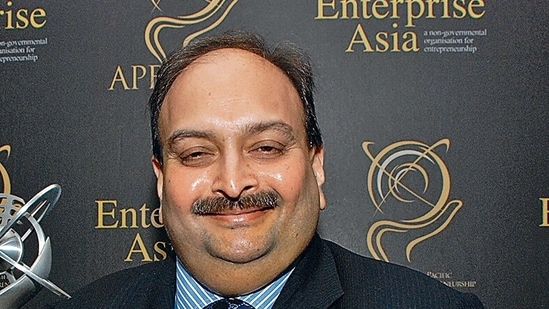
CBI files three fresh FIRs against fugitive diamantaire Mehul Choksi in Rs 6,746 crore fraud case

0

The Central Bureau of Investigation (CBI) on Friday filed three fresh FIRs against fugitive diamantaire Mehul Choksi and two jewellery brands, Nakshatra Brands Limited and Gitanjali Gems Limited. The FIRs were filed on the basis of a complaint filed by the Punjab National Bank (PNB), bringing to light an additional loss of Rs 6,746 crore incurred by it and other banks of a consortium.

Choksi and his nephew Nirav Modi are already wanted by Indian investigative agencies for defrauding Punjab National Bank to the amount of Rs 13,600 crore. The fraud was discovered in 2018, and Choksi and Nirav Modi have been on the run ever since.

Notably, Vijay Kumar Wadhwa, deputy general manager of the zonal office of the Punjab National Bank in Mumbai submitted three fresh complaints to the CBI on March 21. The FIRS were against Nakshatra Brands Ltd and Gitanjali Gems Ltd, Mehul Choksi, who is the managing director of Gitanjali Gems Ltd and guarantor for Nakshatra Brands Ltd; Dhanesh Vrajlal Sheth, director of Nakshatra Brands Ltd’ and several others; including public servants, for causing an additional unwarranted loss of more than Rs 6,000 crores to a consortium of banks.

Details of 1st fresh FIR against Mehul Choksi

It was alleged in the first complaint against Nakshatra Brands Limited that the jewellery company is a division of Gitanjali Gems Ltd and that Mehul Choksi actively conspired with the accused listed in the FIR.

Between January 21 and April 1, 2010, the jewellery company and other accused, including Choksi, conspired to defraud a group of nine banks, led by Punjab National Bank, of Rs 807.72 crores.

What does the second FIR state

It is alleged in the second complaint that between April 1, 2010, and January 31, 2018, the jewellery company and the accused parties, including Choksi, conspired to defraud a group of 28 member banks headed by ICICI Bank Limited of Rs 5,564.54 crores.

Both complaints claim that the jewellery companies and the accused mentioned in the FIR engaged in account fudging, and money-siphoning and used approved credit limits for fictitious business transactions.

The group of participating banks labelled the accounts of Gitanjali Gems Ltd. and Nakshatra Brands Ltd. as non-performing assets and reported them as frauds to the Reserve Bank of India.

Involvement of Mehul Choksi in the PNB scam

Choksi and his nephew Nirav Modi are accused of defrauding the Punjab National Bank of Rs 13,600 crore. The fraud was discovered in 2018, and he and his nephew have been on the run ever since. Choksi escaped to Antigua while Nirav Modi is in the United Kingdom. Only two days ago, on December 15, the UK Supreme Court denied fugitive diamantaire Nirav Modi’s plea against his extradition to India. According to reports, Modi has now lost all options and could be extradited to India within the next 28 days.

Choksi, who is accused of criminal conspiracy, criminal breach of trust, deception, and dishonesty, as well as property delivery, corruption, and money laundering, had argued that he is no longer an Indian citizen as he took Antiguan citizenship in 2017. However, Antigua has agreed to send him back to India to face the law.

Last year in July, however, the fugitive was given interim bail by the Dominican High Court on medical grounds. He was allowed to go to Antigua for treatment of his neurological condition. He has been granted bail until he is fit to travel.

Twitter Files 6.0: FBI, security agencies stayed in regular touch with top Twitter employees, frequently sent censorship requests

On Friday (December 16, US local time), the sixth tranche of internal communication between Twitter employees was released on the micro-blogging platform.

Dubbed the ‘Twitter Files 6.0’, it exposed how the Federal Bureau of Investigation (FBI) and other security agencies stayed in regular touch with top Twitter executives and sent requests to censor accounts.

The explosive story, covered by independent journalist Matt Taibbi, also showed how Twitter employees readily complied with the censorship requests under one pretext or the other.

At the very onset, the journalist pointed out how the Twitter Files have unearthed the relationship between the FBI and the top executives of the social media giant.

“Twitter’s contact with the FBI was constant and pervasive as if it were a subsidiary,” he noted while pointing out 150 email exchanges between the FBI and Yoel Roth (former Global Head of Trust & Safety) during the period of January 2020 and November 2022.

So far, the ‘Twitter Files’ have exposed how Yoel Roth has justified the censorship of the infamous New York Post story about Joe Biden’s son Hunter Biden. He was also seen patting himself on the back for quickly censoring Donald Trump. 

According to Matt Taibbi, the email exchanges between the FBI and Yoel Roth included reminders for quarterly calls and information about users pertaining to active investigations.

He pointed out that a large tranche of emails from the FBI involved directing the Twitter team to take action against accounts under the pretext of ‘election misinformation.’ Taibbi added how several such handles posted satirical content and joke tweets.

He also informed that the FBI created its own social media task force, comprising 80 agents, to prevent ‘foreign influence and tampering’ in US elections.

The ‘Twitter Files 6.0’ revealed that Twitter employees were pressurised by the FBI, and even the Department of Homeland Security (DHS), to increasingly moderate content on the micro-blogging site.

“What stands out is the sheer quantity of reports from the government. Some are aggregated from public hotlines,” noted Taibbi.

The independent journalist revealed an internal chat between the FBI and Twitter moderation team in November this year where the federal agency was seen demanding action against 4 accounts for ‘potentially violating Twitter rules’.

Interestingly, the Twitter employees readily complied and permanently suspended the said accounts, including one that posted only satirical content.

On November 6 this year, the National Election Command Post of the FBI sent a list of 25 usernames to the Twitter team and sought ‘additional action’ against them.

On receiving the request from the FBI, Twitter permanently suspended 7 of the 25 accounts and took action against 9 handles for violation of ‘civic management policy.’ One account was temporarily suspended for ‘spam’.

Interestingly, Twitter took no action against American actor Billy Baldwin, who had claimed that former US President Donald Trump would go to jail on the release of his tax returns by the Supreme court. Baldwin had also accused Elon Musk of ‘delivering’ mid-term elections to the Republicans.

In a letter addressed to former Deputy General Counsel of Twitter Jim Baker (now terminated by Elon Musk), a legal executive by the name of Stacia Cardille informed about her weekly meetings with the Department of Justice, FBI, Department of Homeland Security and the Office of the Director of National Intelligence.

“The Twitter exec writes she explicitly asked if there were “impediments” to the sharing of classified information “with industry.” The answer? FBI was adamant no impediments to sharing exist,” Matt Taibbi informed.

“This passage underscores the unique one-big-happy-family vibe between Twitter and the FBI. With what other firm would the FBI blithely agree to “no impediments” to classified information?” he asked.

The independent journalist also shared an internal letter, dating back to January last year, where top Twitter employees were seen mulling action against accounts for ‘possible violative content.’ Interestingly, the list of such Twitter handles (with low engagement) was provided by the FBI.

“This is what the FBI spends its time on,” Matt Taibbi noted.

‘Twitter Files 6.0’ also exposed the close nexus between top Twitter employees and federal agencies. In one email exchange dating back to March 2021, an FBI officer was seen thanking a senior Twitter executive for speaking to him.

Later, the security official also shared DHS bulletins with the Twitter team and emphasised “the need for greater collaboration between law enforcement and private sector partners.”

“The ubiquity of the 2016 Russian interference story as stated pretext for building out the censorship machine can’t be overstated. It’s analogous to how 9/11 inspired the expansion of the security state,” journalist Matt Taibbi tweeted.

He informed that the FBI had multiple ways to reach out to the top Twitter employees and influence the decision-making process. In one such internal communication, the employees were seen congratulating each other for reviewing ‘possible violative content’ sent over by the FBI.

It must be mentioned that requests for content moderation and censorship were not just limited to the FBI. The Department of Homeland Security (DHS) and State governments were equal parties to it.

In one instance, officials from California were seen coercing Twitter employees to take action against a tweet by Donald Trump. According to Matt Taibbi, Twitter received reports from an outlet named Partner Support Portal, which was created by DHS’ partner organisation ‘The Center for Internet Security’.

“The takeaway: what most people think of as the “deep state” is really a tangled collaboration of state agencies, private contractors, and (sometimes state-funded) NGOs. The lines become so blurred as to be meaningless,” Matt Taibbi concluded.

Twitter Files 3.0 also revealed the influence of the FBI on Twitter employees

On December 9, the third tranche of confidential conversations between top Twitter executives was released on the micro-blogging platform which also exposed the influence of FBI on Twitter. 

The ‘Twitter Files 3.0’ revealed that the senior executives of Twitter Inc. were in constant touch with federal agencies ahead of the 2020 US Presidential elections.

It revealed how the Federal Bureau of Investigation routinely sent tweets, posted by Republican candidates, to the moderation team for expunction.

Matt Taibbi informed that Twitter began enforcing rules arbitrarily and using pretexts to justify their actions. Following the US Capitol riots, the meetings between top Twitter employees and federal agencies intensified.

Matt Taibbi unearthed how the mindset of top Twitter executives evolved between late 2020 and early 2021. He informed that a channel titled ‘us2020_xfn_enforcement’ was created to discuss the censorship of high-profile accounts (also called Very Important Tweeters) in the context of US elections.

The ‘Twitter Files 3.0’ exposed how the likes of Vijaya Gadde (former Head of Legal, Policy, and Trust at Twitter) and Yoel Roth (former Global Head of Trust & Safety) were making decisions based on whims and fancies.

“The latter group were a high-speed Supreme Court of moderation, issuing content rulings on the fly, often in minutes and based on guesses, gut calls, even Google searches, even in cases involving the President,” journalist Matt Taibbi noted.

He also added that the duo was “clearly liaising with federal enforcement and intelligence agencies about moderation of election-related content”.