Home Blog Page 3316

‘Hateful, inciteful, obnoxious’: Delhi HC observations while hearing plea challenging refusal of bail to Delhi anti-Hindu riot accused Umar Khalid

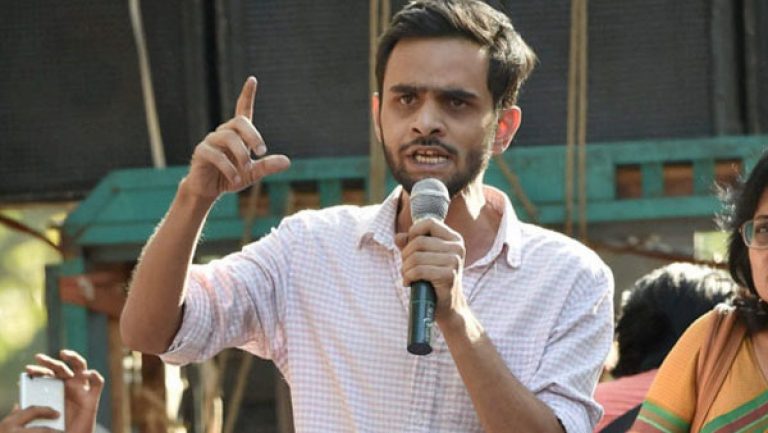
On Friday, April 22, a division bench of the Delhi High Court comprising Justice Siddharth Mridul and Justice Rajnish Bhatnagar termed one of the speeches given by Umar Khalid as ‘offensive’, obnoxious’ and ‘inciteful.’ The court made the scathing remarks while hearing the plea challenging the refusal of bail to the former JNU student, one of the prime accused in the 2020 Delhi anti-Hindu riots.

Notably, the particular speech the court condemned was given by Umar Khalid in Amravati and was a part of the charge sheet against him in the larger conspiracy case related to the Northeast Delhi riots.

“This is offensive, obnoxious. Don’t you think? These expressions being used, don’t you think they incite people? You say things like aapke purvaj angrezun ki dalali kar rahe the, (your ancestors were British slaves) you don’t think it is offensive? It is offensive per se. This is not the first time that you said so in this speech. You said this at least five times. It is almost as if we distinctly get the impression that it was only one particular community that fought for India’s independence,” said the division bench of Justice Siddharth Mridul and Justice Rajnish Bhatnagar after Khalid’s lawyers read the contents of his speech before the court.

“Don’t you think it foments religious ferment between groups?”, the court further asked Senior Advocate Trideep Pais, representing Khalid, who submitted that it was an opinion of an individual being given in a speech and that there was “absolutely no incitement” and no reaction among the public afterwards.

Coming down hard at Pais’ argument, the court asked whether the right to free speech extends to making “obnoxious statements” and whether it does not attract the provisions of 153A and 153B of the Indian Penal Code.

Reading the relevant portion of the speech, Justice Bhatnagar said, “all we can say that Prima facie this is not acceptable.” The court added, “Everything else may be acceptable within the four corners of democracy and free speech, this is not acceptable.”

When Umar Khalid’s lawyer responded by saying, “It is so easy to invoke UAPA today. Your lordships may find the speech obnoxious”, Justice Siddharth Mridul curtly reiterated, “Yes we do. It’s inciteful.”

When advocate Trideep Pais insisted that he would prove that the speech was not inciteful, the court rescheduled the hearing of the case on April 27 and asked SPP Amit Prasad to share the digital charge sheet and also other portions of the speech and overt act. It also asked the police to file a short reply within three working days.

Umar Khalid was booked under UAPA

The Delhi Police apprehended Umar Khalid on September 13, 2020, and charged him on November 22, 2020, under several provisions of the UAPA and the Indian Penal Code. In July 2021, Khalid filed a bail application.

It may be noted that Khalid’s bail plea has been rejected thrice since his arrest in September 2020. Most recently, the Delhi Court had refused bail to so-called activist and former JNU student Umar Khalid on 24th March in connection with a case pertaining to the bigger conspiracy in the 2020 Delhi riots, involving offences under the Indian Penal Code and UAPA (Unlawful Activities Prevention Act). The order was issued today by Additional Sessions Judge Amitabh Rawat.

The FIR filed against Khalid includes serious allegations such as Sections 13, 16, 17, 18 of the UAPA, Sections 25 and 27 of the Arms Act, and Sections 3 and 4 of the Prevention of Damage to Public Property Act of 1984. He is also charged with a number of offences listed in the Indian Penal Code of 1860.

The bail application of Umar Khalid, represented by Trideep Pais, Ld. Senior Advocate, filed under Section 437 of Code of Criminal Procedure (CrPC) read with Section 43­D(5) of Unlawful Activities (Prevention) Act (UAPA) on 6th September 2021.

Jahangirpuri Riots: Delhi Police Commissioner writes to ED, asks for probe against prime suspect Ansar under PMLA

In the case of violence against a Hanuman Jayanti procession in Jahangirpuri in Delhi, Delhi Police Commissioner Rakesh Asthana has written to the Enforcement Directorate (ED) Director to probe the prime suspect Ansar under the Prevention of Money Laundering Act (PMLA). Ansar was arrested the day after the riots when he was identified as the individual who initiated the violence by confronting the procession.

As per reports, the Hanuman Jayanti Shobha Yatra was proceeding peacefully in the Jahangirpuri area on April 16. When the procession reached Jama Masjid in C-Block, Mohammed Ansar, with his men, descended on the procession and started the argument. In no time, there was massive stone-pelting by Islamists from the mosque and surrounding areas.

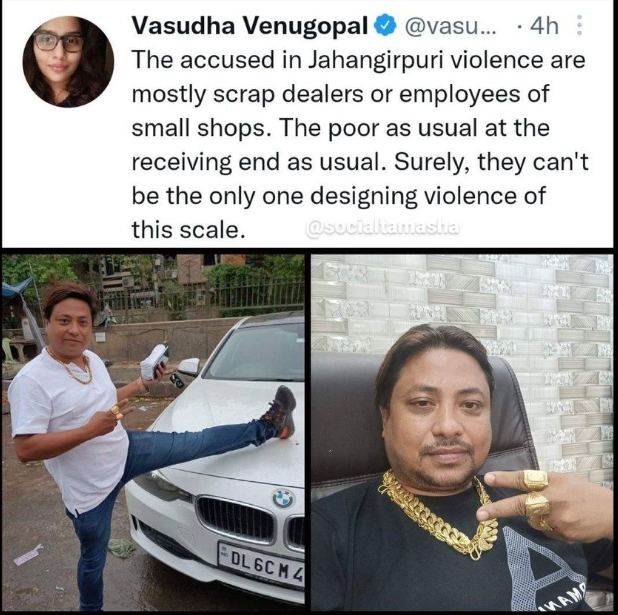
Ansar has shared several pics of his wealth on social media even though several journalists tried to portray him as a poor man suffering due to the system.

Source: Twitter

As per Firstpost, Delhi Police suspect gambling money was used by Ansar to purchase land and properties in various places. Sources in ED said, his properties and bank details are under scanner and the case is no longer of rioting. The probe of illegal funds is also underway. With him flaunting BMWs and massive gold chains, the authorities are zeroing in on his financial dealings.

Ansar was also found to be involved in multiple illegal cases previously and has been arrested several times, although NDTV gave him a clean chit by saying his neighbour said he has always been a good person.

However, with ED entering the frame, Ansar may have to finally explain his BMWs and gold chains and gold rings he accumulated while living in slums, even though he very famously madejhukega nahi saala” pose from the Pushpa movie.

Entitlement, sycophancy, posts for Gandhis, demand to report directly to Sonia Gandhi: Prashant Kishor gives suggestions for Congress’ revival

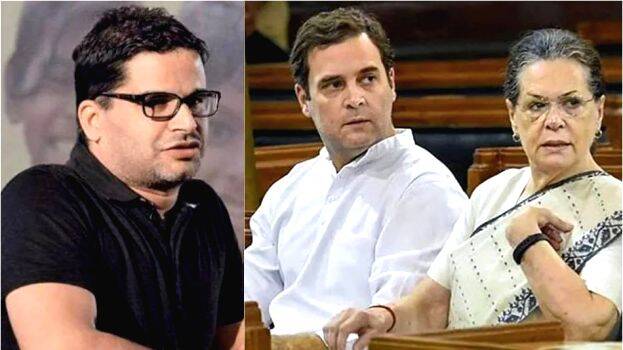
Poll strategist Prashant Kishor, whom the Congress Party is eyeing to help it emerge from political oblivion, has asked the Congress leadership to elect a non-Gandhi as the party president. He proposed that the three key positions of UPA Chairman, Parliamentary Board Chief, and General Secretary Coordination be reserved for the Gandhis, namely Sonia Gandhi, Rahul Gandhi, and Priyanka Gandhi Vadra.

Kishor suggested forming a shadow Cabinet of 20-25 experienced and new politicians, as well as a brain trust of 10-12 SMEs and global authorities, in his presentation to Congress leadership, “to effectively represent the voice of the people both in Parliament and outside.” This, he claimed, would go a long way toward combating “elected autocracy” with “collective credibility.”

According to the strategist, “traditional media is heavily biased towards the ruling party,” and “the current dispensation’s vast network combines the resources of government and party to maintain news stranglehold.”

Poll strategist Prashant Kishor calls out Congress party’s sense of entitlement and sycophancy

He also claimed that the “timing and choice of propagation for INC is lopsided and not driven by data or science.”

Kishor proposed establishing, “a network of ideologically inclined digital supporters divided into 543 digital zones, each with an ecosystem of approximately five lakh digitally connected people”.

Kishor stated that the party should not give tickets or organisational positions to those accused of heinous crimes and that the one-man-one-post principle should be strictly followed. He slammed the party’s “jaded and aged leadership,” saying they had “complete disconnect with the grassroots” and the party had “ceased working as a democratic organisation” under them.

He emphasised the Congress party’s sense of entitlement and sycophancy, claiming that only 23 of the party’s 118 central leaders are elected.

Kishor, without his mincing words, pointed out how the Congress leadership does not appear to be aligned in terms of goals, strategy, method, approach, tactics, and the path forward, leading to a lack of unity, at times confusion, and impasse.

He presented some jarring figures illustrating the party’s “perpetual decline since 1985.” The statistics demonstrated a steady decline in vote share and the number of seats won by Congress in Parliament and state legislatures.

When competing directly with the BJP, the Congress has performed miserably: Prashant Kishor shares insight

Prashant Kishor elucidated how the Congress party has performed particularly badly when it has been in direct competition with the BJP. In 2019, Congress lost 92% of Lok Sabha seats where it was in direct contest with the BJP, compared to 90% of similar seats in 2014, remarked Kishor.

He cited three plausible causes for the party’s electoral decline: the natural disadvantage of being a legacy incumbent; four periods of organised mass dissent; and a failure to capitalise on legacy and achievements.

Going into the history of the Congress’ collapse, he stated that four mass movements – the JP Movement, Bofors, Mandal, Ram Mandir, and the rise of Modi and India Against Corruption – harmed the party’s prospects and caused a decrease in vote share.

He criticised the party for failing to capitalise on its legacy and the accomplishments of its regimes.

The poll strategist remarked how between 1885 and 1998, the party had 61 presidents, whereas between 1998 and 2022, the party had only two presidents (Sonia 21 years and Rahul 2 years). Further delving into the flaws of the Congress party, Prashant Kishor stated that more than 65 per cent of district presidents and 90 per cent of block presidents have never met with the Congress president or the AICC secretary.

He stated that the party needs to “preserve its soul” and “create a new body”.

Congress leaders divided on the induction of the poll strategist into the party

Notably, the aforementioned suggestions were made by Prashant Kishor during a three-hour presentation at Congress president Sonia Gandhi’s residence on April 16. 

According to reports, key Congress leaders gathered at the house of party president Sonia Gandhi on Saturday and have reportedly discussed the strategy for the next Assembly elections as well as the brainstorming session that the party is intending to host to create measures for the party’s recovery.

The meeting was attended by former Congress president Rahul Gandhi, General secretary Priyanka Gandhi, and senior leaders AK Antony, Ambika Soni, Mallikarjun Kharge, Digvijay Singh, Mukul Wasnik, KC Venugopal, Jairam Ramesh and Ajay Maken, besides the Congress president.

After the presentation, Sonia Gandhi asked the leaders about their opinion on the presentation. She also formed a three-member committee comprising party veterans AK Antony, Ambika Soni and Mallikarjun Kharge to examine election strategist Prashant Kishor’s strategy paper for contesting the 2024 Lok Sabha elections. 

As per reports, senior party leaders Digvijay Singh and AK Antony were not quite impressed by Prashant Kishor’s proposal. Digvijay stated that this is exactly what the party declared after its last two chintan shivirs in Pachmarhi and Shimla. Most of the points raised in the plan, according to Antony, were identical to those raised in his report following the party’s defeat in 2014.

The two leaders also suggested that Kishor should not be made an office-bearer or senior party leader as that would “create chaos” in the ranks, the person added.

Some sources in Congress revealed that some senior leaders are of the opinion that before entrusting Prashant Kishor with complete responsibility for strategizing the 2024 general elections, he should be challenged to demonstrate the effectiveness of his strategy in the upcoming state elections.

“Elections are due in over a dozen states before the 2024 Lok Sabha election. Congress holds a little over 400 seats out of the 1500 plus seats in these states. Let him first help the party improve its tally in these states before taking a big bite,” a senior Congress leader was quoted as saying.

Meanwhile, Hindustan Times reported that while some prominent leaders are sceptical about Kishor’s appointment, others, like former Madhya Pradesh chief minister Kamal Nath, have welcomed his appointment. To accommodate Kishor, Nath even proposed a new position of general secretary (strategy).

Prashant Kishor says he can not work with several layers of hierarchy

During his talks with senior leadership, Kishor stated that he could not operate with multiple layers of hierarchy and preferred to report directly to the Congress President. This has proven to be a source of friction for many of the senior officials who have been close to the Gandhi family.

Given the opposition to the title of “general secretary,” some other members of the party proposed that Kishor be appointed as an adviser to Sonia Gandhi.

Interestingly, Prashant Kishor’s induction into the party fold has also been supported by Gandhi scion Priyanka Gandhi Vadra and her brother Rahul Gandhi. Priyanka Gandhi Vadra is said to have told senior party leaders, “everyone has tried and failed. He wants to do something new, so we should give him a chance”.

Notably, in 2021, there had been frequent talk that election strategist Kishor would become a full-fledged member of Congress. According to many reports, Kishor sent out feelers about working for the party as a member in May 2021, after the results of the West Bengal assembly elections were known.

Prashant Kishor stated in December 2021 that he had been in contact with the Congress leadership for the preceding two years, but that after the Bengal election, the relationship became much more planned and focused. He stated that he was on the verge of joining the party, but decided against it since he understood that working together would be unproductive for both sides owing to several concerns. He did not, however, address the concerns that prevented him from joining the Congress party.

In the recent assembly elections in five states, Congress performed faired extremely poorly winning only a handful of seats in all states. They even lost deposits on 97 per cent of the seats in Uttar Pradesh that were up for election. Since then, Congress has been working tirelessly to act in a way that will result in the party’s revival at whatever cost.

Lawyer who helped child rapist Firoz justifies his actions, insinuates ‘Hindus deserve what happened to the 4-year-old victim’

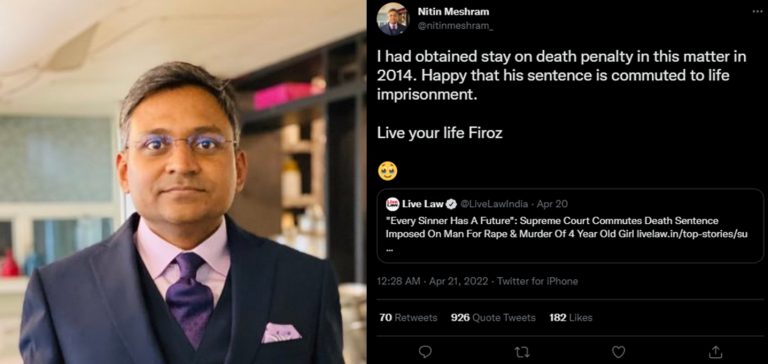
A tweet by Supreme Court Advocate Nitin Meshram has sparked a debate on social media, with several users criticising his statements. Meshram commented on the Supreme Court’s decision to commute the death sentence of rape and murder convict Firoz. Firoz was sentenced to death in 2014 for raping and murdering a 4-year-old girl.

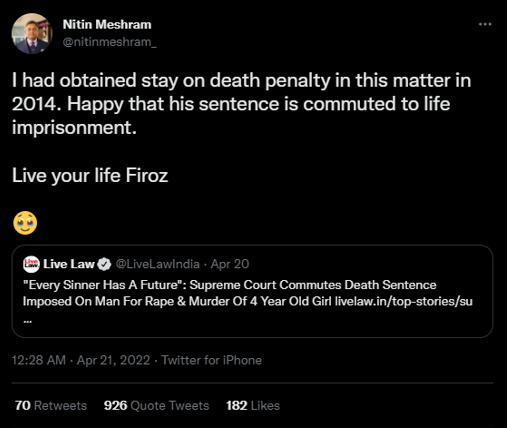
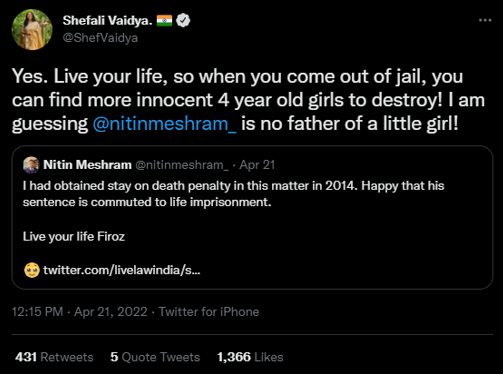
Adv Meshram stated in the tweet that he was the one who helped Firoz secure a stay on his death sentence in 2014. In the tweet, he cited the recent Supreme Court judgement and wrote, “I had obtained stay on death penalty in this matter in 2014. Happy that his sentence is commuted to life imprisonment. Live your life Firoz”

The Tweet made by Adv Meshram.

Quoting his tweet, Author and Social activist Shefali Vaidya wrote, “Yes. Live your life, so when you come out of jail, you can find more innocent 4-year-old girls to destroy! I am guessing @nitinmeshram_ is no father of a little girl!”

The tweet.

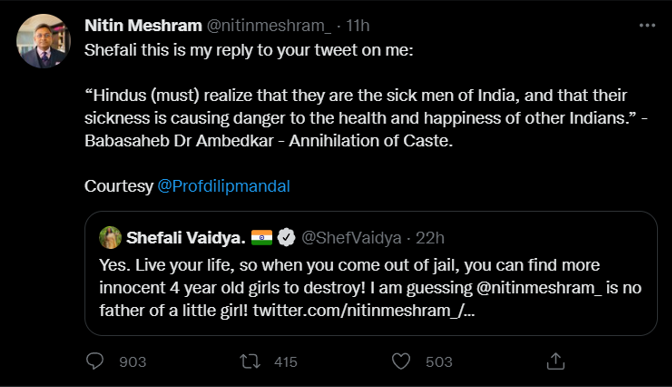
Adv Meshram then responded to Shefali Vaidya’s comment by writing, “Shefali this is my reply to your tweet on me: “Hindus (must) realize that they are the sick men of India, and that their sickness is causing danger to the health and happiness of other Indians.” – Babasaheb Dr Ambedkar – Annihilation of Caste. Courtesy @Profdilipmandal”

Meshram’s response to author Shefali Vaidya

Meshram’s response to Vaidya’s concern regarding the 4-year-old victim who died at the hands of rapist Firoz, was an out of context Amebkar quote. Meshram appeared to be using that quote to justify his help to the child rapist in evading harsher punishment based on the culprit’s religion. Indirectly, Meshram insinuated that Hindus ‘deserve’ what happened to the 4-year-old girl.

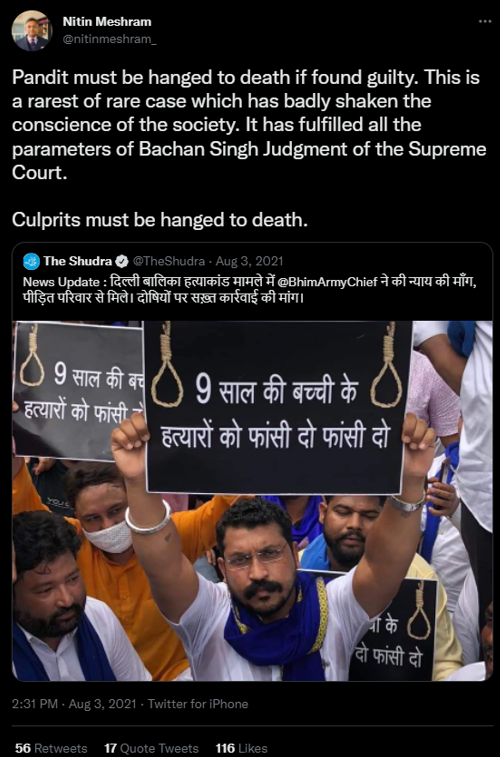
Following this exchange of responses, several other social media users highlighted what Adv Meshram had previously remarked in a case involving the death of a juvenile girl in 2021. Meshram had posted comments on Twitter in 2021 demanding the death penalty for the accused in that case. In a tweet made on August 3, 2021, he stated, “Pandit must be hanged to death if found guilty. This is a rarest of rare cases which has badly shaken the conscience of the society….Culprits must be hanged to death.”

Tweet by Adv Meshram.

Concerning both of his remarks, Twitter user Anshul Saxena wrote, “…If both Pandit & Firoz are guilty, why not demand to hang both?”

Another user Monidipa bose wrote, “Ppl like Nitin Meshram are the reason why our society is going all awry, with institutions like the SC sympathising more with rap!sts & j!Hadis instead of the victims! With zero sympathy for the dead 4 yr old girl who had her future cut short brutally, he’s wishing the rapist !”

People on social media are slamming Adv Meshram for his comments about the court’s order. People are questioning why his comments are so skewed and one-sided.

Meshram, it is worth noting, sought the death penalty for the pandit accused of murdering a juvenile girl in 2021, yet he backed the commuting of Firoz’s death sentence, stating, “Live your life Firoz.”

His disparate words have sparked outrage on social media, with individuals pointing out how his remarks differ when it comes to Hindus and how they shift when it comes to Muslims.

Meshram also wrote an opinion in 2021 in which he questioned Former Chief Justice of India SA Bobde’s competency. Meshram argued in the article that Bobde was unsuitable for constitutional courts and that his judicial precedents were defective and denounced constitutional benchmarks.

OpIndia reached out to Adv Meshram and inquired about his position on the remarks he made on Twitter. When asked to comment on his tweets and the discussion around them, he stated, “It was my personal opinion, and under the constitution, I am allowed to express it. Debate and discourse are essential in a democracy, and if people are talking about something, they have the right to talk about it.”

“The tweet was simply a social communication on the order I obtained in 2014. An opinion may be abusive, but it is protected under the constitution as long as it is within the constitutional framework,” he further added.

How SS Rajamouli is filling the canvas of Bhartiya cinema with civilisational beauty

In 2005’s Chatrapathi, the Telugu action drama that catapulted Prabhas to superstardom, music director MM Keeravani’s Agni Skalana almost became an anthem signifying the scuffle between dharma and adharma. The song soared in the background every time Shiva fought against evil to protect his people in the port of Vizag. Weaving a tale of the oppressed finding a leader to save them from the oppressor even as he takes the law into his hands, SS Rajamouli’s audience got a hero who didn’t shy away from the tandaav while restoring balance on his land.

The Sanskrit lyrics coupled with catchy beats amplified the resonance with Chhatrapati Shivaji Maharaj establishing a Rashtra that is as much Hindu as it is free from brutality and injustice. Anyone who has been following the creative graph of Rajamouli cannot deny the inclusion of thoroughly Hindu symbolism in his works from the beginning. ‘Rise, Roar, Revolt’, his latest money-spinner continues with the narrative thus becoming another glorious feather to that artistic bent.

Still from Baahubali

Heavily influenced by Bharatiya itihaasa, Ramayana and Mahabharata, the director, known for his larger-than-life cinema, has been steadily building his filmography that borrows concepts, ideologies and philosophies from not just those Indian epics but also from our ancient Sanatani texts and scriptures. Except for an oddball ‘Sye’, the sports action drama where Hindus were painted in a sordid light compared to others, Rajamouli’s art has quite regularly stood out for flaunting the Hindu identity emphatically.

If Chatrapathi played on the imagery of the Maratha warrior vanquishing villains, Magadheera, Baahubali and RRR’s good triumphing over evil liberally use Indic iconographies giving the silent majority in the country a reason to cheer and derive confidence from our forgotten icons and their heroic past. 

Nationalism wrapped in Hindu Iconography

While Telugu cinema largely carried a pro-India narrative always, it is with Baahubali and RRR that the focus magnified on celebrating quintessential Hindu vocabulary. The thundering box office collections prove that India is thirsty for movies diametrically different from the anti-Hindu diatribe Hindi filmmakers have churned out till now.

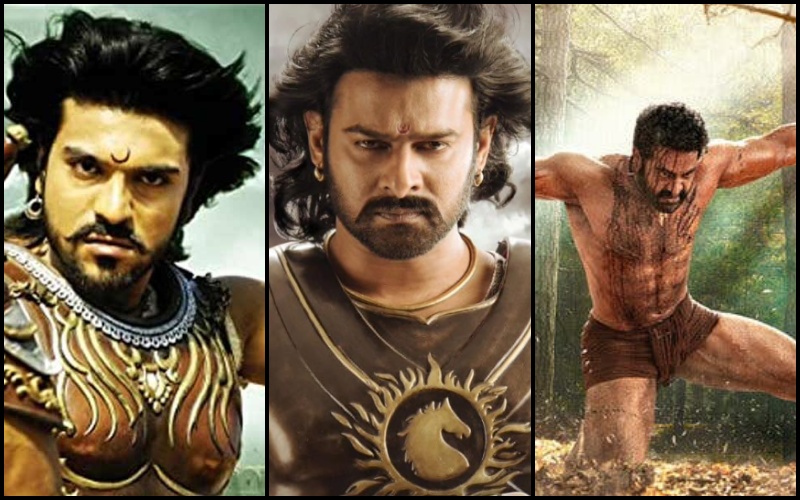
RRR has also intensified the penchant to learn about lesser-known national heroes after Rajamouli picked relatively obscure historical figures to weave a patriotic tale of grit and gumption even as he paid a handsome tribute to everything gloriously Hindu. While Magadheera’s gallant warrior Kumarabhairav traversed births to unite with his lover, Baahubali’s lead avenged his father’s death to become the king of Mahishmati, RRR’s Alluri Rama Raju and Komaran Bheem take on British cruelty with unstinted bravura.

The montages in the movies hark to the age of intrepid Hindu legends winning wars for their motherland and the honour of their women.  

Stills from Magadheera, Baahubali, RRR

An Ode to Forgotten Heroes

RRR’s protagonists are inspired by Alluri Sitarama Raju and Komaram Bheem, two revolutionaries from the Gond tribe our NCERT texts never featured. Ram Charan dons the role of Sitarama Raju who led the Rampa Rebellion (1922-24) against the Madras Forest Act, which prevented the free movement of tribals in the forests and impacted their livelihoods.

Under his leadership, the tribes fought a gruesome guerilla war by attacking British armouries and police stations. Komaram Bheem, played by NT Rama Rao Jr, led a rebellion against the feudal Nizams of Hyderabad and the British Raj in the eastern part of the princely state during the 1930s which culminated in the Telangana Rebellion of 1946.

Rajamouli, despite taking vast creative liberties, doesn’t shift from the patriotic goalpost. While Baahubali’s theatrics painted a magnificent picture of our ancient Indian kings, his latest historical fiction unifies the leads using strength and strategy as catalysts. 

Imagery laced with Sanatani Concepts

The infusion of Indic heritage, itihaasa and Sanatan concepts is directed at making the Indian audience feel proud of their illustrious past. Remember a strapping Prabhas carrying the Shivalinga on his shoulders in Baahubali-The Beginning? Or the climactic fight sequence where Mahendra Baahubali sprays holy ash on his wounds as his blood trickles down the marble Shivalinga?

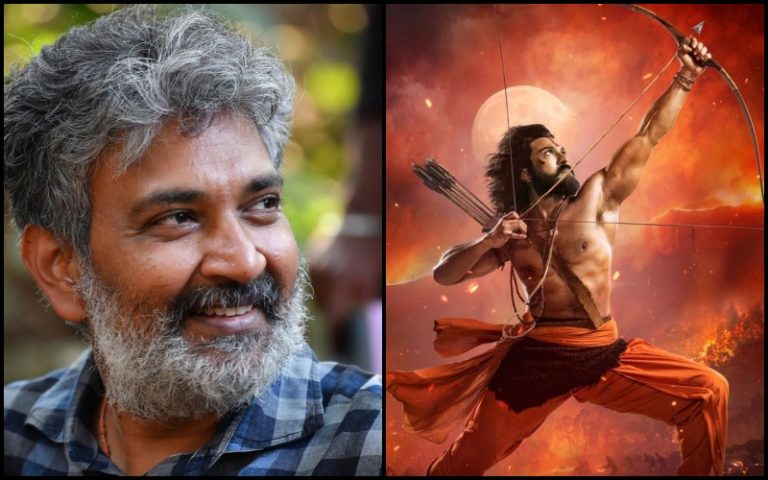
In RRR, too, the makers harp on such imagery as well the Panchabhoota. In the climactic sequence, Alluri Ramaraju appears as if Shri Ram is training his arrow at the enemy. Komaram Bheem shoots his spears at the soldiers as if one would do with a Trishul.

Still from RRR

Refer to the scene where Mahendra’s darting spear smashes that of Bhallaladeva’s during their fierce fight. These are not just remarkable glorification of our Sanatan heroes and their heroism but also Rajamouli recreating famous battle sequences from Ramayana and Mahabharata. 

In one of the posters of RRR, Alluri shows Bheem how to train a gun, taking us back to the image of Shri Krishna directing Arjun in the art of warfare. Then there is Bheem apologizing to the tranquillized tiger referring to the Hindu sentiment of treating animals with compassion.

That Sanatani traditions have always shared beautiful conjunction with nature is also impressed on when Amarendra Baahubali spares sacrificing a buffalo before the battle with Kalakeya. Note here that war ensues, in both Magadheera and Baahubali, only after due respect is paid to giant Hindu deities.  

Creating Sounds of Pride

Rounding off on a musical note, Keeravani’s symphony for Baahubali and RRR combined Indian classical, modern rock strains with Sanskrit lyrics. While Magadheera and the former featured romantic ballads (when Devasena croons Kannaa Nidurinchara that lulls Baahubali to sleep, it not only invokes reverence but also suggests a sweet, playful dalliance between Radha and Krishna), too, RRR’s music is heady with nationalistic fervour with the compositions Komaram Bheemudu and Janani carrying a strong patriotic undercurrent.

Ramam Raghavam on the other hand elevates the character of Alluri to a spiritual level even as the music video has young musicians in saffron attires and nakshatra beads. Courage seems to thematically wash over the track accompanied by the hue of fire. Can it get more Hindu than that? 

Rajasthan: Hindu temple in Alwar district demolished by bulldozer, over a hundred families made homeless in Rajgarh

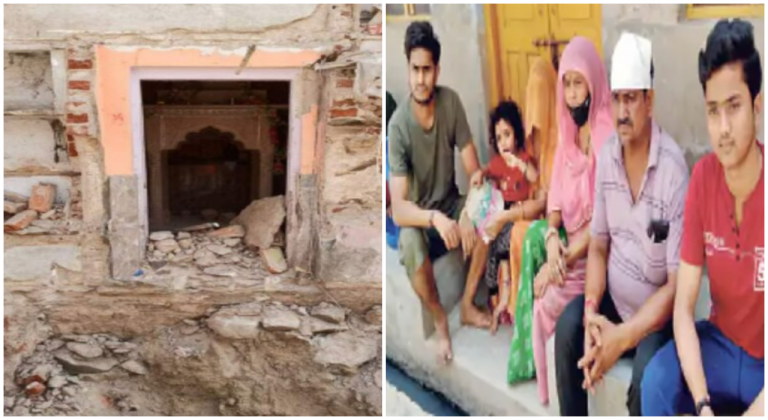
In Rajgarh, district Alwar in Rajasthan, the authorities have demolished an old Hindu temple, inviting criticism and condemnation from locals.

As per reports, a JCB was brought in to destroy the temple’s roof and pillars. Idols of the temple have been damaged in the demolition drive. A report in India TV stated that the Shivalingam inside the temple was also uprooted by using drills.

As per the report, a video by local MLA Jauhari Lal Meena has gone viral on social media where he is heard saying a Congress municipality could have prevented the demolition drive. He reportedly stated that if the 34 councillors were brought near him, he could have stopped the demolition drive.

On the other hand, the BJP in the state is blaming the Gehlot government for the demolition of the temple that was reportedly 300-year-old.

In a tweet, the BJP has stated that the temple demolition in Alwar’s Rajgarh was the Gehlot government’s ‘revenge’ for the demolition drive in Delhi’s Jahangirpuri.

Notably, the Rajgarh authorities had demolished the houses of over 85 Hindu families in a ‘road-widening’ drive citing a city masterplan. A report in Dainik Bhaskar had mentioned that the said road, the ‘station road’ in Rajgarh has a ‘masterplan-approved’ width of 60 feet only for a stretch of 120 metres or so, from Nandlal Shah garden to Saini dharmshala. The rest of the road is narrower than 50 feet.

Reports mentioned that many shops, that had been allotted by the government itself decades ago, had been demolished without giving notice to the tenants. The local authorities and local MLA have all refused to comment on the issue. Earlier this week, CM Gehlot had announced that the government cannot demolish houses and shops without notice.

Locals whose houses and shops have been demolished have stated that they had the valid documents of their properties. Despite this, the municipality has demolished their buildings. In a drive that started on 17 April, over 150 houses and shops, including old temples have been demolished so far, a Patrika report stated.

Karnataka: Hindu Temple-like structure found inside a mosque in Mangaluru, locals suspect the presence of a temple in the past

0

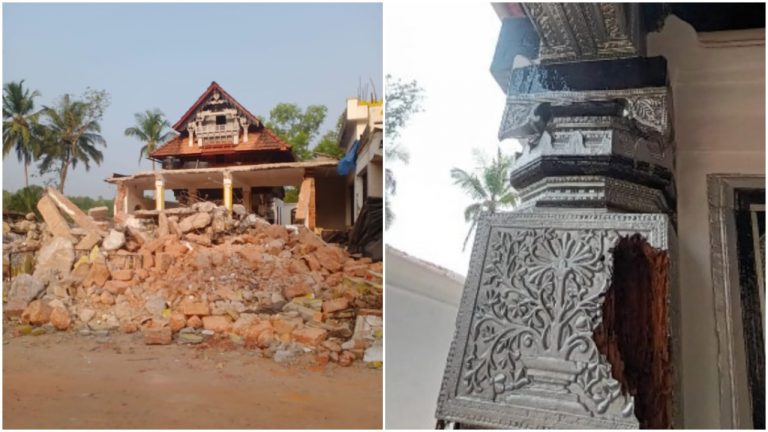
In a significant discovery, a Hindu temple-like structure has been found underneath an old mosque on the outskirts of Mangaluru in Karnataka. According to reports, the mosque authorities of the Juma Masjid in Malali, on the outskirts of Mangaluru, were carrying out renovation work of the mosque on Thursday. A Hindu temple-like structure with ornate columns was found on the premises as they brought done structures.

The presence of a Hindu temple-like structure inside the masjid has now raised curiosity among the people residing in the area whether a temple existed in the place before the present mosque existed. Locals suggest that there is every possibility that a Hindu temple existed at the site.

Hindu activist group Vishwa Hindu Parishad (VHP) leaders have now appealed to the district administration to stop the work till the documents are verified.

However, Dakshina Kannada Commissionerate has ordered to maintain the status quo of the structure till further orders. The administration said they would look into the land records and appealed to people to maintain peace.

“I have received information from field officials and the police department about the issue. The District administration is looking into the old land records and entries regarding the ownership details. We will take reports both from the endowment department and the Waqf Board,” said Rajendra KV, Deputy Commissioner, Dakshina Kannada.

The district administration said they would check the validity of the claims and take the appropriate decision very soon.

“Till then, I have instructed them to maintain the status quo and requested people not to jump to conclusions. I am requesting people to maintain law and order and peace,” he added.

India raises security concern: Pakistan misusing the Kartarpur corridor to make contact with Indian pilgrims, hold business meetings

On Thursday, India raised security concerns about the anti-India activities underway at the Kartarpur Corridor along the borders of India and Pakistan. The intelligence agencies have reported that Pakistan is misusing the corridor to interact with Indian pilgrims and cultivate contacts with them.

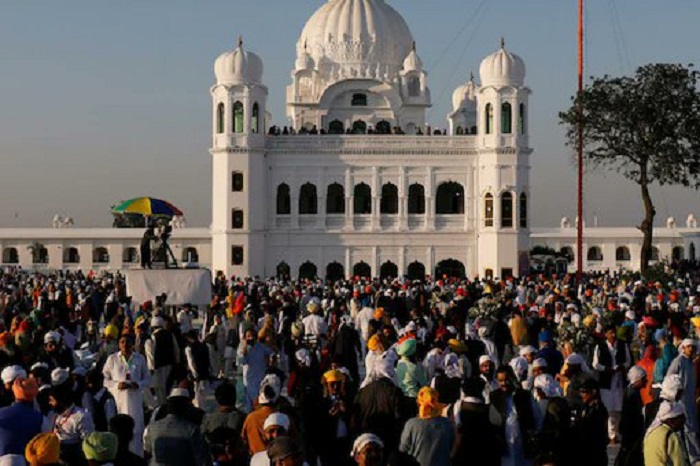
According to the reports, Pakistan has been misusing the 4.5 km corridor that allows Indian pilgrims to visit Gurdwara Darbar Sahib in Pakistan visa-free. Pakistan is trying to meet and cultivate contacts among Indians going on the pilgrimage. It is also using the corridor to conduct business meetings.

This is after India took cognizance of a meeting of the officials of the Rotary Club that was recently held inside the shrine at the Kartarpur Corridor. By interacting with the Indian pilgrims and holding business meetings at the corridor, Pakistan has violated the 2019 Kartarpur pact as the purpose of the corridor is only a religious pilgrimage, and conducting business meetings there is banned.

The Indian intelligence agencies are collecting evidence against the country and the matter will be raised with Pakistan soon. After being shut for more than 20 months due to the COVID-19 outbreak, the corridor was re-opened last November. However, though the government of Pakistan has changed, it continues to display its bitter attitude towards India. In 2019, when PM Narendra Modi inaugurated the portion of the corridor falling on the Indian side, the then Pakistan PM Imran Khan had inaugurated the corridor’s part on the Pakistani side. Khan had said that the launch of the corridor was a new road to peace. But since then, Pakistan has been using the corridor for various anti-India activities.

In November 2019, Pakistan tried to instigate Sikhs against India. It had placed a ‘bomb’ inside the Kartarpur Sahib Gurudwara premises with a banner that read that ‘the Indian Air Force had dropped this bomb during the 1971 India-Pakistan war on the gurudwara to destroy it’.

Also, the Indian intelligence agencies had reported that a group of terrorists was infiltrating near the Dera Baba Nanak area of Punjab. The report added that a substantial number of men and women are undergoing training at these terror camps. Recently, in 2021, the government of Pakistan appointed a non-Sikh person named Muhammad Latif as the CEO of the Project Management Unit, Kartarpur Corridor. It had hurt the Sikh sentiments seeing a non-Sikh with no knowledge of Sikh Maryada being given the crucial responsibility.

The Gurudwara is considered to be one of the holiest places in Sikhism as it is believed to be the final resting place of Guru Nanak. Kartarpur is located in Pakistan’s Narowal district across the Ravi river.

‘Kids may throw stones while playing’: Jama Masjid committee in Jahangirpuri asks Muslims not to bring children to Friday Namaz

Nearly a week after Muslim mobs threw stones and bottles at Hindu devotees taking out a Hanuman Jayanthi procession in Delhi’s Jahangirpuri, the Jama Masjid has asked Muslim Namazis not to bring kids along.

According to the reports, the clerics at Jama Masjid in Jahangirpuri have issued an order asking Muslims not to bring kids to the congregation. The order has been issued as a precautionary move so that kids do not throw stones on others ‘by mistake, while playing’.

The latest circular has raised suspicion among residents of Jahangirpuri. The Hindu residents fear that the mobs might unleash violence on Hindus yet again, and kids are being deliberately kept away from the mosque to keep them away from harm.

Post the violence on 16 April, the situation in the area remains tense.

It is important to note that the Muslim mobs had attacked the Hindu procession from inside the mosque, and on the streets on the Hanuman Jayanti. On April 16, Islamists attacked Hanuman Jayanti Shobha Yatra in Jahangirpuri, Delhi. Several people were injured, including police personnel.

So far, 40 people have been arrested by the Police in the case, including prime accused Ansar and Aslam. There have been allegations that Ansar is an Aam Aadmi Party member.

A video that the victims shot showed that a violent Muslim mob had attacked Hindu devotees passing through the street near the mosque during the recent Shobha Yatra in Delhi’s Jahangirpuri area. In the video, it was seen that the Muslim mob attacked the Hindu devotees from a mosque.

Hindu devotees were marching with the procession on the streets of Jahangirpuri on Saturday. As they celebrated the festival with chants, religious slogans and flags, a Muslim mob attacked them with stones and glass bottles. Shots were fired too.

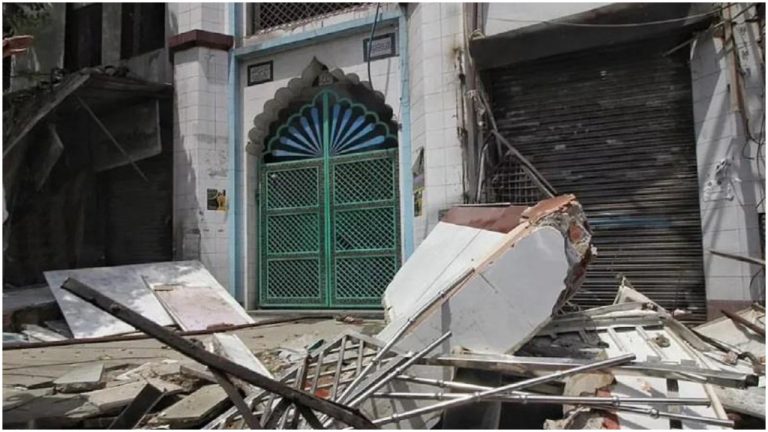
The gate of the mosque was constructed on the road by stretching an extension for almost 10 feet. The gate was demolished as a part of the demolition drive, and so was a mazaar which was illegally built on the road.

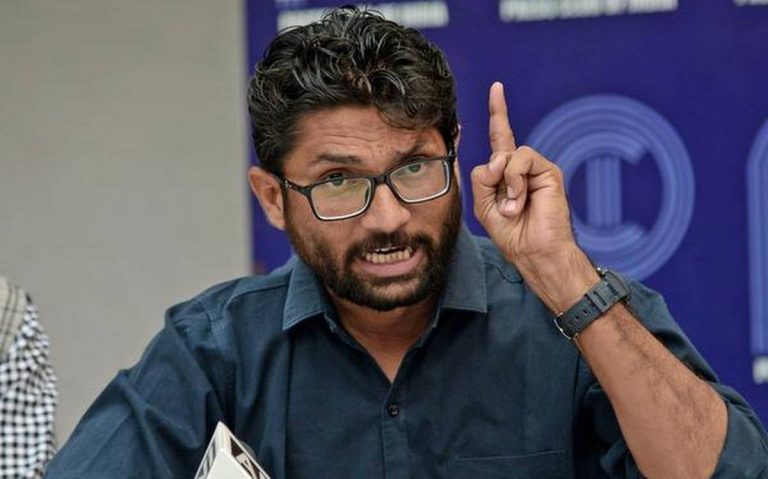
Assam: Court in Kokrajhar rejects Gujarat MLA Jignesh Mevani’s bail plea, remands him to 3-day police custody

Gujarat MLA Jignesh Mevani was arrested by the Assam police on the night of April 20 and was brought to Assam on April 21. As per the latest reports a court in Kokrajhar, Assam has rejected Mevani’s bail plea. The MLA from Gujarat’s Vadgam has been remanded to 3 days in police custody.

Mevani was picked up from the circuit house in Palanpur, Gujarat by the Assam police. The complaint against him has been filed by a Kokrajhar resident over some provocative tweets.

As per reports, Mevani was taken to Kokrajhar court right after the police team landed with him at the Guwahati airport. Kokrajhar is 225 km away from Guwahati. Mevani reportedly shouted, “This is vendetta politics. PMO is doing this.”

Mevani’s lawyers have informed that a review petition will be filed in the Guwahati High Court on Monday.

Mevani is booked under sections 120B (criminal conspiracy), section 153(A) (promoting enmity between two communities), 295(A), 504 (intentional insult with intent to provoke breach of peace), and sections of the IT Act. Banaskantha SP Akshayraj Makwana had earlier confirmed to the media that the Assam police had informed the local police about Mevani’s arrest.

The complaint has been filed against Mevani for a tweet dated 18 April where he had written that PM Modi worships Godse as his God. The complainant is from Kokrajhar, Assam.

Jignesh Mevani is a Member of the Legislative Assembly from Gujarat’s Vadgam. Mevani, who is an independent MLA, had extended support to Congress. As Mevani is elected as an independent MLA, he cannot join any political party.

However, Congress supporters were seen protesting against Mevani’s arrest in Assam and Congress has been providing him legal help in the case.