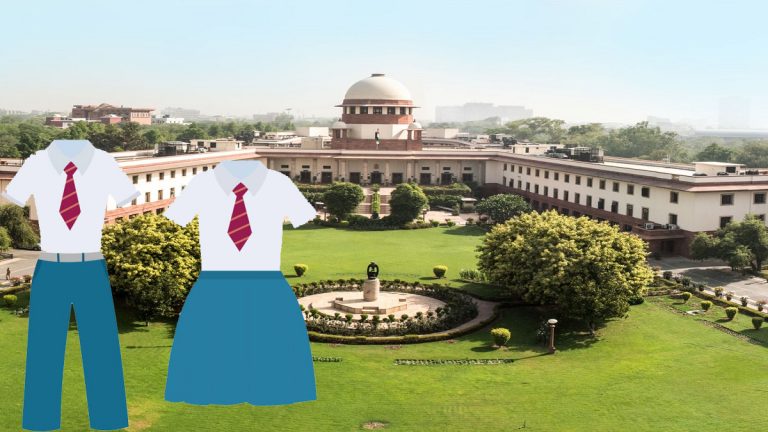
As the Karnataka High Court is hearing petitions by Muslim students demanding the right to wear hijab in educational institutions instead of uniforms, a petition has been filed in the Supreme Court demanding dress code in educational institutions in the country.
Nikhil Upadhyay, son of advocate Ashvini Kumar Upadhyay, has filed a public interest litigation petition in the supreme court seeking directions to the Central and State governments to implement a common dress code in all registered and State recognized educational institutions across the country. It is notable that the Karnataka High Court has ordered students not to wear Hijab in colleges till the matter is being heard, and the Supreme Court has refused to intervene in the matter when the pro-Hijab students had approached the apex court against the interim order of the high court.
The petition filed by Upadhyay puts forth that in order to secure social equality, assure dignity and promote fraternity, unity, and national integration, a uniform dress code in educational institutions is very essential.
The plea says “Common Dress Code is not only necessary to enhance the values of equality, social justice, democracy and to create a just and humane society but also essential to curtail the biggest menace of casteism, communalism, classism, radicalism, separatism, and fundamentalism.”
Quoting the examples of various countries like the United States of America, the United Kingdom, France, Singapore, and China, this plea claims that, the educational campuses of these countries adhere to a common dress code despite frequent challenges to the constitutionality of dress guidelines.
In this petition, it is further said, “Petitioner submits that according to a survey, around 2,50,000 guns were brought in schools and colleges in 2018. So, having a Common Dress Code that requires a student’s beltline exposed reduces the fear of a concealed weapon.”
The petitioner has also said that the common dress code reduces violence and promotes a more positive educational environment. In the petition, it is said, “It reduces other forms of violence that occur due to socio-economic differences. It ensures that every student looks relatively same which reduces the chances of bullying in schools.”
Amidst the raging hijab controversy in Karnataka, a video has been doing the rounds on Twitter with claims that a group of Muslim youths have brutally beaten up a youth named Nagaraj. The incident has reportedly taken place during the Hijab protests in the Harihar First Grade College campus in Davanagere district, Karnataka. Six people have reportedly been arrested after the incident.
Two seperate incidents of violence was reported frm Davangere over the #HijabRow
Video from Harihara: A group of Muslim boys brutally beat up a youth named Nagaraj during the #Hijab protests at harihara 1st grade college , reason for attack is under investigation. 6 arrested. pic.twitter.com/iSjblEW7XK
In the video, being shared online, a group of stick welding youths can be seen attacking a youth, who has been identified by social media users as one Nagaraj.
Nagaraj, who sits in one corner of the street, is mercilessly beaten and kicked by the enraged bunch of youths. The youths can then be heard shouting in their local language before fleeing the scene, leaving Nagaraj injured on the street.
Karnataka: Reportedly a group of M boys have brutally beaten up a youth Nagaraj during the #HijabRow Protests in harihara 1st grade college pic.twitter.com/ugdlzbRzFD
It may be noted that the district administration has clamped prohibitory orders in Davanagere and Harihar till midnight on Friday after many incidents of violence have been reported from the twin cities amid the ongoing hijab row in the state.
Davangere town in Karnataka marred with violence over hijab controversy
On February 11, OpIndia reported another incidence of violence in the Malebennur town of Davangere district wherein a Muslim mob attacked a person and stabbed him for allegedly uploading a post against hijab on his WhatsApp status.
According to the reports, Dileep Malagimane, who runs a store near Gigali circle in Malebennur town, was attacked by a mob of 300 persons from the Muslim community, who dragged him out of the store and brutally attacked him over a post he had uploaded on WhatsApp wherein supported the ban on hijab.
The enraged mob assaulted the police officials, who had rushed to the spot to rescue the victim.
A few policemen, who rushed to Dileep’s rescue, were also manhandled. The police have now registered cases against the mob and have arrested a few of them.
In a similar incident in Nallur village of Davangere district, another mob of Muslims have attacked a person and his 60-year-old mother for their alleged posts on social media on the hijab controversy. The 25-year-old Naveen and his 60-year-old mother Sarojamma were assaulted by the mob, who ransacked their house.
The CCTV image has captured the incident that shows how angry Muslims carrying weapons were marching towards the residence of Naveen.
On Tuesday, February 8, the police fired teargas shells and carried out a baton charge to quell the violent mob in the Harihar First Grade College campus in Davanagere district. According to eyewitnesses, several policemen and students were injured in the violent incident. Many two-wheelers have been damaged and a tense situation prevails in the Davanagere town. Police have been deployed at all sensitive places.
On Monday night, the town was also rocked by protests in response to an offensive social media post. The incident turned communal when ‘Pakistan zindabad’ slogans were raised. However, the situation was quickly brought under control by the police.
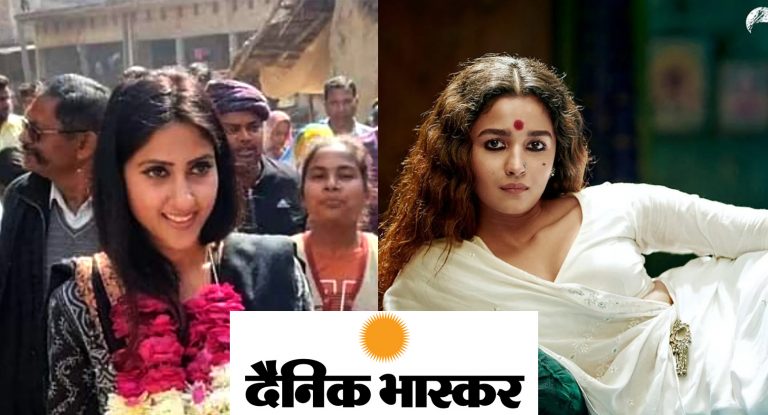
Hindi news outlet Dainik Bhaskar stooped to a new low on Saturday after they compared former Congress leader Aditi Singh, who recently joined the Bharatiya Janata Party, to a prostitute.
On Saturday, the Dainik Bhaskar group took to Twitter to put out an infographic ahead of the 2022 Uttar Pradesh Elections. Dainik Bhaskar tweeted a crass poster in which BJP leader Aditi Singh was depicted as “Gangubhai Kathiawadi” – a fictional character of the upcoming Bollywood movie.
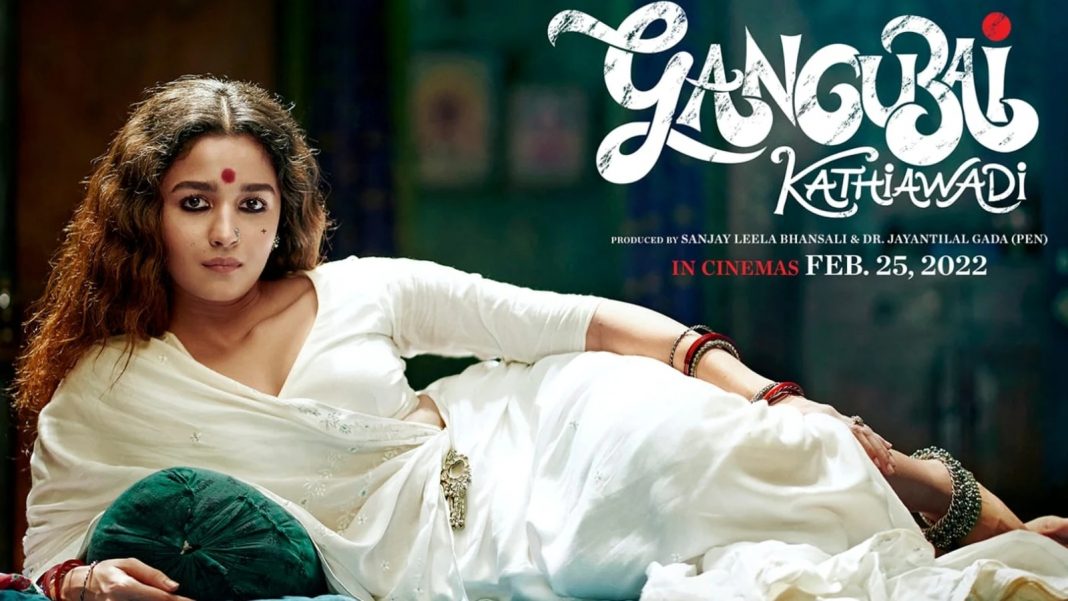
Gangubhai Kathiawadi is an upcoming movie that is based on the character of Gangubai Kothewali – a sex worker and madam of a brothel n the Kamathipura area of Mumbai.
Dainik Bhaskar put out a photoshopped image of the movie poster, in which they morphed the face of the lead actress of the film – Alia Bhat, to fix Aditi Singh’s image.
Dainik Bhaskar’s crass tweet was posted along with an interview of senior Congress leader Kishori Lal Sharma. In the interview, Sharma had claimed that Aditi Singh would return to another party if the BJP fails to form the government. The Congress leader claimed that political ideology did not matter to Aditi Singh as she treated politics as business.
The original movie poster
Aditi Singh, a former Member of the Legislative assembly from Raebareli, had recently tendered resignation from her post as an MLA and as a member of the Indian National Congress and joined the BJP. The 34-year-old BJP leader, as a then Congress MLA, was famous for her criticism of Priyanka Gandhi Vadra and the party leadership and had often praised the BJP over policy issues.
Netizens slam Dainik Bhaskar for vile tweet
The vile sexist tweet put out by Dainik Bhaskar has created a massive outrage on social media platforms. Netizens slammed the news outlet for outraging the modesty of a woman by comparing her to a prostitute. Several social media users took to Twitter to hit out at Dainik Bhaskar for targeting a female politician.
Levina, a social media user, slammed Dainik Bhaskar, saying how low one can stoop after the media group compared Aditi Singh to Gangubhai, a movie based on a prost*tute-turned-politician.
How low can you stoop??
Have they compared an MLA, Aditi Singh, to Gangubai, a movie based on prostit*te turned politician?
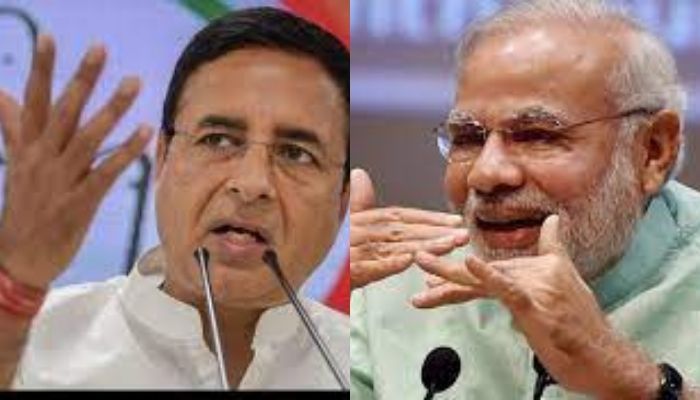
Congress leader Randeep Singh Surjewala today shared a clipped video from the speech of PM Narendra Modi to make misleading claims. The clip was taken from a speech by Modi given in an election campaign rally at Almora in Uttarakhand. In this clipped video, PM Narendra Modi is saying “Sab me daalo foot, Mil kar karo loot” which means “divide them all and loot them collectively”.
Sharing the clip, Surhewala wrote that the learnings from the British are still being utilised, referring to the infamous ‘divide and rule’ policy of the British empire. However, PM Modi used those words to describe the policy of the Congress party, but Randeep Singh Surjewala clipped the video to remove the mention of the Congress party.
In his tweet, Surjewala had added the caption “Learnings from the British rulers is used (by BJP) till date. But the people have now understood that BJP will lose.”
The netizens responded to Surjewala to expose him within minutes sharing the complete sentence along with the context PM Modi was referring to while he said those lines.
A Twitter user Naweed has replied to Randeep Singh Surjewala posting the full video of what Modi had actually said in his speech. Naweed has said in his tweet “Here is the full video Surjewala ji. Earlier, people like you would temper the heritage of this nation. Then the people of this country showed you your proper place. Now you are good for nothing except tempering with videos such as this one.”
पूरा वीडियो ये रहा सुरजेवाला जी, पहले आप लोग ऐसे देश के धरोहर से छेड़खानी किया करते थे फिर जनता ने आपको आपकी जगह बता दी, और आज आप सिर्फ वीडियो से छेड़खानी करने के ही लायक बचे हैं pic.twitter.com/1WalFnGXYi
In this complete video, Modi is saying “The only formula our opponents have is that ‘ divide them all and loot them collectively’. This has been the policy of the Congress party not only in Uttarakhand but in the whole nation. On the national spectrum Congress divides the people of the country on the basis of caste, religion, language and state; while within a state, it divides people of the state on the basis of the two sections in a state.”
Industrialist and former Bajaj Auto chairman of Rahul Bajaj passed away on Saturday, February 12, at the age of 83 years.
“It is with deep sorrow that I inform you about the passing away of Shri Rahul Bajaj, husband of the late Rupa Bajaj and father of Rajiv/Deepa, Sanjiv/Shefali and Sunaina/Manish. He passed away on the afternoon of 12th February, 2022 in the presence of his closest family members,” a statement from Bajaj Group said.
Rahul Bajaj was the chairman emeritus of the Bajaj group and was awarded the Padma Bhushan in 2001 by the govt of India.
Born in 1938 in, Rahul Bajaj was the grandson of Indian independence fighter, Jamnalal Bajaj. He had studied at Harvard Business School in the US after graduating from St. Stephen’s College in Delhi.
He had taken over the Bajaj group in 1965, and the business of the group spread over various sectors had flourished under his leadership in the following decades. Close to the Congress party and the Gandhi family, the Bajaj Group had benefited from the protectionist policies of the Indian govt at that time.
In 2005, he had stepped down and his son Rajiv Bajaj became the managing director of Bajaj Group. Last year, he had stepped from the post of non-executive chairman of Bajaj Auto, and the post was occupied by his cousin Niraj Bajaj. However, he remained the chairman emeritus of the conglomerate, which includes Bajaj Auto and Bajaj Finserv.
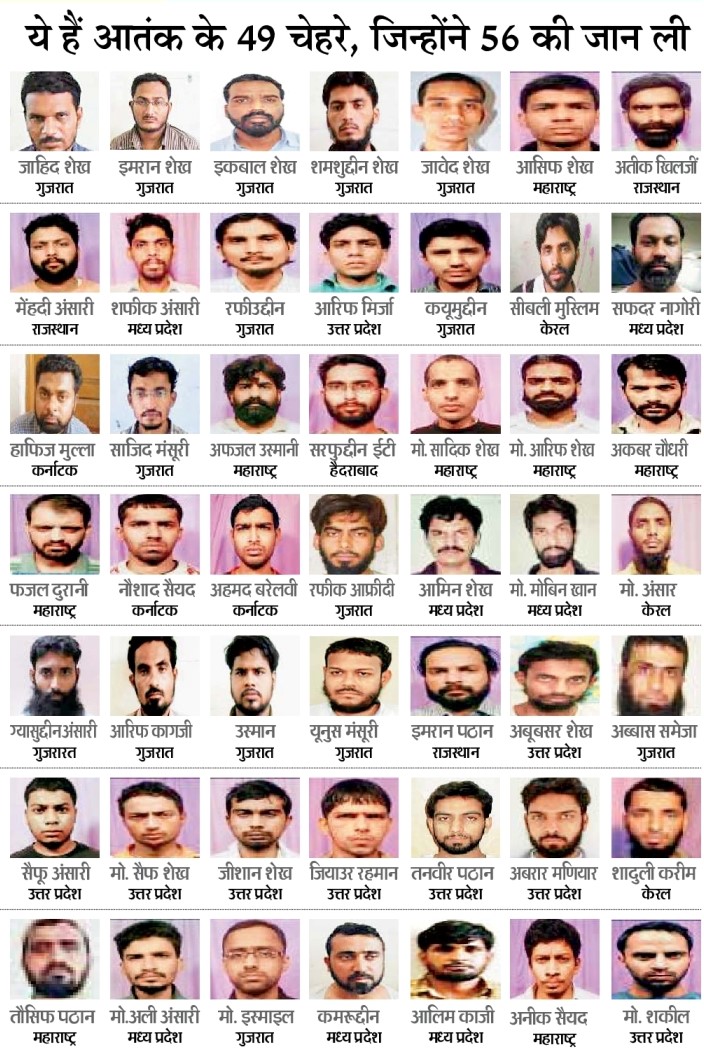
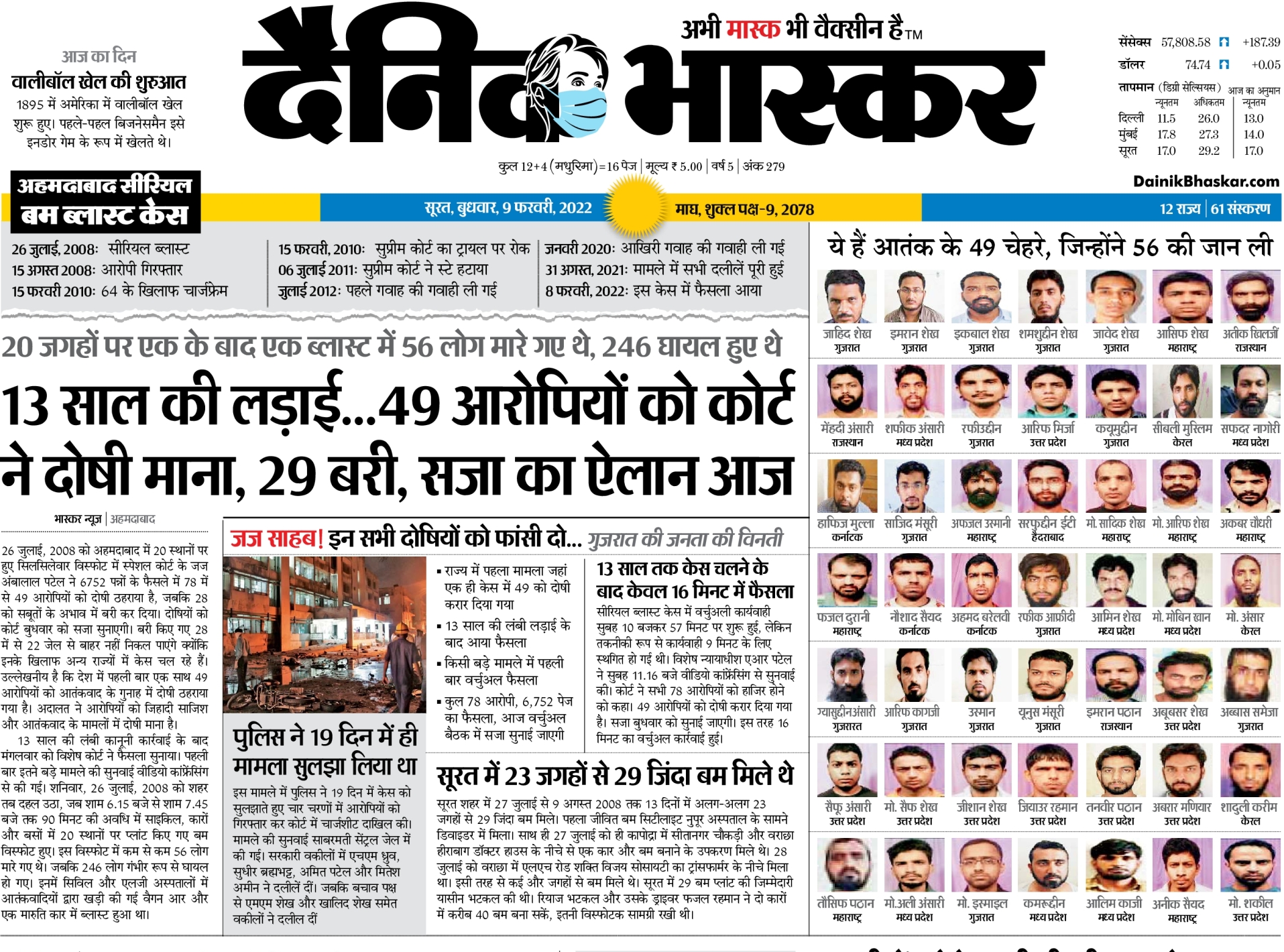
On Tuesday, February 8, 2022, a special court in Gujarat convicted 49 of the 77 accused in the 2008 Ahmedabad bomb blast case. 28 accused were acquitted by the court. Out of these 28 acquitted, 16 were given a benefit of the doubt, while 12 were pronounced innocent due to lack of evidence.
The blasts that shocked the city were carried out by an Islamic terrorist organization Indian Mujahidin (formerly known as SIMI – Students Islamic Movement of India). As the case crosses an important judicial milestone, it becomes important and relevant to revise the terrorist attacks on one of the most important cities in the western part of India.
The Threat Email
On 26th July 2008 at 6:41 in the evening, several news agencies received a 14-page e-mail five minutes before the explosions with the subject line: “Await 5 minutes for the revenge of Gujarat”. It was clear enough that the terrorists were referring to the Gujarat riots of 2002 which took place after the Godhra carnage. This email was sent by Indian Mujahidin. The email had further said, “In the name of Allah the Indian Mujahideen strike again! Do whatever you can, within 5 minutes from now, feel the terror of Death!” With mentioning of Allah, it was also clear that Islam is the inspiration of these terror attacks.
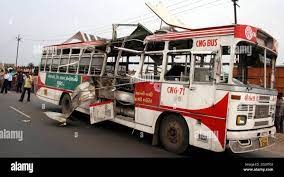
The terrorists targeted city buses in the Ahmedabad bomb blasts of 2008 to kill people in large numbers. Image Source: www.alamy.com
The terrorists mocked the Indian security systems reminding the then CM of Maharashtra Vilasrao Deshmukh and his deputy R. R. Patil of the bomb blasts that took place in the local trains of Mumbai on 11th July 2006. The email said “We wonder at your memory. Have you forgotten the evening of 11 July 2006 so quickly and so easily?”
All the culprits of the bomb blasts. Image source: Dainik Bhaskar
As Ahmedabad holds great financial importance and Mumbai is the financial capital of the nation, the email vocally threatened one of the leading businessmen in the country Mukesh Ambani for building his multistorey house in Mumbai. The email said, “Think twice before usurping and building a citadel on land in Mumbai that belongs to the Waqf board…lest it turns into horrifying memories for you which you will never ever forget.” The email had also threatened many Bollywood actors asking them to stop acting in films.
The Blasts
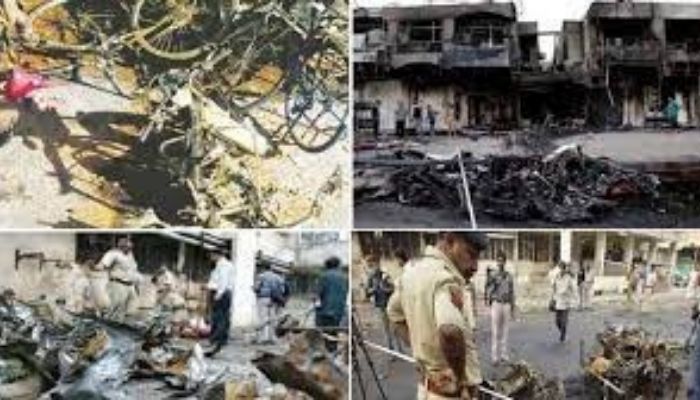
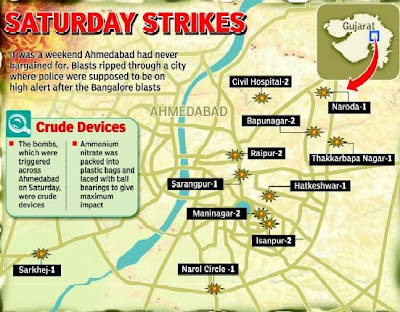
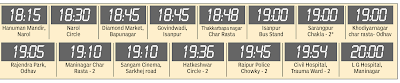
Five minutes later, as threatened in the email, the city of Ahmedabad shook with the serial blasts. It started at 6:45 PM and the explosives blasted in various parts of the city at regular intervals. There were 21 blasts in all which took place at 14 different locations in the city in the next 70 to 80 minutes. The bomb blasts shook the following areas: Khadia, Raipur, Sarangpur, Maninagar, Hatkeshwar Circle, Bapunagar, Thakkarbapa Nagar, Jawahar Chowk, Govindwadi, Isanpur, Narol, and Sarkhej.
The site map of the blast locations. Image Source: www.twenty22.in
Two more severe blasts occurred in two hospitals in the city namely L. G. Hospital Maninagar and Ahmedabad Civil Hospital’s Trauma Center. A total of 56 innocent citizens were killed in this attack while 243 people were injured. The bomb blast in the civil hospital caused what could be the peak of the most horrific scenes in the city ever.
It was a typical lazy Ahmedabad evening. People returning home from their offices. Suddenly the bombs blasted in various parts of the city and everything changed. Ambulances taking injured people to the hospitals. Sirens of police vans and ambulances underlining the seriousness of the incident and the fear in the minds of people. News channels flooded with stuff about the bomb attacks in Ahmedabad. People were gathering at the civil hospital to help the injured ones and to meet their kins who were injured in the attack. And right at this moment, the bomb in the civil hospital of Ahmedabad exploded.
The timeline of the blasts. Image source: www.twenty22.in
The blast was so severe that everyone in the hospital had gone deaf for a while. Reeling the senses, what people found there was bloodshed and pieces of dead bodies all around. The blast in the hospital claimed 37 lives, the most of all 21 blasts in the city. The hospital was targeted specifically with the intent of raising the count of casualties which would, in turn, amplify the fear in the minds of people. And as mentioned in the threat mail, rooting the fear deep in the minds of Indians was the core purpose of the attacks. The difference in this attack from other mass casualties was that it occurred in the Trauma center of the hospital itself, which disrupted the entire Disaster management plan of Civil Hospital. The burns of the patients who were affected in this bomb blast in the hospital were so severe that their treatment later became a topic of medical research.
The Human Within the CM Modi
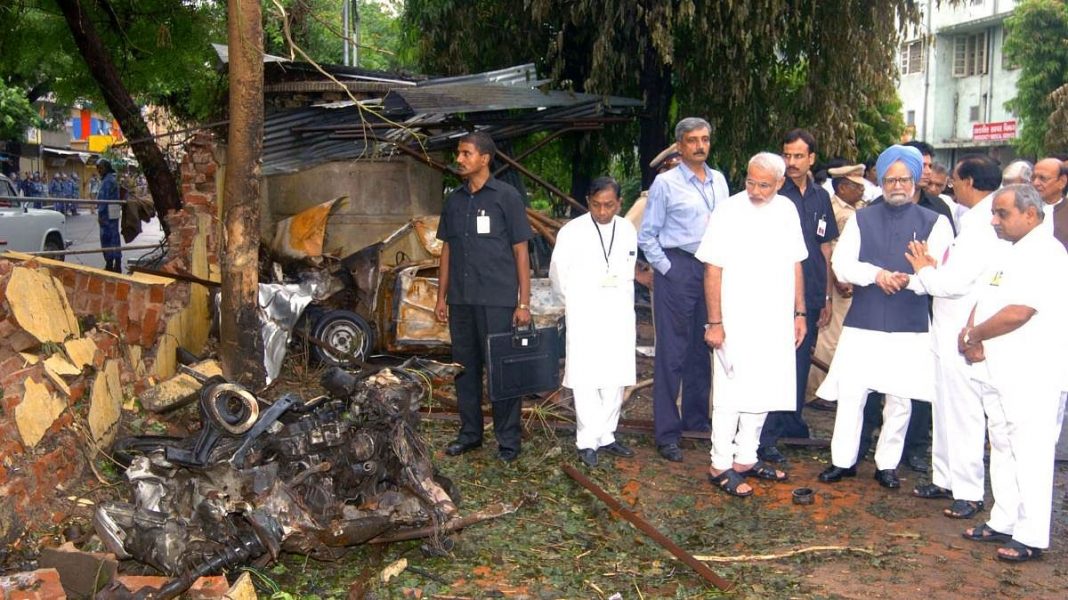
Narendra Modi was the CM of Gujarat in 2008. The attacks caused pain to him. He instructed the administration and the medical staff for the best treatments to be given to the injured people. He announced a compensation of Rs 500,000 to each victim of the bomb blasts as opposed to the Rs 100000 compensation given by the then PM Manmohan Singh.
Narendra Modi visited the sites of the bomb blasts. Image Source: The Print
With Gujarat’s then Home Minister (States) Amit Shah, Modi immediately reached the police commissioner’s office. Simultaneously, orders were given to DGP PC Pande and Commissioner OP Mathur to get hold of the operating forces behind this attack. All support from the government was assured.
The Investigations
27th July 2008, late in the night. Abhay Chudasama, DCP of the crime branch of Ahmedabad police was busy gauging the depths breadths of this case when he started receiving inputs from the network of his informers about the said activities SIMI agents were involved in for the last few days. A report by News18 has detailed his role in the investigation of this case.
According to the report, Abhay Chudasama had an invincible and impeccable network of informers which is a prerequisite to breaking the backbones of organized crimes like such terrorist attacks. All he needed was a team of a few more committed officers. The state government extended him full support on this front and he was provided with a team of brave and intelligent officers having excellent track records of solving complicated cases.
The state home ministry overnight deputed a team of officers like GL Singhal, Himanshu Shukla, Rajendra Asari, and Mayur Chavda into the crime branch. Earlier these officers were at that time serving in different cities of the state. It must be noted here that, the network of informers, in this case, grew exponentially with every single officer included in the team. DGP Ashish Bhatia was the joint CP now.
The Initial Leads
As per the inputs received from the informers, Abhay Chudasama led the investigations in those directions. A handful of suspects were rounded up. No concrete development was being marked in the initial two weeks despite tireless efforts by the team. Only the IP address from which the email was sent to various news agencies was found. It was U.S national Ken Haywood from whose IP address the threatening email was sent. He used to live in the Sanpada area of New Mumbai. His residence was raided by the ATS officials on 27th July 2008 soon after tracing the IP address. But the real culprits were yet to be traced.
After two and half weeks of futile efforts, one day Abhay Chudasama received a call from the informer. He heard a ‘Pakki Khabar’ from the other end. The informer in Bharuch had seen the red and white car used in the Ahmedabad bomb blasts. Within minutes, DCP Chudasama left for Bharuch. He was accompanied by IPS officer GL Singhal and DSP Mayur Chavda.
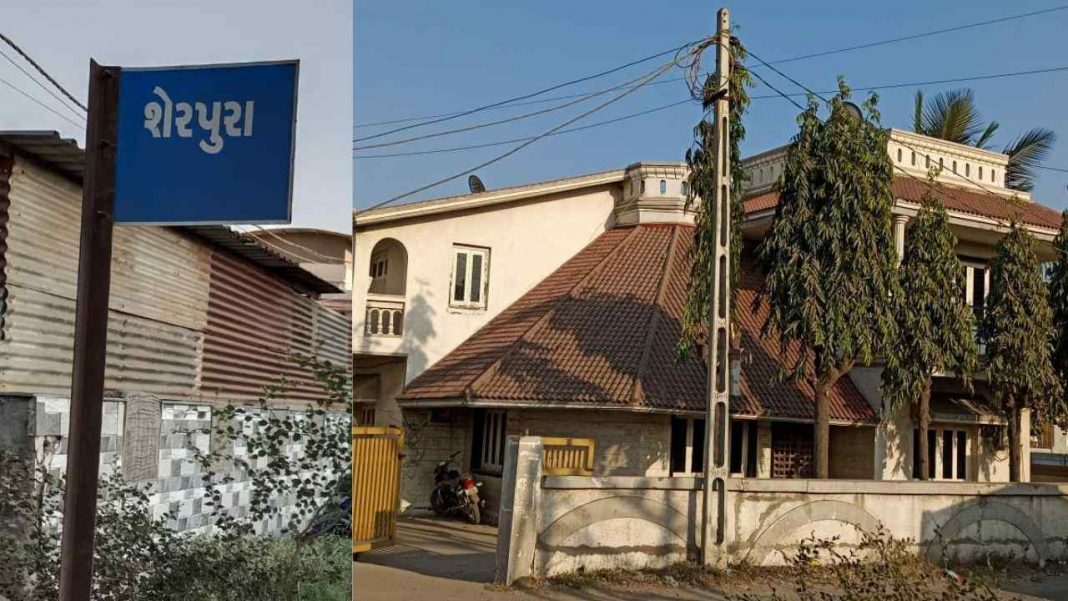
The terrorists made bombs in this house in the Sherpura area of Bharuch. Image source: TV9 Gujarat
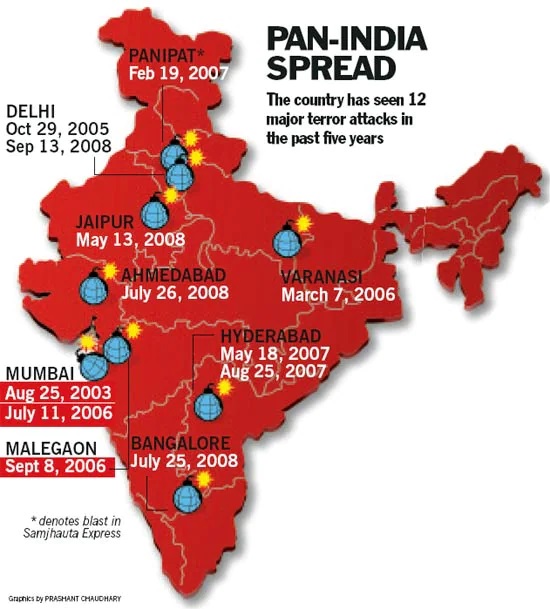
Officers reached the spot as told by the informers. The house they raided gave them the first lead. The terrorists had made a few of the bombs in the same house. The interrogations of the house owner revealed a phone number. And this phone number was the master key that went on to open the locks of not only the Ahmedabad blasts but also the locks of the bomb blast cases in other major cities like Hyderabad, Bangalore, and Jaipur.
Abhay Chudasama into Action
While on the return journey from Bharuch to Ahmedabad, all the three top officers were brainstorming on how to break the network as early as possible. The challenges that followed were to build a strong case against the ones they were going to catch. This whole exercise of getting leads, raiding the spots, arresting the suspects, interrogating them, collecting the evidence, and framing the charges was not going to be an easy task. It needed a systematically planned and output-oriented effort.
As per a report by News18, at this point in time, Abhay Chudasama designed a strategy for teamwork and every officer in his team supported him wholeheartedly. The first step taken by Chudasama was to break the officers into different teams and assign them dedicated tasks to execute in cohesion with each other.
Abhay Chudasama and IPS officer Himanshu Shukla joined the technical surveillance team because all major leads were going to be received from that front. The most important part of the interrogations was headed by the experienced IPS officer GL Singhal. He was assisted by DSP Mayur Chavda.
The same gang of terrorists was behind the bomb attacks in multiple cities pan India. Image Source: India Today
Picking up the suspects as per the leads revealed in the interrogations was a tricky job. DSP Rajendra Asari headed this team of officers. Mayur Chavda was also involved in this team as he was also a member of the interrogation team. DSP Rajendra Asari’s team too had a very responsible job because after the interrogations, gathering the evidence together in a definite order and preparing the witness is extremely important to build a strong case.
Usha Rada, Jitendra Yadav, J. D. Purohit, Bharat Patel, Tarun Barot, and VR Toliya were among the other brave officers who were involved in these different multi-layered teams working in concurrence with each other.
Connecting The Dots
The technical surveillance team received some more clues. According to these clues, suspects were being picked up one after the other. The teams were ensuring almost zero time lag between receiving the information and catching the suspects. Jahid Sheikh was the first to be arrested on this lead. The links to this case unfolded and it was revealed that it was a grand pan India conspiracy.
The Lucknow connection, in this case, was revealed in the interrogations and the inputs from the technical team. On 13th August 2008, IPS Himanshu Shukla and DSP Mayur Chavda were in Lucknow to arrest Mufti Abu Bashir who was the biggest arrest in this case till then. CM Narendra Modi had sent a special flight for these officers to ensure that the terrorist don’t get any chance to escape. Mufti Abu Bashir was brought to Gujarat on this special flight. Modi was being informed by Amit Shah about every minute detail of this case.
Exposing the Biggest Terrorist Network
As the suspects were being arrested one after the other, IPS officer GL Singhal and his team were conducting their interrogations continuously. Every interrogation would reveal some new name from some new state. First, it was Ahmedabad, then Bhuj, then Bharuch, then Surat, and suddenly it started going out of the state.
The first among the other states was Uttar Pradesh. The further revelations made the police teams raise their eyebrows. Maharashtra, Madhya Pradesh, Karnataka, Andhra Pradesh, Bihar, Rajasthan, Delhi, and whatnot.
As the script was unfolding through the statements of the arrested culprits, the biggest terrorist network active in the country at that time was being exposed. With every single location named in their statements, a separate team was immediately being sent to that location to arrest the suspects immediately.
The Arrests
The day Mufti Abu Bashir and his allies were brought to Gujarat, these different teams had caught 10 more accused from different locations. The total number of arrests on that single day was 13. Everyone was being interrogated separately. More information came out. The technical surveillance team was already prepared with its equipment. The officers located and arrested 30 more accused within the next two days.
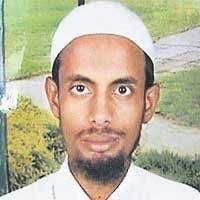
Mufti Abu Bashir Kasmi was arrested in Lucknow and brought to Gujarat by a special flight. Image Source: www.MumbaiMirror.indiatimes.com
On the independence day of India, that is within 19 days of starting the investigations, the team had exposed and arrested the biggest terrorist network active in the country at that time. These were the same terrorists who had executed bomb blasts in various cities including Hyderabad, Varanasi, Bangalore, and Jaipur before the Ahmedabad bomb blasts. The police of these different states were still searching for the basic clues while the Gujarat police led by Abhay Chudasama had arrested the culprits of every single terror attack mentioned above.
This network was called Indian Mujahidin as they had identified themselves in the threat email. It was the same old SIMI that is the Students Islamic Movement of India in its new form. Gujarat police had broken its backbone in the investigation of a single incident. The blow was so heavy that the terror outfit has not yet recovered from the tremors and aftershocks. It is notable that at the time of the attacks, there was a BSP government in Uttar Pradesh, a Congress government in Maharashtra and Andhra Pradesh, and a newly formed two months old BJP government in Karnataka.
The Modus Operandi
Ahmedabad crime branch arrested 78 accused suspects. 13 from Ahmedabad, 5 from Vadodara, 1 from Bharuch, 1 from Bhuj, 2 from Surat, 11 from Maharashtra, 12 from Madhya Pradesh, 10 from Karnataka, 9 from Uttar Pradesh, 5 from Kerala, 3 from Andhra Pradesh, 3 from Rajasthan, 2 from Jharkhand, and 1 from Bihar. When 30 accused were arrested at once, the role of SIMI was exposed.
The Ahmedabad bomb blasts were planned as early as December 2007. The terrorists were trained in the jungles of Waghamon (Kerala) and Pawagarh (Gujarat). Gujarat DGP PC Pande had announced the arrest of Mufti Abu Bashir. At that time, he had said “Mufti had paid frequent visits to Gujarat and the Ahmedabad and Surat terror strikes were planned during a camp held in January 2008 in the forests of Pavagadh, 50 km from Vadodara.”
Many participants of that training camp were already arrested by the Madhya Pradesh police well before the blasts actually took place. When their role was revealed, they were taken into custody by a transfer warrant. It is notable here that Shivraj Singh Chouhan of BJP was the CM of Madhya Pradesh at that time.
Revealing the planning part of these attacks, Ashish Bhatia, the then joint commissioner of the crime branch of Ahmedabad police, had said “Bashar planned the attacks in the house of Yunus Mansuri in Bapunagar area of Ahmedabad. Raw material for making the bombs arrived from Madhya Pradesh and a house in the Vatva area of Ahmedabad was rented by the group to make the bombs. While some bombs were made at Yunus’ residence, the rest were manufactured in Vadodara and sent to Surat.”
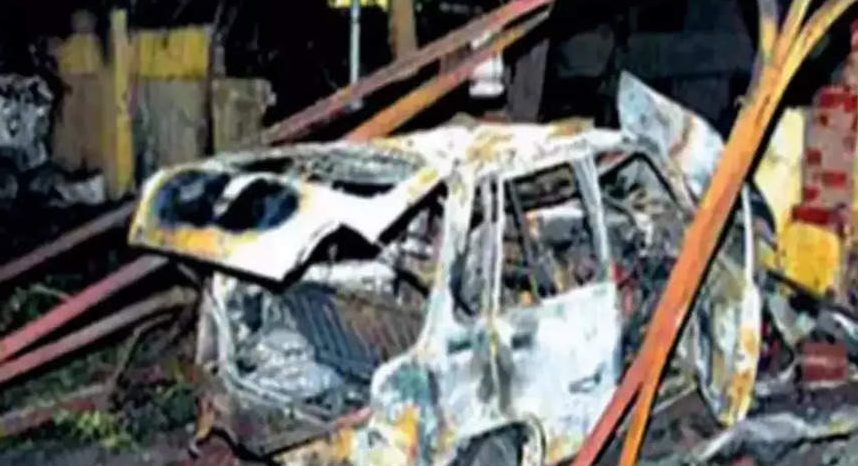
The crime branch officer also informed that the two cars that were turned into deadly bombs in the Civil Hospital and L G Hospital blasts in Ahmedabad were stolen from Mumbai by SIMI activists from MP. The same cars were then handed over to the terrorist group in the Vapi town of Gujarat. The car lifters stayed in the house of the SIMI terrorist Sajid Mansuri in Bharuch. It was Sajid Mansuri whose arrest started the unfolding of this whole plot. These cars were later brought to Ahmedabad where bombs were fitted into them.
The car used in Ahmedabad bomb blasts. Image Source: Times of India
Other bombs were planted in tiffin carriers on bicycles. The bicycles were procured second-hand from local markets and used for the blasts. A similar pattern was used by the terrorists in the Jaipur bomb blasts that took place on 13th May 2008. Many of the blasts targeted the city bus service of AMTS (Ahmedabad Municipal Transport Services), ripping apart portions of the vehicles.
Two blasts took place in two of the biggest hospitals in the city after the gap of half an hour from the initial bomb blasts. One of the blasts in the hospitals occurred when injured victims of the initial series of blasts were being admitted there. This was planned with the intent of increasing the count of the casualties and rooting the fear among the people that the hospitals where they would rush for medical help are also unsafe.
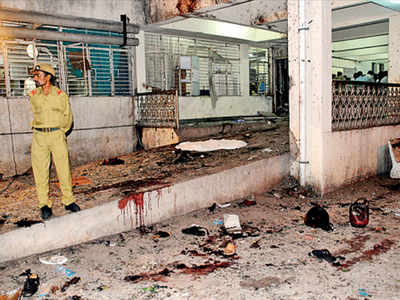
The civil hospital trauma center after the blast. Image Source: Times of India
The trauma center in the hospital houses the most critical patients. The terrorists targeted the trauma center of the civil hospital of Ahmedabad to kill those innocents. The blast at this hospital claimed maximum lives on that day.
More Explosives Recovered and Defused
Another bomb was found and defused on the following day in the Hatkeshwar area. Two live bombs were also retrieved from Maninagar which was the constituency of the then Gujarat CM Narendra Modi.
Gujarat police recovered and defused two more bombs in Surat, another major city in Gujarat, a day after the Ahmedabad blasts. Two cars filled with materials required to make explosives, including detonators, were also found, one of them parked on a roadside near a hospital, and the other in the outskirts of Surat.
On 29th July 2008, the police defused 18 more bombs in Surat. They were placed majorly in the diamond market. In all the incidents executed and the bombs recovered, there were primarily the explosives having a low-intensity blast capacity, but in all those cases, they were placed in the highly crowded areas of the city. The aim was to cause the maximum damage by the blasts and the subsequent stampedes in the minimum possible resources.
Similar explosives were found and defused in different cities in the subsequent days as the whole nation was on high alert considering the arrests from the various states.
A report covering major details of the Ahmedabad bomb blast case. Courtesy: Dainik Bhaskar
The Trials
35 different cases were merged into one which was heard in a special court of Justice AR Patel in Ahmedabad. The trial began in 2009 and lasted for about 13 years. The hearing was concluded in September 2021. Earlier this month, the court announced that 28 accused were acquitted while 49 were convicted. The nation now awaits the punishments to be given to these culprits.
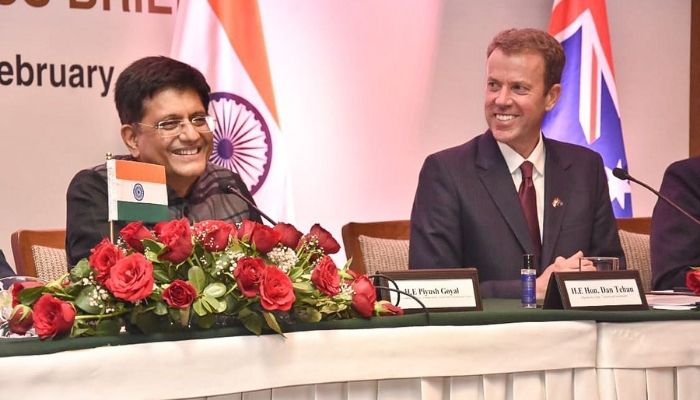
Union Minister of Commerce and Industries Piyush Goyal has identified Indo-Australian relations as ‘Dil Chahta Hai’ on 11th February 2022 while addressing a press conference after both countries signed MoU on tourism cooperation in the field of tourism in New Delhi. He has also expressed hope for a jump in the bilateral trade between the two countries.
Piyush Goyal signed the MoU with Dan Tehan Wannon who is the Australian Minister of Trade, Tourism, and Investment. The aim of this agreement is to facilitate bilateral relations in tourism and the exchange of information and data related to the sector between the two countries.
According to a press release by the Press Information Bureau, the ministers of both countries have announced reaching an understanding of the Interim Agreement and finalizing it in the next 30 days. The India-Australia Comprehensive Economic Cooperation Agreement (CECA) is expected to be concluded in 12 months thereafter.
While speaking in the press conference, Piyush Goyal said “Every free trade agreement always concludes with the ‘Dil Chahta Hai’ more moment. And many of you have seen the movie Dil Chahta hai which is shot largely in Australia. You will appreciate that the Dil Chahta Hai moment today was also covered in the CECA FTA and tourism MoU that we have both executed today.”
India-Australia are working towards a ‘Dil Chahta Hai Free Trade Agreement’ post which our bilateral trade is expected to see a quantum jump. ?? ??
He further said, “I must thank the Ministry of Tourism led by the honorable minister Kishan Reddy and the Tourism Secretary Mr. Arvind Singh and of course the officers from Dan’s side. These officers and Arvind Singh have put in a lot of effort and I thank them for that. I think we will continue to demand more from each other and that is what friendship is all about. I am sure that the bilateral trade which is currently about 20 Billion Dollars is going to take a quantum leap after this agreement.”
The PIB has also informed that the two nations are expected to sign the Interim Agreement in March 2022. The areas covered under the interim agreement should include goods, services, rules of origin, sanitary and phytosanitary measures, customs procedures, and Legal and Institutional issues. The CECA would be a substantial opportunity for both economies and a significant moment in the India-Australia bilateral relationship.
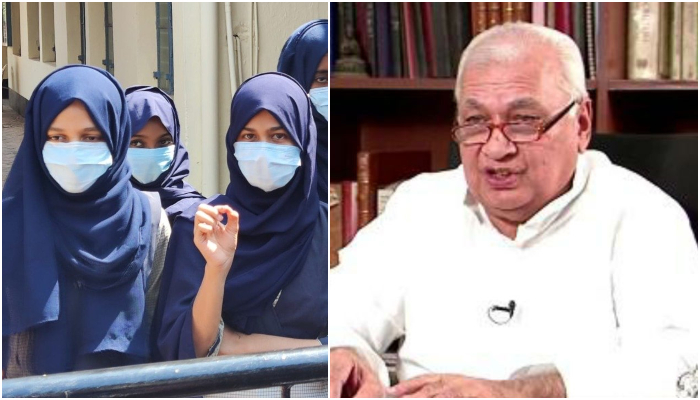
Criticising the ongoing Karnataka hijab controversy, Kerala Governor Arif Mohammed Khan on Saturday said that ‘Right to wear Hijab’ argument is acceptable, but then it will be the Muslim women who will be the losers. He recalled several instances of women refusing to wear the veil in the history of Islam.
Khan narrated a short story to prove his point on the hijab row in the neighboring state of Karnataka. “A young girl, who was brought up in the household of the Prophet himself, and she was the niece of the wife of the Holy Prophet. She was proverbially beautiful. In medieval times, she was chided for not wearing a hijab. What she said was that God had made her beautiful and the almighty had placed His stamp of beauty on her. She said I want people to see my beauty and see the grace of God in my beauty. This is how the women of the first generation of Islam behaved”, he said reaffirming that the story is true and is written in the history of Islam.
“In the past, veil in north India came up due to invaders. But now women in north India women don’t put-up extremely long veils, and are not mandated to do so; as time changes, so do the customs,” he said.
He sharply added that those claiming to follow the legacy of Islam today are actually losers and the entire act of hijab controversy is useless. “Those girls having problem with the uniform can go and join any such school where there is no compulsion of following the uniform discipline. They (hijab girls) should understand that when they’ve joined some school with certain principles and standards, they are bound to follow the rules of that institution”, he stated.
The Kerala Governor while exclusively talking to India Today also slammed the Pakistan government for interfering in the matters of India. He said that the Pakistan govt must be treated the way it deserves to be treated. “I don’t even want to talk about Pakistan govt. Malala who supported the hijab may be misinformed about the issue. She fails to understand that if hijab right is accepted, Muslim women will become losers, their lives will become miserable”, he added.
He appealed to the hijab girl students to avoid being instigated by the outside forces and requested them to focus on education and a better standard of life. The hijab controversy gained ground earlier this month when eight hijab-wearing Muslim girls refused to follow the school uniform regulations. They hit the High Court seeking permission to attend the classes with hijab, as it is their fundamental right, they said.
The High Court so far has declared that no one should be allowed to wear their religious attire inside the educational institutions until the matter is pending in the Court. However, the Supreme Court denied to interfere in the matter after the girls impatiently knocked the doors of the apex court.
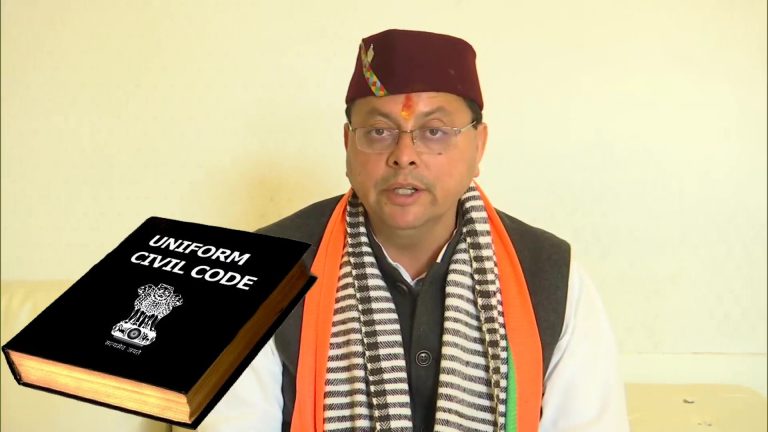
Two days before the state goes to the polls, Pushkar Singh Dhami, the Chief Minister of Uttarakhand, said on Saturday that if the BJP wins the upcoming Assembly elections, the state’s administration will implement the Uniform Civil Code. Dhami stated that as soon as the BJP takes power in the state, a panel will be formed to prepare a draft of the Uniform Civil Code.
Speaking to ANI, the Uttarakhand CM said: “Soon after its swearing-in, new BJP govt will form a committee to prepare the draft of Uniform Civil Code in the state. This UCC will provide for same laws regarding marriages, divorce, land-property & inheritance for all people, irrespective of their faith”.
#WATCH | “Soon after its swearing-in, new BJP govt will form a committee to prepare draft of Uniform Civil Code in state. This UCC will provide for same laws regarding marriages, divorce, land-property & inheritance for all people, irrespective of their faith” says Uttarakhand CM pic.twitter.com/83SYlH2AkE
The Uttarakhand CM in his statement said: “Our Devbhoomi, Uttarakhand, the home to 1.3 Crore citizens, holds a deep cultural and spiritual significance for the country and our civilization. The State also has a very critical role in national security. It shares an international border with 2 countries and hence the geographical and political aspects within Uttarakhand deeply impact the overall national security of the country.”
He further said, that “in all different facets- cultural, environmental, national security, Uttarakhand is a State of key strategic importance for the country. Hence, the BJP Government, right after the elections shall be forming a committee comprising experts and imminent citizens from diverse fields to prepare the draft of the Uniform Civil Code. Through this, Uttarakhand will implement a Uniform Civil code to provide a uniform legal framework to all citizens irrespective of religion in issues including family law, property law etc.”
The implementation of the Uniform Civil Code in Uttarakhand as soon as possible will help to ensure that everyone in the state has equal rights. It will improve social harmony, promote gender equality, build women’s empowerment, and aid in the preservation of the state’s unique cultural-spiritual character and environment, Dhami added.
Implementing Uniform Civil Code in Uttarakhand at the earliest will boost equal rights for everyone in state. It’ll enhance social harmony, boost gender justice, strengthen women empowerment&help protect the extraordinary cultural-spiritual identity & environment of the state: CM pic.twitter.com/uK8YhFbwtu
“Our constitution via Article 44. mentions how India should strive for achieving Uniform Civil Code across the country. This Uniform Civil Code will be a step towards realising the dreams of those who framed our Constitution and solidify the spirit of the Constitution. This will also be an impactful step towards Article 44 that provides for UCC for all citizens,” said Dhami.
Many ministers welcomed CM Dhami’s decision, calling it a significant step toward fulfilling a key constitutional mandate.
BJYM congratulates the young & dynamic CM of Uttarakhand Sri @pushkardhami Ji for resolving to introduce UCC in Uttarakhand.
UCC in Uutarakhand .. It’s huge .. ” New BJP govt will form a committee to prepare draft of Uniform Civil Code in state. This UCC will provide for same laws regarding marriages, divorce, land-property & inheritance for all people, irrespective of their faith” …CM @pushkardhami
The implementation of the UCC has been a longstanding issue in the country. The BJP has, on various occasions, said that it was committed to the implementation of the UCC. However, unfortunately for Muslim appeasement, Congress and other pseudo-secular parties always blocked the road of UCC.
Last year, the Allahabad HC had asked the central government to take steps for the implementation of the Uniform Civil Code (UCC) across India under article 44 of the Constitution of India.
Prior to this, in July last year, the Delhi High Court had also lent its support for a Uniform Civil Code (UCC) in the country and urged the Indian Government to take necessary steps to implement the same.
In fact, former Chief Justice of India S A Bobde had in April last year, appreciated the uniform civil code (UCC) in Goa, the only state to have one and urged intellectuals to seriously study the Goa UCC.
The UCC would involve a single set of laws for all communities in the area of personal laws, substituting the Hindu Marriage Act, Hindu Succession Act, Indian Christian Marriages Act, Indian Divorce Act, Parsi Marriage and Divorce Act, the Shariat Application Act and Dissolution of Muslim Marriages Act among others.
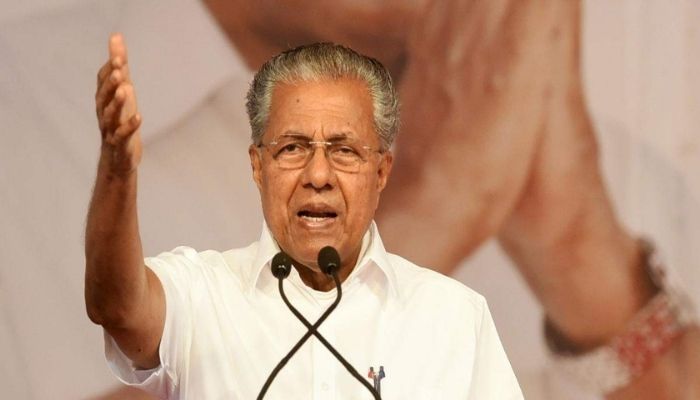
Amidst the war of words between Kerala Chief Minister Pinarayi Vijayan and Uttar Pradesh Chief Minister Yogi Adityanath over the ‘development models’ in their respective states, a controversy surrounding Vijayan’s educational qualifications arose on social media.
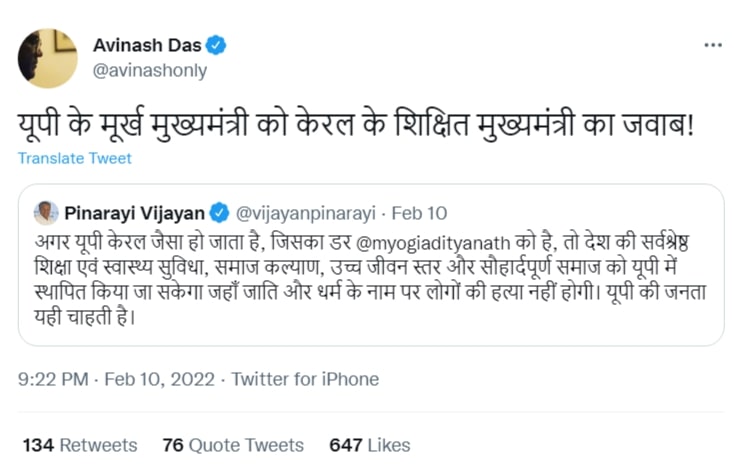
On Thursday (February 10), controversial filmmaker Avinash Das shared a tweet by Pinarayi Vijayan and wrote, “UP’s ignorant Chief Minister received the response of educated Chief Minister of Kerala.” His tweet prompted comparisons between the educational qualifications of the two political leaders.
Screengrab of the tweet by film director Avinash Das
Official Kerala CM website claims Pinarayi Vijayan is a graduate
According to the official website of the Kerala Chief Minister, Pinarayi Vijayan is a graduate with a Bachelor’s degree in the discipline of Economics. “In 1962, he joined the Government Brennen College, Thalassery for pre-university studies. From 1964, he did his Bachelor of Arts studies in Economics,” the description read.
Screengrab of the profile of Kerala CM on the official government website
The Wikipedia page of the Kerala Chief Minister also claims that he had earned a BA Economics degree from Government Brennen College.
Screengrab of the Wikipedia page of Pinarayi Vijayan
Election affidavit lists Pinarayi Vijayan as 12th Pass
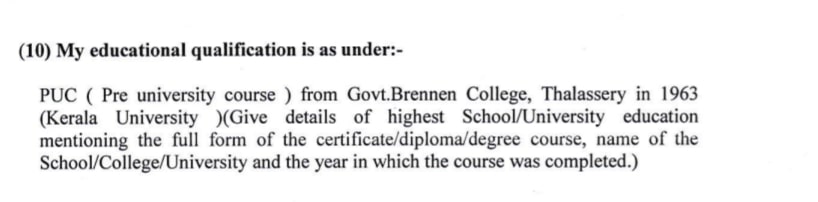
Ahead of the Vidhan Sabha polls in Kerala, the Communist Party leader had filed his election affidavit on March 15, 2021. Interestingly, as per the affidavit, Pinarayi Vijayan’s educational qualifications had been listed as 12th Pass.
Under the column that sought details of his highest school/University education, the incumbent Kerala CM wrote, “PUC (Pre Univeristy Course) from Govt. Brennen College, Thalassery in 1963 (Kerala University).”
Screengrab of the election affidavit of Pinarayi Vijayan
His 2016 election affidavit also shows that he is an undergraduate. Despite being 12th pass, the official government website of Kerala CM lists him as an Economics graduate. The same ‘misinformation’ is parroted by Vijayan’s party cadet on social media.
Contrary to claims made by controversial filmmaker Avinash Das that the Uttar Pradesh Chief Minister Yogi Adityanath is illiterate, he holds a Bachelor’s degree and is thus more ‘literate’ than the Kerala Chief Minister.