Home Blog Page 395

Seelampur, Delhi: 17-year-old Hindu boy stabbed to death by Sahil and his gang, locals name ‘lady don Ziqra,’ CM Gupta assures justice

Delhi Chief Minister Rekha Gupta on Friday said that justice will be served for the 17-year-old boy, who was attacked by knives and was pronounced dead on arrival at the Lok Nayak Jai Prakash Narayan (LNJP) Hospital.

The teenager, who was killed in the J block of Seelampur, has been identified as Kunal, the Chief Minister said.

“I have spoken to the Police commissioner on the murder of a 17-year-old boy, Kunal. He was attacked by knives and was rushed to the Jai Prakash hospital, where he was pronounced dead on arrival,” Gupta told reporters.

She informed that the police had registered an FIR in the murder case while assuring that the police would arrest the accused soon.

“The police are after the accused, and they will be caught soon. FIR has been registered, and the police are on the job. Justice will be served,” Gupta said.

Delhi BJP President Virendraa Sachdeva appealed to the people to maintain peace in the area.

“Police have arrested all the criminals in such cases that have happened in the last few days. In this case, too, both of them are declared criminals. They are identified and will be arrested soon. Police are doing their work. We need to maintain peace right now,” he said.

Joint Commissioner of Police (CP) East, Pushpendra Kumar, said that the boy was killed in Seelampur’s J block on Thursday, and the accused are from the same area. He added that the police were on the lookout for two people who remain suspects in the murder case.

“A 17-year-old boy was stabbed to death in Seelampur’s J block yesterday. Few people from the same area are accused in the case. The accused have been identified, and our teams are working to nab them soon. The two individuals whose names have come to light are being pursued by the police. If any other person’s involvement is found, they will be arrested,” Joint CP Kumar told ANI.

Family alleges police negligence, local Hindus protest against constant harassment by Muslim gangs

The mother of a 17-year-old boy who was stabbed to death in the Seelampur area of the national capital said on Friday that she had not been given any updates from the police, alleging complicity by the authorities in catching the culprits and allowing the perpetrators to flee the area.

“My son had a fight a few days ago. There was some incident, and my son was just standing there and watching as he got beaten up; they gave him threats. We had taken him to the hospital; we had not eaten anything for two days. When my kid came back, he had asked for a samosa and milk and had gone out to get the food. He went out around 7 o’clock, and by 7:15, we got the news that our son had been stabbed,” the mother told ANI.

She further said that the doctor who had treated the child was also beaten up by some people.

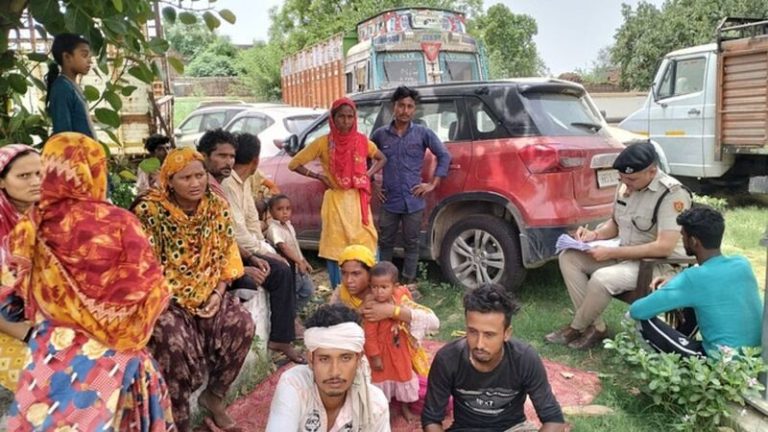
Locals in the Seelampur area continued their protest from last night against the stabbing of the 17-year-old boy in the area, blocking roads and holding signs demanding justice for the boy.

Visuals from the area showed hundreds of locals blocking the roads late at night on April 17, and on the morning of Friday, they continued the protest. The locals were seen shouting slogans demanding justice and holding cards written with ‘Modi ji madad karo, Yogi model chahiye’ (PM Modi, help us, we need the Yogi model).

‘House for sale’ posters, lady don Ziqra and more

The Hindu families have reported that they have been living in fear due to the constant harassment and threats from Muslim gangs. Some families have put up posters for selling their houses and are pleading with authorities for help. BJP MLA Ravi Negi has reached the area to speak with the locals and address their problems.

Locals of the area have told media that they are continuously harassed by Muslim gangs and face threats and violence from the Muslims. “There have been six murders of Hindus in the last few years. The accused are powerful. They run crime gangs and have political connections too. The councillor, MLA are all in their hands. Police know all this but they do not take any action”, a local man was quoted by Aaj Tak.

The locals, and the victim Kunal’s family have also named a local woman named Ziqra, Sahil’s sister, who runs a gang of Muslim goons. Locals have stated that Ziqra’s gang had a fight with some boys few months ago, where one of their gang members was injured. Kunal’s family members have stated that though Kunal knew the boys who were involved in the fight, the boy wasn’t involved in the fight, neither was he a member of any gang.

Ziqra reportedly roams around with guns in hand and threatens people in the area. She was also arrested under arms act for possession of illegal weapons, but she came out on bail.

Additional Deputy Commissioner of Police of the northeast area, Sandeep Lamba, assured that the accused will be caught soon as authorities conduct raids in the area.

“We are conducting raids. The accused will be caught soon. Investigation is underway,” he said.

According to the Delhi police, the 17-year-old victim was rushed to a hospital but succumbed to his injuries during treatment.

As of latest updates, the police have detained some persons for interrogation, but nobody has been arrested so far.

This is a developing story.

(With inputs from ANI)

We are the ISIS which came before ISIS: What Pakistan’s Chief of Army Staff, Asim Munir, essentially said and what it means for India

On April 16, 2025, journalist Taha Siddiqui posted a video of Asim Munir, Pakistan’s 11th Chief of Army Staff, speaking to a gathering of Pakistanis based abroad. With his chest puffed out, a proud smirk on his face and his head held high, arguably one of the most powerful men in Pakistan gloated about the core aspiration that every Pakistani Muslim should have – essentially, to believe that Pakistan is the ISIS which came before ISIS.

Speaking to the Pakistani diaspora, General Munir said they were the country’s ambassadors and must not forget that they belong to a “superior ideology and culture”. “You should definitely tell Pakistan’s story to your children. Our forefathers thought that we were different from the Hindus in every aspect of life. Our religions, our customs, traditions, thoughts and ambitions are different. That was the foundation of the two-nation theory that was laid.”

He further said, “We are not one nation. That is why our forefathers struggled to create this country. Our forefathers and we have sacrificed a lot for the creation of this country. We know how to defend it. My dear brothers, sisters, daughters and sons, please don’t forget this story of Pakistan. Don’t forget to narrate this story to your next generation so that their bond with Pakistan never weakens.”

Pertinently, he said that to date, there have been only two ‘states’ which were established on the basis of the Kalma. The first, he said, was Riyasat-e-Tayyaba and the second, he said, was also established by Allah after 1300 years – Pakistan.

To understand the significance of what Munir said and how, it essentially means that the eternal Pakistani aspiration is to be the ‘real’ ISIS, we need to understand what Riyasat-e-Tayyaba was. Riyasat-e-Tayyaba was basically the establishment of the concept of Ummah after it is claimed that Mohammad constituted the Charter of Medina. The charter basically formed the first Islamic nation – a collection of Muslim tribes which followed Mohammad.

The most significant part of the charter is the first two points, as translated by Michael Lecker in 2004.

  1. This is a prescript of Muhammad, the Prophet and Messenger of God (to operate) between the faithful and the followers of Islam (“Muslims”) from among the Quraish and the people of Madina and those who may be under them, may join them and take part in wars in their company.
  2. They shall constitute a separate political unit (Ummat) as distinguished from all the people (of the world.

While it is claimed that the charter also included Jews and established peaceful relations with their tribes, it is also theorised that the charter gave Mohammad the justification to later attack the jews, citing their opposition to his supremacy.

Be that as it may, what becomes clear is that Asim Munir was talking about Pakistan being only the second state, in the history of Islam, to have been established on the basis of puritan Islamic principles, just like Medina in 622 CE. From a cursory reading of the Ummah Document, it becomes evident that the principles which Pakistan wants to base its existence on are the following:

  1. All Muslims are one nation, governed by Sharia and ruled by a Caliph, and this would automatically exclude non-Muslims
  2. The strict adherence to and the spread of Islam
  3. A theological state to which all Muslims must bear allegiance, according to Islamic jurisprudence, since it has been established as Riyasat-e-Tayyaba
  4. As an extension, Pakistan would therefore have divine sanction to lead the Muslim world into war and/or peace for the ultimate protection and expansion of Islam.

Based on these principles, which Munir says (rightly so) that Pakistan was established on the basis of, it would not be far-fetched to conclude that Pakistan is ISIS 1.0 – that one true ISIS which came before ISIS.

ISIS espouses similar principles, harbours similar delusions and follows the exact same doctrine that Munir says Pakistan has followed and should continue to follow. ISIS claimed that it had the divine sanction to create a theological state based on Islamic jurisprudence, ruled by Sharia, which all Muslims should declare allegiance to. It further claimed that its explicit goal was the spread of Islam to the entire world, the supremacy of the Ummah and becoming the ideal state based on puritan Islamic values, just like the one ordained by Mohammad. It claimed that its Caliph was the descendant of Mohammad and therefore had the divine right to rule and lead the Muslims of the world.

The two-nation theory, embedded in Islam, is the foundation of Pakistan, and Munir was certainly not off the mark when he claimed that Muslims like himself (and an overwhelming majority) believe that Hindus and Muslims cannot coexist, given that Muslims are a nation unto themselves, given their unique theological moorings. That Pakistan was created basis of this foundational belief is not in dispute at all. At the same time, that ISIS (the cheap version of Pakistan) was also formed on the basis of this very ideology is also not in dispute. The fact that Pakistan, based on the very foundational principles of ISIS, came decades before what we know as the Islamic State of Iraq and Ash-Sham, beyond reasonable doubt, establishes Pakistan as the real ISIS – brute, based on puritan Islamic theology, proud of their barbaric ways, predisposed to persecuting non-believers, harbouring wet dreams of world domination and fancying themselves as the chosen ones who would convert Dar-ul-Harb into Dar-ul-Islam.

In fact, this is not an original idea at all. This is something late Tarek Fatah said often – “Pakistan is the original ‘Islamic State,’ much before ISIS”

With Pakistan being the original ISIS (and proud of it), one is forced to ask if it deserves to be a part of the free world. Post the French Revolution and the Industrial Revolution, the civilised world broadly came to a consensus that modern nation states would not be purely driven by religious expansionism and theology; rather, the Westphalian system of national sovereignty, where legitimate states were assumed to correspond to nations, defined as groups of people united by culture, geography, history and more.

These driving principles, broadly agreed upon by the free world, enabled modern nation states to interact with each other in an increasingly globalised world without harbouring (most of the time) dreams of theological and geographical expansionism, approaching global relationships with mutual respect for each nation’s independence and integrity.

Pakistan, however, has been a glowing exception to the civilised world agreeing on these basic principles. Asim Munir, in his speech, not only spoke of being the chosen people of Allah and proved how it was, indeed, the original ISIS, but he also substantiated Pakistan being an exception to the free world. In his speech, Munir spoke about Kashmir being the jugular vein of Pakistan, right after he spoke of how Pakistan (Muslims, basically) belong to “superior ideology and culture”. He also spoke of how Balochistan is Pakistan’s pride and that the “terrorists” who were trying to gain independence would be defeated”, Inshallah”.

Pakistan’s unhealthy obsession with Kashmir and its illegal occupation of parts of the state is steeped in religious expansionism and conquest, believing that since the state has a substantial Muslim population, Pakistan, the supposed Riyasat-e-Tayyaba, has a divine right to conquer it owing to their “superior culture and ideology” – the Ummah.

That Islam forms the foundation of Pakistan’s obsession with Kashmir is evidenced by how ISIS 1.0 has consistently used the Organisation of Islamic Cooperation (OIC) in an attempt to strongarm India on the matter of Kashmir, and it has done so by invoking shared Islamic roots and theological brotherhood while doing so. In fact, the events of the October 1947 invasion itself evidence the strong Islamic foundation of Pakistan’s obsession with Kashmir.

The first clashes were reported on the 3rd and 4th of October 1947. On the 22nd of October, after Pakistani Pashtun tribals infiltrated into J&K and attacked Muzaffarabad, the region fell quickly without much resistance. Many Muslim state forces mutinied and joined the invading Pakistani tribesmen. The path to Srinagar was clear, but instead of advancing towards the capital, the tribal forces resorted to loot and plunder. Apart from plundering the state armoury, they are also said to have resorted to arson and set markets on fire.

“They plundered the state armoury, set entire markets on fire and looted their goods,” Gohar Rahman, who was one of the Pakistanis that crossed over into J&K, told the BBC. “They shot everyone who couldn’t recite the kalma – the Arabic-language Muslim declaration of faith. Many non-Muslim women were enslaved, while many others jumped in the river to escape capture.” He further said, “Muslim women would sometimes offer us food, but the Pathans were reluctant to accept, thinking it may be poisoned. They would instead capture those people’s goats and sheep, slaughter them and roast the meat over fire.”

While the events of October led to the first Indo-Pakistan war and the accession of Kashmir to India, the horrific stories of rape, plunder and murder of those who could not recite the Kalma haunt Hindus to this date.

Pakistan is, therefore, one of the few theocratic states in the world which outright rejects modern principles and bases its state policy on ancient and barbaric religious supremacist and expansionist principles. While fancying itself as more Arab than the Arabs, it is so subsumed by its fantasies of Ummah and leading the world domination of Islam, that it even, on occasion, rejects the recent strides Saudi Arabia has made in modernising itself and shedding the archaic religious dogmas that potentially hold its society back.

While the converted Muslims of Pakistan may sound and appear comical, rejecting Saudi advancement as a betrayal of Islam, for India, the truth of its neighbourhood is a grim reminder of the dangers of being forced to coexist with barbarians and the horror that would befall the nation if it chooses to not acknowledge that the two-nation theory wasn’t a mere political slogan but the very basis of existence for Islamic nations like Pakistan and Bangladesh. It is not irrelevant. It is not an aberration of the past but a reality that we must come to terms with.

In 1876, Syed Ahmad Khan, the founder of Aligarh Muslim University, said that Hindus and Muslims could never become one nation as their religion and way of life were quite distinct. Twelve years later, he said, “Now, suppose that the English community and the army were to leave India, taking with them all their cannons and their splendid weapons and all else, who then would be the rulers of India?… Is it possible that under these circumstances two nations—the Mohammedans and the Hindus—could sit on the same throne and remain equal in power? Most certainly not. It is necessary that one of them should conquer the other. To hope that both could remain equal is to desire the impossible and the inconceivable. But until one nation has conquered the other and made it obedient, peace cannot reign in the land.”

While Khan spoke in the context of India specifically, the nature of Muslim separatism was not new and was certainly not an alien concept that anyone who was willing, to be honest, could not see for themselves. Karl Marx, the Father of Communism, stated in 1854, “The Koran and the Mussulman legislation emanating from it reduce the geography and ethnography of the various people to the simple and convenient distinction of two nations and of two countries; those of the Faithful and of the Infidels. The Infidel is “Harby,” i.e. the enemy. Islamism proscribes the nation of the Infidels, constituting a state of permanent hostility between the Mussulman and the unbeliever.”

It was only in 1940 that Jinnah formally announced the demand for a separate Muslim nation. At the 1940 Muslim League conference in Lahore, Jinnah said: “Hindus and the Muslims belong to two different religions, philosophies, social customs and literature… It is quite clear that Hindus and Muslims derive their inspiration from different sources of history. They have different epics, different heroes and different episodes… To yoke together two such nations under a single state, one as a numerical minority and the other as a majority must lead to growing discontent and final destruction of any fabric that may be so built up for the government of such a state.”

Essentially, while Jinnah only made the formal demand in 1940, the verbalisation of Muslim separatism had taken place much before that, almost 70 years ago, by the founder of AMU.

Unless the reality of the two-nation theory is not acknowledged and accepted, Bharat as a modern nation-state would always be caught off-guard, like it was in 1946, into carving out pieces of itself to satiate the insatiable appetite of the believers to cast Kafirs into hell-fire and turn Bharat into a Muslim nation.

While Pakistan and Bangladesh view India as a Hindu collectivity and repeatedly persecute Hindus on the basis of the two-nation theory and the Ummah, often branding them as ‘agents’ of the Hindu collectivity, there are those from within India as well who in letter and spirit, believe in the ideals espoused by Pakistan and Bangladesh.

This theory is proved by the fact that over 70 years after the partition of India, while our lawmakers believe that we have managed to achieve a nation where general brotherhood between Hindus and Muslims exists as a norm, we saw the rise of organisations like the Popular Front of India (PFI) which vowed to turn India into an Islamic state, convert Hindus and even commit genocide of the Kafirs in their holy war. One must ask the question that if the partition of India on the basis of religion was time and geography-specific, why does India, with one of the largest Muslim populations in the world, see the rise of Muslim separatism repeatedly and why does, to this day, Pakistan and Bangladesh who got their theological states, ‘untainted’ by Hindus, over 70 years ago, still harbour dreams of turning Dar-ul-Harb into Dar-ul-Islam – something that Asim Munir articulated so honestly, so eloquently and so vehemently.

Government considering 18% GST on UPI payments over ₹2000? Here is the fact behind the baseless claim

A claim is made by some media houses and social media users that the Union government has proposed imposing GST on UPI transactions. As per the claims, there will be 18% GST on UPI transaction values above ₹2000. ET Now published a report titled “GST on UPI payments or transactions above Rs 2000? What experts argue” on 18 April, fuelling the rumours.

Subsequently, several anti-BJP social media users circulated the claim on social media, attacking the government for imposing yet another burden on taxpayers.

A post by user @IndianGems_ claiming the same was widely shared by several users on ?, including pro-AAP handle Kapil (@kapsology). Sharing the now-deleted tweet, Kapil wrote, “Only people with white money use UPI for payments. That money has already been taxed by the government before they can spend it. They also pay GST on the product/Service they’re purchasing via UPI Now, the government wants to charge GST on the UPI transaction itself as well.”

‘Crypto Educator’ Sumit Kapoor shared the ET Now report, adding that “The change will drastically impact daily spending, especially for small businesses, freelancers, and middle-class families.”

While social media users have started outrage over the so-called GST proposal, the fact is the ET Now report is nothing but speculation, and the report does not quote any govt source over the ‘proposal’, and calls it a ‘hypothetical situation’. The report itself states in the first paragraph, “But what will you do if a GST of 18 per cent is charged on transactions, will you continue using UPI for daily payments or return to cash? Well, that seems to be a hypothetical situation as of now, considering that way government is promoting digital economy and the scale of UPI in our country.”

It then states, “GST on UPI is the talk of the town after multiple reports started are doing the rounds that GST will be imposed on UPI payments or transactions above Rs 2,000.”

But the fact is, this is complete misreporting by the so-called business and finance portal, as there was never any talk of imposing GST on UPI transactions above ₹2000. Even if any GST is charged, it will be charged on the service charge on UPI payments, not on the transactions themselves.

Notably, payment aggregators charge a fee ranging from 0.5% to 2% on cashless transactions like credit card payments, which is called the Merchant Discount Rate. But it is not applicable to UPI payments yet. Rupay credit cards are also exempt from this fee now. While there is a proposal to bring MDR on UPI payments too, so that the UPI service providers can recover their cost, this has not been implemented yet.

Notably, there is a 1.1% service charge on certain specific UPI transactions above ₹2,000, not all. The fee is applied for payments made through prepaid payment instruments (PPIs) like wallets or credit cards linked to UPI. This fee is payable by the merchant, not by the consumer.

Therefore, when a customer makes a payment above ₹2000 using wallets or credit cards through UPI apps, the payment aggregators charge a 1.1% fee from the merchant, the same as the fee charged for credit card payments. As this is a service charge, 18% GST on it becomes applicable, the rate for services under the GST regime.

At present, there is no service charge on other UPI payments, and therefore, there is no question of GST on them. Notably, as per the govt, less than 1% of UPI payments are made using wallets or credit cards; therefore majority of payments, over 99.9%, are exempt from any service charge.

The rules make it clear that customers don’t have to pay any charge for both Peer to Peer (P2P) and Peer to Merchant (P2M) transactions. P2P transaction means money transfer between two individuals using UPI, not involving any business transaction.

At present, there is an exemption from paying GST for digital payments below ₹2000. However, the GST council last year proposed to impose 18% GST on MDR of transactions below ₹2000 made using Debit and Credit card. But the proposal has not been implemented yet. There is no proposal for imposing MDR on UPI payments, and therefore, there is no proposal for GST on them.

Robert Vadra’s grilling by ED in Gurgaon land case: Questioning over in one case, other witnesses to be examined

Businessman Robert Vadra’s questioning in the Gurgaon land deal case is “concluded for now,” but the Enforcement Directorate (ED) intends to question additional witnesses and gather further evidence, according to officials familiar with the matter.

With the ED wrapping up its intensive three-day questioning of Vadra–spanning nearly 16 hours and concluded on Thursday–officials indicated that the investigation remains ongoing. The agency is expected to summon others connected to the Gurgaon land deal case for further interrogation in the coming days.

There is a strong possibility that fresh summons may be issued to Vadra if the ED requires his presence for cross-questioning with other witnesses or in light of new evidence that may emerge during the ongoing investigation.

“Questioning of Robert Vadra is over in only one case. Other witnesses to be examined and evidence to be collected. Long way to go…,” officials suggest.
Besides, ED is also engaged in collecting more evidences in two other ongoing money laundering cases against Vadra on charges of his alleged links with fugitive arms dealer Sanjay Bhandari, who had acquired properties in London from alleged proceeds of crime from defence deals, as well as a case linking Bikaner land deal.

It is also learnt that the agency will later file separate prosecution complaints (chargesheets) in these three cases against Vadra after it collects enough evidence and records the statements of witnesses.

As per the officials, filing prosecution complaints against Vadra in these three money laundering cases will take time.

According to sources, submitting prosecution complaints will lead to charges being formally brought against Vadra in all three cases at the same time.

Amid Vadra’s questioning in Gurgaon land deal case, ED filed a chargesheet against his mother-in-law Sonia Gandhi and Lok Sabha opposition leader Rahul Gandhi in the National Herald money laundering case.

The two have been accused of illegally acquiring assets valued at Rs 5,000 crore belonging to Associated Journals Ltd (AJL), a company once controlled by the Congress party, through Young Indian, in which they held a dominant 76 per cent stake.

The remaining 24 per cent of Young Indian was owned by former Congress treasurers Motilal Vora and Oscar Fernandes, both of whom have since passed away. The Gandhis held official positions in the Congress party and served as its presidents during the time these transactions took place, continuing in those roles until 2022.

In addition to the Gurgaon case–where Vadra is accused of purchasing land for Rs 7.5 crore and selling it for Rs 58 crore within a few months–his legal troubles also arise from his alleged ties to close associates CC Thampi and Bhandari.

The Enforcement Directorate (ED) has already detailed financial transactions involving Thampi and Bhandari in an earlier chargesheet, linking them to suspected kickbacks from various defence deals, including India’s acquisition of 75 trainer aircraft from the Swiss company Pilatus.

In its investigation into the Pilatus deal, the ED uncovered suspected bribes totalling Rs 310 crore routed through accounts held by Bhandari’s Dubai-based firm, Offset India Solutions FZC. These alleged ‘proceeds of crime’ were reportedly used to acquire real estate in Dubai and London. The agency traced Rs 150 crore and seized Bhandari’s assets worth over Rs 26 crore in India. Vadra has been associated with some of Bhandari’s London-based properties in the course of the probe.

In the Bikaner land deal case, Vadra is accused of acquiring land designated for displaced persons by using forged documents through his associates. The Enforcement Directorate (ED) has seized his properties in Delhi, claiming that 275 bighas were purchased through his firm, Skylight Hospitality, for Rs 72 lakh and later sold for Rs 5.2 crore.

In another case, a supplementary chargesheet filed on November 21, 2023, stated that Vadra, Priyanka Gandhi, and CC Thampi had purchased 531 acres of land in Faridabad between 2005 and 2008 from Delhi-based realtor HL Pahwa. Vadra and Thampi are also under investigation for a separate 12-acre land deal in Gautam Budh Nagar, Uttar Pradesh.

According to ED, all three later sold the Faridabad land back to Pahwa, who then transferred it to companies linked to the DLF group. The court acknowledged the chargesheet on December 22, 2023, and initiated the process of framing charges. At that time, neither Vadra nor Priyanka Gandhi were formally named as accused in the case.

(This news report is published from a syndicated feed. Except for the headline, the content has not been written or edited by OpIndia staff)

6 mosques to be demolished in Varanasi’s Dalmandi area: Read details of the road widening project and how 100s of shops are set to be relocated

Under the recently approved road widening project in the Dalmandi market area of Varanasi, hundreds of shops and six mosques are set to be demolished by the Uttar Pradesh Public Works Department (PWD). The Uttar Pradesh government recently gave a go-ahead for the Dalmandi road widening project, which will enlarge the route leading to the Kashi Vishwanath temple.

Hundreds of shops and 6 mosques will be demolished as part of the project

According to the local administration, the road passing through the Dalmandi market was not so narrow earlier. The width of the road has been reduced due to encroachment. The PWD will now demolish hundreds of shops on either side of the road to widen it. Six mosques, namely Mirza Qareemullah Beg Mosque, Sangemarmar Mosque, Ali Raza Khan Mosque, Nisaran Mosque, Rangeele Shah Mosque and Langde Hafiz Mosque, will also be demolished as part of the project. As per reports, a total of 146 buildings have been identified for demolition after a survey conducted by PWD, apart from the 6 mosques.

The Dalmandi market is one of Varanasi’s oldest and busiest markets, accommodating thousands of shops. Located about 100 metres away from the Kashi Vishwanath temple, the market area faces the problem of overcrowding and frequent traffic jams because of the narrow size of the road passing through it. The total length of Dalmandi from Nai Sadak to Chowk Thana is 650 meters. It is 9 metres wide in some places, while in other places it narrows down to 3 metres. Under the road widening project, the road will be enlarged up to 17.50 metres. The entire project has a budget of around ₹222 crore.

Dal Mandi is called the supermarket of Varanasi, as there are a large number of shops selling various merchandise. There are lines of selling clothes, jewellery, food, puja items, mobile phones, electronic items etc. People from the entire Purvanchal area visit the place for business. It remains so crowded that it becomes difficult to even walk during the day. After the road is widened, business in the area will improve due to improved facilities.

People affected by the project will receive compensation

The project was approved considering the increase in the number of devotees visiting the Kashi Vishwanath temple every year. The area becomes overcrowded because of a large number of devotees visiting the temple, causing inconvenience to locals as well as devotees. The project gained momentum after it was approved by Chief Minister Yogi Adityanath in a recent review meeting with public representatives and officials. The first installment of the project was released last month. The PWD has measured the road and collected the data to provide compensation to people whose properties will be demolished. The compensation will be transferred directly to the bank accounts of eligible people.

Shivamogga, Karnataka: Students forced to remove janivara (sacred thread), Rudraksha at CET centre, Brahmin community leaders protest

0

On 16th April, two students were reportedly asked to remove their sacred thread before taking the Common Entrance Test (CET). Security personnel at Aadichunchanagiri Independent PU College in Shivamogga of Congress-ruled Karnataka forcefully removed the “Janivara” (holy thread) when the candidates entered the building. The Brahmin community has protested against the incident. They have demanded that the exam center be held accountable for offending religious feelings.

On April 17, representatives of the Bhramina Sanghagala Okkuta led by former MLA KB Prasanna Kumar complained to Deputy Commissioner Gurudatta Hegade about a CET official in charge at an examination center in Shivamogga who made students to take off their kashidara and janivara (sacred thread) before they could enter the exam room. They also submitted a memorandum to him. The association was made aware of this instance by the parents of the students.

“Of the three students, who were asked to remove their ‘Janivara’ by the security at the entrance of the centre, one opposed it and he was allowed to enter the examination hall without removing it. The others who did not resist were made to remove it. It is unfortunate that the security staff threw ‘Janivara’ into a dustbin. We strongly condemn this and demand disciplinary action against the staff. Besides, such incidents must not repeat in the future,” expressed Kumar while talking to Deccan Herald. Additionally, he disclosed that the staff ordered that they take off the “Kashi Dara,” which is worn around the wrist.

The representatives voiced, “The incident left the students in shock. The CET is a milestone in a student’s life. The officer’s act was uncalled for and against Hindu practices. Such conduct by the official would disturb students appearing for the important examination of their student career.” After receiving the details, the Deputy Commissioner declared he would investigate the matter and obtain a report from the relevant officials in a week. He instructed the relevant authorities to refrain from engaging in such activities.

However, there were no extra limitations and they were following the dress code that the Karnataka Common Entrance Test (KEA) had established, he conveyed while talking to the Times of India. Furthermore, Siddalinga Reddy, the additional deputy commissioner for Shivamogga, asserted that the claims have been denied by officials.

The controversy began when a home guard hired for security duties began enforcing the dress code too rigorously and insisted that students to get rid of their Rudraksha, Janivara, and Kashidaara. One youngster complained to his parents, but other pupils removed the threads without complaint and retrieved them after the test. Candidates at another CET center, an engineering college in Shivamogga, were instructed to remove Rudraksha, according to Congress leader HC Yogesh.

Leaders of the Brahmin community demonstrated outside the institution, led by S Dattatri of the BJP and Prasanna Kumar. The crowd was dispersed by a police platoon stationed at the center to guarantee a smooth exam, which ended incident-free on 17th April.

Similar incidents in the past

Two Brahmin candidates were only permitted to enter a Rajasthan Eligibility Examination for Teachers (REET) center during Februray after taking off their sacred thread. Community groups responded sharply to the issue, which even made it to the state assembly. According to media reports and the administration’s investigation, a teacher who was the test supervisor at the center was suspended and a police constable was summoned to report to headquarters, based on Dungarpur Collector Ankit Kumar.

On 22nd September 2024, while traveling to a religious function in Thiagaraja Nagar, a Brahmin Hindu boy, Akhilesh was ambushed by four males riding a two-wheeler in a startling instance that transpired in Tamil Nadu. He was attacked while he was walking shirtless from TVS Nagar Street to take part in a bhajan that the Asthika Samajam Trust had organized. Akhilesh’s Janeu, or sacred thread (called Poonool in Tamil), was grabbed by the perpetrators, who then severed it and threatened him to never wear it again before they escaped.

On 15th May of last year, a Hindu student was compelled to take off his sacred thread prior to taking the Common University Entrance Examination (CUET). The unsettling episode happened at Bhawanipur Anchalik College, an exam center in the Assamese district of Bajali. The victim was named as Dhritiraj Basistha who went to the exam location with his mother. He was stopped at the entrance of Bhawanipur Anchalik College, where officials checked his identity card. They denied him entry after realizing he had a sacred thread beneath his shirt. “I was not allowed to enter the college to inform the higher authority,” his mother added.

That same year, another row erupted over the Common Eligibility Test (CET) for graduation level conducted by the Rajasthan Staff Selection Board when a student in Jaipur was forced to remove his sacred thread. Haren Dave, a resident of Talwara in Banswara, had his exam center allotted at Mahatma Gandhi School located near Tonk Phatak in Jaipur. The security personnel present there asked him to remove his janeu. When he protested, they took him to the school principal.

He complained to the principal about the issue and asserted that there is no provision in any exam that requires the removal of the janeu. However, the principal did not agree. When the student asked him for a written statement regarding the action, he responded, “You are trying to create an unnecessary issue.” Left with no choice, Haren reluctantly removed the sacred thread and appeared for the exam.

Murshidabad: Hindus continue to live in fear, priest and barber afraid to go to ‘shradh’ of father-son duo, killed by Muslim mob

Days after a Hindu father-son duo was murdered by a Muslim mob in Shamserganj area of Murshidabad, it has come to light that the family members of Harogobindo Das and Chandan could not perform their ‘shradh’ due to unavilibility of purohit (priest) and naapit (barber).

According to reports, both the priest and barber did not show up in the shradh ceremony out of fear.

A relative named Chitradeep Das informed The Indian Express, “Today (17th April) was the shradh ceremony. We had asked a purohit (priest). But he said he can’t come because it is a security issue.”

“We arranged another purohit (priest). But he stays in Basudevpur, which is 5 km away. He said he can’t come because there is no security here. I went to the his house and got Gangajal,” the deceased’ nephew Bapon Das added.

According to a report by Aaj Tak Bangla, forced by circumstances, the family members of the deceased father-son duo had to perform ‘shradh’ without a priest and barber.

“The fact that no one wants to come to the shradh of the two people, who were killed during the Waqf violence, out of fear for their own lives is clear from this case,” the report by Aaj Tak Bangla stated.

The Background of the Case

For the unversed, Harogobindo Das (70) and his son Chandan Das (40) were killed on 11th April by Muslim rioters opposing the recently enacted Waqf Amendment Act.

A total of 3 extremists, namely Kalu Nawab, Dildar Nawab and Inzmam Ul Haque were arrested in connection to the murder of the father-son duo.

The Muslim-dominated Murshidabad district has witnessed large-scale incidents of violence, vandalism, arson and targeted attacks against the Hindu community on Friday (11th April) in the garb of protests against the newly enacted Waqf Amendment Act.

OpIndia has reported in detail how Hindus were selectively targeted, including their homes, shops and temples. The carnage began soon after Jumma Namaz on 11th April in the name of ‘protests’ against the new Waqf law and continued till 12th April.

The situation became so grim that 1000s of Hindus had to flee their homes in Murshidabad to the nearby Malda district via boats. 

Hindu homes were selectively marked with ‘black ink’ before Murshidabad carnage, later bombed and set on fire, reveals ground report

Days after Muslim mobs ran riot in the Murshidabad district of West Bengal, it has come to light that the extremists marked Hindu homes with black ink in advance to carry out bombing and arson attacks selectively.

The revelations were made exclusively by NMF News in their ground report published on Thursday (17th April).

Journalist Pankaj Prasoon was heard saying, “They have made these markings so that rioters can know which house needs to be bombed and which house needs to be set ablaze.”

“Hindu homes were marked like this before the onset of riots…Every Hindu home in the area has been marked with black ink. Only those houses were attacked during the riots. Bombs were hurled and houses were set on fire,” he informed.

Journalist Pankaj Prasoon talked to local Hindus and pointed out that the violent Muslim mobs had entered the Hindu lanes to spot the houses were were pre-marked and targeted them selectively.

Targeted attack on Hindus in Murshidabad

The Muslim-dominated Murshidabad district has witnessed large-scale incidents of violence, vandalism, arson and targeted attacks against the Hindu community on Friday (11th April) in the garb of protests against the newly enacted Waqf Amendment Act.

Muslim mobs unleashed mayhem in Suti and Samserganj areas in Murshidabad after the conclusion of the Jumma Namaz.

 In the guise of peaceful protests, the extremists destroyed the sweet shop of a Hindu couple and looted all their belongings.

While breaking down in tears, the owner of the shop said, “I had a sweet shop here.” He then pointed towards his now-destroyed ‘Subha Smriti Hotel.’

“They took away all our belongings. including cash kept inside the shop…There is nothing left. How will we eat now?” the owner’s wife was heard saying.

Muslims also vandalised another establishment named ‘Sri Hari Hindu Hotel & Lodge’. The visuals of the damage were shared by the news agency ANI.

There have also been local reports of attacks on Hindu temples and idol desecration in Murshidabad. In a video shared by Republic Bangla, Trinamool Congress MP Khalilur Rahaman admitted that a temple was vandalised in Jangipur.

According to a report by India Today, the extremists also targeted homes belonging to Hindu families.

Several houses of Hindu families in the minority-dominated district were targeted and shops were attacked,” it stated.

The protesters didn’t even spare an ambulance that got caught in the violence and set it ablaze. The driver of the ambulance was brutally thrashed before the vehicle was set on fire,” the report further pointed out.

An eyewitness confirmed to India Today that Muslims set fire to an ambulance and assaulted the driver of the vehicle. “We were scared and sitting inside our homes. I had kept my parents, wife and children at home,” he narrated.

The Hindu man pointed out that the attackers were local Muslims and not outsiders. A CCTV footage that has now surfaced online shows an attacker damaging the vehicle of a Hindu family in Murshidabad.

“They have destroyed and torched bikes, looted our belongings and set shops on fire,” another Hindu victim of the Murshidabad carnage narrated to ANI.

“I couldn’t sleep at night. We were awake and in fear. There was no police force when violence was being carried out here. The cops were running for their lives…Let us see if the government gives us compensation,” he added.

Manju Bhagat, the wife of a Hindu trader Amar Bhagat, told Aaj Tak, “They (Muslim mobs) tried to enter through the front gate. When they failed, they attempted to enter through the back gate.”

“They broke the bike, vandalised our home, and looted everything from chairs, mattresses, TV to expensive household items,” she added.

“Our whole family was praying to God. We were risking our lives and hiding on the terrace. We were chanting the name of God and praying that the mob leave the house. What would I have done if something happened to my daughter at that time” she narrated her ordeal.

The situation became so grim that 1000s of Hindus had to flee their homes in Murshidabad to the nearby Malda district via boats. 

Dawoodi Bohra community helped a lot in shaping the Waqf Amendment Act, even down to the smallest detail: PM Modi

 Prime Minister Narendra Modi on Thursday praised the Dawoodi Bohra community for their significant contribution in shaping the Waqf (Amendment) Act, saying their involvement extended to even the smallest technical details — “even down to commas and full stops.”

PM Modi also lauded Dawoodi Bohra spiritual leader Syedna Mufaddal Saifuddin for playing a key role in the drafting process.

“Perhaps very few of you know that when I first got the idea of working on the Waqf (Amendment) Act, the first person I consulted was Syedna Sahib,” PM Modi told the delegation.

He said Syedna Saheb gave his full support and even sent members of the Bohra community to help with the legal review and drafting of the law.

“He smiled and later sent you to me. After that, I kept bothering him for three years, asking him to look at it in his own way, to give me legal advice, to give me a draft. You cannot imagine how much support he gave me during the consultation.”

The Prime Minister added that the community’s involvement went into the smallest technical details.

“He brought in knowledgeable people from your community, and even down to commas, and full stops — I received help at every step.”

PM Modi also reflected on his long-standing connection with the Dawoodi Bohra leadership and said discussions around Waqf issues go back many years.

“You might remember, when your grandfather, Syedna Saheb, who lived to be 99 or 100, once came to my home — we started talking about the Waqf issue even back then.”

He said he understands the community’s concerns about encroachments on sacred lands and stressed the importance of empowering honest caretakers of Waqf properties.

“If there is anyone who can present the best model of how the spirit of Waqf should work, and for whom it should be done, it’s Saheb Sahena.”

PM Modi said one of the main motivations for the reform came from complaints by Muslim women.

“After my 2019 victory, there were over 1,700 complaints from the Muslim community. Most of these were from women and daughters seeking justice. That’s when I truly understood the reality on the ground.”

He said the government spent five years studying the issue and consulted religious leaders from different sects, including Shia Muslims.

“Whether it’s the larger Muslim society or the Shia Muslims, all of them face challenges with the Waqf board and Hadiya.”

He explained that the aim of the new system is to bring justice to the poorest and most vulnerable.

“When the prayers of the poorest people come to you, their power multiplies many times. Our job is to give authority and system control to such honest people — and that’s the fight we’re fighting.”

The Prime Minister thanked the Bohra community for their support and said he was happy to meet them again.

The Waqf (Amendment) Bill, 2025, was passed to improve the management of Waqf properties. It focuses on empowering those involved in Waqf property management, improving survey, registration, and case disposal processes, and promoting development using modern and scientific methods. The Mussalman Wakf Act of 1923 was also repealed.

The bill, first introduced in August last year, was revised based on suggestions by a Joint Parliamentary Committee. It amends the original Waqf Act of 1995 and aims to streamline the administration of Waqf properties across India. Key changes include a better registration system and more use of technology to improve Waqf board operations.

The new law is designed to fix the shortcomings of the earlier act and make Waqf boards work more efficiently. 

Varanasi gang rape case: Further arrests stopped after claims by families of accused that victim was active on social media during her abduction and demanded money, SIT formed

In a major development in the Varanasi gangrape case, Police Commissioner Mohit Agarwal has said that there will be no further arrests in the case until the probe is completed by an SIT formed for the purpose. The police have so far arrested 14 accused in this case, in which a 19-year-old girl was gangraped by 23 youths over a period of 7 days.

The development came after the families of the accused youths questioned the version of the victim girl. In a memorandum submitted to the Police Commissioner, they raised the question that if the girl was being molested for so many days, then why did she not complain to the police earlier. They also claimed that there are no marks of any kind of injury on the girl’s body and it is a matter of investigation. 

They also alleged that the girl took money from some youths and did not include their names in the FIR and money was demanded from some others.

Moreover, the families showed several videos and Instagram chats to the police, apparently showing that the girl was active on social media during the 7-day period. The FIR claimed that the girl was gangraped by 23 youths from March 29 to April 4, but a video from 31 March allegedly showed the girl with three of the accused outside a restaurant, while the fourth accused was making a video.

In other videos, the girl is seen roaming around with the accused in a normal condition, raising questions about the claim that she was drugged and abducted. In other videos, the girl is seen roaming around with the accused in a normal condition, raising question on the claim that she was drugged and abducted. A CCTV footage also purportedly shows the girl riding a bike during the time period of the alleged gang rape as mentioned in the complaint.

The memorandum further claimed that the girl herself had messaged one of the accused, asking him to come to a cafe. It was also claimed that the girl initially named 23 people but identified only nine in her court testimony, which suggests possible manipulation or coercion.

Police Commissioner Agarwal confirmed that when the victim girl was first located by authorities, she neither mentioned rape nor expressed a desire to return home. “Only after a lengthy conversation with the officers did she agree to go back to her family,” he said.

Following these allegations and finding that the victim’s social media account was active during her abduction, the police commissioner formed an SIT to probe the case. The SIT, led by Pramod Kuma,r includes female officer ADCP Neetu, ACP and an inspector. SIT will have to submit its report within 30 days. Moreover, further arrests have been stopped in the case.