Home Blog Page 4210

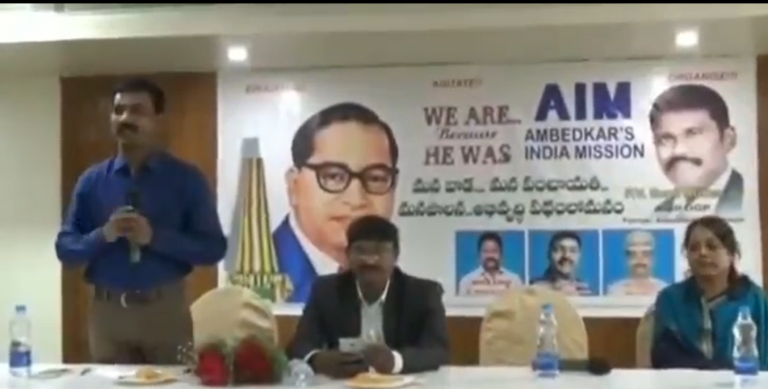
Video of Andhra Pradesh ASP M Sattibabu giving provocative speech to Dalit youths goes viral

In an undated video that has gone viral on social media, the ASP of Krishna district in Andhra Pradesh M Sattibabu can be heard preaching that one must be ready to die for ideology just like the terrorists who crashed a plane into the World Trade Centre in one of the most ghastly terrorist attacks witnessed by the US. 

Shared by Legal Rights Protection Forum’s Twitter handle, M Sattibabu speaking at Ambedkar India Mission’s meeting said, “Terrorist who crashed the plane into WTC didn’t do so for money, but because he was committed to die for the ideology he believed in. Need to have a similar commitment to our ideology. It’ll give us the courage to lay down our lives for our ideology.”

“The aim of this meeting is to nurture people who are willing to lay down their lives for the cause of Ambedkar’s India Mission,” M Sattibabu added. 

Complaint filed against Andhra Pradesh Addl DGP and founder of Ambedkar’s India Mission

Legal Rights Observatory (LRO), the legal activism non-profit group, has filed a legal complaint against Andhra Pradesh Addl DGP and founder of Ambedkar’s India Mission for indulging in hate speech in the garb of his organization’s mission.

The complaint detailed several activities of the IPS officer who is the Additional Director General of Police, (Crime Investigation Department) in the Andhra Pradesh Government.

As per the complaint, Kumar’s organization “Ambedkar’s India Mission” is known for hate speeches against Hindus and peddling divisive communal/caste-based politics. 

In an instance dated 26th November 2020 (India’s Constitution Day), Kumar went live from the official Facebook page of his organization and abused the Hindu religion and sacred scriptures like Vedas and Puranas. The video, however, is no longer on Facebook.

In another viral video, Kumar can be seen praising the Britishers for giving them a God to pray when they were allegedly disallowed by the Hindu society, thereby, admitting that he is a Christian.

Demanding SC status for the SC’s who converted to Christianity, Kumar in an interview to The Times of India had confessed that he will represent only the SC Mala community and will oppose the inclusion of any other caste in the SC category list.

The complaint also stated that the officer has abused his position by running a private organization, thereby, violating Section 3 of The Police Forces (Restriction of Rights) Act, 1966.

Punjab Elections 2022: As political landscape warms up, will Dalit votes be the game changer?

Punjab is less than a year away from assembly elections. This is going to be the first time in 25 years that Shiromani Akali Dal (SAD) and Bharatiya Janata Party (BJP) will not contest the elections together. SAD and Bahujan Samaj Party have recently announced that they have formed an alliance for the upcoming assembly elections.

Notably, BSP and SAD were in an alliance in Punjab before the 1997 Assembly elections. In the 1992 Assembly elections, BSP had won nine seats in Punjab. A year before the 1997 elections, SAD and BJP came in alliance, and BSP went down to one seat in the state. Since then, BSP has failed to mark its presence in four consecutive state elections.

With the new alliance, all political parties are going all out to woo Dalit votes. In such a scenario, how does the prospect of a Dalit Chief Minister or Deputy Chief Minister of Punjab look like?

The ‘ardaas’ incident

A few weeks back, a video of a Pathi went viral on social media in which he welcomed BJP’s decision to project a Dalit as the Chief Minister candidate of Punjab in the 2022 Assembly poll. In a special ardaas (prayer) he offered in the Gurudwara, Gurmel Singh Khalsa prayed for PM Modi’s long life and backed BJP’s reported decision to project a Dalit as CM candidate in the upcoming Punjab Assembly elections.

A complaint was registered by an advocate Harpal Singh Khara who alleged Gurmel hurt religious sentiment. Acting on the complaint, Punjab Police arrested the Gurmel, Pathi of the Gurdwara at Bir Talab village in Bathinda district.

A few days later, a similar incident, Harpal Singh, granthi of the Ravidas Gurudwara, Ambedkar Nagar, Sangrur, conducted a similar ardaas. According to the reports, some people approached him for the ardaas who were identified as BJP SC Morcha. He said, “Immediately after the ardaas, I even apologised for any offence that I may have caused to other members of the congregation.” He was reportedly dismissed from his job after the incident.

‘BJP believes in the inclusion of everyone’

Though PM Modi or BJP had not made any such promise about Punjab CM being Dalit, the ardaas and the aftermath showed that the subject of Dalit inclusion in Punjab politics is going to be an important point of contention in the coming months. In April, state organising secretary Dinesh Kumar had said, “After 1947, only Jatt Sikhs have been becoming CM. Sikhs and Dalits or other castes have never got any chance. We have already been asking why can a Dalit or member of some other community not become CM in Punjab when Jatt Sikhs have just 17% population. They (Dalits) also have the right (to become CM). They should get justice.”

Speaking to OpIndia, BJP State President Ashwani Kumar Sharma said, said, “Why can a Dalit not be CM in Punjab? BJP believes everyone who lives in Punjab has the right to be politically involved for the betterment of the state, let it be a Sikh, Dalit, OBC, Brahmin, or someone else. Interestingly, it is only after the recent incidents where Dalits spoke in favour of BJP, everyone wants to include them.” He further added if they were so concerned, why no party made a Dalit deputy CM of the state.

BJP State Secretary Sukhpal Singh Sran speaking to OpIndia over the recent incidents and the inclusion of Dalits in Punjab politics said, “What should we conclude from the recent arrest of the Pathi in Bathinda district? Are Dalits not even allowed to do ardaas in Gurudwaras? The arrest was against the teachings of Sikhism. Our Gurus have taught us not to indulge in casteism.” While talking about the BSP-SAD alliance, he said, “It is a politically motivated alliance. It is not a “gathbandhan” but a “thungbandhan”. They do not believe in the inclusion of the suppressed. They only want to use them as vote bank.”

He further added Congress, the ruling party of Punjab, is scared that the suppressed are now waking up, and BJP is supporting them to become more active in the state politics. “BJP’s ideology is based on ‘Sarve Bhavantu Sukhina’. We believe everyone is equal. Guru Gobind Jihad said, ‘Manas ki jaat sabhaye Ek pehchanyo’ (We must treat everyone equal), and BJP do not discriminate among any caste or religion.” Condemning the attack on BJP leaders in recent months, Sran said that Congress and other parties are trying to spread misinformation about BJP and its leadership, but they cannot hide the truth for long.

No Dalit deputy CM since independence

Punjab had three Deputy Chief Ministers since independence. Notably, none of them was a Dalit. In the 2016 assembly elections Aam Aadmi Party had said they would appoint a Dalit as Deputy CM of the State if they come to power. While speaking at an election rally in 2016 at Doaba, a Dalit-dominating region, Arvind Kejriwal had said, “Every party talks about giving Dalit benefits, but no one wants to give the higher position as a minister. They only give you a choice for MLAs, that too because of the reservation. But AAP is not here to exploit you for votes. We will share the power with you. Bhim Rao Ambedkar and Kanshi Ram had stated that Dalits can only be brought in the mainstream if power is shared with them.”

However, their announcement did not make much difference in the election results, and Congress ended up winning the elections. The reason, some experts believe, the lack of originality in the announcement for Dalits in the manifesto. Except for the seat of Deputy CM, AAP did not promise anything more than what other parties had promised.

AAP is also eyeing the upcoming state elections in 2022, and the party is known for playing religion and caste cards very often. As there is an alliance between BSP and SAD, it may cut votes of the Aam Aadmi Party. Moreover, AAP only promised the post of deputy CM to a Dalit while BJP is talking about the possibilities of a Dalit Chief Minister based on the party’s ideology of inclusion of everyone.

Dalits in Punjab: discrimination that is visible to everyone but no one talks about

Dalits’ role in Punjab politics is hard to understand. According to the official data, the Scheduled Caste population in Punjab is 88.60 lac which is 31.94% of the total population of the State. Punjab accounts for 2.3% of the total population and 4.3% Scheduled Caste population of India. Though Dalits comprise almost 32% of the population in the State, their role in politics is almost non-existent.

Santosh K Singh published an op-ed titled “Dalit Politics and Its Fragments in Punjab – Does Religion Hold the Key?” in Economic & Political Weekly. He said, “There are standard reasons to explain this enigma. The most prominent being the dominance of the landed community of Jats and other castes. In other words, it is argued that because of the Jat Sikh dominance, the Dalit community was never able to chart its own independent, political journey. They continued to express themselves either through the Shiromani Akali Dal or the Indian National Congress, the two dominant political parties of the State, again largely led by the Jats. The Bahujan Samaj Party (BSP), as the perceived face of Dalit politics, has been reduced to a mere footnote.”

Surinder S. Jodhka, in a January 2002 article titled Caste and Untouchability in Rural Punjab in Economic and Political Weekly, talked about how Dalits who have converted to Sikhs feel discriminated against. He said, “Though at the level of religious principle Sikhism has been anti-caste and has had an attraction for the Dalits of Punjab, caste prejudices have not been completely absent among the Sikhs. This has been so particularly among the dominant castes of landowning Sikhs of rural Punjab. While in most gurudwaras in Punjab there are no restrictions on Dalits entering the local shrines, there are several cases where Dalits felt that they are discriminated against by those who control gurudwaras.”

While researching for his paper, Jodhka interacted with several Dalits individually and in groups. He found that though the majority of the Gurudwaras Dalit Sikhs are not stopped from entering, they are not treated as par with their counterparts from the upper caste. He said, “During a group discussion with Dalits in a village of Ferozepur district, we were told that the upper caste Sikhs did not really appreciate their participation in the daily activities of the local gurudwara.”

Sadly, it took a pandemic to break the caste bias in Punjab. According to April 2020 reports, it was only after the Covid-19 pandemic hit India in March 2020, the caste practices faded out in some of the religious places in Punjab. Jat Sikh Gurudwaras reportedly sent food to Dalit houses daily during the pandemic. Notably, while Sikhism preaches for equality, there are separate Gurudwaras and cremation grounds for Dalits in Punjab.

Despite several anti-caste movements, including Adi Dharam, Arya Samaj, Singh Sabha, Sacha Sauda and several others, Punjab and casteism seem to have an unbreakable relationship. Even the government’s efforts to uplift the scheduled caste population have no effect due to a deep-rooted sense of caste-based biased. In many cases, Dalits face a lot of resistance when they try to bring Guru Granth Sahib for worship at home during wedding and other auspecious ceremonies.

Agriculture Laws and BJP’s chance in Punjab 2022 Assembly elections

If elections were to happen in Punjab today, it may be one of the most difficult elections BJP would have to face. Congress, AAP and SAD have infused so much hatred in the minds of the people of Punjab against BJP over the Agriculture laws enacted in September 2020 that it will be very difficult for BJP to win the election without playing aggressive politics.

In the past few months, several incidents of attack on BJP leaders have happened in Punjab. The ‘farmers’ are protesting on the borders, and some reports have suggested that political parties are using these protests to earn brownie points against BJP.

Keeping the current situation in mind, BJP has to come up with a foolproof plan to win the hearts of the voters again. It is clear that giving a good price for the crop is not going to work as despite getting payments for the produce in the bank account for the first time, farmers are still protesting at the Delhi border. While the union government under BJP is doing everything to ensure farmers have a better life, the anti-BJP atmosphere among farmers in Punjab is going to make it extremely difficult for the party to earn trust.

In such situations, exploring faces from SC/ST community for CM and other important posts may become beneficial for BJP. It is evident that Dalits do not have any role in the political scenario in Punjab and other parties are, at max, may announce Deputy CM post for the Dalits as they would not want to anger the Jat Sikh community in the state. However, on the other hand, as BJP has nothing to lose in the state, they can explore options for inclusive politics.

2022 elections may become a turning point for Punjab politics

Notably, SAD and BJP broke their alliance in September 2020 after Agriculture Laws were enacted. As BJP has all the room for contesting elections on their own in Punjab, the party should look for innovative ideas to attract voters. Other than schemes, it is important to announce the inclusion of all sections equally so that they become the decision-makers.

The Dalit community in Punjab is divided into several sections. Among those, Ravidasis and Valmikis are the most significant sections. These sections are associated with deras alongside rural Punjab. During elections, these deras play an essential role. Also, it has to be noted that the number of NRIs in the Doaba region is much higher than in other regions. The majority of the Dalit families have at least one NRI making the region extremely prosperous. Their impact is majorly seen in parts of Phagwara, Jalandhar and Ludhiana. However, despite their strong financial position, the Dalits of Doaba are unable to make any mark in the political arena in the state. This is where BJP can have the upper hand by giving them more political power.

The elections are still ten months away. Though it is too soon to speculate what BJP and other parties are going to plan for the elections, it will be interesting to see how the things unfold.


“Global decisions no longer dictated by small group of countries”: China hits back at the G7 summit

Leading the Group of Seven discussions of China on Saturday, Canadian Prime Minister Justin Trudeau called on the leaders to come up with a consolidated approach to tackle the challenges posed by the People’s Republic of China. However, the G7 countries that have been looking for a strategic and coherent response to deal with President Xi Jinping’s growing dominance especially after China’s economic and military rise, have been now warned by the country.

Hitting back at the world’s richest democracies that are desperately looking for a blueprint to take on Beijing, a spokesperson for the Chinese embassy in London said, “The days when global decisions were dictated by a small group of countries are long gone.”

“We always believe that countries, big or small, strong or weak, poor or rich, are equals, and that world affairs should be handled through consultation by all countries,” he added. 

Currently, the leaders of the G7 – The United States, Canada, Britain, Germany, Italy, France and Japan – are using their gathering in the English seaside resort of Carbis Bay as an opportunity to showcase to the world that the richest democracies can offer an alternative to China’s growing dominance.

Meanwhile, Beijing has time and again hit back against what it perceives as attempts by Western powers to curtail China. Calling it a humiliation, Beijing says many major powers are still gripped by an outdated imperial mindset.

G7 backs global infrastructure project

On the second day of the summit, the G7 leaders backed a vast global infrastructure project plan for the developing and emerging countries as a counter to the Chinese “Belt and Road” project.

‘Build Back Better World’- an initiative put forward by the Joe Biden administration, the White House said the project would mobilize private sector capital in a “transparent infrastructure partnership” to meet the shortfall in the developing world that had been exacerbated by the COVID-19 pandemic.

“(B3W) will be global in scope, from Latin America and the Caribbean to Africa to the Indo-Pacific,” the White House statement said. 

“The aim is to help countries recover from the pandemic, focusing on the climate, health, digital technology and the fight against inequality,” it added.

PM Modi addresses G7 summit

Addressing the G7 summit virtually, Prime Minister Narendra Modi on Saturday called for adopting a “one earth, one health” approach to effectively deal with the coronavirus pandemic globally.

“The prime minister committed India’s support for collective endeavours to improve global health governance. He sought the G7’s support for the proposal moved at the WTO by India and South Africa, for a TRIPS (Trade-Related Aspects of Intellectual Property Rights) waiver on COVID related technologies,” an official statement said.

As chair of the G7, the UK invited India, Australia, South Korea and South Africa to the 2021 summit as guest countries.

Throttle Aerospace Systems led consortium to start trials for drone delivery of medicine in Bengaluru

A consortium led by Throttle Aerospace Systems (TAS) in Bengaluru will carry out the first set of trials of beyond visual line of sight (BVLOS) medical drone from June 18 onwards, reported The Times of India.

TAS had received the permission of the Directorate General of Civil Aviation (DGCA) in March 2020 itself but other permissions from agencies were stalled due to the Coronavirus pandemic. After having secured all clearances, it will now carry out trials of delivery of medicines by drones for 30-45 days in Gauribidanur taluk in Chikballapur District of Karnataka. It is located about 80 km from Bengaluru.

Throttle Aerospace Systems’ CEO, Nagendran Kandasamy, informed, “Two other consortia also have permission for BVLOS experiments, but ours is the first legal/official medical drone delivery experiment. We have come a long way since 2016 and are at a pivotal moment. After a long wait, we now have an official go-ahead from the BVLOS Experiment Monitoring Committee (BEMC) and we look forward to leveraging commercial drone delivery in India soon.”

Besides TAS, Invol-Swiss company will provide unmanned traffic management (UTM) systems and Honeywell Aerospace company will provide safety expertise. For the trials of beyond visual line of sight (BVLOS) medical drone, Throttle Aerospace Systems will use two variants of MedCOPTER drone and delivery software named RANDINT. Reportedly, the smaller model of MedCOPTER drone can carry a weight up to 1 kg for 15 kms. The other variant can carry 2kg for 12 kms.

TAS will test the range and safety of both models for 30-45 days. During the said period, both the drones will be flown for at least 100 hours in accordance with the guidelines of COCA. According to CEO Kandasamy, TAS is planning to fly the drones for about 12 hours. He informed that all logs will be reviewed and submitted to the authorities on completion of the trial phase.

Cardiac surgeon Dr. Devi Shetty has announced that he will provide the medicines to be used during the trials. The partnership with Narayana Healthcare is meant to understand the type of medicines that can be transported via drones. It will also help TAS understand the challenges and whether it could be used on a regular basis in the future.

“Our software will receive the demand raised by Narayana. Nobody will know who the recipient is, but the delivery will be made to the pre-loaded address…They are the other user partners. They are interested in knowing the per kilometre cost and other such commercial aspects of object delivery,” TAS CEO pointed out. Besides Narayana, Udaan has reached out to inquire about the commercial aspect of the model.

Bengaluru Hospitals use drones to deliver vaccines

Last month, four Bengaluru hospitals made use of drones to deliver vaccines and medicines within their campuses to improve the availability of drugs in Covid wards. The hospitals- Victoria, Vanivilas, and Bowring government hospitals — and the Jagjivan Ram Nagar Referral Hospital deployed drones manufactured by Chennai- headquartered Garuda Aerospace.

Centre gives nod for experimental use of drones in Telangana

In an innovative move, the Civil Aviation Ministry had given a nod to the Telangana government last month to use drones for experimental delivery of vaccines using drone flights.

Sharing the update via a Tweet, “MoCA grants conditional exemption from Unmanned Aircraft System (UAS) Rules, 2021 to Government of Telangana for conducting experimental Beyond Visual Line of Sight (BVLOS) drone flights for delivery of vaccines,” informed the Ministry of Civil Aviation. “This exemption will remain valid for a period of one year from the date of approval of the said SOPs or until further orders, whichever is earlier,” said the letter of approval.

Watch: Shiv Sena MLA and his supporters attack contractor blaming him for waterlogged street, dump garbage on him

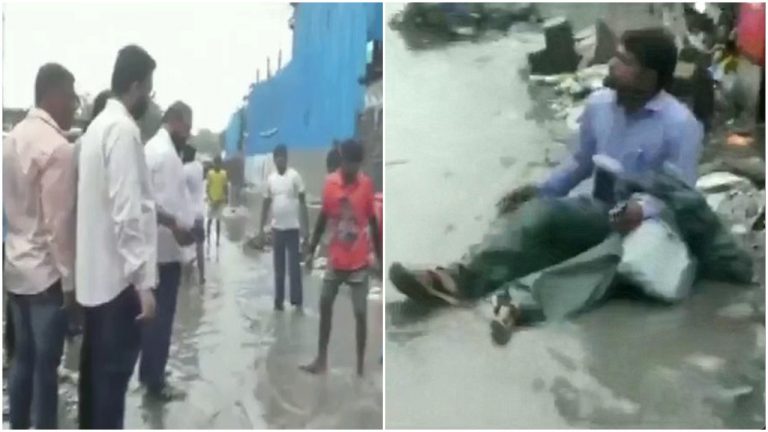
In a sheer display of arrogance, Shiv Sena MLA from Chandivali in Mumbai, Dilip Lande, forced a contractor to sit in a pile of garbage that was allegedly blocking drainage and causing waterlogging in the area. Shiv Sena workers later dumped garbage on him.

A video of the incident has gone viral on social media, in which Lande and his supporters were seen threatening a contractor and forcing him to sit on a waterlogged street. In the video, it can be seen how Shiv Sena workers overpowered the contractor and made him sit near the garbage. The Shiv Sena MLA was seen asking workers to dump garbage on him.

The shocking act of Shiv Sena MLA has not gone well with the public, who slammed him for misusing his position to bully common people. Responding to the incident, the Shiv Sena MLA claimed that he had been calling up the contractor for the last 15 days, requesting him to clear the road. However, he never did that, said Lande.

“It was this contractor’s job to clear that garbage which he didn’t do. This was resulting in waterlogging and was causing a lot of trouble to the local people. I did what I did because the contractor did not do his job,” the Shiv Sena MLA said.

The continuous onslaught of heavy rains, coupled with thunderstorm and strong winds, brought Mumbai and its suburbs into a standstill on Saturday. The heavy rains has led to disruption of train and bus services as tracks and roads got waterlogged at several locations.

Meanwhile, the India Meteorological Department has predicted the rains will continue in the city till Tuesday.

Culture of political violence in West Bengal: How the Islamist challenge can turn an already very bad situation into much worse

The outbreak of political violence in West Bengal shows no signs of abating. Political violence against opposition party workers in the state by goons of the ruling Trinamool Congress peaked right after trends on results day showed a comprehensive Trinamool victory and lasted for about a week.

Since then, the violence has continued on and off with more workers of the BJP reported dead in the state. Communal violence was also reported at Tiljala recently with the vandalisation of a Hindu Temple also being reported. It is not clear whether the communal violence is in any manner connected to the ongoing political violence in the state.

With murders reported left, right and center, and the exodus of BJP supporters from the state, the culture of political violence in the state has received greater focus. But it is not a phenomenon that has begun recently. It goes as far back as to the years right after independence.

The culture of political violence

The immediate years after independence witnessed the influx of a great number of Hindu refugees from then East Pakistan. The sudden influx of the huge number of Hindu refugees overwhelmed the state machinery and the then government was unable to provide them with basic ameneties.

The central government at the time under Prime Minister Jawaharlal Nehru was not particularly sympathetic to the incoming refugees from East Pakistan and that only served to exacerbate the already difficult situation.

Soon, the Left parties began to organise the Hindu refugees under their banner and mounted a challenge to the ‘Eviction of Persons in Unauthorized Occupation of Land Bill’ in 1951, popularly known as the Eviction Bill. The Bill was formulated to evict the refugees who had occupied public and private lands to settle down in Kolkata.

March 1951 onwards, rallies, meetings and public demonstrations became part and parcel of the everyday urban life which eventually culminated with the original bill being considerably amended. The refugees later protested against several other measures such as the policy to disperse them from Kolkata to less populated areas and the proposal to increase tram fare by 1 paise.

West Bengal’s complicated history with protests

West Bengal was hit with a near-famine situation after a failure in crops in 1959. The Price Increase and Famine Resistance Committee (PIFRC), a platform for Left political parties, organised protests calling for food.

Prafulla Chakrabarty wrote, ‘The united Left was now in a position to mobilize the encapsulated refugees and the petty bourgeoisie at a moment’s notice; it could also rely upon the majority of the working class to respond favourably to a strike call. But what was new in the autumn of 1959 was the presence in Calcutta and its immediate neighbourhood of thousand peasants who could be thrown into the struggle.’

The protests were met with police force and the number of dead was speculated to be between 39 and 80. Seven years later, in 1966, another round of food protests would hit the state. This was to be more violent with far reaching implications for Bengal politics.

It set the stage for the Naxalite movement which began in 1967. Led by charismatic figures such as Charu Mazumder, the rebels believed in ‘armed resistance’ as a means of revolution. The movement also saw the participation of students from numerous universities.

Ultimately, the Government would crush the protests with force but the movement continues to dominate pockets of the country to this day. Through these years, what became entrenched was the culture of political violence and the violence was intrinsically political in nature and not communal.

The culture of violence perpetuated by the Left Front

The Left Front rose to dominance on the back of violent tactics as mentioned earlier. One of the most ghastly incidents of violence came to be known as the Sainbari Massacre. The Sain family was a supporter of the Congress party and the Communists in the area wanted them to flip.

Upon their refusal, the Sain family was attacked brutally and murdered in open. The mother was fed rice soaked with the blood of her son. Years later, the surviving members of the family is yet to receive justice and the Congress party is in alliance with the Left Front in the state.

Apart from that, there was also the attack on the Ananda Margis when the monks were lynched in broad daylight. The Left Front, consequently, exercised complete dominance over the state machinery and the domination continued well into the first decade of the 21st century.

Trinamool Congress continues the legacy of the Left Front

Mamata Banerjee rose to power after combating the state sponsored violence of the Left Front. She herself suffered the brunt of it when she was dragged by her hair and beaten up by the Police when she led a rally to the erstwhile secretariat.

In 1990, she was hospitalised for a month after being hit on the head by a Youth CPI(M) leader. There were other occasions when she was attacked in a bloody turf war between the Trinamool Congress and the Left Front. Multiple Trinamool workers also lost their lives to the same.

Since coming to power, her party has only carried forward the legacy of the Left Front. Murders of political adversaries in the state are rampant. While there were those who genuinely hoped that she would bring the cycle of violence to a halt, it was not to be.

Unique features of political violence in West Bengal

The culture of political violence in the state in unique in many aspects. The violence is driven primarily by party association and not religion or caste or tribal loyalties as in certain other regions of India. This violence continues regardless of who is in power, only the party affiliations of those being attacked changes.

There are good reasons for this. The unique conditions of West Bengal a mentioned earlier led to a situation where party affiliation acquired greater prominence in the administration of the state than religious identity.

As is the characteristic of Communism dominated states, political persecution is the norm of the day rather than religious or caste. Targeted attacks based on religion does occur, for sure, but it is a consequence of perceived threats to political power.

In West Bengal, as a consequence of Communist politics, the party dominates the state machinery. And there exists vestiges of the hierarchy that operate outside the domain of the state machinery but exert great influence on administration.

Trade Unions, for example, are significant institutions which affect administration and policy. Political parties combat with each other for control of these unions. Simultaneously, the implementation of government policy and welfare initiatives also depend on individuals associated with the ruling party.

Thus, it is very easy for ruling parties to block citizens they perceive to be against party interests from receiving benefits of the welfare initiatives of the government. There also exists a ‘club culture’ in West Bengal where clubs in every locality are responsible for welfare work there.

Such clubs lean towards one party or the other and exercise significant control over the administration. Political parties contest for control over these clubs as well. On voting day, these clubs can often decide the fate of the party.

The political violence that occurs is often a consequence of political rivalries at the local level. And it would continue regardless of who is in power in the state. Leaders at the top would fail to curtail it even if they seriously desire to bring it to a halt. And there is no inclination as yet that Mamata Banerjee wants the cycle to end.

The Islamist challenge

There is a serious threat that the cycle of violence can be hijacked by Islamists to achieve their sinister ends. If Islamists succeed in capturing the unions and the clubs at the local level, they can already use the structure in place to pursue their objectives.

It does appear to have occurred in certain pockets but there is no clear evidence as yet that it is the case in overwhelming regions of the state. Since the BJP is effectively a party of Bengali Hindus in the state, the victims of political violence in the state have been primarily individuals who happen be Hindus.

But there is no evidence as yet that the current spate of violence is a targeted campaign against Hindus in the state. As evidence, there have been visuals of Hindu workers of the TMC looting a shop owned by a Muslim affiliated to the BJP as well.

Furthermore, Muslim workers of Peerzada Abbas Siddiqui have also reportedly been killed in the ensuing spree of violence. Thus, while the political violence is not yet a pogrom against Hindus specifically, the institutional capture of organisations by Islamists can very well happen in the near future with their increasing influence in Bengal politics.

Therefore, the already very bad situation in the state could turn infinitely worse. It is for this reason that it is imperative that reasonable heads prioritise the formulation of a solution to the menace that currently exists.

Watch: People climb atop tankers to avoid queues as water crisis worsens in Delhi

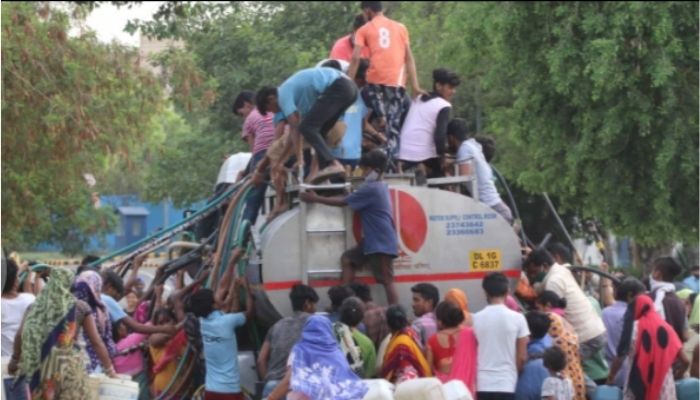
As the water crisis in the National Capital worsens, locals in the Vivekanand Camp in the Chanakyapuri area were seen climbing atop the water tank instead of waiting in queues.

In a video shared by news agency ANI, a large group of women was seen waiting on the footpath with water vessels. When the water tanker of New Delhi Municipal Corporation (NDMC) reached the Vivekanand Camp, a few of them climbed atop the water tanker with complete disregard for their safety. They then put in pipes to fill their buckets.

The desperate situation, caused due to the water crisis, led to overcrowding around the water tanker. People were also spotted without masks and violating social distancing guidelines amidst the Coronavirus pandemic.

Reportedly, the water crisis in the area has led to people lining up in long queues waiting for water tankers. The situation is similar in Sanjay Camp of the Chanakyapuri area. The residents are forced to wait for over 5 hours for water, while only 4-5 water tankers come for 15,000 people. Locals also said that while the tankers come twice a day, there is no fixed time for the same. Therefore, they are forced to wait for hours for the tankers.

Locals said that if they stay indoors, they won’t know when the tanker comes and even a five minutes delay will mean they will not get water. To avoid that, they keep waiting outside till the tankers come.

Amidst the rising temperature in the National Capital, people are left rendered by the Delhi administration. Meanwhile, a war-of-words have started between the BJP and the Aam Aadmi Party (AAP) over the water crisis.

Earlier on June 5, the Delhi Jal Board had informed that areas including Inderpuri, Mayapuri, Todapur Village, Naraina Village, Naraina Vihar, Krishi Kunj, Mansarovar Garden, Rajouri Garden, Subhash Nagar, Ramesh Nagar, Hari Nagar, Kirti Nagar, HMP colony, and Punjabi Bagh would face water shortage due to repair work. It had urged the people to save adequate water.

How a ‘liberal’ filmmaker went from criticising Rahul Gandhi to saying ‘I am on your side’ and what it shows

‘Liberals’ in India take pride in imaginary conversations they have in their minds which they call ‘speaking truth to the power’. They also like to believe that all things that go wrong with them are the side effects of these imaginary conversations. Except, this ‘standing up against fascism‘ rule goes for a toss whenever the ruling party is non-BJP. In which case, they’d stand with the corrupt and convicted politicians serving jail term only because they are in opposition.

‘Liberal’ filmmaker Hansal Mehta on Saturday kicked up a storm after he lowkey pretended to criticise Rahul Gandhi and the lack of democracy in Congress.

Mehta’s tweet came just days after Jitin Prasada quit Congress to join the BJP triggering so-called criticism where everyone worth their biscuits asked Congress to reevaluate why such tall leaders are quitting the party.

Except, Mehta’s ‘rebellion’ was not taken rightly by Congress-supporting-neutral journalists.

Apparently, if the dissenting Congressis within Congress don’t have the strength to take on Rahul Gandhi, how will they even take on the BJP?

Other independent filmmakers and ‘journalists’ too chimed in to accuse Mehta of giving ‘faltu advice’ for Congress and not BJP.

More such pearls of wisdom were exchanged where Mint columnist Salil Tripathi inadvertently ended up comparing opposition leaders to a lamppost.

Soon enough, official Congress workers, too, joined in to question Mehta for questioning Rahul Gandhi.

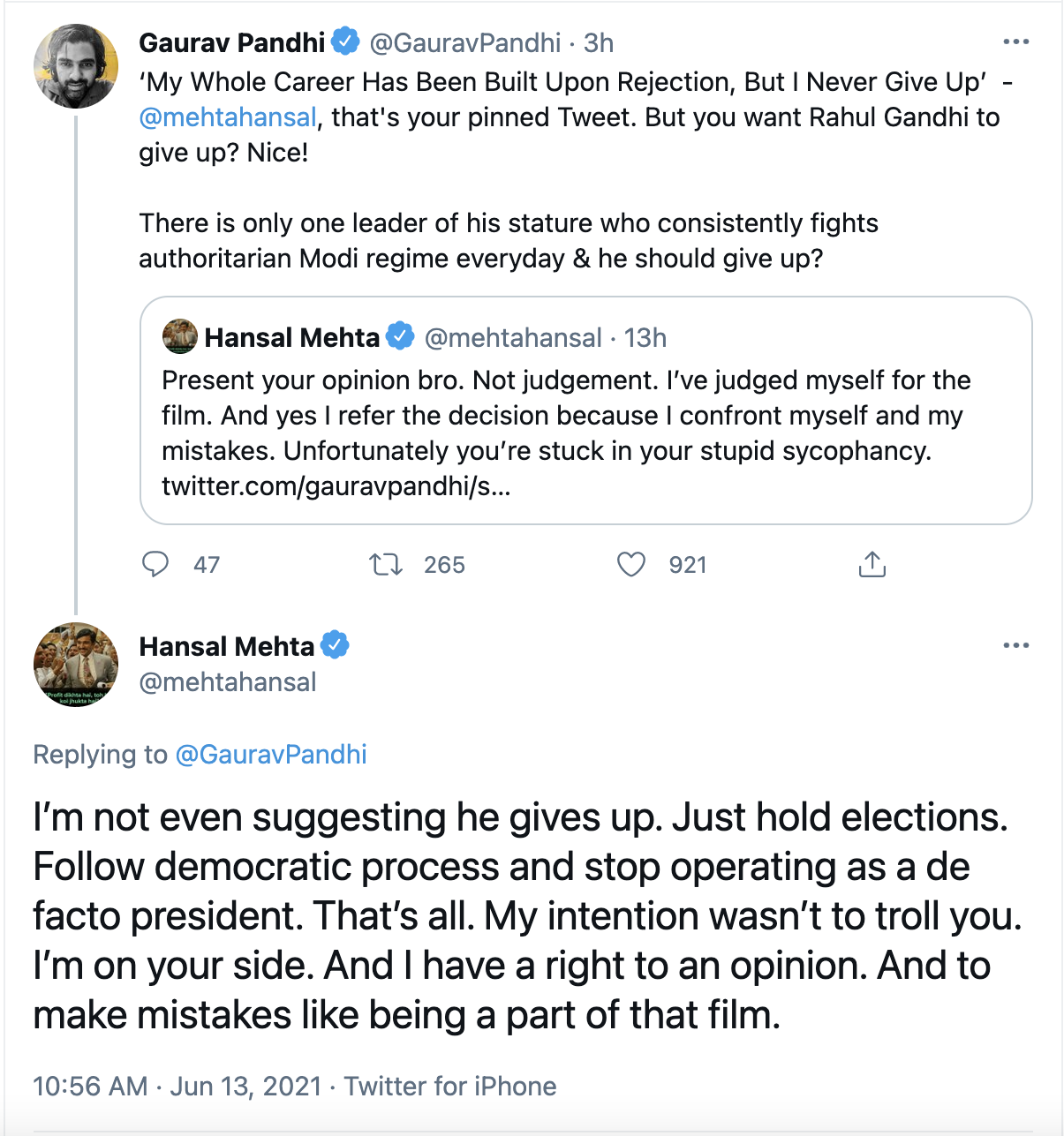
Gaurav Pandhi attacks Mehta

Mehta was questioned about his professional decision to act as Creative Producer to The Accidental Prime Minister, the political drama based on Sanjaya Baru’s book of the same name which spoke about India under UPA era and how Dr Manmohan Singh, the then Prime Minister of India was a victim to Congress’ dynastic approach.

However, upon being shown his place, Mehta quickly acknowledged the mistake of being associated with the film. After all, ‘I am on your side’.

But why this sudden discussion on Congress leadership? Well…

Congress worker Gaurav Pandhi attacking Hansal Mehta

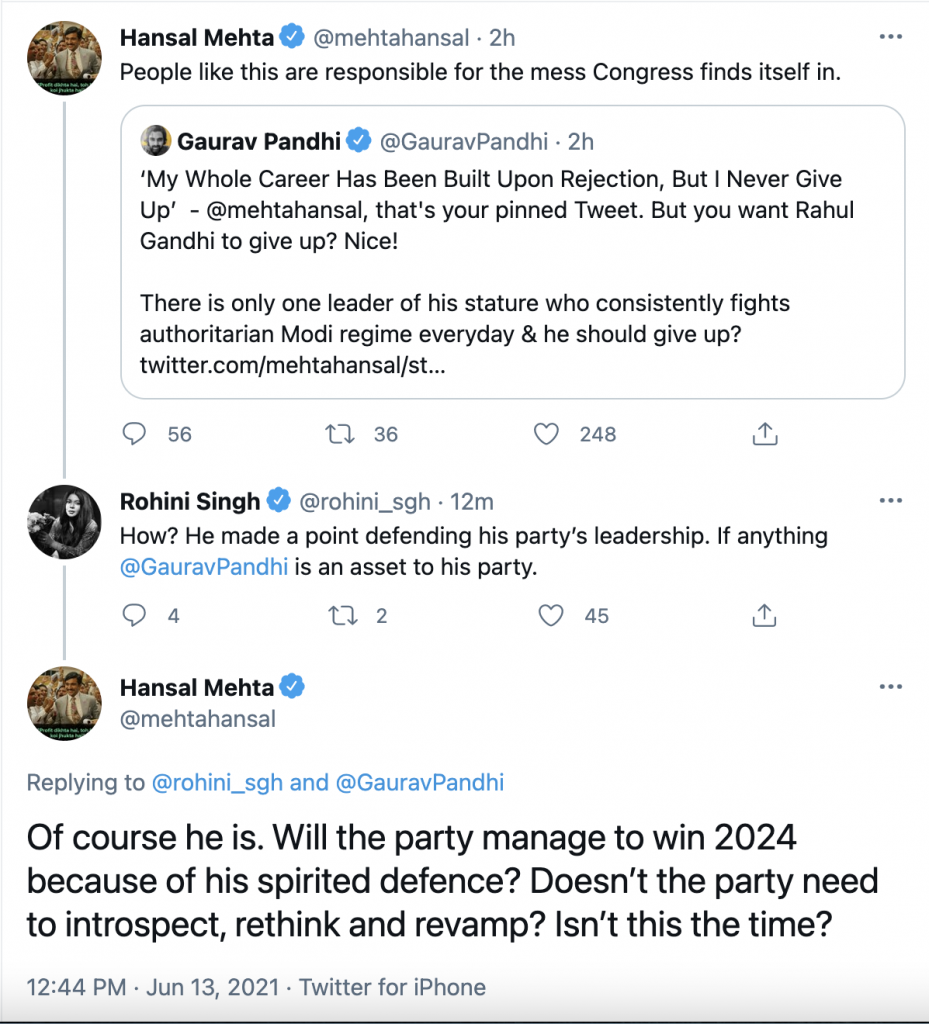
When a visibly irritated Mehta replied slightly rudely, he got another round of scolding from ‘neutral’ journalists. But then Mehta clarified on how will Congress manage to win 2024 if the party does not introspect and reinvent itself?

You see, this is how it is.

Congress and their loyalists are still not able to get over the shock of not only losing 2019 elections, but BJP outperforming them and itself from the previous term. Something that was ‘rightfully theirs’ was taken away not once, but twice. That it might happen a third time is now making them nervous.

This ‘liberal vs liberal’ mock fight is just that. Gentle nudges to try to wake up the emperors because, well, at this rate, Rahul Gandhi will also lose Wayanad next elections.

This ‘Rahul Gandhi/Congress must introspect’ is a tirade that comes up every few months whenever someone leaves the party. Remember, this did not come when Congress was left with a big fat zero in West Bengal elections, where BJP made significant progress against ruling TMC. Despite Congress not winning a single seat and BJP going from 2 seats in previous elections to primary opposition party, it was the BJP that was painted as the ‘losers’.

Defeating the BJP somehow appears to be the bigger goal than getting Congress to win.

But with BJP out of power, the Congress ecosystem will be back at putting these intellectuals where they wish to go, like heading some film school somewhere be made in charge of some department somewhere. Which is what they crave. Which is why they want the Congress back in power.

Not because they think Rahul Gandhi or any other Congress leader for matter is a brilliant and able administrator, but because it will only be under Congress their ecosystem will thrive unquestioned.

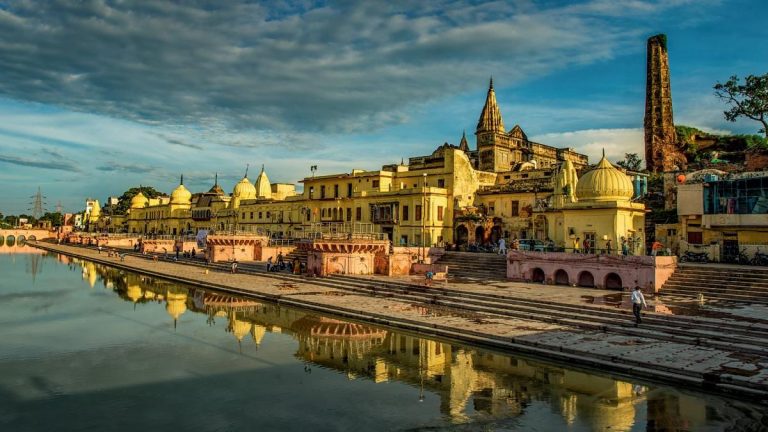
Ayodhya to be developed as a religious, Vedic and solar-powered sustainable city, says UP CM Yogi Adityanath

Uttar Pradesh Chief Minister Yogi Adityanath has announced that the state government will develop Ayudhya as a religious, Vedic and solar city with world-class facilities. Laid on a historical, cultural and spiritual foundation, Ayodhya is all set to become a global tourist destination while being a sustainable city.

The announcement was made during a presentation on the vision document of Ayodhya at the Chief Minister’s official residence on Saturday. Yogi Adityanath emphasized that the work for the conservation of water bodies, intelligent traffic management system, animal protection, outer ring road and other road projects, solar projects, tree plantation and new employment opportunities amongst others should be initiated on priority. 

Based on Sanatan traditions, the city will bring to the fore the ancient culture, heritage and traditions while incorporating sustainable modern facilities. 

Ram Janmbhoomi city plan

CM Yogi has given orders to build utility ducts to ensure roads are not dug continuously for underground cabling and water pipes repair work.

“Heritage lighting should be done in the city. The panch kosi, chaudah kosi and chaurasi kosi parikrama pathways should be developed keeping their religious significance in mind,” remarked Yogi Adityanath. A direction has also been given to the tourism department officials to identify and develop heritage, historical and religious spots in the city.

The CM has also asked the officials to take consenses and make arrangements to relocate affected shopkeepers and residents Prior to land acquisition for road widening of the pathway leading up to the Ram temple.

Discussing the plan for the international museum project, the CM laid emphasis on the fact that the museum should be developed keeping in mind the “ancient pride” and modern knowledge. Additionally, he has asked the officials to identify and acquire land for guest houses, institutions dedicated to various sects.

The plan also involves developing multi-level parking lots with space reserved for commercial activities at railway and bus stations.

A plan for beautification and preservation of all ghats and the Sarayu river has also been chartered out. 

Ayodhya Ram Mandir foundation work to be completed by October

The Ram Janmabhoomi Teerth Kshetra Trust announced that the foundation work at the Ram Mandir would commence in December this year.

According to the latest update by the Ram Mandir Trust, the filling of the foundation measuring 50-feet deep, 400 feet long and 300 feet wide will be completed by the end of October, giving way to the second phase of construction work which includes fixing of stones to create the temple structure.

“In December, the work on the base plinth will start with pink stones of Mirzapur and an order has been placed. The stones will be cut and shaped in the premises of Ram Janmabhoomi,” said Anil Mishra, Trustee of Ram Mandir Trust.

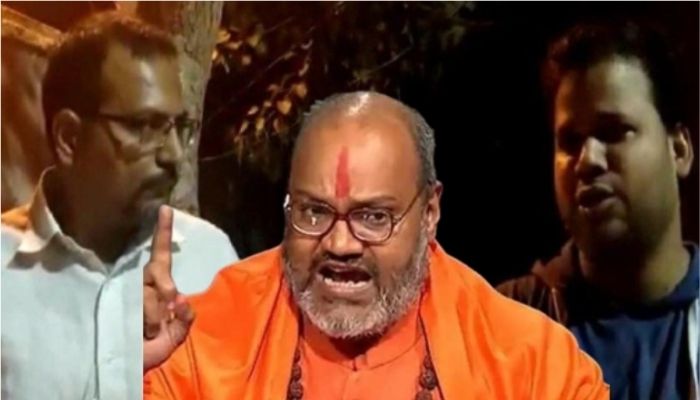
Yati Narsinghanand assassination attempt: Suspects Vipul and Kashif were highly radicalised, were sent by one Salimuddin

Days after two men were caught on charges of carrying out the assassination attempt on Mahant Yati Narsinghanand, the Mussoorie police in Ghaziabad arrested the mastermind named Salimuddin on Friday (June 11). The two accused were identified as Vipul Vijayvargiya and his brother-in-law Kashif.

As per reports, the duo was instigated to assassinate the Hindu priest by one Salimuddin, who is a resident of Vijaynagar Sector-12 in Ghaziabad. Vipul, who lived in Nagpur, was sent to the Dasna temple by Salimuddin to carry out the nefarious agenda. He was taught Urdu and educated in para-medical science by the mastermind. During the police investigation, it came to light that Vipul had married Kasif’s sister Ayesha one and half years ago.

Although Vipul accepted that he was radicalised and provoked by Salimuddin, he claimed that he went to the temple to have a debate with Mahant Yati Narsinghanand. The police had recovered surgical blades, religious books, and other equipment from the bags of the two accused. Mahant Yati Narsinghanand had accused the duo of carrying out an assassination attempt. At the temple entrance, Kasif had claimed that his name was ‘Kashi Gupta’ and that he was a resident of Nagpur.

Vipul had several connections, tried to mislead the police along with his aide

It has come to light that Vipul Vijayvargiya had connections with several people in Delhi and Maharashtra. Reportedly, he had met several people before making his way to the Dasna temple. The law enforcement authorities realised that Vipul and Kashif had been trying to mislead them since the onset of the investigation. Based on preliminary investigation, the police concluded that the purpose of their visit to the Dasna temple was not limited to having a debate with Mahant Yati Narsinghanand.

Kashif’s father and Salimuddin were office bearers of a radical outfit

During the probe, it was revealed that Vipul’s father-in-law (Kashif’s father) and Salimuddin were office bearers of a radical outfit. Kashif tried to mislead the authorities by naming all his ‘Hindu friends’ and did not name any Muslim aide. This had increased the suspicion about Kashif’s ingenuine testimony to the police. Although Vipul had been staying in Vijayangar for learning Urdu and paramedical science, he did not much information about Ghaziabad.

Police arrested Salimuddin, found erased data on his phone and laptop

However, despite being a resident of the city and well-aware of the restrictions on the entry of Muslims into the temple, Kasif went to the temple along with Vipul using a fake identity. The ATS along with Mussoorie and Vijaynagar police had interrogated several suspects confidentially in the Pratap Vihar of Vijaynagar. Citing sources, Dainik Bhaskar also reported that the cops arrested the man who taught Vipul Urdu and paramedical science. The cops had hinted that they were planning to conduct searches, undertake recce, and attacking the temple security.

The police had registered a case of fraud against Vipul and Kashif for entering the temple using a fake name. The duo was sent to five-day judicial custody on June 8. On Friday, they were interrogated by the Anti-Terrorism Squad (ATS). During the probe, the ATS recovered a laptop and some books from the mastermind Salimuddin. According to the police, he had erased data from both his phone and laptop. The two devices have now been sent to experts for data recovery. Salimuddin was also sent to judicial custody, following interrogation.

The Background of the Case

On May 2, sevadaars of Dasna Mandir, Ghaziabad, caught two men identified as Vipul Vijayvargi and Kashif on suspicion of carrying out assassination attempt on Mahant Yati Narsinghanand. Yati Narsinghananad Saraswati said in a tweet, “Two more pigs were caught today who came to murder me. It is not that easy to kill me.”

Anil Yadav, a close aide of Dasna Priest, filed a complaint with the Police. Superintendent of Police Dr Iraj Raja said that both the suspects had been arrested, and an investigation is underway. Kashif told the Police that he came in contact with Vipul on Facebook three years ago. When Police asked the reason for staying in touch on Facebook, he said it was just a normal friendship. Vipul claimed that he wanted to meet the famous priest of Dasna Mandir.

On May 17, Delhi Police uncovered an assassination plot against Dasna Devi Temple head priest Yati Narsighanand Saraswati with the arrest of a 24-year-old Jaish-e-Muhammad terrorist Mohd. Dar alias Jehangir from Delhi’s Paharganj area. Besides one .30 bore pistol along with two magazine and 15 live rounds, the Police recovered a Bhagwa kurta, a Kalava, a Mala and a Chandan-tika from the terrorist. Reports suggest that he wanted to kill the priest while posing as a Hindu.