Home Blog Page 4229

Coronavirus vaccination drive: It is time to talk about the J&K model

He had recently joined a new job in Srinagar secretariat after quitting a software job in Bangalore. In third week of April, he happened to be in earshot of two senior officer hurried discussion. He was already into first week of Ramzan fasting but remained fully enthused at work, after all he had returned home with a secure position in government.

The officers had a serious issue at hand, people in different parts of the state were not turning up for vaccination. Besides hospitals and health centres, J&K government had put up mobile vans in front of mosques and were requesting those coming out after offering Namaz to get vaccinated. Some were curious to know what these vans were meant for but soon as they got to know they would turn around and leave.

Vaccination was simply not picking up. It was rumoured that a vaccine dose would actually end their Ramzan fasting, something which went against community’s religious beliefs. Even worse, another rumour was gaining ground that the vaccine causes infertility. The officers were thus discussing how to convince people, perhaps find a religious-spiritual leader of repute and acceptance who could dispel these doubts.

On hearing this young techie (name withheld on request) couldn’t contain himself and spoke out “Mufti Nasir Ul Islam (religious leader in the valley) is my uncle. I hope he would understand things in perspective. If you agree I can speak to him and he agrees you all can talk to him.”

The officers informed Lieutenant Governor Manoj Sinha about it. Mufti Nasir Ul Islam in 2018 had made a controversial statement that the Indian Muslims should demand a separate country. However, beating the pandemic became a bigger concern and the office of LG did not shy away from taking his help either. LG Sinha immediately started issuing instructions, drawing up a plan how to proceed on the matter. In last 10 months in office as LG, Sinha had acquired a reputation among officials that he meant business and worked with a zeal which this region had not seen in past decades.

Shopian and Ganderbal, districts otherwise considered to be hotbed of militancy was chosen as a test case. The idea was if a lead could come from Shopian and Ganderbal in South Kashmir, other people in other parts of the UT would be more inclined to follow the suit.

Mufti Nasir Ul Islam role became important here. He made a 1.30 minutes video clarifying to people that vaccines do not invalidate ‘fast’. It was circulated ‘informally’ through various WhatsApp groups through the UT. It worked very positively.

Added to that Saika Rasheed, a young Ladishah artist was requested to prepare a song on vaccines. Ladishah is a dying art (satire folk song) but still very popular among elderly people in the valley. This too was circulated on various WhatsApp groups. Local influencers and celebrities like Vibha Saraf and Mannat Noor (well known Kashmiri Singers) with a huge fan following in Kashmir valley were roped in. Radio jockeys played their part. Health officials, led by Dr Shahid were closely monitoring the progress in Kashmir valley on a daily basis.

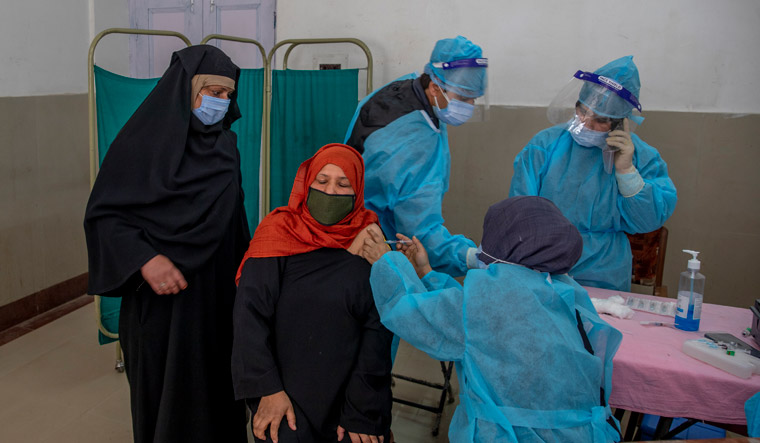
The UT had lately strengthened Asha, ANM and Aanganwadi workers (all locals in respective villages). Their door to door knocking and convincing people for vaccination drives helped. Once they succeeded a bit “Vaccine on Wheels” (mobile vaccination) vans were brought in at their door steps at the earliest.

The multi-pronged strategy paid off well. Shopian became first district in the country with 100 percent first dose vaccination of 45 plus age group. Besides Shopian, Jammu, Ganderbal and Samba had achieved 100 45 plus first vaccination target. Other districts were closely following. Also districts like Kathua, Kulgam, Ramban, Resai, Udhampur and Sambha had 100 percent front line worker vaccination.

At another level, the state had developed its own app JKWIN to manage their internal rationalisation of high risk groups, comorbidities and vulnerable population.

These groups include shopkeepers, vendors (critically needed for opening the economy), journalists, lawyers, all kinds of people associated with tourism. “Vaccinated” sign was prominently displayed outside of shops where shopkeepers and vendors were vaccinated. This worked to inspire confidence among people visiting there, and also to motivate them to vaccinate.

What changed the game in J&K was this — instead of people going to health centres and waiting in queue, mobile vaccine vans were reaching to their doorstep.

A sense of confidence for UT administration sincerity in tackling pandemic also came through administration establishing five bed isolation centres with provision of oxygen cylinders in each of 4290 (over 85 percent Panchayats covered). Doorstep delivery of medicine for anyone testing positive or having such early systems helped contain the situation.

Without any hype, the region, which had over recent decades had made news for wrong reasons was making a difference, a positive one, that too in once in a century crisis.

As against the national average is 37 percent for first dose of vaccination for 45 plus age group, J&K average is 68 percent. Even among 18-44 age group J&K percentage is higher than the national average.

Compare and contrast this with a developed state like Maharashtra, which had reported maximum cases in Delta version of Covid spread. Till May 26 Maharashtra could provide first dose of vaccination to 40 percent of 45 plus age group. Kerala, which got a great deal of media hype for providing a model to contain spread of pandemic during the first phase last year could give first shot only to 49 percent of people in this age group. Telangana percentage is 30, Karnataka 46 percent, Delhi 48 percent, Andhra Pradesh 40 percent, percent Punjab 32 percent, West Bengal 29 percent, Madhya Pradesh 35 percent, Odisha 41 percent, and the list goes on with Jharkhand 23 percent, Tamil Nadu 18 at the bottom of it.

It’s time to talk of J&K vaccination model, just like we talked of Mumbai model for oxygen. More so, because for decades situation in J&K had been completely different and post formation of UT critics, political, social and academic had painted a completely gloomy picture. Also, to be noted that J&K unlike other states and UTs never reported shortage of oxygen in current wave of Covid mutated Delta virus spread. Other states and UTs may take a cue.

Ludo Supreme app controversy: Here’s why the Bombay High Court will decide whether the game requires skill or just luck

Social media was abuzz today after it was reported that the Bombay High Court will decide whether Ludo is a game of skill or sheer luck. There was plenty of mockery going around but as it turns out, Ludo is a serious matter and no joke.

Jokes apart, the petition was filed by MNS office-bearer Keshav Ramesh Muley and he demands that Ludo be declared a “game of chance and not a game of skill”. If Muley has his way at the Court, then provisions of the Maharashtra Prevention of Gambling Act, 1887 would apply.

If Ludo is declared a game of luck, then should stakes be involved, then it could be categorised as gambling. Muley had initially approached the local police in November of 2020 seeking action against the makers of an online Ludo game, Cashgrail Private Ltd, under the Gambling Act and un der relevant sections of the IPC.

However, the local police rejected his plea which motivated him to approach the Metropolitan Court. The local Court, too, rejected his complaint ruling that Ludo is a “game of skill and not a game of chance”.

Keshav Muley says that he was told by children that they could win money in the game which was confirmed later by online searches. “In the content of the said videos the uploader encouraged people at large to play the game of ludo the Ludo Supreme App and further claimed that it is and easy way of earning money with an assurance that one would only win money and not lose any,” the petition says.

“Given the impact the Ludo Supreme App has on the youth of the country given the evils of gambling and social menace caused by it, the applicant urged the respondent (police) for taking action,” it says.

“One cannot completely discount the possibility of a 3-year old winning while playing the game of Ludo against any other person and thus it is not a game of mere skill but a game of chance and therefore provision of Gambling Act are applicable to the above-mentioned activity. Therefore there is no element of skill and there is a predominance of chance,” the petition says further.

The plea also contends that “The entire game is completely an uncertain future event and the occurrence or non-occurrence of a particular result is absolutely based on luck, or in other words based on ‘chance’.” It also pointed out that the prize is real time currency and not some fictional notion of winning.

According to Keshav Muley, the earlier order by the local court was “erroneous as Ludo is a game of chance and not a game of skill and the provisions of Maharashtra Prevention of Gambling Act shall apply if the game is played for stakes.”

He also brought attention to the fact that the player has no control over what the dice throws up online and it is predicated entirely on the app and algorithm, which merits an investigation according to him.

As is clear, Muley does raise some valid points. Therefore, in order to settle the matter once and for all, the Bombay High Court has issued a notice to the Maharashtra state government seeking its stand over the matter.

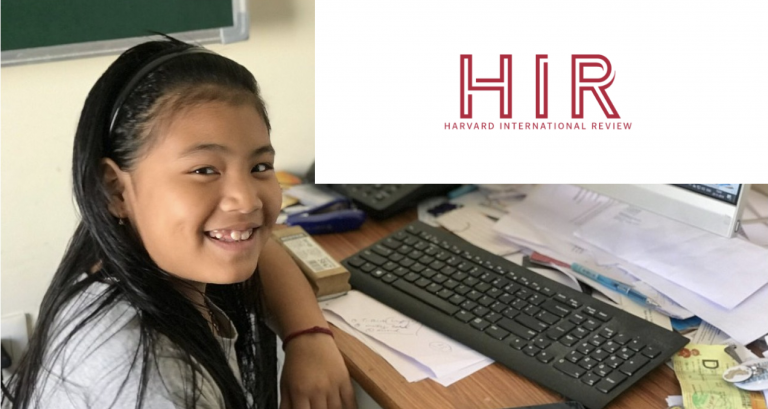
Days after lies of Licypriya Kangujam published in Harvard International Review came to light, the journal distances itself from her comments

A day after OpIndia, in an exclusive report, had exposed how the hallowed organisations like Harvard University and international media outlet DW News had fallen for the propaganda peddled by child-activist Licypriya and her father KK Singh and had published their lies without any due diligence, Harvard International Review has backtracked from its interview on Sunday saying it has not endorsed any contents associated with the child-activist.

Earlier on Saturday, we had reported in detail regarding how child-activist Licypriya Kangujam and her father KK Singh, who was arrested for duping nearly 100 children from 12 countries under the garb of activism, had used deceitful methods to hog limelight and favourable publicity. The father and the daughter were caught exaggerating their manipulated accomplishments and using run-of-the-mill acknowledgements from reputed organisations to spin a web of lies around their achievement. The matter had come to light after KK Singh was arrested by police for cheating multiple people.

After it was pointed out how Harvard International Review had erred in providing a platform for the child-activist to propagate lies, the Harvard International Review has issued a statement saying that they have a policy of not endorsing the contents of any interview and interviews inherently reflect subjective views of the interviewee.

“In light of Kangujam’s father’s arrest in India, the Harvard International Review reiterates its policy of not endorsing the contents of any interview. Interviews inherently reflect subjective views of the interviewee,” Harvard University added this statement at the end of its interview with Licypriya Kangujam. With this statement, Harvard sought to distance itself from the claims by Licypriya, saying it does not endorse the comments made by her as per its policy.

The statement from the journal came after Twitter user @her1n, who was instrumental in revealing how Harvard International Review had published Licypriya’s claims without verification, wrote to the journal asking them to make corrections in the interview. However, instead of making any corrections, they only added the disclaimer.

Two organisations – Harvard University and the international media outlet DW News had fallen for their propaganda and had published them without bothering to carry out basic due diligence. Harvard International Review had published an interview with her in December last year, where she had made tall claims about her works as a climate activist. She had falsely claimed that she was responsible for the new Air Pollution law in India, and used routine acknowledges issued by governments and institutions against her letters as her achievements. She had also claimed that she had planted 3,50,000 tress in her life, while just 9 months ago she had claimed she had planted 50,000 trees.

She had made similar false claims in an interview with DW News.

Licypriya’s father, Dr KK Singh arrested by the police for duping over 100 children

Projecting his 9-year-old daughter as the face of a national and international ‘climate activism’ campaign, Licypriya’s father Kanarjit Kangujam has reportedly duped nearly 100 children from 12 countries under the garb of activism as per a Vice report. The fraud amount is estimated to be approximately $44,685, just from fees collected from students.

As of now, Kangujam Kanarjit has been arrested in a joint operation by Delhi Police and Manipur Police on 31 May and was being produced before the Court.

Kanarjit has been accused of cheating multiple people, with amounts as high as Rs 19 lakh. In 2015, he was arrested in Manipur with charges of criminal case number 176 of 2015 under Section 420 (Fraud), 324 (Assault) and 406 (Criminal breach of trust).

Kanarjit had also invented the fake achievements of daughter Licypriya Kangujam in order to propel her to international fame. In Multiple press investigations and reports, it was found that Licypriya’s so-called UN invite and other attendances were all fake, cunningly drafted and used by her father for media hype.

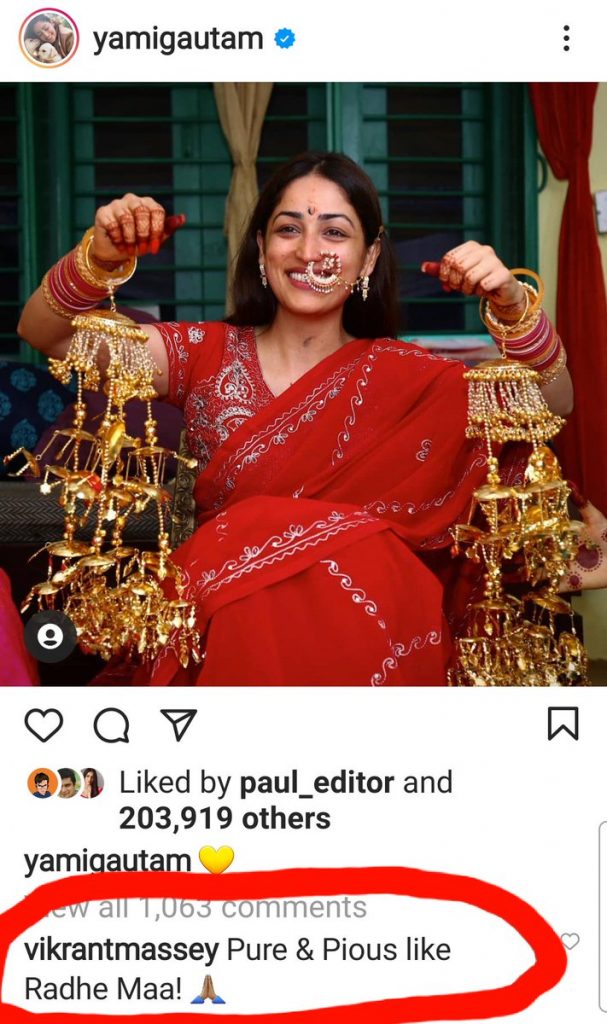
‘Lao meri chappal’: Vikrant Massey slammed after he compared Yami Gautam to Radhe Maa over wedding pic

Actor Vikrant Massey mocked Yami Gautam on Instagram after the actress shared a photograph from her wedding ceremony. Replying to a photograph where Yami Gautam was holding jewellery, Vikrant Massey commented that she was looking “pure & pious like Radhe Maa”.

Source: @ThtKashmiriGuy/Twitter

Radhe Maa is a self-proclaimed ‘Godwoman’ who is universally ridiculed for her preposterous cosmetic choices. She is often spotted wearing bright red lipstick and bright red clothing. Since Yami Gautam was wearing red for her marriage ceremony as well, Vikrant Massey compared her to Radhe Maa.

There is significant outrage over the comment. Kangana Ranaut called Massey a cockroach and commented ‘lao meri chappal’ (bring my slippers).

Others have also slammed the actor over the comment.

It is not clear whether the two are good friends and the comment was made in jest or it was an insensitive remark on the actress’ wedding photograph. Either way, people on social media have interpreted it as the latter and have spoken out against the actor for the same.

Christian Engineer from Kerala converts to Islam to join IS, dies in a suicide bomb attack mission in Libya

A Chrisitan Engineer from Kerala, who had recently converted to Islam to join Islamic State’s (IS), has been killed in a suicide bombing terror attack in Libya, reports New Indian Express.

According to the reports, the intelligence officials have gathered information that the name of the Keralite had appeared in an IS document titled ‘Know your martyrs’, in which he was referred to as “Abu Bakr Al-Hind”. In the document, IS has claimed that the Kerala-based engineer is the first ‘Istishhadi’ or suicide bomber or ‘martyr’, from India to be killed on the African continent.

The Kerala based IS terrorist is believed to be a Christian who embraced Islam while working in the Gulf.

Unlike in the case of other Kerala-based IS terrorists who were killed in Syria and Afghanistan, the IS document did not mention Abu Bakr’s real name. The intelligence agencies also have no clue about his other whereabouts either, except that the person was born in a rich Christian family ‘where there are many engineers.’

According to the IS document, Abu Bakr was working in Bengaluru before moving to the Gulf. “That was the first time he was in a complete Muslim environment,” said the document.

Kerala-based IS terrorist got radicalised by watching videos of Anwar Al-Awlaki

The Kerala-based IS terrorist was introduced to Islam through a pamphlet handed over to him while he was shopping at a market. “He was shocked to know that Muslims believe in Jesus and respected him,” said the IS document adding that Islamic terrorist wanted to know more about Islam.

Abu Bakr watched the speeches of another Islamic terrorist Anwar Al-Awlaki, which radicalised him and led him to the IS. Abu Bakr wished to do hijra (migration) like other Kerala Muslims who had joined the IS, but he had to return to India as his company’s contract in the Gulf expired.

Later, the IS handlers asked him to go to Libya, where its activity was going strong. “As he was an engineer and his passport had a Christian name, he flew easily to Libya,” said the document. Abu Bakr was killed in a terror operation three months after reaching Libya.

The Security agencies are identifying the person and are also preparing a timeline of events. Earlier, security experts warned that the IS might shift its operations to Africa after losing its strongholds in Syria and Afghanistan. Many Muslims from Kerala, which has become the hub of Islamic terrorism, had joined the IS and travelled to Syria and Afghanistan, but a case of travelling to Libya is the first known case.

In 2014, IS had declared the formation of Wilayat (province) in Libya, and many foreign fighters had been dispatched to the country. The Islamic State had claimed that its cadre from Kerala had taken part in many ‘Istishhadi’ operations in Afghanistan, including the attack on Gurudwara in Kabul and prison in Jalalabad last year.

Ex-radicalised Muslim author studies mosques in UK, reveals Taliban, ISIS-like lifestyle of the ultra-orthodox community

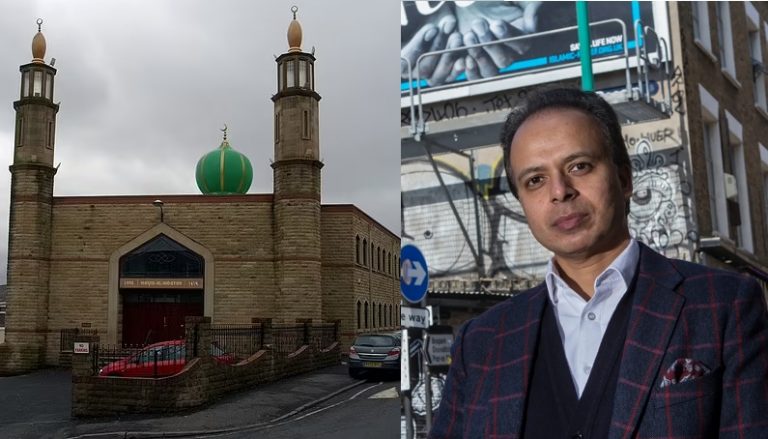
Noted professor and political advisor Ed Husain, who himself is a former radicalised Muslim, has come up with a fascinating study about how mosques in the United Kingdom are trying to control Muslim-dominated areas in the country. He has explained the community’s efforts to enforce Taliban-like lifestyle in major cities of the United Kingdom, reports Daily Mail.

In his latest book – ‘Among The Mosques: A Journey Across Muslim Britain‘, author and political advisor Ed Husain has documented in detail how Islamic societies in the UK are slowly occupying households in the country and are enforcing strict Taliban-like rules.

Ed Husain, a Professor at the Walsh School of Foreign Service in Georgetown University, has explored some of the UK’s largest mosques and the Muslim communities worshipping there to investigate the integration of Muslims in the United Kingdom. Husain, who visited several mosques to understand Islamic penetration in the country, has revealed how parts of Blackburn are ‘no-go areas’ for white men, while ultra-orthodox parents in Bradford make children live under Taliban-like rules.

Husain, who was himself radicalised in his youth and trained for Islamic Jihad, has researched extensively regarding how Islamic communities have enforced “no-go areas” for white people in their localities, with white people in towns admitting that they have been physically attacked in these “no-go areas”.

British cities with Muslim population are a ‘different universe’, says author

In his yet-to-be-launched book, the author has documented how areas like Bolton, Dewsbury and Blackburn are described as ‘a different universe’ and has observed how a Muslim can spend months with no contact whatsoever with mainstream ‘white’ Britain’ in certain parts of the British cities.

Among the areas, Ed visited was Blackburn, which has the highest Muslim population outside of London, the global hub for the Deobandis and the Tablighi Jamaat.

Nearly 50 per cent of the mosques in the UK are controlled by the Deobandis, the radical Islamists who inspired and created Islamic terror outfits such as the Taliban in Afghanistan, while the Tablighi Jamaat dreams of returning to ‘true’ Islam as observed by the Prophet Mohammed. Tablighi Jamaat was also the single source superspreaders of Covid-19 in India last year, who accounted for the first wave of the Chinese pandemic in the country.

According to Ed Husain’s observations, there has been a massive increase in the resentment between white locals and Muslim citizens. Speaking to Ed, a group of white men said that they are scared to go into ‘no-go areas’ in the town, such as Whalley Range. Apparently, Muslims in these areas had repeatedly ‘jumped’ his 12-year-old son.

In Bradford, Muslim parents have banned their children from participating in the drama, theatre and dance classes, and drawing, mimicking rules that the Taliban implement in Afghanistan and ISIS in Syria. 

“They are ‘physically’ in Britain but mentally living elsewhere,” said Husain in his book that is scheduled to be released next week.

According to the 2011 census, the population in the Whalley Range was 30 per cent British Asian and 38 per cent White, the area which is considered to be avoided by the white population. “If we go to Whalley Range at night-time, we’re guaranteed to get jumped. We won’t walk out of it. We won’t walk to the other end of the street,” narrated a white British citizen to Husain.

Muslims in UK threaten whites for flying ‘British’ flag

Shockingly, the Muslims living in Blackburn with Darwen threatens people with eviction for flying the English flag and calls the white population as ‘racist.’ 

Saima Afzal, a former councillor, has revealed to Ed that a headteacher at one Muslim school in Blackburn had withdrawn young girls from swimming lessons, saying it was inappropriate for them to wear swimming costumes. 

During his trip to several mosques, Ed Husain has also visited what he described as an ‘otherwise ordinary-looking shop’, where he found several books detailing strict restrictions for women. According to Husain, he discovered copies of Bahishti Zewar, which insists that it is a sin to “enjoy dancing and listening to music” and to “like and be attracted to the customs of the kuffar [unbelievers]”.

He also discovered the book “Mukhtasar al-Quduri: A Manual of Islamic Law,” which reads, ‘When a girl reaches puberty, it is not appropriate that any of her should be seen, excepting her face, and her hands up to the wrists.’ 

In Bradford, Ed was shocked to see the lack of white English people in the city and asked a Muslim taxi driver about their whereabouts. To which, the Muslim taxi drivers said they had all ‘gone with the wind’.

According to the author, there were mosques on almost every corner in Bradford. Several houses also serve as mosques and madrasas, banners affixed to their facades, he writes. Ed mentions that Muslim parents living in the area had forbidden their children from taking part in the drama, theatre and dance classes as well as drawing. 

As Islam prohibits figurative art and also bans dancing, so the children are not permitted to draw or dance and their parents cannot allow them to come here,’ a director of a theatre company said to Ed.

During his investigation, Ed also visited The Islam Bradford Centre and heard a sermon from an Imam who commands worshipers to avoid the ‘innovations of the modern world.’ “All new matters, he says, are deviations, and all deviations belong in hellfire,” Ed writes in his book.

“He speaks from paper notes and delivers the entire sermon in English, again differing from many other mosques I have encountered where Arabic and Urdu sections are also delivered,” the book recounts.

Meanwhile, another Imam in the city said him he was concerned about the “widespread abuse of disabled children in the Muslim community”.

“Disabled children are hidden away. Many of the Muslim parents just don’t care about these children, and take their social benefit money and use it to support their families, open shops, back in Kashmir,” Ed mentions in his book.

Bookstores in Muslim majority areas sell Jihad material that glorify terrorism

During his visit to these areas, Ed discovered bookstores filled with books glorifying violent jihad, especially by Sayyid Qutb, the Egyptian godfather of Islamist terror and an acknowledged influence on Osama bin Laden and al-Qaeda.   

Ed speaks to Louise Denham, the director of a local theatre company dedicated to helping disabled children, who say she was pessimistic and warned that Bradford could become ‘an apartheid city’ within 30 years. She predicted, “There’ll be more pushback against diversity. We’ll have parties like Nazi Germany organising against the immigrant and Muslim populations.”

In his book, Ed Husain also points out how stated that upon arriving in Dewsbury, he felt like he was in a different country and century.

As he visited the Markazi Mosque mosque, one of the largest mosques in Europe controlled by the Deobandis, he observed that there were no spaces allocated for women to pray. A cleric said to Ed, “There can be no discussion of there being women in the mosque. This would be a temptation for many.”

The Markaz mosque is also the central office for the Tablighi Jamaat, which was founded in India in 1927 to stop the dilution of the identity of a Muslim in the cosmopolitan cities of British India. 

In his visit to Dewsbury, Ed also found local bookshops that sold pamphlets and books promoting the separation and suppression of women. One such book also outlined how women should not leave the house without their husband’s permission.

“When a woman leaves her home without her husband’s consent, then all the angels of the skies and the entire universe curse her for this act until she returns home,” the book read.

Another stated, “Being in seclusion with a strange woman, and the reckless intermingling between men and women, is most certainly haram, forbidden in the religion of God.” The third one read, “The woman was the strongest factor in destroying noble characteristics.”

Apparently, women can’t go out easily. To come out of their houses, Muslim women have to cover their faces with black veils. 

In his book, Ed called it “the culture of caliphism”, explaining, “The Tablighi Jamaat separates itself from secular society, and preaches from door to door, to create a Muslim society from which a caliphate is expected eventually to emerge.”

Sharia Court within a mosque in a Didsbury

During a trip to Didsbury, Ed also visited the town’s mosque, which was a church before it was purchased in 1967 by Syrian Arabs.

Ed noticed banners and Palestinian flags outside the mosque and, on the inside, he found posters urging support for terrorist organisations. He also discovered a sign for the ‘Sharia Department’ in the mosque to hear disputes regarding divorces, marriages, and other dispute that can be resolved under sharia.

Ed also came across the books written by Khurshid Ahmad, an ideologue of the Jamaat-e-Islami and other Islamist groups in Pakistan who has advocated for the creation of an Islamic state. In these books, Ahmad has referred to members of al-Qaeda as ‘brethren’ and refused to acknowledge their role in the 9/11 attacks. 

He also became aware of the shocking fact that Islamic terrorist Salman Abedi, who detonated a suicide bomb killing 22 at an Ariana Grande concert in the city, was a member of this mosque. Abedi and his family regularly attended the mosque and his father sometimes led the call to prayer. 

Muslims in Britain want a ‘Sharia’ state

Upon his visit to Edinburgh’s Central Mosque, Ed found it was guarded by security wearing high-vis jackets. Husain spotted a poster for a “Politics and Media Masterclass”, which created awareness among the Muslim community about who regulates the media, how to challenge it and how legislation is made.

The study was sponsored by MEND (Muslim Engagement and Development), a controversial group that aims to encourage British Muslim communities to be more involved in British media and politics. In his book, the author stated that he later travelled to Glasgow to visit several mosques, including the Central Mosque in the city. During his visit, Ed was told not to take photographs inside the mosque by a cleric.

Later, he visited Dawate-Islami madrasa, a mosque in another part of the city, where young girls were required to wear all black burkas as uniform to cover their “private parts”.  

In Birmingham, Ed met with two Muslims who had recently moved to the country from Saudi Arabia. They insisted that they cannot change their religion to suit Britain, with one, Ahmed, saying, “I have no government. We are waiting for our government of the sharia to return again, headed by a caliph.”

Rajasthan: District Collector of Chittorgarh organizes special vaccination drive for Muslim community

District Collector of Chittorgarh in Rajasthan has held a special coronavirus vaccination drive for people of Muslim community. As per reports, this is done to tackle the vaccine hesitancy in the community.

The Congress-led Rajasthan government has been facing backlash over high vaccine hesitancy and vaccine wastage in the state. To add to it, the vaccine hesitancy in the Muslim community as per an ETV Bharat report is at an all-time high because of various misconceptions. 

The District Collector Tarachand Meena of Chittorgarh along with former MLA Surendra Singh Jadawat had to call for a meeting with community representatives to bust the myths around vaccination and promote the inoculation drive. 

Meena, in the meeting, highlighted the importance of the Covid-19 vaccine and encouraged the Muslim community to come forward for vaccination. It was also decided that special camps will be organized to strengthen the vaccination drive in the Muslim community and counter various misconceptions. 

The representatives of the community extended their support and emphasized the need to bust misinformation to curb vaccine hesitancy. Post the meeting, the community representatives appealed to their community to come forward and get themselves vaccinated in the special camps. 

The first camp will be organized in Chippa Basti followed by another at Kuttchi Basti. The District Collector also educated the representatives about the Covid-19 protocols, the need to wear masks and maintain social distancing at the vaccination camps. 

He also urged the representatives to get inoculated first to send out a positive message and help build the confidence of the community.

Additionally, former MLA Jadawat announced that every family that gets vaccinated will be eligible for a health insurance of Rs. 5,00,000 under the Chief Minister Chiranjeevi Health Insurance Scheme. 

No takers due to vaccine hesitancy

As per a Times of India report, health workers in several tribal villages reported that there were no takers for vaccinations due to misinformation against the Covid-19 vaccines. Several villages in Pratapgarh, Chittorgarh and Dungarpur recorded zero or few takers of vaccines posing a challenge for the district authorities.

Villages in Chittorgarh’s Chikarda, Sangesra, Chapakheri had kept the health team waiting for six hours from 9 am to 3 pm with no beneficiary going for the vaccination.

Vaccines buried and burnt in Rajasthan

We had reported earlier on how the Covid-19 vaccines were not only thrown in the garbage in Rajasthan but were also buried haphazardly in several hospitals. Hindi daily Bhaskar had reported last week that there has been rampant vaccine wastage in Rajasthan. They had collected over 500 vials with around 2500 doses still left in them. However, the state government has been denying wastage.

After Bhaskar’s report, the health minister of the state had threatened legal action against the Hindi Daily, after which the media house responded. They published a photograph of 500 vials with the batch number and expiry dates. Bhaskar said that its reporters had picked up the vials from dustbins of various vaccination centres in Rajasthan.

Hours after Dainik Bhaskar published its report posting a picture of the wasted vials to fact-check Rajasthan Health Minister’s claims of ‘misleading’ report, the minister responded. He alleged that the picture Dainik Bhaskar has posted to substantiate its claims is that of “expired and discarded” vaccines. He further claimed they had been kept in a yellow disposable bag according to the rules laid down by the Biomedical Waste Management rules of the Government of India.

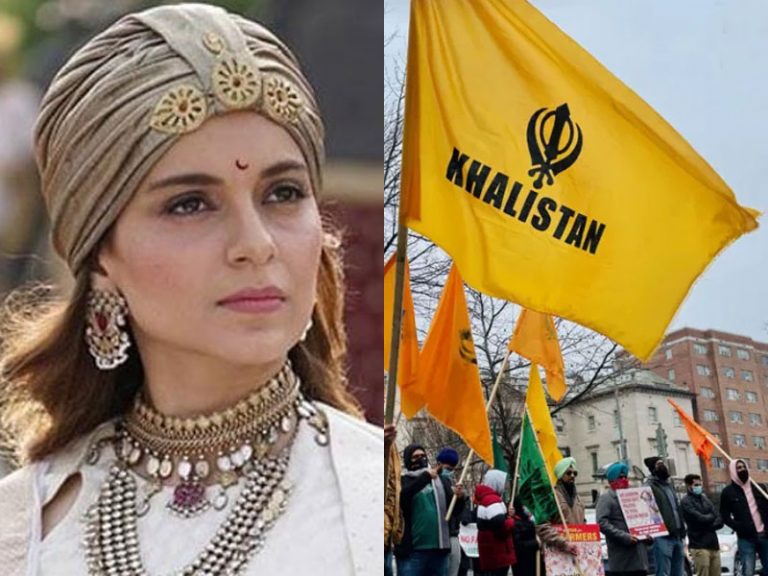
Kangana Ranaut slams Khalistanis on the death anniversary of Bhindranwale, questions their relationship with Congress

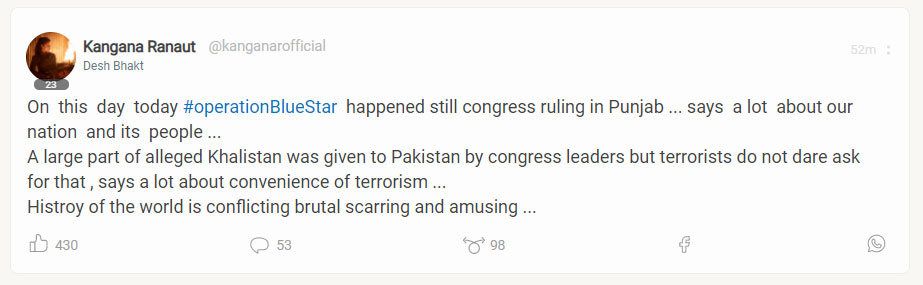
Hindi film actor Kangana Ranaut slammed Khalistani forces on the 37th anniversary of Operation Blue Star. Taking to social networking app Koo, she said, “On this day today #operationBlueStar happened still congress ruling in Punjab… says a lot about our nation and its people… A large part of alleged Khalistan was given to Pakistan by congress leaders, but terrorists do not dare ask for that, says a lot about the convenience of terrorism… History of the world is conflicting brutal scarring and amusing…”

Kangana Ranaut’s post on Koo raising questions on the intentions of Khalistanis

Ranaut raised two valid questions for the Khalistani sympathizers that shows how naïve their intentions are. The first question raised by Ranaut was how Congress manages to rule Punjab as Operation Blue Star happened during Congress tenure at the centre.

The second question she raised about the misplaced intentions of the Khalistani forces. Notably, a large part of the alleged Khalistan (the land of Sikhs or Punjab) was given to Pakistan at the time of the partition. Congress leaders who ruled the country in the initial years had agreed to the terms of partition. However, the Khalistani terrorists and their sympathizers have never asked the neighbouring country for their “deserving share” of the Punjab Province in Pakistan.

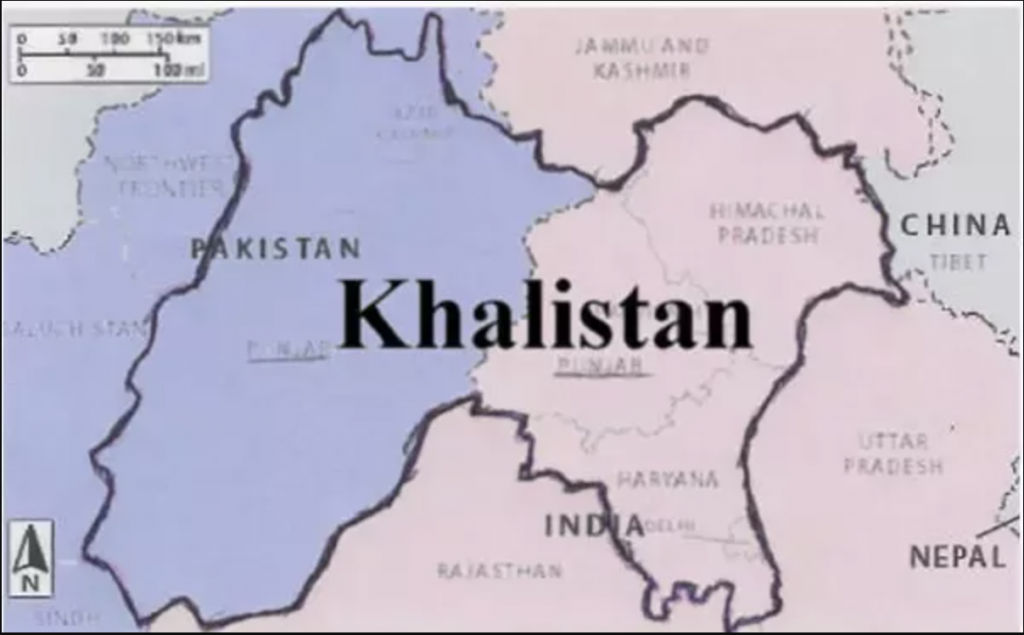
‘Map’ of so-called Khalistan region

As can be seen, the ‘Khalistan’ region falls between India and Pakistan. However, pro-Khalistan slogans are only raised in India and against India. Many such protests have taken place outside Indian embassies in foreign countries, but never outside Pakistani embassy.

While Khalistani elements have protested outside the Indian embassy countless times in foreign nations, they never dared to do the same outside Pakistan’s embassy anywhere. In fact, in several cases, Khalistanis have been seen marching shoulder-to-shoulder with Pakistanis to raise inflammatory slogans against India and its government.

The alleged role of Khalistani forces in farmer protests

Reportedly Khalistani forces have infiltrated the farmer protests against the Agriculture laws that were enacted in September 2020. There are several pieces of evidence that point to the fact that Khalistani organizations like Sikhs For Justice have provided funds in the name of “rewards” to instigate riots during tractor rally. Pannu, head of SFJ, had announced a reward for anyone who hoisted the Khalistani flag on Red Fort and on January 26, a group of alleged farmers had hoist two flags with Sikh Holy Symbol on the Red Fort.

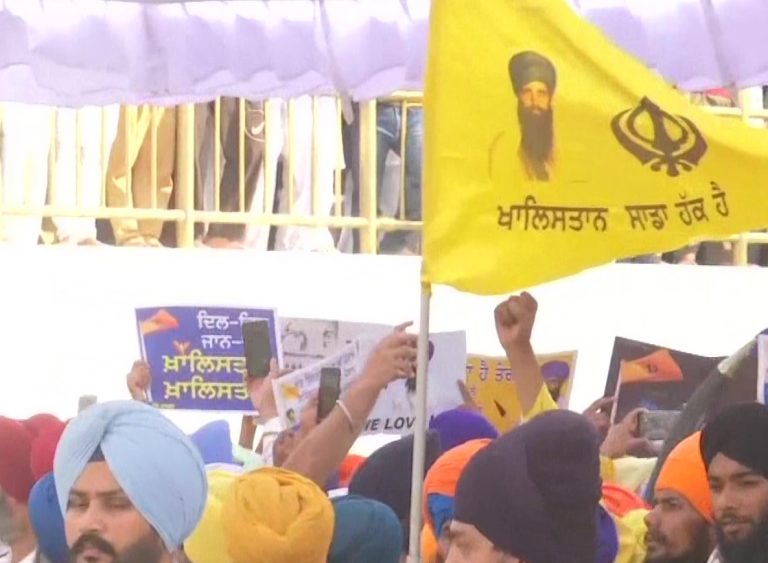
Hundreds march chanting pro-Khalistan slogans as Bhindranwale posters spotted inside the Golden Temple on his death anniversary today

On 37th anniversary of Operation Blue Star, the Indian military action carried out to remove Khalistani separatist leader Jarnail Singh Bhindranwale, who was hiding inside the Golden Temple complex in Amritsar, his pictures have been spotted inside the temple complex.

As reported by news agency ANI, posters of Bhindranwale as well as Khalistan flags were seen during an event inside Sri Harmandir Sahib in Amritsar.

As per reports, actor Deep Sidhu, one of the prime accused in Republic Day riots, was also spotted inside the complex. He is currently out on bail.

Pro-Khalistan group Dal Khalsa also carried out a march to the shrine to mark 6th June as ‘Khalistan Day’.

Operation Blue Star

Operation Blue Star was carried out between June 1 and June 8, 1984, in Amritsar’s Golden Temple. It was the biggest internal security mission ever undertaken by the Indian Army. It was ordered by Indira Gandhi, the then Prime Minister of India as a solution to law and order situation in Punjab.

During Operation Blue Star, Khalistan supporters took over the Akal Takht complex in Amritsar’s Golden Temple. The casualties as per the official reports were 83 Indian Army jawans and 492 civilians throughout the whole Operation. Few months later, on 31st October, 1984, Indira Gandhi was assassinated by her Sikh bodyguards to avenge for the Operation Blue Star. This led to large-scale anti-Sikh riots in India where Congress leaders were accused of leading mobs against Sikhs.

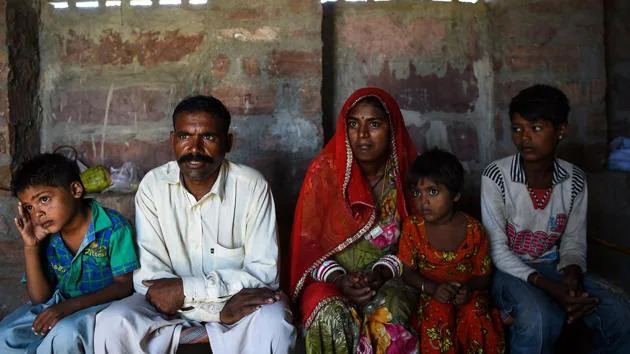
‘Why are Pakistani Hindus not vaccinated yet?’ Rajasthan HC questions state govt

The Rajasthan High Court on Thursday questioned the state government for singling out Pakistani Hindu migrants for the Covid-19 vaccination despite the Centre’s vaccination norms making them eligible for it. The court, too, has given an order on May 28 in which it had directed state government to specify steps for vaccination of those Pakistani minority migrants who do not have prescribed identity cards yet.

A Jodhpur bench of the high court sought clarification and took strong objection to the state government’s failure to apprise it of their efforts for vaccinating people not having the prescribed identity cards, which includes the Hindu migrants from Pakistan.

Centre’s vaccination SOP from May 06 made provisions for Pakistani minority migrants

A bench of justices Vijay Bishnoi and Rameshwar Vyas expressed displeasure and ordered the chief secretary to file an affidavit to the court, detailing the steps taken by the state for inoculating people without valid identification documents in line with the Centre’s guidelines. 

The bench had made the Centre’s SOP for identifying people for vaccination in absence of any valid identification documents clear to the state government on May 28 itself.

“It is noticed that once this Court in its order dated 28.05.2021 has already opined that SOP dated 06.05.2021 is not excluding the Pakistani Minority Migrants, who are eligible for COVID-19 vaccination,” the bench said in the order.

However, the state government sought further clarification from the Centre. Irked by the delay, the bench remarked, “It is difficult to understand why the state government is seeking further clarification from the central government and requesting it to include the Pakistani Minority Migrants in the SOP.”

The strong remarks were made after the National Health Mission under the Medical, Health and Family Welfare Department of Rajasthan had written a letter to the Union Health and Family Welfare Ministry urging the Centre to include minority migrants too in their SOP.

Sajjan Singh, the amicus curiae appointed on behalf of the Pakistani minority migrants, reported that even the Pakistani minority migrants who have already been declared as citizens of this country but do not possess an Aadhaar card have been kept out of the vaccination drive.

No ration kits for the migrants

After it was brought to light that except Jodhpur, migrants in Jaipur, Jaisalmer and Barmer have not been provided with food packets and ration supplies, the court has ordered the state’s law officer to submit a status report on the availability of food to these migrants in Rajasthan on next hearing scheduled for June 10.