Home Blog Page 506

Hamas out, Hamas terrorists: Thousands in Gaza join widespread protests against the terror group, call for an end to war and demand exit of Al Jazeera

Protests in the Gaza Strip have drawn thousands of Palestinians who are demanding an end to the war with Israel and chanting anti-Hamas slogans. It has been characterized as the biggest demonstration against the terrorist organization within the region since the 7th October 2023 attacks on Israel.

A week after the Jewish state resumed heavy bombing on Gaza for not returning the hostages, following nearly two months of a truce, thousands of people, largely men, were seen chanting “Hamas out,” “Hamas terrorists,” “The people want to overthrow Hamas” and “Yes to peace, no to the ongoing war,” among other slogans in Beit Lahia, according to videos and images posted on social media on 25th March.

Locals were seen on camera protesting for an end to the dispute and Hamas rule. Some of them were holding placards that read, “Stop war” and “Children in Palestine want to live.” Others held banners bearing the words “We want to live in peace” and “Stop the war.” The demonstrations occurred in front of the Indonesian hospital in the northern Gaza Strip. The people also declared their desire for peace and a normal existence during the event.

The Gazans are making three major points: that the Hamas is a terrorist group, Gazans want peace, and they want to live a normal life. It is clear that the ordinary Palestinians are fed up with non-stop war and violence and want an immediate end to it. The protesters say that if Hamas relinquishing power can ensure peace and end of war, then the terror group should do it. Notably, Israel has made it clear that as long as Hamas remains in power in Gaza, it will not stop military offensive against the group.

At least one call to participate in the demonstration was making the rounds on Telegram. “Our voices must reach all the spies who sold our blood,” the protest organizers stated in a social media post that called for nine anti-Hamas protests throughout Gaza on 26th March. “Let them hear your voice, let them know that Gaza is not silent, and that there is a people who will not accept to be eradicated,” it added.

The development took place the day after Islamic Jihad terrorists fired rockets at Israel, leading to the evacuation of a sizable portion of Beit Lahia and inciting local outrage.

Meanwhile, in a strong appeal for a popular revolt (intifada) against Hamas, the Assembly of Southern Gaza Clans charged that the organization was exploiting Palestinian lives as a prop to further its own limited and self-serving agenda. “Enough is enough, a popular uprising against injustice. No more playing with our lives, our children’s future, or disregarding our suffering. Gaza is not anyone’s hostage. Gaza will be liberated by the will of its people,” it declared.

“I don’t know who organised the protest. I took part to send a message on behalf of the people: Enough with the war,” a man conveyed while disclosing that he spotted “members of the Hamas security forces in civilian clothing breaking up the protest.” Another voiced that “people are tired” and asked, “If Hamas leaving power in Gaza is the solution, why doesn’t Hamas give up power to protect the people?”

“We refuse to die for anyone, for any party’s agenda or the interests of foreign states. Hamas must step down and listen to the voice of the grieving, the voice that rises from beneath the rubble, it is the most truthful voice,” a Beit Lahia resident named Mohammed Diab stated. Protesters also chanted, “down with Hamas rule, down with the Muslim Brotherhood rule.”

Dozens of protesters burned tires and chanted, “We want to eat,” during a second anti-war and anti-Hamas rally in northern Gaza’s Jabalia refugee camp just hours after the previous one. Other agitations arose around Gaza as word of the demonstrations spread, including one in Khan Younis, a major city in the south, when demonstrators were captured on camera shouting “down with Hamas” and demanding an end to the conflict.

“Their rule has destroyed us, killed us as well as ruined our lives, and all of us here in Beit Lahia stand firmly to end Hamas’s rule,” a frustrated protestor reportedly expressed on camera. In Gaza, protests are rather infrequent, particularly when directed against Hamas, which has firmly established itself in the strip since driving out the Palestinian Authority almost twenty years ago. Large-scale protests against Hamas authority have been virtually nonexistent in Gaza, despite an increase in public declarations by individuals opposing the group’s rule since the war began.

No just Hamas, but the demonstrators also chanted slogans against pro-Hamas media group Al Jazeera and demanded its exit from Gaza along with Hamas. Notably, Israel has banned the Qatar-funded media group for its open support of the Hamas terrorist group.

“Excuse me, but what exactly is Hamas betting on? They’re betting on our blood, blood that the whole world sees as just numbers. Even Hamas counts us as numbers. Step down and let us tend to our wounds,” remarked Mohammed Al-Najjar from Gaza on Facebook. Pro-Hamas Al-Jazeera, an infamous Islamist media outlet supported by Qatar also had to face the wrath of the populace who shouted, “Al Jazeera get out.”

According to some Gazans, the demonstrations can expand to other areas of the war-torn region, where the people are worn out and traumatized from a year and a half of fighting. Interestingly, although Hamas did not formally respond to the rallies, certain Gazan media outlets, including those connected to the terror group, released images and footage of the events under the heading of “demonstration for stopping the war” without bringing up the demands for the terror group’s dismantling.

In January 2024, Palestinians in Deir al-Balah and Khan Younis staged the last known demonstration against Hamas in the strip, seeking a resolution to the conflict, the cessation of the terror group’s control over Gaza and the release of Israeli hostages. Anti-Hamas demonstrations were also comparatively uncommon prior to the war and the terror organization frequently put an end to them brutally.

After winning Palestinian elections and forcefully overthrowing competitors, Hamas has been the only political force in Gaza since 2007. Since the start of the war, there has been an increase in open criticism of Hamas in Gaza, both online and on the streets. Long before the war, there was opposition to Hamas, but most of it was kept under wraps out of concern for retaliation.

Beyond Greenland: It is the Arctic Ocean that the USA wants to control, because Russia dominates there now

On 25th March 2025, US Vice President JD Vance made a surprise announcement that he and his wife, Usha Vance, would visit Greenland on 28th March. The US Second Lady was to attend Greenland’s iconic Vannaata Qimussersu dogsled race. However, the White House announced a change in plan, and now JD Vance and Usha Vance will visit the Pituffik Space Base in the semi-autonomous territory of Denmark on Friday. Vance will receive a briefing on Arctic security issues and engage with US service members.

The Pituffik Space Base, which is operated by the US Space Force’s 821st Space Base Group, is the northernmost installation of the US Department of Defence. The base plays a critical role in missile warning, missile defence, and space surveillance missions.

Taking to X, JD Vance informed about his Greenland visit plans and said in a video message, “I decided that I didn’t want her to have all that fun by herself, so I’m going to join her… I’m going to visit some of our guardians in the Space Force on the northwest coast of Greenland, and also just check out what’s going on with the security there of Greenland.”

A statement issued by JD Vance’s office highlights the significance of the Greenland visit and tracks the historical context of the Second World War. It recalled that the US had established dozens of military bases there to defend the North Atlantic from Nazis, with additional resources added to counter the then Soviet Union during the Cold War.

“The strategic partnership between the United States and Greenland has long played a vital role in our national and economic security. During World War Two, the United States established over a dozen military bases in Greenland to defend the North Atlantic from Nazi incursion. During the Cold War, additional resources were committed to counter Soviet missile threats,” the statement reads.

Vance further criticized the supposed historical neglect of Greenland by both the United States and by the leaders of Denmark. “In the decades since, inaction from Danish leaders and previous US administrations has allowed adversaries to advance their priorities in Greenland and the Arctic,” while affirming, “President Trump is rightly changing course.”

The US Vice President and the Second Lady are set to visit Greenland, especially at a time of shifting global alliances and President Trump’s open declaration of interest in taking over Greenland, the Panama Canal and even inducting Canada as the US’s 51st state. While Russia and the United States appear to be reaching a common ground in the context of the former’s ongoing conflict with Ukraine, it is pertinent to understand why Greenland matters and how any change in its independence might affect US-Russia’s seemingly improving ties.

Is Trump’s Greenland dream inching closer to becoming reality?

JD Vance’s upcoming visit to Greenland has sparked speculations that the United States is serious in its pursuit of controlling the strategically important island, especially given President Donald Trump’s ambition of bringing Greenland under US control. Even during his first tenure as US President, Trump had shown interest in controlling Greenland, given its strategic and economic potential. In December 2024, Trump expressed his desire to gain control of Greenland. In a post on Truth Social, Trump asserted that it was an “absolute necessity.”

In his post on Truth Social, Trump announced that Ken Howery would serve as the ambassador to the Kingdom of Denmark. Howery, who is a co-founder of PayPal and a venture capital fund among other companies, served as ambassador to Sweden during Trump’s first term as President. In the post, Trump further added, “For purposes of National Security and Freedom throughout the World, the United States of America feels that the ownership and control of Greenland is an absolute necessity.”

Earlier in March 2025, Trump reiterated his desire to control Greenland during his Congressional speech. This week as well, President Trump told the media, “I think Greenland is going to be something that maybe is in our future.”

Greenland: Nature’s treasury of vast minerals and strategic significance

Greenland, the world’s third largest island, carries immense economic, strategic as well as geopolitical significance owing to its unique location and resources. Since it is positioned between the Atlantic and Arctic Oceans, Greenland falls along the key maritime and aerial routes. These routes connect North America with Europe. Given its proximity to the Arctic Circle, it is an important player in the rapidly changing Arctic region where melting ice due to climate change has unlocked both challenges and opportunities.

As ice sheets recede, Greenland’s vast deposits of rare earth minerals, gas, oil and other resources are becoming increasingly more accessible, further adding to the island’s consequences. In addition to the natural resources, Greenland’s location enhances its military significance, especially for missile defense, space surveillance as well as monitoring naval activities in the Arctic and the North Atlantic.

The United States has sustained its presence in Greenland through the Pituffik Space Base, which was formerly called the Thule Air Base. The US has been using this installation for space monitoring, ballistic missile early warning, and defence operations. The Pituffik Space Base signifies Greenland’s role in the Greenland-Iceland-UK gap or simply the GIUK Gap.

Notably, the GIUK gap is a naval chokepoint which was historically used to monitor Soviet and now Russian submarine movements in the Atlantic. Its significance, however, is not confined to being a conventional chokepoint; rather, it is a strategic transit route.

Why US wants to control Greenland?

Until the ice began receding due to climate change, the Arctic historically served as a natural shield for Russia against naval threats; however, as nature takes a different turn undermining Russia’s natural defence, America views this as a great opportunity to take over Greenland and expand its presence over the GIUK gap.

The United States under President Trump has prioritized national security and its desire to reaffirm the country’s global influence. In this direction, Greenland’s unparalleled oversight of the North Atlantic and Arctic could be pivotal for the US to monitor and counter Russian, Chinese and even North Korean activities in the region. In addition, with Greenland under its control, the United States would be able to bolster its dominance in the Arctic shipping routes and help the US project power into the High North.

Another major draw for the United States is Greenland’s untapped natural reserves of rare earth minerals (RREs), which are essential for advanced technologies, defence systems and renewable energy. Greenland has an abundance of neodymium, dysprosium, and other REEs, which are crucial for green technology manufacturing. The Kvanefjeld (or Kuannersuit) in southern Greenland is known for its rare earth oxides and uranium deposits. The Motzfeldt Sø and Kringlerne deposits in the Gardar Province are also rich in rare earth elements.

Kvanefjeld (or Kuannersuit) in southern Greenland (Image source: Ej Atlas)

Thus, securing these diverse resources all in one place would help the US curb its dependence on China, which dominates the global supply of RREs. It must be recalled that in 2024, the United States lobbied with Tanbreez Mining, the Australian mining firm and a RREs deposits developer of Greenland, not to sell a massive RREs project to the potential Chinese buyers. Clearly, the US does not want China and other of its adversaries to set a footing in Greenland.

Countering Russia and China becomes even more paramount for the United States since the former two are expanding their Arctic presence. The US sees Russia’s military buildup and China’s economic ambitions through its Polar Silk Road Initiative as a threat to its interests.

Russian dominance in the Arctic Ocean

It is pertinent to mention that Russia has a fleet of 40 icebreakers, including nuclear icebreakers, deployed in the Arctic. By the year 2019, the Kremlin had established 14 airfields, six military bases, refurbished 16 Soviet-era deep-water ports, and 10 border posts in the Arctic, with its Northern Fleet boasting an estimated 120 ships, including 40 icebreakers.

Russian icebreaker Ivan Papanin (Image source: AsiaTimes)

Interestingly, Russia also controls the Northern Sea Route (NSR), a shipping lane along its Arctic coast. This has over the years become viable for longer periods as the ice sheets continue to recede. Russia sees NSR as a national asset and charges fees for transit and rakes in huge profits from the same. Russia’s Arctic dominance has also helped it circumvent the West’s sanctions after it entered into a full-fledged war with Ukraine. Reports say that in the last three years, the Kremlin has made $800 billion from Arctic resource extraction.

Russia has also allowed China to construct five docks along Russia’s Arctic coastline, further exacerbating the US’s worries. Interestingly, while Russia and China have strengthened their Arctic game, the US lags behind with having just two ocean-going icebreakers.

Greenland’s Strategic Position in the Arctic (Image source: National Snow and Ice Data Center; National Geospatial-Intelligence Agency)

It is also projected that NSR could surpass the Suez Canal’s economic profits by 25% as it extends its operational season by three to six months by 2100. Similarly, the Russia-controlled Northwest Passage (NWP) may also witness extension of operational season from two to four months, further adding to the vast revenue for the Kremlin.

From modernizing its Arctic military infrastructure, reopening Cold-War-era bases as well as deploying advanced missile systems, submarines and aircraft, Russia has done it all to maintain its dominance in the Arctic region. In fact, in its Northern Fleet, based on the Kola Peninsula, Russia has deployed nuclear-powered ballistic missile submarines (SSBNs) like the Delfin-class (NATO: Delta IV) and Borei-class submarine as well as facilities to store nuclear warheads.

After years of nonchalance, the United States has finally noticed the disparity in its military presence in the Arctic compared to Russia and China’s robust capabilities, as President Trump in January this year emphasized the ineluctable imperative to float new projects including the deployment of 40 huge ocean icebreakers to match up to the Russian fleet.

It is pertinent to mention that Russia’s approach to aggressively militarize the Arctic goes back to the early 2000s, as what Mikhail Gorbachev described in 1987, a “peace and cooperation” zone, progressed to become a zone of distrust, clashing ambitions and display of military might. In the 2000s, Russia started seeing a NATO presence in the Arctic as a threat to its security and sovereignty, as well as to reclaim its lost superpower glory after the USSR’s collapse.

The Trump administration views Greenland as a solid base in maintaining its edge in the warming Arctic, even if it comes at the cost of facing backlash and straining ties with Denmark, which is both Greenland’s colonial power and a NATO ally.  

The status of Greenland

Notably, Greenland has a population of about 57,000. The mineral-rich country was a Danish colony till 1953. 

While in recent years, Greenland has obtained internal autonomy from the Kingdom of Denmark through the 2009 Act on Greenland Self-Government and continues to witness a demand for complete independence, the US has its eyes set on the coveted island. Russia, too, has criticized the US’s approach of ensuring its national security at the expense of the interests of other countries, saying that it may “result in further deterioration of the situation in the Arctic.”

Greenland is part of the Overseas Countries and Territories of the European Union. It is also covered under NATO’s security guarantees. However, the people of Greenland wish to be an independent nation and don’t want to remain a colony of Denmark.

In January this year, Greenland’s outgoing Prime Minister Múte Egede expressed willingness to hold a conversation with US President Donald Trump, however, he clarified that he has no intention of ceding the Greenlandic territory to the United States of America. 

“We don’t want to be Danes. We don’t want to be Americans. We want to be Greenlandic, of course. It’s the Greenlandic people who decide their future. We have a desire for independence, a desire to be the master of our own house…this is something everyone should respect,” Egede said in January this year.

The leaders of Greenland and Denmark have time and again reiterated that Greenland will not be sold to any country, even though the US is intensifying its pursuit.

While the US Vice President’s upcoming Greenland visit has received backing from its MAGA support base which is in favour of US taking over Greenland, Panama Canal and even inducting Canada as a 51st US state, JD Vance is also receiving backlash from many Greenlanders and the Danish people.   

It is evident that the US wants to secure trade routes in the Arctic, build a robust icebreaker fleet, without which it can neither effectively operate in nor protect the emerging sea lanes. Besides, the US also wants to counter Russia’s fortified Arctic bases and submarine presence, especially given the concerns over the Kremlin turning the NSR into a full-fledged militarized corridor.  Not to forget, with growing distrust toward the Suez Canal due to terrorist attacks and other reasons, NSR has emerged as a key alternative route, which many South Asia countries, including India, want to rely more on for sending their goods to Europe.

The concerns about the Sino-Russian bloc controlling Arctic trade and resources while also dominating the region militarily have made the United States desperate to control Greenland, however, VP Vance’s upcoming visit to the island is being seen by many as a power play rather than about cultural exchanges or a normal visit to strengthen ties.

US delegation’s unsolicited Greenland visit irks Greenlander and Danish leadership

This unsolicited visit by the high-profile US delegation to Greenland has irked the Danish Prime Minister Mette Frederiksen, who called it an exertion of “unacceptable pressure” on the mineral-rich island. “I have to say that it is unacceptable pressure being placed on Greenland and Denmark in this situation. And it is pressure that we will resist,” Frederiksen said.

Both the Danish and Greenlandic leaders view the US’s unsolicited visit to Greenland as the Trump administration’s pressure tactics at a time when the government coalition talks are on and municipal elections are to be held in Greenland in the coming days. While President Trump remains adamant about bringing Greenland under US control, the polls show that a majority, 85% of Greenlanders, do not want their homeland to be a part of the United States.

Although it remains to be seen if Greenland, by negotiation or coercion, joins the US or not, if the latter manages to take over the coveted island, the US could expand Pituffik Space Base, build more icebreakers, and expand its dominance in the Arctic routes as well as bolster its global influence. It, however, would come at the cost of straining ties with Denmark and escalating tensions with China and Russia, which would further trigger responses from the Kremlin, including a further militarization of NSR and the GIUK gap alongside deepening ties with China. Besides, if the Greenlanders remain hostile towards the US, it would be a diplomatic stalemate, and the USA’s Arctic strategy would end up becoming weak and nearly ineffective.

The escalation of US-Russia tensions in the Arctic region might lead to global trade disruption and accelerate environmental damage. However, if these countries manage to arrive at a mutually beneficial agreement with keeping Greenland’s interests in account, the new arrangement could also benefit global trade.

Greenland, with its vast tapestry of minerals and other natural resources and strategically significant location, is at the center of this unfolding geopolitical drama. While the Trump administration wants to establish its influence, its outcome depends on how it balances Greenland’s autonomy, Russia’s interests, and the Arctic’s metamorphosis into an international trade and security frontier.

Families of Hamas hostages sue anti-Israel groups in the USA, claim Columbia University’s Students for Justice in Palestine had prior knowledge of the Oct 7 attack

A lawsuit filed in USA by some families of victims of 7 October Hamas terror attack claims that several US-based anti-Israel groups had prior knowledge of the attack. The lawsuit has been filed seeking damages from the pro-Hamas groups and activists operating in the USA.

Six relatives of victims kept hostage by Hamas have filed the suit against detained Columbia University protest leader Mahmoud Khalil and several student groups for allegedly “aiding and abetting Hamas’ continuing acts of international terrorism.” In the most shocking claim, the suit reveals that Columbia University’s Students for Justice in Palestine had prior knowledge of the terror attack by Hamas.

The claim is based on an Instagram post by Columbia SJP, posted just before the Hamas terror attack on Israel, which states “We are back”. The lawsuit states, “. Three minutes before Hamas began its attack on October 7, Columbia SJP posted on Instagram “We are back!!” and announced its first meeting of the semester would be announced and that viewers should “Say tuned.” Before the post, Columbia SJP’s account had been dormant for months.

While the suit states that the Instagram post was made just 3 minutes before the attack, later it has been revealed that it was 4 hours before the attack. The confusion occurred due to different time zones.

The petitioners accuse Columbia SJP of being part of American propaganda arm of Hamas, adding that it is US-based in-house public relations firm of Hamas, “which has changed forms several times to evade criminal and civil liability.”

“Columbia SJP was the leading organizer of pro-Hamas disruptions, encampments, and riots on Columbia’s campus, including virulent antisemitic protests that harassed and physically intimidated Jewish students and faculty, glorified Hamas, engaged in dangerous premeditated unlawful acts, and significantly impaired Columbia University’s ability to provide educational services to its students,” the suit states.

While the group was suspended by the university in November 2023, the lawsuit says that it continues to operate covertly.

The lawsuit also mentions a “toolkit” disseminated by National Students for Justice in Palestine on October 8, 2023, and signing of the Towfan Al-Aqsa Statement to conclude that the groups named in the suit had prior knowledge of the attack.

The suit also names other groups as respondents such as Mahmoud Khalil of Columbia University Apartheid Divest, Nerdeen Kiswani of Within Our Lifetime-United For Palestine, Maryam Alwan of the Columbia SJP and Cameron Jones of the Columbia-Barnard Jewish Voice for Peace.

US Annual Threat Assessment report declares terrorist group Lashkar-e-Tayyiba as a “concern” for the US, calls it ‘anti-India’

The Annual Threat Assessment report (ATA) released by the United States has declared Lashkar-e-Tayyiba (LeT), a designated terrorist organisation by India, as a “concern” for the US, considering the terrorist group’s historical links with terrorist Al-Qaeda, which was behind the 9/11 terrorist attacks.

“In South Asia, Tehrik-e-Taliban (TTP) operations in recent years have focused exclusively on targeting the Government of Pakistan, probably to avoid drawing more counterterrorism pressure. However, TTP’s capabilities, historical ties to al-Qa‘ida, and previous support to operations targeting the United States keep us concerned about the potential future threat. Anti-India groups, including Lashkar-e-Tayyiba, similarly concern us in part because of their historical links with al-Qa‘ida”, the report read.

The 2025 Annual Threat Assessment (ATA) report, released this month, has been prepared by the Department of National Intelligence (DNI), headed by Tulsi Gabbard. It “reflects the collective insights of the Intelligence Community (IC)” regarding global threats to the US national security and provides intelligence inputs for dealing with these threats. “The 2025 Annual Threat Assessment (ATA) is the Intelligence Community’s (IC) official, coordinated evaluation of an array of threats to U.S. citizens, the Homeland, and U.S. interests in the world. A diverse set of foreign actors is targeting U.S. health and safety, critical infrastructure, industries, wealth, and government. State adversaries and their proxies are also trying to weaken and displace U.S. economic and military power in their regions and across the globe,” forward to the report said.

Al-Qa‘ida exploited anti-Israel sentiment in Gaza to encourage attacks on Israel and the US

The report claimed that al-Qa‘ida has been targeting the US and US citizens globally and that it encouraged attacks against Israel and the US by exploiting anti-Israel sentiment over Gaza. “Al-Qa‘ida maintains its intent to target the United States and U.S. citizens across its global affiliates. Its leaders, some of whom remain in Iran, have tried to exploit anti-Israeli sentiment over the war in Gaza to unite Muslims and encourage attacks against Israel and the United States. Al-Qa‘ida’s media apparatus issued statements from leaders and the group’s affiliates supporting HAMAS and encouraging attacks against Israeli and U.S. targets,” the report stated.

Russia, China, Iran and North Korea pose a challenge to US interests

It further claimed that countries like Russia, China, Iran and North Korea have been using asymmetric and conventional hard power tactics to challenge the US interests. “Russia, China, Iran and North Korea- individually and collectively challenging U.S. interests in the world by attacking or threatening others in their regions, with both asymmetric and conventional hard power tactics, and promoting alternative systems to compete with the United States, primarily in trade, finance, and security,” claimed the report.

‘A Muslim family feels safest among 100 Hindu families. But can 50 Hindu families be safe among 100 Muslim families?’ UP CM Yogi Adityanath

Uttar Pradesh Chief Minister Yogi Adityanath assured that people from all religions are safe in the state, asserting that as a Yogi, he wishes for everyone’s happiness.

The Uttar Pradesh Chief Minister, speaking to ANI, said that if Hindus are safe, then Muslims are also safe in his state.

CM Yogi, highlighting the tolerant nature of Hindus, said that a Muslim family would feel safe among a hundred Hindu families. He, however, questioned the possibility of 50 Hindu families being safe among a hundred Muslim families.

“A Muslim family is the safest among a hundred Hindu families. They will have the freedom to practice all their religious deeds. But can 50 Hindus be safe among 100 Muslim families? No. Bangladesh is an example. Before this, Pakistan was an example. What happened in Afghanistan? If there is smoke or someone is being hit, we should be careful before we get hit. That is what needs to be taken care of,” Yogi said, while adding that he treats everyone equally.

CM Yogi reiterated that Muslims in Uttar Pradesh are the safest, emphasizing that communal riots in the state have stopped since the BJP came to power in 2017.

“In Uttar Pradesh, Muslims are the safest. If Hindus are safe, then they are also safe. If there were riots here in UP before 2017, if Hindu shops were burning, then Muslim shops were also burning. If Hindu houses were burning, then Muslim houses were also burning. And after 2017, the riots stopped,” he added.

“I am an ordinary citizen, a citizen of Uttar Pradesh. And I am a Yogi who wishes for everyone’s happiness. I believe in everyone’s support and development,” the UP CM stated.

He termed Sanatan Dharma as the most ancient religion in the world while asserting that there are no examples in the world where Hindu rulers, using their own strength, have established dominion over others.

“Sanatan Dharma is the most ancient religion and culture in the world. You can guess from its name. Sanatan Dharma followers have not converted others to their faith. But what have they received in return? What did they gain in exchange? There is no example anywhere in the world where Hindu rulers, using their own strength, have established dominion over others. Such instances do not exist. While everyone has this mind-set–‘this belongs to me, and that belongs to someone else’–which is a product of narrow and limited intellect. In contrast, for Sanatan Dharma followers, the whole world is considered a family, guided by this universal feeling,” he said.

Speaking about law and order in the state during Ram Navami and Eid, he said, “We sit with the administration from time to time, and we have already prepared an SOP for this. Uttar Pradesh is the first state that, according to the instructions of the Supreme Court, has controlled noise coming from outside its territory or has had it removed and controlled it through this communication.”

Referring to violence in West Bengal last year during Ram Navami, he asserted, “If we can do it, then why can’t it be done in Bengal?”

Speaking on the tarpaulin used to cover the mosque during Holi in Uttar Pradesh, the CM said that there are strict instructions not to throw colours at the mosque, but colours do not harm anyone.

“If you are playing with colours, it does not harm anyone’s existence. You tell me. It is not like that; there are rallies during Muharram. Doesn’t the shadow of their flag fall on any Hindu house near the temple? Does it make the Hindu house impure? These are strict instructions not to put anything that is not coloured. But even then, if it has fallen, then the administration is cleaning it and repainting it,” Yogi Adityanath said.

(This news report is published from a syndicated feed. Except for the headline, the content has not been written or edited by OpIndia staff)

Delhi HC issues notice on plea challenging former CM Atishi’s election from Kalkaji alleging bribery

0

The Delhi High Court on Wednesday issued a notice regarding a petition challenging the election of AAP leader Atishi from the Kalkaji constituency in the recent Assembly elections, alleging her involvement in corrupt practices.

Atishi defeated the BJP’s Ramesh Bidhuri by a margin of 3,521 votes.

According to the petition, Atishi is accused of engaging in the corrupt practice of “bribery” as defined under Section 123(1)(A) of the Representation of People Act, 1951.

The bench of Justice Jyoti Singh, after noting the submission, sought responses from Atishi, the Returning Officer, the Election Commission of India (ECI), and the Delhi Police in the matter.

The court directed the Election Commission of India (ECI), the Returning Officer, and the Delhi Police to preserve all records related to the Kalkaji constituency elections, whose results were declared on February 9.

During the hearing, the counsels for the Returning Officer and the ECI argued that established legal precedent states neither the ECI nor the Returning Officer can be made a party in an election petition.

The court, while seeking their responses, stated that it would allow the ECI and the Returning Officer to raise this objection in their replies.

The petition, filed by two voters naming Kamaljit Singh Duggal and Ayush Rana from the constituency, alleges that Atishi engaged in “corrupt practices.

The petitioners claim that, on the eve of polling, individuals closely associated with Atishi were apprehended with Rs 5 lakhs in cash, allegedly following her instructions to bribe voters and secure their support.

Additionally, the plea asserts that Atishi, with her approval, allowed AAP party workers to disseminate “fabricated videos” containing false accusations that certain individuals were involved in “hooliganism” in Kalkaji under the orders of BJP candidate Ramesh Bidhuri.

The plea states that the petitioner lodged a complaint against Atishi at the Govind Puri Police Station on January 8, 2025.

The petitioner accused Atishi of breaching the Model Code of Conduct (MCC) and improperly using an official government vehicle for political campaigning on behalf of Atishi from the Aam Aadmi Party.

The petitioners urged the Delhi Police to investigate the matter and take appropriate legal action.


(This news report is published from a syndicated feed. Except for the headline, the content has not been written or edited by OpIndia staff)

Mumbai Police reject Kunal Kamra’s appeal seeking extension; to issue second summons today

0

In a recent development in the Kunal Kamra controversy case, the Mumbai Police have rejected the stand-up artiste’s request for a week to appear before the authorities.

Kamra’s lawyer submitted the appeal and the reply in person to the Khar Police Station. However, the police have turned down Kamra’s request.

The Khar Police will issue a second summons to Kunal Kamra today, under the Bharatiya Nyaya Sanhita (BNS) Section 35.

Earlier, Mumbai Police sent a summons to the stand-up artist asking him to appear before the investigating officer on Tuesday.

The MIDC police registered a first information report against Kamra for his remarks during a stand-up comedy show, which was then transferred to Khar police for further investigation.

Kamra sparked up a political storm with his controversial ‘gaddar’ (traitor) joke, which was allegedly aimed at Maharashtra Deputy Chief Minister Eknath Shinde.

Several political leaders condemned Kamra’s statement during a stand-up show and sought action against him. Kamra, however, on Tuesday, shared a new video to mock Shiv Sena workers for vandalising Mumbai’s The Habitat comedy club, where he had performed earlier.

On Tuesday, Deputy Chief Minister Ajit Pawar said, “Our CM Devendra Fadnavis had responded on this issue on behalf of the government. Our CM has said that action will be taken as per the law.

Chief Minister Devendra Fadnavis took a strong stand on the alleged disparaging remarks made by stand-up artist Kunal Kamra against Eknath Shinde. The Chief Minister, while speaking in the state Assembly on Monday, stated that the government would not accept freedom of expression if it led to tyranny.

The Chief Minister said, “We appreciate humour and satire. We accept political satire, but we do not accept freedom of expression if it leads to tyranny.” He stated that Kamra staged “low-quality” comedy.

“This artist makes statements against the Prime Minister, the Chief Justice; he wants to gain fame by creating controversy. He targeted Eknath Shinde and staged a low-quality comedy,” the CM said, adding that the people will decide whether Eknath Shinde is a traitor or a selfish person.

(This news report is published from a syndicated feed. Except for the headline, the content has not been written or edited by OpIndia staff)

Meet Hamid Engineer: Islamist who had called for the death of Nupur Sharma over ‘blasphemy’, now arrested for inciting Nagpur violence

On 21st March, the working president of the Minorities Democratic Party (MDP), Mohammad Hamid Engineer, was arrested in connection with the 17th March Nagpur violence. Hamid was once known as a vocal community figure, and he was part of a delegation to Prime Minister Narendra Modi in 2015. However, he now faces sedition and rioting charges for allegedly inciting communal tensions through inflammatory speeches and mentoring riot mastermind Fahim Khan.

Notably, Hamid made headlines in 2022 for his controversial statement against former Bharatiya Janata Party (BJP) national spokesperson Nupur Sharma, threatening her life. Hamid’s arrest was confirmed by Deputy Commissioner of Police (DCP) Lohit Matani.

From state engineer to a voice for Barelvi Islam

Hamid’s public journey began as a Public Works Department (PWD) employee, where he earned the nickname “Engineer”. In 2002, he entered public life when a theological and administrative battle over a mosque in the Mominpura area of Nagpur drew his attention towards community activism. The mosque in question was traditionally under the Ahle Sunnat Jamaat’s control. However, it was taken over by members of the Tablighi Jamaat, a Deobandi-influenced group named in several past radical activities. The Deobandi and Barelvi schools, which Hamid follows, have theological differences.

The dispute pushed Hamid to establish a religious organisation named Iman Tanzim. Reportedly, it is dedicated to preserving Barelvi Sunni identity and Sufi traditions. In a speech, Hamid had said, “We realised the administration often favoured those with political influence. This led to the creation of Iman Tanzim.”

Hamid was deeply critical of both Wahhabi and Deobandi dominance over Indian Sunni institutions and publicly attacked organisations like the Jamiat Ulama-i-Hind. He also targeted freedom fighter Maulana Abul Kalam Azad and accused him of sidelining Barelvi interests. His speeches were mostly about Sufi reverence, shrine culture, and loyalty to the Prophet.

In 2009, Engineer launched the Minorities Democratic Party or MDP. The party’s slogan, “Jo Sufi santo ki baat karega, wohi Bharat par raj karega”, made its ideological line clear. Since then, MDP has contested elections across several states but has not made any notable electoral gains. However, it continued to be active on the ground, especially during religious tension.

A rare meeting with Modi – and warnings about Wahhabism

In 2015, Hamid was under the spotlight when he met Prime Minister Narendra Modi as part of the first Muslim delegation in the PM’s Sufi outreach initiative. During the meeting, he reportedly raised concerns over the growing influence of Wahhabi ideology within key Sunni institutions.

He reportedly told PM Modi, “A radical ideology has become dominant on the Sunni Waqf Board… Many Sunni institutions have been captured where extremist ideology is being promoted. If this ideology takes root in India, it will be very dangerous for the country.”

He also proposed the creation of a separate Waqf Board for the Ahle Sunnatul Jamaat and said, “Let the Wahhabis have their own Wahhabi Waqf Board.” At that time, many thought Hamid was a moderate Sufi voice countering radical Islamist narratives in the country.

From defender of the Prophet to purveyor of threats

He became a person of interest around 15 years ago when his tabloid, Imam Ki Awaz, predicted serial blasts in Gujarat and later in Jaipur. Copies of his publication were sent to top police officials in Gujarat. However, Hamid then claimed that he merely pointed out a growing factional dispute within his community that could lead to bloodshed.

In 2011, Hamid was detained after mob violence erupted in Mominpura over the controversial burial of Sufi saint Baba Mustafa. He allegedly played an important role in the unrest, linked to internal disputes.

Hamid’s radical shift came to the fore in 2022 when he made controversial remarks against Nupur Sharma. He held a press conference in the first week of June 2022 in Nagpur under his party MDP’s banner and issued death threats against Sharma and former Delhi BJP leader Naveen Jindal.

He said, “To attack the honourable Prophet Mohammed and to attack his honour, there is only one consequence of this – and that is death. No one can stop you (from being killed). You are signing a suicide note,” referencing the 2019 murder of Kamlesh Tiwari. He added, “Don’t think that, if the issue is resolved today, you will be spared. So, better you don’t commit blasphemy.”

This was also the period when his party, MDP began to shift from being merely symbolic to more street-level activism, often leading agitations demanding legal action against those accused of insulting Islam.

What led to the Nagpur riots

On 17th March, communal tension broke out in Nagpur’s Mahal area following rumours of the desecration of the Quran. The rumours surfaced at a time when Hindu groups were holding protests demanding the removal of Mughal invader Aurangzeb’s tomb from Khuldabad.

Police stated that MDP’s Nagpur city president, Fahim Khan, played a key role in amplifying these rumours and circulated provocative videos to mobilise mobs across north and central Nagpur. He was arrested on 19th March as the alleged mastermind of the violence.

His arrest turned the police’s focus on Hamid Engineer, who not only defended Khan in public but also made provocative statements on his YouTube channel. He was arrested by the police on 21st March, along with YouTuber Mohammad Shahzad Khan, another MDP member.

Patna: Five persons including husband arrested in Surbhi Raj murder case, Police suspects husband’s affair with hospital HR as possible motive

Police investigation into the shocking murder of Surbhi Raj, director of the Asia Hospital, inside her office in Patna has reportedly revealed her husband’s love affair as a possible reason behind her murder. Surbhi Raj, who was the co-director of a private hospital named Asia Hospital, was shot dead on Saturday (22nd March) afternoon inside her office by an unidentified assailant. Raj was shot six times.

Police arrested five persons, including her husband Rakesh Roshan and his brother Atul, on Tuesday (25th March) in connection with her murder. “The accused include her husband, Rakesh Roshan, his younger brother Atul, and three hospital staff members, one of whom is a woman,” ASP Patna City-1 Atulesh Jha said. The staff members are Anil Kumar (30), and Masood Alam (34).

Surbhi opposed her husband’s affair with the hospital HR

According to reports, Raj has recently got involved in managing the hospital and has found some financial irregularities. Besides, police investigation revealed that Surbhi and her husband, who have 2 sons, had strained relations due to the latter’s alleged affair with 30-year-old Alka, who was working as an HR at the Hospital. Alka was reportedly married but had separated from her husband.

“Hospital HR Alka and Rakesh Roshan were having an affair. Roshan was having a dispute with Surabhi for the last one and a half months regarding this. After 3 days of investigation, 5 people, including Roshan, have been arrested. Their narco test will also be done. Permission will be sought from the court for this. They will be interrogated after taking them on remand. Roshan and Masood have an important role in plotting the conspiracy and destroying evidence,” SSP Patna Avkash Kumar said.

“We have enough evidence. But we need to know the answers to many more questions about the conspiracy. Therefore, first of all, we will appeal to the court to conduct a narco test of Masood. Surabhi was murdered between 1.30 and 2.15 pm that day. At the time of the murder, the husband was not present at the spot, but the other 4 people, including the brother-in-law, were present at the spot,” the SSP added.

CCTV cameras were turned off 20 days before the murder

As per the police investigation, the victim’s husband had planned her murder and had turned off the hospital CCTV cameras 20 days before. Police suspected internal involvement in the doctor’s murder after the hospital staff denied hearing any gunshots on the day of the incident. Besides, the hospital staff allegedly tried to clean the blood stains from the spot before the police arrived. ASP Jha said that six bullet casings were recovered from the crime scene. A laptop and multiple SIM cards were among the things recovered by the police from the place. Surbhi’s bullet-riddled mobile phone was found in her husband’s possession.

The incident is said to have occurred in the afternoon after Surbhi’s husband dropped her off at the hospital. Her husband said that he left for a meeting before he was informed about the shooting. No one at the hospital saw the assailant who fled after shooting her. One of the hospital staff reportedly sensed that someone was in Surbhi’s office. When they went to check, Surbhi was found lying on the floor. She was taken to AIIMS Patna, where she was declared brought dead. The hospital staff informed the police about the incident.

Police are also suspecting physical assault before the murder as Surbhi Raj’s face was swollen and several injury marks were found on her body.

What Dr Surbhi’s father said

Surbhi’s father said she left around 11 am on the day of the incident with her husband and children. He received a call from his son-in-law around 3 pm, who informed him that Surbhi had fainted. “She left with her husband and children at 11 o’clock. I left the house at 2 o’clock. At 3:19, I got a call from my son-in-law. Surabhi has fainted. I ran to her. I had a bag in my hand. I fell and broke my arm. I did not know about the shooting at that time,” said her father.

“After half an hour, they said that there was a pellet in her head. I came to know that 6 bullets were fired. There is no suspicion on anyone. I feel that it is a pre-planned murder. The son-in-law was having a dispute with some people. There was a dispute with the doctors here. The marriage took place in 2017, ” the father added.

Police investigation into the matter is going on. Alka (HR), Rakesh Roshan (victim’s husband), Ramesh Kumar alias Atul Kumar (victim’s brother-in-law), Anil Kumar and Masood Alam have been arrested so far by the police in the case. They were produced in court on Monday.

Jharkhand: Islamist mob resorts to stone pelting at Mangla procession in Hazaribagh ahead of Ram Navami

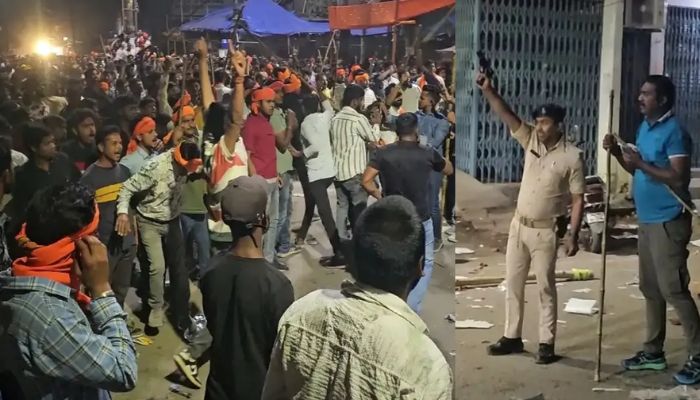
On 25th March, an Islamist mob resorted to stone pelting at a Mangla procession near Jama Masjid Chowk in Hazaribagh, Jharkhand. The incident happened around 10:45 PM. Reportedly, stone pelting started over songs being played during the procession. Upon learning about the incident, senior police officials rushed to the spot with heavy police force to restore law and order. Reportedly, police had to use mild lathi-charge and aerial firing to bring the situation under control.

Every year, Mangla processions are taken out by the Hindu community ahead of Ram Navami. The incident happened during the second Tuesday Mangla procession. Various Akhara groups were participating across different areas in the city. They were proceeding peacefully near Jhanda Chowk and Masjid Gali turn. The Islamist mob reportedly got triggered by the songs being played during the procession.

An argument broke out between the mob and members of the procession, which quickly escalated, leading to the stone pelting incident. Members of the Hindu community also resorted to stone pelting in retaliation. Nearby shops were vandalised during the incident and the Eid Market was temporarily shut.

Senior police officials, who reached the spot, tried to alleviate the situation. However, the initial efforts failed. The police then resorted to mild lathi-charge and four rounds of aerial firing to disperse the crowd. Hazaribagh City SP Arvind Kumar Singh, SDPO Amit Anand, DSP Amit Kumar, and several senior officers camped at the site to ensure law and order.

Deputy Commissioner Nancy Sahay confirmed that there was an incident of stone pelting and a physical scuffle between the two communities during the Mangla procession near Jhanda Chowk. She added that songs being played during the procession “provoked” the other side. Furthermore, she said that additional police force has been stationed at the site and affirmed that the situation was “peaceful and under control”.

Superintendent of Police (SP) Arvind Kumar Singh has urged the public not to pay heed to rumours and confirmed that the situation was normal. He said, “A few individuals have been identified and are being questioned.”

The police have initiated an investigation in the matter using CCTV footage and drone surveillance to identify miscreants. Senior officials have urged both communities to maintain calm.

Previous incident on Maha Shivratri

In recent weeks, this is the second time a Hindu festival has been attacked in Jharkhand. On 26th February, Muslims opposed the installation of Mahashivratri flags and loudspeakers in Jharkhand’s Hazaribagh. When the dispute escalated, stones were pelted from a nearby madrasa. The Hindu side also started pelting stones in defence and in no time the situation took a violent turn. In this violence, many vehicles including one car,  two bikes, a tempo and a shop were set on fire.