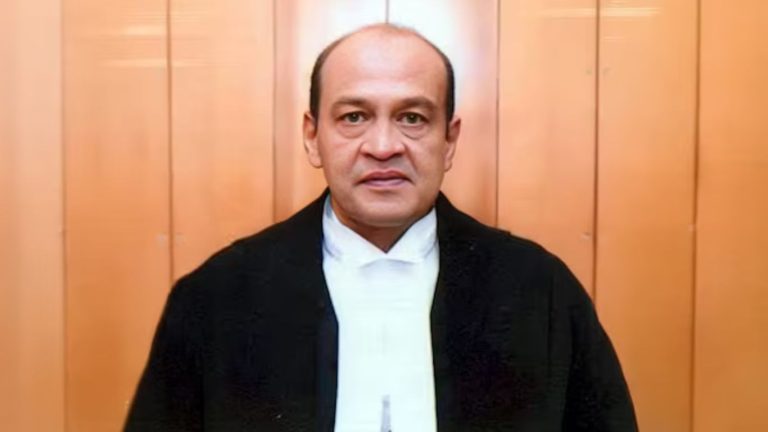
Days after hordes of cash were discovered at the residence of Justice Yashwant Varma, controversial Trinamool Congress (TMC) MP Mahua Moitra attacked the media for diligently covering the corruption allegations against the Delhi High Court judge.
She was visibly upset that the sensational story was picked up and debated at length in the media, thereby ensuring the possibility of a free and fair investigation in the matter.
Mahua Moitra brazened out, “I am digressing to speak on an issue which has immense controversy and intrigue attached. The story about a bundle of currency notes discovered in the outhouse of a judge of the Delhi High Court. Now the veracity of the incident is still being ascertained, but the Godi media has gone to town debating whether the appointment of judges and how the government of the day must have a preponderance say in the appointment process.“
The TMC MP alleged that the claims about the discovery of unaccounted cash at Justice Yashwant Varma’s house was not verified, despite the Supreme Court releasing video evidence showing burnt currency notes.
Mark my words. This Govt & its Godi Media are laying ground for doing away with collegium system in favour of NJAC type total govt control over judicial appointments. Much like EC’s de-fanging. pic.twitter.com/UBId9CWpCR
She further peddled conspiracy theories that the matter was being extensively covered in the media at the behest of the BJP. Mahua Moitra alleged that the ulterior motive was to bring back the decade-old National Judicial Appointments Commission (NJAC) Act under the pretext of the Varma case.
“Now you see this media are trying to mahol banao, they are trying to toe the government line to suborn the higher judiciary. Someone who cannot be named in this house, who presides over a neighbouring chamber has already added his two cents and said how he thinks that the government should do away with the collegium system,” Mahua Moitra claimed.
She also misled about the nature of the NJAC, which was enacted by the Parliament in 2014 to ensure the appointment of the judges in a transparent manner.
Mark my words, just like the election commission has been emasculated by the government takeover of its appointments process, this…is the beginning of an effort to bring back something like the NGAC with complete government control and do away with the collegium system amount of money apportioned to the judiciary will be of any avail unless its independent character is zealously guarded.
The ‘cash scam’ involving Justice Yashwant Varma
Ever since the news of the fire accident at Justice Varama’s residence boke out, new twists and turns have been emerging in the matter every day.
The hushed manner in which the matter has been dealt with by the authorities also raises serious questions on the accountability and transparency of the judiciary as well as the administration.
Interestingly, the fire incident occurred on 14th March but the news about the incident broke out on 20th March, a week later.
Moreover, the Delhi Fire Services chief Atul Garg initially denied reports of finding piles of cash at the judge’s residence but later on, he denied having given any such statement to any media outlet and dismissed his earlier quoted by the media as fake news.
In the meantime, a transfer order was also issued by the Supreme Court transferring Justice Varma to Allahabad High Court.
However, the Supreme Court yesterday denied any link between Collegium’s proposal to transfer the judge to Allahabad High Court, saying that it was a routine transfer proposal that has not been finalized yet.
On 22nd March, the Supreme Court publicly released a report on its website including three images and a video of the incident. The same day, a three-member committee was formed by the Supreme Court to conduct a probe into the matter.
The committee is chaired by Justice Sheel Nagu, Chief Justice of the Punjab and Haryana High Court, alongside Justice GS Sandhawalia of the Himachal Pradesh High Court and Justice Anu Sivaraman of the Karnataka High Court.
The committee will investigate the allegations and submit a report to the Chief Justice of India, Sanjiv Khanna. The CJI also asked the Chief Justice of Delhi High Court to not assign any case to Justice Varma.
The controversy surrounding Delhi High Court Justice Yashwant Varma has left the entire country, including the legal circles in shock. Following the revelation of unreported cash found in his residence during a fire incident on 14th March, everyone is questioning the accountability of Judiciary. The Supreme Court also confirmed the incident and released a report which included images and footage of the burnt cash.
The Chief Justice of India Sanjiv Khanna then formed a three-member commitee to look into the matter and instructed Delhi High Court Chief Justice D K Upadhyaya not to assign any judicial work to the accused judge. The panel consists of Justices Sheel Nagu (Chief Justice of the Punjab and Haryana High Court), G S Sandhawalia (Chief Justice of the Himachal Pradesh High Court) and Karnataka High Court Judge Anu Sivaraman. Recommendation of his transfer to the Allahabad High Court has also been made.
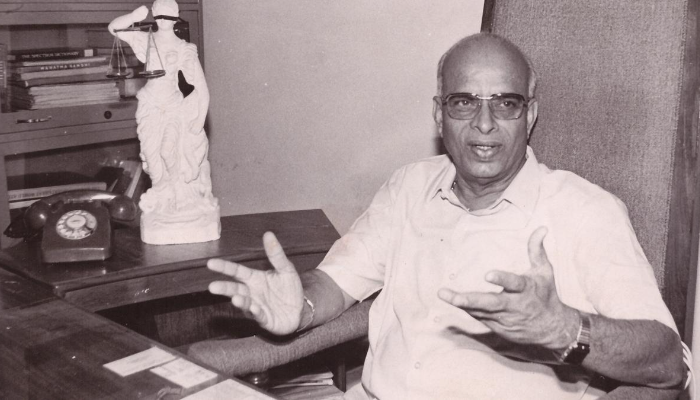
The case has captured the attention of the entire nation and has raised concerns about the extent of corruption within the judiciary, however, this is not the first instance in which a Judge has faced scrutiny. A political and judicial storm in the early 1990s centered around Justice (retired) V. Ramaswami who passed away this year. He was the first judge to be subjected to an impeachment motion and if the Lok Sabha had accepted the resolution which was presented by the opposition, on 11th May 1993, he would have been the first Supreme Court justice to be removed from office.
He stood as the first and only judge selected through the endorsement of his father-in-law who was a chief justice and later resigned during the Emergency after the CBI (Central Bureau of Investigation) found undeclared money in his home. Ramaswami’s appointment caused quite a stir when he entered the Madras High Court in 1971 because of this extraordinarily unusual move.
Afterward, his career got tarnished by allegations of impropriety, including his profligacy, which led to the impeachment move. He ran into trouble after it was unveiled in the media that while serving as Chief Justice of the Punjab and Haryana High Court in Chandigarh, he had incurred egregiously extravagant expenses for his official residence. He misused government vehicles and resources and bought pricey furniture, carpets and other goods with public money for his own gain. A motion demanding his impeachment was also approved by the Supreme Court Bar Association.
Ramaswami had been promoted to the Supreme Court by the time of the investigation. After reviewing the accusations, Sabyasachi Mukharji, the Chief Justice of India at the time, advised him to refrain from serving till the matter was resolved. He received the official letter on 18th July 1990, and immediately requested a six-week leave of absence, effective 23rd July 1990.
A committee composed of three Supreme Court Judges (BC Ray, KJ Shetty and MN Venkatachaliah JJ) was then appointed by the Chief Justice of India to investigate the facts and determine whether the accusations had any prima facie truth that would have prevented the judge from performing his duties. It was founded solely to evaluate the facts in a preliminary way. It was not a committee of inquiry into the charges.
The panel stated, following an investigation, that it did not find evidence of improper behavior constituting moral turpitude. It then examined whether Ramaswami might be asked to stop serving as a Judge before a formal probe is launched. It held that he could not be compelled to abstain from performing his judicial duties as long as the constitutional warrant designating him as a Supreme Court Judge remained in effect.
Committee found Ramaswami guilty
108 Lok Sabha members, afterward, moved the Speaker of the 9th Lok Sabha to address the President on 28th February 1991, asking for the removal of the Judge in accordance with Article 124(4) of the Constitution and the Judges (Inquiry) Act of 1968. A notice to file a resolution in the Lok Sabha was put out by the Bharatiya Janata Party (BJP) and Left parties, during the Viswanath Pratap Singh government.
On 12th March 1991, Rabi Rai, the speaker of the Lok Sabha at the time, approved the motion and established an inquiry committee. It consisted of Justice P B Sawant of the Supreme Court, Justice P D Desai of the Bombay High Court, and Justice O Chinnappa Reddy, a retired Supreme Court judge was established.
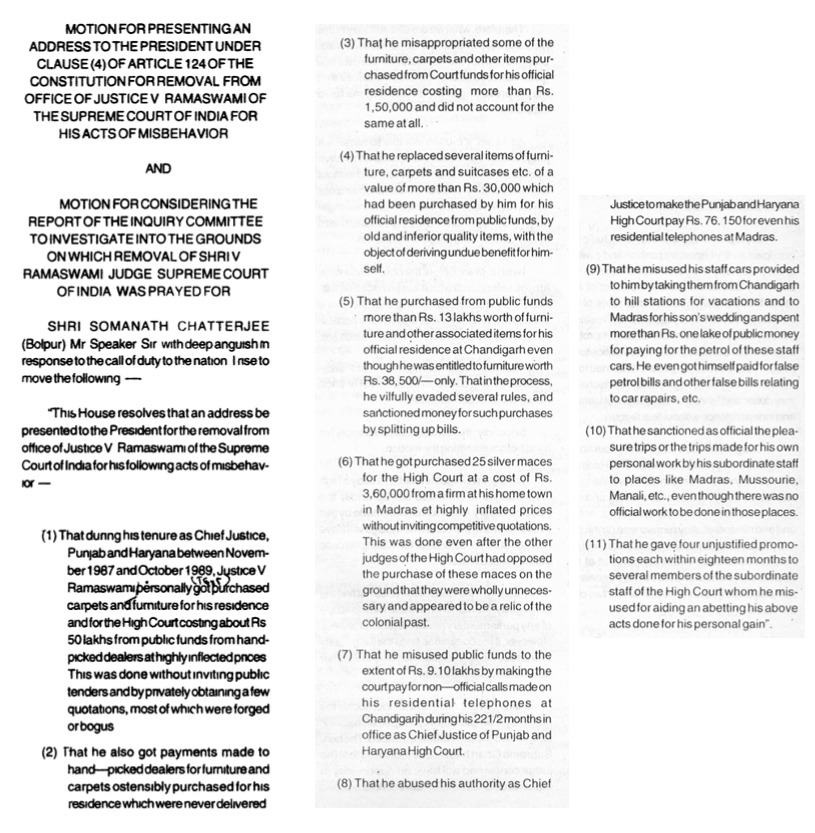
They assessed that he had engaged in “willful and gross misuse of office, intentional and habitual extravagance at the cost of the public exchequer, moral turpitude by using public funds for private purposes and reckless disregard of statutory rules” pronouncing him guilty on 11 of the 14 charges. He, on the other hand, refused to appear before the committee. Ramaswami’s case was argued by Congress stalwart and senior counsel Kapil Sibal. On 10th May 1993, the proposal was brought up for discussion in the Lok Sabha after the committee determined that the accusations had merit.
Charges framed against Ramaswami. (Source: Parliament Digital Library)
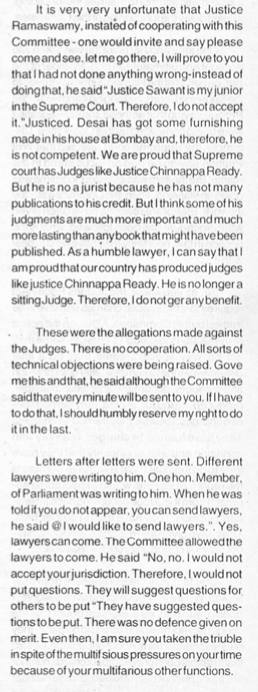
“Justice Sawant is my junior in the Supreme Court. Therefore, I do not accept it,” Ramaswami was quoted by senior advocate and CPI (Communist Party of India) leader Somnath Chatterjee who had moved the motion in the Lok Sabha. Chatterjee added that aspersions were cast on the members of the panel and technical issues were raised instead of providing cooperation. “No, no. I would not accept your jurisdiction. Therefore, I would not put questions. They will suggest questions for others to be put,” Ramaswami stated after he was told to send his attorneys if he could not appear before the panel. “There was no defence given on merit,” the CPI MP outlined.
Ramaswami refused to cooperate in the probe. (Source: Parliament Digital Library)
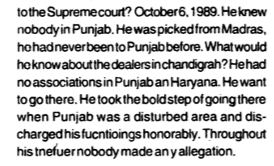
It was claimed that Ramaswami had relocated to Chandigarh during the height of the Punjab militancy and had enthusiastically taken on cases involving the insurgency. However, several previous judges and even politicians disagreed with the submission. According to reports, prior to becoming Prime Minister, even former Prime Minister Narasimha Rao attempted to speak with Rai to prevent the impeachment resolution. Furthermore, Kapil Sibal alleged that since his client never visited Punjab and knew no one in the state, he could not be aware of any dealers in Chandigarh.
Kapil Sibal argued in favour of Ramaswami. (Source: Parliament Digital Library)
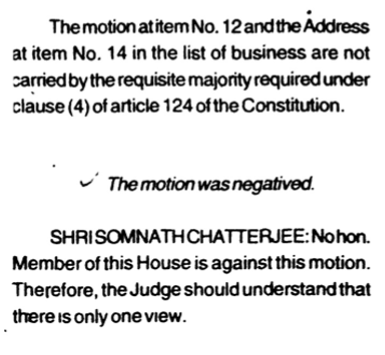
The house had 401 members, but only 196 of them voted in favor. It was not opposed by anyone. The motion failed because 205 Members of Parliament from the Congress and a few other parties abstained. According to the law, the motion must have the support of at least two-thirds of all members who are present and voting. However, Chatterjee pointed out that “no MP is against this motion,” as there were no negative votes and highlighted, “Therefore, the Judge should understand that there is only one view.”
The ruling Congress initially maintained that after hearing both sides, its members would be free to use their discretion and cast their votes any way they deemed appropriate. Union Minister for Parliamentary Affairs and Water Resources, VC Shukla, told reporters that “by not asking the members to vote in a particular manner, we want to uphold the highest tradition” in reference to the decision of the Congress Parliamentary Party under the leadership of Narasimha Rao. A year later, Ramaswami retired and never rendered his resignation.
The motion could not be adopted in the Parliament. (Source: Parliament Digital Library)
Congress leaders spoke in support of Ramaswami
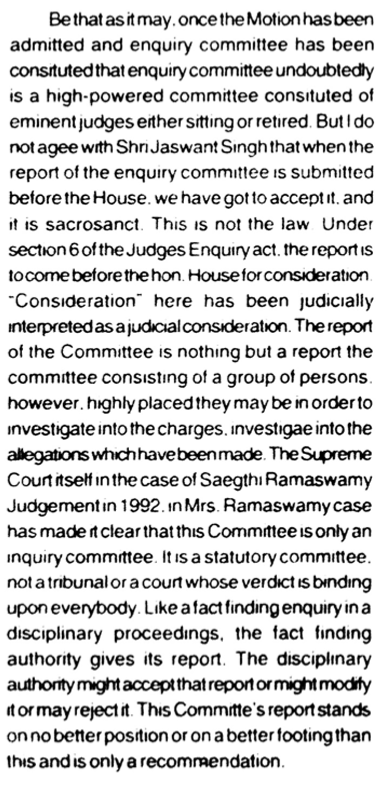
The debate on the impeachment motion lasted 16 hours over two days. Senior attorney and Congress leader Debi Prasad Pal opposed accepting the probe committee’s conclusions, which were suggested by Jaswant Singh, another prominent lawyer and senior leader of the Bharatiya Janata Party. “This is not the law under section 6 of the Judges Enquiry Act. The report is to come before the house for consideration.” He added that it is merely a report by a group of people, “however, highly placed they may be” to investigate the charges.
He further referred to the Supreme Court decisions and conveyed, “It is a statutory committee and not disciplinary tribunal or a court whose verdict is binding upon everybody. Like a fact finding enquiry in a proceedings, the authority gives its report. The disciplinary authority might accept that report or might modify or reject it. This committee’s report stands on no better position or footing than this and is only a recommendation.”
Image via Parliament Digital Library
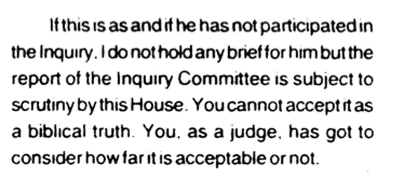
The former minister of state for finance insisted, “You cannot accept it as a biblical truth. You, as a judge, has got to consider how far it is acceptable or not.”
Image via Parliament Digital Library
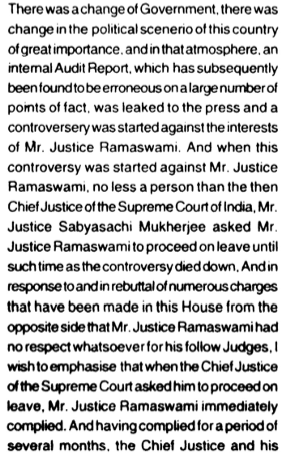
Congress veteran Mani Shankar Aiyar alleged that the change in the government and the political landscape of the country “and in that atmosphere, an interal audit report, which has subsequently been found to be erroneous on a large number of points of fact, was leaked to the press and a controversery was started against the interests of Justice Ramaswami.” He claimed that he promply left for leave after Chief Justice Sabyasachi Mukherjee asked him, in an effort to counter the charges levelled against Ramaswami.
Image via Parliament Digital Library
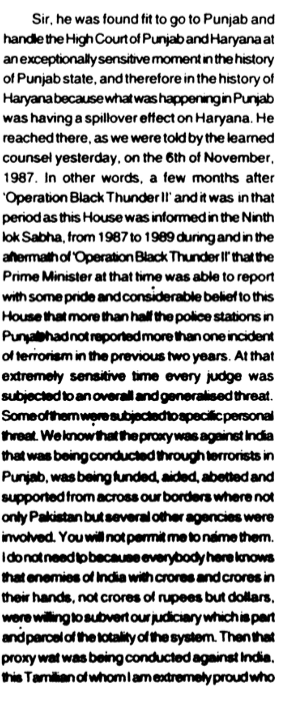
He also credited Ramaswami for going to Punjab in the aftermath of “Operation Black Thunder ।” and claimed, “At that extremely sensitive time every judge was subjected to an overall and generalised threat.” He mentioned that a proxy war was launched against India by the country’s hostile neighbour and other vested interests. “I do not need to (name them) because everybody here nows that enemies of India with crores and crores in their hands, not crores of rupees but dollars, were willing to subvert our judiciary which is part and parcel of the totality of the system.
Image via Parliament Digital Library
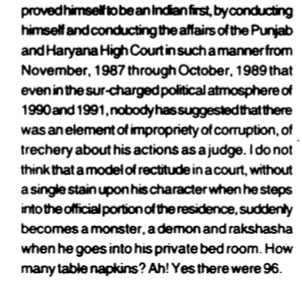
He then lauded Ramaswami and announced that he was proud of the Judge who “proved himself to be Indian first by conducting himself and the affairs of the Punjab and Haryana High Court in such a manner from November 1987 through October 1989 that even in the surcharged political atmosphere of 1990 and 1991, nobody has suggested that there was an element of impropriety of corruption, of treachery about his actions as a judge.”
“I do not think that a model of rectitude in a court, without a single stain upon his character when he steps into the official portion of the residence, suddenly becomes a monster, a demon and rakshasha when he goes into his private bed room,” he then dramatically claimed.
Image via Parliament Digital Library
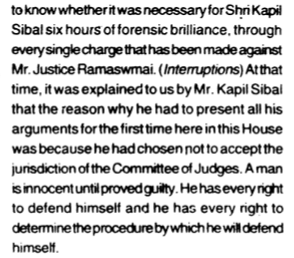
He also endorsed Ramaswami’s decision to snub the inquiry panel and added that “it was explained to us by Mr. Kapil Sibal that the reason why he had to present all his arguments for the first time here in this house was because he had chosen not to accept the jurisdiction of the committee of judges. A man is innocent until proved guilty. He has every right to defend himself and he has every right to the determine procedure by which he will defend himself.”
Image via Parliament Digital Library
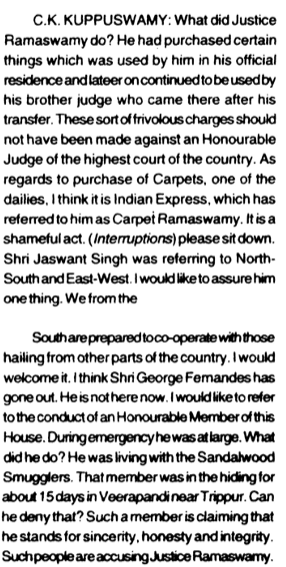
Congress MP CK Kuppuswamy declared Ramaswami, while presenting arguments in favour of him. He asked, “What did Justice Ramaswamy do? He had purchased certain things which was used by him in his official residence and later on continued to be used by his brother judge who came there after his transfer. These sort of frivolous charges should not have been made against an honourable judge of the highest court of the country.” He even slammed “The Indian Express” for mocking him as “Carpet Ramaswami.”
He even attacked George Femandes in a disparaging manner and accused, “I would like to refer to his conduct of an honourable member of this house. During emergency he was at large. What did do? He was living with the Sandalwood Smugglers. That member was in the hiding for about 15 days in Veerapandi near Trippur. Such a member is claiming that he stands for sincerity, honesty and integrity. Such people are accusing Ramaswami.”
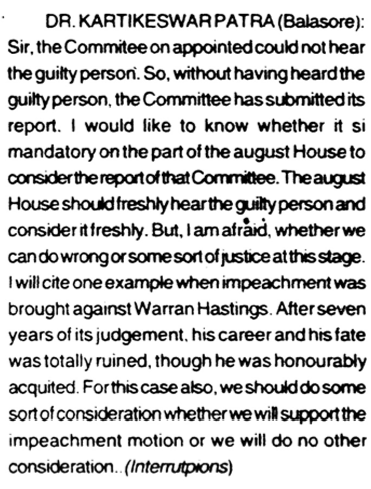
Congress leader and author Kartikeswar Patra pointed out that the probe panel formed its report without presenting Ramaswami’s side (because he didn’t appear before them) and voiced, that “without having heard the guilty person, the committee has submitted its report. I would like to know whether it is mandatory on the part of the august house to consider the report of that committee. The august house should freshly hear the guilty person and consider it freshly. But, l am afraid, whether we can do wrong or some sort of justice at this stage.”
Image via Parliament Digital Library
Ramaswami’s controversial career and profound connection with Congress
There were many disputes during Ramaswami’s time as a Judge in Madras. He kept about ten buffaloes in his garden for dairy, reported India Today. His decision to rule on a matter involving his wife, Sarojini, in 1986 spurred a row. It was about a set of petitions that contested the purchase of land. Ramaswami, who was in charge of a division bench, allowed the others but removed his wife’s name off the list. The following day, her petition was heard by a single Judge who was constrained by the division bench’s judgment.
Additionally, Ramaswami came under fire for some of his conclusions about his Naidu community. Due to his prejudice, a lecturer who was involved in a lawsuit with his Naidu-run PSG College of Technology in Coimbatore in the early 1980s asked him not to hear the case. As expected, he was found in contempt. A newspaper, Sigappu Nada, was taken to task for making a similar implication in its criticism of a ruling that remarked employees could not participate in a company’s winding up proceedings. The business was owned by R. Prabhu who was a Naidu and a Congress (Indira Gandhi faction) MP.
Prabhu was the most vocal advocate of Ramaswami and was instrumental in rallying Tamil Nadu MPs against the “North Indian conspiracy” during the impeachment procedures. M. Krishnaswamy, another Naidu MP, contested the validity of the impeachment motion on behalf of the Judge in the lengthy legal fights before the Supreme Court and the inquiry committee. His son, Sanjay Ramaswami, a Congress MLA who is also married to the sister of late movie actress Sridevi, strengthened the family’s ties to the Congress (I). The party tended to support him since non-Congress parties had attempted to impeach him in 1991.
Bogus claims of patriotism
The Supreme Court heared all appeals against the appointed sessions court’s judgments. Regardless, during Ramaswami’s two-year tenure in Chandigarh, no one was convicted and TADA (Terrorist and Disruptive Activities Prevention Act) accused were consistently released on bond. Lavish Independence Day celebration on the grounds of the High Court is the sole “patriotic” thing that Ramaswami is renowned for in Chandigarh. As they were all required to arrive in a procession wearing their gowns and escorted by carriers of silver maces, over half of the Judges chose not to attend the event.
His successor overturned several of his decisions, including the organisation of this function. Likewise, he hired roughly ten female translators after interviewing them in Shimla. The ‘IAS girls’ or ‘interviewed at Shimla’ girls were the nicknames given to this group. They were all fired shortly after the Judge was transferred. Ramaswami’s indifference made him unpopular among his Chandigarh peers. He never joined them for the usual lunch in the common room, which they didn’t appreciate. According to Supreme Court Justice Dharam Veer Sehgal, who left the bench in December 1988 owing to disagreements with Ramaswami, “He was intelligent but not Judge-like.”
He disbanded the division benches led by certain senior judges because of animosity towards them. Lawyers protested to him as the number of writ petitions pending admission increased due to fewer division benches. This paved the way for a remarkable situation that enabled Ramaswami to issue orders on dozens of petitions every day without even considering the cases. He would merely declare: “Numbers 1-4 admitted, number 5 dismissed, numbers 6-14 admitted and stay order granted” each morning as hundreds of attorneys poured into his courtroom.
A group of bureaucrats combed over the petitions and provided him with a summary, which he used to make his conclusions. Since most of the petitions were accepted, attorneys did not object to this extralegal process. “We used to call it the Ramaswami bumper draw,” Chandigarh advocate Anupam Gupta stated. All of this, however, backfired on Ramaswami, who was under fire even after being promoted to the Supreme Court in 1989 without the then-chief justice of India’s approval. Afterward, audit findings on his excesses in Chandigarh surfaced in April 1990.
There hadn’t been any relief for him since, and the scandal made sure he never served on any of the Constitution benches that handled important issues but he never repented for his actions.
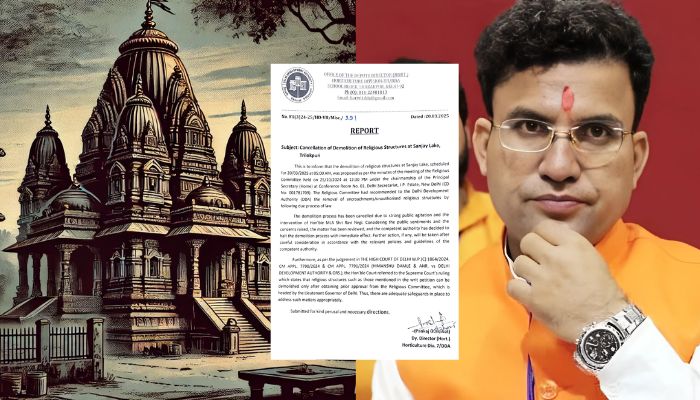
On 20th March, the Delhi Development Authority (DDA) cancelled the proposed demolition of three temples near Sanjay Lake in Trilokpuri, which was scheduled for the same day. The decision was conveyed via an internal report by the Deputy Director of Horticulture (DDA). The notice cited strong public opposition and the intervention of Bharatiya Janata Party (BJP) MLA Ravi Negi as key factors behind the decision.
The demolition was originally proposed during the discussion of a Religious Committee meeting that was held on 25th October 2024, chaired by the Principal Secretary (Home), Delhi Secretariat. The committee had recommended removing “unauthorised” religious structures through the due process of law.
However, following the increasing public agitation and backlash, the demolition was halted with immediate effect. The notice further mentioned that any further action will only be taken after due consideration of relevant policies and guidelines, and under the approval of a competent authority.
The notice also cited a ruling of the Delhi High Court which referred to a Supreme Court direction stating that no religious structure, including those under question, can be demolished without prior approval from the Religious Committee headed by the Lieutenant Governor of Delhi.
Supreme Court refused to entertain plea against demolition, asked to approach HC
Earlier on the same day, the Supreme Court had refused to entertain a petition filed by Advocate Vishnu Shankar Jain against the demolition. Advocate Jain was representing temple committees from Mayur Vihar Phase 2 – namely, Purbi Delhi Kali Bari Samiti, Sri Amarnath Mandir Sanstha, and Sri Badri Nath Mandir.
The plea challenged the DDA demolition notice that was issued on 19th March, giving only a few hours to the committee members before razing the structures. Advocate Jain argued that the temples, over 35 years old, were not given a proper hearing and highlighted that the Kali Bari temple had even received DDA’s permission in the past to host public festivities. The Supreme Court, however, directed the petitioner to approach the Delhi High Court instead.
BJP MLA Negi also accused the DDA of arriving at the site without proper prior notice. He said, “At 3 AM, the police and DDA arrived for demolition, claiming no notice is required for green belt areas.” The demolition was eventually stopped following the intervention of Delhi CM Rekha Gupta.
The Supreme Court Collegium on Monday recommended the transfer of Justice Yashwant Varma, Judge of the High Court of Delhi, back to his parent court, the Allahabad High Court.
The resolution of the Collegium stated, “In its meetings held on 20th and 24th March 2025, has recommended repatriation of Justice Yashwant Varma, Judge, High Court of Delhi, to the High Court of Judicature at Allahabad.”
The Allahabad High Court Bar Association had raised an objection over the Supreme Court Collegium’s decision to transfer Justice Varma to the Allahabad High Court.
Justice Varma has been in controversy since a stash of cash was allegedly recovered from his official residence here.
As per the media reports, a fire at the judge’s house had inadvertently led to the recovery of cash by the firefighter.
Media reports said the cash was found initially by fire tenders when a fire broke out in the judge’s residence on March 14. The judge was not present at his house.
The Chief Justice of India, Sanjiv Khanna, on Saturday constituted a three-member Committee consisting of High Court judges for conducting an inquiry into the allegations.
The committee consists of Justice Sheel Nagu, Chief Justice of the High Court of Punjab & Haryana, Justice GS Sandhawalia, Chief Justice of the High Court of Himachal Pradesh, and Anu Sivaraman, judge of the High Court of Karnataka.
The Chief Justice of the High Court of Delhi, Devendra Upadhyaya, for the time being has been asked not to assign any judicial work to Justice Varma.
The Supreme Court had also released the inquiry report of the High Court Chief Justice into the controversy relating to Justice Varma. In his report, the Delhi High Court Chief Justice said that he is of the prima facie opinion that the entire matter warrants a “deeper probe.” It also released the response of Justice Varma, who has denied the allegations and said that it clearly appeared to be a “conspiracy to frame and malign” him.
Justice Varma had said that no cash was ever placed in that storeroom either by him or any of his family members and said he strongly denounce the suggestion that the alleged cash belonged to them.
Justice Verma had also stated that the room which caught fire and where cash was allegedly found was an outhouse and not the main building where the judge and family resides.
On Friday, the Supreme Court brushed aside any connection between the transfer of Justice Varma to his parent Allahabad High Court and the alleged recovery of a stash of cash from his official residence here.
(This news report is published from a syndicated feed. Except for the headline, the content has not been written or edited by OpIndia staff)
On the 18th of March 2025, the Karkardooma Court pronounced their judgement on the murder of a Muslim man called Babbu, during the Delhi anti-Hindu Riots. The court acquitted 11 Muslims who were charge-sheeted in the case, framing charges against 8 Hindus.
The case pertains to FIR 119/2020, which was filed by Pappu, the brother of Babbu. In the FIR, Pappu had said that his brother, Babbu, was an auto-driver and was driving back home on 25th February 2020. At about 2 PM, Babbu reached Khajuri Chowk, there was a mob, which was pelting stones. It was further alleged that Babbu got serious injuries and Babbu was admitted to Jag Parvesh Chandra Hospital, Shastri Park, Delhi by police. Thereafter, Babbu was referred to UCMS and GTB Hospital for treatment and during treatment Babbu died on 27.02.2020.
Babbu’s postmortem indicated, “Cause of Death is coma as a result of head injury produced by blunt force impact. However, viscera preserved to rule out poisoning”.
Thereafter, the investigation led the police to arrest 11 Muslims and 8 Hindus in the given case. The court document says that during the investigation, the accused, including Hindus and Muslims “Admitted to their involvement in the incident of riot dated 25.02.2020 at Khajuri Khas i.e. the place of occurrence in the present case”.
What had happened on the 25th of February – as revealed by Court documents
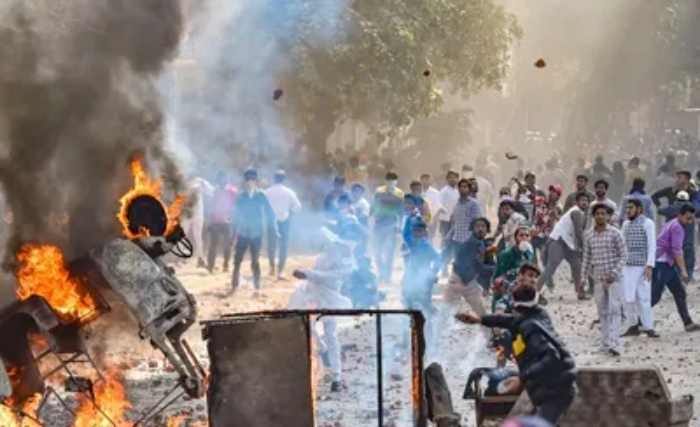
On the 25th of February, the investigation by the police revealed that both communities started gathering at Khajuri Chowk. While members from the Hindu community were gathering towards Khajuri Khas, members from the Muslim community were gathering towards Shree Ram Colony. Both communities thereafter started raising slogans against each other and pelting stones at each other.
It is pertinent to note that all the accused – Hindus and Muslims – charge-sheeted in the current case were identified by eyewitnesses as being part of the respective mobs.
It is during this, that Babbu was caught hold of and beaten by some Hindus.
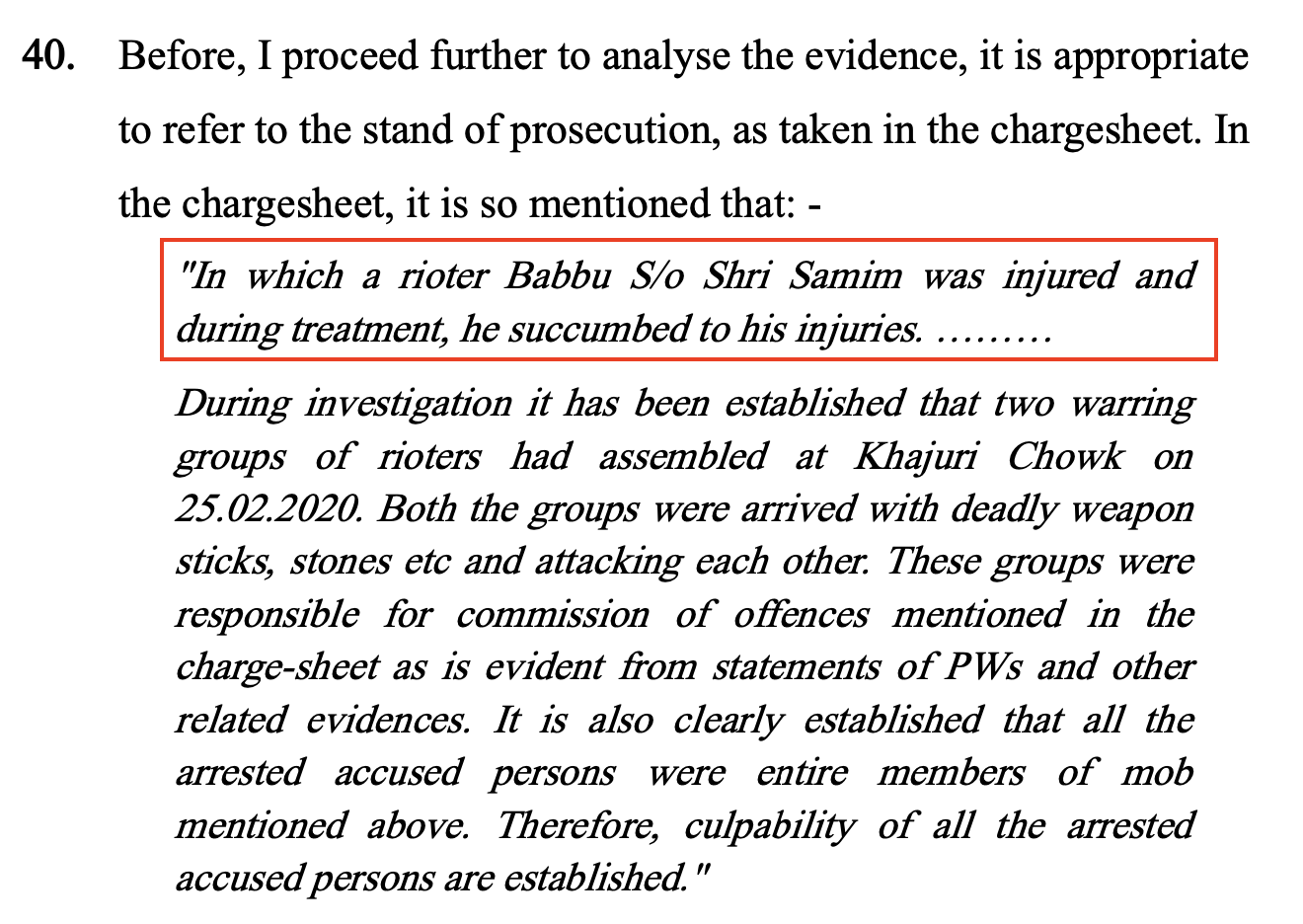
It is pertinent to note that Babbu was not an innocent bystander or just an auto-driver who was on his way home. The charge sheet, as quoted by the Court, reveals that Babbu himself was a rioter and a part of the Muslim mob.
This aspect of the investigation – that Babbu himself was a rioter and a part of the Muslim mob – has not been discredited by the court. In fact, apart from the charge sheet being quoted, the court in its judgement makes no other mention of Babbu being a part of the mob – therefore – not disregarding this finding by the police.
The court observed that it is clear that this case is of two rival groups attacking each other – as evidenced by two videos – when Babbu was chased and beaten.
On what basis did the police charge sheet the Muslim accused, later acquitted
As evidenced by the charge-sheet excerpt, the police had arrested and charged the Muslim accused by invoking Section 149 of the IPC. Section 149 essentially says that those who are a part of the mob are assumed to have a common objective to commit crime and are therefore, individually, severally and vicariously responsible for the crimes committed.
If an offence is committed by any member of an unlawful assembly in prosecution of the common object of that assembly, or such as the members of that assembly knew to be likely to be committed in prosecution of that object, every person who, at the time of the committing of that offence, is a member of the same assembly, is guilty of that offence.
The logic employed by the police was simple – Hindus and Muslims were both face-to-face – and the ensuing riot from both sides ended up in the killing of Babbu – identifiable members from both sides were individually and severally liable for the crime.
What the court said about section 149, acquitting the Muslim accused
The court said, “for inviting liability by virtue of Section 149 IPC, it is not required to prove overt act on the part of every member of the mob. However, it is important for the prosecution to show that the alleged act was done by the members of that mob in pursuance to the common object of that mob and accused was member of such mob at the relevant time. Hence, common object of an unlawful assembly plays important role in fixing the vicarious liability”.
The court said that the members of the Muslim mob were “sympathisers” of Babbu and after he was beaten up by the Hindus, it was the Muslim mob that picked him up and took him away.
As such, Section 149 cannot be invoked because while it is true that to invoke Section 149, an overt act is not necessary to be proven against members of the mob, it is important that a “common object” is displayed. Since the deceased was a Muslim, the Muslim mob, while they were rioting, cannot be said to have played a part in killing Babbu since it was the Hindu mob which shared the “common objective” against the Muslim rioters.
Were the 11 Muslims acquitted in this case innocent? Not at all – what the court said
In para 49 of the judgement instructing to frame charges against the Hindu accused, the court made an important observation.
The court said:
The chargesheet itself refers to a different case being investigated i.e. FIR no. 103/20 by SI Naveen, wherein all these aforesaid accused persons were arrested. FIR 103/20 was also registered in respect of an incident taken place at the same place during same time period, wherein Ct. Amit had sustained fracture in his hand. This example is sufficient to say that for any other riotous activity of aforesaid accused persons, they should have be separately booked. They cannot be prosecuted in this case, which relates to culpable homicide of Babbu. In this case, court has to look for culpability of accused persons, who are connected with incident of beating of Babbu, which resulted into his death.
The judgement notes that the Muslim accused, acquitted in this case, are already being tried in another case of rioting on the same day and in the same place. Essentially, FIR 103/2020 pertains to the Muslim rioters injuring and targeting police officials and Hindus. It is the same incident in which the Hindus beat up Babbu. Since the Muslim rioters are already being tried in a separate case for the same incident of rioting, they cannot be tried in this case since this would amount to double jeopardy (being tried twice for the same crime).
Crime of commission – How Live Law presented the judgement
LiveLaw, a legal portal, published a thread on X (formerly Twitter) on the 19th of March.
Delhi Court discharges 11 muslim men in a #DelhiRiots case concerning death of one Babbu.
Court says mob of Muslim community had no role to play in deceased’s beating, rather they were sympathisers.
In the thread, they mentioned the portions of the judgement which acquitted the Muslims and ordered the framing of charges against the Hindus without mentioning that the Muslim rioters were not innocent and had not been implicated falsely but were rioters who were already being tried in a different case for targeting Hindus and police officials.
The report which was published on the 20th of March by LiveLaw also missed this important aspect of the judgement, portraying the Muslim rioters as innocent men, falsely implicated by the police.
How propagandists used the Live Law report to exonerate Muslims and why they are wrong
One propagandist claimed that innocent Muslims who “risked their lives to help the victim” were framed by the police.
Delhi Police framed the very people who risked their lives to help others during the riots.
11 innocent Muslim men suffered just for their identity, while the real culprits walked free for years. https://t.co/Cc5sAwLwos
One Muslim propagandist claimed that the “court said that “Muslims were targeted because of their religion”.
Delhi Riots: The court acquitted 11 Muslims in the murder case of auto driver Babbu, while framing charges against 8 Hindus in murder cases. The court stated, “Muslims were targeted because of their religion.”
This is, of course, a misrepresentation. The court said that the Muslims were targeting Hindus for their religion and the Hindus were targeting the Muslims in turn. In the case of Babbu, the court used this to ascertain blame for Babbu, saying that the Hindus were beating Babbu up for his religious identity, however, the court also said that the Muslim mob was pelting stones and was armed against the Hindus.
Another misrepresentation was by a propagandist called “Drunk Journalist”. He claimed that police had charged the Muslim men claiming that the Muslims killed Babbu.
Babbu was killed by 8 men belonging to the Hindu community but Delhi Police arrested 11 Muslim men claiming they killed Babbu.
Thankfully due to video evidence, they were discharged and criminals got caught. https://t.co/6WPySOZpdM
In reality, the Muslims were charged owing to Section 149. As explained, the police had booked the Muslims saying that since Muslims were also a part of the mob which created the riot, they would be individually and severally responsible. They were not charged by the police for directly killing Babbu. Such narrative is peddled often to discredit the investigation of the police – not because the propagandists want to save the specific Muslim accused – but because they want to cast a shadow of doubt on the entire police investigation – specifically to whitewash the crimes of the conspirators like Sharjeel Imam, Umar Khalid and others.
It is pertinent to note that the conspiracy to create violence and burn Delhi started right on the 6th of December 2019 – with the explicit involvement of Umar Khalid, Sharjeel Imam and several others. Detailed coverage of how the conspiracy unfolded can be read here.
Beyond the conspiracy, if we analyse only the violence which broke out on the 23rd, 24th and 25th of February 2020, it is also documented in the charge sheet how the violence was initiated by the Muslim mob and not the Hindus. conspiracy
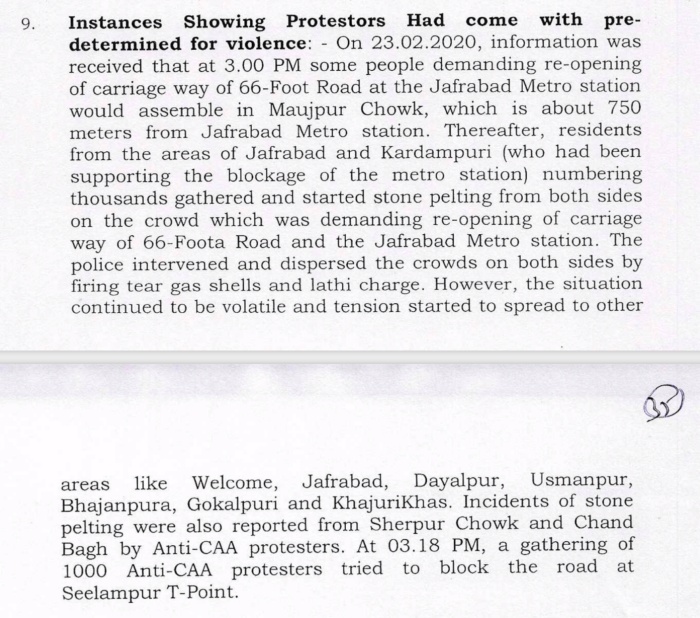
In charge sheet 59/2020, which explains the Delhi anti-Hindu Riots conspiracy, it is categorically mentioned that on the first day of the Delhi anti-Hindu riots – the 23rd of February – it was the Muslim mob which started the violence.
A group of individuals who were demanding the opening of the 66-foot road near Jafrabad had assembled at Maujpur Chowk around 3:00 PM on 23rd February. The Maujpur Chowk where they had assembled was about 750 M away from the Jafrabad Metro Station.
The charge sheet then reveals that the residents of Jafrabad and Kardampuri who were supporting the blockage of the Jafrabad metro station congregated in the thousands and started pelting stones from all quarters at the group that was demanding the re-opening of the roads.
However, this portion of the charge sheet proves that the incidents of violence were indeed started by the anti-CAA protestors – the Muslim mob.
The first murder to have been committed during the Delhi anti-Hindu Riots was that of Constable Ratan Lal by the Muslim mob.
It was only by the latter half of 24th February 2020 did the Hindus started defending themselves and retaliating. This fact is evident by the judgement in the case of the death of Babbu – who was beaten by Hindus – causing his ultimate death. The incident happened on the 25th of February when Hindus started defending themselves and retaliating against the Muslim mobs who had gone on a rampage since the 23rd of February. In no way does that whitewash the fact that the Delhi anti-Hindu riots were indeed orchestrated, planned and executed by the Muslims and Leftists to specifically target Hindus of Delhi – as evidenced by the police investigation and several court orders covered in the past.
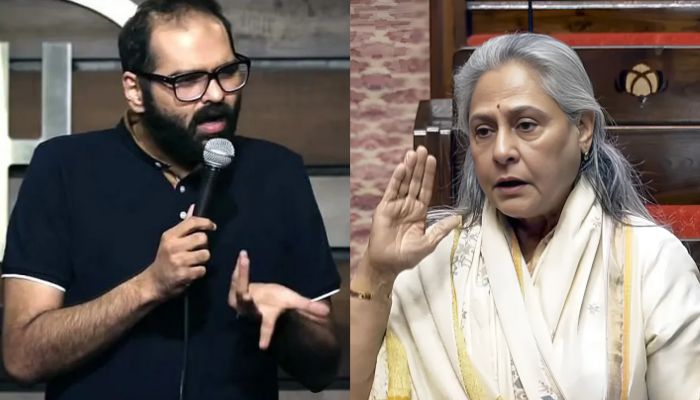
On 24th March, Rajya Sabha MP and veteran actor Jaya Bachchan raised concerns over the shrinking space for free expression. Her comments came in response to the attack on alleged stand-up comedian Kunal Kamra’s office by Shiv Sena (Eknath Shinde faction) members. Ironically, in 2014, she had raised objections over mimicry done by Radio Jockeys (RJs).
#WATCH | On Kunal Kamra row, SP MP Jaya Bachchan says, "…If there is restriction on speaking, what will become if you? You are anyway in a bad situation. There are restrictions on you. You would be told to speak just on this and nothing else, that do not interview Jaya… pic.twitter.com/GWpkNyEDHS
Reacting to the backlash against Kunal Kamra over his video indirectly mocking the Deputy Chief Minister of Maharashtra, Eknath Shinde, and the FIR, she asked, “Where is the freedom of speech?” She added, “If restrictions are placed on what people say, what will happen to the media? You people are already in bad shape. Soon you’ll be told—say only this news, don’t say anything else. Don’t take Jaya Bachchan’s interview.”
Taking aim at the ruling party, Bachchan added, “There is freedom of action only when there is violence—beat up opposition members, rape women, murder them. What else is left?” She also criticised Eknath Shinde, saying, “You left your original party for power. Wasn’t that an insult to Balasaheb Thackeray?”
The irony – her 2014 call for a ban on mimicry
While Jaya Bachchan has suddenly realised that there is a need for ‘freedom of speech’, her own record says otherwise. In August 2014, she had raised objections in Parliament against mimicry and jokes by radio jockeys. She called such humour “absolutely objectionable” and accused RJs of being guilty of obscene jokes and disrespecting lawmakers. At that time, she asked then Information and Broadcasting Minister Prakash Javadekar if he was going to do anything about it and demanded action against what she saw as an attack on the dignity of Parliament.
The change in her stance on freedom of speech is a stark reminder that for several public figures like her, the value of free speech depends entirely on who is speaking and whom they are speaking against.
The latest Kunal Kamra controversy over song mocking Eknath Shinde
On Sunday, 23rd of March, Shiv Sena workers reportedly vandalised the hotel – The Unicontinental Mumbai, in Khar – where Kunal Kamra did his “comedy” skit. Members of Shiv Sena also gathered outside various police stations demanding action against Kamra.
In his skit, Kunal Kamra performed to a parody song set to the tune of the 1997 Bollywood song ‘Dil to pagal hai’. In that, he had referred to Chief Minister Eknath Shinde as ‘Gaddar’ (traitor) for his defection in 2022.
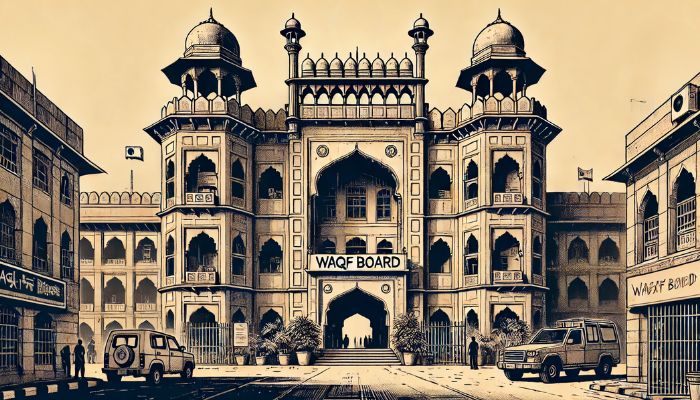
Waqf has a long, winding history in India. Initially, back in 1894, the British came up with the Waqf Bill for the first time via a judgment. At that time, the British were grappling with its legal status. From 1894 to 1947, laws and amendments were introduced to shape the Waqf Act’s legal system. Later, after 1947, the Congress-led government eventually turned it into a system with far-reaching authority. So much so that now Waqf Boards can claim any property using several clauses, and the onus to prove the land they have claimed is not Waqf lies on the actual owner, which in many cases is the central or the state government.
Waqf was initially supposed to be about charitable endowments, which has drastically changed over time. It has grown into something much larger, often at odds with the secular framework of the country. The initial rules were indeed set by the British, but it was the Congress that took it further—and took it too far. Here is how the Waqf has changed over time.
British rule – A shaky start for Waqf
Waqf properties were dedicated under Islamic law for religious and charitable purposes. However, under British rule, Waqf faced legal hurdles. In 1894, a landmark judgment by the Privy Council in Abul Fata Mahomed Ishak vs Russomoy Dhur Chowdhury sent a shockwave through the Muslim community. According to the judgment, Waqfs which benefited the founder’s family were declared invalid. The Council cited English law’s aversion to perpetuities as the basis of the judgment.
It was not a minor ruling and challenged a tradition stretching back to the Delhi Sultanate. Notably, Sultan Muizuddin Sam Ghaor gave villages to Multan’s Jama Masjid, which continued through the Mughal era’s vast Waqf holdings. The decision by the Privy Council caused uncertainty among the Muslim community.
The case that led to the establishment of the foundation of the Waqf Act stemmed from a family feud over a Waqf property in Bengal. Two brothers, Abul Fata Mahomed Ishak and his sibling, had created a Waqf property as per Islamic law. The intention behind creating it was to provide for their descendants. The remaining benefits would eventually flow to charitable causes. Following the death of the founders, a creditor named Russomoy Dhur Chowdhury challenged the validity of the Waqf in court.
He argued that there was no legal standing of the Waqf under British India’s judicial system. The dispute escalated to the Privy Council in London, where the core issue discussed was whether this Waqf, designed to support the family indefinitely, aligned with the legal norms of the British. It was not about the legality of the Waqf’s management but its very existence that was at stake and created a fissure between Islamic traditions and colonial law.
Following the judgment, Muslim leaders pushed back against the ruling, which eventually worked in their favour. In 1913, the British introduced the Mussalman Wakf Validating Act, which allowed Waqfs—even those aiding families—to exist, as long as charity was the ultimate goal.
Over time, till 1923, more structure was added to the Waqf Act, requiring registration and oversight to curb mismanagement of the properties. The aim was to provide a practical governance structure to the Waqf. The British could have scrapped it, but they decided to box it in and keep it running, only to hand it over to the Congress-led Indian government after independence.
How Congress helped Waqf get unchecked powers
When India gained independence, the Congress had a chance to rethink Waqf’s place in a secular nation. However, Congress decided to expand its powers. In 1954, under the first Prime Minister of India, Pandit Jawaharlal Nehru, the Waqf Act was introduced, replacing the 1923 law. The law established Central and State Waqf Boards to oversee properties. It was not merely a handover of power, but it gave Waqf a formal foothold in the country. The Waqf Act of 1954 allowed boards to register and manage endowments with minimal checks.
Though the base structure of the Waqf Act was introduced in 1954, the real shift came in 1995 when the Congress-led central government introduced a new Waqf Act. Under the new Act, Waqf Tribunals were established to handle disputes outside regular courts. The move raised eyebrows as it gave Waqf its own judicial setup instead of integrating it into a broader legal framework that resolves all cases. The empowerment given to the boards enabled them to exert sway over properties and disputes, making it extremely difficult for a common man to get justice in case a property is wrongfully declared Waqf.
Then came the 2013 amendment, where Congress doubled down. Just before losing the Lok Sabha Elections in 2014, Congress brought amendments to the Waqf Act, handing sweeping powers to the Waqf Boards, including surveying properties, “reclaiming” land, evicting occupants, and more without much oversight.
For instance, Section 54 of the Waqf Act allows boards to issue orders to remove “encroachers”, and Section 32 empowers them to manage Waqf properties almost autonomously. The Central Waqf Council got a bigger role too, advising on policy without clear accountability. The result is clear: Waqf Boards now have around six lakh properties under the Waqf umbrella. From markets to farms, residential plots, government buildings, temples, and even entire villages have been claimed as Waqf properties since then. Instead of scaling it back, which should have been the aim of the government, Congress gave Waqf Boards tools to flex their muscles—sometimes at the expense of other claimants. Why? Mostly because of appeasement politics. The 1894 judgment contained Waqf to some extent, but what happened in the following decades changed the scenario completely.
Why this matters
The evolution of Waqf is not just history. It is a live issue. Waqf Boards operate with little scrutiny. Even if the claims they make are proven to be fake, Waqf Boards do not face any legal action. In a secular nation, the existence of Waqf raises questions. Should a religious system have such latitude? Why did Congress not trim its powers? Why does Waqf still exist?
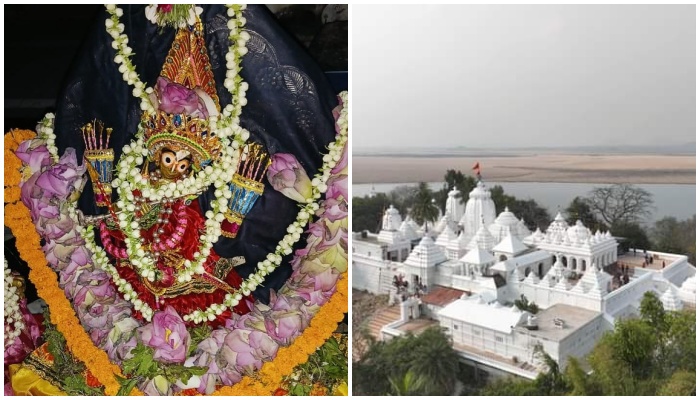
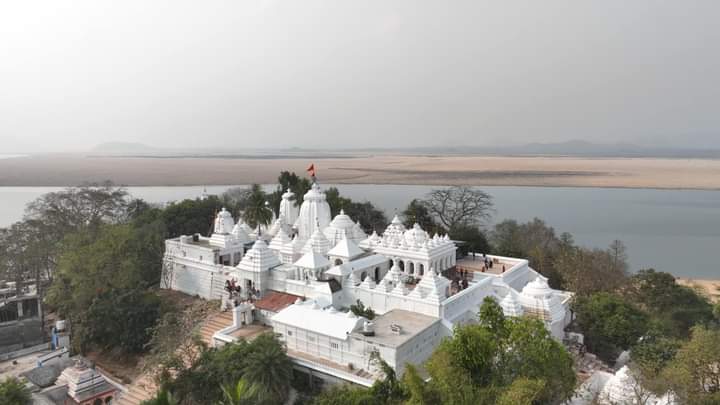
On Monday, 24 March, President Droupadi Murmu visited the Nilamadhaba Temple in Odisha’s Kantilo. The temple holds a significant place among the Hindus in Odisha and serves as a reminder of how the present culture and traditions of the state’s Hindu population originated from ancient tribal customs and how the roots of Dharma have emerged from the very seas, rivers and forests that have nurtured our people and lands for thousands of years.
#WATCH | Nayagarh | Preparations in full swing in Kantilo ahead of President Droupadi Murmu's visit to the famous Nilamadhaba Temple.
The President is scheduled to visit the temple from 3.05 pm to 3.25 pm before leaving for Bharatiya Biswabasu Shabar Samaj Foundation, where she… pic.twitter.com/olHcs2i8mS
Nilamadhav Temple: The ancient home of Lord Jagannath
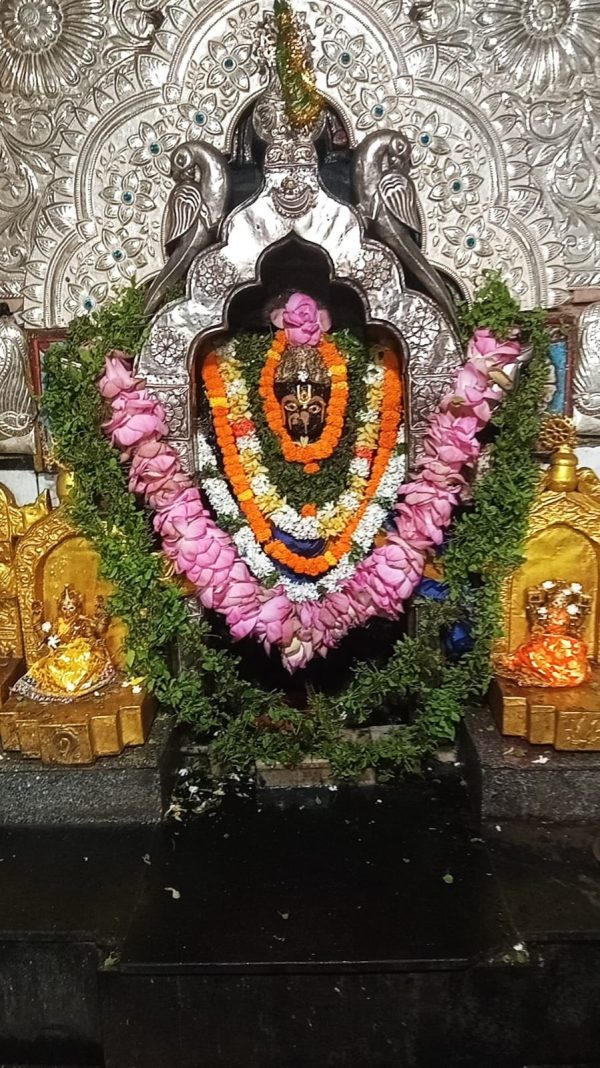
As per Odia folklore and religious beliefs of the state’s culture that revolves around Lord Jagannath and old Vaishnava worship, Lord Nilamadhaba is one of the manifestations of Lord Vishnu. Nilamadhaba was being worshipped here before he came to be worshipped as Lord Jagannath at Puri. Nilamadhaba, or ‘Neela Madhava’ is one of the 24 principal names of Lord Vishnu in Vishnu Sahasranama (the 1000 names of Vishnu). Historical references say that the worship of Nilamadhaba was popular in Odisha for over 1000 years, from around 4th century AD.
In Odisha, the Nilamadhaba worship was centred around 4 rivers, Mahanadi, Rushikulya, Baitarani and Prachi. Kantilo is a place situated on the bank of mighty Mahanadi, the Nayagarh district of Odisha, about 110 Km away from Puri.
Folklore says Lord Vishnu appeared as an wooden idol in the form of Nilamadhaba here in Kantilo first.
Kantilo Nilamadhaba temple on the banks of Mahanadi river, image from XNilamadhaba, the manifestation of Vishnu
Odia lore credits a Satya Yuga king named Indradyumna for the construction of the Jagannath temple and the first commissioning of the distinct idols of Jagannath, Balabhadra and Subhadra, along with Sudarshana in Puri.
The pious king was blessed with a divine dream by Lord Vishnu himself. The Lord told Indradyumna that he has manifested in the form of Nilamadhaba in a place on the banks of Mahanadi in Odra Desha, where the Shabara (tribe) chief is worshipping him under a giant tree. Learning of this, Indradyumna sent his trusted Brahmin priest Vidyapati to locate the idol of Nilamadhaba and bring him to Purushottama Kshetra (Puri) to be worshipped in a grand temple.
Vidyapati travelled far and arrived in the tribal kingdom, where tribal chief Bishwabasu lived with his tribe. Vidyapati sought friendship and shelter in the tribal realm, which he was given, on Bishwabasu’s orders. Eventually, Vidyapati fell in love with Lalita, the daughter of Bishwabasu and married her. He noticed that Bishwabasu was often disappearing into the forest to worship Nilamadhaba at a secret location, he had no idea about.
Upon Vidyapati’s request, Lalita convinced her father to take Vidyapati for a darshan of Nilamadhaba. Bishwabasu agreed, but he blindfolded Vidyapati during the journey into the depths of the forest. Clever Vidyapati had concealed a handful of mustard seeds with him, which he kept sowing on the path.
After Vidyapati had the darshan of Nilamadhaba, he went back to his king, revealing that he had located Nilamadhab in the tribal realm. King Indradyumna arrived with his entourage and followed the path of the mustard plants now growing on the forest trail, only to be disappointed. Nilamadhaba had disappeared from his abode.
Disheartened at the failure, King Indradyumna started a tough penance, renounced food and water and started meditating for Lord Vishnu to appear before him. Lord Vishnu did not disappoint his bhakta, he spoke to Indradyumna again, and told him that he would appear as ‘Daaru Brahma’ (divine log of wood) on the beaches of Puri, and instructed Indradyumna to get a grand temple built for him, where he will be worshipped as Jagannatha.
When Indradyumna found the Daaru Brahma, he brought them to the palace. Lord Vishwakarma, the divine architect, appeared as an old carpenter to carve idols from the logs. But the old carpenter had a condition, nobody should disturb him while he worked behind closed doors, with absolute secrecy.
And so Vishwakarma started carving the idols. After seven days, the king and queen grew restless, they opened the doors to the workshop, only to find Vishwakarma vanished, leaving behind three grand idols of Jagannath, Balabhadra and Subhadra, with unfinished hands and feet. The incomplete, yet unique idols were enshrined in the grand temple, and to this day bless millions of devotees in Puri.
The king did not forget his duty towards the tribals either. Lalita’s tribe was known as ‘Daitapati’, and were granted the status of special sevayats for Lord Jagannath in the temple. To this date, Lalita’s descendants, the Daitapatis, are the special sevayats of Lord Jagannath. Every 12 years, the idols are given a ‘Naba Kalebara’ where new idols are carved from the logs of Neem trees. The location of the Neem trees are revealed to the Daitapatis in dream. The trees bear the distinct marks of Lord Vishnu, in the forms of Shankha (conch shells), Chakra, etc.
Two recent incidents in Maharashtra—the Nagpur violence triggered by protests against Mughal emperor Aurangzeb and the vandalism of Mumbai’s Habitat Studio following “comedian” Kunal Kamra’s provocative remarks—expose the glaring hypocrisy of left-leaning intellectuals and their shameless intellectual dishonesty in their selective outrage against two incidents, both of which ended up in grave loss to private property.
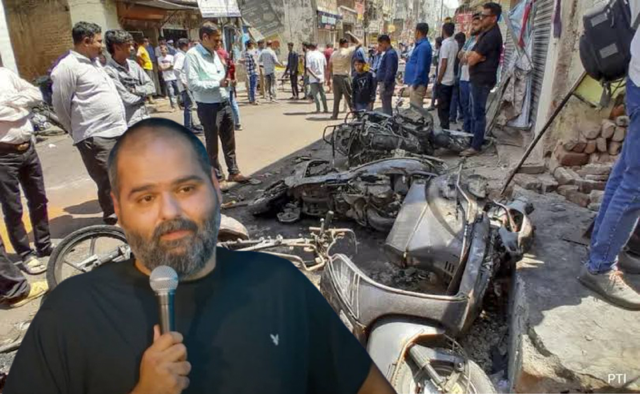
While the Nagpur riots saw a furious Muslim mob indulging in arson and destruction of public property, stone-pelting, and torching of private vehicles, the Mumbai incident involved Shiv Sena workers attacking a venue after Kamra’s politically charged jabs at their leader. Yet, the response from the so-called liberal intellectual class has been jarringly inconsistent.
The vandalism in Mumbai was provoked by washed-up comedian Kunal Kamra, who in a meticulously crafted “skit”, criticised former Maharashtra CM Eknath Shinde. On Sunday, 23rd of March, Shiv Sena workers reportedly vandalised the hotel – The Unicontinental Mumbai, in Khar – where Kunal Kamra did his “comedy” skit. Members of Shiv Sena also gathered outside various police stations demanding action against Kamra.
In his skit, Kunal Kamra performed a parody song set to the tune of the 1997 Bollywood song ‘Dil to pagal hai’. In that, he had referred to Chief Minister Eknath Shinde as ‘Gaddar’ (traitor) for his defection in 2022.
#WATCH | Mumbai: Shiv Sena (Eknath Shinde faction) workers vandalised Habitat Comedy Club in Khar after comedian Kunal Kamra's remarks on Maharashtra DCM Eknath Shinde here sparked backlash. (23.03)
And in no time, the left-leaning liberals on X pulled in support of Kunal Kamra, who instigated vandalism with his political commentary laced as “humour”, days after they held Hindu Groups responsible for Nagpur violence because they criticised Mughal tyrant Aurangzeb and called for the removal of his tomb in Sambhaji Nagar.
Nagpur violence: Whitewashing rioting by Muslim mobs
Nagpur witnessed large-scale violence when Hindu groups, led by the Vishwa Hindu Parishad (VHP) and Bajrang Dal, protested against Aurangzeb’s legacy and demanded the removal of his tomb. This, in turn, triggered an aggressive backlash from a Muslim mob that resorted to vandalism, torching vehicles, and attacking police officers.
Instead of outrightly condemning the rioters, several left-wing commentators rushed to justify, arguing that the violence was a reaction to “provocation.” They suggested that the protesters had crossed a line by demanding the removal of Aurangzeb’s tomb and that this somehow “explained” the violent backlash. The irony is hard to miss—these are the same voices that preach the virtues of free speech and tolerance but suddenly found excuses when Islamist mobs went on a rampage.
Mumbai vandalism: Defending Kunal Kamra while condemning Shiv Sena
Contrast this with the reaction to the vandalism of Habitat Studio in Mumbai. Kamra, known for his politically charged comedy, mocked Maharashtra Deputy Chief Minister Eknath Shinde, calling him a ‘gaddar’ (traitor). Shiv Sena workers took offence and vandalised the venue. This time, the same intellectuals who had excused the Nagpur violence as a “reaction to provocation” suddenly rediscovered their commitment to free speech.
They rushed to defend Kamra, arguing that satire is a fundamental part of democracy and that Shiv Sena’s reaction was an attack on artistic freedom. Nowhere did they apply the same logic they had used in Nagpur—that provocations can lead to violent reactions. Instead of introspecting on whether Kamra’s remarks might have incited anger, they squarely placed the blame on Shiv Sena workers.
India Today journalist Rajdeep Sardesai defended violence that enveloped Nagpur last week, justifying it as a fallout of protests against Aurangzeb’s tomb. “To unleash a hate-filled narrative where you want to go and demolish Aurangzeb’s tomb, you must be prepared for some reaction and a backlash,” Rajdeep Sardesai says in a snippet that has since gone viral on the internet.
This week, Rajdeep pivoted to take a swipe at PM Modi over his “criticism is the soul of democracy” remark. “Will anyone in govt (state or centre) speak up to defend Kamra’s right to free expression? Didn’t like what the stand-up comedian said? Don’t watch!” Sardesai said.
Rajdeep Sardesai’s mental gymnastics in the span of a week
Curiously, Rajdeep didn’t invoke the “Don’t like it, don’t watch it” mantra when hundreds of Muslims in Nagpur orchestrated a violent rampage against Hindu protests over Aurangzeb’s tomb. But when the tables turned—with Shiv Sena workers vandalizing a Mumbai studio after being provoked by Kamra’s “humour”—he suddenly reached for the “right to free expression” argument to condemn the attackers.
Rajdeep is not the only one to somersault and blame the vandals instead of criticizing Kunal Kamra for hurting their sentiments and inciting their anger. Others of the left-leaning intelligentsia shamelessly lined up to rightfully condemn vandalism, but in the process exposed their own selective outrage and intellectual dishonesty.
The hypocrisy of selective outrage
The blatant double standards are impossible to ignore. When Islamist mobs in Nagpur reacted violently to protests against Aurangzeb, the Left defended them, arguing that Muslims were pushed against the wall with unabated criticism of Mughal ruler Aurangzeb, throwing word salad to defend their tenuous stance, and justifying the continued veneration of Aurangzeb by a significant section of the Muslim population.
But when Kamra made provocative remarks against a contemporary political figure, the same group conveniently shifted its stance—now, the responsibility was solely on the offenders, and provocation was no longer an excuse.
If one believes in free speech, it must be defended consistently. If provocations are a valid excuse for one group’s violent reaction, the same logic should apply to the other. However, the selective outrage from left-leaning intellectuals exposes a deeper problem—their response is dictated not by principles but by ideological biases.
Democracy thrives on free speech, but it also demands intellectual honesty. Both the Nagpur riots and the Mumbai vandalism were acts of violence triggered by perceived provocation. If one is condemned, so should the other. But when certain intellectuals engage in mental gymnastics to justify one and denounce the other, they reveal their ideological blind spots. If free speech is sacrosanct, it must be upheld for everyone—not just for those who align with a particular political ideology.
In his address at the annual function of RSS Delhi on December 7th, 1947, M.S. Golwalkar, the second Sarsanghchalak (Chief) of RSS, declared, “Swayamsevaks would prefer to burn themselves to ashes in the cause of their Motherland, her defence, honour and culture. To save Hindutva is the sacred mission of the Sangh. With that firm determination, we are facing our problems and no one, not even the Creator of the Universe, can stand in our way of achieving true Bharatiyatva.”
Guruji, as he was fondly called right from his days of teaching at BHU, a disciple of Swami Akhandananda, had the crux of the RSS mission imbued in that statement. While the organization that had umpteen misgivings and accusations hurled at it ever since its founding days in 1925 steps into its centenary year, it remains well entrenched in India’s heartland with around 5 – 6 million members and more than 73,000 Shakhas (branches) nationwide. Indeed, RSS’ essence remains a cultural organization, away from active power politics – though its ideology has distinctly shaped and nurtured the democratic politics of Bharat.
How is RSS shaping the tenets of the education system in Bharat, across technological advancements and deep-rooted wisdom of Rishis and Puranas?
How is RSS shaping the education system?
There are multiple aspects of the notion of cultural nationalism that RSS exemplifies. Education is one of them. It is to be noted that at the heart of this is an effort around ‘intellectual decolonization’, with an aim to move away from the vestiges of Eurocentrism. It also centres around ‘inclusive nationalism’, which celebrates the plurality of Indian cultures.
Akhil Bharatiya Pratinidhi Sabha (ABPS), the apex policy-making body of RSS, in its 2016 Resolution (No. 2) at the ABPS Sabha held in Nagaur, Rajasthan, laid down clear guidelines around how the education system in contemporary India should be like. “…Every child should get value-based, nationalistic, employment-oriented and skill-based education in an atmosphere of equal opportunity. It is utmost essential to ensure proper training, appropriate salaries and strengthen the dutifulness of the teachers to enhance their standard” – should be the driving force behind India’s education system.
RSS has been of the opinion that the purpose of education is not merely to enable the student to earn a livelihood but also to impart values of patriotism, the spirit of service, and social responsibility. The medium of education should be Bharatiya languages. Hindi as a National Link Language should be encouraged. Working knowledge of one foreign language like English, French, German, etc should also be imparted. The prime goal should be character-building education, not sex education. Focus on Sanskrit should be given.
Ever since Guruji established the first Gita school at Kurukshetra in 1946, Saraswati Shishu Mandirs began to operate in 1951, promoted by Nana Ji Deshmukh, Deendayal Upadhyaya, and Rajju Bhaiya. This subsequently mushroomed into nearly 25,000 schools. Later, many other schools and colleges, initiated by Sangh-inspired people, got nurtured under the overarching apex body Vidya Bharati. Most of the Vidya Bharati schools are affiliated to CBSE or their local State Boards. ‘Sanskar Kendras’ (cultural schools) are also run to impart moral values to young minds. The National Education Policy (NEP) 2020 saw a copious footprint of RSS’ educational ethos.
Key themes were universal access of education at all levels, early childhood education (shape young minds in line with our cultural roots), Foundational Literacy and Numeracy, increased flexibility to choose courses, mother tongue or regional language as medium of education till Class 5 (promote regional language to train pupils), Gender Inclusion Fund and Special Education Zones for disadvantaged regions and groups, and others. As can be seen, RSS’ goal of imbibing a deep sense of cultural nationalism to young minds has been given a fillip through NEP 2020.
‘साविद्यायाविमुक्तये’ (Sa Vidya Ya Vimuktaye) – goes the motto of Vidya Bharati. Originally present in Verse 1.19.41 within Vishnu Purana, the phrase means – ‘That is knowledge which liberates’. Indeed, the stellar service rendered by Vidya Bharati and other educational institutes under RSS’ fold have been nurturing Bharat’s young minds to liberate themselves from colonial bondage and embrace the best of what India’s priceless heritage offers.
Resistance to NEP
American author Orison Swett Marden said, “Success is not measured by what you accomplish but by the opposition you have encountered and the courage with which you have maintained the struggle against overwhelming odds.” BJP-led NDA govt at Centre has probably seen this first hand, day in and out. Karnataka and Tamil Nadu vehemently protested against NEP 2020. TN’s primary opposition is the 3 language formula, which to them is a covert attempt at imposing Hindi. In reality, it has been made amply clear that no language will be imposed on any State.
In it’s 2018 resolution, ABPS came up with the view that ‘The languages and dialects, prevalent in the country are most essential to protect our culture, noble traditions, excellent knowledge and vast literature as well as to promote creative thinking.’ The 3 language formula is perfectly aligned to that by keeping flexibility of choice to States and individuals while ensuring that at least 2 of the 3 languages are native to India. There can’t be a more balanced approach that lays focus on both modernity and tradition! Why the Opposition from DMK and Congress then?
The short answer is politics. TN’s opposition stems from the inflamed sentiments against Hindi imposition that shaped Dravidianist polity in mid 20th Century. Right through 1937-40, 1948, and 1965, TN had seen agitations. It is ironic that the 1968 NPE had in fact mandated Hindi, unlike NEP 2020. It stated, ‘Every effort should be made to promote the development of Hindi.’ As a consequence of the agitations, TN had seen a two-language policy (Tamil and English) being institutionalized. The ‘link language’ as a consequence was clearly missing for TN. Bharat’s root can be best understood by using common parlance across its length and breadth, its sounds and colours – and TN being such a profoundly cultural state replete with temples and heritage deserves this more so.
More politics by TN
DMK took the misaligned resistance to NEP 2020 a step further by refusing to partake in the PM SHRI initiative. PM Schools for Rising India (PM SHRI) was approved by the Cabinet in 2022 and it aims to set up more than 14,500 schools that enshrine the tenets of NEP 2020. The schools aim at being exemplary schools for children, and by linking a noble cause as this to petty regional politics, DMK only did a disservice to deserving pupils of the State!
Curious case of Congress’ opposition to NEP 2020
The most bizarre, and downright ludicrous, instance of opposition to NEP 2020 has been from INC. The first National Education Policy of 1968 was introduced by the then PM Smt Indira Gandhi, on the recommendations of the Kothari Commission18 (1964-66). Of the various recommendations therein, a section was devoted to the 3-language formula. Hindi was clearly called out as the ‘link language’, an idea that RSS also holds. It further mentioned, ‘In developing Hindi as the link language, due care should be taken to ensure that it will serve, as provided for in Article 351 of the Constitution, as a medium of expression for all the elements of the composite culture of India.’
The same Congress is now holding placards against Hindi imposition when NEP 2020 mentions nothing of that kind.
The shortcomings of NPE 1968 were highlighted by Ramamurti Review Committee (1990) and Janardhan Reddy Committee (1992), findings from which were incorporated into the new NEP 2020 drafted by K. Kasturirangan Committee. Naturally, not only is NEP 2020 a more flexible set of guidelines as relates to the 3-language formula, but it is an improved version of the earlier NPE too. Hence, the party that should worry and oppose the least around NEP 2020 or ‘Hindi imposition’ is Congress!
Best of past and present
In a letter as a reply to Maharaja of Khetri, dated 04.03. 1895, Swamiji wrote, “…It is out of this past that the future has to be moulded; this past will become the future. The more, therefore, the Hindus study the past, the more glorious will be their future, and whoever tries to bring the past to the door of everyone, is a great benefactor to his nation.” NEP 2020 is moulded in a similar frame, with the best of our ancient wisdom and modern advancements playing their part in tandem. It remains to be seen though if the new education policy gets to shape new India and its brilliant minds in ways more glorious than we could possibly imagine, or it gets sacrificed at the altar of self-serving politics!