Home Blog Page 5233

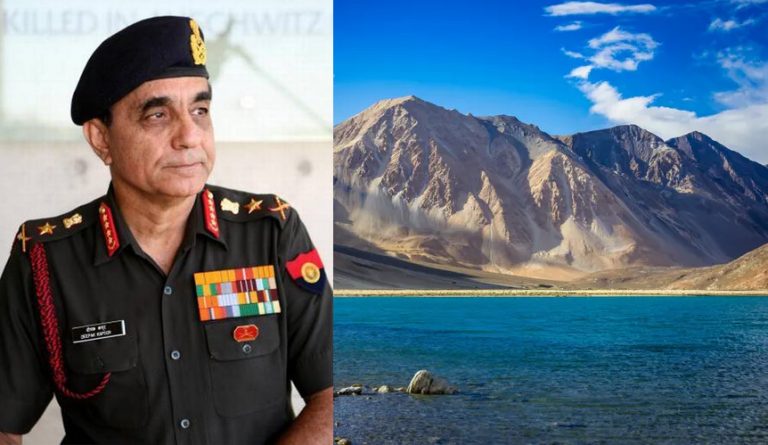
‘We are on the brink of yet another border skirmish with China, especially in Pangong Tso’: Former Army Chief General Deepak Kapoor

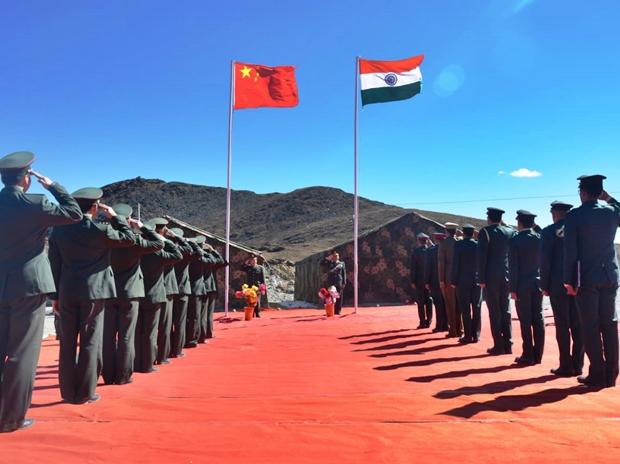
As tensions continue to simmer between Indian and Chinese forces along the Line of Actual Control (LAC) in Eastern Ladakh, the former Indian Army Chief General Deepak Kapoor has remarked that the situation in the border areas, especially in Pangong Tso region, may lead to another border skirmish between the two sides after the deadly clashes that erupted in Galwan Valley on June 15.

Repudiating the possibility that a full-fledged war is in the offing, the ex-Army Chief General Kapoor said that he disagreed with the ubiquitous public perception that a war with China is imminent. However, he added border clashes like that happened on June 15 may likely happen in other regions along the LAC. “The possibility that border skirmish like that happened in Galwan Valley is very much there, especially in Pangong Tso region,” General Kapoor said.

Claiming that he is not at all surprised by the Chinese treachery after reports of a massive build-up of Chinese camps and structures yet again at the flashpoint in Galwan Valley, General Kapoor said, “I am not surprised by these Chinese manoeuvres. Till the time we reach a conclusion, both sides agree and all the facts are verified, we have to be prepared for any activities from the Chinese side, be it in the Galwan sector, Depsang sector, Chumar sector, Dongchong area, Sikkim, or towards Arunachal sector. However, I believe the Armed Forces of the country are prepared for any eventuality and we won’t be found napping in any of these sectors.”

Days after the violent clashes in Galwan Valley in eastern Ladakh that resulted in the deaths of 20 Indian Bravehearts and an undisclosed number of Chinese casualties, India Today journalist Shiv Aroor asserted that the focus has now been shifted to the Pangong Tso lake where the intruding Chinese troopers are in ‘eyeball to eyeball’ situation with their Indian counterparts. He also stated that the region has seen 62 new Chinese positions and about 300 structures such as camps and observation posts erected up by the People’s Liberation Army(PLA). The Chinese positions on the top of Finger 4 ridgeline now overlook the Indian positions, making the Indians sitting ducks for the PLA, opined Strategic thinker–Brahma Chellaney.

Violent clashes between Indian and Chinese troops in Galwan Valley

At least 20 Indian soldiers, including Commanding Officer, had attained martyrdom in the violent clashes with the Chinese troopers in Eastern Ladakh’s Galwan Valley, the Indian Army said on Tuesday. The Army had initially claimed that 3 soldiers, including one Commanding Officer, were killed in the skirmishes but later in the evening it revised the figure to 20 saying 17 others had succumbed to their injuries due to the prolonged exposure to sub-zero temperatures.

Though Beijing remained reticent on the number of casualties suffered by it, the Indian Government said that the Chinese side endured heavy casualties with close to 43-45 PLA soldiers been seriously injured or killed in the clashes. Now, a US intel report has stated that at least 35 Chinese soldiers have perished in the brawl at the Galwan Valley.

The killing of the Indian soldiers marks the Indian Army’s worst losses since the Kargil War in 1999 and signifies the most intense military combat between India and China since 1967 when about 80 Indian soldiers and at least 300 Chinese PLA troops were killed in the course of the savage skirmishes that broke out near the Nathu La and Cho Lo passes, the strategic gateway to the crucial Chumbi valley.
India to withdraw 55 staffers from the Indian High Commission in Islamabad in the next seven days

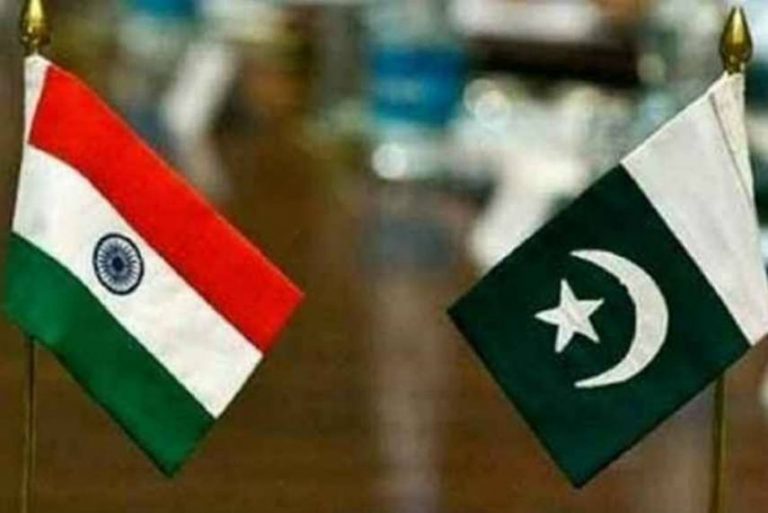
The Indian government has decided to withdraw 55 of its officials working at the Indian High Commission of Islamabad. The decision has been mutually agreed between both countries to reduce the strength of working staff by 50%. Pakistan will also be withdrawing staff from the Pakistan High Commission in New Delhi with the same proportion.

India also announced on Tuesday that the strength of Pakistan High Commission in New Delhi will also be reduced to half along with the ongoing process in Islamabad in order to downgrade the diplomatic relations with Pakistan.

The proposal to cut down the employee strength in the Indian Mission came after horrifying details of the torture of Indian diplomats in Pakistan came to light on June 16.

The decision also came on the heels of the mistreatment meted out to the Indian diplomats in Pakistan, who were abducted by Pakistani security agencies before being tortured and framed in a false case of a road accident and possession of fake currency.

In another incident, Pakistani diplomats working in the Pakistani High Commission in New Delhi were caught on the charges of espionage by India.

The Ministry of External Affairs on Tuesday summoned Pakistan’s Charge d’ Affaires Syed Haider Shah and informed him about India’s concerns regarding the activities of officials of his mission, who have been involved in espionage and associated with terror outfits.

Pakistani agencies captured and tortured Indian high comission staffers in Islamabad

The two Indian High Commission staffers, who were abducted by Pakistan’s ISI and were later released on Monday, were tortured to confess that ‘they were involved in an accident’. As per sources, the two Indian staffers of the High commission working as drivers were picked up by 15-16 armed men at around 8:30-45 am from a fuel station near the high commission.

The ISI officers had blindfolded the two Indian staffers with a rucksack and took them to an unknown location. It was further reported that the abductors made multiple videos in which Indian High Commission officials were forced to confess under coercion that they were involved in an accident.

Armed Pakistani men also forced them to confess that there are “Intelligence officials” inside the Indian High Commission who order them to bring people from outside in their cars for a meet inside the High Commission. The Indian diplomatic officials were repeatedly beaten with rods/wooden sticks, punched and made to drink filthy water.

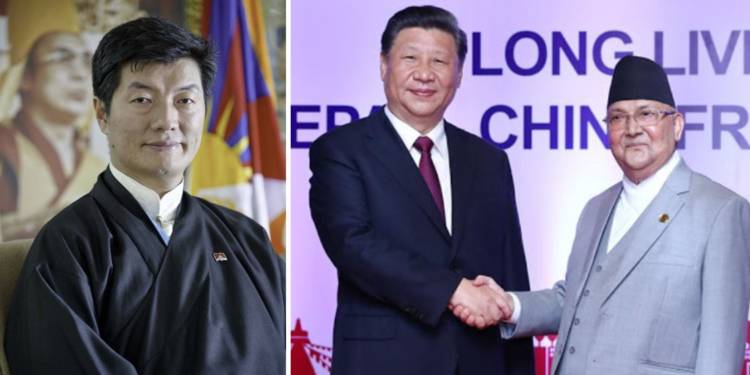
President of Tibetan govt-in-exile warns Nepal, says after occupying Tibet, Beijing looking to accomplish its “Five-fingers-plan”

Slamming China for its “expansionist policies”, the President of the Tibetan government-in-exile, Lobsang Sangay has warned Nepal that China has been looking at occupying the entire sub-continent since the 1960s after the occupation of Tibet. Sangay said that what China did with Tibet, it is looking at emulating the same with Nepal. In a bid to bolster its expansionist policies in the Indian subcontinent region, “China is driving a wedge between centuries-old Indo-Nepal relations to quietly colonise the Himalayan country,” said the Tibetian president Lobsang Sangay in an interview with WION.

President of the Tibetan government-in-exile speaks of China’s “five-finger” plan

Speaking to WION on Chinese combativeness, Sangay said that the Chinese leadership had stated that Beijing was looking to accomplish its ‘Five Finger’ plan, where Tibet was the palm, while Ladakh, Nepal, Bhutan, Sikkim and Arunachal Pradesh, the five fingers.

Sangay was quoted in the article as saying: “After the occupation of Tibet, in the 60s, Chinese leaders said Tibet is the Palm, now they have to go for 5 fingers-Ladakh, Nepal, Bhutan, Sikkim and Arunachal Pradesh”.

Condemning the death of the Indian soldiers in Ladakh’s Galwan valley, Sangay said: “So in 2017, you have Doklam incident that borders Sikkim and Bhutan, and then now you have Ladakh. This is all part of the grand, long term expansionist strategy which they had and are implementing now.”

For the uninitiated, recently, as many as 20 Indian soldiers had lost their lives in a violent clash in Galwan Valley after the Chinese troops attempted to unilaterally change the status quo during the de-escalation in eastern Ladakh.

President of the Tibetan government-in-exile warned Nepal of meeting similar fate like Tibet

Providing a blueprint of how China’s expansionist policies are set into motion, Sangay talks about how Tibet was occupied by China. He says the Chinese first built a road from China to Tibet stating that it will bring prosperity to Tibetans and once the road was built, trucks, tanks and guns followed. Soon enough, Tibet was occupied. Sangay cautioned Nepal that similar fate awaits them as well if they do not distance from China.

“In the process, they have a very shrewd strategy, which is called elite co-optation–which is to buy off all the elites. Go after your political leaders, your business leaders, intellectuals, your journalist, and your Dharmic leaders. They buy of each of the sectors of the community which are elite at the top. So when the actual occupation happens, you realise that elite in the country is divided, one supporting china and one supporting own country”, said Sangay to WION.

The article mentioned that the Chinese Communist Party led by President Xi Jinping “is looking to bolster its expansionist policies in the Indian subcontinent region.

The article claims that the incursions into Ladakh and other regions by the People’s Liberation Army’s (PLA) proves beyond doubt that China is planning a bigger conspiracy.

China maliciously expanding its road network to encroach Nepal

As per reports, Nepal’s Survey department published a report where in it showed how China had encroached upon 10 of 11 places consisting of about 33 hectares of land. China has done so by diverting flow of rivers which acted as natural boundary between two countries. Chinese construction work in Humla district diverted Bagdare Khola river and Karnali river wherein China took over 10 hectares of land. Similarly, China took over about 6 hectares of land in Rasuwa district after ‘construction work’ in Tibet diverted Sinjen, Bhurjuk and Jambu Khola. 11 hectares of Nepali land was claimed by China for ‘falling in Tibet’ after Kharane Khola and Bhote Kosi in Sindhupalchowk district were diverted.

However, the feud between India and Nepal which has been brewing since May after the latter released a controversial new political map, which shows the disputed territories of Limpiyadhura, Lipulekh and Kalapani within its borders, has forced Nepal to turn a blind eye to Chinese encroachment.

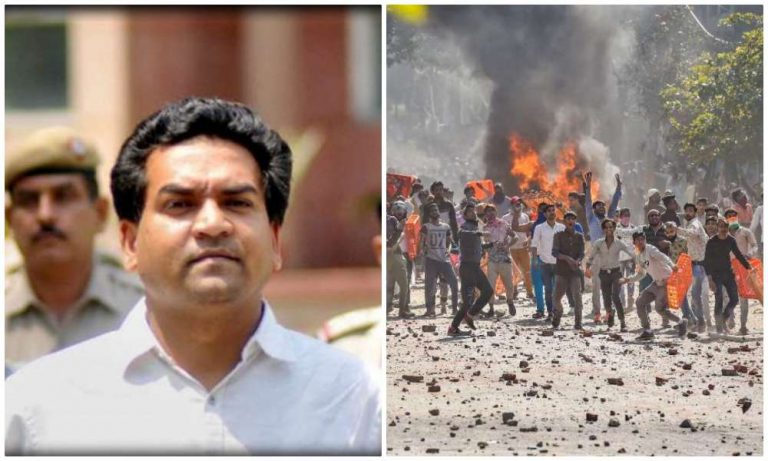
Kapil Mishra says Indian Express report on constable Ratan Lal chargesheet misleading and full of lies, used to malign him

BJP leader on Wednesday took to Twitter to say that the Indian Express report on charge sheet of Constable Ratan Lal’s murder by rioting anti-Hindu mob in February this year is misleading and a deliberate attempt to spread malicious rumour against him.

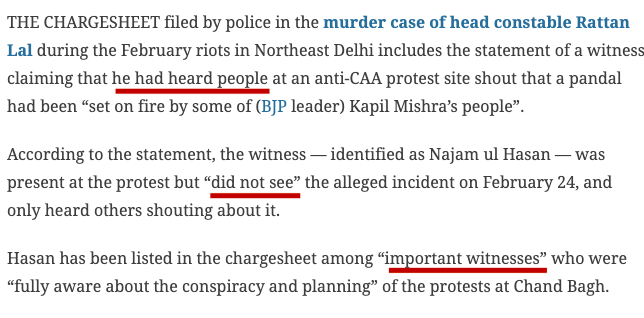
Mishra was referring to the Indian Express report titled “Witness in Delhi Riots Chargesheet: ‘I heard people shouting Kapil Mishra’s men set pandal on fire’” wherein one witness identified as Najam ul Hasan who had heard the rumour that a pandal has been set on fire by Mishra’s men but not seen the incident, was referred to as an ‘important witness’ to cast aspersions that Mishra incited the riots.

Indian Express’ report on Constable Ratan Lal’s murder charge sheet

The headline of the article mentions only part of his statement where he only “heard” people shouting that Mishra’s men had set a pandal on fire. Not that he never saw any such incident.

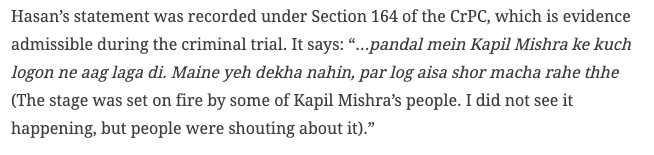
The Indian Express in later part of the report mentions how Hasan’s statement itself says that he did not see any of Mishra’s men setting any pandal on fire. He only heard the rumours.

Hasan’s statement

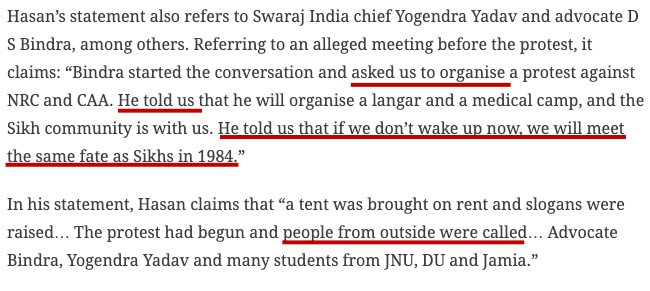
Interestingly, while Indian Express chose to cast aspersions on Mishra over rumours someone heard about a pandal being set on fire, the same reporters choose to refer to a meeting the same witness Hasan attended as an ‘alleged meeting’.

Indian Express quoting Hasan’s statement on Bindra

Advocate D S Bindra, who was hailed by media for organising langar at Shaheen Bagh and other protest sites, was mentioned by Hasan in his statement as having told the Muslims to ‘wake up now’ or they will meet ‘same fate as Sikhs in 1984’. In 1984, following the assassination of then Prime Minister Indira Gandhi by her Sikh bodyguards, widespread riots took place in India where Sikhs were specifically targeted by mobs especially led by Congress leaders. Congress leader Sajjan Kumar is convicted and currently serving life term for his role in 1984 Anti-Sikh riots.

Indian Express also chooses not to mention that Advocate DS Bindra is an AIMIM (All India Majlis-e-Ittehadul Muslimeen) leader. In fact, Indian Express claims that while Bindra and Swaraj India leader and former AAP cofounder Yogendra Yadav were named in the charge sheet for alleged “links” to “organisers of the (Chand Bagh) protest site”. Indian Express chooses not to disclose that the charge sheet categorically mentions, “The accused persons further combinedly disclosed that along with them D.S Bindra, Dr. Rizwan, Athar, Shahdab, Upasna, Tabbsum, Ravish and others were involved in the conspiracy behind the ChandBagh riots.”

Another accused, Mohd Saleem Khan (Organiser of the Chand Bagh protest) had revealed that about two months ago, DS Bindra had started community kitchen at service road, Wazirabad road, ChandBagh. Because of the community kitchen, a rather large crowd used to assemble there. He, along with Salman Siddiqui, Dr Rizwan, Salim Munna and others used to visit the community kitchen. DS Bindra instigated him and other Muslims to oppose CAA/NRC strongly and he stressed that people should come on the road to show their dissent.

The chargesheet also categorically states that the conspirators “were fully aware that violence may ensue and had accordingly directed the protestors to arm themselves”.

However, Indian Express chose to turn a blind eye to all these facts in the charge sheet.

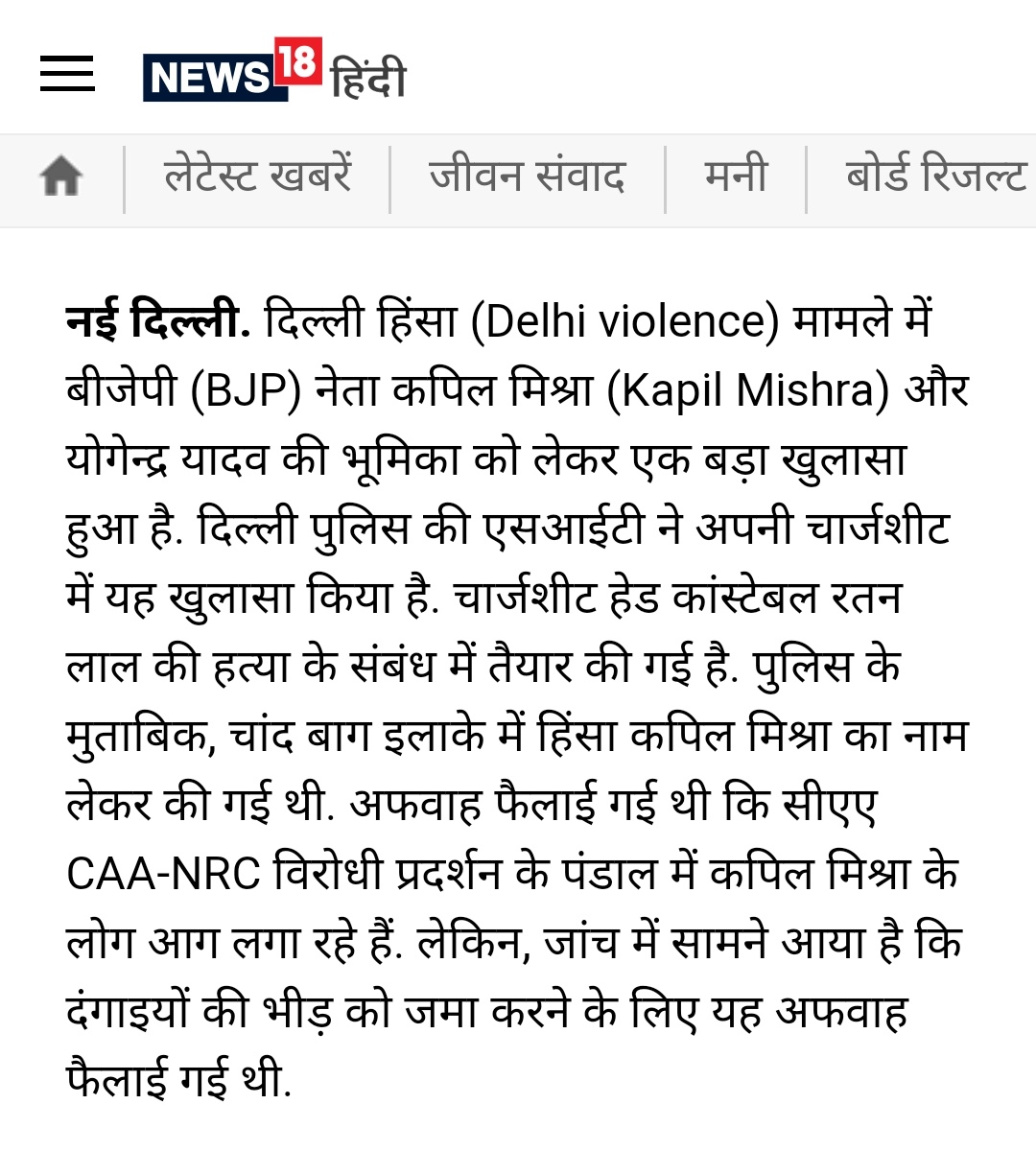
News18 in its report mentioned how the Delhi Police SIT has mentioned in the charge sheet that a rumour was spread in Mishra’s name that a pandal which was set up to protest against the CAA and NRC was set on fire by Mishra’s men.

News18 report

However, by the time this report was published, News18 has deleted the report without any explanation.

Did you know Congress govt had agreed for de-militarisation of Siachen and proposed joint-monitoring of the strategic glacier with Pakistan: Read details

The recent clashes along the Line of Actual Control (LAC) have now ignited a series of debates over the failure of the previous governments to secure the country’s national interest, especially along the borders.

Since last few days, the strategic blunders committed by the past governments, especially during the Nehruvian era have once again become a talking point, reminding us the cost that our country has paid due to the lapses committed by previous regimes, especially by the Congress party.

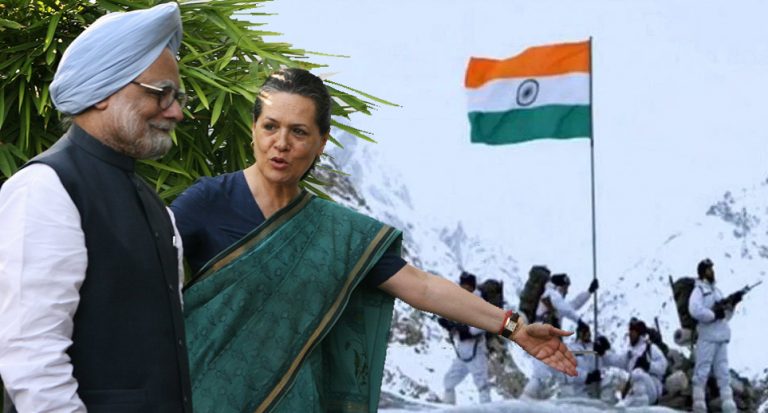
The indifference of the Congress party over critical national security concerns, especially during the UPA era would have cost us another important strategic asset. The Siachen glacier, which has immense strategic value to Indian security forces to keep an eye on both the Pakistan and China along the northern borders, was almost gifted to Pakistan by the Manmohan Singh government in 2006, but only to be stopped by the intervention of the then National Security Advisor (NSA) MK Narayanan.

In his book “How India Sees the World”, former Foreign Secretary Shyam Saran has revealed how India and Pakistan had nearly agreed to an agreement to not only de-militarising the Siachen Glacier but also agreed on the mutual withdrawal of troops from the area. The UPA government had also proposed a joint-monitoring mechanism of the Siachen area to check the incursions once troops are withdrawn from the heights.

According to Saran, India and Pakistan had nearly come to an agreement on de-militarising the Siachen Glacier at least three times before – in 1989, 1992, 2006. Interestingly, the two prior discussions pertaining to Siachen, once in 1989 and 1992, had also taken place during the Congress rule.

The book states that the first agreement was reached during the Rajiv Gandhi era in 1989 to de-militarise the Siachen area, which according to Saran, did not materialise due to Pakistan’s disagreement over the deal. Again in 1992, during the PV Narasimha Rao government, an attempt was made to the mutual withdrawal of forces from the Actual Ground Position Line (AGPL). However, the Congress government had taken a political decision not to further the talks on Siachen issue and left it to the next round of talks.

UPA government had agreed to withdraw troops form Siachen glacier

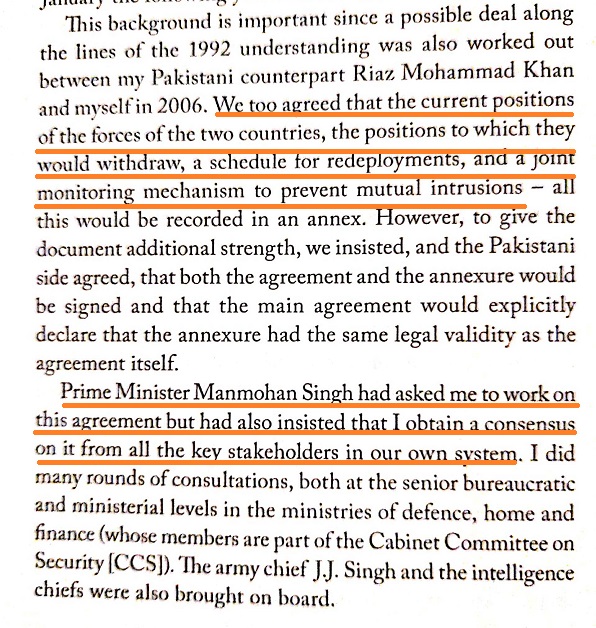
Shyam Saran, who was the Foreign Secretary in the First Manmohan Singh government, in his book revealed that, in 2006, he along with his Pakistani counterpart Riaz Mohammad Khan had struck a deal on orders of Congress government to take back Indian troops and give away the Siachen Glacier to Pakistan.

In his book, Shyam Saran even records that the two sides had even agreed on authenticating ground positions of the troops before the deal fell apart. Sharan further writes that Manmohan Singh wanted to settle the deal with Pakistan by handing over Siachen glacier for which all stakeholders consented.

“To give the document additional strength, we insisted, and the Pakistani side agreed, that both the agreement and the Annexure will be signed and that the main agreement will explicitly declare that the annexure had the same legal validity as the agreement itself,” writes  Sharan.

“Prime Minister Manmohan Singh had asked me to work on this agreement but had also insisted that I obtain a consensus on it form all the key stakeholders in our own system. I did many rounds of consultations, both at the senior bureaucratic and ministerial levels in the ministries of defence, home and finance (whose members are part of the Cabinet Committee on Security (CCS).”

Image Source: How India sees the World: Kautilya to 21st century/Shyam Saran/ Page No.90

The former Foreign Secretary then writes that the then Army Chief JJ Singh and all chiefs of the Intelligence Agencies were brought on board. The deal was even consented by the Indian Army and mentioned its finer points, including current positions of the forces of the two countries, the positions to which they would withdraw, a schedule for redeployment, and a joint monitoring mechanism to prevent mutual intrusions. All this would have been recorded in an annexure to the main agreement.

After the initial examination and agreement to it by all the relevant stakeholders of the security establishment, the draft agreement was then presented to the Cabinet Committee on Security, the final decision-making body on the issues of national security.

NSA MK Narayanan objected to the deal on Siachen with Pakistan

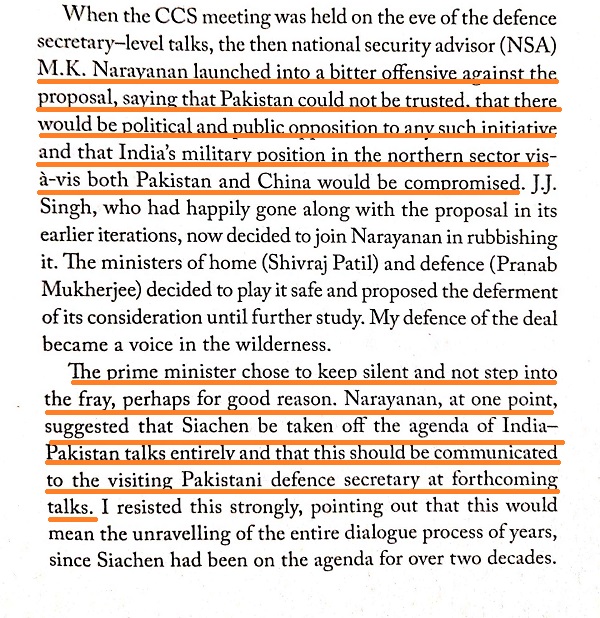
But it was during the CCS meet, the NSA MK Narayanan raised serious concerns about the deal and argued about compromising the National security of the country.

“When the CCS meeting was held on the eve of the Defence Secretary-level talks, the then national security advisor (NSA) launched a bitter offensive against the proposal, saying that  Pakistan could not be trusted, and that there will be political and public opposition to any such initiative and that India’s military position in the northern sector vis-à-vis both Pakistan and China will be compromised,” Shyam Saran reveals in his book.

The former Foreign Secretary added that General Singh, who had happily agreed to the proposal before, had now decided to join Narayanan in rubbishing the deal of the UPA government to cede control over Siachen glacier. It was only after MK Narayanan raised concerns, the Chief of the Army also agreed that the Siachen deal was not safe and would put India in grave danger, the book reads.

In the meeting, then Home Minister Shivraj Patil and Defence Minister Pranab Mukherjee, however, stayed quiet and played safe in front of NSA chief as they did not endorse such a deal that would provide an opportunity to Pakistan to re-occupy the heights of Siachen. The then PM Manmohan Singh, who desperately wanted to pass the deal, remained mute after NSA and Army Chief raised concerns and defied with the order.

In the meetings, NSA Naryanan also suggested that that the issue of Siachen should be taken off the agenda in the India-Pakistan talks on the border issue. At this step, it is said that Pranab Mukherjee himself supported de-militarisation of Siachen glacier and added that Rajiv Gandhi himself had agreed to include Siachen in the India–Pakistan dialogue.

Image Source: How India sees the World: Kautilya to 21st century/Shyam Saran/ Page No.91

It is also pertinent to state that addition to Shyam Saran’s memoir, a Wikileaks report had also exposed how the UPA government under Sonia Gandhi and Manmohan Singh had decided to give away Siachen glacier to Pakistan despite the Indian Army had opposed the move citing long-term national security implications.

The shocking disclosure made by the former Foreign Secretary Shyam Saran only highlights the complicity of the Congress party in dealing with the issues critical to national security. The Congress party, which has a long history of gifting territories to hostile neighbours – China and Pakistan, would have perhaps lost another major chunk of land to Pakistan by their ill-advised decision to de-militarise Siachen Glacier.

However, thanks to the then NSA MK Narayanan, the strategic glaciers were saved from another occupation, which is one of the highest battlefields in the world enabling Indian security forces to keep a vigil on the rogue armies of Pakistan and China.

Delhi riots: Shahrukh Pathan, who had fired bullets at police, seeks bail on ‘humanitarian grounds like Safoora Zargar’, HC refuses

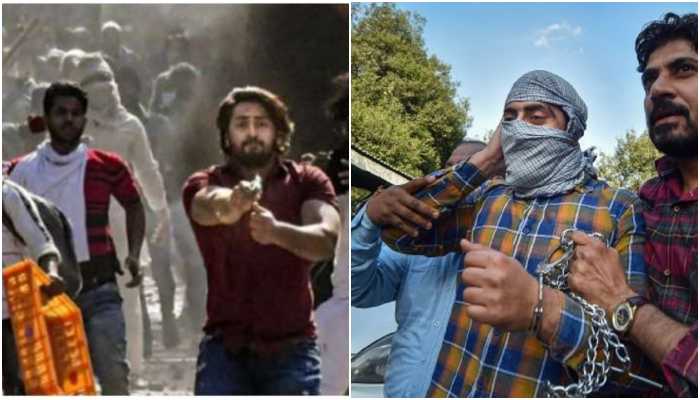
On Wednesday, the Delhi High Court refused to grant bail to Mohammed Shahrukh aka Shahrukh Pathan who had opened fire at Delhi Police on February 24 this year, during the riots that had broken out in the national capital under the pretext of peaceful protests against Citizenship Amendment Act (CAA).

As per reports, after Justice Suresh Kumar turned down his bail, Shahrukh’s counsel Asghar Khan withdrew the plea.

The accused had opened 8 rounds of bullets on the Delhi Police on February 24, the day US President Donald Trump was visiting India. While initial reports had suggested that Mohammad Shahrukh was arrested on February 25, Delhi Police later clarified that he had escaped and was absconding since. He was finally arrested on March 3 from the Shamli district in Uttar Pradesh and has since been languishing in prison.

The police had registered a case against him under Sections 147, 148, 149, 283, 186, 188, 353, 332, 323, 307,505, 120B, 34of the Indian Penal Code (IPC) and Section 27 of Arms Act, and Sections 3 and 4 of Prevention of Damage to Public Property Act (PDPP) Act. The cops had also informed that the gun of the 23-year-old accused was recovered from his house. Reportedly, he had left the pistol at his home and fled the city after the incident. A 350-page charge sheet was filed against Shahrukh in Karkardooma Court on May 1 in connection to the riots that led to 53 deaths.

Arguments made by the Defence and the Prosecutor

Asghar, appearing for Shahrukh, had pleaded that the accused was in judicial custody for 113 days and had clear ‘antecedents’. He argued that Shahrukh did not injure anyone during the incident and that the First Information Report (FIR) was not registered on the basis of the information provided by the complainant. “He’s the victim of the circumstances”, the counsel claimed. Asghar further sought for the accused’s bail on humanitarian grounds in line with that of Safoora Zargar.

The petition was filed challenging the decision of the trial court which denied him bail on June 9. Additional Public Prosecutor Amit Chadha, however, opposed the bail and emphasised that CCTV footage clearly showed him firing his pistol. He added that ample evidence existed to highlight what happened in the National capital during the communal riots. Delhi Police had also opposed his bail on the ground that his identity has been testified by witnesses.

Observations made by the Judge

“You were trying to become a hero and lead the mob. A gun was purchased by you with more than 20 live cartridges from the person who is absconding. You became a hero and your intention was to be one. I am not inclined to entertain this”, Justice Kumar was quoted as saying. Asghar had argued that Shahrukh had to take care of his ailing father but the Court refused to entertain the argument and remarked that he should have thought about the same, prior to brandishing his gun. “While committing the offence, you forget everyone and now you are thinking about your aged and ailing parents,” the learned Judge noted.

The Delhi High court had earlier sought a response from the police on the bail petition. Reportedly, Justice Prateek Jalan had ordered the Investigation officer to verify the medical records of the accused’s father and file a status report. Earlier, the trial court had dismissed his petition highlighting that the right to protest against government policies did not imply disrupting public order.

‘If our soldiers are attacked, there will be consequences’: India warns China during de-escalation talks over LAC conflict

India on Monday issued a stern warning to China that it will reply to Chinese provocation and violence in kind and with interest during the second rounds of Lt General level talks, in the aftermath of the deadly clashes in Galwan Valley that claimed lives of 20 Indian Army soldiers along with an undeclared number of Chinese casualties, India Today journalist–Shiv Aroor said.

As tensions along the LAC simmered, top commanders of the two armies carried out a marathon review of the situation in eastern Ladakh and determined to deal with any kind of Chinese “misadventure” with a firm hand. The Lt General level talks commenced at around 11:30 am at Moldo on the Chinese side of the Chushul sector in eastern Ladakh and went on for about 11 hours, Aroor said. The focal point of the discussions was on finalising modalities for disengagement of troops in eastern Ladakh, however, a final word on the outcome of the talks is yet to come.

Indian side also asserted that it will continue its infrastructure development activities like building road and bridges on its side of the LAC, and asked China not to interfere on this issue.

According to the sources, the Indian and Chinese commanders have reached a “mutual consensus to disengage” from all “friction areas” along the Line of Actual Control (LAC), which has been flashpoints of various brawls between the two armies since last month.

The deliberations between the two sides were aimed at reducing tensions and pruning the military escalation on either side of the LAC. “The Corps Commander-level talks between India and China were held in a cordial, positive and constructive atmosphere. Modalities for disengagement from all friction areas in eastern Ladakh were discussed and will be taken forward by both the sides,” Aroor said while quoting the sources privy to the details of Lt General level-talks between the two sides.

While consensus has been reached between the Armies of India and China, sources claim trust deficit continues to exist as the brutal brawls that took place in Galwan Valley on June 15 happened nine days after the two sides agreed to disengage from the LAC following the first Lt General-level talks between India and China on June 6.

As per the latest developments, after Indian troops incinerated Chinese camps erected on the Indian side of the LAC that resulted in the savage brawls between the two sides on June 15, Chinese soldiers have once again set up tents on the Patrol Point 14.

Besides, it is also reported that ever since the clashes erupted in Galwan Valley, the Chinese sides have firmed up their presence at all the “friction points” along the LAC. It remains to be seen if the consensus arrived at the Lt General-level talks between the two sides results in defusing the tensions along the LAC and re-induction of the Chinese soldiers on there side of the LAC.

SC lawyer files petition demanding NIA probe against Sonia Gandhi, Rahul Gandhi over the 2008 MoU between Congress and the Communist Party of China

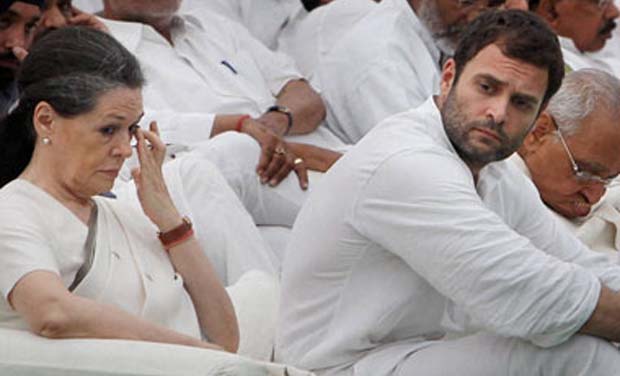
A petition has been filed in the Supreme Court against Congress interim president Sonia Gandhi, Gandhi-scion Rahul Gandhi and some other Congress leaders seeking a National Investigative Agency (NIA) or Central Bureau of Investigation (CBI) probe to their alleged links with the Communist Party of China.

According to the reports, the lawyers who have filed the petition in the apex court has asked for an investigation into the details of the MoU signed between the Congress party and the Communist Party of China in 2008 during the UPA era.

Interestingly, the petitioner has asked the Supreme Court to direct the NIA to investigate the agreement between the Congress party and the CPC under the stringent provisions of the Unlawful Activities (Prevention) Act, 1967.

According to journalist Utkarsh Anand, the petition was filed in the Supreme Court by activist and journalist Savio Rodrigues and lawyer Shashank Shekhar Jha seeking an investigation by NIA or the CBI into 2008 agreement between two political parties. The plea sought a probe questioning the intent of Rahul Gandhi’s to sign this party-to-party agreement.

Demands for probe into agreement

Days after the image from 2008 showing the Indian National Congress leaders signing an MoU with the Communist Party of China went viral on social media, there were demands from a section seeking a probe into the agreement between the Congress party and the Communist Party of China.

Senior advocate Mahesh Jethmalani had also demanded an NIA probe into the agreement under the Unlawful Activities (Prevention) Act. The senior advocate said that the agreement signed in the presence of Sonia Gandhi and current Chinese premier Xi Jinping has possible sinister implications for the country’s security and called for a probe by NIA into the agreement under the stringent UAPA. He also said that the NIA should secure the agreement.

A ‘secret-deal’ between the Congress party and the Communist Party of China

The agreement signed by the Congress party with China’s Communist Party has gained significance after the recent stand-off between India and China at the Galwan valley along the LAC in Ladakh.

The agreement was signed between the two parties on August 7 in 2008 in Beijing for exchanging high-level information and co-operation between them. The memorandum of understanding (MoU) also provided the two parties with the “opportunity to consult each other on important bilateral, regional and international developments”.

At that time, Congress party was leading the UPA-I govt in India and Sonia Gandhi was the chairperson of the National Advisory Council, which acted as the super cabinet over the Manmohan Singh led govt. The agreement was signed by Congress leader Rahul Gandhi and Wang Jia Rui, Minister in the international department of the CPC, in the presence of Sonia Gandhi and the then Chinese Vice-President Xi Jinping.

According to reports, Before the signing of the MoU, the then Congress president Sonia Gandhi and her son Rahul Gandhi had held a long meeting with Xi and other senior leaders of the Communist Party of China to discuss issues of mutual interest.

Delhi: AAP MLA Prakash Jarwal gets bail by HC in doctor suicide case

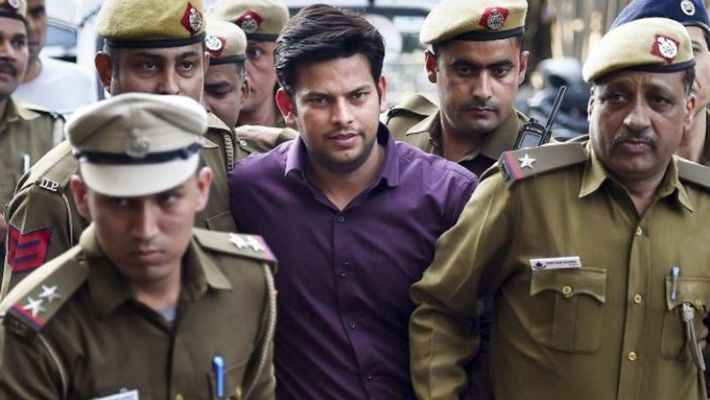
The Delhi High Court on Wednesday granted bail to Aam Aadmi Party (AAP) MLA Prakash Jarwal in connection with a doctor’s suicide case. He will be released on bail on furnishing a personal bond of Rs 25,000 and surity.

On its previous hearing on June 19 the Delhi Court had reserved its order. The HC has stated that Jarwal’s incarceration is no longer required for the investigation and as he has been in jail since May 9, he can be granted bail. Prakash’s brother Anil is also one of the accused in the case who had already received anticipatory bail.

Police had arrested the AAP leader and his aide Kapil Nagar from Saket on May 9 after a 50-year-old doctor named Rajendra Singh residing in the Deoli neighbourhood of South Delhi took the drastic step of ending his life. The doctor had, in a suicide note blamed Prakash Jarwal and Kapil Nagar for harassment and extortions over the water tanker business.

The doctor’s son had blamed Prakash Jarwal and associate for his father’s death

Police had registered a case against the AAP leader and his aide after the doctor’s son blamed them for his father’s death on April 18. A First Information Report (FIR) was filed with the police by the son of the deceased who claimed that the duo extorted money from his father who was into water tanker business since 2007. Depressed over financial issues, the doctor had taken his own life. It is accused that the AAP MLA has connections with the water tanker mafia operating in the Deoli and Sangram Vihar areas.

Tanker operators confirmed the AAP MLA collected bribes up to Rs 60 lakhs a mo

Reports had stated that the AAP MLA had allegedly received bribes to the tune of Rs 60 lakh per month from the water tanker owners.

As per a report, as many as 20 water tanker owners had come forward to claim that the AAP MLA had asked them to pay money. 4 of them testified before a magistrate saying that they had paid Rs 20,000 to get their file cleared and Rs 500 for each round of supply. The total amount had sumed up to Rs 60 lakhs per month.

Prakash Jarwal and the Suicide Case

The deceased doctor, identified as Dr. Rajendra Singh, was a resident of the Deoli neighbourhood in South Delhi and had committed suicide on the 18th of April. In his suicide note, he accused Prakash Jarwal and his associate Kapil Nagar of harassment and blamed them for his decision to take the drastic step. Consequently, the Police had registered an abetment of suicide case against the AAP MLA, his associate Kapil Nagar and others in the matter.

They were arrested later by the Delhi Police after the Saket Court issued a non-bailable warrant against the accused.

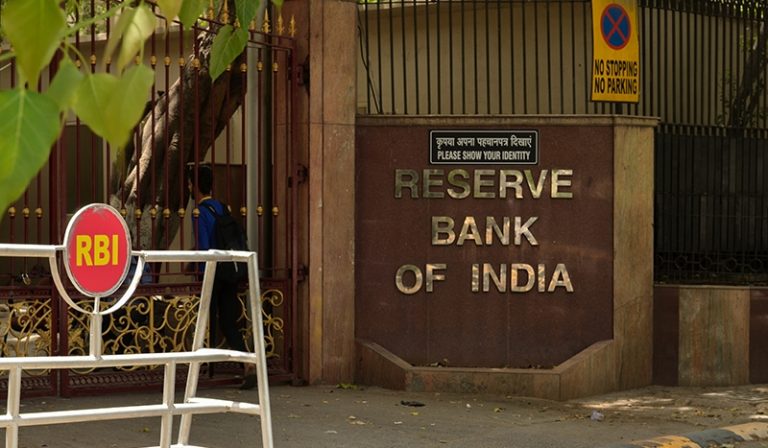
Union government brings cooperative banks under RBI control through an ordinance

The Union Minister of Information and Broadcasting, Prakash Javadekar on Wednesday said that the government banks, 1,482 urban cooperative banks and 58 multi-state cooperative banks are now being brought under the supervisory powers of the Reserve Bank of India (RBI).

An ordinance to with respect to urban co-operative banks and multi-state co-operative banks was passed by the government on Wednesday with President’s approval that will now immediately bring these banks under the governance of the RBI.

The decision by the government to augment RBI’s supervisory powers over the urban and multi-state co-operative banks comes after Finance Minister Nirmala Sitharaman had announced the government’s intentions of bringing the co-operative banks under the RBI’s supervision in Budget 2020. The ordinance to this effect could not be passed in the Budget session of the parliament.

RBI’s supervision will apply to the cooperative banks like they apply to the scheduled commercial banks.

“The decision to bring 1,540 cooperative banks under RBI’s supervision will provide an assurance to more than 8.6 crore depositors in these banks that their money amounting to Rs 4.84 lakh crore will stay safe,” said Union Minister Prakash Javadekar.

The Minister of Information and Broadcasting also added that the Union Cabinet has given its nod for a scheme “for interest subvention of 2 per cent to Shishu loan category borrowers under Pradhan Mantri Mudra Yojana outstanding as on March 31, 2020, for one year to eligible borrowers.

Besides, the central government also decided to extend the tenure of the OBC Commission by six months in the wake of the coronavirus outbreak, Union minister Prakash Javadekar said. The government also announced Rs 15,000-crore infrastructure fund to provide interest subvention of up to 3% to private players for setting up of dairy, poultry and meat processing units

Cooperative Banks were until now jointly governed by the RBI and respective state governments

The move by the cabinet to grant greater powers to the Reserve Bank of India over the jurisdiction of cooperative banks will provide additional teeth to the central bank in dealing with the cooperative banks that are not exactly registered as bank entities but as cooperative societies. So far, the urban and multi-state cooperative banks are registered and governed by the state governments under the respective Co-operative Societies Act of the concerned states. They also come under RBI jurisdiction under the Banking Regulation Act, 1949.

However, lately, multiple corruption cases, structural weaknesses and pervasive collapses of the cooperative banks had resulted in demands for greater control of these banks, who have now developed substantial deposit and credit base, by a competent authority on par with the nationalised banks. Cooperative banks were hitherto jointly controlled by the RBI and the respective state governments but in the aftermath of the Punjab and Maharashtra Cooperative (PMC) Bank fiasco last year, the Union Cabinet in February 2020 amended Banking Regulation Act to strengthen the cooperative banks in the country.