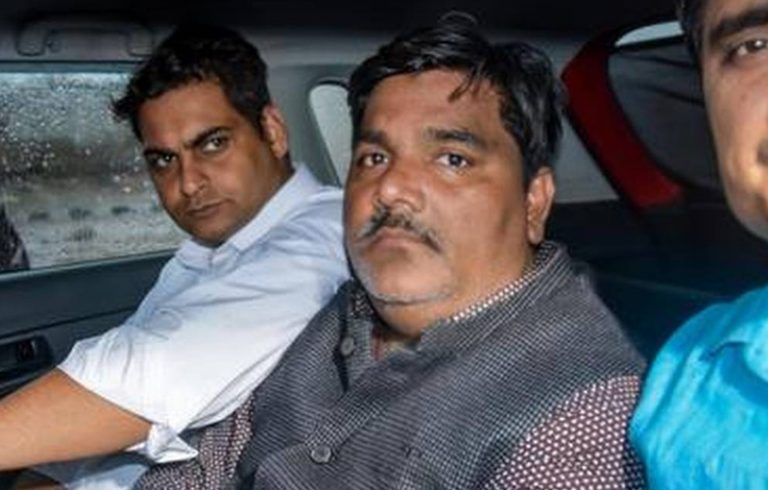
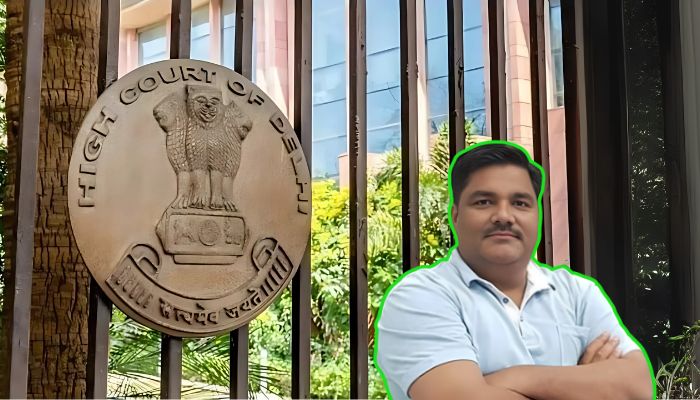
The Delhi High Court on Tuesday (14th January) denied interim bail to Tahir Hussain, a former Aam Aadmi Party councillor, who stands accused of playing a pivotal role in the 2020 anti-Hindu riots in North East Delhi. The court emphasized the seriousness of the allegations against him, highlighting his involvement in the violence that led to the deaths of 59 people.
However, the Court has granted Tahir Hussain custody parole to allow him to file his nomination papers and participate in campaigning for the upcoming Assembly elections. Hussain, who is contesting from the Mustafabad constituency, has been fielded by the All India Majlis-e-Ittehadul Muslimeen (AIMIM), led by Asaduddin Owaisi.
Hussain approached the Court seeking interim bail to complete election-related formalities. Considering his criminal history, the nature of the allegations, and the circumstances surrounding the case, the Court granted him custody parole to take the oath and complete the necessary steps for his nomination.
The parole is subject to the following conditions: He shall have no access to mobile or landline or the internet. He is not permitted to interact with anyone except for the officials involved in the nomination process.
He is prohibited from addressing the media. While family members may be present during the nomination process, they are not allowed to take photographs or post any content on social media.
The court has instructed the state to facilitate the filing of Tahir Hussain’s nomination papers and ensure the necessary arrangements are in place for the process. In its order, the court emphasized, “The State may coordinate with the concerned authorities to ensure that the entire process is completed promptly, and the Applicant/Petitioner’s right to file his nomination is not affected in any way.”
The court, in its order, stated, “The gravity of the allegations against the Applicant/Petitioner, who is accused of being a key perpetrator in the 2020 riots in North East Delhi, which resulted in the deaths of approximately 59 people, cannot be overlooked. The mere fact that the Applicant/Petitioner had previously been a Municipal Councillor does not provide a peculiar circumstance that would justify granting interim bail.”
As reported earlier, the Delhi Police opposed the interim bail plea of Tahir Hussain, former Aam Aadmi Party councillor and key accused in the anti-Hindu Delhi riots of 2020, in the Delhi High Court. Hussain has sought interim bail in the Ankit Sharma murder case to contest the upcoming Delhi Assembly elections as an AIMIM candidate.
Appearing for the Delhi Police and the state, Additional Solicitor General (ASG) Chetan Sharma, along with Special Public Prosecutor Rajat Nair, vehemently opposed the plea. Nair described Hussain as a “threat to society,” underscoring the severity of the allegations against him.
ASG Sharma suggested granting custody parole for filing nominations and related activities but objected to bail for election campaigning, citing the potential for witness tampering.
Sharma asserted, “The right to contest elections is not a fundamental right. Allowing him to campaign would disrupt proceedings. Four witnesses have already turned hostile.” He further described Hussain as the mastermind and primary conspirator in the riots, adding, “In UAPA and ED cases, jail is the rule and bail is the exception.”
Role of Tahir Hussain in the Delhi riots
It is notable to mention that Tahir Hussain had earlier confessed in a disclosure statement that he chose his own house as a launchpad for the riots. Given that his house was a high-rise building and was under construction at that time, it was easy to collect stones and bricks without raising any suspicion.
He confessed that he and his co-conspirators had started collecting stones, bricks, and other ammunition, well in advance so that they could teach those, who were in support of the CAA, a lesson when the time was right. To that end, 2-3 days before the riots broke out, he had also got his licensed pistol released from the police station.
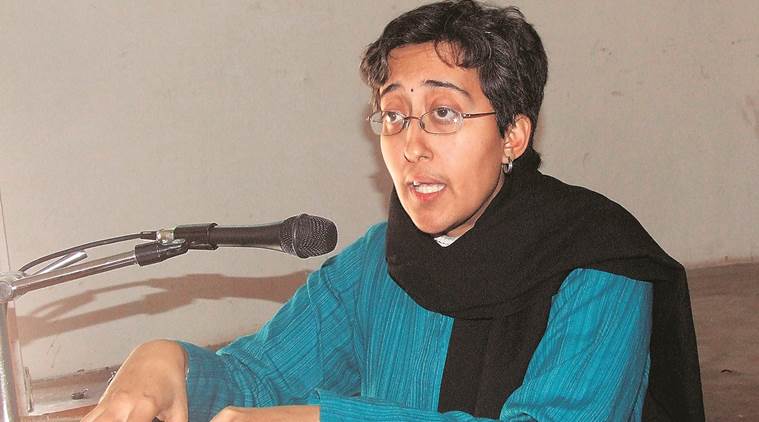
A complaint was filed against AAP leader and Delhi chief minister Atishi for allegedly violating the Model Code of Conduct by using a government vehicle for political purposes.
Police said that a complaint was received regarding a violation of MCC. The FIR was registered at the Govindpuri police station in southeast Delhi following a complaint submitted by the returning officer of the Kalkaji assembly constituency, officials said on Tuesday.
According to the FIR, the District Election Officer, South-East Delhi, received a complaint on January 8, 2025, alleging that Delhi Chief Minister Atishi used a government vehicle in her political campaign, which is prohibited under the Model Code of Conduct (MCC) during election periods.
The complaint specifically mentioned the vehicle, which belongs to the Public Works Department (PWD) under the Government of National Capital Territory of Delhi (GNCTD), being used for political purposes.
According to the letter from the General Administration Department (GAD), GNCTD, dated January 7, 2025, the use of government vehicles for campaigning or election-related activities is strictly prohibited during elections. The letter also stated that such actions would invite legal consequences under section 223 of the BNS.
Following the complaint, an order was issued by the Returning Officer, instructing the local police station, PS Govindpuri, to register a case against Sanjay Kumar, the Executive Engineer responsible for the misuse of the vehicle.
The FIR was registered under section 223(a) of the BNS, and the investigation was assigned to SI Sumit of PS Govindpuri.
In a response to the complaint filed against her for allegedly violating the Model Code of Conduct (MCC) by using a government vehicle for political purposes, Delhi Chief Minister and AAP leader Atishi raised questions about the Election Commission’s impartiality.
Atishi pointed out that BJP leader Parvesh Verma was seen distributing Rs 1100 during a recent event, which he later claimed was part of a health camp and distribution of spectacles. She further accused Verma of distributing bedsheets with his name on them, suggesting that these actions violated the MCC.
Despite these actions, Atishi claimed, the Election Commission had failed to take action against Verma, sparking doubts about the fairness of the commission’s decisions.
Delhi CM and AAP leader Atishi told the media, “The whole country saw how Parvesh Verma was distributing Rs 1100. Later, Parvesh Verma himself tweeted that he was holding a health camp and distribution specs. After that, he distributed bedsheets with his name on them. But the Election Commission doesn’t see any MCC violation in this. The question arises – who is the Police with? Is there pressure on EC officials? We hope the commitment of a free and fair election given by EC will be implemented on the ground.”
Earlier in the day, Delhi Chief Minister and AAP candidate from Kalkaji Assembly seat Atishi filed her nomination for the upcoming Delhi Assembly Polls, scheduled on February 5.
The AAP filed her nomination at the District Election Office.
Atishi is in the electoral fray against the BJP candidate Ramesh Bidhuri and Congress’ Alka Lamba for the Kalkaji seat.
In the 2020 Assembly polls, Atishi contested from the Kalkaji seat and defeated the BJP candidate Dharambir Singh by a vote margin of more than 10 per cent.
At 43, Atishi became the third woman Chief Minister of Delhi, following in the footsteps of Sushma Swaraj and Sheila Dikshit.
On September 17, 2024, Kejriwal tendered his resignation as Chief Minister to Delhi LG VK Saxena, following which Atishi staked claimed to form the new government days after the AAP chief was released on bail from Tihar jail in the excise policy case.
Kejriwal said that he would return to the post only if he gets a renewed mandate and a “certificate of honesty” from the people of Delhi in the assembly polls likely to be held in February 2025.
Atishi took oath as the Chief Minister of Delhi on September 22 after she was named successor to the post by AAP chief Arvind Kejriwal.
The Delhi assembly polls will be held in a single phase on February 5 and the counting of votes will take place on February 8.
(This news report is published from a syndicated feed. Except for the headline, the content has not been written or edited by OpIndia staff)
The Indian Navy will be commissioning three naval combatants on January 15, its official X account said on Tuesday. Destroyer INS Surat, Stealth frigate Nilgiri and submarine Vaghsheer will be commissioned at the naval dockyard, in Mumbai, at a ceremony presided over by PM Modi.
PM Modi announced on X that three warships will be inducted into the country’s naval forces on January 15.
“Tomorrow, 15th January, is going to be a special day as far as our naval capacities are concerned. The commissioning of three frontline naval combatants will strengthen our efforts towards being a global leader in defence and augment our quest towards self-reliance,” PM Modi tweeted.
Tomorrow, 15th January, is going to be a special day as far as our naval capacities are concerned. The commissioning of three frontline naval combatants will strengthen our efforts towards being a global leader in defence and augment our quest towards self-reliance. https://t.co/zhrVjbgA2T
A major shot in the arm for India’s naval defences, all three combatants are a tribute to PM Modi’s ‘Atmanirbhar’ campaign, the push to attain self-reliance in key sectors, including defence, and a milestone that reflects India’s commitment to securing its borders from adversaries, including maritime borders, and redefining its naval combat-readiness.
INS Nilgiri, the inaugural vessel of the P17A Stealth Frigate Project, has been designed by the Indian Navy’s Warship Design Bureau. The Navy states that INS Nilgiri represents a significant upgrade over the Shivalik-class frigates, featuring advanced stealth capabilities and a reduced radar signature, thanks to cutting-edge technology. It has a super-rapid gun mount, greatly enhancing its combat power. Its induction in India’s fleet not only underscores the country’s capabilities of manufacturing frigates that match global standards but also its operational readiness in protecting its maritime zones.
One of the most advanced naval combatants in its category, INS Surat, the fourth and final ship of the P15B Guided Missile Destroyer Project, is considered to be among the most lethal destroyers in the world. With 75% indigenous content, it is equipped with cutting-edge weapon-sensor systems and next-generation network-centric capabilities, a statement from the PMO revealed.
Nilgiri and Surat both are equipped with the capability of operating various helicopters, including the Chetak, the advanced light helicopter, and the newly inducted MH-60R. “Designed by the Navy’s Warship Design Bureau, both ships are outfitted with advanced sensors and weapon systems, largely developed in India or through strategic partnerships with leading global manufacturers,” the Navy stated.
The inclusion of these three combatants in the Indian Navy would doubtlessly augment India’s position as a formidable force in the Indo-pacific region, underscoring the importance of securing a nation’s maritime borders at an increasingly fraught time, with several nations trying to assert their dominance as transnational conflict becomes the order of the day.
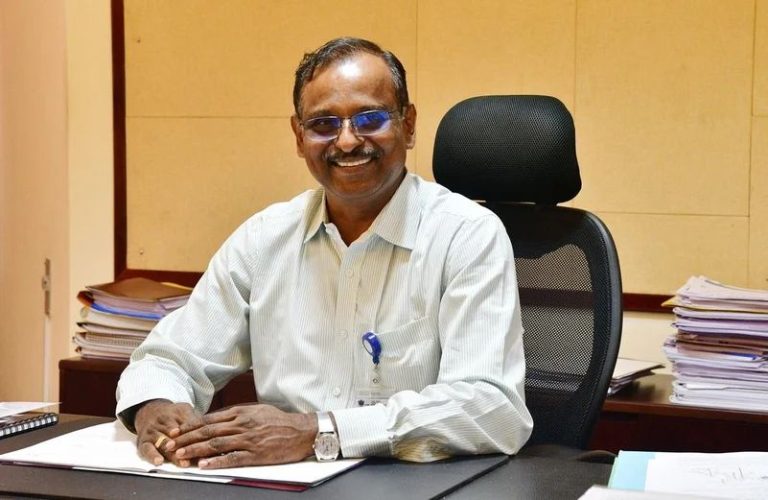
Dr V Narayanan on Tuesday took charge as the Chairman of the Indian Space Research Organisation (ISRO), succeeding S Somnath. As a distinguished Scientist (Apex Grade), Narayanan brings nearly four decades of experience at ISRO to his new role.
In a post on X, the ISRO announced, “Dr V Narayanan, Distinguished Scientist (Apex Grade), has assumed charge of Secretary, Department of Space, Chairman, Space Commission and Chairman, ISRO.”
Dr. V. Narayanan, Distinguished Scientist (Apex Grade), has assumed charge of Secretary, Department of Space, Chairman, Space Commission and Chairman, ISRO.
This marks a key leadership transition for India's space program.
“This marks a key leadership transition for India’s space program. With nearly four decades at ISRO, his leadership is set to guide India’s ambitious space missions,” the post added on X.
According to a statement from ISRO, he previously held the position of Director of the Liquid Propulsion Systems Centre (LPSC), one of the main centres of the Indian Space Research Organisation (ISRO), which has a unit in Bangalore and its headquarters in Valiamala, Thiruvananthapuram.
In his capacity as Director, he gave LPSC techno-managerial leadership. LPSC is involved in the development of chemical and electric propulsion systems for satellites, control systems for launch vehicles, liquid, semi-cryogenic, and cryogenic propulsion stages for launch vehicles, and transducers for propulsion system health monitoring.
Narayan joined ISRO in 1984 and functioned in various capacities before becoming Director of the Liquid Propulsion Systems Centre in January 2018.
He earned a Silver Medal for placing first in his M. Tech program at IIT Kharagpur, where he also earned a PhD in Aerospace Engineering and an M. Tech in Cryogenic Engineering. Additionally, he received the Life Fellowship Award from IIT Kharagpur in 2023 and the Distinguished Alumni Award in 2018.
Before joining ISRO in 1984, he began his career with TI Diamond Chain Ltd., Madras Rubber Factory, BHEL, Trichy, and BHEL, Ranipet, where he worked for a year and a half. He served as the Director of the Liquid Propulsion Systems Centre for seven of his forty years of meritorious service at ISRO.
Narayan designed the engine systems, created the required software tools, helped set up the infrastructure and test facilities, performed testing and qualification, finished developing the Cryogenic Upper Stage (CUS), and made it operational for the GSLV Mk-ll vehicle’s cryogenic technology.
As Chairman of the Project Management Council of Space Transportation System, he guided the teams for the operational & new launch vehicles. He was also responsible for the Propulsion Systems for Venus Orbiter, Chandrayaan-4, Gaganyaan, Bharatiya Antariksha Station (BAS) and the Next Generational Launch Vehicle programme cleared by Cabinet recently.
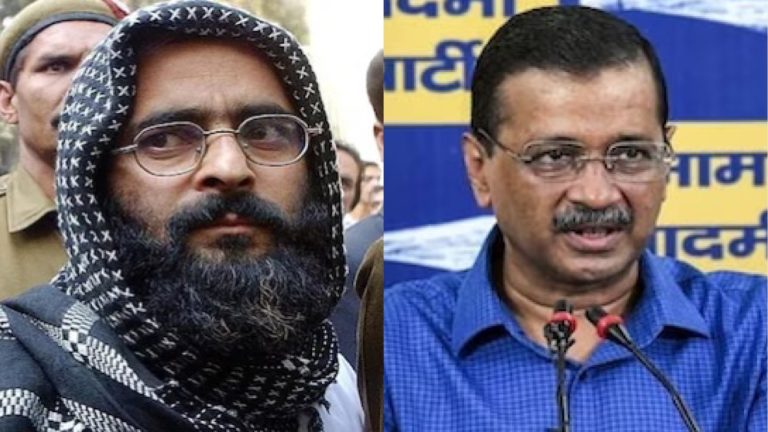
On Tuesday, January 14, Delhi Police revealed that a teenager detained for sending over 400 hoax bomb emails was linked to an NGO connected to a political party and which had previously thrown its weight behind Parliament attack convict Afzal Guru.
Though Delhi Police did not reveal the teenager was linked to which political party, the BJP said the political party in question was Arvind Kejriwal-led Aam Aadmi Party (AAP). AAP, however, shot back saying the BJP was politicising the matter.
The political mudslinging ensued after the Delhi Police detained the teenager for sending hoax emails of bomb threats.
“We conducted an extensive investigation, analyzed data from email providers, and profiled the family,” said Madhup Tewari, Special Commissioner of Police (Law and Order). The inquiry showed that the child sent mass emails, including one batch to 250 schools at once.
Tewari noted that the sophisticated techniques used make it unlikely the child acted alone. The investigation was complicated by the use of VPNs, which masked the origin of the emails. Authorities also explored potential links to terrorist organisations.
Initial investigations revealed links between the teenager and an NGO that had voiced support for Afzal Guru in the past, heating up the political atmosphere in the national capital that is gearing up for assembly elections next month.
“We are investigating whether the child was influenced by the NGO or other entities,” Tewari said. “It’s too early to conclude he acted alone, and we are examining possible political motives or attempts to disrupt public order.” The motive remains unclear since many emails were sent on non-exam days, casting doubt on a simple intent to delay exams.
BJP leader Sushanshu Trivedi, during the briefing, questioned whether AAP or any affiliated NGO had any involvement in the hoax bomb threats, referencing Atishi’s parents’ efforts to support Afzal Guru.
“AAP has links to anti-national NGOs. Even Atishi’s parents supported Afzal Guru’s mercy plea. Does AAP or its associated NGOs have any involvement in this case?” BJP spokesperson Sushanshu Trivedi questioned.
In response to the allegations, AAP leader Sanjay Singh held a press conference, criticizing the BJP by stating, “When did BJP join the Delhi Police? You are politicizing bomb threats targeting young children. Don’t you feel ashamed?”
Amid the ongoing war of words between the two political parties, the police said the investigation into the matter is underway. They revealed that the accused sent threat emails on seven separate occasions, including one instance where 250 schools received bomb threats simultaneously. The minor himself doesn’t recall how many such emails he sent. The Delhi Police also shared that between May and December of last year, bomb threats were issued 50 times to schools, hospitals, airports, and airlines in Delhi. While all these threats were hoaxes, they caused significant disruption for the administration and the public.
Following this revelation, the question arises whether there is a larger conspiracy behind these fake threats and whether political parties and NGOs may be involved. The police are now thoroughly investigating the NGO and its political connections.
On Monday, 13th January, the Punjab and Haryana High Court expressed severe concerns over the enforcement of the Haryana Gauvansh Sanrakshan and Gausamvardhan Act. The court asserted that an increase in the number of cases under the given legislation indicated improper execution of the law.
As per the reports, the court stated that the objective of the law was to put a cap on the ‘consumption of beef menace emanating from the powerful meat lobby consuming and selling beef’, but it said that the state failed at properly executing the legislation. This was when the court was hearing the bail petition of the accused Khalid arrested for owning a van used for the transportation of cows for slaughter.
Rejecting the anticipatory bail, Justice Sandeep Moudgil said, “The prime objective of the Haryana Gauvansh Sanrakshan and Gausamvardhan Act, 2015, is to curtail the cow slaughtering, consumption of beef menace emanating from powerful meat lobby consuming and selling beef for their own satiation. But the alarming situation with the increase in such litigations shows that the Act is not executed properly in its true spirit.”
Notably, the case against the accused persons was filed under sections 148, 149, 186, 429, and 307 of the IPC, and the provisions of the Gauvansh Sanrakshan and Gausamvardhan Act and the Arms Act. The charges for attempt to murder were also filed against the accused at the Dhauj police station in Faridabad, Uttar Pradesh.
The advocate representing the accused stated that he was falsely charged in the case and that he had no role to play in any cow slaughter incident. He added that the arrest of his client was solely made based on the statements issued by the co-accused who were directly involved in the matter.
The state meanwhile stated that the accused arrested owned the vehicle used for the transportation of the cows for slaughter. The authorities also stated that the detention of the accused was necessary for the custodial interrogation which could lead to recovery of weapon, if any.
“First and foremost, the court hearing anticipatory bail is to consider the gravity of the offence and the prima facie case against the accused. It is necessary to bring the offenders to book, for which the courts should refrain from taking a lenient view,” Justice was quoted as saying.
“Be that as it may, as has been culled out from the facts of the present case the petitioner has been roped in the instant FIR based on the disclosure statement of co accused for having driven the pick-up vehicle which is indeed registered in his name. Moreso, there are serious allegations against the petitioner of actively participating in the offence,” he added.
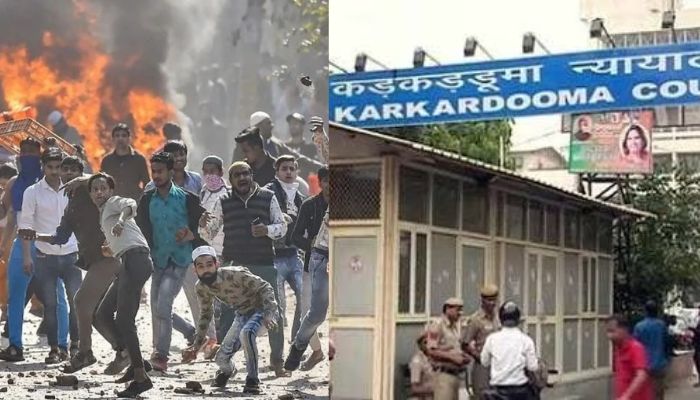
In a recent ruling, Delhi’s Karkardooma Court reprimanded the Delhi Police for clubbing six FIRs in a 2020 anti-Hindu Delhi Riots case and noted that the Investigating Officer (IO) “shrugged off” his duty to conduct a thorough investigation into the 6 FIRs. The court found that the 7-second video, based on which the IO falsely implicated a Hindu man Sandeep Bhati was manipulated.
Acquitting the Hindu man on the 8th of January 2025, Additional Sessions Judge Pulastya Pramachala referred the case to the Commissioner of Police and directed him to assess the concerned IO’s conduct and take suitable steps.
The case against Sandeep Bhati was registered at the Karawal Nagar Police Station based on the statement given by a person named Shahrukh who was injured in the Delhi riots on 24th February 2020.
In his statement, Shahrukh said that on 24th February 2020, at around 4:15 pm, he was returning from his maternal grandmother’s home in an auto-rickshaw and “when he reached near Shiv Vihar Tiraha, a riotous mob dragged him out of the auto, started beating him with sticks and stones, and thereafter somebody fired upon him as a result of which he received gunshot injuries upon his left leg and chest. He further stated that he became unconscious and when he gained consciousness, he found himself in GTB Hospital.”
The 6 complaints alleged loot and arson but none named Sandeep Bhati – they were not even there to witness who committed arson
The prosecution told the court that during the investigation of this case of the Delhi Riots, the site plan of where the incident described by Shahrukh unfolded, was prepared by the IO. As per this site plan, the place of incident was at Shiv Vihar Tiraha on Main Road, Karawal Nagar, which was going towards Joharipurfrom Karawal Nagar Chowk, via Shiv Vihar Tiraha. There was a Hanuman Temple beside the place of the incident.
While the investigation into this matter was underway, 8 other written complaints were received by the police. These 8 complaints were clubbed for investigation with the present FIR. However, one of the complainants Arif Ahmad withdrew his complaint saying that his father had filed a similar complaint. Later, it was found that the incident reported in the complaint filed by one Mohammad Khalid transpired on 25th February 2020 and thus a separate investigation report was to be filed. Thus, out of 8 only the remaining 6 complaints of complainants namely Mohammad Haneef, Sayba, Ashma, Gulab Singh, Mohammad Rahish and Sahab Jadi, were prosecuted in the present case, on the grounds of the proximity of date, time and place of the incident, the prosecution said.
In his complaint, Mohammad Haneef alleged that his Paan shop near Hanuman Mandir, Shiv Vihar Tiraha was not found two days after he returned to the place after having fled the spot on 24th February 2020 after the riots began.
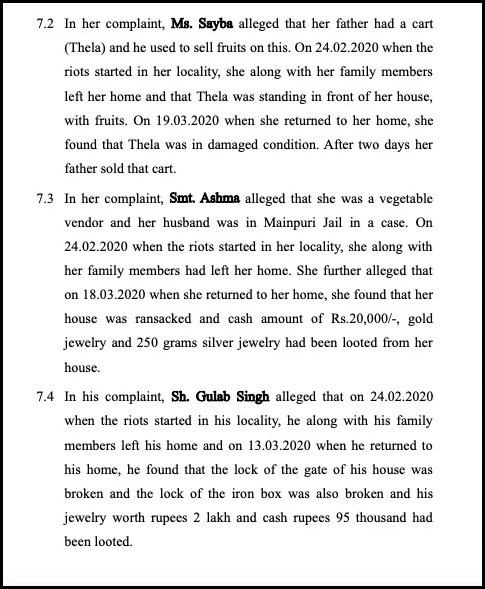
In her complaint, Sayba alleged that her father had a fruit cart (thela) and on 24th February 2020, when the riots began, she along with her family left the place while leaving the fruit Thela there. However, when she returned to her house later she found the Thela in a damaged condition and two days later sold the cart.
Another complainant named Ashma who was a vegetable vendor alleged that on 24th February 2020, when the riots erupted in her area, she along with her family left her house. Ashma claimed that when she along with her family returned on 18th March 2020, she found her house ransacked and Rs 20000 cash and gold jewellery and 250 gm silver jewellery were looted from her home.
Similarly, Gulab Singh alleged in his complaint that on 24th February 2020, when the riots began he and his family left the locality only to return on 13th March 2020. Gulab Singh found that hat the lock of the gate of his house was broken and the lock of the iron box was also broken and his jewellery worth Rs 2 lakh and cash of Rs 95 thousand had been looted.
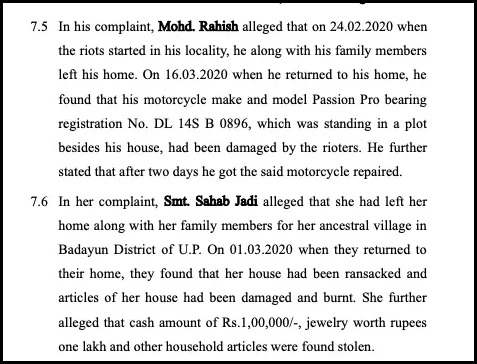
In the complaint, Mohammad Rahish claimed that on 24th February 2020, when the riots broke out, he and his family left the locality and returned home on 16th March 2020. Rahish alleged that he found that his motorcycle make and model Passion Pro, which was standing in a plot beside his house, had been damaged by the rioters. He further stated that after two days he got the said motorcycle repaired.
Meanwhile, complainant Sahab Jadi alleged that she also left her house along with the family for her ancestral village in Badaun and returned to her house in Delhi on 1st March 2020. She claimed to have found that her house had been ransacked and articles of her house had been damaged and burnt. She further alleged that cash amount of Rs.1,00,000/-, jewellery worth rupees one lakh and other household articles were found stolen.
It must be noted here that all of the six complainants and their family members had left the riot-hit area on 24th February 2020 and none of them actually saw who allegedly damaged their properties or looted their belongings. None of the complainants even named Sandeep Bhati.
Video presented by injured ‘victim’ Shahrukh’s brother led to the false implication of Sandeep Bhati in Delhi Riots
While the investigation into the six FIRs was ongoing and the statements of the complainants were recorded by the Investigation Officer, on 20th November 2020, Sameer Khan, the brother of injured Shahrukh produced one CD containing two video clips to the IO, showing his brother being dragged by the mob and he identified the accused Sandeep Bhati in the said video-clip. Following this, Bhati was arrested on 23rd December 2020.
After Bhati’s arrest, the police analysed the accused person’s call data records and it was found that on the day of the incident i.e. 24.02.2020 from 16:17:39 hrs to 16:42:29 hrs the location of his mobile number was near Rajdhani Public School, A-1, Babu Nagar, Shiv Vihar, Delhi. This Rajdhani Public School was just adjacent to the Shiv Vihar Tiraha, where the injured Shahrukh was found in an unconscious condition.
During his testimony, Sameer Khan identified his brother Shahrukh and accused Sandeep Bhati in the video file with time duration of 7 seconds. In another video file with a duration of 15 seconds, Sameer Khan identified a person being dragged by another group of persons, as his brother Shahrukh.
On the basis of the statements of the complainants of clubbed complaints, sections 427/436/380/454 IPC were added in the present case. On the basis of the supplementary statement of injured/victim Shahrukh, Section-392/394 IPC was also added in the present case as his mobile phone i.e. iPhone 6 was also looted by the rioters.
On 24th March 2021, a charge sheet was filed against accused Sandeep Bhati under sections 147/148/149/188/307/380/392/394/427/436/454 IPC. Later, in 2021, charges were framed against Bhati, to which he pleaded not guilty and demanded a trial.
Sandeep Bhati was charged with an attempt to murder with the prosecution building its case against Bhati solely based on a video which they claimed showed Bhati participating in the assault.
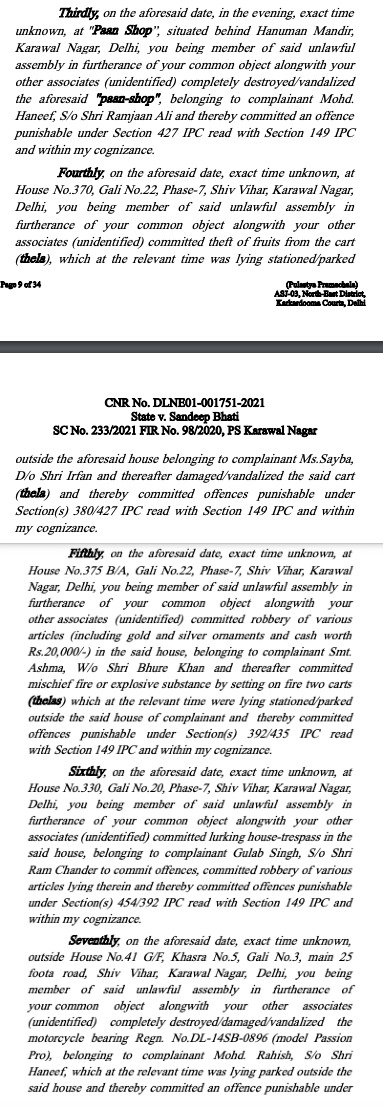
“That in the evening of 24.02.2020, in the area at or around Shiv Vihar Tiraha, main Karawal Nagar, Delhi-110094, within the jurisdiction of PS Karawal Nagar, you being from a particular community alongwith your other associates (unidentified) formed an unlawful assembly, the object whereof was to cause maximum damage to the property and persons, including committing murder, commit criminal trespass, vandalism, robbery and arson in the shops, houses and other properties of the persons residing in the said area, damage their vehicles, use force, violence and firearms inprosecution of the common object of such assembly and thereby committed offences punishable under Section(s) 143/147/148 IPC read with Section 149 IPC and within my cognizance,” the charges framed against Bhati read.
The Investigating Officer also alleged that “on the aforesaid date and place, between 4.00PM to 6.00 PM, you [Sandeep Bhati] being member of said unlawful assembly in furtherance of your common object alongwith your other associates (unidentified) caused gunshot injuries upon the person of Shahrukh, S/o Shri Yakub Khan, aged about 25 years, merely on account of the fact that he belonged to the other community and with such intention knowledge that had hisdeath been caused, you would have been guilty of murder and thereby committed an offence punishable under Section 307 IPC read with Section 149 IPC within my cognizance.”
Similarly, charges in the context of the rest of the complaints were also framed against Bhati.
Sandeep Bhati’s defence: How the man who stopped others from assaulting Shahrukh during Delhi Riots was falsely accused of the same by the victim’s brother and the police
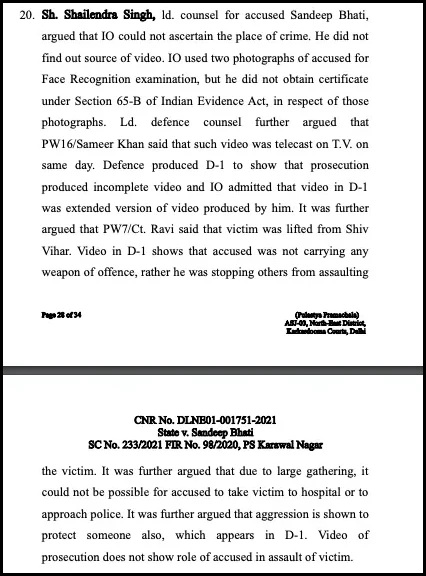
Sandeep Bhati refuted the allegations levelled against him and contended that the witnesses falsely deposed against him and that he had been falsely implicated in the Delhi Riots case. Bhati’s counsel Shailendra Singh argued that the Investigating Officer (IO) could not ascertain the place of crime and that he did not find the source of the video based on which, Bhati was arrested.
IO used two photographs of the accused for the Face Recognition examination, but he did not obtain a certificate under Section 65-B of the Indian Evidence Act, in respect of those photographs, Bhati’s counsel told the court.
Further, Singh pointed out that the video which was Sameer Khan claimed to have seen on television and the prosecution produced before the court was incomplete and that the video clip produced by the defence was an extended version of the same video. The defence highlighted that the IO has also admitted that the video clip produced by the defence was indeed an extended version of the video produced by him.
The prosecution witness number 07 Ct. Ravi said that victim Shahrukh was lifted from Shiv Vihar. The longer video produced by the defence shows that accused Sandeep Bhati was not carrying any weapon of offence, rather he was stopping others from assaulting the victim. The defence further contended that due to large gatherings, it was not possible for Bhati to take the victim to the hospital or call the police.
Moreover, the defence emphasised that Sandeep Bhati’s aggression as seen in the video was to protect the victim and not to assault him. In addition, the video clip produced by the prosecution does not show the accused assaulting victim Shahrukh.
In response to this, the prosecution could only give the argument that since Sandeep Bhati was present at the crime scene and he alone could be identified in the video, he was prosecuted. The prosecution presented 21 witnesses during the trial.
Rajdhani School in the Shiv Vihar Tiraha area was the centre of Islamist mob attacks on Hindus during Delhi Riots
Notably, the Shiv Vihar Tiraha area where the incident of assault against Shahrukh and alleged incidents of vandalism and loot as claimed in the 6 FIRs happened, was near the Rajdhani School owned by one Faizal Farooqui where Hindus were brutally attacked by the Islamist mobs. On the afternoon of 24th February, the first body that was found was that of Dilbar Negi. His hands and legs were chopped off, and the rest of him was burnt right in front of Rajdhani school in Anil Sweets.
OpIndia reported how the Rajdhani School was turned into an attack base by the Islamists to target Hindus. The Delhi Police’s chargesheet in the riots case, mentions the testimony of the guard of DRP School which is adjacent to the Faizal Farooqui-owned Rajdhani School. The guard testified that in the afternoon of 24th of February when he went to close the gates of DRP school, he saw that several Muslims were standing at the gate of Rajdhani school and the owner, Faizal Farooqui was also present with them. Faizal, who was sitting on his bike, asked the guard of Rajdhani school (a Hindu whose identity we are withholding) to give access to “all his Muslim brothers” into the school and also said, “Aaj dekh lenge Hinduon ko”.
In Shiv Vihar Tiraha, one of those most sinister plans hatched was executed from the rooftop of Rajdhani School. Islamist mobs fired guns, and threw bottles full of acid, stones etc from the rooftop of Rajdhani school. The first chargesheet filed in the Delhi Anti-Hindu riots case also pertained to the Rajdhani school and the events that transpired there on the 24th and the 25th of February 2020. It was in this Shiv Vihar Tiraha area that on the 24th of February, the totally burnt body of Dilbar Negi was recovered. On the 24th at 4 PM, Rahul Solanki sustained gunshot injury. On the 25th, acid was thrown as SSB Jawans. On the 25th at around 4:30 PM, Veer Bhan sustained gunshot injury on his head while crossing the Taraha on his bike. On the 25th at around 5:00 PM, Dinesh sustained gunshot injury on his head while standing at the Taraha. On the 25th of February at around 10:15 PM, Alok sustained injuries from stone pelting by Muslims.
Given the one after the other brutal attacks on Hindus by Islamist mobs in the Shiv Vihar Tiraha area, the local Hindus were enraged and thus a crowd of Hindus also gathered in the area.
Observations made by the court while acquitting Sandeep Bhati
The court found conspicuous lapses in the investigation and observed that while allegations of unlawful assembly and rioting as levelled by Shahrukh were “well established”, the IO clubbed 8 more complaints and later decided to prosecute 6 complaints with the present case. The court noted that the stand of the prosecution and Investigating Officer relied on the presumption that the same mob may have been involved in all the incidents described by the 6 complainants in their respective cases.
Moreover, the court observed that instead of investigating each of the six complaints, the IO only recorded statements under CrPC 161 and prepared site plan for three complaints. In fact, it was only during the cross-examination that the IO admitted the signature on the three site plans. The court found that other than this, no investigation was conducted into the six complaints. The extent of the IO’s negligence was such that the officer did not even care to confirm the date and time of the incidents described in the six complaints or find out the source of the information based on which the complainants filed their complaints since all of them had left the riot-hit area on 24th February 2020 and none of them witnessed the crimes or saw Sandeep Bhati carrying out any illegal activity.
“Such stand of IO and prosecution, however, remained based on presumption that same mob would have been involved in those six incidents as well. Record shows that in the name of investigation on those six complaints, IO only recorded statement under Section 161 Cr.P.C. and prepared site plan for three complainants. IO even did not remember about preparing three site plans and it was only during cross examination by defence that IO admitted his signature on these three site plans. Apartfrom aforesaid steps, nothing more was done to investigate into other six complaints. IO even did not confirm as to when did these six incidents had actually taken place. It was well known toIO that none of these six complainants had seen their respective incident. Thus, they mentioned the date of incident in their respective complaints, only on the basis of some other source. IO did not bother to find out source of their information or any witness to such incidents, if taken place as reported by these six complainants,” the court said adding that no photographs were taken or obtained in respect of property of complainants Ashma, Gulab Singh and Sahab Jadi, which was otherwise being done in a routine manner in such cases.
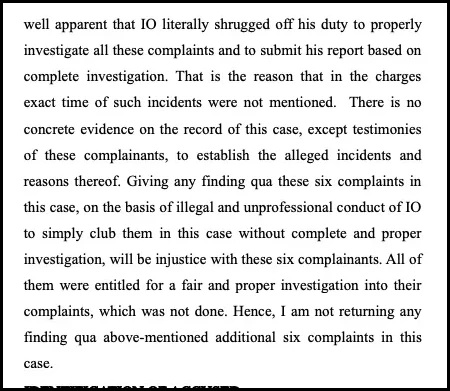
Justice Pulastya Pramachala observed that the IO “shrugged off” his duty to conduct an investigation into each of the six complaints and file a report accordingly adding that this is the reason why the exact time of such incidents is not mentioned in the charges.
“Thus, it is well apparent, that IO literally shrugged off his duty to properly investigate all these complaints and to submit his report based on complete investigation. That is the reason that in the charges exact time of such incidents were not mentioned. There is no concrete evidence on the record of this case, except testimonies of these complainants, to establish the alleged incidents and reasons thereof,” the court noted.
Calling the IO’s conduct of clubbing the six complaints with the present case pertaining to Sandeep Bhati’s alleged role in assault against Shahrukh, “illegal and unprofessional”, the court observed that the clubbing of the six complaints without proper investigation was an injustice to the six complainants.
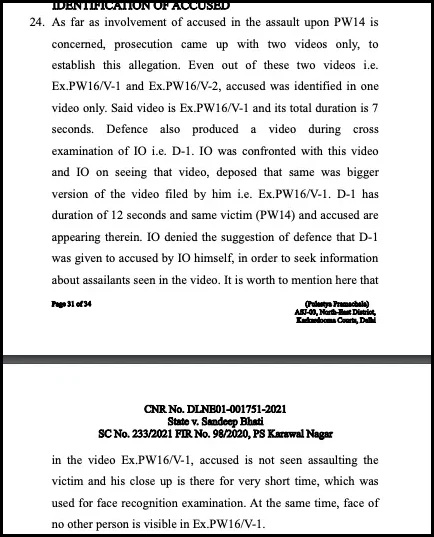
Regarding the present case against Sandeep Bhati over his alleged involvement in the attack on Shahrukh, the court said that the prosecution only produced two videos to back their allegation. Of these two videos, the accused was identified only in one 7-second video. However, a longer (12-second) version of the same video produced by the defence featured both the victim Shahrukh and the accused Sandeep Bhati, however, in the video, Bhati was not seen assaulting the Muslim youth. In fact, the accused was seen stopping the others from attacking Shahrukh.
“But, video D-1 shows further part of video Ex.PW16/V-1 for another 5 seconds. In this video accused is seen stopping the others from assaulting the victim. Ld. prosecutor took an objection that thisvideo was not forensically examined, hence cannot be looked into. However, that objection cannot be a reason not to compare this video with some photographs proved by prosecution itself asEx.PW16/P-1 to P-13,” the court said.
According to the testimony of prosecution witness Sameer (Shahrukh’s brother), he turned over 18 images to the IO, claiming to be screenshots from the video. However, the court concluded that these photographs were taken from the omitted five-second portion rather than the video submitted by the prosecution. The court found that the photographs showed those involved in violence, however, instead of tracing and prosecuting them, the IO falsely implicated the accused Sandeep Bhati.
“This goes on to show that PW16 and IO did have video D-1 with them. IO did not use that longer video, rather he cut short that video for 5 seconds, to omit the portion showing role of accused as stopping others from assaulting the victim. Photograph Ex.PW16/P-7 and P-8 showed the persons, who were part of assaulting group. But, IO instead of tracing and prosecuting those actual culprits,framed accused herein for assault on the victim. The abovementioned suggestion of defence as given to IO, thus, appears to be a possible scenario,” the court observed.
Further pointing out the investigation lapses on the part of the IO, the court said, “He did not try to find source of this video at all. Thus, it remains without any doubt that IO did not investigate this case properly and accused herein was falsely implicated in this case on the basis of video Ex.PW16/V-1. As already observed herein above, apart from this video, prosecution did not come up with any other evidence against accused.”
(All images taken from relvant court order)
Considering the arguments of the defence and prosecution and observations and findings that emerged, Justice Pulastya Pramachala acquitted accused Sandeep Bhati of all charges brought forth against him. The Delhi court also referred the matter to the Commissioner of Police to assess the conduct of the IO in the context of the present case and take requisite steps. Moreover, the court ordered a separate investigation into the six complaints and a final report be filed in those cases.
The conviction of Dinesh Yadav on charges of rioting during the 2020 anti-Hindu Delhi Riots and the dramatic acquittal
In May 2023, a Delhi court acquitted Dinesh Yadav alias Michael, Sandeep alias Mogli and Tinku of the charges of rioting during the anti-Hindu Delhi Riots of 2020. While observing that the possibility cannot become evidence, the court said that there was insufficient proof against the three. The three were accused of rioting, being members of a riotous mob that vandalised two properties and looted certain articles. Based on the complaint of Aakil Saifi and Irfan, FIR 124 was filed against the three at Gokalpuri Police Station. Charges were framed against them under Sections 147, 148, 149, 380, 188, 427 and 436 of Indian Penal Code, 1860.
Back then, Justice Pulastya Pramachala observed that the victims, who were also the witnesses, were not present at the concerned places when the incident happened during the Delhi Riots. Thus, their statements regarding the incident were based on hearsay only. It was found that the special public prosecutor ‘led’ the witness to the identification of the accused during his cross-examination. It must be recalled that in January 2022, Dinesh Yadav was the first to be convicted in the 2020 Delhi Riots case and was sentenced to five years in jail over the accusation of setting ablaze the house of a 73-year-old Muslim woman and taking away her buffalo and calf.
OpIndia had reported how the conviction of Dinesh Yadav in Delhi Riots was based solely on his religious identity – that is – him being a Hindu and how the sections under which he was convicted had been interpreted differently to convict Dinesh Yadav and on the other hand, give bail to Muslim accused in the Dilbar Negi case. Those reports can be read here and here.
On 14th January, the Delhi Police opposed the interim bail plea of Tahir Hussain, former Aam Aadmi Party councillor and key accused in the anti-Hindu Delhi riots of 2020, in the Delhi High Court. Hussain has sought interim bail in the Ankit Sharma murder case to contest the upcoming Delhi Assembly elections as an AIMIM candidate. The plea was heard by Justice Neena Bansal Krishna. The court reserved the judgment to decide on the bail application in the larger conspiracy case.
Seeking bail for election campaign
Senior Advocate Rebecca John represented Hussain in court. Hussain has sought interim bail from 16th January to 9th February, citing the need to file nominations, open bank accounts, and campaign for the elections. John argued that Hussain has already served more than half of the custody period in one of the cases under the Prevention of Money Laundering Act (PMLA). She further asserted that he might eventually get acquitted in the 11 FIRs filed against him.
Strong opposition from Delhi Police
Appearing for the Delhi Police and the state, Additional Solicitor General (ASG) Chetan Sharma, along with Special Public Prosecutor Rajat Nair, vehemently opposed the plea. Nair described Hussain as a “threat to society,” underscoring the severity of the allegations against him.
ASG Sharma suggested granting custody parole for filing nominations and related activities but objected to bail for election campaigning, citing the potential for witness tampering.
Sharma asserted, “The right to contest elections is not a fundamental right. Allowing him to campaign would disrupt proceedings. Four witnesses have already turned hostile.” He further described Hussain as the mastermind and primary conspirator in the riots, adding, “In UAPA and ED cases, jail is the rule and bail is the exception.”
The Ankit Sharma murder case
Notably, the plea is linked to the case regarding the murder of Intelligence Bureau officer Ankit Sharma, whose body was recovered from a drain during the riots. His post-mortem report revealed 51 injuries inflicted by sharp and blunt weapons. The prosecution has alleged that Hussain, along with his associates, orchestrated the killing and other riot-related activities.
A case under multiple sections of the IPC, including murder, criminal conspiracy, and promoting enmity, was registered against Hussain and others. The trial court framed charges in December 2022 under sections 147, 148, 153A, 302, 365, 120B, 149, 188, and 153A of the Indian Penal Code (IPC). Hussain was additionally charged under sections 505, 109, and 114 of the IPC. Notably, the trial court denied him bail on 3rd December, citing no significant change in circumstances.
Role of Tahir Hussain in the Delhi riots
It is notable to mention that Tahir Hussain had earlier confessed in a disclosure statement that he chose his own house as a launchpad for the riots. Given that his house was a high-rise building and was under construction at that time, it was easy to collect stones and bricks without raising any suspicion.
He confessed that he and his co-conspirators had started collecting stones, bricks, and other ammunition, well in advance so that they could teach those, who were in support of the CAA, a lesson when the time was right. To that end, 2-3 days before the riots broke out, he had also got his licensed pistol released from the police station.
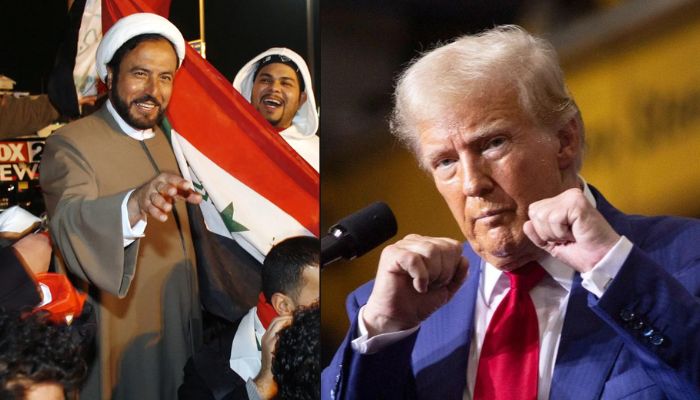
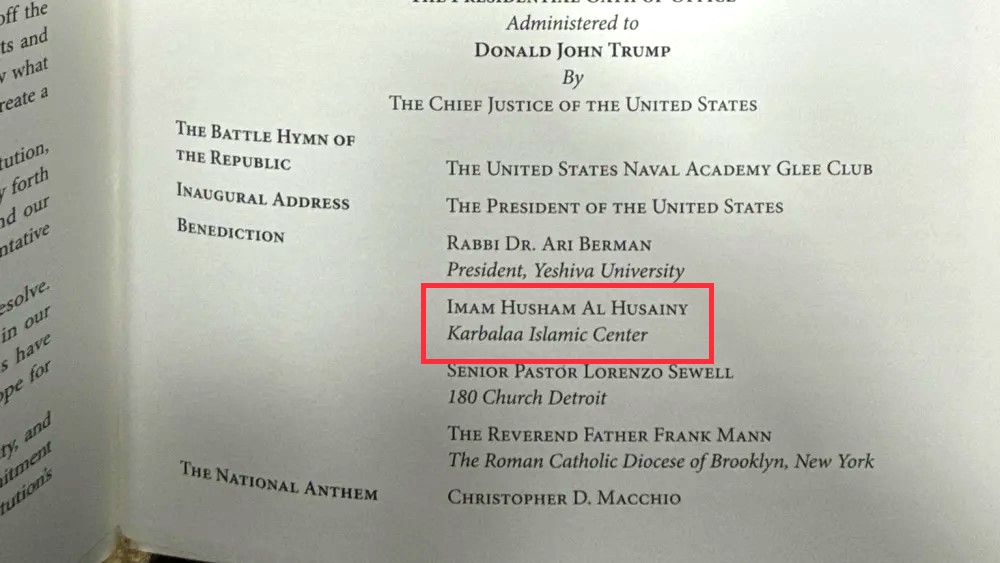
Husham Al-Husainy, a radical Islamic cleric who refused to call Hezbollah a terrorist organisation, has been invited to deliver a Benediction at the inauguration ceremony of Donald Trump. The event is scheduled to take place on 20th January this year.
Husainy, who has a history of extremism, will speak immediately at the inauguration ceremony after the address by Donald Trump. He is also the imam of the Karbalaa Islamic Educational Center in Michigan.
According to a report by the Middle East Forum, Husainy is an anti-Semitic, pro-Hezbollah Shia imam. In 2015, he had called death upon Suni-majority Saudi Arabia for attacking Yemen.
Screengrab of the invite extended to Husham Al-Husainy
He had also eulogised terrorist Hassan Nasrallah during a pro-Hezbollah rally in 2006. Husham Al-Husainy had also demonised US security forces as ‘oppressors and occupiers’ for its war against Iraq.
Despite such an extremist track record, the Islamic cleric has been invited to the inauguration ceremony of Donald Trump.
Interestingly, Husham Al-Husainy extended his support to Trump in October 2024 for opposing gay marriage and upholding ‘conservative values’.
Appointment of Harmeet Dhillon in Trump 2.0 cabinet
The development comes a month after Donald Trump appointed Harmeet K. Dhillon as the Assistant Attorney General for civil rights.
Dhillon had long been accused of being a terror sympathiser and harbouring Khalistani sentiments—an extremist ideology that uses violence as a tool to push its objectives and calls for the secession of the Punjab state from India and the establishment of an independent Sikh-majority Khalistan.
Nothing corroborates her pro-Khalistan bent more starkly than her stance on the Khalistani Hardeep Singh Nijjar’s killing.
In March 2024, she quoted The Economist report on how Indian migrants were helping PM Narendra Modi in campaigning at home and lobbying for India abroad.
Quoting the report, Dhillon repeated the baseless accusations that the Indian government is assassinating critics in the diaspora.
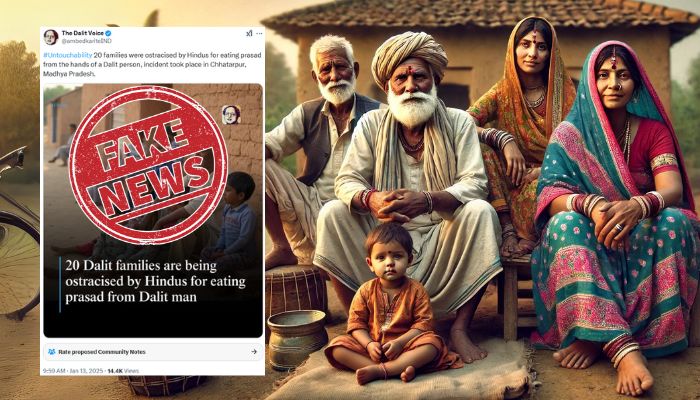
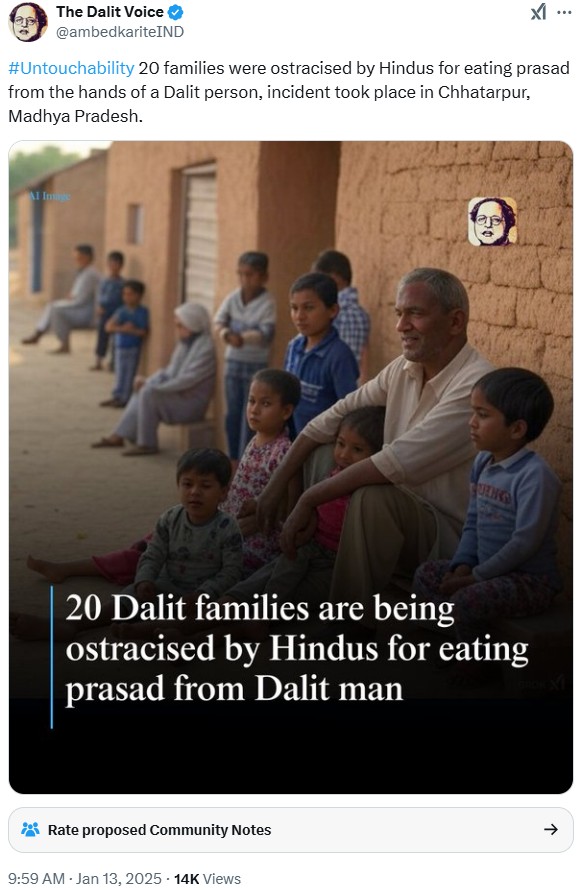
On 13 January, X user The Dalit Voice published a post alleging that Hindus ostracised 20 Dalit families in Madhya Pradesh for eating prasad distributed by a Dalit person.
The post stated, “20 families were ostracised by Hindus for eating prasad from the hands of a Dalit person, incident took place in Chhatarpur, Madhya Pradesh.” However, the post lacked substantial news reports or evidence to support the claim. Similar posts were made by other social media users, amplifying the allegation without verified details or credible sources.
Source: X
Another user Nadya wrote, “India 21st century looks like this. In Madhya Pradesh’s Chhatarpur district, around 20 families are facing a social boycott for accepting prasad from a Dalit man in Atrar village.” The X user cited the propaganda website Maktoob Media which also mentioned that “upper caste” families were boycotted. It read, “When news spread that upper-caste families had accepted prasad from a Dalit, the sarpanch allegedly declared a social boycott against all those who participated.”
India 21st century looks like this ? In Madhya Pradesh’s Chhatarpur district, around 20 families are facing a social boycott for accepting prasad from a Dalit man in Atrar village. https://t.co/zBsnlJOPRj
The Dalit Voice’s Instagram account’s screenshot was shared by one Dr Sylvia Karpagam who wrote, “India’s love affair with discrimination.” There was no news report mentioned or details provided.
X users, including Arya_Anviksha_ and Dr Neha Das, refuted the claims and provided evidence to debunk fake news disseminated by social media users who refer to them as Ambedkarites.
Details of the incident
The fake news stems from reports of allegations made by a Dalit man from Atrar village in Chhatarpur district, where he claimed that he and five other families had been excluded from social events after they ate prasad (religious offering) distributed by him. However, the police have refuted the claims, stating there is a longstanding political dispute between two groups in the village.
A man named Jagat Ahirwar, who belongs to a Dalit community, filed a complaint with the Chhatarpur police on 7 January, alleging that in August 2024, he had distributed laddoos as prasad at a local temple. Following that, according to him, the village sarpanch, Santosh Tiwari, ostracised his family and five others who consumed the prasad. Ahirwar has claimed that these families were no longer invited to social gatherings, including weddings and other community events.
Furthermore, Ahirwar accused Tiwari of using caste divisions to enforce the boycott and said, “We are being denied basic community interaction because of an age-old caste bias.”
Police refute allegations, cite political rivalry
Sub-Divisional Officer of Police (SDOP) Shashank Jain spoke to the media about the incident and refuted the claims, saying, “We investigated the matter by speaking to the villagers but found no evidence of such ostracisation.”
The police said that the incident appeared to be a fallout of political animosity between two groups that stemmed from fiercely contested local elections. SDOP Jain added that the allegations might have been influenced by tensions between rival factions supporting Ahirwar, the former sarpanch, and Tiwari, the incumbent sarpanch.
Sarpanch Tiwari also denied any involvement and said, “These allegations are baseless and politically motivated. Ahirwar lost the sarpanch elections, and this is a tactic to defame me.”
Interestingly, media reports on this case categorically mention that the families that have allegedly been boycotted belong to both Dalit and upper-caste communities. A report in The Times of India, one of the first to cover the case, stated: “This prasad was shared with over 20 villagers from various castes, including Brahmins and other upper castes. Once word spread that upper-caste individuals had accepted prasad from a Dalit, the sarpanch allegedly ordered a social boycott of all these families.”