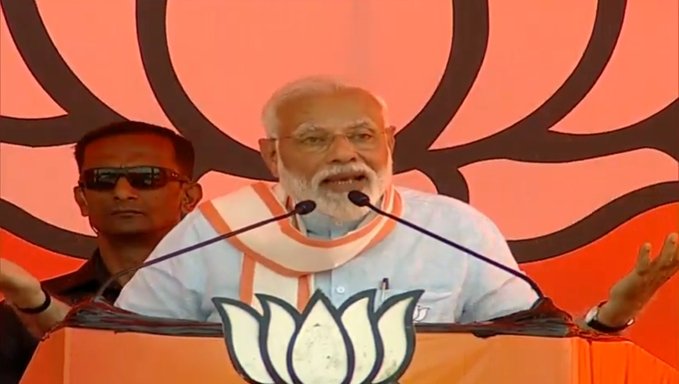
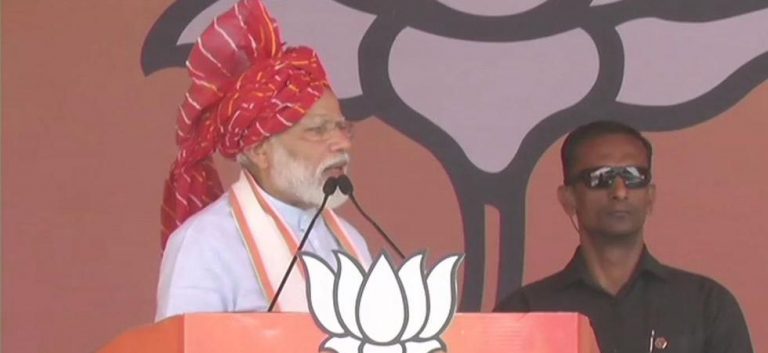
Prime Minister Narendra Modi took an apparent dig at Robert Vadra and said he was close to being put behind bars. Addressing a rally in Haryana’s Fatehabad on Wednesday, PM promised if voted back to power, the NDA government will ensure the ‘shahenshah’ who looted farmers, is thrown behind bars within the next five years.
“This chowkidar has taken the person, who looted farmers, to court. He is making the rounds of ED and courts to take bail. He used to think he is ‘shahenshah’ but now is nervous. I’ve already taken him to the jail door. Give blessings and I’ll put him in jail within the next 5 years,” the PM remarked, while the crowd cheered on. He asserted those who have looted the country ‘will have to pay back.’
Though Modi did not take any names in his speech, he made an obvious reference to UPA chairperson Sonia Gandhi’s son-in-law Robert Vadra, who is currently facing trial in a land deal case.
Vadra has been facing charges for his involvement in corruption-marred land deals in Haryana’s Gurugram. The transactions in Gurugram deal had taken place when Congress was in power in the state and Bhupinder Singh Hooda was the Chief Minister.
He is also accused of money laundering and Enforcement Directorate (ED) is investigating him in connection with the purchase of a London-based property at 12, Bryanston Square. Estimated at a staggering 1.9 million pounds, Vadra is believed to own this property.
Earlier, ED had sought custodial interrogation of Robert Vadra in this matter. In his defence, Vadra had moved the court appealing to quash the ED case against him. he also demanded certain provisions of PMLA be declared unconstitutional.
However, the troubles only seem to escalate for Rahul Gandhi’s brother-in-law Vadra. In February, ED had attached Vadra’s company, M/s Sky Light Hospitality (P) Ltd worth Rs 4.62 crore. In April last year, ED had attached the properties of Vadra’ aide Jaiprakash Bagarwa in connection with Bikaner Land Scam case. In Bikaner Land Scam case, the land was allegedly allotted in the name of non-existent individuals by the State government officials in collusion with some fraudulent individuals, including real estate developers.
The PM, in his address, launched a scathing attack on the Congress party by highlighting their corrupt policies and the ecosystem it adhered to in the past decades of their rule.
The PM was blistering in his attack. He criticized the Congress party over the 1984 anti-Sikh riots and blamed it for benefitting the tainted involved in committing the sin. He went on to accuse them of not putting in enough efforts during independence to ensure that Kartarpur Sahib is a part of India.
He divulged that Congress is seen backing the ‘tukde, tukde gang’, and aims to revoke the sedition law and Armed Forces Special Powers Act (AFSPA), which will give full freedom to stone pelters and those who support terrorists and Naxals.
Modi switched topics speaking effortlessly about everything the Congress party has been complying to in its divisive plan to break the country for its personal benefits.
You can catch the PM’s full speech in the rally here:
Earlier we had reported that Vadra was being questioned by ED in money laundering and other cases against him. According to reports, ED had confronted him with the detail of Sanjay Bhandari’s interrogation by the Income Tax department in 2016, which show that Vadra has a link with the fugitive arms dealer.
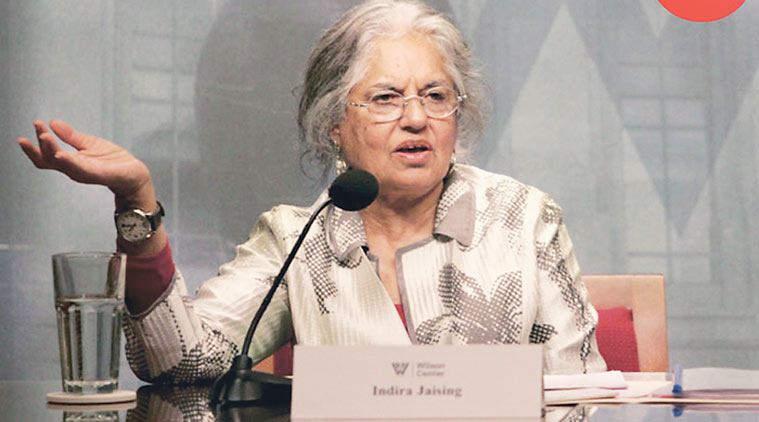
The Supreme Court has issued a notice to senior advocates Indira Jaising, Anand Grover and NGO Lawyers Collective on the basis of a PIL filed by a voluntary organization of lawyers, Lawyers Voice, seeking an SIT investigation into the inaction of the Central Government over the violation of FCRA laws by the entities concerned. The notice was issued by a bench headed by CJI Gogoi.
The Central Government had cancelled the FCRA licence of the NGO after the FCRA violations came to light but apparently, no action was sought against the individuals themselves.
The petitioner claimed that “despite recording serious acts of commission and omission by the Union of India in its order dated May 31, 2016, and order dated November 27, 2016, which led to the cancellation of FCRA certificate of Lawyers’ Collective, the officers of the Union of India have deliberately not registered offences against the respondents under the respective criminal Acts for reasons best known to them”.
It was also claimed that Jaising and Grover have received foreign funding to influence democratic process of the country by lobbying with the Members of Parliament in an unauthorized manner and media for the passing of certain legislation and to influence the policy decisions.
The last two decades have witnessed mushrooming of several voluntary organisations which are funded by foreign sources which are trying to thwart the development of the country. Such voluntary organisations thrive on foreign funding and carry out various activities which are not in the interest of the nation, the petitioner alleged further.
Indira Jaising, in typical fashion, has claimed victimization for her involvement in the issue of sexual harassment allegations against CJI Gogoi. In a statement issued by Lawyers Collective, it was claimed that petition ought to have been taken on the 10th of May but was listed on the 8th instead.
The statement further claims that CJI Gogoi ought to have recused himself in the matter. It reads, “Considering that Ms Jaising has been publicly vocal on the issue of due process of law in relation to the conduct of the in-house inquiry, the Chief Justice ought to have recused himself from hearing the matter.” It adds, “It has been brought to our knowledge that during the proceedings today, though the Petitioner’s advocate did not orally seek any interim orders, the Court has passed an order to the effect that the pendency of the petition will not come in the way of government agencies proceeding in the matter.”
Meanwhile, the petitioner has requested that an FIR against Jaising, Grover, and Lawyers Collective for offences under the IPC, PMLA and PC Act. Action for the violation of the Income Tax Act has also been sought.
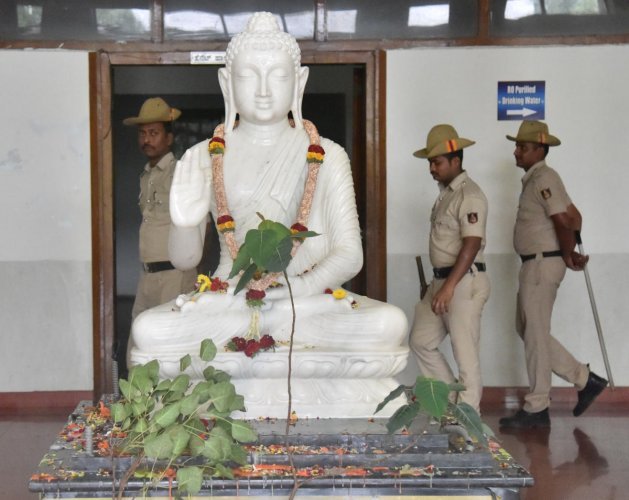
In the Jnanabharathi campus of Bangalore University, two groups are at loggerheads with each other over the forceful installation of a Buddha idol in a place that is meant to have a Saraswati idol.
A Saraswati idol installed in 1973 was reportedly broken last year during an event and a new idol was to be inaugurated this Friday. Vice-Chancellor K.R. Venugopal had reportedly spent money from his personal account to buy a new idol of goddess Saraswati.
On Monday, some research scholars led by one professor Mylarappa allegedly brought the Buddha idol and installed it at the spot meant for the Saraswati idol, at the entrance of the administrative block in Jnanabharathi campus.
Irked by this, students and staff staged a protest and demanded the idol to be removed. The protesters did not object to having a Buddha idol but objected to the fact that idol was installed in that particular spot.
Following, this the Vice Chancellor intervened and ordered the idol removed. A while later, there was a heated exchange of words between the two parties at the administrative block. The police were called in to control the situation. In the evening a sub-committee meeting was organised to decide on the situation.
The Vice-Chancellor has stated, “In the sub-committee meeting chaired on Monday evening, we have decided not to change the place designated for Saraswati idol. New idol will be installed at the same place where the old idol was installed. The committee will look into an alternate place to keep the Buddha idol.”
As reported by TOI, the controversy is rooted in some university officials and a professor attempting to settle old scores and exert control over administrative affairs.
Reportedly, students who had installed the Buddha idol were close to controversial Professor of Sociology, BC Mylarappa. According to the Vice-Chancellor, Mylarappa had denied his involvement in this. A CCTV footage has been submitted to the police showing 30-40 people who came for the Buddha idol’s installation.
Home Minister MB Patil, had directed the state police chief to submit a report on the situation. He told reporters, “The university should not have replaced one statue with another. We have great respect for both Saraswati and Buddha. I have instructed the police chief to ensure things remain as they were earlier.”
The sub-committee has finally decided not to change the location of the Saraswati statue and install a Buddha statue nearby. They have appealed to all stakeholders to cooperate and maintain peace.
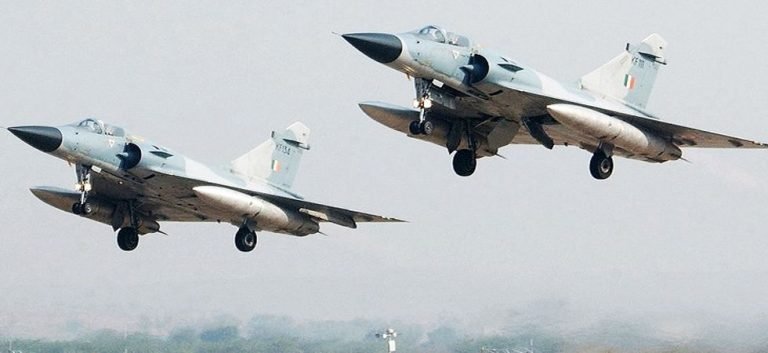
Amidst the raging debate in the Indian political arena around Balakot airstrikes’ authenticity and efficacy, a senior Italian journalist has claimed that 130-170 terrorists had died in India’s airstrike in Balakot. In a report published on Stringerasia, journalist Francesca Marino has claimed that the number of terrorists died in the strike was in the range of 130-170, which includes those who have died during treatment later.
Where I piece together the informations I’ve got in the past few days. More details to come in future
The report is of special significance due to its timing. It has been published within days after the United Nations (UN) designated Masood Azhar, deadly and most wanted chief of Jaish-e-Muhammad (JeM) a global terrorist. JeM had claimed responsibility of the Pulwama attack, wherein more than 40 Indian paramilitary personnel lost their lives.
The report further revealed that 45 injured terrorists are still under treatment by Pakistani Army Doctors, while 20 terrorists have already died during treatment. It also suggests that terrorists who have recovered are still under the custody of the Pakistani Army.
Marino claims to have summed up the quotes from her sources to prepare this report, which clearly indicates that terror camps in Balakot were attacked in Balakot in the wee hours on February 26. While the attacks took place around 3:30 am, the Pakistani Army Unit managed to reach the spot from their camp in Shinkari around 6 am. Shinkari, the location of a Pakistani Army Base, is situated about 20 km away from Balakot. Incidentally, the injured terrorists are being treated by army doctors at a Harkat-ul-Mujahideen camp located in Shinkari.
According to Marino’s report, 11 out of the dead were trainers meant to conduct training for bomb-making to those imparting weapons training. 2 out of the 11 trainers were natives of Afghanistan. The report also reveals that Jaish members had visited the families of the deceased to hand over over cash compensation and avoid the risk of the number of fatalities being leaked to the media.
A freshly painted signboard has been put up at the site mentioning the presence of Taleem-ul-Quran on the hilltop. All references to the banned JeM terrorist Masood Azhar have been removed, which were there in the earlier signage. The site is still under the control of the Pakistani Army and even local police face restrictions to visit the camp.
Marino claims some locals of Bisian town still discuss the incident wherein they had noticed vehicles dumping debris in the nearby Kunhan river on the first night after the strikes.
Meanwhile, Jaish leadership has assured its cadres that revenge will be taken when the time is right.
In their disdainful attempt to attack PM Narendra Modi, some detractors will, however, continue to questions the Balakot Airstrikes despite a neutral source the confirmation. In the past, even after IAF’s admission of carrying out the airstrikes, Congress leaders including Digvijaya Singh, Ashok Gehlot, Kapil Sibal, Sam Pitroda, Kamal Nath, Captain Amarinder Singh have raised their doubts about these strikes and demanded proof to pin down Modi.
Independence of judiciary has been a hallmark of our constitution. The Hon’ble Supreme Court many a times has ruled that a judge should be given an atmosphere in which he can dispense the justice fearlessly and without any intimidation, to uphold the dignity of law. It is not merely of some importance but is of fundamental importance that Justice should not only be done but should manifestly and undoubtedly seem to be done.
The nature of judicial function involves the performance of difficult and at times unpleasant tasks. I would like to quote the words of Justice Sanjeev Khanna, which he stated in his farewell speech, in full court reference that “sometimes there is no office as powerful as the judge and at the same time it is frightful and defenseless”.
The Chief Justice of India, at present, despite having all the qualities of a righteous judge is feeling defenseless and is facing unnecessary criticism, which is even reflected in an interview of Justice AP Shah, Former Chief Justice of High Court of Delhi, published in The Indian Express dated May 7, 2019. Justice Shah may have his own notions but certainly as a former judge, he would agree that institutions always function on certain basic rules and procedure.
In the event of any unpleasant situation, being faced by the institution or by a responsible person of that institution warranting set up of an inquiry, the Inquiry must be conducted within the four corners of the established and recognized rules.
Nevertheless, it is a fact that in-house inquiry, which looked into the allegations of a former Supreme Court employee comprised of the senior-most Judge of the Hon’ble Supreme Court of India after the Chief Justice, and two women judges namely Ms Justice Indira Banerjee and Ms Justice Indu Malhotra.
Any practicing lawyer who has appeared before Ms. Justice Indira Banerjee, will vouch for her impartiality, patience and integrity. All who have appeared in her court would agree that nobody in her court was condemned unheard. The same applies for the other Hon’ble Judge Ms. Justice Indu Malhotra. She was a leading practitioner in the Hon’ble Supreme Court of India and was designated as a Senior Advocate from the Supreme Court, which is a rare achievement for any Advocate. She also left her flourishing practice for serving the society, by accepting to be a judge of the Hon’ble Supreme Court of India. The third member, Justice Bobde is in line to be the next Chief Justice of India and is known to be a strong and independent judge with unimpeachable integrity and merit.
Unfortunately, the former Supreme Court employee did not even spare the Hon’ble Judges of the above caliber, heaping reckless and unwarranted allegations against them in a manner similar to the allegations that were thrown on Hon’ble Mr. Justice N.V. Ramana, forcing him to recuse himself from the panel probing the charges of sexual harassment.
The legal fraternity would know that the inquiry against the sitting High Court and Supreme Court judges is contemplated under an in-house procedure which was recommended by a committee of five former Hon’ble judges, the prominent of all was Justice S.P. Bharucha. The said report of the committee was evolved and adopted by the full court of the Hon’ble Supreme Court on 15.12.1999. The objective was to give judges protection given the nature of their office and judicial functions which they dispense. Since 1999 no one has assailed or pointed out any lacunae in the procedure for setting up an inquiry and the working of the inquiry committee.
A perception is being created in the mind of the general public that the Complainant was not allowed to be represented and accompanied by a lawyer, the inquiry did not proceed in a judicious manner.
I may say that the inquiry into the allegations made by the Complainant was an inquiry of the truthfulness of the allegations and not on any point of law, and the best person to answer and apprise the committee of the alleged real events was the Complainant herself, in which no lawyer could be of any assistance. The committee had the detailed affidavit of the complainant and she had already supplied relevant material to the Hon’ble Supreme Court with her affidavit.
The affidavit and the material were duly considered by the inquiry committee as the newspaper reports clearly suggested that the complainant was called by the committee on different occasions. Her grievances cannot take a new shape with each passing day and if her version did not inspire any confidence, the committee is within its right to bring a quietus to the entire controversy. Merely because the report of the Inquiry committee has not gone in favour of the complainant, it does not mean that the whole system is against her.
It needs to be remembered that the principles of natural justice have many facets and there is no straight jacket formula for the same. The said principle has to be judged in the facts of every matter. The main objective of natural justice is that no person should be condemned unheard.
From the news reports I can gather that the former employee was given around six hours to present her allegations. If certain uneasy questions would have been asked by the Hon’ble Committee to her, which she could not answer and chose to walk away on unfounded grounds, it cannot constitute a breach of natural justice. The inquiry cannot be called an ex-parte inquiry when the Complainant has participated in the same and she was satisfied with the constitution of the committee, once Justice Ramana opted to withdraw himself for the committee.
Mere allegations of prejudice and apprehension of bias against the committee which had no personal interest in the matter cannot be a subject of criticism and judicial impropriety.
From the above, in my humble opinion the entire system cannot have any motive against a single person and sometimes there is a difference between what one perceives and what meets the eye.
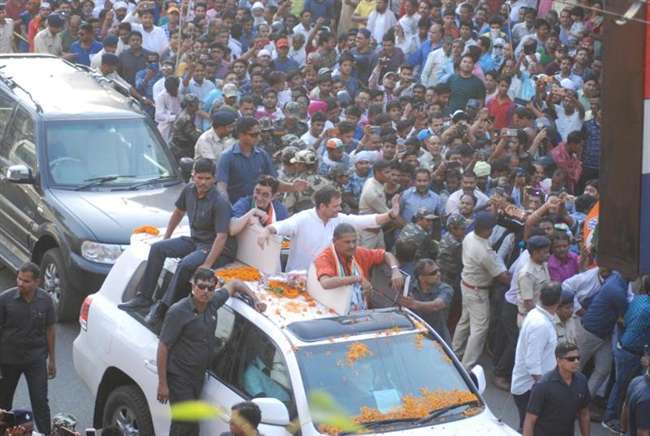
Congress President Rahul Gandhi, like various other politicians, is sweating it out as the 2019 Lok Sabha elections reach almost its last leg. The Gandhi scion had held a roadshow in Dhanbad, Jharkhand on Tuesday, campaigning for its Dhanbad candidate Kirti Azad, as Dhanbad goes to vote in the 6th phase of the ongoing elections scheduled on May 12.
In what could be seen as a major embarrassment for the Congress party, few people attending Rahul’s roadshow were heard chanting ‘PM Modi zindabad’ slogans in retaliation to the ‘chowkidar chor hain’ slogans called out by Rahul’s supporters.
In the 45 minutes roadshow, as Rahul’s convoy passed through Matkuria check post to reach the Bank More, several people standing on the terraces of the nearby houses were also heard shouting slogans: “Chowkidar pure hain, unka aana sure hain” and in the same breath were heard echoing, “PM Modi zindabad”. However, looking unaffected by the uproar, Rahul and his minister’s continued with their roadshow.
Amongst all this, a shocking incident also transpired. In a video shared by a Tweeter handle named @ExSecular, a police officer, Surendra Singh, is seen hitting a young boy for wearing a PM Modi’s mask during Rahul’s Dhanbad rally. The officer slaps the boy, snatches the mask and destroys it. He forces the young boy to shout “Chowkidar chor hain”.
कल धनबाद में राहुल गांधी के रोड शो के दौरान सड़क के किनारे खड़े बच्चे ने मोदी जी का मुखौटा पहन रखा था, पूलिस ने जोरों से दो थप्पड़ जड़ दिया उनके मुंखोटा फाड़ दिया और कहा चौक़ीदार चोर है कहो और भाजपा के महिला कार्यकर्ताओं को गाली गलौज किया pic.twitter.com/ldu8i0d70A
Another Bank More police officer, when asked about the incident, said, that the boy who was standing in the corner of the street with Modi’s mask on, was asked to remove the mask and move to a side, as Rahul Gandhi’s convoy was approaching. Even after being asked multiple times the boy refused to move, which irked police officer Surendra Singh, who in turn started hitting him.
Meanwhile, the man recording the incident is heard warning the officer of dire consequences if he does not stop bullying the boy, but the police officer unruffled by the warning continues to intimidate the child.
Later police said that they did not hit the boy, but said that the boy was behaving inappropriately hence they were talking to him. But the video clearly shows that the boy was just standing when he was suddenly slapped by the police officer.
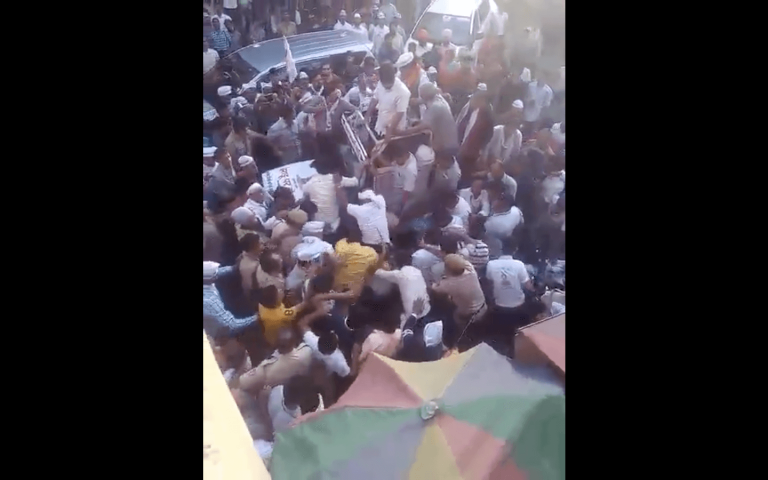
A video has gone viral on social media where the AAP supporter who slapped Delhi Chief Minister Arvind Kejriwal at a roadshow in Delhi is being beaten to a pulp by Kejriwal supporters and he is just standing there, watching it unfold.
A man getting lynched in front of Delhi CM @ArvindKejriwal . He does not intervene. This man promises to make Delhi crime free if it becomes a full state but refuses to intervene in a crime that’s happening before his own eyes pic.twitter.com/PL4bK3UP8b
As can be seen above, the scene is from right after the man had slapped Kejriwal. Kejriwal supporters jumped off the vehicle and started beating up the man. More and more people joined in beating him up even as Delhi Police tried to stop the mob. In the video which is almost 2 minutes long, the man gets beaten up and not once is Kejriwal seen asking his supporters to refrain and not take law in their own hands.
In fact, when Kejriwal was slapped, AAP leaders and supporters had put the blame on BJP and accused that Suresh, the man who slapped Kejriwal, was a ‘Modi Bhakt’ and part of a BJP conspiracy to attack him. Senior AAP leader Manish Sisodia even claimed that Amit Shah and Narendra Modi have conspired to get Arvind Kejriwal killed. Terming it as a conspiracy by the BJP, AAP leader Sanjay Singh asked the Delhi Police to increase the Chief Minister’s security.
Recently, Tripura Congress chief Pradyot Deb Burman had slapped and threatened a man inside the police station. On the other hand, when a shoe was hurled at BJP spokesperson GVLN Rao during a press briefing, the security guards sprung into action and escorted him out before handing him over to the police. In Kejriwal’s defence, he just stood as a mute spectator and didn’t get off the car to join the mob.
How the Modi government’s strategic plan helped open 5,000 Jan Aushadhi Kendras and deliver 1,000 medicines at less than half the market price.
Medicines account for nearly 70% of treatment costs, putting access to basic healthcare out of reach of the majority of the public. To tackle escalating costs, Pradhan Mantri Bharatiya Jan Aushadhi Yojana was introduced in 2008 but failed to overcome challenges and make a difference in the lives of citizens. A renewed attempt under the Modi government has resulted in opening 5,000 stores, providing more than 1,000 medicines. This strategic push under PM Narendra Modi’s leadership has resulted in an estimated savings of more than Rs. 1,000 Crores for the public.
Introduction and Need for affordable medicines in India
Medicare is becoming significantly expensive year-on-year. Medicines account for nearly 70% of total treatment costs. Branded medicines are sold at higher prices due to the associated patent protection, advertising expenses and high-profit margins. It is estimated that branded medicines cost anywhere between 30-90% more than their equivalent generic medicines. Such high prices mean that quality branded medicines are out of reach for more than 40% of the Indian public, considering mainly the poor and disadvantaged. Guaranteeing fair prices for medicines has always been a major concern for the Government of India. Despite several regulatory and fiscal measures, the cost of medicines is still on the rise.
To combat the escalating costs of medicines, ‘Pradhan Mantri Bharatiya Jan Aushadhi Kendra’ was launched by the Government of India in the year 2008. The first Kendra was opened in Amritsar in Punjab. The initial target for implementation during the 11th five-year plan starting in 2008-09 was to cover 630 districts of the nation. Further subdivisional major towns and village centres were to be covered by 2012.
The objective of the scheme
This scheme aims to bring down the cost of medicines and make it affordable for each and every citizen. The objective of the scheme is:
“Making quality medicines available at affordable prices for all, particularly the poor and disadvantaged through exclusive outlets ‘Pradhan Mantri Bharatiya Jan Aushadhi Kendra’, so as to reduce and redefine the unit cost of treatment per person.”
Mission
The Mission of the Pradhan Mantri Bharatiya Jan Aushadhi Parriyojana is as follows:
Create awareness among the public regarding generic medicines
Create demand for generic medicines through medical practitioners
Create awareness through education and awareness programme that high price need not be synonymous with high quality
Provide all commonly used medicines covering all therapeutic groups
Provide all related healthcare products under Pariyojana
Status of work done under Jan Aushadhi Pariyojana from 2008 to 2015
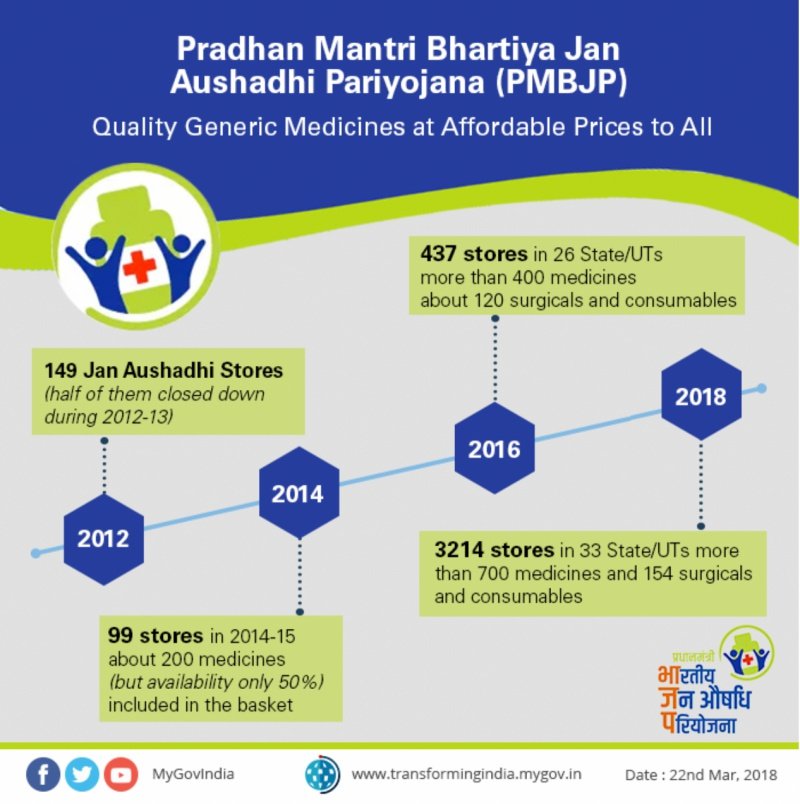
In house production of CPSU’s led to supply of only 139 medicines out of 319 that were supposed to be made available. Only 85 products covering 11 therapeutic groups were made available. As per the original plan, Jan Aushadhi kendras were aimed to be opened in each and every one of the 630 districts in India. But as on 2012, only 157 such kendras were opened with many of them nonfunctional.
The causes of failure were identified to be overdependence on support from State Government, poor medicine stock management, nonprescription by Doctors, lack of awareness about medicinal availability and competition with other State free medicine distribution schemes.
To overcome the initial challenges faced and provide a boost to the scheme, a new business plan was formulated with a target to open a minimum of 500 kendra’s during 2013-14. The results in 2015 also did not match initial expectations. By the end of 2014-15, only 99 Kendra’s were opened, and a number of medicines to be provided were only 200 with less than 50% availability.
Strategic overhaul and implementation by NDA
A Strategic Action Plan (SAP 2015) was prepared after the NDA Government’s complete analysis of the reasons behind the failure of the scheme. Areas studied were availability, acceptability, accessibility, affordability, awareness and effective implementation of the scheme. The scheme was later renamed as Pradhan Mantri Bharatiya Jan Aushadhi Pariyojana (PMBJP). BPPI (Bureau of Pharma PSUs of India) was established for coordinating procurement, supply and marketing of generic medicines.
The new strategy of Jan Aushadhi Kendra under the Modi government laid emphasis on the sustainability of the initiative with no dependence on government subsidies beyond the initial support. To make the scheme successful and sustainable, the government had sought collaboration with private pharmaceutical companies. Substantial incentives were also provided for entrepreneurs who were willing to open Jan Aushadhi Kendras. The budget was also allocated to create awareness regarding this initiative, and achieve scheme penetration in all villages.
Timeline of Pradhan Mantri Bhartiya Jan Aushadhi Pariyojana (PMBJP), from 2012 to 2018. Half of the stores were closed in 2012-13, since the inception of the scheme in 2008. After 2014, the pace of establishing Jan Aushadhi Kendra’s was increased exponentially. As on 22nd March 2018, 3,214 stores were established.
As a result, as on 10th March 2018, the following changes had occurred:
Product basket contained 1,000 medicines and 154 surgical products
Supply chain from suppliers to agents was streamlined for timely delivery of medicines.
Central warehouses were launched in Gurgaon.
8 C&F agents and 55 distributors were appointed to cover all states and UT’s.
More than 3,200 Kendra’s were established across 33 States/UT’s.
Factors for success during NDA tenure
To enable more Jan Aushadhi Kendra’s across India, the NDA Government provided support to operating agencies. Financial support in the extent of Rs. 1 lakh for free medicines at start of Kendra, Rs. 1 lakh reimbursement for furniture & fixtures, and Rs. 50 thousand as reimbursement for computer & peripherals was provided. 2% of total sales or actual loss compensation against the expiry of medicines were also provided to stores. The credit facility was provided upto 30 days against post-dated cheques, with 60 days facility available for distributors. The government has also increased the margins from 16% to 20% for retailers and from 8% to 10% for distributors.
Indian Medical Association, an organization with 3 lakh doctors spread across 1,700 local and 30 State branches were contacted for collaboration. This association which stands for affordable, accessible and quality healthcare; collaborated with PMBJP and started promoting medicines available through Jan Aushadhi Kendra’s.
Indian Railways was roped in to open Jan Aushadhi Kendras at 1,000 railway stations and PSU-run petrol pumps.
The success of Jan Aushadhi Kendra’s under NDA Government
Due to effective strategies and successful implementation of this initiative, the following positive changes have occurred throughout the nation:
Currently, over 5,000 Jan Aushadhi stores have been opened, with additional 2,500 to be inaugurated by 2020
Jan Aushadi stores across the country are serving 10-15 lakh people per day
A decision has been made to celebrate March 7thas ‘Janaushadhi Diwas’ across India
Under the PMBJP, the government provides more than 1000 medicines and 154 surgical through Jan Aushadhi kendras
Average sales per store per month of Rs 1.50 lakh
4 big warehouses opened at Delhi, Guwahati, Bengaluru, Chennai to ensure adequate medicine availability
The road ahead
The successful implementation of the Jan Aushadhi Yojana during the NDA tenure has led to reduction of medicinal costs of treatment. Medicines available through Jan Aushadhi Kendra’s are 4-15 times cheaper than alternative sold in the market. Anti-diabetic drug glimepiride priced at Rs 4.02 under the government scheme costs a whopping Rs 54 under a branded disguise. This anti-diabetic drug alone can save 13 times the amount if bought through Jan Aushadhi Kendras. A cap was placed on prices of stent and knee implants after they were lowered by more than 50%.
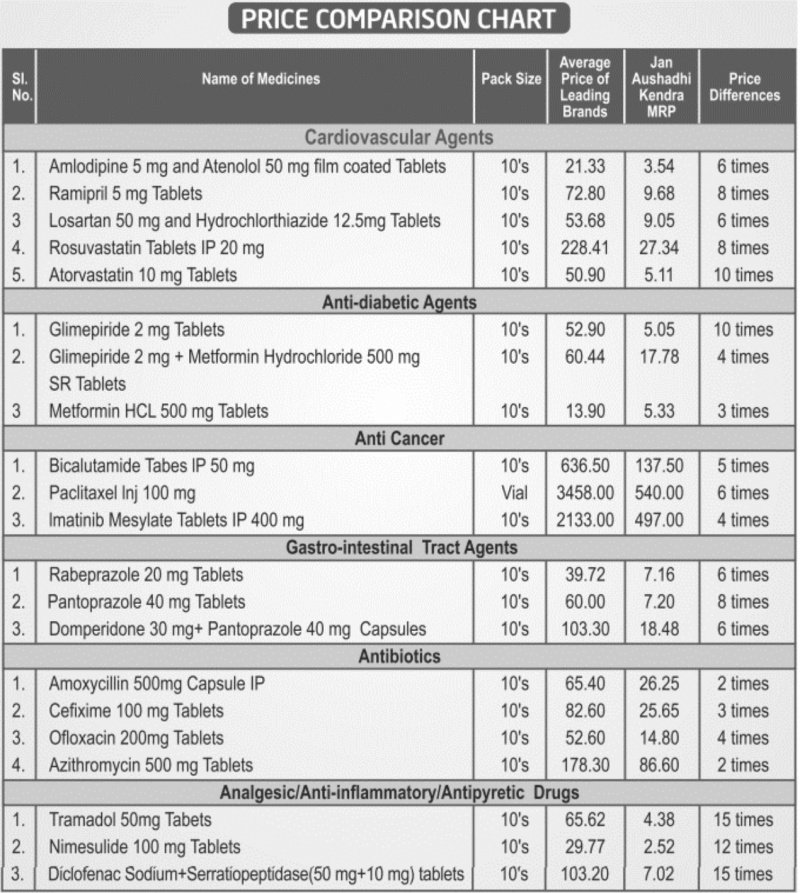
Comparison chart of medicines available through PMBJP verses similar medicines sold by leading brands. The difference between prices can be seen to be a minimum of twice the cost of medicines sold by brands. In some cases, the difference between prices is an astronomical 15 times.
PM Narendra Modi promised a legal framework to ensure that doctors prescribed low-cost generic medicines instead of expensive branded medicines. Prescribing a medicine by its molecular name rather than its brand name improves the possibility of a customer opting for a cheaper alternative to the prescribed medicine rather than buying one from a branded manufacturer with high costs.
Annual turnover of PMBJP has also increased to Rs 73.66 crore in 2017-18 (as on October 30, 2017) from Rs 33.4 crore in 2016-17 and Rs 12.43 crore in 2015-16, increasing rise in the adoption rate of this scheme. Rs. 74.16 Crores were allocated during the budget of 2017- 2018 to further boost the progress of the scheme.
The Modi Government is putting major efforts towards completing the initial vision of opening at least 1 Jan Aushadhi Kendra store in every block. As such plans are in place to open additional 2,500 Jan Aushadhi stores by 2020.
Jan Aushadhi Yojana has also resulted in the reduction of costs of Cancer treatment. As of now, the government is conducting talks with various companies to take the plan forward. Health experts, oncologists and institutes like Tata Memorial Cancer Hospital have suggested that prices of drugs for the treatment of cancer should be regulated by the government. Presently, the cost of only 51 such drugs is under price control of the government. Bringing more cancer-related medicines under price control of the government will help bring down cancer treatment costs extensively.
The endeavour of this project is to make all commonly used medicines available at all Jan Aushadhi Kendra’s and to provide a complete spectrum of healthcare products at all outlets. Accessibility to basic healthcare and medicines is a birthright of every human on the planet. PMBJP has taken bold steps towards enabling the right to medicine for every citizen and has led to savings worth Rs. 1,000 Crore for the Indian public until now. The NDA Government under the leadership of PM Narendra Modi is ensuring no step is left unturned towards providing health and medicines to every citizen of this nation.
Prime Minister Modi, while addressing an election rally in Kurukshetra, Haryana, recalled the abuses hurled at him by the various opposition leaders. He said that such abuses are hurled at him by the Congress Party and its allies because he stopped corruption and also exposed their nepotism.
मैं कांग्रेस और उसके साथियों को मनमानी नहीं करने देता हूं, उनके भ्रष्टाचार को रोकता हूं, उनके वंशवाद की बात करता हूं, इसलिए ये लोग बार-बार प्रेम का नकाब पहनकर मुझे गालियां देते रहते हैं: पीएम मोदी #ModiHiAayega
The Prime Minister recounted all sorts of derogatory terms that have been used by the opposition leaders against him like sewage worm, Gangu Teli, Mad dog, Bhasmasur, Virus and even Dawood Ibrahim.
कांग्रेस के एक नेता ने मुझे गंदी नाली का कीड़ा कहा, तो दूसरा मुझे गंगू तेली कहने आ गया।
इनके एक नेता ने मुझे पागल कुत्ता कहा, तो दूसरे नेता ने भस्मासुर की उपाधि दे दी
Reciting the list of abuses he said that he had also been compared with Hitler, called a worthless son, rabies stricken monkey, mouse, and Lahu (Blood) Purush. He said that Congress even called him Ravana, Scorpion, filthy man, and also one who does the farming of poison.
इनके एक नेता ने मुझे हिटलर, तो दूसरे ने मुझे बदतमीज नालायक बेटा कहा।
इतना ही नहीं, मुझे रैबीज बीमारी से पीड़ित बंदर, चूहा और लहू पुरुष बोला गया।
कांग्रेस वालों ने मुझे रावण, सांप, बिच्छू, गंदा आदमी, जहर बोने वाला तक बोला: पीएम मोदी #ModiHiAayega
The list did not end there and the Prime Minister counted more abuses including the infamous ‘trader of death‘ jibe by former Congress Sonia Gandhi, mentally ill, lowlife, and a comment by a Congress leader questioning who his father was.
कांग्रेस के नेता जिसके सामने नतमस्तक होते हैं, उन्होंने भी मुझे मौत का सौदागर कहा।
ये इनका ‘प्रेम’ करने का तरीका है: पीएम मोदी #ModiHiAayega
Listing down all the abuses, Modi said that the opposition leaders are exposing their dictionary of love and yet no one is questioning them.
कांग्रेस के नामदार जिस तरह अपने प्रेम की डिक्शनरी दिखा रहे हैं, उस पर कोई उन पर सवाल नहीं उठा रहा है।
मुझे गाली देते हुए उन्होंने कितनी बार मर्यादा तार-तार की है, ये भी इनकी प्रेम वाली डिक्शनरी से पता चलता है: पीएम मोदी #ModiHiAayegapic.twitter.com/7oNmrzG3of
Prime Minister strongly reacted to the non-stop criticism and abuses that he has been receiving from opposition leaders, particularly West Bengal CM Mamata Banerjee. He also talked about the increase in abuse and criticism that he is facing from opposition parties.
Talking to Times Now, when asked about the difference in the Lok Sabha elections of 2014 and 2019, Modi said that his digestion power has increased in these five years. Elaborating, he said that before 2014, he had to face criticism only from political leaders in Gujarat and few leaders from Delhi. But now, he is forced to prepare for digesting all kinds of false allegations, dirty abuses that he receives from all over the country.
In the context of abuses, when the reporter asked about Mamata Banerjee saying that she does not consider Narendra Modi as her PM, Modi said that the West Bengal CM is disrespecting the mandate given by the voters of the country. Last week when it was reported that Mamata Banerjee did not receive two phone calls made by the PM to talk about cyclone Fani, the TMC leader had said that she does not consider Modi to be her PM, and she will talk to a new Prime Minister after 23rd May, when the results of the ongoing Lok Sabha elections will be declared.
The PM also said that after the incidents of Pulwama and Balakot, she had addressed the Pakistan PM as the prime minister. She accepts the PM of Pakistan, but does not accept the PM of India. So now the voter of Bengal and India will decide whether such people respect the Indian constitution and the mandate of people, or whether they are capable of respecting the same. People in the country will decide whether these people are eligible for the democracy, the prime minister said.
When asked about how he would like to respond to Priyanka Gandhi comparing him with Duryodhan and saying that he has high ego, Modi said that he would like to respond by keeping silent. He said he will not react to Priyanka Gandhi’s attack and remain silent.
Reacting to Congress criticism that Modi broke tradition and culture by attacking Rajiv Gandhi who is no more, the PM said that Congress party has been abusing dead persons for a long time. He said that a Congress minister, who is a guru of the namdar, had removed and kicked out the nameplate of Veer Savarkar from the Cellular in Andaman. He also gave the example of how persons like Shyama Prasad Mukherjee, Manohar Parikar etc persons are being abused by Congress leaders.
When asked how China finally agreed to declare Masood Azhar as a global terrorist, the PM said that India has become successful in convincing the world about India’s point of view regarding terrorism.