Home Blog Page 6551

Delhi’s AAP government requests another month’s time for deciding whether to sanction prosecution of the accused in JNU sedition case

The Delhi government asked the court on Wednesday to provide it with a month’s time to decide whether to grant sanction to prosecute former JNU students’ union president Kanhaiya Kumar and others in the 2016 JNU sedition case. Responding to the plea, Chief Metropolitan Magistrate Deepak Sherawat directed the AAP government to file a “proper reply”, providing a definite time-frame.

The court had asked Delhi Police on February 6 to procure sanctions by February 28. On January 19, it had rebuked the police for filing a charge sheet in the 2016 case without the approval of the Delhi government. According to the DCP of Special Cell of Delhi Police, Pramod Kushwaha, the agency had already sent a request to the Delhi government requesting permission and added that the permission was an administrative action and the charge sheet can be filed without that.

In February this year, the court had come down hard against the AAP government claiming that it is deliberately delaying the process of granting the sanction to prosecute Kanhaiya Kumar and others, accused of sedition.

After being reprimanded for delaying the process, the Delhi government has now once again resorted to dilatory tactics, soliciting another month’s time to allow its permission on the prosecution of those accused in the sedition case, just a day after Congress released its manifesto. Yesterday, Congress had released its manifesto for the upcoming Lok Sabha elections 2019 with the scrapping of sedition law as one of its central promises, should it comes to power.

The AAP government in Delhi has been showing a dubious inclination towards the accused in the JNU sedition case as it has been repeatedly trying to derail or delay it. Earlier, the Delhi government had issued a show-cause notice to the bureaucrat who had cleared the file of the case. It has been delaying its sanction for months now. In February, three BJP MLAs were marshaled out of the Delhi assembly for demanding the AAP government’s sanction on the case.

Party that imposed the Emergency promises ‘Code of Conduct’ for media, while the Lutyens Media keeps firmly shut

The manifesto of the Congress party reflects its radical transition towards the far Left. It is a minefield of bad ideas that could have an extremely disastrous impact on the country if they were ever implemented. While the promise to amend AFSPA garnered the most attention, the manifesto had other horrible ideas such as the return of Communal Violence Bill 2.0 and Section 66A.

Apart from these, the Congress party has hinted towards another move which further reveals its totalitarian inclinations. In its manifesto, in a very subtle manner, it has made it clear that it tends to enforce a crackdown on media should it win the elections this year.

The party manifesto states on page 37 that they intend to formulate a ‘Code of Conduct’ for the media. It says, “We will work with the Press Council of India and associations of newspapers and media to formulate and enforce a Code of Conduct on reporting in situations of natural disaster, communal conflict, riots, terrorist attacks and war in order to ensure a balance between the need to inform, need for restraint, maintenance of law and order, and interest of national security.”

These are of course very vague terms and the establishment can very well twist it to mean whatever it wants them to mean. The malicious intent is revealed in a separate point where the party states, “In recent times, sections of the media have abused or surrendered their freedom.”

What does Congress mean by that? If it believes that a certain media house violates any law, then it should have considered approaching the courts for justice. If no laws were broken, what actions of the media could be construed as ‘abusing’ or ‘surrendering’ their freedom?

The proposal for a ‘Code of Conduct’ for the media reeks of Communist totalitarian tactics. It is the proverbial hammer through which the Congress seeks to bend dissenters to its will.  It can be very well used to enforce a complete blackout of communal violence, it could be very well used to force the media to peddle the government propaganda without asking any questions. Worst of all, the proposed ‘Code of Conduct’ could be used by the Congress party to intimidate the media into propagating its political agenda such as the ‘Hindu Terror’ myth once again. If any media house asks any questions, then the Congress could easily accuse them of endangering national security or some such obscure clause.

No one will be allowed to expose the numerous lies that the Congress President speaks on the Rafale Deal as it is a matter pertaining to national security. The Congress’ potential ally Mamata Banerjee will be further empowered to vehemently deny anti-Hindu riots in her state and enforce a crackdown on media houses which expose her lies. In short, the Congress party and their allies will be perfect liberty to adopt all means necessary to maintain their stranglehold over politics.

The mainstream media has, overwhelmingly, always favoured the Congress party. It’s only during Narendra Modi’s tenure as Prime Minister that we have witnessed the emergence of a host of neutral media houses. Congress has gotten so accustomed to having its way with the mainstream media that even neutrality appears as partisanship to them.

It’s consistent with how liberals and the Far Left perceive the world. In their perception of the world, any disagreement with them could never be motivated by a difference of opinion, it is always motivated by racism, xenophobia, Islamophobia, patriarchy and other such things. They are unable to comprehend that people may have different premises for their arguments, which may not necessarily be consistent with theirs.

Quite similarly, the Congress party and its supporters believe as long as the media parrots their talking points, agree to whatever they say and do not ask too many questions, they are independent. Should any journalist dare to disagree, then he or she is a political stooge. As long as journalists engage in quid pro quo with them or they are coerced or intimidated into toeing the party line, they are independent. “Freedom is Slavery!” Orwell would have been proud.

The Congress party, of course, has a history of curtailing the independence of the media. It’s the party of The Emergency after all. And although Rahul Gandhi doesn’t have an ounce of the political acumen of his late grandmother, he does seem to have acquired her taste for complete servitude of the mainstream media.

The ‘Code of Conduct’ for the media should be considered in light of the Congress’ promise to crack down on ‘fake news’ and ‘hate speech’ on social media. All these proposals are geared towards achieving a very particular objective: Complete Control over Narratives. For decades after Independence, the party enjoyed exactly such a monopoly which was broken by the advent of social media initially and then was cemented by various media houses which adopted a neutral stance on issues. Rahul Gandhi, like his late grandmother, does not appear to have the tolerance for it. Therefore, attempts will be made to curtail their freedom.

It’s interesting that very few people in mainstream media have raised a hue and cry over it. And the ones raising their voice are those we can expect due to the neutral stance on politics they have maintained in recent years. It appears others don’t care if the Congress’ ‘Code of Conduct’ is enforced. Perhaps, it’s because they are already adhering to it, they always have.

The Congress manifesto makes it abundantly clear that its real intentions is to create a Stalinist regime where its power is unchallenged by dissent. For all its commitment to ‘dissent’, it makes it clear that only when narratives favour the Congress can it be called ‘dissent’. If words hurt its political prospects, then it’s ‘abusing’ or ‘surrendering’ freedom of expression which must be curtailed.

National Herald case: SC sets April 23 for final hearing of income tax case against Sonia and Rahul Gandhi

The mother-son duo is heading for trouble as the Supreme Court has fixed April 23 for the final arguments on an appeal filed by Congress President Rahul Gandhi and his mother Sonia against the Delhi high court order allowing re-assessment of their Income Tax for 2011-12 in connection with the National Herald case.

The Gandhis had sought an adjournment of the hearing which was opposed by the Income Tax department, stressing on the need of a detailed hearing in the issue.

During the brief hearing, senior counsel Kapil Sibal and Arvind Datar denied the allegations levelled by the Income Tax Department while Solicitor General Tushar Mehta justified the decision to reopen their assessments.

The bench headed by Justice DY Chandrachud, while listing the matter for the final disposal, confirmed that the hearing in the case would be completed within two days.

In the last hearing on the matter on January 8, Income Tax Department (ITD) had informed the apex court that an assessment order (AO) with respect to the tax of Rahul and Sonia for 2011-12 in connection with the National Herald case has been passed but has not been given effect.

The Supreme Court had on December 4 2018, allowed the Income Tax Department to carry on with the exercise to reassess the tax of Rahul and Sonia for 2011-12 in the National Herald case.

The tax matter is related to the National Herald case in which the Congress leaders are also facing criminal proceedings.

The Gandhis had challenged a Delhi High Court order which dismissed their pleas against the Income Tax Department’s decision to re-open their tax assessment for the financial year 2011-2012 in connection with the National Herald Case. Congress leader Oscar Fernandes, too, has filed an appeal in the matter.

Earlier in August, Rahul Gandhi had appeared in the Delhi High Court and challenged re-opening of his tax assessment, after the I-T department accused him of concealing his income in the years 2011-2012. The department had considered reopening Rahul’s case because he did not disclose his directorship in Young Indian Pvt Ltd (YI) since 2010.

The same day, Sonia Gandhi and Oscar Fernandes too had moved the Delhi High Court challenging the reopening of their assessments by the Income-Tax regarding the Young Indian- National Herald transactions.

As the judiciary is tightening the noose, things seem to be slipping out from the  Congress party bigwigs’ hands. Earlier too, we had reported how high-strung Gandhis had tried to oppose the Income Tax’ investigation into the National Herald case. Congress had also earlier reportedly threatened tax officials with legal consequences for asking “irrelevant questions” during their investigations. Baffled with so much going against them, the Congress president had asked the court to gag media on National Herald case which the Court in all earnestness had declined.

It is notable here that the income tax assessment cases against the Congress leaders relate to an investigation into the complaint filed by BJP leader Subramanian Swamy in connection with the National Herald case.

In the complaint, Swamy had accused Sonia and Rahul of conspiring to cheat and misappropriate funds by paying just Rs 50 lakh, through which Young India (YI) had obtained the right to recover Rs 90.25 crore that the Associated Journals Ltd (AJL) owed to the Congress party.

Congress party’s manifesto promises on repeal of criminal defamation, sedition are ‘nonsense’ and ‘impractical’: Soli Sorabjee

In the latest, eminent jurist, Soli Sorabjee has slammed the Congress poll manifesto and called the party’s promise to repeal criminal defamation and sedition as ‘nonsense’ and ‘impractical’.

The dynast president of the family-run political party, Rahul Gandhi, had in the poll manifesto launched by him on April 2 promised, amongst several other controversial things, that his party would repeal the colonial-era laws on criminal defamation and sedition if voted to power in the upcoming general elections.

It has accused the government of trying to suppress dissent with the sedition law, used on students and social activists, and said it would scrap the colonial-era sedition law that it said has been “misused and, in any event, become redundant”.

In the manifesto released by the Congress party, it has promised to omit Section 499 of the Indian Penal Code and make ‘defamation’ a civil offense. Moreover, it said, “Sedition laws has been misused and, in any event, has become redundant because of subsequent laws.”

Section 500 of the IPC holds a maximum of two years imprisonment for the offence of criminal defamation. The offence of sedition entails a minimum and maximum punishment of three years and life imprisonment respectively, to which fine may be added.

When asked about his views on the Congress party’s promise, Sorabjee said it is “nonsense” and such claim in “impractical”.

However, Sorabjee chose not to comment on the pending defamation case against Rahul Gandhi in Bhiwandi in Maharashtra for allegedly blaming RSS for the assassination of Mahatma Gandhi.

This announcement made by Congress has also drawn a sharp rebuke from the BJP which accused it of trying to “protect Jihadis and Maoists”.

Finance Minister Arun Jaitley said, reacting to the promises, “The Congress does not deserve even a single vote for promises like doing away with sedition law.”

Meanwhile, BJP president Amit Shah had also hit out at the Congress party over its promise to repeal Section 124A (sedition law) and review the Armed Forces (Special Powers) Act, saying it is bringing a smile to terrorists and separatists while lowering the morale of the armed forces.

Repealing the sedition law will lead to the chanting of slogans like “Bharat tere tukde honge” (India will break into pieces) by anti-national gang instead of “Bharat Mata ki Jai” (Hail Mother India) under the Congress rule, he claimed.

He also asked whom the Congress was trying to impress by promising unconditional dialogue with separatists and what is the reason that terrorists, separatists, the Pakistani prime minister, and the Congress have the same kind of language in their manifestos.

PM Modi, in his rally today at Arunachal Pradesh’s Pasighat, has called the Congress manifesto as a ‘Dhakosla Patra’ (document of hypocrisy).

Indian Army raises strong objection to Congress promises regarding dilution of AFSPA and reduction of security forces in Kashmir: Report

Congress is facing severe flak after it released its manifesto entailing a bunch of controversial promises amongst which are the review of the dilution of AFSPA in the Valley as well as reducing the presence of Army in Kashmir. As per an Aajtak report, the Indian Army has raised apprehensions about these controversial promises made Congress, alleging that it will strengthen the anti-national forces.

Congress has stated in its manifesto that if it comes to power, it will reduce the presence of the army in the Kashmir Valley and reconsider AFSPA. According to the sources, the Indian Army has raised a strong objection on such promises made by Congress in their manifesto. The Indian Army believes that reducing its presence in Jammu and Kashmir may have catastrophic consequences.

According to reports, this decision will give an open rebate to the militants in Jammu and Kashmir for targeting security forces and the common people, the Army believed. It was precisely due to the reduction in the number of army personnel in Anantnag and Tral that the situation worsened.

Objecting to the Congress manifesto, the Indian Army sources said that it should not be held responsible if the administration fails to deliver on the promises made in the manifesto. Army sources also asserted that it may be very difficult for the Jammu and Kashmir Police to handle such a situation.

In addition to pruning down of the Armed forces in the Valley, Army has also objected to the dilution of AFSPA claiming it will benefit the anti-national forces. Even the apex Court has commented that AFSPA is necessary in Jammu and Kashmir.

Congress had released its 55-page manifesto booklet on Tuesday. In the manifesto released on Kashmir, the Congress has stated to review the deployment of the armed forces, deploy more troops on the border to prevent infiltration, reduce the presence of army and CRPF in the Kashmir Valley, apart from providing increased responsibility to Jammu Kashmir police.

In addition to this, Congress party had also leveled insidious allegation of sexual violence on the Armed Forces owing to the AFSPA in their manifesto. Congress has implied in their manifesto that the Indian Armed Forces deployed in Jammu and Kashmir are responsible for torture, sexual assault and rapes of women in the Valley.

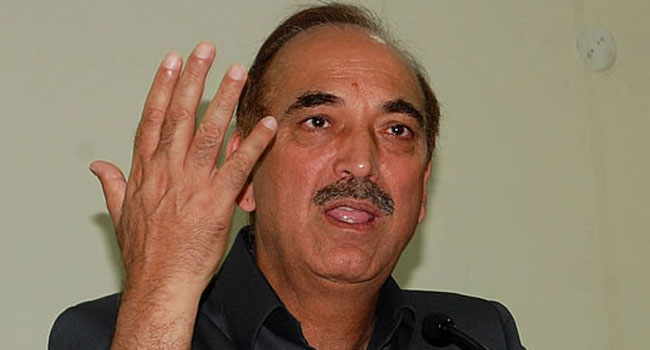
J&K Police killed unarmed people for promotions and money in Kashmir: Senior Congress leader Ghulam Nabi Azad

In a shocking statement, senior Congress leader Ghulam Nabi Azad has accused the security forces in Kashmir, especially the Jammu and Kashmir police of resorting to the killing of unarmed people to make money and avail promotions, reported ANI.

Speaking at an election rally in Kupwara district, Jammu and Kashmir, Ghulam Nabi Azad attacked the J&K police officers, said that they were not smaller enemies by any means to the people of the Jammu and Kashmir and also held the security officials responsible for the current state of the Kashmir.


Taking the political discourse to another low, Ghulam Nabi Azad compared Prime Minister Modi with Hitler and said that PM Modi cannot win the hearts of Kashmiris with the guns. “Modi wants to win hearts of Kashmiris with the gun. Nobody can win hearts with the help of the gun. There was one in Germany, who used the guns, but ended up killing himself,” said Azad.

He further blamed PM Modi for what he claimed as the poor state of affairs in the state of Jammu and Kashmir. Azad claimed that the situation of the Kashmir today is similar to 1990s while holding PM Modi responsible despite the fact that pro-Pakistan terrorists have been supported by Kashmiri separatists.

Ghulam Nabi Azad statements against the security forces depict the disdain of the Congress party towards the security forces, which is being increasingly growing lately. In the Lok Sabha election manifesto released by the Congress, the party has made some dangerous promises especially for Kashmir, where it toes the separatist line to a large extent.

In its manifesto, the Congress party has promised to review the deployment of forces in the valley if voted to power and has also accused the Indian Army of heinous crimes like sexual violence in the Valley owing to AFSPA similar to the claims of Pro-Pak Kashmiri separatists.

Congress leader P Chidambaram and Rajdeep Sardesai spread misinformation about dilution and withdrawal of AFSPA

The Congress party in its manifesto, which was released yesterday, promised to amend AFSPA to ‘balance’ security and human rights. It also appeared to blame the Armed Forces for sex crimes as it said Congress would “remove immunity for enforced disappearances, sexual violence and torture”. The manifesto was slammed by leaders from the BJP.

In light of the criticism the party has received and realizing that it could jeopardize their electoral prospects in the General Elections, a concerted effort has been initiated by senior Congress leaders and their friends in the media to spread misinformation on the entire issue.

The Former Union Finance Minister, P. Chidambaram, equated amending AFSPA with removing it once the situation has improved.


Rajdeep Sardesai, Brian Stelter’s Indian counterpart, parroted the same narrative.


The entire premise is extremely illogical. Withdrawing AFSPA from areas because the situation in the ground has improved is not equivalent to amending the Act itself, which the Congress party has promised. Thus, if the Congress party intends to remove AFSPA from Kashmir or elsewhere, then the party should have made that promise in its manifesto clearly.

The AFSPA has not been amended by the NDA government. After reviewing the situation at the ground, it made the call that circumstances did not warrant the implementation of the Act. There is a great deal of difference between the dilution of the Act and its withdrawal. Congress is thus comparing apples and oranges.

The Congress party likely made the promise to amend AFSPA due to political considerations as its ally, Omar Abdullah, has been making some unreasonable comments lately. He had expressed his desire to have a separate Prime Minister for the state. It comes across as another instance where the Congress party has prioritized partisan politics over national interests.

RSS seeks compensation of Re 1 from Rahul Gandhi and Sitaram Yechury for linking RSS to Gauri Lankesh killing, court issues summons

A Thane civil court on Tuesday has summoned Congress president Rahul Gandhi and CPM general secretary Sitaram Yechury to appear before it on April 30 over the charges of defamation filed by the Rashtriya Swayamsevak Sangh (RSS).

According to the reports, a civil defamation case seeking a token compensation of Re.1 from Congress President Rahul Gandhi and CPI(M) leader Sitaram Yechuri was filed by Rashtriya Swayamsevak Sangh (RSS) activist Vivek Champanerkar. RSS leader Champanerkar had accused both Gandhi and Yechury of defaming the RSS by linking it to the killing of alleged Naxal sympathiser Gauri Lankesh.

In his plea, Champanerkar has said that Rahul Gandhi and Yechury are in the habit of blaming the RSS for any act of violence and this needs to be stopped. Champanerkar’s counsel Aditya R Mishra urged the court to direct them to stop linking the RSS with any such incidents.

Advocate Aditya Mishra said that the suit seeks two prayers, “One, we are asking for an injunction that these people and their party workers should be barred from speaking against the RSS whenever Gauri Lankesh case is mentioned. Secondly, we are seeking Re 1 as compensation for this defamation,” said Mishra.

Following journalist Gauri Lankesh’s murder on 5th September 2017, Rahul Gandhi had said, “anyone who speaks against the ideology of the BJP-RSS is pressured, beaten, attacked and even killed.”

Sitaram Yechury, who was part of the Rally for Resistance which was held following Gauri Lankesh’s murder had spoken out against the RSS, claiming that Sardar Patel had banned the RSS.

Civil Judge JS Bhatia, listening to the arguments, ordered the issuance of summonses to Rahul Gandhi and Sitaram Yechury. Both have been asked to be present before the court on April 30.

Reportedly, another RSS activist and lawyer, Dhrutiman Joshi has filed a criminal defamation case against Rahul Gandhi and Sitaram Yechury in the Mumbai metropolitan magistrate court. In the criminal defamation case, complainant Dhrutiman Joshi has cited some remarks made by Gandhi and Yechury against the RSS after the killing of Lankesh, a strong Hindutva critic.

Rahul Gandhi seems to have a habit of resorting to shooting down false accusation and then taking a U-turn following a case of defamation against him. In the past, he had made controversial statements against the RSS after he had accused the nationalist organisation of killing MK Gandhi. He is also facing another defamation case in a court at Bhiwandi in Thane district over his alleged comments against the RSS regarding Mahatma Gandhi’s assassination.

During the trial, Rahul Gandhi had made a U-Turn when he had told the Supreme Court that he did not blame the assassination of Mahatma Gandhi on the RSS. He further said his remark had been misinterpreted by the RSS worker who filed the initial complaint against him.

Like Congress party itself, their ‘Dhakosla Patra’ is full of corruption and hollow promises: PM Modi in Arunachal Pradesh

Prime Minister Narendra Modi is addressing a huge public rally today at Arunachal Pradesh’s Pasighat ahead of the upcoming Lok Sabha and state assembly elections. This is his second rally in the state after the March 30 rally in West Siang.

Pasighat comes under the Arunachal East Lok Sabha constituency. Addressing the people in the state, PM Modi stated that under the NDA government, Arunachal Pradesh, that has been neglected and alienated under the decades of Congress rule. Even pointing the rally venue in Pasighat, PM Modi stated that when he had come there in 2014, it was a grazing field, but now it has been developed into a sprawling stadium which will help the budding footballers in the state to showcase their talent.

He thanked the people in the state for their continued support to the government which has enabled the NDA government to continue developmental works and infrastructure development in the state.

PM Modi targeted Congress leaders who have mocked the costumes and traditions of Arunachal Pradesh in the past. he added that he has always respected the culture and traditions of the state as his own.

Highlighting the developmental works in the state, PM Modi added that under his government, Pasighat and Itanagar are being developed as Smart Cities, every house in the state now has electricity and with roads, educational institutions, hospitals, and airports, Arunachal Pradesh, which faced neglect all these years, is now surging ahead with the speed of double engines.

PM Modi highlighted that while the one family of Congress, which held on to power for 55 years in the country, can not state that they have fulfilled the aspirations of the people, he, in his 5 years of rule, has dared to challenge the challenges.


PM Modi stated that he wants to make Arunachal the gateway of East Asia.

PM Modi targetted the recently declared manifesto of Congress and stated that it is not a ‘Ghoshnapatra’ but a ‘Dhakoslapatra’. He added that just like Congress itself, their manifesto is full of empty promises and corruption.


PM Modi reminded the people of the state that to continue the stride of the state on the tracks of development, they have to make sure that they vote the NDA to power again.


PM Modi added that the upcoming elections are the election between hollow promises and solid achievements, between corruption and trust, between conspiracies and determination. He added that the people will choose between the leaders who have toiled day and night for the development of their state and the party that has neglected and alienated their state for decades. PM Modi assured the people that the Chowkidar who respects them, honours their aspirations and works restlessly for their overall Vikas is standing firm wth them.

On sedition and AFSPA, does Congress want to turn India into JNU campus?

As with many things about our political setup, free speech in India runs on some tough compromises. As shaky as these compromises are and as far from ideal as they may be, they sort of keep the Republic afloat. The Congress Party manifesto released yesterday appears to be breaking these compromises, possibly turning the country into something like JNU campus.

Take secularism. Real secularism would mean complete separation of state and religion. It is based on the principle that public representatives cannot use public money to pander to any particular religion. That’s not fair to people of other religions.

But ‘Indian secularism’ is different. At least in principle, it allows for some amount of state patronage for every religion. As I said, it’s a compromise. Another way of saying is that instead of being equally fair to all, our secularism tries to be equally unfair to all.

Free speech in India works in the same ramshackle manner. The alleged Constitutional guarantee of free speech comes with so many riders that it’s not worth the paper it is printed on. The first was inserted by Nehru himself in 1951 to overrule a Madras High Court decision that allowed his political opponents to publish magazines that could criticize him. In 2012, rationalist Sanal Edamaruku was facing arrest and had to flee from India because he dared to debunk a “miracle” at a Mumbai church. Let alone Nehru, even the Election Commission today makes rules on what leaders are allowed to say in political speeches. Whither free speech?

Despite these curbs on free speech, we at least had a compromise. Even though it was never explicit, it was mostly clear which curbs on free speech were targeted at which side of the political spectrum. The principle of being unfair to all.

The Congress manifesto issued yesterday appears to suggest a breakdown of this compromise.

Untitled.png

Congress wants to remove sedition laws because they now believe that the law violates freedom of expression. Interesting realization after 58 years of ruling India. But in the very same manifesto they also say this:

Untitled.png

So they want to include sedition under freedom of expression and at the same time expand the definition of hate speech (which is already overly broad)? Since the one in power decides what is “hate speech”, it is clear where this is going. So the law is being relaxed to make “Bharat ke tukde” chants legal, but the law will be tightened against whatever the Congress calls “hate speech”. Fairly clear that they intend to use this law against those who speak for Hindu rights. The entire secular ecosystem has been pushing for it: over the last few years, everything from Hanuman stickers to sarees has variously been labelled as symbols of hatred.

This is what I meant by turning India into JNU campus. A place where calling for Bharat ke tukde is perfectly legitimate free expression, but having a Hanuman sticker on your car can get you labelled as a potential criminal.

The compromise is being broken. From equally unfair to all sides, the new ideal is to make it unfair to just one side. In other words, apartheid.

This reminds me of the time Modi came to power and the Chief of the Censor Board changed. Liberals complained bitterly that the new Chief of the Censor Board was anti-free speech, which apparently made them different from the previous Chief! In other words, liberals did not object to the existence of the Censor Board itself, they merely objected to who was wielding that power of censorship. The protest was not against censorship as a principle, but against their friends being censored.

On AFSPA, the Congress manifesto is even more problematic.

Untitled.png

First of all, when a big national party suggests in its manifesto that the Indian Army is systematically involved in “enforced disappearance, sexual violence and torture”, it seriously undermines our position in the world. Aren’t they repeating what Pakistan wants the world to believe?

In this respect, the defence mounted by P Chidambaram is quite pathetic.

Untitled.png

As a free democratic nation, the Indian state does not impose AFSPA as a merry sport. It is done to deal with exceptionally difficult situations. To promise amendments in AFSPA as a political lollipop, as a carrot to dangle before voters in an election manifesto, is extremely irresponsible. In fact, it helps enemies who would have the world believe that the Indian state uses AFSPA as a tool of oppression, rather than a tough choice in extreme situations.

There is one thing in the Congress manifesto that deserves some serious ridicule but has not been mentioned very much in the media so far.

Untitled.png

Gareebi Hatao was promised by Indira Gandhi in the 1971 election. Some 48 years later, her grandson Rahul Gandhi has renewed this promise but pushed the date for fulfilling the promise to 2030!

That’s at least three elections away! A promise made in 1971 … and Rahul ji now says he will fulfil it provided the Congress wins not just 2019, but also the 2024 and 2029 elections!

Also, be very careful about the language. Congress does not promise to eliminate poverty even if it wins the next three elections: only “abject poverty”. The manifesto does not define what “abject poverty” would mean.

Is Rahul Gandhi asking the people of India to give him 3 more successive election victories in return for removing what he calls “abject poverty”, something that he refuses to define? This would be comical if the joke was not on the poorest of the poor.

The question is where would the Congress get these ideas from. Why would a party that has governed India for 58 years suddenly be so irresponsible?

There are two reasons for this. The first is that with the current Congress having no ideas of their own, the JNU type radical leftists have filled the intellectual void. Sapped of all organizational strength and intellectual clarity, the Congress has handed over the steering wheel to the radical left.

The second reason could be more sinister. Even though Congress has ruled 58 years, their chances of being dominant over the next several decades are practically zero. The BJP’s geographical spread now includes Bengal, Odisha, Haryana, the North East.  Simultaneously, the Congress at the end of the road in old strongholds like Andhra Pradesh and Telangana. It seems increasingly unlikely that Congress will be able to get more votes than BJP in any foreseeable future election.

In other words, Congress knows that going ahead, it will have very little stake in governing India. Is this realization taking them into dangerously irresponsible territory?