Home Blog Page 7067

‘India must have a Temple at Ram Janma Bhoomi’, writes Savio Rodrigues

0

Savio Rodrigues, former senior leader of the Congress party has previously attracted the wrath of supporters of the Church after his criticism of the Delhi Archbishop’s communal agenda. He had earlier written condemning the “save India from Nationalist forces” statement from Archbishop Thomas Macwan. He had also written about the rising cases of sexual violence in Churches and other religious institutions. In fact, the Catholic Bishops’ Twitter handle had blocked Rodrigues because he has relentlessly asked tough questions of the Church regarding the crimes committed by nuns and priests.

Savio Rodrigues has now published an article on Goa Chronicle, a media outlet he owns demanding that Ram Mandir must be built at Ayodhya.

His article has been reproduced here in totality, with due permission. He writes:

I remember when the Babri Masjid demolition happened and the subsequent riots that ensued, I was seething with anger and hatred from Hindus and Muslims in India.

I remember, us Indians in our school in Dubai, felt so disappointed in our nation that we never wanted to go back. We were left stunned that human life, Indian life was worth nothing.

Many years later when I started to research and understand the Babri Masjid demolition and the Ram Janam Bhoomi demand. I started to understand the nuances of the games being played politically at a national and international level.

If you refer to the Meenakshi Jain book ‘Rama and Ayodhya’ published in 2013, you will find some interesting facts that in 1611, an English traveller William Finch visited Ayodhya and recorded the “ruins of the Ranichand (Ramachand) castle and houses”. He made no mention of a mosque.
In 1634, Thomas Herbert described a “pretty old castle of Ranichand (Ramachand)” which he described as an antique monument that was “especially memorable”.

The Jesuit missionary Joseph Tiefenthaler, who visited the site during 1766-1771, wrote that either Aurangazeb or Babur had demolished the Ramkot fortress, including the house that was considered as the birthplace of Rama by Hindus. He further stated that a mosque was constructed in its place, but the Hindus continued to offer prayers at a mud platform that marked the birthplace of Rama.

In 1810, Francis Buchanan visited the site, and stated that the structure destroyed was a temple dedicated to Rama, not a house.

We can deliberate on the many issues regarding the existence of the temple, demolishing of the temple to build a mosque, whether Bhagwan Ram was born at the site, why should a temple be built at that site only. You could find answers for all these questions, if we as Indians choose too and are inclined too.

I am for one as a Christian with a Hindu lineage and Vedic roots believe that if Ram Janam Bhoomi is indeed that site under dispute which is what is coming out in ASI findings reported by media; then in all fairness and measuring the religious and historical significance of the Bhagwan Ram to Hindus all over the world. It would only be logical, ethical and humane to build a temple at the birth place of Ram.

Every Indian – Muslims and Christians – too must support the building of a temple.

Let for a moment assume that if Jesus Christ were to be born in India or travelled to India and left a mark; would it not be fair for the Christians to demand for a Church to build at that site. In Goa for example we have an entire Basilica devoted to St Franis Xavier – who the Church also christened the Patron Saint of Goa – wherein out of reverence and faith of many Catholics in Goa and across India – mortal remains of the Christian saint are kept. At this religious site – Christian, Hindu and Muslims all visit and prayer.

Muslims too have religious demands of place for their Saints and religious customs across the world not only in India like the Mecca &Madina. The religious significance of Haj cannot be denied.

If Christians can have Vatican, Muslims have Mecca, Jews have Jerusalem; I do not think it is communal to ask for Ayodhya Ram Temple for the Hindus.

If however, we do not want to look at through the humane eyes of mutual acceptance and respect of the religion of our Hindu family. Let us a look at it economically.

The industry that is booming globally is religious tourism. Ayodhya has the potential to evolve into a global religious tourism destination. The economic activity will touch many lives in Ayodhya and neighbouring towns, in fact the whole of UP and India.

Better infrastructure, better sanitation, better hotels and restaurants. It will change the current footprint of Ayodhya and Faizabad. As Indians that is what we should aim for – a religious structure that touches the life of every Indian and becomes a globally respected gift of the people of India to the rest world – a gift of Vedic thought and structure, a gift of oneness of us Indians.

Jai Shri Ram!

Girl drugged, molested and filmed in Goa, Aqib Sheikh and Kaffil Sayed arrested

0

Two persons have been arrested by Margao Town Police on charges of outraging the modesty of a 19-year-old girl by filming her in an appropriate manner after drugging her. According to the Police, the accused, Aqib Sheikh, 24, and Kaffil Sayed, 19, took the victim to a flat at Fatorda, a suburb of the town of Margao in Salcete, Goa, where she was made to smoke a cigarette containing some narcotic substance. Then, one of the accused misbehaved with her and filmed her in an inappropriate position.

The victim, a college student, is said to be known to the accused, Sayed. The accused were arrested after the victim registered a complaint with the Police on Friday. The Police managed to secure a seven days remand of the accused after producing them before Judicial Magistrate First Class (JMFC), Margao. The Police suspect that photographs and videos of the accused were supposed to be circulated by the accused.

The accused have been booked under Sections 328 (causing hurt by means of poison, etc., with intent to commit an offence), 354 (assault or criminal force to woman with intent to outrage her modesty), 354B (assault or use of criminal force to woman with intent to disrobe) and 354C (watching or capturing the image of a woman engaged in private act) of the IPC. Further investigation into the matter is currently underway.

Javed Akhtar has Twitter meltdown, again, this time for his hypocrisy on free speech being pointed out

Javed Akhtar has done it again. Noted lyricist and poet seem to be in the habit of picking fights with commoners and in the process, insulting them for merely having a different point of view.

Yesterday too, when Twitter user Ankit Jain reminded him that he had called for a female cop to be dismissed from her job because she had written a poem that he did not like, Javed Akhtar lost his cool and lashed out at Jain.

Ankit Jain was attempting to make a point about how hooligans desecrating memorials of martyrs and creating havoc were absolved of any guilt while lakhs of Kanwariyas are being branded hooligans due to some stray incidents.

Akhtar, attempting to justify his call for her dismissal, claimed he did so because one line of her poem was taken from his song.


Akhtar then went ahead to justify his stand against the female cop further, stating that she was inciting violence through her poetry. Jain reminded him that she was not and she was only calling out those who put Islam over India and indulge in anti-India activities.

On Jain’s reply that calling out Islamists and hate India brigade is not communalism, Akhtar went on to state that Jain deserves his contempt because he is ‘petty and devoid of introspection’.

Ankit Jain’s reply to Javed Akhtar

What transpired next was nothing short of bizarre. Javen Akhtar went on to talk about Ankit Jain’s “type”. Called “his type” hypocrites and cowards. Jain’s “type” however, was not clarified by Akhtar.

Javed Akhtar on Twitter

Akhtar then accused Jain and ‘his gang’ did of not raising the slogan of Bharat Mata Ki Jai before the British and they were ‘collaborators like Muslim League’.

Ankit Jian on Twitter

Javed Akhtar’s hypocrisy and attempt to attack Ankit was called out by other Twitter users.


Javed Akhtar has had Twitter meltdowns before too. Ironically he tried to justify his rage against a female cop or using one line from his song, but had gone on a Twitter rampage when earlier some Twitter users had tried to point out to him that his movie Sholay was almost entirely lifted out of Hollywood movie plots. Javed Akhtar has in the past been called out for being a radicalism apologist, Rohingya terrorist sympathiser and he had even defended Triple Talaq. He had also abused people and has mocked legendary sportspersons as ‘hardly literate’, just because they had a different opinion than him.

Javed Akhtar or his fans can justify his petulant behaviour saying that he was provoked and angered and thus gave it back in the same coin. If that be the case, then why should he find fault with a cop for merely expressing in words after being angered by what happened at Azad Maidan. If words born out of anger can be the reason for being fired from a job, perhaps Akhtar should fire himself from whatever job he has given himself, for that’s all he has been doing on Twitter.

Research scholar subjected to targeted attack and online hate for writing on Aadhaar

0

Indian Government’s biometric identity programme Aadhaar is not new to controversies. While one group has raised serious privacy concerns, the other seems to have accepted the Aadhaar system wholeheartedly.

Research scholar Shekhar Chandra, who is a PhD student at Massachusetts Institute of Technology (MIT), wrote an article on Slate.com titled “India’s biometric identity program is rooting out corruption”. The excerpt of the article read “but serious privacy concerns remain”. Without even reading the article, one might draw the conclusion that the article is rather balanced, detailing both the pros and cons of the system.

The article spoke about how Aadhaar has given many the identity document that has helped them open bank accounts, avail welfare schemes etc and has helped in combatting a serious problem ailing India, which was people using fake identities to avail government subsidies.

He gives facts and data to make a case for how Aadhaar has helped curb corruption. He used Rajiv Gandhi’s own words to show how government subsidies and benefits were earlier not reaching the intended people. And how, because of Aadhaar, it has started to reach the right people.

While Shekhar Chandra wrote about the pros of Aadhaar, he also wrote about the controversies surrounding the biometric system. Chandra mentions how many have argued that wide-scale use of Aadhaar could lead to profiling and the data can be misused by private companies. He mentions how activists have displayed concerns about the reduction of social mobility and the chance that it could all precipitate into India turning into a surveillance state.

Chandra also concedes that the privacy concerns aren’t merely hypothetical. He writes :

There are also not-merely-hypothetical concerns about hacking and leakage of data. In 2017, the details of 1.4 million pensioners were inadvertently leaked by a local social security office. To allay privacy concerns, the government has added additional security layers to the Aadhaar architecture and also codified that the data is to be exclusively used for welfare services.

He also criticised politicians who use Aadhaar to make outlandish statements.

While by all standards, Chandra’s article was a well-researched balanced take on the raging debate surrounding Aadhaar, there are certain people who use social media as a tool to question anything and everything that doesn’t conform to their agenda in totality. Balance and nuance are often lost on people who take extreme positions due to their dislike for a particular person or entity. Chandra was attacked and became a recipient of online hate for his article.

Rita Banerjee, who is a writer with HuffingtonPost, feminist, author and adds #DestroyTheAadhaar in her Twitter bio, started questioning Shekhar Chandra on his “research” and “support for Aadhaar”. In doing so, she curiously quoted an article that was based on fabrications and was debunked comprehensively.


Chandra responded to her asking her not to troll needlessly and wondered what she was saying had to do with Aadhaar.


There are others who directed hate at Chandra wantonly claiming that his article displayed his “hatred for India”.


The constant hate which was directed at Chandra eventually got the Editor of Slate.com, who edited the article, to respond and assert that “she is looking into it”.


It is staggering how a balanced article that brought out the pros and cons, including privacy concerns related to Aadhaar so effectively and its author are now under constant attack from absolutists who believe that anyone who doesn’t share their unbridled hate deserves to be shut out. The article was not censored or taken down (by the time of publication of our report) despite an organized effort to do that by putting pressure on the publication.

Jharkhand Christian NGOs in the dock: Police raids 88 and reveal Rs 250 crore spent on forced conversion

0

Days after the Missionary of Charity ‘baby-on sale’ scandal was brought to light creating much of a turbulence, the Jharkhand police swooped down on 88 Christian missionary-operated non-governmental organizations (NGOs), on grievous charges of misusing foreign funds for forceful religious conversion of tribals and political subversion, as exclusively reported by MyNation.

As confirmed by the Jharkhand police as many as 33 NGO’s have already been raided and rest of the task would be completed soon. These NGOs have been reported to have received in excess of Rs 250 crore funding between 2013 and 2016 under the Foreign Contribution Regulation Act (FCRA).

A ‘CID report’ accessed by MyNation, makes grave charges against the Christian Missionary operated NGOs’ running ‘hospitals, schools, shelter homes’ saying that these organizations “train tribal women as nurses and sends them abroad. They also pressurize them to convert to Christianity.” It also mentions that many of these institutions were indulging in political subversion and anti-State activities. “Many of these institutions, especially the missionary NGOs, misuse funds received under FCRA to foment anti-State rallies and protests,” the report noted.

Mostly all of these organizations have received funds running in crores, with the top 11 receiving funds between Rs 7.5 crore and Rs 39 crore. Name of few with the annual break-up of funds received from 2013-2016 are listed below:

Source: MyNation 

Reportedly, the CID has been collecting information regarding these nefarious activities conducted within the NGOs’ for a long time now and has managed to complete the mammoth task almost a month ago, soon after which the Jharkhand police took prompt action, digging out all the filth these so-called prestigious organisations have been cloaking.

Rahul Gandhi asks why the Government did not ‘buy cellphones from BHEL’, Twitter answers

0

Just when India’s political scenario starts to look dim and boring, Rahul Gandhi gets a brainwave and leaves everyone scratching their heads in bewilderment. We have had connected MRI machines and Shikanji sellers turning beverage tycoons, but this time Rahul has got more technical. He suggests that governments should buy mobile phones from BHEL, Bharat Heavy Electricals Limited.

According to reports, Rahul was on a tour in Chhattisgarh and inaugurated the new Rajiv Bhavan in the Pradesh Congress Committee. While addressing the Congress workers there, Rahul dropped another bombshell. He stated that the Chhattisgarh government’s Sanchar Kranti Yojna, where the state government is distributing 5 lakh smartphones to poor students, women and families below the poverty line, is a scam. He questioned why the government is not buying mobile phones from BHEL. He even compared it to Rafale deal. The video went viral immediately and Twitter was in splits

Everyone is aware that BHEL does not manufacture mobile phones, well everyone except the Congress President. BJP spokesperson Sambit Patra was not to miss a chance to take another potshot at the Congress prince.


Apparently, Congress supporters were in action mode to cover up the mistake, some suggested that it was a slip of tongue and Rahul was referring to BEL, not BHEL, but the video makes it clear, Rahul has said BHEL twice.


Supporters of BJP always say that Rahul Gandhi is the star campaigner, not for Congress, but for BJP and PM Modi. They might actually be right.


Whether BHEL makes mobile phones or not, and MRI machines are gossiping with each other or not, Twitter users cannot deny that the Congress President never errs in making them laugh. In current times when stand-up comedians are more interested in politics and less keen to mind their trade, Rahul Gandhi is maintaining a healthy balance between the two professions.

The Caravan of lies that is now headed straight towards Amit Shah

The essence of communication is to say as much as you can in as few words as you can. However, for some media houses, investigative journalism essentially means saying as little as they possibly can in long-winded articles, that confuse the reader with such unnecessary, irrelevant details, that the reader eventually gets tired and without applying his reasoning, accepts the faulty assertions as the gospel truth.

A similar method seems to have been deployed by Caravan Magazine in its latest article. The article headlined “Amit Shah Omits Liability That Secured Credit For Son’s Business In Electoral Affidavit; Dramatic Increase In Credit Facilities To Son’s Firm In Last Year” makes certain assertions that one has to work hard to find.

The Caravan article’s headline talks about Amit Shah failing to mention his “liability” that secured credit for his son’s business. They also added a graphic that detailed the credit facilities received by Jay Shah in exchange for mortgaged properties. In that graphic as well, Caravan mentions “Amit Shah….. did not disclose this liability in election affidavit”.

Before we delve into the fallacies of the argument, it becomes essential to understand what ‘Liability’ means.

A liability is a present obligation of the enterprise arising from past events, the settlement of which is expected to result in an outflow from the enterprise of resources embodying economic benefits. The question one must ask is whether there is an obligation on Amit Shah to pay today? The answer is No. If not, then is it a “liability”? The answer is no again.

Their first few charges levelled by Caravan are these :

1. Amit Shah mortgaged two of his properties for his son Jay Shah’s venture Kusum Finservice LLP which has “recorded a dramatic increase in credit facilities in recent years despite poor finances”.

2. Amit Shah’s ‘contingent liability’ concerning this credit facility is, however, missing from his 2017 electoral affidavit.

3. The credit extended to Kusum Finserve has gone up by nearly 300 per cent in the last year, even while its latest reported balance sheets show a net worth of only Rs 5.83 crore.

Firstly, a firm “recording a dramatic increase in credit facilities” is hardly an allegation when they are admitting in the article that to avail that credit facility, legitimate properties were mortgaged.

The article asserts that Kusum Finserv, Jay Shah’s company is an LLP. An LLP is a limited liability partnership, which, according to the Limited Liability Partnership Act 2008 is a separate legal entity, that is a body corporate. When an LLP takes a loan, it is the liability of the LLP itself, since the LLP is a separate legal entity according to the law. If the LLP has drawn the loan, then there is no legal reason why the loan should reflect in Amit Shah’s personal affidavit. It has to be thus clarified that a loan extended to an LLP is by no stretch of the imagination, Amit Shah’s liability. It will not even be his contingent liability if he is not a guarantor, a point which Caravan makes shoddily, by firing off imaginary shoulders.

What perhaps happened here was that Amit Shah gave the Power of Attorney (for his property) to Jay Shah (as also mentioned in the Caravan article). Jay Shah became Mortgagor No. 1 and also a guarantor since he is the partner in the LLP which is taking the loan. Amit Shah was Mortgagor No. II (as also mentioned in the Caravan article) since he was the legal owner of the property. In such a scenario, there is neither a liability on Amit Shah nor a contingent liability.

Hence, Caravan’s assertion that “The BJP national president’s contingent liability with respect to this credit facility is, however, missing from his 2017 electoral affidavit” doesn’t hold water.

Kusum Finserve has not taken any fund based loan from Kalupur Commercial Co-op. Bank Ltd. Only a non-fund based working capital facility in the form of Letter of Credit (LC) of Rs.40 crores has been sanctioned and is availed from time to time. This facility has been secured on usual banking terms which include hypothecation of the goods purchased under LC, Cash margin of 10% and collateral security of properties belonging to Amit Shah and another property of Kusum Finserve.

In fact, the goods purchased under LC are stored at the warehouse/port under CM (Collateral Manager) arrangement and goods are allowed to be lifted from the warehouse only on the basis of PICK & PAY, meaning thereby, upon deposit of the full amount of the goods sought to be lifted, in a fixed deposit. The bank issues Delivery order after receiving full payment and then goods are released from the custody of the CM. The bank receives payments before the retirement of LC on its due date resulting in this being non-funded and no-risk facility for the bank.

The article also makes some financially and legally unsound points. When a property is mortgaged, the property itself doesn’t become a liability as has been insinuated in the article. The ownership of the property is not transferred. Since the ownership of the property remains unchanged, and the loan drawn is by the LLP which a separate legal entity, one wonders what liability does Caravan expect Amit Shah to declare in his affidavit.

The article maintains that Amit Shah omits liability that secured credit for son’s business in the electoral affidavit, thereby explicitly saying that the property mortgage itself is to be treated as a liability that should have been disclosed in the electoral affidavit. Only zero understanding of the law would inspire one to imply that a property mortgaged is a liability thereby conflating the mortgage as a sale or transfer of ownership.

In one looks at the Election Commission affidavit that one is meant to fill and analyses the liabilities section of Form 26 which needs to be submitted by all candidates, nowhere does it ask if the candidate has pledged his asset as collateral. Collateral isn’t a loan or due.

Essentially, the Caravan makes the following fundamental errors :

1. The article ends up conflating collateral of property as a sale or transfer of ownership

2. Doesn’t read up on the LLP Act which deems the LLP a separate legal entity

3. Expects a loan drawn by an LLP, which is a separate legal entity, to feature in Amit Shah’s affidavit. Amit Shah’s affidavit will only reflect loans taken by him or his spouse, not by an LLP.

4. Agrees that the loans were extended to Jay Shah’s LLP against property extended as collateral and yet, insinuates wrongdoing.

5. Fails to realise that the loans thus extended are not NPA. There has been no default or litigation initiated against the firm or Jay Shah.

Interestingly, as if trying to debunk their own story, the Caravan details the properties, securities, book debts and stock that was mortgaged to avail the extended credit facility.

It writes, “Kusum Finserve used these properties, in addition to the hypothecation of stock and book debt, to secure a credit of Rs 25 crore from Kalupur Commerical Co-Operative Bank, in May 2016. In September 2017, the same bank enhanced the credit to the firm by Rs 15 crore. That same month, the firm secured an additional credit of Rs 30 crore from the private bank, against goods and book debts. In July 2017, the firm was leased a land of 15,754.83 square metres in the Sanand Industrial Estate, by the Gujarat Industrial Development Corporation, or GIDC. By mortgaging this property, Kusum Finserve secured an additional credit of Rs 17 crore from the private bank in April 2018, one month after the lease was signed. Currently, a factory stands on the mortgaged land in Sanand”.

The Caravan goes on to make some even more wild insinuations. It writes :

Part of the credit facility has been extended to Jay Shah’s firm against three Ahmedabad properties: two plots in Shilaj village of 3,839 square metres and of 459 square metres respectively, and an office space of 186 square metres on the third floor of a building in a commercial complex named Sarthik-II, in Bodakdev.

Amit Shah owns the two Shilaj properties. In a mortgage deed signed between Kalupur Bank and Kusum Finserve in May 2016, he is listed as “Mortgagor no. II,” and an “absolute owner” of the two plots. Jay Shah is listed as the holder of the power of attorney for his father’s mortgaged properties. On being shown the documents, a financial expert said that, when a person mortgages their property for credit, “primarily you are a guarantor—maybe he has no profit share, but he has a stake in this business.”

In the first paragraph quoted above, Caravan itself admits that credit facility has been extended against multiple properties. That would be the very definition of running a business and availing credit facility by legal means. Caravan should have done this article had property not been extended as collateral and the banks had decided to extend loans without property mortgage.

In the second paragraph, Caravan goes on to name an unnamed “financial expert” who says that when a person mortgages their property for credit, “primarily you are a guarantor—maybe he has no profit share, but he has a stake in this business.” This is one of the most outlandish claims a “financial expert” could make. Amit Shah, by virtue of being the guarantor, has absolutely no “stake in the business”.

A guarantor is someone who promises to make good the loans if the person to whom the loan is extended to, fails to make good on his promise to repay the banks and financial institutions or any other entity which have extended the loan. A Mortgagor is someone who gives his property as a mortgage. It is unclear why the Caravan’s unnamed “finance expert” has conflated the two, especially when the report itself says that the only explicit personal guarantee was given by Jay Shah, who is the borrower. If Amit Shah was a guarantor, why doesn’t the report clearly name him to be one (as it has named Jay Shah)? Why fire from the shoulders of an unnamed “finance expert”?

The fact that Caravan includes “Mortgagor no. II” and “absolute owner” in quotes so as to insinuate some sort of wrongdoing is a craft, yet useless tactic.

Caravan then goes on to cite an article by The Wire, the shoddy articles of which were summarily debunked by us. The Wire, at the moment, is also facing a defamation suit for the article in question. That the Caravan had to rely on a shoddy article, laden with loopholes to strengthen their case points towards the lack of their own merit.

The article then goes on to detail Jay Shah’s companies regular business, without really explaining what they are alleging or insinuating. Their hope is that the reader would assume impropriety without the article explaining what the impropriety really is. The article also makes up a 2 line conversation that is fashioned as a “you know who these lands belong to” format. Of course, the conversation is something that can neither be confirmed or fact checked and the reader is simply supposed to take the writer’s word for it.

This entire article published by the Caravan too hinges on the faulty understanding of finance, law, and a shady debunked article that has inspired a lawsuit against a leftist propaganda website. Perhaps Caravan must consider that the act of someone as powerful as Amit Shah having to mortgage his property to secure a loan for his son, is in sharp contrast to hordes of sons and sons-in-law getting unsecured loans running in billions of rupees during Congress regime.


‘Was denied entry to Audrey Truschke’s event as I was wearing Shivaji t-shirt and dhoti’, man claims

0

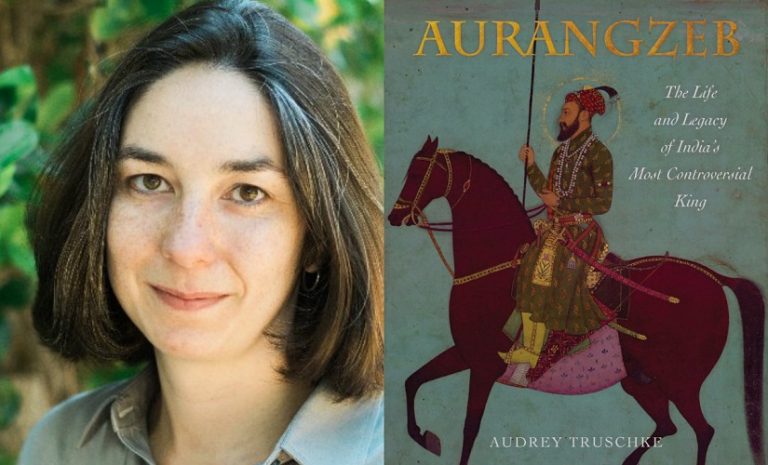
Controversy has erupted over pro-Aurangzeb racist ‘historian’ Audrey Truschke’s event at the Indian Habitat Center, New Delhi when Twitter user Mohit Bharadwaj, founder of Vaidika Bharata, claimed that people were not allowed inside to attend the scholar’s lecture and only a select few people were let in.


In the above video, a lady can be heard saying that there were many empty seats available (but still entry was barred). She can be heard saying that the main objective of the lecture was to sell Audrey’s book. It was also claimed that people were ready to stand in the “supposedly houseful auditorium” despite waiting for more than an hour but yet, only a select few were let in and others were denied entry.


While many stood waiting outside denied entry, select people, however, were let in even though they came late to the ‘open’ event.


Finally, one lady came to the conclusion that the authorities do not want them to watch Audrey’s lecture. And others appeared to agree with the conclusion she had reached.


Talking to OpIndia, Bharadwaj said, “I had gone in hopes of understanding her ideas and ask her a few honest questions which she refuses to answer on Twitter by labelling people as trolls or anonymous and thus unworthy of a reply.” He went on to suggest that his attire might have influenced the authorities to deny him entry. “When I approached the person in charge and requested him to let me in, he looked at my clothes with close attention, a t-shirt with an illustration of Shivaji on it and a dhoti, smirked and said ‘No, Sir. The auditorium is totally packed.'”

Bharadwaj also said that people in the queue were frustrated after standing there for so long when they could see that some people were allowed to walk straight inside. Bharadwaj confided that he wanted to ask Truschke a question in Sanskrit, a language she claims to have mastered because he had his suspicions that Truschke could not even manage a basic conversation in the language.

Bharadwaj’s claims were backed up by Aniruddha Subhedar, a professor of journalism who has worked at media houses in the past, who was also denied entry at the event. According to Subhedar, it appeared that the audience was ‘fixed’ and no one was allowed to enter apart from a select few. Speaking to OpIndia he said, “I have seen Truschkey not replying to criticism on various online fora, asking people to first get published in “peer-reviewed” journals. I was under the impression she’ll answer questions when asked in an open programme. Now it seems there’s no way to engage in a debate with her.” Subhedar said that even professors of History were denied entry.

It appears that the organizers and the academic, both, were wary of Truschke’s critics and wanted an audience who would accept her claims, however outrageous and dubious, without question. It does not speak well of a scholar that she is not willing to expose herself to critics and defend her claims against the evidence presented by those who endorse an opposing view.

‘Indiregandi’, Turkey invokes Indira Gandhi to describe cheating and stealing, reports VICE

0

The grand old party clearly had not seen it coming. As per a VICE report “İndiregandi” is an act of misusing public money, stealing from someone else’s pocket, or trying to get something for nothing. Gaming enthusiasts apparently use the word as an exclamation when they are using cheat codes in games.

Indira Gandhi, among other things, is mostly known for incidents like the 1971 war which ended with carving of independent country, Bangladesh, the 21-month period of Emergency in 1975 and Operation Blue Star in June 1984, which she had ordered to remove Jarnail Singh Bhindranwale and his armed followers from the Harminder Sahib complex in Amritsar.

However, in recent times, the Congress-led UPA coalition has become synonymous with corruption. And it appears it’s not just Indians who associate Congress politicians with corruption. Far way in Turkey, people invoke the name of Indira Gandhi to describe cheating, stealing and corruption.

As per a literature research scholar quoted by VICE, the term originated out of the similarity between “Indira” and “indir”, a conjugation of the Turkish verb indirmek—lowering, or downloading something—which is also used as slang for stealing or pocketing money. Another professor of linguistics appeared to agree, “The only explanation I can think of is based on sound resemblance to indir (take down, pull down) and ‘kandı’ (deceived, fooled).” So while it may not be her politics, personality or her way of working which makes the Turkish people use her name as code for cheating, but the fact that it sounds similar to the Turkish expression indirmek.

‘Indiregandi’ appears to be a moniker. The Turkish appear to invoke ‘indiregandi’ to describe acts of stealing and cheating. This is similar to when many started referring to others as “Pappu” when they didn’t make sense. Unfortunately for the Congress party, both of them are associated with leaders of their party.

Triple Talaq Bill not just about Muslims, but about resisting mob rule

0

So the Triple Talaq Bill will not be taken up by the Rajya Sabha today, due to “lack of consensus” among political parties. The monsoon session of Parliament ends today and with it the hope of bringing even a semblance of gender justice to Indian Muslim women. These 8 crore citizens of India will now have to wait until the winter session to find out if our political parties can finally put gender justice above the Mullahs of Indian secularism. I wouldn’t hold my breath.

Vote bank politics wins again. Justice waits for another day.

In so far as the rights of 8 crore Indian Muslim women are concerned, this is a terrible blow. But it is much more than that. Because the Triple Talaq Bill transcended the cause of Muslim women and became a symbol of the struggle to establish rule of law in this country.

Have you ever wondered what goes through the mind of a gangster turned politician and his lackeys when they throw their weight around, harassing women, beating up people in bars and restaurants, refusing to pay tolls on highways and the like? Have you ever wondered what goes through the mind of a mob when it goes on a rampage? I’d bet that none of those individuals in the mob would have the courage to carry out those crimes if they were acting alone.

In either case, it is a matter of people believing that they have reached a state where the law no longer applies to them. This criminal form of nirvana, the fact that it is possible for individuals under certain circumstances to be freed from the law, is at the root of what ails our democracy.

For the last 70 years, it is things like Triple Talaq (and other Muslim appeasement based laws) that have been the most spectacular example of the power of the mob.

Everyone understood that Triple Talaq was at odds with the values of a modern secular democracy that makes no distinction between its citizens on the basis of gender. Yet, how did Triple Talaq stay legal? Because of the fear of votebanks and outright violence on the street.

Remember the “Direct Action Day” of the Muslim League? Our tallest leaders at the time, Nehru and Gandhi and Patel, bowed down to the power of the mob and acceded to the partition of India. This left a deep imprint on the psyche of the masses. The message was clear: you could push through unreasonable demands as long as you had the mob behind you. The politicians are going to fold before the mob.

Because the Republic of India had a very substantial Muslim minority, such appeasement continued. Jammu and Kashmir, India’s only big Muslim majority state, was essentially allowed to be a sovereign country all on its own. As late as 1965, Kashmir used to have its own “Prime Minister”.

Over the next several decades, the Indian state continued to fold repeatedly before the fear of the Muslim mob. There was no uniform civil code, which meant that Indian Muslims would be able to run a state within a state. Then, the Shah Bano case happened. An entrenched Prime Minister, with a monster majority of 400+ in the Lok Sabha, went down on his knees and surrendered. If the Indian state could overrule its own Supreme Court and deny a few rupees of maintenance to a 62-year-old woman, what would it not do to please the mob?

The modern state is supposed to protect the rights of the weak. That’s why we have laws. So that the poor and the weak don’t get steamrolled. But Rajiv Gandhi’s government would not stand by a 62-year-old woman against the power of the mob.

This was far from the only compromise Rajiv Gandhi made. There is also the Assam accord, which starts out by regularizing all illegal immigrants who jumped the border before 1966. Even India’s very sovereignty, the sanctity of our borders, becomes negotiable when a Muslim mob wants certain things. Today, the same Congress party (and its regional clones) supports a nationwide network of “Sharia Courts” which would visibly undermine the supremacy of our Constitution.

This is what Triple Talaq really means to India’s psyche. It is a visible symbol of mob power overwhelming human rights, democratic values, gender justice and basic decency.

No wonder then that the model of mob power was seized upon by many other groups of people to demand all sorts of things. Even in cases where the demand of a group may not be unfair in itself (especially in case of “lower” castes demanding social justice), street violence or the threat of it came to be seen as a “shortcut” towards achieving goals. No wonder that ‘everyone’ wants to use it in some form or another. In 2006, when Lalu Yadav was railway minister, his brother-in-law Subhas Yadav ‘ordered‘ Rajdhani Express to stop at Platform No.1 at Patna Junction (instead of the usual Platform No. 4) because he did not want to cross an overbridge. The ability to intimidate had become a status symbol.

Like I said, every group is to blame here up to a greater or lesser extent. Much has been written by liberals about lynchings by so-called gau-rakshaks. Those who carry out lynchings in the name of the cow are drinking from the same well as the Mullahs who force secular parties to support Triple Talaq. The secular ecosystem made mob power legitimate, even something to aspire to. No wonder certain elements on the right want to exercise the same now that they feel their side is in power.

We don’t want a competition between left and right on who can exercise more mob power. It will be a race to the bottom, a descent into anarchy.

Therefore, the Triple Talaq Bill was intended not only to bring gender justice but also to strike at the heart of mob power. This mentality is like a termite, hollowing out our democracy and eating away at our nation’s future. And it is an absolute tragedy that today, yet again, on the floor of the Rajya Sabha, this mentality won.