Home Blog Page 7330

Congress Leader Kripashankar Singh’s discharge in disproportionate assets case raises questions that NCP must answer

0

Maharashtra Congress leader Kripashankar Singh has been discharged by a special court in a disproportionate assets case that was going on since 2010. This comes as another major relief to Congress after former Maharashtra CM Ashok Chavan was granted relief by the Bombay High Court in the Adarsh Scam.

Ashok Chavan was granted relief by Bombay High Court as the HC had quashed and set aside Governor Ch Vidyasagar Rao’s sanction to the CBI in 2016 to prosecute Chavan.

Kripashankar Singh was discharged by Mumbai sessions court from the case that had started in 2010 when social activist Sanjay Singh had filed a PIL in the Bombay High Court and a complaint in the Anti-corruption Bureau about how Kripashankar Singh who was a vegetable seller had amassed huge assets and wealth.

While the HC was hearing the case of the PIL, it had directed the Mumbai City police commissioner in 2012 to file an FIR for criminal misconduct under PCA and attach the movable and immovable assets of Kripashankar and his family members. The case was subsequently handed over to the Economic Offence Wing of the crime branch.

Yesterday, special judge D K Gudadhe heard Singh’s application that as the speaker of the previous Congress-NCP led assembly had twice refused to grant sanction for his prosecution under the PCA, he should be discharged. Singh’s lawyer K H Giri had filed the application for discharge in November 2016.

It is notable here that after the FIR against Singh was filed in the Nirmal Nagar station in Mumbai, the case was given to Economic Offence Wing which had written to the speaker of the Maharashtra Assembly for the sanction to prosecute him. Dilip Walse Patil, the NCP leader, who was the speaker of the assembly at that time had twice refused the sanction. The first time on June 14, 2014, and for the second time on October 21, 2014.

The Maharashtra state legislative assembly elections were held on October 15, 2014, and the current Devendra Fadnavis government had sworn in on October 31, 2014. Days after the second time the sanction request was refused.

Kripashankar Singh’s lawyer has said that as the permission to prosecute Singh under section 19 of the PCA was denied by the speaker, it is not legally permissible for the EOW to prosecute him.

Singh has also maintained that though the speaker had denied the sanction, the orders were not shared with him. He has submitted that the speaker had sought relevant material from the EOW both the times but as serious discrepancies were found in the material, the speaker had refused the sanction. Singh’s defence has also mentioned that both the orders were in the custody of the prosecution and they have been deliberately and wantonly suppressed and withheld. Singh claimed that he had to obtain the orders of the speaker by filing Right To Information Applications.

The EOW had stuck to its argument that they did not need the sanction of the speaker to prosecute Singh because, at the time of filing the charge sheet, Singh was no longer a minister.

The EOW of the crime branch had filed the charge sheet against Singh in 2015. They had concluded that Singh and his family members possessed assets worth 19 crores which is disproportionate to their income sources by over 20%.

After Singh had been discharged, it is now being questioned that why the Devendra Fadnavis government, in its three years in power, did not seek to reverse the refusal of sanction and allowed the prosecution to go ahead. However, the pertinent question also is why the NCP leader, who was the speaker at the time refused to provide sanction to prosecute. It is not unreasonable to wonder, that given the Congress-NCP alliance, was the refusal to give sanction politically motivated so as to shield the Congress minister from facing the law. It is also noteworthy that the second sanction was denied on 21st October, two days after the Maharashtra Assembly election results were declared in favour of BJP and at the time of filing of the charge sheet, Kripashankar Singh was no longer a minister. Clearly, Congress and NCP have a lot to answer for.

Kerala: Pregnant woman loses child after ‘drunk’ CPM leader kicks her in the womb

0

A 30-year-old pregnant woman lost her child after a drunk CPM leader allegedly kicked her in the womb. She had to undergo a forced abortion after she was kicked in the stomach two weeks ago. She was four weeks pregnant. As of now, seven people are arrested in the case.


As reported by Times Now, the woman had tried to intervene in a tussle between her husband and two other men, one of whom was a local CPM leader named Thamby. However, she was allegedly kicked by Thamby, following which she started bleeding profusely. She was rushed to a nearby hospital where she had to undergo a forced abortion.

Her husband has accused local leaders of CPM of pressurising them to withdraw the case, failing which, they have allegedly threatened, they will chop off his legs.

This is not the first time CPM leaders in Kerala have shown violent behaviour towards women. In November last year, a CPM panchayat member Antonio Williams, accompanied by his friends, who were reportedly drunk, allegedly dragged a pregnant woman out of her car and kicked her in the stomach, because her car allegedly brushed against theirs.

The feminism of India’s left-liberals is casteism and elitism by proxy

0

Renuka Chowdhury is a politician from the state of Andhra Pradesh. She has been a Member of Parliament (MP) since 1986, 4 times in the Rajya Sabha and 2 times in the Lok Sabha. She has been a member of the Union Council of Ministers and several other parliamentary committees. She was even the chief-whip of the Telugu Desam Parliamentary Party in Rajya Sabha. So, by any yardstick, she is a senior parliamentarian who is aware of not just the rules and traditions of the legislature but also the minimum decorum expected of the MPs.

But Renuka Chowdhury has also had a privileged existence all her life by virtue of being born to and later being married to uber-rich parents and husband respectively. Her ascent to political leadership and parliament was most likely due to being close to N. T. Rama Rao. She also probably never had to struggle or fight through ranks to acquire a life of luxury and power. It is therefore not surprising that she relishes humiliating people she thinks are below her in the social or economic hierarchy. Like having her domestic help stand in attention, with folded hands, as she and her family dined at an upscale restaurant.

It is but natural that this snobbish attitude would be that much more severe towards a person who belongs to both a socially discriminated community and an economically impoverished family. Add to the mix that this person, through sheer hard work and perseverance, has made it to a position that is beyond Ms Chowdhury even in her wildest dreams. The result would be pure, unadulterated hatred driven by bigotry. The kind that Ms Chowdhury displayed a while ago through her sneering and heckling of Prime Minister Narendra Modi during a speech in the parliament. Civil, but not one to be cowed down by bullies, the Prime Minister responded with wit and sarcasm.

[youtube https://www.youtube.com/watch?v=capb9ImVDeU?rel=0&w=560&h=315]

This kind of obnoxious behavior is not unexpected from a Congress Party politician. Chowdhury’s colleagues have in the past used uncivil language and gestures to deride Mr Modi’s humble origins among the socially and economically deprived sections of the society. They have repeatedly called him a chaiwala (and advised him to go back to his original trade), neech, ganguteli and much worse. In comparison Ms Chowdhury’s boisterous mocking was mild and would have normally been forgotten in due course. But what followed was an intense drama of political opportunism and naked hypocrisy.

The immediate response of Ms Chowdhury herself was to wave her victimhood card. She dubbed Modi’s snub of her rowdy behaviour to be an affront to all the women in India. And as if on cue, self-proclaimed feminists among the left-liberals picked up the baton to peddle their standard bull dung (or camel dung, as they prefer) about patriarchy and misogyny and denial of a woman’s right to laugh out loud.

A right to laugh out loud? In the parliament? What next? A woman’s right to laugh out loud in an operating theatre? At a funeral? In a court? There is a time and place for everything. You might enjoy laughing out loud, but you have to be mindful of the situation.

It does not seem to matter to these outraging left-libbers that Chowdhury was behaving like a deranged individual at a place that is the symbol of democracy in this country. It does not worry them that her conduct was bringing disrepute to other female parliamentarians who do exceptional work for their constituents. Instead, what outraged the leftist cabal was that a man from a humble background had dared to defend himself against the insults dished out by an elite, privileged woman. That the man had in the past had to hawk tea on railway platforms to make a living was like salt, and chilli, on the wound.

It does not bother them one bit that their martyr for the “right to be rowdy” had justified gang rapes, as health minister of the country asserted that wearing dhoti increases male fertility, accepted bribes from tax evaders and defrauded Adivasis. But what’s unpardonable in their books is that a backward caste, chaiwala (tea seller) had managed to reduce their rich, upper caste fellow traveller to an utter joke. How dare these downmarket fellows have a self-respect, they ask; how dare Modi standup for it, they ask.

Manik Sarkar accuses BJP of ‘conspiracy’, wrongly claims inflation at all time high

The Chief Minister of Tripura, Manik Sarkar, on Tuesday, accused the BJP of trying to wipe off Tripura from the map. He has deemed the alliance between IPFT and BJP to be “unholy” and called it a conspiracy to against the state itself.


The Chief Minister also accused the BJP of inciting disturbances across the nation and failing to address issues related to the economy. According to him, “Achchhey din” isn’t here and wrongly claimed that inflation is at an all-time high. The NDA government has been remarkably adept at controlling inflation and inflation rates are much lower now than they were under the UPA.


Taking a leaf out of Rahul Gandhi’s book, Manik Sarkar accused the NDA government of trying to solely help the corporate even at the expense of the poor of the country. He accused Narendra Modi of taking money from the corporate for his 2014 election campaign and was now returning the favour as the Prime Minister of the country.


Tripura will go to polls on the 18th of February and a fierce battle has ensued between the BJP and the CPI(M). Narendra Modi visited the state recently and is expected to visit again and so did the Chief Minister of Uttar Pradesh, Yogi Adityanath, apart from a host of other BJP leaders including the Party President Amit Shah. A NewsX opinion poll gave BJP-IPFT alliance the edge ahead of the polls.

NIA to file charge sheet in Naxal funding case, top CPI(M) central committee leader among those named

0

The National Investigation Agency (NIA) is all set to file the charge sheet in a Naxal funding case. The charge sheet is expected to expose the interstate module of CPI(M) in Jharkhand and Telangana. As per a report in India Today, the NIA has named CPI(M) top central committee leader Sudhakar as one of the five main accused in the case.


As per the report the NIA has asked for prosecution sanction against the five main accused from the Ministry of Home Affairs. a 35-page charge sheet has been prepared with a 1000 page annexure. The case had come to light in 2017 when the Ranchi Police had arrested the top Maoist leader Sudhakar’s brother, B Narayan and his business partner Sathyanarayan Reddy red-handed in Ranchi. They were arrested with over 25 lakh rupees in cash and about half KG of gold biscuits. They were trying to send the money to Telangana. After the major arrest, the NIA had started probing the interstate module of the Naxal operations.

When the arrest was made, it was the PAN and AADHAR cards of the accused that had given them away. The police were keeping an eye on the operations of their accounts.

The Naxal leader, Sudhakar was reportedly involved in collecting extortion money from businessmen in Jharkhand, Odisha, Maharashtra and Chhattisgarh. The NIA probe is expected to be a major breakthrough in solving Naxal insurgency. In August 2017, Home Minister Rajnath Singh had hailed the role of NIA in stopping terror funding adding that the NIA has a conviction rate of 95% and its name strikes fear in those involved in terror funding.

As per the reports, NIA has been able to unearth the interstate module by taking into account both scientific evidence and open sources. Once the charge sheet gets clearance from the MHA, it is likely to be filed by the end of the month.

The NIA charge sheet in the Naxal funding case comes after the NIA had filed charge sheet in the terror funding cases in the Kashmir Valley. With this, it seems like the Modi government is all set to and is effectively following the money trail.

The curious case of Rahul Gandhi’s misplaced, vacant, eerie smile

0

It is said that laughter is the best medicine. However, when it comes to Congress President Rahul Gandhi, laughter comes at awkward moments, causing major embarrassment to himself and the party. Twitter user Kiran Kumar S, pointed out the inappropriate moments where Rahul Gandhi was all smiles, making people wonder if the beautiful mind knows more than we do.


In 2014, right after NDA swept the polls and Congress was reduced to 44 MPs in Lok Sabha, Rahul Gandhi, as the then Vice President of Congress, decided to take responsibility for the loss. However, for reasons best known to him, he was smiling when then his mother Sonia Gandhi was telling the country how upsetting it is to lose the elections.

In 2016, after former Chief Minister of Tamil Nadu Jayalalitha’s passing, Gandhi was again spotted smiling mysteriously. Joining him in his happy moment was Congress leader Ghulam Nabi Azaad.

Speaking of laughing at funerals, in 2017, Gandhi was spotted laughing when he went to condole the death of Punjab Chief Minister Captain Amarinder Singh’s mother, Rajmata Mohinder Kaur.And then yesterday, Gandhi was again spotted laughing while meeting widow of Dharam Singh, former Chief Minister of Karnataka. Singh passed away in July last year and Gandhi met his widow while on his campaign trail in poll-bound Karnataka.


These incidents make one wonder what really goes on in that brain of his.

Channel which recently won ‘Best Hindi News channel’ award, conducts debate triggered by a parody tweet

0

Recently, many media anchors jumped on to social media to proudly declare that they had been awarded for their fantastic work in the sphere of news coverage. The likes of NDTV, Aaj Tak and other media houses basked in the glory of these awards.

Aaj Tak won in eight categories including Best Hindi News Channel. In the next edition of the awards, Aaj Tak should probably win in “best fictional news” category too.

Aaj Tak conducted a debate on the issue of the viral song of Priya Prakash Varrier, being “offensive” to muslims. However, the trigger for the show, as described by the marketing of the show itself, were the alleged comments of Maulana Qadri. The channel’s anchor Anjana Om Kashyap tweeted this out, with a promotional poster of the show, expressing her disgust at the alleged comment by Qadri:

As scheduled, the show began at 5.58 PM, and the anchor opened with the following remarks:

In the video, one can clearly hear her mention that Maulana Qadri had said that thanks to this viral song, whenever he closes his eyes for namaaz, he can see Priya Varrier’s face.

Unfortunately for Aaj Tak, Qadri never said that. The quote attributed to Qadri is in fact based on a tweet by a parody handle called “Times How”

While the outrage amongst Islamists over this song is very real, Maulana Qadri, who is otherwise known for his motormouth, had not made the above comment in respect of this issue.

Earlier today, we had reported how many seasoned journalists fell for this tweet and believed it was true and that the comment was really made by Qadri. While people seeing the tweet can be excused, it is hard to fathom how an “award winning” news channel believed this and made this the main promotional material for their show?

This only shows the complete lack of media ethics and journalistic standards. Worse, it also exposes the standard of the so called media awards, which declare that channels such as Aaj Tak and NDTV are the best channels, when in fact these channels are repeat offenders.

Aaj Tak, next time just pick a phone and call the person whom you wish to target, to confirm that the gun isn’t actually pointed at you.

Jignesh Mevani ‘doubts’ if anybody ever said ‘I love you’ to PM Modi, here is how Twitter responded

0

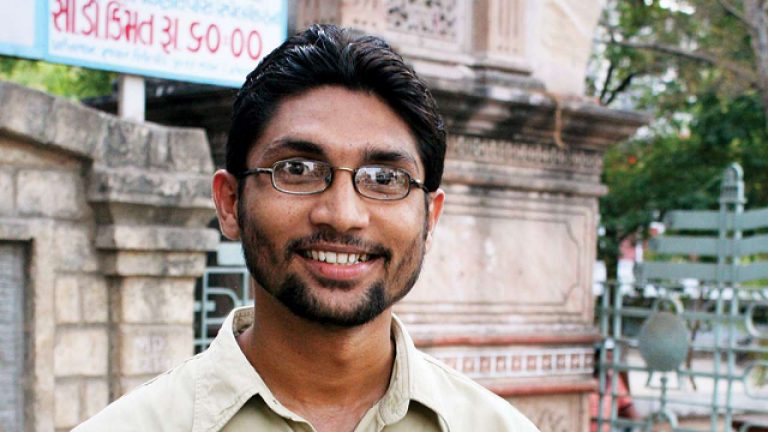
Jignesh Mevani, one of ‘youth leaders’ of India has been a habitual Modi baiter. He has been targeting PM Narendra Modi with his vile comments since he took a plunge into politics in Gujarat assembly polls. On one occasion he had claimed that Modi had accumulated enormous wealth and had been transferring money to media houses


In December 2017, Mevani had asked the PM to retire from politics, go to the Himalayas to “melt his bones” on a TV show. His comment means, “to go and die” in colloquial usage.  This was met with severe criticism on social media. We had reported on this episode earlier.

This time, Jignesh Mevani who is now an elected MLA has posted a derogatory and churlish tweet that claimed that many people have said ‘I love you’ to him. He also wondered whether Modi got such greetings from people so far.


However, Twitterati decided to show how much the PM is loved by people of India. The hashtag #ILoveYouPMModi has garnered traction among Twitter users.


The flood of tweets reiterating the people’s love for Narendra Modi must have cleared the doubts of Jignesh Mevani

Book Review : ‘The Attention Merchants’ by Tim Wu

0

The business of selling requires that the target consumer pays attention at the very least, for without attention, there is no interest, no sale, and no market. Even, and especially so, with services that are sold and advertised as free, there is still a valuable personal resource that is sold in exchange – your time.

Tim Wu’s book is an engrossing, well-researched, and fascinating look into the evolution of the advertising business – the attention merchants, as he calls them. It helps put into perspective many of the advertising practices we see today.

Each one of Brahma’s days may well be more than four billion years long, but for humans, the time available to each one of us is far limited in comparison. What we do with the time available to us is decided by what we choose to pay attention to. The job of those looking to sell us their wares is to take a bite out of that span of attention and to broker it to the other party in the transaction.

The idea that a service could be provided for free in exchange for the consumer’s attention is not a new one. It owes its birth to the ingenuity of a twenty-three old Benjamin Day, who, in 1833, came across the of selling his publication, the New York Sun, for the royal sum of one cent a copy. It competed against New York City’s leading newspaper at the time, “The Morning Courier and New York Enquirer, a four-page daily with a circulation of just 2,600 in a city of almost 300,000.1 At 6 cents, it was something of a luxury item.” At the loss-making price of one cent, every copy sold for a loss, but it came filled with often unsolicited advertisements. “A little after three months, the balance turned, and the New York Sun became profitable.” Thus was born the concept that attention could be brokered into money.

Almost two hundred years ago, therefore, began a race to the bottom that continues to this day. Parallels from the nineteenth century can be found all over the world today. Whether it is atrocity journalism practised by some venerable media houses in the United States or disaster journalism in India and elsewhere, one of the intentions remains the same – capture attention. Observers of Indian tabloid journalism and mainstream media would not be surprised at the case of Gordon Bennett, a competitor to Benjamin Day, who was “a shameless braggart who promoted himself as a paragon of gentility while also feeding the public’s appetite for the lurid and debauched … Bennett would pioneer on-the-scene crime reporting, beginning with his sensational account of the murder of Helen Jewett, a prostitute killed with a hatchet and left on a burning bed. Bennett was let in to see the naked corpse:

It was the most remarkable sight I ever beheld….“My God” I exclaimed, “how like a statue!” The body looked as white, as full, as polished as the purest marble. The perfect figure, the exquisite limbs, fine face, the full arms, the beautiful bust, all surpassed, in every respect, the Venus de Medici….For a few moments, I was lost in admiration of the extraordinary sight….I was recalled to her horrid destiny by seeing the dreadful bloody gashes on the right temple.”

That Bennett the media-man was also the media’s first troll should not also come as a surprise. “Bennett loved to gain attention for his paper by hurling insults and starting fights. Once he managed in a single issue to insult seven rival papers and their editors.”

More than commerce, more than modern management fads and theories, if one has to understand the modern advertising machine, one has to look at organized religion, and the Church. Modern-day advertising owes much to the practices of organized religion.

“organized religion had long taken human attention as its essential substrate. This is especially true of monotheisms, whose demands for a strict adherence to the one true God naturally promote an ideal of undivided attention.

…

At the dawn of the attention industries, then, religion was still, in a very real sense, the incumbent operation, the only large-scale human endeavour designed to capture attention and use it.”

The term snake-oil salesman is used to refer to an unethical salesman who knowingly sells fake goods. The phrase has very literal roots and traces its origins to Clark Stanley, one of the “most successful advertisers in America” who plied his trade in the last decade of the nineteenth century.

“While spectators watched, Clark would reach into a sack, pluck out a fresh snake, asphyxiate it with ether, and plunge it into a pot of boiling water. As he did so, fatty remnants of the snake rose to the top, which Clark skimmed and, on the spot, mixed into an elixir. The resulting potion he called “Clark Stanley’s Snake Oil Liniment” and sold to onlookers. The Snake Oil, Clark boasted, had the power to cure many ailments: it was “good for man and beast.”

Such snake oil was advertised as a sure shot remedy for all kinds of ailments, like “rheumatism, neuralgia, sciatica, lame back, lumbago, contracted muscles, toothache, sprains, swellings, etc“. In short, such snake oil was guaranteed to “cure any and every disease that is known to the human body.”

Leaving snake oil salesmen aside, the birth of modern advertising – advertising as we understand it today – owes itself to innovations of the 1920s. In its basic form, advertising has not changed much in a century, and the principles devised then are in vogue even today – “demand engineering“, “branding“, and “targeted” advertisements. Such inventiveness led to the re-branding of a floor cleaner as a cure-all for bad breath – halitosis. Listerine had been a floor cleaner, and a disinfectant used on the battlefield. In a seven-year period, Listerine company’s annual earnings grew almost seventy-fold. Similarly, a floor cleaner became a “Champion of Women’s Rights“, Shredded Wheat cereal became a “Declaration of Independence“, bad breath could leave a girl unmarried, and so on. There was no shame in shaming women into buying. Buying goods was good. Buying brands goods even better.

More fundamental changes to society, however, were required to break through barriers to reach the hitherto unreached. Till about a hundred years ago, the custom in the western world was that women did not smoke. That meant that the total addressable market for tobacco products could be doubled overnight if only cigarette smoking could be made acceptable to women. Enter Edward Bernays, master-manipulator, a journalist turned press agent and nephew of Sigmund Freud. He “hired a group of attractive women to march in the 1929 New York City Easter Day Parade, brandishing their Lucky Strikes, or “torches of freedom.” He had paid Ruth Hale, a prominent feminist, to sign the letter inviting the women to the march. “Light another torch of freedom! Fight another sex taboo!” While historians are divided over the precise magnitude of the impact this march had, what is not in dispute is the tripling in the rate of smoking among women from the 1920s to the mid-1930s. Cigarettes were even advertised as a way for women to keep slim – “To keep a slender figure, no one can deny…Reach for a Lucky instead of a sweet” went the slogan. Naked greed and astute manipulation of public opinion combined to gift to women the gift of cancer, packaged as emancipation, and endorsed by faux feminists. One wonders whether the situation has changed much in the intervening ninety years.

Advertising built and grew in its early period on the back of the distortion of the “mechanisms of choice“. But this could only grow the market so much. Advertising alone was insufficient to protect the market from regulation or oversight. It became important, therefore, to also subvert the legal mechanisms for controlling and curbing false or misleading advertising claims. Manipulation of public opinion was now steered in a new direction – the misshaping of public policy. So when the FDR administration put out the Tugwell-bill (so named after Rexford Tugwell, an economist at the Agriculture Department (the precursor to the FDA)), that was tough on false labeling, false advertising, a canard of innuendo and attacks began on Tugwell. “that he was a communist agent trying to import socialism.”

“Sensing their very viability was at stake, the newspapers, food producers, and drug manufacturers formed a tight phalanx with the advertising industry, doing everything they could, even funding front groups, until they were sure the Tugwell Bill would go down in flames.”

In 1938, a far weaker law passed.

If this sounds like ancient history, it should not. It. Should. Not. Because history repeats itself. In 2015, when Apple released iOS 9, the latest version of its mobile operating system and which ran such popular devices as the iPhone and iPad, it included support for adblocking extensions in its Safari browser. One analyst called it an “atomic bomb.” By the end of 2015, “an estimated 100 to 200 million Americans were now using some kind of adblocker some of the time.” What about the advertising industry? Its reactions were along predictable lines [emphasis mine]:

“‘Ad blocking is robbery, plain and simple,’ opined Ad Age.10 ‘Ad-blocking threatens democracy,’ pronounced the president of the Newspaper Association of America; the industry also released a study estimating that $22 billion of revenue was being destroyed and warned of far worse. ‘Every time you block an ad,’ wrote another editor, ‘what you’re really blocking is food from entering a child’s mouth.’”

That Apple’s strategy was also a deft manoeuvre against its competitor, Google and its mobile operating system, Android, was not entirely coincidental. Android was Google’s foray into harvesting the attention of smartphone users, to be sold to advertisers.

“In 1998, Larry Page and Sergey Brin had written that reliance on advertising would inevitably make it difficult to create the best possible product; in the late 2010s, in competition with Apple, they faced their own prophecy.”

In reaction to the unbridled nature of invasive and pervasive advertising and digital snooping would be born the model of companies like Netflix. While the company began life by renting out DVDs of movies it sent in mailers to customers, by 2010 it had expanded into streaming movies over the internet for its subscribers. In 2011, Netflix made an enormous and hugely ambitious, boom-or-bust bet by putting down an estimated $100 million for exclusive rights to two, thirteen-episode, seasons of the American remake of the British political drama, House of Cards. The rest, as they say, is history. In 2013, Netflix went one step ahead, and released “all thirteen episodes of House of Cards at once.” It discovered that thousands of its subscribers watched all episodes in a single session of viewing – binge watching. With Netflix spending billions of dollars on content – licensed as well as original – it was threatening not only the traditional Hollywood model of business but also the cable television’s model built on advertising. And, not in the very least, it was also plunging a deep dagger into the internet’s incumbent model of advertising-laden content. Which way this battle will veer is still years away from a decisive result.

The second generation of advertising, that followed print advertising, was radio advertising. Television, cable, the internet. In the 1920s, while some radio shows were sponsored, the general idea of advertising on the radio was unheard of. Future president Herbert Hoover had considered it “inconceivable” that radio is drowned in “advertising chatter.” That changed with “Amos ‘n’ Andy“, a fifteen-minute “serial” around two Negro characters, voiced by white actors, that launched on NBC in August 1928. By 1929, it became a superhit, with people moving their schedules around it. NBC paid a million dollars for the serial, and the sponsor was Pepsodent. More serials followed, since “Amos ‘n’ Andy” “demonstrated that an industry could, in effect, wholly “own” a part of the day.” As the evening hours were colonized under the name of “Prime Time“, so were the remaining hours of the day.

Radio shows like this opened a much larger market for companies like CBS, who offered independent radio stations “all of its sustaining content for free“. The only condition, if it can be called that, was that the radio stations “agree to carry the sponsored content as well.” For carrying this sponsored content, the stations would get paid as well! Why? In this way, CBS was buying the attention of millions of people across the country. As far as the radio stations were concerned, all this was for free. Nor did the consumers complain. The only loss was the loss of independence of independent radio stations.

A century of relentless advertising meant that the consumer was ready to pay for content, as long as it meant “peace and quiet“, was “hardly good news for the attention merchants or their brokers in the advertising industry.” What Tim Wu calls for, and argues for, is a sort of “human reclamation project“, where “consciousness and mental space” are sought to be placed beyond the reaches of the attention merchants, even if it is for short periods of time. This is by no means an easy objective to achieve, as all of us who have tried various forms of “digital detox” diets at one point or the other. However, if we as individuals are to survive this century with our identity and sense of self, the attention merchants need to be separated from our attention. If anything, this will prove even more difficult than the author may imagine. A new breed of intrusive, omnipresent, robots have made their emergence in the last couple of years – smart speakers like Amazon Echo, Apple HomePod, or Google Home, that sit like furniture in our homes, always listening, always connected to the internet, always sending data back, always refining their understanding of humans-as-consumers. The battle may only be intensifying.

This is one of the most important books to come out in recent times, and certainly one of the most remarkable books I read in 2017.

Buy from: Amazon India, Amazon US, Kindle India

Dreaded Indian Mujahideen terrorist arrested by Delhi Police special cell

0

Delhi Police Special Cell has secured the arrest of terrorist Ariz Khan alias Junaid, member of Indian Mujahideen, who had been absconding for 10 years. The dreaded terrorist is reportedly involved in 5 bomb blasts including the Jaipur, Ahmedabad and Delhi bomb blast cases.


Ariz Khan is a resident of Azamgarh, Uttar Pradesh and had a reward of 10 lakh rupees from the NIA and 5 lakh from the Delhi Police on any information leading to his arrest. He is believed to have been involved in the Batla House encounter but had managed to escape.

The arrest of Ajiz Khan is the second big arrest for the Delhi Police after Abdul Subha Qureshi on January 22nd. Qureshi was referred to as ‘India’s Bin Laden’, the bomb-maker was arrested after a brief shootout from Ghazipur. The arrests of the two wanted terrorists are expected to come as a big boost to Indian security agencies.