Home Blog Page 1073

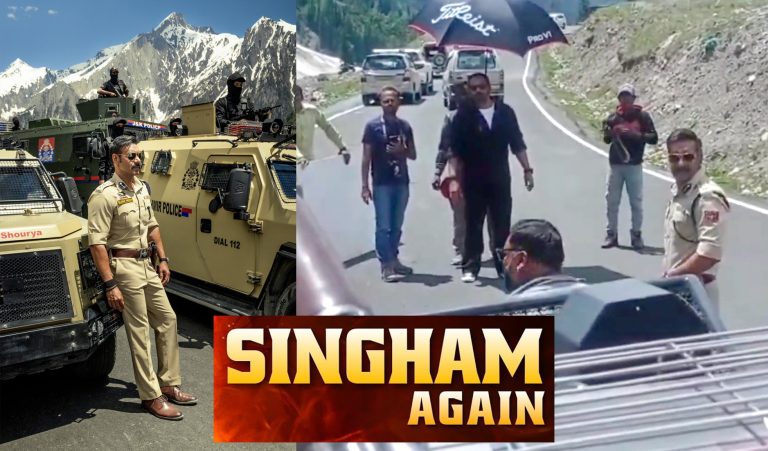
Ajay Devgn and Rohit Shetty shoot “Singham Again” in Jammu and Kashmir: How peace and prosperity came in the valley after removal of Article 370

Rohit Shetty’s “Singham Again” starring Ajay Devgn has created a lot of buzz on social media, not only for the project but also because of the videos and pictures from the shooting that went viral on social media as they were taken in Kashmir. It serves as yet another testament to the drastic change that Jammu and Kashmir has undergone in only around five years after the abrogation of Article 370 in an epochal move in 2019.

The audience will get to witness the beautiful valley on silver screens after a long break owing to the strong government initiatives and policies aimed at bringing peace and prosperity to the region. Kashmir was a favourite location to shoot Bollywood movies before terrorism hit the valley, after which the producers were forced to avoid the beautiful locations due to security reasons. However, now that situation have changed, and considerable number of movies and shows have been shot there in recent times.

The government has implemented various measures to progressively restore normalcy in Kashmir, and the union territory has been witnessing gradual changes in recent years that were inconceivable before 2019. The image of the new Kashmir of 2024 is defined by a sharp decline in terror, a significant increase in the tourism sector, a bustling first-ever multi-plex opened after decades and the “God of Cricket” strolling through its streets. The place which was earlier solely recognized for violence, stone-pelting, strikes and terrorism is now renowned for its development and peace.

300 films shot in Kashmir

Jammu & Kashmir has been the stunning backdrop for over 300 movies and web series over the last two years, winning recognition for the exquisite display of the region’s ethereal beauty. The year 2023 marked the approval of 102 web series and films from Tollywood and Bollywood to be shot in Jammu & Kashmir. Yami Gautam’s “Article 370,” John Abraham’s “Vedaa” and Shahrukh Khan’s “Dunki” are a few of the prominent projects among them.
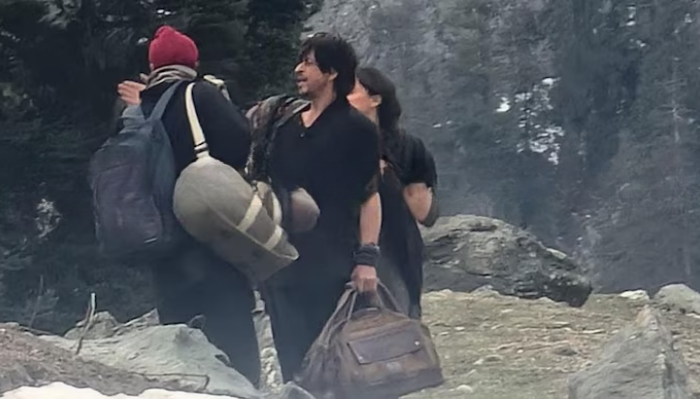
Shah Rukh Khan was spotted in Sonamarg for “Dunki” shoot. (India Today)

The administration granted permission for up to 200 movies, web series and music videos to be filmed in Kashmir in the year preceding 2022. According to officials, the valley has been effective in drawing filmmakers, with several of them requesting authorization to shoot in Kashmir. They attributed the development to the film policy, which encouraged filmmakers to use Kashmir as their shooting location.

Moreover, the government has advocated for new destinations to be used as ideal film locations. The government of Jammu and Kashmir introduced its first film policy in 2021 in an attempt to foster interest in filmmakers. Furthermore, for the fiscal year 2022–2023, the government established a Film Development Fund (FDF) in the Information Department to distribute subsidies as specified in the Jammu & Kashmir Film Policy 2021.

The government of Jammu and Kashmir launched its first film policy in 2021 in an effort to pique the interest of filmmakers in the area. Moreover, in the fiscal year 2022-2023, the government created a Film Development Fund (FDF) within the Information Department to provide subsidies outlined in the Jammu & Kashmir Film Policy 2021. The Film Development Council of Jammu and Kashmir has introduced a single-window system to streamline the process of shooting and make it less complex.

Filmmakers have the option to submit their applications through the online platform jkfilm.jk.gov.in. Many directors have applied to shoot their films in Jammu and Kashmir since the film policy was introduced. The government provides financial assistance to filmmakers so they can film in the union territory.

It is essential to acknowledge that none of this could have been achieved if the area continued to exist as it did before 2019. “Lights, sound, camera and action” would have been drowned out by the roar of gunfire, stones being hurled and the cries of the hapless victims.

Kashmir’s first-ever multiplex opens in Srinagar

Kashmir’s first multiplex was inaugurated in the Sonwar neighbourhood of Srinagar in 2022 by the lieutenant governor of Jammu and Kashmir, Manoj Sinha which marked the reopening of theatres after a three-decade hiatus. There are three movie theatres in the INOX-designed multiplex, totalling 520 seats. Additionally, there is a food court on the property to support regional cuisine. A “Khatambandh” made of Kashmiri wood is also utilized in the lobbies to showcase the region’s artwork and design, lending it a distinctively Kashmiri appearance. The public was invited to attend a special screening of “Lal Singh Chaddha,” starring Aamir Khan and Kareena Kapoor in leading roles.
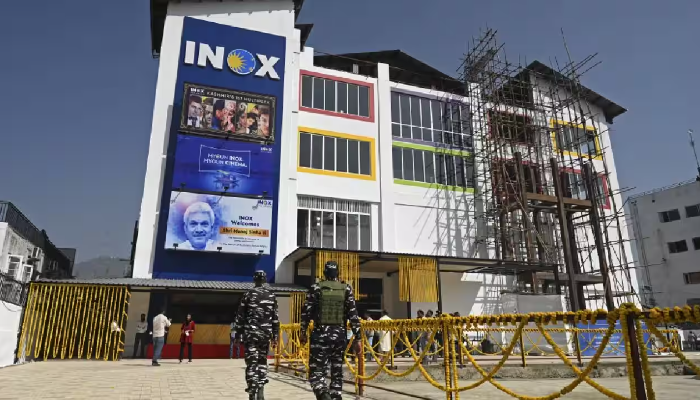
Image via Moneycontrol

People in Kashmir will have access to the same recreational amenities as the rest of the country due to the permanent installation of the multiplex and the screenings of the newest films. Multipurpose cinema halls in Pulwama and Shopian were also opened.

After 33 years, cinema returned to north Kashmir in 2023 following the official launch of multipurpose movie theatres in Baramulla and Handwara by J&K Lieutenant Governor Manoj Sinha. Seven major movie theatres in North Kashmir existed before the rise of Pakistan-sponsored terrorism. These theatres were owned and operated by the local community while the Army managed three theatres in Baramulla, Pattan and Uri towns that bore the names of notable generals.

However, the valley’s movie theatres were all shuttered on 31st December 1990, amid the escalating terrorist attacks. The terrorists threatened the proprietors and people stopped going to the movies out of fear. With the end of Article 370 and a significant drop in terrorist attacks, cinemas have made a comeback in Kashmir much to the delight of the general public.

Sachin Tendulkar visits the valley

Sachin Tendulkar, otherwise known as the “God of Cricket” went viral online earlier this year when he posted pictures from his trip to Kashmir. Sachin Tendulkar was enjoying the latter part of winter in the valley with his wife Anjali while on a week-long trip to Jammu and Kashmir. He shared his favourite travel memories from the trip and recommended people to add the mesmerising valley to their bucket list of places to visit. He termed Kashmir as “one of the several jewels” of the country and echoed the views expressed by Prime Minister Narendra Modi regarding the abundance of natural beauty that the nation has to offer to tourists.

The legendary cricketer also prayed at the Shankaracharya temple in Srinagar. He wrote, “It felt surreal to visit the Shankaracharya temple last month, which is situated at an altitude of 1100 feet above the surface level of Srinagar city. During the 240+ steps ascent, every step felt like a step closer to divinity. I feel truly blessed to have had this experience with my family and friends,” while sharing the experience.

The former Indian opener also paid a visit to a Chursoo cricket bat factory, a nod to the area’s well-known expertise in crafting fine Kashmir willow bats. He heaped praise and stated that they are excellent representations of the global impact that “Made in India” products are making.

Furthermore, the Indian cricket maestro stunned one and all by engaging in a session of gully cricket in Uri. He got down from his car as he spotted some kids playing cricket on the road with an empty oil can and a cardboard carton for stumps. He even turned the bat upside down and played with the long handle to give the starstruck young boys a shot at dismissing him.

Who would have imagined, prior to 2019, that such images could be captured in a valley notorious for its horrific scenes of murder and violence?

Srinagar hosts maiden Formula-4 car racing event

Srinagar held its first Formula-4 car racing event in March in an effort to boost tourism and provide more opportunities for young people in the area. Professional Formula-4 drivers from all over the country participated and impressed the audience with their impressive performances and entertained them for almost four hours. Fans gathered in droves to see the exhilarating competition and many took advantage of the chance to interact with experienced drivers after the event. The latter provided advice to young people looking to get into motorsports.

Authorities made sure that attendees had a flawless experience by carefully organizing everything, including the setup of the track, the deployment of medical professionals to boost safety and a strong security system as sleek race cars thundered across a 1.7-kilometre course that stretched from Lalit Ghat on the banks of Dal Lake to the city’s Nehru Park.

The Federation of Motorsports Clubs of India, a member of the Federation Internationale de l’Automobile (FIA), arranged the inaugural event of its sort in the Kashmir Valley. Prime Minister Modi also expressed that the occasion will further highlight Jammu and Kashmir’s splendid scenery.

The Tourism Department facilitated the partnership between Formula-4 and the Indian Racing League which resulted in the event as a major step in demonstrating the region’s potential in motorsports. The race, according to its organisers, was about more than just rivalry and speed, it was also about unity and resiliency and urged the young people in the region to pursue careers in Formula-4 racing and enhance Kashmir’s growing motorsport presence. They voiced, “It goes beyond the usual motive. The event was grand and historic. Formula-4 will be an addition to the adventure in Kashmir.” Officials pointed out that the purpose of the event was to familiarize the valley with the culture of Formula-4, as motorsports has been growing in popularity there.

From a history of strife to the sound of engines, from young people gathering to throwing stones to youth lining the charming Boulevard road at the base of the Zabarwan mountain range to watch racing events, Kashmir has indeed come a long way.

Kashmir hosts G-20 meeting

The Indian government hosted over 100 meetings throughout the nation while it took on the G20 presidency in 2023. Furthermore, a working group meeting of the international forum was held in Kashmir from 22nd to 24th May at the Sher-i-Kashmir International Conference Centre (SKICC) in Srinagar. The development grabbed a lot of attention since it was the first time in Kashmir’s history that representatives from so many different nations were present in the region, which had spent decades under the shadow of terrorism funded by Pakistan.
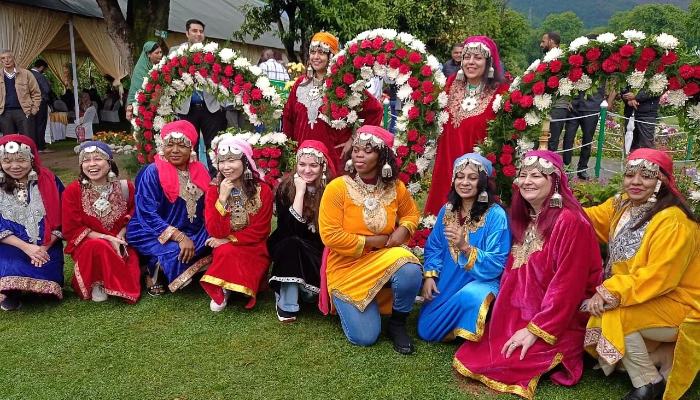
Enthusiastic delegates took pictures in traditional Kashmiri attire. (Source: Greater Kashmir)

A general strike in Srinagar would have been expected in the past in response to an incident of this magnitude, but according to MoS Jitendra Singh, people are now “going about with their activity.” He mentioned, “Jammu and Kashmir has moved on, the common man has moved on. He’s seen two generations of Kashmiris being sacrificed on the altar of Pak-sponsored terrorism, he’s no longer in the mood to succumb to that.” Jitendra Singh highlighted positive transformations in the Valley and noted, “It is indeed a moment of rejuvenation, a moment of reincarnation.”

The delegates had a “Shikara” boat trip on Dal Lake and visited other picturesque locations in Srinagar including the Nishat Mughal Garden and the 18-hole Royal Spring Golf Course. They also did some shopping at Polo View Market, the city’s all-pedestrian marketplace. They showed keen interest in the regional handicrafts and purchased some to bring home as mementoes of their exciting trip to the valley. A few of the local handicrafts that drew their interest were walnut wood carvings, Pashmina shawls, and papier-mache pieces, among others.

Tourism boom and influx of foreign investment in Kashmir

The G20 Tourism Working Group meeting and the Miss Universe press conference were just two of the major international events that the valley hosted in 2023 as part of the government’s ambitious plan to establish Kashmir as a global tourism hub which was followed by the first-ever Formula-4 (F4) automobile racing competition. Mercedes-Benz’s electric car also made its premiere in Gulmarg and many such events will be observed in the future, according to J&K tourism agency representatives. Furthermore, throughout the past few years, films featuring stunning landscapes from Jammu and Kashmir have been shot, reflecting the region’s allure and charm. This cinematic embrace and the government’s coordinated efforts to promote stability have been crucial in bringing the tourism industry back to life.
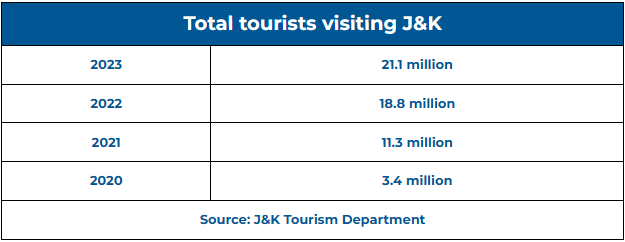
Image via CNBC TV18

Diversification became prominent as a crucial tactic, with a focus on marketing isolated and rural locations that enhance visitor experiences while accentuating the area’s natural and cultural heritage. Notably, border tourism underwent a notable uptick as a result of the army and tourism authorities working together to provide travellers with immersive and safe experiences. Greater peace and order has a noticeable effect on the local economy, based on the tourism-dependent business owners who credit it with aiding their ventures.

The first foreign direct investment (FDI) for the Union Territory was initiated by the creators of Dubai’s Burj Khalifa, last year with their ambitious and intended multipurpose tower and retail mall on the outskirts of Srinagar. Around 10,000 employment opportunities are expected to be created in the Kashmir Valley as a result of the Rs 500 crore project. Moreover, bids totalling Rs 50,000 crore are being processed, while investment projects worth Rs 10,000 crore are being carried out in Jammu and Kashmir.

The Union Territory has received proposals worth Rs 84,544 crore till 2023 in as many as 42 industrial sectors in nearly three years after the Jammu and Kashmir administration launched a new industrial policy in January 2021.

Major decline in terror incidents

Modi government informed the Parliament in December of last year that there has been a notable decline in terror occurrences in Jammu and Kashmir over the last six years, with 2023 recording all-time low figures. Union Minister of State for Home Affairs Nityanand Rai stated that the government has a “zero tolerance against terrorism and its approach is to dismantle the terror ecosystem” in a written reply to the Rajya Sabha. He unveiled, “There were 42 terrorist-initiated incidents in Jammu and Kashmir till November 15 this year. In 2022, 125 such incidents were recorded in the region, 129 were recorded in 2021, 126 in 2020, 153 in 2019 and 228 in 2018.”

The minister added, “Due to this, there was also a reduction in civilian casualties resulting from terror incidents. The toll this year has been 13 so far, while 31 civilians were killed last year, preceded by 41 in 2021, 38 in 2020, 44 in 2019 and 55 in 2018. Rai also informed the Parliament that 44 gunfights between militants and security personnel took place in Jammu and Kashmir this year, as compared to 117 last year, 100 in 2021, 118 in 2020, 102 in 2019 and 189 in 2018. The toll of security personnel killed in action has also declined. This year, 20 security personnel lost their lives in terror incidents, as compared to 32 in 2022, 42 in 2021, 63 in 2020, 80 in 2019 and 91 in 2018.”

Record voting percentage in Kashmir

The Baramulla Lok Sabha constituency in Jammu and Kashmir, which was previously infamous for its high levels of terrorism reached a historic milestone by recording its highest-ever voter participation during the ongoing Lok Sabha election. The seat, where the first parliamentary polls were held here in 1967, recorded a healthy turnout of 59 per cent in the fifth phase of Lok Sabha elections. The Baramulla Lok Sabha seat reached its highest voter participation in 1984, with 59.10% of the vote cast. The achievement was also lauded by Prime Minister Narendra Modi.

With a commendable 37.99% of votes cast in the districts of Srinagar, Ganderbal, Pulwama, Budgam, and partly Shopian, the fourth round of voting for the 18th general elections ended peacefully. Chief Election Officer, Pandurang K Pole stated, “The corresponding percentage for the last Lok Sabha election in 2019 was 14.43 per cent. This time, there was no boycott and no polling station recorded zero per cent or nil voting which speaks of people’s firm trust in the democratic system as imperative for their overall welfare.”

He attributed the significant increase in the polling percentage to several factors, including the enhanced security and law and order situation over the past four to five years, the mobilization of 24 candidates and political parties, the implementation of election awareness campaigns by the CEO office and Deputy Commissioners through SVEEP (Systematic Voters’ Education and Electoral Participation) activities, and, especially, the strong belief among people that voting can lead to sustainable development.
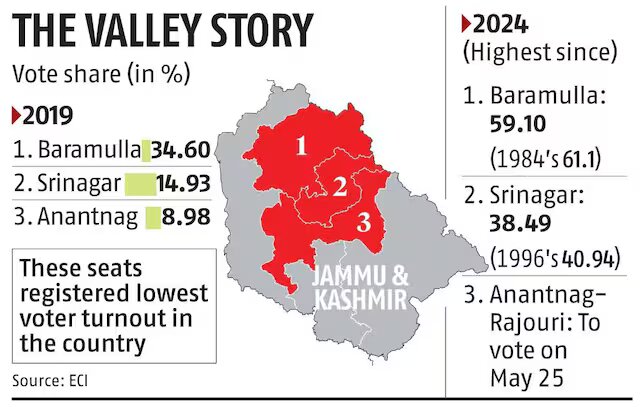
Image via Business Standard

Voter turnout in the notoriously low-voting constituencies of Srinagar and Baramulla was 38.49% and 59.10%, respectively, for the first time in decades. The greater voter turnout was credited by Home Minister Amit Shah to the revocation of Article 370, and he asserted that it was a “befitting reply” to concerns about what had changed following the centre’s decision in August 2019.

Conclusion

Repeating the words of Shehla Rashid, “I have not changed. Things have changed,” who once was a significant voice of the anti-Modi camp and rebuked the government on all its actions. Even the most vocal opponents of the Modi government were compelled to modify their views after witnessing the resurgence of Kashmir. Kashmir has indeed undergone a massive transformation for the better. While its other half “Azad Kashmir” is enduring brutal oppression at the hands of its administrators merely for seeking basic rights and needs, the Indian side is flourishing and making giant strides on the path of historical achievements and development.

The success story of Kashmir has spread across the world, reaching even India’s hostile neighbours. People in Pakistan-Occupied-Jammu and Kashmir are now also expressing a desire to join Indian Kashmir and raising the tricolour as they show their contempt and anger towards the administration. Kashmir now represents a positive symbol of a transforming, resilient and advancing India.
Activist Medha Patkar convicted in defamation case filed by Delhi Lt Governor VK Saxena, suit was filed over her allegations in 2006

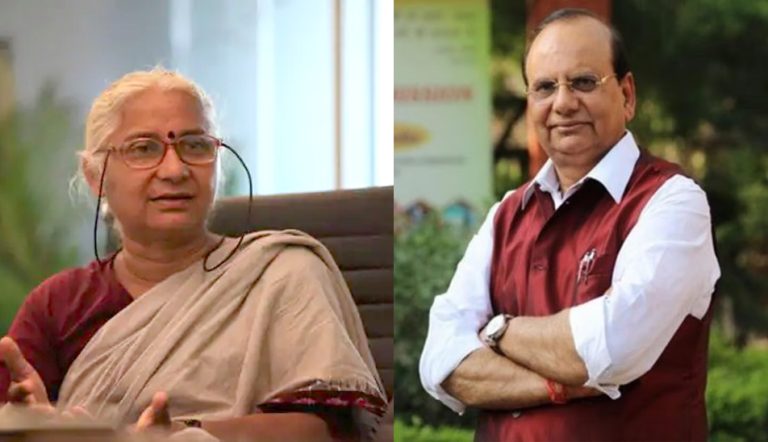
A Delhi Court on Friday convicted activist Medha Patkar in a defamation case filed by Delhi LG VK Saxena. Saxena had filed the defamation case against the Narmada Bachao Andolan (NBA) leader for making derogatory remarks against him on a TV channel and issuing a defamatory press statement against him.

Medha Patkar and Vinai Kumar Saxena are involved in a legal battel since 2000, after Patkar filed a case against him for publishing ads against her and Narmada Bachao Andolan. At that time, Saxena was the chief of Ahmedabad-based NGO National Council for Civil Liberties. At the same time, Saxena filed two defamation lawsuits against her over her comments against him.

The defamation suit was filed in response to Medha Patkar’s statements in April 2006. In a panel discussion on a news channel, Patkar had alleged that Saxena received civil contracts from Gujarat-based Sardar Sarovar Nigam, which manages the Sardar Sarovar Dam. The allegation was denied by Saxena.

After her comments, Sardar Sarovar Nigam Ltd wrote to Gujarat Police denying her charges. They stated that Saxena never applied to the Nigam for the award of any civil contract and/or for any supply contract in the past, nor the Nigam ever gave any civil or any other contract to him or to his NGO.

After years of hearing, Metropolitan Magistrate Raghav Sharma found Medha Patkar guilty of criminal defamation.

In July 2018, the Delhi court had framed defamation charges against Patkar in the case filed by VK Saxena, who was the Khadi Village and Industries Commission (KVIC) Chairman at that time. While framing the charges, the court had said, “Prima facie case is made out against the accused for the offences.”

Earlier in 2017, the court had slapped a fine of ₹10,000 for not appearing in the court hearings. The court had warned that her complaint against Saxena would be dismissed if she fails to appear in the court. The imposed the fine after her lawyers told the court that she couldn’t appear in the court because she was on a hunger strike in Madhya Pradesh.

‘There is an international Khan Market gang as well’: Dr Jaishankar on anti-India ecosystem operating abroad with domestic support

0

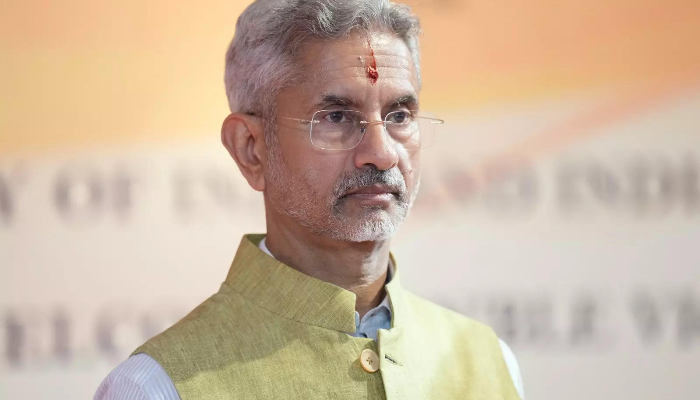
Taking a swipe at the anti-India ecosystem over their ‘negative’ portrayal of India, External Affairs Minister S Jaishankar said that just like the ‘Khan Market Gang’ in India, there is also a global extension of it, like the ‘International Khan Market Gang’.

In an exclusive interview with ANI, Jaishankar said, “In the country today, there is a certain thought process, or entitlement process, which the metaphor of ‘Khan Market Gang’ is a very good description. I want to tell you there is an international Khan Market Gang as well.”

“These are people, who are sort of linked to entitled people out here. They are socially comfortable with them, they know them, they feel like them,” he added.

Further taking a jibe at the anti-India ecosystem, the EAM said, “The sales are down in the domestic Khan Market, the international Khan Market Gang feels like ‘I need to pep up these guys and give them support’.”

On being asked about the Prajwal Revanna case; why the former JD(S) leader’s passport was not impounded and why was he allowed to leave, Jaishankar said that the Ministry of External Affairs got a request from the Karnataka government only on May 21 and MEA has to function only as per the law.

“The MEA got the request from Karnataka only on 21st May…people were saying a lot of things to the press. I don’t know how others, other state governments, function, we at least in MEA function as per the law,” he added.

Regarding the claim of Opposition parties that BJP will be ‘Dakshin mein saaf aur Uttar mein half’ (rout in the South, and half in the North), Jaishankar exuded confidence in the Modi government’s return to power with an even bigger majority.

“For us (BJP), it would be dakshin mein double (twice in South), and for the Opposition, I would say uttar mein even more trouble,” he stated.

He also rebuffed the allegations by Congress and other Opposition parties that the BJP government is “against the Constitution”, highlighting that it was the Congress party under whose rule, around 80 amendments were made to the Constitution.

“Constitution does not provide for faith-based reservation. You are actually implementing and advancing faith-based reservations, and then you are saying I have respect for Constitution…this is against the Constitution….80-odd amendments were done to the Constitution by whom, by the Congress party,” Jaishankar further added.

Catch the entire podcast of External Affairs Minister S Jaishankar at ANI YouTube channel.

(This news report is published from a syndicated feed. Except for the headline, the content has not been written or edited by OpIndia staff)

Skinned, bones shattered and minced flesh disposed of across Kolkata: Chilling details of Bangladeshi MP Anwarul Azim Anwar’s murder

Anwarul Azim Anwar, a Member of Parliament from Bangladesh, who was found dead in Kolkata was subjected to horrific violence, a report published in India Today citing sources within the West Bengal Crime Investigation Department (CID) said. Before being disposed of throughout the city, he was skinned and his bones were shattered. These gruesome details came to light following the arrest of a suspect by the CID team.

The suspect, identified as Jihad Hawladar, allegedly a skilled butcher from Barakpur in Bangladesh’s Khulna district, had been residing illegally in Mumbai. Reportedly, he was recruited for the crime by Akhtaruzzaman, a friend of the Awami League MP and a US citizen. The murder took place in Akhtaruzzaman’s rented accommodation in Kolkata, where Hawladar had arrived approximately two months prior, according to CID sources.

The report also stated that Hawladar, who was residing in a hotel close to Kolkata airport, received a portion of the Rs 5 crore that Akhtaruzzaman reportedly invested in orchestrating the murder of the Bangladeshi MP.

During interrogation, Hawladar admitted to his involvement in the murder alongside four other Bangladeshi nationals, stating that they suffocated the MP at an apartment located in Kolkata’s New Town area. He asserted that they carried out the killing under the directives of Akhtaruzzaman.

According to CID sources, they proceeded to skin the entire body within the apartment and then minced the flesh to erase the victim’s identity. Subsequently, they broke the bones into fragments and packaged them in multiple plastic bags. The perpetrators then utilized various modes of transportation to travel to different parts of Kolkata, where they disposed of the packets.

The last sighting of the Bangladesh MP was when he entered the flat in New Town. Authorities had previously disclosed that the apartment was rented to the MP’s acquaintance by its owner, an employee of the excise department.

Bangladesh’s Home Minister, Asaduzzaman Khan, has confirmed the tragic demise of the MP who disappeared from Kolkata on May 13. He stated that three individuals have been apprehended in connection with the case, but the victim’s body has yet to be located.

The three-time Bangladeshi MP had reportedly travelled to Kolkata on May 12 for medical treatment. Initially, he stayed at the residence of his family friend, Gopal Biswas, who resides in Baranagar, north Kolkata.

On May 13, Anwarul Anwar departed from Biswas’s residence to consult a doctor. However, there has been no contact with the MP since May 17, prompting Biswas to lodge a missing person report a day later.

Modi government empowering women: Read about how PM Modi has ushered economic development and health-related improvement in the lives of women

MK Gandhi famously said – “If by strength is meant moral power, then woman is immeasurably man’s superior.” Women empowerment and gender equality have been priorities for nations, developed and developing alike. Of the 17 Sustainable Development Goals propounded by the UN, that form part of its 2030 Agenda for Sustainable Development, Goal mentions that – ‘Gender equality is not only a fundamental human right, but a necessary foundation for a peaceful, prosperous and sustainable world.’    

Guiding principles 

American Indologist Edwin Bryant, whose landmark work around Yoga and Sutras are acclaimed the world over, talks in ‘Krishna: A Sourcebook’ of the reverence accorded to women in Hinduism. Chapter 18 mentions – “Nowhere in the panorama of world religious traditions, from ancient times to the present, do we find such a strong presence of the feminine voice within the divinity as we do in the Hindu complex of religion”. Vedic literature profoundly espouses the reverence for feminism. In the 10th Chapter of Rigveda, Devīsūktam propounds that the feminine is the supreme principle behind all of the cosmos. 

The same guiding principles have pivoted present-day Central government to focus on ‘Nari Shakti’ across all walks of life. Women empowerment as envisioned by Centre can be bucketed under a few distinct heads:

  • Economic empowerment of women 
  • Health and infrastructural provisions 
  • Quality education for girl child 
  • Social progress of women

In this first of a two-part series, I will focus on the former two viz. Economic empowerment and health-related improvements for women and girl child, and how India has seen steady advancements in these over the past 10 years.  

Economic empowerment

Few notable schemes have helped women in this regard.

Pradhan Mantri Kaushal Vikas Yojana (PMKVY): This was launched in 2015 to encourage skill development via free short-duration skill training and incentivise this through monetary rewards for skill certification. This successful scheme has seen over 59 lakh women getting trained from 2015 to 20222. Not just training, 12.51 lakh women candidates have been employed under this scheme from 2015 to 2023. A positive testament to this is borne by the fact that e-shram portal has registered 2.67 crore domestic and household women workers. A notable fallout of this has been, the female labor participation rate has increased to 37% in 2022-23.   

1. PM Jan Dhan Yojana: This is one of the largest financial inclusion initiatives in the world, with 52.20 Crore beneficiaries banked so far since its launch in 2014, and INR 231,154.51 Crore balance created in beneficiary accounts. Out of 52.20 Crore beneficiaries thus far, 29.03 Crore are female. This means, that around 55.6% of beneficiaries of this landmark Direct Benefit Transfer program happen to be women. This, augmented by the fact that 13 lakh banking touchpoints have been mapped on the GIS-based Jan Dhan Darshak App, makes ease of access to banking for our women force easier and less tedious.

2. PM Mudra Yojana (PMMY): This is a flagship scheme launched by PM on April 8, 2015, for providing micro-credit/loans up to INR 10 Lakhs to income-generating micro-enterprises, facilitated by Member Lending Institutions (MLIs), that include PSBs, Private sector banks, MFIs, NBFCs, and others. For FY 2023-24, a total of INR 532358.35 Crore had been disbursed, out of which INR 222297.27 Crore was disbursed to women entrepreneurs. More than 69% of the beneficiaries under this scheme were women. This has significantly enhanced access to collateral-free institutional credit for women, aiding directly in their empowerment. Notably, NPAs in PMMY have reduced significantly from 3.17% in March 2022 to 2.68% in June 2023.

3. Udyam Sakhi Portal: To foster women’s empowerment, Udyam Sakhi is a network that was created to boost financial entrepreneurship, innovative business models, and access to finance for women. As of 2023, around 6 lakh women-owned MSMEs have turned into reality. Over 1.45 lakh women MSMEs have fulfilled 7.32 lakh orders amounting to INR 15,922 Crore through the Government e-marketplace.

4. PM Street Vendor’s AtmaNirbhar Nidhi (PM SVANidhi): This scheme aims to provide collateral-free working capital loans of up to INR 10,000 for one year tenure, to approximately 50 lakh street vendors. The 1st loan target up to March 2024 had been set at INR 74,96,503, and 43% of street vendors covered under this scheme are women.   

5. Mahila Samman Savings Certificate Scheme: In her budget speech 2023-24, FM Nirmala Sitharaman introduced the Mahila Samman Savings Certificate Scheme, which will offer a maximum deposit limit of INR 2 Lakh in the name of women or girls. This is provided for 2 years of maturity duration, with a fixed interest rate of 7.5% pa. To date, around 14 lakh Mahila Samman Savings Certificate Accounts have been opened.  

6. Sukanya Samriddhi Yojana (SSY): This is a small deposit scheme launched by the Ministry of Finance, exclusively for a girl child. Inaugurated by Hon. PM on 22nd January 2015 as part of the ‘Beti Bachao, Beti Padhao’ campaign, this scheme encourages parents to build a fund for the education of their girl child, as well as to meet marriage expenses. SSY accounts offer an 8.2% interest rate, and the maturity period is 21 years. As of February 2024, more than 3.77 Crore accounts had been registered, and more than INR 2.13 Lakh croredeposited.11

Lakhpati Didi Yojana: This is a self-help group member with an annual household income exceeding INR 1 Lakh. They inspire not only through financial independence but by adopting sustainable livelihood practices too. Through SHG, 1 crore+ women have become Lakhpati Didis. 1000 drones were distributed under Namo Drone Didi, and INR 7.68 Lakh Crore loans have been distributed under National Rural Livelihood Mission11.    

Health and infrastructure: A few snippets of information will set the stage for this conversation better.

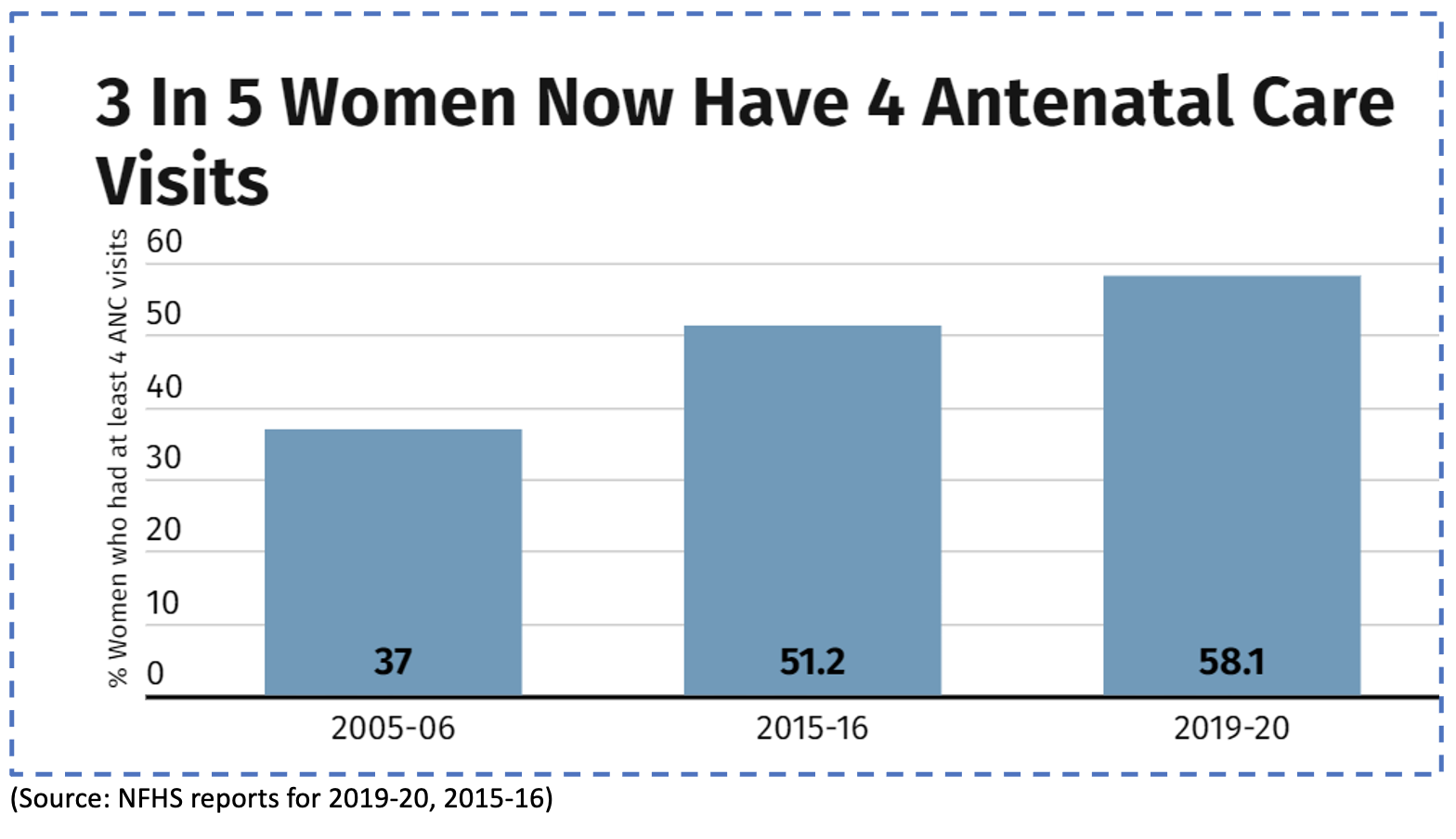
Utilization of maternal health services improved substantially between 2005-06 and 2019-20, as evidenced by National Family Health Survey (NFHS) data. 

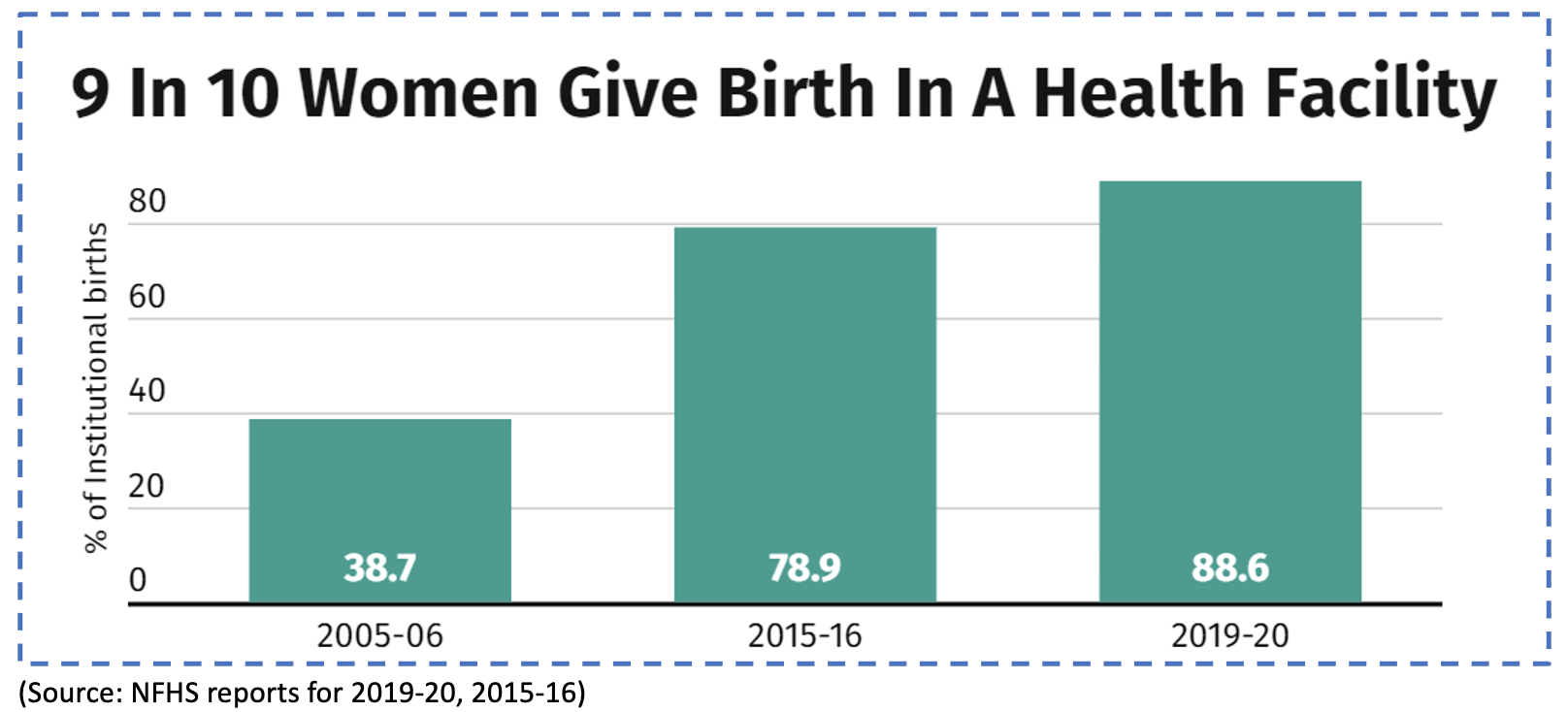
Access to health facilities for giving birth has gone up remarkably over past 10 years. 

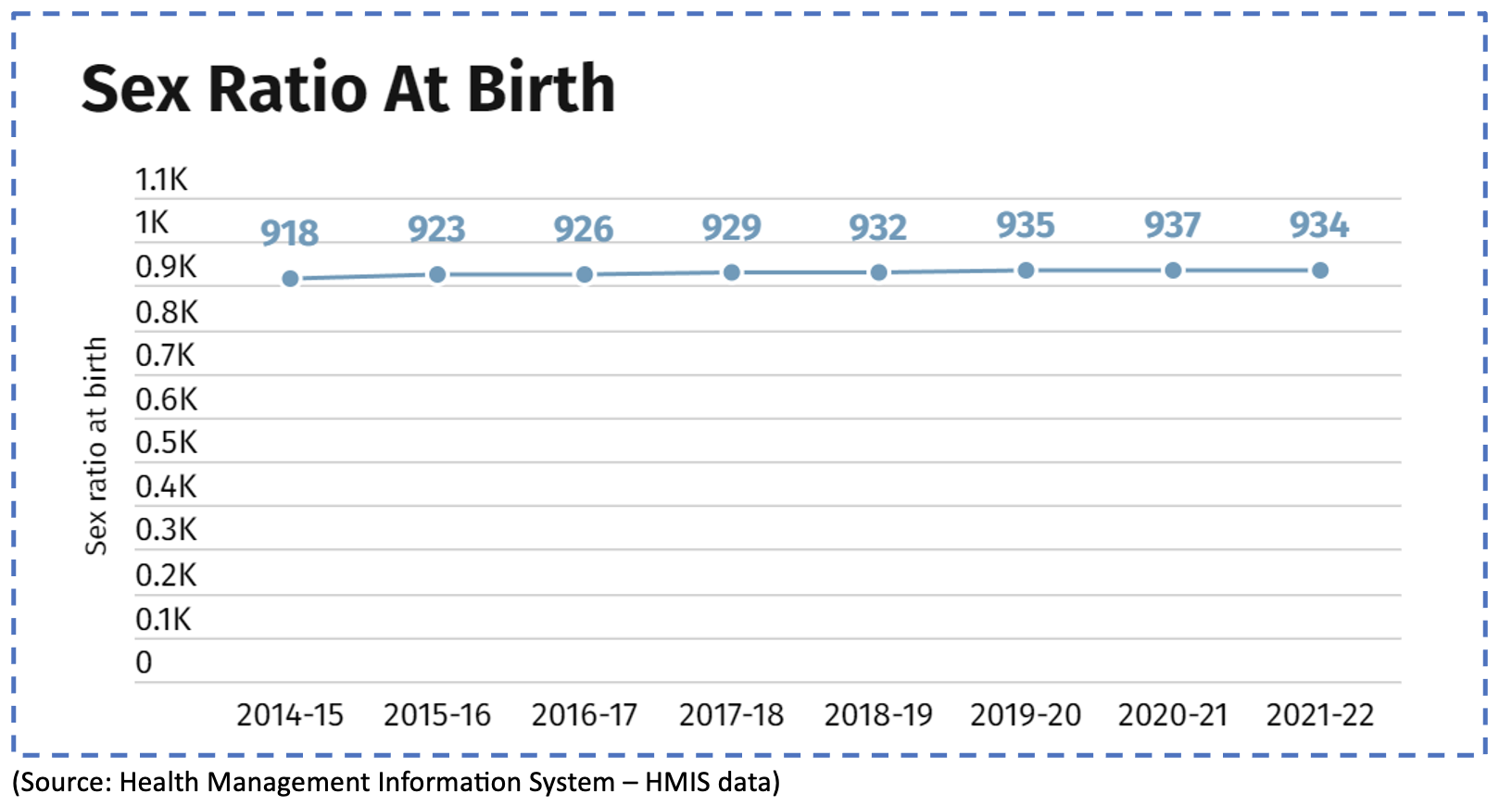
Sex ratio at birth (SRB), which is number of girls for every 1000 boys, notched up steadily from 918 in 2015 to 934 in 2022.

These have been possible owing to a few schemes that were introduced by the Centre. 

Janani Suraksha Yojana (JSY) – This flagship program aims to reduce maternal mortality among pregnant women by encouraging them to deliver in Gov health facilities. As of date, more than 8.55 Cr women have benefited under this program. One key outcome that has been witnessed is a sharp decline in Maternal Mortality Ratio (MMR), from 130/lakh in 2014 to 97/lakh in 2020.

Janani Shishu Suraksha Karyakram (JSSK): JSSK entitles all pregnant women delivering in public health institutions to absolutely free and no-expense delivery, including Caesarian section. Free drugs and consumables, free diet, free provisions of blood, and free to-and-fro transportation from home to health institution and back – are features of this scheme. Newborn Care Corners (NBCCs) were established to provide essential newborn care at points of delivery, while for sick newborns, Special Newborn Care Units (SNCUs) were started across the country. 

Pradhan Mantri Surakshit Matritva Abhiyan (PMSMA): This scheme was launched to provide fixed-day assured, comprehensive and quality antenatal care to all pregnant women (in the 2nd and 3rd trimester), on the 9th of every month. As of date, 20,752 facilities nationwide are providing PMSMA services, with 6,813 volunteers registered.

Pradhan Mantri Matru Vandana Yojana (PMMVY): This is a Centrally sponsored DBT scheme, with cash incentives of INR 5000, being provided directly to bank/post office accounts of pregnant women and lactating mothers. As of 15.07.2022, more than 2.89 crore beneficiaries have been enrolled, and INR 11,217.39 Crore disbursed under this scheme.    

The improvement in prenatal care for mothers aged 15-49 with alive children, and basic immunizations for children, have been remarkable over the past 10 years.

A key tenet of the BJP-led Centre has been to transition from a ‘Women-centric development’ to a ‘Women-led development’. As part of this mission, Interim Budget 2024-25 saw a substantial increase of the Gender Budget by 38.6% over 2023-24. This is also a whopping 218% increase over UPA’s allocation in 2013-14. 

Way forward

On 13th March 2024, UNDP came out with their Human Development Report 2023/2024. The Gender Inequality Index (GII) 2022 saw India ranked at 108 out of 193 countries, a jump of 14 notches over the 2021 ranking (122 out of 191 countries). Over the last 10 years, India’s rank has slowly yet steadily improved, up from 127 in 2014. This has been possible due to a razor-sharp focus on improving the condition of women and girl children through policy initiatives, around socio-economic and political development. 

“Women hold up half the sky” famously said former CCP Chairman Mao Zedong. As India’s skies open up to a glorious trove of opportunities, courtesy a set of bold and pragmatic decisions by the Central government over the past 10 years, women are taking wings in ways one could barely imagine a decade back. And, in the process, they are turning out to be the true harbinger of India’s Viksit Bharat dream of 2047!

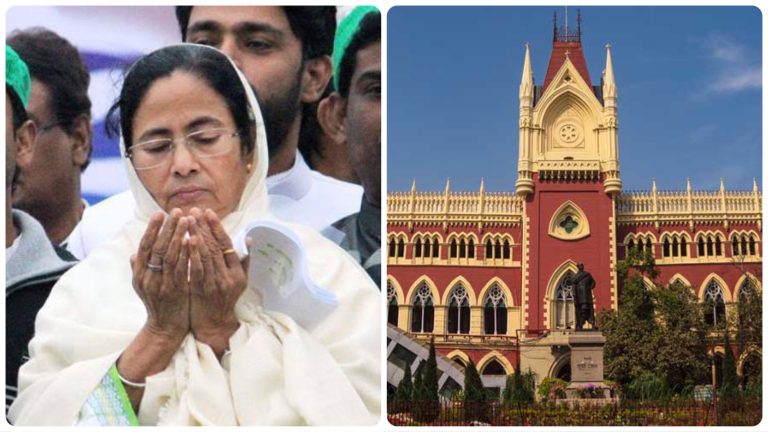
Mamata govt to approach higher court after Calcutta HC cancels OBC certificates over the inclusion of 77 classes of Muslims in the backward category list

On Friday, West Bengal Chief Minister Mamata Banerjee declared that her administration will seek a higher court’s intervention to overturn the Calcutta High Court’s decision to revoke all OBC certificates issued in the state since 2010.

During an election rally in Sagar, South 24 Parganas district, Banerjee stated that the government would file an appeal with the higher court after the summer break.

“We do not accept the ruling that nullified OBC certificates. We will challenge it in a higher court after the summer vacation,” Banerjee announced.

The Calcutta High Court had ruled on Wednesday that the OBC status granted to various classes in West Bengal since 2010 was illegal, igniting a political controversy amid the Lok Sabha elections. The court noted that including 77 classes of Muslims in the backward categories list was an attempt to use them as a vote bank.

Banerjee also appealed to voters to support the TMC and reject the BJP and other parties, stressing the need for the INDIA bloc to form a government at the Centre.

On Wednesday (22nd May), the Calcutta High Court cancelled an estimated 5 lakh Other Backward Classes (OBC) certificates issued by the Mamata Banerjee-led-Trinamool Congress government since 2011.

Following the verdict, Mamata Banerjee has announced to not follow the verdict of the Calcutta High Court and continue to grant OBC reservations to groups that are now invalid.

“I don’t accept Calcutta HC’s verdict. OBC reservation will continue as it is,” the West Bengal Chief Minister was quoted as saying by the West Bengal CM.

In June 2023, the National Commission for Backward Classes (NCBC) found that Rohingyas and illegal Bangladeshi immigrants had received Other Backward Classes (OBC) certificates in West Bengal.

NCBC also found that there were more Muslim OBC castes in the state compared to Hindus (although the latter constitute the majority in West Bengal).

NCBC chief Hansraj Gangaram Ahir informed that 118 out of 179 castes, which were granted OBC status in West Bengal, belong to the Muslim community. The matter came to light during field surveys conducted between February and May 2023.

Nupur Sharma murder conspiracy: More terrorists apprehended after Maulvi Sohail’s arrest, Pakistani links emerge

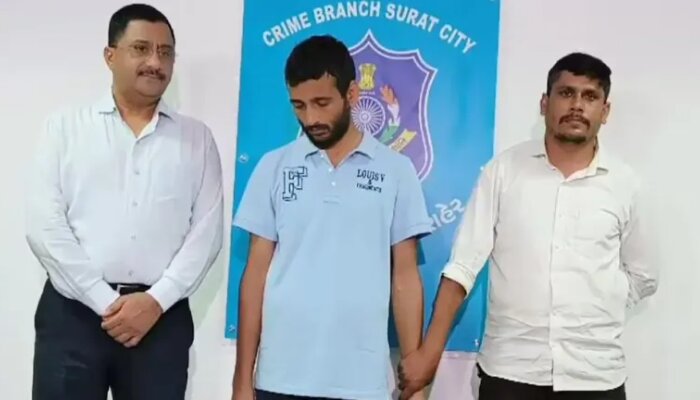
Many more terrorists who were living in India and working for Pakistan were apprehended following the interrogation of Maulvi (Islamic scholar/cleric) Sohail Abu Bakar Timol, a terrorist who was recently caught in Surat, Gujarat. Now, one such terrorist by the name of Abu Bakar, who worked as a carpenter, was caught by the Surat Crime Branch in Rajasthan’s Bikaner. The authorities produced him before the court on 23rd May, which led to several shocking revelations. The court has now remanded him for 7 days.

Notably, he was a Hindu named Ashoka but converted to Islam after he met a Pakistani girl on social media who seduced him to change his religion under the pretext of marriage. Afterwards, he came in contact with Maulvi Sohail and started threatening Hindu leaders along with planning attacks on them at the behest of the Pakistani handler. It was further disclosed that the former was luring other Hindu youths to marry Pakistani girls and honey-trapping them. He eventually converted them and also involved them in anti-Hindu activities.

The police investigation has found more than 40 Pakistani numbers from Abu Bakar’s mobile, which he used to threaten Hindu leaders and was in constant contact with his Pakistani handler.

Co-accused arrested from Nepal has dual citizenship

Another man named Mohammad Ali from Muzaffarpur in Bihar was also arrested recently in this case, and many startling disclosures came to light during his interrogation. He was unveiled to be a dual citizen of India and Nepal. He was questioned about the same, and cops even travelled to the neighbouring country for inquiry.

Maulvi Sohail and his followers were using Pakistani numbers to threaten Hindu leaders like Sunil Rajput, Updesh Rana, Ishaan Sharma, Kuldeep Soni, Nupur Sharma and even Shabnam Sheikh, who went to Ayodhya to visit Ram Mandir. The police, in their statement, divulged that they are also looking at the terror funding angle in this matter.

Gujarat Police arrested 27-year-old Maulvi Sohail Abu Bakar Timol from Surat on 4th May. He is accused of conspiring to kill suspended Bharatiya Janata Party spokesperson Nupur Sharma, party MLA from Hyderabad’s Goshamahal T Raja Singh, Sudarshan News editor-in-chief Suresh Chavhanke, and Sanatan Sangh national chairman as well as social media activist Updesh Rana. The Maulvi considered them ‘gustakh’ (blasphemers). He maintained contact with supervisors living in Pakistan and Nepal to execute his nefarious plans. He was also using a foreign SIM card to evade security agencies. Now, further revelations are expected during his interrogation.

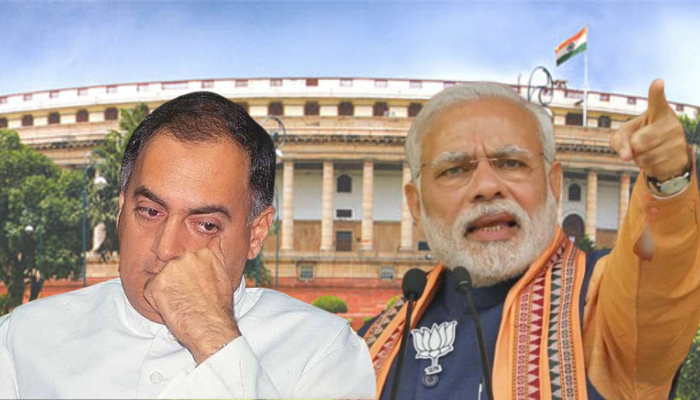
PM Modi’s big reveal on how Congress benefitted from Rajiv Gandhi’s death, how the ECI flouted rules and postponed entire polling process instead of just his seat

On the 23rd of May, Prime Minister Narendra Modi launched a scathing attack on the Congress recalling the 1991 Lok Sabha elections after Congress president Mallikarjun Kharge recently said that the BJP is not providing a “level playing field” in the ongoing Lok Sabha polls. Kharge in a PTI interview asked why opposition leaders including JMM’s Hemant Soren and AAP’s Arvind Kejriwal were arrested during elections. The Congress party recently accused the Election Commission of inclining towards the BJP.

In an interview with IndiaTV, the Prime Minister responded to the Congress party’s allegations pertaining to the “level playing field”. PM Modi while rejecting the allegations recalled the 1991 Lok Sabha elections. PM Modi recalled how the then-Chief Election Commissioner TN Seshan postponed polling across the country for 22 days after Congress leader Rajiv Gandhi was killed in Sriperumbudur on the 21st of May 1991, with only one round of voting conducted. The elections were postponed until mid-June, and voting resumed on 12 and 15 June.

It is notable here that Rajiv Gandhi was not even the PM at that time, but a Congress leader and a candidate for the Lok Sabha elections.

“Was that a level-playing field? Normally, when a candidate dies, the election in his constituency is adjourned and conducted on a later date. However, in 1991, election across the country was postponed, Congress was provided 21-22 days, and polling dates were given only after the funeral of Rajiv Gandhi and his ashes were toured across the country, what level playing field was it? And later he [the then-CEC TN Seshan] fought against [Lal Krishna] Advani ji on a Congress ticket,” PM Modi said.

“You [Congress] are talking about the election commission. And that’s why the justice being done will not seem a level playing field to Congress since they have so far taken the benefit of special category and favours…” the Prime Minister added.

How the Election Commission facilitated Congress’s poll campaign after Rajiv Gandhi’s assassination

While the Election Commission of that time should have cancelled the polling on the Amethi seat from where Rajiv Gandhi was contesting, the ECI postponed the elections across the country flouting the rules. Thus, giving ample time to the Congress party to benefit from the sympathy wave across the country.

Such was Congress’s hold on the ‘system’ that the ECI cancelled the Lok Sabha election entirely instead of just in Amethi when Rajiv Gandhi was no longer the Prime Minister. At that time, Gandhi was just a Congress candidate contesting against BJP’s Ravindra Pratap Singh.

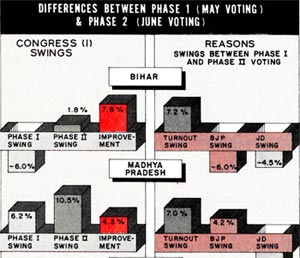
The exit polls of that time also suggest how Rajiv Gandhi’s death generated a sympathy wave in favour of Congress and the postponement of elections by the ECI allowed a window for the party to encash the outpouring of sympathy. Media reports from 1991 show the dramatic surge in voter turnout and swing towards the Congress. 211 seats were polled before Rajiv Gandhi’s assassination and 332 seats after. The Congress(I) lost 5.7% of the vote in the first round of voting in May but gained 1.6% in the second round in June. Conspicuously, the assassination played a significant role in enhancing Congress(I) voter turnout.

Source: IndiaToday

After Rajiv Gandhi’s assassination by LTTE terrorists, Bihar’s 6% swing against the Congress(I) in the first phase turned into a 1.8% swing in its support in the second phase. In Madhya Pradesh, turnout increased from 42% to 49%, and the Congress(I) gained more than 4%. Rajasthan had the most dramatic shift in Congress(I) fortunes between the two rounds of voting. From a minor 2% swing in its favour, the Congress(I) saw a tremendous 14% swing in the June round.

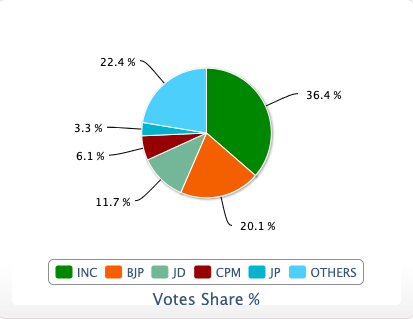
The Congress with its allies won 256 seats with 38.1% of the vote, followed by the Third Front with 133 seats (27.1%). The BJP and its allies with 124 seats (20.9%). Congress received the highest 36.4% vote share followed by BJP, Janata Dal, CPM, and so on.

Partywise vote share percentage in 1991 Lok Sabha elections (Source: IndiaVotes)

CEC TN Sheshan and Rajiv Gandhi

It is pertinent to note that the then-Chief Election Commissioner TN Seshan was very close to Rajiv Gandhi. In his autobiography “Through the Broken Glass” Seshan talked about having been friends with Rajiv Gandhi. He had even advised Rajiv Gandhi to include former PMs and their families as protectees when the SPG Act (1988-89) was being drafted. Later, in 1999, TN Seshan contested on a Congress ticket against BJP veteran Lal Krishna Advani from the Gandhinagar seat and lost.

The Congress party is now lamenting about “level playing field”, just because it is not them “controlling” the playing field anymore. While complaining about the arrest of Hemant Soren and Arvind Kejriwal, who are out on bail for the election campaign, it should reflect on its own past conduct when the Gandhi family and the Congress party used the ‘system’ in their favour at their whims. While the Congress is accusing the ECI now of “not fulfilling its constitutional duty, was it ECI’s constitutional duty to countermand elections across the country instead of doing the same on just Amethi seat after Rajiv Gandhi’s killing?

PM when asked about the timing of the arrest and subsequent incarceration of Hemant Soren arrested in connection to an alleged land scam and Arvind Kejriwal who was arrested over his alleged role in the Delhi liquor scam, said that the two opposition leaders were sent to jail by courts. “We did not send them to jail. The courts sent the two chief ministers to jail. We do not have the power to send someone to jail or keep anybody in jail. Only courts have the powers. Look at what the Supreme Court said,” PM Modi said.

Notably, On 22nd May, the Supreme Court refused to entertain Soren’s plea challenging his arrest saying that Soren was pursuing parallel remedies by submitting this bail application while also appealing the HC ruling on the legal validity of the arrest.

Interestingly, much like the EVM-VVPAT blame game, the  Congress party’s attacks on the Election Commission accusing it of being biased only reflects the party’s frustration and fear of failing to defeat the BJP-led NDA.

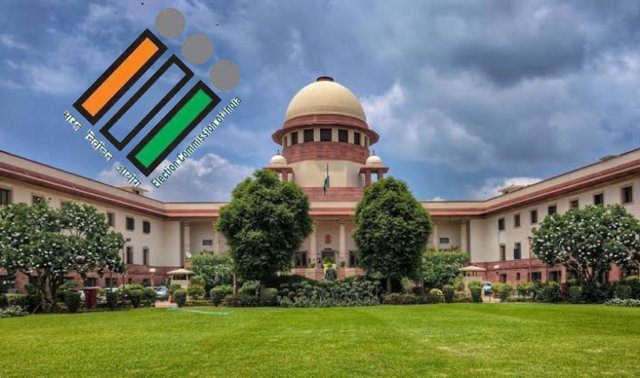
SC refuses to consider a plea directing ECI to publish information on the total votes polled per booth

On Friday, the Supreme Court declined to issue any interim order on a plea by the NGO Association for Democratic Reforms (ADR). The plea sought directives for the Election Commission of India (ECI) to release final authenticated data on voter turnout at all polling stations, including the number of votes cast in the 2024 Lok Sabha Elections, within 48 hours of polling.

A Vacation Bench consisting of Justices Dipankar Datta and Satish Chandra Sharma pointed out that the interim request in the current plea mirrored a request already made in a main petition pending since 2019.

“Compare prayer B of the 2019 plea with prayer A of the 2024 interim application. Previous Supreme Court decisions indicate this cannot be done, with one 1985 judgment stating it can only be done in exceptional cases. Why was this application not filed on March 16?” the Court queried.

Senior Advocate Dushyant Dave, representing ADR, responded, “We could only file after disclosures by the ECI.”

At the outset, Singh, appearing for ECI, challenged the validity of the petition filed by ADR, arguing that the issues had already been addressed in the EVM-VVPAT case judgment. Contradicting this, Dave argued that the EVM-VVPAT case dealt with post-counting issues, whereas the current petition concerns pre-counting matters.

Singh claimed that ADR’s petition was based on “unfounded suspicions” and “false allegations.” He noted that the petition, filed on May 9, did not mention the EVM-VVPAT case judgment from April 26. Referring to Article 329 of the Constitution, Singh asserted that it prevents judicial interference during the election process.

Singh also explained that the figures in the Voter Turnout App are provisional and based on secondary sources. He disputed ADR’s claim of a 6% discrepancy between the final data and the published figures, stating that the actual variance is only 1-2%.

Highlighting that the Supreme Court had questioned ADR’s credibility in the VVPAT case, Singh argued that the current petition, filed on the same day as the adverse judgment, deliberately suppressed this judgment. Singh further claimed that such petitions undermine voter turnout by continuously questioning the electoral process.

The Court, consequently, refused to grant interim relief, emphasizing the need for a non-interventionist stance during ongoing elections. “As responsible citizens, we must maintain a hands-off approach,” the bench noted.

Consequently, the Court ordered that the matter be scheduled for after the ongoing Lok Sabha elections. “Prima facie, we are not inclined to grant interim relief as prayer A of the 2019 petition is similar to prayer B of the 2024 application. List the interim plea after the summer vacation,” the Court stated.

The Court clarified that no opinion was expressed on the merits, apart from the prima facie view.

On Friday, the Supreme Court declined to issue any interim order on a plea by the NGO Association for Democratic Reforms (ADR). The plea sought directives for the Election Commission of India (ECI) to release final authenticated data on voter turnout at all polling stations, including the number of votes cast in the 2024 Lok Sabha Elections, within 48 hours of polling.

A Vacation Bench consisting of Justices Dipankar Datta and Satish Chandra Sharma pointed out that the interim request in the current plea mirrored a request already made in a main petition pending since 2019.

“Compare prayer B of the 2019 plea with prayer A of the 2024 interim application. Previous Supreme Court decisions clearly indicate this cannot be done, with one 1985 judgment stating it can only be done in exceptional cases. Why was this application not filed on March 16?” the Court queried.

Senior Advocate Dushyant Dave, representing ADR, responded, “We could only file after disclosures by the ECI.”

The Court, however, refused to grant interim relief, emphasizing the need for a non-interventionist stance during ongoing elections. “As responsible citizens, we must maintain a hands-off approach,” the bench noted.

Consequently, the Court ordered that the matter be scheduled for after the ongoing Lok Sabha elections. “Prima facie, we are not inclined to grant interim relief as prayer A of the 2019 petition is similar to prayer B of the 2024 application. List the interim plea after the summer vacation,” the Court stated.

The Court clarified that no opinion was expressed on the merits, apart from the prima facie view.

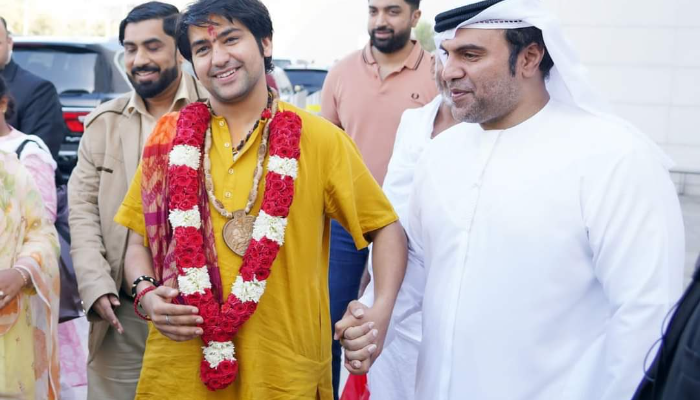
Honoured to receive Guruji in Dubai: Emirati businessman Dr Bu Abdullah invites Dhirendra Krishna Shastri of Bageshwar Dham Sarkar for a Satsang

A well-known businessman in Dubai named Dr Bu Abdullah of Bu Abdullah Group of Companies, which includes Real Estate, Legal Firm and Business Consultancy, has historically been inviting and meeting with prominent Hindu gurus, preachers and actors to Dubai. Now he has invited “Bageshwar Dham Sarkar” fame Dhirendra Krishna Shastri to organise a ‘satsang’ (Devotional programme) for the Hindus residing in the cosmopolitan city.

The businessman also tweeted a welcome message for the religious guru and wrote, “Dr Bu Abdullah was honoured to receive Guruji Dhirendra Krishna Shastri (Bageshwar Dham Sarkar) in Dubai. His presence is a special occasion that celebrates cultural connections and spiritual unity between India and the UAE (United Arab Emirates).” Devotees can also be seen touching his feet and taking his blessings in the video.

The two-day event is being held on 24 and 25 May as part of a large cultural celebration of spiritual discussions which will take place at the World Trade Center in Dubai.

Dhirendra Krishna Shastri also showered praise on the beauty, architecture and multiculturalism of Dubai. He stated, “I have reached Dubai. It is a wonderful place and has amazing natural beauty. The people here are also very polite, and it is a very safe place. The inherent respect for all cultures and beliefs is another incredible aspect of this place. This is a huge thing and they have a big and open heart. I will pray to Lord Hanuman for this country to prosper, become more prominent in the world and live in peace.”

The official handle of “Bageshwar Dham Sarkar” also gave information about the spiritual leader’s visit to Dubai and conveyed, “His two-day satsang program is going to be held on 24-25 May at the World Trade Center in Dubai. Please do not give in to anyone who approaches you requesting money or other assistance in the hopes of meeting him or receiving his blessings. It costs nothing to meet him to acquire his blessings.”

Pandit Dhirendra Krishna Shastri who was born as Dhirendra Krishna Garg is popularly known as Bageshwar Dham Sarkar or Maharaj among his followers. He is a Hindu Spiritual Guru and the peethadheeshwar (supreme pontiff or the head of a Hindu monastery or matha) of the Bageshwar Dham Sarkar, a religious Hindu pilgrimage site in Chhatarpur district of Madhya Pradesh.

Dr.Bu Abdullah is an Emirati businessman who owns Bu Abdullah Real Estate, Bu Abdullah Business Consultancy, Bu Abdullah Investments and other ventures. He is known for his humanitarian works, and was widely recognised for the work he did during the Covid-19 pandemic.