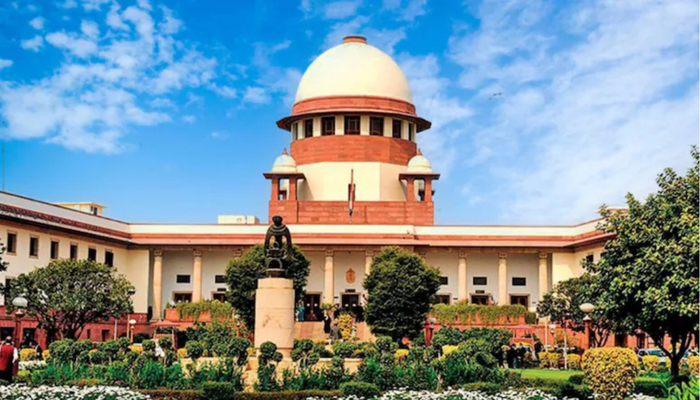
A court in the Bahraich district of Uttar Pradesh has delivered its verdict in the October 2024 communal violence case, handing out strict punishment to those found guilty. The court awarded the death penalty to the main accused, Sarfaraz alias Rinku, while nine others were sentenced to life imprisonment for their role in the riots and the murder of Ram Gopal Mishra.
The verdict was pronounced on Thursday, 11th December 2025, nearly 14 months after the incident, which had shaken the region during Durga Puja celebrations.
“Justice was possible only because of this government,” says the victim’s brother
Reacting to the court’s decision, Harimilan Mishra, brother of the deceased Ram Gopal Mishra, expressed satisfaction with the verdict and openly thanked the Yogi Adityanath-led BJP government for ensuring justice.
Speaking to OpIndia, Harimilan said the punishment was possible only because of the strong legal push by the present government. He claimed that under a Samajwadi Party government, the outcome would have been very different.
“If there were no Yogi government, this punishment would not have been possible. If it were an SP government, we Hindus would have been the ones sent to jail,” he said, speaking in Awadhi (उन्होंने अवधी में बोलते हुए कहा, “योगी सरकार न होत भाजपा कै, तो इहो सजा कहाँ होई पावत। सपा के सरकार होत तो उल्टा हमहै सब बंद होए जात।”).
He added that instead of justice, the victims would have faced harassment and legal action if a different political dispensation were in power.
Brutality of the crime still haunts the family
Harimilan Mishra also spoke about the brutal condition in which his brother’s body was found. He recalled that even after the post-mortem, blood was still oozing from Ram Gopal’s toes. His nails had been ripped out, pointing to extreme torture.
He said these details were not just personal memories but were also clearly mentioned in the charge sheet and the court’s judgment, underlining the seriousness of the crime.
Convictions and acquittals
The court held 10 people guilty in the case. Apart from Sarfaraz alias Rinku, who was awarded the death penalty for murdering Ram Gopal Mishra, nine others received life imprisonment.
Those sentenced to life include Abdul Hamid (Sarfaraz’s father), his brothers Fahim and Talib alias Sablu, along with Saif, Javed, Zeeshan, Nankau, Shoaib, and Maruf.
However, the court acquitted three accused, Khursheed, Shakeel, and Afzal, citing a lack of sufficient evidence. Harimilan Mishra expressed concern over their acquittal, saying it could create problems in the future and questioning how they were let off.
What happened on 13th October, 2024
The violence broke out on 13th October, 2024, in Rehua Mansoor village of Bahraich during Durga Puja idol immersion. According to the case details, a dispute started after some local Muslims objected to songs being played during the procession.
The argument quickly escalated into large-scale violence. Stones were pelted at Hindu devotees, leaving several people injured. Idols being taken for immersion were also damaged during the attack. In retaliation, there was vandalism of nearby houses and shops.
Murder of Ram Gopal Mishra
During the chaos, Ram Gopal Mishra was accused by the mob of climbing onto a roof and removing a green flag. Following this, Sarfaraz alias Rinku shot him dead.
The killing became the most serious outcome of the riots and led to widespread outrage.
Following the incident, police registered 13 FIRs, 11 at Hardi police station and two at Ramgaon police station. After the investigation, 13 people were named as accused.
Initially, five accused were booked under the National Security Act (NSA), including Sarfaraz, Abdul Hamid, Talib alias Sablu, Shakeel alias Bablu, and Khursheed. Later, the NSA was also imposed on the remaining accused.
The court’s verdict has now brought legal closure to one of the most sensitive communal violence cases in recent years in Uttar Pradesh, even as the acquittal of three accused continues to raise questions for the victim’s family.
Hearing a Special Leave Petition filed by the Central Bureau of Investigation (CBI) against the Calcutta High Court’s order granting bail to the accused in the 2010 Jnaneshwari Express derailment case, the Supreme Court, on Thursday (11th December), held that the national interest lies above personal liberty.
A bench of Justices Sanjay Karol and NK Singh criticised the Calcutta High Court for granting bail to the accused and said that “acts of barbarity cannot be excused”. “…the rights of an individual are always subservient to the nation’s interest, the High Court fell in error in granting bail,” the court noted in the judgment. “While the Constitution permits the members of the public, be it whichever group/section of society they belong to, to oppose, within the permits of the law, a stand taken by the State, such acts of barbarity cannot be excused,” it added.
The Court, however, refused to interfere with the order of the High Court and did not reverse the bail granted to the accused. It quoted the painfully slow pace of the trial and the years spent by the accused in jail as the reason for not reversing the High Court’s order.
“…It is a matter of record that an earlier application for bail, about a decade ago in the year 2016, had been rejected with the High Court recording that examination of the remaining witnesses should be completed within a year. If in 2022, the Court finds that despite such direction and also the passage of nearly six years, the same could not be achieved, it cannot be said to have not considered the case in its proper light,” the apex court said.
“…The trial being at an advanced stage is also not something that can be, in this case, a ground to send the respondent-accused behind bars. The trial is of the year 2010, and as we stand at the end of 2025, still 28 witnesses are to be examined. We may note that the glacial pace at which the trial has proceeded cannot justify the incarceration of the accused, particularly when they have already been in prison for a dozen years, and once out, have not given the authorities reason to seek urgent cancellation, or even stay on the impugned judgment when this Court issued notice, or even anytime thereafter,” the Court stated.
“…This Court does not interfere against the grant of bail unless circumstances warranting such an exercise of power are plainly present in a given set of circumstances,” it adding “interfering with the liberty of the accused, at this stage, particularly when nothing else holds against them, would not be justified”.
On November 9, 2022, the Calcutta High Court granted bail to one of the accused in the Jnaneshwari Express derailment case. Subsequently, on February 28, 2023, the High Court released eleven accused on bail, followed by the release of another accused on bail on June 13, 2023. The CBI approached the Supreme Court against the judgments/orders of the High Court.
Background of the case
In a horrific incident on May 28, 2010, the Jnaneshwari Express, passing between Kehmasoli and Sardiha stations on the Kharagpur-Tatanagar section of the Kharagpur division, had a head-on collision with a goods train. The incident turned out to be a well-thought-out conspiracy in which the accused damaged the rail tracks near Rajabandh to cause the accident. The conspiracy was carried out on the intervening night of 27th -28th May 2010 by the accused persons.
“The pandral clips of the railway tracks were removed, with the knowledge and intention that grievous hurt would be caused to the passengers of a train. This action caused the derailment of the train, which thereafter collided with an oncoming goods train from the opposite direction, causing widespread loss of life,” as stated in the Supreme Court judgment. In addition to that, a loss of 25 crores approx was caused to the Government due to the destruction of property.
An FIR was registered on June 9, 2010, against unidentified persons under Sections 120B, 302, 307, 323, 325, 326, 440, 212 of the Indian Penal Code,1860, Sections 150/151 of the Indian Railways Act, 1989, and Sections 16/18 of the Unlawful Activities (Prevention) Act, 1967. During the investigation of the case, the motive behind the crime was found to be the resentment among the Maoist cadres due to the deployment of a joint force of State Police and Central Paramilitary Force in the jurisdiction of Jhargram Police Station to combat the capture of Rasua village by the Maoists. The accused worked with the common intention and hatched a conspiracy to pressure the Government to withdraw the Joint Forces from the Jhargram Police Station area and create terror.
Directions given by the Supreme Court relating to the delay in the trial
Even though the Supreme Court refused to reverse the bail order of the Calcutta High Court, it issued a set of directions to the trial court to speed up the trial of the case. It directed the trial court to record the status and reasons in an order for the trial that had remained pending for so many years.
It further asked the trial court to conduct a day-to-day hearing of the case and grant adjournments only in exceptional circumstances. The Court directed the Administrative Judge of the High Court nominated by the Chief Justice of the Calcutta High Court to seek a report from the Trial judge every four weeks to ensure compliance with its directions.
Referring to the Crimes in India Report, 2023, published by the National Crimes Records Bureau, the Supreme Court highlighted that the total number of cases pending for investigation in 2023 under the UAPA was 394919 and 479420, respectively. The Court instructed the State Legal Services Authority to take steps to inform undertrials of their right to representation, either by counsel of their own choice or through a legal aid counsel.
In addition to that, it directed the Chief Justices of all the High Courts to examine the number of cases pending within their States under laws such as the UAPA. It further directed the Chief Justices to ascertain the number of special courts/ sessions courts dealing with such offences, and see if there is any shortage of courts, judges, and public prosecutors in such cases, to eliminate the reasons for delay.
Manusmriti has a complex role in Indian legal thought. In contrast to the Constitution, statutes, and legally binding precedent, it is not a source of enforceable law for constitutional courts. However, because Indian courts frequently discuss the nation’s social history, the development of personal laws, and the moral language that society uses to interpret justice, it still appears in judicial speech. Because of this, Manusmriti is occasionally cited not to “apply” its regulations but rather to highlight more traditional normative concepts, contrast tradition with contemporary constitutional obligations, or uphold moral standards, particularly in situations pertaining to social reform, women’s dignity, and family relationships.
In two parts, we look at this limited but recurrent “relevance.” Dr. B. R. Ambedkar’s interaction with Manusmriti is briefly discussed in the first section. Although Ambedkar is renowned for criticising Manusmriti as a representation of caste oppression and graded inequality, his continued involvement with it also shows why historical texts and constitutional authority must be kept distinct in constitutional democracies. The second section focuses on published Supreme Court and High Court rulings where justices have cited Manusmriti, replicating the verses as they appear in the rulings and outlining the rationale for the quotations. The main contention is that Manusmriti serves only as an illustrative or rhetorical reference in Indian adjudication, with the decision’s binding authority deriving from established legislation and constitutional principles.
Any study that wishes to demonstrate how “Manu” is still ingrained in Indian legal imagination even in the constitutional era must take into account the fact that Ambedkar’s interaction with Manusmriti was far more complex than the widely held stereotype of an indiscriminate rejection of the entire text. Although he used the dramatic act of burning a copy of the Manusmriti at Mahad in 1927 as a political protest against caste and gender oppression, his sophisticated legal and constitutional work frequently makes a distinction between the text’s objectionable parts and its provisions that could be interpreted as supporting equality and women’s rights, which he occasionally purposefully invoked. Thus, although rejecting birth-based hierarchy as unconstitutional, the same legal culture that Ambedkar transformed through the Constitution continued to regard Manusmriti and the larger Dharmashastra tradition as historical roots of Hindu law.
Ambedkar’s protest: targeted, not textualist
Ambedkar publicly burned a copy of the Manusmriti in Mahad in 1927 as a moral and political protest against the religious justification for caste inequality and untouchability. Instead of framing the event now known as Manusmriti Dahan Diwas as a philological judgment on every line of the book, Ambedkar specifically framed it as a strike against those particular laws in the text that denied Dalits access to water, temples, education, and dignity. Ambedkar’s response to critics who mocked the act by claiming that Manusmriti was already “outdated” was telling if the text was socially dead, its supporters should not be disturbed by its symbolic burning. This indicates that his target was not a thorough theological exegesis of the entire work, but rather the still-living caste ideology that was drawn from specific passages of Manu.
Ambedkar’s doctrinal critique: specific provisions
Ambedkar’s criticism of Manusmriti in his later academic and political works regularly focuses on specific doctrinal clusters, the systematic subjugation of women, the immutability of varna by birth, and caste-specific punishments. For instance, he objects to verses that forbid interdining and intermarriage, place women under lifelong male supervision, and impose mutilatory punishments on Shudras who hear or recite the Veda. He interprets these passages as the canonical justification for untouchability and patriarchy. However, contemporary analyses of his writings reveal that Ambedkar did not downplay the text’s historical complexity and was well aware that legal tradition frequently reinterpreted or softened harsh provisions. This further suggests that Ambedkar’s disagreement was with the oppressive strands that were accepted as normative rather than with all of Manu’s ideas or norms.
Ambedkar citing Manu in reform debates
The Hindu Code Bill discussions provide the most convincing proof that Ambedkar did not view Manusmriti as a monolithic enemy, since he occasionally cited Manu to support progressive reforms, particularly those pertaining to women’s inheritance. According to archival reconstructions of those discussions, Ambedkar used these readings strategically to convince conservative members that his ideas were not completely out of step with the Shastric tradition by pointing out that Manu could be interpreted to recognize certain proprietary rights of women. If one assumes that Ambedkar’s position was an unqualified denunciation of the entire text, then this legislative strategy that criticizes oppressive verses while invoking more egalitarian strands makes little sense. Rather, it represents a jurist engaging critically with an inherited source of Hindu law, drawing arguments for equality from within while demolishing its casteist core.
Manu within Hindu Law tradition
Manusmriti was a foundational Dharmashastra for pre-modern and colonial jurists, but it was never the only or final word. Later commentators such as Vijnaneshwara (Mitakshara) and Jimutavahana (Dayabhaga) mediated it, adopting and modifying Manu’s rules on subjects like inheritance and joint families. According to contemporary doctrinal accounts, the Dharmashastra corpus, which includes Manu, Yajnavalkya, and others, is the ultimate source of both major schools of Hindu law, Mitakshara, which spread throughout most of India, and Dayabhaga in Bengal. This means that Manu’s categories, concepts, and terminology were carried over into the classical law that colonial courts subsequently treated as “Hindu personal law.” Therefore, even before to independence, Indian courts applied a juristically filtered Manu rooted in commentarial traditions that adapted his rules to local and temporal settings rather than applying “Manusmriti” in its entirety.
Manu’s juristic legacy in codified Hindu Law
Even though the codified Hindu law statutes of the 1950s and later on guardianship, succession, marriage, and minority were specifically written to overturn numerous injustices that can be linked to the Manusmriti and later Dharmashastras, they nevertheless maintain a number of legal categories and presumptions influenced by this tradition. Despite being redefined and trimmed by legislation and case law, concepts like coparcenary, joint family property, sapinda relationships, and ritual proximity are historically rooted in Manu-centered Dharmashastra discourse, and courts continue to interpret them using classical commentaries that heavily reference Manusmriti.
As the Law Minister spearheading these reforms, Ambedkar recognised this continuity. By enacting legislation to change Hindu law, he made sure that the aspects of Manu that went against constitutional equality were eliminated while the structural ideas that allowed for the maintenance of orderly family, property, and duty relationships within a democratic, secular framework could be preserved.
How Indian courts have actually used Manusmriti
Manusmriti is not a legally binding source in contemporary Indian law; instead, courts base their decisions on the Constitution, statutes, and precedents. However, courts may use ancient writings, such as Manusmriti, as cultural ethical examples to highlight principles like equality, decency, and women’s protection. The court is employing a well-known passage as a moral reminder when enforcing constitutional or statutory duties (dowry law, women’s safety, victim compensation, PCPNDT enforcement, etc.) in the majority of recorded “Manusmriti citations,” rather than “applying” Manusmriti as law.
Supreme Court using Manusmriti
Up to 2019, the Supreme Court has directly quoted or cited Manusmriti in seven published judgments, frequently in Hindu personal law, interpretive theory, or rights-related matters, according to survey study based on SCC Online and Indiankanoon. Vimla Bai v. Hiralal Gupta is one early example found by this research, in which the Court addressed the idea of “bandhava” (kinsman) in Hindu inheritance and mentioned Manusmriti as one of the classical dharmashastric sources influencing Mitakshara doctrine, even though the judgment does not include lengthy Sanskrit passages. Later, in Vijay Narayan Thatte v. State of Maharashtra, the Court again relied more on the conceptual framework than on duplicating specific verses, citing Mimamsa interpretation principles and mentioning Manusmriti as part of the shastric foundation.
The Supreme Court’s 2025 ruling, which maintained a father’s conviction for raping his minor daughter under the POCSO Act and cited Manusmriti to bolster its condemnation of incestuous sexual abuse, is the most notable contemporary example. In order to support their claim that granting bail would violate the constitutional promise of justice to every child, the Bench of Justices Aravind Kumar and Sandeep Mehta cited a verse that highlights the honor and importance of women in the home and society. They noted that this sentiment now aligns with the “constitutional vision” of non-negotiable dignity for women and children. In scholarly writing, you can describe this as “a verse from Manusmriti extolling the protection and honor owed to women in the family,” reference the case and the report, and then explain how the Court transformed a cultural cliché into a constitutional principle that upholds women’s rights without having to quote the original verse.
The position of personal law and dharmashastra sources following the Constitution is another significant area of Supreme Court doctrine that indirectly supports Manu’s legal significance. The Court emphasized in Sri Krishna Singh v. Mathura Ahir (AIR 1980 SC 707) that judges must apply “recognised and authoritative sources,” such as Smritis and commentaries, in matters of Hindu personal law unless they are modified by statute or custom. This keeps Manusmriti within the recognised canon of sources, even if the judgment does not quote any specific shloka. This method is essential to your research argument because it demonstrates how the highest court views Manu and other Smritis as part of the legal lineage that continues to influence uncodified portions of Hindu law, always subject to statutory override and constitutional review.
High Court using Manusmriti
When it comes to maintenance responsibilities in Hindu joint families, High Courts have been more inclined than the Supreme Court to replicate or at least closely paraphrase certain phrases from the Manusmriti. The Delhi High Court used a verse from Chapter 9 (often cited as 9.108) that establishes the karta of a Mitakshara joint family’s obligation to support all dependent members, including wives and children, as historical support for the contemporary legal duty of family maintenance in two Narang v. Narang rulings, according to the “Manusmriti and the Judiciary” study.
The 2024 Jharkhand High Court ruling on a maintenance dispute, in which Justice Subhash Chand cited Manusmriti to determine a wife’s entitlement to support, is a more recent and contentious example. According to media reports and summaries, the court framed the ideal Hindu view of women’s role in the home by citing a well known passage that is frequently paraphrased as follows: “where the women of a family are miserable, that family is soon destroyed and the family flourishes where the women are content.” The court then denied the specific wife maintenance based on the facts.
Manusmriti verses have also been used by High Courts to influence the law of spousal and post-marital obligations in various situations. In a case mentioned in the same survey (Das v. Das), the Chhattisgarh High Court read a traditional dharmashastric duty into contemporary matrimonial law by citing an uncited Manu verse regarding a husband’s ongoing duty to his wife. The court held that even in cases where a husband receives a decree for the restoration of conjugal rights, he is still obligated to pay maintenance if she does not return. Manu’s legal categories and moral rhetoric have been selectively re-used by courts to fill statutory gaps and to justify duties consistent with modern understandings of family justice. This type of reasoning where an ostensibly patriarchal text is used to protect a financially vulnerable wife fits the larger thesis.
Court’s treating Manusmriti as ‘holy book’ or ‘scripture’
In addition to direct verse-level quotes, certain High Court rulings have publicly referred to Manusmriti as a “holy book” or “our scriptures,” which is pertinent to the judiciary’s current normative positioning of Manu. The Bench referred to the Manusmriti as a “holy book” while refusing to quash a FIR against a political spokesperson accused of tearing it on live television, according to coverage of an Allahabad High Court case in 2025. This phrase subtly elevates the text’s symbolic status even though the order is basically about criminal procedure and freedom of religion.
Similar to this, women’s organizations and activists criticized Delhi High Court judge Justice Prathiba M. Singh for praising Manusmriti for giving women in Indian scriptures a “respectable position” in an extrajudicial speech at a FICCI event. They pointed out the conflict between this praise and the Constitution’s commitment to equality.
Conclusion
Dr. B.R. Ambedkar’s engagement with the Manusmriti is an example of a selective and principled critique, he acknowledged the text’s wider juristic complexity and possibility for reformist readings while focusing on the sections that solidified gender oppression and caste systems. In the Hindu Code Bill debates, he deliberately invoked egalitarian strands like women’s proprietary rights to advance legislative equality, exhibiting a jurist’s discernment rather than outright rejection. His symbolic burning at Mahad in 1927 protested specific verses sanctioning untouchability and unequal punishments. His constitutional vision is in line with this balanced approach, keep the flexible frameworks for a democratic system while eliminating the oppressive. Manusmriti verses on family maintenance (such as Chapter 9 duties of the karta), women’s household honor, and moral condemnation of incest are cited by Supreme Court and High Court benches to support statutory rights under POCSO or CrPC without endorsing the text’s discriminatory core. This selectivity is echoed in contemporary judicial practice.
After being scrutinized through the Mitakshara and Dayabhaga schools and selectively confirmed after codification, Manusmriti’s persistent presence in Indian adjudication highlights its deeply embedded significance within the Dharmashastra tradition that informs Hindu personal law. Courts use Manu as illustrative moral rhetoric or historical genealogy, always subservient to constitutional supremacy and equality under Articles 14–15, from Sri Krishna Singh v. Mathura Ahir, which affirms Smritis as authoritative sources, to recent Jharkhand and Delhi High Court invocations of verses on spousal duties and women’s “respectable position.” Manu’s evolution from prescriptive code to contested cultural reference is revealed by this critiqued yet operationalized integration, which embodies Ambedkar’s legacy: a legal system that respects indigenous heritage while subjecting it to egalitarian scrutiny, ensuring Manu survives not as sovereign law but as a pruned ancestor in India’s judicial DNA.
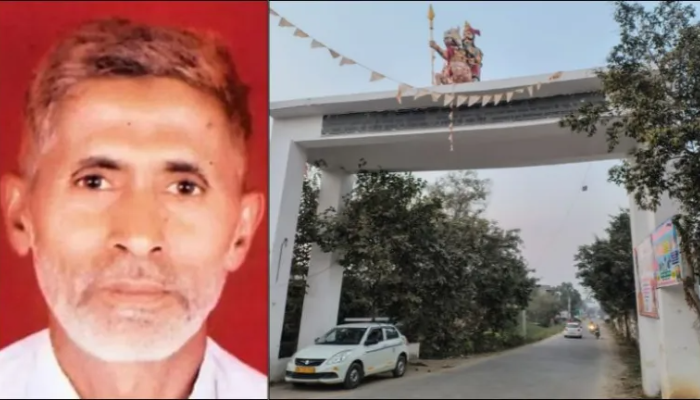
The Bisahda village in Dadri of Uttar Pradesh, has once again captured media attention after Yogi government submitted a petition to the court seeking the withdrawal of cases against all 18 individuals accused in the Akhlaq murder case. The development has instilled a sense of hope in the families of the accused for potential justice. However, the family of Akhlaq has raised concerns regarding the government’s action. On 12th December (Friday), the district court is scheduled to deliberate on the matter of whether all charges against the accused will be dismissed.
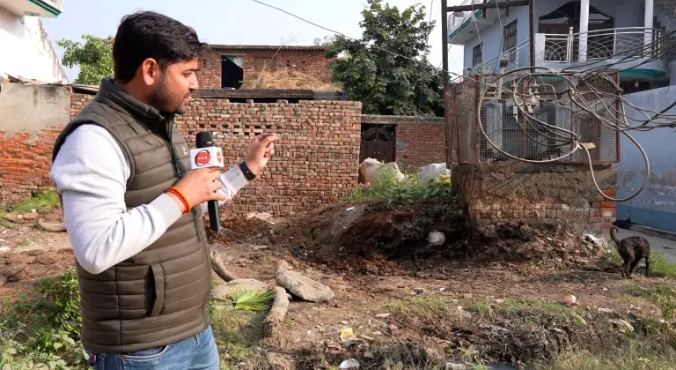
Hence, OpIndia team visited the village which is 50 kilometers from Delhi, a day earlier. Its entrance is marked by a statue of Maharana Pratap and a sign with an image of King Mihir Bhoj welcoming visitors to the “sacred area of Bisahda.” We subsequently arrived at the location where Mohammad Akhlaq had killed the cow and discarded its remnants onto a dung heap by the roadside. However, no one was willing to talk to us. We then proceeded to the residence of Arun Sisodia, a veterinarian situated 50 meters from Akhlaq’s home, who had recognised the remains as those of a cow, drawing upon his expertise.
Sisodia stated that Shivam, a resident of the village, witnessed Akhlaq discarding a polythene bag on the roadside during the night. “Upon inspecting the bag, I discovered the remains (mouth and ears) of a Friesian calf,” Sisodia highlighted. He added, “My sole offense was utilising my 21 years of experience to recognise the parts, a fact that was soon validated by two laboratories.”
Troubled families narrate their ordeal
Sisodia further clarified that the police terrorised the village, unjustly accusing innocent people for political reasons after the incident. “This was a blunder by the Akhilesh government. As a result, I was imprisoned for 23 months. Everything fell apart. I used to make 3-4 thousand rupees each day by treating animals, but my business collapsed after my incarceration. Now, we are left with only one hope: CM Yogi, who we trust can bring us justice,” he mentioned.
Afterward, OpIndia discovered that Bharatiya Janata Party leader Sanjay Rana’s son Vishal Rana, who had been identified as the primary suspect in the case, also departed from the village. The house was locked. The window grills exhibited signs of rust and the ceiling had caved in. The dilapidated place symbolised the anguish of a family in distress. Villagers voiced that Sanjay’s political aspirations effectively ended following the matter.
We then interviewed Yogendra Sharma, the father of Puneet Sharma, who is also implicated in the case. He explained that his home was situated approximately 400 meters from the location of the instance. His son was sleeping on the roof at the time and rushed downstairs after he learnt about the situation. However, bystanders prevented him from approaching the site. Nevertheless, Puneet was booked and spent nearly 17 months behind bars.
According to Yogendra, Akhlaq’s family akin to his, already knew that the young man was not part of the incident, yet he was wrongfully charged due to political rivalry. He added, “At this point, the Yogi government has acknowledged our ordeal and the court is our ultimate hope.”
Media depicted Hindus as terrorists
Former village head Rakesh Rana conveyed that the government has yet to provide any proof regarding who was responsible for Akhlaq’s death. “The accused were named by individuals due to personal oppositions. The Samajwadi Party government saw the incident from a communal viewpoint, siding against the Hindus,” he pointed out.
Rakesh recounted, “The intimidation by that government’s police was such that vegetable vendors refused to enter the hamlet and many people fled out of fear of the cops. At that time, the media portrayed us as terrorists, as if we were oppressing Muslims, while the genuine feelings of the villagers were never represented.”
“Akhlaq’s family has been part of the village for generations. The names of the accused were changed despite this which revealed a profound conspiracy. Our children suffered torture in prison. Ravi’s death in custody was a direct result of this,” he complained. Rakesh noted that the previous governments had retracted cases even against terrorists while these were just innocent individuals concerning the withdrawal of the case.
Sanjeev Rana, living about 150 meters from Akhlaq’s home, stated that the families of all the accused have lost their way. “After Akhlaq’s passing, the SP government was responsible for snuffing the life out of 20 families in the village. They are all like the living dead. The time has now arrived when ruler will battle ruler. The SP government favoured the Muslims, while the Yogi government will ensure justice for us Hindus,” he emphasised.
Akhlaq became a hardliner following his trip to Pakistan
Veterinarian Sisodia, who is also Akhlaq’s neighbour conveyed that Akhlaq’s family was exceptionally kind. He often visited their home and even recalled having a photograph of Akhlaq in his wedding album. He conveyed that Akhlaq’s behaviour transformed after returning from Pakistan and several people associated with Jamaat began visiting his house. Sisodia added that Akhlaq even provided these persons with food and his radicalisation intensified during this period.
Sanjeev mentioned that Akhlaq was a blacksmith. “He was once engaged in a conversation that raised suspicions. When a person expressed concern and asked to see his mobile phone, he refused and instead threw it into a fire furnace. Akhlaq had become more radicalised after interacting with Jamaatis and his growing affection for Pakistan was becoming clear,” Sanjeev remembered.
Hindus repeatedly demonstrated spirit of brotherhood.
Sisodia pointed out that Hindus played a crucial role in preventing the divorce of Akhlaq’s brother Mohammad Afzal’s daughter, Kamar Jahan and they united to support her. Rakesh Rana likewise stated that a sense of brotherhood always existed in the village. He added, “Hindus donated land for the mosque and Eidgah in the village and also contributed to their construction.”
“The two daughters of a destitute Muslim hakim were wed by Hindus in the village, even after Akhlaq’a death,” Rakesh mentioned. He asserted that no untoward event occurred in the village either before or after Akhlaq died. He stated, “The deceased’s siblings did not even sustain a scratch.”
Sanjeev stated that Akhlaq’s family was very close with Hindus but he perpetrated a grave offense that severely damaged the village’s sense of unity.
On 28th September 2015, Akhlaq, who lived in Bisahda village within the Dadri Assembly constituency, slaughtered a cow following Eid. This act incited a furious mob of thousands who forcibly removed Akhlaq and his son Danish from their residence and assaulted them. The injured Akhlaq succumbed to his wounds while receiving medical care at the hospital. The cow slaughter incident was initially regarded as a fabrication, but laboratory tests later verified that the meat disposed of by Akhlaq was, in fact, cow meat.
On the 11th of December 2025, a sessions court in Uttar Pradesh’s Bahraich sentenced Sarfaraz alias Rinku to death in the October 2024 communal violence case, wherein a Hindu youth, Ram Gopal Mishra, was murdered
In this case, 10 people were found guilty by the Additional Sessions Judge (First) Pawan Kumar Sharma. While Sarfaraz has been sentenced to death for shooting Ram Gopal Mishra dead, the nine others have been sentenced to life imprisonment. Sarfaraz’s father, Abdul Hameed, and his two brothers, Faheem and Talib alias Sabloo, are among the convicts. In addition to the death sentence for Sarfaraz and jail term for the other convicts, the court also imposed a fine of Rs 1 lakh each.
Besides Sarfaraz and some of his family members, Saif, Javed, Zeeshan, Nankau, Shoaib, and Maruf have been sentenced to life imprisonment. The court, however, acquitted Khurshid, Shakeel, and Afzal over a lack of sufficient evidence.
सजा-ए-मौत!#बहराइच में प्रतिमा विसर्जन जुलूस के दौरान एक घर से इस्लामिक झंडा उतारने पर रामगोपाल मिश्रा की हत्या की गई थी. आज इस मामले में कोर्ट का फैसला आया है
मुख्यारोपी सरफराज को फांसी, बाकी 9 आरोपियों को उम्रकैद की सजा सुनाई गई है. हत्या के बाद शहर में दंगा, आगजनी हुई थी pic.twitter.com/t8EPzJmEY7
The accused were charged under Section 103(2) of the Criminal Procedure Code (CrPC), apart from sections 191(2), 191(3), 190, 109(2), 249, 61(2), and Section 30 of the Arms Act.
Notably, the convicted persons have the right to appeal, and their appeals can be filed within 30-90 days, seeking commutation or revocation of the sentence. Defence lawyer Mukhtar Alam has said that an appeal against the verdict will be filed.
Meanwhile, Ram Gopal Mishra’s widow, Roli Mishra, has welcomed the verdict and said, “We are satisfied with the court’s decision. The person who shot my husband has been given the death penalty.”
Durga idol immersion and the brutal murder of Ram Gopal Mishra by Islamists
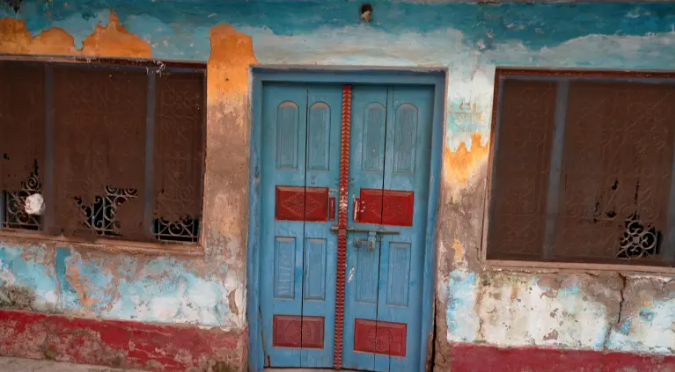
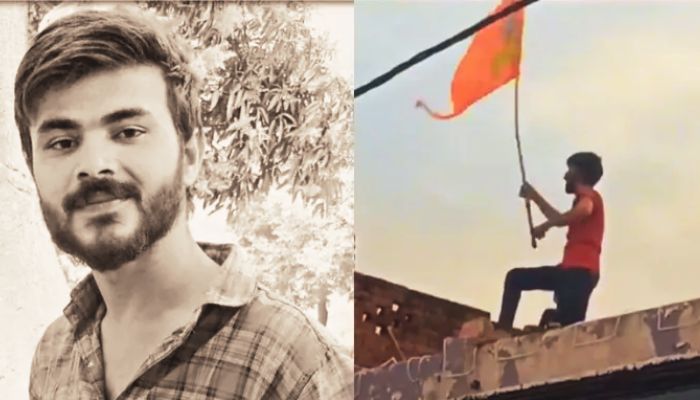
The murder case of Ram Gopal Mishra stems from Islamist mob violence in the Bahraich district of Uttar Pradesh on 13th October 2024, during a Maa Durga idol immersion (visarjan) procession in the Maharajganj market under the Hardi Police Station precinct. A 22-year-old Ram Gopal Mishra, a Rehua Mansoor village resident, was claimed to have climbed onto the roof of one of the convicts in the present case, Abdul Hameed. It was alleged that Mishra removed green ‘Islamic’ flags installed there, replacing them with saffron Hindu flags. Some videos of the incident also surfaced on social media.
It was moments after this incident; Ram Gopal Mishra, who got married just two months before the incident, was brutally assaulted by the convicted Islamists and shot dead by Sarfaraz. Several other Hindu devotees were injured in the stone pelting by the Muslim mob. The Durga puja idols heading for immersion were also damaged in the stone pelting. In retaliatory violence, the Hindus had also vandalised the houses and shops in the area. A total of 13 FIRs were registered in the case, 11 at Hardi police station and two at Ramgaon police station.
Source: Bhaskar, file
It all started when local Muslims protested against the music played in the immersion procession, resulting in a clash. Following an investigation into the incident, the police charged 13 people, including the main accused. Five of these accused were charged under the National Security Act, including Abdul Hameel, Mohammad Talib alias Sablu, Mohammad Sarfaraz Ahmed alias Rinku, Shakeel Ahmed alias Bablu, and Khurshid. The remaining eight were later charged under the NSA.
The next morning (14th October 2024), a crowd carrying the body of the youth killed in the violence was stopped by the police. After the police placated them, the family took the body and went home. However, the crowd became enraged and set fire to a bike showroom and a private hospital.
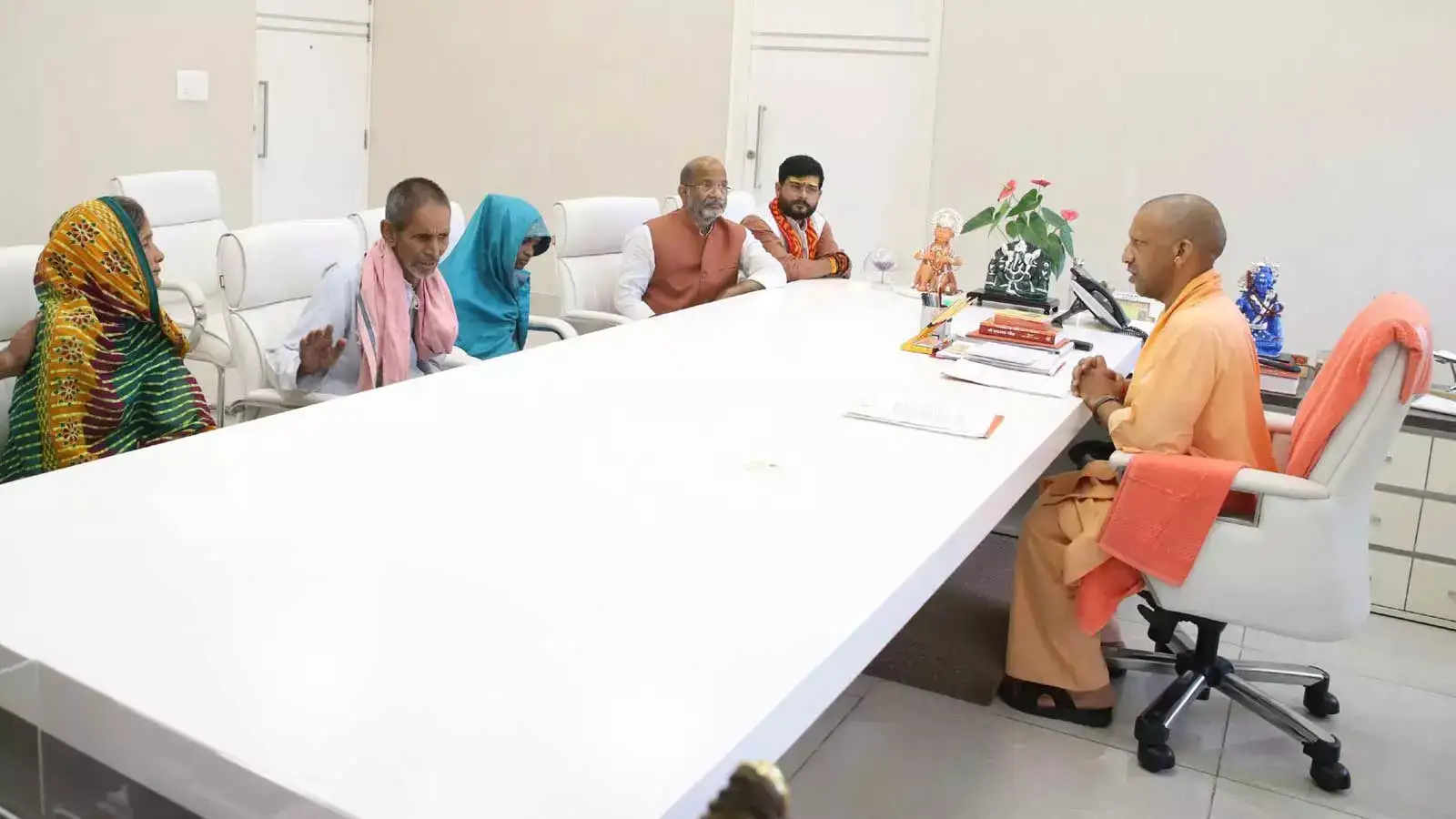
In the aftermath of the Islamist mob violence, internet services were temporarily suspended, and large police forces were deployed. Later, Chief Minister Yogi Adityanath met the deceased victim’s family, assuring justice, financial aid and a government job for Ram Gopal Mishra’s widow, Roli Mishra.
Source: NBT
After the dust settled, the government initiated bulldozer action against illegal constructions belonging to the accused killers of Ram Gopal Mishra.
The deceased victim’s family had, back then, alleged that Ram Gopal Mishra would not have been killed had police not resorted to a lathi-charge against the Hindus, which created chaos, and people started fleeing everywhere. The Islamist perpetrators reportedly exploited the chaos and dragged Ram Gopal Mishra into a house, where he was assaulted and shot dead by Sarfaraz.
How Islamists and media tried to whitewash and justify the brutal murder
OpIndia had reported about the alleged Nepal madarsa connection of the convict Abdul Hameed. It was reported that Hamed has connections to anti-India elements in Nepal and visits a madrasa near Fultekra in the Banke district of Nepal. It is said to be a hub of anti-India and anti-Hindu activities.
It was reported how the Islamo-leftist media had tried to rationalise Ram Gopal Mishra’s brutal killing. Newslaundry, a leftist propaganda outlet, had tried to suggest that since the Hindu procession reportedly played “Tel laga lo Dabur ka naam mita do Babur ka” song on DJ, it ‘offended’ the Muslims and thus the brutality inflicted by them on the Hindu youth is justified. It was reported by locals that the Hindu procession also played songs mocking Pakistan, which also allegedly offended the Islamists.
Islamists widely circulated the propaganda ground report video by Newslaundry online to establish that since Hindus played an ‘offensive’ song, Muslims grew infuriated and thus unrest erupted.
What the court said in its order sentencing the killers of Ram Gopal Mishra, and how the mere mention of a Manusmriti shloka is being used to create confusion
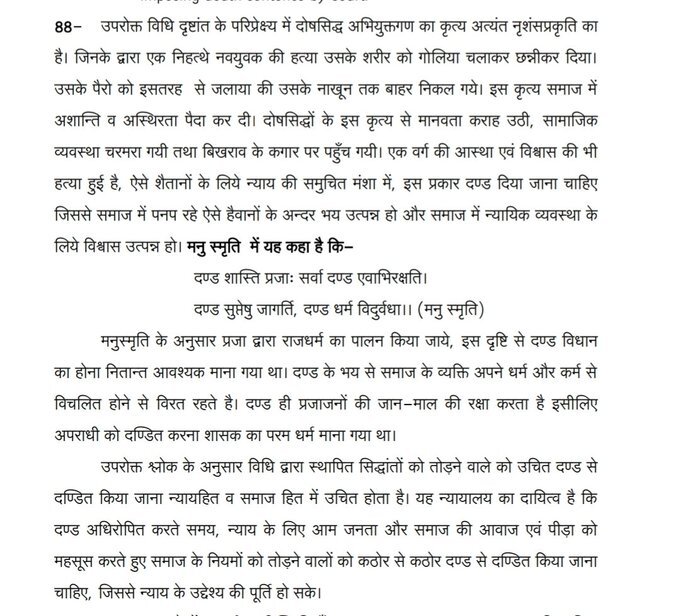
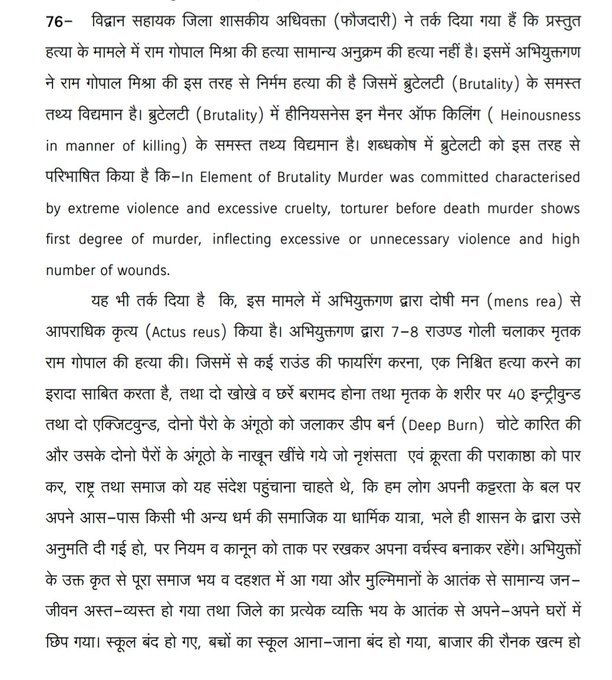
In the order dated 11th December 2025, ASJ Pawan Kumar said that the act committed against Ram Gopal Mishra by the convicted persons was “extremely heinous in nature. The judge noted that Mishra’s body was riddled with bullets, and his one leg was burnt in such a manner that even his nails came off. He emphasised that the cruelty inflicted by the convicts shook humanity, and they deserve appropriate punishment.
“… the act committed by the convicted accused is of an extremely heinous nature. They brutally killed an unarmed young man, riddling his body with bullets. His legs were burned so severely that even his nails came off. This act created unrest and instability in society. The cruelty displayed by the convicts shook humanity, disrupted the social order, and pushed it to the brink of collapse. For such perpetrators, the true intent of justice requires that punishment be awarded in a manner that instils fear in those who harbour similar tendencies and reinforces public confidence in the judicial system”.
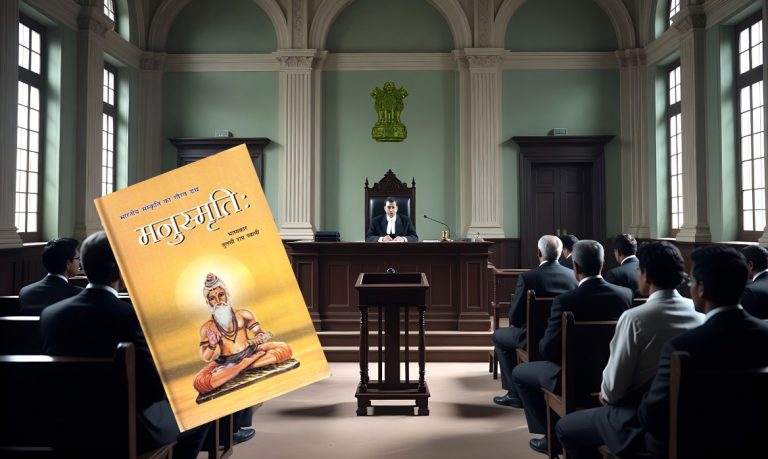
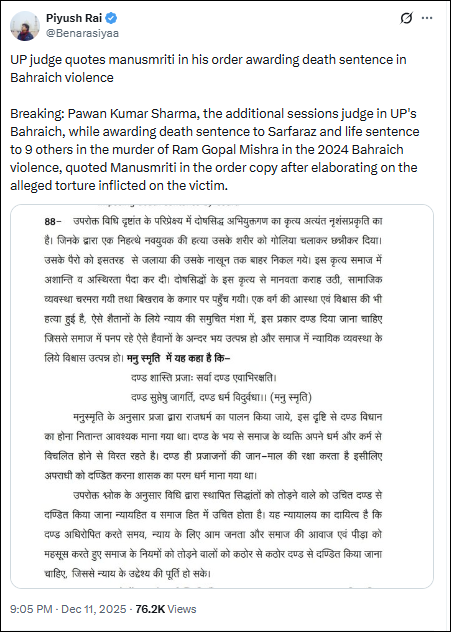
ASJ Pawan Kumar also cited a shloka from the Manusmriti to emphasise the imperative to punish those who violate the law.
The shloka cited by the judge is, “Danḍa śāsti prajāḥ sarvā, danḍa evābhirakṣati. Danḍa supṭeṣu jāgarti, danḍa dharm avidurvaḍhā.”
“According to Manusmriti, penal laws were considered essential to ensure that the people followed the duty of the state (Rajdharma). The fear of punishment kept society from deviating from its duties and responsibilities. Punishment alone protected the lives and property of its citizens, and therefore, punishing criminals was considered the ultimate duty of the ruler,” the court order reads.
“…it is appropriate in the interests of justice and society to punish those who violate the principles established by law with appropriate punishment. It is the court’s responsibility to impose penalties, heeding the cries and anguish of the public and society for justice, and to punish those who violate societal rules with the harshest possible punishment, so that the purpose of justice can be achieved,” it adds.
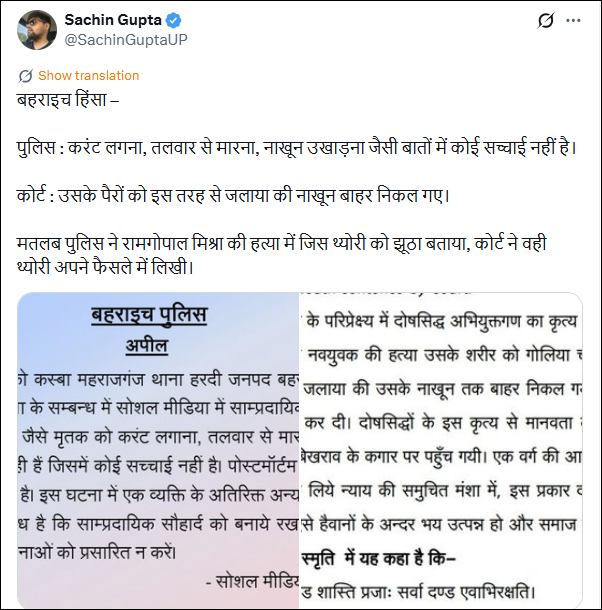
Notably, the court’s observation that Mishra’s feet were burned in such a way that the nails came out is being widely cited by many to suggest that while the Bahraich Police had refuted the claims of Mishra being subjected to torture before killing, the court has accepted the same ‘theory’.
Journalist Sachin Gupta wrote, “Bahraich Violence – Police: There is no truth to claims like being electrocuted, beaten with a sword, or nails being pulled out. Court: His feet were burned in such a way that the nails came out. Meaning: The theory that the police called false in the murder of Ramgopal Mishra was the same theory that the court wrote in its judgment.”
However, the above post fails to mention that the court has not mentioned the claims of electrocution and sword attack at all. Also, “nails were pulled” is not the same as “toes were burned so badly that nails came out”.
Piyush Rai wrote, “UP judge quotes the Manusmriti in his order awarding death sentence in Bahraich violence. Breaking: Pawan Kumar Sharma, the additional sessions judge in UP’s Bahraich, while awarding death sentence to Sarfaraz and life sentence to 9 others in the murder of Ram Gopal Mishra in the 2024 Bahraich violence, quoted Manusmriti in the order copy after elaborating on the alleged torture inflicted on the victim.”
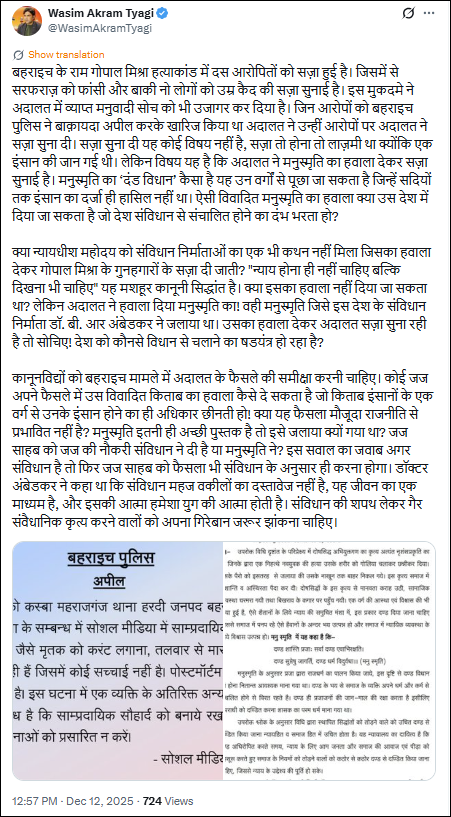
Meanwhile, Wasim Akram Tyagi, an Islamist notorious for peddling fake Muslim victimhood narratives, expressed displeasure over the judge citing a shloka from the Manusmriti. “Did the honourable judge not find even a single statement from the framers of the Constitution to cite while sentencing Gopal Mishra’s culprits?” he lamented.
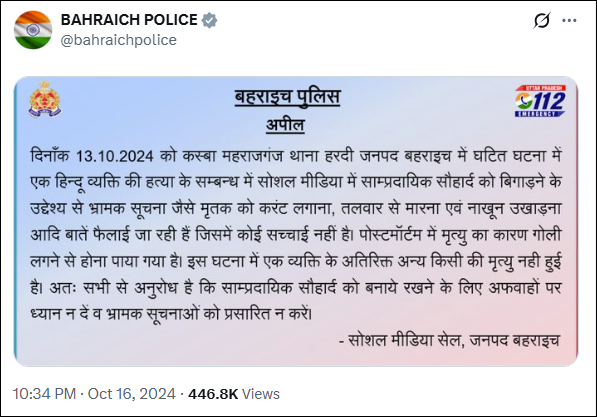
It is worth recalling that, following several media reports and social media posts, it was claimed that Ram Gopal Mishra’s toenails were deliberately pulled out. However, the police had denied the claims, saying that “There are social media posts that indicate that the body of the deceased was given electric shocks, was attacked with a sword, and that his toenails were desecrated. These posts are not true. The post-mortem report says that the death occurred due to gunshots. No other reason for death has been mentioned in the reports.”
Notably, the postmortem report had stated that the death of the deceased had occurred due to several gunshot wounds. The report further stated that Mishra had several injuries on his face, neck, and arm. The post-mortem report also states that the authorities recovered 7 pellets from the body of Mishra that had 30 entry wounds and 2 exit wounds.
It also mentioned 29 entry wounds on the upper part of the chest extending to the neck, 2 entry wounds on the right upper arm, 3 entry wounds on the left upper arm, and a total of 6 entry wounds on the whole face. Apart from these, there were 2 exit wounds in the back of the neck. A total of 7 pellets were recovered from the body. The cause of the death has been mentioned as shock and haemorrhage caused by gunshots. The report also revealed that Mishra had injuries on 8 spots in his body, including his feet.
The Chief Medical Officer of Bahraich, Sanjay Kumar, had also stated that there were around 25-30 pellet injuries on the body of Mishra. “There are some injury marks on his left eye and on his toes. Some parts of the nails of both his feet are also missing, and toes exhibited burn injuries,” he confirmed.
#WATCH | Bahraich, UP: | Bahraich incident | Chief Medical Officer of Bahraich, Dr Sanjay Kumar Sharma says, "Due to continuous beating, Ram Gopal Mishra lost a lot of blood due to which he died. The victim's left eye was injured by being hit with a sharp object…." pic.twitter.com/4lXRqqQvQh
In the verdict, Judge Pawan Kumar pointed out that Ram Gopal Mishra’s body was riddled with bullets and that the victim’s nails came off. Nowhere does the judgment accept the exaggerated claims of torture, which were refuted by the police earlier. The judgment does not mention the police-debunked claims that Mishra was given electric shocks, was attacked with a sword, or that his toenails were deliberately pulled out.
While it is true that the Bahraich police had denied exaggerated claims of electrocution, sword attacks etc, and stated that the cause of death is bullet wounds alone, it is notable here that the court order is not “contradicting” the police statement at all, unlike what these handles are suggesting.
Both the postmortem report and the Bahraich CMO, Sanjay Kumar, had confirmed that Mishra’s feet, particularly toes, had injuries, and some parts of the nails of his feet were missing. It is only these facts that the court has mentioned in its order, focusing only on the proven brutality, not the claims like sword attacks, electric shocks, nail-pulling or post-shooting prolonged abuse, debunked by the police.
It was confirmed that there were burn injuries, although the nails were not deliberately pulled out. The court order highlights this fact, and even if the ‘toenails missing’ part is set aside, Ram Gopal Mishra’s killing was brutal and torturous. Merely because the judge quoted the Manusmriti, the Islamo-leftists are calling him biased and apparently a ‘Sanghi’.
Uttar Pradesh | Bahraich Verdict Sparks Alarm | Why Is Manusmriti Entering Court Orders in a Constitutional Democracy? What Does It Signal?
In UP’s Bahraich district, Additional Sessions Judge Pawan Kumar Sharma has awarded death penalty to Sarfaraz & life imprisonment to nine… pic.twitter.com/Hlv9oKZHf9
Dragging Mishra, his burnt toes, 30 bullet wounds caused by multiple close-range shots, 10 people ganging up to kill one unarmed man for merely having removed a religious flag, does amount to cruelty via overkill. The police rejected the unproven extras, and the court did not accept or endorse those extras; however, Islamo-leftists are peddling a narrative that simply because the judge quoted Manusmriti, he is a Hindu hardliner riddled with anti-Muslim bias and thus included exaggerated claims of torture by Muslim convicts on the Hindu youth.
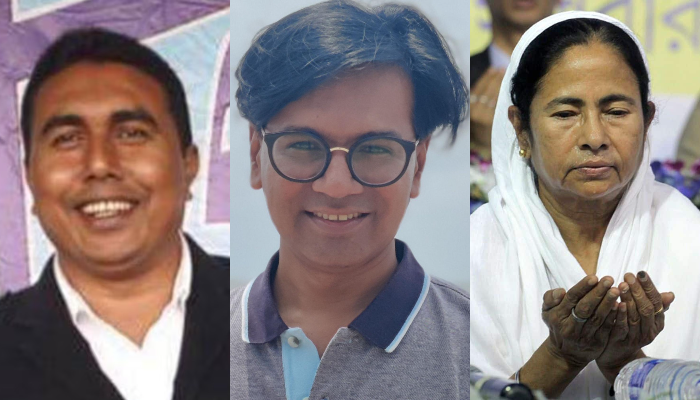
On 10th December, a prime witness against former All Indian Trinamool Congress (AITC or TMC) leader Sheikh Shahjahan narrowly escaped death after a ten-wheeler truck struck his vehicle in the North 24 Parganas area of West Bengal. Bholanath Ghosh (64) is a crucial witness in land-grab proceedings brought by the Central Bureau Of Investigation (CBI) and Central Bureau Of Investigation (ED) concerning Shahjahan who is also booked over systematic rape of women in Sandeshkhali.
Unfortunately, Ghosh was severely wounded and two people were killed including his son Satyajit and driver Shahanoor Molla in the collision. Notably, the occurrence happened when he was travelling to testify in Basirhat Sub-Divisional Court in relation to one of Shahjahan’s many cases and the former’s family has asserted foul play.
While the shocking event took place in the state ruled by TMC, already infamous for its protection of criminals like Shahjahan for vote-bank politics, the Islamists and their left-liberal allies have been more preoccupied with amplifying a heated confrontation including two snacksvendors in Kolkata.
According to reports, a street vendor selling chicken patties was allegedly beaten close to Kolkata’s Brigade Parade Ground, the site of a “Gita Path (recitation)” event. Afterward, 50-year-old Sheikh Riyazul stated that “eight-nine unknown people, including a disabled man,” assaulted him, in a First Information Report. Similarly, 60-year-old Muhammad Salauddin also filed a case and claimed that “two-three persons” had attacked him for selling chicken patties. Two FIRs have been filed by a lawyer on behalf of the vendors.
Nevertheless, the malevolent ecosystem devised a convenient distraction to redirect attention from the troubling developments surrounding Ghosh owing to this incident.
TMC leader, Islamist “fact-checker” and calculated propaganda
TMC spokesperson Riju Dutta, in a display of impudence associated with his party, could not produce a single remark about the horrific tragedy experienced by Ghosh and its extensive ramifications but he wasted no time in blaming the Bharatiya Janata Party (BJP) and “Hindutva goons” over the matter in relation to the vendors.
Dutta alleged that the program was planned by the saffron party, referring to the occurrence as “just the trailer of things to come if the BJP ever comes to power in Bengal.” He then dramatically commented that the BJP seeks to control people’s lives and Bengal would be at risk of extinction if the party was not stopped.
I, am fuming because a poor man was brutally attacked by ‘Hindutva’ Goons during the “Gita Recitation” event of @BJP4India at Kolkata’s Brigade Parade Ground.
A poor street vendor selling chicken patties near the venue was physically and mentally assaulted by individuals from… pic.twitter.com/Nvshmg2n2p
The state apparently is not at risk due to the perilous pandering to Bangladeshi inflitrators, restrictions on Durga Puja and anti-Hindu pogroms. It is also unaffected by the rampant crime and suspicious attacks on primary witnesses related to important cases involving leaders connected to the ruling party in the state. However, it is a “fight for Bengal” over an issue that has yet to undergo a probe and reach a logical conclusion.
Dutta also left out the fact that if the allegations are indeed true, it is yet another demonstration of deteriorating law and order in the state under the TMC government, and accusing others merely highlights the government’s shortcomings, especially considering its bleak history.
Mohammed Zubair of propagandist “Alt News” also took the lead in crafting this distasteful narrative to shift focus from the two fatalities and the grave charge of an attack on the life of the key witness by his family. If the victims had been of Zubair’s ideological leanings or the accident happened in a BJP-governed state, he would have repeatedly attacked the government and even found a means to shamelessly malign “Hindutva,” regardless of the facts.
Zubair also accused the mainstream media of neglecting the issue and slammed Republic Bangla for “selectivity,” while his own account had no mention of the vital development related to Shahjahan, exemplifying the tactic of “accuse others of what you are guilty of” by Nazi propaganda minister Joseph Goebbels. Zubair has truly established himself as a master in the art of propaganda and the dissemination of particular narratives.
Except for a brief digital report by a Bengali daily, the matter has received little mainstream attention. But television channels, like Republic Bangla promoted selective narratives around the event, but the assault to the poor vendor wasn't unaddressed. https://t.co/nfWGfVR1IIpic.twitter.com/SFP2dMJGq1
Left-liberal cabal jump on the victimhood bandwagon
The moment Zubair began to peddle the victimhood narrative in an effort to overshadow the significant instance, other members of the cabal also raised their voices in unison with him, deliberately ignoring the evidently larger development for obvious reasons. Likewise, their braindead audience also latched onto this constructed narrative and tried to further the same.
Anti-Hindu Delhi riots accused Apoorvanand who also writes for another propaganda outlet “The Wire” remarked that such incidents are “becoming a common occurrence in India, across various states.” He even added that the community should be concerned about the widespread “criminalisation and lumpanisation of Hindus,” however, “they seem to be relishing this dehumanisation as it harms Muslims & Christians and gives them a sense of power.” The post was retweeted by Zubair.
Apoorvanand, much like the co-founder of Alt News, failed to find any time to tweet about Ghosh’s accident or the serious allegations of his family. Nonetheless, the vitriol directed at Hindus and the perceived hypocrisy is neither novel nor surprising. They have perfected the skill of making a mountain out of a molehill when it benefits their agenda and simultaneously turn a blind eye to even the most critical issues in accordance with their interests.
It is becoming an everyday affair in India, across states. This mass lumpanisation/criminalisation of Hindus should concern the community, but they seem to be relishing this dehumanisation as it harms Muslims & Christians and gives them a sense of power. https://t.co/8R7KzBsHCV
Apoorvanand, however, went one step further in spreading his obnoxious fabrications. First off, these are not widespread incidents and the administration along with the judiciary is available to inquire about the facts and punish the guilty. Secondly, the veracity of such issues have been regularly exposed and they turn out to be falsehoods and propaganda manufactured by his ilk.
Furthermore, the man would not dare to express similar sentiments regarding terrorism and Muslims, but instead sinks even lower than his already deplorable level, uttering outrageous lies to target Hindus in order to appease and protect his “secular” political despots.
Zubair retweeted another “journalist” Wuqar Hasan, who had reacted to his post to augment the matter. He, akin to the rest of the ecosystem, was indifferent to the troubling events around Shahjahan’s cases.
Sanghamitra Bandyopadhyay lashed out at the police for failing to protect “secularism,” “brotherhood” and “peaceful coexistence” in West Bengal. She seemingly forgot that the police also did not protect the women in Sadeshkhali, the Hindus in Malda and Murshidabad, as well as Bholanath Ghosh, his son and their driver. On the other hand, the administration was focused on safeguarding the culprits. However, as expected her perverse outrage was directed solely for the sake of the vendors and not other victims.
Sheikh Riyazul, a street vendor selling chicken patties, was humiliated and beaten at a Gita Path event at Brigade Parade Ground. Bengal is a secular state and we believe in brotherhood and peaceful coexistence. How did the @KolkataPolice on duty allow this to happen?… pic.twitter.com/OsWA7PPms9
A liberal brought BJP into the matter and tried to convince Bengalis not to support the party if they want to keep consuming fish, chicken and mutton. These individuals never pass up an opportunity to push their political goals. More importantly, they argue that the saffron party should not be allowed to gain power as it would threaten their food habits without any substantiation for these statements. However, TMC should never be ousted regardless of its shameless appeasement politics, the crimes committed by its leaders and the lives lost under its misrule.
SAFFRON GOONS ASSAULT POOR VENDOR FOR SELLING CHICKEN PATTIES!
A Helpless Street Vendor was Brutally Slapped, Abused, and his Entire Stock of Veg & Chicken Patties Dumped on the Road by a raging mob.
Accident or conspiracy: Statements of eyewitnesses and family’s strong suspicions
According to Biswajit, Ghosh’s older son, Shahjahan ordered attempted murder on his father. Ghosh who is an ex-TMC worker and also worked with Shahjahan eventually emerged as an essential witness in a case against him. Biswajit outlined, “They had threatened to kill my father earlier. This is not an accident, 100 per cent murder. Shahjahan’s order was carried out by Sabita Roy and Muslim Sheikh.” Muslim is the vice president and Roy is the president of the Najat Panchayat Samiti.
An investigation has been opened up into the allegations. “We are not sure if it was an accident. We are probing every angle. We are putting more emphasis on why the collision occurred where there is no CCTV coverage and how the driver fled the spot,” mentioned a senior official.
It was unveiled that the truck destroyed a side of Ghosh’s car on the Basanti Highway, contrary to what was first believed to be a head-on crash, which transpired next to the Boiramari petrol station in Najat police station limits. The cops conveyed that the road is not accident-prone and is broad alongside straight.
The truck reportedly approached from behind, hit the automobile, shoved it forward and threw it into a roadside ditch. All three people were trapped inside the four-wheeler when it was crushed. The witnesses disclosed that the truck driver then absconded from the scene.
Ghosh’s family is among the people who have suggested that the catastrophe was planned. They mentioned earlier instances in Sandeshkhali where witnesses were assaulted, on Shahjahan’s orders from the prison. They maintained that the deaths and the crash were “not a coincidence.”
“Reports indicate that the truck was being driven by Abdul Halim Mollah, one of Shahjahan’s closest aides along with his associate Nazrul Mollah. Abdul has long been listed as a fugitive in CBI records. It is therefore evident that this was no accident but a cold, calculated act of murder,” stated Union minister Sukanta Majumdar.
When the protection of criminals becomes more important than upholding law and order in a state—and when the Chief Minister herself appears desperate to shield such offenders—what could be more appalling?
“It was a planned murder and not an accident. It was an attempt to disguise a murder as an accident. Let there be an impartial investigation,” likewise expressed BJP leader Sajal Ghosh.
Conclusion
The aforementioned clearly demonstrated the severity of the incident and its massive impact on the cases associated with Shahjahan. The issue would have been emphasised repeatedly and the government would have been under fire for its inability to act in any other situation.
However, the TMC, Muslim radicals, liberals and their whole group were engaged in burying the paramount matter and bringing the incident related to the vendors in the limelight. They made every effort to ensure that the major development that could potentially influence many lives, the legal proceedings and even the justice that would be served to Shahjahan, somehow disappeared into the backdrop of the fervently attached communal perspective that sought to blame the BJP and Hindutva.
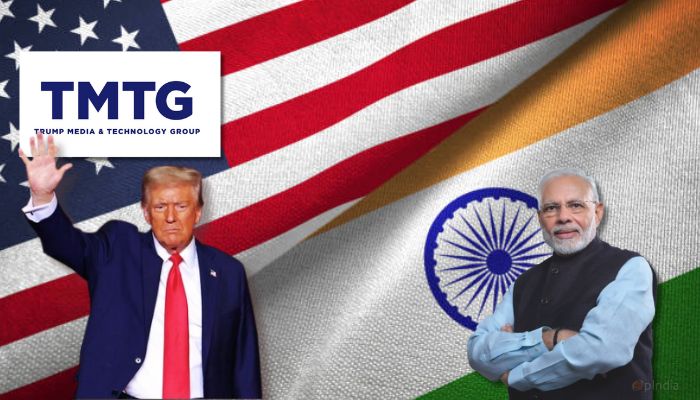
Donald Trump posits himself as a defender of American nationalism and a strong leader who would traverse any lengths to pursue his country’s interests. However, President Donald Trump is simply ‘Dollar Trump’, who tweaks foreign policy to accommodate his personal business interests. Months after the US President called India a ‘dead’ economy, Trump Media & Technology Group (TMTG) is set to invest up to Rs 1 lakh crore in the Indian state of Telangana over the next decade.
On 8th December, Eric Swider, the executive director at Trump Media & Technology Group, announced that the TMTG helmed by Donald Trump’s family is set to invest around Rs 1 trillion in multiple real estate and infrastructure projects across Telangana over the next decade. A major share of this massive investment will go towards the Bharat Future City, a futuristic urban project on the outskirts of Hyderabad.
While announcing the Telangana Rising Global Summit in Hyderabad, Eric Swider lauded India’s booming digital economy and tech ecosystem, saying that “India is on a rise.” Swider also emphasised collaborations in technology, media, and infrastructure.
“I would like the Honourable Chief Minister (Revanth Reddy) to know that over the next 10 years, it is my intention to deploy through our organisations up to ₹1 trillion into the future city and into the areas of development here. India will continue to be on the rise and will lead the world in technology. I think it is important that we find ways to work together and invest together. We have seen technologies here that I am very excited to invest in,” Swider said.
Setting an early benchmark for the scale and scope of success of our vision and game-changer projects, the Trump Group has decided to invest Rs 1,00,000 crore into the #BharatFutureCity and the larger #TelanganaRising journey.
Swider added, “If you go back 20 years, India from the technology space was about call centres. Now, you start looking at who is working in technology companies around the world, you understand that the talent is coming from India. Now, forward to today, you would be blind not to see that the technology capitals around the world are coming from India. India is on the rise.”
Notably, the Bharat Future City Project spans 765 sq. km, incorporating 56 villages between the Srisailam and Nagarjuna Sagar highways. The project will be overseen by the Future City Development Authority (FCDA).
The Bharat Future City will be divided into several zones, including the Technology and Innovation Zone, where AI, electronics, EV and high-tech companies will come. Pharma and Healthcare Zone: Where large industries related to medicines and medical research will be set up. Manufacturing Zone: Where large-scale production companies will come. Educational and Research Institutes: Where people can study and get jobs. Residential and entertainment areas: Where there will be good houses, parks, malls and sports facilities. Green Zones and Reserve Forests: To ensure that the city remains green and in balance with the environment
Trump calls India’s economy ‘dead’, his own media empire pouring billions into an “India on rise”
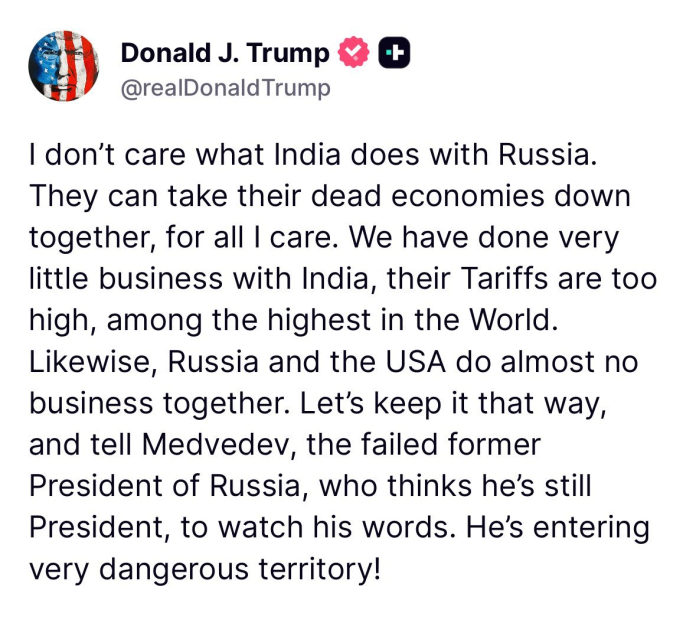
The Trump Media and Technology Group’s Rs 1 lakh crore investment in India demonstrates that pragmatism always trumps charged and delusional rhetoric. Just a few months ago, in July and August, the Trump administration’s rhetoric towards India was bullish and insulting. President Trump took to Truth Social to label India’s economy ‘dead’. He lumped India’s economy with America’s Bête noire, Russia. “They can take their dead economies down together,” he wrote.
Disgruntled over India’s Russian crude oil purchases had not only called the Indian economy a “dead economy”, but also imposed a 50 per cent tariff on Indian exports as ‘punishment’. This did not end here, the Trump administration officials, especially Peter Navarro, Scott Bessent and Howard Lutnick, piled on, with press briefings, and interviews, portraying India as a villain in global supply chains, a financier of the Russian ‘war machine’, a tariff-dodging freeloader, a geopolitical wildcard cozying up to Russia and China, both of America’s ‘rivals’.
These accusations, rooted in false narratives, came even as the US itself was buying Russian goods, including non-essentials, in large quantities. The Trump administration singled out India as a country fuelling the Russian war machine against Ukraine and took no such hard stance against China, even as Beijing has been the top importer of Russian oil, not India. OpIndia has repeatedly called out the Trump administration’s hypocrisy in throwing shade at India for something America and the whole of Europe have been doing despite imposing sanctions on Russia and villainising Moscow. In fact, no other country has profiteered from the Russia-Ukraine war more than the US.
However, now Trump’s own media empire is pouring billions into the very Indian soil he deemed economically barren. It is almost a cinematic irony that Trump, who weaponised tariffs and tirades against India’s growth story and strategic autonomy, now has his company betting big on India’s potential.
India, with its massive population, digital boom, a thriving startup scene and gradual shift towards business-friendly policies, makes it an irresistible market. It is for these reasons; big American tech companies do not want to miss the bus and are doubling down their investments in India. In December 2025 alone, Amazon announced that it will invest more than $35 billion in India’s cloud computing and artificial intelligence sectors by the year 2030. Microsoft followed suit, and its CEO Satya Nadella announced a landmark Rs 1.5 lakh crore (USD 17.5 billion) investment to accelerate India’s journey towards an AI-driven future.
The massive investment commitments by Amazon and Microsoft reflect a wider recognition of India’s growing digital influence and its potential to shape the global technological order. It also positions India as a critical market for AI innovation.
Interestingly, India’s second-quarter real GDP growth for FY (Fiscal Year) 2025-2026 reached a strong high of 8.2%, significantly exceeding projections of 7.3% growth as the real GDP has expanded at its fastest rate in six quarters. These remarkable numbers came months after the United States slapped 50% tariffs on India, including 25% additional tariffs for purchasing Russian oil.
Clearly, the Trump administration’s ‘tariffs and tirades’ arm-twisting tactics could not bend Modi’s India and only embarrassed the American president. While in politics, Trump gave the ‘America First’ mantra; however, this nationalistic slogan of his blurred the lines between state policy and personal ventures long back, as evident from several White House deals favouring his properties. It was seen how the Trump family’s golf resort in Vietnam got fast-tracked in exchange for tariff reduction from 46% to 20%.
Not to forget, Trump is now mollycoddling Pakistan, a country he has been critical of historically for the latter’s support to Islamic terrorists like Osama Bin Laden and squeezing American funds in the name of counterterrorism measures in Afghanistan. However, Trump took a U-turn, and his family’s company, World Liberty Financial (WLF) signed a ₹17,000 crore cryptocurrency deal with Pakistan.
The US Congress has largely been critical of Trump’s newfound love for Pakistan; however, Trump continues to bolster ties with the Pakistan Army leadership, as evident from the recent approval of $2 billion in funding for the Reko Diq mining project in Pakistan-controlled Balochistan.
Donald Trump has been leveraging political relationships for personal profit in the Middle East as well. Trump’s companies are investing money in countries he has antagonised in the past.
In a nutshell, in Trump’s political rhetoric, India could be a dead economy, but in business realpolitik, opportunistic hypocrisy is his way.
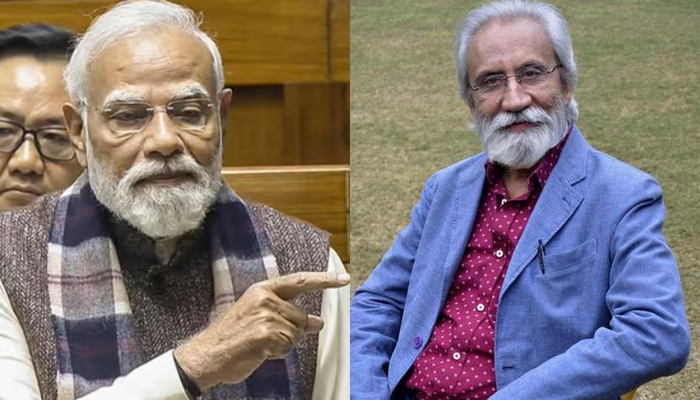
Controversial ‘historian’ S Irfan Habib, on Monday (8th December), claimed that Prime Minister Narendra Modi made a false statement in the Lok Sabha regarding Mohandas Karamchand Gandhi’s endorsement of ‘Vande Mataram’ as the national anthem. He referred to a speech given by PM Modi in the Lok Sabha on Monday, wherein he mentioned that Mohandas Karamchand Gandhi praised Vande Mataram and referred to it as the national anthem.
Speaking about the history of the national song Vande Mataram in the Lok Sabha, PM Modi said that in 1905, Gandhi wrote an opinion praising the song and acknowledging that it had become so popular across Bengal that it became like a national anthem.
“I want to tell the House about Mahatma Gandhi’s emotions regarding Vande Mataram. In the weekly Indian Opinion on 2 December 1905, Mahatma Gandhi wrote that the song Vande Mataram, composed by Bankim Chandra, had become famous across Bengal. During the Swadeshi movement, lakhs of people sang it. He also wrote that this song was so popular that it had become like our national anthem, carrying deeper emotions and more melody than the national songs of other countries. It views Bharat as mother and prays to her,” PM Modi said in the Lok Sabha on Monday.
VIDEO | Debate over Vande Mataram: Speaking in Lok Sabha, PM Modi (@narendramodi) says, "I want to tell the House about Mahatma Gandhi’s emotions regarding Vande Mataram. In the weekly Indian Opinion on 2 December 1905, Mahatma Gandhi wrote that the song Vande Mataram, composed… pic.twitter.com/ztogz7CnZo
However, the controversial historian rejected PM Modi’s statement by claiming that in 1905, Gandhi was in South Africa and returned to India in 1915. Therefore, it is not possible that he could have endorsed the song.
“During the Vande Mataram debate today, PM Modi claimed that Mahatma Gandhi saw it as the ‘national anthem’ since 1905. But Gandhi was in South Africa; he arrives in India in 1915. Is there any reference which I seem to have missed?” Habib wrote in a post on X.
During the Vande Mataram debate today PM Modi claimed that Mahatma Gandhi saw it as 'national anthem' since 1905. But Gandhi was in South Africa, he arrives in India in 1915. Is there any reference which I seem to have missed?
— S lrfan Habib एस इरफान हबीब عرفان حبئب (@irfhabib) December 8, 2025
Habib was joined MK Venu, founding editor of the Left propaganda website, The Wire, in dismissing PM Modi’s remarks as untrue. Responding to Habib’s post, Venu wrote on X, “If we start looking for references on Modi’s statements, we will go insane!”.
If we start looking for references on Modi's statements we will go insane! https://t.co/1WSs6wi7tk
A fact-check of the claims of S Irfan Habib and MK Venu
To verify, ‘historian’ Habib’s claim, OpIndia conducted a fact-check of his claim and found it to be absolutely wrong. As per our fact-check, Mohandas Karamchand Gandhi expressly supported the song Vande Mataram, composed by Bankim Chand Chatterjee and also referred to as the “national anthem”.
Indeed, Gandhi came back to India from South Africa in 1915, but much before that, in December 1905, Gandhi’s views, published in the newspaper Indian Opinion on December 2, 1905, clearly show that he supported and praised the song.
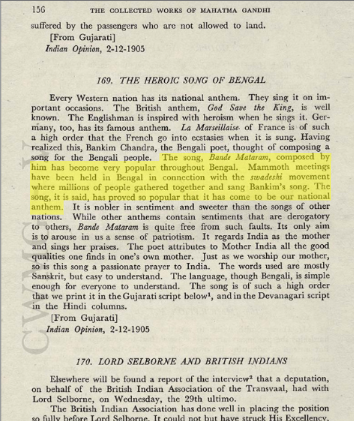
In his writing titled ‘The Heroic Song of Bengal’, Gandhi stated, “The song, Bande Mataram, composed by him has become very popular throughout Bengal. Mammoth meetings have been held in Bengal in connection with the Swadeshi movement, where millions of people gathered together and sang Bankim’s song. The song, it is said, has proved so popular that it has come to be our national anthem.” An image of a Gandhi’s writing published in Indian Opinion has been produced below.
Screenshot of an excerpt from The Collected Works of Mahatma Gandhi (Image via https://www.gandhiheritageportal.org/)
It is clear from the abovementioned lines from Gandhi’s own writing that he admired the song and was aware of its popularity among freedom fighters, who sang it like a national anthem.
MK Venu’s claims contradicted by an article published on his own website
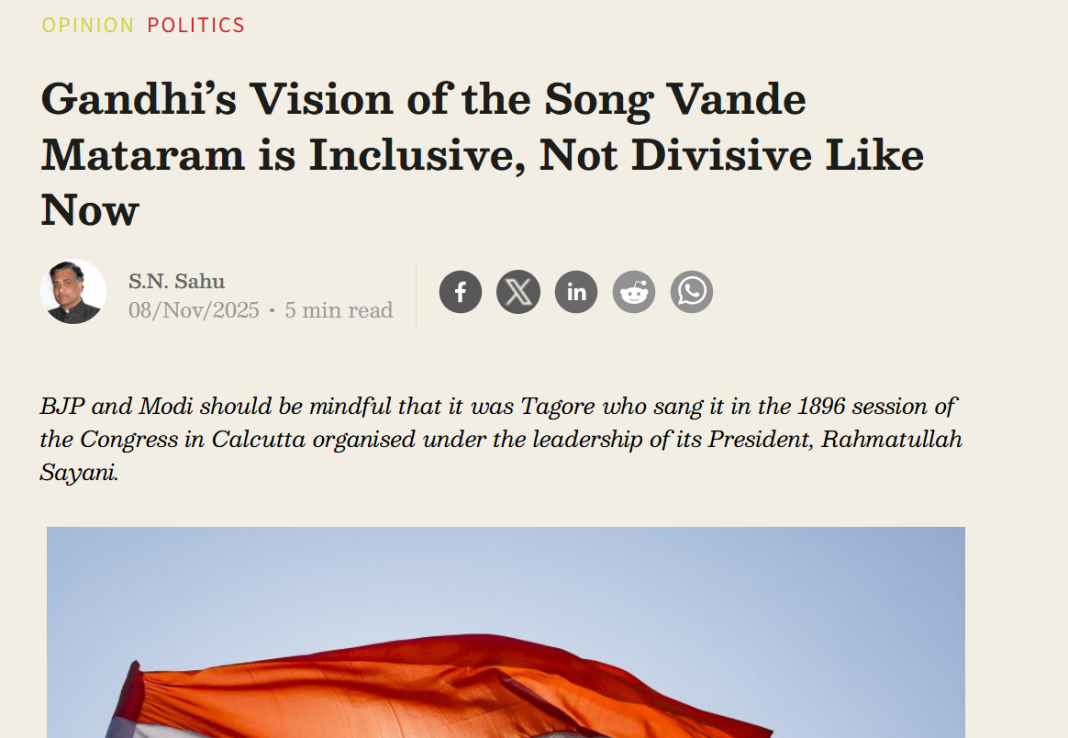
Interestingly, an article titled “Gandhi’s Vision of the Song Vande Mataram is Inclusive, Not Divisive Like Now”, which was published in The Wire on November 8, 2025, also refers to the same writing of Gandhi, wherein he praised Vande Mataram and called it the national anthem. “While in South Africa, Mahatma Gandhi wrote an article “The Heroic Song of Bengal” in Indian Opinion on December 2, 1905 and described Vande Mataram as our national anthem…” the article states.
Screenshot via The Wire
It is thus obvious after the fact-check that ‘historian’ S Irfan Habib and The Wire Founding Editor spread misinformation about PM Modi’s statement as well as Vande Mataram. However, Habib and Venu’s are not surprising, considering the Left ecosystem’s historic contempt for nationalists and the nationalist ideology.
The latest storm over Vande Mataram in Parliament has revived an old ideological battle in the country. Prime Minister Narendra Modi has accused the Congress of having “fractured” the national song under pressure from the Muslim League. He accused Jawaharlal Nehru of “betraying” the song. As the government commemorates 150 years of the composition of the legendary song, the Opposition’s strong objections, counter-accusations and protests outside Parliament have brought the debate to the centre of national politics once again.
On the surface, it may look like a disagreement over a song. However, it has reopened deeper questions about the nature of India’s national identity and the historical consequences of allowing religious objections to dictate public symbols.
How the original objections were framed
The roots of the dispute date back to the 1930s, when Bankim Chandra Chattopadhyay’s Vande Mataram had already become an emotive rallying point in the national movement. However, the Muslim League, under Muhammad Ali Jinnah, rejected the song outright and claimed that bowing to the Motherland amounted to idolatry. He claimed that Anandamath, the novel in which the song appears, presented a hostile portrayal of Muslim rulers.
Jinnah used this argument repeatedly. He portrayed the Congress’s use of Vande Mataram as a deliberate attempt to undermine Muslims. His rhetoric attempted to turn a national symbol into a marker of communal divisions.
These objections soon influenced the Congress leadership. In October 1937, the Congress Working Committee decided that only the first two stanzas would be sung at public functions. It was a compromise justified on the ground that the remaining stanzas might conflict with the “religious ideology” of some groups.
The decision followed internal exchanges between leaders such as Jawaharlal Nehru and Subhas Chandra Bose. Nehru claimed in a letter that the novel’s background might “provoke Muslims” even as he dismissed much of the outcry as “manufactured by communalists”.
How national leaders interpreted the issue
There were several leaders in that era who understood the danger of repeatedly yielding to objections framed in religious terms. For example, Sri Aurobindo argued vigorously that Vande Mataram was an invocation to the Motherland, not a theological offering. He warned that rejecting national symbols to appease sectarian anxieties would damage unity.
Dr BR Ambedkar was thoroughly critical of the idea of seeing the country as “Mother India”. He rejected the idea and in fact coined the term “Bahishkrit Bharat” (Outcast India), claiming it represents the true sense of divided Indian society.
MK Gandhi, in 1905, when he was in South Africa, wrote, “The song Vande Mataram, composed by Bankim Chandra, has become extremely popular throughout Bengal. During the Swadeshi movement, massive gatherings were held in Bengal where hundreds of thousands assembled and sang this song of Bankim.” He added, “This song has become so popular that it has become like our national anthem. Its emotions are noble and it is sweeter than the songs of other nations. Its sole purpose is to awaken the spirit of patriotism within us. It regards Bharat as a mother and offers praises to her.”
Although deeply appreciative of the song’s role in the freedom struggle, argued in the late 1930s that it should not be sung at gatherings where objections were raised. His advice, which was published in Harijan, reflected a desire to avoid confrontation in a period of rising communal tension.
Responding to the letters from Bose and Nehru, Rabindranath Tagore explained that he valued the tenderness and devotion in the first two stanzas. However, he added that he recognised that the larger poem, read together with the novel, could be misinterpreted. He believed that the truncated version had gained an independent identity and should be retained for national events.
The ramifications of the decision to use only two stanzas were visible. The accommodation validated the Muslim League’s belief that objections based on religious interpretations could dictate national practice. This helped the Muslim League to push the separatist narrative, which steadily grew in confidence through the 1940s and ultimately led to the formation of Pakistan.
Why the logic of the objections remains unchanged
In the current scenario, the Opposition’s arguments bear a striking resemblance to the ones advanced by separatist leaders in the pre-Independence era. The demands remain the same, that the national symbols must be reshaped, restricted or discarded if a religious interpretation finds them objectionable.
This insistence that religious sentiments must supersede collective national identity reflects the intellectual foundation of the two nation theory, which held that Hindus and Muslims represented distinct civilisations that were incapable of sharing a single national framework unless the majority continually compromised its cultural space.
Historically, once this principle took root, it did not remain confined to songs or symbols. It expanded into demands for separate electorates, distinct laws and political safeguards built around the idea that communal identity was superior to national identity. This is the reason there is so much opposition to the Universal Civil Code (UCC) and this is the reason why Congress-ruled states are trying to woo their natural voter base with laws like the Hate Speech Bill. The end-point to this worldview was Partition of the country, not by accident but by ideological design.
Why the debate today is not about a song
Almost a hundred years have passed and the argument has resurfaced in a new form. The resistance to Vande Mataram has always been there in different circles. Resistance to the song has happened in functions, State Assemblies and in meetings. However, it no longer hinges on the literary content of Anandamath or any genuine grievance.
Instead, it reflects the larger ideological position that national symbols must remain subject to a religious veto. This position, which is built upon the logic that one community’s theological reading deserves primacy over collective national sentiment, is inherently aligned with the two nation theory. It reiterates the idea that India cannot have a shared civilisational identity unless the majority continuously curtails its cultural expressions.
Rejecting Vande Mataram in 2025 is not a matter of “choice” or “interpretation”. It is a continuation of the same separatist logic that once divided the country. The reverence for the Motherland cannot be considered sectarian unless one chooses to interpret national identity through a purely religious lens.
A dispute that still tests India’s unity
The debate over Vande Mataram is not going to end in Parliament. The ideological fault line will remain the same as it was in the 1930s. The issue is not about the two stanzas or four which should be sung. It is whether India defines its national identity through a shared civilisational consciousness or through a patchwork of religious vetoes.
The continuity of the controversy over the national song has shown that it is more than a historical composition. It is a measure of how India balances its pluralism with its unity. It does not matter what the outcome of the debate in Parliament will be, as it will not unite India’s communities divided over religious interpretations. It, however, reaffirms that “Unity in Diversity” is only a mask that will go off the moment one community starts opposing national symbols over religious readings.
On 10th December, Assam observes “Swahid Divas (Martyr’s Day)” every year in remembrance of those who died during the Assam Movement demanding deportation of illegal immigrants from Bangladesh. On this day in 1979, Khargeswar Talukdar had become the first martyr of the movement. Around 860 agitators had died during the 6-year-long protests led by All Assam Students Union (AASU) and All Assam Gana Sangram Parishad (AAGSP).
Notably, this tragic loss of life transpired due to the detrimental and brazen Muslim appeasement actions of Indian National Congress which governed the country for over 50 years since independence. The party ascended to power following the gruesome partition of the nation, in the name of representing the collective consciousness of a “secular” India. However, its extensive rule and unrestrained power were marred with multiple occurrences of oppressive actions, undermining democracy and Constitution, suppressing dissent and more.
Similar to its current politics, the grand old party prioritised vote-bank and catering to its favourite community over national interest, integrity and the genuine concerns of its own citizens. It did not even hesitate to use the authority to force people to conform to its agenda through unrestrained violence. The same unfolded in Assam in a dreadful manner during the largely peaceful and momentous Assam Movement as more than 850 young people lost their lives.
Prime Minister Narendra Modi payed tribute to the martyrs and stated that “we recall the valour of all those who were a part of the Assam Movement.” He mentioned that India’s history will always hold a special place for the struggle. “We reiterate our commitment to fulfilling the dreams of those who participated in the Assam Movement, notably the strengthening of culture and the all-round progress of the state,” he further conveyed.
Today, on Swahid Diwas, we recall the valour of all those who were a part of the Assam Movement. The Movement will always have a prime place in our history. We reiterate our commitment to fulfilling the dreams of those who participated in the Assam Movement, notably the…
Assam Chief Minister Himanta Biswa Sarma likewise offered “shraddhanjali to Khargeswar Talukdar and the over 850 bravehearts of the Assam Movement who gave their lives for Aai Asomi.” He added, “Their love for the motherland will forever be an inspiration for us as we remember their supreme sacrifice today.”
On Swahid Divas, I offer my shraddhanjali to Khargeswar Talukdar and the over 850 bravehearts of the Assam Movement who gave their lives for Aai Asomi.
Their love for the motherland will forever be an inspiration for us as we remember their supreme sacrifice today. pic.twitter.com/ntEnlYJYgX
On the occasion of the Swahid Divas this year, Chief Minister Himanta Biswa Sarma inaugurated a centralised memorial named Swahid Smarak Kshetra at West Boragaon in Guwahati on Wednesday. The foundation stone for the memorial which was built at a cost of ₹178 crore was laid by the then Sarbananda Sonowal on December 10, 2019.
The 150 bigha site has a 225 tall main memorial, 860 busts of the swahids, a meditation hall, a laser show area, a horticulture garden, a food court, an auditorium and a cycle track. It also features a digital library that has information about the entire Assam Movement, among other things.
As photographs of around 400 martyrs were not available, their portraits and busts are being created using descriptions of their appearances by their families. Therefore, some spots are kept empty at present, and they will be filled as and when artworks are completed.
The eternal flame known as “Swahid Pranam Jyoti” at the Swahid Smarak Kshetra was lit by Sarma, and 860 diyas were lit in memory of the 860 swahids. Family members of all the martrs were invited to attend the inauguration, apart from senior leaders of the Assam movement.
At the inauguration ceremony, Bhupen Hazarika’s “Swahid Pranamo Tumak” was performed by a large number of artists after the recitation of the state anthem. Notably, Hazarika had created the song in honour of the martyes of the Assam movement.
The Swahid Smarak Kshetra is the first centralised memorial to remember those who lost their lives demanding the detection, disenfranchisment and deportation of illegal aliens from Assam. AASU has built a large number of small memorials in almost every town, including in almost every school and college in Assam, but there was no centralised place. Even though AGP, the party born out of AASU and AAGSP, ruled Assam for two terms, no plan was made for a centralised memorial.
What was Assam Movement
The profound challenges faced by the ordinary and law-abiding Indian population against those in power unfortunately did not cease with the fall of the British Raj, as the successors also focused on their own political objectives instead of the welfare, rights or security of those they pledged to protect under the Constitution.
The nation, akin to the present situation, was tackling with the grave problem of Bangladeshi infiltrators, particularly in the border regions and Assam was similarly affected. As a result, the All Assam Students Union (AASU) and the All Assam Gana Sangram Parishad (AAGSP) started a civil disobedience movement in 1979 to protest the unchecked inflow of illegal immigrants into Assam, especially from Bangladesh. It is regarded as one of the world’s longest student movements.
Image via The Sentinel
Furthermore, the state went through a volatile political period in the late 1970s and early 1980s, characterised by the overthrow of governments and the introduction of President’s Rule. Meanwhile, the massive illegal migration from Bangladesh triggered fears about the implications for resource exploitation, demographic change, the economy and underdevelopment, among other matters.
Hence, the inability of the administration to respond to the legitimate worries of the populace gave rise to the Assam Movement. It not only became one of the most well-known movements in post-colonial India but was a determined attempt to protect the state’s true identity which was gravely endangered by foreign intruders.
The anti-foreigner agitation was started in 1979 by the All Assam Students Union. The repatriation of foreigners who had entered Assam after 1951 was one of their key demands. The demonstration was also against a flawed voter registration that contained the names of countless unlawful immigrants, further escalating unrest.
Image via India Today
Foreign nationals had been fraudulently entered into electoral rolls since 1963. The draft enrolments in Mangaldoi revealed a large number of non-citizens in 1979. According to Assam BJP leader Dilip Sharma, the Congress deceptively added over 40,000 East Bengali Muslims to the electoral records for the Dalgaon Assembly segment during the by-election which transpired after the death of MP Hiralal Patowary from the Mangaldoi Lok Sabha constituency.
Congress committed vote fraud in Assam…
The six-year-long Anti-Foreigners Movement that began in 1979 had its roots in Congress’ vote-stealing tactics. That year, following the demise of Hiralal Patowary, the MP of the Mangaldoi Lok Sabha constituency, a by-election was to be… pic.twitter.com/YxIQ4qMHiZ
Afterward, AASU announced to boycott the 1980 Lok Sabha election and advocate for completely updated electoral records throughout the entire state. The Indira Gandhi government, however, chose not to accept the demands, as it would have impacted her electoral support. As a result, the movement only escalated, leading to economic blockades, tyranny, bloodshed and protracted hostilities.
Murder of AASU leader Khargeswar Talukdar
Khargeswar Talukdar, the 22-year-old general secretary of AASU’s Barpet unit was among the many young leaders who took a stand for the pivotal cause. However, his determination quickly made him a target and Bangladeshi Muslims mercilessly silenced his voice.
On the early hours of 10th December 1979, former president Fakhruddin Ali Ahmed’s wife Abida Ahmed went from Guwahati to Barpeta to file nomination for elections as a Congress candidate. The agitation was triggered by announcement of the polls without removing the names of illegal immigrants from the voter lists, and they were boycotting the polls.
AASU workers had tried to block Abida Ahmed in Guwahati and at various places on the way, but they were removed and mercilessly beaten by police. Similarly at Bhawanipur, local AASU members were on a picketting, but they were also targeted by the police. This included Khargeswar Talukdar, the 22-year-old general secretary of AASU’s Barpet unit and a 1st year student of Hawli College. He was dragged by the police, beaten to death, and then his body was thrown into a ditch on the side of the road close to Bhabanipur.
The heinous act was intended to quell the uprising but produced opposite result. After his death, his mortal remains were brought to Gauhati University, where the first Swahid Bedi or martyrs memorial was built.
Talukar became the movement’s first martyr and the killing shocked the entire state. The struggle turned personal and emotional for the grieving masses. The protests grew louder and gained traction.
Image via glimpseofassam
As a result on 12th December 1979, the central government imposed President’s Rule in Assam, removing the Janata Party government, which was the first critical change in the state’s political landscape. However, the movement had evolved into an fight for the entire state. Students, farmers, intellectuals, and regular people protested in the streets, calling for the identification, disenfranchisement and expulsion of undocumented immigrants. The leaders of the protest also boycotted the 1983 Assembly elections.
On the other hand, several negotiations with the government did not succeed while the state faced consistent curfews, disruption of normal life, economic setbacks and widespread violence as hundreds of people sacrificed their lives to protect Assam from Bangladeshi intruders.
Image via India Today
The centre eventually understood that the turmoil in Assam could not be disregarded after six arduous years of demonstrations, agitation and talks. On 15th August 1985, the officials of the Rajiv Gandhi government met with the leadership of AASU and AAGSP. They negotiated the landmark “Assam Accord” to deal with the fundamental issues presented by the movement. The agreement resulted in the creation of the critical National Register of Citizens (NRC) and pushed the subject of illegal immigration to the forefront of public discussion in India.
CM Sarma highlights insidious actions of Congress
“For years, Assam’s bravehearts didn’t have any permanent memorials in honour of their sacrifice in protecting the land, culture and identity of Assam. Correcting this historical anomaly, the Swahid Smarak in Guwahati today stands tall as a testament to their sacrifices,” CM Sarma expressed on the eve of Swahid Divas.
He outlined, “Over 860 young people lost their lives due to the brutality of the then Congress government in Assam. Their only fault was demanding a secured Assam, demanding an end to illegal infiltration.”
According to Sarma, the deceased were victims of “state brutality” and were penalised for asserting a justifiable demand for a “safe and secure Assam.”
“All that we have seen, youths died for demanding that Assam be made a safer place by deporting illegal immigrants in the state. However, unfortunately, more than 850 lives were lost due to the brutality unleashed by the state administration. At that time, Congress was in power at both the centre and the state. The Congress government was solely responsible for the loss of lives during the Assam agitation,” he mentioned.
The martyrs were remembered through get-togethers and private tributes for many years. Many of these martyrs were young people, mostly students, who had a resolve to uphold Assam’s real heritage and cultural roots. The central memorial has brought their stories to one location where they can be preserved, passed down and continue to inspire future generations. Their supreme sacrifice has now found a permanent place in the legacy of the state.
Conclusion
The Assam movement is yet another somber chapter of the sinister actions of the Congress to strengthen its electoral base at the expense of Indian citizens. It also stands as a grim reminder of the phrase, “The more things change, the more they stay the same” in the context of Indian politics, where the opposition’s pandering to Muslims extends even to intruders.
The outright objection to the Special Intensive Revision (SIR) drive, Citizenship Amendment Act (CAA) or NRC is a result of the same mindset, where these “secular” parties do not hesitate to compromise national security and interests, if it results in securing them some votes while the country and its natives suffer relentlessly.