Home Blog Page 1847

Viral video: Former DGP shouts at IPS officer Sweety Sehrawat, asking why she refused to meet him at her residence, social media divided on ‘personal space’

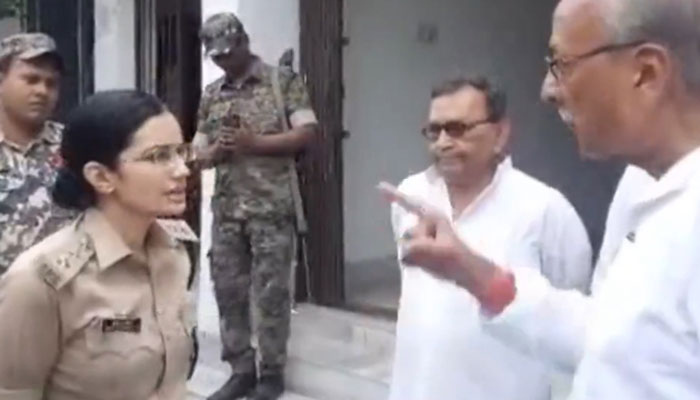
On 5th September, a video from Aurangabad, Bihar, went viral on social media in which former Deputy General of Police (DGP), former MLA and former governor Nikhil Kumar was seen shouting at young IPS officer ASP Sweety Sehrawat asking why she refused to meet him at her residence.

The viral video has divided social media into two sections. While one supports Sweety Sehrawat, saying she has the right to have a personal space at her residence and not see visitors, the other section claims the police officers or public servants are supposed to be on duty 24×7 and Sweety Sehrawat was wrong and disrespectful to a former senior officer and governor.

What happened at ASP’s residence?

According to reports, Kumar attempted to contact ASP Sehrawat on her office phone but was unsuccessful. He wanted to discuss the increase in reports of thefts in the area with her. Instead of going to her office, Kumar went to her residence early in the morning with the victims and other individuals. Reports indicate that when he sent someone to call ASP outside, the security personnel at her residence informed them that she was getting ready.

After approximately 45 minutes, at around 10 AM, ASP exited her residence and proceeded straight to her vehicle to go to the office. A person who accompanied Kumar rushed to stop her and informed her that Kumar wished to speak with her. ASP informed him that her residence was her personal space and that Kumar could meet her at her office. This irked Kumar, who then decided to lecture her on the matter.

In a video shared by X (formerly Twitter) user Utkarsh Singh, Seherawat asked Kumar to calm down as he appeared agitated. When she told him that there was no need to use the tone he was using, Kumar responded, “I will talk like this only.”

The ASP is seen calmly saying that she had informed everyone that she would meet them all at her office. Kumar angrily asked, “Why don’t you meet here?” She responded, “I have my personal space,” Kumar retorted, “That’s wrong.” Kumar claimed that as an IPS officer, it was her duty to meet people day and night. Seherawat said that if he had informed her, she would have gone to the office 30 minutes earlier, which further angered Kumar.

Kumar asked her what preventive measures she had taken to stop thefts in the region and what steps had been taken on the cases that had already been reported. She responded, “Let’s go to the office.” However, Kumar continued to insist on speaking to her outside her residence. Kumar was also seen using a strong, loud tone and pointing fingers at the young officer.

Interestingly, the victim who came with Kumar agreed that ASP had not only met with him every time in the office but also changed the investigation officer on the victim’s request. Throughout the interaction, ASP Sweety Sehrawat calmly tried to convince Kumar that the case the victim referred to occurred before she took charge. There were some issues with collecting evidence during the previous IO’s tenure, which the new IO attempted to rectify, and the investigation was ongoing.

When she mentioned that patrolling had been increased, another individual claimed no patrolling was in his area at night. Interestingly, he had never informed ASP, and when she questioned why she was not informed, he responded, “What would change if I had informed you? I came with bhaiya ji” (points at Kumar). Kumar signalled him to be quiet. Kumar claimed he was “horribly provoked” to come to her residence and talk to her.

The ASP suggested that if she had not acted on the victim’s complaint she was ready to face the consequences. Another victim who was robbed during her tenure claimed that action had not been taken. ASP stated that a special team had been formed to investigate the matter, and the investigation was ongoing. Towards the end, Kumar claimed that she had to be on duty round the clock.

The debate around personal space

The incident divided social media into two sections. While one is in favor of personal space, the second group claimed public servants are not entitled to one.

Senior IPS officer Arun Bothra said, “Police officers are supposed to be on 24×7 duty. They are expected to meet people at their residences. But this applies to emergency situations. In cases of sudden law & order or heinous crimes. Not political delegations followed by cameramen and aiming at elections.”

X user Manish Gawde said there was nothing wrong with what ASP said. He further questioned what the emergency was that they formed a group and went to her residence.

X user Ananmika said ASP deserves immense respect for staying calm during the conversation. “They are individuals who also require personal space, not just robots in uniform,” she added.

X user Bewaakbaatein pointed out she was polite and answered in a good way. “She is correct that she has a personal life as well,” he said.

X user Sam said, “The demonstration of maturity, calmness, and especially GRACE by the young IPS officer is simply commendable!”

X user Satiish Kumar said, “Nikhil Kumar’s decision to visit the officer’s house seems questionable. Given that there was no emergency or life-threatening situation, it may have been unnecessary. It’s important to respect everyone’s personal boundaries.”

While there were some sensible voices, many X users made comments that raised questions about the sense of entitlement of the public itself.

X user Pragath Shukla claimed as her residence was built with public money, the public could enter her residence and even the washroom.

X user Divya Kanwar said, “No, she’s wrong. Bringing procedures in place is meaningless when the output result is zero. They mention that five burglaries occurred within the same area at the same time, and they’ve been forced to come to her residence because they fear for their safety. She’s instead merely telling that she has followed the procedure, met you, so and so but with no end result. That’s ineffectiveness. That’s like I logged in and filed your complaint but system wasn’t working, so what more I can do.”

X user Stallion questioned if the personal space rule applies to soldiers at LOC. Maybe he does not know duties change at LOC after every few hours to ensure the soldiers are well rested.

X user Ayush Singh claimed IAS IPS officers do not have personal space. If they need it, people will come to their house. He then claimed that the residence she got was not to have fun and called her an “officer with ‘two kaudi’ attitude.”

Every person in any field has the right to have personal space. No person can work 24×7 without rest. Otherwise, they will burn out and make mistakes while performing duty. Going by the video, the matter was not urgent, and there was no need to visit her residence. The concerned individuals could have met the officer in her office to discuss their problems.
262 eminent citizens write to CJI asking him to take cognisance of Udhayanidhi Stalin’s hate speech against Sanatan Dharma

0

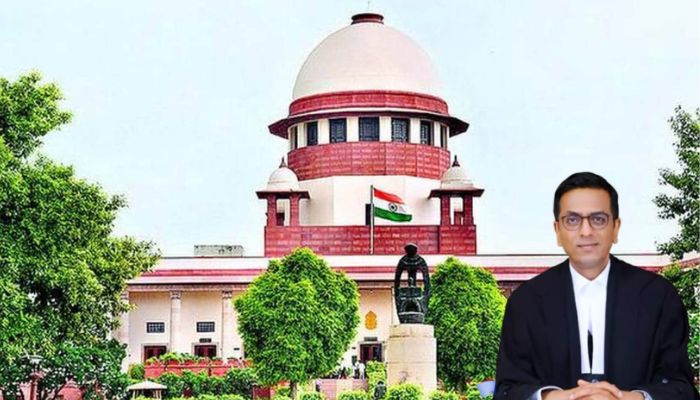
On Tuesday (September 5), 262 eminent citizens, including retired Justices, armed force veterans, former ambassadors, and bureaucrats wrote a letter to the Chief Justice of India (CJI) DY ChandraChud regarding Udhayanidhi Stalin’s recent remark where he compared Sanatan Dharma with diseases and called for its eradication.  

In the letter, these eminent citizens have requested the CJI to take the suo moto cognisance of hate speech by the son of Tamil Nadu CM MK Stalin. The letter states that his speech could incite communal disharmony and sectarian violence in the country. 

Notably, the list includes 14 retired judges including Former Chief Justice of Telangana High Court K Sreedhar Rao; 130 bureaucrats out of which 20 had served as ambassadors and 118 armed forces officers. 

Drawing attention to the incident, the 262 eminent citizens have emphasised that the remarks and subsequent developments have caused “anguish in the hearts and minds of common citizens of India” and it has hurt the sentiments of those who believe in Sanatan Dharma.

Highlighting the incident, they noted that a few days ago, Udhayanidhi Stalin, a serving Minister in the Tamil Nadu State Government, while addressing a press conference in Chennai stated, “Few things cannot be opposed, they should be abolished. We can’t oppose dengue, mosquitoes, malaria, or corona, we have to eradicate them. In the same way, we have to eradicate the Sanatana (Sanatan Dharma), rather than opposing it”. 

The letter to the CJI added that the Tamil Nadu Minister further deliberately remarked that Sanatana Dharma enslaved women and did not allow them to step out of their homes.

The letter cites the Supreme Court’s order to register the Suo Moto case in matters of hate speech

It noted that the Supreme Court in a writ petition(s) observed – “There cannot be fraternity unless different religious communities are amenable to live in harmony. Supreme Court expressed concern over the growing incidents of hate speeches in the Country and directed the governments and police authorities to take suo motu action in such cases without waiting for the lodging of formal complaints.”  

The letter pointed out that the Supreme Court stressed that such action is needed in order to preserve the secular character of the country. Further, any delay on the part of the administration in taking action on “very serious issues” will invite the court’s contempt.

Briefly touching on the importance of ‘Sanatan Dharma, the letter states, “It (Sanatan Dharma) is a set of duties incumbent upon all Hindus and has often been defined as an “eternal” that will always be relevant and gives the people of the Hindu faith, the freedom to choose the mode of worship of the Almighty of their choice.” 

The letter added that rather than apologising for hate speech, Udhayanidhi Stalin justified his remark and the clarifications he gave did not assuage the affected people. 

The letter added, “Not only did he make a hate speech but Udhayanidhi Stalin refused to apologise for his remarks. Rather he justified himself by stating: “I will say this continuously” with reference to his remark that Santana Dharma should be eradicated. He reiterated that he stands by his remarks and offered ambiguities and nuances that did little to address the concerns raised by people.” 

Stating that they were deeply concerned by Stalin’s remarks, the eminent citizens asserted that these remarks undeniably amounted to hate speech against a large population of India. They also argued that these remarks strike at the very core of the Constitution of India which envisages Bharat as a secular nation. 

The letter also pointed out that the rule of law was further undermined when the Tamil Nadu government refused to take any action against Udhayanidhi Stalin and rather chose to justify his remarks. 

Citing the Supreme Court’s order regarding hate speech, the eminent citizens requested that the apex court should register suo moto cases and the offenders should be punished in accordance with the law. Any hesitation to act as per the directions would be viewed as contempt of court, the letter noted.

Requesting to take suo moto cognizance of the alleged hate speech, the letter added, “Since the State Government has refused to take action and acted in contempt of the Court’s orders and gravely undermined or rather made a mockery of the rule of law, we urge the Hon’ble Supreme Court to take the suo moto notice of contempt, ensuring accountability for the inaction of the State Government of Tamil Nadu, and take decisive steps to prevent the inducement of hate speech, preserving public order and peace and we request you to take immediate appropriate actions.” 

Former Delhi High Court judge Justice SN Dhingra and IAS officer Gopal Krishna are the coordinators of the letter sent to CJI DY Chandrachud. It has also attached the list of 262 eminent citizens who have signed this letter to CJI. 

India announces 15-member squad for Cricket World Cup 2023; KL Rahul in, Samson out

0

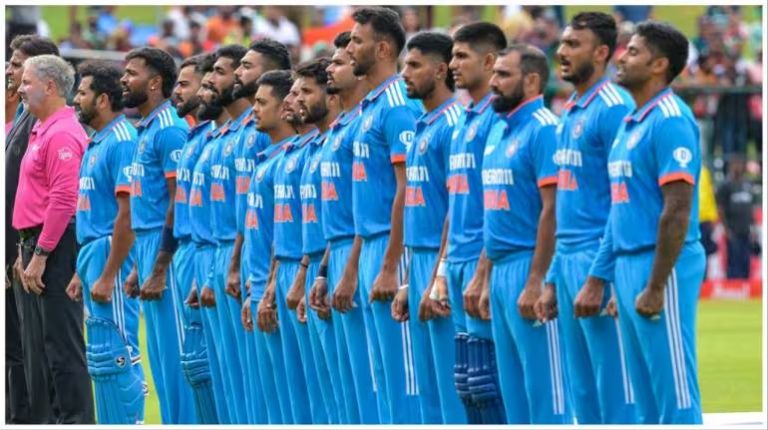
Indian captain Rohit Sharma and BCCI chief selector Ajit Agarkar announced the 15-member squad for the ICC men’s Cricket World Cup on Tuesday here in Kandy.

The squad is almost the same as the Asia Cup squad, Tilak Varma and Prasidh Krishna are excluded from the side.

India is going with four seamers Shardul Thakur, Jasprit Bumrah, Mohammad Shami, and Mohammed Siraj while three spinners Ravindra Jadeja, Axar Patel and Kuldeep Yadav.

Rahul injured his thigh earlier in the year at the IPL, though has been training at the National Cricket Academy in Bengaluru, and will likely join his India teammates during the latter stages of the Asia Cup in Sri Lanka. With Rahul in the squad, Sanju Samson has missed out, as well as Tilak Varma and Prasidh Krishna as other omissions.

Captain Rohit Sharma leads the batting group, with Shubman Gill, Virat Kohli, Shreyas Iyer and Suryakumar Yadav all named, as well as Ishan Kishan who provides another keeping option. All-rounders Hardik Pandya, Ravindra Jadeja, Axar Patel and Shardul Thakur have also been named in an emphasis on batting options.

After showing no signs of injury upon his return, Jasprit Bumrah spearheads the bowling group, with Mohammed Shami and Mohammed Siraj likely the first-choice pace group. Kuldeep Yadav is the side’s leading spin option.

The World Cup commences on Thursday, October 5 when 2019 finalists England and New Zealand clash at Narendra Modi Stadium in Ahmedabad, with the event culminating in the final at the same venue on Sunday, 19 November. India will start its campaign with a match against Australia in Chennai on October 8.

Ten teams will feature in this biggest Cricket World Cup ever, to be played across 10 venues from October 5 to November 19, with the Narendra Modi Stadium in Ahmedabad hosting the tournament opener and the final. The event will feature 48 matches to be played across 46 days.

The venues other than Ahmedabad and Chennai are Bengaluru, Delhi, Dharamsala, Hyderabad, Kolkata, Lucknow, Mumbai and Pune. While Guwahati and Thiruvananthapuram will join Hyderabad in hosting the practice games.

Eight teams have qualified for the 46-day event through the Cricket World Cup Super League while the final two spots were decided by the ICC Cricket World Cup Qualifier taking place in Zimbabwe. Sri Lanka and the Netherlands grabbed the two final spots in the tournament.

The top four teams will qualify for the semifinals, to be played in Mumbai on November 15 and in Kolkata on November 16. The final will be on November 19 in Ahmedabad. The semi-finals and the final will have reserve days.

Indian squad for World Cup: Rohit Sharma (Captain), Shubman Gill, Virat Kohli, Shreyas Iyer, KL Rahul, Ishan Kishan, Suryakumar Yadav, Hardik Pandya (vice-captain), Ravindra Jadeja, Axar Patel, Shardul Thakur, Jasprit Bumrah, Kuldeep Yadav, Mohammed Shami, Mohammed Siraj.

(This news report is published from a syndicated feed. Except for the headline, the content has not been written or edited by OpIndia staff)

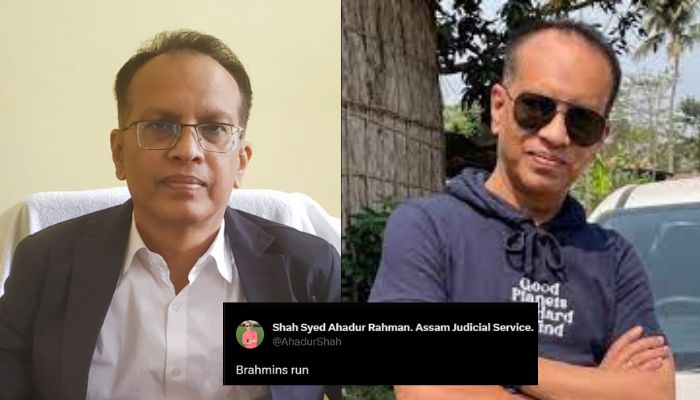
Brahmins run, Hindu terrorism, Indian army communal: Hateful tweets of Assam Sessions Judge Rahman go viral, was earlier not promoted for ‘doubtful integrity’

On Monday (September 4), an Assistant Sessions Judge named Shah Syed Ahadur Rahman, posted in the Udalguri district of Assam, came under fire after his tweets targeting the Hindu community and the Indian army went viral on social media.

A judicial officer of the Assam Judicial Service since 2002, Rahman had earlier served as Sub-Divisional Judicial Magistrate (SDJM) in the Sivasagar district of Assam.

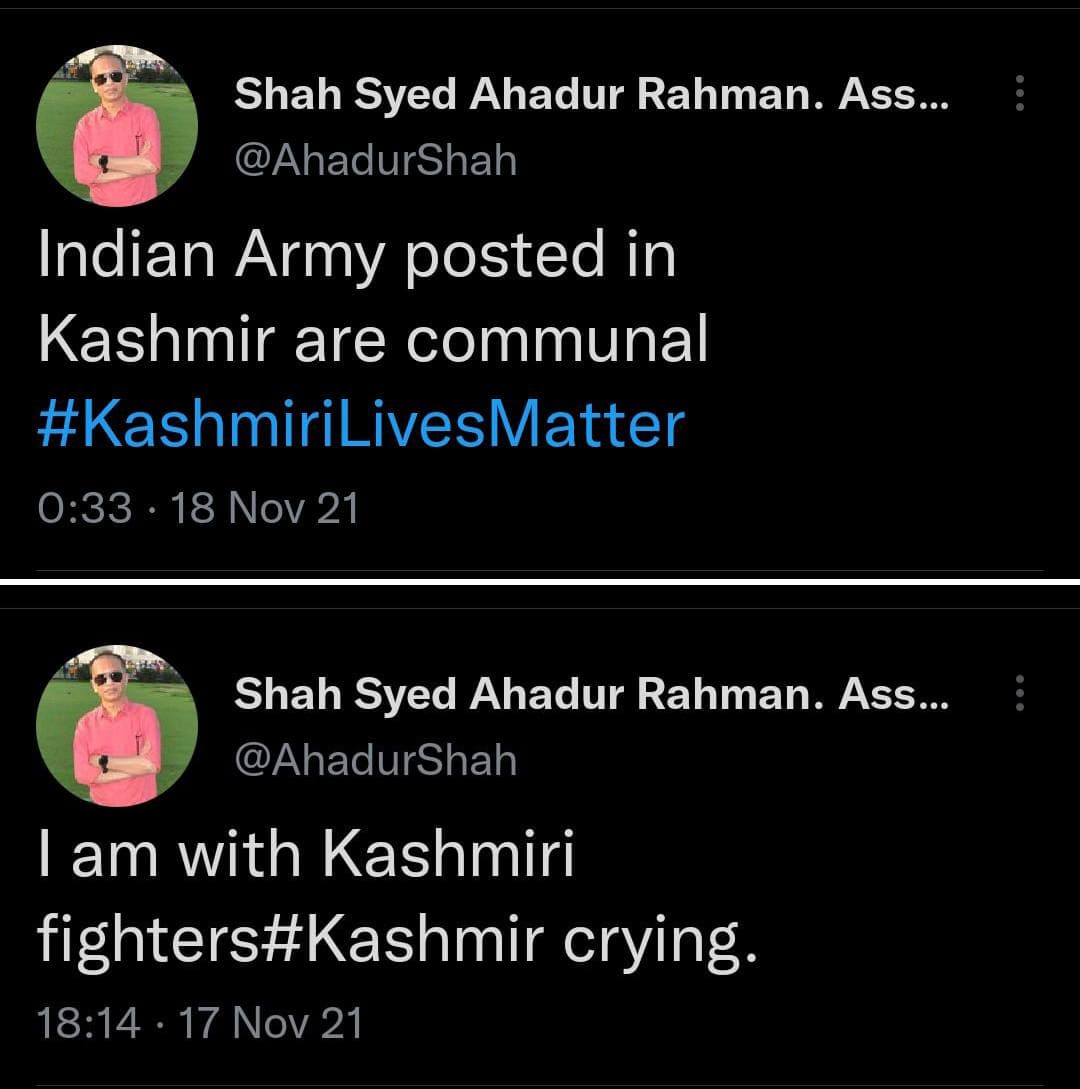
“Indian army posted in Kashmir are communal #Kashmir Lives matter,” he had claimed in a tweet in November 2021. The Assistant Sessions Judge (Udalguri) had also expressed his support for Kashmiri ‘fighters.’

Tweets by Shah Syed Ahadur Rahman

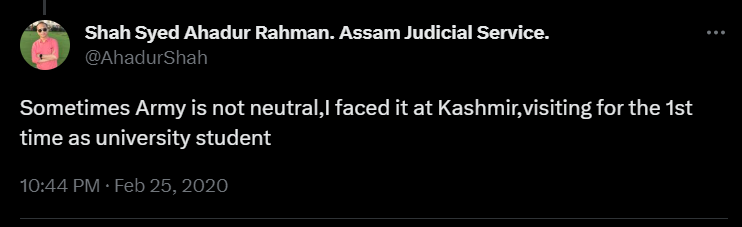
Shah Syed Ahadur Rahman was also seen casting aspersions on the integrity of the Indian armed personnel, posted in the Union territory of Jammu and Kashmir. “Sometimes the army is not neutral. I faced it in Kashmir, visiting for the 1st time as a university student,” he had alleged.

Tweet by Shah Syed Ahadur Rahman

Attacks on Hinduism

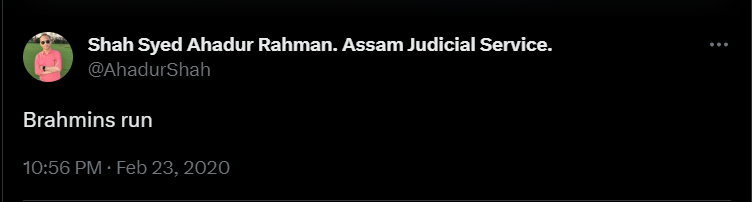
Besides spreading canards against the Indian army, he was also seen targeting the Hindu community. “Brahmins run,” the Assistant Sessions Judge had tweeted on the day the anti-Hindu riots broke out in the National Capital.

Tweet by Shah Syed Ahadur Rahman

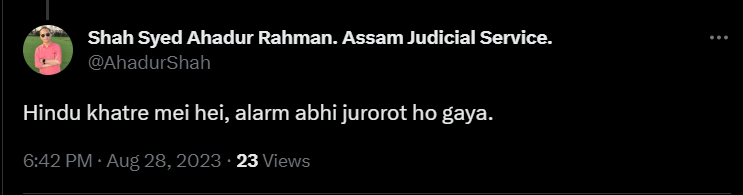
Shah Syed Ahadur Rahman was also seen downplaying the insecurities of the Hindu community, following the onslaught of Islamists. “Hindu khatre mein hai, alarm abhi jurorot ho gaya (Hindus are in danger, an alarm is the required now),” he mocked.

Tweet by Shah Syed Ahadur Rahman

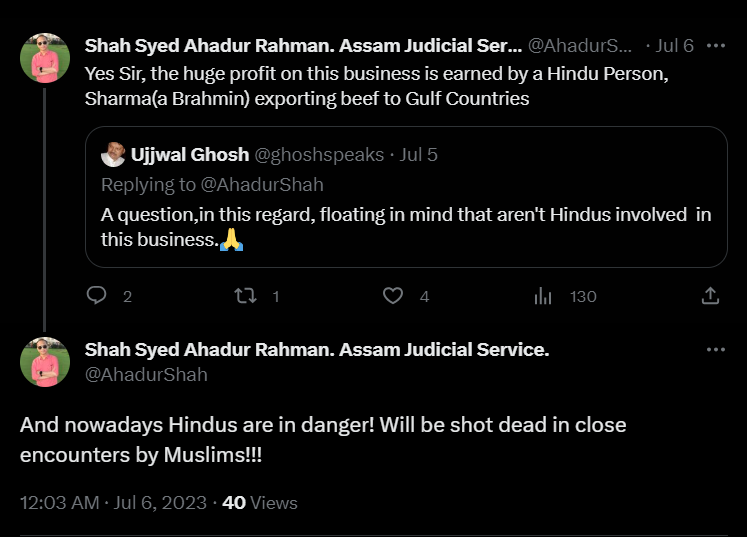
He was also seen peddling the false claim that India is exporting beef (referring to cow meat) to Gulf countries and that Hindus are at the helm of such businesses. In reality, only carabeef (buffalo meat) is exported from India, a fact that was reiterated by BJP Minister Nirmala Sitharaman way back in 2017.

“And nowadays Hindus are in danger! Will be shot dead in close encounter by Muslims,” Rahman claimed in a tweet in July this year.

Tweet by Shah Syed Ahadur Rahman

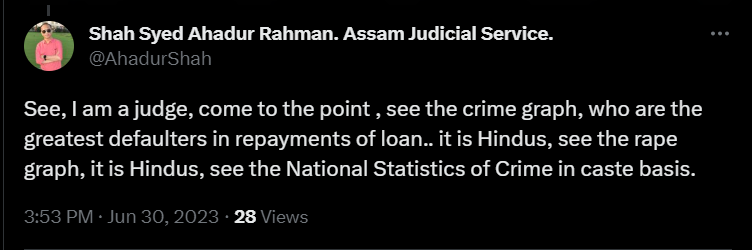
The prejudiced Assistant Sessions Judge also claimed that the Hindu community is responsible for defaults in loan repayments and rapes. “See the National Statistics of Crime in caste basis,” he gave a glimpse into his disturbing mindset.

Tweet by Shah Syed Ahadur Rahman

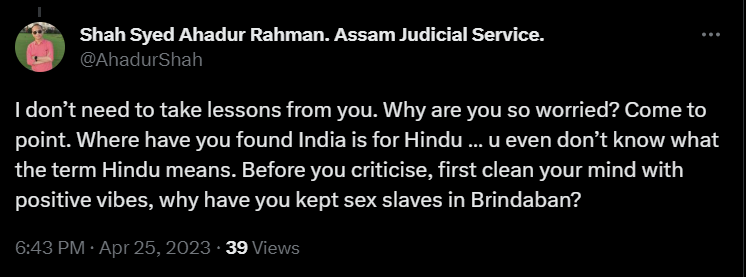
While responding to a Hindu handle on Twitter, he made a derogatory assertion, “Before you criticise, first clean your mind with positive vibes, why have you kept sex slaves in Brindaban.”

Tweet by Shah Syed Ahadur Rahman

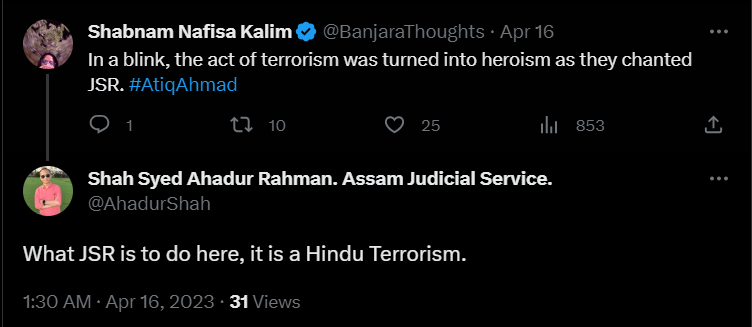
Shah Syed Ahadur Rahman was also seen labelling the assassination of notorious criminal and gangster, Atiq Ahmed, as an act of ‘Hindu terrorism.’

Tweet by Shah Syed Ahadur Rahman

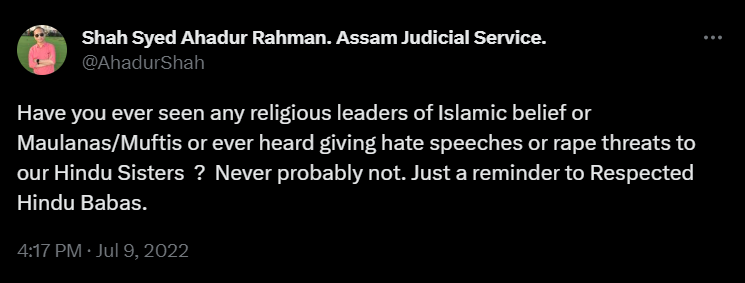
The Assistant Sessions Judge was also seen spewing hatred against Hindu spiritual leaders. He claimed that Islamic clerics have never been involved in hate speeches or gave rape threats to Hindu women.

“Just a reminder to respected Hindu babas,” Rahman suggested that it was such remarks were common among the spiritual leaders of the Hindu community.

Tweet by Shah Syed Ahadur Rahman

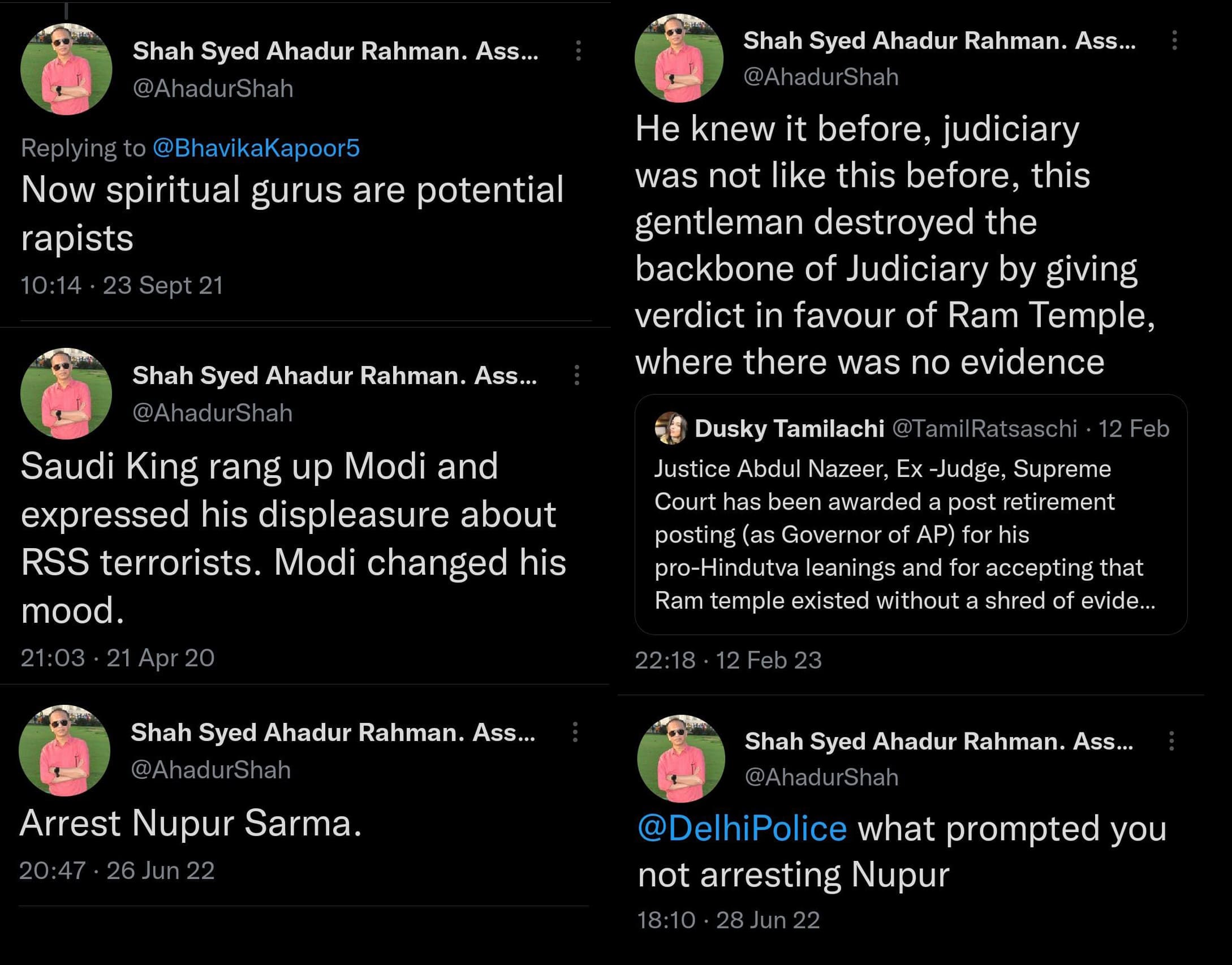
“Now spiritual gurus are potential rapists”, he had also said in another tweet.

Political commentary by a sitting Judge

Shah Syed Ahadur Rahman, who serves as the incumbent Assistant Sessions Judge of Udalguri, was seen making political statements on social media, hounding former BJP spokesperson Nupur Sharma and even casting aspersions on the character of Justice Abdul Nazeer for the Ayodhya verdict.

“Saudi King rang up Modi and expressed his displeasure about RSS terrorists. Modi changed his mood”, he claimed in a tweet. Just like his co-religionists, Rahman was seen hounding ex-BJP leader Nupur Sharma on social media. “Arrest Nupur Sharma”, he tweeted.

“Delhi police what prompted you not arresting Nupur,” he said in another tweet.

Tweet by Shah Syed Ahadur Rahman

In February this year, Shah Syed Ahadur Rahman was seen engaging in the character assassination of a retired Supreme Court judge over the Ram Janmabhoomi verdict.

“He (Justice Abdul Nazeer) knew it before, judiciary was not like this before, this gentleman destroyed the backbone of judiciary by giving verdict in favour of Ram temple, where there was no evidence,” he tweeted.

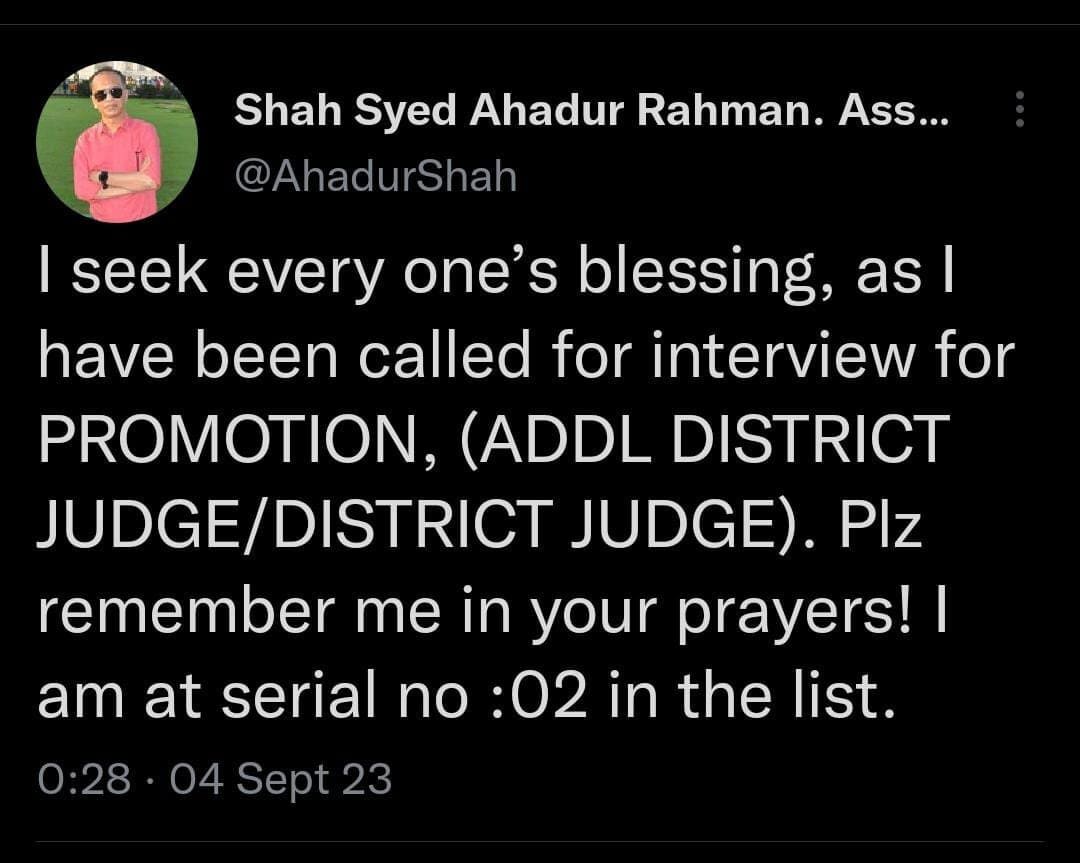
Interestingly, on Monday (September 4), Rahman took to the social media platform to inform that he is being considered for the position of additional district judge/ district judge.

Screengrab of the tweet

‘Doubtful integrity’ of Shah Syed Ahadur Rahman

OpIndia found that he had moved a petition before the Gauhati High Court in March 2015 after he was not considered for promotion from Grade III officer to Grade II in the Assam Judicial Service in 2011.

His name did not feature in the list for promotion in 2012 due to ‘doubtful integrity.’ The authorities were also asked to keep Rahman under watch.

“ACRs (Annual Confidential Rolls) of 2009, 2010 and 2011 were communicated to the petitioner. Petitioner was graded “good” in the years 2009 and 2010. In the year 2011, he was graded as “average” with the remark “integrity: doubtful”. There was a further remark of the accepting authority to keep the petitioner under watch,” it said.

Later, the remark ‘integrity: doubtful’ was somehow expunged but the direction to authorities to keep him under watch was upheld in the Annual Confidential Roll.

After being questioned over his anti-Hindu antecedents on Monday (September 4), Shah Syed Ahadur Rahman cried foul and claimed that he has many friends from the Hindu community. “My maximum friends are from Hindu community,” he said.

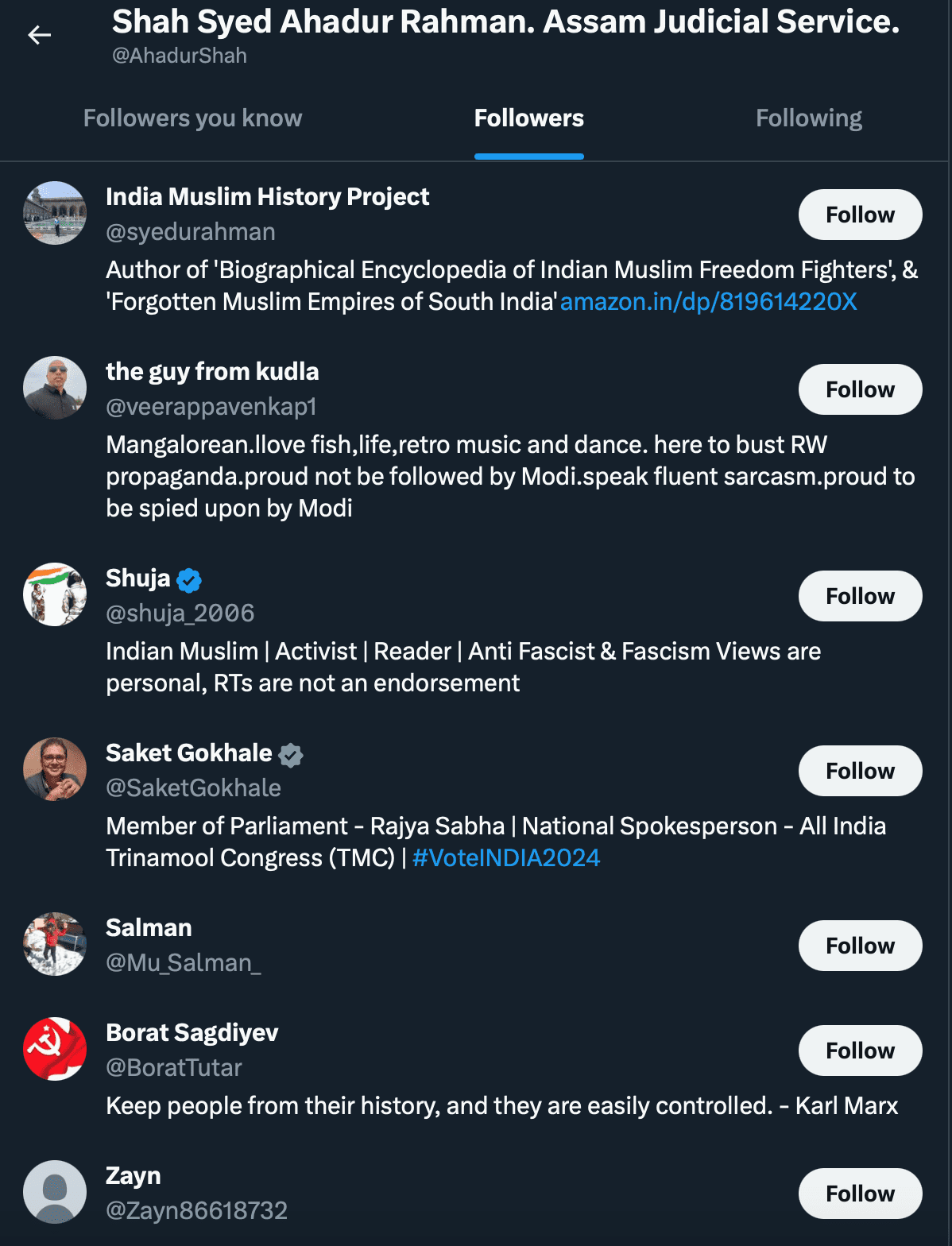
Screengrab of the followers’ list of Shah Syed Ahadur Rahman

As expected, Rahman is followed by the likes of Trinamool Congress leader and Rajya Sabha member, Saket Gokhale. He was earlier arrested by the Enforcement Directorate in the crowdfunding fraud case.

‘Republic of Bharat’: Assam CM tweets amid media buzz over govt planning to ‘rename’ India as Bharat

The announcement of a special session of Parliament from 18 to 22 September has created a lot of buzz in media and political circles. Speculations are rife that the government can bring a set of bills which according to many could be the Women reservation bill, ‘One Nation, One Election’ bill, Uniform Civil Code (UCC), or repealing laws like the Places of Worship Act, Waqf Act, or others. 

Amid all of this, Assam CM Himanta Biswa Sarma’s post on Twitter (X), has added to the already spreading media speculations. Taking to X, Sarma wrote, ‘Republic of Bharat’, adding that he is happy and proud that our civilization is marching ahead boldly towards Amrit Kaal.

It is pertinent to note that Assam CM Sarma had earlier changed his Twitter bio from Assam CM, India to Assam CM, Bharat. Highlighting this change, he shared a post explaining the reasoning for the same. 

Furthermore, Times Now, citing sources, too has claimed it is likely that India could be ‘renamed’ as Bharat. 

Additionally, Congress media in-charge Jairam Ramesh shared a purported invite in which the President has been referred to as ‘President of Bharat’. The letter shared by some social media handles, states that the ‘President of Bharat’ requests the pleasure of the company, followed by the name of the invitee, at dinner on September 9. It is said to be on the occasion of the G20 Summit in New Delhi. 

Regarding this, Congress leader Ramesh said, “So the news is indeed true. Rashtrapati Bhawan has sent out an invite for a G20 dinner on Sept 9th in the name of ‘President of Bharat’ instead of the usual ‘President of India’.”

Additionally, two days back, RSS Chief Mohan Bhagwat had urged the citizens to use the name ‘Bharat’ instead of India.

There have been voices that have been demanding that India should be ‘renamed’ Bharat to revive the civilizational connection and for this, many MPs have raised this issue in the Parliament. Evidently, during the Monsoon session of Parliament, BJP MP Naresh Bansal claimed that the name of the country, as mentioned in the Constitution, should be changed from ‘India, that is, Bharat’ to Bharat.

However, there is no official confirmation yet on what could be the agenda for the 5-day sitting in the special session of Parliament. Though it is not the first time that a special session of Parliament has been called, it has created a strong buzz regarding the introduction of some major legislative changes this time. 

NIA convicts ISIS terrorists Atif and Faisal for the murder of retired principal Ram Shukla in 2016, had shot him after noticing his Kalawa and Tilak

0

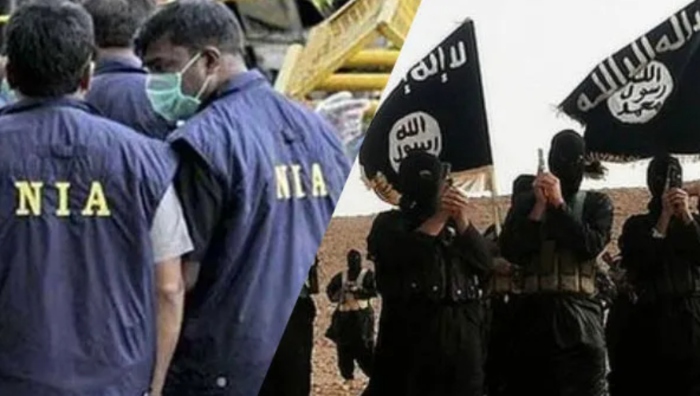
On Monday, September 5, the special court of the National Investigation Agency (NIA) in Lucknow convicted two highly radicalised ISIS terrorists Atif Muzaffar and Mohammad Faisal Khan. The duo are guilty of the murder of a retired school principal Ram Babu Shukla that took place in Kanpur in 2016. The court also found them guilty of promoting the agenda of the terrorist organisation ISIS.

A report by the Hindi daily Jagran revealed how the innocent principal was targeted only because of his religious identity. It read that the duo had reportedly shot the retired Hindu teacher in broad daylight after seeing a Kalawa on his wrist and a Tilak on his forehead. Moreover, the terrorists simply carried out the killing because they wanted to test the new pistol they had recently acquired from their handlers and also because they wanted to instil fear amongst the non-Muslims.

A Vishnapuri resident named Ramesh Babu Shukla was killed on October 24, 2016, while he was returning home on his bicycle. The terrorists attacked him when he reached the Pyondi village. At first, the police began investigating the case as a simple murder case and registered a case against unknown people.

Meanwhile, in March 2017, a deadly blast happened on the Bhopal-Ujjain passenger train.  The train explosion on March 7, 2017, left 10 injured. This case was also investigated by the NIA. The breakthrough in the ISIS-backed criminal conspiracy case came when the main accused Mohammad Faisal Khan was arrested for his involvement in the Madhya Pradesh train explosion of March 7, 2017. Disclosures made by him led to the arrest of his other associates including Atif Muzaffar.

In March this year, the NIA court awarded death sentences to Atif, Faisal, and five others in a terror conspiracy case registered in 2017. Another accused, Mohammad Atif, was given life imprisonment in the case. Atif Muzaffar and Mohammad Faisal Khan’s role in the murder of Ramesh Babu Shukla (60), the retired Kanpur principal, came to light during their questioning in this train blast case.

The NIA court, meanwhile, has charged Atif Muzaffar and Mohammad Faisal Khan under the sections of IPC 320 (murder) and 120 (B) (criminal conspiracy) along with sections of the Unlawful Activities Prevention Act (UAPA) and the Arms Act. The court will pronounce the quantum of punishment in the case on September 11.

On September 4, NIA in a press release stated that the chargesheet filed against the convicts Atif Muzaffar and Mohammad Faisal Khan in 2018 revealed that they had been radicalised by the ISIS ideology and were out to kill whom they believed to be ‘Kafirs’ (disbelievers).

“Investigations by NIA revealed that the accused were operating under the influence of ISIS, a proscribed terrorist organisation. They had conspired to carry out terrorist activities (Jihad) in India by targeting non-Muslims through violent acts. In furtherance of their conspiracy to promote the ISIS ideology & agenda, they murdered Shukla to strike terror and alarm in the minds of the common people,” the NIA press note read.

Earlier, on March 7, 2017, the third accused in the case, Mohammad Saifulla, was neutralised in a confrontation with the Anti-Terrorist Squad of Uttar Pradesh.

The convicts killed the Hindu teacher after identifying his religious identity

During interrogation in the Bhopal-Ujjain passenger train blast case, the arrested ISIS terrorists revealed that two of their associates- Atif Muzaffar and Mohammad Faisal Khan, along with Mohammad Saifullah, had murdered the retired Principal Ramesh Babu Shukla to strike terror in the minds of the ‘Kafirs’ and increase the influence of ISIS.

Atif Muzaffar and Mohammad Faisal also confessed during questioning that they wanted to instil terror in the minds of non-Muslims and strengthen ISIS’ influence. They further added that they had been brand-new guns by their handlers so he decided to murder someone to test it out.

The two approached Ram Babu Shukla on the fatal day of October 24, 2016, while he was riding his bicycle back. They recognized him as a Hindu when they noticed that he was wearing a tilak on his forehead and a Kalava on his wrist. Shukla was questioned about his name. The two shot the former principal with their revolver and fled the scene as soon as he revealed his name and that he was a Hindu.

The NIA recovered the pistol used in the murder from Hyde House, Lucknow. The bullet recovered from the body of the Principal was tested at FSL Chandigarh. On examination it was found that Ramesh Babu Shukla was killed by the bullet fired from the pistol recovered from Hyde House.

Rajasthan: Congress leader Aradhana Mishra stops workers from raising ‘Bharat Mata ki Jai’ slogans, asks for ‘Congress Zindabad’

0

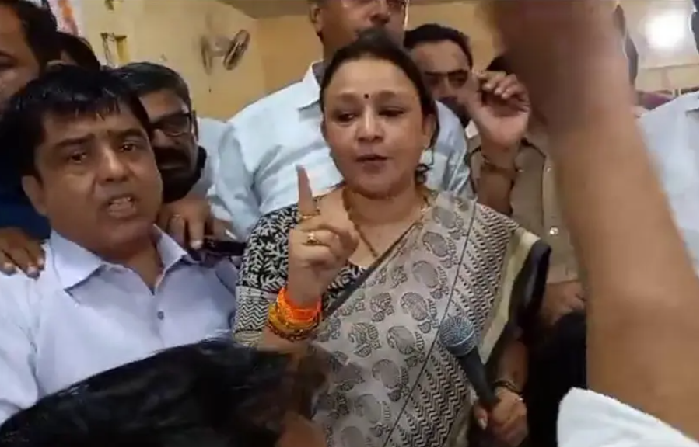
On Monday, September 4, a massive row erupted during the Block Congress Meeting in Jaipur, Rajasthan in the presence of Congress invigilator Aradhana Mishra (Mona Tiwari) and City Congress President RR Tiwari. Congress workers engaged in a brawl and raised loud slogans against each other. They also raised slogans of ‘Bharat Mata ki Jai’. Mishra was then heard stopping the Congress workers from raising the slogans of ‘Bharat Mata ki Jai’ and asking workers to raise slogans of ‘Congress Zindabad’ instead.

The incident took place just months ahead of the 2023 Rajasthan Legislative Assembly election.

According to the reports, the saga began in Jaipur’s Adarsh ​​Nagar Block Congress meeting as two groups of Congress workers began fighting with each other. Aradhana Mishra (Mona Tiwari), the district supervisor of Jaipur and a Congress legislator from Uttar Pradesh, and the city president RR Tiwari had turned up at the Congress gathering at the Janata Colony community center for discussions with the candidates.

The situation worsened after Congress leader Mohammed Afzal, who is scheduled to contest from Adarsh ​​Nagar assembly, opposed the appointment of Block Congress President Ghulam Mustafa.

Afzal opposed the appointment of block president Ghulam Mustafa, who was a BJP worker earlier. He asked how Mustafa, who earlier was part of the BJP, could be made the block president. The Block President and his supporters then had an altercation with Afzal and his supporters.

Meanwhile, an altercation is also said to have happened between the supporters and opponents of MLA Rafiq Khan in the Adarsh ​​Nagar assembly constituency.

The Congress workers created chaos and also raised slogans against each other’s leaders. They also engaged in a brawl resulting in injuries. Mishra then attempted to pacify the matter and asked the workers to maintain peace.

She also stopped the workers from raising slogans against each other. Later, the workers began raising slogans of ‘Bharat Mata Ki Jai’ to which Mishra said that if they (workers) were so fond of raising slogans, they should raise slogans of ‘Congress Zindabad’.

A case has been registered in the matter against four Congress workers including Adarsh ​​Nagar Block president Ghulam Mustafa.

The incident took place ahead of the Rajasthan Legislative Assembly election which is scheduled to be held in November 2023. Elections will be held to elect all 200 members of the state’s Legislative Assembly.

‘Global tech superpower’: CEO of NVIDIA Jensen Huang meets PM Modi, highlights the AI giant’s growing partnership with India

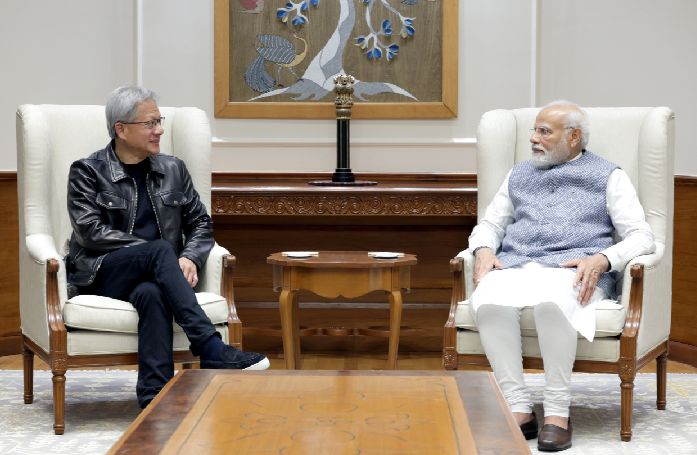
On Monday, September 4, Nvidia CEO Jensen Huang met with Prime Minister Narendra Modi and had an extended conversation about the enormous potential that India has in the field of artificial intelligence.

PM Modi highlighted that Jensen Huang valued the advances India had achieved in the field of artificial intelligence. “Had an excellent meeting with Mr. Jensen Huang, the CEO of Nvidia. We talked at length about the rich potential India offers in the world of AI. Mr. Jensen Huang was appreciative of the strides India has made in this sector and was equally upbeat about the talented youth of India,” PM Modi wrote on Twitter (X) on September 4.

The US-based technology company, Nvidia also posted about the meeting on Twitter (X) and indicated that this was the second meeting between the company’s CEO Jensen Huang, and PM Modi.

“Our CEO met with Indian Prime Minister Narendra Modi, underscoring the growing partnership between our company and the global technology superpower. At this second meeting between Modi and Huang, applications of AI and leveraging the nation’s talented youth were discussed,” the company’s official handle tweeted.

Notably, this meeting comes as PM Modi prepares to host a conference of international leaders from the G20 group, including US President Joe Biden, later this week.

In its official statement, the company also stated that after meeting PM Modi, Huang had a casual meal with several dozen scholars and researchers from global science and technological powerhouses such as the Indian Institute of Science and the several campuses of the Indian Institute of Technology.

“The evening’s discussions ranged across topics from the use of technology to address language barriers, improve agriculture yields, bridge gaps in health care services and transform digital economies — as well as addressing some of the grand scientific challenges of our time,” the official statement read.

Jansen Huang started the US-based technology startup Nvidia in 1993 with the goal of bringing 3D graphics to the gaming and multimedia markets. According to the corporate statement, Jansen Huang has been the company’s chief executive officer and a member of its board of directors since its inception.

NVIDIA launched its operations in India nearly two decades ago in Bangalore in 2004. India now has four engineering development centers — in Gurugram, Hyderabad, Pune, and Bengaluru, and there are over 3,800 employees working for the company in the country.

Furthermore, NVIDIA’s developer program has around 320,000 India-based developers. In India, the CUDA parallel programming platform from NVIDIA is downloaded about 40,000 times a month, and the country is home to, according to NVIDIA, 60,000 seasoned CUDA developers.

“That growth comes as India’s government continues to expand the nation’s information technology infrastructure,” the company’s official statement read.

Earlier in June, Prime Minister Modi emphasized the need for G20 nations to balance the benefits and difficulties provided by digital technology, which he described as a force multiplier in boosting access to education and adapting to future needs.

PM Modi addressed a G20 Education Ministers’ Meeting in Pune by video message, mentioning the promise of artificial intelligence in the fields of learning, skilling, and education.

The Prime Minister emphasized that G20 countries can play a critical role in fostering research and innovation, particularly in the Global South. He asked the dignitaries to pave the way for more research collaborations.

He also stated that ongoing skilling, re-skilling, and up-skilling are critical to preparing youth for the future, stressing that education is not only the foundation on which India’s civilization was built but also the architect of humanity’s future.

In order to underscore the importance of research and innovation, the Prime Minister stated that India has established 10,000 ‘Atal Tinkering Labs’ across the country that serve as research and innovation nurseries for our schoolchildren. In these labs, he said, more than 7.5 million pupils are working on more than 1.2 million innovative ideas.

‘We view that as a great possibility’: India to be invited to the next trilateral summit by Israel, Greece, and Cyprus as they look to boost energy cooperation

0

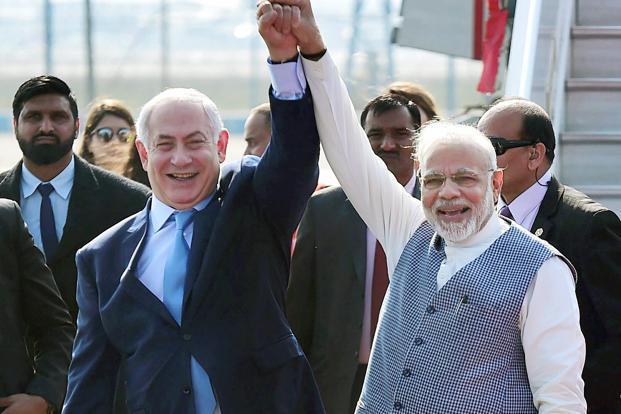
India will be invited to the next trilateral summit which includes Israel, Greece, and Cyprus. During the joint press conference on 4th September (Monday) at the 9th Trilateral Summit, the three member nations announced that work is in progress to establish a “3+1” format and that India could be a part of the same in the next summit.

Greek Prime Minister Kyriakos Mitsotakis said the country is interested in a natural gas export partnership with countries like India. Israeli Prime Minister Benjamin Netanyahu too spoke about plans to expand the 3+1 format of the summit beyond the United States and include India. He said, “There’s something else that could develop, and we discussed it at great length.”

Netanyahu also added that India’s role has been viewed as a great possibility by all three countries. “All three countries view that as a great possibility, but they also see that this could lead to a connection between India, the Arabian peninsula, Israel, Cyprus, Greece, Europe. There is a natural…there is a geographic connection but it could be also something that would lead to many rewards for our peoples and our countries.”

Cyprus President Nikos Christodoulides said they reaffirmed “our strong commitment to the 3+1 format with the United States and agreed on the value of intensifying 3+1 cooperation, with concrete deliverables also with other countries and we talked specifically about India.”

The development has highlighted India’s significant role in global energy cooperation. In the joint statement, the leaders said that their engagement reflects their shared values and ever-increasing common interests, aiming to contribute to peace, stability, security, and prosperity in the Eastern Mediterranean and the wider region.

“Our three countries remain committed to welcoming other like-minded parties in our resolute effort to create and advance synergies, to the benefit of our countries and peoples, as well as of our region,” the statement reads.

Both Israel and Cyprus are attempting to join forces and export natural gas to the European mainland. All three nations are working to promote “energy synergies” like electricity interconnectors and a possible natural gas pipeline.

Salangpur Temple controversy: Swaminarayan sect removes Lord Hanuman murals after meeting with Hindu saints under VHP’s initiative

On 5th September, the Salangpur Temple controversy ended after the temple administration removed the Lord Hanuman murals in the wee hours. Notably, on 4th September, the saints of the Swaminarayan sect and other saints of Hinduism met at Ahmedabad and decided to remove the disputed murals before sunrise on 5th September. The meeting was organized by Vishva Hindu Parishad (VHP).

Shri Kashtbhanjan Temple where the controversy erupted is located at Sarangpur in Botad district of Gujarat. The temple is one of the most prominent temples of Swaminarayan sect. The disputed murals were installed as part of the renovation and beautification of the temple premises. A 54-feet idol of Lord Hanuman was installed and murals were placed around it.

The process to remove the murals started late at night on 4th September. The lights were shut off in the temple premises, and curtains were erected around the murals amid tight police security. New murals were added to replace the disputed ones.

Saints announced the removal of disputed murals on 4th September

On 4th September, the Salangpur Temple administration announced that they would remove the disputed mural of Lord Hanuman by the 5th of September morning. The decision was taken during a meeting of saints where Vadtal Swaminarayan Sanstha assured that the murals would be removed. An official statement on the matter was released following the meeting.

As per reports, the meeting was organised by Vishva Hindu Parishad (VHP). The saints and Vadtal Temple saints met at Shivanand Ashram to discuss the matter. In the two-hour meeting, they decided to remove all the disputed murals by the morning of 5th September.

Furthermore, VHP said they would meet different sects of Swaminarayan Sampraday and saints and acharyas of the Hindu religion to solve other controversies to ensure Hindus function as one community.

Saints and Hindu leaders met at Gandhinagar in the presence of Gujarat Chief Minister Bhupendra Patel and Home Minister Harsh Sanghvi. They came to a resolution to solve the controversy as soon as possible.

Salangpur Temple mural controversy

On 2nd September, it was reported that a controversy erupted in Gujarat over the murals depicting Lord Hanuman in Salangpur, where the Hindu deity is portrayed as a servant of Sahajanand Swami. There was a lot of opposition to this on social media, so saints of Sanatan dharma came ahead to protest this display of God as a servant of a Saint. Many Hindu saints and mahants publicly expressed their anger, including Morari Bapu, famous saint Harshad Bharti Bapu, and Mahant Manidhar Bapu of Kabrau Mughal Dham in Kutch.

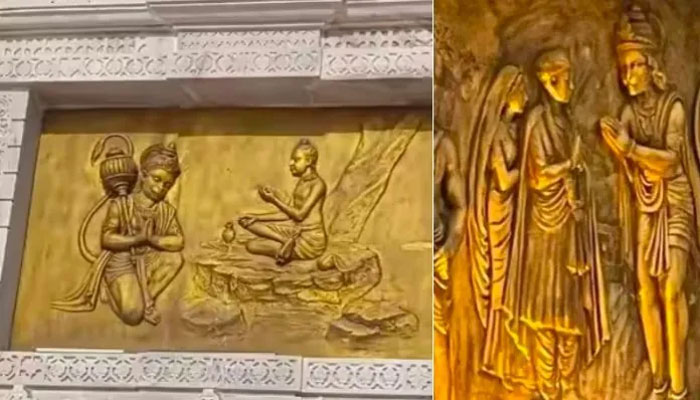
The Swaminarayan sect, which is divided into various factions, venerates Sahajanand Swami (1781-1830) as Lord Swaminarayan, around whom the sect coalesced. The Hanuman temple in Salangpur, under the management of the Vadtal Gadi faction, erected an impressive 54-foot-tall statue of Hanumanji Maharaj. On the base of the statue, numerous murals were created. However, in the murals, Hanumanji has been depicted as a devoted disciple of Sahajananda Swami.

In these murals, Hanumanji is portrayed standing before Sahajananda Swami, displaying deep reverence with folded hands in a salutation pose. Another mural depicts Hanumanji seated in an asana, once again with hands folded in a gesture of profound respect. Controversy ensued when images of these murals began to circulate widely.