On September 7, a case of gang rape of a girl who belongs to the Dalit community has come to light from Uttar Pradesh’s Bareilly district. As per the information received, a complaint has been lodged in this matter, and a girl named Shifat Ansari, who happens to be the victim’s ‘friend’, along with two other individuals, Shoaib and Nadeem, has been named as the accused. The incident is said to have occurred on Saturday (2 September 2023).
The Bareilly police have taken to X, formally Twitter, to inform that they have taken cognisance of the incident and a case has been registered against the accused under relevant sections at the Baradari SPS in Bareilly.
प्रकरण के सम्बन्ध में थाना बारादरी,बरेली पर सुसंगत धाराओं में अभियोग पंजीकृत कर अग्रिम विवेचनात्मक कार्यवाही प्रचलित है।
According to the complaint, it is alleged that the victim girl was asked to come to a hotel where two Muslim men Shoaib and Nadeem forced her to eat beef and consume spiked cold drinks. After intoxicating the victim, Shifat recorded the obscene video while the victim was being gang-raped by the two accused. It is also alleged that on the basis of the obscene video, the three accused blackmailed her and demanded Rs 5 lakh.
Following the complaint, the Police have registered a case in this matter. Currently, Police officials are interrogating Shifat and her male companions who are in custody.
According to media reports, the matter pertains to Baradari police station in Bareilly. In the complaint, the victim stated that she was acquainted with a girl named Shifat Ansari who is said to be a resident of Hussainbagh.
As per the victim, a few days ago, Shifat claimed that she had some important work lined up and borrowed Rs 30 thousand from her.
The victim added that on September 1, when she asked Shifat to return the money she had borrowed from her, Shifat asked her to meet her the next day (2 September) at Tapri Cafe in Didipuram. When she reached there, Shoaib and Nadeem were already present alongside Shifat. After some time, citing some important work, all three went to the Rajni Hotel and asked the victim to come there and collect the money.
Two hours later, when the victim reached Rajni Hotel, the receptionist told her that there had been a change in the room and asked her to go inside. Shoaib and Nadeem were present inside the room alongside Shifat.
They made the victim consume a cold drink that was laced with intoxicants and in an inebriated condition, the three fed her beef kebabs.
When the victim became unconscious, Shoaib and Nadeem raped her. When she regained consciousness, they informed her that they had recorded obscene videos of the victim while she was being gang-raped.
They said, “We have corrupted your religion. Now you forget your Rs 30 thousand and bring us Rs 5 lakh from anywhere.” They threatened her that if she failed to give them Rs 5 lakh, they would make her obscene video viral.
When the victim failed to raise the amount, the three accused sent her objectionable video to her fiance. It is further alleged that the accused pressurised the victim to have physical relations with other Muslim youths.
According to the information received, the accused Shoaib is a student of B Pharma, while Nadeem runs a salon and their friend Shifat Ansari is a class 12 pass-out.
प्रकरण के सम्बन्ध में थाना बारादरी,बरेली पर सुसंगत धाराओं में अभियोग पंजीकृत कर अग्रिम विवेचनात्मक कार्यवाही प्रचलित है।
Responding to a social media user who demanded strict action in the case and highlighted the media report regarding the heinous crime, Bareilly Police responded by stating that a case had been registered under relevant sections at Bareilly’s Baradari Police Station.
“The victim has filed a case against her friend who hails from another religion and two of her companions. The accused are being interrogated. Action will be taken after a medical examination of the girl and her statement in court”, CO Ashish Pratap Singh said.
According to Singh, the accused were preparing to flee to Kashmir where Nadeem has a salon. Based on the complaint, an FIR has been registered against the three accused under sections of the SC/ST Act, gangrape, intimidation, and extortion.
A 26-year-old (19 to some accounts) woman of the tribal community in the Jashpur district was gang-raped by two men named Saddam Khan and Imtiaz alias Sonu Ali on 4 September. Notably, both accused, who are between the ages of 25 and 28, are associated with the National Students’ Union of India (NSUI). They are residents of the Kusmi area in Balrampur district.
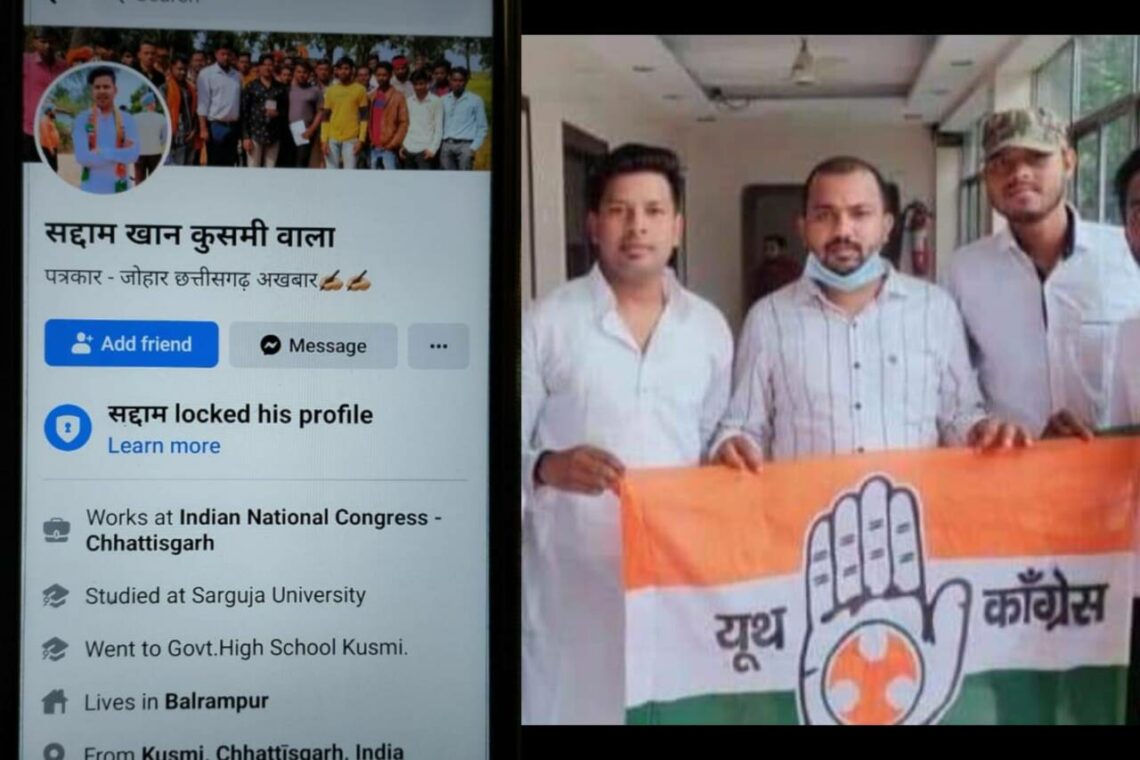
Saddam Khan (Source: Organiser)
The matter pertains to the Bagicha police station area. The victim woman is from Manoharpur and is employed as a teacher in a private school located in the Shankargarh neighbourhood. The pair took her under the pretence of going to the Dangari Waterfall. They were already familiar with her. Police are searching for the accused who are presently absconding.
She made friends with about three to four males on social media and eventually started interacting with them frequently. She complied politely when they requested her to show them the waterfall located in the city on 4 September.
Police stated that both perpetrators visited the waterfall along with the victim posted in a private school in the Jashpur district. All three were well-acquainted and used to talk on the phone as well. She, therefore, joined them as friends.
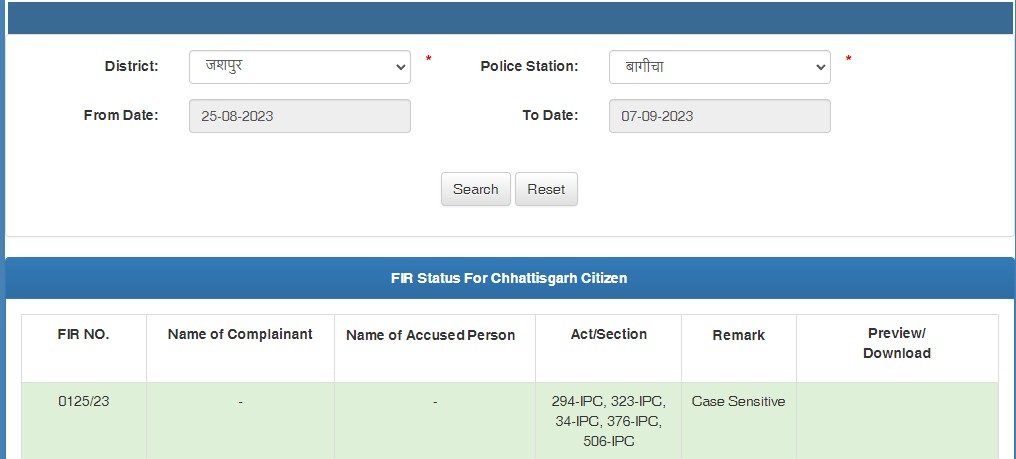
Details of the FIR. (Source: Organiser)
After exploring the waterfall, the trio wandered around in a nearby desolate area which had bushes of wild plants, based on her statement. Their intentions turned wicked when they saw the alone woman and started molesting her. When she refused, the duo physically assaulted and gang-raped her.
They threatened her with life if she disclosed details about the episodes to anyone and fled from there. She managed to get to the Pandrapat police station along with her relatives and report the occurrence out of fear. A case was registered there and forwarded to the Bagicha police station.
They have been booked under Indian Penal Code sections 376 (rape), 506 (criminal intimidation), 323 (voluntarily causing hurt), 294 (obscene acts), and 34 (common intention). Bagicha police station in-charge Akhilesh Singh informed that the police team reached Kusmi to look for them, but they could not be found. Teams have reportedly been deployed to apprehend them and they would soon be arrested.
Bharatiya Janata Party member of Parliament (MP) Gomti Sai has attacked the Congress and demanded that the perpetrators must be arrested as soon as possible and locked behind bars. Accused Saddam Khan was a former secretary of the Youth Congress and social media in-charge as well, per District Panchayat President Raimuni Bhagat.
He is seen with Congress leader and Jashpur MLA Vinay Bhagat in multiple images on the internet. She proclaimed, “Vinay Bhagat needs to respond to this and Congress should apologise.”
The political war of words around Udhayanidhi Stalin’s slanderous remarks against Sanatan Dharma is not going to end anytime soon as BJP has ramped up its attack against Dravida Munetra Kazhagam (DMK). K Annamalai, the chief of the Tamil Nadu unit of the Bhartiya Janata Party (BJP) has called for the eradication of DMK, calling it “Dengue, Malaria and Kosu.” This was response to Udaynidhi Stalin comparing Sanatan Dharm with Dengue, Malaria and Covid.
Hours after Minister Udhayanidhi Stalin and his father and Tamil Nadu Chief Minister MK Stalin issued their statements addressing the controversy, BJP’s Annamalai issued a “detailed rebuttal” to the CM Stalin’s statement.
Taking to X (formerly Twitter) K Annamalai shared an 11-minute 18-second long video in which he responded to CM Stalin’s claim that Sanatan Dharma essentially practices discrimination mentioning about two leaders of the state, MC Rajah who hailed from the scheduled caste and had quit the Justice Party in 1923. Speaking about the reason behind the Dalit leader M.C. Rajah quitting the Justice Party, Annamalai said, “The very founding principle of the Justice Party is not in queue with what they practice. Justice Party when they came into existence they said that they wanted to abolish the Brahmanical domination in Tamil Nadu, that was their allegation. M.C. Rajah said that the so-called Brahmincal domination is replaced by the Hindu upper caste domination there is no space for an SC leader inside the Justice Party that is why painfully he quit in 1923.”
He went to talk about DMK leader Sathyavani Muthu who was a minister in former Tamil Nadu CM Karunanidhi’s cabinet, she was however, expelled from her post and the party after she alleged in the state assembly that her own party’s government was not granting funds for the opening of a law college in Dr BR Ambedkar’s name citing lack of funds.
If something needs eradication from Tamil Nadu, it is the DMK.
D – Dengue M – Malaria K – Kosu
Going forward, we are sure that people will associate these deadly diseases with DMK.
“What was the price that Madam Sathyavani Muthu got? She was dismissed from the ministry and removed from the party also,” Annamalai said while highlighting how the DMK treated its own Dalit leaders.
Taking another swipe at CM Stalin, Annamalai said that when the DMK talks about abolishing certain ills of Sanatana Dharma and that the party is here to promote equality is like “Satan talking about Vedas to the God.”
He further highlighted that while CM Stalin claimed that his party is progressive, out of the 35 ministers in the DMK government in Tamil Nadu only two are woman ministers and only three ministers belonging to the Scheduled Castes community. Annamalai added that even those ministers have been given minor and insignificant portfolios. The BJP State President further made a comparison between the Central cabinet led by Prime Minister Modi with the state cabinet led by CM Stalin.
“Out of the 79 ministers, 20 ministers are from the SC/ST community, 11 ministers are women, 5 ministers are from the minority community. You don’t practice what you preach. You don’t give them political rights and powers, then what are you talking about improving the standards of the oppressed communities,” Annamalai said.
Annamalai further alleged that DMK is a party that runs on and promotes caste lines adding that “Tamil Nadu sees highest caste-based violence in the country and highest number of caste fault lines.”
Calling Sanatan Dharma eternal and which predates any other religion, Annamalai said that Sanatan Dharma’s very nature is timeless. “It doesn’t have an origin and an end. Sanatan Dharma views every human being, all living beings as god and treats everyone as equals.”
Annamalai further questioned CM Stalin and his son Udhayanidhi Stalin’s understanding of Sanatan Dharma pointing out that if certain discriminatory practices emerged, several social reformers emerged and abolished such practices within Sanatan Dharma. He also recalled that last year Udhayanidhi Stalin had said that he was a practising Christian and that “now he says that he does not have any faith over it.”
Towards the end of the rebuttal video, Annamalai challenged DMK to contest the coming election on the issue of Sanatan Dharma.
“The DMK says we will abolish Sanatan Dharma, we will say, we will protect Sanatan Dharma. We know the DMK drama. In first year of your power, you oppose Sanatan Dharma, in the second year, you say abolish Sanatan Dharma. The third year, you want to brutally root out Sanatan Dharma. But the fourth year, you say you are a Hindu and 90% of your members are Hindu. The fifth year, you say you are also a Hindu. So, Tamil Nadu has seen this drama for many many years,” Annamalai added.
Moreover, he took a swipe at Congres leader Rahul Gandhi saying that he becomes Amar, Akbar and Anthony as per his convenience in different states. He went on to proclaim that in the coming years, DMK as a party will be “wiped out” since “DMK stands for dengue, Malaria and Kosu.”
“When the election comes, you suddenly become Amar, Akbar, Anthony which Mr Rahul Gandhi Ji has been failing to do for the last 17 years. He becomes Amar in one state, Akbar in one state and Anthony in another said. The people of India and Tamil Nadu and the whole of Bharat have read into your elitist cabal, family-oriented corrupt practices. In 2024, DMK as a party will be wiped out. I am not saying it. Your son said it because DMK’s D stands for dengue, M for malaria and K for kosu. Good luck sir,” Annamalai said.
Earlier today, Tamil Nadu CM MK Stalin had issued a statement addressing the controversy around Udhayanidhi Stalin’s derogatory remarks against Sanatan Dharma and blamed the BJP ministers and leaders of twisting Udhayanidhi’s comments and building up fake narratives.
“Hon’ble Minister @UdhayStalin didn’t call for ‘genocide’ as distorted by BJP but only spoke against discrimination. Disheartening to see the ‘responsible’ Hon’ble Prime Minister, Union Ministers and BJP Chief Ministers ignore facts and driven on fake narratives despite having all access and resources to verify the facts,” CM Stalin posted on X.
Hon'ble Minister @UdhayStalin didn't call for 'genocide' as distorted by BJP, but only spoke against discrimination. Disheartening to see the 'responsible' Hon'ble Prime Minister, Union Ministers and BJP Chief Ministers ignore facts and driven on fake narratives despite having… pic.twitter.com/F9yrdGjxqo
Notably, the controversy around Sanatan Dharma erupted after Udhayanidhi Stalin, the Minister for Youth Welfare and Sports Development of Tamil Nadu on September 2 said, “Mosquitoes, dengue, flu, malaria, corona – we should not oppose these things. They’ve to be eradicated completely.”
“The same is the case with Santanam (Hinduism). Our first work should be to abolish/eradicate Sanatanam instead of opposing it. So, my appreciation to you all for giving an apt title to the meeting,” he further added.
Following the footsteps of Udhayanidhi, DMK MP A Raja added fuel to the controversy by saying that Udayanidhi was soft while commenting on Sanatan Dharma and added it should have been compared to HIV and social stigmas.
Earlier in December 2022, Udhayanidhi Stalin announced that he and his wife belong to the Christian Faith. “I am proud to call myself a Christian, all the Sanghis today will be burning,” he was quoted as saying.
On Tuesday, September 5, Britain’s second-largest city Birmingham officially declared itself bankrupt. The decision was reportedly taken as the Birmingham City Council, the largest local authority in Europe, as it doesn’t have enough money to pay £760 million ($955 million) in equal pay claims it owes to female government employees who were paid less than their male counterparts in the past.
The other reasons the council cited for its financial woes are problems installing a new IT system and £1 billion in government cuts.
The city’s council issued a Section 114 notice on Tuesday to meet its financial liabilities, it said in a statement.
A Section 114 notice means that a council is unable to meet its financial liabilities and cannot commit to new spending. After the notice is issued, the local authorities shift focus on maintaining only vital services and halting those they deem ‘unessential.’ It often leads to a new budget with reduced expenditure.
The council said that the dire financial situation arose as it must fund an “equal pay liability” but it does not have the resources to do so. “On that basis, the Council’s Interim Director of Finance, Fiona Greenway, has issued a report under section 114(3) of the Local Government Act, which confirms that the Council has insufficient resources to meet the equal pay expenditure and currently does not have any other means of meeting this liability,” the council statement read.
“The Council will tighten the spend controls already in place and put them in the hands of the Section 151 Officer to ensure there is complete grip. The notice means all new spending, with the exception of protecting vulnerable people and statutory services, must stop immediately,” it added.
Sharon Thompson, deputy leader of the council said it faces “longstanding issues, including the council’s historic equal pay liability concerns”. Thompson also blamed the ruling Conservative Party, saying Birmingham “had £1 billion of funding taken away by successive Conservative governments.”
Meanwhile, a spokesperson for UK Prime Minister Rishi Sunak said the responsibility for effective budget management lies on elected councils.
Reasons for Birmingham City Council’s bankruptcy
The equal pay claim was a major factor contributing to the city’s bankruptcy. The local authority said it was required to pay up after a Supreme Court judgement in 2012 agreed with a group of mostly female employees who had missed out on incentives offered to staff in typically male-dominated professions at the council. It has already paid out more than £1 billion on the equal-pay claim and has been hammered with expenditures from a new IT system.
The council also blamed “unprecedented financial challenges,” such as inflation, increased need for adult social care, and “dramatic reductions” in income from business taxes.
Birmingham is the most populous city in central England. It hosted the Commonwealth Games last year, a significant athletic event for Commonwealth countries, and is set to host the European Athletics Championships in 2026.
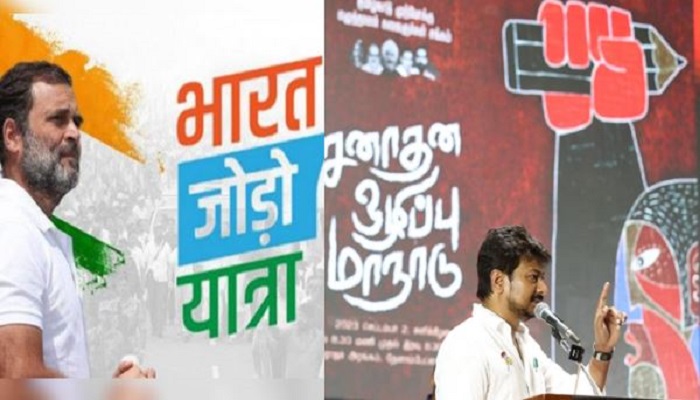
On Thursday (7 September), the Congress party is marking the first anniversary of ‘Bharat Jodo Yatra’, which is by far the lengthiest and most elaborate sketch thought off by the grand old party for the umpteenth relaunch of Gandhi scion, Rahul. The BJY is said to be his brainchild.
Reflecting on the anniversary of BJY, Rahul Gandhi said that the yatra will continue till ‘hatred is eradicated’ and India is united. Taking to X, the Congress leader gave a ‘promise’ and said, “The crores of steps of Bharat Jodo Yatra towards unity and love have become the foundation of a better tomorrow for the country. The journey continues – till hatred is eradicated, till India unites. This is my promise!”
भारत जोड़ो यात्रा के एकता और मोहब्बत की ओर करोड़ों कदम, देश के बेहतर कल की बुनियाद बने हैं।
Interestingly, patting his own back for having spent some time with the common hard-working citizens of India, only to alleviate the ‘hardships’ endured by walking on foot through a leisurely foreign trip, has been the favourite pastime of the dynastic leader.
During the Bharat Jodo Yatra (in fact in all his public appearances), the Gandhi scion virtually played the game of word salad. In his incoherent mumbling, he coined his now favourite phrase “Nafrat ke bazaar me Mohabbat ki dukan khol raha hu” (Amid the vitiating market where hatred is in prominence, I am opening a shop that caters love and affection to the customers). However, despite repeating his catchphrase a gazillion times, he has failed to delve into the depths of these virtuous words that he haphazardly stitched together.
In fact, the antithesis of his mumbling was out on public display during the entire stretch of the Bharat Jodo Yatra which saw the participation of several notorious breaking India forces and rabid Hindu haters. There were at least 11 controversial instances that reflected that the actions and intentions were a travesty to the virtuous words being spoken and the Bharat Jodo Yatra was a deliberate refuge for carrying out the ‘Bharat Todo Yatra’.
Unveiling the Ruse: BJY, a call to unite divisive anti-India forces, ignites dormant fault lines by empowering extremist elements
On the very first day of the so-called “Unity March”, Rahul Gandhi was present alongside Tamil Nadu Chief Minister MK Stalin and other senior functionaries of a party (DMK) that has always propagated to widen the linguistic divide and regionalism.
On 9 September 2022, Rahul Gandhi made a controversial statement and said he was fighting against the Indian system rather than any political party. He said, “We’re not fighting anymore a political party. It is now between the structure of the Indian state & opposition.”
Earlier, the Wayanad MP had confessed that his party was attacking India’s whole infrastructure, alleging that the Centre had taken control of all democratic institutions in the country.
Mollycoddling with rabid Hindu haters – Evangelist and Talibanised Islamists
On 9 September 2022, the Gandhi scion, Rahul met anti-Hindu Christian pastor George Poonaiah who is notorious for deranging Hindu deities and Bharat Mata.
During the secular unity meet, Gandhi was receiving evangelical sermons from communal bigoted Poonaiah and curiously initiated a religious debate that inevitably stooped into deranging Hindu deities.
Inquisitively, Gandhi asked, “But, He (Jesus Christ) is not God? Or is he God? Jesus is also God?”
A man in the background tried to explain the religious theology with the analogy of water. “It is Like water, which is in 3 states – solid, liquid, and gaseous form,” he said.
Proceeding further, the man argued that Jesus Christ is God and also the son of God. To which Rahul Gandhi inquired, “So, Jesus Christ is a form of God?”
At that point, Father George Ponnaiah interjected and claimed that Jesus is the ‘real God’, unlike ‘Sakthi and other Hindu gods’. The rabid Hindu hater said, “He (Jesus Christ) is a real God, revealed as a human person. Not like Sakthi and all.”
Pertinent to note that Gandhi, who claims to be a Janeudhari Brahmin, had no problem whatsoever and remained a mute spectator when the Christian pastor continued his tirade against Hindu deities and called them fake and imaginary to promote his evangelical idea of Jesus.
Another blatant case of the divisive anti-Hindu nature of the so-called Bharat Jodo Yatra (Unity march) came to the fore when a Congress leader who made headlines for slaughtering a cow in public in Kerala joined Rahul Gandhi.
On September 26, 2022, Rahul Gandhi met Indian Youth Congress (IYC) leader Rijil Chandram Makkutty who had slaughtered a cow in broad daylight in 2017 to mock Hindu sentiments.
Notably, in 2017, in defiance of the centre’s move to enforce a ban on cow slaughter, Rijil Makkutty along with his aides dragged a calf and brutally slaughtered it.
Although, Rahul Gandhi tried to do some damage control at that time and tweeted against the incident. However, no action was taken against the Congress functionary for deliberately hurting the sentiments of Hindus, and Makkutty not only continued to appear with Congress leaders but joined Rahul Gandhi’s “love shop”. (A perfect case to highlight the travesty and wretchedness of Congress leader’s newest preneur which in the truest sense is at best a residue of ‘bull in a China Shop’.)
In the in-exhaustive list, Hindu believers were left with bruises of another whiplash of Hinduphobia on the 8th of January. Back then, Rahul Gandhi ranted against Pooja (the Hindu form of worship) while trying to promote himself as a Tapasvi (ascetic).
He made contentious remarks during the Haryana leg of his ‘Bharat Jodo Yatra’. While speaking to the media in Samana near Kurukshetra, Rahul Gandhi claimed that the BJP is a party of ‘Pooja’ while Congress is a party of ‘Tapasya.‘
Upon realising that he may have upset his Hindu voters by taking potshots at their religious practice, Rahul Gandhi tried to undo the damage but ended up causing more harm to his party. “There are two types of Pooja – the normal one and the one done by RSS. RSS wants people to forcibly worship them(do their Pooja). The response to such a form of worship can only be tapasya. BJP says that there should be no respect for tapasya but only for those who do our pooja,” Rahul said.
Is the underpinning of ‘Eradicating hatred’ ‘Eradicating Sanatan Dharma’?
Apart from the hatred against Hindus in ‘Bharat Todo Yatra’, Congress leaders and its allies have recently reinvigorated their tirade against Sanatan Dharma which is also known as Hinduism.
Evidently, in a deliberate ploy, I.N.D.I.A. bloc leader and Tamil Nadu Minister Udhayanidhi Stalin recently spewed venom against Sanatan Dharma (Hinduism) and called for its complete eradication. The Congress ally, and son of Tamil Nadu Chief Minister, Stalin Jr. equated Sanatan Dharma with diseases like Malaria and Corona and blatantly asserted that eternal Dharma should not be opposed rather Sanatan Dharma should be eradicated.
The DMK leader said, “Mosquitoes, dengue, flu, malaria, corona – we should not oppose these things. They’ve to be eradicated completely. The same is the case with Santanam (Hinduism). Our first work should be to abolish/eradicate Sanatanam instead of opposing it,” from the dias of “Eradicate Sanatan Conference”.
However, Udhayanidhi Stalin is not a lone crusader from the I.N.D.I.A. bloc who has been displaying the crooked and perverted meaning of their ally Rahul Gandhi’s “Love Shop”.
To defend, Stalin’s hate speech against Sanatan Dharma, the Congress Party used the trope of freedom of expression. It claimed that “every political party has the freedom to tell their views” and Congress party respects everybody’s beliefs.
While, Priyank Kharge who is the son of Congress President Mallikarjun Kharge, claimed that any religion which doesn’t have equality is as good as disease.
Similarly, another dynast and Tamil Nadu Congress leader Karti Chidambaram said, “Sanatan Dharma is nothing but code for a Caste Hierarchical Society.”
Backing Stalin’s vile remark, the Tamil Nadu Congress General Secretary ranted that Sanatan is another name for hate-mongering.
On 4 September 4, Communist Party of India (CPI) leader D Raja canceled Sanatan as a religion and said, “First, we should understand, Sanatan is not Dharma. Dharma is something else. Yes, he (Udhayanidhi Stalin) said something…We are all opposed to Sanatan.”
“Sanatan perpetuates the caste system, Sanatan perpetuates patriarchy, Sanatan perpetuates inequality…Let them say no,” he brazened it out.
In the long list of deranged Hindu haters, the newest entrant but an old-time Hinduphobe is DMK MP A Raja. Taking the baton against Sanatan Dharma, he argued that Sanatan Dharma should have been compared with HIV, leprosy and Udayanidhi Stalin was soft in comparing it with dengue or malaria.
Again, the list is in-exhaustive but the deliberate “eradicate Sanatan” ploy is evident for everyone to see.
Conspicuously, the leaders of the I.N.D.I. alliance have been adamant about passing the choicest of expletives against Hindu Dharma and underscoring the real intent behind the new catchphrase “eradicate hatred” – that is “Eradicate Sanatan” from which neither the Congress party nor the paragon of love and beacon of unity, Rahul Gandhi has distanced or condemned the abhorrent ideology of hatred.
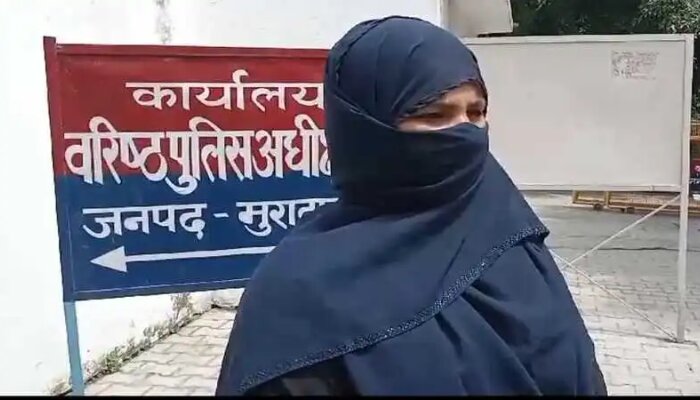
On September 6, 2023 (Wednesday) a woman belonging to the Muslim community in Moradabad, Uttar Pradesh reached the Senior Superintendent of Police office. She demanded action against her boyfriend Shoaib, his brother and two others. According to the victim, the police had registered a case against the accused on August 19, but no arrest has been made till now.
According to the victim, she was sexually assaulted on June 18. She did not file the case earlier due to the fear of shame in society, however, a month later she mustered the courage and filed a complaint against her boyfriend Shoaib and three others accusing them of rape. She also wrote in her complaint, that the accused filmed the heinous act and threatened to leak it on social media if she complained.
Shoaib worked as a compounder in a nursing home in Kohinoor Tiraha, according to the victim. He has since disappeared from there after the incident.
Sumit Tandon, a Moradabad-based journalist working for Sudarshan News shared a video where the woman, a resident of a locality in the Majhola police station area of Moradabad, Uttar Pradesh, shared her harrowing tale and grieved the betrayal of her companion.
Speaking to OpIndia, the journalist said that the victim mentioned receiving threats when telling him about her ordeal. He said that the woman alleged that she was being pressured to drop the complaint. The accused are allegedly threatening to file fake complaints against the victim’s relatives, Tandon quoted the woman as telling him. He added that the victim confirmed that the accused had already filed a bogus complaint against her cousins.
The victim, narrating her ordeal, said that on the fateful day of June 18, Shoaib, who lived in her neighbourhood, took the victim for a drive in his car. He was accompanied by his brother Uvaish and two other friends. Shoiab offered the victim cold drinks and samosa, which she suspected was spiked as she fell unconscious after eating it.
There wasn’t a single cloth on my body when I regained consciousness: Moradabad Muslim victim narrates how her childhood friend betrayed her
When she regained consciousness, there wasn’t even a single article of cloth on her body and the four accused were standing in front of her, she added. Afterwards, her boyfriend showed her the videos on his phone and threatened, “If you don’t want these videos to go viral on social media, keep your mouth shut.”
She stated that she had known him since childhood and the two shared a strong friendship since the beginning. However, one and a half years ago their bond turned into a love affair. They met regularly and also developed a physical relationship after he promised marriage, she said, adding that she was unaware of what was going on in his mind and never thought that he would ruin her life in such a manner.
Continuing to narrate her story, she said that she lived with her father as her mother died when she was just two years old. She added that she used to be alone at home when her father went to work and Shoaib took advantage of the opportunity. He used to come to her residence and establish physical relationships with her, promising to marry her. She too used to visit his place.
Shoaib’s father, however, decided to install cameras after his mother witnessed their rendezvous. The girl started to meet him outside after that.
She charged that when the offender’s family learned about their relationship, he refused to acknowledge their affair and declined to marry her after violating her sexually for around one and a half years. Therefore, she registered the complaint after which both he and his family agreed to the marriage, she asserted.
The victim conveyed, “After the agreement at the police station, Shoaib and his family members made us feel that they have started preparing for the wedding. Meanwhile, on 18 June, Shoaib claimed that he wanted to take me to the highway and brought me along. He was taking me in a white vehicle with three other young people inside and his brother Owais was one of them and gave me a samosa and cold drink.”
“I became unconscious after drinking it. When I regained consciousness around 11 at night, I was lying near the tower in Kundarki. I was completely naked with nothing covering me. When I looked up, my lover Shoaib was standing right in front of me with a mobile in his hand. He revealed my naked clip and warned me that he would make the video viral if I disclosed anything to anyone.”
She further added, “At first, I kept quiet out of concern for public shame. I didn’t say anything to anyone. Then on 30 July his mother also threatened me. After this, I met SSP Moradabad and told him about the whole situation after which the police registered an FIR (First Information Report) of gangrape against Shoaib, Owais and other unknown culprits.”
She voiced that she is receiving constant threats from the accused. The station in-charge Kundarki informed the reporters that no arrests had yet been made. He added that an investigation is being conducted into the victim’s accusations.
On 7th September, leader of the opposition and Bharatiya Janata Party (BJP) West Bengal MLA Suvendu Adhikari said that Anandabazar Patrika journalist Debmalya Bagchi was arrested after a report on hooch dealers was published in the newspaper. Accusing media and left-liberals of maintaining silence on the arrest, he narrated the chronology of events that led to Bagchi’s arrest.
Journalist arrested by Police in West Bengal. No media outrage & condemnation by the pseudo liberal & intellectual brigade, as the said Journalist doesn't have any PFI link.
Chronology of events:-
August 27, 2023 – A news article gets published in the Kharagpur edition of the… pic.twitter.com/TAOMkRkwcK
— Suvendu Adhikari • শুভেন্দু অধিকারী (@SuvenduWB) September 7, 2023
On 27th August 2023, the Kharagpur edition of Anandabazar Patrika published a report highlighting hooch traders operating from houses in the residential area of Sanjoal in Ward No 24 of Kharagpur Municipality.
As per the report, Basanti Das and other women of the locality formed a group and worked together to lawfully obstruct the illegal trade of illicit alcohol in the area.
In his post on X (formerly Twitter), Adhikari pointed out that because of the unrestricted trade of illicit alcohol or hooch in the area, the teenagers were getting involved, and the ward atmosphere became unsafe for the women. They went to the police seeking help but they were reluctant to act. Furthermore, the women sought help from the local councilor and chairperson of the Municipality but could not get anyone to act on their complaint.
Following the article, the administration and police allegedly got rattled, leading to the arrest of a few drunkards in the area. Adhikari said it was done to contain the public outrage in the backdrop of hiding the main operators of the illegal business.
Interestingly, on 28th August, the relatives of hooch traders filed a complaint against the women who initially went to the police to file a complaint against the illegal business. Police sprung into action and filed an FIR under Section 3(1)(r)(s) of The Scheduled Castes and Scheduled Tribes (Prevention of Atrocities) Act, 1989. In the complaint filed on 27th August, the complainant accused the women of attacking them and using castist slurs. She also accused the woman of pulling her clothes and injuring her.
On 7th September, Anandabazaar Patrika published another report highlighting the hooch dealers’ attack on Basanti Das and other complainants.
The report pointed out that seven houses in the area are indulged in the business of illicit hooch trade in the area. The women have been complaining about it for over two years, but the police or the administration took no concrete action.
As per the report, the dealers surrounded the houses of the complainants and kicked the door. They demanded to withdraw the complaint. The woman called the police, but they arrived around one hour after the call. However, the police claimed they reached the spot soon after receiving the call.
Journalist Debmalya Bagchi was allegedly picked up by the police from his residence in the aftermath of the reports published by Anandabazaar Patrika.
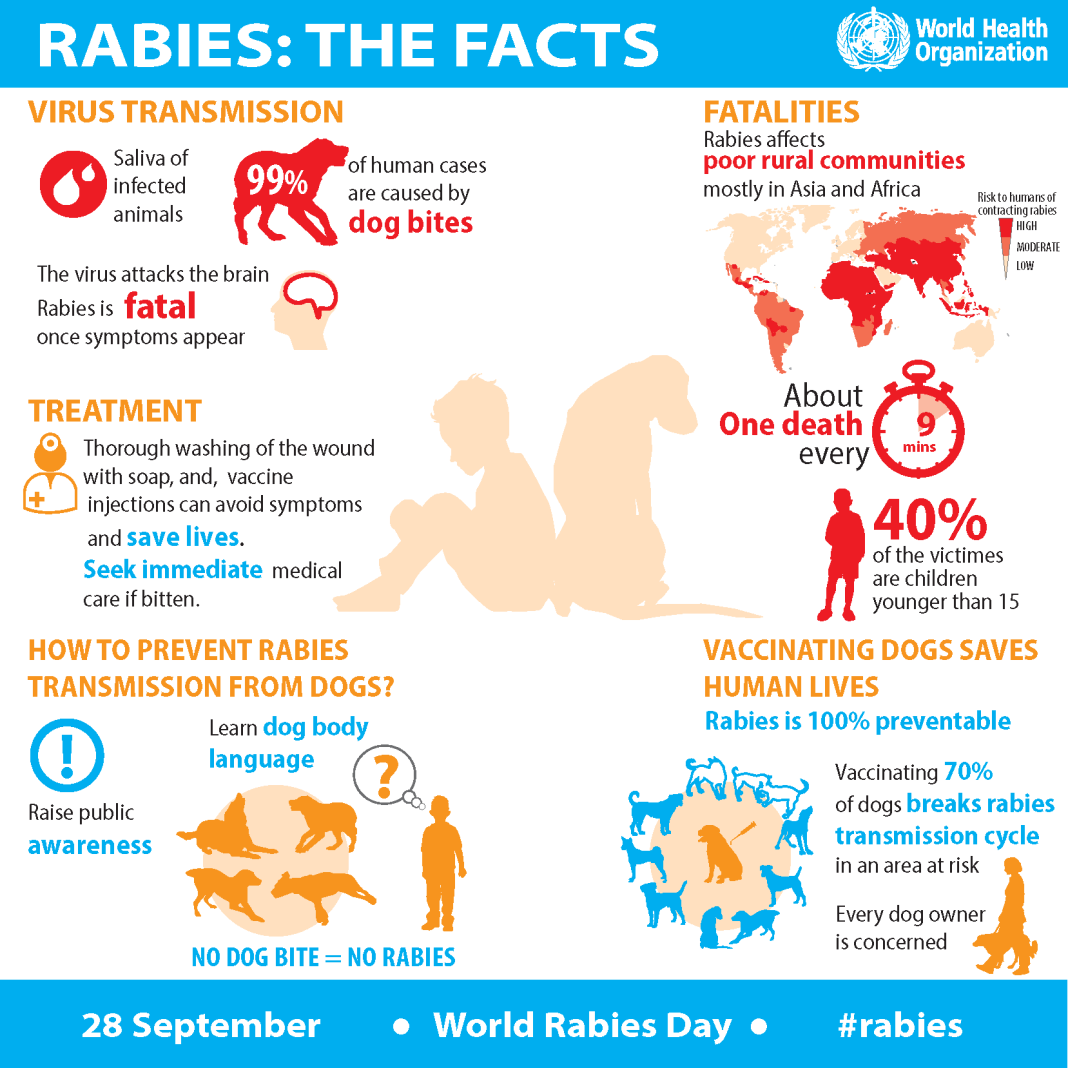
Rabies is a preventable viral disease most often transmitted through the bite of a rabid animal. The RABV virus infection is the root of the ailment. The virus infects the central nervous system of mammals which ultimately results in brain disease and death. It causes encephalitis (inflammation of the brain) in humans and other mammals.
Rabies was historically referred to as hydrophobia (fear of water) due to the symptom of panic when presented with liquids to drink. It is spread from the saliva of infected animals. The majority of rabies in the United States are linked to skunks, raccoons, bats and foxes. However, dogs continue to carry the rabies virus in many other nations, including India, and dog bites are the leading cause of rabies-related deaths in humans worldwide.
The animals most likely to spread the rabies virus to people include pets and farm animals like cats, cows, dogs, ferrets, goats, horses and wild animals like bats, beavers, coyotes, foxes, monkeys, raccoons, skunks and woodchucks.
How rabies is transmitted
Rabies is caused by the lyssaviruses, including the rabies virus and Australian bat lyssavirus. It is spread through direct contact with saliva or brain/nervous system tissue from an infected animal, such as through a break in the skin or mucous membranes in the eyes, nose, or mouth.
The disease is typically transmitted to humans by an animal’s bite. The risk of contracting rabies from non-bite exposures, such as scratches, abrasions, or open wounds exposed to saliva or other potentially infectious material from a rabid animal is also theoretically possible but unlikely.
Other forms of interaction, for instance caressing a rabid animal or coming into touch with its blood, urine or faeces are not considered to present a risk of infection and are not regarded as rabies exposures to be concerned about. The disease can be diagnosed only after the start of symptoms.
Dogs are the most common animals involved in rabies transmission on a global scale. More than 99% of rabies cases in countries where rabies is often spread are due to dog bites. Less than 5% of rabies cases in the Americas are caused by dog bites with bat bites being the most frequent cause there. Rodents are very rarely infected with rabies.
On rare occasions, the virus has been transferred from an infected organ to recipients of tissue and organ transplants. Furthermore, rabies might be spread by bites and non-bite exposures from an infected individual, but no such cases have been reported.
There is no risk of infection from incidental contact with substances like touching a person who has rabies or touching urine, blood or faeces. Any contact with a person who is undergoing rabies vaccine does not result in rabies exposure, infection risk or the need for postexposure treatment.
When the rabies virus dries up and is exposed to light, it loses its ability to transmit the infection. The rate at which the virus deactivates varies depending on the environment, however normally, if the virus-containing material is dry, the virus can be categorised as non-infectious.
The symptoms of rabies
The rabies virus first reaches the brain following exposure before it is able to begin to produce symptoms. The incubation period is the span of time between exposure and the onset of symptoms. It could continue for weeks or months. The incubation period could change depending on the type of rabies virus, the location of the exposure site (the distance from the brain) and any prior immunity.
The initial signs of rabies, such as weakness or pain, fever, or headache, could resemble those of the flu. Additionally, there might be pain, prickling or an itchy sensation at the part where the animal attacked you. The signs could persist for several days.
The symptoms then intensify to include agitation, anxiety, confusion and brain dysfunction. The person might suffer from delirium, bizarre behaviour, hallucinations, hydrophobia (fear of water) and insomnia as the illness progresses.
In general, the disease’s acute phase lasts between two and ten days. The disease is largely fatal once clinical symptoms of rabies manifest and treatment tends to be supportive. Less than 20 human cases of clinical rabies survival have been recorded. Only a small number of survivors had never received pre or postexposure prophylaxis.
Postexposure prophylaxis (PEP) consists of a dose of human rabies immune globulin (HRIG) and rabies vaccine given on the day of the rabies exposure, and then a dose of vaccine given again on days 3, 7, and 14.
The symptoms, indications and prognosis of rabies in animals can differ. Animal symptoms often mimic human ones. Early nonspecific signs, immediate neurologic problems and ultimately mortality are some of them.
Rabies facts by WHO
The prevention of rabies
Rabies is a deadly but preventable viral disease. A life can be saved by being aware of rabies risk and knowing what to do if you come into contact with an animal. A strategy to prevent rabies is to keep away from wildlife. All wildlife, especially injured animals, should be left alone. Don’t handle an injured animal. instead, get in touch with the appropriate authorities to request help.
Preventing rabies in pets is a crucial step in reducing the number of human rabies cases since pets can contract the disease from wild animals and then potentially carry it to humans. In the event that you do come into contact with a rabid animal, timely and adequate medical attention would completely prevent rabies in people. If you are uncertain about whether you require PEP or have been bitten or scratched, consult a healthcare professional.
Every dog and cat older than four months need to have a rabies vaccination and always keep your vaccines up to date. Cats and dogs should be kept under supervision and they cannot be left unattended.
When compared to pets under their owners’ control, roaming or stray animals are more likely to have been exposed to rabies. Do not approach stray or unfamiliar cats or dogs. Animals on the loose are more prone to attack people and have rabies exposure. Keep pets and stray animals separate.
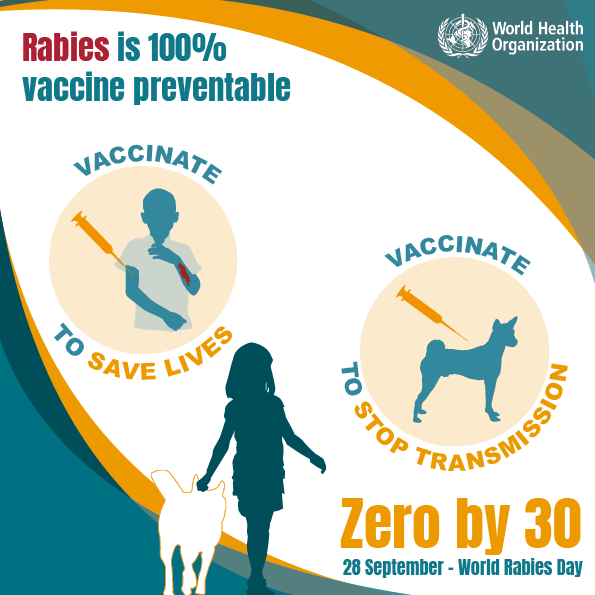
Rabies is 100% preventable by vaccine
If an animal bites, scratches, or comes into contact with you wash the wound thoroughly right away as well as scrub and flush for a few minutes with lots of soap and water. Any animal bite should be reported right away to your local animal control agency, police department or health department for further investigation. If the animal is stray or wild identify it and keep watching it to help with ultimate capture, but refrain from exposing yourself to risk again.
An intramuscular regimen of four 1-mL doses of the HDCV or PCEC vaccination is recommended for previously unvaccinated people. The four-dose course’s initial dose needs to be given as soon as feasible following exposure. On days 3, 7, and 14 following the initial immunisation, further doses should be administered. Adults should always receive the immunisation intramuscularly in the deltoid region (arm).
The anterolateral side of the thigh is also appropriate for children. Since delivery of the rabies vaccination in this location is thought to induce lower neutralising antibody titers, the gluteal region should never be used for injections.
Wild animals should be left alone. Although they seem friendly, stay away from them and never encourage one to feed from your hand. Do not be afraid of them, rather, respect them and keep your distance.
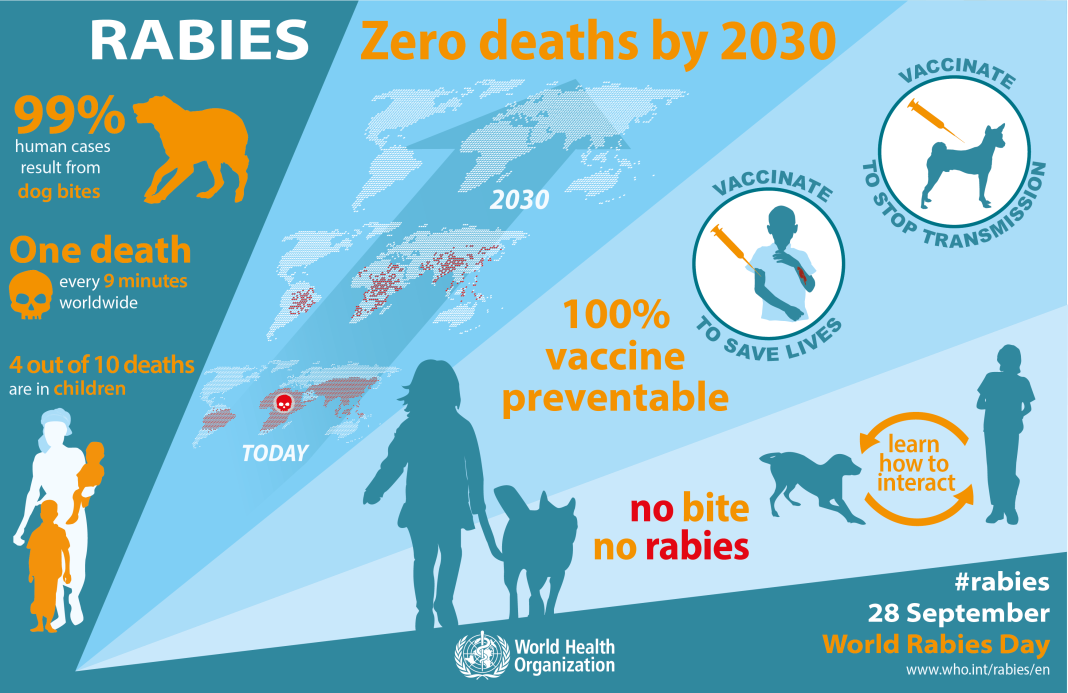
WHO has targeted zero rabies death by 2030
The epidemic of rabies in India
The number of human deaths globally due to dog-mediated rabies is estimated to be 59,000 annually. India is responsible for 36% of rabies-related deaths worldwide, according to the statistics of the World Health Organisation. Moreover, India is responsible for 65% of the such fatalities in South-East Asia. The National Rabies Control Programme recorded 6644 medically suspected cases and fatalities of rabies between 2012 and 2022.
The unexpected increase in rabies infections in India is a serious public health issue. Deaths from rabies among both vaccinated and unprotected people have raised a lot of public concern, particularly in Kerala. Within the last five years, the state has seen a two-fold increase in the number of sick canines.
A comparable study conducted in 2016 indicated that 32% of the 300 samples obtained from dogs tested positive for rabies, while this year, 168 samples (or 56% of the total) did. More than 200,000 dog bite instances and 21 fatalities, almost twice as many as during the previous year have been reported by the state, 12 of which have been confirmed by a laboratory.
Despite getting anti-rabies immunoglobulin (RIG) and a vaccine, six of the patients, including a 12-year-old child, passed away. 250 anti-rabies shots were given out without the necessary quality checks due to a serious vaccine shortage brought on by an upsurge in rabies cases.
The new Thai Red Cross Schedule for intramuscular (IM) and intradermal (ID) immunisation is presently implemented in India. The current post-exposure prophylaxis (PEP) protocol calls for either five intramuscular (IM) doses on days 0–3, 7–14, and 28 or eight ID doses (two locations per visit). Ineffective RIG administration, non-administration or inadequate wound care allows the virus additional time to proliferate. A painful consequence could occur even with the right PEP.
The body’s production of antibodies and the virus’s ability to enter the brain compete for control of the body once the vaccination is given. It has been hypothesised that the vaccination wouldn’t have enough time to work if damaged areas of the body were close to the brain or rich in nerve tissue. Therefore, RIG must be administered as soon as feasible for passive immunity because the vaccination alone cannot protect against rabies in category III exposure. There have also been a few documented instances of fraudulent or subpar vaccines and cold chain failure.
307 died of rabies in India last year
India records 1.7 crore dog bites per year, per the Association of Prevention and Control of Rabies in India (APCRI). In 2022, rabies claimed the lives of 307 people. Delhi had the most occurrences (48), West Bengal came in second (38) while Maharashtra, Karnataka, and Andhra Pradesh each had 29 fatalities.
The information was provided in answer to a query posed by Dean Kuriakose, the Congress MP from Idukki, Kerala, last week, by SP Singh Baghel, the Union minister of state for health and family welfare, during the current monsoon session of the Lok Sabha. Rabies is a major cause of morbidity and mortality in India, according to the National Centre for Disease Control (NCDC).
“A large stray dog population and limited success in control methods, such as mass dog vaccination and animal birth control, are among the reasons for the high number of animal bite and rabies cases in India. Almost all of these deaths can be prevented with safe and efficacious rabies vaccines, but somehow the efforts have fallen short so far,” stated Indian Medical Association’s central working committee member, Dr Sharad Gupta.
Why India is struggling with rabies
The Global Alliance for Rabies Control (GARC), the World Organisation for Animal Health (OIE), the Food and Agriculture Organisation of the United Nations (FAO), and nations from all around the world convened in December 2015 to discuss eradicating human rabies mortality by the year 2030. In her own words, WHO Director-General Dr. Margaret Chan stated that eradicating rabies is a possibility. She remarked, “Rabies belongs in the history books.”
With a high prevalence of the disease and the ability to mobilise the support of other nations in the region owing to its wealth of technical expertise and resources, India has to play a significant role in the effort to eradicate human mortality from dog-mediated rabies by the year 2030.
According to specialists, this is feasible only if the Indian government changes the status of rabies and makes it a “notifiable” illness like tuberculosis or polio. It basically means that the government would give it the attention it requires, calculating the incidence rate, tracking the development, and providing resources along with money.
For example, health clinics across the nation would need to maintain sufficient supplies of the rabies shot, as opposed to the existing scenario, in which clinics in rural locations frequently run out of supplies or lack the competent staff to administer a full course of injections. Along with the essential issue of immunising and sterilising stray dogs, a government strategy would need to include a campaign to raise public awareness.
India now has more stray dogs than ever before. An estimate puts the number at 35 and 40 million. There are bound to be packs of dogs everywhere in the streets. The animals are typically fed by dog lovers, but no one is in charge of administering their shots. A dog can have numerous puppies in a year even after vaccination and before sterilisation, which starts the cycle all over again.
The population of stray dogs must be sterilised and immunised in order to eradicate rabies which is challenging. It is difficult to capture stray dogs, not lumbering and obese labradors, rather tough and street-smart animals to vaccinate them.
The dogs are able to observe the dog catchers coming from a mile away which starts a chase that could or might not end with a dog being caught, rendered immobile, and given a shot. Dog vaccination is typically given low priority by most municipal authorities, who already have to deal with significant pollution, waste handling and homelessness challenges.
Conclusion
Controlling rabies is proving to be a difficult task for India with the problem gradually escalating every year. As Dr Reeta Mani, Associate Professor of India’s National Institute of Mental Health & Neurosciences (NIMHANS) highlighted, “Control of canine rabies through vaccination and dog birth control is imperative, although with 25 million stray dogs in the country, this is a formidable task.”
However, the country has an impressive history of completely eradicating severe diseases like plague, leprosy, and smallpox in spite of all the challenges. She further added, “Collaborative efforts between the medical, veterinary, and public health sectors have already made a significant difference. We have seen improved rates of pre-exposure vaccination (PrEP) for vulnerable populations, such as children, and improved awareness of the need for post-exposure prophylaxis (PEP) after a bite.”
Just like before, India needs to make a concentrated and dedicated effort in order to make progress in this direction along with better facilities and support from all sections to comprehend the gravity and risk the disease poses to society.
An extensive plan needs to be devised on the part of the government and implemented to tackle the menace of rabies and people need to understand that one can practice their love for dogs and animals without putting the lives of others in danger. The matter requires us to be sensitive towards others, particularly children, who are the main victims of all of this.
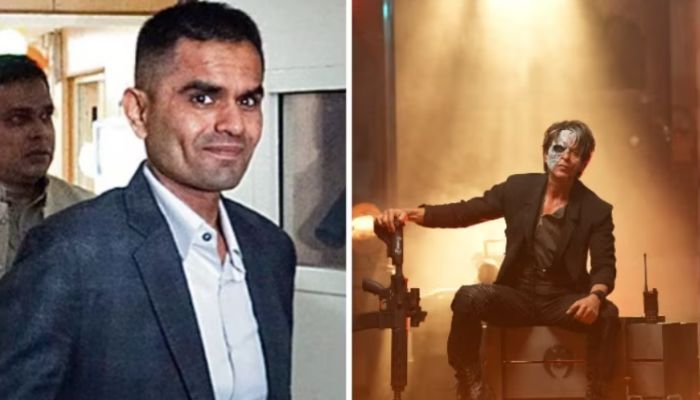
On Thursday, 7th September 2023, the Central Administrative Tribunal (CAT) reportedly ruled an order stating that NCB Deputy Director General Gyaneshwar Singh should not have been a member of the special inquiry team (SET) established to investigate alleged procedural deficiencies by former NCB Zonal Director Sameer Wankhede.
This decision was based on the fact that Singh had provided instructions to Wankhede during the investigation of the Cordelia cruise drugs case, which involved Shah Rukh Khan’s son, Aryan Khan. Coincidentally, this development has come on the release day of Shah Rukh Khan’s film ‘Jawan’.
The Central Administrative Tribunal (CAT) acknowledged the National Control Bureau’s (NCB) argument that the special inquiry team (SET) report was preliminary and that any actions against Wankhede would be independently determined by the Union government and the NCB. A panel of judges heard Sameer Wankhede’s petition, in which he sought the dismissal of a CBI case against him for alleged extortion and bribery, based on the findings of the SET led by Gyaneshwar Singh.
The CAT, based on a thorough investigation, evidence, and documents, held that Gyaneswar Singh, being actively involved in the Cordelian. cruise investigation, could not have been a part of the SET set against Wankehde.
According to the case, Sameer Wankhede and four others were accused of soliciting a bribe of Rs 25 crore from actor Shah Rukh Khan to avoid framing his son Aryan, who was allegedly involved in the 2021 drug seizure on the Cordelia cruise ship. Sameer Wankhede, refuting these allegations, sought to have the CBI case against him dismissed, contending that Gyaneshwar Singh, his reporting boss during the case in question, was “acting as the judge of his own cause and conduct.” He pursued this argument in both the CAT and, more recently, the Bombay High Court.
Meanwhile, Shah Rukh Khan’s film ‘Jawan’ is released today. The movie also stars Nayanthara, Vijay Sethupathi, Sanya Malhotra, and Priyamani, and includes cameo appearances by Deepika Padukone and Thalapathy Vijay. ‘Jawan’ is a Red Chillies Entertainment production directed by Atlee, produced by Gauri Khan, and co-produced by Gaurav Verma. The film has been released in Hindi, Tamil, and Telugu languages.
On 3rd October 2021, Aryan Khan, Arbaaz Merchant, and other 6 people were detained from a luxury cruise liner where a rave party was going on. As per reports, cocaine and ecstasy pills were found on Khan and others with him. The Court had then held that a prima facie case is made out against Khan and other co-accused. However, on 28 October 2023, the Bombay High Court granted Khan and two others bail in the case.
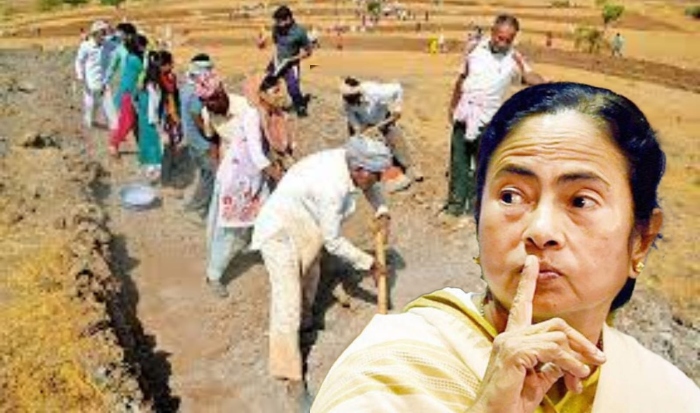
As the central as well as Delhi authorities are busy preparing to host World leaders at the G20 Summit in Delhi, the Mamata Banerjee led TMC government in West Bengal has on September 6 written to the Delhi police seeking permission to hold a protest rally in the national capital against the centre’s decision to withhold the Mahatma Gandhi National Rural Employment Guarantee Scheme (MGNREGS) funds for West Bengal.
According to reports, TMC’s Rajya Sabha leader Derek O’Brien wrote three letters to DCP Parliament Street Police station, New Delhi, seeking permission to organise dharnas at Jantar Mantar, outside Krishi Bhavan and in front of Union agriculture minister Giriraj Singh’s residence on October 2 and October 3.
In the letters, O’Brien asked the Delhi Police for “permission for the Trinamool Congress to hold dharnas involving workers from the state of Bengal who have been denied wages under the MGNREGA scheme from 10 am. to 6 pm. on October 2 and 3 at Jantar Mantar, Krishi Bhavan, and outside the minister’s residence from 10 am. to 6 pm. on October 2 and 3.”
Abhishek Banerjee, national general secretary of the TMC, will lead the protests in New Delhi.
The letter was written after the central government decided to withhold Mahatma Gandhi National Rural Employment Guarantee Scheme (MGNREGS) funds for West Bengal for the fiscal year 2023-24, extending the imposition of Section 27 of the MGNREGA, which allows for the suspension of funds for violations of rules in the scheme’s implementation by the state.
The decision was reportedly taken last week after a meeting with the West Bengal administration and the Centre on March 13.
This is not the first time that the ruling TMC government in West Bengal has been denied funds for central government schemes. The Centre had first invoked the rule in December 2021. In fact, West Bengal is the only State in the country against whom this Section 27 of the MGNREGA was invoked.
Since the central government decided to halt the disbursement of funds for central government schemes to the state, Mamata Banerjee and her party loyalists have attempted to accuse the union government of discriminating against Bengal by failing to provide the state with its fair share of funds under centrally-sponsored schemes. The party has been feverishly defending itself against allegations of gross malfeasance and corruption by its employees in numerous centrally-sponsored development initiatives and projects.
The truth, however, is that the fund disbursal was suspended only after large-scale anomalies in the implementation of the welfare schemes of the central government including the Mahatma Gandhi National Rural Employment Guarantee Act (MGNREGA) by Trinamool functionaries, especially in the rural areas, had been exposed.
Central govt stopped fund disbursal to WB after large-scale anomalies by Trinamool functionaries unearthed
As per the scheme’s norms, a job cardholder can directly approach the panchayat or other implementing agencies for work and is entitled to get at least 100 days of work. However, in West Bengal, a large number of Trinamool officials in rural areas have been accused of placing ineligible people, including family members, on PMAY beneficiary lists.
The list of PMAY beneficiaries in Bengal was discovered to be filled with wealthy individuals with ties to the ruling party, as well as children, wives, and close relatives of Trinamool functionaries.
Similarly, Trinamool employees in rural organizations have been accused of distorting MGNREGA beneficiary lists, generating bogus job cards, and misrepresenting records of assets produced under the scheme in order to siphon off funds, among other violations.
The union administration suspended fund disbursement after central audit teams discovered these large-scale errors and malfeasance.
BJP leader Suvendu Adhikari accuses TMC govt of creating fake data to claim employment generation in rural Bengal
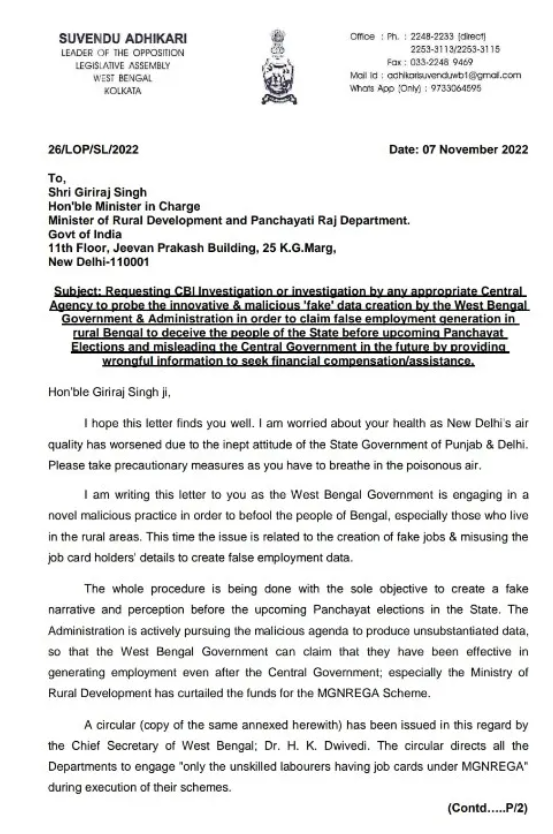
It may be recalled that in 2022, BJP leader Suvendu Adhikari had taken to X, formally Twitter to share the letter he had written to Union Rural Development Minister Griraj Singh seeking an investigation against Mamata Banerjee administration in West Bengal. Asking for a CBI probe or a probe by any central agency, the BJP leader alleged that the WB Govt was creating ‘fake’ jobs and misusing the job holder details to create false employment data.
Alleging that the details of the Job Card holders are being used arbitrarily and at whim by the Mamata Banerjee administration, the BJP leader said that if an audit is conducted the following facts would certainly be revealed:
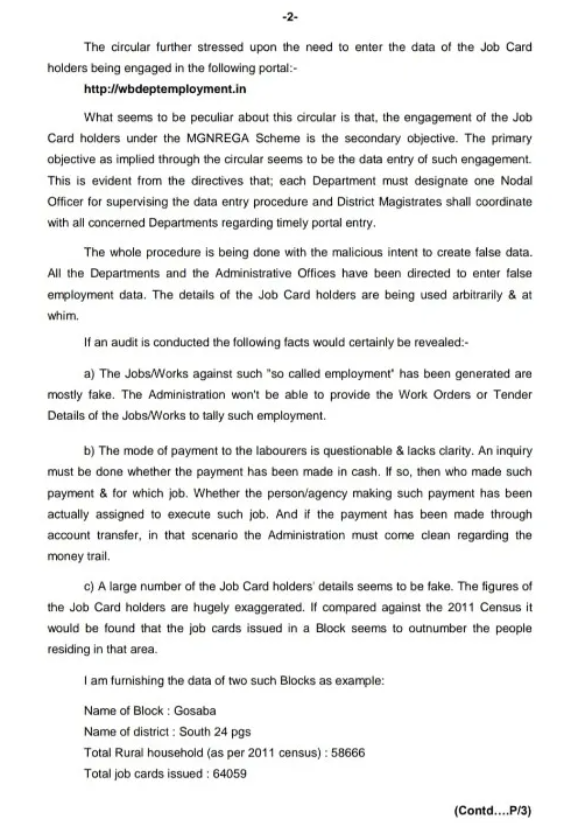
The Jobs/Works against such “so-called employment” that have been generated are mostly fake. The Administration won’t be able to provide the Work Orders or Tender Details of the Jobs/Works to tally such employment.
The mode of payment to the labourers is questionable & lacks clarity. An inquiry must be done whether the payment has been made in cash. If so, then who made such payment & for which job? Whether the person/agency making such payment has been actually assigned to execute such a job. And if the payment has been made through account transfer, in that scenario the Administration must come clean regarding the money trail.
A large number of Job Card holders’ details seem to be fake. The figures for the Job Card holders are hugely exaggerated. If compared to the 2011 Census it would be found that the job cards issued in a Block seem to outnumber the people residing in that area.
Saying so, BJP Leader Suvendu Adhikari urged Union Rural Development Minister Griraj Singh to launch an investigation against Mamata Banerjee’s administration in West Bengal.
In fact, for the uninitiated in 2019, Mamata Banerjee herself had inadvertently admitted that ‘cut money’ was taken by members of her own party, for implementing the welfare schemes of the government.
Mamata Banerjee’s MGNREGA lie
In 2013, two years into office, Mamata Banerjee made big claims of development, especially about providing 100 days of work to unemployed adults under the Mahatma Gandhi National Rural Employment Guarantee Act (MGNREGA). Her government claimed that the state topped the chart in 2012-13 with the implementation of projects worth Rs 4475.80 crore, which is the highest in the country and generated employment for 57.76 lakh families.
TMC government’s ad in a local newspaper made tall claims of topping the development scale.
This also turned out to be nothing but a deception. The national statistics then suggested that West Bengal ranked 24th on the list. The then Union Minister of State for Urban Development Deepa Dasmunsi had said in a statement: “The state has ranked 24th on the list, whereas the (Trinamool) government very boastfully claimed otherwise. It easily nailed the lie of the state administration as they are misleading people with wrong information ahead of the panchayat elections”.
The national statistics also suggested that West Bengal dipped to the 35th position in the list in the year 2019.
So, contrary to the lie peddled by Mamata Banerjee about topping the MGNREGA chart, there has been an unprecedented growth of unemployment under the TMC rule. Between October 2016 to 2020, unemployment in West Bengal has grown by an astounding 217 per cent.
West Bengal also always has the highest percentage of delayed MGNREGA payments and it is plagued by TMC’s cut-money across the state, where workers are forced to pay hefty sums to avail work under the scheme.
Though all facts have been out in the open the Trinamool top leadership has succeeded time and again in fooling the people of the state by distancing itself from the corrupt within the party’s ranks, corruption and extortion have become too endemic within the party to be rooted out. This letter to the Delhi Police requesting permission to protest the central government for withholding Mahatma Gandhi National Rural Employment Guarantee Scheme (MGNREGS) funds for West Bengal for the fiscal year 2023-24 could be a new strategy of the Mamata-led government to mislead the public by diverting attention from the widespread corruption inside her own party due to which the central government has been compelled to withhold the Mahatma Gandhi National Rural Employment Guarantee Scheme (MGNREGS) funds for West Bengal.