For the past couple of days, a seemingly systemic and organised onslaught has been unleashed on some of the Hindu Rights activists and popular social media handles for speaking on issues that the ecosystem has been desperately trying to brush under the carpet – the Udupi video recording case of few Hindu girls in a private institution.
As a part of this, on 24 July, a coordinated campaign was launched to intimidate popular Hindu Human Rights activist and Former Oxford Student Union President Rashmi Samant. All of this comes in the wake of her Twitter thread where she raised her voice for Hindu female victims.
It is alleged that their videos were recorded by girls of the Muslim community in the washrooms of a private institution in Udupi. It is also alleged that their videos were shared in some community Whatsapp groups. However, several news reports by regime-friendly media organisations quoted police officials as saying that the video may not have been ‘extensively’ shared on Whatsapp.
I'm from Udupi and nobody is talking about Alimatul Shaifa, Shabanaz and Aliya who placed cameras in female toilets of their college to record hundreds of unsuspecting Hindu girls. Videos and phots that were then circulated in community WhatsApp groups by the perpetrators.
— Rashmi Samant (@RashmiDVS) July 23, 2023
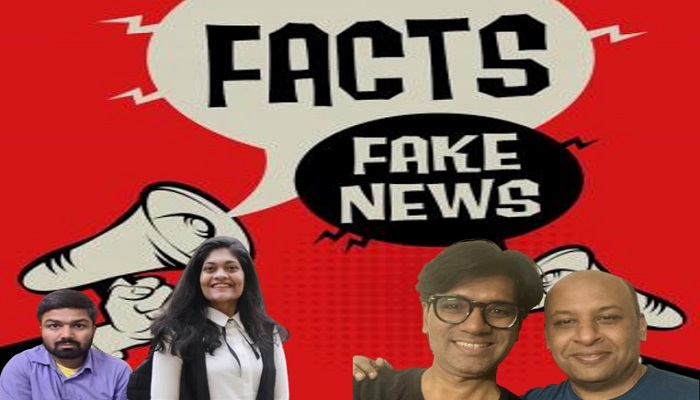
Several social media handles which were spearheaded by Alt News Co-founder Muhammad Zubair, engaged her in a Twitter spate and hurled accusations, and name-calling. Zubair also issued a veiled threat of legal action under the pretext of spreading false information.
It is important to note here that the Congress-led Karnataka government is setting up a ‘fact-check unit’ to combat ‘misinformation’. For this, they have sought the help of notorious fake news peddlers such as Alt News.
Will @PoliceUdupi take action against these accounts for amplifying misinformation related to Udupi?
— Mohammed Zubair (@zoo_bear) July 24, 2023
C'C: @DrParameshwara @DgpKarnataka @HMOKarnataka pic.twitter.com/XY0e5f4FBB
Without relenting to the ‘dog-whistling’ by the alleged Fact Checker Zubair and ilk, Samant stood by her claim.
An open declaration to everybody coming at @ShefVaidya and I. You've picked the wrong Hindu women to mess with. pic.twitter.com/oN1GuUltsZ
— Rashmi Samant (@RashmiDVS) July 25, 2023
She also shared the details about the case and vetted her claims made in the tweet which has irked the entire Islamo-liberal ecosystem.
Classic @zoo_bear trying to incite mobs against the Hindu women @ShefVaidya like he did to Nupur Sharma. Udupi is my home and I will not be intimidated into silence by the misinformation you peddle in the name of fact-checking. Now I don't have the time to teach you Kannada. https://t.co/8W4mPqHUhQ pic.twitter.com/LyrWZFEcJC
— Rashmi Samant (@RashmiDVS) July 24, 2023
I can't find enough proof in this whole world for your bigotry @zoo_bear
— Rashmi Samant (@RashmiDVS) July 25, 2023
Local newspaper cuttings, naming all the perpetrators, statements from local student unions acknowledged by the SI Udupi and more. All I pray is that mahadev blesses all bigots with renewed sense of… https://t.co/pHO5MCUCiH pic.twitter.com/VQDfWoL8DZ
Additionally, she too stressed that strict action needs to be taken against fake-news peddlers online to stop the murderous dog-whistling that’s currently happening.
Spoke with @ShobhaBJP avaru yesterday on the issue. We agreed that strict action needs to be taken against fake-news peddlers online inorder to stop the murderous dog-whistling that's currently happening!
— Rashmi Samant (@RashmiDVS) July 25, 2023
After Alt News’ Zubair ‘flagged’ her tweet for allegedly spreading false information, the Udupi police also launched a campaign to locate Samant.
Samant’s advocate Adhitya Srinivasan took to Twitter and shared the ordeal faced by her family. According to Srinivasan, at around 8 PM, a group of policemen visited Rashmi Samant’s residence in her absence. They then questioned her parents and were repeatedly asking about her whereabouts. This was also confirmed and reiterated by many other journalists, popular social media users, and politicians.
I just spoke to @RashmiDVS , & she informed me that policemen were sent to her house in Udupi as she raised her voice for the Hindu girls. I am shocked to know that the Congress government is using intimidatory tactics to silence her.
— Pradeep Bhandari(प्रदीप भंडारी)?? (@pradip103) July 24, 2023
I urge all to stand with her! pic.twitter.com/tWFnsosTT9
Karnataka police have visited the residence of @RashmiDVS for stating the truth.
— C T Ravi ?? ಸಿ ಟಿ ರವಿ (@CTRavi_BJP) July 25, 2023
I am not surprised that the CONgress government is using police to strangle the truth. It has been the practice of CONgress to silence truth that tries to expose its agenda. pic.twitter.com/ERId38bfb9
Additionally, the police called her father multiple times to locate her. Her counsel, Srinivasan said, “It is clear that the police visited my client’s residence in connection with Rashmi’s recent tweets condemning the secret video recording of Hindu girls in a college toilet.”
1. At 8:00 PM this evening, a group of policemen visited the residence of my client, @RashmiDVS . As Rashmi was not at home at the time, it was her parents who were questioned by the police and repeatedly asked about Rashmi’s whereabouts.
— Adhitya Srinivasan (@ads_0013) July 24, 2023
Apart from Rashmi Samant, the alleged fact checker Zubair bayed for Nupur Sharma’s life in the past. Recently, he has been dog whistling against ANI’s Editor-in-Chief Smita Prakash, popular social media user Shefali Vaidya and OpIndia’s Editor-in-Chief Nupur Sharma among others. And as stated above, the formation of a so-called ‘Fact check’ unit in Karnataka has bolstered the confidence of these ‘Fake News’ peddlers doing the exact opposite, baying for free speech.
The unfortunate thing is that these are not one-off incidences and are not even limited to a geographical area alone. Instead, crushing dissent under the garb of curbing fake news has become a new norm for states ruled by the I.N.D.I.A. bloc.
‘Fact checking’ and ‘curbing fake news’: A new blatant tool to suppress dissent and critical voice
Earlier this year, on 18 March, the Police arrested YouTuber Manish Kashyap aka Tripurari Kumar Tiwari from Bihar in connection with the alleged attacks on migrant workers in Tamil Nadu. A special team of the Tamil Nadu police brought him to the southern state on transit remand after the Madurai Crime Branch police registered a case against him.
Back then, it was reported that Kashyap had tweeted a ‘fake video’ of the attacks on migrant workers from Bihar in Tamil Nadu which went viral over social media. However, the video was created by the main accused Rakesh Ranjan Kumar, a native of Gopalganj district in rented accommodation in Patna.
Later, the Tamil Nadu police slapped stringent NSA on him. He has been in jail since then despite moving bail petitions multiple times.
Similarly, many more journalists were also booked for sharing the concerns of the migrant workers from Bihar, which, however, were reportedly found to have relied on some fake videos. In connection with this ‘fake news’ of Bihar migrant workers assaulted in Tamil Nadu, the state police had also filed FIRs against OpIndia CEO Rahul Roushan and Editor-in-Chief Nupur Sharma, for publishing articles based on claims made in a Bhaskar report – which also explicitly and prominently added the police version.
Additionally, Tamil Nadu BJP president K Annamalai, the Twitter handle of the BJP’s Bihar unit – BJP4Bihar, BJP spokesperson Prashant Umrao and Dainik Bhaskar newspaper’s editor, Mohammed Tanveer, were also booked for sharing the news of the ordeal Bihar migrant workers.
Kolkata-based journalist arrested for shedding light on anti-Hindu violence
Similarly, in October 2022, a Kolkata-based Manab Guha was arrested and framed in non-bailable sections for sharing the ground reality of the anti-Hindu Mominpur Violence. The photojournalist’s alleged “crime” was that he dared to post footage and images of anti-Hindu violence on social media.
The West Bengal police justified the arbitrary action by claiming that such recordings could have generated additional hostility in society.
In another case of ‘witch hunt’ against media voices, the Kolkata Police, on 9 January, registered an FIR against 10 journalists and BJP state president Dr Sukanta Majumdar for allegedly ‘misreporting’ the stone pelting incidents on the Vande Bharat Express.

They were booked under specific sections of the Information Technology Act for giving the state a ‘bad name’. The arbitrary action was a follow-up of Mamata Banerjee’s earlier threat to media outlets that legal action will be taken against journalists for spreading ‘fake news’ about the stone pelting incident on Vande Bharat Express trains in West Bengal.
Raipur-based journalist arrested for posting satire against Chhattisgarh Congress leaders
In March 2022, the Chhattisgarh Police arrested Raipur-based journalist Nilesh Sharma who is an Editor of the web portal indiawriters.co.in and print magazine ‘India Writers’. He was accused of spreading ‘fake news’ against the ruling Congress leaders in the state of Chattisgarh. According to reports, Sharma runs a popular series based on political satire, ‘Ghurva Ke Mati’.
The series uses fictional characters resonating with the Congress leaders and Chattisgarh MLAs.
OpIndia targeted by West Bengal government
Earlier, in 2021, the West Bengal government had singled out OpIndia and filed as many as four cases for reports – highlighting the Covid handling in Bengal; Azan being played in Durga Pandal – the video of it had gone viral back then and was widely reported by many media houses. However, in a major relief to media freedom and free speech, in December 2021, the Supreme Court quashed all these FIRs.
The apex court raised concerns about how journalists are having to bear the repercussions of publicly available information.
The bench had observed, “State force should never be used to either browbeat a political opinion or the journalists suffer the consequences of what is already in the public domain.”
Social media user arrested in West Bengal for critical remarks against CM Mamata Banerjee
Since 2014, the Islamo-liberal leftist ecosystem has been crying foul claiming that fascist voices are curbing free speech and dissent. Apart from gagging journalists, several dissenting voices have also been booked and jailed flagging virtue as vice and vice versa.
In October 2019, 28-year-old Chandan Bhattacharya was arrested for allegedly posting critical remarks against Bengal CM Mamata Banerjee.
In fact, in May 2019, the West Bengal government’s misuse of state machinery was called out by the Supreme Court. While asking for the immediate release of BJP youth worker Priyanka Sharma, the Apex court observed that her arrest was “prima facie arbitrary”. Sharma was arrested on 10 May for allegedly posting a morphed picture of state CM Mamata Banerjee.
Actor Ketaki Chitale arrested for sharing Facebook post criticising Sharad Pawar
Another example of stifling dissent and free speech was the case of Marathi actor Ketaki Chitale. She was booked and arrested for sharing a Facebook post that was alleged to be directed at Sharad Pawar even though there was no explicit reference to the NCP patriarch. She was merely arrested for sharing a critical post written by Advocate Nitin Bhave. Yet, she was booked under sections 500, 501, 505 (2), and 153 A of the Indian Penal Code.
Modus operandi of the ecosystem: Dispelling doubts, if any
As blatantly obvious from this earlier tweet by Supreme Court advocate Prashant Bhushan, the ecosystem has been trying to suppress voices that do not conform to their ideological stance and exposes their inherent prejudice. Bhushan had made no bones about using police power to intimidate critical voices, in this case, OpIndia, exhorting opposition parties to file FIRs against the portal, presumably to exact obedience.
OpIndia is a godi media portal created to spread hateful fake news. They are committing serious offences under the Penal Code. Why are they having a free run? Time for people to lodge FIRs against them & for the police at least in Opp run States to hold them accountable https://t.co/KhldUgM9bD
— Prashant Bhushan (@pbhushan1) May 18, 2020
In the tweet, he had asked opposition-ruled states to register FIRs en mass against dissenters in their state – particularly the likes of OpIndia – a direct call for excesses by the state machinery to hide uncomfortable truths and narratives of the common people who had been enslaved in the tyranny of one artificially constructed narrative.
The ecosystem has been aggressively gunning opposition parties to target those media houses or individuals who are reporting inconvenient truths about forced conversions, and how many Islamist groups are preying on innocent Hindu girls whether through Love Jihad or other means.
In all of these cases, which is merely an indicative list, the opposition has misused the state machinery to file flimsy cases merely to harass those who the ecosystem does not agree with. First, these false cases are filed when journalists or individuals talk about Islamists targeting Hindus. Second, dissenting voices are booked for criticising politicians from ‘secular-liberal’ parties and third, those they despise are booked when they dare to mock their leaders, as is the democratic right of every citizen. Hilariously, the very politicians who misuse state machinery to silence citizens are the ones who talk about freedom of speech and expression, freedom of the press and the right to express opinions. Further, they claim to espouse the lofty ideals of democracy while stifling the very essence of it – the right to dissent. The ecosystem especially gets riled up when individuals, organisations or journalists report crimes against Hindus by Islamists and demand accountability from the dispensation, presumably because it is the Islamists on whom they depend to someday get them back to power at the centre, displacing the Modi government.
Bengal, Bihar, Tamil Nadu, and now Karnataka governments are the states where administrations appear to be inclined to use state machinery with an iron fist and cage dissenting voices so that it has a “chilling effect” on journalists and common people and discourages them from raising voices on stories that are either brushed under the carpet or grotesquely misrepresented. The hounding of Rashmi Samant is just another manifestation of this unfortunate template.