Home Blog Page 2219

Adani Group to develop India’s first integrated data centre and technology business park in Visakhapatnam

The Adani Group is developing an integrated data centre and technology business park in Visakhapatnam to boost local technology ecosystem in the region.

The investments will be on top of the Rs 20,000 crore already invested in the state, which created more than 18,000 direct and 54,000 indirect jobs, according to a statement from the Group. The Adani Group’s investments in Andhra Pradesh span multiple sectors, including ports, logistics, and renewable energy. The groundbreaking ceremony at the park site in Visakhapatnam was held on May 3 in the presence of Andhra Pradesh Chief Minister Y S Jagan Mohan Reddy, Adani Group Managing Director Rajesh Adani, and Adani Ports & SEZ (APSEZ) CEO and Whole Time Director Karan Adani.

The project, which will have a data centre, technology and business park, and skill development centre, will generate jobs for local communities and open new gateways of growth in the region, connecting Vizag to the APAC (Asia-Pacific) IT ecosystem, according to a statement from Adani Group.

AdaniConneX, a 50:50 joint venture between Adani Group and EdgeConneX, will host within the park an integrated 300 MW data center facility, according to the statement.

“Our world is being defined by our ability to generate, store, access and move data,” said Gautam Adani, Chairman, Adani Group. “With the advancements in AI, high-definition content and massive digitization, the need for computing and storage is increasing exponentially.”

Gautam Adani said, “Andhra Pradesh, with its geographical advantages of land for renewable energy and a long coastline, is well positioned to host data centre parks not only for our country but also for those nations that are short of land or energy. What the Adani Group brings through our ports, data centres and green energy capabilities is a uniquely powerful combination of unmatched strategic adjacencies within the data centre world.”

“The establishment of 300 MW data centres by the Adani Group will facilitate the laying of a submarine cable from Singapore and help change the future dynamics of broadband services,” he said.

Y S Jagan Mohan Reddy, Chief Minister, Andhra Pradesh said “The technology park will propel Vizag into a tier-1 city which will also deploy renewable sources of energy to power it up.” 

(This news report is published from a syndicated feed. Except for the headline, the content has not been written or edited by OpIndia staff)

‘Can’t punish minors in romantic consensual relation using POCSO’: Bombay HC grants bail to 25-year-old Imran Shaikh accused of raping a minor in 2020

On Thursday, 4th May 2023, the Bombay High Court granted bail to 25-year-old Imran Shaikh who is accused of raping a minor girl in 2020. The court noted that the testimony of the mother of the victim apparently indicated that the relationship was consensual and observed that the POCSO act cannot be used to punish minors in a romantic relationship. The court has also imposed conditions on the accused while granting him bail.

Imran Shaikh, who was 22 years of age at the time of the alleged crime, was charged with kidnapping and raping a juvenile in violation of sections 363, 376 of the IPC and section 4 of the POCSO Act. Justice Anuja Prabhudessai granted bail to him after he moved the court seeking bail. The applicant was represented by attorneys Sunny Aaron Waskar, Harshada Morey, and Shamish Marwadi. The State was represented by SV Gavand, an additional public prosecutor. The victim was represented by advocate Veerdhawal Deshmukh, who was appointed by the Court.

While the court granted bail because Shaikh is in prison as an undertrial for a long time, Justice Anuja Prabhudessai also noted that the relationship was consensual, and the POCSO was not made to punish minors in such cases.

The court said, “The Applicant was also a young boy of 22 years of age at the time of the incident. The statement of the first informant, prima facie indicates that the relationship was consensual. It needs to be noted that the POCSO Act has been enacted to protect children from offences of sexual assault, sexual harassment etc. and contains stringent penal provisions to safeguard the interest and the well-being of the children. The object is certainly not to punish minors in a romantic or consensual relationship and brand them as criminals.”

The POCSO Act does not recognise consensual sexual relations with minors and considers such cases as rape. Moreover, the accused Imran Shaikh is not a minor and he was an adult when the alleged crime happened, and therefore it is not clear what the judgement means by saying that “the object is certainly not to punish minors in a romantic or consensual relationship and brand them as criminals.” In this case, only the victim girl is a minor and she is not being punished, only the adult man is facing the case.

Imran Shaikh was arrested by the Mumbai Police for allegedly kidnapping and raping a minor girl. The young girl, however, claimed that the relationship was consensual and that she had left her parents’ home on her own in December 2020, not been abducted. However, the applicant was arrested in February 2021 and has been imprisoned ever since the mother of the victim girl accused him of kidnapping and rape.

The court also said while granting the bail, “The Applicant is in custody since February 17, 2021. The trial has not yet commenced and considering the large pendency, the trial is not likely to commence in the immediate future. Detaining him further will bring him into association with hardened criminals which will also be detrimental to his interest.”

The applicant was released by the court on various conditions, including that he would not obstruct the complainant or the other witnesses, tamper with the evidence, or make any attempt to influence or get in contact with them or anyone else involved in the case.

Following a complaint from the victim’s mother, an FIR was filed with the Dindoshi Police Station in Mumbai for offences punishable under Sections 363, 376 of the Indian Penal Code and Section 4 of the Protection of Children from Sexual Offences (POCSO) Act, 2012.

The victim had left the residence on December 27, 2020, and had not come back, according to the FIR. Her mother suspected the victim had been abducted by someone. After being located, the girl gave a statement in which she admitted that she had left the home on December 27, 2020, and had spent two to three days with her friends. She was afraid to go home since she had left the house without telling her parents. She maintained that she did not go back home and that she spent the night sleeping in a rickshaw and the day wandering around the area near her house.

According to the FIR, the victim was sleeping in a rickshaw on December 29, 2020, when the accused called her to the terrace of the SRA building next to the Kodarmal Masjid and engaged in an enforced sexual relationship with her. He allegedly had a sexual relationship with her again on January 7, 2021.

The bench stated that the victim was a minor as defined by Section 2(d) of the POCSO Act, and the petitioner was also a young boy at the time of the incident. the court also noted that the statement of the mother of the victim indicated that the relationship between the two was consensual.

Manipur governor authorises shoot-at-sight orders in extreme cases after violence during tribal protests against ST demand by Meiteis

0

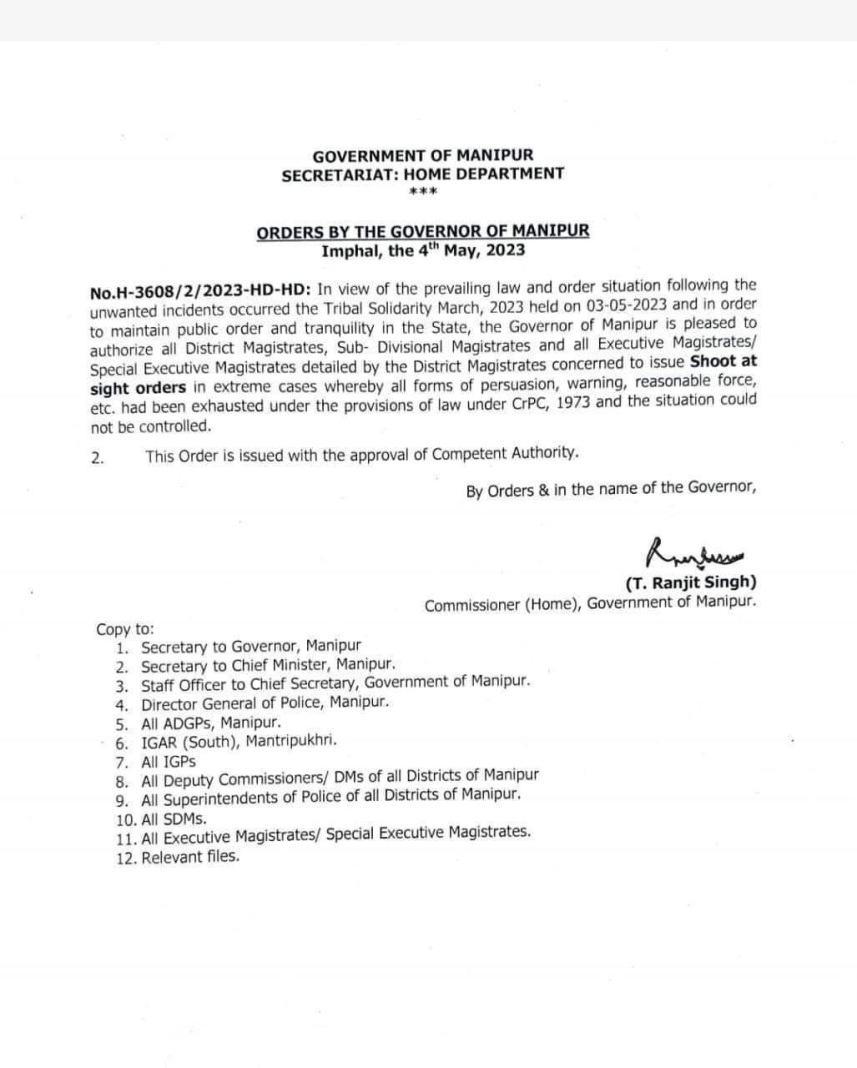
The Governor of Manipur on Thursday authorised all District Magistrates, Sub-Divisional Magistrates and all Executive Magistrates/Special Executive Magistrates to issue shoot at sight orders ‘in extreme cases whereby all forms of persuasion, warning, reasonable force etc has been exhausted’, an official statement issued by the office of Manipur Governor said.

“In view of the prevailing law and order situation, following the unwanted incidents that occurred at the Tribal Solidarity March 2023 held on 03-05-2023 and in order to maintain public order and tranquillity in the State, the Governor of Manipur is pleased to authorize all District Magistrates, Sub- Divisional Magistrates and all Executive Magistrates/ Special Executive Magistrates detailed by the District Magistrates concerned to issue Shoot at sight orders in extreme cases whereby all forms of persuasion, warning, reasonable force, etc. had been exhausted under the provisions of law under CrPC, 1973 and the situation could not be controlled,” the official order said. Earlier today, Union Home Minister Amit Shah spoke to Manipur Chief Minister N Biren Singh and took stock of the situation in the State where law and order were disrupted after tribal groups took out rallies in several districts.

In the telephonic conversation with Manipur Chief Minister, the Union Home Minister was apprised of the present situation and the steps being taken by the State government to control it.

A total of five companies of the Rapid Action Force (RAF) of the Central Reserve Police Force (CRPF) were airlifted on Thursday to violence-hit Manipur on the directions of the Union home ministry.

After clashes in various parts of Manipur after a mass rally held by tribal groups, Chief Minister N Biren Singh said that the incidents were a result of a “prevailing misunderstanding between two communities”.

“The government is taking all the measures to maintain the law and order situation in the state. Paramilitary forces have been deployed in sensitive areas. We are committed to protecting the lives and property of all our people. Long-term grievances of different communities will also be suitably addressed in due course in consultation with the people and their representatives,” Singh said.

Earlier violence had broke out during the ‘Tribal Solidarity March’ called by the All Tribal Student Union Manipur (ATSUM) in the Torbung area of Churachandpur district to protest the demand of non-tribal Meiteis, who dominate the Imphal Valley, for Scheduled Tribe (ST) status.

Thousands of tribals — who make up about 40 per cent of the state’s population — joined the processions, waved placards and raised slogans opposing ST status for the Meitei.

(This news report is published from a syndicated feed. Except for the headline, the content has not been written or edited by OpIndia staff)

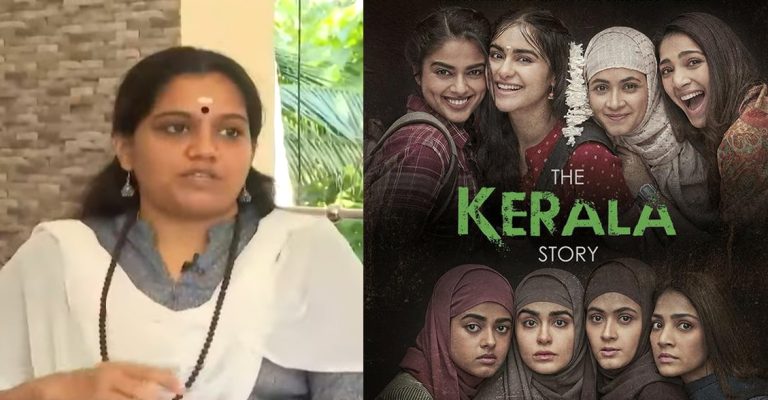
As Islamists call The Kerala Story a propaganda movie, a Hindu girl who was brainwashed by her Muslim friends to embrace Islam says the movie is factual

Sudipto Sen’s The Kerala Story is all set to release in theatres on 5 May 2023. The movie tells the story of ‘ISIS brides’ from Kerala, women from the state who had joined ISIS and married ISIS terrorists in Syria, including Hindu and Christian women who had converted to Islam. The opposition particularly the left and the Congress, and Islamist groups, have been attempting to delegitimize the movie.

They labelled it as propaganda cinema and tried to prevent its screening. However, the film has asserted to shed light on the experiences of countless Kerala girls who were coerced into becoming Muslims and wound up in territories under the occupation of ISIS (Islamic State of Iraq and Syria) or IS (Islamic State).

Now, in a recent development, ABP News interviewed multiple victims of the Islamic conversion factory that operates in the southern state in order to uncover the truth about the horrific and grave problem.

Shruti, a Brahmin and native of Kasargod was one of these females. She said that she was brainwashed by her Muslim friends to convert to Islam, and asserted that the movie Kerala Story is factual.

She went to college to pursue her graduation where she was befriended by other Muslim students. However, this was neither an organic nor innocent association as they had a nefarious agenda behind forming the relationship which soon came to fruition.

She was brainwashed, converted to Islam, and given the name Rahmat. She conveyed that everything portrayed in the trailer of “The Kerala Story” is factual.

She recounted her startling tale in the interview. “Everything the girls are claiming in the movie (The Kerala Story) is true. I also changed my religion ten years ago after being misled. I am from a Brahmin family and converted to Islam because I was brainwashed as well,” she disclosed.

“Muslims made up the majority of the graduation class who influenced me about Islam. They often discussed Hinduism with me. They questioned our religious practices and I had no idea how to respond to them. I had some knowledge due to television series like Om Namah Shivay and Jai Hanuman, but they had so many inquiries that I was unable to address them all and they took advantage of this opportunity,” she informed.

According to Shruti, her Muslim friends used to make fun of Hinduism. “They mocked our festivals and alleged that our festivities happen only to bring boys and girls together. They argued that in the temples, where celebrations are held, males take advantage of females.”

They left no stones unturned to sow the seeds of doubt in her mind. “They used to link the occurrences of physical contact with our events and interpret Hinduism improperly. As a result, I began to wonder a lot about the truth.”

She was lied to by her Muslim acquaintances that such instances are unheard of in Islam. “They remarked that boys and females sit in different sections and the veil ensures the safety of girls. They placed the highest priority on their religion and believed that Islam is the only true ideology.”

She observed that they were very good at manipulating others. “They used to express their thoughts in a way that even the listener took their arguments to be valid.”

Notably, The Kerala Story, directed by Sudipto Sen, also chronicles how a young Hindu girl named Shalini Unnikrishnan converted to Islam with the help of her Muslim companions, married their co-religionist and fled to an ISIS-controlled area with her spouse.

Fatehpur mass conversion: ‘Aadhaar cards were changed for money’, UP Police refutes allegations that VHP staged people to prove mass conversion

On Thursday, the Uttar Pradesh Police told the Supreme Court that it had strong evidence in the mass religious conversion case of persons from Hindu religion to Christianity at Evangelical Church of India, Hariharganj, Fatehpur by defrauding them. The lawyer appearing for the state said that the police had recordings of people in which Adhaar Cards of the Hindu people were being changed and money was being offered to them in return.

This is after Senior Advocate Dushyant Dave, appearing for the defendants in the case alleged that the Hindu organizations like the Vishwa Hindu Parishad had picked up the persons to wrongly prove that they were forcibly converted to Christianity. “200 FIRs have been filed across Uttar Pradesh for no offence,” Dave claimed.

The UP govt’s counsel rejected this claim by Dave that the accused persons were booked without an offence. He said that the accused were seen on camera changing Aadhaar card details of victims, and it is not that there is no case.

The SC then asked the parties to file their pleadings in the case and said that the case would be next heard in the month of July.

As reported earlier, the FIR in this case was filed last year in April in response to a complaint made by a VHP leader named Himanshu Dixit alleging that about 90 people of the Hindu religion had gathered at the Evangelical Church of India in Hariharganj, Fatehpur, with the intention of converting to Christianity through coercion and undue influence. The accused had also promised easy money, among other tactics to the Hindus.

The government officials arrived at the scene after receiving this information and questioned the pastor, Vijay Massiah, who admitted that the conversion process had been ongoing for 34 days and was expected to be finished in 40 days.

The pastor Vijay Massiah was arrested by the Uttar Pradesh Police on October 31, 2022 for illegally converting a group of Hindus to Christianity in the Fatehpur. The accused was absconding after he was booked in another case of illegal mass conversion of Hindus to Christianity in around July of that year. The Police arrested him after they got a tip against the accused who was secretively carrying out another mass conversion in Hariharganj Church of the city.

The accused pastor was arrested while he was giving lessons about Christianity to Hindus and was trying to forcefully change their religion in the name of prayers. The Police arrived at the spot after they were informed about the illegal conversion and arrested the pastor for luring the Hindus. The Police also recovered several Aadhaar Cards with different identities from the accused.

The accused pastor during the investigation confessed that he was illegally converting a group of Hindus to Christianity in the Hariharganj Church of the city. He said that the Aadhaar Cards recovered by the Police belonged to those Hindus who had been converted and that their identities had been updated after they had been given lessons about Christianity and converted to a new religion.

The Police in April last year had also arrested around 26 people including the pastor in a case of mass conversion of Hindus to Christianity in the ECI Church building in Uttar Pradesh. Police had booked 55 people in total in the case, including 10 women. The names of the accused included Vijay Kumar Samson, Reshma Samson, Ratna Daud, Sharon, Jyoti Monalisa, Geeta Masih, and more.

The matter had come to light after the members of the Vishwa Hindu Parishad (VHP) and Bajrang Dal surrounded the ECI Church building in Fatehpur, Uttar Pradesh, and staged protests against the pastor who was allegedly converting more than 50 Hindus inside the Church. Around 100 people had gathered inside the Church on April 14 of which more than 50 were Hindus. The VHP members had also gathered outside the Church and alleged that the pastor in the name of prayers was giving lessons of Christianity to Hindus and was trying to forcefully change their religion.

The accused converted poor Hindus under the guise of a healing assembly. On receiving the complaint, the police registered a case against Massiah and the other persons involved. While they arrested many other accused involved in the case, they could not nab pastor Vijay Massiah who went absconding from the spot. However, the accused pastor was arrested by the Police in October while he was secretively luring, brainwashing innocent and poor Hindus and forcing them to convert to Christianity.

The VHP and Bajrang Dal members had launched protest in April last year and had demanded strict action against the Church for conducting a religious gathering without permission and inviting local Hindus to it. They reiterated that the pastor intended to convert the religion of Hindus.

The VHP leader Himanshu Dixit had also alleged that the pastor was deceptively giving lessons of Christianity in the church by luring poor Hindus. He said that it was the fifth time that a similar incident had happened in the area. “The pastor invites poor Hindus and brainwashes and illegally converts them by offering some ‘religious’ drink. So far five such cases in the church have come to the fore, where the disgusting game of conversion is being played under the guise of a healing meeting without any permission”, Dixit had said adding that the police never take any action against the Church.

However, after the arrest of the accused pastor, the Anti-Terrorist Squad (ATS) of the Uttar Pradesh Police took over the investigation and probed into the foreign funding links of the accused. The details of the bank accounts of as many as 31 of the 36 accused were scrutinised and the UP ATS suspected that the accused had been receiving foreign funding to fuel illegal religious conversions in the state.

‘I got 99 problems, but a husband ain’t one’: Tamil actress Shalini celebrates her divorce, had accused ex-husband Riaz of abuse

In recent days, the ‘divorce photoshoot’ of Tamil actress Shalini sparked discussion on social media as the pictures from the photoshoot went viral. In these pictures, the actress is seen celebrating her divorce by tearing up her wedding pictures.

Taking to her Instagram, Shalini shared some pictures from the photoshoot. One of the pictures read, “I got 99 problems but a husband ain’t one”. In another picture, she is seen tearing her picture with her ex-husband Riyaz. She is also seen trampling a picture of herself with her ex-husband with her foot in one of the photos. In the caption of the said Instagram post, the actress let out a message to “those who feel voiceless” and said that “it is okay to leave a bad marriage.” She also asserted that “divorce is not a failure”.

“It’s okay to leave a bad marriage cause You deserve to be happy and never settle for less, take control of your lives and make the changes necessary to create a better future for yourself and your children. DIVORCE is NOT a FAILURE!!! It’s a turning point for you and to led positive changes in your lives. It takes a lot of courage to leave a marriage and stand alone So to all my BRAVE WOMEN out there I dedicate this.” she wrote in the caption of the photos showing her tearing the photo and celebrating her divorce.

While a section of people lauded the actress for her boldness others wondered why the actress was happy about her divorce.

Actress Shalini who made her television debut with “Mullum Malarum” reportedly got married to Riyaz in 2020. The two also have a daughter. A few months back, Shalini filed a complaint against her husband alleging mental and physical abuse. 

Reacting to the viral photoshoot of the actress, BJP leader Krishan Gahlot took to Twitter and said that the woman seen in the viral divorce photoshoot is Tamil actress Shalini. He said that the cunning media deliberately covered up the truth of the woman who is being hailed as the poster girl of a revolution against patriarchy and labeled as ‘cool’.

“This photoshoot of Tamil actress Shalini has gone viral. In the name of a divorce photo shoot, the way the girl is being described as a poster girl, calling it cool as a revolution against patriarchy, just know the truth that the cunning media has hidden,” Gahlot tweeted.

He further added that Shalini had a Nikah with Riyaz, who later on started to mentally and physically torture the actress. Gahlot also claimed that even after torturing the actress for over five-six years, Riyaz was not ready to divorce her. It was after much struggle that Shalini got divorced and is thus celebrating the same. 

“That is why Shalini, who has overcome tremendous hardships, is celebrating the festival of freedom with such frivolity She must celebrate after all she got out of that hell.  But madam should tell the entire truth to society,” Gahlot wrote.

Madras High Court dismisses the PIL against the release of the film ‘The Kerala Story’

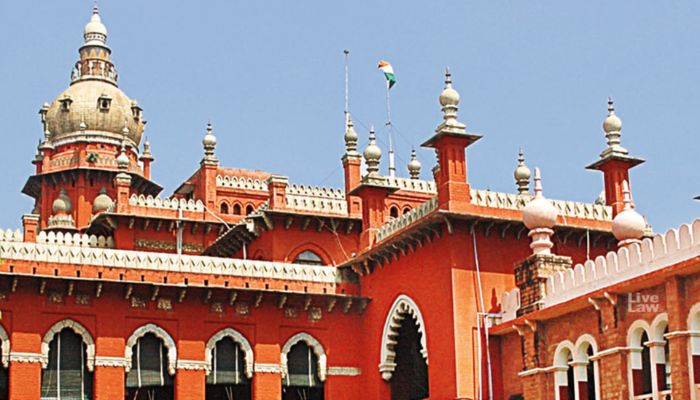
On Thursday, 4th May 2023, a Public Interest Litigation raising an objection to the theatrical release of the multilingual film ‘The Kerala Story’ was rejected by the Madras High Court. After noting that the Kerala High Court and the Supreme Court had previously addressed the matter of the release of the movie, the vacation bench of Justices AD Jagadish Chandira and C Saravanan rejected the PIL filed by a Chennai-based journalist BR Aravindakshan.

The petition filed by the journalist contended that the movie will affect the country’s sovereignty and unity causing disturbance to the public order. He said that the movie made a deliberate attempt to depict Kerala as a state that supports terrorism. He further argued that if the film is permitted to be exhibited, it will be embarrassing for the whole nation since it will give the image that India is a nation that breeds terrorists. The petitioners were questioned by the court over how they could predict that a film would cause issues with law and order without actually seeing the film.

Justice Chandira said, “Why are you coming so late? If you’d come earlier, we could’ve asked someone to watch the movie and decide. You have not seen the movie yet. How can you assume that there will be problems? We’re dismissing this case. The Kerala High Court and the Supreme Court have already dealt with the issue.”

The petitioner’s supporters questioned the movie’s certification. According to the argument, the film was not suitable for certification under Section 5(b) of the Cinematography Act, which prohibits approval if any aspect of the film is determined to be in violation of the State’s sovereignty, security, or integrity. The petitioner alleged that the film’s creators had misrepresented the truth when they said that 32,000 women had joined the terrorist outfit ISIS. Additionally, it was claimed that not even the Home Ministry had any information on such a large number of people joining the terrorist organisation.

When questioned if the film was based on any statistical information or records, the complainant said that the maker of the film had given interviews mentioning that the statistics were based on an address delivered by a previous Chief Minister of Kerala. The appellant said that the movie was premised on events that were occurring in Kerala since the producers claimed to be discovering certain facts.

In his appearance on behalf of the director, senior attorney Santosh Parasaran argued that the petition could not be maintained. He said that the Kerala High Court had previously approved the film’s release and that the Supreme Court had denied relief in a similar petition requesting the ban on the film.

The much-awaited trailer of Sudipto Sen’s film ‘The Kerala Story’ was released on 26th April 2023. Vipul Amrutlal Shah is the producer and creative director of the film starring Adah Sharma, Yogita Bihani, Sonia Balani, and Siddhi Idnani in the lead roles. The film will be released on 5th May 2023 in Hindi, Tamil, Telugu, and Malayalam language.

As allegations and counter-allegations fly between Meiteis and Kukis, here is everything you need to know about the recent Manipur violence

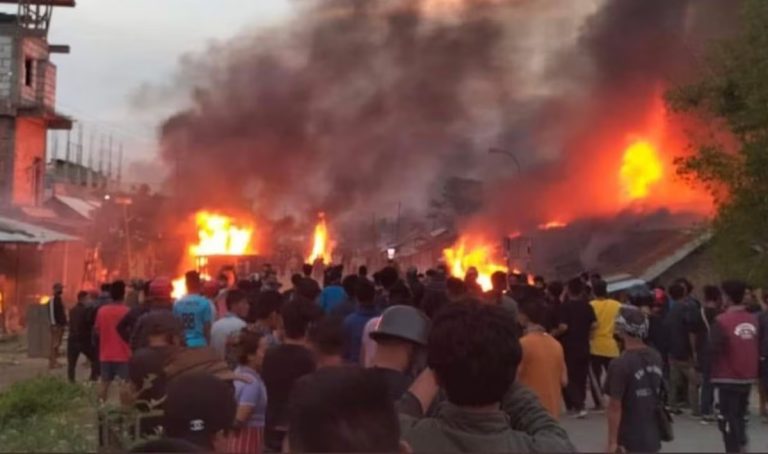
Violence erupted at several places in Manipur on Wednesday during protests by tribal groups against the demand for ST status by the Meitei community. Protests by the tribal groups turned violent at various places in the state, where large scale arson took place. Manipur CM N Biren Singh has said that lives have been lost and property has been damaged in the violence. Curfew has been imposed in eight districts, and mobile internet services have been suspended in the entire state, while army and paramilitary forces have been deployed to contain the situation.

The recent violence first took place in Churachandpur district on 27 April, when a mob led by the Indigenous Tribal Leaders’ Forum (ITLF) burnt down a newly constructed gym-cum-sports facility a day before it was scheduled to be inaugurated by Chief Minister N Biren Singh. The tribal groups were protesting against the proposed survey of reserved and protected forests and wetlands by the state govt, and the demolition of three unauthorised churches.

While the situation was handled swiftly by the security forces, things went out of hand on 3 May, when All Tribal Student Union Manipur (ATSUM) called for a ‘Tribal Solidarity March’ in the Torbung area of Churachandpur district to oppose the demand for inclusion of the Meitei community in Scheduled Tribe (ST) category. Protestors started burning tires and other objects on the roads, which then led to arson and violence.

Similar protests in support of the ‘Tribal Solidarity March’ took place in several other places in Manipur, and many of them turned violent. Violence erupted in tribal-dominated Churachandpur, Kangpokpi, and Tengnoupal districts as well as the non-tribal-dominated Imphal West, Kakching, Thoubal, Jiribam, and Bishnupur districts. According to authorities, violence was fuelled by hateful and provocative messages circulated on social media, which led to the suspension of mobile internet services for 5 days.

While the tribal groups have been opposing the demand of the Meitei community’s demand for ST status for years, the recent protests and violence were triggered by a Manipur High Court order on 27 March, directing the Manipur state government to submit recommendations to the union government for the inclusion of Meitei in the Scheduled Tribes (ST) list. The court had issued the order after several petitions filed by Meitei activists seeking the said direction.

The high court also criticised the state government for dragging the issue for over 10 years. In May 2013, the union ministry of tribal affairs asked the state govt to submit a formal recommendation along with the latest socio-economic survey and ethnographic report, but the Manipur govt failed to do so.

The demands by Meities started with a memorandum submitted to the governor in November 2012 by the Scheduled Tribes Demand Committee of Manipur Valley (STDCM). The committee then met Chief Minister Okram Ibobi Singh in December 2012 with the demand, and then met prime minister Dr Manmohan Singh in July 2013 with the demand. However, the PM asked to them to discuss the matter with the state cabinet.

Meities vs Kukis

The current conflict between Meiteis and ‘tribals’ is the extension of hills vs plains conflict that exists in almost all states in the north east. Meiteis are the majority community in Manipur, comprising around 53% of the population, while tribal communities account for around 40% of the population. There are 34 recognised tribes in Manipur, broadly classified into Naga tribes (24%) and Kuki/Zomi tribes (16%).

While the Naga and Kuki tribes are included in ST list, most of the Meitei community people have OBC status, and some of them are listed as SCs.

Also, the majority of Meiteis are Hindus, with some of them are Muslims and some identify as animists, while the tribals are Christians. The Muslim Meitei community, known as Meitei Pangal, is also demanding ST status, along with the Hindu Meitei community.

However, the Meiteis are limited to only around 10% of the land in the state, as the rest of the state is classified as tribal areas. They live in the small patch of plain area in the state, the Imphal Valley, while the tribals reside in the protected Hill Areas, exclusively reserved for them. Being classified as non-tribals, Meitei people can’t buy land in over 90% of the state.

It is notable that Hill Areas in Manipur, comprising 90% of the total land in the state, are declared by the government under the provisions of Article 371C of the Constitution. The same Article also provides for the constitution of a Hill Areas Committee comprising MLAs from Hills Areas, while relevant laws passed by the assembly constitute village authorities. The committee and the authorities do not allow non-tribals to purchase land in the notified Hills areas.

The Imphal Valley has five districts, while the Hills Area has eleven districts. Apart from the Meteis, the valley is also home to other non-tribals, including people from other Indian states, and immigrants including illegal immigrants from Myanmar. On the other hand, only tribals are allowed to buy land in the hill districts.

The petition by the Meetei (Meitei) Tribe Union that resulted in the High Court order said that Meiteis had Scheduled Tribal status before 1949, but when the state merged with India in October 1949, they lost that status. When different communities in India were classified as Scheduled Castes (SC) and Scheduled Tribes (ST) under Article 341 and Article 342 of the constitution, the Meitei community was not included in any of them, reportedly because they are caste Hindus. At that time, not having SC-ST status was not a big issue, but things changed later, and the Meiteis started demanding reserved status.

After the implementation of the Mandal Commission report, Meiteis were granted OBC status, and thus they became eligible for reservation in govt jobs and seats in educational institutions. In Manipur, the quota for ST is 31%, OBCs enjoy a reservation of 17%, and the same is 2% for SCs.

Apart from ST status, Meiteis are also demanding NRC in the state, alleging large-scale illegal immigration in the state, which is being opposed by the tribes.

Naga tribes distance themselves from violence

While both Naga and Kuki tribes are opposing the Meitei demand for ST status, the Naga community has distanced itself from recent protests and violence. It is the Kuki tribes who are mainly behind the recent protests and violence. While the Tribal Solidarity March took place in the entire state, violence took place mainly in the Kuki areas, and the march was peaceful in the Naga areas.

In fact, several organisations of the Naga community, including the Maram Union, Mao Union and Rongmei Naga Council Manipur, have said that Indigenous Tribal Leaders’ Forum is a new organisation and it does not represent all tribals.

Rongmei Naga Council Manipur issued a statement last month saying that the actions of ITLF are against the wishes and integrity of the indigenous tribes. “Creating chaos to the peace and tranquillity loving people of the state has become a daily practice of some class of people. The indigenous Rongmei people clarify once for all that, it have no knowledge of the existence of such bogus forum and appeal all right thinking indigenous communities to abstain from the said rally,” the Naga boy had said.

What the tribals alleging

The tribal groups are alleging that Meiteis want to grab their jobs by becoming STs, while they already have reservation as OBCs. They also claim that the Meitei community is already an advanced community, and they don’t require the benefits of reservation. Pointing out that out of 40 out of 60 MLAs are from the Meitei community, the tribal groups claim that the majority community is the dominating community in the state.

According to them, the Meiteis are wealthier, wield both political and administrative power, have higher population than all tribes combined in Manipur, occupy most positions of power, control major businesses and institutions, and have relatively higher social, educational and economic standing than tribals.

In a memorandum submitted to union law minister Kiren Rijiju, the All Tribal Students’ Union Manipur (ATSUM) had said, “the fact that the Meetei/Meitei community has done exceedingly well in the fields of technology, medical, engineering, sports and civil services under UPSC is indicative of their advancement”. 

The tribal groups are alleging that if Meiteis become STs, they will grab all jobs reserved for STs, claiming that the educational qualifications of Meiteis are generally better than Nagas and Kukis. “If the advanced Meitei community is recognised as ST by the government, all the seats reserved for ST in the present will be occupied by the Meiteis. Despite already availing the reservations from SC and OBC categories, the Meiteis are insisting for inclusion in ST category with a sole objective of grasping the benefits presently reserved for the hill tribes,” ATSUM has said.

Further, according to them the Meitei language is included in the eighth schedule of the constitution and is a well-developed language with a script, as opposed to most tribal languages, and therefore Meitei community is ineligible for protected status.

Apart from this, they are also claiming that the Hindu Meiteis want to buy land from tribes in protected hills areas, which they don’t want to happen.

The tribal groups further argue that the plain people, the Meiteis, were not included in the ST list because they have lost their ‘primitive and distinctive’ features, therefore they can’t be classified as tribals.

The tribal groups further claim that originally Meiteis were happy to be not classified as tribals due to the social divide between the people of valley and hills, and the plains people used to use derogatory words like ‘Haos’ to refer to the tribals.

What the Meiteis say

On the other hand, Meiteis deny that they are seeking ST status to grab reserved jobs. According to them, without the status of the scheduled tribe, the Meetei will lose the status of an indigenous community. According to them, it is not about reservation in jobs & educational Institutions and tax relief, but it is more about protecting the Lands, culture and identity of the people, which can’t be protected without ST status.

They claim that their ancestral lands, culture and identity are under constant threat from illegal immigrants from Myanmar and outside the state, and therefore they need the protected status.

The Meitei community also reject the claim by ATSUM that they have lost their tribal nature, saying that even though they follow Hinduism, they still follow ancient animist rituals, they belong to mongoloid race, they are geographically isolated, economically backward compared to the national average, they are a microscopic minority, and therefore they fulfil all the criteria for being classified as Scheduled Tribals.

In regard to land, the Meitei community say that while they are allowed to buy land in only 10% of the state, there are no restrictions on others, including tribals and outsiders, from buying land in the valley, while only tribals are allowed to buy land in hill districts. According to them, this has resulted in a scarcity of land for them.

According to Meetei (Meitei) Tribe Union, as a result of being left out of the ST list, “the community has been victimised without any constitutional safeguards to date. The Meitein/Meetei have been gradually marginalised in their ancestral land. Their population which was 59% of the total population of Manipur in 1951 has now been reduced to 44% as per 2011 Census data”.

Protest against Meitei ST status or eviction of Burmese Kukis?

The Meiteis also claim that the violent protest against ST status demand is just a façade, and there is another motive behind the protests by the tribals. According to them, the real target is the survey of forest land and eviction of illegal immigrants from protected areas.

According to the Meitei groups, Manipur is witnessing a sudden population surge with a growth rate of 24.5% against the national average of 17.64%, as a result of illegal immigration. They said the abnormal surge and mushrooming of villages were being noticed in the hill areas of Manipur. They said that such abnormally high population growth can’t be attributed to natural birth, adding that it is the result of migration from neighbouring countries.

According to them, Kuki people are immigrating from Myanmar and occupying forest land in Manipur, and the local Kukis are supporting them. Aware of the situation, the state govt has launched an eviction drive, which is being opposed by the tribal groups.

Chand Meetei Pocshangbamof of the All Meitei Council said, “Kukis are migrating illegally from across the Myanmar border and occupying forest land in Manipur. Recently, the Manipur government started an eviction drive to clear illegal settlements in reserve forest areas. The drive was in all areas, including those inhabited by Meiteis and Muslims, but only the Kukis are protesting.”

For this reason, Meiteis are demanding the implementation of a National Registrar of Citizens (NRC) in the state, to identify illegal immigrants. “Meiteis are demanding an NRC because of the sudden population spike in the last two decades in areas bordering Myanmar. Illegal immigrants from Myanmar have been settling in Manipur since 1970s but the movement has intensified now,” Pocshangbamof said.

It is notable that the state government has identified 38 villages in the Churachandpur-Khoupum Protected Forest area as “illegal settlements” and said that its residents are “encroachers”. Following this, the govt launched an eviction drive that led to clashes. The government also announced a survey of forest areas to identify encroachment, which is being opposed by the tribal groups.

Chief Minister N Biren Singh said that the protesters were challenging the constitutional provisions. He had said, “the people there were encroaching reserved forests, protected forests and wildlife sanctuaries for poppy plantation and drugs business.”

The tribal groups, mostly Kuki groups, claim that the eviction and the survey are in violation of Article 371C of the constitution, which confers some administrative autonomy to the tribal-dominated hill areas of Manipur.

Allegations of pre-planned strategy for ethnic cleansing

Amid allegations and counter-allegations, another allegation has emerged saying that it is a pre-planned strategy to evict Hindu Meities living in Christian Tribal areas. According to Meitei groups, following the violence in the Churachandpur district, Meities who had left their villages have not returned. Allegedly several houses were burnt by tribals and stones were pelted, forcing the Meiteis to flee.

Unverified videos have emerged showing houses on fire, allegedly belonging to Meiteis. Reportedly, miscreants armed with sophisticated weapons attacked Meitei Hindu houses and torched them on Wednesday.

Reportedly, around Hindus fled their homes in Kuki-dominated areas in Churachandpur and took shelter in nearby Indian Army and para-military camps.

Hindu activists have claimed that it is not a tribal vs non-tribal conflict, but it was actually initiated by the Christian tribals to evict the Meiteis from Christian majority areas. They allege that Christian tribals pre-planned the incident, and implemented it on the day vice president Jagdeep Dhankhar visited Manipur.

The Hindu activists point out that the Tribal Churches Leaders’ Forum issued a statement supporting the tribal solidarity march. In response to the call by ATSUM, The Tribal Churches Leaders Forum (TCLF unanimously resolved to endorse the ‘Solidary March’ of ATSUM in a meeting held on May 1. “This solidarity March organised by the ATSUM is to collectively protect the social, political and religious interests of the tribal people of Manipur,” said the statement.


The admirable political chutzpah of Prime Minister Narendra Modi

‘You have to believe in yourself. You need to have audacity to be great’ ~ Rosie Perez

Chutzpah is a word adopted from Hebrew/Jewish vocabulary. In Hebrew, it has a negative connotation, but of late in English, especially used by Americans, it is something to do with audacity. Former US president Barack Obama wrote a book titled Audacity of Hope; it could well be titled Chutzpah of Hope.

The word audacity borders on arrogance and defiance. He had the “audacity to insult me” which means he had the guts or the gumption or the cheek to say this. Oprah Winfrey’s Chutzpah Awards, presented annually to women whose chutzpah—audacity, nerve, boldness, conviction—has taken them to the most amazing places.”

For instance, Narendra Modi made some tough decisions in his first six years in power, which many didn’t like. Demonetization was one, and the immediate lockdown of the country during the COVID-19 pandemic and the abrogation of Article 370 were all similar chutzpah moments.

The air strike on Balakot in Pakistan, Indian aircraft crossing the Line of Control (LOC), and going 80 km deep to bomb terrorist camps in Pakistan were very tricky and risky decisions. Anything could have gone wrong, but he did it. The executive order was given by him. An ordinary man will not be able to sleep with this kind of stress.

The Republic Summit 2023- A chutzpah event?

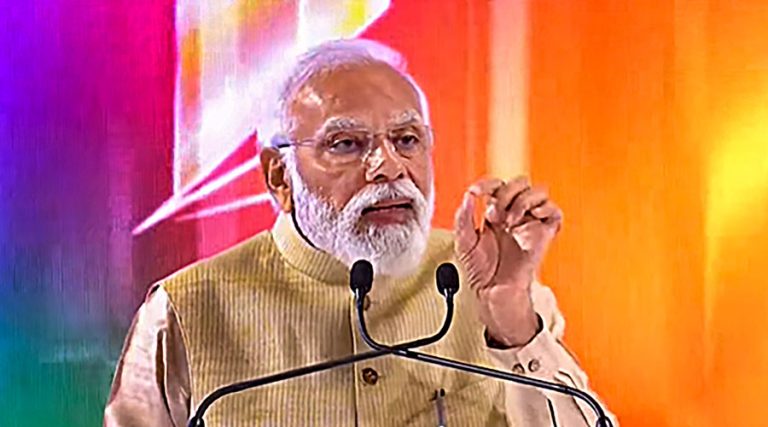
PM Narendra Modi and his select cabinet ministers spoke at the Republic Summit on the 25th and 26th of April 2023, the theme being transforming India- which gave me the idea of writing this piece.

He has the guts to take difficult decisions even putting his political existence at risk. With the opposition, foreign media, and several guys within the nation all watching like hawks and looking for one single major failure from him or his administration so that they can take him down. In such an environment, taking bold decisions is even more risky and requires tremendous courage of conviction.

Let me illustrate this with an example. Every safe flying trapeze rig in a circus has a large safety net underneath the ring. If an artist/gymnast misses a catch, or slips and falls off the bar, he lands on the net and is saved. In the case of PM Modi, the risks and stakes are higher than one could imagine, they have national and international ramifications and he is doing it without a safety net!

One thing which he mentioned in his stellar speech was that the entire opposition was asking him to go for importing Covid Vaccine and there was no point making our own. In any case, someone will come out with one and all we need to do was to pay and buy!

He said this was the easiest thing to do but he wanted ‘Atmanirbhar’ Bharat- self-reliant India, and went ahead with indigenous development and mass production of vaccines at home. He was candid enough to say that he had put his entire political capital at risk- but he did it.

In the case of Truman, it was millions of Japanese that would perish due to Atomic bombing but in the case of Modi, it was the lives of his own people at risk- and that is the major difference.

Almost all the members of his council of ministers who had spoken before him had said that the biggest strength of the Prime Minister was to take risks. This was one reason his team always stood by him.

The greatest art of leadership and acumen of a great leader is to produce and motivate more leaders. Republic Summit in more than one way demonstrated that Modi ji is a great leader who has nurtured a great team of leaders in his cabinet colleagues. You cannot run a 1.4 billion strong economy single-handedly, though he personally gets involved with ministers to give clear directions and sets an accountable road map.

‘The only safe ship in a storm is leadership’ ~ Faye Wattle ton

Each one of the participating ministers on the dais was fully charged up and spoke with passion and facts on the ground. It was like India firing on all cylinders at once.

Mr. Nitin Gadkari, Minister of Road Transport and Highways in India, told the nation that highways are the connectivity that would make the cost of logistics lower and make us a more competitive production hub for the entire world. It impacts our economy directly. He even quoted John F Kennedy that ‘American roads are not good because America is rich, but America is rich because American roads are good’. This is the focus and commitment at the national level in India. He gave several statistics which were mind-boggling. The work is going at breakneck speed on Tunnels, Highways, and bridges.

Ashwani Vaishnav, the railway minister who is a Post graduate in Engineering from an IIT and Management graduate from Wharton business school, presented his achievements brilliantly. Modi ji has picked up the right people for the right job- which is a great leadership skill.

If one looks at earlier Ministers, I don’t think anyone would be anywhere close to him in his experience and the relevance of his education to the job at hand. Arnab Goswami, the editor-in-chief of Republic, did mention that earlier ministers were happily doling out railway stations to their own constituency and state but today things are different. Today, the focus is on overall progress across the country.

The minister told the audience that most of the stuff was produced in India. Our train is doing 0 to 100 kmph in 52 seconds beating the Japanese bullet train by full 2 seconds. We are building and commissioning Vande Bharat trains at a breakneck speed. He told the audience that the PM didn’t believe in delta changes which means tiny changes but wanted quantum shifts in every field. Railway tracks, stations, and the quality of trains are totally different. Indians were given trains with technologies of 1940 or 1960 till now. Today we are giving world-class trains at par with the best in the world. He also mentioned that the kind of knowledge the PM has in advanced technologies like AI and quantum computing is unbelievable.

Hardeep Puri, the minister for energy and urban development, was setting a different benchmark. Importing crude from Russia was a big geopolitical decision and a shift in foreign policy. Today we are setting the world agenda through G20 and a robust foreign policy stance. He proudly announced that more than 2000 archaic laws which were created by the British and are no more relevant today have been scrapped. How our students from Ukraine were rescued and how India helped other nations during times of crisis was something to be proud of. Today every Indian going abroad is proud to be an Indian. This is something that does not seem to be tangible but in fact, is the most tangible of all achievements.

Jyotiraditya Scindia, minister for civil aviation, explained how the hub and spoke model was being implemented to take aviation to the last mile – by connecting the Tier 3 and Tier 4 cities, even reaching border areas. How airports are being modernized and new ones coming up at a rapid rate.

Piyush Goyal, who holds charge of multiple ministries like commerce, textiles, and public distribution also gave an idea of how the PM wants cities and states in the North East to be given a priority, understanding that they were neglected for decades. Roads, bridges, and Industrial development is taking place even in states where there is only one Lok Sabha seat! This means the government is focusing on the entire nation and not looking at political leveraging’.

Of course, the last one to speak at the summit was the PM himself. He did give an overall perspective on the transformation of the nation.

Today the world is looking at our digital India initiative. When at the press of a button by the PM, millions of beneficiaries get money directly into their accounts instantly, even amazing most of the countries in the West. The scale and speed often become unbelievable for the leaders in the West who now look up to PM Modi for his indulgence and guidance.

If this is not the Chutzpah of a nation and its leadership, then what is?

‘One day everything will be well, that is our hope. Everything is fine today is our illusion’ – Voltaire.

Damage control from Congress continues: After Veerappa Moily said they can’t ban Bajrang Dal, DK Shivakumar promises to build Hanuman Temple in every Taluka

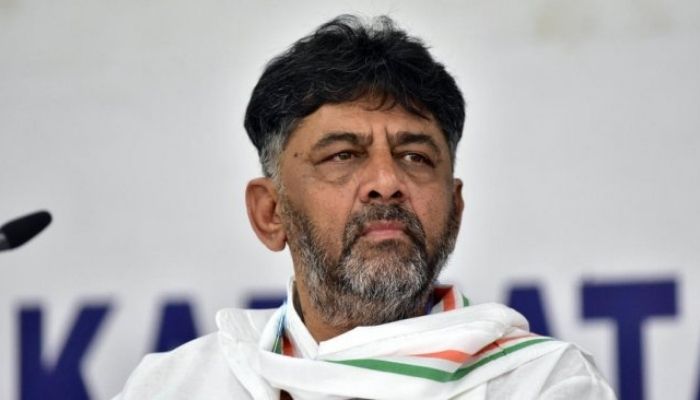
On Thursday, May 4, DK Shivakumar, the head of the Karnataka Pradesh Congress Committee (KPCC) paid a visit to Goddess Chamundeshwari temple in Mysuru to seek the blessing of Lord Hanuman. Speaking to the media after that, he vowed to build Hanuman temples in each Taluka of Karnataka if his party is elected to power in the state.

The extensive backlash the Congress is facing for promising to outlaw the Hindu organisation Bajrang Dal in its election manifesto for Karnataka is unsettling the party’s leaders, just before the crucial Assembly elections in the state.

While other party bigwigs like Karnataka Congress leader and former chief minister M. Veerappa Moily are already attempting damage control, DK Shivakumar has tried to play the “soft Hindutva” card, which his party typically employs before every major election.

It is worth noting here that the day Congress released its Karnataka poll manifesto, PM Modi criticised the grand old party for pledging to ban the Hindu outfit Bajrang Dal and equating it to the banned Islamist terrorist organisation Popular Front of India (PFI). He said that the party is trying to lock up those who revere Lord Hanuman, in an obvious reference to members of the Bajrang Dal.

Now, only two days later, the party’s senior leader DK Shivakumar has not only embarked on a visit to a Hanuman Temple but also pledged to build Hanuman Temples in each and every district of the state.

Sharing a picture of himself bowing before Lord Hanuman at the Chamundeshwari temple in Mysuru DK Shivakumar captioned his tweet in Kannada which roughly translates to, “Performed puja for Lord Hanuman after mother Chamundeshwari’s darshan in Mysuru. Hanuman means power, and Hanuman means peace.”

He told the media there that the Congress will build Anjaneya temples across the state if voted to power. “We will establish a special board to oversee the development of Anjanadri Hill and ensure its preservation. Our party will also prioritize the construction of new Anjaneya temples in various parts of the state, reflecting our commitment to honouring the rich cultural heritage of Karnataka,” he said.

“Additionally, we will organize specific programs aimed at educating the youth about the principles and values embodied by Lord Anjaneya,” the KPCC president added.

Shivakumar also raised questions over why Anjaneya temples were not built and why Anjanadri Hill was not developed as a tourist spot. He asked, “How many Anjaneya temples did the BJP government build? Their record on the matter remains unclear and we firmly believe that the promotion of Anjaneya’s legacy is essential for the spiritual and cultural upliftment of the state. Therefore, if elected, the Congress party will hold separate programs in the name of Anjaneya in each taluk to spread awareness about his teachings and inspire more people to follow his path.

Congress tries to do damage control after backlash over Karnataka poll promise

Earlier, Karnataka Congress leader and former chief minister M. Veerappa Moily in an apparent damage control move said that it is not possible for the state government to ban Bajrang Dal, adding that there is no proposal to ban the group. 

“We have PFI and Bajrang Dal mentioned in our (Congress) manifesto and included all radical outfits. However, banning an outfit is not possible for the state government as it is the central government’s jurisdiction. So a ban on Bajrang Dal by the Karnataka government is not possible. DK Shivakumar will come up with more clarity on this,” Moily said while addressing the media in Udupi.

The former Karnataka CM also said that the Congress promised action against outfits like Bajrang Dal in the manifesto in the backdrop of the recent Supreme Court observation against hate politics.

Interestingly, the Congress party invited severe backlash by promising to “ban organisations like Bajrang Dal” in its election manifesto for Karnataka.

While Congress says that it will act against organizations spreading hatred, the Social Democratic Party of India (SDPI)—the political wing of the now-banned PFI announced on Wednesday that it will be contesting only 16 Assembly seats in the upcoming Karnataka elections in a bid to help Congress defeat the BJP. Initially, the SDPI had said that it will be contesting on 100 seats.