Home Blog Page 2440

Can’t beat the anti-India campaigns backed by billions? Join them and tap their funds

0

There is a very popular saying in the western world – if you can’t beat them, join them! Maybe India should do that with George Soros & co! Am I talking nonsense? What am I saying?

Let me explain!

Before that, let me highlight a small story from the famed Asterix comics series. To me the Blackadder series, Asterix, Yes Minister, Two Ronnies etc hold valuable lessons and anecdotes, not to speak of jokes, that apply forever across cultures.

In one of the Asterix comics, titled “Mansion of the Gods”. Julius Caesar tries to defeat the village of Asterix, the last holdout against the mighty Roman empire, by building a huge city in the forest next to their village. After initially trying to defeat the plan by attacking the builders, and failing, Asterix & co think up a better plan. They join them! By sending a few villagers to live in the new city. One of them is the horribly out of tune village bard, Cacofonix. I will not spoil the plot anymore by continuing, you can buy the book!

That is exactly what I am suggesting. Instead of the current whack-a-mole strategy of taking on the anti-India forces one by one and finding new ones pop up a few feet away, why not just join them?

Before I elaborate further on the plan, let me discuss why it is so hard to defeat the anti-India lobby with any other plan.

It is demand and supply stupid!

There is a huge amount of anti-Hindu and anti-India dollars and euros out there looking for avenues to “invest”. Just as VC capital looks for startups to fund. In boom years, these funds even get invested in useless deals that everyone suspects will bomb from day 1. But because funds have been raised and targets to be met by the manager. If not, he doesn’t get his next quarter bonus. It’s like Poojary’s loan mela.

Right now, it is boom time – or “Amrti Kaal” as Modi puts it. No, I am not talking about Indian economy and cultural renaissance. It is Amrit Kaal for anti-India forces since Modi is ruling. Never has so much been set aside for regime change. It is a blank cheque – the sky is the limit – just get him out. Or as Mani Shankar Aiyar will put it, “Inko hataayiye, hamein laayiye!”.

These funds that want Modi out has a variety of sources – regime change warriors like George Soros, Evangelist and Church lobbies, do-gooders filled with white man’s guilt, Billionaires that just have too much cash and too little to do, Crypto billionaires that made too much in too short a time, weirdos that think Maoist ideologies that their own countries rejected are ideal for dark Indians, Middle Eastern Islamist lobbies, arms makers pissed off that their deals are off, competitor nations trying to put a spoke in the wheel, list goes on.

The “exit plan” is simple – India that is poor, in anarchy and chaos, fulfilling Malthusian prophecies and “told you so” predictions, proudly showcasing slums and snake charmers to visiting dignitaries, dependent on their aid dollars, ashamed of their faith and history, ready to embrace the “true Lord”.  And of course, ruled by the same fascist families that kept it there.

Now, who will they “invest” these funds with?

They can of course fund a few Audrey Truschkes – but this comes with inherent risks. A white lady telling us how to do things will only go so far. The game will be up once it moves away from JNU campuses and reaches the heartlands.

The best is if they can find brown coolies that can carry the message. They offer plausible deniability. They can exploit internal fault lines better. If they happen to be rootless and faithless commies that loath their own skins, even better. On the surface, it may appear weird that hardcore capitalists like Ford, Bezos or Soros are funding Maoist or Stalinist ideologues. But remember, their home economies, balance sheets and Corporates are insulated from the fringe left ideologies they sponsor. They are safe. The poison and the sewage are for us to drink. It is the ideological equivalent of toxic ships, garbage and other junk that get exported to the third world for processing.

Once the word is out that there is a fund with a few hundred million dollars looking for “suitable” candidates, the rest is easy. There is a stampede. Just think of the number of history, social “science”, political “science” graduates JNU etc churn out, unfit for any productive job. We are in a country where a job listing for a few peons by Indian Railways attracts millions of applications. Even PhDs and postgraduates will apply, amply testifying the value of their degrees in social “science” or history.

Whack a mole doesn’t work

India’s reaction so far has been, well, reactive. We wait for someone to say or do something, then desperately try to lash out. Or present dossiers. Try point facts. Play victim. It just doesn’t work because the target is too far away, too secure, and moreover, too many. The left relishes this attention because it furthers their own reach, visibility and goals. On top of that, we don’t control the Western or even Indian media and its narratives.

We have been whacking moles that pop up relentlessly and growing tired.

Ignoring is one good strategy but is not effective if as I pointed out, we don’t control the narrative. The stench they manage to spread becomes self-fulfilling prophecies and regime change usually follows.

Hence the new plan! Why not join them?

Exploit the demand-supply gap!

My suggestion is simple. Just flood the market. Exactly as Asterix and his villagers did. In fact, in another comic from the same series, they create an oversupply of menhirs to flood the market and defeat Caesar’s plan of corrupting them. Create so much supply, demand is sucked dry!

RW hacks should set up NGOs in stealth mode, preferably staffed with patriotic and nationalist minorities, backwards and Dalits, to write articles that an Arundhati, Dhanya, Varadarajan or Ranaa write. In fact, they can use ChatGPT to write it. It is so easy.

Send them to Soros, Omidyar, Ford foundation, BBC and all other such “investors” and try secure funding and sponsorship. Once funds arrive rinse and repeat. Train more to do the same, pro-bono. Every week the investors must be flooded with hundreds, if not thousands of typical bleeding heart, anti-Hindu/Modi/India material saying essentially the same thing in slightly different ways. Some can be in regional languages so that you may get funded even without someone reading it! Online portals that can easily replicate the “successful” leftist ones can be set up too to act as funding magnets.

I say employ Dalits, backwards and minorities because Soros types will be faced with a choice – do they continue to fund the Chianti bottles and business class tickets of upper caste/class coolies at high cost or use the cheaper alternative from the real deprived classes? If they don’t accept, the victim card can be played. To get more bang for their buck, they may very well choose the alternative. It also brings competition to the market and reduces earnings of the “genuine” fringe frauds – something quite desirable as they may give up and pick other hopefully useful ways to earn their keep. Or join the Congress like Kanhaiya did.

I can tell you, why one billion, even a hundred billion dollars set aside to topple Modi will get sucked in like a cup of water in the Thar desert once we get going. It will boost jobs, consumption, and growth.

You may point out a risk – that this may indeed work too well and all that propaganda, both real and fake will end up causing regime change. Well, that is a risk but quite a low one. Because as Jairam Ramesh, the intellectual genius pointed out, our Nehruvian heritage will protect us from being influenced. How many read Dhanya Rajendran and decide who to vote for? Most likely their mind is already made up.

I suspect Soros, Ford & co will simply get too tired processing the millions of applications and material that floods their inbox and move on to more convenient targets. Just as Julius Caesar did.

True Amrit Kaal indeed!
Pakistan’s PM directs the foreign office to cut expenses and the number of missions abroad to reduce expenditure: Report

0

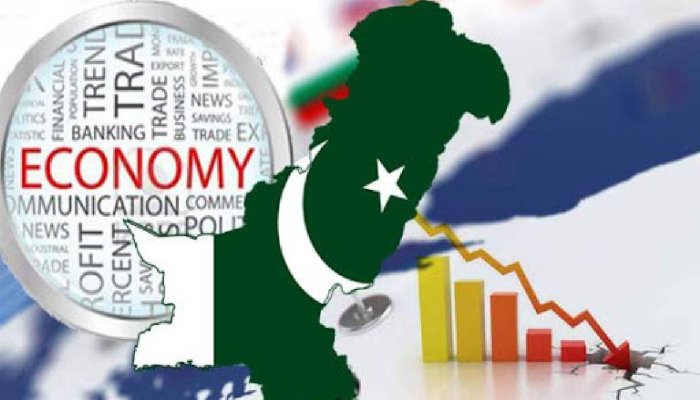
In face of a mounting economic crisis and no tangible signs of relief, Pakistan’s prime minister, Shehbaz Sharif, in an attempt to reduce expenses, has issued a fresh directive to the foreign office urging it to implement cost-cutting measures.

With no financial assistance from the International Monetary Fund (IMF) or “friendly nations,” the government of Pakistan has undertaken a comprehensive austerity drive to manage its faltering economy.

In an effort to cut down spending by 15%, the Pakistani PM reportedly gave the Ministry of Foreign Affairs instructions to close down a number of diplomatic embassies abroad and scale back on their offices, staff and other operations.

A statement from the PM Office read, “The prime minister is pleased to direct that a well-considered proposal/ plan in this respect may please be submitted to this office within two weeks positively.”

According to this official message titled “Rationalization of Foreign Mission Abroad,” the prime minister was glad to establish a National Austerity Committee (NAC) in light of the ongoing economic restrictions and the ensuing necessity for fiscal consolidation and control of the external deficit. In addition to cutting spending to lower the budget deficit, NAC attempts to conserve resources and implement stringent measures to ensure the wise use of public funds.

 The budget reduction for Pakistani missions abroad was suggested by the committee.

“This may be achieved by curtailing the number of Foreign Missions, reduction in the number of officers and staff posted there and other suitable measures,” it said.

The committee has proposed that multiple parcels of properties be retrieved from judges, military and civil officials and other elements of society.

In addition, it advocated a 10% salary cut for all government workers through June 2024, along with a 15% cut in member of parliament (MP)s’ wages and benefits. It further recommended installing pre-paid metres nationally in the gas and electricity industries.

Pakistan’s economy is in the worst state it has ever been in, and has no alternative, but to implement strict economic measures in order to obtain financial aid from the IMF.

Israel’s ambassador to India says ‘Adani Group has potential’, backs takeover of the Haifa port

0

On Wednesday, 22nd February 2023, Israel’s ambassador to India Naor Gilon said that Israel handing over the Haifa port to the Adani Group is a reflection of the trust it has in India. Gilon said that the Adani Group has the potential to make the Haifa port the port it needs to be.

Addressing a press conference on Wednesday, Naor Gilon said, “We want our friends to remain close to us. We feel very comfortable with India. As I said before, Indian-controlled ports in Israel are something that we’re welcoming.”

Naor Gilon added, “It was a very important move from our point of view because Haifa Port is our strategic asset. Adani Group has the potential to make the Haifa Port the port it needs to be and to increase trade between Israel and India.”

He further said, “The fact that we are giving to an Indian company, I think from our point of view, it is a symbolic or sign of deep trust of handing the strategic asset in an Indian group.”

Talking more about Indian companies he said, “Adani Group is looking for more projects in Israel. We have about 80 joint ventures with Indian companies, including TATA, Kalyani, and BHEL. Ports are the core business of the Adani Group. I see ports working very well. Adani Group is looking for more projects in Israel & I hope they succeed.”

About the Center of Excellence jointly started by India and Israel, he said, “We have completed 30 years of full diplomatic relations and recently just inaugurated the Centre of Excellence in agriculture. We have in the pipeline 10 CoEs more and we have more in the pipeline. There is one in Karnal in Haryana. These CoEs are doing a wonderful job of outreaching farmers by giving them technologies that can be adapted to their capacity. These lower-end technologies are lower in cost.”

On Thursday 14th July 2022, the finance ministry of Israel announced that India’s Adani Ports and Israel’s Chemical company Gadot have won a tender for the privatization of the port of Haifa. Haifa is one of the largest seaports in Israel. The consortium that bid for the port consists of the Israeli company Gadot (70%) and the Indian Adani group (30%). The Adani Group paid USD 1.2 billion for the important Israeli port of Haifa and promised to reshape the skyline of this Mediterranean city as part of its plan to invest further in the Jewish nation, including the establishment of an artificial intelligence lab in Tel Aviv.

Supreme Court refuses to stay Election Commission’s decision to allot Shiv Sena name and symbol to Eknath Shinde faction

0

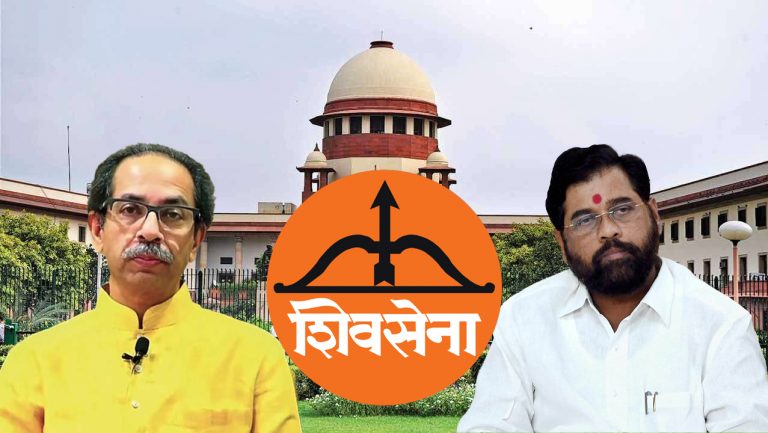
The Supreme Court on Wednesday refused to stay the Election Commission’s order to allot the name ‘Shiv Sena’ and the ‘Bow and Arrow’ symbol to the faction led by Maharashtra Chief Minister Eknath Shinde, saying, “we can’t stay an order at this stage”.

The SC clarified that the Uddhav Thackeray camp can pursue other remedies of law if any action is taken which is not based on the EC order. The top court listed the matter after two weeks.

Senior Advocate Kapil Sibal insisted on SC granting interim relief and said that they are taking office after office and urged the court to pass a status quo order.

Supreme Court asked rival camp Eknath Shinde to file a reply to the petition.

On Tuesday, Kapil Sibal urged the Supreme Court to hear the plea on Wednesday, submitting that if the EC decision is not contested and challenged, the rival faction will take over everything, including the party’s bank accounts, among other things.

CJI Chandrachud said, “It will not disrupt the Constitution Bench hearing because three judges are waiting for them.” He added that he would finish the Constitution Bench hearing on the Maharashtra political crisis and take it up the plea contesting the EC’s ruling on the Sena symbol thereafter on Wednesday.

The court said that it will read the matter first.

The Uddhav Thackeray-led faction of the Shiv Sena moved the Supreme Court challenging the EC’s move to allot the name ‘Shiv Sena’ and ‘Bow and Arrow’ symbol to the rival faction led by CM Shinde.

Uddhav, in his plea filed on Monday, said that ECI failed to consider that his faction enjoys the majority in the Legislative Council and Rajya Sabha.

Uddhav Thackeray in the plea, also submitted that the legislative majority alone, in this case, could not be the basis for passing of the order by EC.

Challenging the EC decision, Uddhav Thackeray said the poll panel was erroneous in its decision and said that, “the entire edifice of the impugned order (EC’s decision) is based upon the purported legislative majority of the Respondent (Shinde) which is an issue to be determined by the top court in the Constitution Bench”.

“The ECI has failed to consider that the Petitioner enjoys a majority in the Legislative Council (12 out of 12) and Rajya Sabha (3 out of 3). It is submitted that in a case of this kind where there is a conflict even in the legislative majority i.e., Lok Sabha on the one hand and Rajya Sabha on the other as well as Legislative Assembly and Legislative Council, more particularly, having regard to the fact that there is a possibility of the alleged members losing their right of membership, the legislative majority alone is not a safe guide to determine as to who holds the majority for the purposes of adjudicating a petition of the Symbols Order,” the plea said.

(This news report is published from a syndicated feed. Except for the headline, the content has not been written or edited by OpIndia staff)

‘TMC spent a lot of money in Goa to help BJP come to power’: Rahul Gandhi in Meghalaya

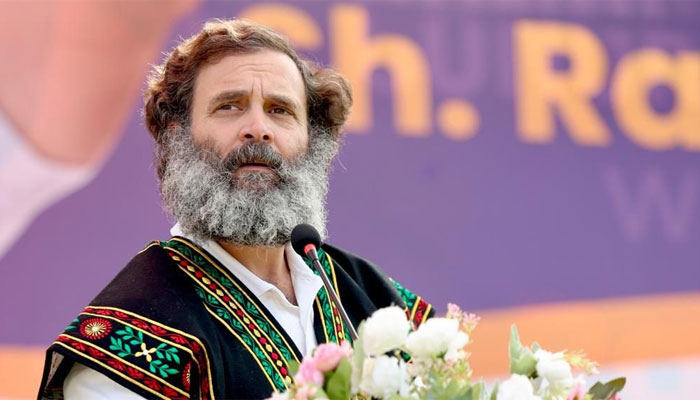
On February 22, Congress leader Rahul Gandhi, who has not yet got over his ‘Bharat Jodo Yatra’ messy-beard look, claimed while addressing a political rally in Meghalaya that Trinamool Congress (TMC) helped Bharatiya Janta Party (BJP) in Goa state elections.

In his speech, Gandhi said, “You also know the history of TMC, you know the violence that takes place in Bengal. You know, the scams, the Sharda scams that had taken place. You are aware of their tradition, they came to Goa and spent a huge amount of money as their idea was to help BJP. This is exactly the idea in Meghalaya. TMC’s idea in Meghalaya is to ensure that BJP comes to power.”

TMC’s MP Mahua Moitra was the in-charge of the party’s Goa unit. In the 2022 elections in Goa, Congress had suffered a loss while BJP won a comfortable majority. Rahul’s claim of TMC “helping” the BJP is bizarre because the BJP was the ruling party before the elections and was slated to secure a majority. TMC’s vote share was 5% and they had failed to win a single seat.

Rahul’s statement is also ironic because the TMC and BJP are staunch political opponents while it is the Congress that maintains a cozy relationship with Mamata Banerjee’s party, often willing to enter into coalitions.

Post-poll violence in Bengal targeted BJP cadre

Though Gandhi claimed TMC’s idea was to help BJP in Goa, and the same is allegedly planned for Meghalaya, it is a far-fetched statement even for a leader like him. Not to forget, the post-poll violence in the state of Bengal was targeted at the BJP cadre. TMC goons attacked BJP workers and leaders consistently in the state, not just after the results of the 2021 assembly election but also before and throughout the run-up to the 2019 national elections.

Under TMC’s leadership, throwing petrol bombs, assaulting people, and even killings became the norm in West Bengal. Many BJP supporters and workers had to go into hiding after the violence broke out in the state.

Meghalaya Assembly Elections

The assembly elections in the state of Meghalaya are scheduled for February 27, 2023. Voting for all 60 assembly seats will be done in a single phase. The results of the Nagaland, Meghalaya and Tripura assembly elections will be announced on March 2, 2023. Among these, voting for Tripura has already occurred, while voting for Nagaland will also occur on February 27.

Dream come true: Tej Pratap Yadav meets late Mulayam Singh Yadav in dream and cycles with him, wakes up and goes to office on cycle, alone

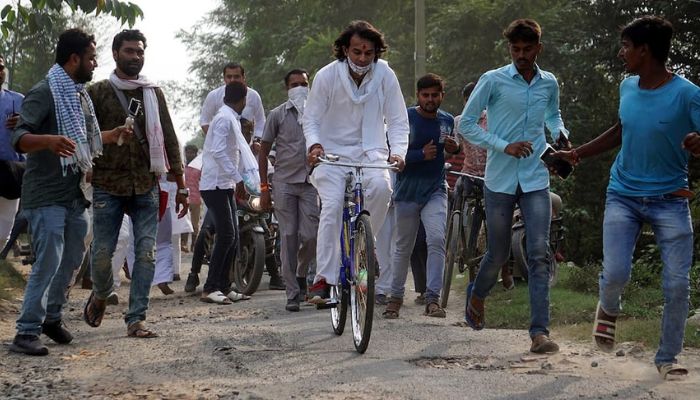
Bihar’s cabinet minister Tej Pratap Yadav has again made it to the news with his latest act. The son of the Rashtriya Janata Dal chief Lalu Prasad Yadav has cycled to his office after Samajwadi Party’s founder late Mulayam Singh Yadav allegedly appeared in his dream. It is notable that the cycle is the election symbol of the Samajwadi Party.

The cabinet minister of the Environment, Forest & Climate Change Department in the Government of Bihar said in his tweet, “Today morning on 22.2.2023 I saw late Mulayam Singh ji in my dream. He hugged me and gave me affectionate blessings. I will try to follow the path shown by him throughout my life. Today I am going to my ministry Aranya Bhawan by bicycle.”

Tej Pratap Yadav shared two pictures with the tweet. One is a photograph of late Mulayam Singh Yadav while in the other photograph, Tej Pratap Yadav can be seen riding a cycle on the way to his office.

Later, while speaking to news agency ANI, Tej Pratap Yadav describe his dream sequence in great detail.

“Netaji came in my dreams when I was going to Vrindavan. In my dream I was going to Vrindavan when Netaji came in my dream. Then I went to Saifai village (Mulayam Singh Yadav’s constituency) and there I saw Netaji was sitting and having a political discussion with some people sitting there. There he saw me and was stunned to see me how have I, Tej Pratap, suddenly landed here.

“He asked what I was doing there and I explained that I was on my way to Vrindavan and stopped by to meet you. I then told Netaji that I want to do sightseeing in his village. So Netaji agreed. I requested for a cycle. Then Netaji became happier. Then Netaji and I drove cycle side by side. When we reached one bridge, one woman was standing there. The woman asked Netaji what brought him there, he told her that I am Tej Pratap from Bihar and he is showing me around his village.

“Then Netaji took part in wedding celebration of a village resident. He invited me as well to join. After that I was resting in my room when Netaji came and sat on a mudda (stool) in the room. I asked him to sit on the sofa. He said no, I am a simple man and always connected to his people. Then I also sat on the floor. Then we got into political conversations. Netaji then even guided me on how to progress my political journey. He said his blessing will always be with me.

“He was wearing a watch and he removed it and gave it to me. Then I became very emotional about the watch. Then I started crying. In my dream. Even Netaji started crying. Netaji then hugged me but then my dream ended. I woke up and immediately called Dhananjay jee to arrange for cycle. I will go to office on cycle. I will carry forward Netaji’s message and also save environment. My father Lalu Prasad Yadav also used to ride a cycle. To reduce usage of diesel and petrol and to save environment, Lalu Yadav ji also used to ride a cycle,” he said.

He often makes it to the news for reasons very different than other politicians. In October 2022, he claimed that he remembered Sai Baba from the bottom of his heart and the holy ashes (bhabhuti) from Shirdi’s Sai Baba temple reached him the next day. It is notable that Tej Pratap Yadav is a very religious person and often describes himself as a devotee of various Hindu gods. In the past, he had said that he is Lord Krishna who will bring change to Bihar. He often dresses up like Lord Krishna, Lord Shiva, and other Hindu gods and saints.

Note: Report updated with detailed description of Tej Pratap Yadav’s dream.

Aligarh: Zareen and her new boyfriend Ayash come together to kill her old boyfriend Ghalib by slitting his throat, both arrested

0

In a shocking incident that came to light in Aligarh in Uttar Pradesh, a girl, along with her new boyfriend, conspired to get rid of her old lover and killed him. The girl named Zareen and her new boyfriend Ayash called her old lover Ghalib from his home to a deserted area and stabbed him on his neck to death. On the complaint of the deceased youth’s family, the police came into action and arrested the accused youth-Yavati. According to the police, on the basis of the complaint, a case has been registered and the accused have been sent to jail.

The body of an unidentified youth was found by the police in Aligarh‘s Jawan police station area a day earlier. The body was taken into custody and kept in the mortuary. The incident came to light when a complaint was received by the Quarsi Police Station about a missing young man. Later, the body was identified as Ghalib, a resident of Nagla Mallah in the Quarsi police station area. According to the police, the murder took place on 20 February.

Iltaja, the maternal uncle of the deceased, alleged, “My nephew was called by a young woman Zareen, a resident of Jamalpur. He left home with a scooter. The young woman took him to a deserted place near Jawan. There the young man was fed intoxicating food. As soon as he fell unconscious, the young woman called a young man. Together, both of them killed him by slitting his throat with a sharp weapon.”

He further said that as Ghalib has not returned, his brother called him at 2.57, when Ghalib pleaded for help. He told his brother, ‘please save me, else Zareen and this boy will kill me’. The phone was disconnected after that, and it was then switched off.

When Ghalib did not return home for a long time, the family started searching for him. After a lot of searching, the family reached the police station and filed a missing complaint. In the investigation, it was found that the dead body recovered on the earlier day was that of the missing youth. His scooter was also found at the crime scene.

The deceased youth Ghalib and the accused young woman had a love affair for a long time. However, Ghalib became aware of her affair with another young man. There was a dispute between the two. Meanwhile, Ghalib had beat up his girlfriend’s new boyfriend Ayash a few days ago while quarrelling with him. Due to this, Zareen and Ayash called Ghalib with the intention of getting rid of him and taking revenge by killing him with a sharp weapon.

SP City Kuldeep Singh Gunawat said while giving information about this case, “On February 20, at 10:00 pm, the Police Station Jawan received information that a body had been found in the area. The body was taken into custody after reaching the spot. The deceased was later identified as Ghalib, a resident of Nagla Mallah in the Quarsi police station area. On the basis of the complaint of the deceased’s family, a case was registered and a young woman named Zareen and one Ayash were arrested. They confessed to the incident. It was reported that Ayash was assaulted by Ghalib a few days ago. To avenge that, Zareen and Ayash called Ghalib in the Jawan area. There he was drugged and made unconscious and then killed. The sharp weapon used in the murder has been recovered from the arrested accused. Further action is being taken against both the accused and both are sent to jail.”

In the meanwhile, Zareen’s father alleges that earlier Ghalib was harassing his daughter, and had even rapped her several times. He also alleges that Ghalib had made a video of Zareen and was blackmailing her using the same. They had filed an FIR against Ghalib last month through the court after police refused to register the complaint, but the probe in the case has not progressed much.

Malikappuram: Why the audience in Kerala and the world showered so much love on the movie on Lord Ayyappa

When Sabarimala came into the eye of a storm a few years ago due to the fracas over permitting temple entry to women of menstruating years, I doubt whether most of those who grabbed the opportunity to gain some attention by opining on the subject even bothered to delve into the history that predates the place, the traditions and customs involved in the worshipping of Swami Ayyappa in Kerala. All those who strongly opposed the age-old beliefs followed in the place perhaps didn’t even know the whys and hows of it. Or what makes thousands of pilgrims flock to the temple to pay their respect to their God. In the noise on the issue, not much was said about the devotion or love that defies legal reasoning.

In fact, the pro-left and Islamic lobbies in the Kerala film industry saw it as an opportune moment to defame the faith behind Sabarimala further. In 2021, Jeo Baby’s immensely successful The Great Indian Kitchen tried to prove how men who are devoted to Swami Ayyappa are misogynistic and patriarchal at home. They insensitively abuse their wives for their selfish sexual needs. The agenda wasn’t exactly subtle in the ‘feminist’ drama targeted to malign Sabarimala in particular and religious Hindu men in general.

The recently released Thattassery Koottam, directed by Anoop, wasn’t that vicious, but casually commented how a Hindu lad, though a Sabarimala volunteer, has a glad eye and is a foul-mouthed lothario. He lazily shirks family duties as well. While it is not our place to comment on the legalities regarding the Sabarimala case it is amusing how the Malayalam film industry has never really broached the topic objectively. There are hardly any movies showcasing the faith that drives people to Lord Ayyappa or delve into why women do not mind waiting for their time to come to meet him. How the restraint is woven into the very fabric of the faith.

There seems to be a shift in the narrative though. The epilogue of Vishnu Mohan’s surprise hit Meppadiyan released last year showed the protagonist take a pilgrimage to Sabarimala after sorting out issues in his life when he is duped by Islamic property sharks. This was a rare montage depicting the lead flaunting his Hindu identity unapologetically. The actor Unni Mukundan seems to have taken off from that well-written work to deep dive into exploring not just Sabarimala in his latest blockbuster Malikappuram but also other concepts of Sanatan Dharma. No wonder, after the unprecedented success of SS Rajamouli’s RRR and Rishabh Shetty’s Kantara, the audience in Kerala first, and then the world, showered love and laurels on the film that celebrates Hindu iconographies proudly, without any monkey balancing. After being thoroughly bored with movies that repeatedly indulged in anti-Hindu agenda peddling, families went back to the theatres to enjoy something that invoked the true essence of Swami Ayyappa in their minds.

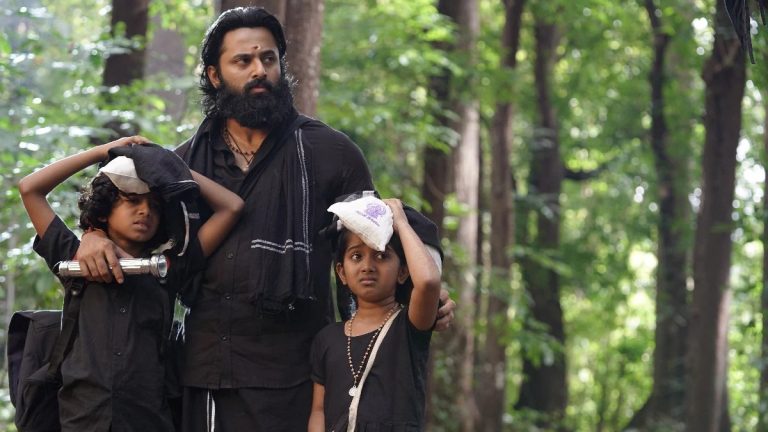
Vishnu Sasi Shankar’s movie might seem like a simple story with two child protagonists, but the thought-provoking writing by Abhilash Pillai drives home certain significant points about Sanatan Dharma, beliefs, customs and ultimately the core values of a family system that urban Indians seemed to be gradually losing connect with. For instance, Kallu’s strong urge to meet Lord Ayyappa is not divorced from the story telling sessions she enjoys with her muthassi. Stories from ancient Upanishads, Puranas and Hindu religious texts were always told by grandparents to their grandchildren earlier when the joint family system formed the basis of a Bharatiya social setup. These carried forward folklore traditions. Kallu too, hears tales of wonder and valour from her grandma and father that instill in her a heartfelt desire to travel to Sabarimala. Guided by her deep faith and devout instinct, the eight-year-old requests ‘her Ayyappa’ to take her to meet the Lord.

The story is a celebration of the strength in beliefs. So strong and real it is that while leading the children, Mukundan’s character, in response to Piyoosh’s doubts, refers to the jungle as his ‘sthalam’ and then casually brushes away the boy’s fear of a roaming elephant by calling it ‘our Ganesha’. It is quite telling how not just Kallu but the audience also envisages Mukundan as Swami Ayyappa then, as he dozes off in a seated stance, lulled by the distant melody of Yesudas’s ethereal rendition of Harivarasanam.

His closed eyes and content demeanour calms as well as reassures those witnessing the imagery. It is these buildups in the journey of Kallu to her destination that makes Malikappuram such a relevant, satisfying and exciting tale. Because unless the Lord is ready to meet the devotee, there is nothing that can drive the difficult journey. In a spectacularly shot sequence where Kallu walks up the 18 celestial steps, it is this very truth depicted about a devotee’s extreme faith that ultimately steers him towards the Almighty. The chaos around a faithful is silenced as utmost reverence bridges the distance between the man and the God he loves and believes in. What a splendid moment captured in cinema by Vishnu Narayanan, for posterity!

Offering a nuanced approach to the revered subject of Sabarimala, Malikappuram also explores the concept of Tat Tvam Asi, the profound philosophy embedded in Sanatan Dharma through the words of Swami Haneef (a masterstroke in casting that highlights its power to welcome all believers in its fascinating fold) as he disentangles the reasons why his colleague rescues and helps the children. Therein lies the attraction of this languid but sensitively written film showcasing the gravity of a devotion that makes pilgrims throng to Sabarimala frequently to pay their obeisance to Swami Ayyappa. God appears in the form of humans before those who have absolute faith in divinity. You are what you seek, remarks Swami Haneef.

The narrative is not devoid of characters who make us question the very tenet of human values and strength. For instance, while it isn’t clear whether Ajayan ends his life to evade monetary hassles or due to the humiliation he faces in the hands of a ruthless loan shark, there is no denying that his decision reeks of weak personality. Similarly, crooks like Mahi tend to bring disrepute to holy places. However, the bad is balanced by good. That is the sacred beauty of Bharat—a land of punya, tolerance and harmony. The evil in humans must be destroyed by the divine in them. That is our Dharma, and this order in peace and chaos is what takes one closer to Swami Ayyappa one step at a time.

Kerala govt issues notice to Asianet anchor for criticising a CPI(M) organised bandh, while party accuses Modi govt of harming press freedom

A prominent journalist and host of the Asianet TV channel Vinu V. John has long been the target of animosity from the Communist Party of India (Marxist) in Kerala. In a new development, the incident from 2022, where the anchor condemned the Bandh (strike), has landed him in trouble yet again.

On February 20, the inspector of Cantonment Police Station issued a fresh summon ordering the anchor to appear before him on February 23. He is also directed to adhere to the litany of conditions dictated in the notification.

John talked to the news agency IANS and informed that he will comply with it.

Background of the issue

The incident took place on March 28, 2022 when John was anchoring the news bulletin at Malayalam TV news channel, Asianet News. A patient who was being transported in an auto rickshaw had to suffer harassment and delays because of the bandh called by the Communist party.

The auto driver, a person named Yasir Muthoor, was assaulted by the Communist goons in Malappuram for daring to defy the bandh and trying to take a patient to the hospital. Anchor Vinu John had criticised the CPM for the attack on the man.

John, who works with Asianet News, had questioned CPIM Rajya Sabha MP Elamaram Kareem, who sought to trivialise the assault by his party goons. It must be mentioned that the ‘failed’ Bharat Bandh was observed by the Communist party between March 28 and March 29 in 2022.

The anchor expressed his anger over the issue and questioned, “If anyone did such a thing to Elamaram Kareem (trade unionist and a member of CPI-M), what would have happened,” in his debate show, drawing the fury of the ruling party.

Kerala saw a bandh (shutdown) organized by 22 central trade unions on March 28-29, when protesters physically took over the state’s streets as residents fled for cover. There were reports of altercations in certain locations as people attempted to open their shops during the bandh.

Following John’s statement, Kareem, who is CPI(M) Rajya Sabha member, declared that he will file a grievance with the police commissioner as well as the Rajya Sabha chair. On April 28 of that year, a case was brought against the former, and a FIR was registered under several sections of the Indian Criminal Code (IPC).

The Peroorkada Area Committee of the Centre of Indian Trade Union (CITU) called for demonstrations against John and his isolation. Furthermore, the unit plastered posters at his residence.

A few days afterwards, trade union workers from all political parties, aside from the BJP, marched to the news station to express their outrage at John’s remark.

CPM pretends to advocate free media, criticises even an Income Tax survey as a political vendetta of the Modi govt

This action by the state government is viewed as an effort to stifle and punish media for expressing their right to free speech.

Earlier, Sitaram Yechury, party’s general secretary, released an official statement in defence of BBC. He attacked the central government for conducting income tax surveys in the offices of the controversial British news agency.

The leftist party, which hails itself as a supporter of media freedom in the country, has chosen to take a very different course when it came to criticism directed against them.

Modi govt to invite bids for auction of Lithium reserves found in Jammu and Kashmir by June: report

Days after the Geological Survey of India (GSI) discovered 5.9 million tonnes of lithium reserves in Jammu and Kashmir, the Central government is set to invite bids for the auction of the country’s first Lithium reserve. 

According to a Mint report, the bids will be invited by the centre in the first quarter of June this year. 

This comes after the Geological Survey of India, for the first time found Lithium inferred resources (G3) of 5.9 million tonnes in the Salal-Haimana area of Reasi District of Jammu & Kashmir earlier this month.

Citing a government official, Mint reported that like any other government auction, this will also be open to all, with one key condition: “The government will mandate that lithium is refined only in India and not sent abroad for processing.”

It is pertinent to note that India does not have a Lithium refining facility. The Modi government, on the other hand, has already set a target of having EV sales account for 30% of private automobiles, 70% of commercial vehicles, and 80% of two- and three-wheelers by 2030, citing an urgent need to decarbonize the transportation sector.

Back in 2021, Nitin Gadkari, the Union Minister for Road Transport and Highways, stated that India would be able to reduce its consumption of crude oil by 156 million tonnes, or Rs 3.5 lakh crore, if electric vehicle penetration reached 40% in the two-wheeler and car segment and close to 100% in the case of buses by 2030.

UNFC classification

Notably, the United Nations Framework Classification (UNFC), a three-dimensional approach that takes geological, feasibility, and economic considerations into account, is used to analyze the assessment of the mineral concession. The four stages of the geological axis are reconnaissance (G4), prospecting (G3), general exploration (G2), and detailed exploration (G1).

According to UNFC, the G3 category or inferred resource is described as amounts associated with a recognized deposit that can be approximated with a low degree of confidence. Resources that can be approximated in terms of quantity, grade, or quantity based on geological evidence, sparse sampling, and reasonably presumed, but unconfirmed, geological and grade continuity is referred to as inferred resources.

Lithium- ‘White Gold’

Lithium is a soft, silvery-white metal that has earned the moniker “white gold” due to its great demand in the global energy markets. Lithium serves a variety of purposes and is an essential part of the electrochemical cells used in the batteries for electric vehicles, laptops, smartphones, and other electronic gadgets.

The discovery of a lithium resource in Jammu and Kashmir can help India meet its goals of decreasing emissions and reaching net zero by 2070. This can be achieved by providing Lithium, a vital component for electric car batteries.

It is worth noting that while “reserves” are a subset of resources that are economically viable to extract, “resources” refers to an approximate quantity of a geological commodity in discovered and undiscovered deposits.

According to International Energy Agency (IEA), the world could face a Lithium shortage by the year 2025. Amidst a significant rise in demand for electric vehicles, India can play a crucial role by addressing the global shortages. 

As per a World Economic Forum (WEF) report, Lithium supply is constrained not just by rising demand but also by resources concentrated in a few regions and the fact that more than half of current production takes place in regions with significant water stress. Notably, the “Lithium Triangle” countries of Argentina, Bolivia, and Chile hold an estimated 60% of global lithium reserves.

According to a report by the Central Electricity Authority (CEA), India would have a battery storage capacity of 27,000 Megawatts by 2029–30. If India manages to deal with the challenges ahead, this discovery of the Lithium reserve can prove to be a game-changer for India.