Saturday, April 4, 2026
Home Blog Page 296

Terrorists used to say ‘Subhanallah’ after terror attacks on India, now say ‘Ya Allah’ following PM Modi’s response: Sudhanshu Trivedi on Operation Sindoor

BJP MP Dr Sudhanshu Trivedi took a dig at Pakistan’s terror establishment in journalist Rajat Sharma’s show ‘Aap ki Adalat‘.

Sharma told Trivedi about a social media joke about Pakistanis asking for India’s BrahMos missile. Responding to this Dr Trivedi mentioned how India carried out precision strikes on terror camps in Pakistan, including Markaz Subhanallah, the headquarters of Jaish-e-Muhammad, with BrahMos missiles.

He jokingly remarked, the terrorists who used to celebrate and thank Allah after carried out terrorist attacks in India were calling Allah for help after their establishments were hit by BrahMos missiles.

“There was time when terrorist attacks used to happen across India and terrorists sitting in Markaz Subhanallah used to cheer and say Subhanallah! Subhanallah! But Modiji has hit them so hard that now they are crying ‘Ya Allah! Ya Allah!” Dr Trivedi said.

After the ghastly Pahalgam terror attack in which 26 Hindu tourists were killed by Pak-sponsored terrorists who verified their religion before killing them, India launched Operation Sindoor on 7th May, to eliminate terror establishment in Pakistan and PoK. India inflicted heavy damage on 9 major terror launchpads in Pakistan as well as on Pakistan’s military establishment after the Islamic country attacked India with swarms of drones and missiles following India’s retaliation against terrorists.

On 10th May, Pakistan, which was on its knees after India’s military action, approached India requesting a ceasefire to which India agreed on its own terms.

Operation Sindoor: How a 10-hour long Indian air assault on Pakistani military bases forced it to beg for ceasefire

With every passing day, intriguing details about India’s Operation Sindoor and its success are surfacing before the world. In a detailed report published by Strat News Global, National Security Analyst Nitin A. Gokhale revealed new information on a 10-hour, multi-phase air assault launched by India on 10th May.

Operation Sindoor was launched by the Indian Armed Forces as a direct response to the deadly Pahalgam terrorist attack that claimed the lives of 26 innocent Hindus. The Resistance Front (TRF), an offshoot of the Pakistan-based terrorist organisation Lashkar-e-Taiba, claimed responsibility for the attack. In the following days, as India prepared for a war-like situation, the Indian Armed Forces planned a military strike on terrorist camps in Pakistan and Pakistan-occupied Jammu and Kashmir.

On 7th May, India launched the attack and destroyed multiple terror camps. India warned Pakistan that it was a strike on terror camps and not on civilian or armed forces establishments. However, Pakistan decided to retaliate, rattled by the killing of over 100 terrorists. Pakistan launched missile and drone strikes, which were neutralised by Indian Air Defence.

In retaliation to Pakistan’s attack, India launched the second phase of Operation Sindoor and, on 10th May, between 2:30 AM and 12:30 PM, the Indian Armed Forces broke the spine of Pakistan’s air defence network. This time, key military structures were targeted, forcing Islamabad to beg for peace within hours.

It is not merely the scale or firepower that makes Operation Sindoor significant. It was the message that rattled not only Pakistan but also its supporters. The message was that India will no longer absorb terror attacks silently. The surgical precision, swiftness of escalation, and decisive outcome of Operation Sindoor have added a new chapter to India’s evolving doctrine of retaliation and deterrence.

A timely warning and a clear directive

The events leading up to the operation were set in motion on the night of 9th May. Notably, the Vice President of the United States, JD Vance, called Prime Minister Narendra Modi at around 10:30 PM. The call reportedly carried a grave warning that Pakistan was likely to carry out a massive strike within hours.

PM Modi’s reply was clear and firm. India was ready not only to endure but to hit back with greater intensity, and this is exactly what the Armed Forces delivered. This stance had already been communicated publicly after the Pahalgam attack, but the call from Vance triggered the final go-ahead.

Soon after, India’s war council, which comprises NSA Ajit Doval, CDS Gen Anil Chauhan, and the three service chiefs, Gen Upendra Dwivedi, Air Chief Marshal AP Singh, and Admiral Dinesh Tripathi, went into a rapid strategy session. Contingency plans were no longer on the table, and targeting protocols were initiated.

Pakistan strikes first, India replies with fire

At 1:30 AM, Pakistan made its move. It launched its heaviest strike in recent years on Indian airbases in the north and west. However, India’s advanced, layered air defence systems, led by the formidable S-400s stationed at Adampur and other key bases, intercepted and neutralised much of the incoming fire. India had been preparing for such an attack for a long time, and it paid off well.

Then came India’s counterpunch

At 2:30 AM, the Indian Air Force unleashed a barrage of BrahMos, Scalp, and Crystal Maze missiles, along with indigenously developed loitering munitions like Harop and Nagastra. These attacks were focused, relentless, and devastating. Pakistan was not prepared for such an attack, or it might have been, but its defence system was on its knees from the beginning.

The Nur Khan airbase near Rawalpindi, which is located dangerously close to the Army’s GHQ in Pakistan, was hit in the very first wave. India was deep inside Pakistan, and there was nothing that could stop the wrath of the Indian Armed Forces. Two mobile command centres were taken out. A C-130 aircraft was destroyed on the ground. Far to the south, Rahimyar Khan airbase was rendered unusable after its runway, taxiways, and apron were pounded.

Meanwhile, Indian Army units stationed along the LoC and International Border used M-777 howitzers loaded with Excalibur ammunition to hammer Pakistani positions, which put additional pressure on Islamabad.

Strikes get deeper, panic spreads

India did not stop there. The second wave of Indian attacks intensified the psychological damage. Sargodha and Murid, which are prized airbases hosting F-16 squadrons, were targeted with chilling accuracy. The impact of precision strikes reaching so deep inside Pakistan’s airspace sent alarm bells ringing in both Islamabad and Washington.

By 9:30 AM, Pakistan was panicking. The first attempt at backchannel communication was made through its High Commission in Delhi. However, India refused to engage and made it clear that if Pakistan wanted to talk, it could only happen through the military hotline. Simultaneously, Gen Asim Munir was desperately calling American officials, signalling readiness to cease fire.

The final phase – breaking Pakistan’s military spine

As the Pakistani leadership scrambled to restore calm, India pressed on with the third and fourth waves of attacks. Airbases and radar sites at Rafiqui, Sukkur, Jacobabad, Bholari, Chunian, Pasrur, Arifwala, and Murid came under fire. Especially critical was the continued assault on Nur Khan, effectively blinding Pakistan’s centralised air defence coordination.

At some point before dawn, Gen Munir reportedly called Prime Minister Shehbaz Sharif. By now, Pakistan had clearly understood the scale of damage and the futility of further provocation.

India halts with upper hand, Pakistan retreats

By 12 noon, India paused its assault. At 12:30 PM, Pakistan’s DGMO attempted to contact his Indian counterpart but could not get through until 3:30 PM. India, as per its stated doctrine, agreed to cease operations from 5 PM IST. This happened only after Pakistan formally requested it through the military hotline.

It has been two weeks since Operation Sindoor was launched and later paused. The guns have remained silent. However, Operation Sindoor has done what words and dossiers could not. It demonstrated that India’s response to terrorism is no longer limited to diplomatic statements or defensive posturing. It is precise, overwhelming, and timed to inflict maximum cost.

India has long been plagued by cross-border terrorism. Operation Sindoor was a bold and necessary message, India will not only defend itself but ensure that provocations are met with punishing consequences. Though a so-called ceasefire is in place, India has made it clear that Operation Sindoor is not over, and any terror attack will be seen as an act of war.

Doctor, who tampered blood report in Pune Porsche case to show no alcohol in accused’s body, found involved in kidney racket: Details

Tainted Dr Ajay Taware, who is in judicial custody at Yerwada Central Jail on the allegations of swapping the blood samples of the accused in the Pune Porsche Case, has also been linked to a kidney transplant racket.

Pune Police Commissioner, Amitesh Kumar confirmed during a press briefing on Friday (23rd May) that Dr Taware will be made a co-accused in the kidney transplant racket involving a private hospital.

“A probe committee headed by a retired judge was constituted to investigate the kidney racket following a complaint registered at Koregaon Park Police Station,” the Commissioner said.

The committee has submitted its findings to the state government which indicate Dr Taware’s involvement in the kidney racket after which he will officially made a co-accused.

The racket was uncovered after police received a complaint filed by Dr Sanjog Sitaram Kadam, Deputy Director of the Health Services Board regarding illegal financial transactions during a transplant procedure.

An investigation carried out based on the complaint exposed an entire network involving private hospital staff, brokers, donors and recipients. Around 15 persons have been indicted based on the complaint.

As per reports, during the investigation of the Pune Porsche Case, some documents were uncovered which linked Dr Taware to a transplant scam.

Dr Taware headed an eight-member transplant approval committee during the time the alleged illegal activities were carried out.

In April 2025, the Maharashtra Medical Council (MMC) suspended registrations of Dr Ajay Taware, Sassoon General Hospital’s former head of forensic sciences department, and Dr Shrihari Halnor, former casualty medical officer (CMO).

Dr Taware was reinstated as SGM medical superintendent

Dr Taware was reportedly asked to step down in April 2022 as the medical superintendent of Sassoon General Hospital after an illegal organ transplant case was exposed at Ruby Hall Clinic in March 2022.

The case came to light after a complaint was filed by a widow alleging that she was promised ₹15 lakh in exchange for a kidney.

However, Dr Taware was reinstated as the superintendent of SGH in December 2023 on the recommendation of NCP MLA Sunil Tingre. Tingre wrote a recommendation letter to medical education minister Hasan Mushrif for reinstatement of Dr Taware.

Dr Ajay Taware, known to me, is a professor and head of the forensic medicine department. He has handled the post of medical superintendent and performed commendable duties during the Covid pandemic. Therefore, I request that appropriate action be taken at your level to appoint him as the medical superintendent of Sassoon hospital,” the letter read.

Pune Porsche Case

The hit-and-run case that happened on 19th May 2024, in Maharashtra’s Pune in which a 17-year-old son of a builder, Vishal Agarwal of Brahma Realty and Infrastructure, rammed his Porsche Taycan car into a vehicle in an inebriated state and killed two people named Aneesh Awadhia and Ashwini Koshta.

The case sparked widespread public outrage as multiple cover-up attempts were made in the case and the accused was granted bail within 15 hours of the incident.

Dr Shrihari Halnor was the CMO who attended to the accused after the accident. According to Pune Police, Dr Halnor swapped the blood samples on the instruction of Taware.

Both were arrested on 27th May 2024, after the accused teenager’s blood sample test conducted at two hospitals gave different results. The results confirmed the Pune Police’s suspicion that the samples at the Sassoon hospital were swapped.

RJD leader Tej Pratap Yadav drops a bombshell: Goes public with 12-year love story with Anushka Yadav

In a move no one saw coming, Tej Pratap Yadav, the irrepressible elder son of RJD supremo Lalu Prasad Yadav, has hit the headlines by shining light on a deeply personal chapter of his life. With a single social media post, he’s stirred the political cauldron of Bihar once again.

On Saturday, Tej Pratap took to Facebook and made a dramatic declaration: he has been in a committed relationship with Anushka Yadav for the last 12 years.

“I am Tej Pratap Yadav, and the person in this photo with me is Anushka Yadav! We have known and loved each other for the past 12 years… I have wanted to share this with all of you for a long time but didn’t know how to,” he wrote in an emotional post, accompanied by a candid picture of the couple.

The post exploded online, triggering a whirlwind of reactions—from stunned silence to curious speculation, from political gossip to tabloid frenzy.

A love story in the shadows: Tej Pratap reveals he is in love with Anushka Yadav for last 12 years

Tej Pratap’s personal life has long been a fixture of headlines, often rivalling his political stunts in drama and unpredictability. His 2018 fairy-tale wedding to Aishwarya Rai, daughter of former Bihar minister Chandrika Rai, was followed by a bitter fallout and a prolonged divorce battle that has yet to be resolved, six years on.

Currently vacationing in the Maldives, Tej Pratap also posted a serene video of himself meditating by the turquoise sea, further stoking interest in his spiritual-meets-sensational lifestyle.

Bihar elections in the offing

As Bihar gears up for the high-stakes 2025 Assembly Elections, Tej Pratap’s revelation may be more than just a personal confession—it could be a calculated move. He’s reportedly planning a political comeback from the Mahua constituency in Vaishali district, shifting focus from his previous seat in Hasanpur.

Interestingly, Mahua is where Tej Pratap first tasted electoral success in 2015. A return could signal an attempt to reconnect with his political roots—this time, with a more emotionally transparent and relatable persona.

In a state where politics is often a family affair and public perception is everything, this unexpected love story might just become part of his campaign narrative.

Rising Northeast Investors Summit 2025 in Delhi attracts investment commitments of ₹4.3 lakh crore, several landmark MoUs signed

The Rising Northeast Investors Summit 2025 concluded with attracting investment commitments of Rs 4.3 lakh crore, according to an official statement.

Held under the leadership of Prime Minister Narendra Modi and led by the Ministry of Development of North Eastern Region (MDoNER), the two-day summit brought together investors from across the globe, reaffirming that the Northeast is not just a region but a strategic growth corridor for Viksit Bharat.

“Today, that acronym, NER, stands for the New Economic Revolution and New Economic Revival of India,” said Union Minister of Development of Northeastern Region Jyotiraditya Scindia during the valedictory session.

“Our summit is not a culmination — it is a beginning. Ye poorna viraam nahi, prastaavna hai,” he added.

Several landmark MoUs were signed with major national and international investors across key sectors.

During the summit, the Sikkim government signed an MoU with SM Hotels and Resorts with an investment intent of Rs 250-300 crore. The Arunachal Pradesh government also signed an MoU of Rs 150 crore with the Farm Native Group. The Meghalaya government signed a Rs 4,000 crore MoU with Agri-Bio Fuels Global Ltd.

The Meghalaya government and Inlambi Pvt Ltd signed an MoU for Rs 1,000 crore. The Manipur government also signed a major MoU of Rs 1,000 crore with Inlambi Pvt Ltd. The Tripura government signed a Rs 500 crore MoU with the Sri Sri Ravishankar Vidya Mandir Trust for Sri Sri University and an Ayurveda College and Hospital.

Beyond the marquee MoUs, the summit recorded a total of 803 investment intents through roadshows, B2G meetings, and PSU/public-private proposals. Roadshows held across states contributed Rs 99,533 crore in interest; PSUs brought in Rs 1.27 lakh crore; industrial houses pledged Rs 1.58 lakh crore; and B2G meetings during the summit itself resulted in over Rs 18,600 crore worth of commitments, as per the release.

“The seed sown by Vajpayee ji has grown into a banyan tree under Prime Minister Modi’s leadership. Our Cabinet has visited the Northeast 730 times in 11 years, reflecting the Centre’s emotional and strategic commitment,” Scindia noted.

With delegations from over 80 countries, the summit reinforced the Northeast’s role as a global economic bridge to Southeast Asia and beyond.

“This isn’t just an investment in rupees and dollars — it’s an investment in trust, relationships, and India’s future economic geography,” the Minister said.

He also announced a new institutional framework: eight sectoral verticals led by Chief Ministers, supported by other states, to ensure implementation of the signed MoUs.

“There is no mainland and Northeast — there is only Akhanda Bharat, where the hearts, hands, and horizons of every Indian stand together,” he concluded.


(This news report is published from a syndicated feed. Except for the headline, the content has not been written or edited by OpIndia staff)

Nehru yelled at Mountbatten and Liaquat Ali to appoint his sister as ambassador—having already made her a minister even before independence: The early seeds of dynastic politics in India

The first family that comes to mind when we talk about dynastic politics is the Nehru-Gandhi family. It is rare in the world for a single family to have held so many high offices of power. At present, Sonia Gandhi is serving as a Rajya Sabha member, her son Rahul Gandhi is an MP from Amethi, and her daughter Priyanka Gandhi is an MP from Wayanad. Priyanka’s husband, Robert Vadra, has also expressed interest in joining active politics on several occasions. Furthermore, a large faction within Congress sees potential in Priyanka and Robert’s son, Rehan, as a future leader.

When the roots of this mighty tree of dynasty are traced, the first Prime Minister of India, Jawaharlal Nehru, stands at the centre. Among the leaders of India’s struggle for independence, he stands out prominently. He was the favoured disciple of Mohandas Karamchand Gandhi, and was appointed as the first PM by Gandhi himself. Many leftist historians and political analysts consider him to be the architect of modern India.

However, when history is examined with an impartial mind and not merely through sentiment, another facet of the Nehru era emerges, a facet where the first seeds of dynastic politics were sown in Indian democracy. A seed which was not planted after Nehru became the PM, but much earlier, in the 1930s.

It is widely known that Nehru’s political career began with the legacy of his father, Motilal Nehru. Motilal had served as President of the Indian National Congress, and played a crucial role in establishing his son in politics. It would not be an exaggeration to say that Motilal Nehru turned the Congress into the political platform of the Nehru family. Dynastic politics was not an overnight malaise. Rather, it developed as a calculated process, and its first product was Jawaharlal Nehru himself.

As Nehru entered mainstream Congress politics, his stature grew with time. Even before independence, he had become so influential that Congress policies and their implementation began to revolve around him. This trend can be seen as early as the 1930s.

In 1937, provincial elections were held in the country. Congress formed governments in eight out of eleven provinces. In the United Provinces, a Congress government was formed under the leadership of Govind Ballabh Pant. In this government, Nehru’s sister, Vijaya Lakshmi Pandit, was given a ministerial post.

Durga Das, journalist and founding president of the Press Club of India (PCI), writes in his book “India From Curzon to Nehru and After” that it was Govind Ballabh Pant and Rafi Ahmed Kidwai who approached Nehru with the recommendation to appoint Vijaya Lakshmi Pandit as a minister. The real intention behind this was, “If we appoint a member of Nehru’s family as a minister, we will earn Nehru’s blessings, and he will not trouble us without reason.”

Source: India From Curzon to Nehru and After page 184

This fact confirms that even at that time, people began valuing Nehru’s familial ties to avoid his political interference. This was not a good sign for democracy, but rather showed that Nehru’s influence stood above reason, merit, and democratic norms.

After independence, he openly sowed the seed of dynastic politics in Indian governance. A particular anecdote, essential for those who regard Nehru as a champion of democracy and inclusivity, sheds light on this. It is mentioned by American historian Stanley Wolpert in his book “Nehru: A Tryst With Destiny“.

The book says that when the country became independent, an interim government was formed under Nehru’s leadership. Nehru was the Prime Minister of this government, Liaquat Ali Khan was the Finance Minister, and Lord Mountbatten was the Governor-General. Nehru proposed to appoint his sister, Vijaya Lakshmi Pandit, as India’s first ambassador to the Soviet Union. Liaquat Ali Khan strongly opposed the move, calling it an act of brazen dynasticism.

According to Liaquat Ali, this was not just a matter of diplomatic posting, but the first sign of power being personalised by the head of India’s largest political party. Nehru not only ignored Liaquat’s objections, but also brazenly threatened Mountbatten, saying that if Mountbatten supported Liaquat on the issue, he would resign.

Source: Nehru: A Tryst With Destiny page 398

This was not the behaviour of a democratic leader, but of a feudal mindset convinced that all state authority resided in his decisions. Dynastic politics becomes even more dangerous when it strangles the spirit of democracy under the guise of democratic legitimacy. Nehru exemplifies this situation perfectly. Though he never publicly endorsed dynasty, his actions consistently reinforced it.

One might argue that dynastic politics became common in Indian political life later, the Gandhi family, the Yadavs, the Abdullahs, the Karunanidhi family, the Pawars, and so on. However, it is essential to know where this trend began. When the country’s first PM himself practised dynasticism, it was inevitable that others would follow suit. The Congress party claimed to uphold democracy, socialism, and secularism, but during the Nehru era, a hidden elitism and dynasty quietly took root.

In other democratic nations of the world, dynastic politics has been met with resistance by the people. In the US, although the Bush and Clinton families have been active in politics, no political party could transform them into a royal dynasty. In France, Germany, and the UK, institutions have always remained bigger than individuals. But in India, institutions continued to appear dwarfed before individuals and families, and this tradition began with Jawaharlal Nehru.

Southwest Monsoon arrives early over Kerala, Meteorological Department warns heavy rainfall, storms across India

0

The Southwest Monsoon has arrived over Kerala on Saturday, nearly a week ahead of the usual onset date of June 1, according to the India Meteorological Department (IMD).

According to the India Meteorological Department (IMD), “heavy to very heavy rainfall likely to continue over west coast (Kerala, Karnataka, coastal Maharashtra and Goa) during next 7 days with possibility of extremely heavy rainfall over Kerala during 24th-26th; coastal Maharashtra and Goa and Madhya Maharashtra on 24th; Coastal and Ghat areas of Karnataka during 24th-27th; Ghat areas of Tamil Nadu on 25th & 26th May, 2025.”

According to the IMD, a depression is present over the East Central Arabian Sea and adjoining south Konkan coast. It is expected to move eastward and cross south coastal Maharashtra by noon on May 24.

Meanwhile, severe heatwave conditions are forecast to continue in Rajasthan until May 27 and in Punjab, Haryana, Jammu, and Kashmir until May 26.

While speaking to ANI, Manorama Mohanty, Director of IMD Bhubaneswar, said, “Southwest Monsoon has set in over Kerala today, the 24th May, 2025, against the expected date of 1st June. Thus, the southwest monsoon has set in over Kerala 8 days before the scheduled date. Heavy rainfall, thunderstorm activity with Lightning, and Gusty surface winds are very likely over the districts of Odisha from 24th to 30th May 2025. Thunderstorm with lightning with surface wind speed reaching 40-50 kmph and Heavy rainfall is very likely to occur in the afternoon/evening hours at one or two places over the districts of Mayurbhanj, Keonjhargarh, Balasore, Bhadrak, Kendrapara, Jagatsinghpur, Ganjam, Gajapati, Rayagada, Koraput, and Malkangiri.”

Normal and Actual progress of Southwest Monsoon

She added, “Rain is happening and one trough is extending from east central Arabian Sea where depression is there and trough is drawn from that cyclonic circulation which is associated with the depression over east central Arabian Sea to the South Chhattisgarh.”

While southern and coastal states braced for downpours, northern and northwestern India continued to battle heat waves and severe heat waves, especially in Rajasthan, Punjab, Haryana, and Jammu and Kashmir. IMD warned that these conditions will persist until May 27 in several regions.

The IMD stated that Vidarbha, Chhattisgarh, Gangetic West Bengal, Jharkhand, and Bihar will see scattered to fairly widespread rain with thunderstorms and gusty winds through May 30. Bihar is likely to experience thunderstorm winds reaching speeds of 70 kmph on May 25 and 26.

A low-pressure area is expected to develop over the west-central and adjoining north Bay of Bengal around May 27, adding to the rainfall threat in Odisha and eastern states.

The IMD also warned that Northeast India will face daily light to moderate rainfall with thunderstorms and lightning from May 24 to 30, with heavy rain expected in Arunachal Pradesh, Assam, Meghalaya, Nagaland, Manipur, Mizoram, and Tripura.

Manorama Mohanty said, “Because of freeze and also because of the change in wind direction or state is likely to get rainfall activity at many places in the district during the next 7 days in addition to that, lightning and some activity was between 40 to 50 kilometres very lightly and also isolated heavy rainfall activities also there.”

She added, “An Orange warning has been issued and isolated heavy rainfall activity will be there… For tomorrow, on May 25th, light to moderate rain, very lightly in addition to that, isolated heavy rainfall activity, thunderstorm, lightning and gusty wind 40 to 50 kilometres per hour, very likely in the district of Mars Ganjamagiri, Sundar and some districts.”

The IMD also predicted the dust storms across West and East Rajasthan till May 27 and hailstorms in Himachal Pradesh and Uttarakhand.


(This news report is published from a syndicated feed. Except for the headline, the content has not been written or edited by OpIndia staff)

Pakistani spy Tufail was honey trapped by ‘Nafisa’, used to video call her to show her Kashi, ISI agent’s network was spread across 4 countries

New revelations are coming to light every day in the investigation of Anti Terrorist Squad (ATS) regarding ISI agent Tufail arrested from Varanasi. According to the latest information, Tufail had helped spread the terrorist network across four Islamic countries.

ATS has got many important clues through Tufail’s mobile. According to media reports, ATS has recovered about 70% of the data from Tufail’s mobile. Many things have come to light about his connection with the terrorist network. Apart from this, Tufail’s accounts on social media platforms are also being investigated.

Investigation of his social media activity revealed that Tufail is not only connected to Pakistan but also to 4 other Islamic countries. He was in constant contact with the people there. It is worth noting that Tufail was honey trapped by Nafisa, the wife of a Pakistani soldier.

Tufail had also shown Nafisa various locations in Varanasi through a video call. He had also sent clothes to Pakistan for her. To send them, Tufail chose the routes of Nepal and Punjab. In the police investigation, names of 4-5 people associated with Tufail have come to light. ATS is planning to interrogate them as well.

Foreign ‘friends’ abandoned Tufail after his cover was blown

Uttar Pradesh ATS arrested Tufail from Varanasi on Thursday (22 May 2025) on charges of spying for Pakistan. As soon as ATS tightened its grip on Tufail, his foreign friends broke all contact with him. This information was recovered from his mobile.

Tufail had also shared videos of Tehreek-e-Labbaik leader Maulana Shah Rizvi in ​​a WhatsApp group. These messages included provocative messages like ‘Ghazwa-e-Hind’ (Islamic occupation of India), taking revenge for the demolition of Babri Masjid, and implementing Sharia law in India.

According to media reports, after his arrest, Tufail was removed from 7 out of 19 groups on WhatsApp. Further, the entire history and chats of this group have been deleted. However, ATS has managed to recover the messages.

Apart from this, ATS also came to know that Tufail had sent the link of Pakistan’s WhatsApp group to other people of Varanasi. He was seeking support from other Muslim people in the area. He had also shared pictures of Rajghat, Gyanvapi, local Railway Station, Jama Masjid, Red Fort, Nizamuddin Auliya, and information related to them to people in Pakistan.

Tufail had become friends with Nafisa through Facebook. Nafisa gave her number to Tufail as he was an Indian from Varanasi and got him added to some Pakistani groups. After this, Tufail came in contact with some more people. Investigation revealed that Tufail was in contact with more than 600 Pakistani numbers.

Cannibal ‘Raja’ Kolander smiled as court granted him life term, the serial killer used to drink blood and eat brain of his victims, collect skulls

A Lucknow court on Friday (23rd May) granted life sentence to cannibal and serial killer Raja Kolander alias Ram Niranjan Kol and his aide Bakshraj along Rs 1 lakh fine in a double murder case committed in 2000. The accused, showed no remorse, as they were convicted by ADJ Rohit Singh on Monday in connection with the murder of journalist Manoj Singh and his driver Ravi Srivastav in 2000.

Kolander, who once worked as a fourth grade employee in an ordnance factory, has over 20 murder cases filed against him. In 2012, Kolander and his brother-in-law, Bakshraj, were convicted for the first time in the case of murder of journalist Dhirendra Singh for which they were granted life sentence by the Allahabad High Court. Kolander reportedly shot dead Dhirendra Singh, mutilated his body before burying it.

The court also granted them each 7 years imprisonment and ₹50 thousand fine for destroying evidence, 10 years imprisonment and ₹50 thousand fine for abduction, 10 years imprisonment and ₹50 thousand fine for dacoity and possessing stolen property. All the sentences will run concurrently, along with the life sentence. Both the accused will remain in jail for their entire lives.

Raja Kolander, a resident of Shankargarh in Prayagraj, is not an ordinary criminal. Once his name used to create terror because of the brutal manner in which he slayed his victims. Kolander’s brutalities were uncovered during the investigation of the murder of journalist Dhirendra Singh whose severed head and body were found by police in different locations on December 14, 2000.

Kolander used to maintain a record of his murders

When the police searched his farmhouse and residence during the investigation of murders committed by him, they found a diary in which he had noted down the details of his crimes. Kolander had reportedly mentioned all the 14 murders in his diary. He wrote the names of his victims. He mentioned journalist Dhirendra Singh’s name in his diary as entry 14 under the codename ‘Dheere Dheere Lal Lal’. Several skulls were also recovered by the police from his farmhouse.

Ate roasted skull and drank brain soup

One of Kolander’s victims was named Kali Prasad Srivastav who used to work with him at the ordnance factory. It is said that Kulander killed him because he belonged to Kayastha caste as he believed that people belonging to this caste have a sharp brains. Kolander also wanted a sharp brain so he killed Srivastav, roasted his skull and made soup by boiling his brain and consumed it.

Named his sons ‘Adalat’ and ‘Jamanat’

Kolander believed that he was a king. He used to call his wife ‘Phoolan Devi’ and named his sons Adalat and Jamanat. Even after going to jail, he used to say that whoever was found gulity in his court, would face death. From living in a small hut, he magically progressed to owning a farmhouse. Kolander also has a documentary made on him with title “Indian Predator: The Diary of a Serial Killer” which was released on Netflix.

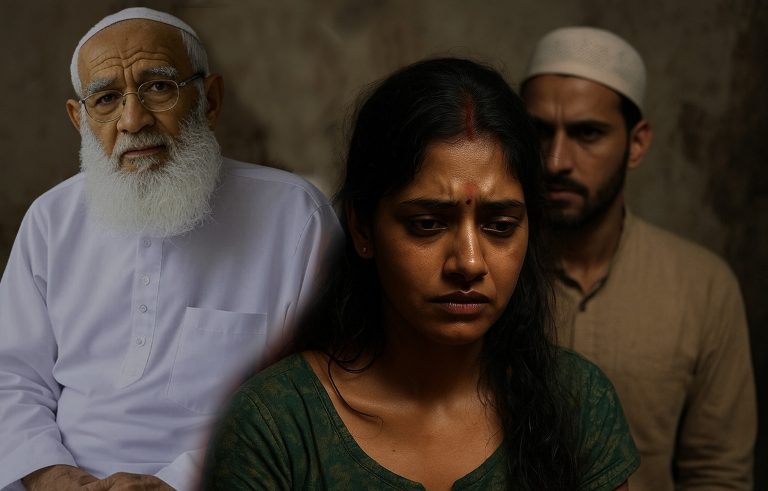
NHRC takes suo moto cognizance of rape, abuse, force-feeding of beef allegations against Omar Rashid, asks The Wire if it has approached the police

The National Human Rights Commission (NHRC) has taken suo motu cognizance of grave allegations against The Wire journalist Omar Rashid, following a viral Instagram post in which a woman accused him of rape, sexual abuse, physical assault, psychological torture, and extreme religious and cultural humiliation.

NHRC seeks ATR over explosive allegations leveled against Omar Rashid

In a notice issued under Section 12 of the Protection of Human Rights Act, 1993, the NHRC has asked the Delhi Police to file an Action Taken Report (ATR) before 5 June 2025. The Commission has invoked its powers to inquire into human rights violations after reviewing the viral testimony, calling the claims “serious” and “deeply disturbing.”

Complainant Flags Complicity of The Wire

The complainant who filed a complaint with the NHRC has also raised serious questions about the editorial ecosystem at The Wire. 

In the complaint, the complainant showed little faith on the ‘Management of The Wire News Portal’s’ internal inquiry, suspecting it to be lacking impartiality and a formality to protect the accused. It allege conflicts of interest and potential suppression to protect the organization’s image.

NHRC demands answers from The Wire in connection with serious allegations of rape, torture, forced beef-feeding by Omar Rashid

This raises troubling questions about the institutional accountability of The Wire, a portal long accused of dressing up regressive perspectives as “dissenting opinions”, which is now under scrutiny for allegedly shielding a serial predator.

In view of the gravity of the matter, the Commission has issued the following queries to the management of The Wire portal:

  1. Regarding Police Complaint:
    • Did the management of The Wire News Portal file a formal police complaint in response to the serious allegations of sexual, physical, and mental abuse made against the accused?
    • If a complaint was filed, on what date was it lodged, and at which police station?
    • What action has been taken by the concerned law enforcement authorities since the filing of the complaint?
    • Were the authorities specifically informed about the grave allegations of rape and severe physical assault, as described by the victim in her viral social media posts?
  2. Regarding PoSH Investigation:
    • Has a formal investigation been initiated by the management of The Wire News Portal under the provisions of the Sexual Harassment of Women at Workplace (Prevention, Prohibition and Redressal) Act, 2013 (PoSH Act)?
    • If so, what is the current status of the investigation?
    • Who are the members of the Internal Complaints Committee (ICC) constituted to handle the matter?
    • Has the complainant/victim been contacted by the ICC, and what steps have been taken to ensure her safety and dignity during the inquiry?

Instagram testimony sparks nationwide outrage

The unnamed woman’s harrowing Instagram post details a prolonged period of sexual violence, manipulation, and physical abuse. She said she was trapped by Rashid using his senior status in Delhi’s liberal media and charmed with conversations on progressive politics and symbolic gestures like walks in Lodhi Garden — a tactic she claims he used with multiple women.

Once emotionally entangled, she alleges, the relationship turned into an ordeal of violent rapes, slapping, kicking, and humiliation, especially during moments of vulnerability.

“He raped me when I was sick, when I begged him to stop. He refused to use protection. I ended up in clinics, getting abortions, getting tested,” she wrote.

Psychological abuse and religious humiliation

The survivor also recounted extreme emotional degradation — including being forced to beg at his feet while Rashid reportedly described the imaginary sexual abuse of her mother in graphic detail.

She further alleged that Rashid force-fed her beef, fully aware of her religious and personal aversion. This was done, she says, to assert his Kashmiri Muslim identity and to humiliate her as a non-Muslim woman.

“I puked it out. He made me eat it again. He knew I hated it — that was the point.”