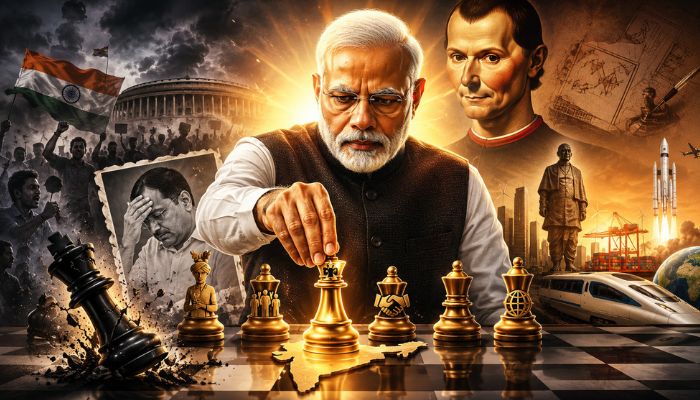
Most people describe Narendra Modi’s power in the same familiar terms. Dominance, electoral strength, and authority. It is the language of a ‘strongman’, and for much of the past decade, it seemed adequate. But strongman is also the least revealing way to understand him because it captures only the scale of his mandate and says very little about how he responds when that mandate comes under pressure.
On Saturday, India’s education minister resigned. Just like that, a month of nationwide student protests that had been building into a real political crisis was over within hours. Looked at one way, it seems like Narendra Modi was forced into a retreat. Looked at properly, it’s more like a trade he was always ready to make. Sacrifice one cabinet minister, someone who could be replaced by Monday morning, to shut down a movement that was starting to look a lot like the youth uprisings that had recently brought down governments elsewhere in the region. That’s not losing. That’s knowing exactly which piece on the board is expendable and which one isn’t.
Farmers got a policy reversal back in 2021. Coalition allies got cabinet seats and veto power in 2024. Students got a minister’s resignation in 2026. Every single time, Modi gave up the smallest thing he could give up to neutralise the biggest threat he was facing, and every single time he was still standing at the end of it, still setting the agenda, still the one person whose own position was never actually on the table. Call it the defining discipline of his politics, ‘he wins big by losing small.’
The traits nobody credits him with
A lot of people think of Modi mainly in terms of his hard-line politics and the strong image he has built around himself. But that misses some quieter strengths that have mattered just as much to his rise and staying power. Patience, the ability to manage alliances, control over his message, and a very sharp sense of timing. His way of communicating is especially important. Since 2014, he has mostly spoken to people directly through social media and Mann Ki Baat, instead of relying on the regular press. That helped him create an image of himself as a Pradhan Sevak, a chief servant, rather than a distant supreme leader.
The idea is that he is there to serve the country, and that image is also meant to connect with Gandhi in a very deliberate way. Scholars who study his media strategy have pointed out that this direct approach let him go around elite media and speak to the public on his own terms. The same instinct for careful presentation can also be seen in foreign policy. During India’s 2023 G20 presidency, the government made a clear effort to present India as a leading voice for the developing world, with scholarships, science initiatives, and a platform for the Global South. This was not just for show. It was a kind of political groundwork, laid long before he needed it to deal with a hung parliament or a difficult election.
Why bending is not breaking
In politics, people usually treat flexibility as just a polite way of saying someone’s dumped their principles. Modi’s career points the other way. Look at how the farm laws got repealed, it’s interesting less because of the fact that he backed down and more because of the way he handled it. The announcement was timed to land right alongside a major Sikh religious festival. Most people saw that as an attempt to spin a clear policy defeat into a gracious gesture toward the Sikh farmers who’d been at the centre of the protests.
At the time, the commentary largely framed it as a tactical move rather than a forced surrender, even though it did dent his strongman image and handed his critics some fresh ammo. Others went further and argued the climbdown wasn’t really an admission of defeat at all, more a calculated bid to protect his voter base ahead of some tightly contested state elections, driven by a real sense of vulnerability after a string of disappointing results in recent state and civic polls. The underlying push for agricultural reform never actually disappeared, it just went quiet. That’s been the pattern right through his career, which is to give ground on the method, hold the line on the objective, and keep tight control over how the concession gets told. A leader who can’t do that ends up hostage to his own past positions. One who can is simply a lot harder to defeat.
The political mind behind the public image
Look, none of this is actually new in political thought, even if it sounds pretty cynical when you just say it straight out. Machiavelli was already arguing this stuff five centuries ago, that the ruler best set up to survive isn’t the most consistent one, but the most adaptable. Someone who can completely shift how they behave the moment circumstances change. Modern takes on ‘The Prince’ basically describe this quality, virtù, as needing what one standard account calls a ‘flexible disposition’, basically the ability to change your approach as conditions shift, while never losing sight of the two things that really matter. Holding on to power and actually getting something done with it.
Machiavelli even borrowed that image of a general reading a changing battlefield instead of stubbornly fighting yesterday’s war all over again. Judged by that old standard, Modi’s willingness to trade a single party, Hindu nationalist posture for coalition dependence, or to switch from confrontation abroad to quiet accommodation and back again, doesn’t read like the record of a leader with no real convictions. It’s just a much older lesson applied with unusual discipline; methods are disposable while objectives are not.
What critics get right and what they miss
Look, the obvious objection here deserves a proper hearing, not just a quick brush-off. Independent monitors have genuinely got more and more worried about the state of Indian democracy under Modi. Freedom House has downgraded India’s scores on political rights and civil liberties, and they trace that decline straight back to the years since he took power in 2014, pointing to things like intensifying intimidation of journalists and growing pressure on rights groups. Sweden’s V-Dem Institute went even further and labelled India an electoral autocracy. These aren’t fringe complaints; they’re among the most carefully documented critiques you’ll find levelled at any large democracy right now. But the same body of research also muddies the simplest version of the story. India’s elections are still genuinely contested, opposition parties actually run major states, and as one recent survey of the evidence notes, the courts have struck down big government initiatives.
You can have a government that wins real popular support at the ballot box while the civil liberties framework around future elections is quietly narrowing at the same time, and that’s exactly the combination these indices are designed to flag. PM Modi’s own foreign minister S Jaishankar has just dismissed the rankings outright, calling them the work of self-appointed international arbiters trying to impose their own rules on a country that’s stopped asking for their approval. It’s not really a rebuttal so much as a reminder that the same flexibility that lets Modi make peace with rebellious allies also lets him soak up institutional criticism without ever being forced into a full retreat. Both of those readings can be true at the same time, and that’s precisely the point that critics and admirers both tend to flatten.
Why this kinds of leadership wins now
This week’s exam protest resignation follows the exact same logic, just on a much shorter fuse. Youth movements in Sri Lanka, Nepal and Bangladesh had recently escalated all the way to the point of leadership collapse. Modi’s government spotted the first real signs that this one might be heading the same way and quickly cut the losing piece off the board, trading a single minister to keep the presidency, the youth vote and the 2027 election calendar completely untouched.
The 2024 election result is probably the clearest real-time test of all this, because it forced an adaptation that nobody really expected Modi to have to make. After ten years of governing with a clear majority, he suddenly found himself dependent on Chandrababu Naidu’s Telugu Desam Party and Nitish Kumar’s Janata Dal (United). Two allies with long track records of switching sides whenever it suited them, exactly the kind of unreliable partners a leader used to having complete authority would normally never choose to lean on. Instead of fighting the shift, he moved quickly to absorb it, getting a formal, unanimous resolution from every NDA party naming him their leader within just a few days of the result.
You see the same instinct at work abroad. Throughout the Ukraine war, India has refused to condemn Moscow, yet the prime minister has also visited Kyiv, as what one Western analysis described as a display of strategic autonomy that avoided any sharp break with Russia while still sending a signal to Washington. And the G20 presidency was set up to serve a domestic political purpose just as much as a foreign one, boosting India’s global standing while quietly banking political capital ahead of the next election. In a fragmented, multipolar world, this is increasingly what leadership rewards, not rigid consistency, but the discipline to keep one objective fixed while constantly rewriting the tactics used to get there.
Conclusion
A leader who’s this good at soaking up pressure without ever really changing course can also be one who never quite has to answer for it, and the steady drop, as per so-called renowned think tanks, in India’s press freedom and civil liberties scores is the cost side of that same ledger, not some separate story. But writing Modi off as just the lucky beneficiary of Hindu nationalism and a compliant electorate misses what’s actually kept him at the centre of Indian politics for two decades. It isn’t the rigid strongman style people usually associate with leaders like him. It’s a rare ability to bend on almost everything except the one thing that really matters to him, staying the man who gets to decide what happens next. Critics keep waiting for him to break. Admirers keep waiting for him to triumph. Both of them keep missing the same point, ‘he was never trying to stand still in the first place.’
A major religious and political row is brewing in West Bengal as a Hindu group, backed by local BJP leaders, has begun conducting prayers near the 650-year-old Adina ‘Mosque’ in Malda district. The historic structure was built over an ancient Hindu temple. Leading the effort, the ‘Adinath Puratan Shiv Mandir’ organisation has announced plans to install a massive 3.6-foot-high Shiva Lingam, weighing around 1.5 tonnes, outside the ‘mosque’ premises. The Shiva Lingam is being transported from Tarakeshwar, located nearly 289 km away.
According to a report by The Indian Express, Kajal Goswami, chief patron of the group and a BJP leader, openly stated, “There are Hindu and Buddhist statues in the so-called mosque. The Adinath Temple was destroyed to build a mosque on it”. He added, “Our aim is to restore the temple and place the Shiva Lingam inside it”.
However, Goswami stressed that they intend to follow the law and avoid any law and order disruption, mentioning that officials from the Archaeological Survey of India (ASI) and the police instructed them to perform rituals outside the protected monument area.
A fresh dispute has emerged around West Bengal's 650-year-old Adina Masjid, with a BJP leader announcing plans to install a Shiva Lingam outside the protected monument while claiming it was originally a temple. The ASI has barred religious activity inside the monument, and… pic.twitter.com/nG5XlCDAL7
Following these developments, the Malda district police issued a strict advisory, reminding the public that the Adina Monument is a Centrally Protected Monument under the AMASR Act of 1958, where unauthorised religious rituals inside the premises are strictly prohibited.
Political momentum has also picked up, with BJP Rajya Sabha MP Samik Bhattacharya raising the issue in Parliament, urging the Central Government and the ASI to look into protecting the original Adinath Temple. Meanwhile, opposition leaders like CPI(M) Politburo member Md Salim have accused the BJP of using a familiar political playbook to divide people ahead of upcoming elections.
Conversion of the ancient temple into a Mosque
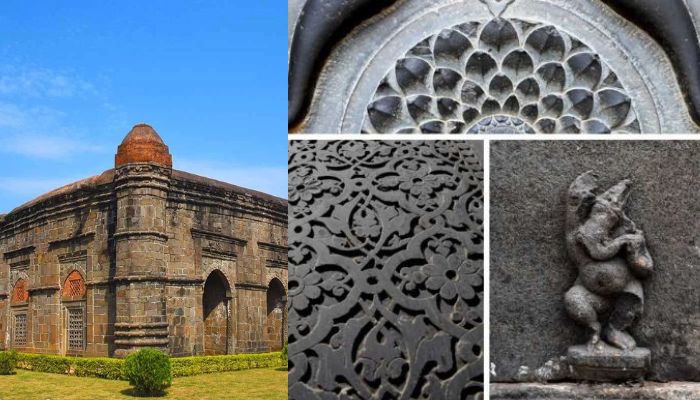
Located in Pandua in Bengal’s Malda district, the Adina Mosque is officially recorded as being built between 1373 and 1375 CE by Sultan Sikandar Shah of the Ilyas Shahi dynasty. While historical narratives often label it the largest medieval mosque in the Indian subcontinent, extensive archaeological and architectural evidence reveals a much older history. The mosque was primarily constructed using materials, pillars, and carved stones salvaged from pre-existing Hindu and Buddhist structures belonging to the Pala-Sena era (8th to 12th century).
Sculptural remnants throughout the structure suggest that the site was originally home to the grand Adinath Temple, dedicated to Lord Shiva, alongside a shrine dedicated to Lord Vishnu. The pulpit of the mosque itself incorporates a doorway made of black basalt stone taken directly from the temple’s architectural ruins.
Furthermore, terracotta and stone carvings on walls, doors, arches and mihrabs or prayer niches depict Hindu deities like Lord Shiva and Ganesh. In addition, there is a significant presence of motifs like flowers, caitya arches, kiritmukha (face of glory) masks, beaded necklaces, and chain-and-bell designs. The Islamic architecture is devoid of this type of adornment, indicating that these motifs and carvings date back to the Pāla–Sena era.
The central mihrab of this mosque carries clear indications of the structure’s Hindu history. The front of this mihrab is placed in the curved wall decorated with a tri-foiled arch, and the spandrel on either side of the arch has been decorated with rosettes, and the panels inside the mihrab are also adorned with the designs of foiled arches and rosettes having chain and bell motifs hanging from the apex of the arches. These are Hindu decorative motifs, as these sorts of chain and bell motifs are noticed on the shaft of the columns engraved during the Hindu period.
Even today, broken Shivlings and overturned idols of Hindu deities remain visible within the walls and surrounding structures, pointing to a widespread destruction of Hindu heritage in the region during medieval invasions.
The issue gained significant legal and social attention when senior advocate Hari Shankar Jain appealed to Hindus to reclaim their right to worship at the site, writing letters to Prime Minister Narendra Modi and calling out the historic destruction caused during Sikandar Shah’s reign.
TMC MP Yusuf Pathan attempted to legitimise it as a mosque
The controversy caught national spotlight when Trinamool Congress (TMC) MP Yusuf Pathan visited the site and attempted to highlight it purely as an Islamic architectural feat.
Sharing pictures of his visit on social media, Pathan wrote: “The Adina Mosque in Malda, West Bengal, is a historic mosque built in the 14th century by Sultan Sikandar Shah, the second ruler of the Ilyas Shahi dynasty. Constructed in 1373–1375 CE, it was the largest mosque in the Indian subcontinent during its time, showcasing the region’s architectural grandeur.
The Adina Mosque in Malda, West Bengal, is a historic mosque built in the 14th century by Sultan Sikandar Shah, the second ruler of the Ilyas Shahi dynasty. Constructed in 1373-1375 CE, it was the largest mosque in the Indian subcontinent during its time, showcasing the region's… pic.twitter.com/EI0pBiQ9Og
Netizens and political commentators quickly called out the TMC leader for ignoring the site’s rich Hindu heritage. Sharing detailed photographs of Hindu carvings inside the complex, social media users offered sharp fact-checks. Advocate Shekhar Kumar Jha posted an image showing a Lord Ganesh carving on the wall, commenting, “Historic: Adinath Mandir became Adina Mosque.”
Another X user, “PlanH,” replied directly to Pathan: “Dear Yusuf Pathan, you are standing in the campus of one of the largest Hindu Temples, Adinath Temple, which was desecrated and occupied by Islamic invaders. Attached are some images for your reference. It is time to undo the injustice and barbarity, and reestablish the temple’s glory.”
Dear Yusuf Pathan, you are standing in the campus of one of the largest Hindu Temples, Adinath Temple, which was desecrated and occupied by Islamic invaders. Attached are some images for your reference. It is time to undo the injustice and barbarity, and reestablish the temple's… pic.twitter.com/CUc1z5lnHD
User “Abdul Kitabi” added: “As a true Muslim, we must give this mosque back to Hindus.”
Others raised fundamental questions about historical accountability, asking, “Have you people made anything of your own, or have you just taken over everything by demolishing others’ religious sites and claimed it as your own?”
Reclaiming rights and moving towards restoration under BJP government
For decades, local Hindus were strictly barred from offering prayers or carrying out any religious rituals at the disputed site. The area was placed under strict protection by the ASI, which effectively halted any attempts at worship or further archaeological excavation. However, the sentiment surrounding the site began shifting noticeably in early 2024.
A group of Hindu devotees led by a young priest, Hiranmoy Goswami, entered the premises, identified idols and a Shivling embedded in the architecture, and started chanting mantras and offering puja. Though local police intervened following the complaint by local Muslims and stopped the prayers at the time, the act marked a turning point for the local community.
Today, backed by BJP leaders pushing for historic justice, the effort to reclaim the site has reached a new high. Comparing the dispute to major historical re-evaluations like Ayodhya’s Ram Janmabhoomi, Gyanvapi, and Mathura, activists and political figures emphasise that public religious sentiment cannot be suppressed forever.
With plans to petition the Calcutta High Court for a complete ASI survey and the ongoing installation of a dedicated Shiva Lingam outside the complex, the Hindu community is taking decisive steps to legally and peacefully reclaim what they consider their rightful sacred heritage.
Azam Khan is once again making headlines after the Rampur Development Authority (RDA) declared 38 buildings at Mohammad Ali Jauhar University illegal. The development has brought renewed attention to several projects carried out during his time as a minister in the Samajwadi Party government.
Among the issues being discussed is the construction of a fly-ower inside Jauhar University, which reportedly cost around Rs 150 crore. Questions have also been raised over the acquisition of land from poor farmers and labourers for university-related projects.
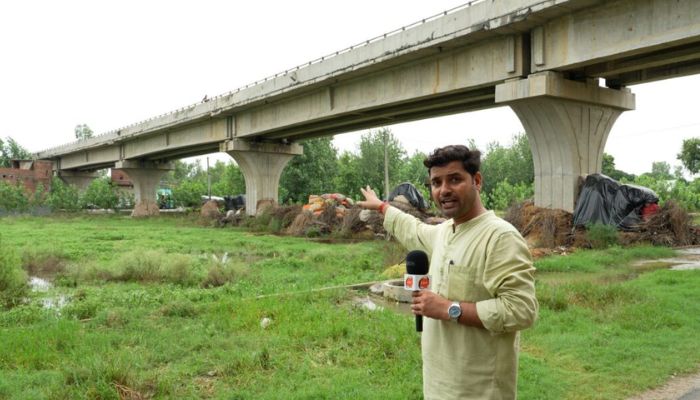
To understand the situation on the ground, OpIndia visited Rampur and spoke to residents living near the 5-kilometre-long flyover that leads directly to the back gate of Jauhar University.
A flyover that leads to the University
The flyover starts from Ekta Tiraha in Rampur, close to Azam Khan’s ancestral house. Interestingly, his house is located only a short distance away, while the Rampur district jail where he has been lodged for years is situated right opposite it.
Travelling on the flyover, dense mango orchards and forested areas can be seen on both sides. Locals said a large number of trees were cut during its construction. Unlike other busy roads in Rampur, this flyover remains largely empty.
What makes the flyover unusual is that it does not cross any railway line, river, stream or major highway. It also does not connect any important road, town or village. Only two small village roads pass underneath it.
A man standing on the flyover told OpIndia that there is rarely any traffic on it. According to him, the road is mainly used by students travelling to and from Jauhar University, while most people in Rampur receive no real benefit from it.
‘Our land was taken for very little money’: Villagers
After getting off the flyover, the OpIndia team met women working in a mango orchard near a village. One of them, Kamlesh, said they had only four bighas of land, which was acquired for the flyover.
“Our valuable land was taken for a very small amount. We did not want to give it, but we are poor people. What could we do?” she said.
Bhagwan Das, who was also working in the orchard, claimed the land was taken under pressure. He said people feared that if they refused, they could be sent to jail.
According to him, the flyover has not helped villagers in any way. He believes that if a normal road had been built instead of an elevated flyover, the area could have developed. Shops, houses and small businesses could have come up, benefiting local people. Instead, he said, the project mainly served Azam Khan’s own purpose.
Some villagers also claimed off-camera that the flyover was built so Azam Khan could travel directly from his home to Jauhar University without getting stuck in city traffic.
‘We were forced to register our land’
The OpIndia team also visited Kishanpur village, located below the flyover.
Dinesh, a resident, said his family’s land was not acquired, but their house is located next to the structure. He said the village has received no benefit from the flyover. Instead, people had hoped a road would be built underneath it, but that never happened.
Two women passing through the village also said the project had not helped residents.
Another villager, Ummed Singh, said part of his land was acquired for the flyover. According to him, officials, including the Kanungo and Tehsildar, came to his house and forced him to complete the land registration.
He further claimed that large-scale financial irregularities took place during the construction of projects linked to Jauhar University.
Ummed Singh also said that while he was driving an auto-rickshaw, an RTO official used to collect money from drivers. According to him, the official claimed that 40% of the collection was meant for Jauhar University. He blamed Azam Khan for the situation and said people in Rampur faced harassment during the Samajwadi Party government. He added that action being taken under the Yogi Adityanath government is the result of those past actions.
A Rs 150-crore flyover that still faces questions
The 5-kilometre-long flyover connecting Rampur to Jauhar University was built during 2013-14 at an estimated cost of around Rs 150 crore. Since its construction, it has remained surrounded by controversy.
Many residents told OpIndia that the flyover was built mainly for easier access to Jauhar University and has provided little benefit to the public. Several villagers say they lost their land for very low compensation and believe the project did not contribute to the development of their villages. With fresh action now being taken against Jauhar University, these old concerns have once again come back into public discussion.
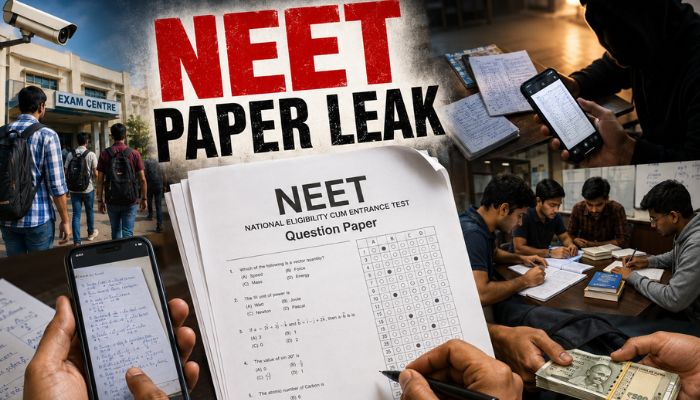
The NEET-UG paper leak of 2024 did not begin with one person breaking open a question-paper trunk. According to the Central Bureau of Investigation, it was the outcome of a network that connected admission consultants, career-counselling operators, examination-centre officials, candidate agents, MBBS students hired as solvers, guest-house operators, drivers, printers and financial intermediaries.
Two years later, the method reportedly changed but the commercial ecosystem survived. In the NEET-UG 2026 case, the CBI said people appointed as subject experts by the National Testing Agency (NTA) passed confidential questions through private coaching sessions and coaching-linked intermediaries. Chemistry lecturer PV Kulkarni was described as a key source. Questions dictated during special classes at his residence reportedly matched the examination held on 3rd May 2026.
The two cases show why paper leaks cannot be viewed only as failures in the movement of sealed boxes. The coaching mafia operates as a market. It finds families willing to pay, locates insiders with confidential access, recruits people capable of solving or teaching the material, arranges accommodation and transport, collects money and documents, then delivers the advantage before the examination begins.
While the term “coaching mafia” is used here, it does not suggest that every coaching centre, teacher or counsellor is involved in examination crime. The term is being used for organisations and individuals who, according to the CBI statements and court records, used education, counselling or admission-related operations to recruit candidates and facilitate cheating. OpIndia is not accusing the entire coaching centre network across the country of being involved in criminal activities.
The principal Patna-Hazaribagh case began when Shastri Nagar Police Station registered an FIR. The case was handed over to the Central Bureau of Investigation on 23rd June 2024 and a fresh FIR was registered. Later, multiple chargesheets were filed against 45 individuals by the investigating agency. For this report, OpIndia has relied heavily on court orders and FIRs. All the documents are linked in a single ZIP file towards the end of the article.
The network reportedly existed before the 2024 examination
The chronology of the 2024 NEET paper leak started with the plan created by two persons who had known each other since 2015-16. According to the CBI, Amit Kumar Singh, one of the main accused, had known Raj Kumar Singh alias Raju Singh since 2015-16. Both reportedly worked in consultancy or agency services that facilitated admissions to professional courses. Pankaj Kumar alias Aditya alias Sahil worked in the same field and came into contact with Amit during 2021-22.
The agency also referred to an older association between Amit and Ranjit Kumar Beura alias Pintu. During Beura’s bail proceedings, the prosecution said they had known each other since 2019 and had been arrested that year in an Odisha University of Agriculture and Technology examination malpractice case. While the older case was not linked to the NEET paper leak, it was relevant because the CBI presented the 2024 operation as an extension of relationships already built around admissions and competitive examinations.
Career Academy Education Trust became one of the principal candidate-recruitment channels. It was registered in Odisha on 3rd August 2023. Beura told the court that it was an NGO created to provide educational facilities and consultation to poor students. The CBI said it was used to identify NEET aspirants, secure commitments from families and collect original educational certificates and cheques as guarantees.
Beura was described as the organisation’s managing director. Amit Prasad Maharana and Dhiren Kumar Panda were identified as office-bearers. The agency said Amit Kumar Singh worked with them and Sanjay Kumar to arrange candidates from Odisha, Bihar, West Bengal, Rajasthan and Madhya Pradesh. Seventeen candidates were reportedly sent to Hazaribagh and accommodated at Raj Guest House or a house at Sindur. Others remained in Bhubaneswar or Patna.
The CBI cited statements from candidates, employees and drivers. One candidate reportedly handed over educational certificates to Career Academy. Another said Maharana shared the solved NEET paper. A candidate in Bhubaneswar said she received a printed copy at a hotel and identified Panda. The agency said Maharana transported candidates in a Scorpio, arranged a printer at Hotel Treefo Palace and distributed solved papers. It cited Rs 2 lakh received in his personal account and Rs 12 lakh received by Chiranjeevi Multiventure Private Limited, where he was a director. Panda was described as Career Academy’s treasurer and was also linked to transport, distribution at Hotel Treefo Palace and the Rs 12 lakh payment.
The CBI said original certificates and cheques were taken as guarantees. This would have given the organisers considerable leverage over the candidates and their families.
The next link was inside the examination system. Jamaluddin alias Jamal was a Hazaribagh journalist associated with Prabhat Khabar who regularly covered programmes organised by Oasis School. Notably, Oasis School was the examination centre from which the question paper was stolen. The CBI said this brought him close to the principal, Dr Ahsanul Haque, and the vice-principal, Md Imtiyaz Alam. The agency cited 814 calls between Haque and Jamaluddin from 3rd June 2023 to 18th June 2024. While call frequency alone was not enough to prove the conspiracy, the CBI used it to establish a continuing association.
According to the agency, Jamaluddin introduced Amit Kumar Singh to Haque and Imtiyaz. Amit later introduced Pankaj Kumar. The CBI also referred to meetings involving Amit, Haque, Imtiyaz, Jamaluddin, Pankaj, Raju Singh and Aman Kumar Singh. The prosecution’s broader theory was clear: Jamaluddin connected the outside admissions network to the officials controlling the secure centre, while Amit brought Pankaj into that circle.
Solvers and candidates were assembled before the paper was stolen
A raw question paper had little commercial value unless it could be solved quickly and delivered to paying candidates. The CBI said at least three solver groups were brought to Hazaribagh. Many members were MBBS students.
Sanjay Kumar was described as the person who arranged solvers, beneficiaries, transport and logistics. The prosecution said he asked AIIMS Patna student Chandan Singh to recruit academically strong medical students. The Patna group included Chandan Singh, Kumar Shanu, Rahul Anand, Karan Jain, Surbhi Kumari, Raunak Raj and Amit Kumar. Amit brought his college mate Sanoj Kumar Yadav, although the CBI said Sanoj did not enter Raj Guest House to solve the paper.
The students were first approached for impersonation. The CBI said Sanjay took Chandan, Kumar Shanu, Rahul Anand and Karan Jain to a photo studio near AIIMS Patna. Their photographs were taken for NEET applications. Raunak Raj and Amit Kumar sent photographs and signatures through WhatsApp. The dummy-candidate plan was later dropped, but the same recruits were reportedly reassigned as solvers.
The Rajasthan group was linked to Amit Kumar Singh. The CBI said he travelled to Bharatpur in February 2024 and met Kumar Manglam Vishnoi, Deependra Sharma and other medical students. Kumar Manglam, an MBBS student at Shri Jagannath Pahadia Government Medical College, reportedly arranged a group that included Deependra Sharma, Sandeep Kumar, Suresh Kumar and Ishita. They too were initially approached as possible dummy candidates. Kumar Manglam later arranged train tickets and brought members of the group to Hazaribagh.
The operation began moving people more than a week before the examination. On the night of 26th April, Sanjay Kumar, Chandan Singh, Kumar Shanu and Rahul Anand reportedly left Patna on the Ganga Damodar Express and travelled to Koderma. Surbhi Kumari arrived separately from Ranchi. The group stayed first at Ramson Hotel and then at Hotel Tara Tower. Bookings were reportedly made by Sanjay and Kumar Abhishek.
Amit Kumar travelled from Chennai to Ranchi on 2nd May and reached Koderma the following day. Raunak Raj came from Mumbai. Karan Jain travelled from Patna on a ticket booked by Kumar Abhishek. On 3rd May, the Patna group shifted to Hotel Sri Vinayak in Hazaribagh. Their early arrival supported the CBI’s case that they had been positioned in anticipation of confidential material.
The prosecution said preparations were also taking place inside Oasis School. Its counter-affidavit in Imtiyaz Alam’s bail proceedings said a toolkit bag was placed in the control room on 3rd May. The tools were later reportedly used to manipulate the rear hinges of an NTA trunk, open the packaging and restore it after the paper was photographed. According to the CBI counter-affidavit reproduced in Imtiyaz Alam’s bail order, Alam placed the toolkit bag in the control room on 3rd May. The agency said Pankaj later used those tools to open and restore the trunk.
Candidates began converging on Hazaribagh on 3rd and 4th May. Beura reportedly arrived in an MG Hector with Career Academy employee Debashish Panigrahi and driver Ranjan Sethi alias Manas. The vehicle was used to move candidates. Beura stayed at AK International Hotel. Candidates from Odisha were sent to Raj Guest House and Sindur.
Raju Singh reportedly managed Raj Guest House. The CBI said the premises were deliberately kept available. Food was arranged and vehicles were used to move candidates and solvers. Raju maintained that he had merely rented rooms and did not know the purpose. The Patna High Court initially refused bail after referring to the prosecution’s case that the guest house had knowingly been provided for preparing candidates.
In Patna, Sikandar Yadvendu coordinated with Akhilesh Kumar, Avadhesh Kumar, Shivnandan Kumar and candidate Anurag Yadav. The CBI said they were told to bring candidates near St Karen’s High School at around 10:30 pm on 4th May. By that night, the different branches were reportedly in position: insiders at the school, solvers in nearby hotels, candidates in guest houses and private premises, and vehicles, printers and accommodation ready.
How the paper was removed and distributed on 5th May
At around 5:30 am, Chandan Singh, Rahul Anand, Surbhi Kumari and Karan Jain reportedly left Hotel Sri Vinayak in a black Hyundai Creta and reached Raj Guest House. Kumar Shanu, Amit Kumar and Raunak Raj followed. The CBI said every member of the Patna solver group except Sanoj Kumar Yadav was inside the guest house before the stolen paper arrived. Deependra Sharma and Sandeep Kumar from the Rajasthan group were also placed there through mobile locations, travel records and witness identifications.
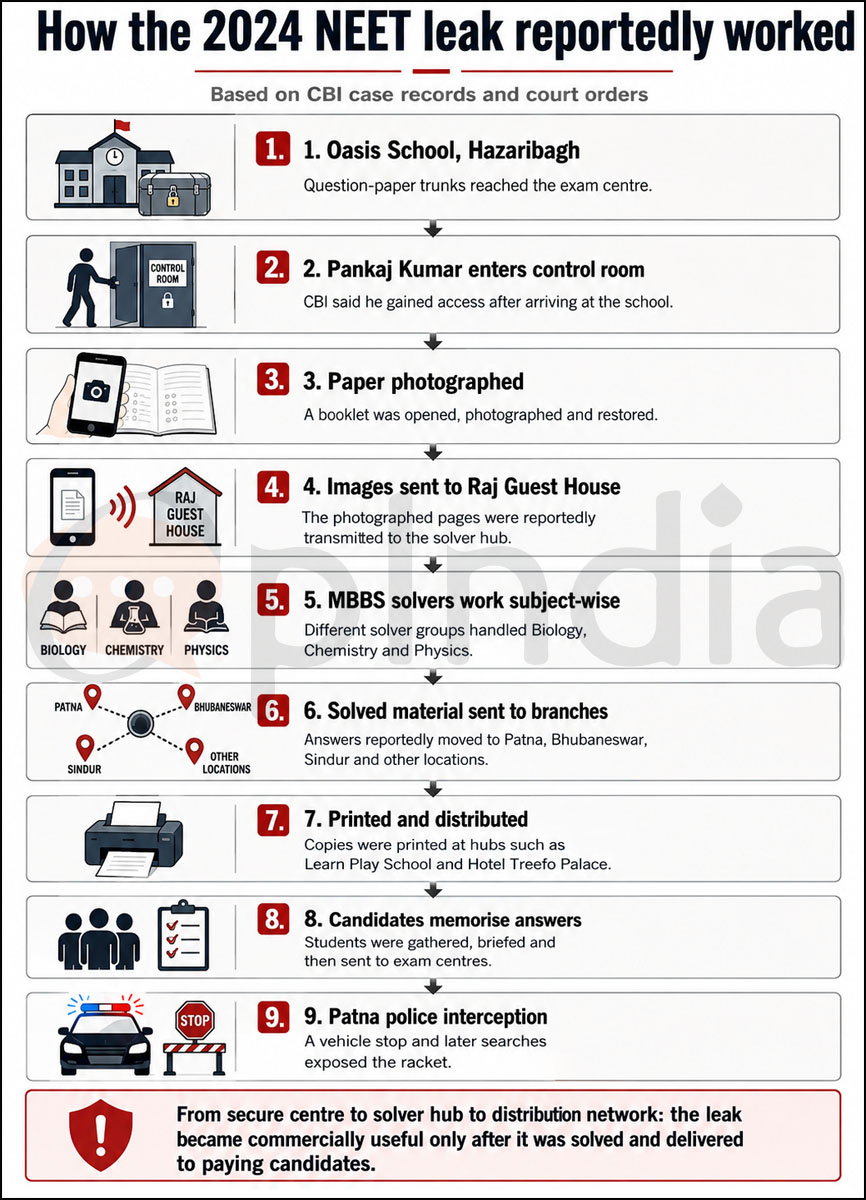
How NEET paper got leaked in 2024.
At around 7:40 am, Oasis School principal Ahsanul Haque collected two trunks containing NEET papers from an SBI vault in Hazaribagh. Haque was also the NTA city coordinator. The trunks were handed to vice-principal Imtiyaz Alam, the centre superintendent, who reached the school at about 7:53 am and placed them in the control room.
The CBI traced the stolen booklet through the packaging chain. Trunk 13093 contained bunches 13560 to 13563. Bunch 13560 contained packets 38988, 38989 and 38990. Packet 38990 contained 24 booklets numbered 6136465 to 6136488. Booklet 6136488 was identified as the source copied inside the school.
Pankaj Kumar reached Oasis School and reportedly told the guard, Rohit Ram, that he represented “Innovative View” and had come to meet Imtiyaz Alam. Rohit called out to Alam, who was standing near the principal’s office. The CBI said Alam signalled that Pankaj should be allowed inside. Pankaj then sat in the staff room. Notably, Innovative View was the official security and biometric verification agency deployed at examination centres. It is unclear whether Pankaj genuinely represented the company or merely used its name to enter the school.
School employees Mohd Shakeb Khan and Sadul Hassan noticed that the outsider had remained there for a long time. Shakeb reportedly informed Alam and later Haque. Sadul also raised the issue. According to statements cited by the CBI, Alam became irritated and told the employees to leave the matter to him. Shakeb and Sadul later gave statements before a magistrate. Shakeb also identified Pankaj in a test identification parade.
At 8:02:11 am, Pankaj reportedly entered the control room through its second door. The CBI said he used the toolkit to manipulate the rear hinges of trunk 13093, removed bunch 13560 and opened packet 38990. He selected booklet 6136488, cut its plastic wrapping and opened the paper seal with a pencil.
The agency said Pankaj photographed every page except the first and last sheets with an iPhone 13 that the CBI said was used in the operation. He had also reportedly obtained a SIM card using another person’s identity. He returned the booklet to the packet, restored the bunch and tried to reseal the trunk. Plastic strips removed during the process were placed inside the toolkit bag, which was concealed near an almirah. The CBI said the disturbed tablecloth could be seen in the school’s CCTV footage. The tools were later seized and Pankaj reportedly re-enacted the process in CBI custody.
Pankaj left the control room at around 9:23 am and the school premises at about 9:24 am. The examination was scheduled to begin at 2 pm. The network had less than five hours to transmit the photographs, solve the paper, prepare readable copies and move candidates to their centres.
The photographed pages were sent to Raj Guest House. The solvers were divided by subject. Kumar Shanu, Deependra Sharma and Sandeep Kumar were reportedly assigned Biology. Surbhi Kumari and Raunak Raj handled Chemistry. Chandan Singh, Rahul Anand and Amit Kumar handled Physics. Karan Jain was assigned difficult or time-consuming questions. Chandan was described as the leader of the Patna group and Kumar Manglam as the leader of the Rajasthan group.
Once the answers were prepared, Chandan and Surbhi were reportedly taken downstairs to explain them to candidates and clear doubts. Other solvers joined them. The CBI said physical solved copies were ordered to be destroyed after memorisation. The solvers returned to Hotel Sri Vinayak, where Sanjay Kumar and Sanoj Kumar Yadav were waiting. The agency relied on statements attributed to Sanoj about conversations in which group members said they had solved the paper.
Pankaj reportedly created PDFs of the solved material and transmitted them to handlers at Sindur, AK International Hotel, Bokaro, Bhubaneswar and Patna. Shashikant Paswan handled the Sindur branch. A copy was sent to a WhatsApp number used by Aman Kumar Singh, the brother of Amit Kumar Singh. In Bhubaneswar, handlers connected with Pankaj’s brother Ghanshyam reportedly worked with two electricians, Gautam and Vikas. Career Academy emerged in the CBI’s case as one of the most extensively documented candidate-recruitment and logistics channels in the 2024 leak.
The Patna branch received the solved subjects separately. According to the CBI chargesheet reviewed by The Indian Express, Baldev Kumar alias Chintu received the solved Biology paper on WhatsApp at 10:50 am. Chemistry arrived at 11:05 am and Physics at 11:40 am. The sequence indicates that each section was transmitted as soon as the relevant solver group completed it.
Baldev and Nitish Kumar reportedly printed 15 sets at Learn Play School in Khemnichak. Nitish brought a Brother printer and a Dell laptop. Around 30 to 32 candidates were assembled in groups of two or three. The chargesheet account placed Baldev, Pintu Kumar, Nitish Kumar, Abhimanyu Patel, Ashutosh Kumar and Manish Prakash at the premises during printing and distribution. Learn Play School was a key distribution and memorisation site for the Patna branch of the leaked-paper network.
Nitish also took solved Biology copies to his residence in Pratibha Colony, where seven women candidates were reportedly kept. Ashutosh Kumar, son of Krishnandan, was described as a candidate agent who took Rashi Singh there. CCTV footage reportedly showed Nitish giving her sets of solved papers.
Investigators said one page from the leaked paper was found on Nitish’s phone with a timestamp of 11:23 am, well before the examination began. At around 12:30 pm, candidates at Learn Play School and Nitish’s residence were told to leave for their centres. They were reportedly frisked so that no printed copy travelled with them.
The police interception that exposed the racket
At around 2:05 pm, Inspector Amar Kumar, then SHO of Shastri Nagar Police Station, received information that an organised gang had breached the NEET question-paper chain of custody. He was also told that members of the network were moving in a white Renault Duster bearing registration number JH01BW0019.
Police intercepted the Duster near Rajvanshi Nagar Mor and detained Sikandar Yadvendu, Akhilesh Kumar and Bittu Kumar. Four photocopied admit cards were found near the front seat. They belonged to Abhishek Kumar, Shivnandan Kumar, Ayush Raj and Anurag Yadav. Two phones were recovered from Sikandar.
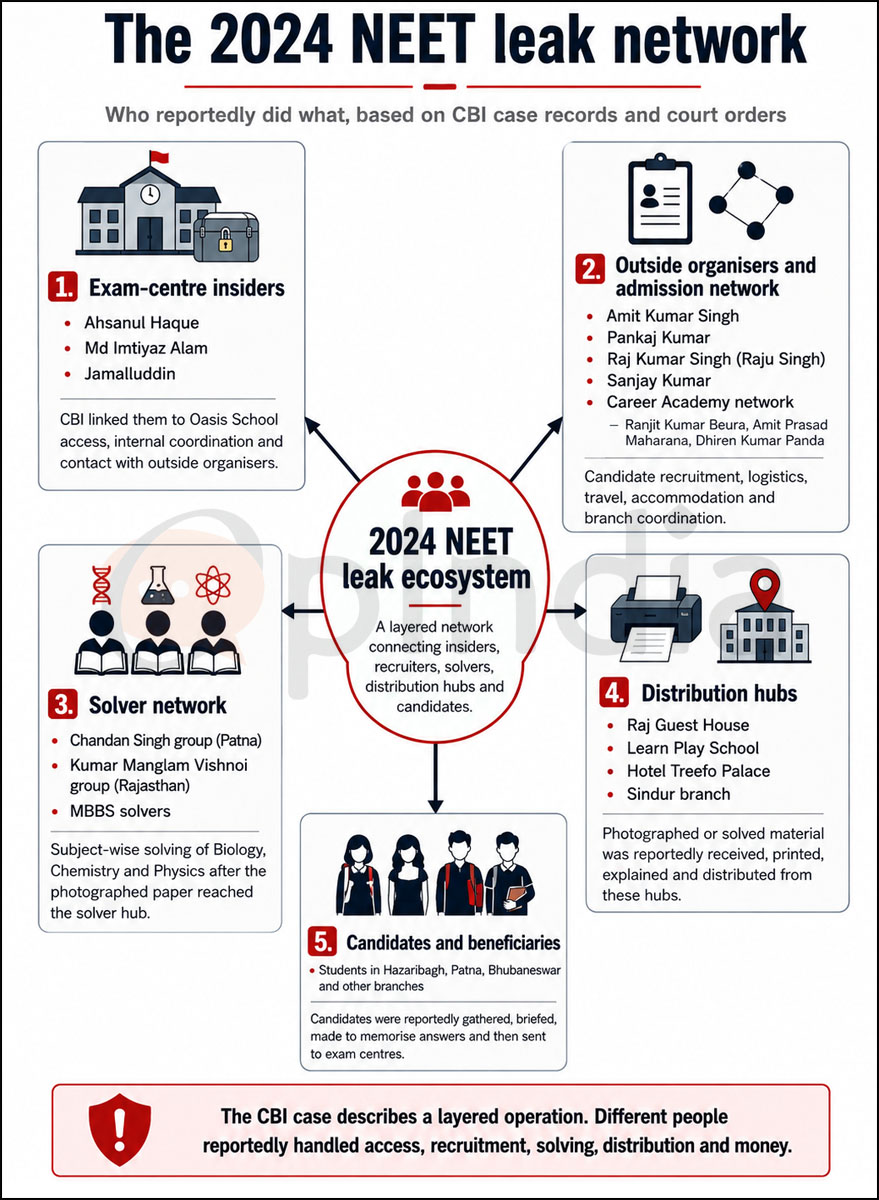
How a network of individuals played their part in the leak.
The FIR records that Sikandar referred to “Sanjeev Singh”, Rocky, Nitish and Amit Anand in connection with candidate arrangements. Police used the recovered admit cards to identify examination centres and waited until the test ended before detaining the candidates.
Ayush Raj was appearing at DAV Public School in BSEB Colony. According to the FIR, he said he and around 20 to 25 students had been taken to Learn Boys Hostel and Learn Play School, provided solved questions and told to memorise them. He also said the questions in the examination matched the material supplied. Police seized his admit card, test booklet and identity documents.
Investigators then searched Learn Play School and recovered half-burnt and wet pieces of the NEET paper from the roof. The CBI later said the fragments enabled it to trace the leak to the booklet assigned to Oasis School. This physical recovery connected the Patna distribution centre with the Hazaribagh paper.
After finishing their work, Chandan Singh, Kumar Shanu, Rahul Anand, Amit Kumar and Karan Jain were reportedly taken to Hazaribagh Town railway station by Kumar Abhishek and Tinku Kumar. They boarded the Vande Bharat Express and reached Patna at around 10 pm. Within one day, the solvers had entered Raj Guest House before sunrise, the paper had been copied after 8 am, subject-wise answers had reached Patna by 11:40 am and candidates had left for their centres by 12:30 pm.
The key organisers and their reported roles
The CBI did not identify one person as the controller of every branch. Its case describes a layered operation in which different people handled access, candidate recruitment, solving, distribution and money.
Amit Kumar Singh emerges as the figure who reportedly linked the largest number of branches. The CBI said he knew Raju Singh from the admissions business, brought Pankaj into contact with the Oasis officials, worked with candidate suppliers and connected both the Patna and Rajasthan solver groups. Kumar Manglam and Deependra Sharma were reportedly accommodated at an Amit-linked flat in Ranchi. The agency also said Kumar Manglam received Rs 2.4 lakh from an account belonging to Ratna Khan that Amit operated. Amit disputed the flat, payment and meeting claims. Searches of his house reportedly yielded no incriminating material.
Pankaj Kumar was described as the operational link between the secure centre and the outside network. The CBI accused him of buying the tools and iPhone, entering Oasis School under a false description, opening the trunk, photographing the paper and transmitting the solved PDFs. It also linked him with candidate locations in Hazaribagh, Bokaro, Patna and Bhubaneswar, as well as payments routed through his brother Ghanshyam’s account. Pankaj denied the allegations. The High Court granted him bail in May 2025 after considering his custody period and parity with other accused. The order did not clear him of the charges.
Rakesh Ranjan alias Rocky was described as one of the kingpins of the Patna distribution operation. His branch reportedly managed Learn Play School, candidate assembly, printers, laptops and local delivery. Baldev received the subject-wise files. Nitish supplied equipment and moved papers to his residence. Rocky denied involvement and was later granted bail.
Raju Singh reportedly made Raj Guest House available and arranged food and transport. He said he was merely renting rooms. His first bail request was rejected, but he received bail in February 2026 after spending more than a year and a half in custody. The High Court noted that charges had not been framed and that the prosecution proposed 589 witnesses.
Jamaluddin was described as the intermediary who introduced the admissions network to Haque and Imtiyaz. Haque and Imtiyaz were the officials responsible for the secure centre. The CBI said Pankaj’s entry was facilitated, his presence was tolerated despite staff objections and access to the control room was enabled. Both denied involvement and questioned the prosecution chronology.
Career Academy supplied a structured candidate network. Beura, Maharana and Panda reportedly recruited aspirants, collected certificates or cheques, arranged travel, accommodation and vehicles, and distributed papers in Hazaribagh and Bhubaneswar. Sanjay Kumar arranged candidates and solvers. Chandan Singh was described as the head of the Patna solver group. Sikandar Yadvendu connected parents and candidates with the Patna handlers.
The separate Godhra network targeted the OMR sheets
The Godhra case involved a different method. It did not depend on stealing the paper and making candidates memorise answers. The CBI said a coaching-linked network attempted to control an examination centre so that correct responses could be filled on selected OMR sheets after the candidates had left.
The case named Tushar Rajnikant Bhatt, Parashuram Bindnath Roy, Arif Noor Mohammad Vora, Vibhor Umeshwar Prasad Singh Anand, Purshottam Sharma and Dixit Kantibhai Patel. Tushar Bhatt worked at Gyan Mandir Career Institute, a private coaching operation. The CBI said he was projected as a teacher and supervisor at Jay Jalaram School so that he could be appointed Deputy Centre Superintendent. Purshottam Sharma, principal of the school and NTA city coordinator, reportedly facilitated the appointment.
Dixit Patel was the chairman of Jay Jalaram Education Trust, which ran the schools used as examination centres. The prosecution said he participated in arranging the centres and officials. His lawyers said those appointments were made by the NTA and denied his involvement.
The CBI said agents instructed candidates to enter present addresses in Panchmahal or Vadodara, select Godhra as their examination city and choose Gujarati as the medium. The purpose was to increase the likelihood that they would be allotted to centres influenced by the network. Candidates were reportedly told to answer only questions they knew and leave the rest blank. The correct options would then be filled in on their OMR sheets. Families were asked to pay between Rs 20 lakh and Rs 25 lakh.
The Gujarat High Court order accessed by OpIndia also recorded statements concerning NEET-UG 2023. A witness named Vishnu Sharma reportedly said he approached the network for three relatives. Dixit Patel asked for Rs 10 lakh in advance for each candidate, according to the statement. Sharma said he paid Rs 20 lakh to Tushar Bhatt on the day of the examination. Bhatt later demanded another Rs 25 lakh and claimed that the work had been completed.
The witness also said he had been appointed as an invigilator in 2023 after sending his photograph to Bhatt. The prosecution relied on the statement to argue that coaching and school networks had already developed methods to influence examination staffing. Dixit Patel challenged the material and said it did not connect him with the 2024 crime. The High Court refused to discharge him in April 2026, holding that the material created grave suspicion that required a trial.
Sanjeev Mukhiya was suspected, but the CBI did not file a chargesheet against him
Sanjeev Kumar Singh alias Sanjeev Mukhiya became one of the most publicised names during the early investigation. Bihar’s Economic Offences Unit described him as the suspected kingpin of an interstate solver gang. Reports said investigators believed he had contacts in examination-leak networks across several states. He remained unavailable for nearly 11 months before the EOU arrested him near Saguna More in Patna on 25th April 2025. The Bihar government had announced a Rs 3 lakh reward for information leading to his arrest.
The CBI took him into custody because he had been named during the Bihar investigation. Initial reports said he was questioned about interstate contacts and logistics.
Mukhiya received default bail in the NEET case in August 2025 because the CBI did not file a chargesheet against him within 90 days. He remained in custody in other Bihar Police cases. On 23rd July 2026, the CBI clarified that it had found no evidence connecting him with either theft or onward distribution of the NEET-UG 2024 paper. The agency said it had identified the people involved and filed chargesheets against 45 accused. Mukhiya was not among them.
Bihar investigators initially suspected Sanjeev Mukhiya of heading the 2024 leak, but the CBI later said it found no evidence of his role in the theft or distribution and did not file a chargesheet against him.
How the 2024 case became a national crisis
The Patna case began with one vehicle, four admit cards and candidates linked to Learn Play School. It became a national controversy after the results were declared on 4th June 2024.
Sixty-seven candidates initially received a perfect score of 720. Questions were raised over scores of 718 and 719, which appeared unusual under the normal marking scheme. The NTA said compensatory marks had been awarded to 1,563 candidates who lost examination time at certain centres. The grace-mark dispute and the Patna-Hazaribagh paper theft had different factual foundations, but they became part of the same public crisis.
On 13th June, the Centre informed the Supreme Court that the compensatory scores would be withdrawn. The 1,563 candidates could accept their marks without grace marks or appear in a fresh test on 23rd June. That addressed the grace-mark question, not the geographical extent of the paper leak.
Student protests spread across the country. Political parties, including the Congress and organisations linked to the ABVP, demanded accountability and a wider investigation. The government brought the Public Examinations (Prevention of Unfair Means) Act, 2024 into force on 21st June. The law provides for punishment for organised cheating, paper leaks, impersonation and unauthorised access to examination material.
On 22nd June, the Ministry of Education constituted a committee headed by former ISRO chairman K Radhakrishnan to recommend reforms in the examination process, data security and the functioning of the NTA. The same weekend, NTA Director General Subodh Kumar Singh was removed from the position. The Centre asked the CBI to conduct a comprehensive investigation, including the wider conspiracy and the role of public servants.
The Supreme Court repeatedly asked when the breach occurred, how widely it travelled and whether tainted candidates could be separated from the rest. The CBI’s initial assessment identified around 155 suspected beneficiaries. The agency later said the leak was centred on Hazaribagh and Patna with interstate distribution to selected candidates.
On 23rd July 2024, the Supreme Court refused to cancel the entire examination. It held that the material then available did not establish a systemic breach that had destroyed the integrity of the test nationwide. It noted the absence of evidence showing that the leaked paper had spread through social media or reached an unmanageable number of candidates. The Court said a re-test for more than 23 lakh candidates could not be ordered without a stronger factual foundation.
The Court nevertheless identified serious failures in the NTA system. Its final judgment called for a stronger standard operating procedure covering paper preparation, storage, transport, centre security, identity verification and handling of irregularities. The number of perfect scores later fell from 67 to 17 after the grace-mark decision and resolution of a disputed Physics answer.
The CBI filed five chargesheets against 45 people in the Patna-Hazaribagh branch. The court orders became the main public source for understanding the investigation. The trial, however, moved slowly. By February 2026, charges had still not been framed in the Patna case and the prosecution had proposed 589 witnesses.
The government began implementing the Radhakrishnan committee’s recommendations. Measures included greater use of government institutions as examination centres, stronger coordination with state administrations, permanent NTA staffing, improved centre allocation, digital monitoring and a steering committee for reform. The Central Consumer Protection Authority also issued guidelines against misleading coaching advertisements. It prohibited false success claims, concealed information and guarantees of selection. By November 2024, the CCPA said it had initiated action against 45 coaching centres and imposed Rs 54.6 lakh in penalties on 18 institutions.
These measures strengthened examination security and addressed deceptive advertisements. They did not create a complete framework for admission consultants and small counselling networks. Career Academy reportedly operated through counselling and candidate handling rather than a conventional classroom. The 2024 network used guest houses, hotels, private homes, original certificates, blank cheques and third-party accounts. The 2026 leak, however, exposed an even greater vulnerability, namely confidential access at the subject-expert level.
The 2026 leak was hidden inside a ‘guess paper’
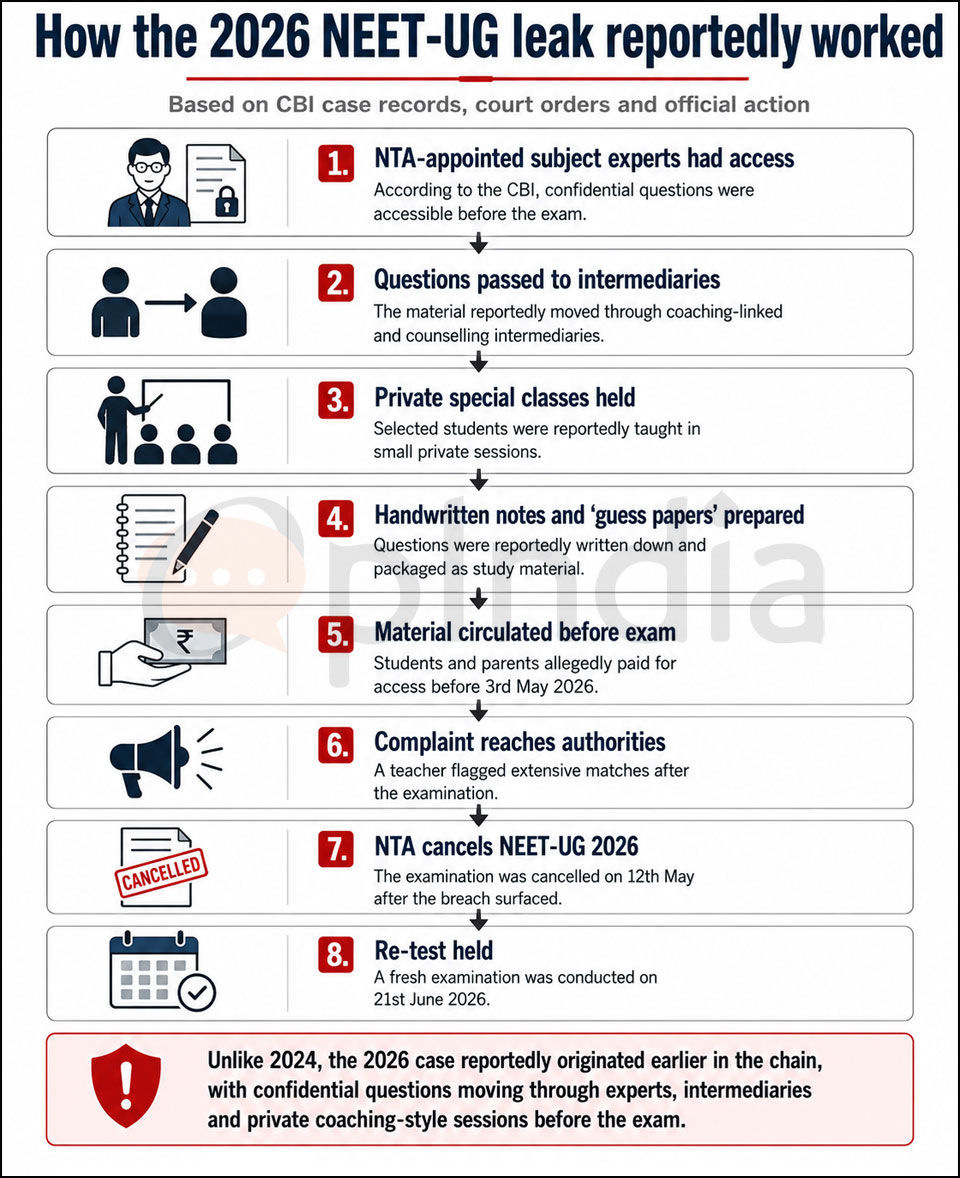
The NEET-UG 2026 breach was not discovered after police stopped a vehicle. It surfaced after a teacher in Sikar received a 150-page handwritten “guess paper” on the evening of the examination held on 3rd May. The document had travelled through his landlord’s son, who was studying in Kerala. The teacher compared it with the real paper and approached the authorities after finding extensive matches.
On 7th May, he sent information to the NTA, the Ministry of Home Affairs and the CBI. NTA officials contacted him the next day and obtained the PDF. The 150-page material reportedly contained around 410 questions. Approximately 120 of them appeared in the Chemistry paper used on 3rd May. Parts of Biology were also suspected to have circulated.
How NEET paper got leaked in 2026.
Calling it a “guess paper” provided deniability. Confidential questions could be sold as expert predictions or a high-probability revision set. Rajasthan’s Special Operations Group traced the file through contacts in Dehradun, Kerala and Rajasthan. It also examined paid digital groups through which material was sold. The inquiry did not establish that every coaching institute in Sikar was involved. It showed that a confidential document had reached a major coaching hub and entered a wider resale market.
The NTA referred the material to central agencies on 8th May. On 12th May, it cancelled the examination and referred the matter to the CBI. Existing registrations and centre preferences were carried forward for the re-test. Candidates did not have to register again or pay another fee.
The decision differed from 2024. The Supreme Court had allowed that examination to stand because the evidence did not show an unmanageable nationwide breach. In 2026, the NTA concluded within nine days that the compromised test could not be preserved.
The CBI traced the 2026 leak to NTA-appointed experts
The CBI registered its case on 12th May and searched locations in several states. It examined phones, messaging applications, bank records and NTA documents. The agency’s case moved closer to the source than the 2024 investigation. Pankaj Kumar had reportedly copied a printed booklet on the morning of the test. In 2026, the CBI said subject experts accessed confidential questions weeks earlier and passed them to coaching and counselling networks.
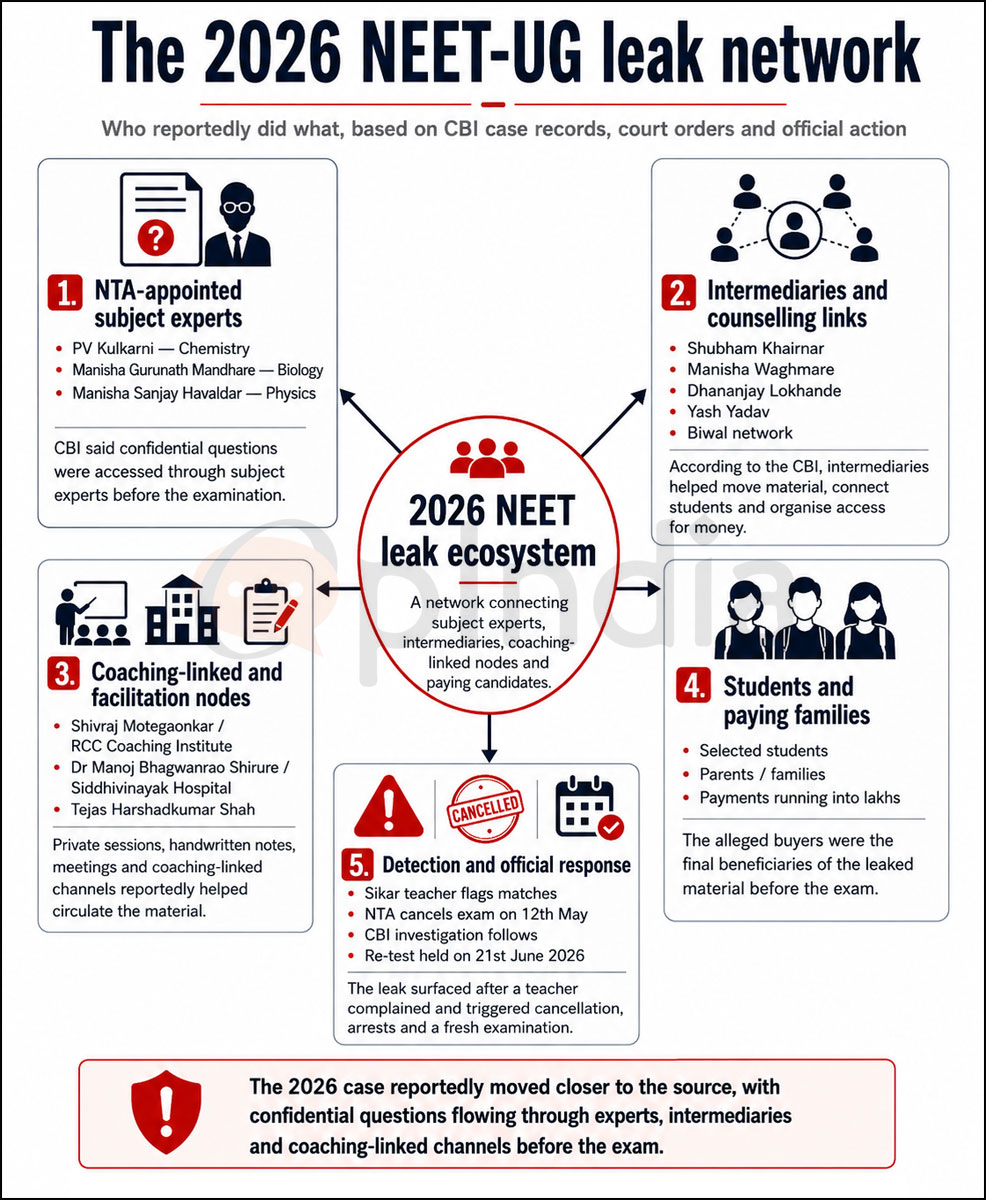
The first five people arrested on 13th May were Shubham Khairnar of Nashik, Mangilal Biwal, Vikas Biwal and Dinesh Biwal of Jaipur, and Yash Yadav of Gurugram. Khairnar reportedly ran SR Education Consultancy, which offered medical-admission guidance. The CBI told a Delhi court that he helped Yadav obtain the paper for distribution. Yadav had reportedly received Physics, Chemistry and Biology PDFs through Telegram on 29th April. Mangilal Biwal was said to have approached the network for his younger son. The price discussed was between Rs 10 lakh and Rs 12 lakh.
How the network worked and who played what role in NEET 2026 paper leak.
Manisha Waghmare of Pune and Dhananjay Lokhande of Ahilyanagar were arrested next. The CBI said Lokhande obtained material from Waghmare and passed it to Khairnar, who facilitated its transfer to Yadav. Waghmare was linked with medical counselling and candidate mobilisation. The agency later said she brought students to special classes held by NTA-appointed Chemistry and Biology experts.
On 15th May, the CBI arrested Chemistry lecturer PV Kulkarni and described him as the kingpin of the Chemistry branch. Kulkarni had been involved in the examination process on behalf of the NTA and had access to confidential questions. During the final week of April, he reportedly held special sessions at his Pune residence for students mobilised through Waghmare.
The CBI said Kulkarni dictated questions, answer options and correct responses. Students wrote them in notebooks. The material reportedly matched the 3rd May paper. Students paid several lakhs to attend. The method converted confidential access into a private coaching product without handing every buyer an identifiable NTA document.
On 16th May, the agency arrested senior Botany teacher Manisha Gurunath Mandhare. The CBI said she had been appointed as an NTA expert and had complete access to the Botany and Zoology papers. She reportedly conducted special classes at her Pune residence. Waghmare mobilised candidates. Students wrote questions in notebooks and marked relevant portions of textbooks. A majority of those questions reportedly appeared in the examination.
The private-residence model avoided a visible coaching-centre transaction. A recruiter used personal contacts, the expert taught a small paid group and students recorded the leak as ordinary notes.
The strongest direct institutional link emerged on 18th May when the CBI arrested Shivraj Motegaonkar, the owner of RCC Coaching Institute in Latur. The agency said RCC operated nine branches and trained NEET candidates. Motegaonkar was described as close to Kulkarni. Searches of the institute and his residence reportedly produced a Chemistry question bank containing questions from the 3rd May examination.
The CBI later told a Delhi court that Motegaonkar’s son Aditya attended Kulkarni’s sessions and prepared handwritten notes. Investigators recovered 36 images from a phone used by Motegaonkar. Five were duplicates. The remaining images contained 132 handwritten Chemistry questions and around 111 matched the NTA master sets. The images were reportedly captured on 23rd April, ten days before the test.
The agency said the transfer took place at Siddhivinayak Hospital in Latur, run by paediatrician Dr Manoj Bhagwanrao Shirure. He was arrested on 26th May. A Rouse Avenue District Court order dated 24th July records the CBI’s claim that Shirure arranged for Aditya Motegaonkar to meet Kulkarni in a deluxe room at the hospital during the third week of April. The agency cited the statement of a hospital employee whom Shirure reportedly tasked with making the arrangements. It said the meeting allowed Aditya to obtain Chemistry questions before the examination.
The CBI said Shirure received Rs 5 lakh from Shivraj Motegaonkar’s wife for facilitating access. The amount was recovered from Shirure’s sister’s house on 21st May. According to the order, she told investigators that Shirure had given it to her the previous night. The agency also said Shirure referred two doctors to Kulkarni. Their children received Chemistry questions after paying Rs 3 lakh each and Shirure reportedly received half of those payments. Statements of the relevant witnesses were recorded before a magistrate under Section 183 of the BNSS. The court order says the witnesses identified 42 questions supplied by Kulkarni that appeared in the NEET-UG paper. Shirure’s lawyers said no leaked questions were recovered from him, his devices, his house or his hospital and disputed the link between him and the Rs 5 lakh.
The Physics branch led to NTA-appointed expert Manisha Sanjay Havaldar. The CBI said she had complete access to the Physics paper and passed handwritten questions to Mandhare. She also reportedly dictated Physics questions to Tejas Harshadkumar Shah, a faculty member at Dr Abhang Prabhu Medical Academy in Pune. Shah was accused of passing the material to students connected with the academy. The available material attributes the act to Shah but does not establish that the academy’s management authorised it. That distinction matters because a faculty member’s reported participation cannot automatically become a finding against the entire institution.
By the end of May, the CBI had arrested 13 people including Khairnar, Mangilal Biwal, Vikas Biwal, Dinesh Biwal, Yash Yadav, Lokhande, Waghmare, Kulkarni, Mandhare, Motegaonkar, Havaldar, Shirure and Shah. The publicly available material supports three subject-level sources: Kulkarni for Chemistry, Mandhare for Biology and Havaldar for Physics. It shows overlapping intermediaries, but does not yet establish that one person controlled all three branches.
On 24th July, the special CBI court rejected Shirure’s bail application. It said the investigation remained at a crucial stage and that the possibility of influencing witnesses could not be ruled out. The order records that all 13 arrested accused were then in judicial custody. The finding was limited to bail and did not decide guilt.
The 2026 network therefore operated closer to the source and with more time. It could organise private classes, handwritten notes, “guess papers” and Telegram sales. There was less need for a large group of solvers racing against a five-hour deadline.
The re-examination, the Supreme Court and the government response
The NTA reconducted NEET-UG 2026 on 21st June with a fresh paper and new subject experts. The cancellation forced more than 22 lakh affected candidates to prepare for another examination. According to the NTA, close to 20 lakh candidates actually appeared in the re-test conducted on 21st June. Candidates from the cancelled test were eligible without fresh registration or an extra fee. Results were released on 16th July.
During Shirure’s bail hearing, the CBI prosecutor said the cancellation and re-examination caused a loss of more than Rs 600 crore to the government exchequer. The prosecutor also said fresh question papers had to be transported to examination centres by helicopter. The order records these as prosecution submissions and not as quantified findings independently reached by the court.
The case reached the Supreme Court before the re-examination. Petitioners questioned the cancellation, the protection of candidates and the ability of the NTA to prevent repetition. The Court asked why reforms after 2024 had not created sufficient institutional memory. It wanted the agency to demonstrate the physical and intellectual capacity needed to prevent another breach.
The concern went beyond locks and CCTV. The 2024 case exposed weaknesses after printed papers reached an examination centre. The 2026 case showed that the expert-selection and confidentiality system remained vulnerable. A permanent risk system should record who had access, what control failed, whether an expert had coaching links and how similar warning signs should be handled in future.
During the 29th May hearing, Solicitor General Tushar Mehta reportedly told the Court that Prime Minister Narendra Modi was personally supervising the response and the re-examination process.
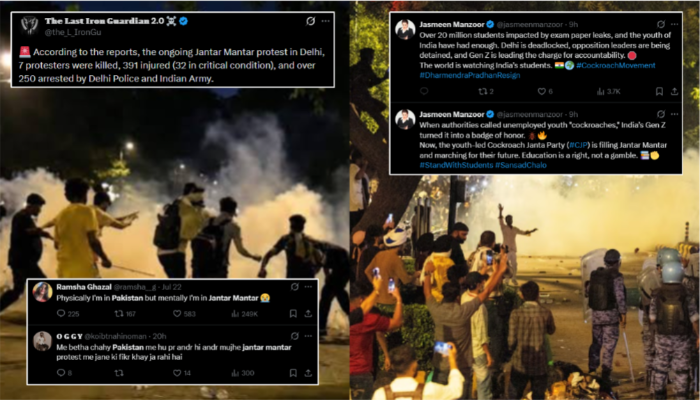
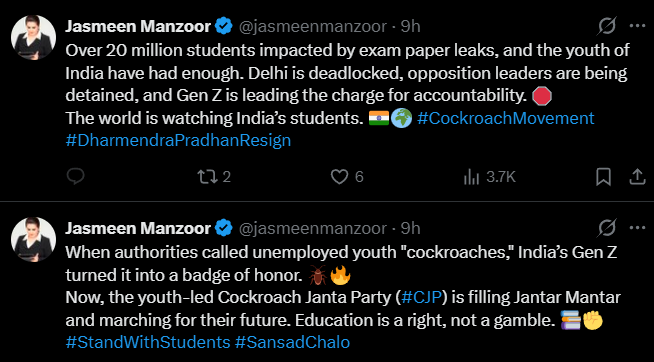
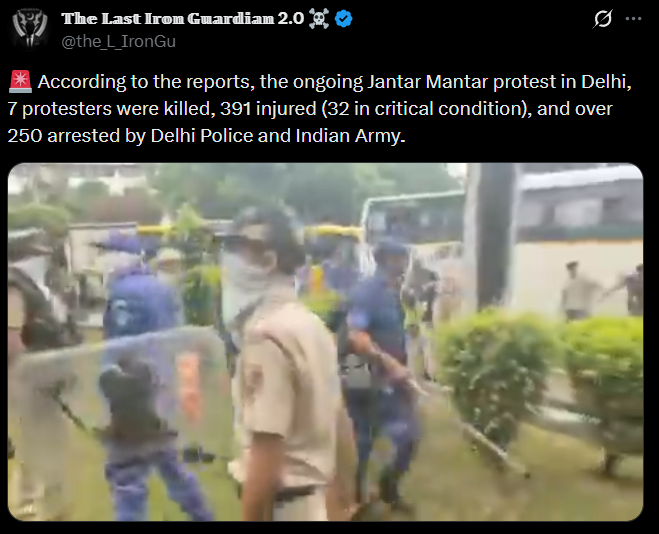
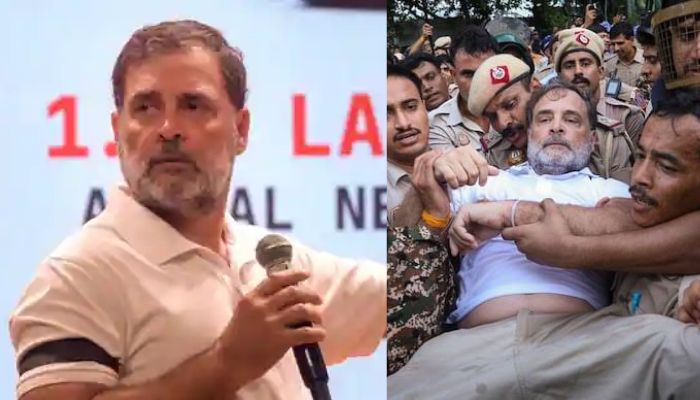
Protests followed the cancellation and later became a wider agitation over paper leaks, the NTA and ministerial accountability. The controversy disrupted Parliament during the Monsoon Session. Opposition MPs demanded the resignation of Education Minister Dharmendra Pradhan, while the government said it was ready for a debate but rejected resignation as a precondition.
On 23rd July, PM Modi announced that fast-track courts would be established for paper-leak cases. He said those who harmed the future of students would face strict punishment. The announcement addressed a real weakness. The 2024 CBI case had produced five chargesheets, but its trial had not reached the framing of charges by February 2026.
Administrative changes also followed. Higher Education Secretary Vineet Joshi was transferred and Naresh Pal Gangwar was appointed in his place. The government promised additional measures. Reports said NEET-UG would move towards a fully computer-based format from 2027. On 24th July, NTA terminated 47 officials.
Nothing is more important than the welfare and future of our youth!
We have decided to set up fast-track courts to ensure swift and stringent punishment for those involved in paper leaks. Have directed the concerned authorities and officials to take all necessary steps in this…
Computer-based testing may reduce risks linked with printed papers, transport and OMR sheets. It cannot by itself stop an expert who has advance access to confidential questions and passes them to a coaching network. The central weakness in 2026 was not the printed booklet. It was the relationship between insiders, coaching operators and candidate intermediaries.
What must change to break the coaching mafia
The first reform must create a strict firewall between confidential examination work and the coaching industry. An NTA subject expert should not be allowed to provide private tuition, conduct paid special classes, receive referral payments, act as a consultant, share revenue with a coaching business or work through an institute controlled by a close relative during the relevant confidentiality period. A declaration on paper is not enough. The NTA must verify company records, professional profiles, payment trails and disclosed associations.
No expert should have access to an entire subject paper unless the task requires it. Question drafting, review, translation, moderation and final selection should be divided. The system should record who accessed each question, when it was accessed, the device used, whether it was printed or downloaded, who approved the answer and when it entered a master set. Unusual access must trigger an automatic alert.
Compulsory registration must cover both coaching centres and admission consultancies. The 2024 case shows why a definition based only on large classrooms is inadequate. A business that prepares candidates, offers medical counselling, collects documents, claims it can arrange seats or acts as an intermediary between families and colleges should fall within the regulatory system even if it teaches fewer than 50 students.
Ownership and finances must be transparent. Regulators should know the promoters, directors, trustees, related companies, authorised signatories and beneficial owners. The same information should be linked across states so that a promoter barred in one jurisdiction cannot reopen through another company or a relative.
Promises of “guaranteed selection”, “confirmed MBBS admission” or “100 per cent success” should trigger more than a consumer-advertising notice. Such claims can indicate impersonation, paper access, OMR manipulation or illegal seat arrangements. A common platform operated by consumer authorities, the NTA and state police should flag unusually high fees, demands for original certificates, blank cheques, instructions to change examination cities, payments linked with marks, private sessions promising exact questions and offers to arrange dummy candidates.
The Godhra case shows how application data can be used to manipulate centre allocation. A cluster of candidates changing their present address to one district, selecting the same city and choosing an unusual language combination should be reviewed before centres are allotted. This need not presume guilt. It should trigger human verification.
Coaching institutions must face liability when the evidence reaches the institution itself. Cancellation of registration, attachment of proceeds and long-term debarment should be available where an owner or director participates, institutional accounts receive money, premises are knowingly used, confidential questions are distributed through the organisation or management ignores credible warnings.
Liability must still follow evidence. RCC stands on a stronger reported footing because its owner was arrested and material was reportedly recovered from devices and premises linked with him. The reported act of Tejas Shah cannot automatically prove that the management of Dr Abhang Prabhu Medical Academy knew about the Physics transfer.
Candidate data also requires protection. Coaching centres and counsellors hold examination scores, family income, preferred colleges, phone numbers, addresses, identity documents and information about a family’s ability to pay. That database allows corrupt agents to identify desperate or financially secure targets. Student information should not be sold or shared with admission agents without explicit consent. Regulators should audit how original certificates and identity documents are collected and stored.
A protected whistleblower system is equally important. The 2026 case surfaced because a teacher examined the “guess paper” and approached the authorities. Teachers, coaching employees, students and examination personnel should be able to submit suspected papers, screenshots and payment demands through a secure portal. It should timestamp the material, preserve the original file, protect identities and alert both the NTA and an independent investigative unit. Protection against retaliation is essential. A financial reward may be justified where credible information prevents a nationwide examination from being compromised.
Financial investigation must begin with the first arrest. In 2024, the CBI traced payments through parents, middlemen, employees, relatives, companies and third-party accounts. Investigators should freeze suspicious funds, examine payment apps and company records, and identify property purchased from the proceeds. Attachment of profits can damage the business model more effectively than arresting a replaceable local handler.
Fast-track courts must complete trials rather than merely process remand and bail applications faster. A designated court should receive a consolidated digital chargesheet, a clear role chart, verified chronology, financial-flow diagram, device-ownership record and a limited list of essential witnesses. A case should not require hundreds of repetitive witnesses to describe the same FIR. Periodic public case-status information would also allow affected students to know whether charges have been framed and the recording of evidence has begun.
The method changed, but the market survived
The 2024 and 2026 cases used different methods. In 2024, the paper was reportedly removed from a sealed trunk after reaching Oasis School. MBBS students were waiting at Raj Guest House to solve it. Admission agents had already assembled candidates across cities. The operation depended on speed, transport, printers and local handlers.
In 2026, the CBI said the questions came from subject experts before the examination. Private classes, handwritten notes, “guess papers”, Telegram files and coaching networks replaced the rushed morning operation. The leak could be disguised as teaching and incorporated into an ordinary revision schedule.
The method evolved because the market remained. Parents were still willing to pay. Consultants could still identify them. Coaching operators had access to large candidate pools. Insiders could still sell confidential material.
Securing examination centres can close one route. Computer-based testing can close another. Arresting individual teachers can temporarily break a chain. None of these steps will be sufficient unless the commercial network connecting insiders, coaching operators, counsellors and candidates is dismantled.
A question paper does not move from a confidential system to paying candidates on its own. In 2024, the operation reportedly required school officials, a person capable of opening the trunk, MBBS solvers, guest-house operators, candidate recruiters, printers, transporters and money handlers. In 2026, it reportedly required NTA-linked experts, private coaching sessions, counselling intermediaries, coaching faculty and digital resellers.
The person who steals or discloses the paper is only the first supplier. The coaching mafia gives that paper commercial value. It knows where to find candidates and which families will pay. It can arrange centres, documents, travel and special classes. It can present stolen questions as predictions and route payments through consultancies, trusts and private accounts.
The government has introduced a dedicated law, restructured examination processes, ordered CBI investigations and announced fast-track courts. These measures are necessary. The next step must target the education businesses that convert confidential access into a marketable product.
Coaching centres and admission consultancies must be registered. Their ownership and finances must be disclosed. NTA experts must be kept away from private coaching relationships. Access to questions must be divided and digitally traceable. Institutions that knowingly participate must lose the right to operate.
Otherwise, the examination authority will continue fighting the previous leak while the coaching mafia prepares the next method.
Court documents and FIRs on which this report is based on can be accessed from this link.
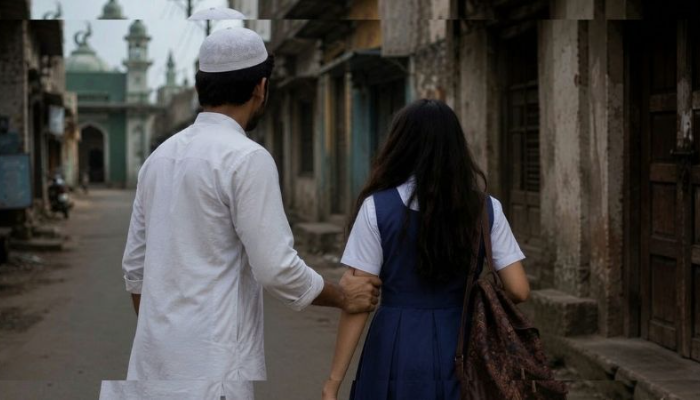
A grave matter regarding the abduction and grooming jihad of an underage Hindu girl has surfaced from Gopalganj in Bihar. A father has charged that a young man named Junaid Ansari has taken away his daughter. The perpetrator is a resident of in Kushinagar in Uttar Pradesh. The distressed complainant is concerned that the Muslim youth might either forcibly marry the 16-year-old or engage in human trafficking. He asserted that the minor has been unaccounted for over the past several days.
What is the matter
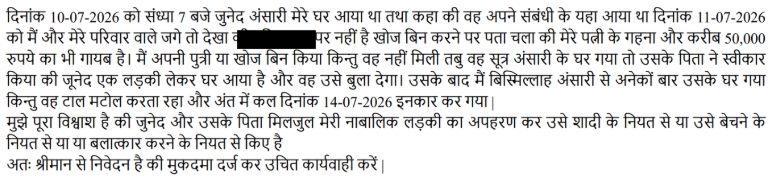
In an interview with OpIndia, the father shared that his elder sister is married in Dumaria. Junaid also lives nearby in the same village and hence began to frequent their home. He mentioned that his daughter would also visit her aunt’s residence, where she became acquainted with the accused. The older man recounted that Junaid came to their place at approximately 7 pm on 10th July and found her missing when he woke up the next morning.
Additionally, gold and silver jewellery as well as ₹50,000 in cash also disappeared from the house. The family searched extensively but could not locate the teenager. According to him, his sister informed that Junaid has been in regular contact with his daughter via mobile phone. This revelation caused the family to suspect that he had lured and kidnapped her with plans to either marry or traffic her.
What unfolded when they arrived at the accused’s house
The father further told us that he travelled to Dumaria with his sister to meet with Junaid’s family. They initially acknowledged that he had been to their residence but later distanced themselves from the issue, asserting they were unaware of the girl’s whereabouts. Afterwards, they remarked, “This is a matter concerning young individuals. A mistake has been made. We will reason with him, bring him back and hand your daughter over to you.”
The victim’s father unveiled, “They asked for a two-day time but did not show up. On 14th July, they refused to come.” He accused Junaid, his mother Baby Khatoon and father Bismillah Ansari of abducting the juvenile with the motive of marriage, human trafficking or rape.
Meanwhile, OpIndia also reached out to the cousin (aunt’s son) of the girl who narrated the entire story. He explained that she had been living with their family for her education. It was during this time that she met Junaid, who had even given her a phone to stay in touch. They learned about this and tried to counsel her.
She refused to listen and was sent back to her father’s place, but Junaid also followed her and kidnapped her. The cousin mentioned that it has been more than a week since the disappearance. However, neither the media took notice of the matter so far, nor the police filed a First Information Report (FIR) until a week had passed. He added that there is still no trace of the girl.
What is inside the FIR
According to the FIR, the father charged that the police delayed the registration of the case for several days and only lodged one on 22nd July. He informed us that the Gopalpur police went to Junaid’s house, but his family did not provide the police with accurate information. He reiterated that they initially assured that they would return the minor but did not follow through.
The police have filed a report in accordance with sections 137 and 96 of the BNS (Bharatiya Nyaya Sanhita). Section 137 addresses the issue of kidnapping. A conviction under this provision could result in a prison sentence of up to seven years along with a monetary fine.
Section 96 is related to the act of procuration of a child under the age of 18 using coercion, seduction or persuasion for the purpose of criminal sexual exploitation. This violation is punishable by a maximum of ten years in prison along with a fine. As of now, the authorities have not invoked the Protection of Children from Sexual Offences (POCSO) Act.
Note: OpIndia tried to get in touch with the Gopalganj police station, but neither the station’s contact number nor the SHO’s (Station House Officer) number was reachable. This report will be updated once an official is available for comment on the matter.
In a strongly worded late-night directive issued at 11:16 pm on 23 July 2026, the Indian Cyber Crime Coordination Centre (I4C) under the Ministry of Home Affairs ordered the global code-hosting platform GitHub to disable access to three specific repositories of the BitChat messaging application within three hours. The order was issued after reports of widespread use of the platform during the Cockroach Janta Party protests in Delhi’s Jantar Mantar.
The notice issued under Section 79(3)(b) of the Information Technology Act, 2000 read with Rule 3(1)(d) of the Information Technology (Intermediary Guidelines and Digital Media Ethics Code) Rules, 2021, identified the repositories containing the main source code, the Android application and its release files. The order warned that failure to comply would result in GitHub losing its safe-harbour protection and facing possible criminal prosecution.
The order described BitChat as a decentralised peer-to-peer messaging platform that operates over Bluetooth mesh networks without relying on mobile networks, internet connectivity or centralised servers, enabling anonymous communication without mandatory user registration or phone-number verification. The notice stated that this architecture significantly impedes lawful interception, attribution and investigation, and creates a substantial risk of misuse by anti-national elements, terrorist organisations and others seeking to coordinate unlawful assemblies, violent protests or circumvent lawful restrictions during internet shutdowns and situations of public disorder.
The notice stated, “The technical architecture of the application significantly impedes lawful interception, attribution, and investigation by law enforcement agencies. Since communications occur directly between nearby devices through a decentralized mesh network, the platform can be misused to evade lawful surveillance, facilitate anonymous coordination, and circumvent lawful restrictions imposed by competent authorities during situations involving public disorder, riots, terrorism, organized crime, or internet shutdowns.
14C further added, “Intelligence inputs indicate that such decentralized communication platforms are capable of being exploited for coordinating unlawful assemblies, violent protests, dissemination of misinformation, radicalization, criminal conspiracies, and other activities prejudicial to the sovereignty and integrity of India, defence of India, security of the State, public order, and for facilitating the commission of cognizable offences. The absence of a centralized service provider also limits the ability of law enforcement agencies to obtain subscriber information. communication records, or timely assistance during investigations. The application’s design, which enables communication even during network restrictions, creates a substantial risk of misuse by anti-national elements, terrorist organizations, organized criminal groups, and cybercriminals seeking to evade lawful detection and continue communication despite legally imposed restrictions.”
Because of these reasons, GitHub was ordered to “remove and disable access to the concerned URLs within 3 hours of the issue of this communication without vitiating the evidence in any manner.”
Why GitHub issued the notice
The order was issued to GitHub, not Google Play Store or Apple Store from where mobile apps are generally downloaded, because of the nature of the BitChat app. GitHub is a widely used online platform owned by Microsoft on which software developers across the world store, share and collaborate on computer programmes, particularly open-source projects that anyone can freely examine, download or modify.
GitHub runs on Git, a free, open-source version control system created by Linus Torvalds, the creator of Linux. Developers use Git to track every change made to their code, create branches, merge work, and keep a complete history of a project. On the other hand, GitHub is a commercial web-based platform that is built on top of Git. While there are other Git platforms, and it can also be run offline, GitHub is the most widely used Git platform.
The government directed the order at GitHub because BitChat is fully open-source and the complete source code along with ready-to-install Android packages are hosted on that very platform. By targeting these repositories, the authorities sought to remove the core technology itself from easy public access in India.
BitChat and its use in large protests
BitChat is a free and open-source decentralised messaging application developed by former Twitter chief Jack Dorsey. It allows users to exchange text messages using only the Bluetooth feature built into ordinary smartphones and requires neither an internet connection nor any central company server. The app requires no 4G, 5G, or Wi-Fi, it relies exclusively on Bluetooth Low Energy (BLE) to establish connections.
The application is specifically designed for situations such as large public gatherings where mobile networks and internet services are temporarily blocked. In its peer-to-peer Bluetooth mesh system, every phone that has the app installed functions simultaneously as a sender and a relay station. When a user types a message, the device broadcasts it over Bluetooth to other phones within a short range of about ten to thirty metres, to the phones that have the app installed and the Bluetooth feature turned on.
my weekend project to learn about bluetooth mesh networks, relays and store and forward models, message encryption models, and a few other things.
Those neighbouring devices automatically forward the message further to the next set of phones in the vicinity, creating a continuous chain or “mesh” network that can extend across a dense crowd of hundreds or thousands of people. Messages hop from handset to handset without ever passing through a mobile tower or the internet, rendering the communication immune to network shutdowns and signal jammers. In dense crowds, the network actually grows stronger and extends its communication range exponentially as more people in the gathering activate the app.
Another important feature is that BitChat is completely anonymous; it requires no account registrations, no phone number or e-mail IDs. As it is a peer-to-peer network, there is no centralised data logging.
As authorities frequently suspend mobile internet services and employ signal jammers during large protests, apps like Briar and BitChat are used by large groups of protesters to bypass such blockades to keep the communication flowing.
Use during CJP Protests
The order to remove the app was issued after reports of its use at the Cockroach Janta Party protests at Jantar Mantar in New Delhi, where mobile internet has been suspended multiple times in recent days along with the reported deployment of signal jammers. When mobile networks stopped working after the CJP protests turned violent, the protestors switched to the Bluetooth mesh application to stay connected. This made the blocking of internet services useless, as protest organisers are still being able to broadcast messages using such apps.
BitChat developer Jack Dorsey strongly objected to the govt of India order. He posted on X: “the government of india does not like technologies like bitchat and wants it taken down,” attaching screenshots of the official I4C order.
the government of india does not like technologies like bitchat and wants it taken down pic.twitter.com/gjzMg1NGCi
Internet Freedom Foundation called the order unconstitutional and authoritarian. The group condemned the order in a detailed statement, saying that as thousands of activists are camping at the Jantar Mantar site, blocking mobile and internet services prevents them from contacting their friends and families.
On the 24th of July 2026, the Delhi High Court rejected the plea filed by the Asian News International (ANI) seeking an interim injunction against OpenAI in its copyright infringement lawsuit involving ChatGPT.
The court said that the grant of an interim injunction against OpenAI in favour of ANI would inflict “irreparable injury” to OpenAI and the public at large.
The decision, however, concerns only the interim application, while the main copyright suit continues.
OpenAI storing ANI content to train LLMs not copyright infringement: Delhi High Court dismisses interim injunction plea
While pronouncing the verdict, Justice Amit Bansal said that the court is prima facie of the view that OpenAI storing original content generated by ANI does not amount to copyright infringement under the Copyright Act of 1957.
Justice Bansal also stressed that the outputs generated by OpenAI’s ChatGPT in response to user queries were not essentially similar to the original ANI content.
“I am of the prima facie view that OpenAI’s act of storing ANI’s original works…falls under Section 52(1)(a) Copyright Act and therefore does not amount to infringement under Section 5. I am also of the prima facie view that outputs generated by ChatGPT…does not amount to copyright infringement under Section 51, since outputs generated by OpenAI were not substantially similar to ANIs…” Justice Bansal stated.
The Delhi High Court further opined that ANI failed to satisfy the court that OpenAI’s ChatGPT responses to user queries involved memorisation or regurgitation of ANI content. Thus, ANI could not, prima facie, make a case for grant of interim injunction.
“…the illustrations given in the plaint are post the training of OpenAI’s LLMs and a case for memorization of ANI’s works on the basis of the said illustrations cannot be made out. Therefore, at this prima facie stage, the contention of ANI that OpenAI permanently stores the training data in order to memorize and regurgitate ANI’s works cannot be accepted. At best, these are disputed questions which can only be determined during trial upon parties leading evidence. Based on discussion above it cannot be concluded that the responses produced by ChatGPT are a substantial reproduction of the news articles of ANI. Hence, at a prima facie stage, ANI has failed to make out a case of copyright infringement based on the responses generated by ChatGPT i.e. the output claim,” the court order reads.
Pertinently, the court emphasised that granting an interim injunction in favour of ANI would cause “irreparable injury” not only to OpenAI but also to the public.
“ANI has failed to satisfy this court that any memorization regurgitation of ANI’s work has happened from responses generated by ChatGPT…in view of discussion above ANI has failed to make out prima facie case for grant of interim injunction…Irreparable injury would be caused not only to Open AI but also to the public at large if an interim injunction is granted in favour of ANI. Application dismissed,” Justice Bansal said.
Justice Bansal, however, highlighted that he had ruled in ANI’s favour on the issue of territorial jurisdiction.
Thus, the Delhi High Court found no prima facie case strong enough for an interim injunction that would severely restrict OpenAI from using ANI content for training its Large Language Models (LLMs). The court allowed OpenAI’s operations to continue pending final adjudication of the copyright infringement lawsuit.
Background of the case: Allegations of ANI and responses of OpenAI
The ANI-OpenAI lawsuit began in 2024. The Delhi High Court summons in the matter was issued in November 2024. The lawsuit was filed by ANI accusing OpenAI, the US-based artificial intelligence research organisation headquartered in California.
In its lawsuit, ANI alleged that OpenAI scraped and used its copyrighted news reports, articles, and other publicly available and paywalled/subscriber content republished by licensees without prior permission. Without obtaining permission or a license, OpenAI used ANI content to train ChatGPT and related LLMs.
ANI also alleged that many times, ChatGPT generated responses that were either reproduced from ANI platforms verbatim or were closely summarised.
Furthermore, ANI claimed that ChatGPT falsely attributed fabricated stories or statements to ANI, damaging its reputation and potentially disseminating misinformation.
Excerpt taken from relevant court judgment. (Source: delhihighcourt.nic.in)
Hearings continued on multiple dates in the Delhi High Court. The court reserved judgment on the interim injunction in March this year and pronounced the verdict on 24th July 2026.
Meanwhile, the court appointed two amici curiae, advocate Adarsh Ramanujan and Prof. Arul George Scaria of NLSIU, to assist, and allowed interventions by entities like the Digital News Publishers Association (DNPA), Federation of Indian Publishers, etc.
Whether OpenAI storing ANI content for training ChatGPT amounted to copyright infringement.
Whether use of data to generate ChatGPT responses for users constitutes infringement
Whether such a user qualifies as “fair dealing” under Section 52
Application of jurisdiction since OpenAI servers are mainly in the US.
During hearings, ANI contended that unauthorised storage and reproduction of its works for commercial training violates exclusive rights under Section 14 and amounts to infringement under Section 51.
Through its lawyers, the news agency also argued that dataset curation and temporary or permanent storage for training is not protected.
ANI further claimed that ChatGPT outputs, including those through Retrieval-Augmented Generation (RAG) can reproduce or significantly summarise protected expression, diverting traffic and hurting ANI’s revenue to creat original journalism.
The news agency also argued that memorisation or regurgitation of training data can occur, and false attribution of fake content can inflict reputational harm.
In addition, ANI contended that fair dealing exceptions under Section 52, which include personal use, criticism, research, etc, do no cover large scale commercial training by a for-profit AI company. ANI argued that such actions should not be permitted in the absence of proper licensing.
In October 2024, ANI had offered OpenAI a licensing arrangement akin to deals the AI giant has with Western media outlets like the Associated Press, Financial Times, and Condé Nast. However, OpenAI rejected ANI’s offer.
ANI was reported to have sought Rs 2 crore damages, a permanent injunction, and most immediately an interim injunction restraining OpenAI from storing, reproducing, publishing or using its content in any form, including through ChatGPT, and directing it to disable access to ANI content.
In response, OpenAI contended that it had already blocklisted ANI’s website from its crawlers back in October 2024, and would also exclude the domain from future training. OpenAI also denied unlawful reproduction or memorisation of ANI’s expressive content.
Excerpt taken from relevant court judgment. (Source: delhihighcourt.nic.in)
Notably, expressive content here means the original creative expression, including specific wording, structure, style, opinions or artistic choices, that copyright protects.
Non-expressive content, on the contrary, includes unprotected elements like ideas, facts, functional copying data, or statistical patterns.
Represented by senior counsel Amit Sibal, OpenAI said that it is an “admitted position that storage of data takes place only for the purposes of training. Creation of copy during the training process is an intermediate step. Once the training process is over, an LLM does not have access to data.”
It also claimed that the training process does not involve ANI data alone, rather “ANI’s data would only be a minuscule amount of the total data on which training takes place.”
“The training process is unconcerned with each work’s unique expression. The LLMs underlying ChatGPT encode the learnt meanings in the form of a ‘vector database’ during the pre-training process, which is equivalent to a dictionary and does not amount to additional copies of raw data. Hence, it is incorrect to state that ‘vectorisation’ is an ‘adaptation’ or ‘translation’ of ANI’s works,” OpenAI said.
“The storage is not intended for human consumption or comprehension. Storage is only an intermediate step to derive the non-expressive element,” it added.
Interestingly, despite being a for-profit entity, OpenAI argued that storing ANI’s works for training its LLMs does not amount to copyright infringement as it falls within the exception under Section 52(1)(a) of the Copyright Act (fair dealing for private or personal use, including research.
“The Copyright Act as originally enacted in 1957 used the words “research or private study” in its fair dealing clause. The Notes on clauses for Copyright Amendment Bill, 1994 (which was enacted as Copyright Amendment Act, 1994) makes it clear that the amendment was proposed in 1992 to expand the “unduly narrow interpretation of the words “private study””. The latest amendment in the Copyright Act, 1957 included the words “personal use”, in addition to the already existing words “private use” and “research”, OpenAI submitted.
OpenAI maintained that its act of storage and use of training data falls within the ambit of “private use”, including “research”, which is protected under Section 52(1)(a)(i) of the Copyright Act and does not amount to copyright infringement.
Excerpt taken from relevant court judgment. (Source: delhihighcourt.nic.in)
It further argued that there is no restriction on “private use” being only for non-commercial purposes. “This view is reinforced from a perusal of sub-clauses (ii) and (iii) of Section 52 (1)(a) of the Copyright Act, which do not make the distinction between commercial and non-commercial… Reference in this regard may be made to Section 52(1)(ad) and Section 32(6)(d) of the Copyright Act. Merely because the use by OpenAI is commercial, would not make it unfair,” it said.
Addressing ANI’s revenue harm argument, the for-profit AI research organisation said that while ANI is a news agency which is mainly focused on creating, verifying and distributing news which involved a process of factgathering, investigative journalism and contextualization of stories, LLMs serve as tools such as content creation, researching, brainstorming and idea generation, language translation, learning and education, creative writing, summarizing or paraphrasing.
“Therefore, activities of Open AI cannot substitute the activities carried out by ANI. No evidence has been provided by ANI that Open AI’s use of AI generative use had led to a decrease in their market share,” OpenAI submitted.
Relevant excerpt taken from the Copyright Act of 1947. (Source: copyright.gov.in)
Court observations and findings
In the context of “fair dealing”, the court addressed three questions;
Whether OpenAI’s use of ANI’s original literary works is limited to training its LLMs underlying ChatGPT?
Whether the usage of ANI’s literary works by Open AI would result in economic competition and would prejudice the legitimate interests of ANI, thereby causing actual or potential damage to ANI?
Whether the functions performed by OpenAI through ChatGPT serve the overall public interest?
Addressing the first question, the court observed that ANI has not been able to establish memorisation of data or its regurgitation, or communication of the exact copies of ANI’s works to the public.
It said that documents submitted by OpenAI indicate that its LLMs underlying ChatGPT are not trained to reproduce the training material to the public but to use training data to generate new responses and perform novel tasks in response to novel user prompts.
“This Court has not been given any instance where OpenAI has used the literary works of ANI for any purposes other than for training. Hence, in my opinion, it would be safe to conclude that the storage by OpenAI is only for the purposes of training OpenAI’s LLMs underlying ChatGPT,” the court said.
Addressing the second question about economic competition, the court differentiated between the primary functions of ANI and OpenAI and their revenue models.
In this regard, Justice Amit Bansal concluded that “except for bare averments, nothing has been placed on record on behalf of ANI to show that they have lost any market share or there has been a reduction in subscription revenues due to operations of OpenAI. Hence, in my prima facie opinion, the use of ANI’s works by Open AI would not result in market substitution of ANI’s works and consequently, will not affect its market share or cause actual or potential damage to ANI.”
On the third question, whether functions performed by OpenAI via ChatGPT serve the larger public interest, the court highlighted the benefits of trained LLMs underlying ChatGPT.
“Training LLMs underlying ChatGPT therefore contributes to advancing scientific knowledge, developing innovative computational tools, disseminating information, promoting education, enhancing accessibility, and advancing artificial intelligence research,” the court said.
Justice Bansal concluded that the factor of public interest also stands established. “Thus, on a prima facie view, all the factors for establishing the aspect of fair dealing stand satisfied in the present case, and the fairness test stands fulfilled,” the court said.
The court also noted that despite having the ability to block its website vis-à-vis any third party, including OpenAI, the news agency has not used the opt-out option, nor have its subscribers/licensees.
The court also highlighted the absence of any material evidence indicating that the activities of OpenAI have resulted in ANI losing subscribers or suffering a loss from its news syndication business.
Excerpt taken from relevant court order. (Source: delhihighcourt.nic.in)
In view of these findings, the court dismissed ANI’s plea for interim injunction against OpenAI, although the court stated that observations made in the context of the present application will have no bearing on the final outcome of the suit.
Security forces demolished homes of two wanted Pakistan-based Lashkar-e-Taiba terrorists and detained over 2,500 overground workers (OGWs) for interrogation throughout Kashmir. The massive crackdown transpired after a Jammu and Kashmir police head constable was shot and killed while on duty in the Lal Chowk market in Anantnag at nearly 12.30 pm on 22nd July (Wednesday).
Ashiq Hussain Qureshi, a head constable in the 3rd battalion of Indian Reserve Police and a member of the Special Operations Group, was assigned to the auspicious Amarnath Yatra. The yearly pilgrimage has been put on hold due to bad weather. He was a resident of Lalpora village in Budgam’s Beerwa in central Kashmir. Ashiq was struck at close range by a lone terrorist wearing a black cap. The incident was captured on CCTV. LeT offshoot The Resistance Front (TRF) claimed responsibility for the murder.
The assailant was observed carrying a sack to conceal the assault rifle used in the attack. Ashiq was critically wounded and immediately brought to the Government Medical College hospital in Anantnag. However, he succumbed to his injuries and was declared dead on arrival.
The authorities instructed individuals not to share the footage of the assault and warned to take harsh legal action against those who did not comply. The 45-year-old cop is survived by his wife, mother and three children. He was appointed after his father, a police constable, perished in an accident on the Srinagar-Jammu route 30 years ago. The hunt is underway to trace the terrorist.
Condolences began to pour in from Chief Minister Omar Abdullah, Lieutenant Governor (LG) Manoj Sinha, and other prominent leaders shortly after the brutal murder. Sinha even met the grieving family and promised to do everything within his authority to safeguard their dignity and well-being. He mentioned that they will receive support from the government until the martyr’s son finishes his education and is qualified for placement under the compassionate employment policy.
Visited Lalpora, Beerwah, Budgam to meet the family members of Martyr Head Constable of J&K Police, Ashiq Hussain Qureshi. His courage and sacrifice will forever inspire us. The nation salutes his devotion to duty and stands firmly with his family. Under the leadership of Hon’ble… pic.twitter.com/7KSolvQGAK
Ashiq became the maiden casualty of the first terror onslaught following Pahalgam, where 25 Hindu men were ruthlessly slain by Pakistan-sponsored terrorists in the Baisaran Valley on 22nd April of last year.
LeT and TRF have been exposed as the orchestrators of the deadly hit on innocent civilians on the grounds of religion. The National Investigation Agency (NIA) has made the disclosure in its chargesheet. TRF initially boasted about the same but later retracted following international backlash against the heinous act.
Security forces, police proactive after the dastardly incident
The entire area was right away cordoned off after the police official’s murder in Anantnag, and a thorough search unfolded to track the perpetrator as key entry points and roads were strictly monitored while more officers were stationed throughout the district.
Central Reserve Police Force (CRPF) spokesperson conveyed that security is heightened, and officials are executing search operations as the valley has been put on high alert. Furthermore, checkpoints have been strengthened, surveillance is intensified and paramilitary troops have joined police in stepping up the inspection and screening of vehicles on the route to upkeep law and order. Patrolling is also increased and special checkpoints are created on critical roads. People have been asked to assist the authorities and stay watchful.
LG Sinha presided over a crucial assessment meeting and directed the officers to be “highly vigilant” and neutralise new threats. It was attended by senior officers of the army, police, civil administration, Central Armed Police Forces (CAPF) and other primary security entities.
Chaired a high-level security review meeting today in Srinagar with senior officials from the Army, J&K Police, Civil Administration, CAPFs, and key security agencies. Also, comprehensively reviewed logistics and safety arrangements for the ongoing Shri Amarnath Ji Yatra in light… pic.twitter.com/WOoAmmHzQQ
The destruction of the house of the two terrorists and the large-scale detentions is part of a comprehensive effort to dismantle the fundamental structure of terrorist groups and their support system in the region.
According to officials, controlled explosives were employed to target Adil Ahmad Thoker’s residence in Guri village of Anantnag district. A similar action was taken on the property after the Pahalgam terror attack too. The other terrorist, Haroon Rashid Ganaie’s home at Hassanpora Tawella in Bijbehara, was also demolished in a similar manner, after asking the occupants to move out.
The teams reached the locations and asked the occupants to vacate before carrying out the detonation process at around 3 am on Thursday. Thoker and Ganaie have been active members of LeT since 2018.
Additionally, those who were picked up have been accused of aiding the terrorists with communications, transportation, money, lodging, and other forms of support. Over 700 locals were apprehended in the Srinagar area, 178 in Baramulla, 200 in Budgam, 100 in Ganderbal, while several hundred more were held in Anantnag, Shopian and Kulgam. According to a police officer, the operation’s goal was to locate and destroy networks that supply financial, logistical, communication, transit and housing support to terrorist groups.
A police representative defined the move as precautionary and driven by intelligence, explaining that they are being questioned in accordance with the law to determine whether they had any involvement in deeds adverse to the security of the region. Suspected OGWs, miscreants, orbit members of JKNOP (Jammu and Kashmir Nationals Operating from Pakistan or occupied Kashmir) and persons implicated in Narcotic Drugs and Psychotropic Substances (NDPS)-related offences were among those in custody.
Omar Abdullah, Mehbooba Mufti and others criticise the detention of suspects
Both the ruling party and the opposition in Kashmir referred to the exercise as redundant and “counterproductive” to peace while promoting a narrative of victimhood. It is important to note that OGWs have traditionally significantly contributed to facilitating terrorist activities, including the massacre in Pahalgam.
“I understand the anger of the police, but the Supreme Court has issued an order stating that summary action of this kind should not be taken. We witnessed a similar situation after the Pahalgam attack when some people’s houses were bulldozed. At that time, I had to speak to the central government to stop the trend,” remarked Omar Abdullah while talking to the media.
He further argued, “Ashiq was killed mercilessly, but when you get to hear that not just 1,000 or 2,000 but 2,500 arrests are made, it will transfer the anger (against militants for killing the cop) against this (arrests).” He added, “Demolishing houses or making thousands of arrests will not improve the situation. In fact, it will only worsen it.”
“We can reach a certain point using the police, Army and the CRPF, but the real end will come only when the general public stands together against such violence,” the vice-president of National Conference (NC) stressed.
Mehbooba Mufti, the former Chief Minister of the union territory and president of Peoples Democratic Party (PDP), condemned the killing of the policeman but alleged that “detaining over a thousand people and demolishing the homes of families of two alleged militants amounts to collective punishment that has no place in a democracy.”
She also charged, “If the Government of India itself maintains that militancy has been reduced to near zero it must adopt a more humane and lawful approach towards innocent civilians instead of resorting to tit for tat for an entire community.”
The killing of a police officer in the line of duty is a heinous & condemnable act. But detaining over a thousand people and demolishing the homes of families of two alleged militants amounts to collective punishment that has no place in a democracy. If the Government of India… pic.twitter.com/erlJs168of
People’s Conference supremo Sajad Lone also termed the response as “collective punishment” which will prove detrimental. “You cannot summon and arrest thousands of people because their name is included in the OGW list. The list is decades old. Most of these people are old, well into their seventies. There is a concept of reintegration in conflict situations. People who have taken to arms are eventually encouraged and facilitated to reintegrate with society. I don’t agree with the concept of mass arrests,” he claimed.
The actions of the J & K police after yesterday’s dastardly attack will do more harm.
You cannot summon and arrest thousands of people because their name is included in the OGW list.
The list is decades old. Most of these people are old, well into their seventies.
Notably, the houses of active terrorists have been razed in the past as well, but the approach was suspended for almost a year due to a drop in the scale of violence.
The police have announced that the intelligence-based operations will continue in close coordination with security and intelligence agencies to eradicate the terror support ecosystem and stop any attempt to disturb the peace, foster communal harmony and guarantee the safety of citizens. The legal action will be founded on revelations, information and details that come to light as the continuing probe and verification procedure progresses with time.
The Cockroach Janta Party (CJP) agitation that began against the NEET paper leak and demanding accountability from the government for shortcomings in the education system has escalated into a violent movement. What started as a “peaceful protest” soon turned into aggressive clashes with the police, resulting in injuries to at least 100 personnel, including senior officials. Chaos erupted in the national capital and the situation appeared to be spiralling out of control, after which the authorities had to take firm action to restore law and order.
Notably, CJP sought Education Minister Dharmendra Pradhan’s resignation, but senior government functionaries have categorically denied the “political” demand. They highlighted that the centre has taken substantial steps to resolve the concerns of students, stating that those affected by these issues have already registered for upcoming courses in colleges and universities. It was strongly insinuated that the demonstration is orchestrated by vested interests rather than authentic participants.
CJP has exploited the hardships faced by students and resorted to perilous pressure tactics in a desperate bid to replicate the anarchy that swept through Nepal and Bangladesh to overthrow the democratically elected Modi government.
Pakistan amplifies the fabricated narrative
Of course, it is only natural that those across the border would want to use such an opportunity to advance their own agenda and further exacerbate the crisis. The people from Pakistan could barely hide their delight at the unrest and almost portrayed it as India’s own “Tiananmen Square” moment.
Notably, the Islamic Republic, which uses terrorism as a tool of foreign policy and wants to bleed India by a thousand cuts, has spent much of its existence as a direct or indirect colony of its military establishment. However, its citizens are preoccupied with elevating a politically motivated struggle to the status of an organic phenomenon for a nation they perceive as an existential threat and their primary adversary.
Thus, it raises the question of why there has been such an unexpected display of support for Indians, and the answer is evident. Pakistani army, politicians, celebrities, influencers and the general populace have no love lost for their neighbours.
In fact, their animosity towards the Bharatiya Janata Party (BJP) government, which refuses to compromise on national security for the inconsequential “Aman ki Asha” production and is perceived as pro-Hindu due to its rejection of the Muslim victimhood narrative, is more pronounced than their disdain for other “secular” parties that cater to Islamists and Islamabad, regardless of the consequences.
Moreover, “Operation Sindoor” and the suspension of the “Indus Water Treaty” have rubbed salt into their festering wounds. Therefore, any action that could undermine the current government will undoubtedly receive full support from Pakistan, which is keen to witness bloodshed and confrontations on the streets of India. The truth remains that they wish India to be set ablaze by turmoil and anyone who can thwart these malicious ambitions is their greatest foe.
Pakistani celebrities, people show their “support” for Indian students: The truth behind the pretence
Popular Pakistani rapper Talha Anjum, who abused India, claimed that Indian forces occupy Kashmir, mocked Group Captain Abhinandan Varthaman and endorsed a post calling Prime Minister Narendra Modi a terrorist, expressed “solidarity with the students staging protest against their government.”
He then returned to his agenda of spreading lies, derogatorily terming Indian media as PM Modi’s “b*t*h” and alleging that police are murdering students in the name of performing their duty of maintaining law and order. His objective was obviously to contribute to the unrest, irrespective of the veracity of his wild statements.
Anjum then attacked figures from politics, Bollywood and the bureaucracy for their supposed indifference towards the common masses. “All you have is your resilience, keep resisting, keep fighting,” he concluded dramatically in his disinformation post, interfering in India’s internal matters.
Standing in solidarity with the students staging protest against their government in Delhi, India. The news channels are Modi’s b!tch, the police who is killing you all in the name of law & order is only doing their “job” & the most consequential figures in politics, bollywood &…
Anjum did not need to look outside his nation’s soil to denounce the real injustice. Pakistan-occupied Kashmir has been witnessing major turmoil for months, with those demanding autonomy, basic rights and facilities or simply raising their voices against inflation being labelled as terrorists, banned, arrested, killed and subjected to harsh state crackdowns. The less said about the violation of human rights and state repression in Balochistan, including enforced disappearances, extrajudicial killings, the targeting of peaceful activists and exploitation of its natural wealth at the expense of the natives, the better.
Anjum and others like him do not dare to speak out against the oppression endured by their own people, yet they are quick to side with the “protesters” in India. Why do their hearts not ache for their fellow citizens who are suffering immensely? This should be sufficient to clarify the performative support for Indians and the hidden motives behind it.
Journalist Mahwash Ajaz, who is another Zohran Mamdani fangirl, has been actively promoting the ongoing protest in India, even sharing misleading videos to illustrate the growing attendance. She lamented, “Nothing will change in India unless there are actual alternatives to PM Modi.”
Ajaz then remarked that the saffron party has significant influence and his support base remains substantial across politics, real life and the media. She then expressed uncertainty about whether CJP founder Abhijeet Dipke could serve as the “antidote,” adding that the Indian National Congress was not the solution.
Real talk re India.
Nothing will change in India unless there are actual alternatives to Modi. The BJP has far too many inroads & Modi’s support base continues to exist in big numbers. In politics, even IR — heck even in the media — these numbers mean everything.
Ajaz commented that “things might change,” contradicting her earlier remarks after violence erupted during the unauthorised “Chalo Sansad” procession by CJP. She accused that “hate-filled rhetoric floods the BJP vein” and appeared to harbour a flicker of hope that such actions by nefarious elements could lead to the removal of PM Modi, which is unlikely to occur through elections given his solid voter support.
NGL, didn’t think anything would ever change in India given how much support their govt enjoys — despite the hate filled rhetoric that floods the BJP veins — but wow. Things might actually change if the people keep demanding accountability.
Many Pakistanis, impelled to display their support for the protesters, started to declare that they were spiritually present at Jantar Mantar.
Ahsan Mirza, a digital creator, attempted to draw parallels between the demonstrations in India and Pakistan, declaring that the students of his nation back those at Jantar Mantar. He self-projected and dubbed Indians as “terrorists” who would rightly call out his sinister propaganda disguised as support.
“We are one. Our ancestors have partaken from the same source as your forefathers. All Pakistani students are with you. We are students. Who else could we possibly support? Those in positions of power will inflict greater atrocities upon you. However, you should not sacrifice yourself and retreat to your homes,” he stated.
“Life is far more important. Protests keep happening. Otherwise, your government will blame your deaths on us,” Mirza quipped, reflecting the level of sensibility expected from his jihadi kind. He also wanted protesters to create a “change” in India and reiterated that Pakistani students were in support of this venture.
Jasmeen Manzoor, another journalist from Pakistan, stated that Bollywood, which has historically functioned as a diplomatic extension of Islamabad, has ultimately turned against the government. “What started as a protest over exam paper leaks has officially snowballed into Pm Modi’s toughest political storm yet. The youth are rewriting India’s political future,” she added gleefully.
Tears, batons, and Bollywood outrage. 🛑 From Salman Khan to Shabana Azmi, the film industry is turning against the state's handling of the CJP student protests. What started as a protest over exam paper leaks has officially snowballed into Modi's toughest political storm yet.…
She asserted that the world is observing as baton charges and tear gas confront Gen Z, who are leading the charge amidst a stalemate, while opposition leaders are being detained as if India is experiencing an emergency. Rahul Gandhi and other Congress leaders had to be removed because they continued their demonstration outside PM Modi’s residence, which is a high-security zone, despite repeated requests and agreeing to leave earlier.
Furthermore, Chief Justice Surya Kant used the term “cockroach”, and it had nothing to do with the ruling party, contrary to the deceptive portrayal by the conniving Pakistani who tweeted multiple times to praise the “student protest” for obvious reasons.
British Pakistani writer Dan Qayyum also joined the chorus to vilify the Modi government, insisting that it had suffered a defeat because it had become fearful of the students rather than intimidating them as it had intended. “You were supposed to be afraid. Yet it’s those attacking you with sticks that are terrified of you. This is the bravest thing happening anywhere in the region right now, and you have our absolute respect,” he argued.
A government that is afraid of its children has already lost. My message to the young people of India. You were supposed to be afraid. Yet it's those attacking you with sticks that are terrified of you. This is the bravest thing happening anywhere in the region right now and you… https://t.co/RlPPjptuhdpic.twitter.com/nKKXCSoie6
Qayyum shared similar tweets and even authored an article comparing the protests in India and Pakistan. He outlined that individuals set aside their castes, religions and identities to come together in Delhi, but such unity is unattainable in his home country as people are divided by ethnicity, party and sect but refrained from mentioning faith as it would have revealed the brutal persecution of dwindling minorities and the deafening silence from his ilk who spot injustice everywhere, especially in relation to India and Muslims but never in their own backyard, particularly when the victims are Hindus.
The boy in Kanpur and the boy in Korangi have the same complaint. India spent twelve years making sure its half never assembled. Ours was already split by ethnicity and party and sect, so nobody here had to build anything.
It was not unexpected that Pakistani accounts were also sharing bogus reports on social media. “7 protesters were killed, 391 injured (32 in critical condition) and over 250 arrested by Delhi Police and Indian Army,” a post read, which aimed to intensify tensions and create panic under the guise of support.
The real goal masquerading as endorsement
Pakistan is confronted with a continuous stream of major difficulties stemming from a faltering economy, surging inflation, increasing poverty, crippling education and health facilities, climbing unemployment, unstable government, non-existent democracy, volatile provinces, mounting attacks by Tehreek-e-Taliban Pakistan (TTP), Baloch fighters struggling for their independence, among other groups.
However, Pakistanis have extended their support to the agitation in India while Balochistan and PoK are in profound distress, encountering repeated crackdowns for wanting their rights and freedom. This outrage is also rarely visible when military dictators dismantle governments and imprison or execute their prime ministers. It is peculiar that the human rights activists and protesters in Pakistan evoke negligible sympathy from their countrymen who have suddenly found compassion for Indians.
More importantly, these are the very people who spare no opportunity to criticise India regarding Kashmir, even glorifying terrorists and terming Indian women as spoils of war, ready to be seized during “Operation Sindoor.” This ongoing support is reminiscent of Lashkar-e-Taiba’s co-founder Hafiz Muhammad Saeed’s praise for Barkha Dutt and the Congress. From Pakistani terrorists to every last member of this rotten extremist society, they are adept at misusing India’s internal affairs and issues to create division and discord.
The rogue state has historically been obsessed with India and strives to exploit any minor issues to its advantage.
A noticeable pattern has also come to light with Pakistani accounts regularly amplifying uploads by CJP leaders, including Dipke and those involved with the agitation. It appears that both sides have found common ground in their opposition to PM Modi. Meanwhile, Pakistani social media handles are already under scrutiny for circulating false claims of violence to add to the upheaval and tarnish India’s reputation.
This should act as a cautionary signal, as when the enemy supports your cause, it indicates that you are either serving their purpose or playing into their hands. However, their final goal appears to be a push for a regime change in India with the help of global powers. It has glaring similarities to when former Congress leader Mani Shankar Aiyar appealed to Pakistan to help remove the Modi government.
On the other hand, the centre has consistently engaged with the protesters, and the police only intervened when public safety and security were under threat. Furthermore, the police were attacked and had to respond accordingly. PM Modi has assured that the responsible will be brought to justice and no one will be allowed to jeopardise the future of children.
In a recent press conference, Lok Sabha MP and Leader of the Opposition Rahul Gandhi made controversial claims regarding Delhi Police personnel involved in detaining him during a protest near the Prime Minister’s high-security official residence. Gandhi claimed that while he was being forcibly removed from 7 Lok Kalyan Marg on Tuesday, 21st July, security officers privately urged him to overthrow the current administration. According to Gandhi, police officers whispered in his ear, “Inko Hataiye” (Please remove the current government).
Expanding on his claims, Gandhi claimed specific interactions with officers during the confrontation. Gandhi claimed that one cop told him, “I am from Rajasthan, we’re just wearing uniform. The second one is saying, I am from Haryana, remove them. So that sentiment is there, and everybody knows the truth.”
He asserted that while police officers are required to fulfil their official duties, many are dissatisfied with the current state of affairs. “Those people have to accept the order, so they are doing it. But even the police are not happy about what has happened. Sensitive police people feel that this is a crime that is being done to the future of our country. They can see their children in this…,” he further claimed.
आज हर छात्र कह रहा है, पुलिसवाले कह रहे हैं, पूरा देश कह रहा है – मोदी सरकार को जाना पड़ेगा।
विपक्ष के नेता के रूप में मेरी ज़िम्मेदारी हर भारतीय की आवाज़ बनना है – और उसके लिए हर कीमत छोटी है। pic.twitter.com/uSLu9Py3F5
Addressing his involvement in the demonstration, Gandhi said he stands firmly with the country’s student movement. He brushed off the physical altercation with security personnel, noting that “a couple of punches” is a minor trade-off for standing up for students.
The incident took place during an unannounced demonstration outside Prime Minister Narendra Modi’s residence. Joined by senior leaders, including Wayanad MP Priyanka Gandhi Vadra, Rajya Sabha Leader of Opposition Mallikarjun Kharge, KC Venugopal, and Pawan Khera, the group marched into the high-security zone. The sit-in was kept secret even from participating Congress members until the final moment. Opposition MPs were initially informed that they were gathering at Kharge’s residence, located about 500 metres from the PM’s residence, to celebrate his birthday. Reports indicate that this story was planned by Rahul Gandhi, Priyanka Gandhi Vadra, and KC Venugopal to avoid alerting government security agencies and the Special Protection Group (SPG).
A deliberate attempt to foster mistrust
Gandhi’s deliberate focus on police dissatisfaction is an effort to foster division within state institutions. By alleging that security personnel privately oppose the administration, Gandhi appeared to actively encourage disaffection among the armed forces and police against the elected government.
Creating internal friction within state institutions is a recognised tactic in wider political strategy. Attempting to seed doubt regarding the loyalty of security personnel often serves as an early phase in destabilising an established government. By publicising statements that suggest officers oppose their leadership, political actors attempt to weaken official authority and lay the groundwork for broader systemic disruption.
Historically, attempts to demoralise or turn security forces against an existing administration are a recognised mechanism in broader regime change operations. When state institutions lose internal cohesion, the stability of a nation’s political system can quickly deteriorate.
A military coup (or coup d’état) is the illegal and sudden seizure of political power by a country’s armed forces, typically resulting in the overthrow of the existing civilian government. Rather than ascending to power through democratic elections or established constitutional mechanisms, the military utilises force, or the threat of force, to secure control of state governance. Such tactics have been documented in several regional contexts across South Asia.
The case of Bangladesh: A blueprint of internal betrayal
Recent geopolitical developments in neighbouring countries provide clear examples of how political instability and institutional mistrust can lead to regime change. Bangladesh offers a striking example of internal military dynamics triggering the fall of an administration.
Political developments in Bangladesh were highlighted following revelations in a book published on 15th November 2025. Titled Inshallah Bangladesh: The Story of an Unfinished Revolution, authored by Deep Halder, Jaideep Mazumdar, and Sahidul Hasan Khokon, and published by Juggernaut, the text details how former Prime Minister Sheikh Hasina was removed from office. In the book, Hasina’s former Home Minister, Asaduzzaman Khan Kamal, made detailed claims regarding the collapse of her administration.
Image via HINDU E SHOP
During a conversation with the authors in Delhi, Khan Kamal characterised the transition of power as “a perfect CIA plot” that was orchestrated over an extended period. He revealed that Bangladesh’s Army Chief, General Waker-Uz-Zaman, played a key role in the operation. “We didn’t know that the CIA had Waker in its pocket,” Kamal stated, noting that intelligence bodies like the Directorate General of Forces Intelligence (DGFI) and the National Security Intelligence (NSI) failed to alert the Prime Minister.
Kamal outlined two primary motivations behind foreign interest in Bangladesh’s leadership. First, he claimed Washington was uncomfortable with multiple strong leaders holding power concurrently in South Asia, referencing Prime Minister Narendra Modi, China’s Xi Jinping, and Sheikh Hasina. Second, he pointed to the strategic importance of St Martin’s Island in the Bay of Bengal, situated near the Myanmar coastline. Before her departure, Hasina publicly claimed she faced pressure to cede access to St Martin’s Island in exchange for political support, a demand she rejected as an infringement on national sovereignty.
The authors also documented how domestic radical groups collaborated with external intelligence assets. Kamal noted that Pakistan’s Inter-Services Intelligence (ISI) coordinated with Jamaat-e-Islami Bangladesh to stir public agitation. Despite warnings regarding foreign-trained agitators targeting police forces, General Waker assured Hasina that the military would manage the situation without police intervention.
On the evening of 4th August 2024, during a high-level security meeting at Gonobhaban, Kamal proposed that police forces secure entry points into Dhaka. General Waker dismissed the proposal, claiming the public lacked trust in the police force and insisted that the army maintain control. Kamal remarked, “She trusted him that evening,” adding that by the morning of 5th August 2024, Hasina was forced to resign and depart the country under direct military pressure.
Lead author Deep Halder noted that these revelations significantly altered public perception regarding the fall of the Awami League government. Comparing Hasina’s sudden downfall to the mythological narrative of Abhimanyu in the Mahabharata, Kamal described how key political and military actors collaborated to bring about the end of her fifteen-year rule.
The Myanmar crisis: Constitutional coups and military rule
Myanmar presents another clear regional example where the armed forces directly intervened to dismantle a civilian government. On 1st February 2021, the Myanmar military (Tatmadaw) seized political power, overthrowing the democratically elected government and detaining key officials.
Myanmar’s political system has been shaped by military control since gaining independence in 1948, following an initial coup in 1962. Although a new constitution was introduced in 2008 to allow a transition toward civilian governance, the text guaranteed the military significant systemic influence. It reserved 25% of legislative seats for military appointees, granted control over three key security ministries, and established emergency provisions, often referred to by analysts as a built-in coup mechanism, allowing power to be transferred to the military during perceived national crises.
Strains between civilian leaders and the military escalated following the November 2020 parliamentary elections. Aung San Suu Kyi’s National League for Democracy (NLD) won a decisive majority, while the military-aligned Union Solidarity and Development Party (USDP) lost significant ground. This defeat eliminated Senior General Min Aung Hlaing’s prospects of securing the presidency through parliamentary election. Claiming widespread electoral irregularities, allegations rejected by domestic and international election observers, the military demanded a rerun of the vote and requested a postponement of Parliament’s opening session.
When the government proceeded with convening Parliament on 1st February 2021, the military executed a swift coup. President Win Myint, State Counsellor Aung San Suu Kyi, and numerous parliamentarians were detained. Vice President Myint Swe, a former military officer, assumed the acting presidency and invoked constitutional articles 417 and 418, declaring a state of emergency and transferring executive, legislative, and judicial power to Senior General Min Aung Hlaing.
The takeover prompted widespread civil unrest, public protests, and nationwide strike campaigns. In response, a shadow administration known as the National Unity Government was formed, alongside armed resistance groups. The military’s push to retain authority plunged Myanmar into prolonged civil conflict, leading to severe economic disruption and widespread instability across the region.
Historical precedents: The pre-emergency era in India
Attempts to influence the loyalty of police and armed forces are not entirely unprecedented in Indian political history. Similar rhetoric emerged during the turbulent period preceding the declaration of the National Emergency in 1975.
On 25th June 1975, opposition leader Jayaprakash Narayan (JP) delivered an address at Delhi’s Ramlila Maidan. During his 80-minute speech, JP called upon the police, armed forces, and civil servants to refuse to carry out orders from the government that they deemed “illegal and immoral.” JP framed his request as a form of non-violent civil disobedience intended to safeguard democratic principles against what he described as authoritarian tendencies under Prime Minister Indira Gandhi.
At the rally, JP also addressed Chief Justice of India A.N. Ray, asking him not to preside over Indira Gandhi’s appeal against an Allahabad High Court ruling that had invalidated her election. While clarifying that he was not directly questioning the Chief Justice’s personal integrity, JP argued that public confidence could be compromised because Ray had been appointed over three senior judges. Warning of democratic backsliding, JP remarked that India was neither Bangladesh nor Pakistan, where arbitrary governance would be accepted without challenge.
Following the rally, opposition parties organised a week-long satyagraha demanding the Prime Minister’s resignation, establishing the Lok Sangharsh Samiti (LSS) to coordinate nationwide protests. In response to the growing political pressure and appeals directed at the state’s administrative machinery, the Congress government led by Indira Gandhi declared a nationwide Emergency on the night of 25th June 1975, leading to the suspension of fundamental rights and the detention of political opposition figures.
The Media’s historical relationship with the “Coup” narrative
This tendency of media outlets and political actors to flirt with theories of military insubordination or coups is far from unprecedented. Notably, even during the Congress-led tenure, media narratives attempting to frame routine institutional movements as coup attempts faced intense pushback across political and ideological spectrums.
A prime example of this was journalist Shekhar Gupta’s infamous 2012 article for The Indian Express “The January night Raisina Hill was spooked: Two key army units move towards Delhi without notifying govt”, which insinuated an unauthorised military movement towards Delhi as a potential coup-like threat.
Screengrab of the Indian Exprress report
The report drew wide condemnation, not just from the government of the day, but even from fierce critics of the Congress party who rejected the conspiracy narrative as sensationalist fiction designed to garner readership and mockingly dubbed him “Coupta.” Pushing such reckless “coup theories” unnecessarily damages the reputation of the armed forces and destabilises public trust in democratic institutions. This historical pattern demonstrates that using the pretext of military or police dissatisfaction to construct regime-change narratives has long been seen as a harmful form of sensationalism rather than responsible political or journalistic conduct.
Similarly, Rahul Gandhi’s recent claims about police officers urging him to remove the government mirror this exact playbook, using insinuations of institutional disaffection to construct a dangerous narrative of instability.