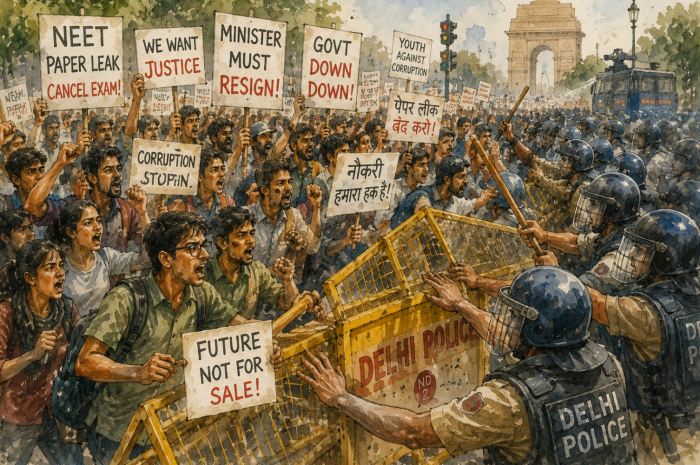
Visuals of young protestors clashing with the police, some throwing stones and getting lathi-charged in return, trying to break barricades and being hit by water cannons have been dominating news screens since yesterday. Some of them are there for politics, some are there to lend support to their peers, some have been genuinely aggrieved by the rampant paper leaks and corruption in recruitment exams. Some may even be there for fun and socialising. All of them are the inevitable victims of the socio-political consequences of their own biological age.
Because that’s how societies work.
“War is young men dying and old men talking.” – Odysseus (in Troy, the movie)
“Every generation imagines itself to be more intelligent than the one that went before it, and wiser than the one that comes after it.” – George Orwell.
This is a pattern so predictable and consistent that it appears less like an accident of history and more like the property of civilisation itself. Every generation believes it is uniquely wise. Every generation also believes its struggles are unprecedented. Yet, if one steps back from the emotional impact and tunnel vision of current events, the pattern makes itself clearly visible.
Delhi Police have registered 5 FIRs so far over violence during the CJP protest march, with more expected as accused are identified through CCTV footage
FIRs cover flying a drone without permission in the New Delhi district during the Parliament session, 2 cases involving… pic.twitter.com/0Cm8erZUyj
The slogans keep changing, ideologies keep changing. But the age factor in power structures hardly changes. Regardless of the era, political, military, financial, and institutional power overwhelmingly rests with the older generation, while the young supply the energy, bodies, and often the blood. They rarely inherit the levers of real control; they get used as pawns and cannon fodder in elite political clashes, then sidelined as the system stabilises itself, transferring power from one set of old men to another.
The reasons behind this tragedy are also rather simple, if one thinks about it. The pattern is not some grand conspiracy of older folks against the young of their society. It is the inevitable dividend of accumulated resources, networks, institutional knowledge, and risk aversion that the older folks gather in the course of ageing.
Power is also sticky; it attaches itself invariably to wealth, alliances and established bureaucratic systems.
The script is same, though centuries
Across eras, youth fuel disruption while elders direct and ultimately consolidate outcomes. From ancient Troy to the World Wars and countless wars in between, it is the young blood that is spilt, while older generals sit and decide their fate under orders from even older politicians. Revolutions, no matter how romanticised, follow the same pattern. French radicals and sans-culottes ignited change and flooded the streets, only for the monarchy to be dislodged by anarchy and terror under the likes of Robespierre, followed by the corrupt Directory and eventually a Napoleonic dictatorship.
Russian Bolshevik youth helped topple the Tsar, yet Lenin and Stalin built the new authoritarian elite. India’s long struggle for independence was no different; it saw fiery young martyrs like Bhagat Singh executed, popular leaders like Netaji Subhash deliberately sidelined while established older Congress leaders negotiated the transfer of power.
Whatever political benefit the CJP protestors and the so-called students are hoping for, it will inevitably be reaped by the Congress, AAP, Samajwadi Party, or even Chandrashekhar Ravan, to be used as capital for their next elections. Whether the ‘cockroaches’ admit it or not, the political narrative and outcome of their protest are already hijacked by powers that are older than them. Pun intended.
Coming back to more recent times, the so-called student leaders led from the front to clash with government forces of Sheikh Hasina, only to be ruled by a geriatric Mohammad Yunus and eventually paving the way for the old political family of Khaleda Zia to come back to power in the form of Tarique Rahman. The same story got repeated in Nepal, Sri Lanka, Kenya, and even in the Arab Spring.
Spanning across generations and decades, across borders, the ‘system’ always wins. When it does, the foot soldiers, the blood and energy givers, the cannon fodder are invariably sidelined. The system is old, pun intended again.
This makes sense and has been proven even from an evolutionary perspective. Human societies have always evolved around an asymmetry of resources rather than an asymmetry of physical capability. The young march, the old negotiate. The young fight, the old rule.
This is how the wheel turns
Survival is always rewarding. Age comes with wealth, institutional memory, political networks, and social legitimacy. The young have kinetic energy; the ones who survive into old age adapt to consolidate potential energy among their peers. In the thermodynamics of politics, the former is always converted into the latter, and the latter instigates the former whenever it wants. This is how the wheel turns.
Orwell’s generational delusion sustains the cycles of the wheel; each group believes it will finally break the pattern through superior insight or technology. Gen Z outrages over boomer or Millennial failures on climate, debt, and social injustice. But they fail to realise that the real power will continue to ‘stick’ to old systems. The old may enjoy the benefits of political unrest, but they forget that the very system that empowers them can be swept away from under their feet if the young blood protesting on the streets reaches a critical mass. The power discrepancy keeps the wheel turning.
All of this may sound rather depressing, but it is not. This is how societies stay functional. The streets of Delhi are today flooded with CJP protestors. Tomorrow there will be some other group. Violence may look all good and revolutionary for Insta handles, but jail cells are harsh. The rich kids will escape arrest and find foreign colleges to flex their revolutionary credentials. The not-so rich will suffer for a while before either losing interest and carrying on with their colleges and jobs. A certain kind of young men and women, who believe too much in heroes and ideals, will stay longer. Another kind of youngsters will just enjoy the free food and attention while it lasts.
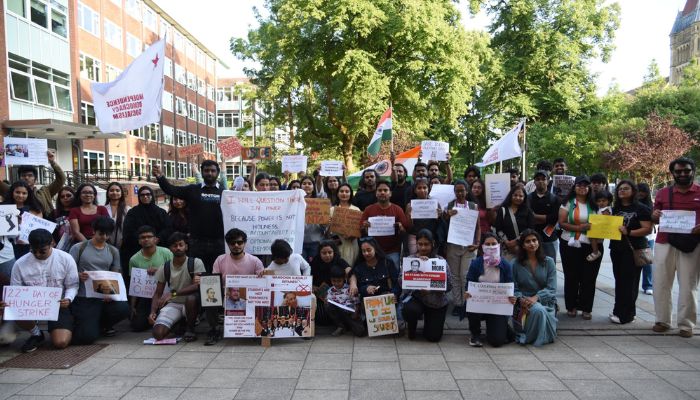
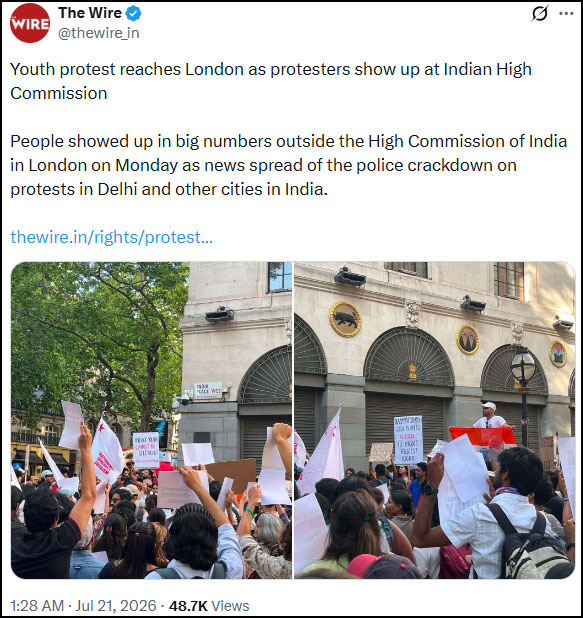
On 20th July, leftist propaganda portal The Wire claimed that the student protest in India had “reached London” and shared photographs of people gathering outside the Indian High Commission after reports of police action against the Cockroach Janta Party-led (CJP) protest in Delhi. Notably, Delhi Police had not granted permission for the protest, and the protesters had turned violent, indulging in stone-pelting and attacking police personnel before the police retaliated.
Source: X
In its post on social media, The Wire declared, “Youth protest reaches London as protesters show up at Indian High Commission.” It claimed that people had appeared “in big numbers” outside the High Commission as news spread about the police action in Delhi and other cities. The portal presented the gathering as a spontaneous response from Indians living in Britain and completely omitted the fact that the Students’ Federation of India’s (SFI) UK chapter had called for the protest outside the High Commission of India in London.
The protest had been announced in advance by SFI UK, and details were all over its social media platforms. The organisation fixed the venue and time, circulated promotional material, listed the demands and called upon supporters to participate. SFI committees had also been holding similar protests at other locations in the UK, including Leeds and Edinburgh, for weeks.
A social media user who participated in the Manchester protest later confirmed that the demonstration there had also been organised by SFI UK.
The Wire presents an SFI protest as a spontaneous diaspora gathering
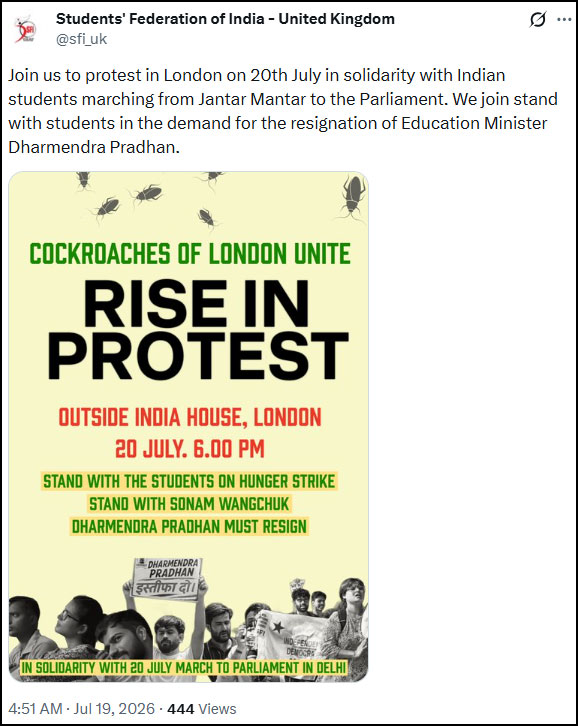
The way The Wire presented the SFI protest outside the High Commission as a response to reports of the confrontation in Delhi is concerning, as the protest had already been announced on 19th July, a day before the march towards Parliament in Delhi.
Source: X
Its poster carried the call, “Cockroaches of London unite” and asked people to “rise in protest” outside India House in London at 6 pm on 20th July. The poster listed three main demands. It asked supporters to stand with students on hunger strike, support activist Sonam Wangchuk and demand the resignation of Union Education Minister Dharmendra Pradhan.
At the bottom, it explicitly stated that the London gathering was being organised “in solidarity with 20 July march to Parliament in Delhi”. Therefore, people did not simply “show up” after watching the news, as The Wire suggested. They had been called to a pre-announced protest by a structured political organisation.
After the gathering, SFI UK itself wrote that thousands of Indians in London had answered “our call for action”. It said the demonstration had been organised in solidarity with the Indian student movement and saluted the struggle of its “comrades in India”. While SFI UK claimed that “thousands” of people had gathered, the video it shared showed a much smaller number of protesters crammed into a small space.
At the protest outside the Indian Embassy, SFI UK Secretary Comrade Somiha expressed our solidarity with SFI comrades waging a hunger strike and protesting in millions across India against sustained police brutality.
— Students' Federation of India – United Kingdom (@sfi_uk) July 20, 2026
While those who attended the protest in the UK may or may not have been members of SFI, the call, publicity, venue, messaging and speeches came from SFI UK. The Wire removed all of that context and transformed an SFI-organised event into what appeared to be an organic uprising by the Indian diaspora.
SFI UK had been mobilising supporters for weeks
The London demonstration was not an isolated protest planned after the confrontation at Jantar Mantar. SFI UK had been running a coordinated campaign against Union Education Minister Dharmendra Pradhan since at least the beginning of June.
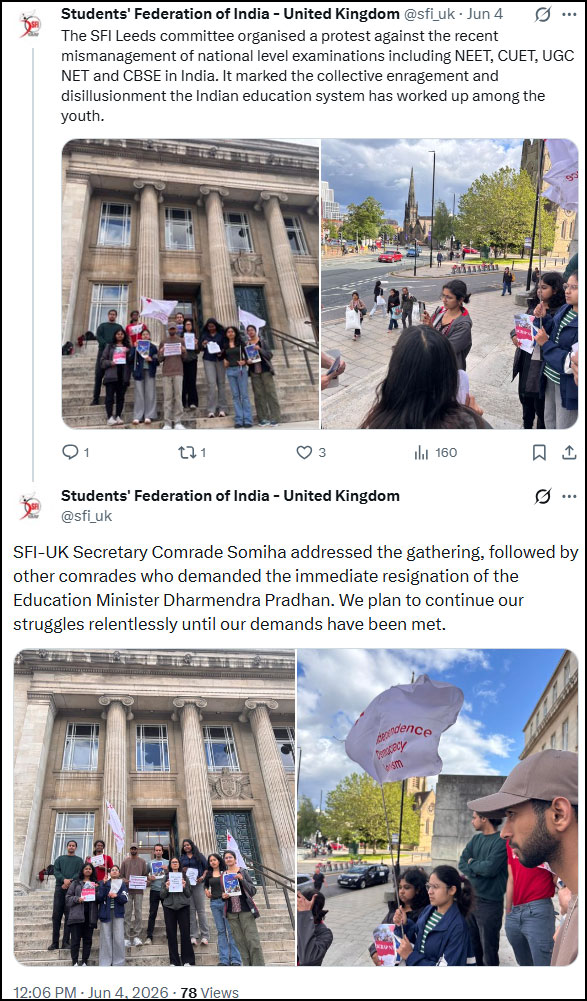
On 4th June, the organisation posted photographs from a protest organised by its Leeds committee against what it called the mismanagement of national examinations, including NEET, CUET, UGC NET and CBSE examinations. The organisation said the gathering reflected anger and disillusionment among young people over the Indian education system.
Source: X
Another post from the same day said that SFI UK Secretary Somiha and other members had demanded the immediate resignation of Dharmendra Pradhan. The organisation promised to continue its protests until its demands were accepted.
SFI’s central leadership had issued a nationwide ultimatum
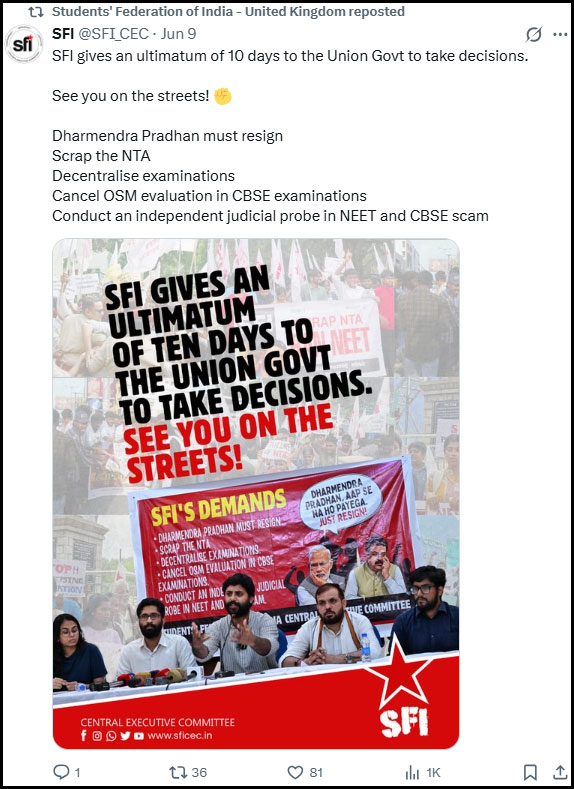
The overseas mobilisation was taking place alongside a campaign by SFI’s central organisation in India. On 9th June, the SFI Central Executive Committee issued a ten-day ultimatum to the Union Government. Its demands included the resignation of Dharmendra Pradhan, the scrapping of the National Testing Agency and the decentralisation of examinations.
Source: X
It also demanded the cancellation of the OSM evaluation system in CBSE examinations and an independent judicial inquiry into the NEET and CBSE examination controversies.
The organisation warned, “See you on the streets.”
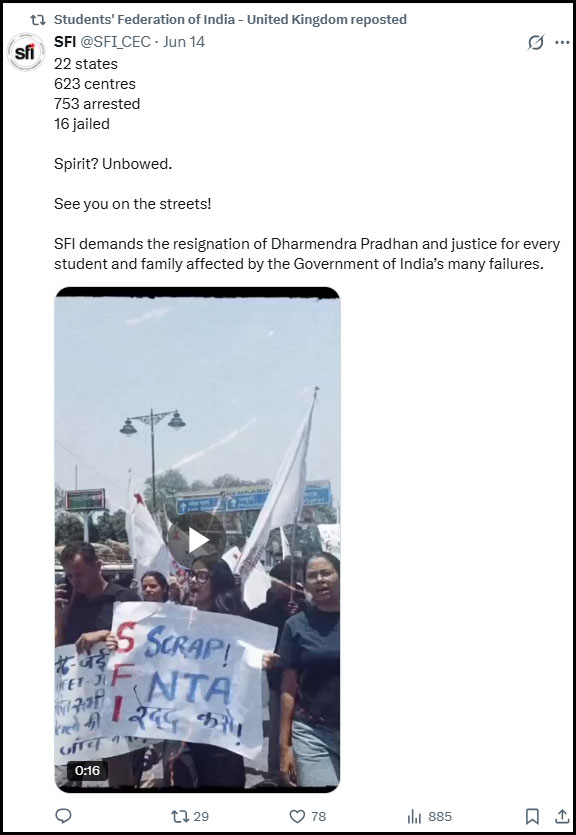
On 14th June, SFI claimed that protests had taken place at 623 centres across 22 states. It claimed that 753 people had been arrested and 16 had been jailed. SFI UK reposted the message while declaring that the organisation’s “spirit” remained unbowed.
Source: X
These posts show a continuing organisational campaign. The protests in Britain were part of that wider mobilisation, not an unplanned reaction by disconnected individuals.
Source: X
Leeds and Edinburgh committees organised separate demonstrations
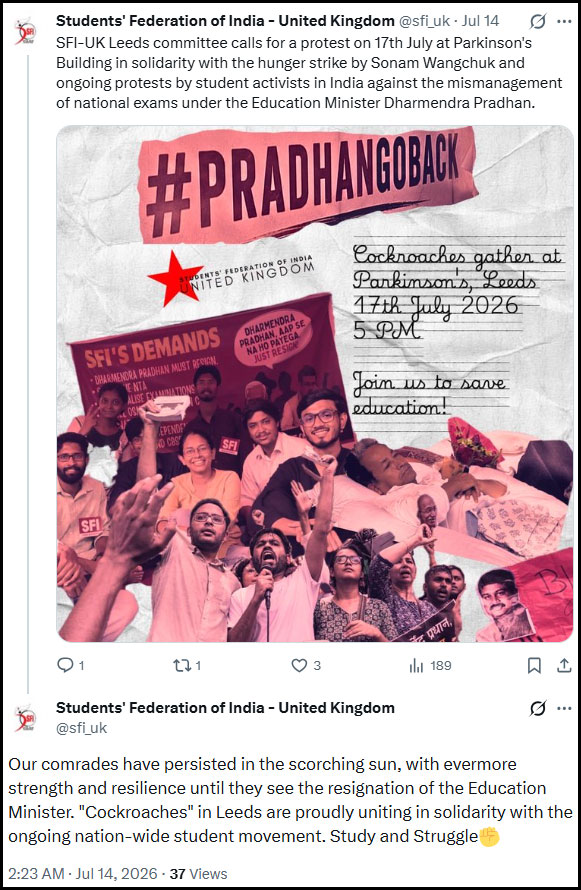
SFI UK’s social media activity also shows how its local committees were mobilised around the same demands. On 14th July, its Leeds committee issued a call for a protest outside Parkinson’s Building. The poster carried the hashtag “PradhanGoBack” and declared, “Cockroaches gather at Parkinson’s Leeds.” The promotional material included photographs of protesters, SFI symbols and the demand for the resignation of the Education Minister.
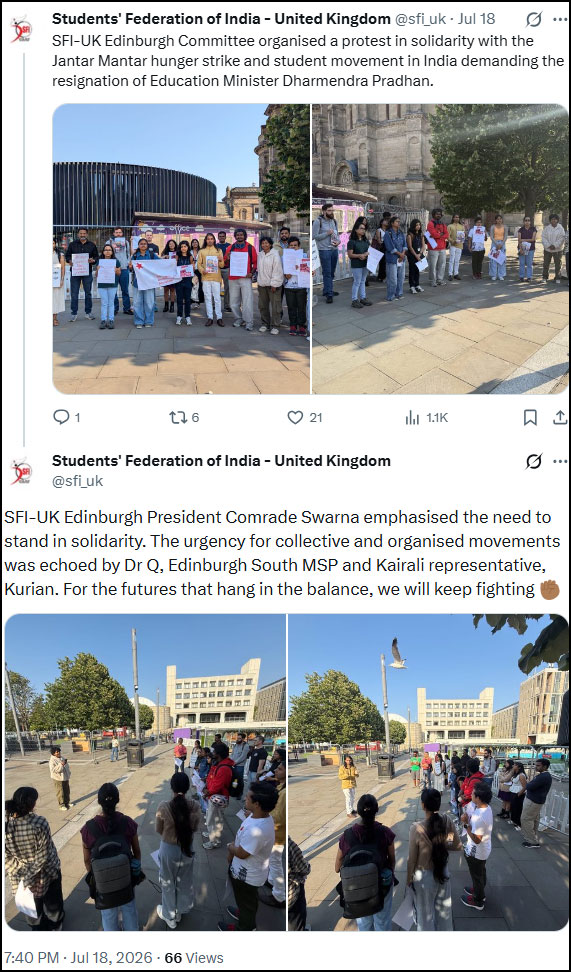
On 18th July, SFI UK said that its Edinburgh committee had organised a protest in solidarity with the Jantar Mantar hunger strike and the student movement in India. The organisation identified its Edinburgh president, Swarna, as one of the speakers and said that the gathering had stressed the need for collective and organised movements.
Source: X
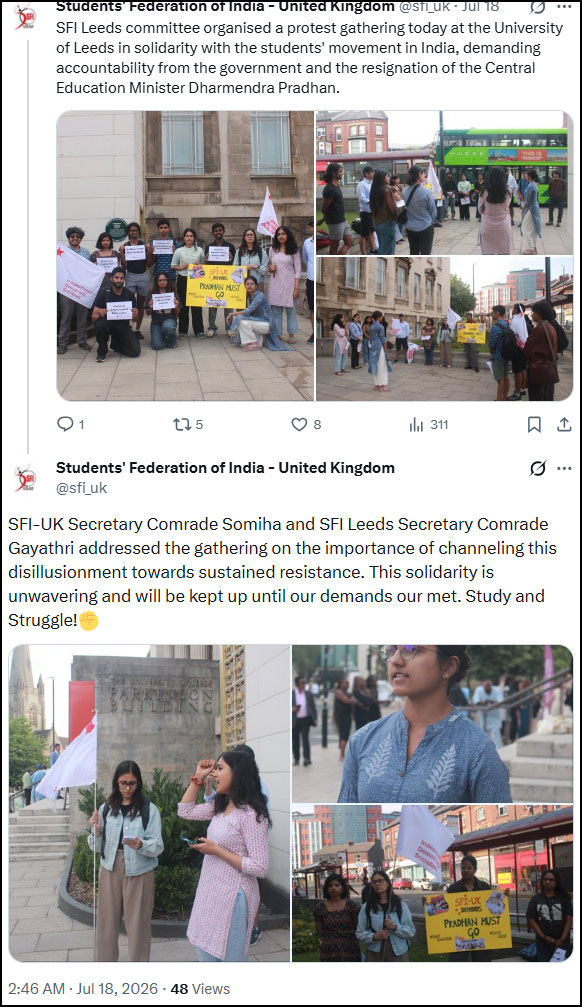
The same day, its Leeds committee organised another demonstration at the University of Leeds. SFI UK said that the protesters demanded accountability from the government and the resignation of Dharmendra Pradhan.
Source: X
It also identified Secretary Somiha and Leeds Secretary Gayathri as speakers at the gathering. The organisation said that its solidarity would continue until the demands were met. These were not crowds that independently assembled after coming across news about Delhi. They were committee-led demonstrations with named office-bearers, common banners and repeated political demands.
Manchester protester confirms that SFI UK organised the gathering
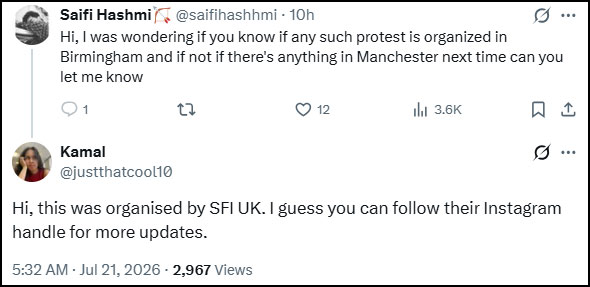
A social media user named Kamal also posted footage of a demonstration in Manchester and demanded the resignation of Dharmendra Pradhan.
When another user asked whether a similar protest could be organised in Birmingham, Kamal responded that the Manchester gathering had been organised by SFI UK and suggested following its Instagram account for further updates.
Source: X
This provides further confirmation that SFI was using its network to organise demonstrations in multiple British cities.
SFI UK is not an informal group created after the Delhi protest
SFI UK describes itself as the first international committee of the Students’ Federation of India. Its website claims that it has over 600 members in Britain and more than ten subcommittees. It also claims to operate active units across British universities and says that it regularly organises campaigns, cultural programmes, fundraising activities and student welfare initiatives.
Its constitution states that SFI aims to organise students in India, as well as Indian students studying abroad, under one banner. It calls for building a “democratic and socialist society”, organising students alongside workers, peasants and other “progressive forces”, and extending solidarity to movements seeking socialism across the world.
The constitution also provides for overseas units, membership fees, affiliation to the SFI Central Executive Committee and committees at several organisational levels.
SFI is student wing of the Communist Party of India (Marxist) or CPI(M). Several senior CPI(M) leaders, including former general secretary Sitaram Yechury, emerged through the organisation and held senior positions in it before joining the party leadership.
Therefore, SFI UK is not an informal WhatsApp group of students that emerged during the Jantar Mantar agitation. It is part of an established Left-wing political network with members, committees, office-bearers and an ideological programme.
BBC and Al Jazeera frame the agitation as a Gen Z uprising
While The Wire removed SFI from its portrayal of the London demonstration, international media organisations framed the agitation in Delhi as a wider Gen Z rebellion against the Modi government.
The BBC promoted an explainer “Jantar Mantar: What is the Gen Z CJP protest in Delhi about?” Its accompanying social media post asked why thousands of people were protesting in the capital.
In another report, the BBC described CJP as a youth-led protest movement seeking education and employment reforms. It called the agitation one of the most visible expressions of public dissent against Prime Minister Narendra Modi in recent years.
Al Jazeera used the dramatic headline “‘Now or never’: Students defy Delhi lockdown to march on India’s parliament”.
It described CJP as a major challenge to the Modi government and claimed that thousands had answered the organisation’s call. The report highlighted police action, quoted protesters and cited commentators who sought to portray the agitation as evidence of deeper dissatisfaction over education, employment, inflation and poverty.
Amnesty International and HRW amplify the crackdown narrative
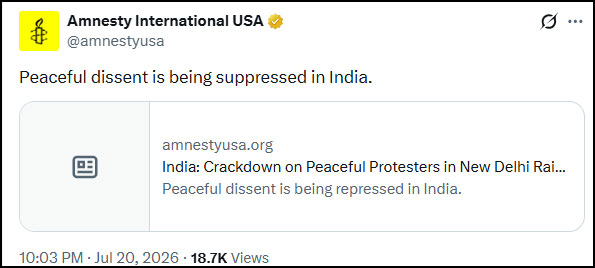
Amnesty International USA also declared that peaceful dissent was being suppressed in India. Its statement relied on “images and reports” from Jantar Mantar and alleged unnecessary and excessive force by Delhi Police. It demanded an investigation into allegations involving batons, tear gas and stone-throwing by police personnel.
Source: X
Amnesty identified CJP as the organisation leading the protests and repeated its demands concerning examination irregularities, compensation and the resignation of Dharmendra Pradhan.
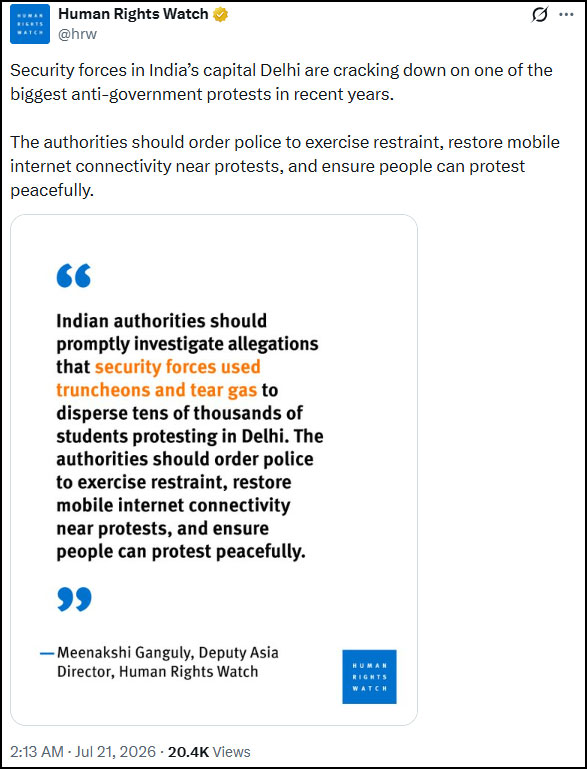
Human Rights Watch similarly called the agitation one of the biggest anti-government protests in recent years. It asked the authorities to exercise restraint, restore mobile internet services near the protest and ensure that people could demonstrate peacefully.
Source: X
The framing by Amnesty and HRW contributed to an international narrative in which the agitation was presented almost entirely as an organic uprising of young Indians being suppressed by the government.
A well-orchestrated attempt to build a narrative against the Indian government
The manner in which SFI UK, left-liberal Indian media, international media outlets and NGOs such as Amnesty International and Human Rights Watch have presented the protests creates an impression that they were entirely organic. It also helps build a narrative that the Indian government is opposed to students’ welfare. Before accepting this narrative, it is essential to examine how these protests were organised and presented.
Not all students at Jantar Mantar were part of the propaganda, but innocent students ultimately face lathi charges and legal cases for participating in unlawful protests. The so-called leaders, including Abhijeet Dipke, Saurav Das and others, were either standing far away from the batons and tear gas or were not even present at the protest sites.
Amid all this, the narrative being pushed on international platforms needs to be scrutinised and countered.
On 21st July (Tuesday), a protest is scheduled to take place at Delhi’s Kisan Ghat. It was announced by the Desh Bachao Morcha against the proposed trade deal between United States and India. According to the organisers, nearly 550 unions of farmers and social groups would attend the event from all over the nation.
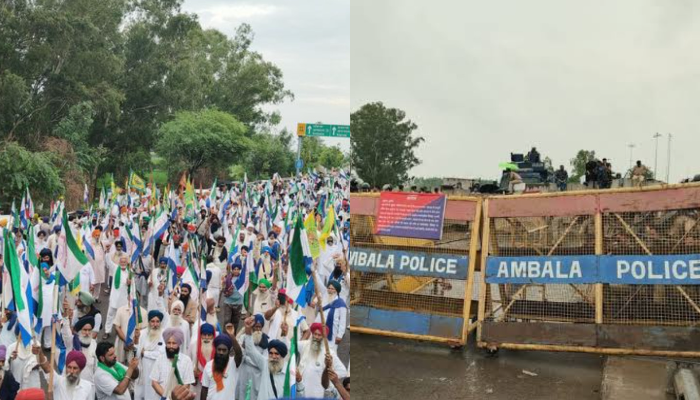
However, the Haryana government has sealed the Shambhu border ahead of this gathering which triggered an agitation on the location which has a heavy police presence. Barricades were built and cement blocks were positioned at the bridge over the Ghaggar River.
The farmers charged both Punjab and Haryana governments with obstructing their march to the purported “Kisan Mahapanchayat.” They charged that the Haryana police erected roadblocks on Punjab’s territory, but the latter did nothing to stop them. Buses were set to transport farmers from various parts of the border state to the national capital.
#WATCH | A large number of farmers reach Shambhu Border (Punjab-Haryana border) ahead of their scheduled march to Delhi today. Visuals from Patiala (Punjab) side. pic.twitter.com/dJtdEt0qti
On 16th July (Thursday) morning, convoy carrying around 1000 farmers departed from Gurdwara Sri Fatehgarh Sahib and reached Madhopur close to Sirhind on the Grand Trunk (GT) Road. Afterwards, they started their journey to Shambhu border.
Gurnam Singh Charuni, the head of the Bharatiya Kisan Union (Charuni) was reportedly arrested by police in Kurukshetra on his way to Delhi for the Mahapanchayat, a day earlier. Prince Waraich, the organisation’s spokesperson, had stated that many of its members were being held by the cops in an effort to prevent them from participating in the demonstration.
The farmers from Haryana made their way from Ambala, Kurukshetra and other places to reach their destination. Sarwan Singh Pandher, a representative of the Kisan Mazdoor Sangharsh Committee (KMSC) stated that people from his outfit, Kisan Mazdoor Morcha (Punjab Chapter), Azaad Kisan Morcha (AKM) and Bharti Kisan Union (BKU) Ekta Sangharsh had proceeded from multiple areas of Punjab.
VIDEO | Haryana Police put concrete barricades at Shambhu border as farmers prepare to head to Delhi for a planned 'mahapanchayat' to protest against the proposed Indo-US trade deal.
Pandher accused the centre of not involving any “stakeholders” regarding US-India Free Trade Agreement (FTA) which he claimed was being inked signing “in a secret way as the government tells us nothing about it.” He insisted, “All that we get to know is from the US side through their press releases,” remarking that they are going to Delhi to ask Prime Minister Narendra Modi about it.
Pandher added, “People from Haryana, Rajasthan, Himachal Pradesh, Maharashtra, Uttar Pradesh and Uttarakhand are also coming for this one-day rally.” He declared that they wished for the deal to be completely scrapped.
Pandher highlighted that the two nations in a February joint release agreed to work towards drafting the first tranche of a mutually beneficial, multi-sector bilateral trade agreement (BTA) by fall. He expressed that this suggested the deal could even extend to include agriculture, dairy, industry, digital trade, e-commerce, government procurement, intellectual property rights and services.
He stated that prior US trade paperwork and yearly related reports have continuously advocated enhanced market access in India’s dairy and agricultural industries. These documents have pushed for lower tariffs on soybeans, corn (maize), cotton, ethanol, apples, almonds, and other agricultural commodities alongside more market access for its dairy products, poultry, fruits, fisheries products, coconuts and other commodities in India.
#WATCH | Amritsar, Punjab | Kisan Mazdoor Sangharsh Committee leader & coordinator for Desh Bachao Morcha, Sarwan Singh Pandher, along with farmers, to leave for Delhi today for a one-day rally to protest against India-US FTA
Germanjit Singh Bandala, the leader of the Kisan Mazdoor Sangharsh Committee Punjab, claimed that the agreement will negatively impact Indian labourers, farmers, small merchants and the general public. He asserted that it disregarded the interests of India’s small and marginal cultivators in favour of American businesses and farmers.
According to Bandala, US agriculture is conducted on a considerably greater scale, with farms spanning thousands of acres and receiving significant government subsidies. On the other hand, the majority of Indian farmers receive much less financial assistance and only possess two to two and a half acres of land. He argued that the low-income community would find it difficult to compete if the arrangement allowed cheaper agricultural imports from the US to enter the country’s market which would prompt a dramatic drop in their earnings.
Bandala stressed that New Delhi was proceeding with the pact under pressure from Washington while previous governments shielded the agricultural sector from undue foreign interference, mentioning that the repercussions could hamper small businesses and employment opportunities in other industries as well.
Farmer groups conveyed that approval of cheaper agricultural imports under the deal would badly affect farmers, workers, livestock rearers, small traders, micro industries and the agricultural sector. Bandala described the demonstration as “only the beginning” and threatened escalation if their demands were not met.
The Desh Bachao Morcha pressed the government to refrain from accepting any contracts without conducting thorough discussions with farmers, workers, dairy producers, small traders and other stakeholders. They also wanted all documents pertaining to the planned FTA to be made public.
The authenticity of the claims
It is important to realise that India-US FTA has not yet been ratified despite the uproar, supposed vulnerabilities and agitations to protect the interests of farmers. Union Minister Piyush Goyal recently informed that negotiations are underway to achieve a “good deal” that satisfies both nations. However, the charges seem to be based more on insinuations, suspicions and doubts rather than on the facts that clearly point to strict protections for Indian sensitive farming sectors.
The government has already explained that the pact “fully safeguards India’s agricultural interests, particularly those of the farm and dairy sectors.” Union Minister Shivraj Singh Chouhan outlined that “no sudden or disruptive entry of foreign products will take place in the Indian market.” He emphasised that all important crops, food grains, fruits and dairy products remain secure and no market segment has been opened in a manner that could hurt Indian farmers.
The centre assured that the deal would put pressure on domestic farmers and the protections for significant agricultural commodities continue to be in place in relation to contention about greater availability of American farm products in local markets.
Furthermore, the statement issued by India and US in February addressed the removal and reduction of tariffs on Dried Distillers Grains, red sorghum for animal feed, tree nuts, fresh and processed fruits, soybean oil, wine, spirits and similar other products. India already imports them to fulfill domestic demand gaps.
However, it did not mention any major staple crops such as rice, wheat or maize. The reductions are specifically aimed at industrial and supplementary goods that do not compete with the core agricultural products of Indian farmers. Hence, any claims to the contrary are incorrect.
Last year, US Commerce Secretary Howard Lutnick even lashed out, “India brags that they have 1.4 billion people, then why wouldn’t they buy one bushel of corn from us? Doesn’t that rub you the wrong way. That they sell everything to us, and they won’t buy our corn. They put tariffs on everything,” in an interview. His comment exuded frustration, but it also underscored the government’s refusal to succumb to pressure while maintaining the welfare of its farmers at the forefront.
Notably, PM Modi echoed the same sentiment when he stated, “For us, the interest of our farmers is our top priority. India will never compromise on the interests of farmers, fishermen and dairy farmers. I know we will have to pay a heavy price for it, and I am ready for it. India is ready for it.” He has consistently provided these reassurances to alleviate authentic concerns.
Washington is indeed interested in gaining wider access to Indian markets, yet New Delhi has repeatedly turned down their demands, prioritising its own farmers and other sectors associated with the industry. This has contributed to the delay in finalising the agreement.
However, how can facts be permitted to impede propaganda? Thus, a similar situation has taken shape in yet another demonstration in the name of farmers, featuring emotional appeals, anger and allegations that bear no relation to the reality. Of course, they are also not concerned with the disruption of public life or the inconvenience caused to commuters.
Farmers or self-interest groups
These entities, created under the guise of upholding interests of farmers have surfaced as their biggest opponents as evidenced during the agitation against the three farm laws. The ordinance, which had the potential to transform the agricultural sector, was ultimately repealed due to the unyielding protests and violence instigated by these organisations.
The laws would have enabled the farmers to bypass the state-controlled Agricultural Produce Marketing Committee (APMC) mandis and sell directly to private buyers, corporations and supermarkets as well as ended the role of traditional middlemen who dominated this system and dictated lower prices to them. This would have also prevented crop loss and low-price wastage by facilitating direct sales to private players, contract farming and improved private storage.
However, a massive agitation was launched to mislead the unsuspecting public by asserting that the government intends to seize the land of farmers and transfer it to industrialists, who would then dominate the sector, ultimately destroying the livelihoods of those associated with it. These outfits were fighting to keep the middlemen in mandis who are infamous for their exploitative practices against farmers.
They ruined a crucial opportunity that could have revolutionised the agricultural sector and improved the lives of farmers instead of participating in a dialogue and pursuing a mutually agreeable solution. Moreover, their violent antics at the Lal Qila, brutal assault on cops and the associated loss of life and property were apparent to everyone.
Now, as India stands on the brink of a major advancement with the FTA, they have once again awakened from their slumber to halt yet another progressive and advantageous move for the country.
These groups appear to be solely focused on aggressive actions aimed at compelling the government to yield to their demands, driven by their egos and ulterior motives under the pretext of representing farmers. Otherwise, they would have opted for dialogue instead of repeatedly taking to the streets and fostering confrontational scenarios. In essence, they function like pressure cartels, pursuing their own financial and political gains while masquerading as champions of farmers and their interests to deceive the masses.
The objective has remained consistent, from rejecting the critical farm laws to protesting against the trade deal, which is still under negotiation and has yet to reach a final agreement.
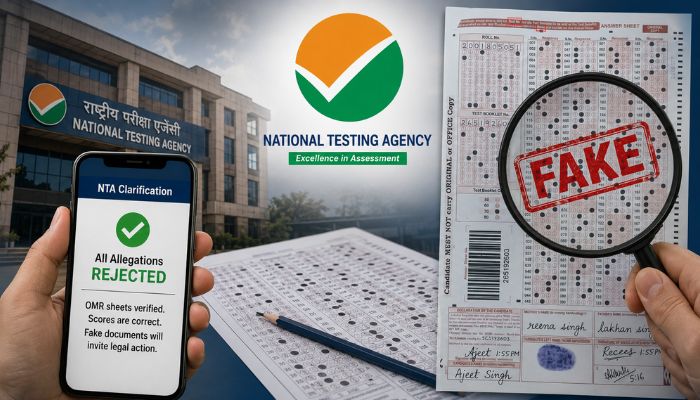
On Monday, 20th July, the National Testing Agency (NTA) issued a detailed clarification rejecting allegations made by several NEET-UG 2026 candidates who claimed that their OMR sheets had been changed, interchanged or incorrectly evaluated. The agency said it examined the complaints and found that many of the documents being circulated on social media were “fabricated, digitally altered or AI-generated” and did not match the official records maintained by the NTA.
The clarification comes after several students alleged discrepancies in their OMR sheets and scorecards following the declaration of the re-NEET results. Some candidates claimed their answer sheets had been swapped with those of other students, while others alleged that their marks had suddenly changed or that the OMR sheets uploaded by the NTA did not match the answers they had marked in the examination.
Regarding OMR-related claims for NEET (UG) 2026 being circulated on social media, it may be noted that the genuine OMR of every candidate concerned is on record with NTA. It was made available on the candidate portal and emailed to the candidates at the time of the OMR Response… pic.twitter.com/rN3r21c4hf
— National Testing Agency (@NTA_Exams) July 20, 2026
Addressing the controversy, the NTA issued case-specific clarifications for five candidates whose allegations had gone viral on social media platforms, especially X. These candidates are Avaneesh Srivastava, Pratibha Trivedi, Abhay Yadav, Lakshya Singh and Arya Singh.
The agency said all five cases were thoroughly verified and that the OMR sheets of all five candidates had been correctly evaluated.
“After verification, it has been found that the score of each of these candidates stands exactly as declared. The images being circulated are digitally regenerated or altered versions of the candidates’ genuine OMR sheets,” the NTA said.
Avaneesh Srivastava case: NTA says there was no OMR sheet mix-up
One of the most widely discussed cases was that of Avaneesh Srivastava, whose family alleged that the OMR sheet uploaded by the NTA belonged to another student named Ajeet Singh. The allegation was later amplified by the Congress, which questioned the credibility of the re-NEET examination and claimed there had been another major lapse after the earlier paper leak controversy.
The NTA, however, categorically denied any interchange of answer sheets.
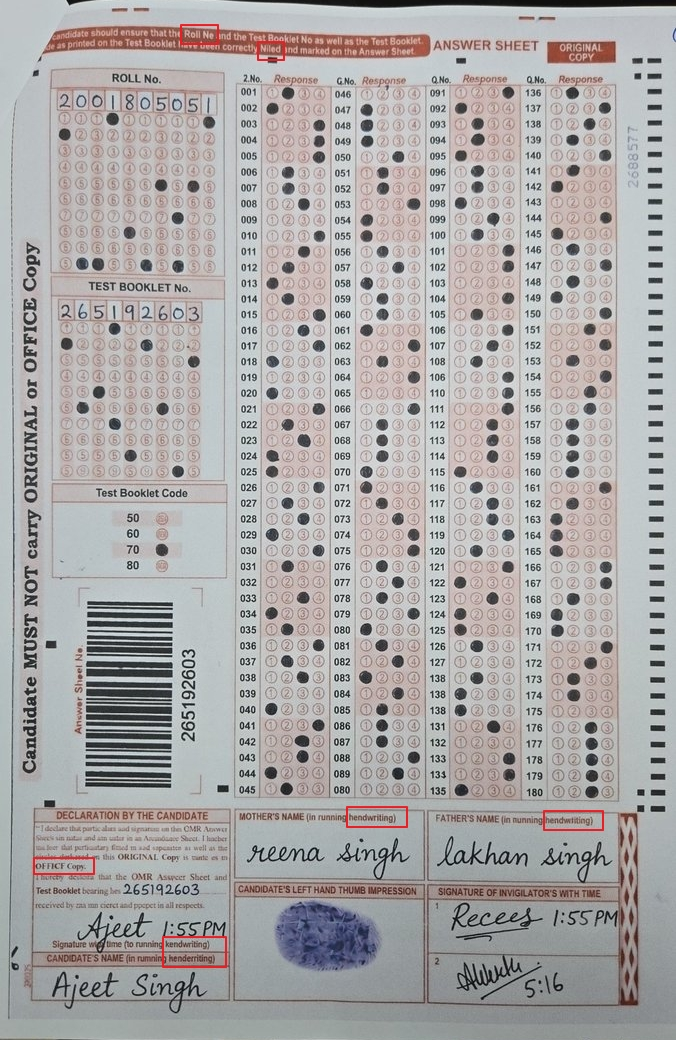
According to the agency, a forensic examination showed that the viral image was not an official OMR sheet but a digitally altered version of Avaneesh’s own answer sheet. It said only the identity-related fields had been changed, while the barcode, booklet number, test booklet code and answer pattern remained the same as the genuine OMR sheet.
The agency also pointed out several signs of digital manipulation. These included spelling mistakes such as “Roll Ne” instead of “Roll No.”, “correctly Nilled” instead of “correctly filled”, garbled words like “partic alam”, “signaroen”, “OFFICF Copy” and “hureby desloxa”, along with incorrect field labels and abnormal question numbering.
According to the NTA, these are common indicators of AI-based document generation, where software often creates meaningless text while reproducing documents.
The agency further clarified that no NEET-UG 2026 candidate named “Ajeet Singh, son of Shri Lakhan Singh and Smt. Reena Singh” exists in its database. “A search of the complete candidate database found no such registered candidate. This is not a case of two candidates’ OMR sheets being interchanged. It is a fabricated image presented as an official record,” the NTA said.
On the allegations circulating on social media regarding the OMR sheet of Re-NEET candidate Avaneesh Srivastava, NTA Sources said- "The image being circulated on social media is not the OMR sheet on record with the NTA. It is a digitally altered version."
It also noted that the viral image had nearly six times the resolution of the original institutional scan, the colour of the answer markings had changed from black to blue-purple, and the thumb impression appeared as a saturated colour block without natural ridge details.
The agency added that Avaneesh’s genuine OMR sheet, containing his correct name, parents’ names, signature and thumb impression, had been evaluated through the standard process and that his result remains unchanged.
Pratibha Trivedi’s OMR sheet was ‘significantly altered’
The NTA also rejected the allegations made by candidate Pratibha Trivedi regarding her OMR sheet.
According to the agency, the genuine OMR sheet was already available with the NTA and had also been emailed to the candidate during the official OMR Response Key challenge window.
However, the image now circulating on social media is not the same document. “The image being circulated is a digitally altered version of the genuine OMR sheet. It is not the sheet held on record with the NTA and has been significantly modified,” the agency said.
Regarding claims by Ms. Pratibha Trivedi (App No. 260412140662) about her NEET (UG) 2026 OMR answer sheet:
NTA has verified the record.
The genuine OMR of the candidate is with NTA. It was also emailed to her at the registered e-mail address during the OMR Response Key…
— National Testing Agency (@NTA_Exams) July 20, 2026
After verification, the NTA stated that Pratibha’s score of 38 marks had been digitally verified and “stands as declared.” The agency also warned that creating or circulating forged OMR sheets is an offence under the Public Examinations (Prevention of Unfair Means) Act, 2024.
Abhay Yadav’s claim contradicted official records
The NTA also dismissed the allegations made by Abhay Yadav regarding his OMR sheet and final result.
According to the agency, Abhay had publicly claimed that he left only five questions unanswered and should have received 634 marks in the examination. However, the NTA said its official records tell a completely different story.
After verifying the original OMR sheet and the calculation sheet, the agency found that Abhay had actually left 44 out of 180 questions unanswered. “The candidate’s public claim is not supported by the official record. The OMR sheet and calculation sheet are fully consistent, and the score of 164 marks stands as declared,” the NTA said.
Regarding claims by Shri Abhay Yadav (App No. 260411367191) about his NEET (UG) 2026 OMR answer sheet and result:
NTA has verified the record.
The genuine OMR of the candidate is with NTA. It was also emailed to him at the registered e-mail address during the OMR Response Key…
— National Testing Agency (@NTA_Exams) July 20, 2026
Like Pratibha’s case, the agency said the genuine OMR sheet had already been emailed to Abhay during the challenge window. It also warned that circulating forged documents or making claims contrary to official examination records could attract action under the Public Examinations (Prevention of Unfair Means) Act, 2024.
Lakshya Singh’s viral OMR is “digitally forged”
The NTA also addressed allegations made by Lakshya Singh.
According to the agency, the OMR sheet being circulated online had been digitally manipulated by adding response markings that did not exist on the genuine answer sheet. “The image being circulated shows response markings that are absent on the genuine OMR sheet. Additional answer bubbles have been shaded digitally to create a forged document,” the NTA said.
Regarding claims by Shri Lakshya Singh (App No. 260412053016) about his NEET (UG) 2026 OMR answer sheet:
NTA has verified the record.
The genuine OMR of the candidate is with NTA. It was also emailed to him at the registered e-mail address during the OMR Response Key challenge…
— National Testing Agency (@NTA_Exams) July 20, 2026
The agency clarified that Lakshya’s original OMR sheet had been correctly evaluated and that his declared score remains unchanged.
Arya Singh’s allegations and NTA’s response
Another case that attracted significant attention was that of Kanpur candidate Arya Singh.
Arya had alleged that when the OMR sheet was first uploaded on 13th July, the order of questions was incorrect. After matching her answers, she claimed her expected score should have been 609 marks and submitted an objection through the official challenge process.
OMR के हिसाब से आए 609 अंक, रिजल्ट में शो हुआ 540 नंबर लेकिन अब आ गए 167, री-NEET रिजल्ट में गड़बड़ी का आरोप
NEET UG 2026 री-एग्जाम के परिणाम जारी होने के बाद कानपुर की छात्रा आर्या सिंह ने नेशनल टेस्टिंग एजेंसी (NTA) की रिजल्ट प्रक्रिया पर सवाल खड़े किए हैं. छात्रा का दावा… pic.twitter.com/T35qFX7NxT
According to Arya, the NTA later uploaded a revised OMR sheet with the corrected question sequence, but the marks still did not match her expectations. She further claimed that when the re-NEET results were declared on the night of July 16, the portal initially displayed her score as 540 marks before it allegedly changed to 167 marks after repeated page refreshes.
Regarding claims by Ms. Arya Singh (App No. 260410434102) about her NEET (UG) 2026 OMR answer sheet:
NTA has verified the record.
The genuine OMR of the candidate is with NTA. It was also emailed to her at the registered e-mail address during the OMR Response Key challenge…
— National Testing Agency (@NTA_Exams) July 20, 2026
She has described the issue as either a technical glitch or an evaluation error and said she had submitted complaints to both the NTA and the Ministry of Education along with screenshots.
Responding to the controversy, the NTA said the image circulating online was a digitally altered version of Arya’s genuine OMR sheet. “The recorded signature time of one invigilator has been changed from 3:45 PM on the genuine sheet to 2:45 PM on the altered image. Several other signs of digital manipulation are also visible,” the agency stated. The NTA reiterated that Arya’s original OMR sheet had been correctly evaluated and that her score “stands as declared.”
NTA explains how fake OMR sheets were created
Along with the case-specific clarifications, the NTA also explained the methods it found being used to create fake examination documents.
According to the agency, one method involved AI-powered image generation tools that recreated the printed sections of genuine OMR sheets.
Another involved digitally replacing candidate details such as names, signatures and thumb impressions while leaving the barcode and answer bubbles unchanged so that the document appeared authentic. The agency also found scorecards in which marks or response counts had been changed digitally without altering the embedded QR code or barcode.
In some cases, fabricated OMR sheets even contained names of candidates who did not exist in the NEET-UG 2026 database.”A fabricated image may appear genuine, but it cannot change the official records securely stored on NTA and NIC servers,” the agency said.
NTA warns of legal action
The agency has advised students, parents and guardians to submit only original documents downloaded from the official NTA portal while raising grievances.
It warned that creating, possessing, circulating or submitting forged, digitally altered or AI-generated OMR sheets, scorecards or examination documents is a cognisable offence under the Public Examinations (Prevention of Unfair Means) Act, 2024.
NTA is closely monitoring and scrutinizing all complaints. In the wake of many OMR sheets submitted for scrutiny turning out to be fake/AI generated, students and parents are advised to submit only original OMRs for scrutiny. Any fake / AI generated OMR may invite legal action…
— National Testing Agency (@NTA_Exams) July 18, 2026
The NTA also said legal proceedings may be initiated not only against candidates but also against third parties involved in preparing or circulating fake documents.
At the same time, it assured students with genuine grievances that they can approach the agency through the official helpdesk by providing their application number, roll number and details of the discrepancy. The agency also clarified that no re-evaluation or revision of results will be carried out on the basis of fabricated images.
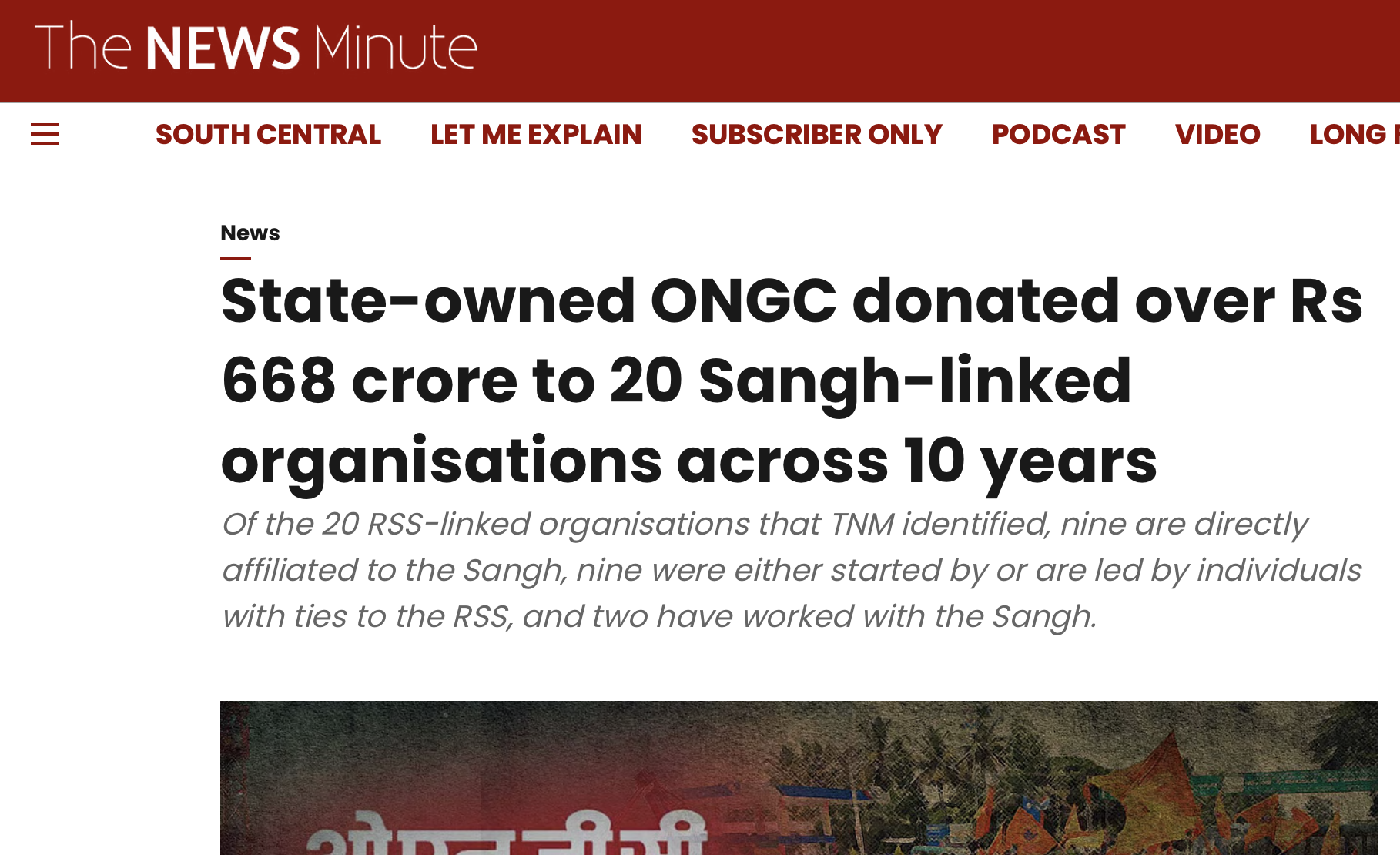
On July 19, 2026, The News Minute published a report about ONGC, the government-owned oil and company. The report found that ONGC gave ₹670.97 crore to 20 organisations that have links to the RSS, with this money being given starting from 2013. Most of this amount, ₹668.01 crore, was given between 2015 and 2025.
In that same period, ONGC spent ₹4,531 crore in total on CSR. It covered more than 2,000 organisations and projects across India. So the money given to RSS-linked organisations works out to about 14.7% of ONGC’s total CSR spending over that decade.
The News Minute report
The News Minute divided the 20 organisations into three groups. Nine are directly connected to the RSS, nine were started by or are run by people connected to the RSS, and two have worked with the RSS in the past. The two organisations that received the most money were BAVP (Dr Babasaheb Ambedkar Vaidyakiya Pratishthan), which got about ₹434 crore to build a 300-bed hospital in Sivasagar, Assam, and DATSAS (Dr Aabaji Thatte Seva Aur Anusandhan Sanstha), which got about ₹140 crore for a cancer hospital in Nagpur. These numbers come straight from ONGC’s own CSR annual reports, which anyone can find on the ONGC website. These facts are correct, and it’s important to say so clearly before adding anything else.
The other 85%
The 14.7% figure doesn’t show the full picture. Out of ONGC’s ₹4,531 crore CSR spend, about ₹3,863 crore, a little over 85%, went to organisations that have no connection to the RSS, spread across more than 1,980 other organisations and projects.
If we look at ONGC’s yearly CSR reports, which are publicly available since 2018-19, it becomes clear how wide this spending actually is. In the financial year 2024-25 alone, ONGC funded medical equipment for S.M. Dev Civil Hospital and Karimganj Civil Hospital in Assam, including anaesthesia workstations, ICU ventilators, and digital radiography systems along with an auditorium for a nursing college in Haridwar, seven Anganwadi buildings for child development services in Coimbatore, a solar power plant for the Brahma Kumaris’ retreat centre in Gurugram, and an AI-enabled machine to help clean garbage from a lake in Thane. None of these organisations has any RSS connection; they range from government-run civil hospitals to a Sikh charitable trust running an ambulance service in West Bengal.
ONGC’s FY2018-19 records show the same pattern on a larger scale. HelpAge India received over ₹7 crore for mobile medical units serving elderly citizens across the country. The Akshaya Patra Foundation got funding for vehicles to deliver school meals in Rajasthan and Jharkhand. During the Kerala floods, ONGC funded relief work through Habitat for Humanity, and after Cyclone Gaja hit Tamil Nadu, it funded emergency food and solar-light distribution through local relief groups. Thousands of smaller grants that same year went toward building toilets in villages across Bihar, Gujarat, and Uttar Pradesh, installing handpumps and solar streetlights in remote areas, and supporting Kendriya Vidyalaya schools nationally, the latter alone receiving over ₹53 crore in a single year.
This spending also touches groups that have nothing to do with ideology at all: the Wildlife Trust of India and Wildlife Conservation Society India for conservation work, the Indian Mountaineering Foundation for training and expeditions, Sulabh International for sanitation projects across multiple states, and organisations supporting the disabled, such as the Bhagwan Mahaveer Viklang Sahayata Samiti, which is known for providing artificial limbs at low or no cost.
Taken together, this shows an organisation whose CSR spending is genuinely broad, covering healthcare, education, disaster relief, sanitation, wildlife protection, and support for marginalised communities, delivered through everyone from national NGOs to local Gram Panchayats. The ₹668 crore figure The News Minute reported is accurate. But it represents a small part of a much larger CSR budget that mostly goes elsewhere, to a very different mix of recipients. It’s simple math, and that’s exactly why it’s the strongest piece of context to start with.
Concentration, not distribution
It’s worth looking closely at how the ₹668 crore is actually spread out among the 20 organisations. Almost all of it, about ₹574 crore, or roughly 86%, went to just two organisations: BAVP and DATSAS. The other 18 organisations together received the remaining ₹94 crore or so, in amounts ranging from about ₹1 crore to ₹15.53 crore each.
This matters because hospitals and cancer institutes are expensive to build. A single large healthcare project can easily cost hundreds of crores, while most other kinds of CSR work, like schools, hostels, and disaster relief, cost far less. So when two hospital-building projects account for the bulk of the RSS-linked total, the 14.7% figure is really being driven by the scale of two specific projects rather than by RSS-linked organisations broadly receiving large sums across the board. The News Minute report was trying to hide this information.
The institutions behind the nnumbers
BAVP was established in 1989 and runs several functioning hospitals, including Dr. Hedgewar Hospital in Aurangabad and the newer hospital in Assam, which is a 300-bed facility with 21 specialities and is empanelled under the government’s Ayushman Bharat health insurance scheme. It offers care at low, published rates, including discounts for patients below the poverty line. DATSAS built the National Cancer Institute in Nagpur, a 470-bed facility that opened in 2023.
Both organisations are registered and have a real, documented history of medical work. The News Minute reported the leadership and founding history of both organisations do have RSS ties, But it’s useful to hold both facts at once: these are functioning institutions doing real healthcare work, and they also have documented links to the RSS. One doesn’t erase the other.
What the organisations say
Uday Kuntal, Akhil Bhartiya Prachar Pramukh of Rashtriya Sewa Bharati, said he did not have complete knowledge of the specifics of The News Minute’s report and was not in a position to confirm its findings without seeing the facts directly.
He pushed back on the framing that RSS itself is not a single registered entity operating at the district level, but that the organisations associated with it, including Rashtriya Sewa Bharati, are separately registered and publish their information on their own websites. He said it becomes easy to target nationalist organisations simply for being labelled as such, when in reality they are working for the country.
Kuntal said it was misleading to suggest that CSR funds were given specifically to RSS-linked organisations because of that link. According to him, organisations like his own work in areas such as hospitals and charity, and the CSR data reflects the projects they’ve undertaken, not an ideological allocation. He said framing it as money being deliberately routed to RSS was inaccurate and manipulative.
He also pointed out that his organisation runs training programmes on how to use CSR funding effectively for social work across India for the first time, and noted that several large organisations have also declined or cancelled CSR partnerships with them in the past, which he offered as evidence against the idea of an easy or automatic funding pipeline.
Conclusion
Both things are true, and neither cancels the other out. ONGC directed ₹668 crore, 14.7% of a decade’s CSR spending, to organisations with documented RSS links. That is not a rounding error or a technicality. It is a substantial sum, and two organisations alone, BAVP and DATSAS, absorbed the bulk of it. The News Minute’s numbers hold up under scrutiny, and no amount of context should be used to quietly wave that away.
But precision cuts both ways. A ₹668 crore figure driven almost entirely by two hospital-building projects is not the same story as ₹668 crore spread thinly across twenty organisations as a pattern of ideological favouritism, and conflating the two, even unintentionally, misleads readers about what actually happened. Large capital healthcare projects cost hundreds of crores by nature; that is, arithmetic, not apologetics. Meanwhile, the ₹3,863 crore sitting alongside that figure, 85% of the total, tells a different story than the headline number alone suggests, funding sanitation, schools, disaster relief, and disability welfare through more than 1,980 organisations with no RSS connection at all.
Neither fact is a rebuttal of the other. A reader who takes away only “ONGC funnelled money to the RSS” due to TNM’s headline and their own bias has missed the shape of the spending.
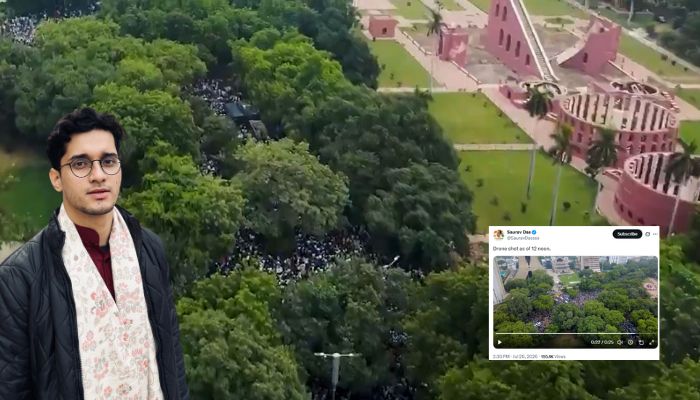
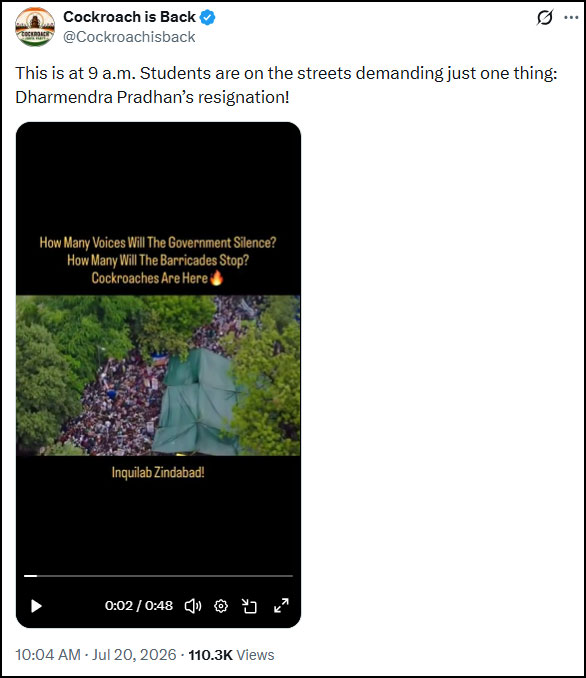
At around 10 am, a drone shot showed Jantar Mantar packed with protesters responding to the Cockroach Janta Party’s (CJP) “Sansad Chalo” call ahead of the proposed march towards Parliament. Notably, Delhi Police did not grant permission for the protest. The aerial footage captured the gathering from above and was circulated to demonstrate the number of people who had assembled at the protest venue.
Source: CJP/X
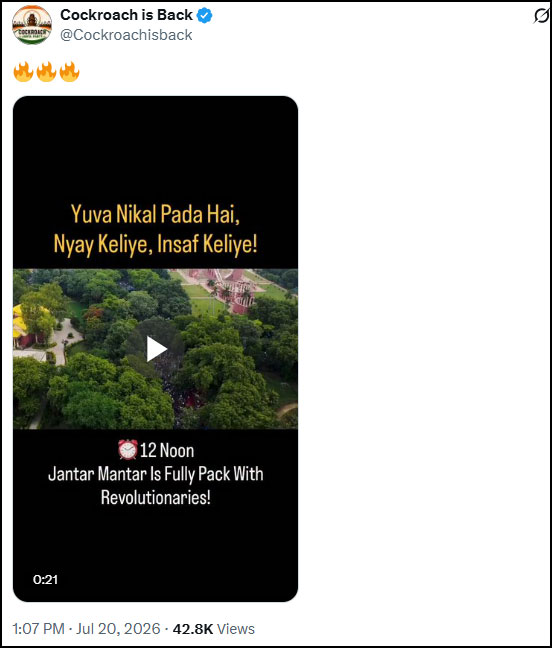
Another video was shared at around 1 pm.
Source: CJP/X
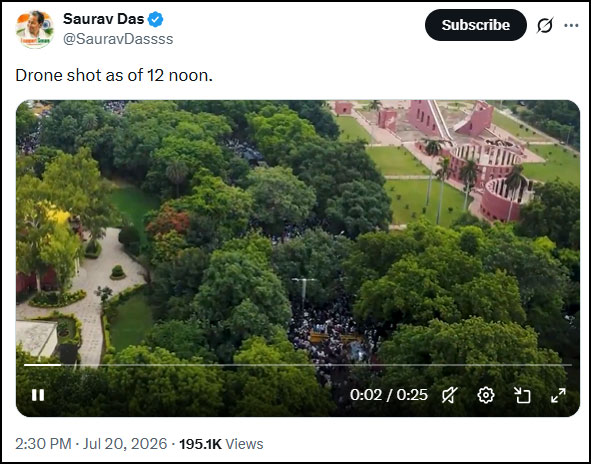
Another video was shared by CJP’s spokesperson Saurav Das at around 2:30 pm.
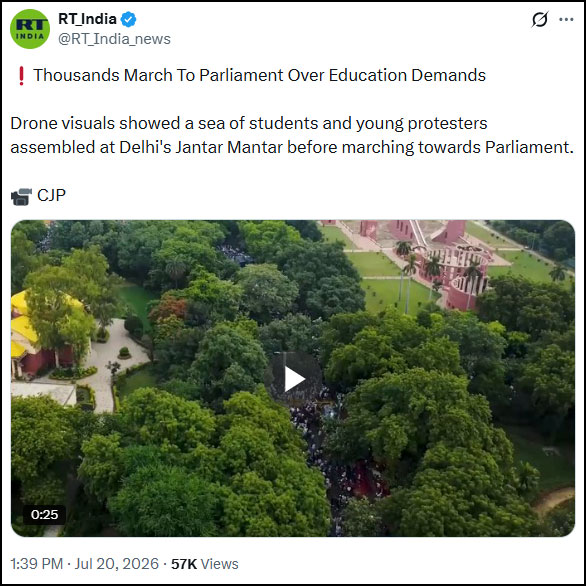
The video shared by Das was also shared with national and international media houses, and was further amplified through their social media handles. However, the footage has also raised serious questions over the legality of the drone flight.
Source: RT India/X
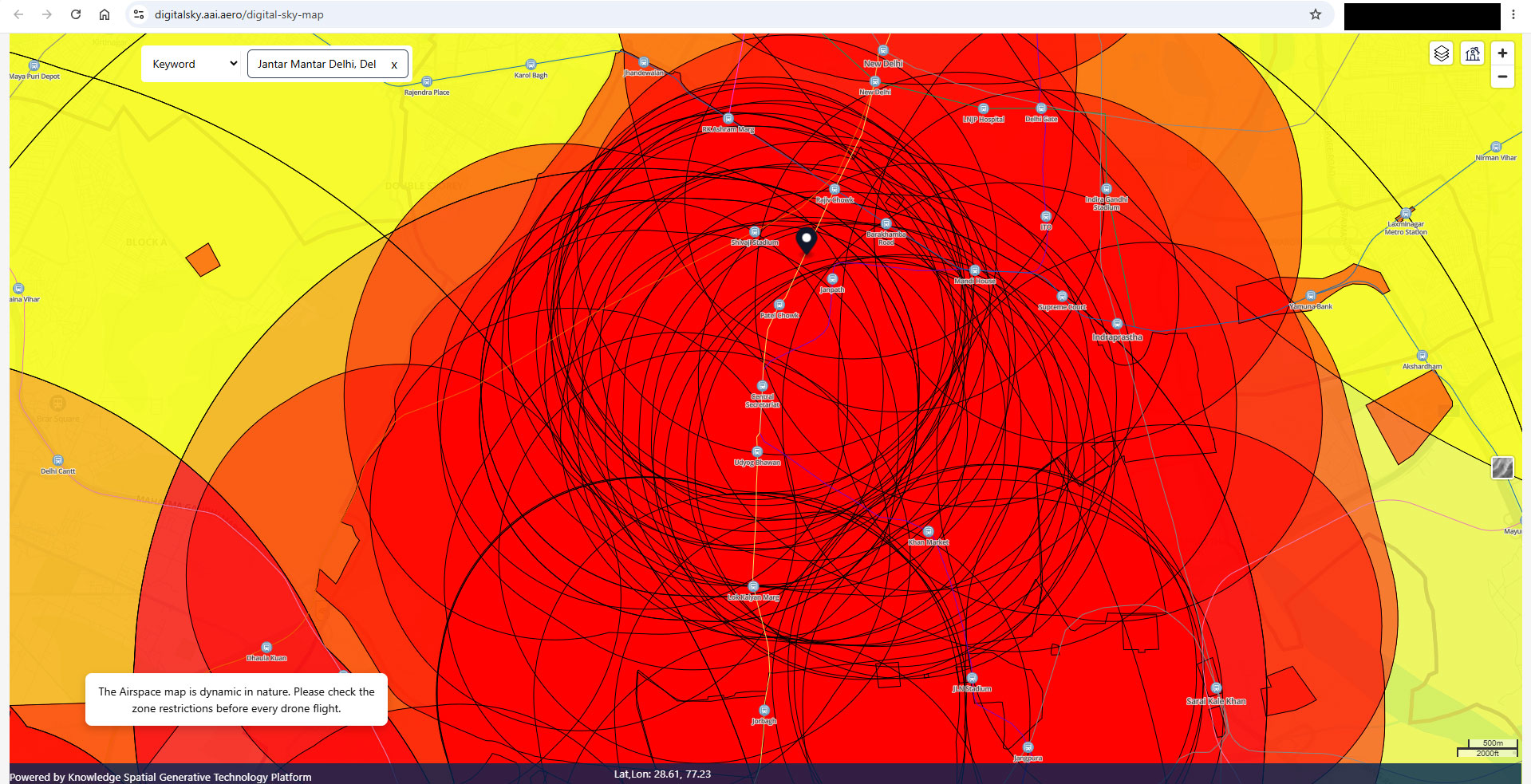
A check of the Government of India’s Digital Sky airspace map shows Jantar Mantar inside multiple red zones. Under the Drone Rules, 2021, no person can operate a drone in a red zone without prior permission. A red zone is the most restricted category on the map, and drone operations inside it can be permitted only by the Central Government. Any unauthroised drone flight in red zone is a serious national security concern.
The black pin on the map is the location of Jantar Mantar. As depicted by the circles around it, the location falls under multiple red zones. Source: Digital Sky
Therefore, unless the operator had secured prior permission from the Central Government, the drone used to capture the CJP protest footage was flown illegally.
The question for CJP and the person who recorded or uploaded the footage is straightforward, that is, who authorised the drone flight over Jantar Mantar, and under which Central Government permission was it conducted?
Considering that CJP did not seek permission for the protest, it is hard to believe that the person who operated the drone had obtained permission to fly it in the restricted area.
Jantar Mantar falls inside a red zone
According to the Drone Rules, 2021, the remote pilot is required to verify the flight path on the Digital Sky platform before commencing any flight. The pilot must check whether any notification or restriction applies to the intended area of operation.
According to Rule 22 of the Drone Rules, no person can operate an unmanned aircraft system in a red or yellow zone without permission. Only a flight conducted in a green zone is exempt from prior permission, and even there, the pilot is required to verify the latest restrictions before taking off.
For those who are unfamiliar with the zoning mechanism, it must be understood that it is not fixed. The zoning is dynamic, and the Central Government can update the Digital Sky map and change the status of an area when and where required. This means an operator cannot rely on an old map, a previous flight or an assumption that a location is open for drones. The map must be checked before every flight.
The Ministry of Civil Aviation describes a red zone as a “no-drone zone”. According to the ministry, drones can be operated in such an area only after obtaining permission from the Central Government. The ministry also says that anyone planning a drone operation must check the latest Digital Sky map for changes in zone boundaries.
The purpose of the flight does not alter the restriction. A drone does not become exempt merely because it is being used for protest publicity, photography, journalism, social media content or recreational recording.
Similarly, keeping the drone at a relatively low altitude does not make the operation legal. Once the location is marked as a red zone, prior Central Government permission is required for the flight itself.
What green, yellow and red zones mean
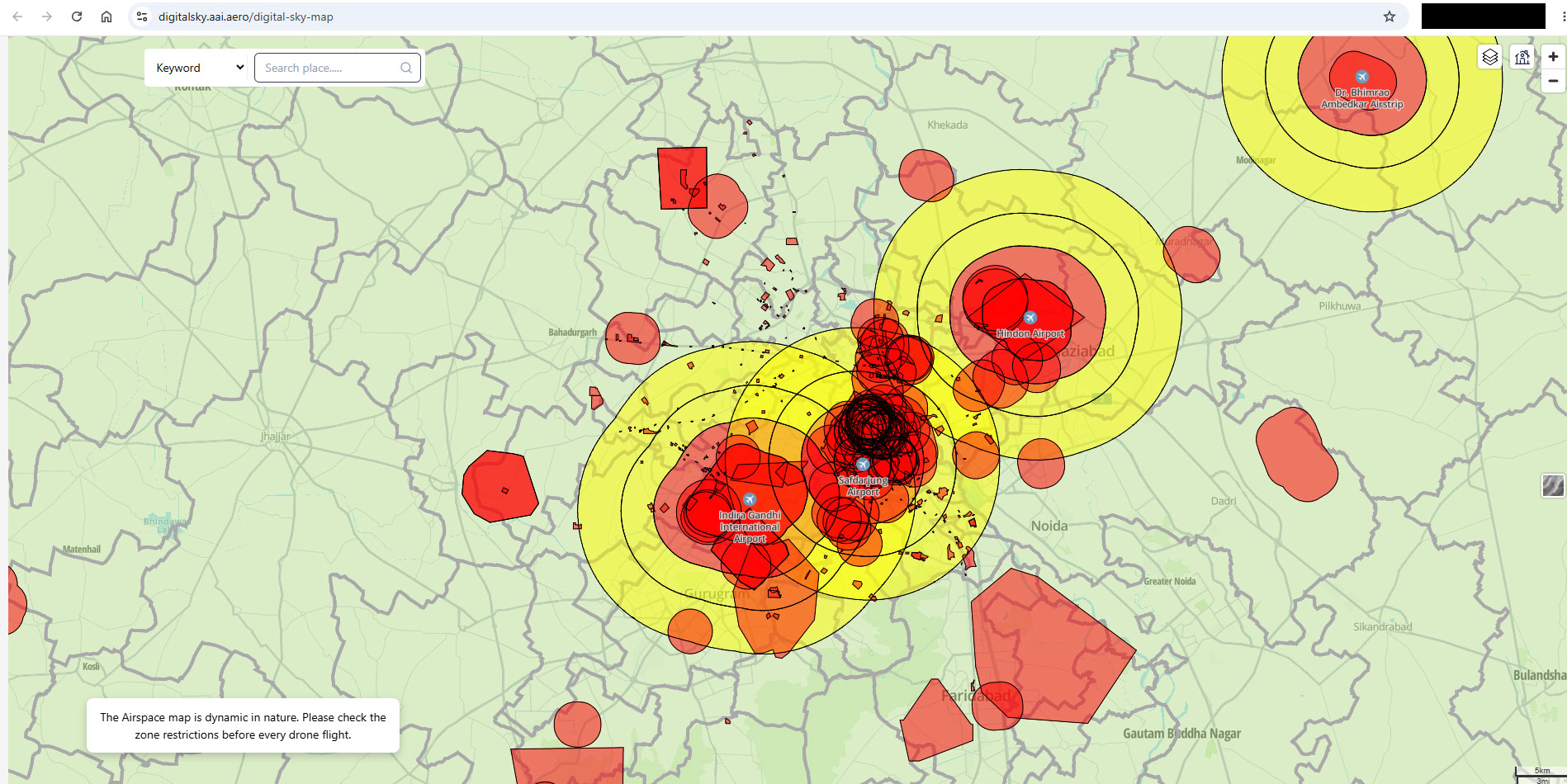
The Digital Sky airspace map divides India’s airspace into green, yellow and red zones. The colours determine whether prior permission is needed and which authority is competent to issue it.
How Red, Yellow, and Green Zones appear on the map. Source: Digital Sky
Green zone
A green zone generally covers airspace up to 400 feet, or 120 metres, above an area that has not been designated as yellow or red.
There is a separate height restriction near operational airports. In an area situated between 8 kilometres and 12 kilometres from an operational airport’s perimeter, only airspace up to 200 feet, or 60 metres, is treated as green.
Prior flight permission is not required in a green zone. However, this does not mean that all other regulations disappear. The drone may still need registration, the operator may need a remote pilot certificate, and the pilot must check the Digital Sky map before the flight.
Yellow zone
A yellow zone is restricted airspace where drone operations require prior permission from the concerned Air Traffic Control authority.
Depending on the airspace, the competent authority may be the Airports Authority of India, the Indian Air Force, the Indian Navy, Hindustan Aeronautics Limited or another designated air traffic authority.
The airspace above 400 feet in an otherwise green zone becomes yellow. Around an operational airport, different altitude and distance restrictions also apply. The Ministry of Civil Aviation says that yellow-zone permission must come from the concerned ATC authority.
Red zone
A red zone is airspace in which drone operations are allowed only with Central Government permission.
The Drone Rules define it as airspace of specified dimensions over land, territorial waters, specified installations or notified port limits where the Central Government may allow drone operations in exceptional circumstances.
A local organiser, private security agency, police officer, photographer or drone service provider cannot independently authorise a red-zone flight. Permission from another authority also cannot replace the permission specifically required from the Central Government.
Temporary red zone
A state government, Union Territory administration or law enforcement agency can declare a temporary red zone when there is an urgent need to prohibit drone flights in an area.
Such a temporary restriction can remain in force for up to 96 hours at a time. It must be declared by an officer not below the rank of Superintendent of Police or an equivalent officer.
The authorities may attempt to inform registered drone owners located within five kilometres of the temporary red zone. However, failure to receive such an alert does not excuse the pilot. The responsibility to check Digital Sky remains with the person operating the drone.
A small camera drone is not exempt from red-zone rules
Civilian drones are classified according to their maximum all-up weight, including the payload carried by them.
A nano drone weighs up to 250 grams. A micro drone weighs more than 250 grams but not more than 2 kilograms. A small drone weighs more than 2 kilograms but not more than 25 kilograms.
A medium drone weighs more than 25 kilograms but not more than 150 kilograms, while a large drone weighs more than 150 kilograms.
Many camera drones commonly used to record political programmes, weddings, public gatherings and social media videos fall under the nano or micro categories. It is generally assumed that because a drone is lightweight, it would be exempt from obtaining permission to record in a red zone, which is false. Their lower weight does not permit them to enter a red zone.
The exemption available to some small drones concerns the remote pilot certificate, not restricted airspace. A remote pilot certificate is not required for operating a nano drone. It is also not required for a micro drone being used for non-commercial purposes. The Drone Amendment Rules, 2022, replaced the earlier term “remote pilot licence” with “remote pilot certificate”, which is issued by an authorised remote pilot training organisation.
However, Rule 22 does not create a nano-drone or micro-drone exception for red zones. Even a drone weighing less than 250 grams requires Central Government permission before it can be flown inside a red zone.
The nature of the footage may also become relevant while determining whether a micro-drone operation was genuinely non-commercial. A drone commissioned by an organisation or media team for promotional or professional footage cannot automatically be treated as a private, non-commercial recreational flight.
Registration, pilot certification and other requirements
Red-zone authorisation is only one part of drone compliance. The Drone Rules generally prohibit a person from operating a drone without first registering it on the Digital Sky platform and obtaining a Unique Identification Number (UIN), unless the drone or operation has been granted a specific exemption.
The UIN is linked to the drone’s manufacturer-provided serial number, flight-control module and remote pilot station. The person operating the aircraft is also responsible for ensuring that it conforms to a valid type certificate where such certification is required.
Where a remote pilot certificate is necessary, the person flying the drone must possess a valid certificate applicable to the relevant category, sub-category and class of unmanned aircraft system.
The rules also prohibit the operation of a drone in a manner that directly or indirectly endangers the safety and security of any person or property. Drones must remain clear of manned aircraft and cannot interfere with their right of way.
Flying above a tightly packed gathering does not automatically prove that the safety rule was violated. However, it creates an additional issue that the authorities may examine. A malfunction, loss of control, battery failure or collision could cause a drone to fall upon the people assembled below.
Third-party insurance requirements also apply to drone operations, although nano drones are exempt from the insurance requirement.
India liberalised drone use, but did not remove security restrictions
The Drone Rules, 2021, were introduced by the Government of India as part of an attempt to simplify the civilian drone regime and encourage the legitimate use of unmanned aircraft systems. According to the government, the framework is based on trust, self-certification and non-intrusive monitoring. With the rules, the number of forms was reduced from 25 to five, and the number of different fee categories was brought down from 72 to four.
Digital Sky was developed as a user-friendly, single-window system. Several approvals were abolished, and green-zone operations were freed from prior flight permission. The yellow-zone radius around airports was also reduced from 45 kilometres to 12 kilometres. However, liberalisation did not mean that anyone could fly a drone anywhere.
The government removed unnecessary restrictions from low-risk green-zone operations while maintaining strict control over airports, defence establishments, government buildings, strategic locations, densely populated areas and other sensitive airspace.
The rules preserved mandatory zoning, pre-flight verification, registration, certification and safety obligations. They also enabled law enforcement agencies to impose temporary restrictions where an urgent security threat emerged.
This is where the distinction becomes important. Flying a drone inside a red zone is not simply a failure to complete an ordinary form in an otherwise unrestricted area. It amounts to entering airspace where civilian drone operations are barred unless the Central Government grants permission.
Why even ordinary camera drones are treated as a security concern
A civilian quadcopter may appear to be nothing more than a flying camera. However, the same basic platform can be used for purposes extending far beyond photography.
Modern camera drones can transmit live video, record high-resolution footage, hover over a location, follow programmed routes and return automatically to their launch point. Depending on the model, they can also carry objects in addition to the camera installed on them.
Such capabilities can be used lawfully for surveying, agriculture, mapping, rescue operations, filmmaking and infrastructure inspection. They can also be misused to observe security deployments, identify access routes, record sensitive installations or carry prohibited payloads.
Authorities cannot determine the operator’s intention merely by looking at a drone in the sky. A machine used to record a public gathering may outwardly resemble another drone being used for reconnaissance or carrying an unauthorised object.
This is why the regulations focus on the location, aircraft, operator and permission rather than accepting the claimed purpose of the flight after the drone has already entered restricted airspace.
Drones have changed the character of modern warfare
Drones are playing a significant role in modern warfare. Earlier, military air power was dominated by fighter aircraft, helicopters and large surveillance platforms. Drones were primarily viewed as specialised systems used by technologically advanced militaries. Cheap commercial quadcopters, first-person-view drones, loitering munitions and autonomous systems have changed that equation.
Small drones can observe enemy positions, relay targeting information, strike vehicles, attack soldiers or force expensive air-defence systems to respond to comparatively inexpensive threats. Their low cost allows military units to deploy them in large numbers without risking a pilot.
However, fighter jets have not become obsolete. They continue to dominate deep-penetration missions, air superiority, electronic warfare, high-speed operations and strikes requiring larger payloads.
The emerging model combines manned and unmanned aircraft. Drones can fly ahead, locate targets, absorb defensive fire and conduct strikes while the manned aircraft remains at a safer distance. Warfare is increasingly being shaped not only by speed and firepower but also by data, signals, software, electronic warfare and autonomous systems.
The development of drone warfare nevertheless explains why governments do not treat unidentified drones near sensitive locations as harmless toys merely because they carry cameras.
Operation Sindoor demonstrated the offensive and defensive use of drones
Operation Sindoor showed how drones now operate on both sides of a modern conflict. According to an official government account, Pakistan attempted to target several military locations in northern and western India with drones and missiles on the night of 7th and 8th May 2025.
The attempted attacks covered locations including Srinagar, Jammu, Pathankot, Amritsar, Jalandhar, Ludhiana, Bathinda, Chandigarh and Bhuj. India’s Integrated Counter-UAS Grid and air-defence systems detected and neutralised the threats.
Pakistan subsequently carried out drone and unmanned combat aerial vehicle attacks against Indian airbases and logistics infrastructure. The attacks were countered by India’s layered air-defence network and integrated command-and-control systems.
India also used drones offensively during the operation. The government said that loitering munitions were used to locate and destroy important targets, including radar and missile systems. Such systems are also described as kamikaze or suicide drones because they remain in the target area before striking an identified objective.
Long-range drones and guided munitions formed part of India’s precision-strike capability. Indian forces also recovered or identified Turkish-manufactured UAVs, long-range rockets, quadcopters and commercial drones used during Pakistan’s attempted attacks.
The response involved a combination of counter-UAS systems, electronic warfare equipment, shoulder-fired weapons, older air-defence guns and modern missile systems.
Therefore, Operation Sindoor showed the complete cycle of drone warfare. Drones were used for surveillance, attempted attacks and precision strikes, while electronic warfare and counter-drone systems were used to detect, jam and destroy them.
What penalties can apply
The Drone Rules provide for action against those who violate the regulations. The authority can impose a penalty of up to Rs 1 lakh after giving the person concerned an opportunity to be heard.
The DGCA can also suspend or cancel a certificate, authorisation or approval if the holder is found to have violated the rules. The rules, as notified in 2021, classified the contravention of the prior-permission requirement under Rule 22 as cognisable and non-compoundable.
The Aircraft Act, 1934, under which the Drone Rules were originally issued, was replaced by the Bharatiya Vayuyan Adhiniyam, 2024, which came into force on 1st January 2025. However, Section 43 of the new law preserves rules, permissions, certificates and other actions taken under the repealed Act, provided they are not inconsistent with the new legislation. The Drone Rules, therefore, continue to operate under the corresponding provisions of the new law.
The Bharatiya Vayuyan Adhiniyam also separately provides punishment where an aircraft is wilfully flown in a manner that endangers a person or property. Such an offence can attract imprisonment of up to two years, a fine of up to Rs 1 crore, or both. Whether that provision applies would depend on the circumstances of the flight and the evidence available to the authorities.
CJP must disclose who authorised the drone flight
The video shared by CJP from Jantar Mantar shows that a drone was operating above the protest venue at around 9 am. The Digital Sky map places the location inside multiple red zones. Under the Drone Rules, the flight could be legally conducted only after prior permission from the Central Government.
The drone’s size, the fact that it was recording a political programme and the claim that it was used only to show the crowd do not replace the legally prescribed authorisation.
CJP and the person who published the footage should disclose the drone’s model, weight and registration number, the identity and certification of its operator, and the Central Government permission under which it was flown.
In the absence of such permission, the drone flight used to capture the ‘Sansad Chalo’ gathering was unauthorised and violated India’s red-zone drone regulations, and the authorities must take necessary action before this gives the impression that such activities are allowed in red zones.
On 20th July (Monday), the Drug Controller General of India (DCGI) has allowed market authorisation to Takeda Biopharmaceuticals India Private Limited for a dengue prevention vaccination “QDENGA” in a significant breakthrough in the fight against the fatal disease.
According to the company, pre-vaccination screening including blood-test is not necessary for this live-attenuated tetravalent vaccine which means that it protects against all four dengue virus serotypes (DENV 1, 2, 3 and 4) and can be administered irrespective of prior dengue exposure in contrast to certain other dengue vaccines like Dengvaxia.
Takeda, a Japanese pharmaceutical entity teamed up with Hyderabad-based Biological E vaccine manufacturer in 2024 to increase QDENGA production in line with “Make in India” mission. Furthermore, the former has set a target of producing 100 million doses yearly for the world by the end of the decade. The goal would be aided by this partnership which intends to build a manufacturing capacity of 50 million doses annually.
The vaccine can be provided to individuals between the ages of 4 and 60. More than 40 countries such as the European Union, the United Kingdom, Brazil, Indonesia and Argentina have already given a nod to the vaccine and India has followed suit as dengue turns out to be among its worst seasonal public health risks.
Mahender Nayak, Head of Intercontinental Markets at Takeda expressed, “Since its launch in 2022, QDENGA has been approved in 43 countries, with more than 32 million doses distributed globally. This approval marks an important step forward in strengthening dengue prevention in India.”
It is intended to boost immunity against all four dengue virus serotypes, minimising the likelihood of severe illness that can lead to hospitalisation and symptomatic dengue. The vaccination is given in two doses of 0.5 milliliter spaced three months apart by subcutaneous injection.
World Health Organisation (WHO) has advised its usage in regions with a high dengue transmission prevalence as part of a global dengue control plan alongside incorporation in public immunisation programs in high-transmission areas without needing pre-vaccination verification.
How useful is QDENGA
The firm mentioned that long-term data gathered over a seven-year period demonstrated that the vaccination remains effective in providing protection against hospitalisation and dengue infection triggered by all four dengue virus serotypes.
The results of Takeda’s worldwide clinical research program, which comprised 19 Phase I, II, and III clinical trials with over 28,000 individuals in both dengue-endemic and non-endemic countries, served as the foundation for the acceptance. The Phase III DEN-302 clinical trial in India, which examined the vaccine’s safety and immunological response in individuals aged 4 to 60 in India, provided further support for the conclusion.
Over 20,000 children and adolescents from 8 dengue-endemic nations engaged in the crucial TIDES Phase III trial, which generated positive long-term outcomes. The review consisted of 4.5 years of monitoring which illustrated that the vaccine showcased 84.1% protection against hospitalisation due to dengue, 90.4% efficacy against dengue-related hospitalisation after 18 months and overall, about 61% protection against dengue with virological confirmation.
Furthermore, efficency varied by dengue serotype but both persons with and without prior dengue infection had sustained protection against severe dengue. The WHO’s recommendation and other worldwide regulatory licenses were influenced by these findings. Nayak conveyed, “Dengue is a growing public health challenge, and India needs sustained, evidence-based prevention.”
Empirical substantiation and ongoing pharmacovigilance to improve knowledge of the vaccine’s safety and efficacy further advance these clinical aims.
The significance for India
The permission comes as India continues to record one of the largest dengue cases in the world and the four virus serotypes circulate at the same time in various places within its borders. The tally has risen dramatically as a result of population expansion, urbanisation, shifting mosquito habitats and climate change.
The reports have surged more than 11-fold over the past 20 years with India accounting for about one-third of worldwide dengue epidemic. Hospitals continue to be under tremendous strain from seasonal outbreaks, especially during the monsoon and post-monsoon seasons. Control of mosquitoes, removing breeding grounds, personal safety precautions, early diagnosis and supportive care were prescribed to counter the menace. However, the vaccine has added another crucial layer to tackle the issue.
Goh Choo Beng, Medical Affairs Head for Takeda’s Southeast Asia and India Cluster pointed out, “Its approval represents an important step in strengthening India’s comprehensive approach to dengue prevention, alongside vector control, surveillance, community awareness and other public health measures.”
QDENGA has been prequalified by the WHO, indicating that it satisfies international standards for efficacy, safety and quality as well as validates the vaccine for purchase by global entities like the Pan American Health Organisation (PAHO) and United Nations International Children’s Emergency Fund (UNICEF).
Local production might boost supply and cut off dependence on imports. The cost of the vaccine will also vary subject to whether it is first solely available on the commercial market or if it is subsequently introduced to government immunisation schemes.
The way forward
The prevention of mosquito bites and the management of mosquito reproduction cannot be replaced by vaccination. WHO highlighted that it should be implemented as part of an integrated approach that consists of control of mosquitoes, awareness of the community, early diagnosis, obtaining healthcare and monitoring.
However, Dengue cannot be totally eradicated by extremely effective vaccinations because 4 distinct virus serotypes are simultaneously transmitted, infection is continuously spread by mosquito populations which are flourishing due to urbanisation and climate change. According to experts, vaccinations should assist with current public health initiatives rather than take their place.
During seasonal outbreaks, QDENGA could lessen hospital admissions, acute medical conditions and the load on healthcare systems if it is extensively implemented. Moreover, India is presently positioned as a key manufacturing location for the world’s supply of dengue vaccines owing to the agreement between the two sides which could also prove advantageous for the country.
India at the forefront of vaccine development
India’s capability for vaccine research and development is accelerating as it continues to be an essential part in the creation of critical new vaccines. The nation is one of the world’s leading producers of vaccines and its stature in this field was recently evident during the Covid-19 pandemic.
India had built its first domestic vaccine “Covaxin” which was created by pharmaceutical firm Bharat Biotech and government-funded Indian Council of Medical Research (ICMR) and the National Institute of Virology (NIV) at the time.
On the other hand, Pune’s Serum Institute of India (SII) made Covishield, a variant of the AstraZeneca-Oxford COVID-19 vaccine along with Covovax XBB.1.5 and Covovax (developed by Novavax). The vaccines were also exported to other countries as part of New Delhi’s “Vaccine Maitri”(Friendship) campaign and flew at least more than 298 million vaccines to about 100 countries worldwide.
SII also developed and produces “Cervavac” which is an indigenous Human Papillomavirus (HPV) vaccine that protects against its 4 HPV types (6, 11, 16, 18). India’s Department of Biotechnology, the Biotechnology Industry Research Assistance Council and the Bill & Melinda Gates Foundation were also involved in the project. The vaccine is used to prevent genital warts and cervical cancer. It was recognised by the drug controller general of India in January 2023.
India has also developed vaccines for polio, rabies, Hepatitis B, Swine flu, Meningitis, Cholera, Japanese Encephalitis and Rotavirus Gastroenteritis, among others.
“India accounts for 60 per cent of global vaccine production making it the largest vaccine producer in the world. India is also one of the biggest suppliers of low-cost vaccines in the world and is the largest provider of generic medicines globally, occupying a 20% share in global supply by volume,” an estimate suggested in 2023.
The central government is all set to introduce an important piece of legislation in the Rajya Sabha on Monday, 20th July, marking the very first day of the Parliament’s Monsoon Session. Union Home Minister Amit Shah will introduce the Prevention of Insults to National Honour (Amendment) Bill, 2026, which aims to make any insult or obstruction to the national song, Vande Mataram, a criminal offence.
The bill has already been formally listed on the Rajya Sabha’s agenda for the day, following a prior clearance by the Union Cabinet. This legislative move comes as part of the country’s year-long celebrations marking the historic 150th anniversary of the creation of Vande Mataram.
If Parliament passes the Bill, deliberately insulting Vande Mataram, stopping its rendition or creating a disturbance while it is being sung could attract punishment of up to three years in jail, a fine, or both.
🚨 The government is set to introduce a bill in the Rajya Sabha today to make insulting 'Vande Mataram' a criminal offense. pic.twitter.com/47nTo9XyAh
— Indian Tech & Infra (@IndianTechGuide) July 20, 2026
At present, the Prevention of Insults to National Honour Act, 1971provides legal protection to the National Flag, the Constitution, and the National Anthem. However, there is no specific provision in the law that deals with insults to the National Song. The proposed amendment aims to fill this gap by bringing Vande Mataram within the scope of the Act.
According to the Bill’s statement of objects and reasons, there is currently “no specific legal provision” to prevent anyone from intentionally disrupting or insulting the singing of Vande Mataram. “The proposed amendment seeks to prohibit any person from deliberately preventing the singing of the National Song or causing disturbance during its rendition by making such acts punishable under law,” the government has said.
The Union Cabinet had earlier approved the proposal to amend the 1971 Act before it was listed for introduction in Parliament.
What the Bill will change
The biggest change proposed by the Bill is that Vande Mataram will receive the same statutory protection as Jana Gana Mana. Once the amendment becomes law, any deliberate act of insulting the National Song or intentionally disrupting its performance will be treated as a criminal offence in the same manner as offences involving the National Anthem or National Flag.
The Centre intends to bring a bill in the Rajya Sabha to make any obstruction or insult to the national song Vande Mataram a criminal offence on Monday, the first day of the Monsoon Session of Parliament.
The government says the move is aimed at ensuring equal respect for both national symbols. “The objective is to extend the same legal protection to the National Song that already exists for the National Anthem under the Prevention of Insults to National Honour Act,” the proposed legislation states.
The amendment is also being brought as part of the year-long celebrations marking the 150th anniversary of Vande Mataram, which has played an important role in India’s freedom movement.
Key changes and legal penalties under the proposed law
Once this proposed legislation is passed by the parliament, any deliberate insult directed at Vande Mataram or any intentional disruption created during its rendition will become a criminal offence.
The legal consequences for breaking this law are stringent. Anyone found guilty of intentionally insulting the song or deliberately obstructing people from singing it will face a prison term of up to three years, a fine, or both. The government hopes that by introducing these tough penalties, the song will receive the highest level of legal dignity and protection across the country.
Alongside the criminal penalties, the new bill outlines a very specific set of protocol guidelines regarding how the national song should be performed and respected. The legislation mandates that Vande Mataram must be sung at all official government functions and should be performed right before the commencement of these official programmes.
Furthermore, the guidelines state that all six stanzas of the song must be rendered during these occasions, which takes a total time of approximately 3 minutes and 10 seconds. The law also requires that people remain standing in the attention position while the song is being sung.
Additionally, schools will be required to play or sing Vande Mataram every day before their morning prayers begin.
Earlier, the Union Home Ministry had directed states to ensure that wherever the National Anthem is played during official events, the National Song should also be performed according to the prescribed protocol, with Jana Gana Mana following Vande Mataram.
Historical significance of India’s National Song
Vande Mataram was written by renowned author Bankim Chandra Chattopadhyay. The song, written in a blend of Sanskrit and Bengali, consists of six stanzas and first appeared in his famous novel Anandamath.
It was publicly sung for the first time in Calcutta in 1896 and later became one of the most powerful symbols of India’s freedom struggle. Over the decades, the song has remained closely associated with the country’s nationalist movement and continues to hold a special place in India’s cultural and political history.
Political debate begins before the introduction
Even before the Bill is formally introduced in Parliament, it has triggered a political debate.
The Bharatiya Janata Party (BJP) has described the proposed legislation as an important step towards strengthening respect for national symbols and preserving the dignity of Vande Mataram.
🔴#BREAKING | Home Minister Amit Shah to introduce Vande Mataram bill tomorrow in Parliament : Bill aims to protect the National Song, to include 3 years jail for disrupting it
The Congress, however, has criticised the move, arguing that it reflects what it called the Modi government’s “jail first” approach to governance. Opposition leaders have questioned whether criminal penalties are the right way to promote respect for national symbols.
The CPI(M) is also opposing the Bill. Speaking to media, CPI(M) MP John Brittas stated, “I have also written a letter to Amit Shah, saying that he should forthwith withdraw this Bill. When this issue came up in the Supreme Court in March, the Supreme Court had said that there is no legal burden and there is no penal provisions attached to this and that they are not entertaining the plea. Now, since the Govt failed on its executive mission, they want to come around with a legislative move to thrust this upon us. They shouldn’t enter into a situation whereby patriotism can be manufactured by such acts of criminalising anything concerning Vande Mataram”
#WATCH | Monsoon session of Parliament | Delhi: On Prevention of Insults to National Honour (Amendment) Bill, 2026, CPI(M) MP John Brittas says, "I have also written a letter to Amit Shah, saying that he should forthwith withdraw this Bill. When this issue came up in Supreme… pic.twitter.com/of6RIZX0DT
The Government of India is set to introduce the Prevention of Insults to National Honour (Amendment) Bill, 2026. It aims to provide statutory protection to the National Song, Vande Mataram. The proposed amendment will expand Section 3 of the Prevention of Insults to National Honour Act, 1971, which currently punishes anyone who intentionally prevents the singing of the National Anthem or disrupts an assembly engaged in singing it. According to media reports, the words “national song” will now be added alongside “national anthem”.
That means once the amendment is passed by Parliament, anyone who intentionally prevents the singing of Vande Mataram or disturbs an assembly singing it could face imprisonment of up to three years, a fine, or both. A person convicted again under the law would face a minimum prison sentence of one year. The Bill has been listed for introduction in the Rajya Sabha during the Monsoon Session that began on 20th July.
The amendment came after the Union Home Ministry issued guidelines requiring the complete version of Vande Mataram to be sung at state functions and civil investiture ceremonies. However, the penal provision quoted in the proposed Bill deals with intentional prevention and disruption. It does not state that a person would be jailed merely for remaining silent or choosing not to sing.
The Statement of Objects and Reasons refers to the Constituent Assembly meeting held on 24th January 1950. Constituent Assembly president Rajendra Prasad had declared that Vande Mataram, which played a historic role in India’s freedom struggle, would be honoured equally with Jana Gana Mana and would have equal status.
Despite this declaration, the national song remained outside the legal protection available to the National Anthem, the Indian flag and the Constitution. Section 3 of the existing Act only criminalises the intentional prevention or disruption of the National Anthem.
Islamists and the Left oppose the Vande Mataram decision
Even before the amendment reached Parliament, Islamist organisations, Left parties and opposition leaders had launched a campaign against the government’s decision to require the singing of all six stanzas of Vande Mataram at official functions and schools.
The All India Muslim Personal Law Board described the direction as unconstitutional, contrary to religious freedom and unacceptable to Muslims. It threatened to challenge the government’s decision in court.
AIMPLB general secretary Maulana Mohammed Fazlur Rahim Mujaddidi argued that references to Hindu deities in the later stanzas conflicted with Islamic monotheism. He claimed that Muslims could not accept the direction because Islam prohibits associating partners with Allah.
Both factions of the Jamiat Ulama-i-Hind also opposed the decision. Maulana Arshad Madani called it biased and portrayed it as a conspiracy to take away the religious freedom of Muslims. He further described it as a coercive attempt to curtail minority rights.
The CPI(M) demanded the withdrawal of the order and accused the government of manufacturing a controversy around national symbols. CPI Rajya Sabha MP Sandosh Kumar P accused the government of “weaponising culture”, while the Trinamool Congress claimed that the Centre was distorting the history and lyrics of Vande Mataram.
Congress MLA Arif Masood similarly objected to the complete rendition of the national song in Madhya Pradesh, claiming that imposing it would restrict religious freedom.
These arguments may be used to debate which version should be performed at official ceremonies. However, they do not explain why anyone should have the right to physically obstruct other citizens from singing Vande Mataram, disturb an assembly, desecrate the national flag or use violence against a patriotic procession.
The proposed provision does not criminalise a theological objection expressed through lawful means. It criminalises intentional interference with the right of others to sing the national song.
Remember what happened to Chandan Gupta
The murder of 22-year-old Chandan Gupta in Kasganj showed why hostility towards national symbols cannot always be dismissed as disagreement, political rhetoric or a matter of personal religious belief.
On 26th January 2018, Chandan Gupta, his brother Vivek and several other youths participated in a Tiranga Yatra organised in Kasganj, Uttar Pradesh, to celebrate Republic Day. They carried the Indian flag and raised slogans including “Bharat Mata Ki Jai” and “Vande Mataram”.
According to the FIR, witness statements and court documents accessed by OpIndia, an armed Muslim mob blocked the procession near the Government Girls’ Inter College.
Members of the mob snatched the national flag from the participants, threw it on the ground and raised slogans of “Pakistan Zindabad” and “Hindustan Murdabad”. They demanded that the participants chant “Pakistan Zindabad” before they would be allowed to pass.
Chandan opposed the demand. The mob began pelting stones and opened fire. Saleem shot Chandan, causing fatal injuries to his lungs and heart. Chandan was rushed to the district hospital, where he was declared dead.
The attack was not simply the result of two groups disagreeing over a route, as sections of the media attempted to portray it at the time. The national flag was snatched and desecrated. A Tiranga Yatra was forcibly stopped. Patriotic slogans, including “Vande Mataram”, were answered with pro-Pakistan slogans. Those carrying the Indian flag were ordered to praise Pakistan, and Chandan was shot when he resisted.
On 2nd January 2025, a Special NIA court convicted 28 people in connection with Chandan Gupta’s murder. On 3rd January, all 28 convicts were sentenced to life imprisonment.
The court observed that members of the mob were armed with firearms, rods and sticks and had carried out communal violence against the Hindu participants. It described communalism as a mindset in which religious interests are placed above the interests of society and the nation.
Chandan’s family also faced intimidation during the trial. His father, Sushil Gupta, told the court that the influence of accused Munazir Rafi had created such a hostile environment in Kasganj that senior lawyers refused to represent the family. The Allahabad High Court eventually accepted the family’s apprehension and transferred the trial outside Kasganj.
From religious objection to jihadist hostility
There is a difference between declining to sing a song because of a personal belief and attacking people for singing it. A citizen may approach a court, question the government’s guidelines, challenge the inclusion of particular stanzas or peacefully remain silent. Such actions fall within the realm of constitutional and political debate.
However, Islamists have repeatedly attempted to convert their religious objection into a veto over the behaviour of everyone else. The objection is no longer limited to saying, “I will not sing.” It becomes, “You will not sing either.” In its most violent form, as seen in Kasganj, it becomes an armed mob stopping a procession, throwing the Indian flag on the ground, forcing Indians to chant pro-Pakistan slogans and killing a Hindu who refuses.
Therefore, the Chandan Gupta case is central to understanding why there is a need for such an amendment. A national symbol cannot enjoy equal constitutional status only on paper while organised groups remain free to physically disrupt its rendition or threaten citizens participating in an event where the National Song is being sung.
There is an interesting aspect to the ideological hostility in the case of Vande Mataram, and it is clearly selective. The organisations and individuals who invoke religious freedom to oppose Vande Mataram fail to explain why the freedom of other Indians to sing the National Song should be subject to Islamist approval.
Furthermore, Left-liberal political parties fail to explain why protecting Vande Mataram from intentional disruption amounts to imposing religion. The existing law has protected the National Anthem for decades. Extending the same protection to a national song that the Constituent Assembly placed on an equal footing is neither unprecedented nor extraordinary. In fact, it is something that the Indian government should have done decades ago.
Beyond theology: How Islamist opposition to Vande Mataram reflects a deeper rejection of national symbols
The proposed amendment, when passed, will ensure that the law does not have to wait for another Chandan Gupta to be killed before recognising the danger posed by those who believe their religious ideology gives them the right to obstruct, intimidate or attack Indians honouring their national song.
The proposed amendment also raises a larger ideological question that goes beyond the legal protection of Vande Mataram. For Islamists, the opposition has rarely been confined to specific lyrics or theological concerns. Their resistance often stems from a worldview that places the concept of the Ummah, the global community of Muslims, above the nation-state as the primary locus of political and civilisational loyalty. From this perspective, expressions of territorial nationalism are frequently viewed with suspicion, particularly when they are rooted in India’s historical and cultural traditions. It is this ideological framework, rather than merely isolated religious objections, that critics argue explains the recurring hostility towards national symbols such as Vande Mataram, the Tricolour and even slogans like “Bharat Mata Ki Jai”.
This pattern is evident in the way several Islamist groups have consistently opposed Vande Mataram over the decades while advancing arguments that are legally and historically tenuous. The Constitution does not compel citizens to profess any religious belief through the National Song, nor does the proposed amendment criminalise a person’s decision to abstain from singing it. Instead, it penalises the deliberate disruption of others exercising their right to honour a national symbol. The debate, therefore, is no longer about personal conscience but about whether organised groups can invoke religious objections to deny fellow citizens the freedom to peacefully express patriotism.
The murder of Chandan Gupta remains a grim reminder of how ideological hostility towards national symbols can escalate beyond rhetoric into violence. When patriotic processions are attacked, the Tricolour is desecrated, Vande Mataram is met with intimidation, or participants are coerced into raising slogans for another country, the issue ceases to be one of religious freedom and becomes one of public order and national integrity. Seen in that context, supporters argue that extending statutory protection to Vande Mataram is not an attempt to compel belief, but to ensure that no citizen faces intimidation, disruption or violence for participating in a lawful expression of national pride.
On 19th July (Sunday), the Madhya Pradesh government approved the Uniform Civil Code (UCC) bill at a special cabinet meeting in Jagdishpur close to Bhopal. It has been drafted by a six-member committee and is going to be tabled in the legislative assembly during the five-day monsoon session commencing on Monday. The bill exempts the state’s tribal population and would not apply to Scheduled Tribes or Particularly Vulnerable Tribal Groups (PVTGs) residing in protected areas not to interfere with their “unique cultural heritage and traditional lifestyle.”
It seeks to uphold the interest of women and children in marriage, divorce, inheritance, succession and live-in relationships across all communities. The proposed law has banned practices like polygamy, triple talaq and nikah-halala. Chief Minister Dr Mohan explained that the objective is to secure women’s dignity, ascertain equal rights, foster social harmony and enhance national unity by putting an end to discriminatory behaviours.
Yadav informed, “Under the marriage provisions, only one marriage is permitted while a spouse is alive, with divorce valid only through legal procedure and court decision. The minimum age for marriage is set at 21 years for men and 18 years for women, and registration of marriages is mandatory across all levels, from panchayat to municipal corporation.” Such unions beyond these age limits will be prohibited.
'समान नागरिक संहिता' : एक नए युग का प्रारंभ
– नारी सशक्तिकरण एवं सम्मान की दिशा में महत्वपूर्ण कदम – सभी विवाहों का पंजीयन अनिवार्य – महिलाओं को संपत्ति में पुरुषों के समान अधिकार – विवाहित व्यक्ति के लिव-इन संबंध में रहने पर 5 वर्ष तक की सजा#UniformCivilCode#UCC… pic.twitter.com/3Et3PgRN5x
The sub-divisional magistrate (SDM), municipality, or village panchayat is set to handle the process in rural regions while Madhya Pradesh’s e-Municipality portal would take care of it in urban areas to guarantee marital rights, alimony and legal protections for women.
The initiation of a second marriage is contingent upon the legal termination of the first marriage. An official conveyed, “Verbal divorce or decisions made by informal panchayats have been declared completely illegal. A marriage can be dissolved only on clear and statutory grounds prescribed by law.”
The bill read, “Accepting, promoting, or forcing degrading or humiliating conditions such as ‘nikah halala’ for remarriage to the same spouse after divorce will be treated as a punishable criminal offence.” It is also forbidden to get married based on invalid consent or within forbidden degrees of relationship (unless custom permits).
Yadav stated, “If a married person enters a live-in relationship, the law provides for punishment of up to five years. Religious freedom is safeguarded, with individuals free to follow their rituals, worship methods, and ceremonies without compulsion, and no religion has been demeaned.”
Live-in relationships
The couples must submit a “Statement of Live-in Relationship” to the registrar within one month and the age criteria is the same as that for marriage. Otherwise, non-compliance could lead to incarceration of up to three months or a fine of Rs 10,000. Likewise, false data might prompt a penalty of Rs 25,000 and three months in jail. A punishment of Rs 25,000 and up to six months in jail could result from a failure to present the necessary statement, even after being notified by the registrar.
A woman can also file for maintenance in a court of competent jurisdiction after her male live-in partner deserts her. The details about the start and end of the live-in relationship will be sent to their parents or guardians and the local police. “The proposed UCC will ensure that whether it’s Ram (Hindu), Rahim (Muslim), Ravindra (Sikh) or Robin (Christian), their marriage, divorce, inheritance and succession are governed by a common civil code,” Yadav reiterated.
Inheritance rights
The recommended legislation also offers equal authority and inheritance rights to both sons and daughters irrespective of their marital status. “The code has removed the term ‘illegitimate’ from the legal framework. Children of married or unmarried parents whether biological, adopted, or born through surrogacy or Assisted Reproductive Technology (ART) will enjoy equal legal status,” the officer underscored.
Additionally, widowers and widows will be recognised equally in the deceased’s estate. The surviving mother and father will be considered as Class I heirs, obtaining equal parts of their departed child’s assets with the spouse and offsprings. Three categories, Class I, Class II and other relatives shall progressively acquire the property of a person who passes away intestate (without a lawful will).
For previous generations, a “right of survivorship” and a “unit system” is created. If someone is found guilty of killing the property owner or helping in the act, they will never be able to inherit. According to the escheat principle, the property will be handed over to the state in the absence of an authorised successor.
Any adult of sound mind can hand over 100% of their property, including inherited and self-acquired, to any individual through a will under the secular framework which has eliminated limitations on obligatory succession, such as Islamic law’s one-third rule. The Indian Succession Act of 1925 will regulate the procedure.
Overwhelming support for the bill from Muslim women
According to the chief minister, the bill does not breach the fundamental rights. He outlined that all of the state’s districts and divisions were consulted by a committee led by former Supreme Court judge Justice Ranjana Prakash Desai before to its preparation. He added that political parties including Aam Aadmi Party (AAP) and the Left along with social groups from other religions were also involved in important state-level talks in Bhopal, but Indian National Congress did not participate.
Yadav charged, “I don’t know what the Congress sees in the Hindu-Muslim votes. They always have a dilemma over one nation, one symbol and one law.” He also highlighted that the consultations showed strong support among Muslims, with 40% of males and nearly 80% of women wanting the adoption of a unified law.
He added, “Some Muslim brothers faced opposition, many emphasised that just as Hindu daughters deserve safety, so too should their own sisters and daughters.” They declared that the law would protect their mothers and sisters. Yadav remarked, “For us, whether Ramchandra or Rahim, everyone deserves equality. This law is a major step in that direction,” pointing out how the move is intended to grant equal opportunities and rights to all people of all faith.
Yadav stressed that the government solicited opinions from the general public at the district and state levels, even though the bill could have been adopted directly in the legislative assembly. He characterised the decision as both a “major and historic step” toward assuring “equality, equity, justice and secularism” for all people and a tribute to the state’s illustrious past.
'समान नागरिक संहिता' : एक नए युग का प्रारंभ
– नारी सशक्तिकरण एवं सम्मान की दिशा में महत्वपूर्ण कदम – सभी विवाहों का पंजीयन अनिवार्य – महिलाओं को संपत्ति में पुरुषों के समान अधिकार – विवाहित व्यक्ति के लिव-इन संबंध में रहने पर 5 वर्ष तक की सजा#UniformCivilCode#UCC… pic.twitter.com/3Et3PgRN5x
The aforementioned official expressed, “Respecting constitutional safeguards, this law will not apply to Scheduled Tribes (such as Bhil, Gond, Korku, Baiga, Sahariya, and Bharia) covered under Articles 342 and 366 (Clause 25) of the Constitution. Furthermore, communities whose traditional rights are protected under Part XXI of the Constitution have also been specifically exempted.”
Meanwhile, Yadav connected it to the spirit of sacrifice and patriotism ingrained in Jagdishpur’s soil, recalling the bravery of Rani Kamalapati who stood up for her dignity during trying times. He stressed, “Henceforth, there will be no special laws for specific groups in the state. People of all faiths will live under a unified legal framework. Whether it concerns live-in relationships or any other aspect of life, everything will be governed by the same set of rules.”
The UCC has been a significant agenda for the Bharatiya Janata Party (BJP) which initiates its implementation after gaining power. Goa has historically adhered to it. Uttarakhand, Gujarat and Assam have officially enacted it whereas states like Maharashtra, West Bengal and Rajasthan formed expert committees to design their respective regulations.