Home Blog Page 29

BJP to launch ‘Samrasta Sankalp Abhiyan’, month-long yatra from Jalandhar to Varanasi: How Ravidassia outreach factors into UP, Punjab polls

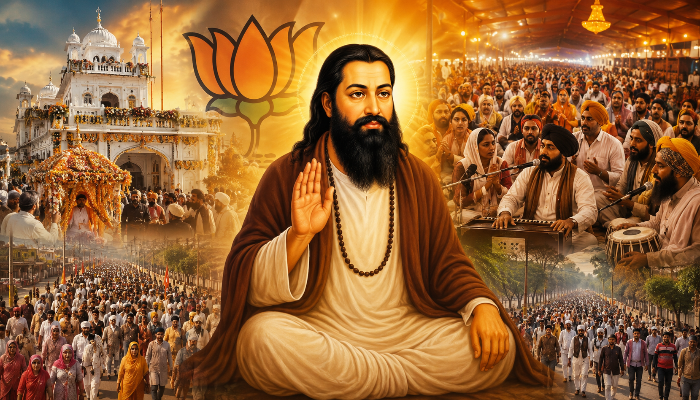
On 27th July (Monday), Bharatiya Janata Party (BJP) announced that it is going to commence a nationwide event to commemorate the 650th birth anniversary (Prakash Parv) of the 15th-16th century mystic poet-saint Guru Ravidas.”Samrasta Sankalp Abhiyan” (campaign for social harmony and resolve) will run for nearly seven months from 29th July to 20th February.

His birthplace at Seer Govardhanpur in Varanasi would host the official inauguration on Guru Purnima. Asim Arun, Uttar Pradesh’s social welfare minister, shared that it would be kicked off amid special functions on 28th and 29th July. Sacred soil would be collected and worshipped (maati pujan) at Seer Govardhanpur on 28th July.

131 kalash (urns) would be transported in a grand procession to his Janmabhoomi Temple for ceremonial worship from the memorial complex of Guru Ravidas. Teams with kalash from multiple states and districts in Uttar Pradesh would gather at Varanasi for this purpose. Every hamlet would be handed over 104 kalash loaded with this soil, and another 27 would be delivered to other states.

BJP delegates from 98 organisational district units and six regional divisions in Uttar Pradesh and 27 other states would receive the kalash and then take them to different temples and sant sammelans (congregations). Several programs would be organised on the occasions of Magh Purnima and Guru Ravidas Jayanti in different parts of India.

BJP national president Nitin Nabin, Uttar Pradesh chief minister Yogi Adityanath,h along with Dera Sachkhand Ballan chief and head of Guru Ravidas Janam Asthan temple, Sant Niranjan Das would all be present for the ceremonial launch.

From Deepotsav to month-long yatra and more: BJP plans multiple events

BJP national general secretaries Tarun Chugh and Dushyant Kumar Gautam also informed that 131 kalash would be sent around India from Varanasi. 21,000 locations would conduct social harmony initiatives, and 51,000 temples would witness the festival of lights. A “Guru Ravidas Maharaj Samrasta Deep Abhiyan” would be performed as 11,000 lamps would be lit at Ravidas Ghat and his memorial site. All BJP mandals and temples dedicated to the saint would observe the Deepotsav on 29th July.

The party officials highlighted that the Modi government has developed his place of origin, pilgrimage routes, airports, special trains and restored a number of sites associated with Guru Ravidas in order to preserve his legacy. According to Chugh, the goal of the recent effort is to spread his teachings on equality, social peace and public enlightenment.

They pointed out that Sikandar Khan Lodi, the Tughlaqs and Timur or Tamerlane were “engaged in carrying out religious conversions and demolishing temples across the country” in that age. Gautam stated, “At that time, their only slogan was ‘the sword or the Quran.’ During that mediaeval period, people had no means of expressing their views, and there was an atmosphere of widespread distress everywhere.”

He added that “many great saints of the Bhakti movement, including Goswami Tulsidas, Kabir Das, Sant Tukaram, Guru Nanak and Chaitanya Mahaprabhu,” emerged who “carried the knowledge and values preserved in Sanskrit to the masses through their respective regional languages, thereby creating public awareness and providing new direction to society throughout the country.”

The BJP spokesperson conveyed that Guru Ravidas made a very important contribution at that time and hence was awarded the title of “Sant Shiromani Guru Ravidas Ji” by Kabir. According to Gautam, his 650-year-old concept of an egalitarian society was well ahead of its time. In 1837, Abraham Lincoln started a campaign against slavery, and Dr BR Ambedkar enshrined the values of equality, liberty and fraternity while crafting the Constitution.

“However, long before them, Guru Ravidas had already conveyed the message of ‘chhote-bade sab base’ (small and big live together). He envisioned a casteless society and ‘Beghampura ‘, a place where there is neither sorrow nor suffering,” he expressed.

Lal Singh Arya, national president of the BJP Scheduled Caste Morcha, emphasised that the objectives are to foster social harmony between all groups and guarantee that every community is involved in building a developed India. He stated that the saint’s way serves as the cornerstone of “Sabka Saath, Sabka Vikas, Sabka Vishwas, Sabka Prayas,” and this mission would evolve into a widespread movement for social harmony and national unity.

“Guru Ravidas worked for human welfare, equality, and social harmony. He was against religious conversion. His message and ideas will be taken to people through 650 jayanti programmes,” Arya stressed. He revealed that state-level workshops were scheduled from 20th to 23rd July, district-level workshops from 25th to 27th July and a national workshop was arranged in Delhi on 19th July for this aim. These preparations transpired in 18 states.

There are scheduled to be five primary phases to the campaign. The national, state, district, and mandal levels would take out the “Shri Guru Ravidas Maharaj Kalash Vandan Abhiyan” from 29th July to 10th September.

BJP delegates from 98 organisational district units and six regional divisions in Uttar Pradesh and 27 other states would receive these kalash and then take them to different temples and sant sammelans (congregations). A Sant Sampark Abhiyan would also unfold from 29th July to 31st August as saints, mahatmas, gurus and mahants would be requested to bestow their blessings.

From 5th October to 5th November, the “Shri Guru Ravidas Maharaj Samrasta Yatra” would depart from Jalandhar to Varanasi, traversing Jammu and Kashmir, Himachal Pradesh, Uttarakhand, Chandigarh, Haryana, Delhi and Madhya Pradesh. The “Shri Guru Ravidas Maharaj Chhatravas Sampark Abhiyan” is slated from 26th November to 15th January.

Furthermore, students, hostels and religious outfits would participate in the outreach drive and processions. BJP is also set to arrange gurbani recitation and bhajan sandhya. Its top leaders would address a Samrasta Sankalp Sabha, and the party has been instructed to ensure an audience of at least 25,000 people.

A critical decision at a pivotal moment

Assembly elections are scheduled to take place in five states, including Uttar Pradesh and Punjab, in early 2027. However, BJP leaders have strongly refuted any association of the yatra with these polls. The party has celebrated Guru Ravidas Jayanti on a large-scale in the past as well.

However, this is the first time such a long drive has been designed to connect with the Dalit population, who follow him and are known as Ravidassias, and are heavily concentrated in Punjab and Uttar Pradesh, The Indian Express reported while quoting insiders.

Dalits make up 21% of the population in Uttar Pradesh, and 84 of the state’s 403 assembly seats are reserved for them. Together, the BJP and its allies Apna Dal (Soneylal) won 63 Scheduled Caste (SC) seats in the 2022 assembly elections while the then Samajwadi Party-led opposition alliance gained 20.

The 117-member assembly in Punjab, where Dalits make up 32% of the population, has 34 seats set aside for the community. None of these seats was secured by the saffron party in the assembly elections of 2022. Over 12 lakh Ravidassias reside in the Doaba region of Punjab, which includes the districts of Kapurthala, Hoshiarpur, Nawanshar and Jalandhar. The Dalits constitute approximately 45% of this area, which is far higher than the state average.

Interestingly, the 2022 assembly elections were rescheduled from 14th February to 20th February after parties objected that the dates would conflict with Guru Ravidas Jayanti, which brings a lot of Ravidassias to Varanasi. The prominence of Dalits in Uttar Pradesh and Punjab politics has attracted the BJP’s special attention on the community ahead of the upcoming contests.

Notably, the yatra between Jalandhar and Varanasi would stop in cities and villages, especially those with a large Dalit population between Punjab and Uttar Pradesh.

How the Modi government historically honoured Guru Ravidas

On 1st February, Prime Minister Narendra Modi landed in Punjab to commemorate the 649th birthday of Guru Ravidas. He went to the highly influential Dera Sachkhand Ballan, a major spiritual centre of the global Ravidassia community in Jalandhar, to pay respects and engage in the public festivities.

Founded in the early 20th century, it progressively became a focal point for Dalit assertion, specifically among Chamars, who have historically been subjugated to untouchability and usually have a link with the leather industry. Its supremo, Sant Niranjan Dass, has been conferred the Padma Shri this year.

Likewise, the Sant Ravidas Express, the first direct AC train between Amritsar and Varanasi, has been introduced by the government this month, satisfying a long-standing wish of the Ravidassia community a few months after PM Modi met Sant Niranjan Das. Countless devotees travel to Seer Govardhanpur each year, mainly from the Doab region,n to mark the birth anniversary of Guru Ravidas.

For years, the devotees had been waiting for a direct train on this route, specifically with air conditioning in the carriages. The Sant Ravidas Express would improve travel comfort and lessen the heavy traffic during the yearly festivities. A special tent city is also being planned for his 650th birthday, which is projected to be an even larger assembly.

PM Modi joined the celebration of the 647th birthday of the revered saint and spoke at the occasion in Varanasi on 23rd February 2024. He also laid the foundation stone for the Sant Ravidas Museum and unveiled the latter’s statue in a park next to his temple at Seer Govardhanpur.

On Ravidas Jayanti in 2022, PM Modi similarly visited the Shri Guru Ravidas Vishram Dham Mandir in Delhi’s Karol Bagh. He indulged in the “Shabad Kirtan” and enthusiastically played “Jhika” in tune with the songs dedicated to the saint.
Odisha govt to name medical college after Swami Lakshmanananda Saraswati: Read how the Hindu leader working against Christian conversions in tribal areas was murdered by Naxals

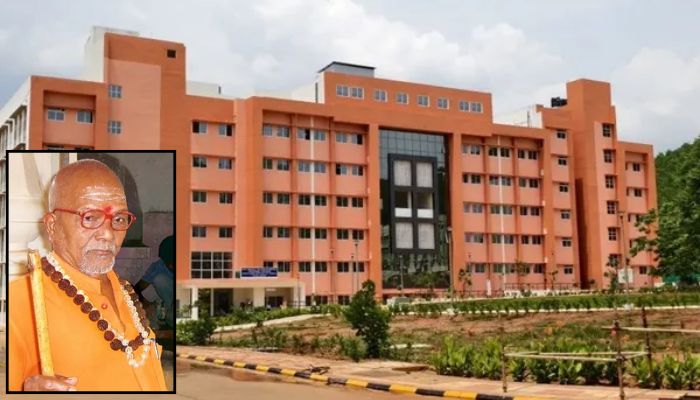
The Odisha government has decided to rename the Government Medical College and Hospital in Phulbani, located in the Kandhamal district, after the revered Hindu leader and spiritual figure, Swami Lakshmanananda Saraswati. Announcing the move on Monday, 27th July, Chief Minister Mohan Charan Majhi stated that the decision aims to honour Swamiji’s lifelong dedication, service, and sacrifice for the tribal communities of the region, ensuring his memory remains preserved for future generations.

Along with the renaming of the medical institution, the Chief Minister has approved a ₹13 crore grant from the Chief Minister’s Special Assistance (CMSA) fund. This financial allocation is directed toward the comprehensive development and preservation of Swamiji’s ashram, the ashram school, and the Kanyashram at Jalespata.

According to an official note from the Chief Minister’s Office, “The funds have been allocated to preserve the heritage of Swamiji’s ashram and to keep his legacy alive.” The financial package aims to strengthen both the educational and residential infrastructure on the campus to better serve local students.

Details of the ₹13 crore development package outline several key infrastructure projects aimed at improving living and learning conditions at the Jalespata campus. Out of the sanctioned amount, ₹5 crore is designated specifically for constructing a new 300-seat girls’ hostel, while ₹3 crore has been earmarked for the conservation and historical preservation of Swamiji’s heritage site. 

To address long-standing basic needs, ₹60 lakh has been allocated to a mega river lift project designed to secure a reliable water supply for the Jalespata Ashram, its school, and the residential facilities. The remaining funds will cover essential works including classroom construction, building boundary walls, expanding toilet facilities, and renovating existing hostel buildings.

The life and mission of Swami Lakshmanananda Saraswati

Swami Lakshmanananda Saraswati was a prominent social reformer who devoted over four decades of his life to the welfare, education, and spiritual preservation of the tribal population in Odisha. Believing strongly in empowering forest dwellers, he established an ashram in Chakapad in 1966, shortly after returning from years of penance in the Himalayas. 

Recognising that education was crucial for social upliftment, he founded the Gurukul Sanskriti Vidyalaya to provide structured education up to the graduation level for local youth. Beyond education, Swamiji was deeply committed to cultural preservation, actively running campaigns against cow slaughter and leading movements to reconnect indigenous communities with their heritage through initiatives like traditional Jagannath yatras.

Swamiji was targeted by Christian missionaries 

Swami Laxmanananda Saraswati had close ties with the RSS and was associated with the Vishva Hindu Parishad (VHP). He had been spreading awareness about Hinduism among the tribal society for 35 years by setting up an ashram in Chakapad. He was vocal aginst Christian conversions of tribals and actively worked against conversion attempts in remote areas, creating awareness and leading efforts to connect with the tribal communities.

His active opposition to aggressive religious conversions in the tribal belts of Kandhamal made him a target of local criminal elements. As he worked to establish schools, Kanya Ashrams, and community programs, his growing influence among the tribal populations was seen as a major barrier by Christian conversion networks operating in the region and Naxals, who were always opposed to tribals becoming a part of mainstream society. 

How the Hindu leader and social activist was brutally murdered in his own Ashram, on Janmashtami

2008 was the year when Maoist violence was at its peak in Odisha. The tensions surrounding Swamiji’s work culminated in tragedy on 23rd August, 2008, the night of Janmashtami. While Swamiji was at the Kanya Ashram in Tumudibandh, surrounded by young students and devotees, an armed group of Naxals carrying AK-47s, indigenous firearms, and sharp weapons stormed the premises. 

The 80-year-old saint, along with four of his disciples, including a young boy, was brutally murdered. The gruesome attack, where Swamiji’s body was hacked with axes, sent shockwaves across the region and occurred in full view of around 130 young schoolgirls staying at the residential facility.

While Maoists later claimed responsibility for the attack, the incident highlighted deep concerns regarding the convergence of Naxalite groups and missionary activities in rural Odisha. Critics and local community leaders pointed out that a significant portion of the local Maoist committee members involved in the region were converts, raising questions about whether the Maoist banner was used to provide cover for those targeting Hindu leaders. 

In 2007, Kandhamal saw communal riots between Hindu tribals and converted Christians who were demanding ST status. On 24 December, the Christians had attacked and vandalised a Durga Puja venue and had attacked Swami Lakshmanananda Saraswati too when he had tried to intervene. This had led to violent clashes where several houses were torched.

In 2015, the Justice Basudev Panigrahi Commission, which was probing the 2007 riots, had submitted its report. The report had cited ‘rampant Christian conversions’ as the reason behind the violence in the area. The former judge had told that despite strong anti-conversion laws in Odisha, rampant missionary activities are underway. Kandhamal, a small district with dense forests, has over 1200 churches and over 300 Christian organisations.

In October 2013, a total of eight people, 7 converted Christians and a Maoist leader named Pulari Rama Rao, were sentenced to life imprisonment for the murder of Swami Laxmanananda Saraswati. Two more Maoist leaders, Dunna Keshav Rao and Sabyasachi Panda, were also accused in the case. Both are lodged in jail and currently under trial in several other cases, including the murder in Kandhamal.

Media ignored the murder of an old Hindu leader and his 4 disciples

The fallout from the 2008 massacre ignited widespread grief and anger across Kandhamal, leading to severe communal violence and civil unrest. So, the initial massacre of Swami Lakshmanananda Saraswati and his 4 followers was not given priority in the news, but when Hindus protested, the nature of the protests became an issue. The massacre itself was forgotten by describing the Hindu protests as violent. ‘Journalists’ compared the protests to the riots in Gujarat after the Godhra massacre.

The recent state initiatives, including the renaming of the Phulbani Medical College and Hospital and the dedicated funds for the Jalespata facilities, represent an official effort to recognise Swamiji’s legacy. By linking major healthcare and educational development to his name, the state administration seeks to formally honour his contributions to tribal education, welfare, and social service in Kandhamal.

The selective feminism exposed: What a woman’s sexual assault at CJP’s Jantar Mantar protest reveals about the Left’s moral contradictions

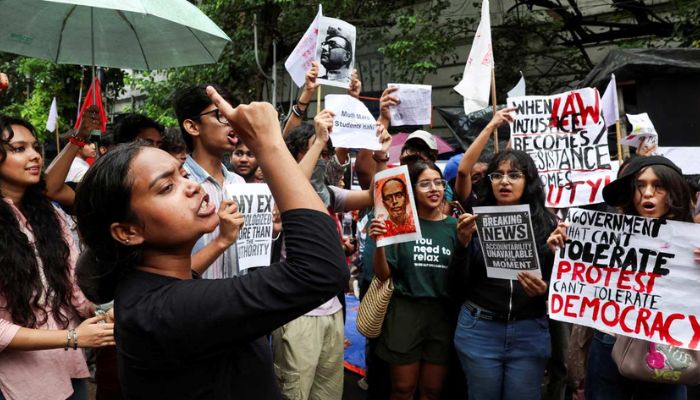
Amid the Cockroach Janta Party’s celebration videos circulating on social media, an X user, Yashaswinee Raje Singh, with X handle @ywineethpooh, on Sunday, 26th July, shared a post detailing the harassment and misogyny she faced while attending the claimed student protests. The protests were organised by another leftist group, the CJP, at Jantar Mantar.

Curiously, Singh posted her ordeal a day after CJP claimed victory as the Centre agreed to its demands. But even then, Singh appeared to shield the CJP from accountability, saying her intention was not to tear down the movement but to expose what she described as the glaring hypocrisy of those leading it. Singh, a daughter of a former BJP MLA from Uttar Pradesh and who recently dominated trends on social media platforms for her ‘friendship’ with a Pakistani, highlighted how, beneath the tall claims of fighting for justice, hope, and solidarity, these spaces are frequently infected by brazen misogyny, sexual assault, and a rampant rape culture.

In her post, Yashaswinee recounted the horrifying sequence of events from around 12:15 am on 24th July. As she and her sister tried to make their way toward the main stage, hundreds of protestors were packed tightly in front of metal detectors in complete chaos. Suddenly, a barricade collapsed just three feet away from them, triggering a dangerous surge that felt like the start of a stampede. Deciding it was unsafe to continue, they turned around to leave. It was at this moment that a man behind her attempted to grope her and force his hand between her legs. Reacting instinctively to the assault, she turned around and slapped the perpetrator thrice.

What happened immediately afterwards was even more infuriating. A young male volunteer who witnessed the incident rushed over, saw her visibly shaken, and instead of offering help or asking what happened, began aggressively shouting at her, “Aap yahaan kyun aa rahe ho?” When she countered, “Women are being sexually assaulted at the protest, and your response is to yell at them?!”, the volunteer continued yelling, “Main kya karun? Aap sun hi rahe ho!” As a crowd gathered, another young male volunteer casually dismissed the sexual assault, sighing, “Ab yeh sab galti toh hoti rehti hai. Aap udhar chale jao.”

Yashaswinee highlighted how the political humour and slogans at the protest leaned heavily on disgusting misogyny, ranging from boys holding sanitary pads reading “Modi, wear this” to posters depicting male politicians in bikinis, bras, or schoolgirl skirts with vulgar phrases.

A persistent pattern across left-led movements 

Yashaswinee’s experience is not an isolated incident, nor is it the first time women have faced systemic harassment, intimidation, and assault in protests organised or backed by the Left ecosystem. Time and again, under the guise of revolution and civil rights movements, female attendees, journalists, and activists have found themselves exposed to predators who operate with near-total impunity while the organisers turn a blind eye.

A glaring example of this unfolded during the farmer protests at the Delhi borders. Allegations of sexual assault against prominent activists associated with the movement opened a Pandora’s Box. Social media documenter Mohammad Zuber, associated with the Kisan Ekta Morcha and Trolley Times, was accused of raping a woman, after which he deactivated his Instagram account. When the survivor spoke out, Varun Chouhan, a key figure in Trolley Times, mocked her publicly. 

Later, multiple women came forward through “The Kaur Movement” detailing how Varun Chouhan had manipulated, groomed, and sexually assaulted them. One victim shared how he forced himself upon her during an election campaign meeting, leaving her with physical injuries and deep emotional trauma, while another recounted how he groped her in his room and dismissed her tears by saying, “I know you want it.”

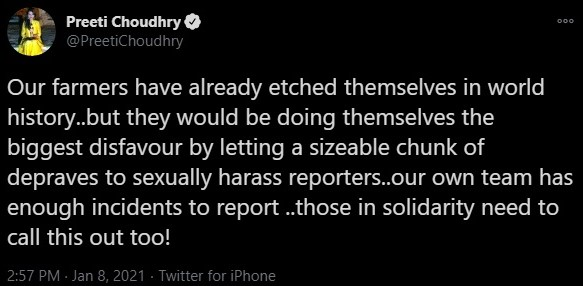
It was not just female activists who were targeted; journalists attempting to cover the demonstrations faced constant abuse. Preeti Choudhry, Editor at India Today, publicly called out the “sizeable chunk of depraves” among the protesting groups who were sexually harassing female reporters on the ground. When she spoke out against the pervasive groping and misconduct, figures linked to the movement tried to justify the behaviour, claiming news-hungry reporters were asking for it. Choudhry had to publicly remind them that if someone did not want to give an interview, they could simply decline rather than pinch a reporter’s buttocks.

Similarly, during the anti-CAA protests, women faced political violence and harassment from leaders associated with the movement. In one high-profile incident in Northeast Delhi, Aam Aadmi Party MLA Abdul Rehman, who had earlier been booked by the Delhi Police for inciting mobs during the anti-CAA demonstrations in Seelampur, was booked under an FIR at the Jaffrabad police station after a woman accused him and his associates of eve-teasing, physical assault, and thrashing her when she dared to object to their harassment during municipal bypolls.

Yogendra Yadav dismissed concerns raised by women during Farmers protests

When allegations of sexual abuse emerge within these movements, the leadership’s primary instinct is rarely to seek justice for the victim; instead, it is to protect the image of the protest. A tragic testimony to this culture of complicity was the case of a 25-year-old female activist from West Bengal who travelled to the Tikri border to join the farmer protests. She was sexually harassed on the train journey to Delhi and subsequently gang-raped at the protest site by two men affiliated with the Aam Aadmi Party, Anil and Anup Singh, before contracting COVID-19 and tragically passing away in a hospital.

Professional protester Yogendra Yadav later admitted in a press conference that he was aware of the woman’s predicament well before her death. Yadav revealed he had been in contact with her and her father since 24th April, 2021, speaking to her when she was being taken away by the accused, who lied about their location. 

Yet, despite knowing about the harassment and suspecting foul play, Yadav and the protest committee did not inform the police. Even after the victim’s father explicitly detailed the horrific rape to Yadav on 1st May, 202,1 after her funeral, the leadership restricted its response to internal measures like “social boycotts” and removing tents, waiting for days while the accused publicly claimed it was a political conspiracy to defame the movement. 

The victim’s father later noted that Yadav turned a blind eye to the brutalities and failed to alert law enforcement, prioritising the protection of the protest over the life and dignity of a young woman.

The expectation of the left ecosystem 

This recurring apathy points to a broader, toxic ethos within the Left ecosystem: the expectation that women must keep quiet about their personal trauma for the “greater good” of the political cause. 

Victims are made to feel that speaking out against abusers within their ranks will weaponise the narrative for their political opponents, damage the movement, or dilute the fight against fascism. In this twisted hierarchy of priorities, political optics are treated as far more sacred than human rights, and women are coerced into enduring abuse so that the movement’s facade remains untarnished.

Over time, this ideological conditioning becomes so deeply internalised that many women affiliated with the Left end up rationalising their own silence. Instead of demanding immediate accountability, they convince themselves that reporting a predator who belongs to a protected identity group or a shared political ideology will fan hatred or empower their political adversaries.

Brainwashed into overlooking abuse

This troubling mindset is clearly illustrated by public figures within the liberal-left space who have openly admitted to concealing sexual misconduct to protect their political narratives.

A recent case involved The Wire journalist Omar Rashid, who was accused by a Hindu woman of sexual coercion, physical abuse, and psychological manipulation, where he reminded her of her identity in a “Hindu Rashtra” to enforce her silence for the “greater good.”

Commenting on the incident, YouTuber who likes to refer to herself as a historian, Ruchika Sharma, publicly revealed that she too had chosen not to name or report her own sexual abuser in the past. She also claimed that they chose silence over justice, not out of fear of their abusers, but out of fear of “fanning Islamophobia.” She argued that if she spoke out, “dingbat Sanghis will just use it to further their own horrible communal agenda.” In Sharma’s worldview, the fear that right-wing opponents might gain political mileage from her story outweighed the necessity of holding a sexual predator accountable. 

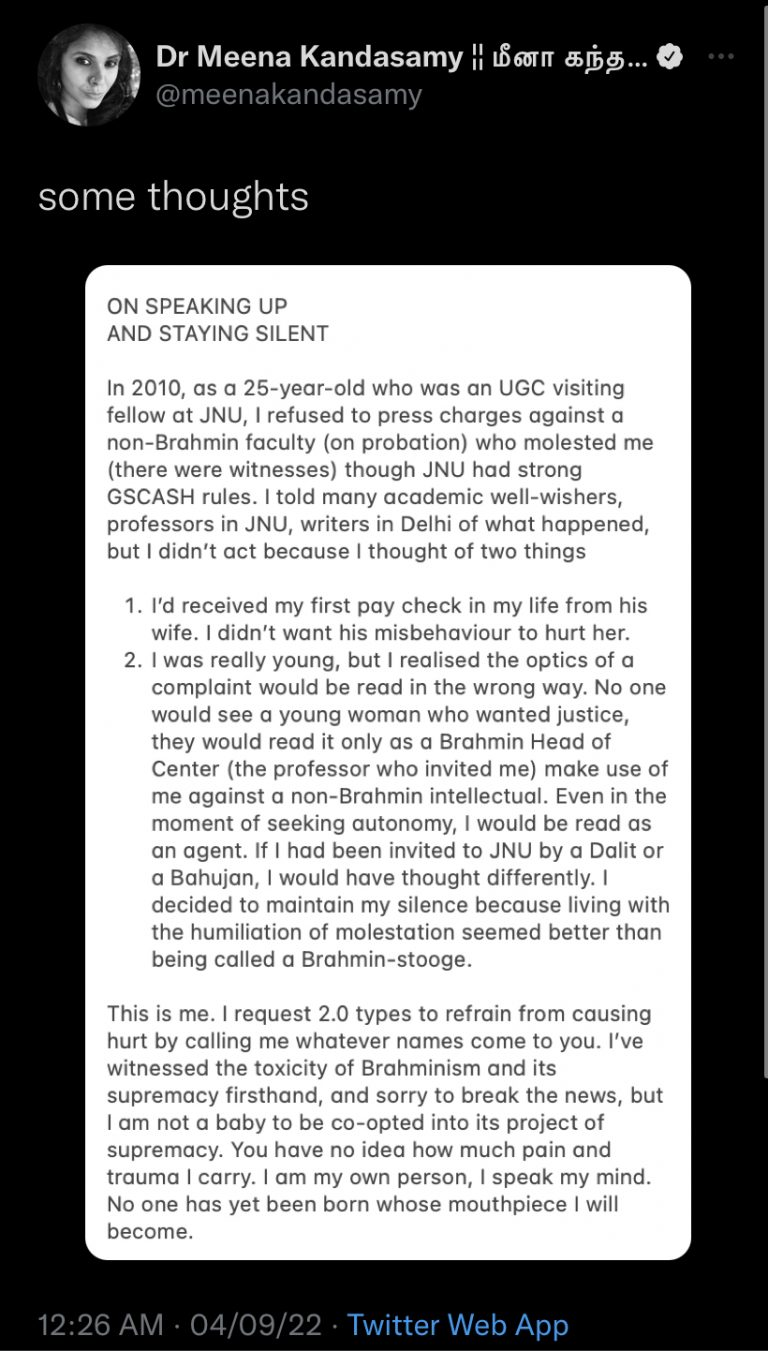
An even more explicit admission came from anti-Brahmin activist and writer Dr Meena Kandasamy. Reflecting on an incident from 2010 when she was a 25-year-old visiting fellow at JNU, Kandasamy admitted that she actively refused to press charges against a non-Brahmin faculty member who had molested her, despite having eyewitnesses and strict institutional rules like GSCASH available to her.

She explained her refusal to seek justice by admitting that her primary fear was being labelled a “Brahmin-stooge” by her peers. She wrote that “living with the humiliation of molestation seemed better than being called a Brahmin-stooge,” showing how ideological hatred completely subverted her self-respect and pursuit of justice.

When women are groomed to believe that exposing a rapist or a molester is an act of political treason, predators are given the ultimate haven. True gender justice cannot exist in spaces where progressive ideals are used as a cover to justify silence, cover up abuse, and protect perpetrators.

Anti-paper leak law: Here’s what the Public Examinations (Prevention of Unfair Means) Amendment Bill 2026 says 

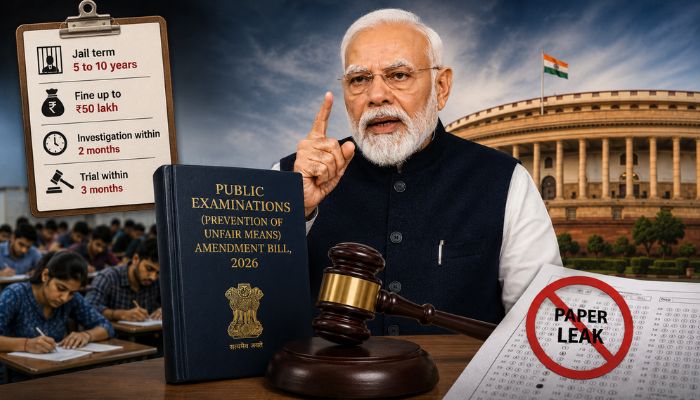
The Centre has proposed sweeping changes to the country’s anti-cheating law, aiming to make investigations faster, ensure time-bound trials and impose much tougher punishment on those involved in paper leaks and examination malpractice. The Union Cabinet has approved the Public Examinations (Prevention of Unfair Means) Amendment Bill, 2026, and Prime Minister Narendra Modi has directed that it be treated as a priority. The Bill is expected to be introduced in the Lok Sabha on Monday, 27th July, after copies of the proposed legislation were circulated among Members of Parliament on Saturday, 25th July.

The proposed legislation seeks to strengthen the provisions of the existing Public Examinations (Prevention of Unfair Means) Act, 2024, which was enacted to curb unfair means in public examinations and protect the integrity of recruitment and entrance tests. 

The amendment increases punishments for examination-related offences, introduces strict timelines for investigations and trials, creates a framework for Special Fast Track Courts and Special Task Forces, and strengthens accountability for organisations and individuals involved in organised examination fraud.

Centre moves to tighten anti-cheating law

The proposed amendments come at a time when several public examinations in recent years have been hit by allegations of question paper leaks, organised cheating rackets and other malpractices. According to the Statement of Objects and Reasons accompanying the Bill, the government believes that stronger legal provisions are necessary to restore confidence in the examination system.

The government has said that while the 2024 Act created a legal framework to deal with organised examination fraud, recent incidents have shown the need for faster investigations, quicker trials and stricter punishment to deter offenders. The proposed law is intended to strengthen the integrity, transparency and credibility of public examinations while ensuring that cases are resolved within fixed timelines.

Jail terms and fines proposed to increase sharply

One of the biggest changes proposed in the Bill is a substantial increase in punishment for offences related to examination fraud.

Under the existing law, those convicted face imprisonment ranging from three to five years, along with a fine of up to ₹10 lakh. The amendment proposes raising the minimum imprisonment to five years, while the maximum jail term will increase to ten years. The maximum fine will also rise fivefold, from ₹10 lakh to ₹50 lakh.

The government believes that increasing the punishment will act as a stronger deterrent against organised paper leak syndicates and others attempting to manipulate public examinations.

Tougher action against service providers involved in malpractice

The proposed law also targets service providers entrusted with conducting examinations.

If a service provider is found involved in examination-related offences, it may now face a penalty of up to ₹5 crore, replacing the existing maximum fine of ₹1 crore.

The Bill also proposes extending the period during which such organisations can be barred from conducting public examinations. Instead of the current four-year ban, offending service providers may now be prohibited from conducting examinations for eight years.

The amendments further make directors, senior management officials and other responsible persons personally accountable. They will face a minimum imprisonment of five years, along with fines of up to ₹5 crore, if found guilty of examination fraud.

Organised examination fraud to invite even harsher punishment

The government has proposed even stricter penalties for organised examination fraud involving criminal networks or large-scale conspiracies.

Under the amended law, such offences will carry a minimum prison sentence of seven years, compared to the existing minimum of five years. The minimum fine for organised examination fraud has also been increased substantially, from ₹1 crore to ₹10 crore.

The proposal reflects the government’s view that organised paper leak rackets require stronger legal consequences than individual acts of malpractice.

Special Task Force to speed up investigations

To ensure quicker investigation of examination-related offences, the Bill empowers the Central Government to constitute a Special Task Force (STF) whenever required.

At present, cases can be referred to a central investigating agency. Under the amendment, the Centre will also have the power to notify a Special Task Force specifically for investigating offences under the Act.

The Bill further provides that once an STF is constituted for a particular case, the investigation will be carried out only by that Special Task Force.

Perhaps the most significant procedural reform is the introduction of strict timelines. Every investigation under the Act must now be completed within two months. This deadline will apply whether the investigation is conducted by a police officer, a Central Investigating Agency or a Special Task Force.

Special Fast Track Courts for speedy trials

The proposed legislation also seeks to prevent examination fraud cases from remaining pending for years.

Every State Government and Union Territory Administration will be required, in consultation with the concerned High Court, to designate a Court of Session as a Special Fast Track Court exclusively for cases under the Act.

These courts will hear proceedings on a day-to-day basis, with adjournments permitted only in exceptional circumstances that must be recorded in writing.

The Bill mandates that every trial should be completed within three months from the date the chargesheet is filed.

The Special Fast Track Courts will also be empowered to try other offences connected with examination fraud, including offences under the Bharatiya Nyaya Sanhita, 2023, during the same trial.

The legislation further provides that all pending cases under the Act will automatically stand transferred to these designated courts, and the proceedings will continue from the stage at which they were transferred. Such transferred cases must also be completed within three months.

Special prosecutors and new appeal mechanism

To strengthen prosecution, every State and Union Territory will appoint one or more Special Public Prosecutors for each Special Fast Track Court. These prosecutors will exclusively handle cases under the Act and will function as Public Prosecutors under the provisions of the Bharatiya Nagarik Suraksha Sanhita, 2023.

The Bill also introduces a separate appeal mechanism.

Any appeal against the judgment, sentence or order of a Special Fast Track Court will lie before a Division Bench of the concerned High Court consisting of two judges. The High Court has been asked to make every effort to dispose of such appeals within three months of their admission.

Appeals must ordinarily be filed within 30 days, although the High Court may condone delays for sufficient cause. However, the Bill makes it clear that no appeal can be entertained after 90 days.

The proposed law also allows appeals against orders granting or refusing bail passed by the Special Fast Track Courts.

From Lala Jagat Narain to ML Manchanda: The journalists marked for death by Khalistanis

During the Punjab insurgency, Khalistani terrorists did not target only politicians, policemen or civilians. Journalists, editors, broadcasters, newspaper hawkers and delivery workers were also marked for death. The campaign began early in the insurgency and eventually developed into an effort to control not only what could be published or broadcast, but even the words journalists were permitted to use.

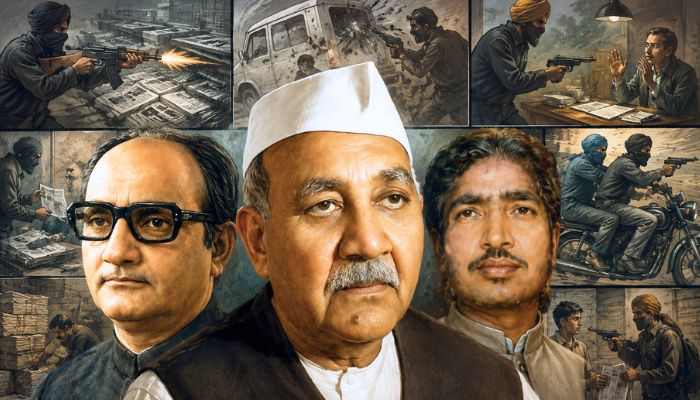
One of the earliest and most consequential attacks came on 9th September 1981, when Lala Jagat Narain, founder and chief editor of the Hind Samachar Group, was assassinated while travelling from Patiala towards Jalandhar. Jagat Narain had repeatedly criticised Jarnail Singh Bhindranwale, opposed communal separation and warned against growing violence. His newspapers reached readers in Hindi, Punjabi and Urdu, making his voice particularly influential. His killing was meant to demonstrate that publicly opposing Khalistani terrorism could carry fatal consequences.

The assassination failed to silence the Hind Samachar Group. Jagat Narain’s son Romesh Chandra continued the same editorial line, writing against terrorism and promoting Hindu-Sikh unity. On 12th May 1984, he too was shot dead in Jalandhar. The threat also crossed religious lines. Sumeet Singh, the Sikh editor of the Punjabi literary magazine Preet Lari, was murdered in February 1984 after advocating communal harmony. Communist activist and editor Baldev Singh Mann, another Sikh critic of Khalistan, was shot dead in 1986. Their killings showed that the decisive question for terrorists was not whether a journalist was Hindu or Sikh, but whether his words supported or obstructed the separatist cause.

District journalists were particularly vulnerable. Giani Jagjit Singh died after an armed attack in 1986, Punjab Kesari and Jag Bani correspondent Narendra Pal Singh was killed in 1987, Jag Bani chief sub-editor Bant Singh was assassinated in 1988, and PTI and Indian Express correspondent Parduman Singh was shot the same year. Hind Samachar news editor Inderjit Sood was also killed in 1988 after the death of Khalistan Commando Force chief Labh Singh, reportedly over the terminology used by Jag Bani while reporting his death. By the early 1990s, reporters including Nanak Chand Nagpal, Bhag Singh Khela, Balbir Singh Saggu and Amar Nath Verma had also been murdered.

The campaign soon extended beyond journalists themselves. After the Hind Samachar Group refused orders to stop publishing, terrorists attacked employees, newspaper vendors and the distribution network. Hawkers were killed while handling newspaper bundles, delivery workers were attacked and a newspaper van travelling towards Ferozepur was ambushed in July 1990, killing all five people inside. Around 40 vendors, agents and hawkers associated with the group were killed. Police eventually accompanied newspaper vendors on their routes as terrorists attempted to make the physical distribution of the publications impossible.

Khalistani organisations also tried to dictate editorial language. In November 1990, the Sohan Singh-led Panthic Committee issued a code instructing journalists to describe those campaigning for Khalistan as “militants” or “freedom fighters”, rather than terrorists. It went further by claiming that leaders of five associated terrorist organisations could pronounce death sentences on journalists and editors. The same battle over terminology reached All India Radio. Chandigarh station director Rajinder Kumar Talib was shot dead in December 1990 after Khalistani groups objected to the broadcaster’s language and terminology.

The most brutal example came in May 1992. Babbar Khalsa abducted ML Manchanda, station director of All India Radio in Patiala, and demanded that the electronic media adopt its prescribed code of conduct, including restrictions on Hindi and other non-Punjabi programming. When the government refused to comply, Manchanda was killed and beheaded. His torso was recovered in Punjab while his severed head was found in Ambala. Babbar Khalsa openly linked the murder to its effort to impose its media code.

From Lala Jagat Narain’s assassination in 1981 to ML Manchanda’s murder in 1992, the methods changed but the objective remained largely the same: force the media to submit. Editors were assassinated, correspondents were killed near their homes, broadcasters were targeted over terminology, hawkers were murdered for distributing newspapers and newsrooms received instructions backed by death threats. Yet newspapers continued publishing, vendors returned to their routes under police protection and journalists continued reporting from some of Punjab’s most dangerous districts.

Read the full article on Chapter One Magazine.

Anti-Paper Leak Bill: Opposition demands accountability, reforms, but paralyses Parliament 

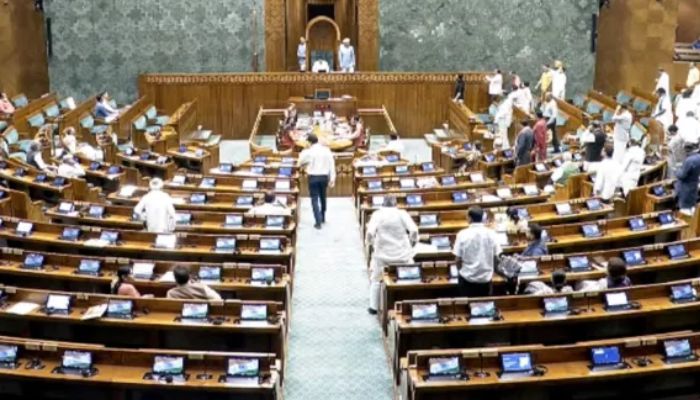
The political opposition in India has stopped believing in agitating for accountability but causing disruptions merely for the sake of targeting the ruling dispensation. On 27th July 2026, both Houses of Parliament, Lok Sabha and Rajya Sabha, were adjourned till noon shortly after proceedings commenced. The adjournments followed noisy protests and ruckus by Congress and other opposition MPs over the Delhi Police’s response to the Cockroach Janta Party-led ‘student protests’. 

The opposition MPs demanded a statement from Union Home Minister Amit Shah on the alleged Delhi Police excesses, including the use of pellet guns, shock batons, lathi charges, and tear gas, against the protests during the CJP-led “Sansad Chalo” march on 20th July. 

While Lok Sabha Speaker Om Birla repeatedly stressed that the government is set to introduce the Public Examinations (Prevention of Unfair Means) Amendment Bill, popularly referred to as the Anti-paper leak bill, and debate is to be on in Parliament, the opposition MPs continued sloganeering, screeching and causing unwarranted disruption. 

Similar scenes of performative protest were seen in Rajya Sabha as well. 

Consequently, both proceedings in both the Houses had to be adjourned.  

In the Lok Sabha, the proceedings began at 11: AM. After some time, when the Speaker tried taking up the Question Hour, the opposition MPs began creating a ruckus. The constant sloganeering and shouting by Opposition MPs forced Speaker Om Birla to adjourn the House first till 12:00 pm, then till 2:00 pm, and extend the adjournment as opposition members disrupted the proceedings again. 

Rajya Sabha was adjourned till 2:00 PM over the same issue. When the House reassembled after the first adjournment at 12 noon, the opposition again started protesting over the alleged police action on students. Consequently, Chairman C P Radhakrishnan adjourned the House till 3:00 PM. 

Lok Sabha Speaker Om Birla stated that the Central government and Opposition should come to an agreement till 5 pm, so that discussion on the Anti-leak bill can be started. Birla has said that a dedicated six-hour window for a comprehensive discussion on the Public Examinations Bill would be provided.

Opposition seeks accountability, without letting its ultimate forum function 

The MPs from the INDI Alliance parties are audaciously framing their in-House disruptions as a ‘fight’ for accountability and reforms in the Indian education system. The Opposition claims to seek justice for injured ‘students’, a probe into Delhi Police’s conduct during the CJP protests, and a statement from Home Minister Amit Shah. 

However, despite the Central government taking a step towards bringing the very reforms that the genuine student protestors demanded- stronger laws against paper leaks, accountability mechanisms, and enhanced exam system credibility- the Opposition is causing obstructions. 

By continuing to disrupt the House and prevent a debate on the Anti-Paper Leak Bill, despite Dharmendra Pradhan’s resignation and the CJP protest withdrawal, the Opposition parties are essentially blocking the legislation that would operationalise the much-needed systemic reforms. 

This impasse, however, is being manufactured by the Opposition MPs not out of an outpouring of sympathy for injured ‘students’ but for their own political agenda.  

Although the Modi government is projecting strength, Prime Minister Narendra Modi is leading the narrative game from the front now; Dharmendra Pradhan’s resignation as Education Minister has set a narrative that the Centre capitulated before young ‘cockroaches’.  

The Opposition does not want momentum to die without yielding maximum political output for them. Even though the Cockroach Janta Party is an unofficial B-Team of the Aam Aadmi Party, the narrative emerged that the apolitical ‘cockroaches’, the youth of India, were doing the job of the Opposition by aggressively demanding Pradhan’s resignation through street protests. 

In fact, it was only when the Parliament session neared that prominent anti-BJP MPs like Samajwadi Party’s Dimple Yadav, AAP’s Arvind Kejriwal, Azad Samaj Party’s Chandrashekhar Azad, among others, began flocking to Jantar Mantar.  

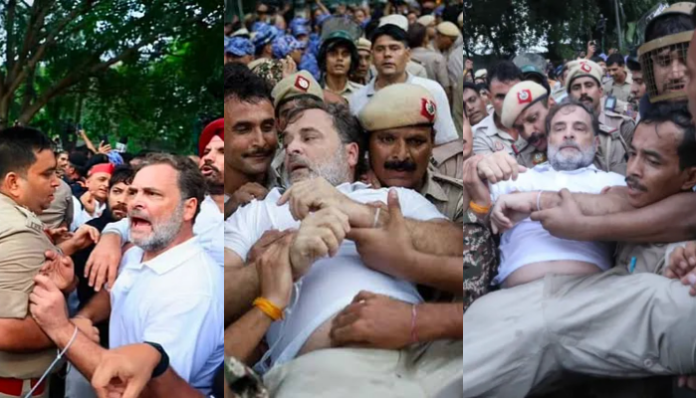
Realising that it has been almost absent and irrelevant in the entire anti-Dharmendra Pradhan agitation, the Congress party launched its parallel protest on 20th July, with Rahul Gandhi leading a march to PM Modi’s residence. The move was Congress’s attempt to hijack the issue and make Rahul Gandhi the hero of the fight he didn’t even participate in until the CJP protests reached their peak. 

Not to forget, Rahul Gandhi had promised to end his agitation if “NEET and related education issues including the ongoing protests” were debated in Parliament. The Centre assured that extensive discussions will be held on the matter in Parliament. However, upon seeing that the wider sentiment is in favour of seeking Dharmendra Pradhan’s resignation, Gandhi also changed tunes accordingly.

The opposition parties, particularly Congress, are now overcompensating for their calculated on-ground absence and restricting themselves to mere social media support by playing the usual performative protest on its political turf, the Parliament. 

The opposition wants to keep the ‘Modi government is defeated’ narrative alive for longer to exploit student grievances into a political theatre where they get to pull the strings. 

For this, Congress and other anti-BJP parties are engaging in classic parliamentary brinkmanship. The Opposition is claiming the moral high ground of ‘accountability’ while denying the very forum where accountability measures can be debated, amended and implemented.  

It is notable that the issue of alleged Delhi Police excesses during the 20th of July protest has reached the Supreme Court, which will hear the matter on 28th July. When the matter is listed for hearing before the Supreme Court, it is illogical to expect the Home Minister Amit Shah to issue a statement in this regard, as a precondition for letting the Parliament function. 

In fact, ever since the Monsoon Session of Parliament began on 20th July 2026, the Opposition has not let both Lok Sabha and Rajya Sabha function peacefully even for a single day. The Opposition has wasted 6 of the 19 planned sittings through disruptions which lead to adjournments. Amidst the Opposition’s intransigence and disruptions, the Parliament has witnessed little to no legislative business in this Monsoon Session.  

The Opposition knows that the passage of the Public Examinations (Prevention of Unfair Means) Amendment Bill, 2026, which PM Modi has directed to be treated as a priority, might help the Central government turn things around.  

The amendment increases punishments for examination-related offences, introduces strict timelines for investigations and trials, creates a framework for Special Fast Track Courts and Special Task Forces, and strengthens accountability for organisations and individuals involved in organised examination fraud. 

The Opposition knows that if the Modi government’s bill offering accountability, stricter laws against paper leaks and broader systemic reforms is passed, which it will be given the NDA has the required majority in both the Houses, it will push a “reforms sought, reforms delivered” narrative. The Opposition will lose the little ground it gained. Thus, the Opposition has weaponised disruptions and anarchy to meet its political objectives.  

On one hand, the Cockroach Janta Party ‘leaders’ are now issuing warnings to the Central government and BJP-ruled states against any detentions or arrest of violent protestors, even after they themselves publicly called them “not students, but anti-social elements”. On the other hand, the Opposition continues to paralyse the Parliament, refusing to let the House function despite claiming to want accountability. 

Clearly, everyone is eager to hold others to account. However, the moment accountability is sought from them, it becomes excess, harassment, and even political vendetta. 

Congress MP Vivek Tankha denies Indian Express report claiming that he mediated between Sonam Wangchuk and government, issues notice calling it blatant lie and cheap journalism

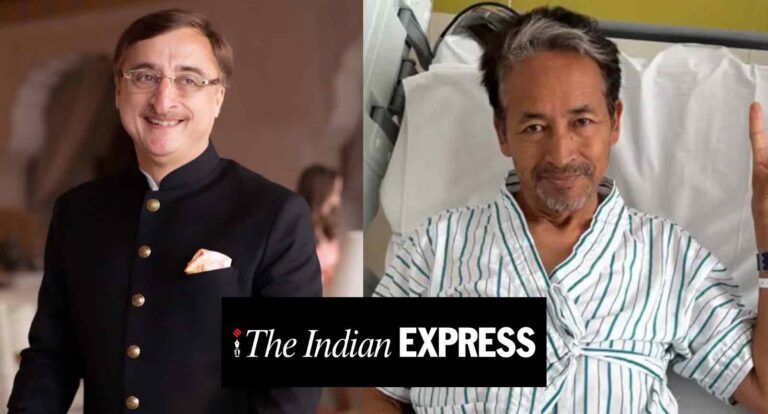
Congress Rajya Sabha MP and senior Supreme Court advocate Vivek Tankha has issued a legal notice to The Indian Express Private Limited and its Hindi editor Saurabh Dwivedi, alleging that the publication and its platforms have disseminated false, misleading and defamatory content regarding his role in the recent conclusion of climate activist Sonam Wangchuk’s hunger strike. The publication has been asked to withdraw the article claiming that Tankha had facilitated discussions between Sonam Wangchuk and the Government of India that led to Wangchuk ending his hunger strike.

On Sunday, advocate Ujjawal Anand Sharma of the law firm Lawmen & White, acting on instructions from Tankha, served the notice calling upon Dwivedi and the newspaper to immediately cease and desist from publishing or circulating the impugned material across print, digital and social media platforms. The notice further demands that the content be permanently removed, that misleading headlines and promotional material be corrected or deleted, and that an unconditional public apology and clarification be published within 48 hours.

Failure to comply, the notice states, will leave Tankha with no option but to initiate appropriate civil and criminal proceedings.

The Indian Express article by Deeptiman Tiwary claimed that Congress MP Vivek Tankha “played a significant role in opening communication channels between the government and Wangchuk and finding a middle ground that both could agree on.” The report also claimed that Wangchuk issued an open letter to minister Nadda on Tankha’s persuasion.

Tankha has denied these claims in the notice, stating that he urged the activist to end the fast due to concerns of his health, and he was not acting on behalf of the central govt, as the article implies.

The notice sets out at length the factual background of Tankha’s long-standing professional association with Wangchuk. It records that Tankha, who had earlier represented the activist in the Supreme Court in the habeas corpus petition challenging his detention under the National Security Act, visited Wangchuk at the Jantar Mantar protest site on 17 July and later at Medanta Hospital in Gurugram on 22 July along with other Members of Parliament. On both occasions, according to the notice, Tankha expressed genuine concern over the activist’s deteriorating health after he had lost more than 11 kilograms and urged him, purely on humanitarian grounds, to consider ending the fast in the interest of his own well-being and the safety of the protesting students.

The notice emphasises that Tankha never acted on behalf of the Union Government, the Ministry of Home Affairs or any official, that he received no request or instruction from the government to negotiate, and that Wangchuk ultimately ended the fast only after receiving a written assurance from the Centre.

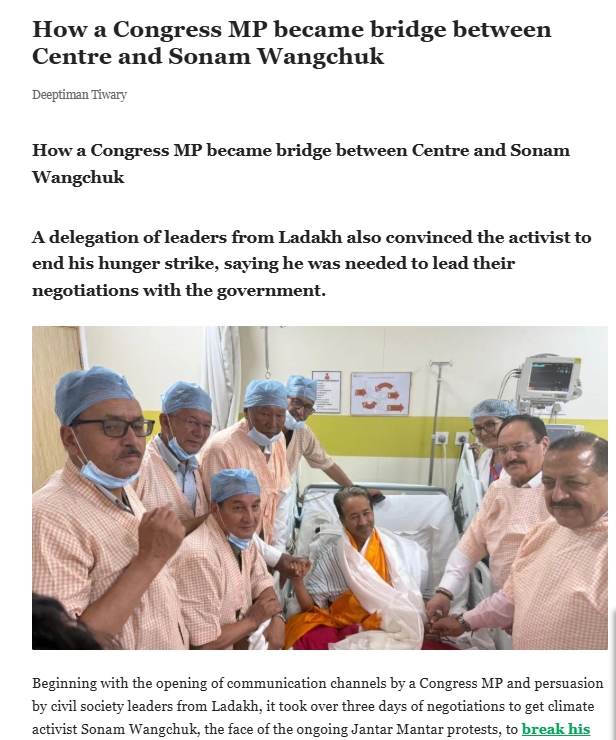
The publications, the notice alleges, have twisted these facts into a narrative that portrays Tankha as the central figure whose intervention persuaded Wangchuk to dilute the movement’s demands and end the fast. Particular objection is taken to the article authored by Deeptiman Tiwary that first appeared on the Indian Express website on 24 July under the title “How a Congress MP became bridge between Centre and Sonam Wangchuk,” which suggested that the Congress MP had convinced Wangchuk to end the hunger strike.

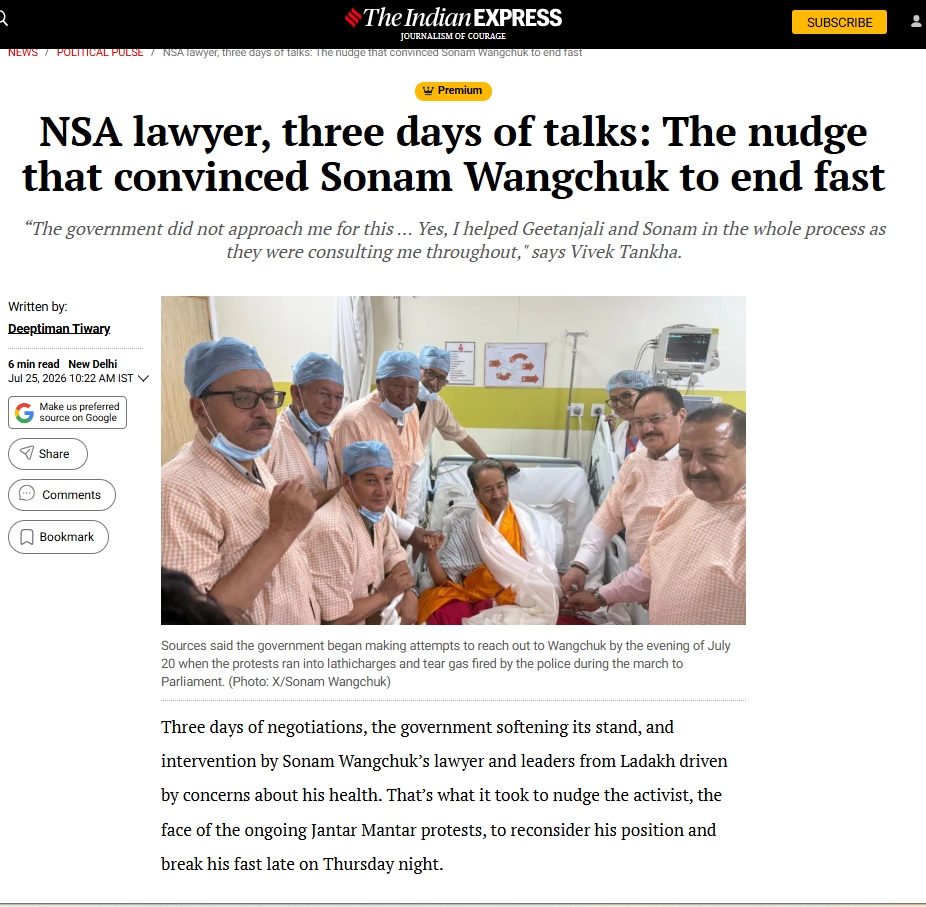
Screenshot of the original report

The title was subsequently altered to “NSA lawyer, three days of talks: The nudge that convinced Sonam Wangchuk to end fast.” The article states that Tankha “played a significant role in persuading him to end the fast” and quotes unnamed sources attributing the decision to discussions with him. Although the piece also carries Tankha’s own clarification that “the government did not approach me for this” and that his involvement stemmed from concern for Wangchuk’s life, the notice contends that the sensational headline, sub-headings and overall framing create a false impression of political intermediary work on behalf of the government.

Screenshot of the modified report

Compounding the alleged false claims, the notice points to promotional material circulated by Indian Express Hindi on X and Instagram. One video posted on 25 July carried the caption “वांगचुक का अनशन तुड़वाने में किस कांग्रेसी सांसद का हाथ है?” (Which Congress MP played a role in getting Wangchuk to end his fast?) while an Instagram reel used the caption “इस कांग्रेसी सांसद ने की अमित शाह की मदद” (This Congress MP helped Amit Shah), both of which, according to the notice, maliciously name Tankha and seek to fasten responsibility on him for “breaking” the fast while linking him to the Home Minister.

These assertions, the notice maintains, are wholly unverified, lack any documentary basis and amount to a calculated attempt to damage Tankha’s reputation as a Congress parliamentarian by suggesting that he abandoned his party’s position and acted in connivance with the ruling dispensation.

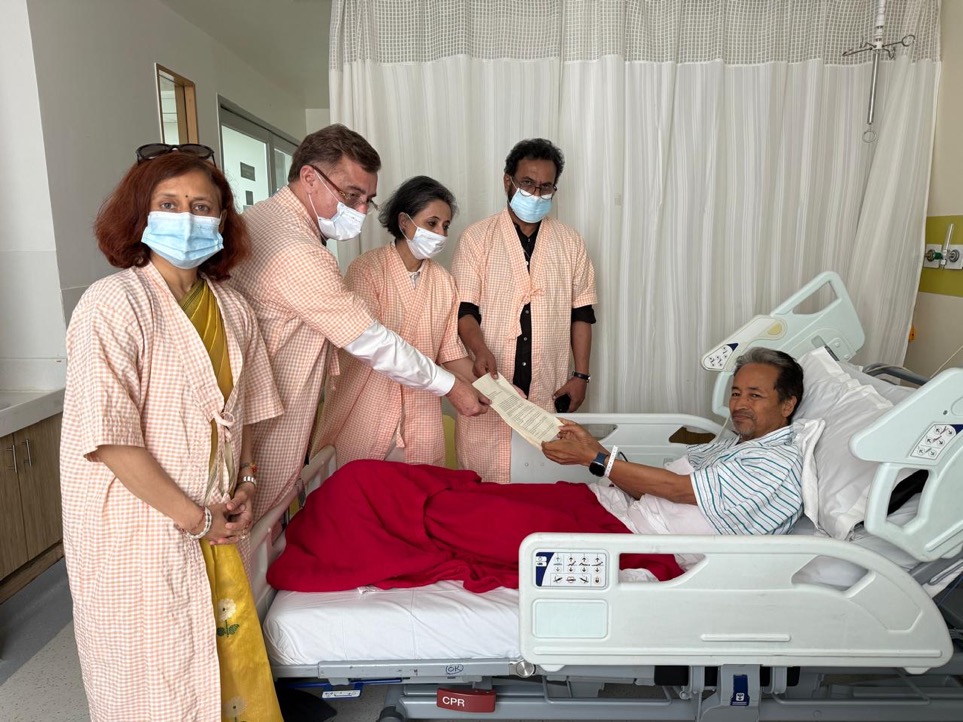
Notably, a delegation of opposition MPs had visited Sonam Wangchuk at Gurugram’s Medanta Hospital on 22nd July to persuade him to end his fast. Apart from Congress MP Vivek Tankha, others included TMC MP Sagarika Ghose and CPI(M) MP John Brittas. The delegation handed over a letter to Wangchuk, requesting him to withdraw the fast.

Wangchuk had been on an indefinite hunger strike for 26 days in solidarity with the Cockroach Janta Party-led student protest at Jantar Mantar demanding accountability for examination paper leaks, including the NEET controversy, and broader reforms in the education system. He ended the fast late on the night of 23 July at Medanta Hospital in the presence of Union Ministers JP Nadda and Jitendra Singh after receiving written assurances that no cases would be registered against peaceful protesters, that the issue of paper leaks and educational reforms would be discussed in Parliament, and that compensation for families of students who had died by suicide would be positively considered. Wangchuk himself later stated that the decision followed a hard bargain and was also influenced by the risk of the agitation turning violent.

In a post on X shortly after the notice was issued, Tankha expressed gratitude to Sharma and the firm, describing the reporting as “blatant journalistic lies being mixed to nix a true humanitarian story” and “cheap journalism.” He asserted that there is no freedom of expression to peddle lies and urged that the matter be taken to its logical conclusion.

The notice grants the addressees a strict timeline for compliance, including the publication of a correction that expressly states Tankha was never approached or authorised by the government and that his intervention was motivated solely by concern for Wangchuk’s health. They have been granted 48 hours to comply, failing which the MP will initiate appropriate civil and criminal proceedings and pursue all remedies available in law. The notice reserves Tankha’s right to claim damages for the reputational harm caused. As of Sunday evening, there has been no public response from The Indian Express or Saurabh Dwivedi.

How left-liberals and Islamists are using Dharmendra Pradhan’s resignation as foundation to incite anarchy in India

0

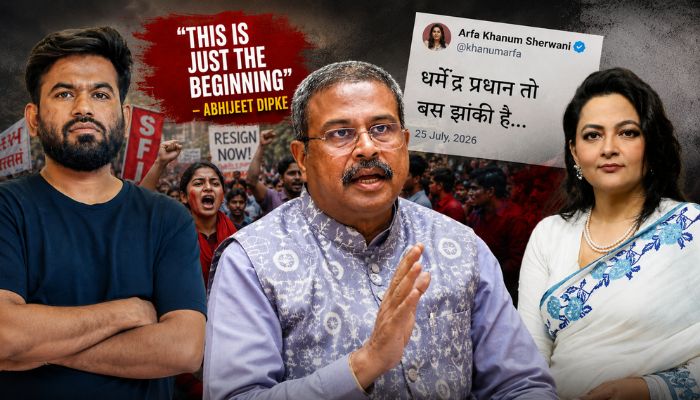
“This is just the beginning,” Cockroach Janata Party (CJP) founder Abhijeet Dipke issues an open threat in his first video message after former Union Education Minister Dharmendra Pradhan resigned on Saturday, 25th July. In the video shared on social media, Dipke issued a direct warning to the government, asserting that the stepping down of a Union Minister proves what united public pressure can achieve. Reiterating his core stance, he insisted that the minister’s exit is not the end of their fight, but merely the start.

Union Education Minister resigns amid growing unrest 

The political storm culminated when Union Education Minister Dharmendra Pradhan announced his resignation on Saturday, 25th July, 2026. The decision comes amid the ongoing protests over the NEET-UG paper leak and Sonam Wangchuk’s hunger strike at Delhi’s Jantar Mantar.

In a detailed two-page public letter addressed to the country’s youth, Pradhan stated that he had submitted his resignation to Prime Minister Narendra Modi in the interest of students and to ensure the issue was not exploited for political gains. Recalling his four-decade-long association with education as a student, teacher, and reform advocate, Pradhan reflected on his core belief that a strong, inclusive, and transparent education system forms the bedrock of a strong nation. 

Addressing the 3rd May, 2026 NEET-UG examination, Pradhan acknowledged that irregularities had taken place. He pointed out that the Centre acted immediately by handing over the probe to the CBI, cancelling the examination, and scheduling a fresh test. Furthermore, he noted that the government had decided to shift NEET to a computer-based test (CBT) format starting next year to bring complete transparency. 

The former minister emphasised that the government’s primary focus was to ensure that more than 20 lakh students could re-appear without hassle, highlighting how central and state governments, district administrations, students, and parents worked in tandem to successfully conduct the fresh exam on 21st June.

Commenting on the Jantar Mantar protests and Sonam Wangchuk’s hunger strike, he appealed to the youth not to get pulled into confusion or drawn into prolonged legal and political battles. He cautioned that anti-national forces should not be allowed to exploit the situation, urging students to direct their focus back to their studies and careers. 

Leftists and Islamists issue open threats and calls for anarchy

Following the minister’s resignation, a flood of mixed reactions erupted online. However, a noticeable wave of threats from leftists, liberals, and radical Islamists began emerging, where veiled threats of wider street agitation and anarchy were openly shared despite the minister already stepping down.

Social media saw a slew of provocative posts and aggressive videos targeting the ruling government. Arfa Khanum Sherwani of the leftist propaganda website The Wire, posted a cryptic tweet on X on Saturday, July 25, writing: “Dharmendra Pradhan is just the trailer…”, suggesting that the resignation was only the beginning and hinting at demands for further chaos in the country.

Similarly, members of the pro-communist Students organisation, SFI (Students’ Federation of India), flooded social media with red colour symbols to celebrate Pradhan’s exit. In a video circulating online, an SFI’s so-called activist was heard raising slogans against the Prime Minister and the Home Minister. Referring to Prime Minister Narendra Modi, she said, “Chai wale chacha, now it’s your time too go, go, resign.” The slogan was raised amid celebrations following Pradhan’s resignation.

Other online users quickly jumped on the bandwagon to push for a broader collapse of the ruling government. User Tarun Gautam called for expanding the protests, writing on X: “Do not settle with Dharmendra Pradhan’s resignation. It’s Modi who must go now.”

Another viral post echoed a similar sentiment, attempting to mobilise followers against the entire cabinet: “Now Dharmendra, Next Modi, Next Amit Shah, Next Gadkari, Next Next how long will we fight for each one, stand once for whole BJP Team none of them have accountability.”

Even CJP founder Abhijeet Dipke, emboldened by the resignation. In a viral video on social media, he openly challenged the country’s security agencies and police personnel. He wrote, “It’s just 1 resignation; withdraw cases against students on July 20 & later. Don’t mess with a cockroach. If we can make Minister resign, then you cops are nothing for us.” The statement was widely circulated online following Pradhan’s resignation.

Political reactions to the resignation 

Political opposition leaders were quick to claim victory following the announcement. AAP National Convenor Arvind Kejriwal released a statement congratulating the public and the student community: “Congratulations to all of you. Congratulations to the youth of our country. It is a matter of great joy that your struggle has borne fruit. Dharmendra Pradhan ultimately had to resign. This is a great victory for our democracy. People in our country had begun to lose faith in democracy. They felt that governments do not listen. People would raise their voices before the government and plead with folded hands, but the government never listened.”

Punjab Finance Minister Harpal Singh Cheema also took a sharp dig at the ruling party, saying: “Ever since the BJP came to power in the country, exam papers started being sold. They were leaked, and lakhs of children across the country took to the streets to protest against it… The downfall of the BJP has begun. From today, these same children who were protesting will give a befitting reply to the BJP whenever any state or national election comes.”

The selective outrage and silence on Non-BJP states

While Punjab ministers and opposition figures appeared visibly overjoyed by the resignation of the Union Minister, it clearly strikes a double standard in their political rhetoric. None of these political leaders or activist groups has acknowledged or condemned similar examination scandals in non-BJP-ruled states, such as the recent Punjab Pharmacy paper leak.

Furthermore, neither the CJP nor opposition commentators have demanded the resignation of education ministers in non-BJP-governed states, such as Madhu Bangarappa in Karnataka or Punjab’s own Education Minister, Harjot Singh Bains. 

This selective silence has raised valid questions about whether the outrage is genuinely about protecting students or simply about leveraging political momentum against a single political party.

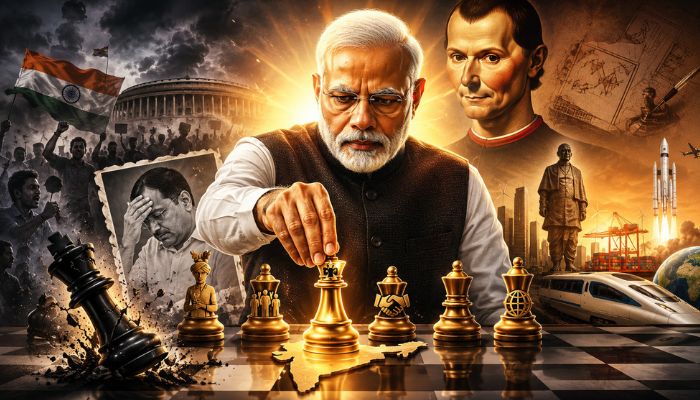
The fox, not the lion: What Machiavelli would notice about PM Modi

Most people describe Narendra Modi’s power in the same familiar terms. Dominance, electoral strength, and authority. It is the language of a ‘strongman’, and for much of the past decade, it seemed adequate. But strongman is also the least revealing way to understand him because it captures only the scale of his mandate and says very little about how he responds when that mandate comes under pressure.

On Saturday, India’s education minister resigned. Just like that, a month of nationwide student protests that had been building into a real political crisis was over within hours. Looked at one way, it seems like Narendra Modi was forced into a retreat. Looked at properly, it’s more like a trade he was always ready to make. Sacrifice one cabinet minister, someone who could be replaced by Monday morning, to shut down a movement that was starting to look a lot like the youth uprisings that had recently brought down governments elsewhere in the region. That’s not losing. That’s knowing exactly which piece on the board is expendable and which one isn’t.

Farmers got a policy reversal back in 2021. Coalition allies got cabinet seats and veto power in 2024. Students got a minister’s resignation in 2026. Every single time, Modi gave up the smallest thing he could give up to neutralise the biggest threat he was facing, and every single time he was still standing at the end of it, still setting the agenda, still the one person whose own position was never actually on the table. Call it the defining discipline of his politics, ‘he wins big by losing small.’

The traits nobody credits him with

A lot of people think of Modi mainly in terms of his hard-line politics and the strong image he has built around himself. But that misses some quieter strengths that have mattered just as much to his rise and staying power. Patience, the ability to manage alliances, control over his message, and a very sharp sense of timing. His way of communicating is especially important. Since 2014, he has mostly spoken to people directly through social media and Mann Ki Baat, instead of relying on the regular press. That helped him create an image of himself as a Pradhan Sevak, a chief servant, rather than a distant supreme leader.

The idea is that he is there to serve the country, and that image is also meant to connect with Gandhi in a very deliberate way. Scholars who study his media strategy have pointed out that this direct approach let him go around elite media and speak to the public on his own terms. The same instinct for careful presentation can also be seen in foreign policy. During India’s 2023 G20 presidency, the government made a clear effort to present India as a leading voice for the developing world, with scholarships, science initiatives, and a platform for the Global South. This was not just for show. It was a kind of political groundwork, laid long before he needed it to deal with a hung parliament or a difficult election.

Why bending is not breaking

In politics, people usually treat flexibility as just a polite way of saying someone’s dumped their principles. Modi’s career points the other way. Look at how the farm laws got repealed, it’s interesting less because of the fact that he backed down and more because of the way he handled it. The announcement was timed to land right alongside a major Sikh religious festival. Most people saw that as an attempt to spin a clear policy defeat into a gracious gesture toward the Sikh farmers who’d been at the centre of the protests.

At the time, the commentary largely framed it as a tactical move rather than a forced surrender, even though it did dent his strongman image and handed his critics some fresh ammo. Others went further and argued the climbdown wasn’t really an admission of defeat at all, more a calculated bid to protect his voter base ahead of some tightly contested state elections, driven by a real sense of vulnerability after a string of disappointing results in recent state and civic polls. The underlying push for agricultural reform never actually disappeared, it just went quiet. That’s been the pattern right through his career, which is to give ground on the method, hold the line on the objective, and keep tight control over how the concession gets told. A leader who can’t do that ends up hostage to his own past positions. One who can is simply a lot harder to defeat.

The political mind behind the public image

Look, none of this is actually new in political thought, even if it sounds pretty cynical when you just say it straight out. Machiavelli was already arguing this stuff five centuries ago, that the ruler best set up to survive isn’t the most consistent one, but the most adaptable. Someone who can completely shift how they behave the moment circumstances change. Modern takes on ‘The Prince’ basically describe this quality, virtù, as needing what one standard account calls a ‘flexible disposition’, basically the ability to change your approach as conditions shift, while never losing sight of the two things that really matter. Holding on to power and actually getting something done with it.

Machiavelli even borrowed that image of a general reading a changing battlefield instead of stubbornly fighting yesterday’s war all over again. Judged by that old standard, Modi’s willingness to trade a single party, Hindu nationalist posture for coalition dependence, or to switch from confrontation abroad to quiet accommodation and back again, doesn’t read like the record of a leader with no real convictions. It’s just a much older lesson applied with unusual discipline; methods are disposable while objectives are not.

What critics get right and what they miss

Look, the obvious objection here deserves a proper hearing, not just a quick brush-off. Independent monitors have genuinely got more and more worried about the state of Indian democracy under Modi. Freedom House has downgraded India’s scores on political rights and civil liberties, and they trace that decline straight back to the years since he took power in 2014, pointing to things like intensifying intimidation of journalists and growing pressure on rights groups. Sweden’s V-Dem Institute went even further and labelled India an electoral autocracy. These aren’t fringe complaints; they’re among the most carefully documented critiques you’ll find levelled at any large democracy right now. But the same body of research also muddies the simplest version of the story. India’s elections are still genuinely contested, opposition parties actually run major states, and as one recent survey of the evidence notes, the courts have struck down big government initiatives.

You can have a government that wins real popular support at the ballot box while the civil liberties framework around future elections is quietly narrowing at the same time, and that’s exactly the combination these indices are designed to flag. PM Modi’s own foreign minister S Jaishankar has just dismissed the rankings outright, calling them the work of self-appointed international arbiters trying to impose their own rules on a country that’s stopped asking for their approval. It’s not really a rebuttal so much as a reminder that the same flexibility that lets Modi make peace with rebellious allies also lets him soak up institutional criticism without ever being forced into a full retreat. Both of those readings can be true at the same time, and that’s precisely the point that critics and admirers both tend to flatten.

Why this kinds of leadership wins now

This week’s exam protest resignation follows the exact same logic, just on a much shorter fuse. Youth movements in Sri Lanka, Nepal and Bangladesh had recently escalated all the way to the point of leadership collapse. Modi’s government spotted the first real signs that this one might be heading the same way and quickly cut the losing piece off the board, trading a single minister to keep the presidency, the youth vote and the 2027 election calendar completely untouched.

The 2024 election result is probably the clearest real-time test of all this, because it forced an adaptation that nobody really expected Modi to have to make. After ten years of governing with a clear majority, he suddenly found himself dependent on Chandrababu Naidu’s Telugu Desam Party and Nitish Kumar’s Janata Dal (United). Two allies with long track records of switching sides whenever it suited them, exactly the kind of unreliable partners a leader used to having complete authority would normally never choose to lean on. Instead of fighting the shift, he moved quickly to absorb it, getting a formal, unanimous resolution from every NDA party naming him their leader within just a few days of the result.

You see the same instinct at work abroad. Throughout the Ukraine war, India has refused to condemn Moscow, yet the prime minister has also visited Kyiv, as what one Western analysis described as a display of strategic autonomy that avoided any sharp break with Russia while still sending a signal to Washington. And the G20 presidency was set up to serve a domestic political purpose just as much as a foreign one, boosting India’s global standing while quietly banking political capital ahead of the next election. In a fragmented, multipolar world, this is increasingly what leadership rewards, not rigid consistency, but the discipline to keep one objective fixed while constantly rewriting the tactics used to get there.

Conclusion

A leader who’s this good at soaking up pressure without ever really changing course can also be one who never quite has to answer for it, and the steady drop, as per so-called renowned think tanks, in India’s press freedom and civil liberties scores is the cost side of that same ledger, not some separate story. But writing Modi off as just the lucky beneficiary of Hindu nationalism and a compliant electorate misses what’s actually kept him at the centre of Indian politics for two decades. It isn’t the rigid strongman style people usually associate with leaders like him. It’s a rare ability to bend on almost everything except the one thing that really matters to him, staying the man who gets to decide what happens next. Critics keep waiting for him to break. Admirers keep waiting for him to triumph. Both of them keep missing the same point, ‘he was never trying to stand still in the first place.’

How Hindus are reclaiming the Adina Temple , which was converted into a mosque by invaders

A major religious and political row is brewing in West Bengal as a Hindu group, backed by local BJP leaders, has begun conducting prayers near the 650-year-old Adina ‘Mosque’ in Malda district. The historic structure was built over an ancient Hindu temple. Leading the effort, the ‘Adinath Puratan Shiv Mandir’ organisation has announced plans to install a massive 3.6-foot-high Shiva Lingam, weighing around 1.5 tonnes, outside the ‘mosque’ premises. The Shiva Lingam is being transported from Tarakeshwar, located nearly 289 km away.

According to a report by The Indian Express, Kajal Goswami, chief patron of the group and a BJP leader, openly stated, “There are Hindu and Buddhist statues in the so-called mosque. The Adinath Temple was destroyed to build a mosque on it”. He added, “Our aim is to restore the temple and place the Shiva Lingam inside it”.

However, Goswami stressed that they intend to follow the law and avoid any law and order disruption, mentioning that officials from the Archaeological Survey of India (ASI) and the police instructed them to perform rituals outside the protected monument area.

Following these developments, the Malda district police issued a strict advisory, reminding the public that the Adina Monument is a Centrally Protected Monument under the AMASR Act of 1958, where unauthorised religious rituals inside the premises are strictly prohibited. 

Political momentum has also picked up, with BJP Rajya Sabha MP Samik Bhattacharya raising the issue in Parliament, urging the Central Government and the ASI to look into protecting the original Adinath Temple. Meanwhile, opposition leaders like CPI(M) Politburo member Md Salim have accused the BJP of using a familiar political playbook to divide people ahead of upcoming elections.

Conversion of the ancient temple into a Mosque 

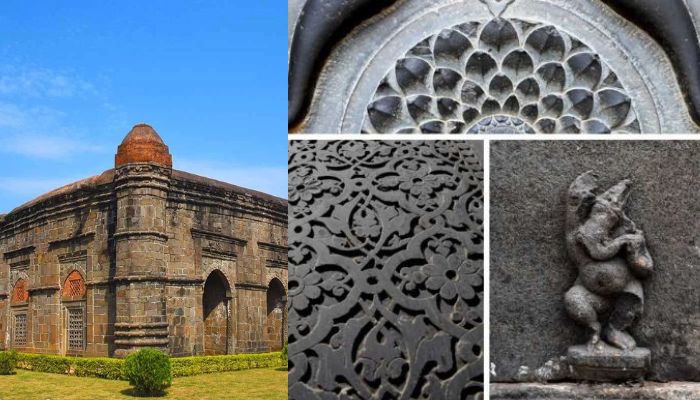
Located in Pandua in Bengal’s Malda district, the Adina Mosque is officially recorded as being built between 1373 and 1375 CE by Sultan Sikandar Shah of the Ilyas Shahi dynasty. While historical narratives often label it the largest medieval mosque in the Indian subcontinent, extensive archaeological and architectural evidence reveals a much older history. The mosque was primarily constructed using materials, pillars, and carved stones salvaged from pre-existing Hindu and Buddhist structures belonging to the Pala-Sena era (8th to 12th century).

Sculptural remnants throughout the structure suggest that the site was originally home to the grand Adinath Temple, dedicated to Lord Shiva, alongside a shrine dedicated to Lord Vishnu. The pulpit of the mosque itself incorporates a doorway made of black basalt stone taken directly from the temple’s architectural ruins. 

Furthermore, terracotta and stone carvings on walls, doors, arches and mihrabs or prayer niches depict Hindu deities like Lord Shiva and Ganesh. In addition, there is a significant presence of motifs like flowers, caitya arches, kiritmukha (face of glory) masks, beaded necklaces, and chain-and-bell designs. The Islamic architecture is devoid of this type of adornment, indicating that these motifs and carvings date back to the Pāla–Sena era. 

The central mihrab of this mosque carries clear indications of the structure’s Hindu history. The front of this mihrab is placed in the curved wall decorated with a tri-foiled arch, and the spandrel on either side of the arch has been decorated with rosettes, and the panels inside the mihrab are also adorned with the designs of foiled arches and rosettes having chain and bell motifs hanging from the apex of the arches. These are Hindu decorative motifs, as these sorts of chain and bell motifs are noticed on the shaft of the columns engraved during the Hindu period. 

Even today, broken Shivlings and overturned idols of Hindu deities remain visible within the walls and surrounding structures, pointing to a widespread destruction of Hindu heritage in the region during medieval invasions. 

The issue gained significant legal and social attention when senior advocate Hari Shankar Jain appealed to Hindus to reclaim their right to worship at the site, writing letters to Prime Minister Narendra Modi and calling out the historic destruction caused during Sikandar Shah’s reign.

TMC MP Yusuf Pathan attempted to legitimise it as a mosque

The controversy caught national spotlight when Trinamool Congress (TMC) MP Yusuf Pathan visited the site and attempted to highlight it purely as an Islamic architectural feat. 

Sharing pictures of his visit on social media, Pathan wrote: “The Adina Mosque in Malda, West Bengal, is a historic mosque built in the 14th century by Sultan Sikandar Shah, the second ruler of the Ilyas Shahi dynasty. Constructed in 1373–1375 CE, it was the largest mosque in the Indian subcontinent during its time, showcasing the region’s architectural grandeur.

Netizens and political commentators quickly called out the TMC leader for ignoring the site’s rich Hindu heritage. Sharing detailed photographs of Hindu carvings inside the complex, social media users offered sharp fact-checks. Advocate Shekhar Kumar Jha posted an image showing a Lord Ganesh carving on the wall, commenting, “Historic: Adinath Mandir became Adina Mosque.”

Another X user, “PlanH,” replied directly to Pathan: “Dear Yusuf Pathan, you are standing in the campus of one of the largest Hindu Temples, Adinath Temple, which was desecrated and occupied by Islamic invaders. Attached are some images for your reference. It is time to undo the injustice and barbarity, and reestablish the temple’s glory.”

User “Abdul Kitabi” added: “As a true Muslim, we must give this mosque back to Hindus.”

Others raised fundamental questions about historical accountability, asking, “Have you people made anything of your own, or have you just taken over everything by demolishing others’ religious sites and claimed it as your own?”

Reclaiming rights and moving towards restoration under BJP government 

For decades, local Hindus were strictly barred from offering prayers or carrying out any religious rituals at the disputed site. The area was placed under strict protection by the ASI, which effectively halted any attempts at worship or further archaeological excavation. However, the sentiment surrounding the site began shifting noticeably in early 2024. 

A group of Hindu devotees led by a young priest, Hiranmoy Goswami, entered the premises, identified idols and a Shivling embedded in the architecture, and started chanting mantras and offering puja. Though local police intervened following the complaint by local Muslims and stopped the prayers at the time, the act marked a turning point for the local community.

Today, backed by BJP leaders pushing for historic justice, the effort to reclaim the site has reached a new high. Comparing the dispute to major historical re-evaluations like Ayodhya’s Ram Janmabhoomi, Gyanvapi, and Mathura, activists and political figures emphasise that public religious sentiment cannot be suppressed forever. 

With plans to petition the Calcutta High Court for a complete ASI survey and the ongoing installation of a dedicated Shiva Lingam outside the complex, the Hindu community is taking decisive steps to legally and peacefully reclaim what they consider their rightful sacred heritage.