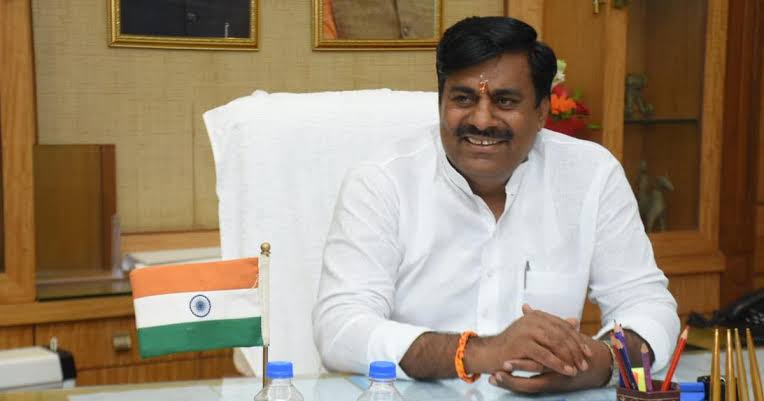
BJP MLA from Madhya Pradesh, Rameshwar Sharma, cautioned Hindus to stay away from “Father and Chadar” while addressing a gathering at a Dussehra function in state capital Bhopal.
The video of the incident was shared on social media and it instantly went viral, with a large number of people, sharing, posting and commenting about it.
In the viral video, Rameshwar Sharma said, “Hindus would do well to steer clear of Father and chadar. If they don’t, they will be destroyed. Keep away from peer babas. The peer baba is an obstacle in your visiting lord Hanuman temple. Tell the followers of peer baba that they believe in those who are buried in the ground, but we worship who runs the universe– Bajrangbali.”
Sharma urged Hindus to protect and preserve their culture, stop greeting with good morning wishes and start chanting shlokas to thank dharti mata (motherland) daily instead.
The BJP leader also spoke on the importance of land citing various instances of Hindu mythological incidents. “It is not just a piece of land but it represents our goddess, so keep worshipping this land. We have worshipped it in the Navratri and we will continue to do so in the coming days. Let’s hail Lord Ram,” Sharma proclaimed.
Ajay Yadav, a Congress party leader, accused Sharma of insulting minority communities. He said, “BJP senior leaders should clarify. Do they believe the same? If they do not, they should take action against Sharma because he is trying to create a rift among people of different communities.”
However, BJP’s Rajneesh Agrawal said it was Sharma’s personal opinion and insisted that the MLA was only warning people against conversion and not insulting any community.
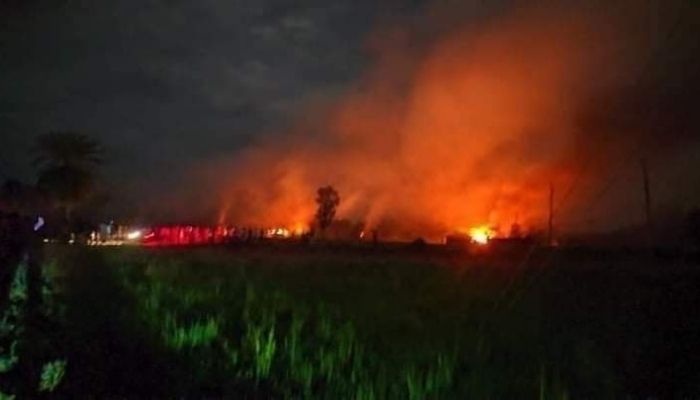
The radical Islamists in Bangladesh have continued their violence against the minority Hindu community, for 5 days straight. In a fresh attack on Sunday (October 17), they carried out arson at a village and burnt 20 Hindu homes in Pirganj Upazila in the Rangpur Division of Bangladesh.
In a tweet, Bangladesh Hindu Unity Council (BHUC) informed, “At present Hindus are being attacked in Pirganj of Rangpur. Attacks on Hindus continue across the country. If this continues, it will be difficult for Hindus to survive in Bangladesh.”
Thousands of local jihadi groups have set fire to and looted 60 Hindu houses and temples in two villages, including Bot Bazar Majhipara in Ramnathpur union of Pirganj upazila in Rangpur district of Bangladesh, last night, spreading rumors of insult to islam. pic.twitter.com/uIw7BFzBHs
BDNews24 reported that Muslims in Jelepolli in Majipara had alleged that a Hindu man had posted ‘content dishonouring religion’ on Facebook. District Superintendent Md Qamruzzaman stated, “Police stood guard around his home. That home was saved, but the attackers set fire to some other homes not so far from his.” The frenzied mob of radical Islamists targeted three villages namely, Majhipara, Bottola and Hatibandha villages in Pirganj Upazila.
BDNews24 added that the Fire Service Department received information about the arson attack at around 9:50 pm. It was only at 3 am on Monday morning that the fire could finally be extinguished. While there have been no casualties or estimates of the damage caused, it is believed that 15-20 houses were burnt down during the attack.
The Daily Starreported that Deputy Commissioner (Rangpur) Asif Ahasan rushed to Karimganj village with the police after allegations of blasphemy resurfaced via a Facebook post. He informed, “But by this time, miscreants set fire to some Hindu houses in other villages in Pirganj.”
Bangladesh Home Minister assures fairness in investigation
Meanwhile, Bangladeshi Home Minister Asaduzzaman Khan Kamal assured of a fair probe in the matter. He added, “We’re seeing and assuming many things. We’re waiting for evidence. Once we get the evidence, we’ll present it before you. We’ve taken the Cumilla incident very seriously. We’ll let you know after a proper investigation. We hope to let you know very soon.
While assuring fair investigation, Asasuzzaman remarked, “”There is no shortage of instigators inside the country.”We’ve arrested two-three suspects in the Cumilla incident. Those involved will be identified soon.With utmost patience, security forces are handling the situation.”
More Hindu temples attacked, petrol bombs hurled in Feni district
In a tweet on Saturday (October 16) night, Bangladesh Hindu Unity Council (BHUC) informed that radical Islamists attacked Hindus in the Feni district in the Chittagong Division of Bengladesh. It had also shared a 14-second video clip wherein radical Islamists could be seen creating mayhem on the streets. Equipped with lathis, the frenzied mob gathered in large numbers and then attacked Hindu temples in unison in the Feni district.
The attackers torched a passenger vehicle at Kalipal, hurled crude bombs, vandalised a fire truck and attacked Hindu temples such as JoyKali, Jagannathbari, Kalibari Temple and Gaziganj Ashram. Reportedly, the President of the Bangladesh Hindu Buddhist Christian Unity Council, Shukdeb Nath Tapan, was attacked by the same Islamist mob near the Joykali temple.
According to Officer-in-Charge (Feni Model Police Station) Nizam Uddin, more than 40 people were injured during the clashes. They were then rushed to the Feni General Hospital. As per eyewitnesses, the student wing of the Jamaat-e-Islami named Islami Chhatra Shibir was among the perpetrators. Local activists of the Awami League and its student wing Bangladesh Chhatra League tried to resist the attackers.
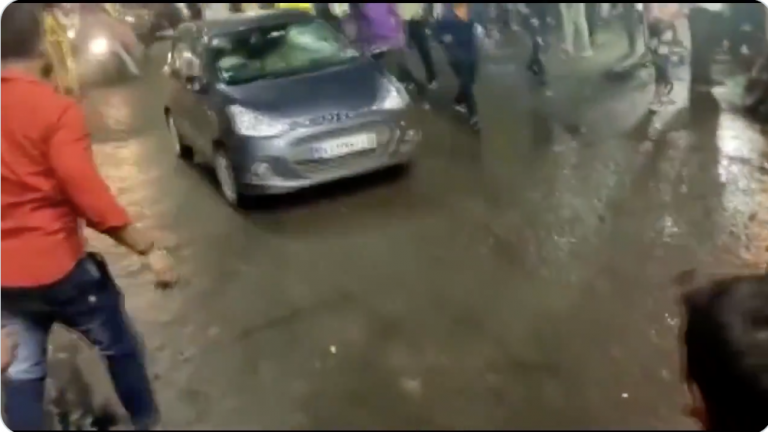
The Bhopal police on Sunday arrested Umar (22) and Shahrukh (23) for ramming their car into devotees who were part of a Durga Puja idol immersion procession.
While Umar was in the driving seat, Shahrukh was in the passenger seat. The duo had come for dinner at a hotel near the Bhopal railway station and returning home when they mercilessly crashed their car into devotees.
As many as six people were injured in the horrific incident that took place on Saturday late at night at Bajaria area near the railway station.
#WATCH Two people were injured after a car rammed into people during Durga idol immersion procession in Bhopal’s Bajaria police station area yesterday. Police said the car driver will be nabbed.#MadhyaPradeshpic.twitter.com/rEOBSbrkGW
While speaking to media on the arrest, Irshad Wali, Deputy inspector general of police Bhopal confirmed, “The car driver has been arrested and the vehicle has been seized. Further investigation is underway.” A case under the Indian Penal Code (IPC) sections 279 (rash driving) and 337 (causing hurt) has been registered against the accused.
‘Accused hurled abuses before ramming into people’
Narrating the incident, Raju Rohit, 30, a resident of Chandbad area and president of Durga Samiti of Chandbad in his complaint revealed that the accused were asked to take an alternate route due to the procession but instead they hurled abuses and forced their way into the procession.
“We had booked a band from Chandbad to the railway station and as we stopped near the platform number 1, a speeding car came from the bridge side and hit a member of the samiti who was drinking near a tea shop along with other members,” said Raju.
“We had told the car driver that the road is narrow and that the procession is passing through and advised him to take another route. But he refused and hurled abuses before running into the procession,” he added further.
The resident said that as the accused was being stopped by the cops, he again accelerated the vehicle in reverse gear and mowed down three other members of the samiti.
Reportedly, a heavy police force had to be deployed to prevent a law and order situation as the devotees had blocked the road demanding immediate action. The police had to use ‘mild force’ to disperse the crowd to bring the situation under control.
Accused claimed ‘was afraid of the mob’
Investigating officer SI Ankit Baghel informed that during interrogation, the two accused claimed that they feared a backlash from the mob after hitting a person and hence reversed the vehicle in a bid to flee the spot.
Both Umar and Shahrukh work at a private firm.
Car rams into people in Chhattisgarh
Bhopal’s incident comes just days after devotees at Durga Visarjan procession were crushed under a speeding car in Chhattisgarh leaving at least one person dead. At least 20 people were left injured in the incident.
A chilling video of the disturbing incident that has gone viral on the internet showed a speeding car running over an unsuspecting group of people gathered for Durga Idol immersion on Raigad Road in Pathalgaon, Jaspur.
As we inch closer to the Uttar Pradesh state assembly elections, the opposition is leaving no stone unturned to create unnecessary noise around the incumbent Chief Minister Yogi Adityanath.
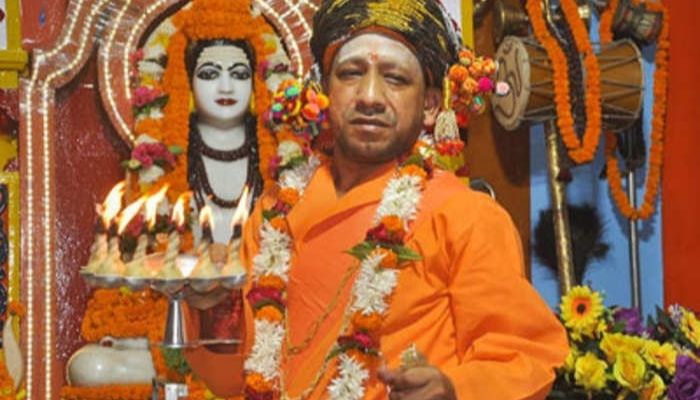
CM Yogi Adityanath is the Mahant of Gorakhpeeth and the current leader of the Nath Sampradaya. Every year, CM Yogi spends the Navaratri time during Dussehra at Gorakhnath Mandir in Gorakhpur and presides over the religious activities there.
As if their utter political humiliation and nationwide embarrassment was not enough, some Congress loyalists have now decided to teach a Yogi and the Mahant of Gorakhpeeth how to perform Hindu religious activities.
Rohan Gupta, the Chairman of Indian National Congress’ social media department sharing a cropped video claimed that the UP CM was performing Aarti ‘for the camera’.
Gupta Tweeted, “Brother, God is behind you!” with a video where Adityanath can be seen performing Aarti in the opposite direction of the sanctum sanctorum of the temple.
The netizens were quick to school the IT Cell head of the ‘Chunavi Hindu’ party. Several social media users educated Gupta on the Hindu ritual of performing Aarti in all ten directions.
One user named Ankur Singh shared the uncropped video where Adityanath can be seen performing Aarti in all directions.
Was Yogi Adityanath doing aarti of Camera?
Lie
You can clearly see that he was doing aarti in all direction. Right, back and left pic.twitter.com/NZGvjdncGT
Another user shared a video posted by Jagannath Puri temple’s official handle where the priest can be seen performing morning Aarti towards the main door of the temple, facing opposite to the sanctum sanctorum.
Several users recommended the part-time seasonal Hindus to visit temples adding that performing Aarti in all directions is a common sight and an old tradition.
In what seemed like another toolkit dished out to the Congress workers, party secretary of INC Puducherry Tweeted, “What a wonderful worship of Yogi Adityanath by Candle aarti. Aarti is not to God but to the camera. People are saying – camera live.”
What a wonderful worship of Yogi Adityanath by Candle aarti.
Congress worker claims CM Yogi is using ‘candles’, gets schooled
Yet another Congress worker, Gaurav Pandhi, the national coordinator of INC’s social media department mocked Adityanath alleging that the mahant used ‘candles’ to perform Aarti.
Pandhi Tweeted, “In a temple, why is he behaving like a father in a Church using candles and doing Aarti of camera-person and not the goddesses? This is the reality of fake Hindus who do politics in the name of religion. Since when did we start using candles for puja & aarti in temples.”
In a temple, why is he behaving like a father in a Church using candles and doing Aarti of camera-person and not the goddesses?
This is the reality of fake Hindus who do politics in the name of religion. Since when did we start using candles for puja & aarti in temples. pic.twitter.com/NVDiNbTSMW
Once again the netizens humbly urged Pandhi to visit a temple and also advised him to observe the video carefully as thick wicks of cotton threads soaked in Ghee were used to perform Aarti and not ‘candles’.
“These are the same people who have not visited the temple till date nor have they seen how the aarti is done? Firstly, it is a wick of ghee, not a candle, secondly, there might be a statue of a god in front of Shri Gorakshanath ji’s statue to whom Maharaj ji is showing aarti, you fool,” Tweeted a user in Hindi.
यह वही लोग है जो आज तक मंदिर न गए है और ना ही यह देखे है की आरती होती कैसे है? पहली बात वह घी की बाती है कोई कैंडल नहीं, दूसरी बात श्री गोरक्षनाथ जी के प्रतिमा के सामने किसी भगवान की प्रतिमा होगी जिसकी महाराज जी गोरक्षनाथ जी के पास से खड़े होकर आरती दिखा रहे होंगे ! You fool.
Several social media users have now started to call the Congress leaders and workers ‘Chunavi Hindus’ for their religious gimmicks right before the elections. The Gandhi family has been receiving flak for going on a temple run wearing a tilak, Janeu and breaking coconuts only at the time of elections in a bid to woo Hindu voters.
As the assembly elections of Uttar Pradesh and four other states are inching close, AICC national secretary Priyanka Gandhi Vadra has once again started masquerading herself as a devout Hindu by visiting temples and loading herself with garlands.
Vadra has already visited temples like Kashi Vishwanath and Durgakunda in Varanasi and also claimed to have observed fast during the festival of Navratri. Interestingly, the newfound love for temple visits is rather new in the Gandhi siblings and is a recreation taken up only in recent years after repeated election defeats at the hands of BJP.
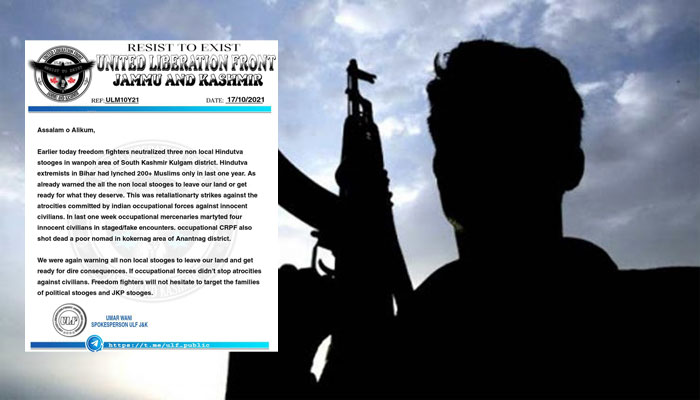
On October 17, United Liberation Front, a terrorist organization operating in Jammu and Kashmir, took responsibility for a recent attack on three Hindus from Bihar living in the valley. The terrorists had entered a house in Wanpoh, district Kulgam and fired the labourers from Bihar staying there. Two of them, Joginder Reshi Dev and Raja Reshi Dev, were killed in the attack. Chunchun Reshi Dev was critically injured and rushed to a hospital.
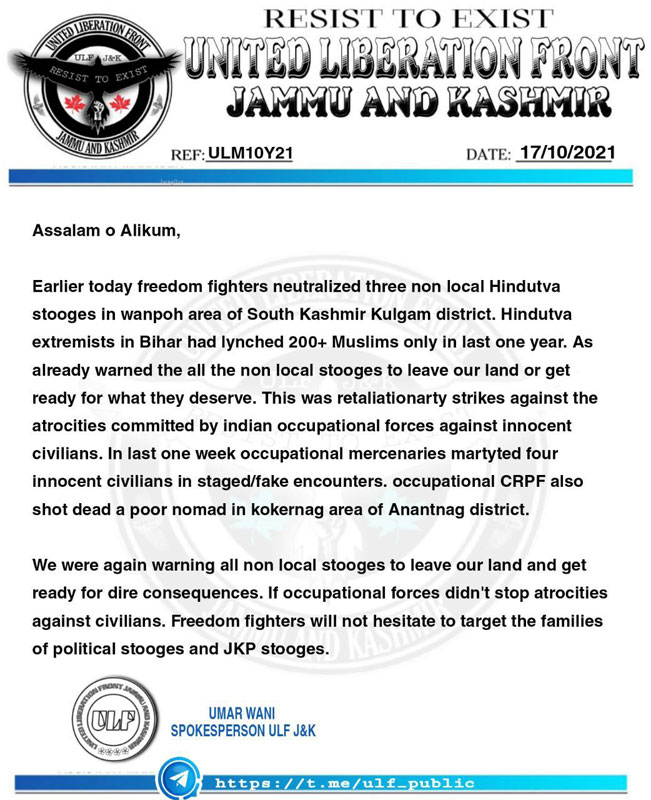
In a statement issued by ULF, the terrorist organization stated that its members attacked three non-local Hindus in the region. ULF alleged that 200+ Muslims were lynched in Bihar by ‘Hindutva extremists’ in the last one year. ULF further alleged that the four terrorists killed by CRPF recently were civilians. It issued a warning for non-local Hindus and called them stooges. They asked Hindus to leave Kashmir else face the consequences.
ULF took responsibility for killing two non-locals, warn others to leave Kashmir
The statement said, “Earlier today, freedom fighters neutralized three non local Hindutva stooges in Wanpoh area of South Kashmir Kulgam district. Hindutva extremists in Bihar had lynched 200+ Muslims only in last one year. As already warned the all the non local stooges to leave our land or get ready for what they deserve. This was retaliationarty strikes against the atrocities committed by Indian occupational forces against innocent civilians. In the last one week, occupational mercenaries martyred four innocent civilians in staged/fake encounters. Occupational CRPF also shot dead a poor nomad in the Kokernag area of Anantnag district.
We were again warning all non local stooges to leave our land and get ready for dire consequences. If occupational forces didn’t stop atrocities against civilians. Freedom fighters will not hesitate to target the families of political stooges and JKP stooges.”
Attack on Hindus in Kashmir
In the past couple of weeks, several attacks have taken place in the valley where Hindus and Sikhs were targeted by terrorists. A gol-gappa seller from Bihar, Arbind Kumar Sah, was killed on October 16. Another poor vendor from Bihar, Virendra Paswan, was killed on October 5.
It is noteworthy that the language used in the warning issued by ULF used the words like Hindutva, Hindutva stooges that have been used by terrorists before. The Jaish-e-Mohammad terrorist, Adil Ahmed Dar, who carried out the Pulwama attack in 2019 was also full of hate against Hindus. In a video that was released after the attack, Adil had referred to Hindus as “Gae ka Peshab Peene Wale” (People who drink cow urine). He had also referred to the demolished disputed structure in Ayodhya.
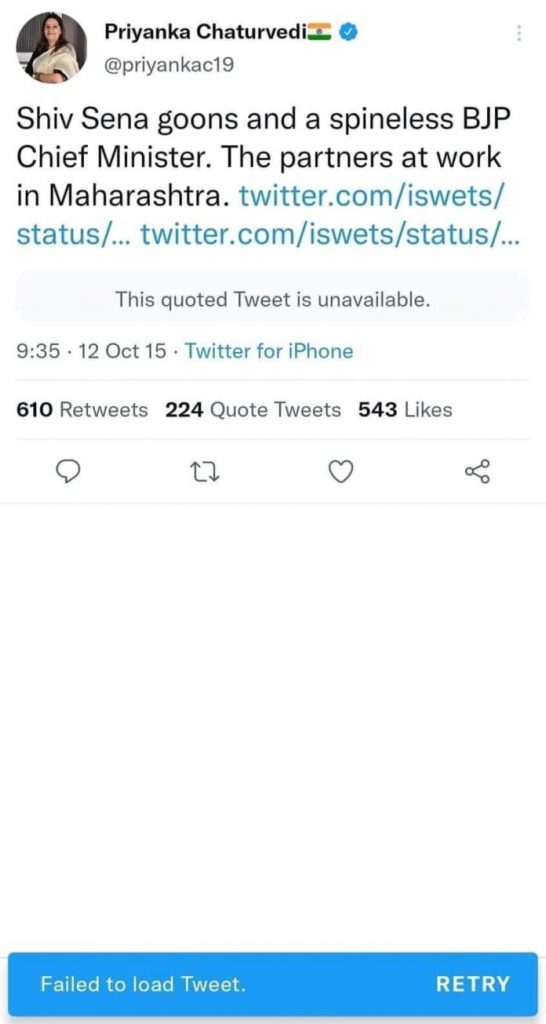
It appears that former Congress member and current Shiv Sena MP Priyanka Chaturvedi deleted one more tweet on the Shiv Sena and the Thackerays, to avoid getting trolled for the same.
The deleted tweet said, “The price of compromise to stay in power, BJP gives away Mumbai Mayor’s Bungalow, a heritage property, for Bal Thackeray Memorial”.
Twitter users on the social media platform found the deleted tweet from 2015 and reported the same to Priyanka Chaturvedi. In the tweet from 2015, Priyanka Chaturvedi had criticised the BJP for ‘giving away’ the Mumbai mayor’s bungalow to be converted to late Bal Thackeray’s memorial. At that time, she was in the Congress party, and Shiv Sena was a BJP ally and a part of NDA.
But now that she is in Shiv Sena, netizens had started to point her to the tweet where she had earlier criticised Shiv Sena, after which she deleted the tweet. However, she took a jibe at people posting her old tweet, implying that social media users are paid for doing so.
She posted a tweet in which she said, “My 2015 tweets are popular again. Is it a slow season for trolls? Anyway, hope employment guarantee schemes help them :-)”
My 2015 tweets are popular again. Is it a slow season for trolls? Anyway, hope employment guarantee schemes help them 🙂
Just recently, Priyanka Chaturvedi was spotted deleting another of her old tweets condemning violence perpetrated by Shiv Sena goons.
Source: Rosy/Twitter
Both the deleted tweets were from 2015 when Priyanka Chaturvedi was a member of the Congress Party and regarded Shiv Sena as ideological untouchables. Also, Shiv Sena was a Hindutva party back in 2015.
Notably, Priyanka Chaturvedi had claimed in 2019 that she was glad she did not delete any of her earlier tweets. She had said, “I am so glad I didn’t delete any of my earlier tweets, it keeps the trolls employable and get their 2 rupees worth of work done. My contribution to failing economy :)”
I am so glad I didn’t delete any of my earlier tweets, it keeps the trolls employable and get their 2 rupees worth of work done.
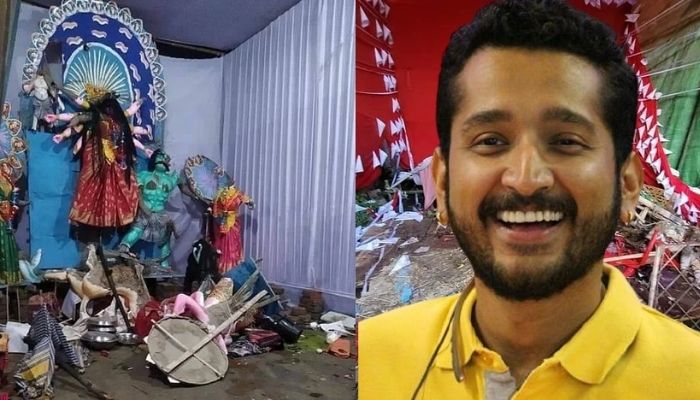
On Saturday (October 16), popular Bengali actor Parambrata Chatterjee courted controversy after he tried to draw parallels between the ongoing pogrom against Hindus in Bangladesh and the supposed atrocities against Muslims in India. In a desperate attempt at monkey balancing, he alleged that the condition of Hindus in Bangladesh is no different from that of Muslims in India.
In his contentious Facebook post, he said, “I am usually not active on Facebook but since Navami morning, I am hearing stories of Muslim extremists attacking some Durga Puja pandals in Bangladesh. My post is based on the issue.” The Bengali actor then went on to tell his audience about the secular credentials of his ‘Muslim spot boy’ named Nasir Gazi. Parambrata recounted how Gazi would wish him during Durga Puja, and remind him to visit temples while travelling abroad.
Furthermore, the actor told his audience of his Muslim carpenter named Sonwar Ali, who didn’t forget to wish him on Navami. He also claimed that his Muslim Bangladeshi friends had shared pictures of Durga Puja pandals and idols on social media. “There are multiple puja committees in India and Bangladesh where members are Muslims,” he added. Through his post, Parambrata Chatterjee portrayed that Muslims are not only tolerant and secular but accommodative of other faiths.
“I am saying all this because the few incidents in Bangladesh have created an image of hate (in India), meant to provoke people. If these incidents make you believe that Hindus in Bangladesh are unsafe, then, similar incidents have happened in India for the past 7 years (with the complicit silence of politicians). Those incidents in India will easily give an impression that Muslims are unsafe here. Despite all this, there is harmony and love for each other,” Parambrata claimed.
He added, “Fascists exist in all religion and they have been existing for the past 1000s of years. When radicals and fundamentalists take birth in a religion, it is responsibility of the co-religionists to mitigate their influence. I request my Bangladeshi friends to openly condemn the incidents that took place in Noakhali and Comilla without any hesitation. Appeal to the government to put the perpetrators behind bars. A positive message was also given by PM Sheikh Hasina. These incidents happen each year and I don’t like this.”
Parambrata Chatterjee then alleged that such incidents in Bangladesh help ‘Hindutvawadis’ to create a communally charged environment, and spread vitriol for political gain. He then told the Hindus to familiarise themselves with the practices of the second largest majority in India and not limit themselves to Eid Mubarak and eating Biriyani. He concluded, “We can do nothing about it. The history of our subcontinent is very complex and chequered… Some proud sword-bearing Hindus will miss the objective of the post…I expect similar reaction from upholders of Sharia in the Muslim Faith.”
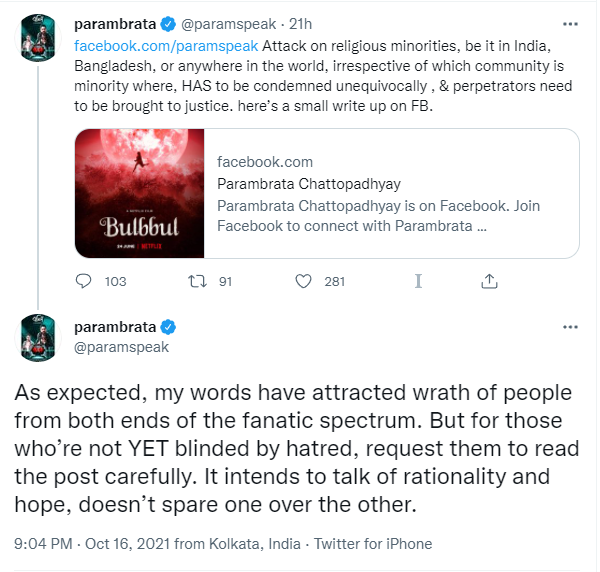
After siding with the radical Islamists in his Facebook post, he reiterated his message on Twitter. He claimed, “Attack on religious minorities, be it in India, Bangladesh or anywhere in the world, irrespective of which community is minority where, has to be condemned unequivocally, and perpetrators need to be brought to justice. Here’s a small writeup on Facebook.”
Screengrab of the tweet by Parambrata
While taking a ‘moral high ground’, the Bengali actor alleged to be the recipient of public wrath especially from both Hindu fanatics and radical Islamists. “But for those who’re not yet blinded by hatred, request them to read the post carefully. It intends to talk of rationality and hope, doesn’t spare one over the other.”
Netizens slammed Parambrata Chatterjee for drawing false equivalence and monkey balancing
The Hindu Bengali community, which was aggrieved at the sight of their co-religionists being killed and attacked in Bangladesh, did not mince any words to slam the actor.
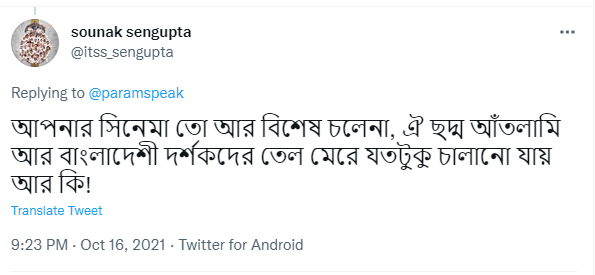
In a tweet, one Sounak Sengupta wrote, “I know your movies don’t make a lot of money. So, you are desperately trying to keep your career afloat by this display of pseudo intellectualism (atalami) and appeasement (tel mara) of Bangladeshi viewers.”
Screengrab of the tweet by Sounak Sengupta
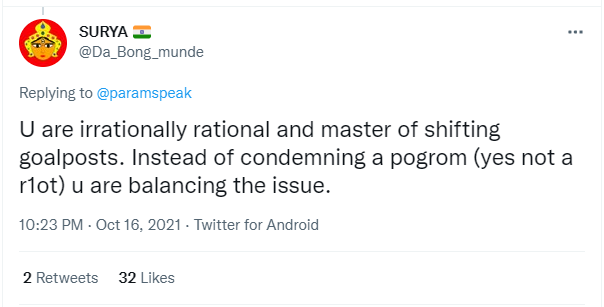
A Twitter user (@Da_Bong_munde) stated, “You are irrationally rational and master of shifting goalposts. Instead of condemning a pogrom (yes not a riot), you are balancing this issue.
Screengrab of the tweet by @Da_Bong_Munde
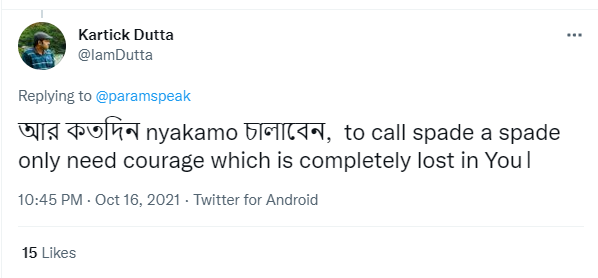
Another Twitter user, Kartick Dutta, added, “How long will you continue this pretentious behaviour? To call spade a spade, (you will) only need courage, which is completely lost in you.”
Screengrab of the tweet by Kartick Dutta
BJP leader challenges Bengali actor for a debate on Hindu pogrom in Bangladesh
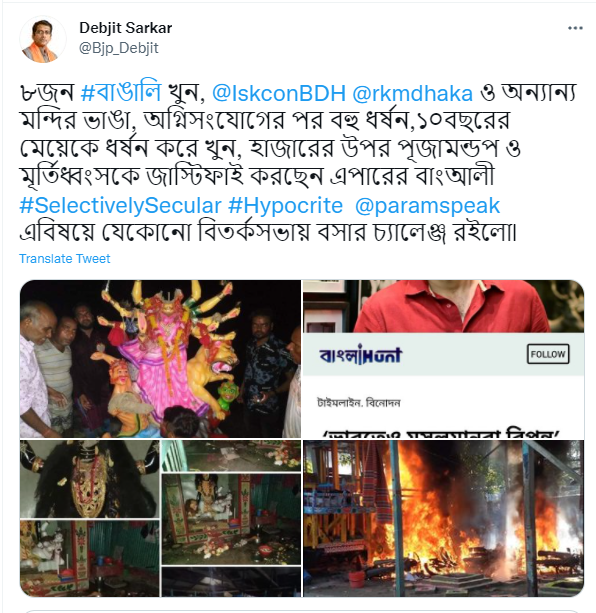
Following his attempt to trivialise and downplay the atrocities committed against Hindus in Bangladesh, BJP spokesperson Debjit Sarkar lambasted him for siding with the Islamists. In a tweet, Sarkar stated, “I want to challenge Bengali Parambrata who is justifying the death of 7 Bengalis, destruction of ISKCON and other temples, mass rapes including that of a 10-year-old, and vandalism of 1000 Durga Puja pandals and idols vandalised.”
Screengrab of the tweet by Debjit Sarkar
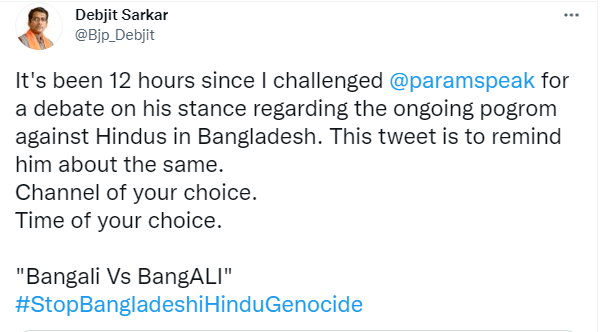
When the Bengali actor did not turn up for the challenge, the BJP spokesperson pointed out, “It’s been 12 hours since I challenged for a debate on his stance regarding the ongoing pogrom against Hindus in Bangladesh. This tweet is to remind him about the same. Channel of your choice. Time of your choice. Bangali Vs BangALI. #StopBangladeshiHinduGenocide.”
Screengrab of the tweet by Debjit Sarkar
Violence in Bangladesh against Hindus under the garb of blasphemy
Brutal attacks, vandalism, looting, and arson had returned to haunt Hindus in Bangladesh’s Noakhali district, as close to 150 households were reportedly attacked and at least three killed in a violent clash on Wednesday (October 13). A day later, a frenzied mob of radical Islamists attacked the International Society for Krishna Consciousness (ISKCON) temple in the Noakhali district in the Chittagong Division of Bangladesh. The Bangladesh unit of ISKCON lamented that the sculpture of its founder, AC Bhaktivedanta Swami Prabhupada, was burnt down during the arson attack on the temple.
The violence and vandalism took place after a Facebook rumour claiming ‘insult to Quran’ at a Durga Puja pandal went viral. Videos emerged on social media where a mob of enraged Muslims were seen pelting stones and vandalising makeshift Durga Puja pandals and attacking Hindu families in Bangladesh’s Chandpur area. A social media user from Bangladesh stated that the Islamic mob was calling for the burning of a local ISKCON temple. Bangladeshi social media users had stated that under the guise of attacks, rampant loot and molestation of women have also taken place. 2 persons have been found dead in the Chandpur area.
Following the incident, Bangladesh’s Prime Minister Sheikh Hasina ordered the criminals, behind spreading communal attacks and propaganda, to be identified and punished as an example. Meanwhile, back in New Delhi, the external affairs ministry said that it was in touch with the high commission officials and noted the strict action be taken by the Bangladesh government. Since the incident, the Bangladesh police have made over 100 arrests and the probe is still underway.
A complaint has been filed by the Kalinga Rights Forum against AIIMS Delhi students for a derogatory Ram Leela skit performed by them on the occasion of Vijayadashami. A video of the skit had emerged on social media where the actors were singing Bollywood songs and using derogatory language in the Ramleela skit, distorting the story of Ramayana.
Filed Complaint with @CPDelhi@LtGovDelhi Director @aiims_newdelhi for Strict action against Communal and offensive Play in the guise of Ramleela organised in campus of @aiims_newdelhi as a premeditated effort to hurt religious sentiments of Hindus on occasion of Vijayadashami pic.twitter.com/X5SVhY5OTr
A tweet by the Forum said, “Filed Complaint with @CPDelhi @LtGovDelhi Director @aiims_newdelhi for Strict action against Communal and offensive Play in the guise of Ramleela organised in campus of @aiims_newdelhi as a premeditated effort to hurt religious sentiments of Hindus on occasion of Vijayadashami”
The group also sought strict actions against all those individuals who were involved in the play for hurting the religious sentiments of the Hindus. It said, “Sought Stringent actions against students/individuals involved in planning, executing & acting in the street play hurting religious sentiments of Hindus and uploading this offensive “Ramleela” as per IPC Sections 295A, 153A, 153, 298, 297, 505, 66 IT ACT, 67A IT ACT”
Sought Stringent actions against students/individuals involved in planning, executing & acting in the street play hurting religious sentiments of Hindus and uploading this offensive “Ramleela” as per IPC Sections 295A, 153A, 153, 298, 297, 505, 66 IT ACT, 67A IT ACT pic.twitter.com/EhXnkMW58v
Furthermore, the group also looked for the identification of advisory members of the students’ council. It said, “Also Sought Identification of Advisory members of the Students’ Council (that plans various cultural activities for students), & hold them liable for criminal offence including above mentioned IPC Sections & MCI Regulations for Professional Ethics, Etiquette and Ethics 2002 Act.”
Also Sought Identification of Advisory members of the Students’ Council (that plans various cultural activities for students), & hold them liable for criminal offence including above mentioned IPC Sections & MCI Regulations for Professional Ethics,Etiquette and Ethics 2002 Act. pic.twitter.com/QbVdZKziGo
This comes after a group of AIIM Delhi students performed an offensive play based on Ram Leela. The video of the derogatory Ram Leela skit went viral on social media and the netizens started demanding the arrest of the accused students using the hashtag #ArrestAIIMSCulprits on Twitter.
The video of the objectionable act which was performed by AIIMS students was uploaded by 2020 Topper Soyeb Aftab on his Youtube channel ‘AIIMS Insider.’ After the social media outrage, Aftab made the video private. Nevertheless, several people had already downloaded the contentious video clip from his account before Aftab could hide it.
Following social media outrage over the offensive skit, AIIMS Student Association had issued an apology for the same.
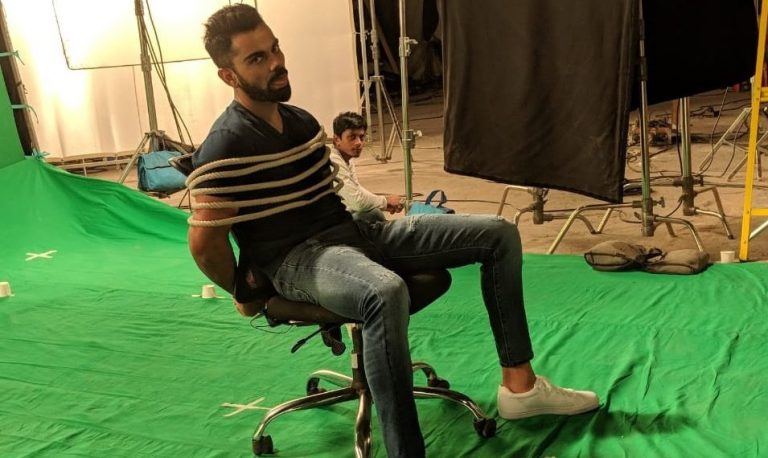
Indian cricket captain Virat Kohli announced on social media that he will be sharing “personal tips” in the coming days on how to celebrate a “meaningful” Diwali. People were not pleased with the message as last year, Virat Kohli had campaigned against firecrackers and they anticipated that he would share a similar message this year as well.
People on social media hit back saying that Kohli should focus on the upcoming T20 World Cup instead of preaching sermons on how to celebrate Diwali.
Not intrested on your so called meanigful Diwali celebration tips ,it will be better you concentrate on the upcoming t20 world cup https://t.co/CZyRFHaKEa
Others said that it is Virat Kohli who needs tips on winning ICC trophies and the IPL, apart from his own captaincy.
Can’t captain a side without shitting his pants and has the nerve to to give “personal tips” on celebrating festivals. Lol. The only one who needs tips is this guy with respect to captaincy in limited overs cricket. https://t.co/llVQfLudRx
To be on Pinterest, do squats and pose in expensive clothes.
This, while some other great sportsmen wear olive green, share a joke and smile with men at frontier, silently pray for well being of others. https://t.co/bCqM0snB0K
Virat Kohli is yet to win an ICC trophy as a captain and has never won the Indian Premier League. He has quit the captaincy of Royal Challengers Bangalore and will step down as the captain of Indian T20 team following the World Cup.
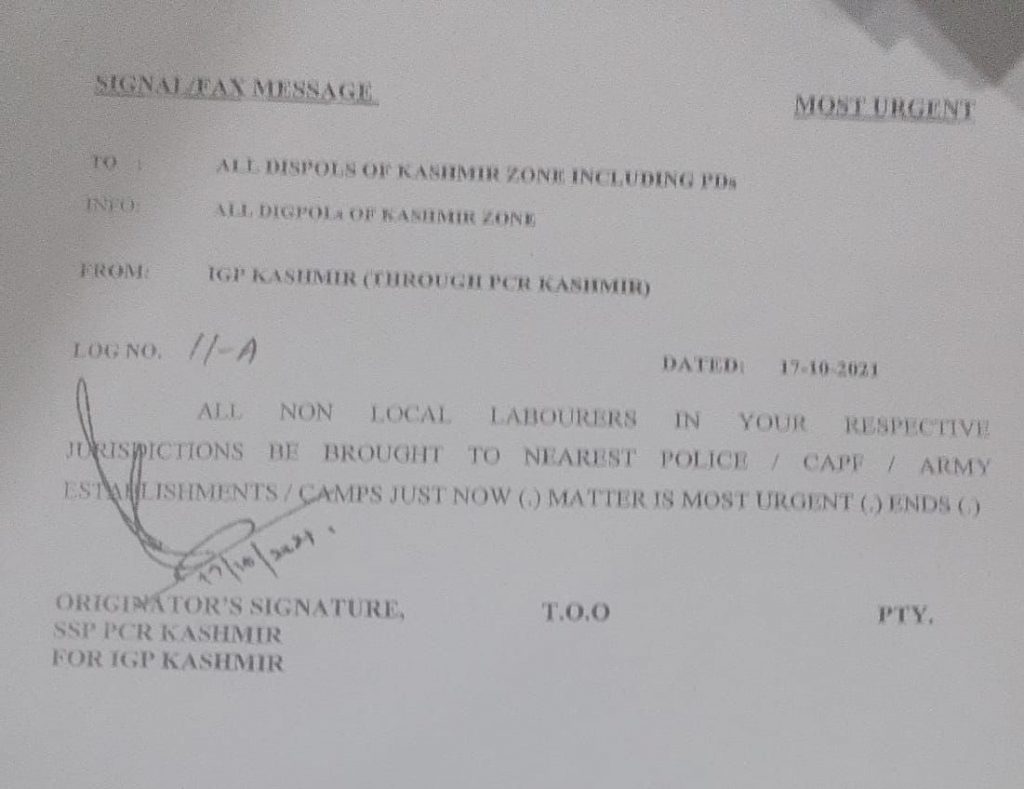
Kashmir police have refuted the reports that the IGP has directed the DIGs in the state to shift all non-locals to police stations and army and CAPF camps in the wake of repeated terror attacks on non-Kashmiri labourers from other states working and living in the union territory.
The Kashmir police have termed the alleged urgent order as totally baseless and fake order. “There is no such order. It’s a fake one,” the IGP Kashmir told news agency Kashmir News Observer (KNO).
Earlier, it was reported that the IGP of Kashmir police has issued the advisory, asking that all non-locals in the union territory should be secured. According to the highly unprecedented directive, all Kashmir zone police establishments were asked to shift the non-locals to police stations and army camps immediately.
The alleged communication by the IGP read, “All non local labourers in your respective jurisdictions be brought to nearest police / CAPF / Army establishments / camps just now. Matter is most urgent.”
The Fake urgent communication from IGP Kashmir to all DIGs
The communication had “Most Urgent” mentioned on the top, and it said “Matter is most urgent” in the message, besides asking to shift the non-Kashmiris to security bases “just now”.
The reports of the directive by IGP Kashmir came hours after terrorists had entered a house in Wanpoh in Kulgam district where labourers from Bihar were staying and fired on them from close range. Joginder Reshi Dev and Raja Reshi Dev were killed in the attack, while Chunchun Reshi Dev was injured and shifted to hospital.
Continuing with the targeted attack on non-locals in Kashmir, two persons from Bihar and UP were killed yesterday in Srinagar and Pulwama.
Note: The story has been updated with new information