Home Blog Page 4568

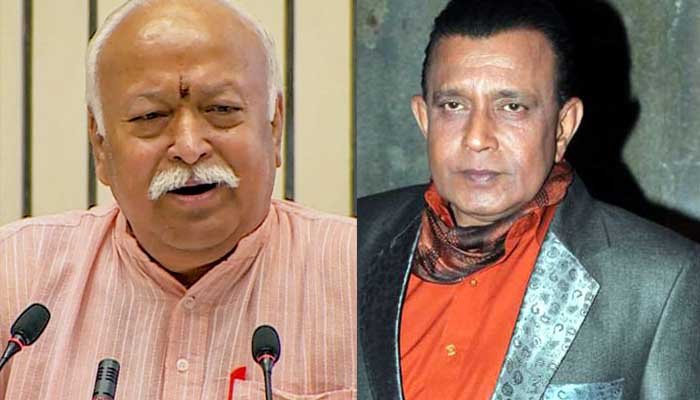
RSS chief Mohan Bhagwat meets ex-TMC Rajya Sabha MP and Bollywood actor Mithun Chakraborty ahead of Bengal elections

RSS chief Mohan Bhagwat visited West Bengal veteran actor Mithun Chakraborty at his Mumbai residence in Madh area on Tuesday morning. With the meeting coming close to the heels of the much awaited West Bengal Assembly elections, speculations are rife that the Bengali superstar might join BJP.

Upon meeting the RSS chief, Chakraborty said that this was not political but a spiritual meeting. He said that he had earlier also invited him home and since Mohan Bhagwat went to his house, Chakraborty believes that he considers him as his family member.

This is, however, not the first time such news has been doing the rounds. Earlier too, when Mithun Chakraborty had met Mohan Bhagwat at the RSS headquarter in Nagpur in October 2019, the West Bengal political circles were abuzz with speculations that the veteran actor was joining BJP.

Mithun Chakraborty is a Bengali superstar and has a massive fan base in West Bengal. If at all, speculations of him joining BJP holds water, it would definitely prove advantageous for the BJP which has been eyeing to win the upcoming polls in Bengal.

Actor Mithun Chakraborty was long associated with the ruling Trinamool Congress in Bengal. He is the former TMC Rajya Sabha member. He had resigned from the party in 2016 over health issues.

Legislative Assembly elections for 294 seats of the West Bengal Legislative Assembly are scheduled to be held in April 2021.

TMC supremo Mamata Banerjee who is eyeing at her third term is currently going through a rough time as several top party leaders including Suvendu Adhikari, Rajib Banerjee and others have quit TMC and joined BJP ahead of the 2021 West Bengal election. The exodus of several veterans from the TMC since 2019 Lok Sabha election, where TMC won 22 Lok Sabha seats while BJP won 18, may impact overall vote-share for Mamata Banerjee’s party in the upcoming polls.

Republic Day violence: Police custody remand of accused Deep Sidhu extended for another 7 days

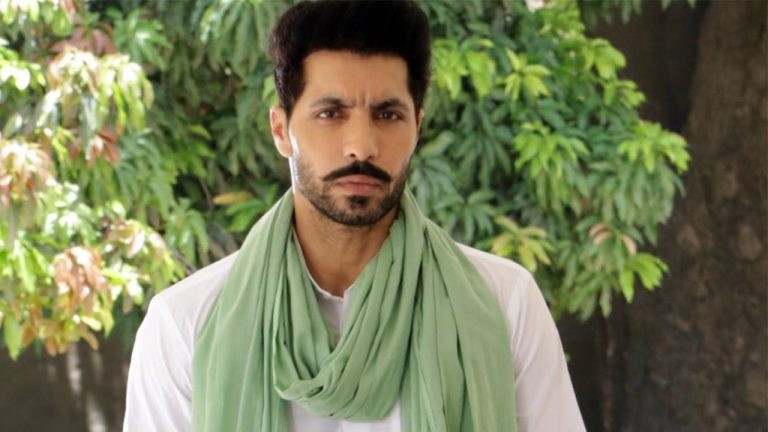
Actor-turned-‘activist’, Deep Sidhu, arrested in connection with the violence that ensued in the wake of Tractor Rally carried out in Delhi on the Republic Day this year has been remanded to seven days additional police custody by a Delhi Court.

The special cell of Delhi Police had arrested the actor and Khalistani supporter Deep Sidhu for his role in instigating violence and the vandalisation at Red Fort on Republic Day during the farmers’ tractor rally. Sidhu was tracked down and arrested in an operation led by Delhi Police’s DCP Sanjeev Yadav. Sidhu was seen in the video footage of the Red Fort violence and was absconding since then.

On Saturday last week, Sidhu and another accused Iqbal Singh were taken to the Red Fort by the Delhi Police’s Crime Branch to recreate the scene of events that unfolded at the historic monument on Republic Day during the farmers’ tractor parade.

On February 3, Delhi Police announced a cash reward of Rs 1 Lakh each for information leading to the arrest of Deep Sidhu, Jugraj Singh, Gurjot Singh and Gurjant Singh. A cash reward of Rs 50,000 each for the arrest of Jajbir Singh, Buta Singh, Sukhdev Singh and Iqbal Singh was also announced.

Deep Sidhu accused of inciting violence at Red Fort on Republic Day

Sidhu has been hiding since the day of the Red Fort violence and has been releasing social media videos to blame other ‘farmer leaders’ who have spoken against him. The Khalistani supporters, who stormed the grounds of the historic Red Fort and desecrated the symbol of India’s sovereignty, had brutally attacked the security personnel and police officials stationed at the location, disrespected India’s national flag by hoisting two other flags. In a video, Khalistani rioters were seen pushing Delhi Police personnel from the top of a high wall, severely injuring hundreds of them.

Sidhu rose to prominence after his video of expressing support to the ‘farmers’ protest had gone viral on the internet. However, his Khalistani proclivities were laid bare when in an interview with journalist Barkha Dutt, the actor hailed Khalistani terrorist Bhindranwale as a hero. After Sidhu’s role of instigating ‘farmers’ to take up arms against the Delhi Police on the day of tractor rally came to fore, the ‘farmers’ leader, who had until now backed Sidhu for his support to the protests, pinned the blame of the violence on him and alleged him of hatching a conspiracy to derail the ‘farmers’ protests.

Rafiq Hussain Bhatuk, prime accused in the Godhra train massacre, arrested 19 years after the incident

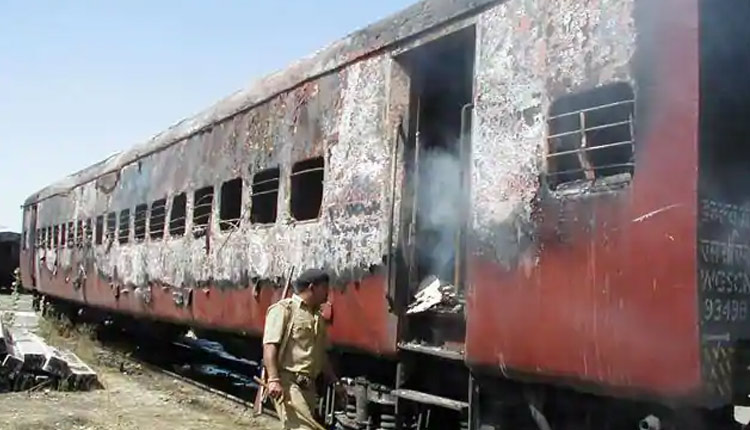
Rafiq Hussain Bhatuk, who is the prime accused in the Sabarmati Express burning case, has finally been arrested after almost 19 years of the ghastly incident in which 59 karsevaks were charred to death. Rafiq was arrested from Godhra town as informed by police on Monday.

Bhatuk was part of the core group of the accused who hatched the conspiracy

According to Panchmahal Superintendent of Police Leena Patil, 51-year old Bhatuk, who used to work as a labourer at Godhra railway station, was part of the ‘core group’ of the culprits who were involved in the entire conspiracy. He was absconding for 19 years. He was reportedly arrested after a team of Godhra police raided a house in Signal Falia area located near the railway station on Sunday after receiving insider information. “Bhatuk was part of the core group of the accused who had hatched the entire conspiracy, incited the mob and even arranged petrol to torch the train compartment. He fled to Delhi immediately after his name cropped up during the investigation. He was facing murder and rioting charges among others”, SP Patil said was quoted as saying.

He fled to Delhi after the incident and worked there as a labourer

59 karsevaks, including women and children, were burnt alive in the horrifying incident that happened on February 27 in 2002. The incident had triggered communal riots in Gujarat. SP Patil said that Bhatuk was involved in pelting stones on the compartment and pouring petrol inside it before setting it ablaze. “After fleeing Godhra following the incident, Bhatuk spent most of his time in Delhi where he worked on railway stations and also at construction sites as a labourer. He also sold household items on a handcart”, the SP said. He had recently shifted his family from Sulta Falia where he used to live earlier to Signal Falia to evade arrest.

He shifted his family to a new location to evade arrest

The police had received information that Bhatuk has changed his house and that he visited his family in the past but he could not be caught as he did not stay at his home for long. “We recently learnt that he had changed his house and visited his family in the past too. However, we couldn’t catch him as he used to leave after a day or two. This time, our teams managed to catch him. We will hand him over to Godhra railway station police for further investigation”, the SP added. Three other accused named Salim Ibrahim Badam aka Salim Panwala, Shaukat Charkha and Abdulmajid Yousuf Mitha are still absconding. It is believed that they fled to Pakistan.

Popstar Rihanna poses topless with Ganesha figurine necklace for her lingerie brand, netizens fume

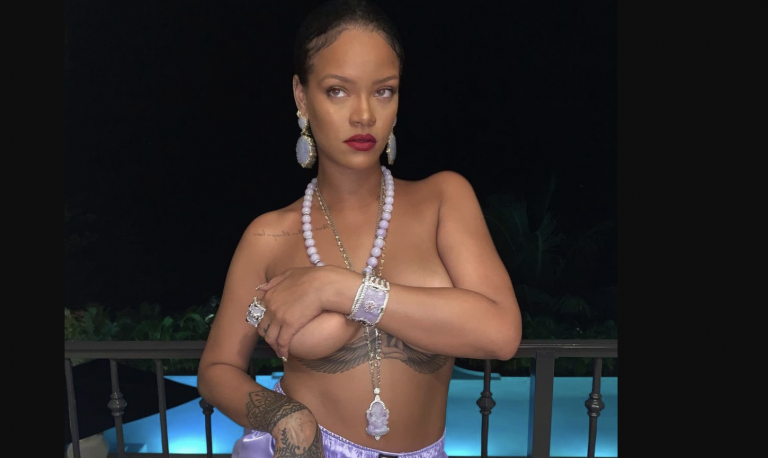
Singer-actress turned ‘farmer activist’ Rihanna on Tuesday posted a semi-nude topless picture for her lingerie brand Savage X Fenty while sporting a necklace with Ganesha pendant.

Rihanna can be seen wearing a purple satin bottoms with a purple necklace with Ganesha figurine on it.

Netizens, however, were not too happy with this and accused her of hurting their religious sentiments.

Twitterati called her out for using Hinduism as aesthetic.

Only few days back, one of the models for her lingerie brand Fenty was found posing for promotional photoshoot at a Hindu temple.

Interestingly, last year, she had apologised to Muslim community after she played songs with Hadiths in virtual runway show for her lingerie brand Fenty.

People also called out the cultural appropriation by Rihanna.

Rihanna recently won hearts of Indian ‘liberals’ for tweeting on the ‘farmer protest’ in India earlier this month. Eventually it was revealed that the tweet by Rihanna was pre-planned when baby-protestor Greta Thunberg tweeted a ‘toolkit’ that detailed the nefarious plan to foment trouble in India.

Congress supporter Saket Gokhale cries victim after BEL filed a Rs 1 crore defamation suit against him for spreading lies

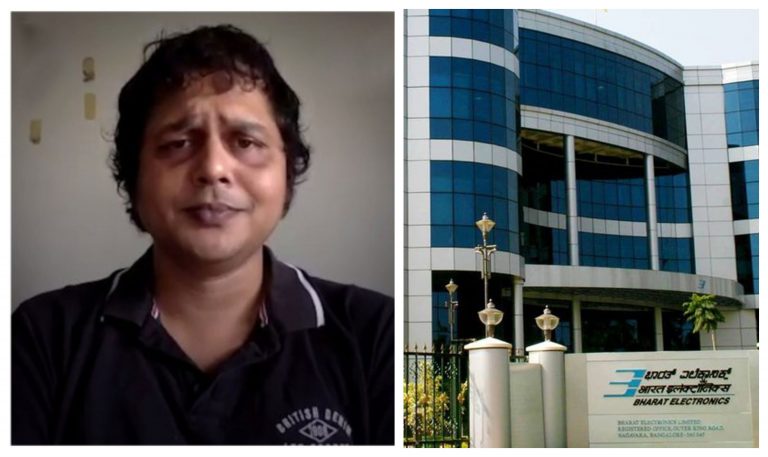
Bharat Electronics Limited (BEL), a Professional Defence electronics company in India which is a Navaratna defence Public sector under Ministry of Defence, has filed a lawsuit against Congress supporter Saket Gokhale who had floated conspiracy theories alleging a ‘Ventilator Scam’ last year. Gokhale had made some clearly misleading and false allegations regarding the procurement of ventilators through the PM-CARES fund that was set up by Prime Minister Modi to deal with the coronavirus pandemic.

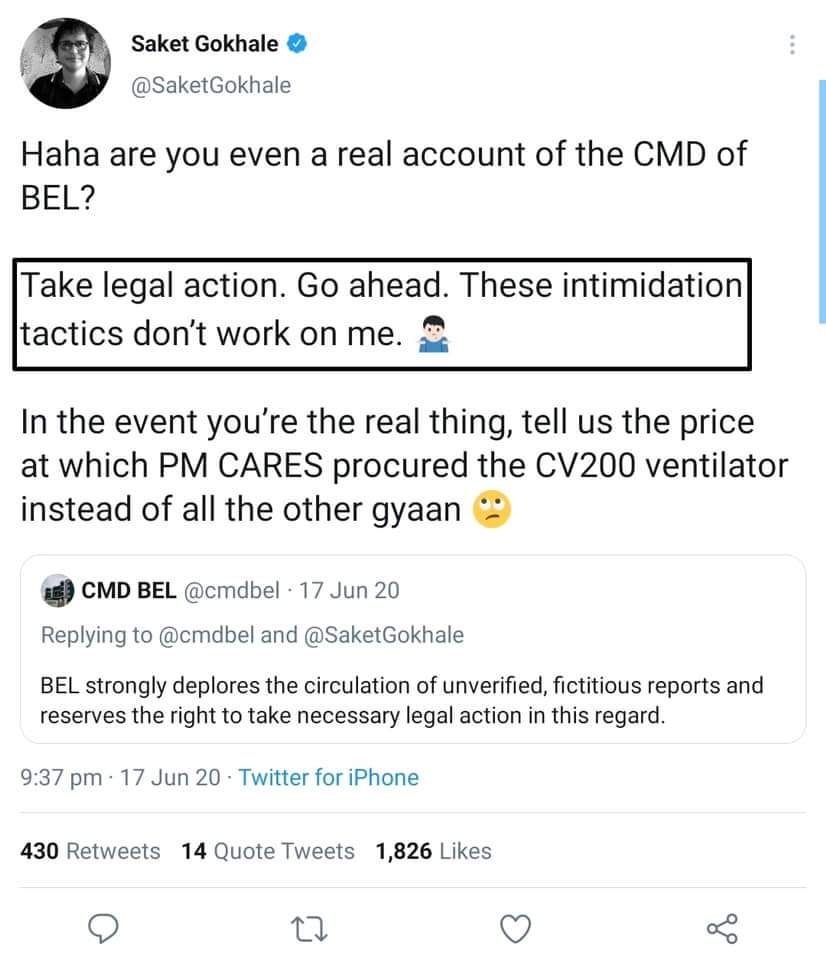
When his lies were countered by the Chief Managing Director (CMD) of BEL, Gokhale went on to question the authenticity of the Twitter account of the CMD and challenged him to take a legal action against him saying “intimidation tactics won’t work on me”.

Screenshot of Gokhale’s tweet

Interestingly, now when the BEL has filed a Rs 1 crore defamation suit against Gokhale who had himself invited the company to take legal action against him, he is now crying victim calling it “intimidation”. In June 2020, when the CMD of BEL had warned Gokhale of legal action if he does not take back his false claims, Gokhale had asserted that he is not scared of their legal actions.

Sharing the picture of the legal notice served by the BEL to him, Gokhale tweeted, “Here’s how intimidation works under the Modi govt: The Modi govt through the state-owned Bharat Electronics Ltd. has filed a defamation suit of Rs 1 crore against me in Bangalore for the work I did on the PM CARES ventilators scam. Not matter what- the truth will always win :)”.Gokhale called the defamation suit a “goldmine” and said that he would fight the suit.

Gokhale’s conspiracy theory and baseless lies alleging a ‘ventilator scam’

Gokhale had alleged that the ventilators that the government was buying through the PM-CARES fund were Skanray CV200 ventilators that the Skanray, a Mysore based company, was manufacturing for Philips India. Gokhale alleged that the Skanray CV200 ventilators were being sold at a market price of Rs 2.5 lakh but the government was procuring these ventilators at Rs 4 lakh through the PM-CARES fund and thus PM Modi and the BJP had “stolen” over Rs 750 crore from the PM-CARES fund using these ventilators. He alleged that the government was passing off these Skanray CV200 ventilators as made-in-India ventilators.

CMD BEL countered Gokhale’s false claims and gave him some facts

Gokhale’ claims were refuted by the Chief Managing Director (CMD) of BEL who said that no such ventilator model was manufactured by Philips and that apparently a fictitious product was being promoted on the virtual marketplace. The CMD further clarified that CV200 was a high-end ventilator having 2-hour built-in battery backup and several other safety features.

He said that the components used in the manufacturing of the ventilators were procured from reputed global medical-grade components, supply-chain partners. He explained and that the DRDO had supported the development and indigenisation of some critical components required for the manufacturing of a large number of ventilators. The CMD said that the ventilators bear the PM-CARES logo as they were being procured under the fund allocated for procuring ventilators and that the logo ensured the traceability and accountability of the ventilators.

“Philips CV200” which Gokhale claimed was the one passed off as Skanray ventilator was actually selling for Rs 11 lakh a piece.

BBC provides platform to British writer to fuel Hindu vs Sikh divide on farmer protest

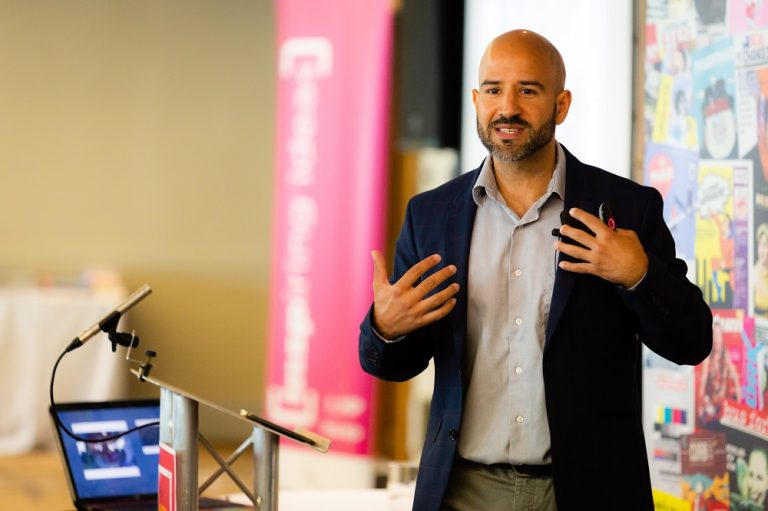
British state-run media British Broadcasting Company (BBC) provided platform to British ‘journalist’ Sunny Hundal of openDemocracy to further the Khalistani narrative of creating a Sikh vs Hindu divide in India.

On its programme, The Newsnight, Hundal claimed that what is happening in India (Punjab farmer protests) is going to have a huge impact in the UK. “What the government is doing now is trying to make this into a Sikh protest and say that these people are being led by extremists and they are Sikhs and they are trying to ruin the government. What it is doing is that it is turning this whole issue into Sikh vs Hindu issue as a way to delegitimise protests,” he claimed.

Hundal further claimed that if there is violence in India, there will be violence in the UK and hence the British government must intervene in India’s internal affairs. “It is our duty to tell Indian government to calm down its rhetoric,” he said.

What Hundal chose not to mention that the so-called farmer protest in India have been hijacked by separatist Khalistani elements. From Khalistani group Sikh For Justice openly offering funds for fuelling the protests to pro-Khalistan Canadian politicians like Jagmeet Singh and Canadian businessmen Mo Dhaliwal extending explicit support and funding to fuel unrest in India, the protest of Punjab farmers has now taken a turn that threatens India’s sovereignty.

Hundal has earlier tried to propagate falsehood regarding the abrogation of Article 370 which made the erstwhile state of Jammu and Kashmir an integral part of India without any riders attached. Hundal is associated with openDemocracy, a globalist institution that receives significant donations from the Ford Foundation, George Soros’ Open Society Foundation, the Rockefeller Brothers Fund, the Heinrich Boll Foundation and numerous others. 

After ‘climate activist’ Greta Thunberg accidentally tweeted the ‘toolkit’ exposing global conspiracy to defame India, George Soros connection had emerged. Billionaire George Soros, who funds political NGOs to disrupt governments and economies, had openly declared his intentions to interfere in India’s internal affairs.

While speaking at the World Economic Forum, Soros had committed $1 billion to start a global university to ‘fight nationalists’, whom he referred to as ‘authoritarian governments’. He had even accused the Indian Prime Minister of ‘creating a Hindu nationalist state’. Soros’ Open Society Foundation has links with a vast network of organisations and ‘activists’. Organisations connected with Soros’ OSF have been pursuing media and legal battles against the Indian government from issues ranging from the Rafael deal to Article 370 and the CAA.

Ex-Karnataka CM Kumaraswamy compares Ram Mandir donation drive to Nazi propaganda

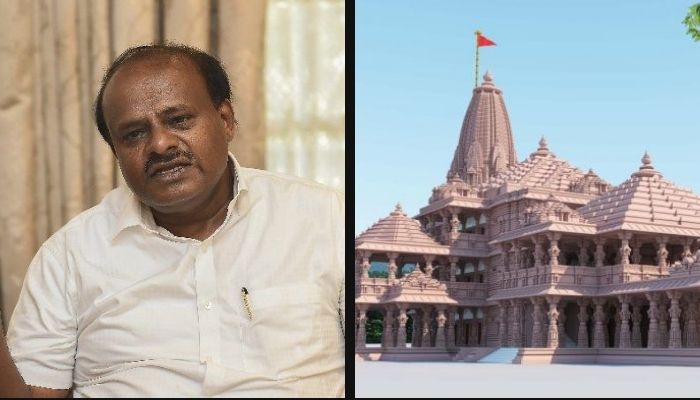
On Monday, former Karnataka Chief Minister and JDS leader H D Kumaraswamy stirred a fresh controversy by comparing the nationwide donation drive for Ram Mandir as Nazi propaganda. He alleged, “It appears that those collecting donations for the construction of Ram Mandir have been separately marking the houses of those who paid money and those who did not.”

Kumaraswamy then drew an analogy with the Nazi regime in Germany. “This is similar to what Nazis did in Germany during the regime of Hitler when lakhs of people lost their lives,” the ex-Karnataka Chief Minister said. Casting aspersions on the future of India, he added that such events might take the country on a dangerous path.

He further compared the Rashtriya Swayamsevak Sangh (RSS) to the Nazi party founded by Adolf Hitler in Germany. Kumaraswamy said, “Historians say that RSS took birth at the same time when the Nazi Party was founded in Germany. There are concerns on what will happen if the RSS tries to implement similar policies adopted by Nazis.” Resorting to fear-mongering, he alleged, “The fundamental rights of people are being snatched away in the country now.”

The former Karnataka Chief Minister compared the situation in India to a supposed ‘undeclared emergency’ where people are not allowed to express their views openly. “A situation has been created where nobody can share their feelings. I do not know what will happen if the media upholds the government’s views in the coming days. In such a situation it is difficult to guess what would be the fate of common man…It is clear from the emerging trends that anything may happen in the country.”

Akhilesh Yadav derides Ram Mandir donation seekers

Earlier, Samajwadi Party leader Akhilesh Yadav, a fierce critic of PM Modi, took a swipe at the Ram Mandir devotees by saying that those who collect donations must be called “Chandajeevi” or professional donation collectors. “What is being said about the agitations? That people are ”Aandolanjeevi”. What should I call the people who go out to collect donations? Are they not members of ‘‘Chandajeevi Sangathan”  (organisation which collects donations)?” he said.

Yadav’s remark was in response to PM Modi’s comments regarding ‘professional protestors’ who do not care about the cause but instigate protests to gain political mileage. Warning the people against such opportunists, PM Modi had called them ‘Aandolanjeevi’ or the people who survive on protests and unrest.

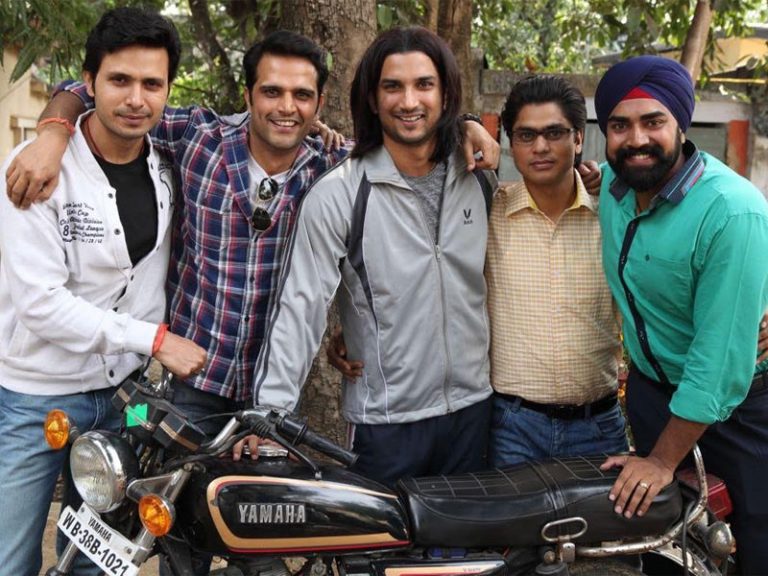
Bollywood actor Sandeep Nahar who acted in Sushant Singh’s MS Dhoni biopic commits suicide

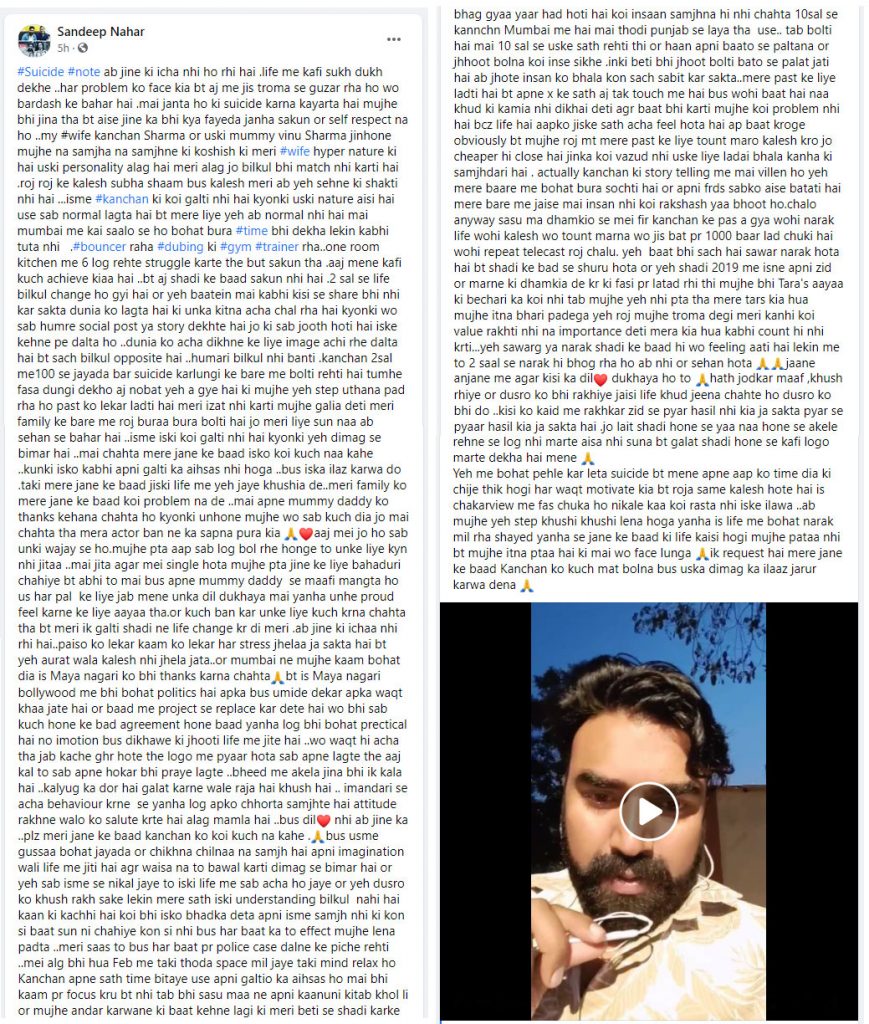
Actor Sandeep Nahar, seen in movies like Akshay Kumar starrer ‘Kesari’ and late Sushant Singh Rajput’ MS Dhoni: The Untold Story’, has died allegedly by suicide on February 15. Before committing suicide, Nahar wrote a long post and a video on his Facebook profile in which he talked about ending his life.

His wife Kanchan and friends at his Goregaon flat found 32-years-old Nahar unconscious at his flat. He was taken to SVR Hospital immediately where he was declared brought dead. As per Mumbai Police, a case has been registered, and the matter is being probed. The police further added that according to his wife, she, along with two others, recovered his body in a hanging condition. DCP Vishal Thakur said, “The body has been sent for postmortem and the exact cause of his death can be ascertained after that.”

Friends remember him as an emotional person

As per reports, Sandeep’s friends described him as an emotional person. In his suicide note, he mentioned that he could not tell his friends and other people about his personal life as he had always kept a strong face in front of the world. He further added that he couldn’t deal with the pain, frustration and trauma of being in an unhappy marriage. Sandeep mentioned his wife and her mother’s names in a suicide note and alleged that they mentally tortured him. He also thanked his parents for supporting him throughout his life and asked everyone not to bother them.

The contents of Nahar’s suicide note

Sandeep Nahar shared a 10-minute long video along with a long suicide note. He wrote that it is getting impossible for him to face the trauma of being in an unhappy marriage. He said there is no meaning in life when there is no self-respect. Mentioning his wife’s name, he said that his wife Kanchan Sharma and her mother Vinu Sharma never understood or tried to understand him. He alleged that his wife was hyper in nature and often fought with him over non-existing matters or the past. He said, “I have seen worst time in life but I never felt broken the way I am feeling now.”

Sandeep Nahar’s suicide note from his now-deleted facebook account

Sandeep wrote that Bollywood is a fake place where a lot of politics happen. He said, “I would like to thank the film industry as well, but there is a lot of politics here. People will give you a lot of hope, but you will get replaced in projects despite of signing an agreement. The industry will eat your time and the people here are emotionless.

Concluding the note, he said he would have committed suicide a long ago, but he wanted to give life another chance. He added he felt trapped in an unhappy marriage and suicide looked like the only way out. He ended the note with a request not to blame his wife for his death and get her psychiatric help so that she can live a better life in future.

Sandeep Nahar’s suicide note has been removed from his profile.

Chinese human rights activist calls for the world to organise ‘clean Olympics’, says China should not have the honour of hosting the event

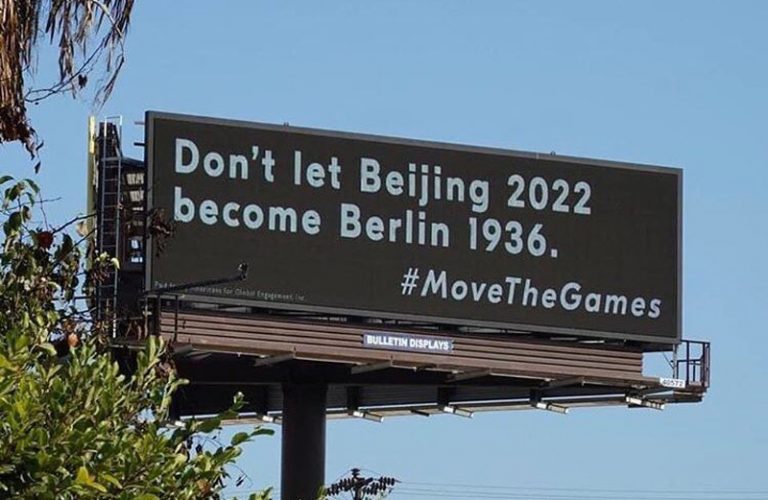
China is due to host the Winter Olympics in 2022. Amidst the ongoing debate over whether an communist regime, accused of committing genocide, atrocities, crimes and grave breaches of an international treaty deserve to host this prestigious sporting event, a Chinese human rights activist has in his article for The Washington Post chronicled why China does not deserve the honour of hosting the Olympic Games.

Recounting the innumerable atrocities the dictatorial regime of the Communist Party in China has committed over the years, Teng Biao, Chinese human right activist, demands that the world should at least this time, organize a “Clean Olympics” elsewhere. 

Biao reminds of what the Olympic Charter refers to, which he says time and again calls to boycott games being hosted by China and other repressive regimes and has been discussed but never implemented.

Biao writes that in the year 1935, the “Committee on Fair Play in Sports” had questioned Nazi Germany’s hosting of the 1936 Summer Olympics. The then American Olympic Committee had backed Germany’s hosting privileges by saying politics should not be mixed with sports. Despite being criticised and called Hitler’s “propaganda bonanza”, America then went ahead to support Germany’s right to host the Olympics.

The activist recollects how a similar question arose when Beijing prepared to host the 2008 Games. The human right activist pens down how China had then carried out an oppressive initiative against common people in order to “clean up” the city to build a state of the art infrastructure. Biao writes that the Chinese Communist Party (CCP) regime had then arbitrarily bulldozed homes and forcefully evicted people. Those who objected were detained and tortured. The journalists who told the truth were imprisoned.

Here the activist recounts his personal life experiance. He shares how he and his friend Hu Jia were implicated by the government in 2008 for publishing an article called “The Real China and the Olympics.” 

While Hu Jia was charged with “inciting subversion of state power” and sentenced to three and a half years in prison, Bias recounts how his license to practice law was cancelled, his passport was confiscated and he was kidnapped from a sidewalk by plainclothes police who detained and tortured him.

The Chinese activist further writes that others who signed an open letter organized by Liu Xiaobo (who later won the Nobel Peace Prize) and Ding Zilin proposing that Beijing’s Olympics slogan be revised to “One World, One Dream, Equal Human Rights” were either detained or imprisoned

He recollects how despite all the calls to boycott, China could not be stopped and it had gone ahead to host the 2008 Games. “No country boycotted, even as tens of thousands of prisoners of conscience stood mute in prison and rights lawyers, like me, were held under house arrest”, says Bias.

Speaking on China’s double standards, the human right activist writes that though from the outside, China has always tries to project itself as a progressive country which respects and guarantees basic freedoms but from the inside it has always been extremely autocratic and repressive.

“Since 1949, China’s Constitution has guaranteed basic freedoms. The regime has signed many international human rights documents to deflect foreign criticism. In 1997, Beijing promised no change in Hong Kong for 50 years”, however, all this has been just a eye-wash, claims the activist.

Additionally, Biao recounts that in the year 2015, when China won the rights to host the 2022 Olympics, it cracked down on lawyers, journalists and activists across China. Since then, it has not only inflicted atrocities on native lawyers, journalists and activists but the Xi regime has transgressed dissidents even outside China’s borders. It has shut down nongovernmental organizations, demolished Christian churches, Tibetan temples and Muslim mosques, persecuted, sometimes to death, believers of Falun Gong; and sharply increased its control of media, the Internet, universities and publishers.

The activist furthers that in late 2019, China concealed the covid-19 outbreak by jailing and silencing whistleblowers and journalists.

Directing attention towards the ceaseless incidents of atrocities and persecution under the CCP regime in China, Bias furthers that the Chinese Communist Party has systematically rounded up millions of Uyghurs and Kazakhs into concentration camps in Xinjiang since 2017. There are credible reports of systematic rape, sexual abuse and torture, forced sterilizations, coerced marriage to Han people, and separation of children from parents.

Since 2009, more than 150 Tibetans have self-immolated, calling for basic freedom and for the Dalai Lama to be allowed to return. The regime has sent a reported 500,000 Tibetans into forced-labour camps. The Xi Jinping’s communist regime has also stopped the teaching of Mongolian language in schools in Inner Mongolia.

He furthers how President Xi Jinping has centralized power and taken all possible steps to ensure that he remains dictator for life.

Saying so, Teng Biao recounts how in October when he along with representatives of more than 160 human rights organizations, met the International Olympic Committee, he got the same response which the then American Olympic Committee had given while backing Nazi Germany’s hosting privileges in 1935.

Biao says that though it would be wrong to deprive athletes of the opportunity to perform on the world stage, it would be criminal to grant the honour of hosting the game, not once but twice, to an communist regime, that has ceaselessly been committing genocide and assaulting human rights and dignity. Saying so, the Chinese activist urges the world to organize a “Clean Olympics” elsewhere.

It is pertinent to note here, that only last week, the Canadian Olympic organisers have said that they would warn its athletes to refrain from openly criticising China ahead of the winter games. The decision was taken due to concerns that the Communist Party’s critics could be prosecuted under the draconian national security law. In an interview with the Globe and Mail, David Shoemaker, chief executive officer of the Canadian Olympic Committee, said that the athletes have been asked to not to comment at least until after the Games have taken place.

Over the years, more and more evidence has emerged of China’s human rights violation of the ethnic-religious minority group- Uyghurs in Xinjiang. The concentration camps are the most extreme example of China’s inhumane policies against the Uyghurs. Uyghurs inside and outside the camps are exploited for cheap labour. Chinese authorities subjected Uyghur women to mass sterilization or have abortions. They are raped and persecuted and put in camps if they resist. 

The Chinese government, however, claims that the camps are merely vocational and training centres. It has justified the oppression in Xinjiang as an attempt to clamp down on terrorism and extremism emanating from the Uighur separatist movement.


Armenian group wants USA to push for FATF blacklisting of Pakistan for funding “Jihadist mercenaries” against Armenia in Nagorno-Karabakh

The Armenian National Committee of America (ANCA), the largest Armenian American political organization operating in the USA, called upon the Secretary of the U.S. Treasury to demand the blacklisting of Pakistan at the FATF meeting later this month. In a tweet last week, ANCA implored U.S. Secretary of Treasury Janet Yellen to direct the U.S. representative for the FATF meeting to demand the blacklisting of Pakistan for “terrorist financing, including its funding of jihadist mercenaries to fight for Azerbaijan against Artsakh.”

This campaign from the ANCA comes in time for a series of meetings by the FATF’s working groups before the crucial plenary session during 22nd to 25th February, which will decide Pakistan’s fate. The Financial Action Task Force (FATF) is a global terrorist financing watchdog which sets international standards that aims to prevent illegal and harmful activities. Pakistan has featured in the FATF’s grey list since June 2018 with multiple deadlines and delays preventing its fall into the blacklist.

This push for the blacklisting of Pakistan by an Armenian lobbyist group comes in the backdrop of the 2020 Nagorno-Karabakh War between Armenia and Azerbaijan. Reports from Armenia suggest that Pakistani troops did have a huge role to play in this conflict against Armenia. According to FreeNews.AM, an Armenian news source, a telephonic conversation between two locals revealed the presence of Pakistani military in the conflict region.

Nagorno-Karabakh is a disputed territory which is internationally recognized as a part of Azerbaijan, but in de facto control of the Republic of Artsakh since the first Nagorno-Karabakh War in the early 90s. The Republic of Artsakh is an unrecognized state with no recognition from any United Nations member or observer state. Artsakh has close relations with Armenia and uses same currency. On 27th September 2020, clashes erupted on the Armenian-Azerbaijani Line of Control. Experts believe that the fighting started with an Azerbaijani offensive, with the support of Turkey.

Turkey has shown its support for Azerbaijan more overtly, choosing to send two Turkish-backed Syrian rebel groups into the Nagorno-Karabakh conflict zone comprising of around 2,500 men. For this, France accused Turkey of sending Syrian jihadists to fight in the Nagorno-Karabakh conflict. Both Turkey and Pakistan have been historically close to Azerbaijan, being the first and second country to recognize its independence from the USSR in 1991, respectively. Moreover, Azerbaijan and Turkey have openly supported Pakistan’s stance on the Kashmir issue as opposed to India.

Understanding the Nagorno-Karabakh Conflict

To understand the Nagorno-Karabakh conflict, a dive into this mountainous region’s history is necessary. The present day conflict over Nagorno-Karabakh has its roots in the Soviet annexation of the South Caucus region. As Azerbaijan, Armenia and Georgia fell under Bolshevik rule, a re-organization of these regions into Soviet republics part of the USSR was inevitable.

During such a reorganization, the Nagorno-Karabakh region, with a supermajority of ethnic Armenians and Christians, was made a part of the Azerbaijan Soviet Socialist Republic, instead of the Armenian Soviet Socialist Republic with which it shared its religious and linguistic culture.

The Nagorno-Karabakh region was a landlocked, self-governing enclave in the Azerbaijan SSR called the Nagorno-Karabakh Autonomous Oblast. According to the 1926 census, the population of this region was 89.2% Armenian. The Nagorno-Karabakh Autonomous Oblast was a linguistic and cultural enclave in the Shia majority, Azerbaijani-speaking Azerbaijan SSR. It was a flawed decision by the USSR to not unite the Nagorno-Karabakh people with their linguistic, religious and cultural brethren in the Armenia SSR.

As the Soviet Union was headed for dissolution in late 80s early 90s, fighting broke out between the Armenians in the oblast and the Azerbaijan SSR in 1987. This fighting later escalated to the first Nagorno-Karabakh War, which went on till May of 1994. In 1991, an independence referendum was held in Nagorno-Karabakh, which received 99.98% of the voter favoring it. The local Azerbaijani population, which made up for around 20% of the population boycotted this referendum.

The newly established Nagorno-Karabakh Republic, with the help of Armenia, not only managed to retain control of Nagorno-Karabakh, but also captured seven Azerbaijani districts bordering the Nagorno-Karabakh region. From the early 90s, these districts were under either Armenian or Karabakh control. In the 2020 Nagorno-Karabakh War, Azerbaijan re-captured some of these districts and regained some in the ceasefire agreement.

Thus the story is clear, Nagorno-Karabakh is a region dominated by Armenian Christians, which was handed over to the culturally and linguistically alien Azerbaijan SSR, either due to a mistake or due to a divide and rule policy. Post the dissolution of the Soviet Union, Nagorno-Karabakh, with the help of Armenia, established itself as a de facto independent state, which is now self-stylized as the Republic of Artsakh. However, it remains unrecognized because Azerbaijan is recognized to have de jure control over the Nagorno-Karabakh region.

Therefore, it is no surprise that Armenian lobbying efforts are targeting Pakistan, which has emerged as one of Azerbaijan’s closest geopolitical ally. Pakistan recognizes all Azerbaijani claims in the Nagorno-Karabkh region and Azerbaijan returns the favor in the case of Kashmir.

If the allegations coming out of Armenia are true, that Pakistan supported Jihadists in the Nagorno-Karabakh region during the 2020 war, it would make Pakistan’s FATF case even more difficult. Pakistan hopes to be taken off the grey list in the upcoming meeting, however according to experts, Pakistan is expected to remain grey listed post the FATF meeting later this month.

India’s stance on the conflict

India has employed a measured and neutral approach in its foreign policy with respect to the South Caucus region. At the very start of the Nagorno-Karabakh conflict in 1993, India “followed with great concern the escalation of hostilities in Nagorno-Karabakh with considerable ingress of Armenian forces into Azerbaijan” and had called for “respecting each other’s’ territorial integrity and inviolability of existing borders”. 

In 2008, India voted against Azerbaijan’s resolution in the United Nations General Assembly which inter-alia demanded “the immediate, complete and unconditional withdrawal of all Armenian forces from all occupied territories of Azerbaijan”, joining Russia, France and USA. India has time and again sought a peaceful resolution of the conflict through diplomatic channels.

Despite Azerbaijan giving every reason for India to side with Armenia in this conflict, India has remained steadfast on her neutrality. India seeks a peaceful resolution this conflict, even as Azerbaijan whole heartedly supports Pakistan in the Kashmir issue. The principled stance of India on this conflict, calling for an immediate cease of hostilities, is certainly not anything new on India’s part.

But with Modi’s bold foreign policy vision at the helm, maybe it’d not be amiss to expect India to have a more forceful stance on such issues. Armenia is a potential strategic ally against an axis of countries which usually align against India which are Pakistan, Turkey and Azerbaijan. That, along with the ascent of Armenian lobbying against Pakistan in Washington D.C., can probably convince some in India’s foreign policy establishment to push for closer strategic ties with Armenia.