Home Blog Page 484

Jharkhand: Islamist mob resorts to stone pelting at Mangla procession in Hazaribagh ahead of Ram Navami

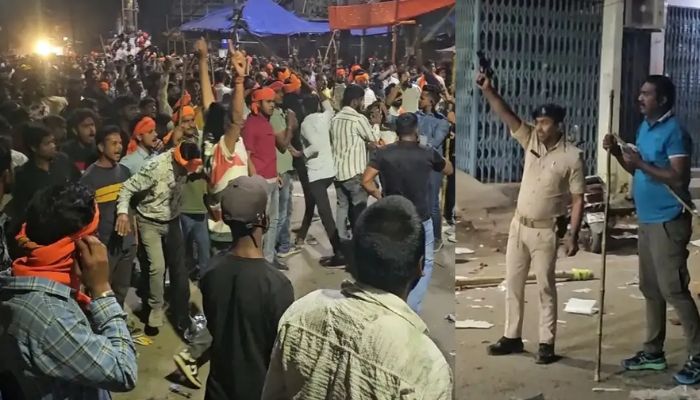
On 25th March, an Islamist mob resorted to stone pelting at a Mangla procession near Jama Masjid Chowk in Hazaribagh, Jharkhand. The incident happened around 10:45 PM. Reportedly, stone pelting started over songs being played during the procession. Upon learning about the incident, senior police officials rushed to the spot with heavy police force to restore law and order. Reportedly, police had to use mild lathi-charge and aerial firing to bring the situation under control.

Every year, Mangla processions are taken out by the Hindu community ahead of Ram Navami. The incident happened during the second Tuesday Mangla procession. Various Akhara groups were participating across different areas in the city. They were proceeding peacefully near Jhanda Chowk and Masjid Gali turn. The Islamist mob reportedly got triggered by the songs being played during the procession.

An argument broke out between the mob and members of the procession, which quickly escalated, leading to the stone pelting incident. Members of the Hindu community also resorted to stone pelting in retaliation. Nearby shops were vandalised during the incident and the Eid Market was temporarily shut.

Senior police officials, who reached the spot, tried to alleviate the situation. However, the initial efforts failed. The police then resorted to mild lathi-charge and four rounds of aerial firing to disperse the crowd. Hazaribagh City SP Arvind Kumar Singh, SDPO Amit Anand, DSP Amit Kumar, and several senior officers camped at the site to ensure law and order.

Deputy Commissioner Nancy Sahay confirmed that there was an incident of stone pelting and a physical scuffle between the two communities during the Mangla procession near Jhanda Chowk. She added that songs being played during the procession “provoked” the other side. Furthermore, she said that additional police force has been stationed at the site and affirmed that the situation was “peaceful and under control”.

Superintendent of Police (SP) Arvind Kumar Singh has urged the public not to pay heed to rumours and confirmed that the situation was normal. He said, “A few individuals have been identified and are being questioned.”

The police have initiated an investigation in the matter using CCTV footage and drone surveillance to identify miscreants. Senior officials have urged both communities to maintain calm.

Previous incident on Maha Shivratri

In recent weeks, this is the second time a Hindu festival has been attacked in Jharkhand. On 26th February, Muslims opposed the installation of Mahashivratri flags and loudspeakers in Jharkhand’s Hazaribagh. When the dispute escalated, stones were pelted from a nearby madrasa. The Hindu side also started pelting stones in defence and in no time the situation took a violent turn. In this violence, many vehicles including one car,  two bikes, a tempo and a shop were set on fire.

Congress was farthest from scientific understanding during COVID-19 pandemic while BJP was the closest, reveals research paper

A peer-reviewed paper, published in the International Journal of Public Opinion Research, has revealed that the Congress party was the farthest from scientific understanding, while the BJP was closest to scientific understanding in the wake of the COVID-19 pandemic.

The paper is titled ‘Politicization and Polarization Concerning Science in Global South: Evidence from News Coverage of COVID-19 in India.‘ The authors analysed more than 2 lakh articles that were published by 6 Indian English newspapers between January 2020 and April 2022.

These newspapers included the Times of India, Hindustan Times, The Hindu, The Indian Express, The Telegraph, and India Today Online (collected from Lexis Nexis).

The paper studied news articles published in India during the entirety of the COVID-19 pandemic (3 different waves) to measure the extent of politicisation of news coverage and polarisation between the BJP and the Congress.

It noted, “We have found a significant level of politicization in the news coverage of COVID-19 vaccine, lockdown, and overall COVID-19 issues. The language difference—the measure of polarization—between the two major national political parties of India, Bharatiya Janata Party (BJP) and Indian National Congress (Congress), on COVID-19 maintains a consistent difference, with an increasing trend during election seasons and a decreasing trend during the peak of COVID-19 waves.”

“On the COVID-19 vaccine issue, the trend is similar, but on the COVID-19 lockdown issue, the degree of polarization has diminished with time. Overall, the politicization and polarization trends in India, resemble a non-uniform pattern, which may be attributed to the perceived shocks in the political competition environment through different state assembly elections,” the paper added.

The interpretation of the results reveals larger politicisation of the COVID-19 vaccine between March 2021 and April 2022. OpIndia had reported at that time how the Congress party was peddling propaganda against Indian vaccine makers.

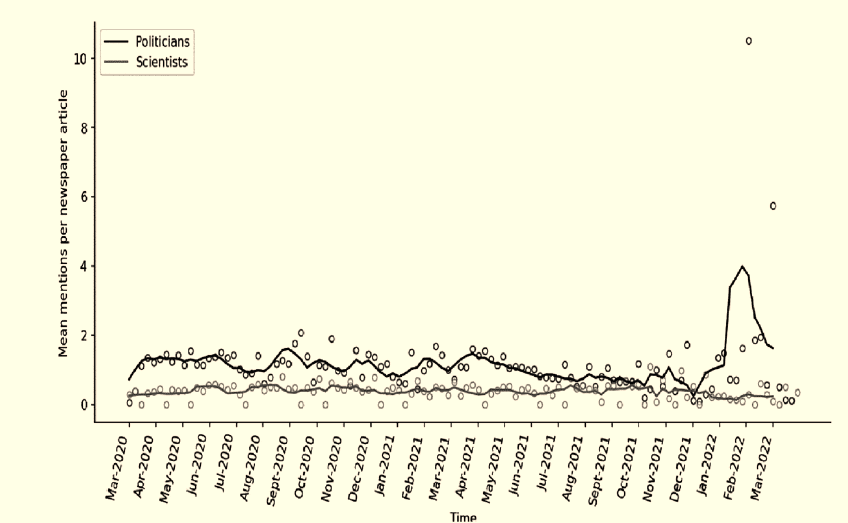
Politicization in Newspaper Coverage of COVID-19 lockdown from March 2020 to March 2022

“We can see a U-shaped trend in the language difference between BJP and Congress during February 2021 to August 2021. Interestingly, the vaccination started in India in January 2021 for the health and frontline workers and was subsequently rolled out for the general public in phases since March 2021. During the height of the second wave of COVID-19 in India, polarization had come down but again
increased after the end of the second wave
,” the paper stated.

Polarisation (defined as differing positions taken by various political actors on any issue) is being measured on the basis of language differences.

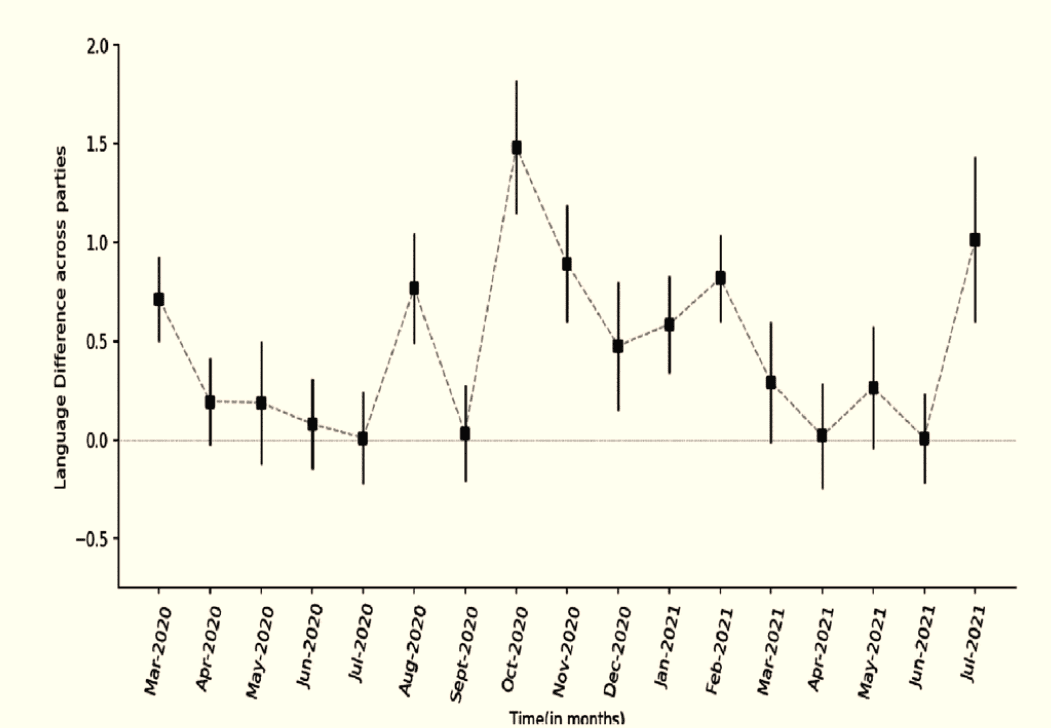
As evident from the image below, the language difference between the BJP and the Congress was found to be high during the announcement of the lockdown in March 2020 (thereby indicating increased polarisation).

“The language difference between BJP and Congress remained stable during the initial period of the pandemic but peaked in September 2020 on the eve of the Bihar assembly election,” the paper added.

Polarization in COVID-19 lockdown news coverage from March 2020 to July 2021

“On the COVID-19 vaccine issue, the language difference between BJP and Congress has been fluctuating but generally at a higher level of difference compared to the earlier issues,” it pointed out.

As per the research paper, the polarisation at the micro level increases if political discourse on handling the COVID-19 crisis diverges.

“The overall COVID- 19 coverage is significantly politicized before the roll-out of vaccine for all, which coincided with the end of the second wave of COVID-19. COVID-19 news coverage was significantly polarized between the two prime political blocs of BJP and Congress. Politicization and polarization of science in the Global South seem to be motivated by competition in the political environment as is the case with the democracies in Global North,” the paper concluded.

Observations made by author Kausik Gangopadhyay

Kausik Gangopadhyay, one of the authors of the peer-reviewed paper, is an economist and a Professor at the Indian Institute of Management Kozhikode.

In a tweet on Tuesday (25th March), he observed, “Congress was the party farthest from the scientific understanding and BJP closest to the scientific understanding. All other parties were in between.”

“This is understandable in the sense that the party in power needs to embrace reality to make things work, and the party in opposition simply opposes the party in power,” Kausik Gangopadhyay added.

He, however, made it clear that it was his observation and not that of the two other authors of the paper Swarn Rajan and Anirban Ghatak.

66 Crore devotees in just 45 days in a temporary city: UP CM Yogi Adityanath on the successful organisation of Mahakumbh

0

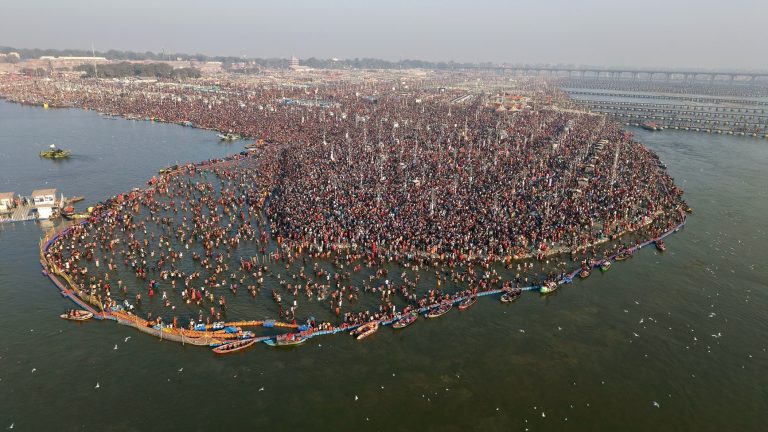
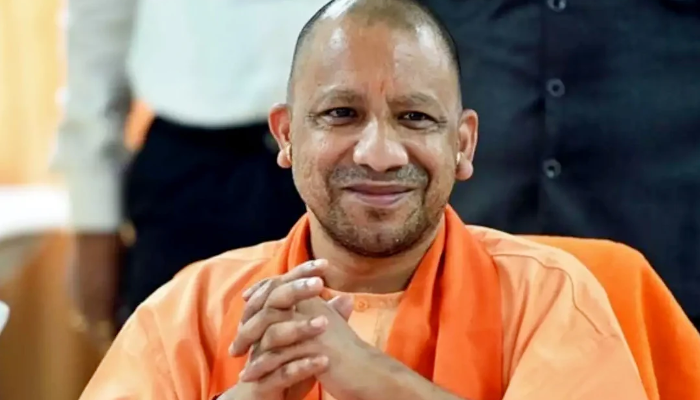
Uttar Pradesh Chief Minister Yogi Adityanath on Tuesday asserted that they succeeded in their goal of organizing the Mahakumbh in Prayagraj with 66 crore devotees in 45 days in a temporary city.

CM Yogi attended the inaugural ceremony of the two-day national seminar on ‘Contribution of Yogiraj Baba Gambhirnath of Indian Yoga tradition’ organized at Deen Dayal Upadhyaya Gorakhpur University.

“I held the first meeting regarding the Maha Kumbh in November 2022. It took a year to finalize everything and then to implement it on the ground. If a good team isn’t selected, the situation will be similar to what happened during the Commonwealth Games in Delhi. The CWG had ended, but the stadiums were still being built. Some people started criticizing the Maha Kumbh. I knew that the 7,000 crore Rs we were spending was the hard-earned money of the people of Uttar Pradesh, but in return, we would give Uttar Pradesh a three lakh crore Rs return and show the world that faith can become a cause of prosperity. We had not understood its strength,” CM Yogi said.

“We succeeded in our goal. The Maha Kumbh was magnificent and divine. The world was amazed to see the spiritual and cultural organization of India, with 66 crore devotees in just 45 days in a temporary city,” he said.

He further emphasized that 66 crore devotees coming to Prayagraj, where they bathe in Maa Ganga and take a sip of water shows the spiritual strength of India.

“The power of spirituality cannot be bound by the limitations of the physical world,” he pointed out.

The Uttar Pradesh CM also highlighted that India’s Upanishads are the greatest treasures not only in this physical world but also if one wants to understand the mysteries of the universe.

“The problem was not in the world but within us. We had distanced ourselves from Upanishads. The result of this is visible today. The world that once ran behind us, we are now running after that world,” he said.

“In the past 10 years, we have seen India change. Earlier, no one paid attention to India. But after 10 years of transformation, today, everyone wants to come to India. Everyone feels proud of India. Today, 193 countries around the world are practicing Indian yoga techniques. Even an atheist country like China organizes yoga events. The same China, which once did not believe in religion, is now researching Buddhist philosophy. Isn’t this India’s victory?” CM Yogi Adityanath highlighted. 

(This news report is published from a syndicated feed. Except for the headline, the content has not been written or edited by OpIndia staff)

I.N.D.I. Alliance used funds given by George Soros: UP CM Yogi Adityanath calls out foreign interference during 2024 Lok Sabha elections

0

In a big charge, Uttar Pradesh Chief Minister Yogi Adityanath has said that Congress and its allies in the I.N.D.I. Alliance used regime-change billionaire George Soros’s money to try and influence the 2024 Lok Sabha elections.

In an exclusive interview with ANI, CM Adityanath said, “They did propaganda and they had not only spread propaganda but foreign money was also involved in it. George Soros had long ago announced it… I am saying that foreign money was involved in the Lok Sabha elections throughout the country in which Congress and other parties of the INDI bloc were directly and indirectly involved, and through that, they tried to influence the elections. This falls in the category of deshdroh (treason).”

It must be recalled that the far-left billionaire George Soros had created a Billion Dollar war chest to fight nationalists like Indian PM Modi.

In 2020, Soros said, “Nationalism, far from being reversed, made further headway. The biggest and most frightening setback occurred in India where a democratically elected Narendra Modi is creating a Hindu nationalist state, imposing punitive measures on Kashmir, a semi-autonomous Muslim region, and threatening to deprive millions of Muslims of their citizenship”.

Soros, who worked with USAID, had also been eyeing a colour revolution in India.

Speaking to ANI, the Uttar Pradesh CM Yogi Adityanath also opened up on the recent controversy surrounding stand-up artiste Kunal Kamra. Criticising him, the Chief Minister said that some people have treated freedom of speech as their birthright to divide the country further.

“The freedom of expression cannot be used to attack. It is unfortunate that some people considered the freedom of speech as their birthright to divide the country and further deepen divisions,” Adityanath said.

CM Yogi also unleashed a fierce critique of the Congress party over the four per cent Muslim reservation quota bill in Karnataka, stating that the reservation on the basis of religion by the Congress-led Karnataka government is an insult to Babasaheb Bhimrao Ambedkar’s Constitution.

“DK Shivakumar is saying exactly what he has inherited from Congress’s legacy,” CM Yogi said.

Asked about his “Dabang” style of governance, the chief minister said, “This lathi not only safeguards our sisters, daughters, and businessmen but also deals with mafia and goons. Ye humara Dabang style nahi, yeh humari sharafat ka style hai.”

In India, judges appoint themselves, investigate themselves and refuse all attempts at accountability: How reforms have been blocked over the years

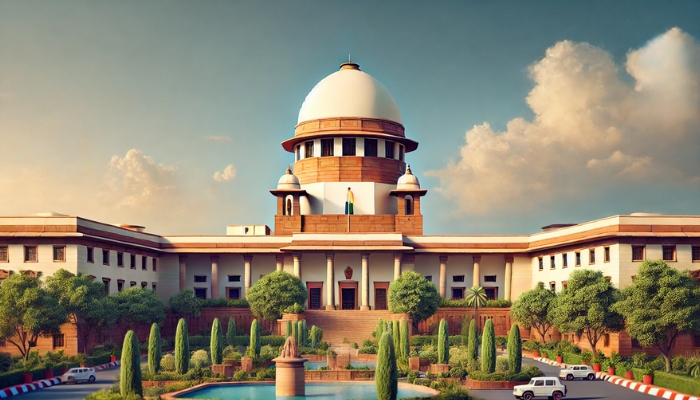
Justice Yashwant Varma of the Delhi High Court has been embroiled in controversy since an enormous amount of unaccounted cash was reportedly discovered after a fire at his residence. After the fire was extinguished, four to five partially burned sacks containing “remains of Indian currency were found in the said room,” according to a police report released by the Chief Justice of India (CJI). The Supreme Court Collegium has now decided, following two meetings on 20th and 24th March, to return him to his parent Allahabad High Court.

Senior advocate Ujjwal Nikam, meanwhile, stated that a transfer or suspension was insufficient and asked Parliament to start criminal charges and, if required, impeachment procedures. On the other hand, Allahabad High Court lawyers have announced an indefinite strike in protest of the ruling. Interestingly, the matter has been shrouded in uncertain secrecy and critical concerns have yet to be addressed.

No true accountability for judges: Justice V. Ramaswami case

Notably, this is not an unprecedented situation as judges have been the target of such grave accusations in the past. Nevertheless, there exists a considerable shortfall in the consequences of their questinable actions.

Justice V. Ramaswami was the first judge to face an impeachment motion and he would have been the first one to be removed from office had the Lok Sabha approved the resolution put out by the opposition. He was the only judge to be chosen with the support of his father-in-law, a chief justice who resigned during the Emergency when the Central Bureau of Investigation (CBI) discovered undisclosed cash in his house.

Ramaswami was convicted of lavishly furnishing his official apartment with bedding, plush furnishings and air conditioning without following the proper procedures as Chief Justice of the Punjab and Haryana High Court resulting in a major political and judicial controversy in the 1990s. Veteran Congressman Kapil Sibal was his counsel. Just 196 of the 401 members of the house cast their votes in support of the impeachment.

Due to the abstention of 205 Congress members and a few members of other parties, the motion was unsuccessful. Ramaswami ascended to the position of a judge on the Supreme Court of India, despite a contentious career.

Cash delivered at the door of a sitting judge: Justice Nirmal Yadav case

A package worth ₹15 lakh arrived at the residence of Nirmaljit Kaur, a Punjab & Haryana High Court judge, on 13th August 2008. The packet was mistakenly sent to Justice Kaur’s Chandigarh address when it was intended for Justice Nirmal Yadav, a serving judge of the same court, according to the preliminary investigation. The Supreme Court collegium, which was headed by KG Balakrishnan, the Chief Justice of India (CJI) at the time, initially cleared her name. The Central Bureau of Investigation (CBI) then filed a closure report in 2009.

Afterward, Nirmal Yadav was transferred to the Uttarakhand High Court. If Justice SH Kapadia, who took over as chief justice after Balakrishnan retired, had not examined his predecessor’s judgment and permitted her prosecution, the case would have been quietly dismissed. On the day of Yadav’s retirement in 2011, the President of India approved her prosecution. The case is still pending in the special CBI court after 14 years.

Sexual harassment of a woman additional district judge: Justice S K Gangele case

The Madhya Pradesh High Court’s Justice S K Gangele also had to deal with the removal process. He was cleared by a committee that Hamid Ansari established in April 2015 after accepting a resolution backed by 58 MPs to investigate allegations of sexual harassment against a female district judge in Gwalior. In her 2014 resignation papers, the complainant, who served as the chairman of the Vishaka committee against sexual harassment, outlined that she had to step down in order to preserve her “dignity, womanhood and self-esteem.”

Resignation before accountability

Justice Soumitra Sen of the Calcutta High Court was the second judge to be the subject of an impeachment motion. He resigned in September 2011, just days before the motion was scheduled to be presented in the Lok Sabha, making him the first judge in India’s judiciary to be ousted by an overwhelming majority vote of the Rajya Sabha. A Calcutta court convicted him guilty of distorting facts and embezzling ₹33.23 lakh in 1983 while serving as a court-appointed receiver in his legal capacity.

The charges against Justice Sen were heard by a three-judge inquiry committee that was founded in 2007. The Prime Minister was then advised to remove him by the CJI. A motion to impeach him was made in 2009 by 58 Rajya Sabha MPs. In February 2009, Vice President and Rajya Sabha Chairman Hamid Ansari constituted a committee that confirmed the accusation. On 18th August 2011, the Rajya Sabha considered and approved a proposal to remove him, voting 189 to 17. The motion was to be discussed by the Lok Sabha on 5th and 6th September 2011 but he put in his papers on 1st September.

Paul Daniel Dinakaran Premkumar, a judge in the Karnataka High Court was recommended for promotion to the apex court by the Supreme Court collegium in August 2009. However, a number of distinguished members of the legal community accused him of corruption. In December 2009, the administration sent back the propsal to the collegium. He was moved to the Sikkim High Court as Chief Justice.

After 76 MPs petitioned for his dismissal, Hamid Ansari accepted the proposal. An inquiry panel under the Judges Inquiry Act was set up by him in January 2010. However, Premkumar voiced his lack of faith in the committee and resigned on 29th July 2011, the day of its first meeting to investigate 16 charges, some as serious as stealing over 300 acres of land from farmers in Tamil Nadu’s Tiruvallur district following his appointment as a judge of the Madras High Court.

Judiciary protects its interests: Kesavananda Bharati vs. State of Kerala (1973)

The Kesavananda Bharati case has its roots in the land reform initiatives implemented in the Indian state of Kerala during the 1950s and 1960s. The Kerala Land Reforms Act, passed by the government in 1963, set a cap on the total quantity of land that an individual could own. The act allowed for the acquisiton of surplus land from landowners and its allocation to the impoverished and landless.

Sri Kesavananda Bharati served as the leader or pontiff of the Edneer Mutt, a Hindu religious organization located in the state. The head of the Edneer Mutt, a Hindu religious organization in Kerala, India, was Sri Kesavananda Bharati. The ownership of land held by religious institutions was restricted by the Kerala government in 1970. The Kerala High Court heard an appeal against the act’s constitutionality from the Edneer Mutt, led by Sri Kesavananda Bharati. The Supreme Court then heard the matter and decided in favor of the state government.

In the meantime, the Indian Parliament enacted the 24th Amendment to the Constitution, which aimed to restrict the judiciary’s authority and the reach of judicial review. Furthermore, the 25th and 29th Amendments were ratified, which aimed to restrict fundamental rights and grant Parliament the authority to change any provision of the Constitution. Sri Kesavananda Bharati contested the legality of these revisions in a petition, claiming that they went against the fundamental framework of the Constitution.

This resulted in the Kesavananda Bharati verdict, which limited the Parliament’s ability to change the Constitution while upholding the basic structure concept and the independence of the judiciary. However, it is important to note that the judiciary gave itself more power by developing a mechanism to overturn modifications that threatened its authority. The same has since been applied to “protect judicial independence” and resist judicial reforms.

K. Veeraswami vs. Union of India And Others (1991)

In a significant decision in K Veeraswami v. Union Of India And Others (1991) case, the Supreme Court of India considered whether the Prevention of Corruption Act (1947) could be applied to Supreme Court and High Court judges. Former Madras High Court Chief Justice K. Veeraswami, the appellant, challenged the criminal charges brought against him under the act, arguing that, as a constitutional official, he ought to be immune from them in the name of protecting the judiciary’s independence.

The case could proceed after the Supreme Court, in a majority decision, approved the dismissal of the appeal. Supreme Court and High Court judges are, in fact, categorized as “public servants” under the act, according to the main conclusion. However, section 6 of the act stipulates that prior sanction from a competent body is required to prosecute them under section 5(1)(e).

The majority ruled that Article 124 of the Constitution, which involves the President and both Houses of Parliament, specifies a precise process for removing judges. The act’s requirement becomes impractical as the President has the power to remove a judge, however, he or she cannot choose to prosecute on their own (due to alleged executive bias). As a result, this effectively excludes judges of the Supreme Court and High Court from the act’s purview.

The decision pronounced that “per incuriam and sub silentio,” or when a court renders a decision without specifically expressing or taking into account a particular legal point, no criminal case might be filed against a judge of the Supreme Court or High Courts without the Chief Justice of India’s prior consent. This raised concerns about accountability as judges were shielded from inquiry or prosecution. The judiciary defended it by maintaining that it was required to maintain judicial integrity and stop harassment.

Supreme Court Advocates-on-Record Association vs. Union of India (1993): The birth of collegium system

A constitutional disagreement about the process for selecting Supreme Court and High Court judges in India resulted in the Second Judges Case (1993), officially known as Supreme Court Advocates-on-Record Association vs. Union of India. In the first judges case, the Supreme Court affirmed the executive’s dominance over the nomination of judges, holding that the CJI’s participation in the process was limited to consultation. However, it turned into tensions and disputes between the judiciary and the executive over the appointment and transfer of judges.

On 6th October 1993, the Supreme Court in a historic ruling declared that the word “consultation” would imply “concurrence” and  decided that when it comes to the appointment and transfer of judges, the CJI has the highest authority. This was a major change from the previous First Judges Case decision. The ruling determined that, in accordance with Article 124 of the Constitution, the CJI’s opinion, as the head of the judiciary, must be interpreted as “concurrence.”

As a result, the apex court underlined the necessity of a “collegium” system that involves the CJI and a group of senior judges to suggest judges for appointment and transfer. The goal of this collegium system was to guarantee that judicial appointments and transfers were guided by the independence and quality of the judiciary and not by the influence of the executive branch.

The verdict clarified that although the executive (President of India) must confer with the CJI, the latter’s recommendation is most important. The CJI’s recommendations cannot be rejected by the administration without good cause. The court stressed that judicial selections must not be impacted by political factors or executive meddling and its independence must be maintained.

The Second Judges Case established the collegium system and the Chief Justice of India’s primacy, which drastically changed the country’s judicial appointment landscape. Fundamentally, the collegium operated on the principle of “by the judges, of the judges, and for the judges.” It was viewed as a power grab since it produced an opaque, judge-dominated structure in place of a balanced executive-judiciary procedure. This led to the judicial system becoming an insular network, lacking accountability to anyone except its own members. Meanwhile, other pillars of Indian democracy do not enjoy the privilege.

Judicial Standards and Accountability Bill (2010)

The Judicial Standards and Accountability Bill, 2010 laid forth judicial standards, mandates that judges disclose their assets and creates procedures for dismissing Supreme Court and High Court justices. The assets and liabilities of judges, as well as those of their spouse and children, must be disclosed, per the bill brought by the United Progressive Alliance government. The National Judicial Oversight Committee, the Complaints Scrutiny Panel and an investigating committee were established by the bill. Moreover, anyone could complain to the Oversight Committee about a judge for “misbehavior.”

The bill was then referred to a standing committee and passed in the Lok Sabha in May of 2012, but lapsed consequent to the dissolution of the 15th Lok Sabha. It seeks for a time-bound investigation of judges who are accused of corruption and sexual harassment. The Bill stated that after the panel receives complaints, they will be forwarded to the scrutiny committee and if the charges are significant, the chairman will request an investigation.

As per the Bill, the inquiry panel, which was to be named the oversight committee and would be overseen by a former Chief Justice of India (CJI), who would assemble a probe team that will look into charges against a judge using an advocate picked by the government. All such processes would be regarded as judicial proceedings, and the probe against a judge must be conducted in camera. If charges are proven after an investigation, the judge could have their judicial work suspended.

Unsurprisingly, there was opposition to the bill. AP Shah, head of the Law Commission and former Chief Justice of the Delhi High Court, stated that it would have a “debilitating effect on judicial independence.” He alleged that it breached the Constitution’s protection extended the higher judiciary which “doesn’t enable Parliament to create another venue that leads in impeachment proceedings stemming from a complaint submitted by one person.” He added that the proposal permits public complaints claiming misconduct by a sitting Supreme Court or high court judge, which may lead to their impeachment.

Supreme Court Advocates-on-Record Association vs. Union of India (2015): NJAC Case

The Supreme Court upheld the collegium system for judicial appointments in the case of Supreme Court Advocates-on-Record Association v. Union of India (2015), also referred to as the Fourth Judges Case. The proposed National Judicial Appointments Commission (NJAC) would have been in charge of hiring, appointing and transferring judges, attorneys and other legal staff under the Indian government as well as all of its state governments. The commission was created by amending the Indian Constitution by the 99th Constitutional Amendment Act 2014, also known as the Constitution (Ninety-Ninth Amendment) Act 2014, which was approved by the Rajya Sabha on 14th August 2014 and the Lok Sabha on 13th August 2014.

It would have established a new mechanism for the nomination of judges in place of the collegium system, which the Supreme Court had activated through judicial fiat. The Indian Parliament passed the act in addition to the Constitution Amendment Act to govern the National Judicial Appointments Commission’s functions. The Constitutional Amendment Bill and the NJAC Bill were approved by 16 Indian state governments before being enacted into law by Indian President Pranab Mukherjee on 31st December 2014. On 13th April 2015, the Constitutional Amendment Act and the NJAC Act went into effect.

However, after considering petitions from a number of individuals and organizations, with the Supreme Court Advocates on Record Association (SCAoRA) serving as the primary petitioner, the Constitution Bench of the Supreme Court ruled on 16th October 2015, by a 4:1 majority, that the NJAC was unconstitutional and maintained the collegium system. The 97th Constitutional Amendment Act was also deemed invalid by the court.

The National Judicial Appointments Commission (NJAC) which would have comprised representatives from the legislature and executive branch, was intended to take the place of the collegium system under the amendment. The court declared that by undermining the judiciary’s independence, this amendment went against the fundamental framework of the Constitution. As envisioned in the amendment, the NJAC was declared as interfering with the nomination process and weakening the independence of the judiciary.

Justice CS Karnan vs. Supreme Court Of India (2017)

The first Indian high court judge behind bars is named Justice CS Karnan. He was taken into custody in Tamil Nadu. The ex-judge was convicted of raising accusations against other judges. After writing to Prime Minister Narendra Modi and urging action against the judges, he was found guilty of contempt of court by the nation’s Supreme Court. He urged PM Modi to look into the matter and take action against persons on the list.

He was then summoned before the highest court and prohibited from carrying out any administrative or judicial duties. The seven justices of the bench were accused of caste prejudice by Justice Karnan, who prohibited them from leaving the country and demanded compensation. The Supreme Court then mandated that a group of government doctors conduct a mental evaluation of Justice Karnan. In a furious reaction, he ordered the seven judges to take similar tests.

He issued a judgement that sentenced India’s chief justice and seven other Supreme Court justices to five years in prison. The judges were found guilty of harassment and discrimination, among other offenses, according to the judgment. The media are not allowed to publish or broadcast Justice Karnan’s remarks, according to the supreme court. The case was perceived as the judiciary pulling together to quell criticism and safeguard its image instead of openly addressing Karnan’s accusations.

Do judges have to declare their property or assets?

According to data gathered a year ago under the Right to Information Act, just 13% of Indian High Court justices had disclosed their holdings. There are around 1,100 judges in the High Courts and 34 justices, including the Chief Justice, in the Supreme Court as of March 2025. Only 98 of these judges, mostly from the Delhi, Punjab-Haryana and Kerala High Courts made their assets publicly available, per a report in News18.

The High Courts of Allahabad and Bombay have already ruled that in compliance with the Right To Information Act of 2005, asset declarations are not considered “information.” While the Andhra Pradesh and Telangana High Courts concluded that asset declarations were confidential and inappropriate for internet posting, the Gujarat High Court has similarly maintained that there is no public interest in disclosing the personal information of the judges.

A statement of assets and liabilities must be submitted by each service member in accordance with the All India Services (Conduct) Rules 1968, which aligns the pay of judges with that of public officers, especially government secretaries. The Supreme Court laid down rules in 1997 mandating that judges disclose all assets to the Chief Justice, including real estate and investments in their own names and also in the names of their spouses or their dependents. This guideline was not followed, though.

The Supreme Court in 2009 decided to post asset disclosures of judges on its official website. In the same year, the Delhi High Court likewise agreed to make the assets of judges publicly available. The majority of judges have not voluntarily disclosed their assets in spite of these steps which could have developed a norm for transparency and honesty.

The laws requiring the declaration of these assets was suggested by the Parliamentary Committee on Personnel, Public Grievances, Law and Justice. A parliamentary standing committee report titled “Judicial Processes and their Reforms” from August 2023 suggested a law that would require judges of the Supreme Court and High Court to file yearly asset returns and create clear guidelines for asset disclosure. The accountability bill and NJAC Act were also steps taken in the same direction.

No mechanism for judicial accountability

The Judges (Inquiry) Act of 1968 governs India’s current judicial accountability system. It states that a three-member committee must decide whether to remove a judge for “proven misbehavior or incapacity.” A Supreme Court judge, a High Court Chief Justice and a distinguished jurist make up the panel. Although it operates similarly to a trial court, this committee is solely called upon following the successful filing of an impeachment resolution in the Rajya Sabha or Lok Sabha. The presiding officer of the house who is either the Speaker in the Lok Sabha or the Vice-President also the Chairman in the Rajya Sabha, must approve the resolution.

The removal from office requires an absolute majority in the Rajya Sabha or a two-thirds majority in the Lok Sabha. This makes reaching an agreement challenging, particularly in a politically sensitive setting. In India, judges are exempt from many laws and can avoid accountability by stepping down before to official proceedings. A weakness in the system’s capacity to hold judges accountable for their misconduct is revealed by the fact that this protection surpasses that accorded to elected officials.

Despite numerous charges of corruption, impeachment procedures have only been initiated against Supreme Court or High Court judges four times in India’s history. There are two primary methods that our legal system handles accusations of corruption against these judges. The first is an internal process that the Supreme Court instituted in 1999.

The Chief Justice of India or the Chief Justice of the relevant High Court reviews complaints against judges internally under this system. A three-member committee composed up of senior judges probes the claims if they are believed to be genuine. Nevertheless, this procedure is informal, opaque and infrequently leads to serious disciplinary action beyond a resignation recommendation or a suspension of judicial work.

The second method, which is protected by the Indian Constitution, is impeachment by Parliament. However, impeachment is an unfeasible weapon due to the high threshold required, support from a two-thirds majority in both houses. It is a laborious procedure that rarely leads to impeachment. Actions taken against dishonest judges are unknown to the general public and the legal world. Contempt laws, however, are the main reason why judges escape punishment for their misdeeds.

It is challenging to openly debate or look into claims of corruption against judges in India due to the country’s severe contempt of court regulations. This stifles independent journalistic research and public scrutiny. Additionally, the judiciary has a conflict of interest because it governs itself to a greater extent than other government agencies. There is no independent body to monitor judicial conduct. The single constitutional means of removal, impeachment, is rarely used and is heavily politicized, making it a weak deterrent.

The judiciary is lacking transparency in India

Many people believe that the judiciary is the last stronghold of accountability, justice, and equity. However, this claim has always been disputed due to instances of corruption, self-preservation and a lack of transparency. The aforementioned cases demonstrated how judges, when confronted with accusations of wrongdoing and corruption, utilize the constitutional protections afforded to them to avoid indictment and trial in addition to reflecting the delay in administering justice.

When an inquiry is commenced, it is carried out by other judges based on a framework they have set up, resulting in lingering uncertainties and a severe lack of desired impartiality and transparency. This privilege is not extended to anyone else. The judiciary requires and enforces standards of transparency and integrity from everyone except itself.

According to the Ethics Act of 1978, federal judges in the United States are required to report their sources and amounts of income as well as any gifts that surpass a specific threshold. High-ranking public officials, including judges, are required by South Korea’s Public Service Ethics Act 1993, to report non-public company shares, real estate, and intangible assets. Public officials are required to disclose their assets under the Anti-Graft and Corrupt Practices Act of 1960 in the Philippines.

Anti-corruption rules in Russia mandate judges and their families to keep track of their assets and income. On the other hand, in India, judges are safeguarded by a complex system. While they have the option to disclose their assets, there is no legal requirement compelling them to do so. High levels of opacity characterize the judiciary’s operations, especially when it comes to the collegium system’s appointment and transfer of judges. It erodes public confidence.

Moreover, efforts to address the problem, such as the NJAC Act or the accountability bill, never proceed to a logical conclusion which only exacerbates the issue. Several attempts to alter the collegium have been met with resistance from the judiciary, which is frequently denounced as self-empowerment but is justified as defending independence.

Due to the collegium’s opaque operations, decisions are not made public and no formal criteria are revealed and hence it has been accused of nepotism and bias, with arguments that it shields a judicial elite that is exclusive.

Likewise, since statements made during court proceedings, including by judges, are deemed privileged and immune from defamation lawsuits, it is not possible to bring a defamation case against a high court or supreme court judge. A defamation case could only be brought against a judge who speaks in a public setting or in their private capacity. A judge’s remarks could possibly be subject to litigation under the Contempt of Courts Act in addition to any other remedies available to the aggrieved party if they are deemed to be defamatory and constitute contempt of court.

A historic ruling by the Supreme Court on 2nd May 2002, mandated that political candidates reveal their educational background, assets and obligations, including those of their spouses and dependents, and any criminal history they may have. The court decided that the right to vote in a democracy includes the right to information for vote-casting citizens. Hence, politicians are accountable to the public every five years and can be rejected by the people in each election. They must reveal their assets, criminal backgrounds and various personal details in affidavits for public awareness.

However, the same doesn’t apply to the judiciary, which is another crucial part of the democracy. The judges are not required to adhere to any such regulations, implying that the public does not have a right to know about judges and their judicial conduct, unlike other pillars of Indian democracy. It appears that the judiciary in India operates in a manner akin to a separate entity where judges are subject to different laws and regulations, superior than common Indians. They benefit from supreme protection and lead lives shrouded in absolute secrecy, a privilege not afforded to the general populace or other arms of the democracy.


Surat POCSO court sentences Ashad Altaf to 20 years in prison for raping minor Hindu girl: Breaking down victim statement and court judgement

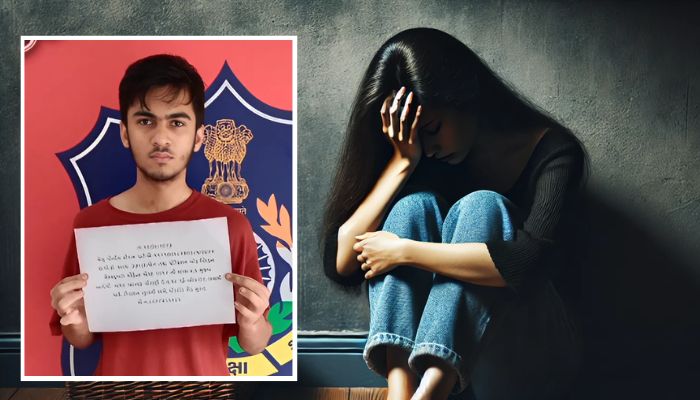
On 18th March 2025, Surat POCSO Court sentenced Ashad Altaf Virani to rigorous imprisonment for 20 years and imposed a fine of Rs 1,00,000 on him for raping a minor Hindu girl. Ashad was booked by Vesu Police in Surat, Gujarat, under Sections 376(2)(N), 450, 465, 468, 471, and 120(b) of the Indian Penal Code (IPC) and Sections 4, 6, and 17 of the POCSO Act on 19th September 2023, based on the complaint of the victim’s mother. He was arrested on 22nd September 2023. At the time of his arrest, Ashad was 19 years old. Two other accused, Rudra Chandresh Patel and Pravin Netrapalsing Chaudhary, booked under the same provisions, were acquitted by the court.

The Special Fast Track Court (POCSO) was presided by Justice Shakuntala Naresh Solanki. DV Dave was the Public Prosecutor. Ashad was represented by advocate KP Reshamwala, Rudra by advocate MH Chaudhary and Pravin by advocate SS Katyare.

Background of the case

On 19th September 2023, the victim’s mother approached Vesu Police Station to file a complaint against Ashad for raping her minor daughter, who was 17 years old at the time of the incident. In her complaint, the victim’s mother said that she noticed her daughter was talking to someone on the phone and sending messages from time to time. She became suspicious and took her phone to check. The mother found some nude photographs of her daughter with a boy.

When enquired, the victim revealed that around six or seven months earlier, her friend Aryan Mehta had introduced her to a young man, Ashad Altaf Virani. He used to take her to parties from time to time at different places. The victim admitted that she was having a love affair with him. Ashad had taken her to the Weekend Home hotel at Dumas Road and also to his house, where they had sexual intercourse.

As the girl was a minor, the police filed a case under the POCSO Act and other relevant sections of the IPC. Rudra and Pravin were also booked by the police during the course of the investigation as they had allegedly modified the victim’s Aadhaar card so that she could submit it at the reception of the hotel where Ashad had taken her. Rudra and Pravin were arrested by the police on 30th September 2023.

Victim’s mother’s statement in court

In her statement in the court, the victim’s mother deposed that on 18th or 19th September, she checked her daughter’s mobile phone and saw nude photographs of the victim and Ashad. Aryan, a common friend of the victim and Ashad, was the key person who arranged the first meeting between the two.

The victim’s mother called Aryan to her home. Aryan told the mother that he was aware of the relationship between the victim and Ashad. Aryan would take her from the house and drop her off with Ashad while the mother was under the impression that the victim was going to Aryan’s house for skateboarding. The mother then called Ashad, who apologised to her. After that, she went to the police station and filed a complaint against the accused.

Notably, court documents revealed that after that day, Aryan went to London and did not turn up for a statement in the court.

After filing the complaint, the victim was taken to the hospital for a medical examination. The victim’s phone and clothes were taken away by the police as evidence.

In her statement, she revealed that when she learnt that Aryan and Ashad had taken the victim to Weekend for a party, it was disclosed to her that they had made a fake ID for her so that Ashad could take her to a hotel. She alleged that at the hotel, Ashad gave her daughter a drink, and after taking that drink, she lost consciousness. When she regained consciousness, the victim felt that something had happened.

When she was taken for a medical examination, the victim told her mother that Ashad had taken nude photographs on his and the victim’s phone and that there had been sexual intercourse between them.

Statement of the victim

In her statement recorded in front of the magistrate, the victim, referred to as the ‘prosecutrix’ in the judgment as she was a minor, said that she already knew Ashad studied at her school and his younger cousin, Zidant, was her classmate. Aryan, her friend, was her schoolmate. Aryan introduced her to Ashad.

During the first meeting, they went to have soft drinks. Days later, they met again to play some sports. Slowly, it became a frequent meeting spot for them. Soon, she and Ashad began texting, and their interactions evolved into private meetups. Her mother was aware that she and Ashad were friends and disapproved of the relationship as Ashad was from a different community. She forbade her from meeting Ashad. However, the victim continued to meet him secretly.

One evening, Ashad texted her, eager to meet. He picked her up, and they drove around. Ashad offered her a drink that tasted bitter. When questioned, he dismissed it and urged her to drink. He then drove to a complex where he took her phone and left the car. After returning, he told her that he had booked a room upstairs. They used a fake ID made by Rudra so that she could go to the room with him. In the room, he offered her more drinks, which left her disoriented yet conscious. Ashad assaulted her and took photos. Later, he drove her back to her home.

Despite her reluctance, Ashad soon insisted on meeting, using the nude photos he had taken to coerce her. He would arrive with alcohol and weed, forcing her to partake before assaulting her again. He threatened the victim with leaking the images if she resisted. As the victim was fearful of her mother’s reaction, she remained silent. Their encounters grew frequent, often marked with forced drinking and assault.

One day, when she refused to meet him, Ashad came to her home unannounced as she was alone and assaulted her. In June 2023, he took her out on his birthday and assaulted her again. Later, he assaulted her under the guise of watching a movie at his home. In August, he mentioned that he was planning to go abroad, which provided temporary relief to the victim, but those plans were stalled. In September 2023, he again took her to a hotel and continued the abuse.

When her mother discovered that the victim had been assaulted multiple times, she filed a complaint at Vesu Police Station. As the hearing proceeded, at one point, the victim became hostile. However, during cross-examination, she restated the facts she had mentioned in her statement in front of the magistrate.

The court noted that while in her statement the victim said the sexual relationship was without consent, at one point she mentioned that it had happened with her consent. However, the court observed that, though there was a contradiction, the sexual abuse happened multiple times, with or without the victim’s consent. Interestingly, based on the photos and videos of the victim and the accused, the court noted that it appeared the victim was a consenting party, but as she was a minor at the time, her consent was deemed invalid.

‘FIR is not an encyclopaedia’

In the judgment, the court noted that the defence tried to discredit the statement given by the victim’s mother in front of the magistrate, stating that it was different from what she had told the police in her complaint that led to the FIR. The court invoked the principle that “an FIR is not an encyclopaedia.”

The court stated that the FIR does not necessarily have to contain all the intricate details of the case, as its purpose is merely to set the criminal law in motion. The aim of filing an FIR is not to serve as a comprehensive or final statement of facts. At the time of lodging the FIR, the complainant is often under emotional distress, especially in cases involving sexual assault.

Hence, expecting the victim’s mother to articulate everything—from the names of all involved and exact locations to the modus operandi—is both unreasonable and legally unwarranted. The court emphasised that what matters more is whether the subsequent investigation and trial testimonies consistently establish the offence. Therefore, minor omissions in the FIR do not nullify the prosecution’s case if the core allegations are substantiated by evidence.

Acquittal of Rudra and Pravin

The court acquitted Accused Nos. 2 and 3, Rudra Chandresh Patel and Pravin Netrapalsing Chaudhary, on the grounds that the prosecution failed to prove their involvement beyond a reasonable doubt. While it was alleged that they had forged the victim’s Aadhaar card by altering her birth year to help Ashad gain hotel access with a minor, the evidence presented did not conclusively establish their active role in fabricating or using the document.

No direct proof was submitted to show that either accused had personally used or submitted the false ID at any hotel. Furthermore, forensic analysis of their mobile phones did not reveal any incriminating data supporting the allegation of forgery or conspiracy. Given the lack of credible and corroborative evidence, the benefit of doubt was extended to them, leading to their acquittal.

Judgment

In its judgment, the court convicted Ashad of offences under Sections 376(2)(n) and 450 of the Indian Penal Code, and Sections 4, 5(l), and 6 of the Protection of Children from Sexual Offences Act, 2012, and sentenced him to 20 years of rigorous imprisonment and a fine of Rs 1 lakh. Out of the fine, Rs 95,000 was to be paid to the victim as compensation.

In default of payment, he would undergo an additional one year of imprisonment. He was also sentenced to three years of rigorous imprisonment and a fine of Rs 2,000 under Section 450 of the IPC, as he had trespassed into the victim’s house and committed sexual assault there. The court ordered all sentences to run concurrently, and the period of detention already undergone by the accused was to be set off.

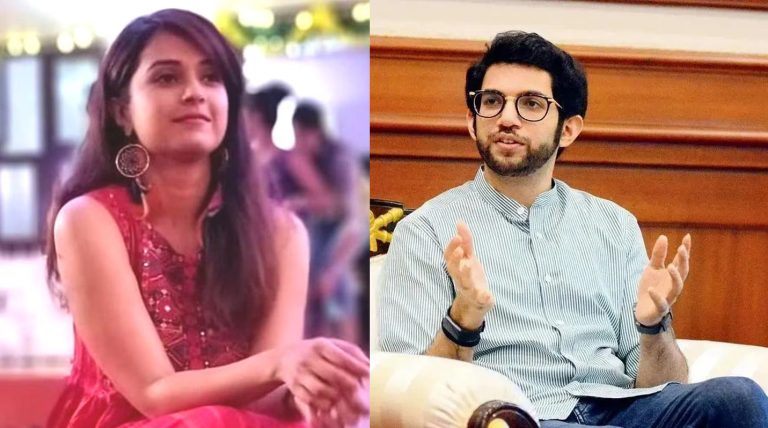
Disha Salian’s father names Aaditya Thackeray, other big names in fresh complaint in daughter’s death case

0

Satish Salian, father of the late Disha Salian, on Monday, filed a written complaint with the Mumbai Police Commissioner seeking the registration of an FIR against Aaditya Thackeray and others accused in connection with the offences of gang rape and murder of his daughter.

Satish Salian’s advocate, Nilesh Ojha, said that the complaint had been accepted by the Joint Commissioner of Police, and the accused in the case, include Aaditya Thackeray, former Commissioner of Police Parambir Singh, Officer Sachin Vaze and actor Aditya Pancholi.

“Today, we have filed a written complaint to the CP office and the JCP Crime accepted it and this complaint is the FIR now… The accused are Aaditya Thackeray, Dino Morea, Suraj Pancholi and his bodyguard, Parambir Singh, Sachin Vaze, and Rhea Chakraborty are all accused in this FIR…Parambir Singh was the main mastermind for the coverup in this case… He did a press conference and fabricated lies to save Aaditya Thackeray…All the details are in the FIR… NCB’s investigation paper proves that Aaditya Thackeray was involved in a drug business, that detail has been mentioned in this FIR,” the advocate told reporters.

He further alleged that Parambir Singh was the “main mastermind” behind the “coverup” in this case back in 2020.

Ojha also alleged that Aaditya Thackeray is linked with a “drug cartel”, which he said is also mentioned in the complaint.

“Aaditya Thackeray is the main accused in this gangrape and murder case. Uddhav Thackeray is the main accused of misuse of power for the coverup… Aaditya Thackeray is found in the drug cartel and this is in the official records of NCB. We have also mentioned this in the complaint… Today, we will also release some pictures in support of this,” he added.

Earlier, Satish Salian approached the Bombay High Court seeking a probe into his daughter’s death and requesting the registration of an FIR against Aaditya Thackeray, among others.

Disha was found dead on June 8, 2020, days before actor Sushant Singh Rajput was found hanging in his flat in suburban Bandra, Mumbai.

This development came on the heels of the CBI reportedly submitting a closure report on the death of Bollywood actor Sushant Singh Rajput in 2020.

According to sources, the closure has been filed in a Mumbai Court nearly five years after Sushant Singh’s death.

Sushant, 34, was found dead at his Bandra residence on June 14, 2020, which created a huge controversy, with the investigation later being handed over to the Central Bureau of Investigation. His postmortem report stated the cause of death was asphyxia. The postmortem was conducted at Mumbai’s Cooper Hospital. 

(This news report is published from a syndicated feed. Except for the headline, the content has not been written or edited by OpIndia staff)

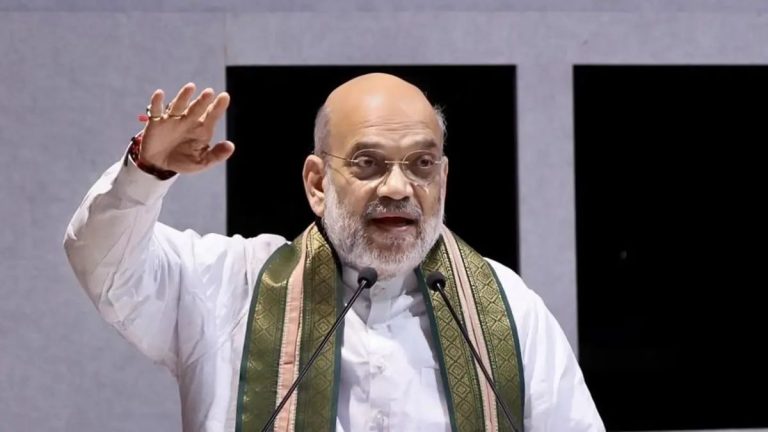
‘Separatism history in Kashmir’: Amit Shah hails decision of two Hurriyat-affiliated groups to sever ties with separatism

0

Union Home Minister Amit Shah on Tuesday hailed the decision of two Hurriyat-affiliated organizations to break away from separatism in Jammu and Kashmir, calling it a “significant victory” for Prime Minister Narendra Modi’s vision of a peaceful and united India.

Shah’s reaction came soon after the significant development came to the fore with the two organizations affiliated with the Hurriyat Conference announcing their decision to sever ties with separatism in Jammu and Kashmir.

“Separatism has become history in Kashmir. The unifying policies of the Modi government have tossed separatism out of J&K. Two organizations associated with the Hurriyat have announced the severing of all ties with separatism,” Shah expressed his views through his ‘X’ handle.

“I welcome this step towards strengthening Bharat’s unity and urge all such groups to come forward and shed separatism once and for all. It is a big victory for PM Shri @narendramodi Ji’s vision of building a developed, peaceful and unified Bharat.”

The two Hurriyat-linked groups’ decision is seen as a reflection of the changing political landscape in the Union Territory. Over the past few years, the government has implemented a series of measures to curb separatist activities, including strict enforcement of anti-terror laws and socio-economic reforms.

Officials believe this development signals a significant shift in Jammu and Kashmir’s political scenario, paving the way for further integration and peace.

(This news report is published from a syndicated feed. Except for the headline, the content has not been written or edited by OpIndia staff)

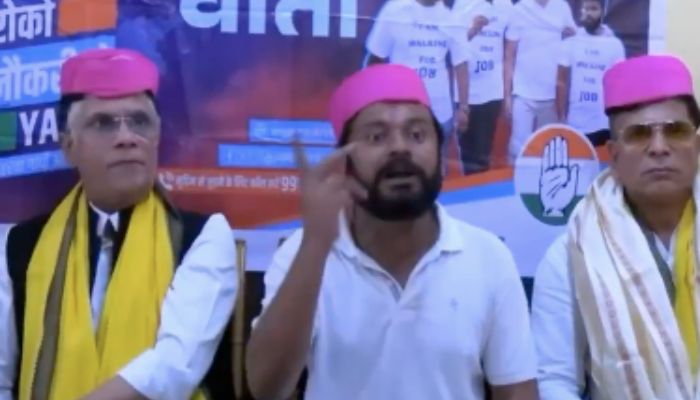
BJP is building roads to loot Bihar’s water: Congress leader Kanhaiya Kumar’s bizarre conspiracy theory against development projects in Bihar

On Monday (24th March), Congress leader Kanhaiya Kumar came up with a rather bizarre theory during a press meet while on the party’s ‘Palayan Roko Naukri Do Yatra’ in Bihar. Kanhaiya claimed that the way water is depleting in the world, the capitalists and businessmen of the world are eyeing the water of Bihar. He went on to claim that the BJP is bringing development projects in Bihar to loot the state’s water resources.

Kanhaiya Kumar said, “Bharatmala Project is under progress in Bihar, why is it being built? If Bihar does not have anything, then why are roads being constructed? Bihar has something the world is going to yearn for. Bihar has water. Water will become more valuable than petrol. “

“When industrialisation should actually have happened then it did not happen. Now that the industry has become automatic and local people will not get employment, these people are bringing small units to exploit Bihar’s water. Big roads are being built around us here. We do not have any income, so they are building roads. For whom are they building roads? To loot the resources here and take them away,” he added.

Notably, the Bharatmala Project envisages the development of about 26,000 km length of Economic Corridors, which along with the Golden Quadrilateral (GQ) and North-South and East-West (NS-EW) Corridors, are expected to carry the majority of the Freight Traffic on roads.

Further, about 8,000 km of Inter Corridors and about 7,500 km of Feeder Routes have been identified for improving the effectiveness of Economic Corridors, GQ and NS-EW Corridors. The programme envisages the development of Ring Roads/bypasses and elevated corridors to de-congest the traffic passing through cities and enhance logistic efficiency; 28 cities have been identified for Ring Roads; 125 choke points and 66 congestion points have been identified for their improvements.

The Congress leader resorted to fear mongering and invoking businessman Gautam Adani’s name to assert that somehow if a BJP leader becomes Chief Minister of Bihar, the state’s resources will fall in the hands of Adani.

“What do you think? The Prime Minister has gone after giving a speech on Makhana. Industrialists have their eyes on the resources here. I am not talking about elections, when elections will be held, we will speak on this issue with full force. BJP wants their Chief Minister to be elected in Bihar at any cost. If BJP manages to have its own Chief Minister, it means that Bihar’s resources will be in the hands of Adani,” Kumar said.

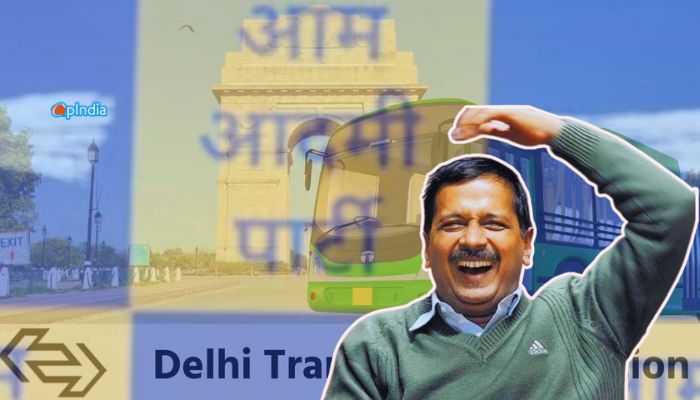
AAP govt failed its promise of 11,000 buses, DTC incurred losses worth thousands of crores: Delhi CM Rekha Gupta tables CAG Report, exposes DTC’s failure under AAP

On Monday (24th March), a Comptroller and Auditor General (CAG) report on the Delhi Transport Corporation (DTC) was tabled by Delhi Chief Minister Rekha Gupta in the Assembly. The CAG report highlighted operational inefficiencies and financial losses the corporation suffered under the previous Aam Aadmi Party (AAP) government.

The report evaluates DTC’s key operational and financial aspects, pointing to inefficiencies and areas needing improvement. It examines fleet management, revenue generation, operational sustainability, and adherence to public transport policies.

AAP govt failed to fulfil 11,000 new buses promise, fleet reduced from 4344 in 2015 to 3937: CAG report

Notably, under the previous AAP government, the CAG report indicates blatant mismanagement of the public transport system. This resulted in financial losses and a decline in DTC’s bus fleet. The Aam Aadmi Party government not only failed to fulfil its promise to launching 11,000 new buses in 2013-15, but the number of DTC buses also decreased from 4,344 in 2015 to 3,937.

“During the period 2015-23, fleet of the Corporation reduced from 4,344 (2015-16) to 3,937 buses (2022-23). The Corporation could procure only 300 Electric buses (EBs) during 2021-22 and 2022-23 despite the availability of funds from GNCTD. There was a delay in addition of EBs in the fleet for which penalty amounting to ₹ 29.86 crore for delayed delivery was not imposed on the operators,” the CAG report reads.

Citing data, the CAG report stated that since 2015, the DTC has not had a sufficient number of buses and it was requisite that new buses be purchased to expand the existing fleet alongside replacing the old and unserviceable buses. Even though ₹ 236.82 crore was available for procurement of buses in 2015 and ₹ 233.06 crore was available for this purpose as of March 2022,

However, the Delhi Transport Corporation under the AAP government “failed to induct new buses (except two Electric Buses in March 20223 and 298 buses after March 2022 up to November 2022) into its fleet during the last 10 years (last bus was inducted in 2011-12). Further, number of buses remained same during the review period excluding Standard Floor Buses which were completely phased out in 2019-20.”

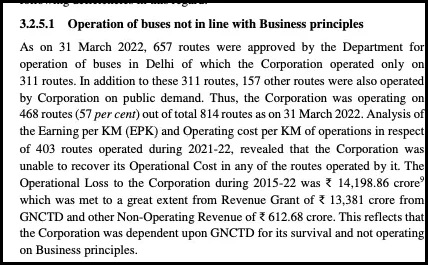
The report also said that the number of old buses in the fleet had risen to 44.96%, impacting vehicle productivity and increasing incidences of breakdowns. Poor route planning led to an operational loss of a whopping Rs 14,198.86 crore during the seven years audited, which was further aggravated by missed kilometres and flaws in route planning, there was a potential revenue loss of Rs 668.60 crore between 2015-22.

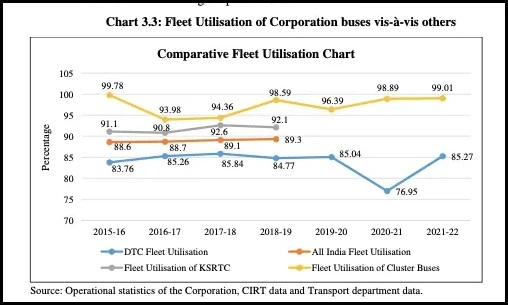
The CAG report also found that the Corporation was unable to achieve optimum utilisation of its fleet, which in turn, impacted its operational performance adversely. Between the years 2015-16 to 2018-19, the trend of fleet utilisation by the Delhi Transport Corporation was below All India Level.

Even on the Vehicle Productivity criteria, while the all India Average per bus per day was 343 KMs to 348 KMs during 2015-16 to 2018-19, for the Delhi Transport Corporation, it ranged from 180 KMs to 201 KMs during 2015-22.

“Vehicle Productivity of the Corporation was less than Vehicle Productivity of other Metropolitan Cities having a higher percentage of over-aged fleet viz. Metropolitan Transport Corporation (MTC) (Chennai) Limited (252 to 287 per bus/KM/day) or Bengaluru Metropolitan Transport Corporation (200.4 to 208.5 per bus/KM/day), although these Corporations were operating in similar crowded city road conditions,” the CAG report reads.

There were about 41 fire incidents during the 7-year observation period ending in March 2022, of these, 6 buses were set ablaze by mobs and records regarding 5 others were unavailable with DTC. The 30 bus fire incidents happened due to short circuits, High Tension (HT) lead burnt due to engine overheating, wheel overheating, HT cable /lead loose, wheel jam, lapse in maintenance by AMC, etc. The CAG report said that this indicates poor maintenance by contractors and the ineffectiveness of the measures undertaken by the DTC to prevent such incidents.

DTC under AAP government failed to chalk out short and long-term plans, didn’t sign the Planning Department-recommended MoU

The CAG report says that to ensure the provision of an efficient, adequate and economical transport service to the people of Delhi, DTC should have prepared Long Term and Short-Term Plans. The Corporation prepares operational plan which involves determination of routes to be operated, number of trips to be scheduled, setting of annual operational targets and preparation of schedule for off-shedding buses at different times of the day etc.

“However, it has prepared neither any Business Plan containing a formal statement of its goals and determining targets of operational and financial parameters to achieve the goals, nor a Perspective Plan i.e. a blue print regarding the objectives and targets for long term growth during the period of seven years ending March 2022,” the CAG report on DTC states adding that since there was no proper plan, the Corporation’s efforts to achieve its goals were “directionless and un-coordinated”.

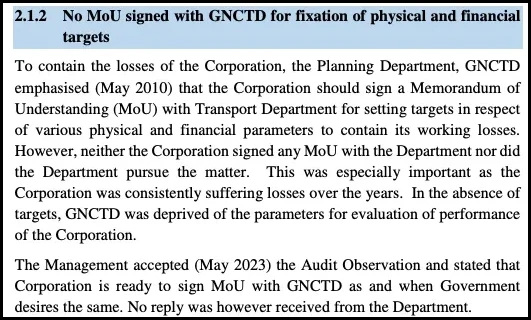
Back in 2010, the Planning Department stressed that the Delhi Transport Corporation should sign a Memorandum of Understanding (MoU) with Transport Department for setting targets in respect of various physical and financial parameters to contain its working losses. The Planning Department said that doing so would help the corporation curb losses.

“However, neither the Corporation signed any MoU with the Department nor did the Department pursue the matter. This was especially important as the Corporation was consistently suffering losses over the years. In the absence of targets, GNCTD was deprived of the parameters for evaluation of performance of the Corporation,” the CAG report reads.

The report mentions that the Corporation made no efforts to conduct any study on profitability/sustainability to make necessary improvements in its operations to increase economy and efficiency even though it was incurring continuous losses over the years.

The CAG report further states that DTC failed to utilise the expertise of Delhi Integrated Multi-Modal Transit System Ltd. (DIMTS) which also operates Cluster buses, to enhance its financial and operational performances. DTC’s nonchalance came despite the fact that DIMTS performed way better than the DTC on the basis of certain performance indicators such as  fleet utilisation, vehicle productivity, load factor and reduced breakdown. The DTC also failed to conduct a comparative analysis.

In response to CAG’s query, the Corporation said that financial performance of DTC and DIMTS was not comparable in May 2023 due to huge Permanent and Contractual staff and payment of Ground Rent and Property Tax of the Depots which were used by DIMTS as well for its Cluster buses without any cost.

The CAG report, however, pointed out that the DTC management failed to justify poor operational performance despite having huge permanent and contractual staff at its disposal.

The report reiterated its DTC-GNCTD MoU recommendation and emphasised that the Corporation must chalk out short and long-term plans.

The CAG report also observed that the Delhi Transport Corporation did not benchmark its performance with parameters of other State Road Transport Undertakings (SRTUs) to determine areas which call for improvements. It also did not follow the best practices of other SRTUs like Call Centres for obtaining Passenger Feedback like other states.

From a profitable entity to perpetual loss maker: The fall and the fall of DTC under AAP government

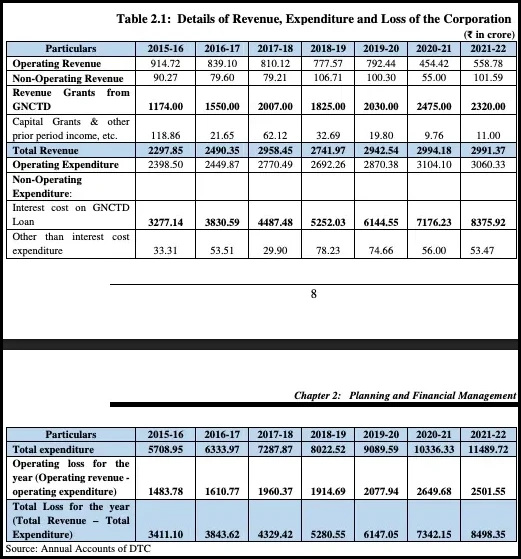
Data indicates that the DTC was profitable, but under AAP, the corporation’s overall losses surged to ₹ 8,498.33 crore, increasing by ₹5,000 crore during AAP’s tenure. A closer look at the revenue decline indicates that DTC’s operating income dropped from ₹ 914 crore when AAP took power to ₹ 558 crore.  

The CAG audit found that revenue from operations had slumped over the years even if the Covid years are overlooked,  an increasing trend of operating loss as operating expenditure was always on the higher side corresponding to operating revenue which made the Corporation dependent heavily upon the financial support—revenue grant— from GNCTD.

Moreover, during the period 2015-22, the total operating revenue of ₹ 5147.15 crore was less than total operating expenditure of ₹19345.93 crore. “However, revenue grant received by the Corporation from GNCTD during the above period was only ₹ 13,381 crore, thereby revenue gap was accumulated to ₹ 817.78 crore,” the report reads.

Detailing the financial ratios, the CAG report said that 43.36 per cent of Debtors were more than three years old and their realisation was “doubtful”.

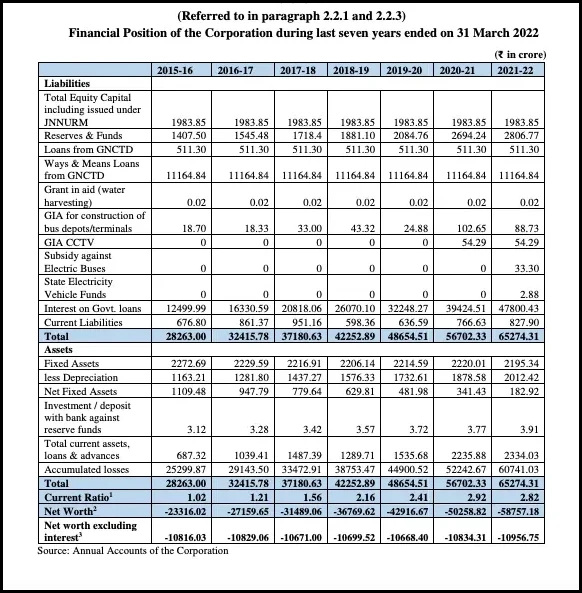
“Although, prima-facie, the Current Assets of the Corporation seems to comfortably cover the Short-Term Liabilities (as the Current Ratio has improved to 2.92 in 2020-21), however, Current Assets include Debtors and Advances (54.40 per cent in 2021-22) which were blocked up (mainly because of deposit with court and unrealised debtors),” the report reads.

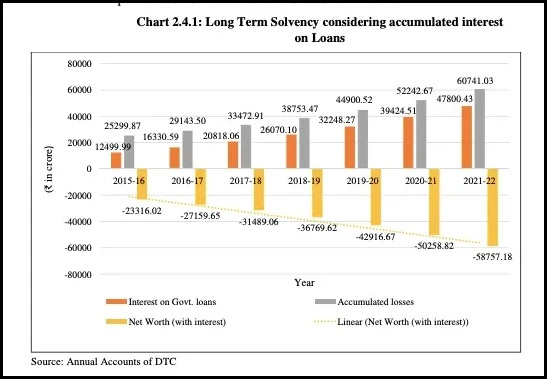
It further stated that from the years 2015-16 to 2021-22,  the DTC’s net worth was negative and increased from (-) ₹23,316.02 crore (2015-16) to (-) ₹58,757.18 crore (2021-22) due to huge accumulated losses. Thus, as on 31st March 2022, the DTC was not able to pay off its huge liabilities amounting to ₹60,483.69 crore.

Highlighting the reason behind this erosion, the CAG report said the Corporation’s revenues were not sufficient to service its operational expenditure. This resulted in an accumulation of losses to ₹60,741.03 crore as of 31st March 2022.

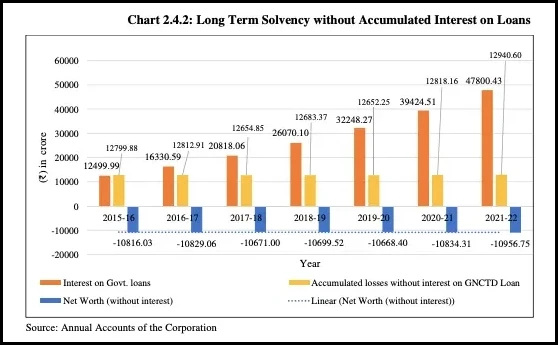
Even if the accrued interest on the unpaid (since 2011-12) GNCTD loans is excluded from accumulated losses, the DTC’s net worth stayed s constant with minor change from (-) ₹ 10,816 crore (2015-16) to (-) ₹ 10,956.75 crore (2021-22) mainly due to old accumulated losses.

“Thus, overall financial position and working results of the Corporation raise a serious concern about its Long-Term Solvency and Fiscal sustainability due to persistent Operational Losses and old accumulated losses,” the CAG report states.

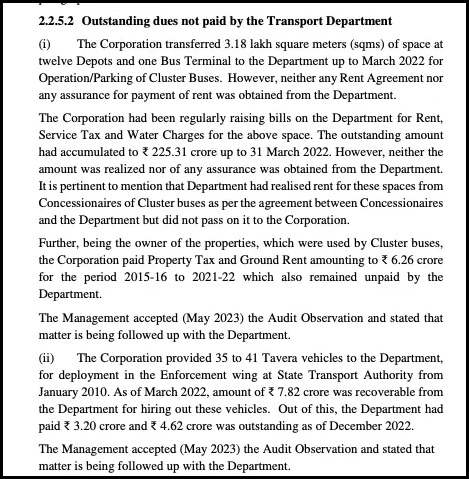
In an apparent case of financial irregularities, the AAP government allotted 3.18 lakh square meters of DTC land to private cluster buses without collecting ₹ 225.31 crore in rent.

The AAP government failed to procure new buses despite having ₹223 crore in 2022 for the Delhi Transport Department.

“Neither the amount was realized nor of any assurance was obtained from the Department. It is pertinent to mention that Department had realised rent for these spaces from Concessionaires of Cluster buses as per the agreement between Concessionaires and the Department but did not pass on it to the Corporation,” the CAG report states.

The CAG report also mentions that back in 2012, the Delhi government directed the DTC that the construction and maintenance of all Bus Queue Shelters (BQSs) in NCT of Delhi would be carried out by Delhi Transport Infrastructure Development Corporation Limited (DTIDCL).

Consequently, the DTC transferred 884 BQSs to DTIDCL by 2015-16. However, the order was made no mention regarding payment to be made by DTIDCL against the cost of these BQS.

In August 2015, the Corporation demanded ₹ 21.29 crore against the cost of construction and Project Management Consultancy (PMC) charges of 156 BQSs on DTIDCL which was not paid as of December 2022.

As per the CAG report, however, it was observed that the Corporation raised a claim for the original cost of construction of BQS instead of the depreciated value of ₹ 7.33 crore on the date of

transfer. The Corporation instead of escalating the matter with the Department for resolving with DTIDCL keeps on corresponding with DTIDCL. Due to this, over the years, the matter has remained unresolved.

The CAG report also mentions that the DTC made an “avoidable expenditure” of ₹16.51 as it failed to transfer an arbitration case to DTIDCL.  

DTC missed opportunities to earn revenue from additional sources

Since DTC was continuously incurring losses, it should have prioritised augmenting revenues from sources other than operations, however, the Corporation failed to earn additional revenue through advertisements, and commercial utilisation of spaces at depots, among other sources.

The report mentions that the DTC failed to finalise a proposal for installation of LED screens in its buses which would have been used to display advertisements. The Corporation’s indecisiveness deprived it from tapping additional non-operational revenue. The DTC under AAP government also failed to make commercial use of bus depots.

It also mentions that the DTC missed an opportunity of availing ₹49 crore subsidy from the Central government’s Department of Heavy Industries under the FAME (Faster Adoption and Manufacturing of (Hybrid &) Electric Vehicles) Scheme launched in April 2015. In 2017, the Corporation submitted a proposal for the procurement of 100 Electric Buses to the Centre, against which the Centre approved 40 e-buses for Delhi. The DTC failed to go ahead with the 40 e-bus deal worth ₹ 88 crores of which ₹ 34 crores was to be provided by DHI as an incentive and ₹ 54 crore by GNCTD as equity to the Corporation, despite the Centre extending the FAME Scheme.

Detailing how the DTC missed the central subsidy, the CAG report states, “The Corporation intimated the Department (9 January 2018) that it would not be feasible for it to place LOI by 28 February 2018 and as per its past experience, it would be able to place order by July 2018. It also informed that project for purchasing 40 E- buses would involve estimated expenditure of ₹ 88 crore (₹ 34 crore to be provided by DHI as incentive and ₹ 54 crore by GNCTD as equity to Corporation) besides involvement of expenditure on creating charging infrastructure in Depots. The Corporation decided not to go ahead with the sanctioned project though the FAME scheme was extended by GoI from time to time up to March 2019.

“Thus, in spite of sanction of 40 E-buses for Delhi under FAME-I scheme and extension of the scheme from time to time till 31 March 2019, the Corporation did not procure 40 E-buses and lost the opportunity to avail the Central Subsidy of ₹ 49 crore under FAME scheme (₹ 34 crore towards cost of electric buses and ₹ 15 crore towards creation of charging infrastructure),” it adds.

The report also describes how the DTC failed to procure electric buses due to a delay in finalising bids for the FAME-II Scheme.

DTC wrongfully availed Input Tax Credit

In around 2017-18, the Delhi Transport Corporation availed Input Tax Credit to the tune of ₹224.34 crore on earnings of AC/Non-AC/Hiring of buses and common services against eligibility for ₹ 39.41 crore.   

“Out of the total ineligible ITC claimed/availed of ₹ 184.93 crore, claims of ₹ 132.33 crore were withdrawn (₹ 55 crore on September 2021, ₹ 24.73 crore in October 2021 and ₹ 52.60 crore in August 2022) and ₹ 38.47 crore was paid in April 2022. In May 2022, GST Department directed the Corporation to pay the balance ITC availed of ₹ 14.13 crore and also levied Interest and Penalty of ₹ 82.18 crore (Interest of ₹ 56.56 crore and Penalty of ₹ 25.62 crore) for wrongly availing of ineligible ITC,” the CAG report reads.

“Thus, availing ineligible ITC by the Corporation resulted in avoidable liability of Interest and Penalty amounting to ₹ 82.18 crore which was not paid so far (December 2022) and the matter was pending with the GST Department,” it adds.

Fare freeze increased the financial burden

The CAG report states that DTC had not raised bus fares since 2009 and despite repeated requests to allow an increase in fares, the governments over the years remained reluctant. What further exacerbated the situation was the Aam Aadmi Party’s free travel for women scheme. The Delhi government provided ₹13,381 crore revenue grant to DTC, but there still remained a ₹818 crore funding gap.

The DTC also failed to modernise fare collection system. In this direction, a project was initiated 9 years ago, however, the Corporation failed to implement an automatic fare collection system. Besides, the Corporation also fell short in installing CCTV surveillance systems meant to ensure increased customer security even those installed were found not functioning.

Overall, the CAG audit found that the DTC’s Internal control mechanism was deficient and there were inefficient managerial controls in addition to a lack of accountability. “Audit noticed indecisiveness in finalising the tenders for purchase of new buses, weak operational control, lack of coordination amongst divisions, lack of follow up with debtors, delay in statutory compliances, etc., leading to losses to the Corporation,” the CAG report stated.