Since the Citizenship Amendment Act has come into effect, there has been a sudden spike in the number of Afghan Muslims and Rohingya Muslims, who are illegal immigrants in India, wanting to convert to Christianity so as to become eligible for Indian citizenship.
According to a report by The Economic Times, the central agencies, aware of this development, have apprised the government that almost 25 such cases of Afghan Muslims converting to Christianity has come to the fore.
Adib Ahmed Maxwell, who heads an Afghan church in south Delhi, told ET: “Post CAA, there has been a spurt in the number of Afghan Muslims wanting to convert to Christianity.
CAA does not provide to accept Rohingya Muslims as India citizens
It is pertinent to note here, that the historic Citizenship Amendment Act (CAA) which came into force from January 10, 2020, seeks to provide Indian Citizenship to the persecuted minorities belonging to six non-Muslim communities, namely Hindus, Sikhs, Buddhists, Jains, Parsis and Christians from Afghanistan, Bangladesh and Pakistan. Since Rohingyas are illegal immigrants who have unduly entered the Indian soil through Bangladesh, the Indian government has refused to accept them and give them Indian citizenship. As such, India is not bound even by international norms to accept Rohingyas.
During the Citizenship Amendment Bill (now an act) debate in December last year, Home Minister Amit Shah had categorically refused to accept Rohingyas in the country. He had clearly pointed out that India has not ratified any international convention on refugees and as such, international laws on refugees were not binding upon India as a sovereign country.
India not bound to accept Rohingya Muslims
India is not a party to the 1951 Convention on Refugees and neither the 1967 Protocol. Therefore, no international convention is binding on India. Even if we take into account the international conventions, the Rohingyas are clearly bypassing a safe haven in the form of Bangladesh to reach India for the purpose of gaining material benefits. Thus, quite clearly, it makes them economic migrants when they enter India and not persecuted minorities.
Afghan Muslims and Rohingyas continue to illegally live in India
Since these illegal immigrants are aware that they will not be granted Indian citizenship, they are now deviously adopting Christianity. According to official data, there are 150,000-160,000 Afghan Muslims living in Delhi. Besides, official estimates suggest there are nearly 40,000 Rohingya Muslims illegally living across India, with the highest number in Jammu and Kashmir. A large number of these migrants have been residing in India prior to 2012 and are now claiming to be from Bangladesh while taking up Christianity.
A few days ago, an incident came into light in which a woman was molested outside Shiv Temple in Jialgora, Jodapokhar of Dhanbad in Jharkhand. As per the reports, the incident took place on 20th July 2020. A few men of the particular community eve teased the woman who was going to the Shiv Temple. When the woman objected, they started beating her.
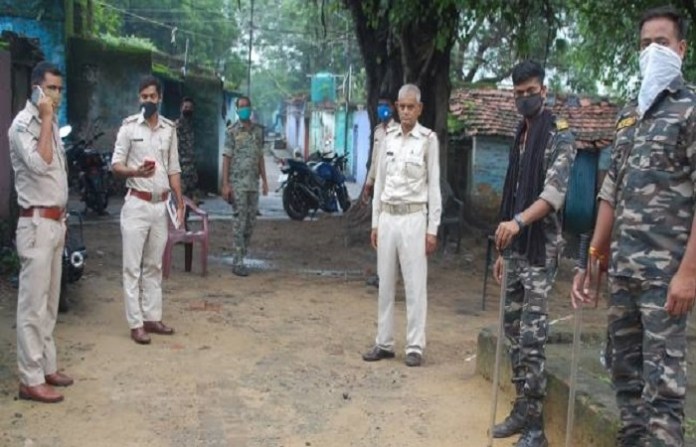
The woman got severely injured in the incident. The area got tense as the victim and attackers were from different communities. The locals and family members of the woman informed Jodapokhar police about the incident. A heavy police force was immediately deployed in the area to control the situation. DSP A.K. Sinha also reached the location to learn more about the incident.
FIR registered against eight molesters
Based on news agency reports, police have filed a case against Saddam Ansari, Riyaz, Naseeruddin, Mintu Ansari, Shahadat, Shahil, Kaif, SHehbat and son of Moinuddin. So far, police have apprehended four of them. When OpIndia contacted Jodapokhar police station, they informed that eight people had been named as accused in the case. They only have Saddam in custody, and police teams are raiding different locations to find rest of them. Saddam was sent to jail yesterday.
Dainik Jagran reported that Satyam Kumar, station in-charge reached the location and found the injured woman. He sent her to the Chasnala hospital for treatment. People from both communities started hurling stones and lathis at each other. Several people got injured, and the area got tense.
Counter case by mother of one of the molesters
Anu Parveen, the mother of Saddam, has filed a counter-case in the police station. She said in her complaint that her son was playing PUBG with his friends outside the temple when some men started harassing them. When her son and his friends asked them to stop, they threatened the boys with knives. They also threatened to burn them alive. She named Rajkumar Sao, Raju Sao, Amarjeet Sao, Sunil Sao and others. However, when OpIndia contacted the police about the counter case, they refused to have any knowledge about it.
Police have also recorded the statement of victim Geeta Devi in the case. There is a considerable difference between the narration given by Geeta Devi and Saddam’s mother about the incident. The victim said that she was going to Shiv Temple for pooja on Monday evening. A group of young men from a particular community were sitting under a Peepal tree. On noticing her, they started making sexist slurs and tried to molest her. When she protested, they started beating her with sticks. Doctors said that she has severe injuries on her head and back. She is currently admitted in PMCH for treatment.
The 27-year-old unemployed man in Chhattisgarh, who had attempted to self-immolate in front of the official residence of Chhattisgarh Chief Minister Bhupesh Baghel on 29th June, succumbed to his injuries on the night of Tuesday. The youth had incurred 50 per cent burn injuries and was being treated in a private hospital in Raipur.
Chhattisgarh: A man, who sustained burn injuries after attempting self-immolation in front of CM residence on June 29, passed away last night, say Raipur Police
Hardev Sinha, a native of Dhamtari district, fed up of his poverty and unemployment, had wanted to meet the CM to seek help, but the security personnel prevented him from entering without an appointment. Taking everyone by a surprise, he had set himself on fire. The father of the youth had said that he had been feeding his son’s wife and his children for a very long time. He added, “He didn’t have any food yesterday night, nor today morning.” He had left the house on Monday morning and the family had no information about him until noon.
After the news of his death came in, BJP national vice-president and three-term Chhattisgarh CM, Raman Singh, slammed the Bhupesh Baghel led Congress Government in the state.
Highlighting the helpless and desperation amongst the youths in the Congress-ruled state, the BJP leader Tweeted: ” कांग्रेस की कुनीति, कुशासन और कुप्रबंधन ने आज प्रदेश के एक युवक की हत्या कर दी। आत्मदाह करने वाले प्रदेश के युवक को @bhupeshbaghel सरकार ‘मानसिक’ बीमार कहकर जख्मों पर नमक छिड़कती रही।” roughly translated as, “the misrule, mismanagement and the poor policy of the Congress have murdered the youth of the state … Bhupesh Baghel government continued to sprinkle salt on the wounds by calling the youth mentally-ill.” He sought a reply from Congress senior leader Rahul Gandhi, asking who should be held accountable for Hardev Sinha’s death.
Congress government declared the youth “mentally unstable”
It is pertinent to note that after the incident, the Congress Government in Chhattisgarh was quick to declare the youth mentally unstable, a claim which his wife had vehemently refuted.
On June 29, the day the youth had set himself ablaze, the state public relations department had claimed that he was mentally unstable for the past two years. The department had said that the youth possessed two acres of land and a job card under the Mahatma Gandhi National Rural Employment Guarantee Act (MGNREGA), 2005, scheme. They furthered that Hardev Sinha had worked for 11 days under the scheme and then left saying that he wanted to make a youtube video.
Hardev Sinha’s wife strongly opposed the Congress government’s claims. “We are suffering from an acute financial crisis due to which my husband was very worried. He is not mentally unstable,” she had told local media persons in Dhamtari on June 29. The youth, according to his father, was unemployed and living with his family without any food at home.
The state government has ordered a magisterial probe into the case.
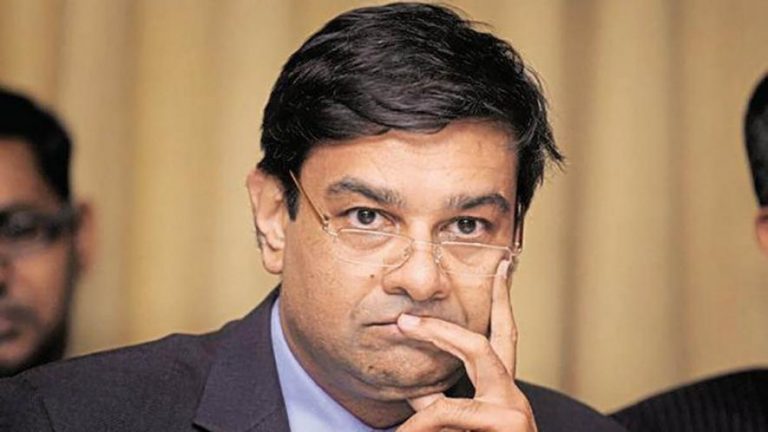
Former Reserve Bank of India Governor Urjit Patel in his book ‘Overdraft – Saving The Indian Saver’ which releases on July 24, has launched a scathing on the UPA government for the non-performing assets crisis at public sector banks (PSBs) stating that they failed to create risk controls or ensuring adequate management.
In his new book the former RBI Governor Urjit Patel writes, “The government is responsible for ensuring adequate capital for banks that are under its ambit on a durable/sustainable basis. The dominant owner pre-2014 didn’t question risk controls in government banks even as it received significant dividends. A number of government banks did not have senior management in place, and governance suffered”.
The former RBI governor in his yet-to-be-released book writes that several government banks did not have senior management in place, and governance suffered. This is a perennial shortcoming on account of bureaucratic inertia and political meddling, he noted.
Urjit Patel, who was appointed as the RBI governor in 2016, had faced with a tremendous challenge of rising NPAs in the banking system, especially in the Public sector banks. The gross NPAs stood at 3.8 per cent in FY14 before rising every year to peak at 10.5 per cent in FY18.
Urjit Patel also questions RBI
In the book, Patel has also questioned the RBI’s failure in identifying bad loans before 2014. “The RBI failed to challenge assumptions through, for example, more rigorous stress-test scenarios at the bank level, as well as sensitivity analysis on (demand) assumptions, and sector (policy) risks,” Patel writes in the book.
The book reads, “The regulator fell short on several counts in the period leading up to 2014. It failed to challenge assumptions through, for example, more rigorous stress-test scenarios at bank level, as well as sensitivity analysis on (demand) assumptions, and sector (policy) risks. The scale of exposure – or risk build-up – was not appreciated enough and contested by the regulator to effectively slow down or tighten the lending norms, say, by increasing sector risk weights to ensure protection by increasing capital requirements.”
He writes, “Had the central bank identified the build-up of risks, it could have tightened lending norms by, for instance, increasing risk weights allotted to various sectors.”
In his new book, Patel writes about the ‘9R’ strategy which would have saved public savings, rescued the banks and protected them from unscrupulous racketeers. The note on the publisher’s website also says “Urjit Patel would have cleared the NPA mess if he hadn’t been prevented” but does not elaborate.
Patel quit on December 11, 2018, midway as the RBI Governor, citing personal reasons. He was recently appointed as Chairman of the National Institute of Public Finance and Policy (NIPFP).
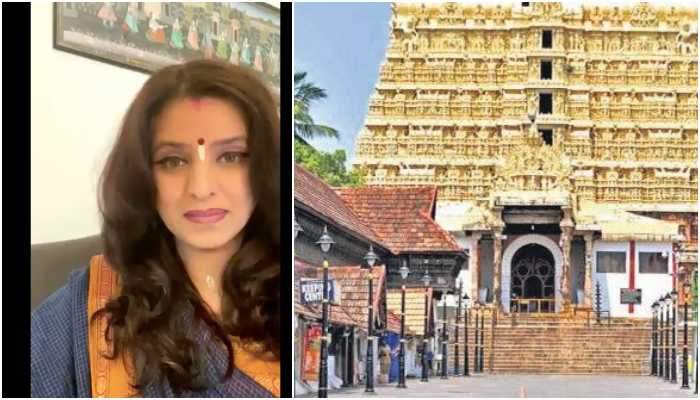
Recently, in a significant decision, the Supreme Court of India had reverted a Kerala High Court decision and upheld the rights of the Travancore royal family as the guardians of the Sri Padmanabhaswamy Temple in Thiruvananthapuram, Kerala.
Following the historic verdict, the temple has been in the headline, partially due to the fact that the Kerala government’s attempts to take over the temple have been thwarted, and secondly, because the temple has the distinction of being the world’s richest temple and usually it’s ‘hidden treasures’ are the centre of much speculations and social media gossip.
Shilpa Nair’s photo circulated as ‘owner of Padmanabhaswamy temple’
Shilpa Nair, the president of ‘People for Dharma’, a Hindu organisation that has been involved in creating awareness and seeking legal remedies for the protection of temples from state interference and political exploitation, had shared some screenshots where a video of her has been circulated claiming that she is the ‘owner’ of the Padmanabhaswamy temple.
The WhatsApp forwards also claimed that the woman in the video, (Shilpa Nair), has become the world’s richest person following the SC verdict.
What kind of practical joke is this ?
Kindly note, Im none of the description mentioned in the images below. Other than being a devotee at the lotus feet of Lord Padmanabha, Im only President of People For Dharma, who were intervenors of the case. Nothing more and Nothing less pic.twitter.com/xmXIWasow9
In the WhatsApp forwards, a video that Shilpa herself had shared after the verdict was used and the claim was made that she is the ‘owner’ of the temple who is now the ‘world’s richest person’.
In her tweet, Shilpa Nair objected to the claims made and clarified that she is not what the forwards claim. She added that she is the president of ‘People For Dharma’, the organisation that was a part of the legal battle for the Padnabhswamy temple and the restoration of the Travancore royal family’s rightful control over the temple management.
She said that she is just a devotee of Lord Padmanabhaswamy.
The original video
The original video where Shilpa is seen welcoming the verdict and thanking their lawyers J Saideepak and Suvidutt Sundaram for their efforts in the long legal battle for the rights of one of the most important Hindu shrines in India.
Thankyou Honourable Supreme Court of India and Justices Shri UU Lalit and Smt Indu Malhotra ???
Thanking the SC judges, Nair had hailed the verdict as a victory for Dharma.
It is notable here that Shilpa Nair is a Dubai-based entrepreneur and artist who is the president of the People For Dharma initiative. The organisation had also fought to uphold the traditional practices in the Sabarimala Temple last year. She is not a member of the Travancore royal family, who are the traditional custodians of the Padmanabhaswamy Temple.
Travancore royal family and Padmanabhaswamy Temple
In its verdict on 13 July, the Supreme Court overturned the 2011 judgment of Kerala High Court that granted the power to the state government to take control of the temple, its management and assets. The SC also stated that all members of the temple management committee will be Hindus.
The historic temple is managed by the Travancore Royal family that had ruled Southern Kerala and parts of Tamil Nadu. Lord Padmanabha (Vishnu) is the family deity of the Royal family. The Lord Padmanabha is also hailed as the ruler of the Travancore kingdom and the royal family is considered as his royal servants.
Even after India’s independence, they managed the temple under a trust. On 31st January 2011, Kerala High Court had ruled that the state government will control the temple administration. The court had asked the state government to form a trust and take control of the temple within three months. The temple is home to vast amounts of treasure, ancient jewellery and artefacts, donated by the royal family, ancient Chera, Pandya, Chola kings and crores of Hindu devotees over the centuries.
The Royal family had challenged the 2011 High Court orders in the Supreme Court. In September 2011, the Supreme Court had asked the government of Kerala not to open the Kellaras(vaults) till they pass final judgment.
With the recent verdict, the traditional rights of the Travancore royal family over their temple have been restored, keeping the temple and its treasures away from the grasp of Kerala’s communist government.
It is also notable here that the Travancore royal family has been the traditional custodians of the temple. They have been managing the temple administration through a trust and the court verdict by no way means that the temple, or its treasure become the private properties of the royal family.
Pakistanis sitting in comfort of a foreign land encouraging and pushing Kashmiri youth to pick up guns and even sometimes funding such nefarious activities is not new. However, some of the Bollywood celebrities seem to have developed a habit of fraternising with individuals who are known to harbour unmitigated hatred for India. From fawning themselves with the D-company chief Dawood Ibrahim—to socialising with Pakistan’s terror establishment, the Bollywood celebrities have often shown that patriotism is a hollow concept for them, worthy only of making money from it by emulating it in their movies.
A multitude of Indian Bollywood celebrities has been hobnobbing with Pakistani businessmen, lobbyist over decades now. From cosying up with these individuals, who are believed to be planted by Pakistan’s spy agency ISI to signing commercial deals with these notorious men, the Bollywood celebrities have enjoyed their ties with the anti-India establishment.
The warm relationship between ISI agents and the so-called Bollywood celebrities is not a secret anymore as images of actors and cinema icons with Pakistani businessmen close to Pakistan establishment were all over on the internet on Wednesday, raising serious questions regarding the Bollywood directs links with Pakistan.
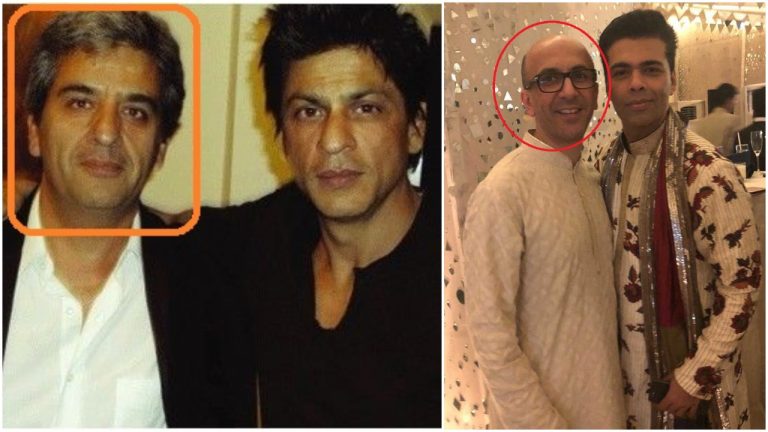
On Wednesday, netizens unearthed images of Shahrukh Khan and his wife Gauri Khan with California based Kashmiri separatist Tony Ashai, who has been urging Kashmiri youth to fight against India.
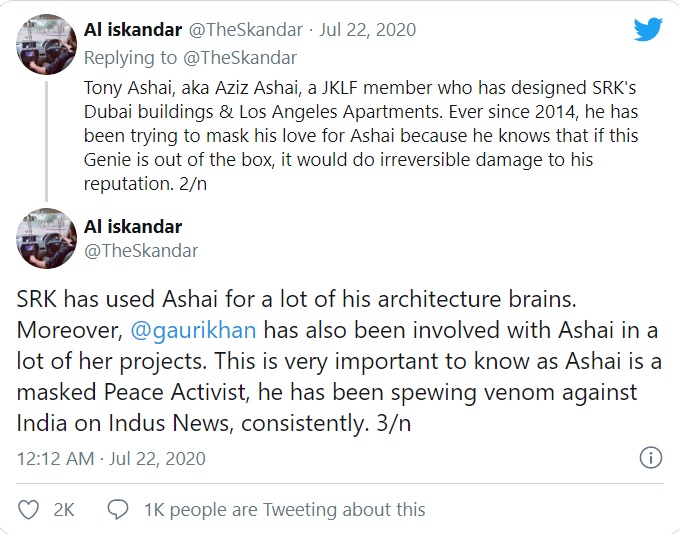
It is alleged that Shah Rukh Khan has a very close relationship with Tony Ashai. Ashai is believed to have built a lot of his properties in Dubai, Abu Dhabi and also designed his apartments in Los Angeles. His son Bilal Ashai has been urging the Kashmiri youth to pick up guns.
A Srinagar-based activist Al Iskandar @TheSkandar on Twitter posted a series of tweets alleging that Tony Ashai, also known as Aziz Ashai, has been a member of the terror group Jammu & Kashmir Liberation Front (JKLF) sponsored by ISI. The Bollywood superstar, according to him, had hired Ashai as an architect. Khan’s wife Gauri, he claimed is involved with Ashai in a lot of her projects.
Image Source: Al Iskandar
The Kashmiri-based activist said that “it’s a well-documented plan” for Tony Ashai to use his Bollywood influence. He said, Bollywood actor Shah Rukh Khan is a patriotic person himself but is not aware of Tony Ashai’s plans.
Reportedly, Tony Ashai, also known as Aziz Azai, studied at University in Buffalo, US, which was funded by pro-Pakistan terror outfit JKLF. Moreover the first business venture of Ashai – ‘Ashai Design’ was also funded by JKLF, he tweeted.
It is alleged that $450k came from a shell company in Birmingham in autumn of 1992. Tony’s son Bilal Ashai is a member of MSA which has links to The Muslim Brotherhood, the social media user alleged.
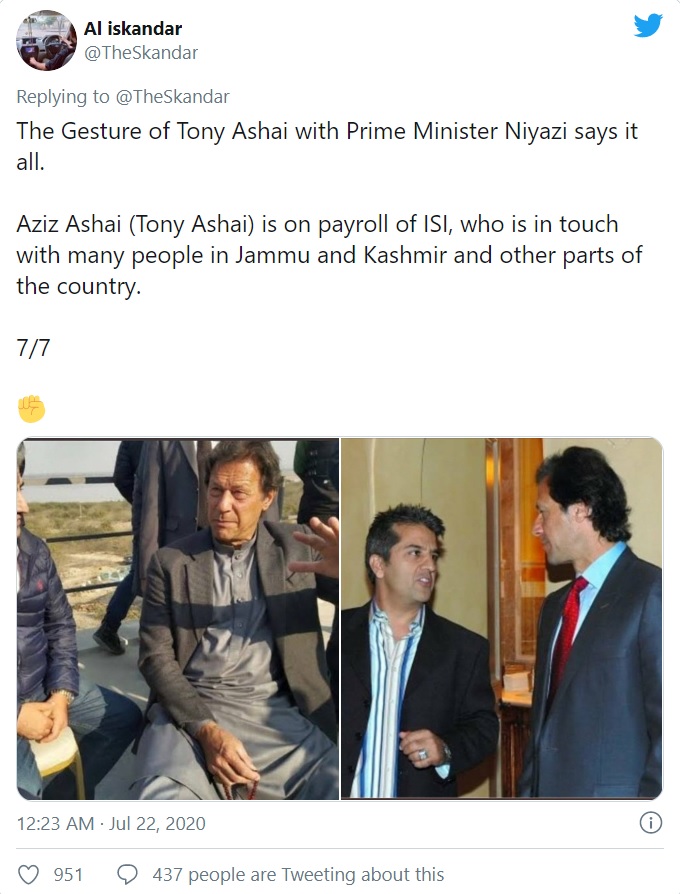
Citing Ashai’s pictures with Pakistan Prime Minister Imran Khan, Al Iskandar alleged that Ashai was on the payroll of ISI, who is in touch with many people in Jammu and Kashmir and other parts of the country.
The social media user also posted Ashai’s incendiary anti-India tweets, to take a dig at Ashai saying he himself was sitting in the cosy rooms of California and provoking Kashmiri youth to pick up stones and guns while his own son Bilal Ashai recently graduated from Los Angeles, the University of Southern California with Masters degree.
Image Source: Al Iskandar
Tony Ashai’s brother Arthur Ashai is no less of an India hater. In a video that has gone viral on social media, Arthur can be seen bullying an Indian for supporting PM Modi.
Arthur Ashai, who bullies Indians who supports Narendra Modi.
He was upset that the Indian man said “Modi Zindabad” on his face and accused him of ‘discriminating’ against people of Kashmir. He bullied him to apologise and asked him whether he will say ‘Modi zindabad’ again.
Not just Bollywood’s intimate relationship with Tony Ashai, social media users dug out several pictures of other stars like Anil Kapoor, Sonam Kapoor, Karan Johar and others with another anti-India activist based in the UK. The netizens pointed out how another Pakistani businessman Aneel Mussarat, also enjoys good relationships with various Indian celebrities.
Aneel Mussarat is believed to be an important aide to Pakistani PM Imran Khan and enjoys close relations with the Pakistani military establishment. Whether it is Shah Rukh Khan or Karan Johar, Sonam Kapoor or her father Anil Kapoor, Deepika Padukone or her husband Ranveer Singh, all these Bollywood luminaries have been found revelling in the company of Mussarat.
A Twitter thread from January went viral on Wednesday
THE Bollywood ~ PAKISTAN connection??! Thread Who is this Individual who is seen with Numerous Bollywood Stars??
Name : Aneel Mussarat ~ A British Paki Businessman ~ A Real estate barron ~ Friends of PTI / Imran khan / Bajwa / Ghafoor / Sheikh Rashid ~Close to Bollywood stars pic.twitter.com/bK5RjolGgH
Aneel Mussarat, a British born Pakistani origin businessman and a real estate baron, not only shares a close relationship with a legion of Bollywood personalities but he also has an intimate association with the Pakistan PM Imran Khan, his political party PTI, Chief of Army Staff of Pakistan Army–General Bajwa, General Director of the Inter-Services Public Relations–Asif Ghafoor.
Mussarat has also been vocal in his support for the Rohingya refugees, considered as a “threat to national security” by the government of India. A large number of unaccountable number of Rohingyas have intruded in India through the porous borders it shares with Bangladesh. Mussarat heads the Rafay Mussarat foundation which has partnered with Minhaj Welfare Foundation to provide aid toRohingya refugees during the Rohingya crisis.
However, what is curious is the close connection that Mussarat has with the current Pakistani Prime Minister Imran Khan, who has made it his ritual to diss about the Indian PM Modi.
Pakistani media refers to him as a close aide of PM Imran Khan. In November 2019, during the inauguration of Kartarpur Sahib Gurudwara, he tried to get close to former Indian Prime Minister Dr Manmohan Singh, but was pushed away by security when he tried to take a selfie.
In 2017, Khan, who was not the Prime Minister of Pakistan then, along with various Bollywood celebs attended Mussarat’s daughter’s wedding in London.
Bollywood’s links with Rehan Siddiqui
Rehan Siddique, who is a Pakistani but is based on Houston also owns a radio channel where he regularly espouses terrorist activity in Kashmir and India and spreads propaganda. Rehan Siddiqui had extensive experience in the music and radio industry and said to have organised more than 400 successful concerts with many of the biggest stars from South Asia and Bollywood.
Rehan Siddiqui has been organising Bollywood events and funding anti-India propaganda, especially against Kashmir. In February, it was reported that Rehan Siddique was on the radar of Indian authorities after it was revealed that Siddique organises Bollywood events and the money raised from it is used to fund anti-India activities abroad, especially with a focus on Kashmir.
Reportedly, he owns a radio channel and brings Indian artistes to Houston for Bollywood concerts. He uses his radio channels as a platform to run anti-India propaganda.
The Indian diaspora in the United States had staunchly opposed Siddiqui’s organised events, urging the government to dissuade the Bollywood celebrities from participating in the events organised by an ‘ISI agent’. There were demands that Bollywood celebrities should not be allowed to participate in shows.
The diaspora have also asserted that Siddiqui and other Pakistani nationals are working to organise anti-CAA protests in Houston and pro-Khalistan protests by the local Sikh community. Siddiqui’s radio channel is also accused of running anti-India propaganda in the wake of Pulwama attack and the subsequent Balakot strikes.
Calls for investigations into Bollywood links with Pakistan grows
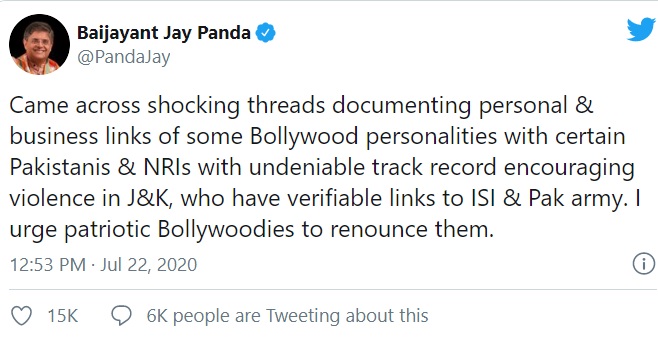
Following the shocking disclosure, Vice President of the BJP, Baijayant Panda urged “patriotic Bollywoodies” to renounce their association with people who encourage violence in Jammu and Kashmir.
Taking to Twitter, Baijayant Panda said, “Came across shocking threads documenting personal & business links of some Bollywood personalities with certain Pakistanis & NRIs with undeniable track record encouraging violence in J&K, who have verifiable links to ISI & Pak army. I urge patriotic Bollywoodies to renounce them.”
Several social media users have now called the government to call for further investigation to unearth the links between the Bollywood superstars and Pakistan.
Shantaram Budna Siddi, who lives in Hitlalli village of Yallapur in Uttara Kannada district, became the first Siddi tribe member to be nominated for the Karnataka Legislative Council. The state government has nominated five persons to the Council on Wednesday including Shantaram. In his statement to The Hindu, he said that till now he could do whatever little help he can provide to the people.
On Wednesday, Karnataka governor Vajubhai Vala appointed 5 new MLC members from the BJP and Shantaram Budna Siddi, the state secretary of Vanvasi Kalyan Ashram was one of them.
55-yr-old Shantarama Budna Siddi, nominated to K’taka council by @BJP4India, is d first ever member of d Siddi community to become a legislator.
Siddis are a tribe who trace their ancestral origin to Africa. Live in parts of Uttara Kannada & still struggle for land rights pic.twitter.com/O8sMJG4KP6
“I did not understand it fully. I thought someone might be playing a prank. I went home for lunch. It was then that my wife and I started getting calls continuously, congratulating me for the nomination,” he added while telling about the experience when he first learned about becoming an MLC.
The fascinating history of the Siddi community
Siddis is an isolated community that is spread along the coast of Gujarat, Karnataka, Andhra Pradesh and Maharashtra. Their roots trace back to Africa. They have an estimated population of 50,000 to 60,000. Most of them are practising Muslims, but many of those who live in Karnataka are Catholics. Majority of their population is concentrated in Junagarh, Gujarat.
However, some reports mention that the Siddis living in Karnataka and other parts of India had not even found out about each other till recent years, because they have been living lives of seclusion in different states, their ancestors having come from different African ports centuries ago.
Their main occupation is agriculture, but it is hard to find landowners among the community. Most of them work as labourers in the field. Their community members often migrate to metro cities for better jobs and lifestyle.
Presence of Siddis in India can be traced back as far as the 7th century. It is believed that they were first brought in by Arabs as slaves followed by Portuguese and Britishers. Many Siddis came to India as merchants, sailors and mercenaries. In later years, the community migrated to forests to avoid conflicts and lead a quiet life.
Siddis of Gujarat
The Siddis of Gujarat had come to the erstwhile princely state of Junagarh. There are some reports which say the King of Junagarh had fallen in love and married a woman from East Africa and she had brought over a 100 slaves and servants with her, who settled down with their families around the Gir forests.
Over the years, the Gujarat government has started some development programs to help the marginalised community often struggling with poverty. In 2010, the then government had started an initiative that trained the Siddi community members as eco-guides in the Gir forest region.
Unique traditions and culture, a blend of Indian and African heritage
They have unique traditions and still follow some of the cultural practices blended with Indian culture and African heritage. Their folk dance, Dhamal, is known for its unique style in which the male dancers paint their bodies and move to the drum beats. Artists who perform Dhamal are often regarded as some of the best tribal dancers in India as well as abroad. Dance moves in Dhamal resemble the folk dances of Africa.
Siddis’ history is India is hard to track mostly because of lack of interest shown by the government authorities and fellow citizens. However, some of the markers indicating their importance in history is still nurtured in the form of architecture. The beautifully carved tree-of-life latticework into the stone windows of Sidi Sayed Mosque, Ahmedabad, is one of the finest examples of their craftsmanship. The community is still struggling to get land rights and mark their presence at the higher positions in the hierarchy. The inclusion of a tribe member as MLC may bring some hope and change for the community.
A 30-year-old doctor, Tufail Ahmed, who works as a government doctor in Aligarh’s Deendayal Hospital was arrested on Wednesday on charges of molesting and trying to rape a 25-year-old girl. As per reports, the woman, a coronavirus positive patient was recovering in an isolation ward.
Dr Ahmed was booked and later arrested from a hotel where he had quarantined himself. The woman, who works in Delhi, had gone to Aligarh where she developed symptoms of coronavirus. On Monday, she was admitted to hospital where she got tested for the Chinese virus. As per the allegations, Dr Ahmed visited the woman on Tuesday night and allegedly touched her private parts under the pretext of examining her. The girl alleged that on Wednesday, he did the same.
CCTV footage revealed that the doctor went to the isolation ward without wearing the PPE gear. Dr Ahmed has been booked under section 376 (2) (d) (taking advantage of his official position and commit rape on a woman in his custody) of the IPC. The CMO (Chief Medical Officer) of the district has formed a committee to further investigate the incident.
Journalist Vikram Joshi, who was shot at by some miscreants near his residence in Ghaziabad on 20th June, died in the hospital on Wednesday morning. Vikram’s nephew had named one Kamal-ud-din’s son as the main culprit behind Vikram Joshi’s death. Earlier in the day, OpIndia, basing it on ANI’s Tweets, reported the same.
OpIndia’s report irked the liberal establishment, who took to Twitter to cast aspersions at ANI and OpIndia for selectively reporting that a Muslim was the main accused in the case. The pro-Islamist lobby hit out at OpIndia and ANI for giving a communal angle to the crime.
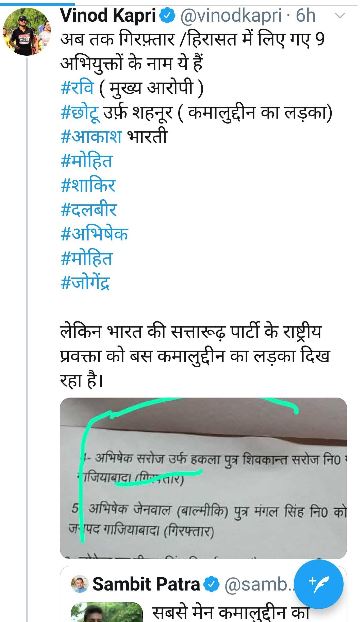
‘Journalist’ Vinod Kapri, a well-known name of the leftist gang, came forward to pursue this propaganda. Sharing BJP spokesperson Sambit Patra’s tweet, where he had shared the ANI Tweet, Kapri shared the names of the other accused and said that though there are 9 other names, the BJP spokesperson could only see Kamal-ud-din’s son’s name.
Vinod Kapri’s Tweet
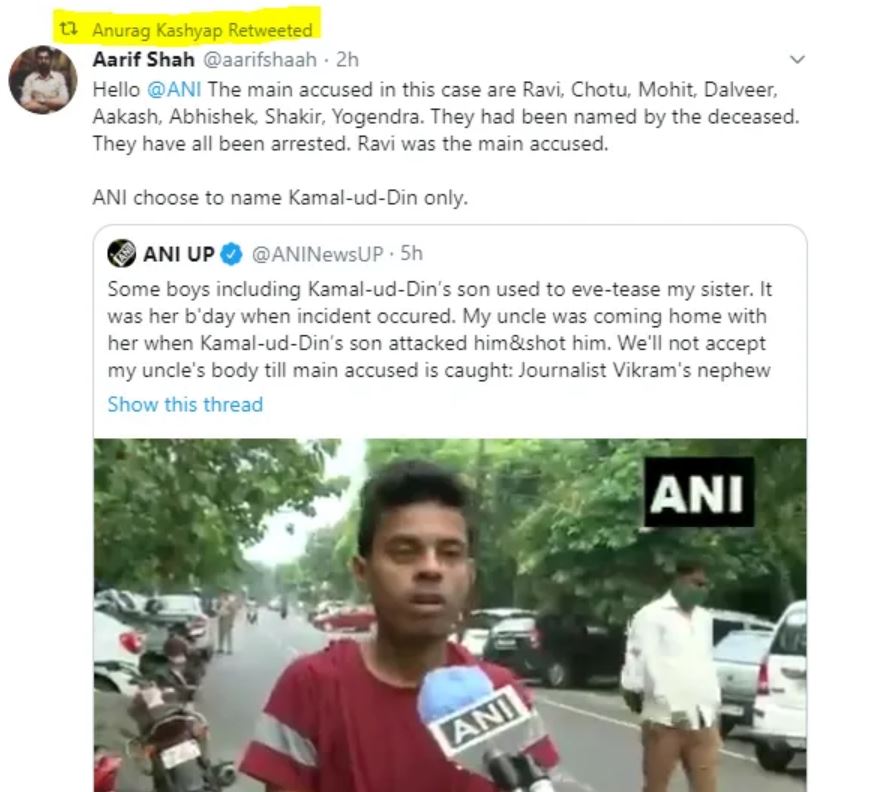
Propagandist Anurag Kashyap, who had openly expressed solidarity with the Islamists who had opposed CAA, got quite miffed seeing a Muslim being blamed for the crime. He re-tweeted a tweet by one Aarif Shah to claim that though the main accused in the case were Hindu, ANI chose to single out a Muslim to give a communal spin to the case.
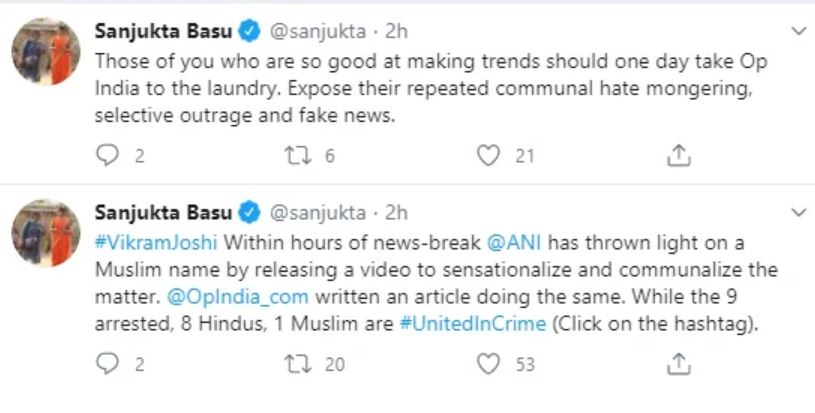
Not to forget, Sanjukta Basu, who is a very vocal Modi-hater and a bigot masquerading as a liberal feminist. She too claimed that ANI released the video and named the Muslim pertetrator to sensationalise and communalise the matter, She also went on to cast aspersions at OpIndia, calling us hate-mongers.
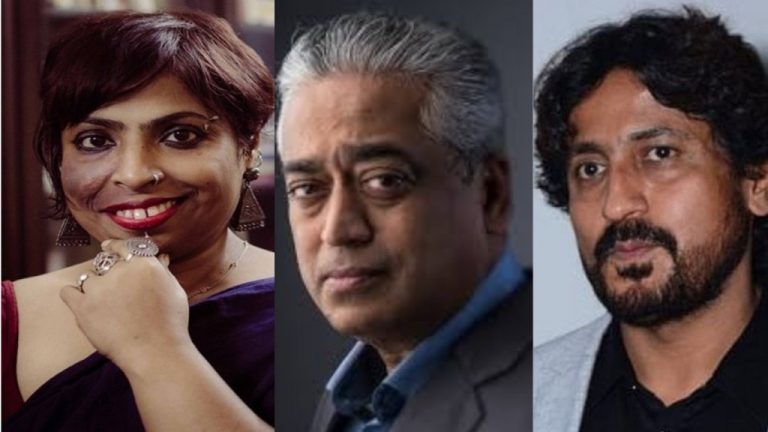
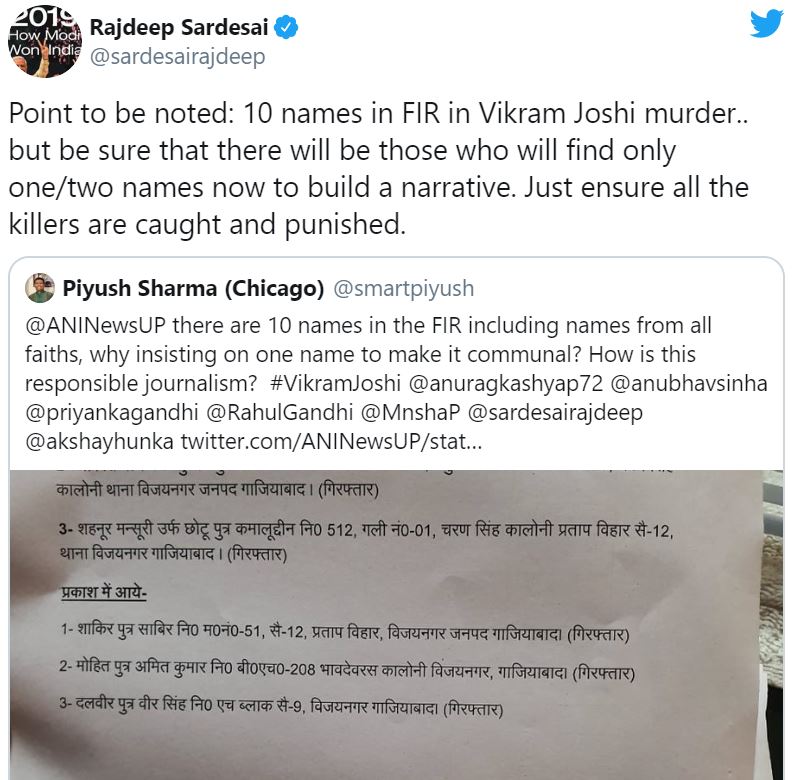
Another person said the same thing. It would have been insignificant in and of itself but it was also shared by the none other Rajdeep Sardesai, who has peddled innumerable number of lies in his glorious career of over 30 years.
The meltdown of the liberal crowd over an OpIndia report somehow does not come as a surprise, but probably in the haste to rebuke us, the left-liberal gang did not read up our report properly.
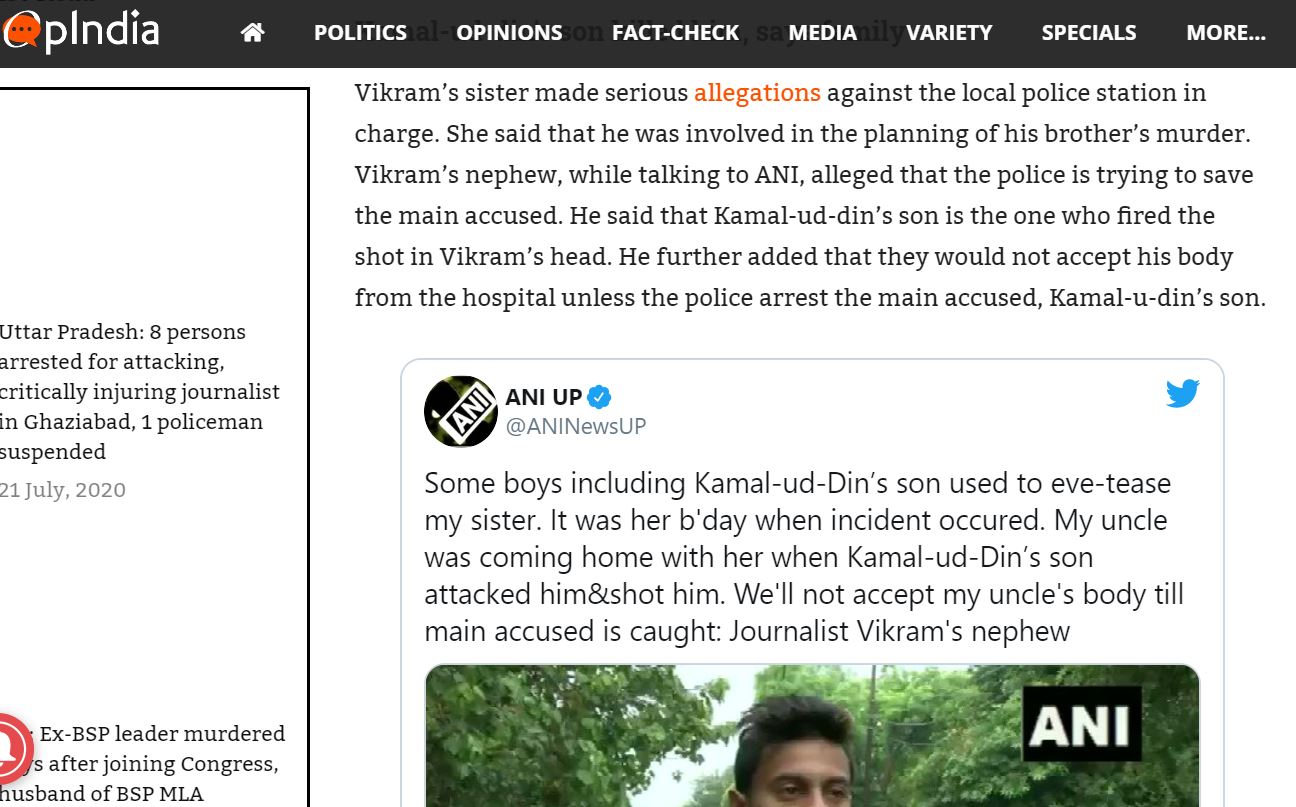
We have not made up any names. Even if our report mentions Kamal-ud-din’s son as the main culprit it is based on a Tweet put out by ANI, where the Vikram’s nephew, while talking to ANI, alleged that the police is trying to save the main accused. He said that Kamal-ud-din’s son is the one who fired the shot in Vikram’s head. He further added that they would not accept his body from the hospital unless the police arrest the main accused, Kamal-u-din’s son.
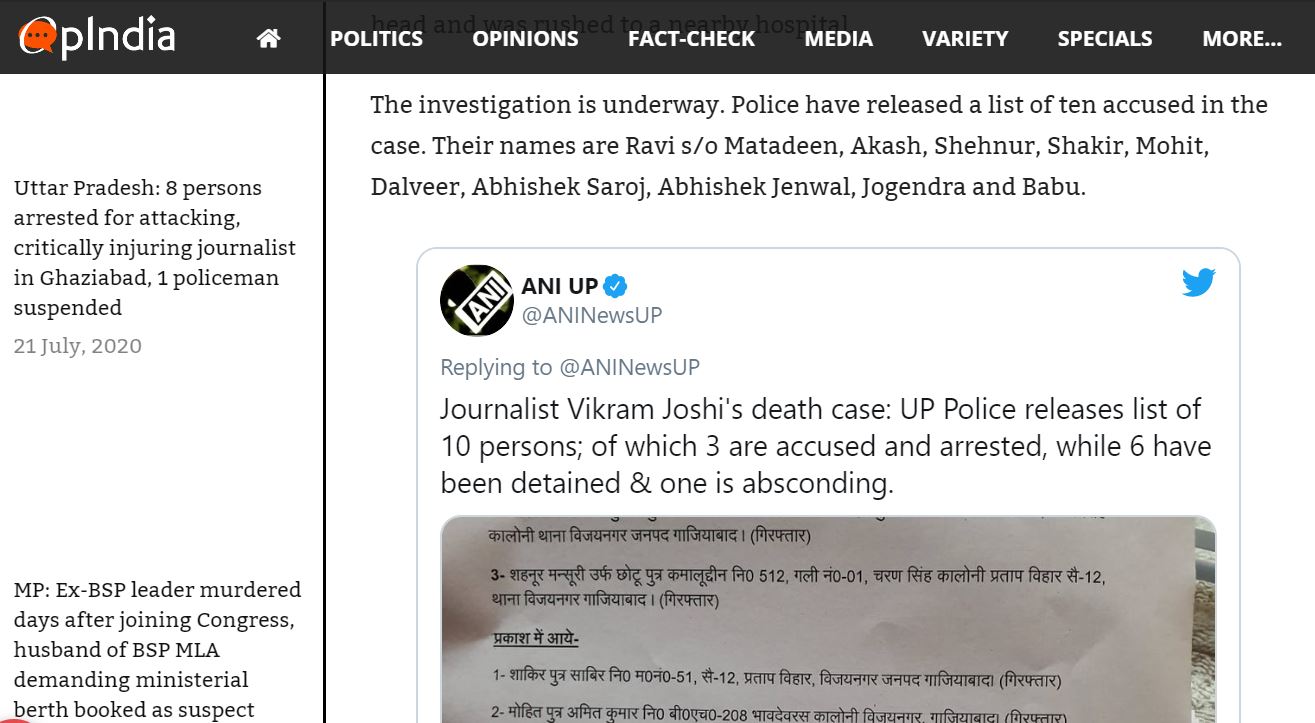
In the same report, we have also shared the names of other accused in the case. Sharing a Tweet by ANI we wrote that the police have released hat list of 10 accused in the case. The names being Ravi s/o Matadeen, Akash, Shehnur, Shakir, Mohit, Dalveer, Abhishek Saroj, Abhishek Jenwal, Jogendra and Babu. A portion of the report, the liberals didn’t think it important enough to be read.
Snippet from our report published earlier in the day
So this allegation that we were trying to sensationalise and communalise the incident holds no grounds. Our report was purely based on the facts. Along with mentioning Kamal-ud-din’s son’s name we also mentioned the names of the other accused in the case, which the leftist brigade chose to conveniently overlook. Without verifying details, the usual assortment of ‘liberals’ and ‘journalist’, in a haste took to social media to cast aspersions at us.
An attempt of kidnapping in broad daylight was throttled by a mother, who bravely fought kidnappers to save her 4-year-old girl child in East Delhi’s Shakarpur area on Tuesday. After rescuing her child, the lady tried to catch the miscreants but they managed to flee away. The whole incident was captured on CCTV camera placed in the area.
A mother was able to save her four-year-old daughter from being kidnapped on Tuesday from the clutches of armed kidnappers in Shakarpur area of East. @DelhiPolice ?? pic.twitter.com/1XdJJb3dIU
In the viral video capturing the failed attempt of kidnapping, a man is seen rushing out of a house with a child in his lap. He is wearing a helmet. As he tries to sit pillion on the bike, which was already standing outside the house with the rider waiting for his accomplice to return with the child, the mother comes barging out of the house and snatches away her child from the clutches of the kidnapper. The rider and the bike fall in the ensuing scuffle. The kidnapper starts running while the rider picks up his bike and tries to flee. Hearing the noise, neighbours begin to gather, who then start chasing the kidnappers.
As can be seen in the second video, a neighbour tries to block the path for the kidnappers by placing his scooter in the middle of the road. When the kidnaper riding his two-wheeler tries to go around it, the man pushes him, and the kidnapper falls down. The kidnapper, ultimately, in a haste, leave the bike and flee. Ther kidnapper on his foot also manages to flee although the man who had blocked the path and another man chasing them tried to hold them back. Although they couldn’t keep the kidnappers, the act of blocking the road proved very helpful, as the police used the bike’s registration number to crack the case, according to reports.
Thanks to the man who showed presence of mind by placing his scooty to block escape route of kidnappers. pic.twitter.com/LybpIyXXLL
As per a report by Nav Bharat Times, the whole plot of kidnapping was hatched by the child’s uncle. Actually, there was some money-related dispute going on in the family. So the brother of the child’s father planned to kidnap his niece by hiring two goons.
The miscreants went to the house and asked for water from the woman. When she went inside to fetch water for the two goons, they grabbed the child and tried to flee. The mother swiftly ran behind the goons and snatched away her child from the miscreants.
Police have raided the child’s uncle house after it was revealed that he had hatched the conspiracy, and are now in the lookout for the two kidnappers.