Home Blog Page 542

Russia-Ukraine war finally coming to an end? Rubio-Lavrov meeting, Ukraine’s stand and Trump-Putin talk: Read what is happening

The situation around the Russia-Ukraine war appears to be shifting significantly, with a new chapter of global diplomacy unfolding on 18th February 2025 as Russian Foreign Minister Sergei Lavrov met his American counterpart Marco Rubio in Saudi Arabia and US President Donald Trump publicly criticising Zelenskyy for ‘failing’.

As the US-Russia efforts to end the conflict between Russia and Ukraine intensify, the question arises whether these endeavours lay the groundwork for a dawn of peace for the two warring sides or turn out to be the prelude of further geopolitical chess moves. It is thus, crucial to understand what exactly is happening.

Rubio-Lavrov meeting: Inching closer to the negotiation table?

In a rare but pivotal high-level meeting since the Russia-Ukraine war started in 2022, US Secretary of State Marco Rubio met the Russian Foreign Minister in Saudi Arabia’s Riyadh. It is interesting to note that even though Ukrainian President Volodymyr Zelensky was also in Saudi Arabia, he was not a part of this meeting.

The US State Department spokesperson’s office stated in a statement, “Secretary of State Marco Rubio spoke today with Russian Foreign Minister Sergei Lavrov as a follow-up to President Donald Trump’s conversation with Russian President Vladimir Putin earlier this week.

“The Secretary reaffirmed President Trump’s commitment to finding an end to the conflict in Ukraine. In addition, they discussed the opportunity to potentially work together on a number of other bilateral issues,” the spokesperson added.

U.S. Secretary of State Marco Rubio stated that the two sides agreed on pursuing three goals: to restore staffing at their respective embassies in Washington and Moscow, to create a high-level team to support Ukraine peace talks, and to explore closer relations and economic cooperation.

“Should this conflict come to an acceptable end, the incredible opportunities that exist to partner with the Russians geopolitically on issues of common interest and frankly, economically on issues that hopefully will be good for the world and also improve our relations in the long term,” Rubio said.

Appreciating the new Trump administration’s approach towards the resolution of the Russia-Ukraine conflict, Russian Foreign Minister Sergei Lavrov said, “I have reason to believe that the American side has started to better understand our position, which we have once again outlined in detail, using specific examples, based on President Putin’s repeated speeches.”

 Interestingly, Russia has been quite positive about engaging in talks with the Trump administration to resolve its conflict with Ukraine. Ahead of the meeting in Riyadh, Russian spokesperson Dmitry Peskov said “From now on, we will talk about peace, not war.”

Taking a small but impactful step towards cooperation and trust-building, Russia approved a unilateral release of an American caught in possession of a certain amount of cannabis at Moscow Airport. On the face of it, this does not seem to be a big step, during the Biden administration, the Kremlin arrested and subjected American nationals to longer prison sentences for similar charges. If not for Russia’s softened stance, the American national released would have possibly served a 7-year jail sentence.

Russia’s decision to release the arrested American national was welcomed by the United States. This development is also important considering the fact that Russia and the US have indulged in prisoner-swap diplomacy which former US President Joe Biden called “hostage diplomacy”.

Trump-Putin telephonic conversation

Last week Russian President Vladimir Putin and US President Donald Trump spoke for nearly an hour over the telephone. The two leaders agreed upon ending the war in Ukraine through a peaceful solution. After this call, President Trump said that his Russian counterpart wanted the war to end. Trump added that the two leaders discussed “getting a ceasefire in the not-too-distant future.”

“He wants it to end. He doesn’t want to end it and then go back to fighting six months later. I think we’re on the way to getting peace. I think President Putin wants peace, President Zelensky wants peace and I want peace. I just want to see people stop getting killed,” Trump told the media.

Interestingly, Trump also had a conversation with Ukrainian President Zelensky who also expressed his willingness the end the war. Informing about his conversation with President Trump, Zelensky wrote on X, “I had a meaningful conversation with @POTUS. We… talked about opportunities to achieve peace, discussed our readiness to work together …and Ukraine’s technological capabilities… including drones and other advanced industries.”

Russia-Ukraine war to end at the expense of Ukraine’s NATO membership dream?

Apparently, the Trump administration is pushing for a swift end to the war, possibly at the cost of some of Ukraine’s long-term strategic goals, most importantly, NATO membership.

Recently, US Defense Secretary Pete Hegseth said that Ukraine may have to relinquish its claim over its territories seized by Russia in addition to its ambition of joining the NATO military alliance.

Not to forget, Ukraine’s desperate attempts at joining NATO were one of the major reasons behind the escalation of tensions with Russia. This remains a bone contention with Russia emphasising that it cannot allow Ukraine to join NATO since this poses a direct threat to Russia’s sovereignty.

On 18th February, while in Riyadh, the Russian Foreign Minister demanded that NATO scrap its 2008 promise or the “Bucharest Declaration” of giving Ukraine membership to the US-led military alliance one day.

“We explained to our colleagues today what President (Vladimir) Putin has repeatedly stressed: that the expansion of NATO, the absorption of Ukraine by the North Atlantic alliance, is a direct threat to the interests of the Russian Federation, a direct threat to our sovereignty,” Lavrov said.

The Russian leader also rejected the idea of NATO forces or British forces as proposed by Keir Starmer, acting as peacekeepers under any kind of ceasefire deal.

“We explained today that the appearance of armed forces from the same NATO countries, but under a false flag, under the flag of the European Union or under national flags, does not change anything in this regard. Of course, this is unacceptable to us,” Lavrov asserted.

Meanwhile, Russian Foreign Ministry spokeswoman Maria Zakharova asserted that now only keeping Ukraine from joining NATO is not enough and NATO must disavow its 2008 promise wherein NATO promised to admit Ukraine and Georgia into the alliance.

“The alliance must disavow the Bucharest promises of 2008,” Zakharova said.

On Tuesday, US President Donald Trump acknowledged that the USA’s previous support to Ukraine’s ambitions of joining the North Atlantic Treaty Organisation (NATO) was a key cause behind Russia waging a war on Ukraine.

President Trump slammed the previous Biden administration for supporting Kyiv’s NATO dream. He also noted that there was no way Russia could have allowed Ukraine to join NATO.

Trump’s NATO remarks received praise from Russian Foreign Minister Sergei Lavrov who said, “He is the first, and so far, in my opinion, the only Western leader who has publicly and loudly said that one of the root causes of the Ukrainian situation was the impudent line of the previous administration to draw Ukraine into NATO.”

Ukraine’s stand

Unsurprisingly, Ukrainian President Volodymyr Zelensky has expressed strong reservations about any peace deal that does not involve Kyiv directly. Zelensky was not invited to the Saudi talks enraging Kyiv over being side-lined from discussions about its own future. President Zelensky has been stressing that any peace agreement must respect Ukraine’s sovereignty and territorial integrity. He also continues to push for Ukraine’s inclusion in NATO or at least concrete security guarantees to prevent future Russian aggression against the east European country.

“Ukraine will never accept any decisions between the United States and Russia [without Ukraine’s involvement]. We have this place at the table at the very beginning, and we are the first who are at this table because the war is in Ukraine. We are thankful for all the support, unity in the U.S. around Ukraine support – even bipartisan support – we are thankful for all of this, but there is no leader in the world that can make a deal with Putin without us, about us,” Zelensky said ahead of US-Russia talks in Riyadh.

Trump slams Zelensky for failing to negotiate peace with Russia, calls for elections in Ukraine before the war-hit country gets a seat at the table

US President Donald Trump has trained his guns against his Ukrainian counterpart. Trump not only accused Zelensky of failing to negotiate peace with Russia but also blamed him for starting the war.

“This could have been settled very easily. You should have never started it. You could have made a deal. I could have made a deal for Ukraine. That would have given them almost all of the land, everything, almost all of the land – and no people would have killed, and no city would have been demolished,” President Trump said.

Addressing Ukraine’s dismay over not being invited to US-Russia talks over ending the war in Ukraine, President Trump strongly asserted that Ukraine had three years to make a peace deal with the Kremlin, however, Zelensky failed to achieve peace for his country.

“But today I heard, ‘Oh, well, we weren’t invited.’ Well, you’ve been there for three years. You should have never started it. You could have made a deal,” Trump said.

Donald Trump also mocked Zelenskyy for his supposed low approval ratings and called on the Ukrainian leader to face elections. “I mean, I hate to say it, but he’s down at a four per cent approval rating. We have a situation where we haven’t had elections in Ukraine, where we have martial law, essentially martial law in Ukraine,” Trump said.

Doubling down his attack on Zelenskyy, Trump on 19th February called the Ukrainian President a “dictator without elections”. He also accused President Zelensky of exploiting the United States and calling his leadership of war-torn Ukraine “terrible.”

A day after seemingly blaming Zelenskyy for igniting the conflict with Russia, Trump once again questioned U.S. support for Ukraine. In response to Trump’s earlier remarks, Zelenskyy stated that the former president “lives in a disinformation space.”

On Wednesday, Trump took to Truth Social to criticize Ukrainian President Volodymyr Zelenskyy, describing him as a “modestly successful comedian” who convinced the U.S. to spend $350 billion on a war that, according to Trump, was unwinnable and unnecessary. He claimed that without U.S. support—and Trump—Zelenskyy would be unable to negotiate a resolution.

“That’s [holding elections in Ukraine] not a Russian thing. That’s something coming from me and coming from many other countries also. He [Zelenskyy] refuses to hold elections, has low approval ratings in Ukraine, and his only real skill was manipulating Biden,” Trump wrote. “A dictator without elections—Zelenskyy better act fast, or he won’t have a country left.”

It, however, is pertinent to note that in 2015, the Ukrainian parliament passed a law which barred elections in the country during wartime. Since the war started in 2022, Ukraine has been under martial law, which bars elections during wartime. Zelenskyy though has been accused of occupying office despite his tenure ending in May 2024, since the war has not ended he continues to lead Ukraine. The Ukrainian President has claimed that once the war ends, he will hold elections in the country.

It has been three years since the war erupted between Russia and Ukraine, millions of people have lost their lives, and the war is at a standoff, however, the Ukrainian President apparently doesn’t want the war to end or to end only at his whims.

Zelenskyy’s nonchalance in negotiating a peace deal with Putin can be understood from the fact that he has remained adamant about claiming Crimea and Donbas, though he admitted Ukraine “lacks strength” to those territories back militarily. He also continues to push for NATO membership for Ukraine or its entry into the European Union, which is unacceptable to Russia. These divergent goals further exacerbate the situation.

As Ukraine under Zelenskyy’s leadership got the political, diplomatic and military backing of the US, NATO and EU, the Ukrainian president was emboldened to continue fighting Russia and hold out for better negotiation terms. This, however, complicated the situation and the only person to apparently benefit from this was Zelenskyy who not only was turned into a ‘heroic’ wartime leader but also did not have to face elections.

European countries want to be part of future negotiations on Ukraine’s fate, US opposes Europe’s involvement

Recently, Europe particularly countries like France, Germany and the UK have expressed the supposed need for their participation in any peace talks. These countries stress that a peace deal must be “fair” and involve security guarantees for Ukraine.

In a joint statement, seven European countries and the European Commission said, “Our shared objectives should be to put Ukraine in a position of strength. Ukraine and Europe must be part of any negotiations. Ukraine should be provided with strong security guarantees. A just and lasting peace in Ukraine is a necessary condition for a strong transatlantic security.”

The United States, however, is not very keen about involving Europe in brokering the Ukraine-Russia peace deal as Trump’s Ukraine envoy Keith Kellogg said that Europe won’t have a seat at the table for Ukraine peace talks but their interests will not be overlooked.

“I’m (from) a school of realism. I think that’s not gonna happen,” Kellogg said on a question about Europe’s prospects of being at the negotiation table.

Upcoming Putin-Trump meeting and the way forward

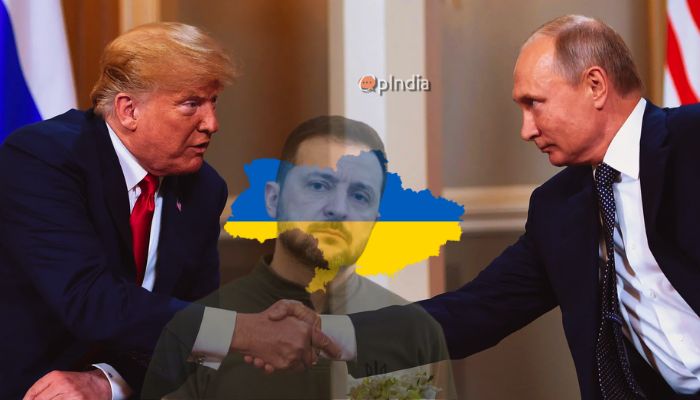
After shaking things up in just a week, Russian President Vladimir Putin and US President Donald Trump are expected to hold a meeting soon. While Trump said that he might meet Putin later this month, the Kremlin said that the meeting may or may not happen this month and could take a little longer to prepare. The two leaders have not had a face-to-face interaction since 2021.

Sooner or later, the two leaders will meet to discuss the Ukraine issue. The prospect of Putin and Trump holding a meeting has signalled a seismic shift in US-Russia relations alongside upending ‘traditional’ alliances. President Trump has a penchant for personal diplomacy and he would possibly like to leverage his relationship with his President Putin to broker a peace deal. Putin would also want to retain Ukraine’s lost territories and persuade the US to coerce Ukraine into conceding certain territories to Russia.

This meeting might prove to be lucrative for President Trump as he would be bypassing Europe’s demands. Besides, Kremlin would try to make the US lift some sanctions which obviously would bring Russia in an even stronger position. President Trump is already quite displeased over the previous US government pumping billions of dollars into Ukraine to fight Russia, the United States might significantly cut support to Ukraine if not completely stop funding to Russia’s bête noire.

This would result in Ukraine’s increased dependence on European countries. While Europe has financially assisted Ukraine against Russia, the US has been the major financial aid provider to Ukraine. If the US curbs or stops financial assistance to Ukraine, Europe may not be able to compensate for the lost US funds due to its own economic constraints. Besides financial aid, the USA has also been a major supplier of advanced weaponry, intelligence etc to Ukraine. However, with changed US-Ukraine dynamics, the US may halt military aid to Ukraine and worsen things for the country. Interestingly, while Russia has managed to remain economically sound despite a myriad of sanctions by the West, Europe’s sanctions on Russia will not be as effective if the US and Russia reach an agreement or US halts aid to Ukraine. With the US not on their side, it might become difficult for European countries to pressure Russia economically or diplomatically.

Beyond the politics, blame games, mudslinging and violence, the Russia-Ukraine conflict demands a multifaceted approach, with Russia, Ukraine and the US (as mediator) indulging in respectful dialogue with realistic expectations. While Ukraine may have to let go of its NATO dream, Russia would be required to commit withdrawal of its troops from Ukraine and respect the latter’s sovereignty. An end to this bloodied conflict should be prioritised over territorial or political gains alongside ensuring that a peace deal is not only about the cessation of hostilities but also about laying the groundwork for lasting stability in Eastern Europe.

While the Trump-Putin meeting can open a new chapter in the US-Russia ties, time alone will tell if the end to the Ukraine-Russia war was finally within sight, or merely a mirage in the desert of diplomacy.
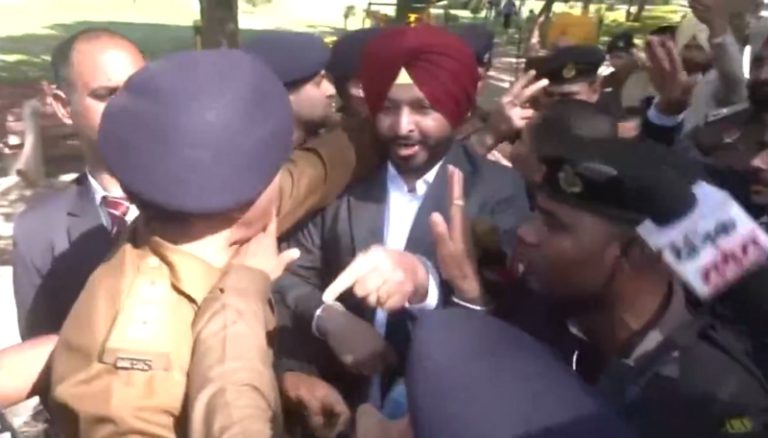

Union Minister Ravneet Singh Bittu accuses Chandigarh Police of physical and verbal abuse during his visit to Punjab, files complaint

0

Union Minister for Railways, Ravneet Singh Bittu has filed a complaint with the Director General of Police (DGP), Chandigarh Police, alleging physical and verbal abuse by Chandigarh Police officers during his visit to Chief Minister Bhagwant Mann’s residence in Chandigarh.

In his letter, Bittu detailed the incident: “They misbehaved with me, using verbal and physical abuse. A team led by DSP Uday Pal Singh consisting of two Assistant Sub-Inspectors and three constables verbally and physically abused me.”

He described how the situation escalated when his vehicle was blocked by the police.

“After that, I entered my vehicle to leave, but DSP Uday Pal and his team stopped my car cavalcade by blocking my way with their cars. My security was alerted by this ambiguous action of Chandigarh Police of trying to breach my Z+ security,” Bittu stated.

The Minister went on to express concerns over the actions of the police, accusing them of attempting to create confrontation. “The Chandigarh Police team went to the extent of getting into a physical altercation with my security officials. Their intention for the same is very questionable and dangerous,” he wrote.

Bittu in his complaint demanded immediate action against the responsible officers, requesting that an FIR be filed against DSP Uday Pal Singh and his team. He also called for a thorough investigation and strict disciplinary action to be taken.

“I demand that immediate action be taken against the responsible officers. An FIR should be immediately registered against Deputy SP Uday Pal Singh and his team and a thorough investigation should be done into this matter followed by strict disciplinary action,” he added in his complaint.

Earlier, an argument broke out between the Union Minister and Chandigarh Police when he reached the Punjab CM’s house to meet him on Wednesday.

(This news report is published from a syndicated feed. Except for the headline, the content has not been written or edited by OpIndia staff)

Muslim man killed by his wife: Leftwing propagandists spread communally charged fake news to insinuate hate crime by Hindus, Mainpuri Police debunks it

A post by X handle @HateDetectors, a controversial account accused of peddling fake news under the pretext of “exposing” hate crimes purportedly taking place in India, claimed that a man named Bhola Yadav killed Sajid in Uttar Pradesh’s Mainpuri after being booked in case of abduction and gang rape by Sajid.

In its post, @HateDetectors also shared two videos, one of the news reports of Sajid’s murder in Mainpuri and another video of Sajid’s relatives alleging Bhola Yadav’s alleged involvement in the case.

Several other social media users belonging to the Islamo-leftist ideology made similar claims, insinuating that Sajid was a victim of a hate crime by his perpetrators who killed him for being a Muslim.

X user @iamharunkhan, notorious for posting inflammatory tweets insulting India’s Hindu culture and heritage, tweeted that Sajid was killed by Bhola Yadav and his associates. He also alleged that Sajid was murdered because he had refused to settle the matter of gang rape when his wife was allegedly kidnapped and gang-raped while held in captivity for over 4 months.

Another X user, who goes by the handle @Delhiite_ and is also followed by several prominent leftwing X accounts, also posted about the incident, claiming that Bhola Yadav killed Sajid since the latter had filed a case against him for abducting and raping Sajid’s wife for four months.

Even an advocate at the Mumbai HC or so as the bio of one Rukhsana Sayed suggests, took to X to claim that Sajid was killed by Bhola Yadav and his three sons, Situ, Shilu, Krishu with their friends Rahul and Ramu, with the names of the accused prominently highlighted presumably to underscore their Hindu identity.

Mainpuri busts communally charged fake news about Sajid’s murder

While Islamists on X tried to insinuate that Sajid was killed for being a Muslim or because of his Muslim identity, the Mainpuri Police issued a clarification stating that Sajid’s wife was behind the plan to murder her husband and implicate Bhola Yadav in it. A police statement confirmed that the incident was not a hate crime but a personal conspiracy.

Putting paid to the fake news in circulation on social media, a police officer from Mainpuri Police released a video statement, detailing the findings in connection with the Sajid murder case. The police official revealed that Sajid’s wife had planned and executed his murder, in conjunction with her friend Sumit, and planned to frame Bhola Yadav for Sajid’s murder.

Bihar: After Muslim mob attacked Hindus in Jamui, minister Sumit Kumar Singh blames victims saying they did not take permission for Hanuman Chalisa recitation

Three days after some Hindus returning from a Hanuman Chalisa recitation were attacked near a mosque in Jamui, Bihar, minister and independent MLA Sumit Kumar Singh blamed the victims for not taking permission for the recitation. Instead of condemning the violence, the Minister of Science and Technology in the Bihar government questioned the victims as to why they went to attend the Hanuman Chalisa recitation in the first place.

“Why did you go there? What did you go there to do? And if you went there, did you inform the administration about it? Did you get a license for it? If we organise any Jagran or anything in our houses, a license is taken for that,” said the Minister. “You cannot just go and start reading Hanuman Chalisa at odd hours, there is no restriction on reading though. Those who went there are not bigger Hanuman devotees than me…they do drama by opening Chalisa book and reading out loud, Hanuman Chalisa cannot be read like this,” he added.

Singh accused the victims of disturbing the environment and said they faced the consequence of reciting Hanuman Chalisa at improper time. “Some fanatics were spoiling the atmosphere here. There is no justification for going somewhere illegally and doing the wrong things. If you do anything at the wrong time, it result is bad,” he said.

What was the incident?

On 16th February 2025, some activists from the Hindu Swabhiman organisation gathered in Baliadih village in Jamui for a Hanuman Chalisa recitation. On their way back from the recitation, a mob near a mosque surrounded their convoy and vandalised their vehicles by pelting stones and bricks. Hindu activists claimed that the attackers were Muslims. Several women were also injured in the attack. Internet services were suspended in the area after police took cognizance of the matter. Several individuals were arrested in connection with the attack.

The attack occurred as the convoy passed through a Muslim-majority area. The mob shattered vehicle windows and threw stones. Several activists, including Hindu Swabhiman district president Nitish Kumar and activist Khushbu Pandey, sustained serious injuries. Pandey alleged that there was a plan to target specific individuals, and discussions about attacking the police were also taking place. Many Hindu activists were reportedly stranded in the area for hours. Videos of the incident, showing stone-pelting, have gone viral on social media.


Concerned over presence of Pakistan Army, ISI in Bangladesh, they should not able to send terrorists to India: Army Chief Gen. Upendra Dwivedi

0

India Army Chief General Upendra Dwivedi stated that he was concerned about the presence of Pakistan Army and ISI officials in Bangladesh areas close to India’s chicken’s neck area

Speaking to ANI in an exclusive interview, General Dwivedi said that they must make sure that those anti-India elements are not able to use that soil to send terrorists to India.

Recently, the Pakistan army and ISI officials visited very sensitive areas near the Indian border, near the chicken’s neck in Bangladesh. When asked if he was concerned about this, the COAS replied in the affirmative.

“I had used the word epicentre of terrorism for a particular country (Pakistan). Now those countrymen, if they go to any other place and they happen to be our neighbor, as far as I am concerned, I should be concerned about it. That they should not be able to use that soil to send terrorists to India. That is as far as that is concerned,” General Dwivedi said.

General Dwivedi said that relations with the administration can be defined only if there is an elected government.

“As far as the second setup is concerned that how is the administration, my stance is that when we have elected government, then we can say how should be our relationship,” he told ANI.

Dwivedi said that the military relationship, however, is very strong with Bangladesh.

“But so the military relationship is concerned is very strong. And we are able to exchange notes whenever we want. And that’s what we have been doing,” he said.

When General Dwivedi was asked if Pakistan has yet understood that Kashmir is part of Indian territory, Dwivedi humorously gave the example of the movie Guide, in which a madman says, ‘I won’t eat until it rains’.

“See, they are stuck in their own words. There is a movie of Dev Anand Ji, I think Narayan Ji has written this book. Do you remember when Devanand Ji became a sadhu in the last? A madman went and announced that he will not have food until it rained. Now Pakistan Army once said that we have to do this. Now they don’t have a way out of it. So they will continue to go for it, look, Kashmir, this is point number one. The second thing is, if you read the book Revenge of Geography, written by Robert Kaplan, both sides of the Indus, can they be one? That’s a big question you have to see,” he said.

Dwivedi further said that Pakistan’s agenda is not limited to Kashmir only, and they are only fueling the anti-India stance.

“So, as far as they are concerned, the idea of India is their major criticality. It’s not limited to Kashmir only. So to keep Pakistan together, you have to have one common agenda which can keep you together. Is the language the same? Are the people the same? What is the same? Only anti-India stance. So therefore, Kashmir, they will keep hyping up at every point of time,” he said.


(This news report is published from a syndicated feed. Except for the headline, the content has not been written or edited by OpIndia staff)

Rajasthan: Minor scuffle over marbles sparks communal clashes and stone-pelting in Ajmer, Hindus demand action against illegal Rohingyas

A minor scuffle between children playing marbles snowballed into violent communal clashes in the Laungiya area of Ajmer in Rajasthan during the wee hours of Tuesday. The situation escalated rapidly leaving more than six people injured. Police force from nine neighbouring police stations had to be deployed to quell the situation.

SHO of Ganj Police Station, Mahavir Singh reportedly said that a preliminary investigation revealed that the clashes erupted as a result of a minor fight between some children who were playing marbles. The children’s fight led to people from two communities getting involved. Soon a violent confrontation happened between the two groups involving the use of swords, sticks and stones. Police detained some people involved in the incident and are looking for others involved. Complaints have been received by the police in the matter.

Locals allege illegal immigrants have been living in the area

A woman named Bharti, belonging to the Valmiki community, reportedly alleged that several members of her family were attacked using swords, sticks and stones by people from the other group. She added that some illegal immigrants have been living in the area and have been involved in several similar incidents. The injured have been admitted to a nearby hospital. People from the Valmiki community surrounded the police station demanding action against the culprits.

People from the Hindu Community protested

Several people from the Hindu community staged a protest on Tuesday at the Collectorate against the violence in Laungiy and submitted a memorandum to Ajmer SP addressed to Range IG. The protestors demanded swift and stringent action against anti-social elements. Sunil Dutt Jain, Coordinator of Sakal Hindu Samaj alleged that Bangladeshi Rohingyas have been living in the hilly area of Laungiya. He further alleged that stones were pelted by Bangladeshi Rohingya at the houses of Hindus and people from the Hindu community confronted them, they were attacked with weapons.

Jain thanked the police for taking swift action in the matter and detaining the culprits. However, he demanded police action against the settlement of illegal Bangladeshi Rohingyas to maintain peace in the area.

Shivaji Jayanti: Why Chhatrapati Shivaji Maharaj, the architect of Hindavi Swaraj, is hailed as the “Father of the Indian Navy”

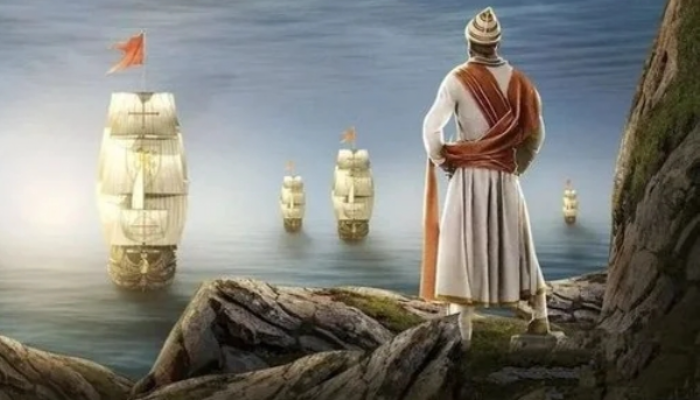
19th February marks the birth anniversary of the man who laid the foundation of Hindavi Swarajya, Shivaji Maharaj, the first Chhatrapati of the Marathas and was immortalised in the annals of history. The founder of the Maratha Empire and Maratha Navy, he was a visionary leader and a skilled strategist. More importantly, he is not just a historical hero who inspires many Indians but also represents a symbol of cultural renaissance and resistance to oppression.

Shivaji was the pioneer of guerilla warfare and even paved the way for an independent naval force during a period when European nations dominated the oceans, giving him the moniker “Father of the Indian Navy.” He recognized the value of having a strong navy at an early age. He established a strong navy to defend the Konkan coast from colonial powers like the British, Dutch and Portuguese. Pirates, fishermen and various seafaring tribes were all part of his naval army and the Marathas established the fort of Kolaba as their naval headquarters.

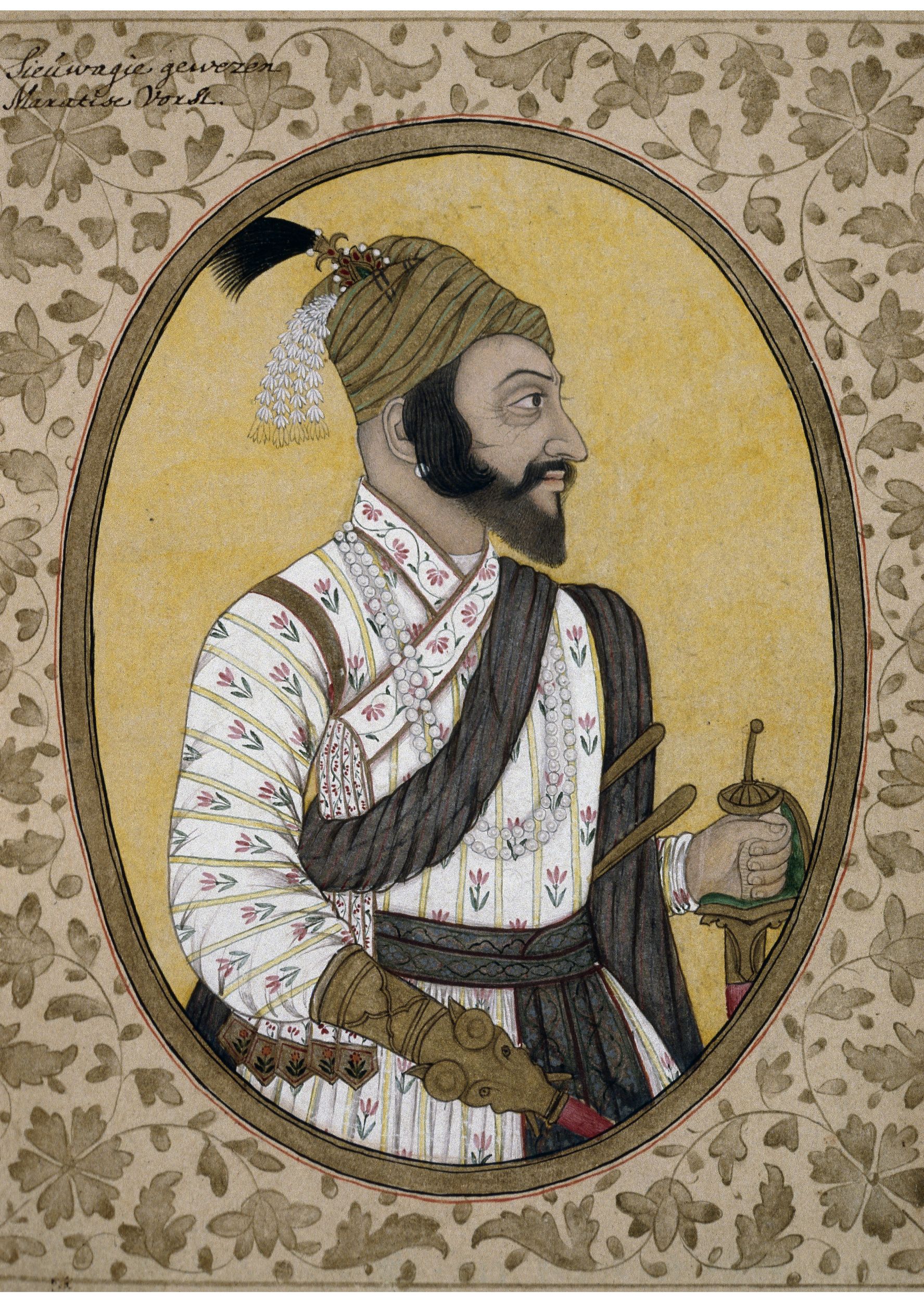
The portrait of Chhatrapati Shivaji Maharaj from the British Museum in London. (Source: British Museum)

The Marathas resisted the British attempts to seize power, on the Indian coasts. Notably, they initially had no navy because they were constantly attacked by the Mughals. However, Shivaji was the first to recognize the value of having a powerful navy. He understood the need to establish a robust fleet and an effective port system after fighting the Siddis, who had their base at Murud Janjira, and witnessing the Portuguese naval might along the Konkan coast. He was a strong supporter of forts and constructed numerous coastal forts along the Konkan coast, including Vijaydurg and Sindhudurg. He built the forts on hillocks with a view of the coast to keep an eye on the seas and fortify the defences of the hinterland.

Soon after, the Maratha navy grew more powerful and took control of the forts at Kolaba, Sindhudurg, Vijaydurg and Ratnagiri. The Marathas repelled the Portuguese and the British on their own for about 40 years. With over 500 ships, the Maratha fleet became a formidable force under Shivaji, however, it weakened following his death in 1680.

A dive into the history

India has a vast and varied maritime history and Chhatrapati Shivaji Maharaj stands out for his unprecedented contributions to naval strategy and warfare. The innovative leader who was born in the 17th century, observed the strategic value of an efficient navy long before other Indian rulers did. He developed the framework for a naval force that would not only protect the coastline but also project power and influence during a period when the subcontinent was divided into numerous kingdoms and faced with the prospect of foreign invasions.

Powerful kingdoms and empires shaped India in the seventeenth century. The Adilshahi of Bijapur, the Qutb Shahi of Golconda and the Mughal Empire had an impact on the Deccan region and Konkan coast. The Adilshahi controlled important ports along the Konkan Coast, a portion of India’s western coastline. The European nations like the Portuguese, Dutch, English and Siddis of African descent dominated the oceans.

The Portuguese took command of the Arabian Sea and its trade routes after Vasco da Gama arrived in Calicut in 1498. They limited Indian merchants by enacting the Cartaz system which needed trading permits and frequently destroyed ships that did not comply. They founded colonies throughout the Konkan Coast, including in Vasai, Chaul, Daman, Goa, Basrur, and Mangalore, to consolidate their dominance with the help of a formidable naval fleet.

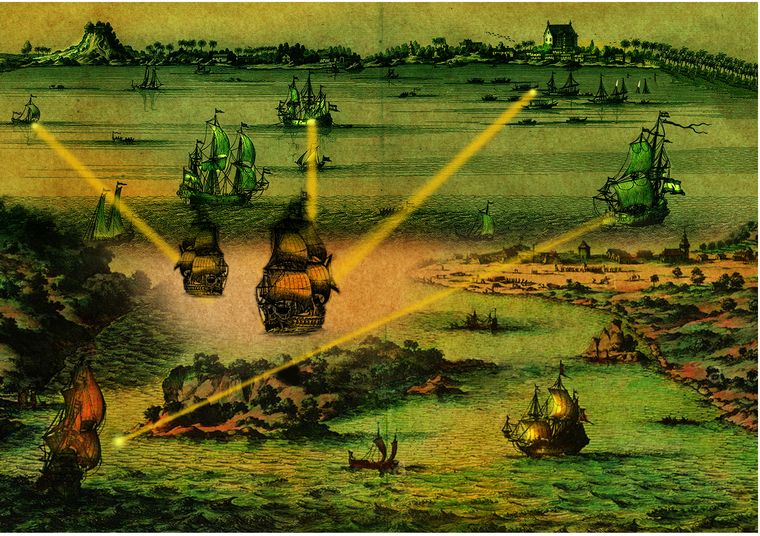
Illustration by Bara Bhaskaran. (Source: The Week)

The first factory of the English East India Company was built at Surat in 1613, reported The Indian Express. After taking over Bombay in 1665, they started building a fort in the southeast corner of the island, which was finished in 1683. They also started building warships, such as the “Revenge” with 22 cannons and the “Hunter” which had 14. They also acquired smaller local ships equipped with cannons for defence.

The Dutch and the French were also active along the Indian coastline, in addition to the Portuguese and the British. On the Konkan coast, the Siddis had taken up residence at Janjira. They maintained a solid naval presence with a fleet of 20 vessels and four Gurabs (frigates), serving first for the Adilshahi and then the Mughals. They were adept seafarers.

A Marathi-language biography of Shivaji titled “Sabhasad Bakhar” expressed, “When Shivaji began his career of independence the coast of Konkan was infested with alien powers. The Siddi was very powerful and a sworn enemy of the Maratha state. He carried fire and sword everywhere on the Maratha coast. He was a standing nuisance, troublesome like a mouse in the house.”

When Shivaji took control of Torna Fort (in the modern-day Pune area), he set up the basis for his empire or “Swarajya” amidst this unstable political environment. The defeat of Afzal Khan, an intimidating general of the Adilshahi Sultanate who had been dispatched to quell Shivaji’s expanding authority was a pivotal point in his ascent to power. He later expanded his power over trade and maritime matters by incorporating a large portion of the Konkan and Kolhapur areas into Swarajya and gaining control of crucial northern ports like Kalyan and Bhiwandi.

He ruled over a 100-kilometer section of the Konkan coast between 1657 and 1658, stretching from the Savitri River to the northern forts of Kohoj and Asherigad. Likewise, he increased his dominion and directly challenged the Siddi domains by capturing several important forts including Surgad, Birwadi, Tala, Ghosale, Sudhagad, Kangori and Raigad (then known as Rairi).

How Shivaji built his navy

As Shivaji consolidated command over the coastal districts, he noted that naval might was imperative to counter European control over maritime trade routes and secure crucial exports along the Konkan coast. He also acknowledged that naval strength was essential to protect his empire since pirates were a constant menace and overseas trade was vital to state revenue. His vision resulted in the construction of a powerful navy, in contrast to other regional kingdoms on the Indian subcontinent that found it difficult to handle marine interruptions.

The water was a new frontier and Shivaji was still the only Indian monarch to have established a fleet with a defined political plan, according to historian Surendranath Sen’s book, “Administrative System of the Marathas” which was published in (1925), even if the Marathas were excellent at land warfare.

There are few firsthand records on how Shivaji started constructing his naval, but Portuguese archives offer important information. Shipbuilding in Kalyan and Bhiwandi started about 1659. On 19th July 1659, Antonio Castro, the captain of Vasai, wrote a letter to the governor of Goa, which was discussed at a meeting of the Portuguese advisory council. According to Castro, Shivaji was building a fleet of 20 sangvisel or Indian ships, in Bhiwandi, Kalyan and Pen in order to take on the Siddis. Rui Leitao Viegas, a Portuguese naval officer oversaw the project and Shivaji asked the Portuguese for permission to use timber and ports for construction.

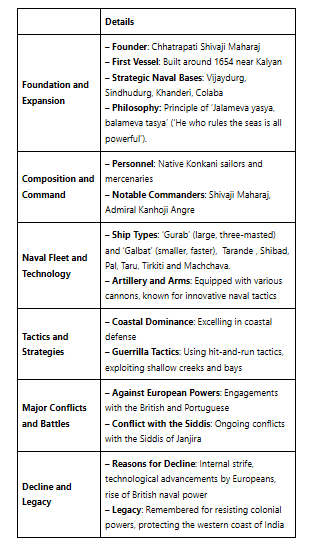
Chhatrapati Shivaji Maharaj’s Naval Legacy (Source: civilsdaily.com)

Castro asked the governor to strengthen Vasai’s defences and put forward apprehensions that such permissions would create a daunting rival. The Portuguese advisory committee responded by taking action to thwart Shivaji’s initiatives. Vasai native Joao de Salazar was assigned the responsibility of impeding the shipbuilding process by convincing workers to drop out of the project due to their religious allegiance to the Portuguese crown.

Portuguese records unveiled that Shivaji’s naval projects made tremendous headway despite these challenges. According to the documents, 7 of the 50 warships that were being built at Chaul had already been launched. Shivaji’s frigates, fort construction and naval operations in Harnai were also mentioned in Dutch documents. These illustrated how Shivaji’s goal of a powerful navy was keenly studied and opposed by European powers. Importantly, they also signalled the start of an incredible maritime legacy in Indian history.

Adnyapatra guided Maratha Empire

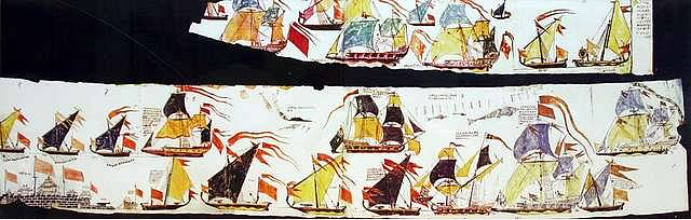
“Adnyapatra” by Ramchandrapant Amatya was the manual for running state matters in the Maratha Empire, especially for Sambhaji II, the grandson of Chhatrapati Shivaji. This text, which reflected the tactics that fortified the empire, discusses administration, government and naval policies. Merchant ships and warships made up the two divisions of the Maratha fleet. Gurabs, Galbats, Mahagiris, Shibads, Tarandes, Taruses and Pagars were warships, whereas Machwas, Shibads, Padavs, Tarandes and Pagars were merchant ships. Although the precise number of Shivaji’s fleet is unknown, English records from 1665 place it at 85 ships with three big Gurabs and 5,000 sailors. The fleet grew to 33 ships by 1673.

A painted scroll showing Gurab, Galbat and other types of warships of the Maratha Navy. (Source: PICRYL)

According to the “Chitragupta Bakhar” (1760–1770), a biography of Shivaji based on Sabhasad Bakhar, there were 30 large Gurabs, 1,000 Galbats, 150 Mahagiris, 50 little Gurabs, 10 small boats, 150 smaller boats, 60 Taraves, 25 Pal ships, 15 Jug-class ships and 50 Machwas. The navy was split into 3 subhas (divisions) each with 5 Gurabs and 15 Galbats, per the Adnyapatra. It directed that the salary of naval personnel must be set by the state to maintain the fleet’s proper maintenance and operational effectiveness. This methodical strategy highlighted the strategic emphasis of the Marathas on naval prowess for defence, trade and conflict.

Importance of forts in Shivaji’s naval strategy

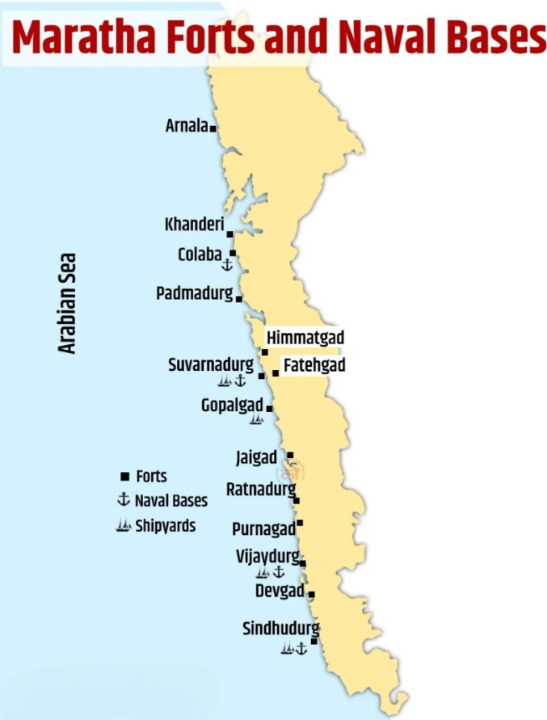
Forts were strategically included in Shivaji’s maritime policy because he grasped their vital function in maintaining naval defence. These forts were divided into three groups: island forts, which were erected on islands near the shore, coastal forts, which were situated immediately along the coastline and forts at river mouths, which were built on promontories along creeks or rivers. The Maratha Navy relied heavily on the key forts along the Konkan coast as operating strongholds, supply depots and safe harbours to enhance its maritime might.

The Adnyapatra defined precise rules for maritime combat along with fortifications. These included the requirement for persistent enemy movement monitoring, regular supply and ammo purchases from safe havens like Janjira, and ongoing naval patrols. The instructions placed a high focus on tactical, coordinated battle responses such as bringing all ships together in a naval engagement and withdrawing to secure harbours when the reorganization was impeded by strong winds. The text also suggested being cautious while engaging adversaries, encircling them from a distance and using guns to degrade their position before launching a direct attack.

Image via Loksatta

Records showed that Shivaji’s navy launched multiple attacks and took control of the Konkan coastline and neighbouring seas. Interestingly, his navy took ships from the British, Portuguese and Adilshahi. The first major naval campaign took place in February 1665 when Shivaji, along with his fleet of 85 frigates and three huge ships, sailed from Malvan (in modern-day Maharashtra) to raid Basrur (in Karnataka) without encountering any opposition from the Portuguese in Goa.

His naval career reached a significant turning point with this campaign at Basrur, demonstrating his capacity to oppose powerful maritime nations. He marched to Karwar, a seashore city in Karnataka, after raiding Basrur where he visited the Hindu temple at Gokarna. He then proceeded to Ankola, which is in modern-day Karnataka. An important turning point in the history of Maratha naval supremacy, the campaign is described in an English letter dated 14th March 1665 and demonstrated Shivaji’s strategic skill.

Emphasis on building a strong navy

BK Apte in his seminal work “A History of the Maratha Navy and Merchantships” wrote, “The navy has been considered as an independent limb of the Maratha State by (Shivaji’s finance minister Ramachandra Pant) Amatya in Rajniti, a work on Maratha polity.” Superiority was his goal. He understood that to acquire land, he needed to control the seas. “When Shivaji began his career of independence, the coast of Konkan was infested with alien powers,” he added.

There were the English, and the Portuguese who ruled the Arabian Sea and the Siddis who posed a serious threat. The conquest of Basrur, in the Karnataka region of Udipi, in 1665 marked the beginning of Shivaji’s naval aspirations. With 85 ships, both large and tiny, he targeted the region and returned with a ton of loot. This attack involved no naval combat but served as a pivotal turning point. Even the Portuguese were alarmed by Shivaji’s bold naval strategy. The viceroy of Goa requested that the Portuguese commander “smother” the movement of the “newly built gallivats” at Kalyan, Bhiwandi, and Panvel in a letter to the king of Portugal dated 6th August 1659. One of Shivaji’s first victories in 1657 was Kalyan, where he also launched his maiden vessel.

There were about 20 warships in the Maratha Navy at the time. Despite having two capable commanders, Mainak Bhandari and Dulat Khan, his crew were Konkanis with a strong affinity for seawater. The legacy was carried on by Shivaji’s son Sambhaji, who expanded the navy, built forts, hired Arab commander Jange Khan to instruct his warriors and acquired Elephanta Caves. However, Kanhoji Angre was Shivaji’s real heir in this regard. He held the unique distinction of never losing a naval combat since being appointed sarkhel or admiral of the Maratha navy in 1699. At Kandheri Island, Angre completed the fortification Shivaji had begun in 1679 and this 16-acre island is named after him.

Naval tactics of Shivaji’s naval army

Shivaji’s maritime strategies were groundbreaking and are still regarded as military strategy masterworks. He was aware of the value of a robust naval force, particularly after observing the Portuguese presence on India’s west coast.

  • Building of naval fleet: In 1654, the Maratha naval base’s first keel was laid close to Kalyan. He eventually constructed a fleet of 20 warships and several naval stations under the leadership of many foreign and indigenous mercenaries, including Portuguese and Siddi individuals.
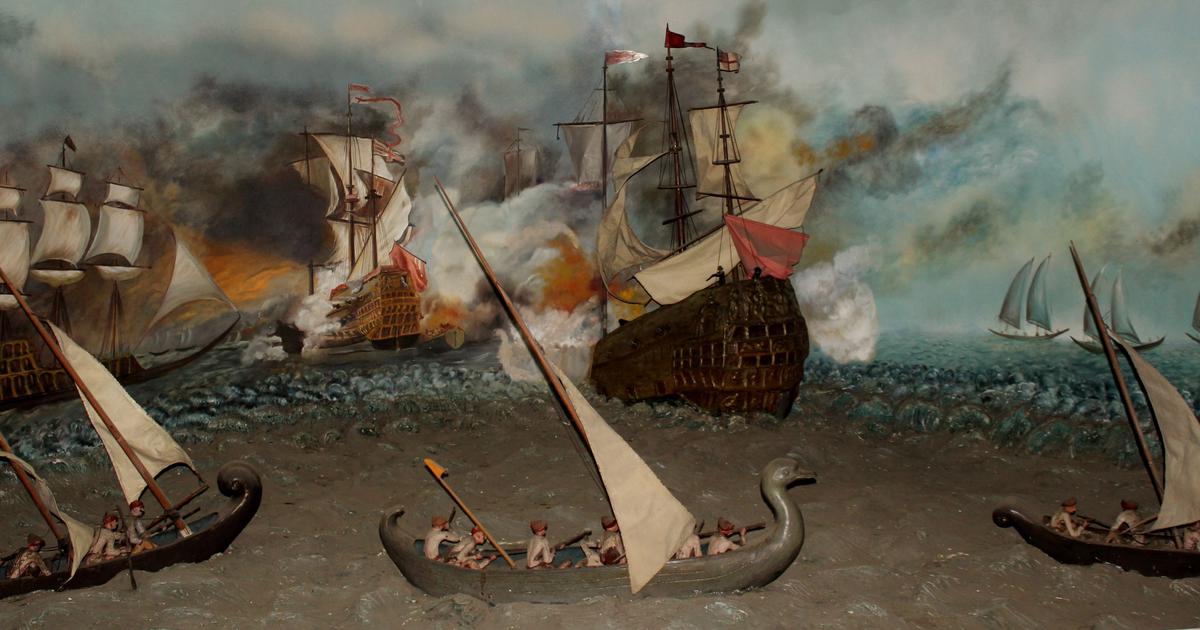
  • Guerrilla warfare at sea: The Maratha fleet was an expert in green-water operations, concentrating on shallow and coastal seas. To hide in bays or small creeks where larger enemy ships couldn’t follow, they used guerilla warfare, attacking from the leeward or astern side.
  • Hand-to-hand combat: The Maratha fleet specialized in hand-to-hand warfare after boarding enemy ships, in contrast to other naval forces that mainly depended on artillery. This strategy neutralized the enemy’s broadside cannons and made it possible for the Marathas to engage in more close-quarters fighting which they were quite good at.
  • Tactical Positioning: The ships of the Maratha fleet were dispersed throughout various squadrons rather than being housed in one location. They were able to respond to threats with greater agility and versatility owing to this distribution, which made it harder for the adversary to anticipate their moves.
  • Intelligence and Infiltration: The navy of Shivaji was renowned for its in-depth combat expertise. They obtained valuable intelligence by infiltrating opposing empires and even buying off commanders. This information was essential for organizing surprise assaults and aggressive military operations.
  • Defense and Offense: The Battle of Surat, in which the Maratha naval successfully defended their coast against the English and Siddi, is the first known instance of the Maratha navy in action. This demonstrated that the Maratha naval was capable of both defending its territories and attacking.
A diorama showing Maratha naval tactics, on display at the National Museum, New Delhi.

Shivaji’s leadership and the inspiration he gave his soldiers were major factors in the Maratha Navy’s success. Despite being outnumbered or having fewer resources, his army’s enthusiasm and vast knowledge played a key role in winning multiple conflicts.

Characteristics of the Maratha Naval Army

Shivaji developed the idea of “Guerilla Warfare at Sea” which entailed attacking enemy ships unexpectedly with quick and nimble ships. The purpose of this approach was to achieve a strategic advantage by surprising the opposition. He built strong naval bases along the coast as he recognized the worth of safe harbours. The forts of Sindhudurg and Vijaydurg stand out among them. They provided secure havens for his fleet and gave him command over important shipping lanes.

He had a diversified fleet like Gurabs, Gallibats, Manjuhasm and others. A variety of tactical methods from swift attacks to protracted naval blockades were made possible due to this. He was willing to soak up knowledge from many naval traditions. He enlisted Muslim mercenaries to broaden the skill set of his naval army and employed Portuguese sailors because of their proficiency in maritime combat. Protecting the Maratha territory’s extensive coastline and commercial routes was one of his navy’s main goals.

His naval strategy was to build a safe marine environment by combining offensive and defensive tactics. Additionally, Shivaji employed his navy as a diplomatic instrument. He consolidated his naval capability through treaties and strategic alliances, improving the Maratha Empire’s geopolitical clout. He was eager to implement the newest naval innovations available at the time. His ships were powerful adversaries in naval battles because they were outfitted with cutting-edge armament and navigation technology.

Forts conquered by Shivaji

Shivaji was an expert in fort warfare in addition to maritime strategy. He began the conquest of forts at the young age of 15, beginning with the fort of Bijapur, which he obtained by bribing the commander. This led to a confrontation with Afzal Khan, who he later killed in hand-to-hand combat. Shivaji oversaw the conquest of almost 300 forts in 35 years.

  • Torna Fort: One of the first forts that Shivaji took control of when he was just 16 years old was Torna Fort which was a major victory over the Bijapur Sultanate. His military campaigns officially began at that time.
  • Raigad Fort: Shivaji took control of Raigad Fort which was formerly known as Rairi and pronounced it as his capital. He was anointed King of the Maratha Kingdom there in 1674.
  • Pratapgad Fort: This fort rose to prominence following the Battle of Pratapgad in which Shivaji vanquished Bijapur Sultanate leader Afzal Khan. Controlling the banks of the Nira and Koyna rivers depended heavily on this fort.
  • Sindhudurg Fort: Situated on Maharashtra’s Malvan coast, this fort was a major naval base in addition to being a military stronghold. Shivaji constructed numerous naval forts to guard the Konkan coastline, and this one was one of them.
  • Vijaydurg Fort: Vijaydurg, another important naval fort, played a key role in regulating the seafaring activity along the Konkan coast. It functioned as a shipbuilding facility as well.
  • Panhala Fort: The strategically significant Panhala Fort, which was taken in 1659, provided command over the Sahyadri mountain pass.
  • Kondana Fort: Kondana Fort, now known as Sinhagad was taken in a bold night-time assault by Tanaji Malusare, one of Shivaji’s trusted generals. A movie starrer Ajay Devgn and Kajol was released in 2020 on the same.
  • Purandar Fort: Shivaji reclaimed the fort after it had been lost to the Mughals and it was an integral part of the Treaty of Purandar with the Mughal Empire.

These forts operated as administrative and governmental hubs in addition to being military strongholds. They were essential to Shivaji’s plan to secure his legacy by controlling the western shore and the Deccan plateau.

Maratha’s clash with other forces

Shivaji and the Siddis are famous for their naval battles. Shivaji tried multiple times to take the powerful Janjira fort, but he was unable to do so because of the stronghold’s natural defences and the Portuguese backing for the Siddis. The Siddis accepted Portuguese suzerainty for protection after realizing they could not compete with Shivaji’s growing power. Shivaji was able to strategically manoeuvre around Portuguese interests while concentrating on expanding his kingdom. The Marathas and the Portuguese also agreed to a pact acknowledging each other’s advantages. The Maratha Navy and the Mughal-Siddi coalition continued to combat despite treaties with the Portuguese. However, Marathas could not capture Janjira.

Shivaji focused on Khanderi Island, which is close to Mumbai after realizing the necessity for a backup naval base. Due to the island’s scarcity of fresh water, the initial attempt to capture Khanderi in 1662 was abandoned. In 1679, Shivaji sent troops and supplies to the island as part of a renewed campaign. The British interests were put at risk by this action since Shivaji’s takeover of Khanderi represented an immediate threat to their hegemony in Mumbai. Shivaji’s presence was fiercely contested by the British, who were eventually compelled to leave.

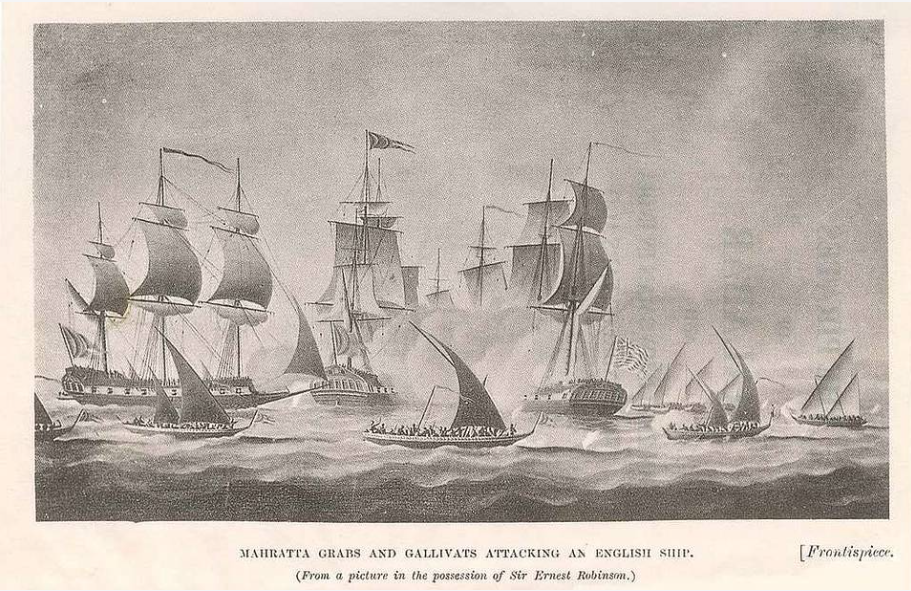
Maratha Grabs and Gallivats attacking an English Ship. (Source: PICRYL)

Shivaji’s navy was very large but he knew that European commerce relied on their naval strength to succeed. He intentionally positioned forts, ports and naval bases by taking advantage of the Konkan region’s natural geology. He bolstered his navy by utilizing the expertise of the locals in marine navigation and the sea. He defended ports, secured commercial routes and promoted economic expansion through greater trade by implementing creative techniques.

Shivaji inherited a landlocked jagir that was cut off from the sea. It is all the more admirable that a landlubber like him constructed a navy at all. He had the wisdom to perceive the importance of naval strength in both defence and offence at a period when it was mainly disregarded in India. He established several fortified naval outposts along the western coastline after laying the groundwork for the Maratha naval force in 1654, close to Kalyan.

His fleet, which included a variety of ships under the direction of both foreign and local experts was evidence of his imaginative management and foresight. He was dubbed the “Father of the Indian Navy” for his strategic vision and approach to naval warfare.

He not only protected the Maratha empire from foreign invasions but also used his naval prowess as a diplomatic tool. He used novel tactics like hand-to-hand combat, guerrilla warfare at sea, and strategic fleet posture. His naval pursuits inspired naval strategy in the present day and set the foundation for India’s future maritime operations. His contribution and accomplishments were revolutionary which perfectly capture his lasting maritime legacy.

Shivaji’s maritime legacy was also honoured by the Modi government. His royal seal (Ashtakoni Rajmudra) served as the inspiration for the Indian Navy’s new ensign in 2022, which honoured his heritage with a sophisticated blue octagonal design. During his visit to Sindhudurg in 2023, Prime Minister Narendra Modi inaugurated a statue of Chhatrapati Shivaji Maharaj at Rajkot Fort.

Google opens ‘Ananta’ in Bengaluru, one of its largest state-of-the-art campuses globally

0

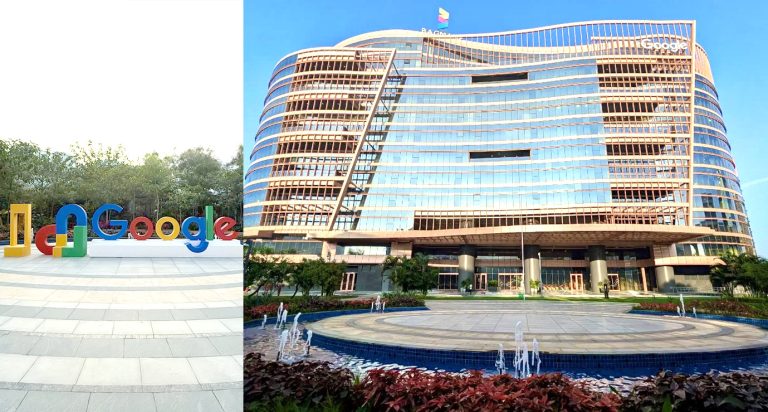
Google has opened its new campus, Ananta (meaning limitless in Sanskrit), in Bengaluru. This state-of-the-art facility is one of Google’s largest globally and represents a significant investment in India’s tech ecosystem.

According to the global technology major, Ananta embodies Google’s latest workplace design principles, fostering collaboration and innovation with features like neighbourhood-style workspaces, a central gathering space called “Sabha,” and accessibility features throughout.

The campus is also designed with sustainability in mind, incorporating 100 per cent wastewater recycling, rainwater harvesting, and a large smart glass installation.

Preeti Lobana, Vice President and Country Manager, at Google India, said “As India has charted an ambitious new reality for its citizens with technology, Google has been its proud partner over the last 20 years.”

The new Ananta campus in Bengaluru marks a significant milestone in our journey, marking the technological paradigm shift underway with AI.

“Looking ahead, I see us focused on some core areas: empowering businesses and individuals through widespread AI adoption, ensuring AI transformation doesn’t stay on the margins of the economy but creates impact in its systemic areas such as agriculture, health and fintech. We aim to work in deep partnership with India’s vibrant research and startup ecosystem while making our products become ever more helpful and ensuring that we’re taking Indians of varying talents along on this journey through skilling. I think we have a unique opportunity to drive population-scale impact and in the spirit of Ananta, the potential is infinite,” Lobana added.

In a blog, Anand Rangarajan, Vice President, of Google Deepmind; and Sunil Rao, Vice President, of Global Delivery, Google Cloud India, said, India has always played the role of a strategic nerve centre in the tech discourse–this is evident in the thriving startup and app ecosystems, the digital public infrastructure that’s transforming life for hundreds of millions of Indians, and the depth and diversity of Indian creators.

“Increasingly, we have been building from India, for the world,” the blog post read.

Ananta is designed to connect people in ways that spark breakthrough ideas and innovation

Each working floor in Ananta is organized like a city grid, with a network of streets for easy navigation. Individual ‘neighborhoods’ foster collaboration while also giving individuals the freedom to focus within smaller nooks and booths.

At the heart of the building is a vast gathering space called Sabha, for community and conversation.

Inspired by Bengaluru’s reputation as India’s Garden City, the grounds feature extensive landscaping and walking and jogging paths–ideal for casual meetings and peaceful breaks, the blog post added.

The campus recycles 100 per cent of its wastewater, harvests hundreds of liters of rainwater on-site and features one of India’s largest smart glass installations to reduce energy consumption.


(This news report is published from a syndicated feed. Except for the headline, the content has not been written or edited by OpIndia staff)

USAID, ‘US Deep State’ and looking for monsters under the bed: Why the ‘Ctrl+F obsession’ won’t help define or understand the deeper problem

A Taliban official is right now touring Japan. Theoretically, one can find fault with Japan for indulging and ‘mainstreaming’ Islamic terrorists, but that would be pedantic if not downright silly. Taliban is now the state, the official rulers of Afghanistan, and nations will have to indulge them – whether they like it or not. Anything ‘Afghanistan’ could have a Taliban link now by virtue of them being the de-facto state, and if the Taliban sustains the power for long, they could as well become the ‘deep state’ of that nation.

Essentially, reductionist and simplistic linking can throw up inaccurate and even ridiculous conclusions like the above, and this is just the rubble of a country called Afghanistan. When it comes to the USA, one similarly needs to think a little before going all red after seeing just terms like ‘USAID’ anywhere. The US deep state is, quite literally, ‘deep’ everywhere and anyone who indulged with the US in some capacity can have some footprints.

And honestly, USAID has become synonymous with the US deep state only because Musk and Trump are talking about it. Let’s be clear that Musk and Trump aren’t dismantling the US deep state per se, they are just pissed off with some of the facets around it like USAID being the funding funnel for Democrats and its spending in areas Trump finds ‘useless’. They are basically going after the Democrat ecosystem and saving some dollars, rather than dismantling the deep state as such. The US deep state will remain, but its character will change a little, depending on how far Trump and Musk go. It will become less Woke and more Christian maybe. India doesn’t gain much as such if that’s what it is.

But it gives us the opportunity to understand the deep state (on a global level, just like ‘ecosystem’ has been understood to some extent in domestic politics) and that’s what we should mostly be bothered about. Obviously, it also leads to ridiculous assertions like everything being linked to the deep state just because ‘USAID’ is found after pressing Ctrl+F.

In fact, one has to realise that USAID scandal is not an issue in vacuum. USAID was created as an agency of the US government to achieve foreign policy objectives and its funding comes from the US State Department. It is the Congress with authorises USAID programs in foreign assistance. And therefore, when Mike Benz says that USAID does jobs which are too dirty for the CIA, it is not a clandestine cabal he speaks of – it is about elements of the US foreign policy of the US itself. It becomes important to recall here that The National Endowment for Democracy (NED) is supposed to be quasi-autonomous and non-governmental, but is funded primarily by the US Congress. Carl Gershman, who was the President of the National Endowment for Democracy till 2021 is on record accepting that the recipients of NED grants are vetted and approved by the CIA.

The problem is, therefore, deeper than merely looking for USAID involvement. The problem is of US foreign policy and the clandestine manner in which several organisations work to achieve it. The USAID or the NED is, therefore, not necessarily the entirety of the “deep state”. They are the “state” which also funds “deep state” actors like George Soros, for example, who then work in a clandestine manner often to the detriment of sovereign nations. Since USAID, NED, CIA and several other US arms are connected to the government, there would be a large part of their functioning which would be legitimate to gain credibility, and others, which would be shady – like funding clandestine operatives, regime change operations, funding dubious NGOs working against the interest of independent nations etc.

USAID isn’t Taliban and they would do many things to earn legitimacy too; even the Taliban talks about women’s rights and press freedom these days. Essentially, the mere presence of USAID can’t be enough to conclude anything. Where the money went and for what the money went is most important, and one will have to go beyond mere ‘expense heads’. Spending on ‘gender equity’ could entail giving funds to build girls-only schools or to promote ‘more than two genders’ politics – one will have to figure that out and go beyond the surface.

The tentacles of the US deep state indeed are very strong in India and it doesn’t start and end with USAID. More than political (electoral), the battlefields are in the cultural and narrative domain. Actually, politics and the economy are tools or weapons to be used on that battlefield. A desired political or economic order can be sustained only when one can manipulate the thought process of people. And it’s easiest to manipulate when people are confused about their identity, history, esteem, purpose, etc. That’s what one needs to look out for – was the money being used to attack or chip away at any of these?

The first step towards fighting the deep state is to know what you have to defend. Is to know what you are. Not everyone is doing that.

India boosts self-reliance: Domestic Manufacturing of MRI, CT Scanners, and Dialysis Machines begins under the PLI Scheme

0

In a step towards self-reliance, India has now started manufacturing medical devices like MRI, CT scans and dialysis machines which used to be entirely imported earlier. According to a report in the Economic Times, the information has been confirmed by Amit Aggarwal, Secretary, Department of Pharmaceuticals.

Aggarwal said that the manufacturing is taking place under the Production Linked Incentive (PLI) Scheme of the central government which is a part of the Make in India initiative. “We have commissioned a total of 19 projects for producing 46 medical devices,” Aggarwal said. He further stated that the government has increased the expenditure on manufacturing incentives, infrastructure and ecosystem development by 44 per cent.

The Secretary further added that the government is also aiming to boost domestic manufacturing of important drugs under the PLI. For this, the government has commissioned the production of more than 175 high-value drugs including drugs for treating cancer, rare diseases, auto-immune disorders and vaccines. “Production of critical antibiotics like Penicillin-G and Clavulanic Acid has started in the country. Also, we are expecting the production of Rifampicin, a key drug used for Tuberculosis treatment, to commence next year,” said Aggarwal.

In 2020, the market size of the medical devices sector in India was reportedly estimated at Rs 90,000 crore amounting to 1.5% of the global medical device market. To boost the domestic production of medical devices and reduce their import, the Union Cabinet adopted the National Medical Devices Policy in 2023. The policy intended to establish centres of excellence in academic and research institutions, innovation hubs, ‘plug and policy’ infrastructures and support to infrastructures. The creation of a dedicated export promotion council is also envisioned under the policy which is intended to initiate learning and projects for learning from the best global practices of manufacturing.

What is the PLI scheme?

The Production Linked Incentive (PLI) Scheme is an initiative of the central government aimed at boosting domestic manufacturing of specified products by offering financial incentives. The scheme intends to establish India as a global hub for manufacturing, innovation and exports. The PLI Scheme covers 14 sectors including electronics, pharmaceuticals, medical devices, automobiles, steel, food, drones, and textiles. The management and implementation of the scheme are overseen by nodal agencies for each sector. The scheme is also supposed to reduce pollution and carbon footprint.