Home Blog Page 5883

Burqa-clad unknown person throws acid on the face of a woman in Bihar’s Kaimur district

0

A 30-year woman sustained severe burn injuries after a burqa-clad person hurled acid on her face in the Kaimur district of Bihar on Monday. According to reports, the unknown assailant entered the woman’s house in Bhagwanpur village in Kaimur district on Sunday night and threw acid on the woman before fleeing away.

According to family members, the woman was standing near the door of her house at around 7 PM on Sunday, when suddenly an unknown person arrived and threw acid on her face. The assailant escaped even before the relatives and neighbours of the woman can tell what happened. After realising the incident, they rushed the victim to the district hospital. After preliminary treatment, the duty doctor at the hospital referred her for further treatment. One side of the face and one eye of the woman was burnt in the attack.

The police said that a probe has been launched in the case. They further mentioned that it is yet to be identified if the burqa-clad person was a male or female.

The victim has been sent to a Varanasi hospital for treatment while her relatives have neither lodged any complaint with the police so far, nor have they expressed their suspicions about the identity of the attacker.

Acid attack has been one of the most violent manifestation of brutal assaults against women. A report published a few months ago said that the acid attacks against women are on the rise in India. It said that India has the highest number of acid attacks in the world, adding that every year 300 attacks are reported in India, while many others go unreported.

Of late, the safety of women in India has become a cause of great concern as reports ranging from violent assaults against women to rapes keep trickling in. Recently, the gruesome gang-rape and murder of the 27-year-old veterinary doctor in Hyderabad galvanised the people into pondering over the plight of women in the country and measures to be adopted to enhance their security and well-being.

Controversial IAS officer makes dangerous insinuations about Supreme Court if they don’t strike down CAB

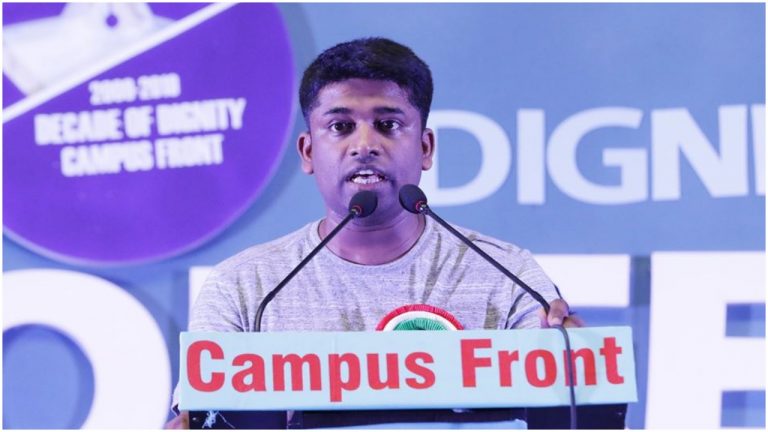
Kannan Gopinathan, whose claim to fame relies entirely on his resignation as an IAS officer supposedly over the abrogation of Article 370, is up to his usual tricks again. After attending an event “Decade of Dignity” organised by radical Islamic student organisation Campus Front of India, whose parent organisation is the controversial Popular Front of India (PFI), the former IAS officer now appears to be spreading insinuations regarding the Supreme Court.

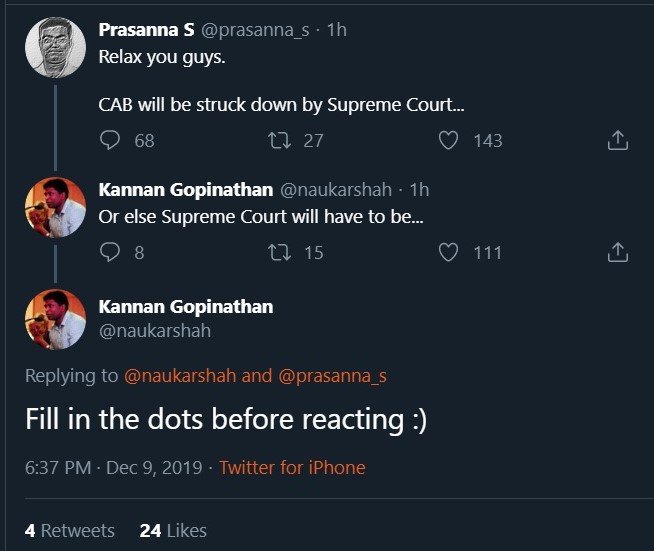
Prasanna S, a liberal lawyer, told people to relax and claimed that the Citizenship Amendment Bill, which was tabled today in Lok Sabha, will be struck down by the Supreme Court of India. Responding to the tweet, Kannan replied, “Or else Supreme Court will have to be…” It’s unclear what he meant by the tweet. He then asked people to ‘fill in the dots’ before reacting.

Source: Twitter

When people pointed out that he was sounding like a dictator, Kannan replied that “It is the other kind of dictatorship”. One wonders if he is referring to the ‘Dictatorship of the Proletariat’, which according to Marxist philosophy, is the state of affairs in which the working class hold political power. However, as good it may sound on paper, such attempts have invariably led to genocides. Although it’s not clear what Kannan precisely meant by his tweets, the insinuations he appears to be making against the Supreme Court of the country do appear dangerous.

Read- Why is UPSC producing people like Shah Faesal and Kannan Gopinathan: Structural problems that must be fixed

After Kannan submitted his resignation in light of the abrogation of Article 370, it was revealed that the officer was facing disciplinary action even before the decision to abrogate Articles 370 and 35A in Jammu and Kashmir were taken. On July 8, almost a month before the decisions on J&K, the government had issued a memorandum proposing disciplinary action against Kannan Gopinathan on several grounds. The memorandum said that the officer had been indulging in various acts of omission and commission which constitute misconduct within the meaning of rule (3) of the AIS (conduct) Rules, 1968. It said that he has indulged in act of insubordination, adoption of dilatory tactics and dereliction of duty etc.

Denial of Reality? Journalist claims India was divided on the basis of secularism, not religion

The introduction of the Citizenship Amendment Bill 2019 by Union Home Minister Amit Shah that seeks to provide citizenship to the persecuted Hindus, Sikhs, Jains, Christians, and Buddhists barring Muslims has ruffled a few feathers from the journalism fraternity. As a new result, many a ‘secular’ journalists have started raising up false alarms and preposterous assertions to criticise the tabled Citizenship Amendment Bill 2019.


One of the grieving journalist-Shivam Vij, known for his perpetually dithering opinions, seems to have been thoroughly rattled by the Citizenship Amendment Bill 2019. In stark denial of reality, Vij claimed that the partition of undivided India happened on the basis of secularism and not on the basis of religion.

Vij posted a tweet repudiating Union Home Minister’s statement that the partition of the country happened on the religious line. “Amit Shah says partition of the country happened on the basis of Religion. FALSE. It took place on the basis of secularism. One country chose secularism and one side rejected it,” Vij tweeted.

Responding to the opposition’s claim that the Citizenship Amendment Bill 2019 runs contrary to the principles of equality and secularism enshrined in the Constitution, Shah lambasted the Congress party for being responsible for dividing the country on the grounds of religion.

Read: The Print’s contributing editor Shivam Vij accused of inventing fake quotes and twisting facts to peddle liberal propaganda

“The Citizenship (Amendment) Bill wouldn’t have been needed if the Congress had not allowed partition on basis of religion. It was the Congress that divided the country on religious lines, not us,” Shah exclaimed in the Lok Sabha during the debate on the bill.

However, Vij, known for overtly harbouring sympathies for the Congress party, quickly came to its defence, by not only turning his back on the country’s recorded history but also unabashedly distorting it.

India was divided into present India, West Pakistan and East Pakistan (now Bangladesh) because a significant Muslim population couldn’t stand the Hindu preponderance in the undivided country. Their insecurity and apprehensions were stoked by Muslim League’s rabble-rousing leaders with the aim to drive a wedge between the two communities. The Congress party, on the other hand, utterly failed in dismantling the Muslim League’s highly communalised propaganda and preserving the country’s territorial integrity. It gave in to the Muslim League’s demand for carving out a separate and secure homeland for the nation’s Muslim majority.

Muslim League wanted a separate nation for Muslims, and the Congress party agreed to it. Therefore, the partition happened because of religion, not secularism.

While many argue that the country was divided on the religious line because of the Congress’ refusal to share power with the Muslim League, a raft of historians believe that it was Jawaharlal Nehru’s thirst for power that emboldened Jinnah in his pursuit to create Pakistan.

The partition of the country, as Shivam would have us believe did not happen on the basis of secularism. In fact, it happened, on the premise of ubiquitous religious division. Millions of Muslims migrated to Pakistan, because they wanted to live in an Islamic nation while millions of Hindus were forced to shift to India because they felt threatened to live alongside Muslim supremacists who dreamt of having a ‘purged’ land for themselves.

Read: Shivam Vij is the ‘Kachcha Nimbu’ of ThePrint that gets to bat from both sides

This inter-community antagonism stemmed from the fact that India witnessed waves of communal riots following the advent of Islamic marauders in the country. The animosity between the two communities – Hindus and Muslims – widened when these Islamic rulers, who are often hailed by liberals as paragons of secularism, sanctioned, promoted and incentivised the massacres of Hindus just because they refused to embrace Islam. Hindus remained in the subjugation of the numerically inferior Muslims until the Mughal regime ended.

In fact, one of the founding principles of Pakistan was the revival of the “Islamic Glory Days”, referring to the above period of sprawling Muslim rule over the Indian subcontinent. However, for the liberal coterie, the continued subjugation of Hindus and the hegemony of Muslims is what secularism stands for. It is for this reason that Shivam claims that Pakistan was created on the basis of secularism and not on the basis of religion.

With this denial, Shivam not only attempts to distort the history, but he also proceeds to insult the deaths of millions of people who perished because of Pakistani leaders’ two-nation theory-a demand to partition India on the basis of religion.

JNU ‘students’ march to Rashtrapati Bhavan to protest against fee hike, police lathi charge to control the unruly mob

0

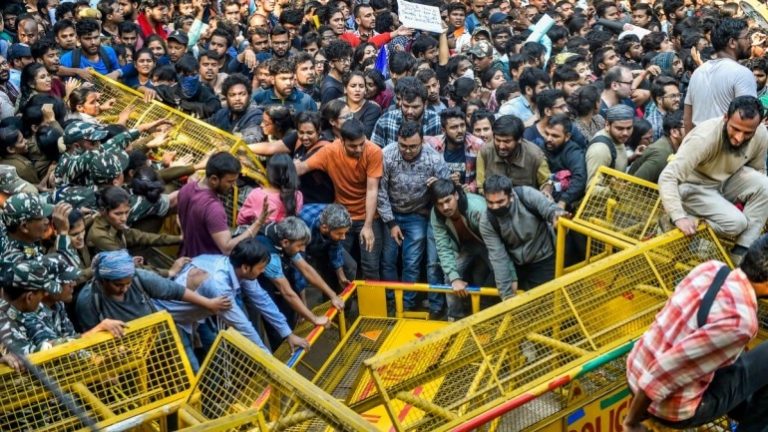
The Jawaharlal Nehru University (JNU) students who have been in loggerheads with the university administration over the draft hostel manual which mentions a marginal increase in fees along with few other changes in rules, marched towards Rashtrapati Bhavan today, seeking to meet the President over the fee hike issue.

As the unruly mob tried to cross the Bhikaji Cama Place Metro station, which was cordoned off by the police, jumping over barricades erected there, Delhi police launched lathi-charge to take control of the crowd. Television visuals showed police pushing back students who tried to jump over barricades en route the President’s house.

This morning, police had tightened security around JNU, blocking traffic on nearby roads and appealing to protesters to not resort to violence. Entry and exit points of the Udyog Bhawan, Lok Kalyan Marg and Central Secretariat Metro stations were also closed over concerns that the students may use the intra-city rail system to make their way to Rashtrapati Bhawan.

The protesting students had organised the march after the university administration rejected the student’s demand for a complete rollback of fee hike, explaining its rationale behind it, saying that the university is facing a deficit of Rs 45 crore and fee hike is necessary because of the huge electricity, water charges and the salary of contractual staff.

The “students” of JNU have continued to protest against the marginal hostel fee hike.

The students had earlier emailed their demands to President Ram Nath Kovind, demanding an immediate rollback of the proposed fee hike, resignation of the Vice-Chancellor and withdrawal of all police cases against agitating students.

In November, JNU students had marched towards the parliament chanting anti-fee hike slogans and carrying placards and posters.

Calling the partial rollback ‘cosmetic‘, the students have in the past, clashed with the police, heckled reporters, violently confined a female professor, who was roughed up and assaulted with filthy slurs during their ongoing protests. Besides, the JNU campus was mercilessly defaced by these goons.

Pro-AAP blogger Dhruv Rathee shows his ‘WhatsApp University’ credentials, claims India was not partitioned on religious grounds

Pro-AAP blogger and YouTuber Dhruv Rathee is a known peddler of fake news. In October, it was announced that he and his favourite politician Arvind Kejriwal would face trial in a defamation case after the former shared a slanderous video against a BJP supporter. There have been occasions in the past when he has attempted to expose the BJP but revealed his own biases in the process. The CAB, again, provided a golden opportunity for Dhruv Rathee to reveal his terrible knowledge of Indian history.

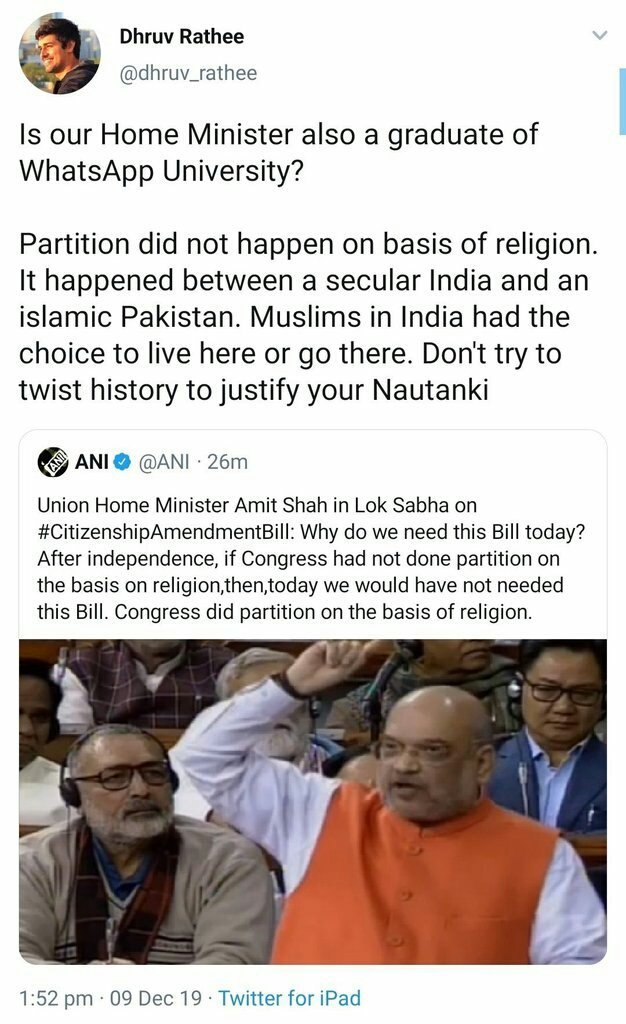
Dhruv Rathee first claimed that India was not partitioned on the basis of religion. It happened between a ‘Secular India and an Islamic Pakistan’ he claimed, demonstrating his complete lack of common sense and basic knowledge.

Read: Pro-AAP blogger Dhruv Rathee tries to expose BJP spokesperson, exposes his own low IQ

He suggested that Amit Shah was a graduate of ‘WhatsApp University’ and accused him of twisting history when, in fact, he was the one guilty of engaging in the most egregious distortion of history. Dhruv Rathee appears to have deleted the tweet from his timeline.

Source: Twitter

Soon after, Rathee tweeted another rebuttal to Amit Shah’s assertions where he claimed that he was talking like a ‘WhatsApp Graduate’. His shamelessness is only exceeded by his utter lack of integrity.


The claim that ‘Congress was against partition and tried their best’, of course, has no basis in fact. It was under their watch that the country was divided. And no amount of historical revisionism by the likes of Dhruv Rathee will absolve the party of its sins.

Read: Propagandist Dhruv Rathee mocks Manohar Parrikar’s death to score political brownie points

The attempt to demonize Hindus for the outcome when the Congress party and Gandhi had supported Islamic Nationalism and the Ummah at every step along the way is sheer hypocrisy of the highest order. But then, of course, it’s nothing less than what can be expected from a charlatan.

From wanting modern day ‘Mahatma’ to fast unto death, to ‘everyone is a piece of shit, ‘Liberals’ lose their mind opposing CAB

The Citizenship Amendment Bill was tabled by Home Minister Amit Shah in the Parliament today. As expected, the Opposition came up with a series of bizarre arguments against the Bill. The journalists weren’t too far behind. On social media, it was an all-around meltdown in the ‘secular’ camp.

Shama Mohamed, a national media panellist for the Congress party, claimed that the Bill is an insult to Indian Muslims despite the fact that it has nothing to do with them at all. It appears a deliberate attempt to fuel divisions within the country.


Compulsive hatemonger Arfa Khanum Sherwani wasn’t too far behind either. She claims that the Bill changes the basic structure of the Constitution. She went ahead to claim that onus to ‘Save India’ was now on Hindus.


According to Suhasini Haidar, an editor at the newspaper ironically named The Hindu, India is debasing itself by providing citizenship rights to religious minorities in Islamic States where non-Muslims suffer rampant persecution due to their religion.


Rajdeep Sardesai, agenda-peddler in chief, claimed that ‘wounds that were healing’ were being opened up because Amit Shah mentioned the religious persecution faced by Hindus in Bangladesh. It appears, according to him, India should abandon the Hindus of the subcontinent to their fate because it might hurt the feelings of India’s ally.


The meltdown was much more obvious in certain other quarters. Vidya Krishna, who features in The Hindu and The Caravan, called people ‘a piece of sh*t’ for exercising their voting preferences in the elections.


Meanwhile, Barkha Dutt is looking for a ‘modern-day Gandhi’ who will fast unto death against the Bill. Social Media users are wondering why wasn’t she volunteering for the purpose.


Zafar Abbas, another ‘journalist’, expressed his bewilderment at the fact that Amit Shah is the Home Minister of the country for stating the obvious.


Rohini Singh, infamous for her biased reportage during the UP Assembly Elections, called the Bill which provides citizenship to persecuted religious minorities ‘one of the most evil exercises’.


Then there were, of course, the likes of Sreenivasan Jain, who claimed that Muslims are minorities in the Islamic States of Pakistan, Bangladesh and Afghanistan. One would have hoped that the ‘secular’ camp would see the obvious necessity of the Citizenship Amendment Bill, however, it appears it’s too much decency to expect from them.

Despite Kulbhushan Jadhav giving power of attorney to Indian High Commission, Islamabad insists only a Pakistani can represent him in court

0

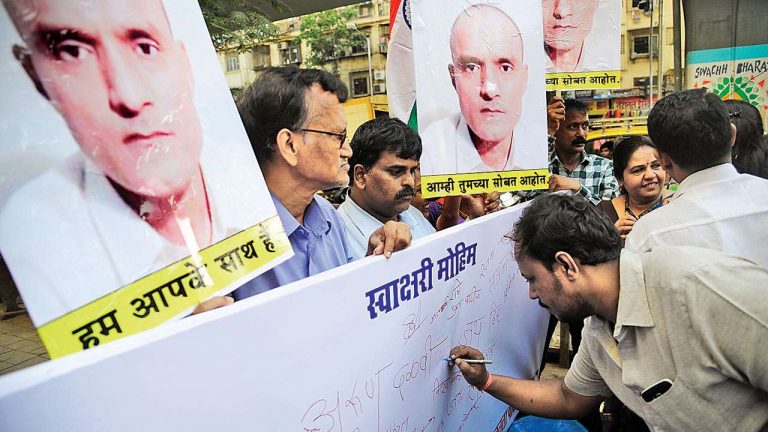
Pakistan’s double-standards in its dealing with Kulbhushan Jadhav’s case was once again on display after the authorities in Islamabad told the Indian side that only a Pakistani can represent him in the court. This announcement came even as Pakistan said that it is in the process of taking further legal steps in Kulbhushan Jadhav’s case.

In a tweet last month, the Pakistani army had said that “various legal options for review and reconsideration” for Kulbhushan Jadhav are being considered and “final status shall be shared in due course of time”.

During the consular access given to India on September 2, 2019, a power of attorney was signed by Jadhav under which he has allowed the Indian high commission in Islamabad to represent him for further legal recourse.

However, as per reports, the Pakistani authorities have stated that only a Pakistani will be allowed to represent Jadhav in court.

The Pakistani army also dismissed reports of amendment in Pakistan Army Act so that Jadhav can appeal in a civil court on the military court’s order.


Incidentally, media reports had stated that the government of Pakistan is in the process of amending its Army Act in accordance with the decision by the International Court of Justice in the Kulbhushan Jadhav case. Reportedly, the laws were to be amended to allow Kulbhushan Jadhav to file an appeal in a civilian court in Pakistan.

As per existing laws under Pakistan’s Army Act, Kulbhushan Jadhav was forbidden from filing an appeal in Pakistan’s civilian courts. However, after the ICJ gave its verdict in India’s favour and stayed the death sentence pronounced for Jadhav, and further allowing consular access to India, the ICJ had asked Pakistan to allow Jadhav to file an appeal in civilian court.

The International Court of Justice (ICJ) headquartered in The Hague, The Netherlands had in July directed Pakistan to stay Jadhav’s execution and allow him consular access. Based on ICJ’s verdict in a 15-1 decision on July 17, Pakistan had on July 30 sent its first proposal to India but with 2 riders attached. One that Pakistani security personnel will be present during the meeting and second there will be CCTV cameras present in the room.

After the ICJ verdict stayed the execution and allowed India consular access, India had declared that it will now push for shifting Jadhav’s case to a civilian court, to ensure he gets proper legal representation.

After the consular access was finally granted in September, India has stated that Jadhav is under extreme pressure by Pakistan to parrot a false narrative.

Ahmadiyyas were at the forefront of creation of Pakistan, an Ahmadiyya Unit fought against India in Kashmir in 1947-48

The Citizenship Amendment Bill was tabled in the Parliament today amidst much ruckus and chaos by the Opposition and one community smack in the middle of the debate was the Ahmadiyya community. Ahmadiyya Community is a sect of Islam that is often persecuted in Islamic countries because Islamic nations believe that the community is not “Muslim enough”.

While the persecution of the community is tragic, it is indeed an internal problem of the Islamic community. With respect to the Ahmadiyya community in Pakistan, a fact that is lesser known is that the community was at the forefront of the creation of Pakistan.

One of the foremost advocates for Pakistan was Muhammad Zafrulla Khan who was an Ahmadiyya. The Lahore Resolution of 1940 was authored by Khan himself. Commenting on his role, one commentator wrote, “[T]here needs to be a realisation that Jinnah was the ‘lawyer’ for the case of Pakistan. He argued for it and won. However, Jinnah was never the visionary or a revolutionary strategic thinker to guide the course of the nation. If anybody at all in Muslim League was a strategic thinker, it was Sir Zafarullah Khan, who was also the author of the Lahore Resolution, which for the first time chalked out the idea of Pakistan. Khan, however, belonged to the then Islamic sect of Ahmadis and thus his role over the years was kept a secret, until recently when documents and letters written by Lord Linlithgow revealed the centrality of his role. Hence, there should be a little less stress on ‘Jinnah’s Pakistan’, because honestly, there is none; and scratching out Jinnah’s vision forcefully has only served to confuse the people and obfuscate the roadway to progress”.

Read: India: A land with Hindu consciousness, which will forever be a natural home for Hindus

According to the book, ‘Facts are Facts’ by Khan Abdul Wali Khan, Viceroy Lord Lithinglow sought Zafarullah Khan’s help who then studied the matter and brought a draft proposal for the partition of the country. The Viceroy wrote, “Upon my instruction, Zafarullah wrote a memorandum on the subject. Two Dominion States. I have already sent it to your attention. I have also asked him for further clarification, which, he says, is forthcoming. He is anxious, however, that no one should find out that he has prepared this plan. He has, however, given me the right to do with it what I like, including sending a copy to you. Copies have been passed on to Jinnah, and, I think, to Sir Akbar Hydari. While he, Zafarullah, cannot admit its authorship, his document has been prepared for adoption by the Muslim League, with a view to giving it the fullest publicity.”

Zafarullah Khan went on to become the first foreign minister of Pakistan. He also represented Pakistan at the United Nations on the Kashmir issue. Ultimately, he was forced to resign after the monster he had helped create devoured on his own people. He is even regarded by some as one of the founding fathers of Pakistan.

Read: CAB necessary because Congress divided the country on the basis of religion, does not violate the Constitution: Amit Shah

Not only the Zafarulla Khan but the Caliph of the Ahmadiyyas at the time, Mirza Basheer-ud-Din Mahmood Ahmad, too, came out in great support for the creation of Pakistan. In the 1946 elections, he advised the Ahmadiyyas to vote for the All India Muslim League and support the demand for the creation of Pakistan on which the elections were fought.

Mirza Mahmood also directed the creation of the Furqan Force, a uniformed fighting force of volunteers comprised entirely of people from the Ahmadiyya sect. The unit fought for Pakistan against India during the first war for Kashmir in 1947-48. Even the expenses for it were paid by the sect itself. He also founded the All India Kashmir Committee in 1931 and the Ahmadiyyas influenced the Kashmiri Muslim identity greatly in the 20th century.

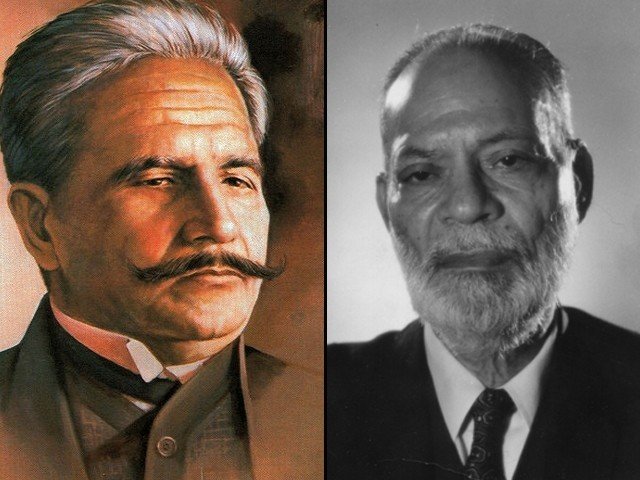
Not merely that, even Muhammad Iqbal, who is referred to as the ‘spiritual father’ of the Pakistani state, was an Ahmadiyya for the most part of his life. He staunchly advocated for the creation of an independent Islamic state and had full faith in the Ummah. It was only during his later years that he quit the sect. It is widely known that he remained in touch with the Ahmadiyya leadership till 1931, when he vouched for the Ahmadi Khalifa as the most able person to lead as the first president of the newly founded all-India Kashmir Committee. His parents and elder brothers remained Ahmadiyyas.

Congress leaders want Rahul Gandhi back as President but want mommy Sonia to handhold him, journalist close to party reveals

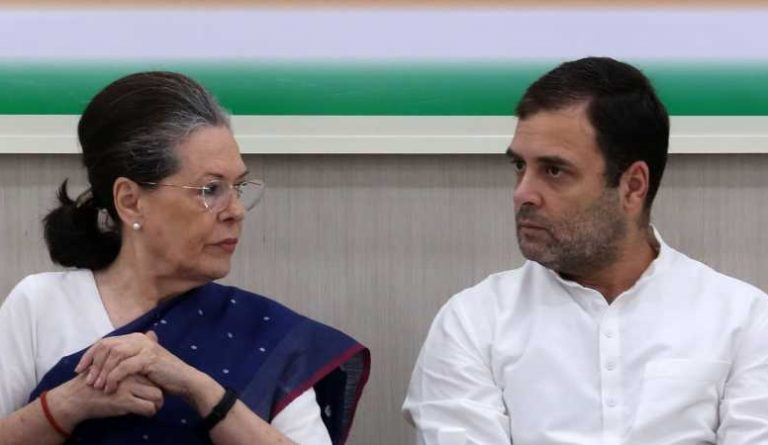
Even as the Congress party remains undecided on selecting a full-time president, the party faces a huge dilemma on Rahul Gandhi. According to journalist Rasheed Kidwai, who is very close to the Congress party and the Gandhi family, while most leaders want Rahul Gandhi back as president if Sonia Gandhi does not want to carry on as interim president, Rahul Gandhi is not favoured as a poll campaigner by most leaders.

Writing in Tribune India, Kidwai narrates the internal thoughts of the country on the matter of president. According to him, Sonia Gandhi is emulating Indira Gandhi in many ways, including promoting her son in politics. But unlike Sanjay and Rajiv Gandhi, Rahul Gandhi has not become the most acceptable leader withing the Congress party, let alone among the voters.

Kidwai writes that Sonia Gandhi is unwilling to continue as interim chief of the party due to health issues. Moreover, she is no longer interested in full-time politics. Therefore, she is asking the party leadership to find her successor soon. And the most common name suggested for the next president of the party is Rahul Gandhi. But while most leaders want Rahul Gandhi to replace his mother, they also don’t want to lead the party alone without the oversight of Mrs Gandhi. Kidwai says that the Congress leaders “do not relish the prospects of him as head of the party in Sonia’s absence.”

Read: The fall and fall of Rahul Gandhi

According to Kidwai, while the mother and son share a strong personal bond, the top leadership of the party is clearly divided as loyalists both of them. He writes that Rahul’s style of functioning is not liked by most Congress leaders. He is rarely sought as a poll campaigner, and his own defeat in Amethi in Lok Sabha election is a big negative for his image among the party workers. Rasheed Kidwai notes that Rahul Gandhi relied on lies during the election campaign, and the party leaders are not very happy about it. He writes that “from Rafale to Doklam, Rahul’s allegations lacked facts, figures and details.” Kidwai also notes that “Rahul miserably failed to influence undecided voters, disgruntled farmers and millions of those who make up their voting decision closer in the 2019 General Election.”

Kidwai also talks about the predicament of Rahul Gandhi returning as president, as he has been advocating intra-party democracy for a long time. Ideally, the party should hold an election for the post of the president where Rahul Gandhi contests. But there is a problem in that also, as hardly any leader will like to contest against him. Therefore, even if there is a poll, Rahul Gandhi is sure to win if he contests.

Despite a setback in Maharashtra, Amit Shah remains the undisputed Kautilya of modern Indian politics

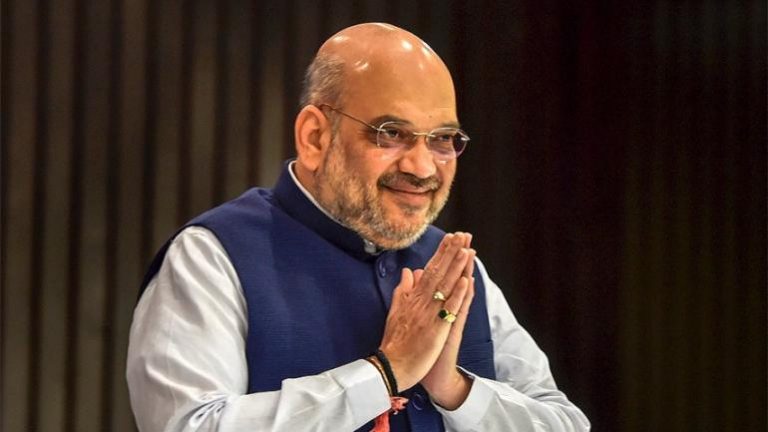
Not for nothing is Home Minister Amit Shah called the modern-day Kautilya. Shah is a master strategist known for his political acumen and statecraft which enables him to register bloodless victories over his enemies, pulverize entrenched regional satraps, and prevent the Balkanisation of India through moves such as the abrogation of Article 370.

Niccolo Machiavelli (the purported Kautilya of the western hemisphere) had in his seminal treatise – The Prince – remarked upon the essential qualities of a successful political leader, thus: “… a good leader must combine the qualities of the lion and the fox, striving to be brave as one and as crafty as the other. It is not sufficient to be like the lion only, for lions do not know how to protect themselves from traps, nor like the fox only, for foxes are unable to defend themselves against wolves…”Amit Shah has, time and again, outwitted and outclassed his opponents for he is the living embodiment of Machiavelli’s description of an ideal politician and Kautilya’s exhortations on the essentials of Neeti-Shastra.

However, after securing a massive mandate in the 2019 Lok Sabha elections, BJP floundered, unexpectedly and disappointingly, in the formation of government in Maharashtra.

Read: ‘Keeping BJP out’ isn’t a winning strategy, and the opposition parties seem to have learnt nothing from history

The reliably biased fourth estate has gone ballistic in saying that Shah is no longer the Kautilya (the venerable mantle, apparently, going to the Maratha strongman) and it is hubris that has been his undoing. Nothing could be further from the truth. Shah has over the past 5 years, fundamentally, changed the prevailing political mores of India – and this in itself is sufficient for him to be called the worthy successor of Kautilya, an electoral reverse or two, notwithstanding.

It would be instructive to look at the Haryana elections and the abrogation of Article 370 to fully appreciate the contours of Shah’s prodigious genius.

Haryana Elections

Historically, politics in Haryana has revolved around the issues of identity – caste, not religion – particularly those of Haryana’s chattis biradaris (36 communities). In 1996, Bansi Lal fought the elections on the issue of liquor prohibition (not caste) and won handsomely too. However, soon he reverted to the tried-and-tested template of identity politics realizing that prohibition has very little political mileage left.

Of the 36 biradaris, Jats – constituting a single biradari – have always occupied an outsized presence in the state’s politics as opposed to the non-Jat biradaris (Sainis, Punjabis, Khatris, Banias, etc.) whose constant in-fighting and sniping, also, did not help their cause.

Haryana: Haryana and Maharashtra Assembly Elections 2019: Lessons and the role of the candidates, citizens and the media

However, in 2014, Shah worked assiduously to unite the 35 non-Jat biradaris into a single, cohesive voting bloc which would put up a united political front to the hegemony of Jats. His social engineering paid off handsomely and for the first time in Haryana’s electoral history, a non-Jat (Punjabi in this case) became the CM with BJP winning a simple majority of 47 in a 90 seat assembly.

In the 2019 assembly elections, however, BJP performed below par, failing to cross the half-way mark, due to 2 major reasons: first, counter-consolidation of Jats behind Hooda and Dushyant Chautala against Khattar’s stridently non-Jat regime; second, cutting of BJP’s non-Jat votes by good JJP candidates. However, in the end, by forming a coalition government with JJP (as the junior partner), Shah played a masterstroke – the optics of a Jat serving as a deputy to a Non-Jat will consolidate BJP’s non-Jat vote bank as non-Jats, generally, view Jats as oppressive. This would not only help stem the attrition in BJP’s core vote bank in the state but would also deal a death knell to Jat politics for some time to come.

Even if tomorrow, say, JJP ditches the coalition, Shah can always expect the tall Jat leaders of Congress to do a Bhajan Lal – that is forming their own splinter group of MLAs who have defected from Congress and supporting BJP on the pretext of a nationalistic issue. Why? Because, these Jat leaders, when they could not get favourable terms from the Congress high command, turned rebels and were quite vocal in their support for PM Modi and Shah over the abrogation of Article 370. This should be indication enough on how things can change overnight owing to political expediencies and fear of court cases.

Clearly, Shah has covered all his bases in Haryana and left everyone else to fend for themselves off the crumbs.

Abrogation of Article 370 and Amit Shah

Ideas sometimes take a long time to fulfil in practice. Even when India was sauntering along the misleading road of Fabian socialism and a misguided hard-separation of religion and state in the name of secularism, some nationalistic Indians, vividly, imagined a time when the Kashmir issue would be resolved and India’s self-esteem redeemed. This idea reached its fruitful consummation when Shah abrogated Article 370 in August – a rare real-life case of poetic justice.

The sharpest thorn in Indo-Pak relations has been Kashmir. Nothing has bedevilled them more than this beautiful mountainous state and the Himalayan blunders committed by India’s first Prime Minister, Jawaharlal Nehru. In fact, Nehru’s policies regarding Kashmir were blinkered, muddled, and a vestige of hopeless romanticism; helped in no less measure by (a) his desire to project himself as a statesman diplomat on the global stage, one who believes in conciliation and not hard realist stands, (b) his Kashmiri ancestry – Nehru is said to have confessed to a British officer: “In the same way as Calais was written on Mary’s heart, Kashmir is written on mine”. Calling for plebiscite, giving a long rope to Sheikh Abdullah and allowing him to create a personality cult around himself, going soft on Pakistan’s transgressions, and last but not the least, imposing article 370 in the state to give it an autonomous status within the federation of India – all of them compounded the problem in Kashmir for decades to come.

Read: Jammu and Kashmir includes PoK and Aksai Chin too, will lay down life for it: Home Minister Amit Shah roars in Parliament

Kashmir had always been a part of the concept of Pakistan and the letter ‘K’ in its name stood for Kashmir. As the Pakistan minister for Kashmir affairs said in 1951, and this has been Pakistan’s line ever since, “Kashmir is an article of faith with Pakistan and not merely a piece of land or a source of rivers” By giving autonomy to Kashmir, under Article 370, Nehru only helped fan the further alienation of Kashmiris who caught between the cross-fire of India and Pakistan, desired to seek refuge in Pakistan – a state where their religion – Islam – was the state’s religion.

This autonomy had two more disastrous fallouts. First, local regional parties like the NC and PDP became power brokers who would cosy up to Pakistan, to garner a few more votes at the cost of India’s sovereignty and security. Second, it created a fertile ground for a militant insurgency which has vitiated the atmosphere of the valley ever since.

The courageous displayed by Amit Shah in taking the decision to abrogate Article 370 was not merely a masterclass in statesmanship and realpolitik but was righting a historical wrong. Now, finally, after so many years of strife, blood, and violence, Kashmir can move forward on the path of development, maybe slowly, but surely.

Prince Otto von Bismarck (1815-98), Germany’s Chancellor who revenged past humiliations inflicted on the German people by defeating their enemies to create a unified state in 1871, had famously said, “Politics is the art of possible. The great questions of the day will not be settled by means of speeches or consensual decision making in a parliament, but by iron and will. A government must not waiver once it has chosen its course. It must not look to the left or right but go forward, boldly and unerringly. Had he been alive today, his heart would have swelled on seeing Amit Shah and his ingenuity in politics and affairs of state.