Vangipurappu Venkata Sai Laxman, famously known as Very Very Special Laxman or VVS Laxman was born on this day in 1974, regarded as one of the greatest players of spin and pace.
VVS was quite severe against the greatest Test team of his era, Australia. Home or away, Tests or ODIS, he scored runs at will against them.
VVS also is known as the savior for the Indian team, most of his runs came whenever India was in deep trouble. Nobody can forget the Kolkata Test, the best test innings played by an Indian cricketer.
Here are some of the best quotes on VVS Laxman by some of the legends of the game.
Always the artist, never the superstar. – Harsha Bhogle
When VVS bats, you just stand at the other end and watch & tell yourself not to get carried away. – Sachin Tendulkar on his Indian
On his day he could beat even 22 fielders and find the boundary. – Zaheer Khan
If Sachin is called the God of Cricket, then you, VVS is the angel we all strive to be. – Murali Kartik
You didn’t bowl badly, you just came up against the player who I think is that’s the best batsman of spin bowling that I have seen. – Ian Chappell to Shane Warne during the Kolkata Test, 2001
Laxman could potentially play shots on either side of the wicket to any given ball. – Muralitharan
If you get Dravid, Great. If you get Tendulkar, Brilliant. If you get Laxman, it’s a Miracle. – Brett Lee
The greatest innings ever played by an Indian still belongs to him. – Bishan Singh Bedi
He’s never changed, and if the Indian Team is in trouble. I’ll still search for Laxman to walk out as assurance. – Pullela Gopichand, badminton player
I enjoyed Laxman’s batting from the other end. It was like watching a highlights package. – Rahul Dravid, after his mammoth partnership with VVS during the Kolkata Test, 2001.
VVS is one of the finest human beings to have played cricket. One of the main pillars of the team and a true friend. Words are not enough. – Virender Sehwag
I feel sadder at VVS’s departure than Dravid’s. With Dravid, I respected *what* he did. With Laxman, I loved *how* he did it. Magic.– Ramesh Srivats, Twitter celeb
A wizard among muggles – Sharda Ugra, Cricinfo
That was the brightest day in Laxman’s career. That innings had a big impact on Indian cricket. It had given us a huge sense of relief and made us have belief in ourselves that we’re not behind… Since then, we never looked back as Indian cricket kept improving. – Sourav Ganguly on Laxman’s 281 in the 2001 Kolkata Test against Australia
Not many batsmen made batting look as easy as VVS Laxman. If a cricketer’s greatness is to be measured in terms of his performances against the best opposition of his time, then Laxman stands right at the top; his record against Australia, the world’s No. 1 team for the better part of his career, speaks for itself. Indian cricket-lovers and the game of cricket itself will miss him for the elegance and grace that he epitomized, on and off the field. Former BCCI president N Srinivasan on VVS retirement.
The Congress government in Madhya Pradesh’s Hoshangabad has taken back already printed and distributed invitation cards after realising that they had the image of Deen Dayal Upadhyay printed on them.
Madhya Pradesh:Invitation cards published (Pic1) for state foundation day (Nov1) celebrations, in Hoshangabad, have been changed as Congress allegedly opposed printing of Deen Dayal Upadhyay’s image on them.Already distributed cards being taken back in exchange for new ones(Pic2) pic.twitter.com/ssoYIf4HuN
As per a report in ANI, in Hoshangabad, Madhya Pradesh, cards were first printed and distributed for the celebration of the state formation day on November 1. However, after realising that the cards have the image of Pandit Deen Dayal Upadhyay on them, the Congress administration has decided to take them back.
The cards which were already distributed are also being taken back in exchange for new cards, the report states.
The new cards being printed have the same programme schedule, just the image of Pandit Deen Dayal Upadhyay at the top of the card has been removed.
However, this is not the first time the Congress leaders have displayed their dislike for the former RSS stalwart and former president of the Jan Sangh, the political outfit that eventually became the BJP.
In Rajasthan, Ashok Gehlot’s government had removed Pt. Deen Dayal Upadhyay’s name from state scholarship tests soon after it came to power last year.
Similarly, Bhupesh Baghel’s Congress government in Chhattisgarh had removed Upadhyay’s name from government welfare schemes and had replaced them with the names of Rajiv Gandhi and Indira Gandhi.
Security heightened in Delhi Airport as RDX was reportedly found in the suspicious abandoned bag at Indira Gandhi International Airport, Delhi, Terminal 3. While initial tests suggest the material is RDX, the same is sent for further tests.
As per reports, Delhi Police got a call at around 1 AM that a suspicious bag was found near gate no. 2 of arrival terminal. The bag was then removed by the police and checked for content.
Delhi: Security tightened at Terminal 3 of Indira Gandhi International Airport after a suspicious bag was spotted in the Airport premises. pic.twitter.com/7CkuNqJbCs
Bomb disposal squad and dog squad were called immediately to the spot and the roads outside T3 were blocked.
Special cell and intelligence bureau have started probe. Formal take over from CISF to happen shortly. No threat as the suspect device was “diffused” in a cooling pit around 3am. #BombAtDelhiAirporthttps://t.co/OnT8ief476
The special cell and intelligence bureau has started probe and will formally take over the investigation from CISF shortly. The explosive was diffused at around 3 am.
Update: As per reports, the bag in which suspected explosives was found was kept near pillar no. 4 at arrival terminal in T3. It did not come from any flight. As of now the CISF has not confirmed the RDX nor have they disclosed the weight. There is no imminent threat and no need of panic.
If there is one festival during which every Bihari wants to be home, it is Chhath. It touches an emotional chord with Bihari populace and is more than just a festival like Diwali, Holi and Durga Puja. Chhath Puja is a festival when the entire family gets together in celebration and none wants to miss. Almost exclusive to Bihar (including Jharkhand), the four-day festival of Chhath is dedicated to the Sun God and his two consorts, Usha and Pratyusha.
In Bihar, the festival dedicated to Sun and Chhathi Maiya (Mother Shashti or Usha) is celebrated with rigorous and strict manners of preparation. The Sun is worshipped as the prime source of energy that sustains all lives on the Earth.
Usha and Pratyusha are the two wives that are considered as the energy of the Sun God Himself. Therefore, the first offering, evening Arghya is offered to Pratyusha, the last ray of the Sun God; and the morning Arghya is offered to Usha, the first ray of the Sun.
Both Ramayana and Mahabharata have references of the festival being celebrated by Sita (after Lord Ram’s return to Ayodhya), and by Draupadi. It has Vedic roots as Goddess Usha is one of the Goddesses mentioned in the Vedas and there are several mantras dedicated to her.
As soon as Diwali is over, Bihar gets into Chhath mode. Every nook and corner of the state is serenaded by the Chhathi Maiya songs sung, almost every single time, by Bihar’s own daughter Padma Shri Sharda Sinha. From ‘Uga ho Suruj dev’ to ‘Marbau re sugaba dhanush se’, these songs reflect the life and culture of rural Bihar.
Image credit: Ajeet Bharti
The villages and towns get into a cleaning mode where it is a community service. It is not left to the people who are paid to clean the streets. The whole path from homes to the ghat, the water bodies where Arghya is offered to Sun, is rid of weeds, pebbles and other dirty items.
The four days of Chhath Puja
Day one: Nahay-Khaay (literally, bathe and eat)
As the name suggests, this day the process of purification for the Vratin(the lady who does the Vrat, or fasts for the festival) starts with her taking a bath and eating seasonal vegetables along with rice and dal. The dal is made of gram (or chickpea), and the vegetable curry is of Lauki (or Kaddu as it is called in Bihar) along with chana saag (a delicacy made of leaves of chickpeas). This food that the Vratin consumes is a prasad which the whole family eats later. Vratin’s food doesn’t have any salt in it.
Image credit: Ajeet Bharti
This day (or the next day, as convenient) the Vratin, with the help of others in the family, washes the wheat that will be used to prepare various offerings to the Sun god. The wheat is washed with the utmost care and spread to dry. The kids are given the duty to see no dirty thing falls into it. They have to make sure the birds don’t eat (or poop on it while flying over!).
Thakua preparation in full swing on the day. This wheat is either ground inside the homes on the Jaata (a small version ofthe mill that is operated by hands and grinds grains to flour) or sent to the village mill (which is washed and purified with gangajal for the festival purposes). The flour is used to make several sweet delicacies as well as rotis and puris for the prasad.
Day two: Kharna
The Vratin fasts for the whole day without taking even a drop of water. It is a strict fast where she has to make sure she doesn’t touch any dirty things and, of course, doesn’t eat or drink. In the evening, she will cook a meal for the family, Tasmai and Puri. Tasmai is similar to kheer as it is prepared with milk, sugar and rice. However, the milk must be from a cow whose calf is alive. No water is added to milk while cooking the Tasmai.
Image credit: Ajeet Bharti
In the evening, after the cooking is done, the Vratin, in closed doors does the rituals where she offers Naiwedya to various deities as well as Gram Devta and Kul Devta. The Naiwedya is prepared from chapatis, Tasmai and bananas and spread over a banana leaf.
The Vratin would offer prayers inside as the house goes silent for a few minutes because any sound might break her concentration while praying and breaking her fast. She eats the food that was prepared by her.
When she is done eating, she will deliberately leave some food on the plate which is considered to be pious and is eaten by the family members as prasad. In fact, kids fight to eat them as it is akin to the purest form of blessing one could ever get.
As she opens the door, someone would bring out the Naiwedya from inside and all family eats it. Later, the food prepared by the Vratin, Tasmai and Puri, is served as supper to the family.
Day three: Sandhya Arghya (the evening offering)
On the third day, the Vratin starts her fast again which would last till the next morning. It is roughly 36 hours from her last meal, again without a drop of water the whole day.
Image credit: Ajeet Bharti
This day the family, normally the kids or younger children, would prepare the baskets, and soops (a bamboo-made winnowing basket of sorts) which would have various sweets like thakua, ladua, saanch, and anything that grows around that time (from sugarcane, oranges, apples to radish, banana, dry fruits, pod corn etc.).
The male members carry the baskets over their head from the home to ghats. The whole path is cleaned and watered and purified to maintain the sacredness of the whole process. The baskets are laid open at the ghats where the Vratin will take a dip, pray to the last rays of the Sun and Pratyusha.
Then she will take every basket in her hand with a Diya (earthen lamp), and face the Sun as the family as well as community members will offer Arghya by pouring water and milk in front of the basket facing the Sun god.
Image credit: Ajeet Bharti
When this process is done the Vratin again takes a dip and comes out to perform some rituals at the ghat. This would include prayers, laying of flowers, burning dhoop (finely chopped sandalwood) and incense sticks. Meanwhile, the male members would carry the baskets back home and keep it inside the house where no one can touch or accidentally hit by legs etc.
Day four: Usha Arghya (the morning offering)
Image credit: Ajeet Bharti
The process of the evening Arghya is repeated here. The baskets are carried to the ghats and Vratin takes a dip in the water. Everyone waits for the first rays of the sun to appear. As soon as the first ray is visible the Arghya, in the form of water and milk as in the evening, are offered to Sun and Usha, the first ray of dawn.
The baskets are carried back to the homes where the family and community people share the prasad items from the baskets. Every item is distributed as everyone is empty stomach till the Vratin walks out of the water.
Image credit: Ajeet Bharti
She would get dressed in new clothes, usually a sari, and walk back home with girl members of the family. On the way, she will worship the soil in the farming fields. This bears significance as it is from the land that we grow our food and she is prayed for her fertility. The Vratin thanks the soil for bestowing us with food.
As she enters the home everyone will take her blessing by touching her feet. As pious as she is, in those moments of extreme control over all the senses and organs, it is considered that whatever she says is a word from the Mother Usha or Chhathi Maiya Herself.
Apart from the prasad from the basket, the main food as breakfast is kaddu-bhat (vegetable of Lauki and steamed rice).
Significance of the offerings in the basket
One can find that every family has different numbers of baskets for the Arghya. Some have one, some two, some ten or even more than that. The number depends on the number of baskets that have been pledged to be offered to Chhathi Maiya by anyone in the house or, even community.
For example, if I am suffering from a disease from a long time, my grandmother would pledge a basket as an offering for a number of years (or forever) to Chhathi Maiya. The same can be done by a concerned aunt or even a grandmother from other house who cares for you.
Not only this but in an excellent show of social harmony and love, my grandmother might even pledge to offer a basket to Chhathi Maiya for the village chief who, for example, has met with an accident. The usual prayer would be, “Chhathi Maiya, if this son of mine gets up from bed healthy, I will offer you a basket of fruits every year till he lives.”
Kasht Lena (to suffer), the penance
This process is a regular sight in two days of Arghya, the evening and morning. You would find people, usually males, with a nail, small knife or any metal laying down and getting up facing the sun.
How is it usually done: They would start from their house with facing the sun and they would lie down with folded hands, then, measuring the length of one’s body, the knife or nail is placed on the ground as a marker.
Ajeet Bharti
The man then stands on the mark facing the sun. They repeat the process again and keep measuring the distance that way till they reach the waters on the ghat.
This process is very difficult. The one who does this has either pledged to do this himself or her mother, grandmother or any other person pledged it for his well being. This is called ‘kasht lena’ which literally means, to suffer.
This (kasht lena) is pledged in extreme circumstances, like life-threatening diseases or accidents when hopes are almost lost. It is done in desperate times when only the Gods can help.
Even the ladies have their version of taking the ‘kasht’. They would stand in the cold waters with folded hands towards the Sun for as long as the whole process of Arghya is finished. This means they would be the first ones in the waters and last ones to get out of it. The water is very cold as Chhath Puja takes place, usually in November.
Image credit: Ajeet Bharti
Chhathi Maiya being the reigning goddess of families and offsprings, grandmothers always pray to her and pledge these things. It is a common belief that Mother Usha always takes care of her children. This suffering is a small gesture of appreciation towards Chhathi Maiya that we are her children and she must always bless us with her kindness.
Belief is what binds us all. Chhath is that moment of belief. Chhath Puja is that moment when the family gets together and enjoys each other’s company. The Vratin is treated with the utmost respect and there is a race among kids to take her blessings by massaging her feet and trying to help and comfort her.
It is a way for the communities to revere and pay obeisance to the only visible God on earth who makes life on our planet possible. It is a way to express our gratitude to the Sun, whose energy sustains our lives, nourishes our farmlands and maintains our health. Sun is the source of energy on the planet as well as cure of various deficiencies and diseases. With Chhath Puja we say thanks to him and his two Consorts, Usha and Pratyusha.
The US has declassified portions of the video of the raid that led to killing of ISIS chief Abu Bakr al-Baghdadi.
“…at the compound, fighters from two locations in the vicinity of the compound began firing on U.S. aircraft participating in the assault.”
– Gen Frank McKenzie CDR USCENTCOM pic.twitter.com/SkrtHNDs7w
“I want to make it clear that despite the high-pressure and high-profile nature of this assault that every effort was made to avoid civilian casualties and to protect children we suspected would be in the compound.”
The US Central Command further said how the US security personnel repeatedly asked those in the compound to come out peacefully.
“I want to make it clear that despite the high-pressure and high-profile nature of this assault that every effort was made to avoid civilian casualties and to protect children we suspected would be in the compound.”
US Commander Gen. Frank McKenzie Jr further said that the individuals who planned the mission are quiet professionals who focus on the mission above glory or recognition.
“Baghdadi’s remains were buried at sea in accordance with the Law of Armed conflict within 24 hours of his death.”
Following his murder-suicide, his remains were collected for DNA identification and rapid analysis showed the samples matched. Baghdadi was buried at sea in accordance with the Law of Armed conflict within 24 hours of his death.
The dreaded terror organisation ISIS has confirmed the death of their chief Abu Bakr al-Baghdadi who had detonated his suicide vest earlier this week following raid by the US. On Thursday, the Islamic State declared a new leader Abu Ibrahim al-Hashimi al-Qurayshi, who claims that he traces his lineage to Prophet Muhammad’s Quraysh tribe. Baghdadi, too had claimed that he was a descendent of Quraysh tribe and hence a descendent of Prophet Muhammad. However, there was no evidence to back his claim.
The above announcement was reportedly made through the audio released by ISIS’ media arm, al-Furqan Foundation. The ISIS also confirmed death of Abu Hassan al-Mujahir who was ISIS spokesperson since 2016 and a close aide of Baghdadi. Al-Mujahir was killed in a joint operation of US troops and Kurdish forces in Northern Syria, hours after al-Baghdadi detonated his suicide vest. Describing US President Donald Trump as ‘crazy old man’, ISIS spokesperson said that they would avenge the death of their leader.
The new spokesperson, identified as Abu Hamza al-Qurayshi warned America to not rejoice and urged the followers to pledge alliance to the new Caliph. The new Caliph is described as a ‘well-known warrior’ who fought against the US.
According to reports, while the name of the new leader is unknown, the US has identified Hajj Abdullah, a leader ISIS terrorist, as a possible successor. He is believed to a former senior member of Al-Qaeda, the rival terror organisation which was headed by Osama Bin Laden, where he was known as Mohamed Said Abdelrahman al-Malwa.
The ISIS spokesperson has warned the US to beware of vengeance against their nation and ‘their brethren of infidels and apostates’.
Addressing a party meeting on 35th death anniversary of former Prime Minister Indira Gandhi, Puducherry Chief Minister V Narayanasamy referred to LG Kiran Bedi as a demon put up by the Centre to hinder implementation of schemes. The two have earlier been at loggerheads over wearing helmets while driving a two-wheeler.
Alleging that Kiran Bedi was delaying implementation of welfare schemes, he said that the Centre has posted a demon there in Puducherry. In February this year accused her ‘abusing her power’ for insisting on implementation of helmet rule while driving a two-wheeler. The Puducherry CM, along with his ministers, had taken to protesting outside the Raj Bhavan, wearing black clothes. He had alleged that the Lt Governor is ‘forcing’ rules on the ‘law-abiding citizens’ of Puducherry by enforcing the use of helmets.
Exasperated, Kiran Bedi had expressed her helplessness at the CM not letting people wear helmets. The helmet drama has been going on since as many months. In October, too, the two locked horns when Puducherry CM attended an election campaign rally without a helmet.
Brazen violation of MV Act and directions of both Honorable Madras High Court & Supreme Court.
Rule of Law prevails.
DGP Puducherry, Balaji Srivastava, IPS, issues directions for legal action against the defaulters. ? @the_hindu Thanku for evidence as posted. @nitin_gadkaripic.twitter.com/0hp1Amsiq9
To that, Narayanasamy had shared older pictures of Kiran Bedi where she was riding pillion on a two-wheeler without a helmet and said, ‘practice before you preach’.
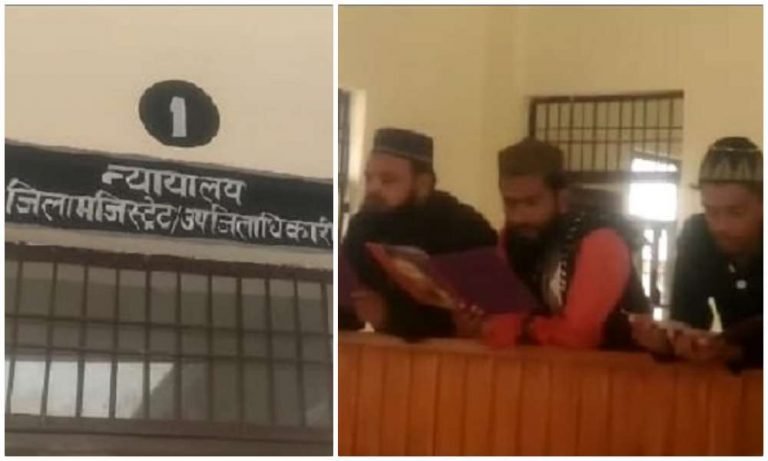
The Uttar Pradesh Police on Thursday arrested one more person from Bareilly in connection with the murder case of Hindu Samaj Party leader Kamlesh Tiwari.
The accused, identified as Kamran, allegedly helped the assailants – Moinuddin and Ashfaq, in trying to escape to Nepal. He works in the travel agency of Naved, another accused who has been arrested after it was revealed that he had harboured the two killers, Ashfaq and Moinuddin, and had helped them cross the border into Nepal.
On 18th October 2019, Hindu Samaj Party leader Kamlesh Tiwari was brutally murdered for his comments in 2015 where he had allegedly called Prophet Muhammad gay. The Uttar Pradesh police and Gujarat ATS sprung into action to blow the lid off a Surat-based Jihadi group that was indoctrinated by one of the accused who planned the murder, Maulana Mohsin Sheikh.
The two main accused, Moinuddin, along with Ashfaq, were arrested by Gujarat ATS on October 22 from Gujarat-Rajasthan border after being on the run for four days. While Moinuddin worked as Zomato delivery boy, Ashfaq, second man arrested for the murder of Kamlesh Tiwari, worked as a medical representative in a pharma company. He had forged his colleague’s Aadhaar to pose as Rohit Solanki, a Hindu rights activist, to gain the trust of Tiwari.
During the interrogation which lasted over six hours, the two radical Islamists had given away their malicious intention and gory details of the gruesome murder of the former Hindu Mahasabha leader who was assassinated at his Lucknow office on October 18, 2019.
It has also been revealed now that Ashfaq and Moinuddin wanted to video record the murder of Tiwari and use it to send a message to warn anyone who dares to ‘Insult Islam’.
Recently, it was also revealed that the murderers were in touch with 72 radicals through WhatsApp who played an equally important role in hatching the well-plotted conspiracy.
Flashback to September 2018, the Chief Justice of India designate Justice Ranjan Gogoi, as he then was, dismissed a “public interest” petition filed in the name of Admiral Ramdas, challenging the appointment of the Chief Vigilance Commissioner. As per media reports, while dismissing the petition, the CJI designate had brought the correct PIL route back to track by remarking – “PILs are for the poor”. Mr Prashant Bhushan, the lawyer for Ramdas, evidently protested, alleging that a whole line of judgments in past has not adopted this approach. The then CJI designate finally boldly brushed off the arguments and denied to interfere under PIL jurisdiction.
Lingering in the background were very audible murmurs about such template petitions, wherein any and every appointment of the governments used to be challenged in court in the garb of “public interest”, often inspired, instigated and even financed by either the officers who had been overlooked for that very appointment or by other vested interests. This judicious approach of the then-incoming CJI with regard to fake PILs, clearly ruffled a few feathers and the people surviving on such motivated litigations felt threatened.
However, the ‘person of interest’, at that time, was then outgoing Chief Justice, who had a different, more interventionist approach to PILs. Despite the same, Justice Dipak Misra, faced an impeachment motion, amidst the controversies surrounding his role as the master of the roster. The acerbic, often uninformed criticism from a particular quarter, that shadowed the tenure of earlier Chief Justice of India Justice Dipak Misra, continued with the current Chief Justice though in a different form. This is symptomatic, at a particular level, of certain institutional and inherent issues with the functioning of the Supreme Court itself, and at the other, of a particular class of self-styled pseudo intelligentsia, which make all-out efforts to deny independent functioning to the Supreme Court of the country.
The modus operandi of this class is ingenious but simple – camouflage a vested interest, political interest, business interest or a stark ideological position as the only possible outcome in a legal issue and peddle the same through motivated blogs, tweets, facebook posts, engineered articles etc. As is often the case, the assertions in such blogs and articles have a little factual basis and purposefully ignore any other possible view. As and when such “vehicles of thoughts” gains traction, they would be given the shape of “public interest” litigations, which either have select coterie of “rent a cause” NGOs or five-star activists [often receiving crores from shady global donations], as petitioners, in a purportedly representative capacity though it rarely remain secret as to whom they “represent”. The same set of lawyers, often connected to the original twitter handle, blogger or author of the article argue the said PILs in Courts.
As and when judges decline to participate in this subversion, this machinery and their machinations, kick into gear. The judges who fall prey to this, often unknowingly, are celebrated by this coterie as upright, honest and brave judges. If and when the opinions of judges do not coincide, the same “social media activists” bloggers, writers and lawyers, often deliberately and mischievously, shorn of the facts and precedents, castigate such judges and their judgments with impunity. Thus, the judges who do not succumb, suffer humiliation through unwarranted, irresponsible and false allegations on social media platforms.
This begs the question, why should and till what time the judges manning the highest constitutional office of the country be concerned with opinions of such handful of vicious “private persons”?
The self-imposed barometer of success in a world of unquantifiables like the judiciary is the “respect” or “image” of a judge which perhaps is the only asset a Judge earns in his entire judicial career. Such intangible and unquantifiable factors, therefore become the AchillesHeel of judges. Also, due to the precedent-based system of common law, judges are fiercely protective of their “legacy” and rightly so. The political tool of impeachment, the purported master of roster controversy, the so-called failure of due process in the sexual harassment allegations, the recusal controversies, though remain utterly unsuccessful, hurt the judges at their most vulnerable spot. Judges are not a part of the political arena of “point v. counter-point” on TV debates and cannot counter any allegations in public. Judges have to maintain the majesty of their office.
With the constant self-imposed weakening of the power of contempt, the Judges are left powerless even if wild and baseless allegations are made by such vested interests with malice and an identifiable agenda. The legacy and image judges so relish as the only “saving” they have in their life’s balance sheet earned during their entire judicial career is damaged irrevocably thereby irretrievably damaging their carefully protected reputation through decades of sacrifice. The “independent” criticism, therefore, becomes a farce in an attempt to brow-beat judges to toe the line or face public embarrassment, personal accusations and a troubled legacy. To be fair, this is a fairly recent phenomenon and largely due to a desperate attempt of this class to continue to have deep access in the mainstream and intelligentsia.
The pervasive presence of this elite clique in social media, leave little scope for independence or disagreement. The approach is “my way or the highway” wherein judges who fail to cater to such vested interests or ideological biases, face an all too familiar fate. The incoming Chief Justice, perhaps in an attempt to hint at this, very correctly stated that a certain section exercises the fundamental right to freedom of speech far too much than the other.
This reminds one of the prophetic lines of senior advocate Harish Salve during the fag end of the arguments in one such “public interest” case. Mr Salve, after the entire arguments on merits, had been canvassed, almost as an elderly statesman of the bar, warned the judges of this same approach. Mr Salve, after referring to the rhetoric and its role during legal arguments, in the context of wild and baseless allegations on the judges, exclaimed – “today, in an attempt to hurt one particular politician, they have attacked everyone that they have found in their way. Tomorrow, after you give the judgment, they will attack you.” As we all know, his prophecy did not remain unfulfilled and materialised soon.
Fast-forward a year. History is seen repeating itself albeit in a different context. The present Chief Justice-Justice Gogoi and the discourse surrounding his legacy is the direct a result of his “no-nonsense approach” in motivated PILs. The scorn with this approach, this clique is out in the open with the set template – “Thou shall not decide against our vested interests”. It is hoped, however; that what will define his legacy will be the alacrity and brevity of his judgments, his unflinching approach in hearing otherwise untouched matters and his practical approach in judicial appointments.
The question which remained unanswered so far is, will the Court – as a collective institution – take up this challenge and send a message, loud and clear, “thus far and no further”. Will this great institution prefer to bend before the nuisance value created by such social parasites based upon their willingness to stoop to any level, or send the message that enough is enough. Will the please Your Lordships to do that?
On the last date to conclude the Naga peace talks, the deadlock between NSCN and the government was finally broken, igniting a ray of hope for peace to return to the North-Eastern state. After a series of meetings among centre’s interlocutor and Nagaland governor R N Ravi, NSCN(IM) and 7 Naga National Political Groups (NNPG) was concluded today evening in New Delhi, it is reported that they had arrived at a mutual understanding.
Although no official announcement has been made yet, it is learnt that NSCN has agreed to keep the demand for a separate constitution and a greater Nagalim on hold for the time being, while the government has approved a separate flag for the state with some conditions.
According to sources, Nagas will be allowed to use their ‘flag’ in Naga Hohos, sports and special events of Nagas. Although at present the flag will not be allowed in official government functions, office premises, it will be approved later, sources say.
An NSCN (IM) member told media that they have agreed to finalise the agreement. The talks on the official flag and constitution will be continued later.
Nagaland Chief Minister Neiphiu Rio confirmed the successful conclusion of the talks. He said that the peace talks have made a historic breakthrough.
We extend our deepest appreciation to the negotiating parties of the peace talks for making the historic breakthrough. Thank you Honourable @PMOIndia Shri @narendramodi and @AmitShah for the political will and concern for the #Naga people.
“It is a historic moment and an occasion of great joy for all Nagas and the nation as a whole. Peace will now pave the way for genuine progress and true nation-building,” the chief minister posted on Twitter.
Nagaland’s leader of the opposition and NPF leader TR Zeliang also tweeted congratulating PM Narendra Modi and home minister Amit Shah for having the resoluteness to solve the issue. He congratulated the parties involved in the talks for arriving at a mutual understanding.
The dream and desire of the Naga people for permanent peace and tranquility in our land will soon become a reality after positive outcome of today’s meeting. Once again big congratulations to all parties involved in bringing about understanding.
“The dream and desire of the Naga people for permanent peace and tranquility in our land will soon become a reality after positive outcome of today’s meeting,” he said.
31st October was the last date to conclude the peace talks, with union government making it clear that the date would not be extended. With NSCN remaining adamant on their demands, it was speculated that the government will go ahead with an agreement with other Naga organisations without NSCN (IM). But that would have meant that the state could have gone back to violence. With NSCN (IM) agreeing to be part of the agreement, it is a major success of the peace talks.
Contrary to NSCN (IM), the other armed separatist organisations, which are called Naga National Political Groups (NNPG) together, have been more flexible in their demands. These groups, which have signed ceasefire agreement with the government, are, NSCN (Kitovi Zhimomi), the Naga Nationalist Council, the Federal Government of Nagaland, the NSCN (Reformation), the National Peoples Government of Nagaland (Non-Accord), the Government Democratic Republic of Nagaland (Non-Accord) and the NSCN (Khaplang). They had agreed to drop the demand for separate flag and constitution.
Although the talks concluded today, it will take some time to finalise the agreement. It is expected that Prime Minister Narendra Modi will make a finance announcement about the resolutions adopted in December when he visits Nagaland to attend the Hornbill festival. The cultural event is scheduled to take place between December 1 and 10 in Kohima and Dimapur.
In the meanwhile, the home ministry has issued a statement saying that lots of rumours and misinformation is being spread in media including social media that final Naga settlement has been arrived at and will be announced soon, which is creating anxiety and concern in some parts of the country. “It is clarified that before any settlement is arrived at with Naga groups, all stakeholders including States of Assam, Manipur and Arunachal Pradesh will be duly consulted and their concerns will be taken into consideration,” the statement said.
The government had issued the statement after protests had erupted in Manipur asserting that any compromise with the territorial integrity of Manipur will not be accepted. One of the demands of NSCN (IM) is the formation of a Greater Nagalim, comprising Naga inhabited areas of Arunachal Pradesh, Assam and Manipur apart from the entire Nagaland. People and governments of these three states strongly oppose the proposal, and the government of India has also not accepted that demand.