Home Blog Page 605

Rs 2026 crore loss, lapses in policy implementation, kickbacks: Read what CAG report on scrapped Liquor Policy in Delhi says

On 11th January, the Comptroller and Auditor General (CAG) released its report on the Delhi government’s now-repealed excise policy. The CAG revealed that the policy resulted in a staggering Rs 2,026 crore loss to the public exchequer. Furthermore, the report highlighted significant lapses in policy implementation and stated that it was ultimately the taxpayers who paid the price of the mismanagement, while there are also allegations of kickbacks having benefited Aam Aadmi Party leaders.

This is the first time a quantified loss has been attributed to the alleged liquor scam, raising serious questions about AAP’s governance under the leadership of Arvind Kejriwal and the accountability of the ruling Aam Aadmi Party in the national capital. The report could have serious consequences for AAP in the upcoming Assembly Elections in Delhi.

Notably, the report suggested that at the core of the issue is the Group of Ministers (GoM) led by former Delhi minister Manish Sisodia. The CAG stated that the GoM disregarded recommendations from an expert panel. Furthermore, the decision-making process was marred by irregularities, which allowed all entities to bid for licences despite documented complaints and financial weaknesses. For example, a licence was renewed for a firm operating at a loss, which further pointed towards negligence.

Violators of licensing conditions were not penalised, and there was a lack of transparency in pricing decisions, which added to the problem. Cabinet and Lieutenant Governor approvals were bypassed on several key matters, and excise rules, which should have been ratified by the Delhi Assembly, were kept from legislative scrutiny.

The CAG highlighted that the financial breakdown of the mismanagement in the excise policy by the AAP government led to a loss of Rs 2,026 crore, painting a grim picture. The failure of the ruling party to re-tender retail licences surrendered mid-policy resulted in a loss of Rs 890 crore. Adding to the financial misery, the government granted exemptions to zonal licensees, which caused additional revenue depletion of Rs 941 crore. Furthermore, the government waived Rs 144 crore worth of licence fees, which was “justified” under COVID-19 restrictions. This directly contradicted tender provisions that placed all commercial risks on licensees. To add to the woes, the incorrect collection of security deposits led to a Rs 27 crore loss.

The CAG report further criticised the implementation of the excise policy as sub-optimal. It prevented its stated objectives from being achieved. There was a lack of scrutiny over the financial conditions and managerial expertise of the bidders, which led to a weak system. The exclusive arrangements between wholesalers and zonal licensees distorted competition. Key measures like the establishment of quality assurance facilities, including testing labs, were not implemented. Even the equitable distribution of retail vends, a critical policy goal, was left unfulfilled.

BJP and Congress targeted AAP over CAG report

In a post on X, Bharatiya Janata Party president and MP JP Nadda said, “Intoxicated by power, high on misgovernance. ‘AAP’DA model of loot in full display and that too on something like liquor. Just a matter of a few weeks before they are voted out and punished for their misdeeds. CAG Report on ‘Liquorgate’ exposes @ArvindKejriwal and @AamAadmiParty Gov. Intentional ‘Lapses’ in Policy Implementation. Rs 2026 Cr Loss to Exchequer money.”

BJP MP Manoj Tiwari said, “CAG has revealed the whole story of the corruption of AAP chief Arvind Kejriwal, who has played the role of a broker by destroying the happiness of Delhi… This is the same CAG report which Arvind Kejriwal used to wave in 2013 to fight against Sheila Dikshit and today the same CAG report has declared Arvind Kejriwal corrupt…”

Delhi BJP President Virendra Sachdeva said, “BJP has been saying this from the first day that the Rs 2026 crore scam was highlighted in the CAG report and it clearly tells that it was deliberately done by Arvind Kejriwal and Manish Sisodia. According to the CAG report, it was a well-planned conspiracy… Government rules were disregarded every time… Why is Arvind Kejriwal not tabling the CAG report in the Assembly?…”

Former Union Minister and BJP MP Anurag Thakur on CAG Report on Delhi Liquor Policy said, “The ten findings of the CAG report are very detailed, and I will explain them to you one by one. The first finding is about revenue loss a loss of ₹2026 crore. The second finding is deviation from the objectives of the policy. The third finding is that the expert panel’s recommendations were ignored by the Group of Ministers (GOM)….”

Delhi Congress President Devender Yadav said, “We have been continuously saying that the CAG report should be tabled as soon as possible. I have also received some information from social media, according to which the loss of Rs 2000 crores to the exchequer has been directly caused by this liquor deal. I am also saddened by the fact that during this time there was also a winter session, should this report not have been tabled there? This makes one thing clear. There was some deal behind all this due to which there was a delay in bringing the CAG report. I want to ask what was the deal between AAP and BJP that there was so much delay in presenting the CAG report…”

The CAG report has come at a time when political parties are focused on the upcoming Delhi Assembly elections. The massive revenue loss underlined in the report has highlighted the need for accountability and a thorough investigation into these lapses. There is a need for responsibility to be fixed for the irregularities, as the onus of restoring public trust now lies on those in power.

Delhi Liquor Scam

At the heart of the controversy is the Delhi Excise Policy 2021-2022, which has been explained in 10 simple points.

  • The liquor policy was first proposed in September 2020 but came into effect only in November 2021.
  • It changed the manner in which alcohol was being sold in the National Capital. Introduced private players in the market and marked the exit of government-owned liquor vendors.
  • Delhi was divided into 32 zones and a total of 27 private vendors were to ply in each zone. Every municipal ward had 2-3 liquor vendors operating in the area. 
  • Proposals such as home delivery of liquor, allowing liquor vendors to offer unlimited discounts, opening of stores till 3 am were also tabled before the Delhi Cabinet.
  • The drastic policy change resulted in a 27% increase in government revenue to ₹8900 crores. At the same time, it marked the complete exit of the Delhi government from the liquor business.
  • While the objective of Excise Policy 2021-2022 was to end black marketing and the liquor mafia, the Delhi government soon came under fire over allegations of corruption.
  • Chief Secretary of Delhi, Naresh Kumar, found irregularities and procedural lapses in the new liquor policy. Lieutenant Governor VK Saxena ordered a CBI probe on the recommendation of Naresh Kumar.
  • Manish Sisodia waived off ₹144.36 crores on the license fee, to be paid by the private liquor vendors, under the garb of the Coronavirus pandemic. Incurred loss to the Excise Department and benefitted liquor licensees by waiving the import pass fee of ₹50 per beer case.
  • All these changes were made without the final approval of the Lieutenant Governor and thus considered illegal under the Delhi Excise Rules of 2010 and Transaction of Business Rules of 1993.
  • Thus, the Delhi government made a U-turn on its new excise policy in July 2022. A month later, CBI booked Manish Sisodia, ex-Only Much Louder (OML) CEO Vijay Nair and 13 others in an FIR for irregularities in the implementation of the Delhi Excise Policy 2021-2022.
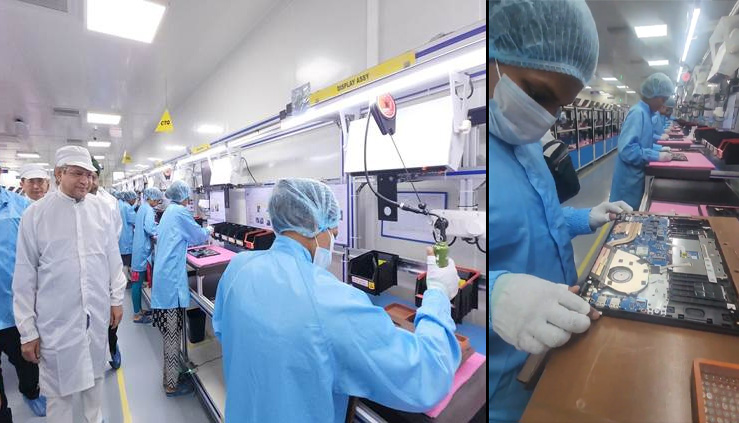
Make In India: Union Minister Ashwini Vaishnaw inaugurates MSI Laptop manufacturing plant by Syrma SGS in Chennai

In a groundbreaking development for India’s electronics manufacturing sector, Union Minister of Electronics and Information Technology, Railways, and Information & Broadcasting Shri Ashwini Vaishnaw inaugurated Syrma SGS Technology’s state-of-the-art laptop assembly line in Chennai yesterday. Syrma SGS has partnered with Taiwanese IT company MSI (Micro-Star International) to manufacture their laptops in India.

The facility, located in the Madras Export Processing Zone (MEPZ), marks a pivotal shift in India’s ‘Make in India’ journey, extending its dominance from mobile phones to IT hardware manufacturing especially the Laptops.

The new assembly line will initially produce 100,000 laptops annually, with a scalable capacity of up to 1 million units within the next 1-2 years. Syrma SGS currently operates four manufacturing units in Chennai, with its Unit 3 now initiating laptop production, as per a press release by the Ministry of Electronics & IT.

Speaking at the inauguration, Shri Ashwini Vaishnaw said, “We must work meticulously to ensure that the electronic component ecosystem is also developed in the coming time. This will not only drive a major growth story for India but also align with our vision of Atmanirbhar Bharat, fostering self-reliance and strengthening our position in the global electronics manufacturing landscape.”

The initiative, part of the PLI 2.0 scheme for IT Hardware, highlights India’s growing capabilities in high-value electronics production and reinforces the nation’s self-reliance in IT hardware.

Key Highlights of the Assembly line

Syrma SGS has partnered with Micro-Star International (MSI), a leading Taiwanese technology company, to manufacture high-quality laptops in India, catering to both domestic and global markets.

The facility is projected to generate 150-200 specialized jobs in electronics manufacturing by FY26, making a substantial impact on both Tamil Nadu’s regional and India’s national economy. These roles are anticipated to have a ripple effect, shaping and enhancing the future workforce in the sector.

The laptops produced will meet international quality benchmarks, showcasing India’s evolving technical and manufacturing prowess.

India’s Rising Electronics Manufacturing Sector

India’s electronics manufacturing sector has grown exponentially over the past decade, with total production increasing from ₹2.4 lakh crore in 2014 to ₹9.8 lakh crore in 2024. Mobile manufacturing alone has reached ₹4.4 lakh crore, with exports at ₹1.5 lakh crore in 2024. 98% of the mobile phones used in India are now being manufactured in India with Smartphones becoming the fourth largest export item from India.

Tamil Nadu: A Key Contributor

Tamil Nadu has over 47 manufacturing units supported under various schemes of the Ministry of Electronics and Information Technology (MeitY). The state is one of the largest beneficiaries of the Production Linked Incentive (PLI) scheme for Large Scale Electronics Manufacturing, with seven out of the 27 approved units under PLI 2.0 located here. The first unit under this initiative was inaugurated yesterday.

Additionally, Tamil Nadu has seen significant support through programs such as Scheme for Promotion of Manufacturing of Electronic Components and Semiconductors (SPECS), with four applications receiving MeitY backing of ₹1,200 crore, and Modified Special Incentive Package Scheme (M-SIPS), which has attracted 33 applications with an investment potential of ₹15,000 crore, supported by ₹1,500 crore from MeitY. Together, these initiatives have enabled companies in Tamil Nadu to achieve a total production exceeding ₹1.3 lakh crore to date.

The state is also home to the Electronics Manufacturing Cluster (EMC) at Pillaipakkam Village, Sriperumbudur, established by M/s State Industries Promotion Corporation of Tamil Nadu (SIPCOT). With a project cost of ₹420 crore, including ₹210 crore in support from the Government of India, this cluster is expected to attract investments worth ₹8,700 crore and create 36,300 jobs. Tamil Nadu contributes around 30% of India’s electronics exports, underscoring its pivotal role in the sector. Notably, the latest iPhone 16 Pro is proudly “Made in India” and manufactured in Tamil Nadu.

A Bright Future for Laptop Manufacturing

The inauguration of Syrma SGS’s laptop assembly line marks a new chapter in India’s electronics journey, paving the way for reduced dependency on imports, enhanced employment opportunities, and world-class manufacturing capabilities. As the facility ramps up production, India is poised to become a global leader in IT hardware manufacturing.

Status of PLI 2.0 for IT Hardware

The Production Linked Incentive (PLI) 2.0 for IT Hardware, launched on May 29, 2023, aims to further strengthen India’s electronics manufacturing ecosystem by offering a 5% incentive to eligible companies.

The scheme covers products like laptops, tablets, all-in-one PCs, servers, and ultra-small form factor devices. With a projected investment of ₹3,000 crore, PLI 2.0 is expected to drive production worth ₹3.5 lakh crore and generate 47,000 jobs across the country.

The scheme has already achieved remarkable progress, with total investments of ₹520 crore, production worth ₹10,000 crore, and has generated 3,900 jobs (As on Dec 2024).

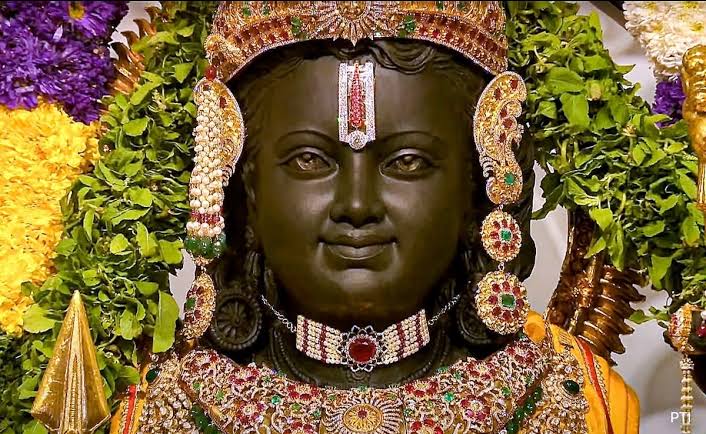
Three-day long celebrations to mark the first anniversary of Pran Prathishta of Ram Lala at Ayodhya begin today

0

As par Hindu Panchang, today i.e. January 11, marks the first anniversary of the Pran Prathishta (consecration) of the Ram Lalla at the Ram Mandir Ayodhya. Last year, on January 22, 2025, Hindus across the world witnessed their centuries old dream take shape when the Pran Prathishta of Ram Lala happened inside Ayodhya Ram Mandir.

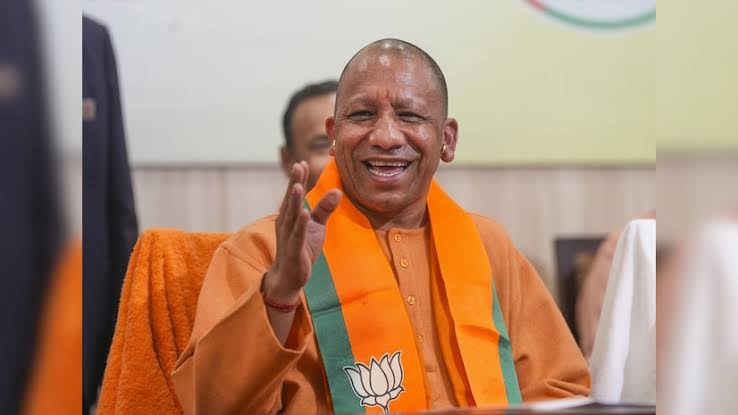
The occasion is being celebrated as Prathishta Dwadashi festival which will go on for three days starting from January 11 till January 13. Uttar Pradesh Chief Minister Yogi Adityanath participated in the worship of Ram Lalla at Ram Mandir today. Several saints also participated in the ceremony.

The local administration has overseen all the preparations for the festival. The festivities will include cultural programmes like Ram-Leela performance, Bhajan-kirtan, folk songs and dances and an exhibition on Indian culture.

Some of the prominent personalities from the arts will be performing on the occasion as informed by Sri Ramjanmbhoomi Tirth Kshetra.

Srimati Usha Mangeshkar, Sri Umesh Pai and Srimati Gauri Yadvadkar will be giving their performances today in Ayodhya.

The entire temple premises has been decorated using 50 quintal flowers. Ram Lalla was dressed in golden clothes. During the worship of Ram Lalla, 56 types of ‘Bhog’ were offered which will be distributed among devotees. A Deepostsav will also be held in the temple.

Assam Rifles seizes drugs worth over Rs 9 lakh in Mizoram, 3 arrested

0

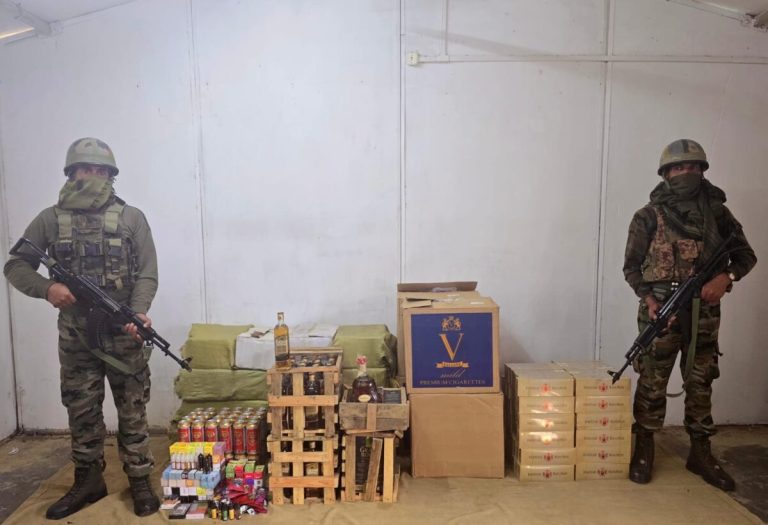
Assam Rifles, in a joint operation with the Mizoram Special Narcotics CID, apprehended three individuals and recovered heroin worth Rs 9.51 lakh from them in Aizawl, an official said.

The operation took place on Friday. The apprehended individuals have been identified as Ngurthanzami and Bikash Gharti.

“Assam Rifles recovered 13.590 gms of Heroin No 4 worth Rs 9.51 lakh and apprehended three individuals (one female and two male) (Ngurthanzami, age 29 yrs resident of New Champhai, Mizoram, Bikash Gharti, age 24 yrs resident of Zemabawk S.A Veng, Aizawl, Mizoram and Lalramthara, age 37 yrs resident of Tuikual South, Aizawl, Mizoram) from general area Zemabawk S.A Veng, Aizawl district on January 10,” according to an official release.

The contraband was found in transparent white polythene carried by the individuals. The entire consignment, along with the apprehended individuals, was handed over to the Special Narcotics CID (Crime), Police Station, Aizawl, Mizoram for further legal proceedings.

“The operation was based on a specific input and was carried out by a combined team of Assam Rifles and Special Narcotics CID (Crime), Police Station, Aizawl, Mizoram,” the release read.

On Friday, Assam Rifles, in a joint operation with the Police and Tripura Forest Service, destroyed large areas of ganja plantation spread over 16.2 hectares in the general area in Boxanagar Forest Range under the Sonamura sub-division here in Mizoram.

The operation led to the eradication of 16,500 cannabis plants, valued at approximately Rs 70 lakh, said Assam Rifles in a press release issued on Thursday.

Earlier this week, Assam Rifles recovered 10,320 kgs of illegal Areca Nuts worth Rs 72.24 Lakhs approximately in the general area of Zote, Champhai district of Mizoram as per a press release.

The operation was carried out by a combined team of Assam Rifles and Reps of Customs Preventive Force, Champhai on January 4.

(This news report is published from a syndicated feed. Except for the headline, the content has not been written or edited by OpIndia staff)

UP: Muslim man in Bareilly arrested for threatening to behead CM Yogi Adityanath; had earlier threatened ‘2025 will be the last year for Ram Mandir’

0

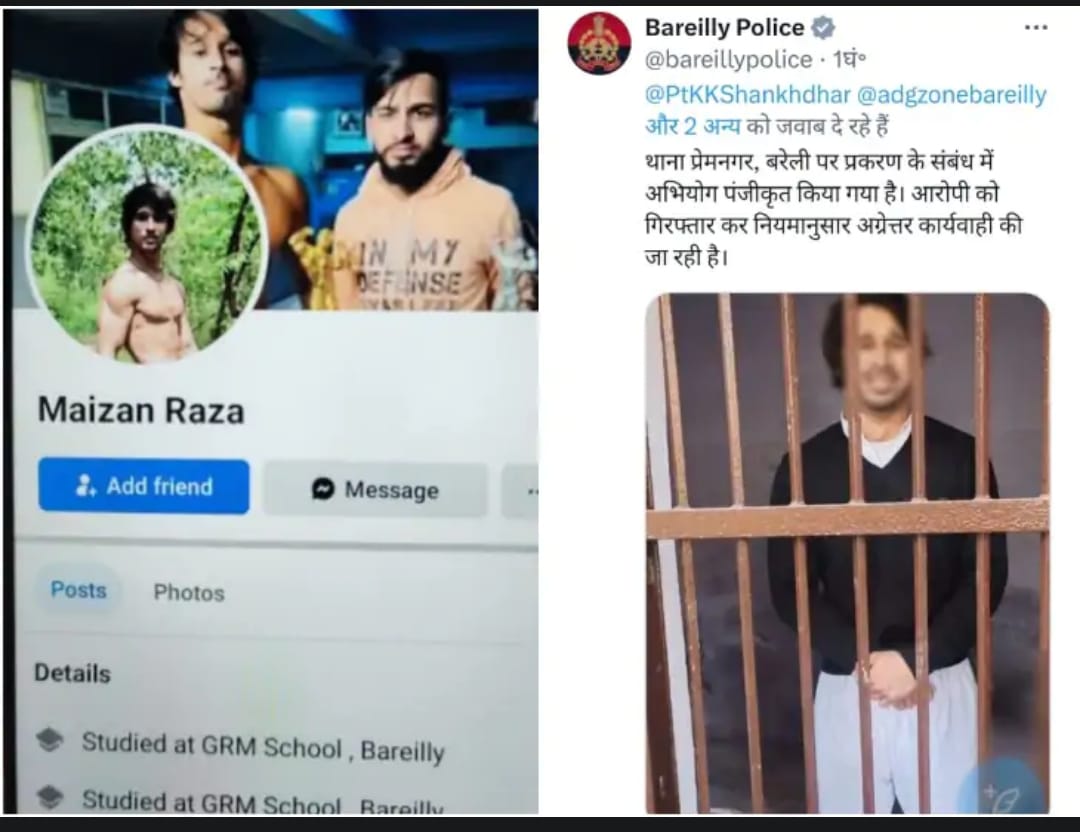
A Muslim man, identified as Maizan Raza, was arrested on Friday for posting threats against Uttar Chief Minister Yogi Adityanath. According to reports, Raza had made posts on his social media account on Facebook threatening to behead Yogi Adityananth.

The 30-year-old man was arrested after his hateful posts were reported to the Premnagar police station. Raza had also given threats about the Maha Kumbh Mela. As per reports, threatening Hindus, he wrote on social media that Muslims will not allow Mahakumbh Mela to take place this year. He also urged Muslims to wage Jihad against Hindus.

Raza also reportedly posted hateful comments regarding Ayodhya Ram Mandir. He threatened that this year, 2025, will be the last year for the Ram Mandir.

Image credit: Dainik Bhaskar

On seeing Raza’s hateful posts, Vishva Hindu Parishad (VHP) leader K K Shankhdhar tagged ADG Bareilly and UP police urging them to take action against him.

This year, the Mahakumbh Mela is facing attacks from some sections of Muslims. Recently, Maulana Shahabuddin Razvi Barelvi, president of the All India Muslim Jamat, has claimed that 55 bighas of Waqf land are being used for the Hindu religious event. Barelvi’s came amidst the call of Hindu saints to restrict entry into Mahakumbh only to Hindus it is a religious gathering. The local Muslims of Prayagraj want to set up shops at Mahakumbh Mela considering that such a huge gathering of people will offer an opportunity for good trade.

Chhattisgarh: Three members of ‘Aaj Tak’ journalist’s family hacked to death using axes over property dispute

0

Three members of the family of a journalist were reportedly hacked to death over a property dispute in Chhattisgarh on Friday, January 10. The incident took place in Jagannathpur village of Khadgawan police station area of Surajpur district in Chhattisgarh when the three victims which included mother, father and brother of the Aaj Tak news channel journalist named Santosh Topo were working in their fields.

According to reports, Santosh Topo’s family had an old property dispute going on with his uncle (father’s brother). On the fateful day, Santosh Topo’s father Maghe Topo (57), mother Basanti Topo (55) and brother Naresh Topo (30) were working in their fields when about seven people from his uncle’s side reached there.

A verbal spat started between both the parties which soon escalated into violence. The other party started attacking Santosh Topo’s family using axes and swords. His mother and brother sustained head injuries and reported died on the spot. His father was taken to Ambikapur Medical College where he succumbed to his injuries. Santosh’s other brother Umesh Topo, who was also present there, was able to escape the attack. He went running to the village to inform the villagers about the attack on his family.

The police reached the sport on receiving information about the incident. The bodies of the victims were sent for postmortem and a case was filed against the culprits.

Earlier this month, a journalist named Mukesh Chandrakar was found brutally murdered in Bijapur district of the state. The police arrested Congress leader and contractor Suresh Chandrakar in relation to the murder. Mukesh Chnadrakar’s dead body was recovered by the police in a freshly cemented septic tank on Suresh Chandrakar’s property.

Indian Railways unveils specifically designed Vande Bharat Express train for cold climate on Katra-Srinagar route

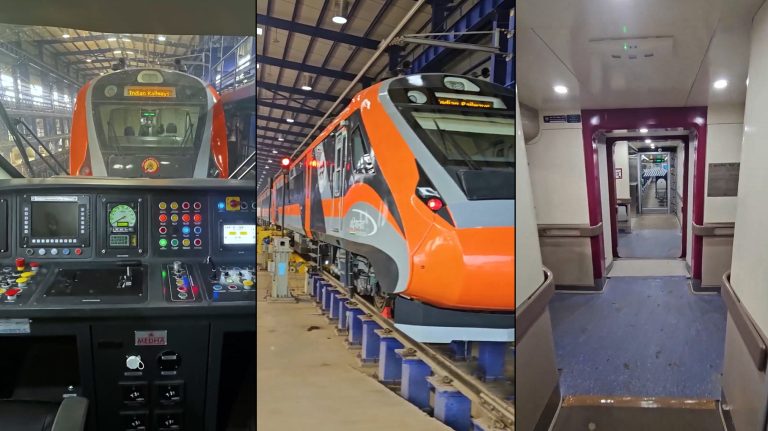
Union Minister of Railways Ashwini Vaishnaw shared a video of the Vande Bharat Express train for the upcoming Katra-Srinagar rail route, connecting Jammu to the Kashmir valley.

The 49-second video, shared on Vaishnaw’s X account, gives a glimpse of the features of the train which is specially designed to operate seamlessly in Jammu & Kashmir’s challenging winter conditions.

According to Railway officials, the train has several additional features as compared to the other 136 Vande Bharat Express trains currently running in different parts of the country so that it can meet the operational challenges and passengers’ amenities in extreme weather conditions of Jammu and Kashmir.

The train has advanced heating systems which prevent the freezing of water tanks and bio-toilet tanks, provide warm air for the vacuum system as well as laboratories and ensure the air-brake system functions optimally for smooth operations even in sub-zero temperatures.

Besides, climate-related features, it has all the other amenities that the existing Vande Bharat trains have like fully air-conditioned coaches, automatic plug doors, and mobile charging sockets.

With the commencement of the final safety inspection, 111 Km long Banihal-Katra Section in the newly constructed, Jammu division, rail commuters can expect a world-class travel experience on this route from later this year as Jammu station is being redeveloped to equip it with 8 platforms and modern amenities.

Vaishnaw has announced that a long-cherished train service between Jammu and Kashmir Valley will start very soon.

The long wait for train connectivity between Kashmir Valley and Jammu will be over.

The completion of the Banihal-Katra section has been an engineering marvel in which 97 kilometres of length is the tunnel and 7 kilometres of distance is covered by 4 main bridges.

(This news report is published from a syndicated feed. Except for the headline, the content has not been written or edited by OpIndia staff)

Gujarat govt resumes eviction in Bet Dwarka: Hundreds of acres of govt land vacated by demolishing illegal structures

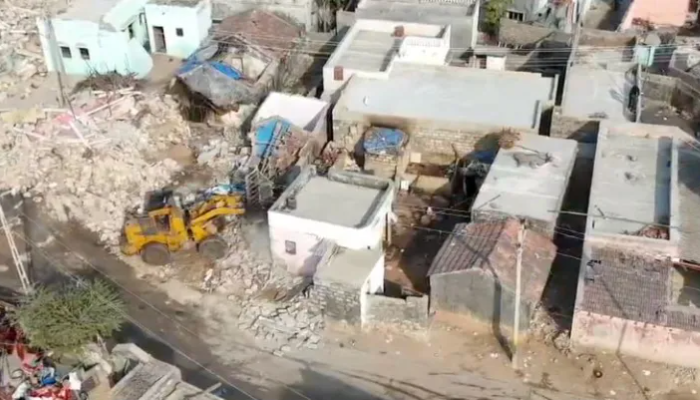
The Gujarat government has once again initiated a bulldozer action in Devbhoomi Dwarka and Bet Dwarka. Hundreds of acres of government land, which had been encroached upon for the construction of houses, religious structures, and commercial establishments, are being cleared, in the coastal areas. The operation is being conducted under strict police security and with adequate safety measures in place.

While an official statement from the state government is awaited, initial reports suggested that around 40 to 50 illegal residential and commercial structures are being demolished as part of this operation. Meanhwile, Harsh Sanghavi, Home Minister of Gujarat, also informed about the same on social media. “Bet Dwarka is the land of faith for crores of people across the country. We will not allow any illegal encroachment in Lord Krishna’s land. It is our responsibility to protect our faith and culture. The Bhupendra Bhai Patel government in Gujarat has shown zero tolerance for illegal encroachment,” he declared on X (earlier Twitter).

The entry for pilgrims into Bet Dwarka has been temporarily restricted, following the action taken by the authorities. Barricades have been set up and strict police security has been deployed. However, special care has been taken to ensure that no disruption occurs in the temple’s functioning. The daily routine of worship and prayers to the deity will continue as usual, maintaining the sanctity of the religious practices despite the ongoing drive.

According to reports, a total of 1,000 personnel, including senior officials and police officers, are involved in the entire operation. Before the action commenced, senior officials from the administration and police department devised a detailed plan and completed all necessary preparations. The district police chief, along with other officers and administrative officials, remained present on the ground to keep an eye on the process, even during the operation.

Additionally, drone cameras are being utilized to monitor the action. It is not yet determined how long this operation will last, nonetheless, given the extensive number of structures involved, it may take a considerable time to conclude.

Notably, Bet Dwarka is located on the western edge of India, just 2 kilometers away from Devbhoomi Dwarka. This small island houses a temple dedicated to Lord Krishna, which holds immense religious significance for Hindus. Millions of devotees visit the temple annually to offer their prayers. While access to the island was previously only possible via sea, a bridge has now been constructed, facilitating easier travel.

Gujarat’s coastline spans 1,600 kilometers, offering numerous advantages but also presenting challenges from a security perspective. Since the Bhupendra Patel government came into power, significant focus has been placed on strengthening security in coastal areas. Simultaneously, measures have been undertaken to uncover encroachments on government land that have persisted for many years in these regions.

The campaign to remove illegal occupation began in Dwarka in 2022, where hundreds of acres of government land were reclaimed by demolishing unlawful structures using bulldozers. This operation is considered one of the largest demolition drives in Gujarat’s history. Following this, similar actions were carried out in coastal areas like Somnath and Porbandar, with similar action recently undertaken in Somnath as well.

Now, bulldozers have returned to Dwarka. Reports informed that after the 2022 demolition, authorities gathered more information regarding the illicit practice in the Bet Dwarka area. Based on this, additional illegal constructions were identified. According to government sources, such action will continue wherever encroachments are found in the region.

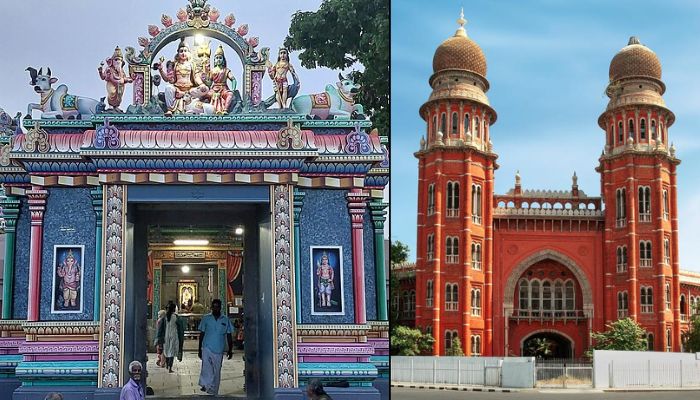
How the Madras High Court thwarted the plan of Tamil Nadu govt to build shopping complex with temple funds

On Thursday (9th January), a 2-judge Bench of the Madras High Court ruled that the surplus funds of revenue-rich temples could not be used for constructing shopping complexes.

The Background of the Case

A Hindu man from Tamil Nadu, identified as P Bhaskar, stumbled upon a tender notification on 11th December 2023 in the New Indian Express paper.

He learnt that the Tamil Nadu Hindu Religious and Charitable Endowments (HR&CE) Department was planning to construct a commercial shopping complex on the land owned by Arulmighu Nandeeswarar Shivan temple using its ‘surplus funds.’

As a person with interest, P Bhaskar filed a Public Interest Litigation (PIL) before the Madras High Court challenging the decision of the Tamil Nadu HR&CE Department.

The jurisdiction and administrative control of the Arulmighu Nandeeswarar Shivan Temple lies with the Tamil Nadu government.

The HR&CE Department had claimed that the funds from the shopping complex would be used for further development of the Hindu temple.

Petitioner P Bhaskar pointed out that the Shivan Temple had no trustees and was being run as a ‘kingdom of the Joint
Commissioner’.

He further contended that the ‘surplus funds’ of a temple could only be utilised in the manner, specified by the the Tamil Nadu Hindu Religious and Charitable Endowments (HR&CE) Act of 1959.

Provisions under the Tamil Nadu HR&CE Act

Interestingly, Sections 36, 36-A, and 36-B of the legislation [pdf] make it clear that the ‘surplus funds’ of a Hindu temple could be used for conducting Hindu marriages or feeding the poor.

Section 66 of the Tamil Nadu Hindu Religious and Charitable Endowments (HR&CE) Act of 1959 further lays down guidelines for the appropriation of endowments (gifts) received by a temple. These include

  1. Grant of aid to a poor religious institution
  2. Grant of aid for purposes connected to the Hindu Faith
  3. Propagation of religious tenets of the institution
  4. Recitation of Divya Prabhandam and Thevaram
  5. Establishment and maintenance of schools to train Hindu priests
  6. Establishment and maintenance of university to study the Hindu religion
  7. establishment and maintenance of educational institutions where instruction in the Hindu religion is also provided

None of the existing guidelines allow for the construction of commercial shopping complexes.

The Tamil Nadu HR&CE Department had attempted to rationalise the decision to build a commercial shopping complex on temple land by claiming that it would yield ‘rental income.’

It further assured that the shops at the complex would only be allotted to the practitioners of the Hindu Faith and only pooja items, utensils and exclusively vegetarian food could be sold by eateries.

The judgment of the Madras High Court

The matter was heard by a 2-Judge Bench of Chief Justice Kalpathi Rajendran Shriram and Justice Senthilkumar Ramamoorthy.

The Madras High Court noted that the Arulmighu Nandeeswarar Shivan Temple has no trustees and that it was not made out whether the surplus funds were spent preferably on items mentioned in Section 66 (a-g) of the Tamil Nadu HR&CE Act.

It added that the provision in the legislation is meant to propagate the religious tenets of the institution.

“Constructing the shopping complex using the funds of the temple certainly does not indicate any propagation of the religious tenets of the institution, i.e., the temple,” the court ruled.

The Judges noted that the Tamil Nadu HR&CE had not conducted a ‘project study’ before going ahead with the construction of the shopping complex. They stated –

“By way of illustration, let us assume Rs.1.00 Crore is spent in constructing the shopping complex. What would be the annual return on the investment has not been studied. If the amount is put in a fixed deposit in a bank, at the current rate of return, it would fetch about 7.25%. Perhaps the temple may not be assessed to tax and that would be a net return. There is nothing to indicate that the returns will be in excess of 7.25%. Even if we take that the decision was taken when the rate of interest was only 6%, still there has to be a project study report which says that the temple funds could be better utilized for earning more returns than 6% fixed deposit return.”

The Madras High Court stated that temples should be kept out of litigation, adding that the construction of a shopping complex could lead to issues of return on investment, eviction of tenants, recovery of unpaid dues and prevention of encroachments.

The Judges ruled, “Therefore, we make it clear that surplus funds of temple, which is a religious institution defined under the HR & CE Act, can be used only for the purposes specified in sub-section (1) of Section 66 or provided under Section 36-A or Section 36-B and for no other purpose. Since the shopping complex does not fall within the category of items (a) to (l) of sub-section (1) of Section 66 or Sections 36-A and 36-B, the decision to construct a shopping complex has to be quashed and set aside.“

While junking the construction of the shopping complex, the Madras High Court suggested the Tamil Nadu HR&CE Department use the existing structure for purposes as laid down by the HR&CE Act.

Planting native trees, conducting marriages for poor Hindus and using the existing building as a shed to feed the poor were three recommendations given by the Madras High Court.

And thus in this way, the 2 Judges of the esteemed court struck down the plan of the Tamil Nadu government to use surplus funds of the Arulmighu Nandeeswarar Shivan temple to build a commercial shopping complex.

What is the Tamil Nadu HR& CE Department

Unlike most parts of India where a particular temple administration lays down its own rules of conduct, the Hindu places of worship in Tamil Nadu are managed by the State government.

The administrative control is established through the implementation of the Tamil Nadu Hindu Religious and Charitable Endowments (HR&CE) Act of 1959, legislation that was supposed to ensure ‘smooth administration’ and ‘proper management’ of Hindu temples and mutts.

The Tamil Nadu government controls 36635 temples, 45 mutts, 68 temples attached to mutts, 189 charitable endowments, 1721 specific endowments and 17 Jain temples.

Through the ‘Tamil Nadu Hindu Religious and Charitable Endowments Act’, the State government exercises unprecedented control over the administration, functioning and management of Hindu temples and mutts.

Data furnished by the HR&CE Department of the Tamil Nadu govt in 2022

The government appoints the Commissioner, the Joint Commissioner, and the Assistant Commissioner of the HR&CE Department. It is also in charge of the assets of the temples and mutts (both movable and immovable), and controls the finances in the name of ‘improving viability’ and ‘sustained development.’

Moreover, the government solicits money from the same temples and mutts to the range of 1.5%-4% under the garb of annual income audit. Every community (sampradaya) within the Hindu fold has its unique customs and ritualistic way of worship. The community decides the pujaris and the management of the temple.

The Tamil Nadu government overrides this Hindu practice in the name of social equality and appoints archakas of its liking under the HR&CE Act.

To make matters worse, a total of 11 Mutts have lost their character under the supervision of the same Tamil Nadu Hindu Religious and Charitable Endowments Department. As such, total Mutts in Tamil Nadu have decreased from 56 to 45 as of 2022.

Uttar Pradesh: Hamirpur police book Nooruddin, Meraju Hasan, Khalik, Irfan, and Hanif for attempting to forcefully convert Dalit family to Islam

0

On 10th January, Hamirpur Police in Uttar Pradesh booked Nooruddin, Meraju Hasan, Khalik, Irfan, and Mohammad Hanif for the forced conversion of a Hindu Dalit family. The FIR under Section 351(2) of Bharatiya Nyaya Sanhita and Sections 3 and 5(1) of the Uttar Pradesh Prohibition of Unlawful Religious Conversion Act against the five was lodged based on the complaint of a woman named Urmila. According to the FIR copy accessed by OpIndia, the accused attempted to convert the family under the guise of medical and financial help.

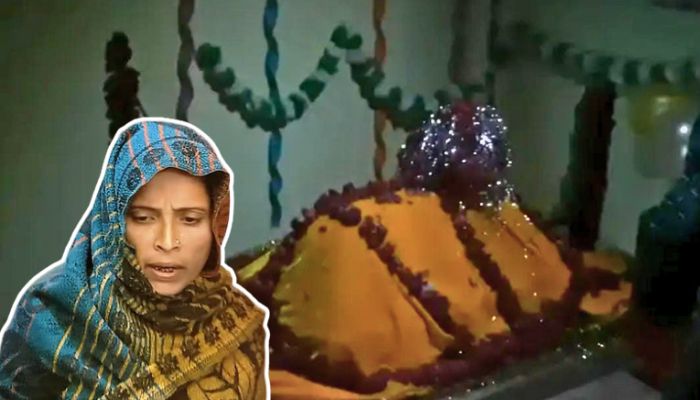
The incident came to light when a video went viral on social media where an event was being organised at the house of the victim after establishing a mazar. Hindu organisations took cognisance of the matter immediately and approached the police. Following the complaint by the Hindu organisations, the police swung into action and stopped the event.

According to media reports, Ajit and his wife Urmila are residents of Tarraus Colony in Moudaha Police Station Area. A Qawwali event was organised at Ajit’s residence, who allegedly converted to Islam and established a mazar at his house. He had reportedly invited relatives and people to attend the event where the accused had planned to lure more people to convert to Islam.

Upon getting information about the conversion racket, the police reached Ajit’s house and stopped the event. The Maulana and others involved in the matter were arrested by the police. Ajit told the police that his wife had not been well for several years. During that time, Nooruddin, a resident of Banda, came in contact with him. He told Ajit that if he established a mazar at his house, Urmila would get better.

After that, Nooruddin came to Ajit’s house, established the mazar, and converted Ajit to Adil Khan.

Speaking to media, Ajit said, “They [accused] came to our house and set-up mazar. We did not convert. We are Hindu and will remain Hindu.” His wife Urmila said, “We don’t know what urs is. We don’t understand what is happening.”

Allegations mentioned in the FIR

According to the complaint submitted by Urmila to Hamirpur Police, she belongs to the Scheduled Caste (Ahirwar) and lives in Tarraus Colony in Moudaha, Hamirpur district. She was unwell for years and struggled with issues at home. During that time, Nooruddin, a Banda resident, approached her and her husband Ajit. He allegedly advised them to set up a mazar in their house, promising that it would cure her illness and solve their problems.

She stated, “Nooruddin said that if we established a mazar and worshipped it, all our troubles would disappear.” She further alleged that Nooruddin, along with his nephew Meraju Hasan and another associate, Khalik, came to her house and built the mazar in one of the rooms.

Furthermore, she said that the accused continued to visit the house and persuaded the couple to convert to Islam. “They told us that converting would elevate us from a lower caste to a higher caste in Islam and that we would receive financial support for life,” Urmila said.

On the day of the incident, Nooruddin, Khalik, Irfan, and Mohammad Hanif, along with several other individuals, gathered at Urmila’s house and organised a religious event, including an Urs (religious gathering) and Fatiha. The accused allegedly invited the couple’s relatives to attend the event and tried to persuade them to convert as well.

Realising the intentions of the accused, Urmila and her husband decided not to convert. “We understood that they were trying to trap us and force us to leave our religion,” Urmila said. She added that the accused also threatened to kill them if they refused to convert.

Statement by the police

In a video statement, the Additional Superintendent of Police, Hamirpur, said, “Police got the information about an illegal religious conversion event being held at a house. Based on the victim’s complaint, an FIR has been registered.”

Further investigation into the matter is underway.