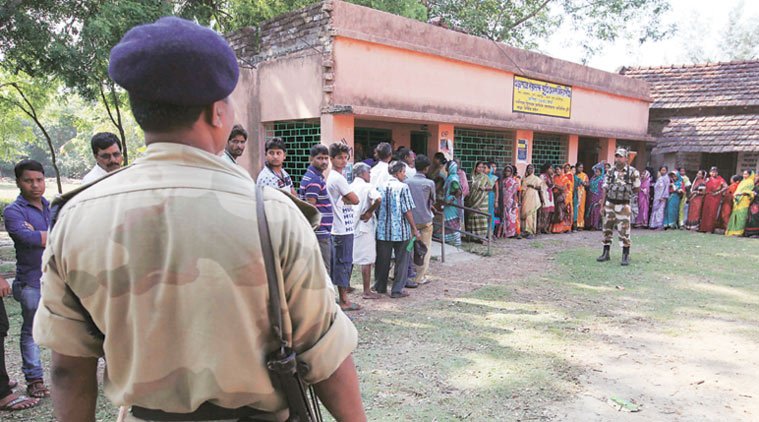
The Lok Sabha elections in West Bengal have witnessed large scale violence and electoral malpractices. Dozens of videos have emerged on social media which who ruling Trinamool Congress indulging in vote rigging during the elections. In several videos, TMC workers are seen casting votes on behalf of genuine voters, in presence of poll officials and security personnel, including from central forces. Many people also have alleged that when they reached poll booths for voting, they were told that they have already voted.
Election Commission is accused of being a mute spectator to such large-scale vote rigging in West Bengal, and now a bizarre incident has happened where the EC has said that since the polls are over, they will not take action on allegations of rigging.
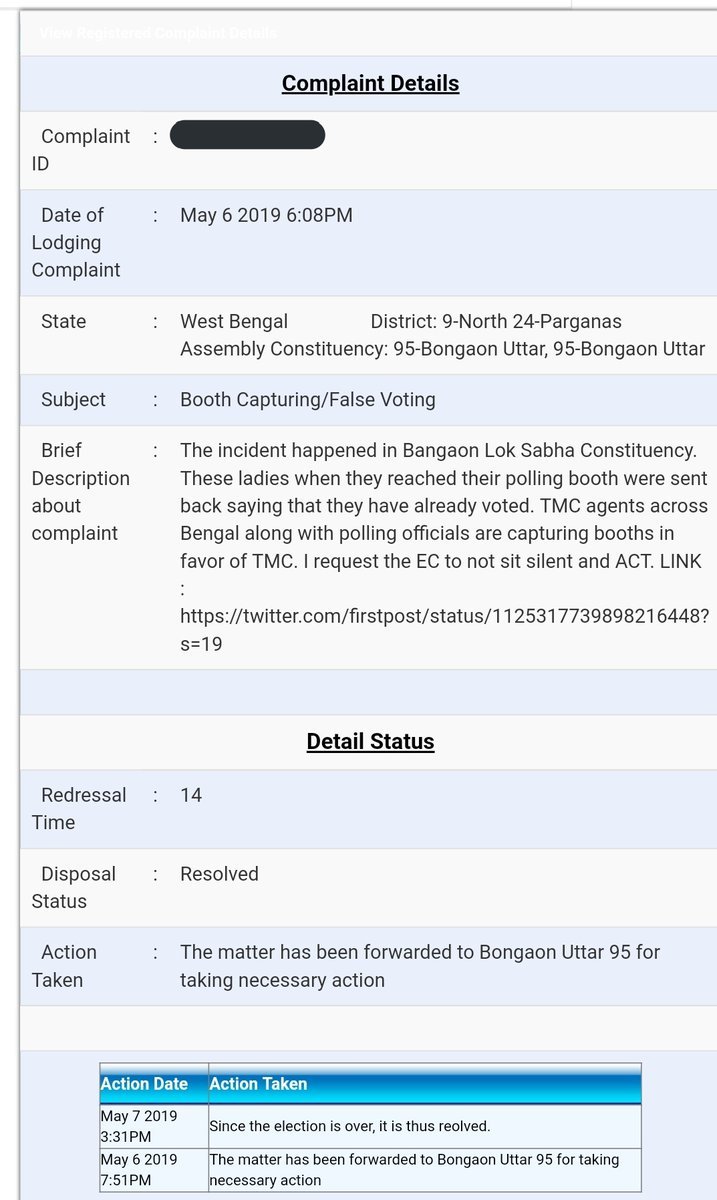
The Election Commission made this statement responding to a complaint filed online through its National Grievance Service portal. In a screenshot from the EC portal which was posted on Twitter by the complainant, it can be seen that on 6th May, a complaint was registered regarding poll rigging in Bangaon Lok Sabha constituency in West Bengal. It says that when few women went to cast their votes, they were sent back saying that they have already voted. The Complaint also noted that TMC agents across West Bengal along with polling officials are capturing booths in favour of TMC.
The EC portal shows the status of the complaint as ‘resolved’, which was forwarded to Bogaon Uttar 95 for necessary action. And in the action taken section, it makes the shocking claim that since the election is over, the issue is resolved. On 6th May evening, the matter was forwarded to Bongaon polling station. And in the afternoon today, the matter has been marked as resolved, with the comment, “since the election is over, it is thus resolved”.
This means according to Election Commission, the poll panel is not liable to take any action on complaints of electoral malpractices after the polls are over.
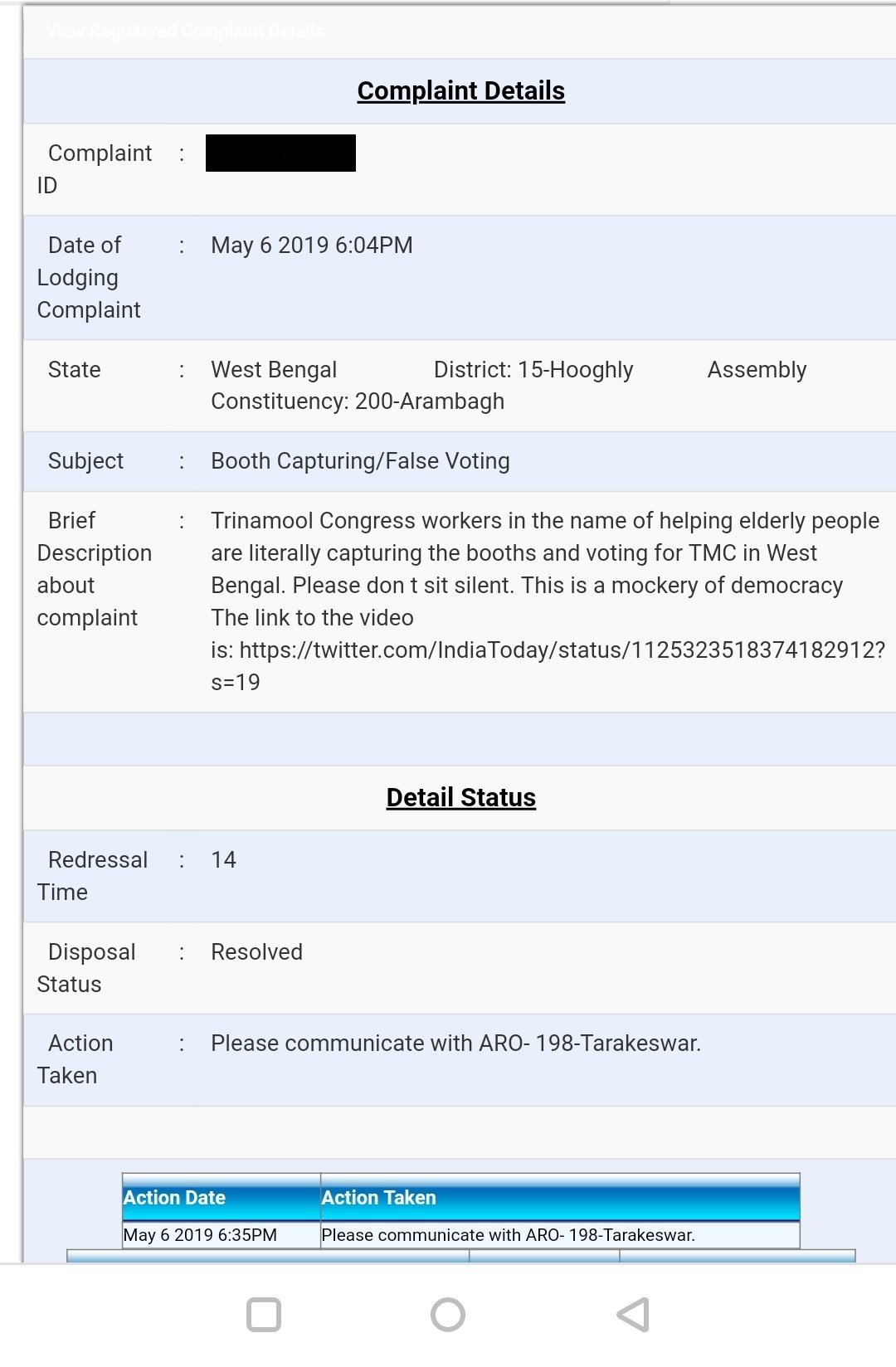
The complainant had filed another complaint with the EC portal regarding TMC men voting on behalf of elderly women, in the guise of helping the senior citizens. But instead of taking any action on the issue, the EC asked him to contact the concerned ARO.
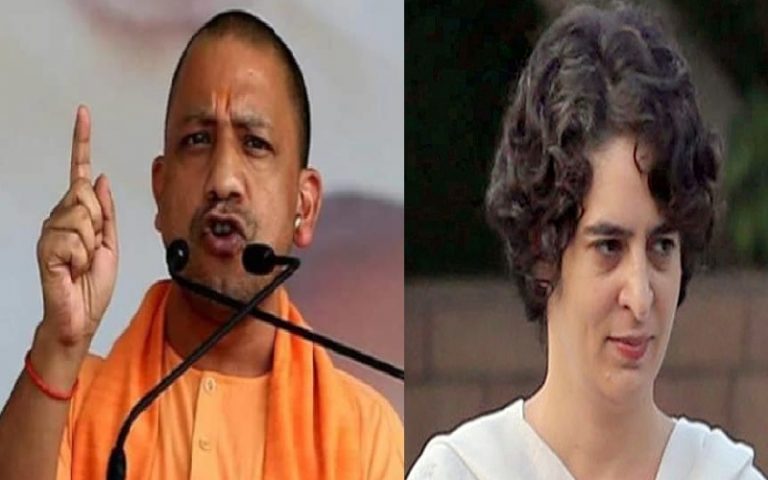
Uttar Pradesh Chief Minister Yogi Adityanath has taken a dig at Congress General secretary for UP East Priyanka Gandhi for her behaviour when children were being encouraged to abuse Prime Minister Modi.
Recently a video of Priyanka Gandhi had gone viral in which she was seen cheering and giggling when a bunch of children were made to make derogatory remarks and shout abusive slogans against Prime Minister Modi.
UP CM Yogi Adityanath in Mandawali ,Delhi: Congress has completely failed, Shehzada also failed so they brought in their Shehzadi. She was teaching abuses to innocent children of Amethi, please and go teach these abuses in Italy. pic.twitter.com/Hxe5MOMjBI
Yogi Adityanath slammed Gandhi for teaching abuses to innocent children. He said that she should instead teach such abuses in Italy. “Congress has failed, Shehzada (Rahul Gandhi) also failed so they brought in their Shehzadi (Priyanka Gandhi). She was teaching abuses to innocent children in Amethi, please go and teach these abuses in Italy”, said the Chief Minister.
The National Commission for Protection of Child Rights (NCPCR) had written to the Election Commission (EC) regarding the video of Priyanka Gandhi and had requested to ensure that children are not involved for election purposes. Later, she was served a notice by the NCPCR regarding the video.
Priyanka’s behaviour at the incident had resulted in widespread condemnation. Union minister Smriti Irani had stated that Priyanka should know that children cannot be used for political activities. She had also added that cultured families should keep their children away from Priyanka.
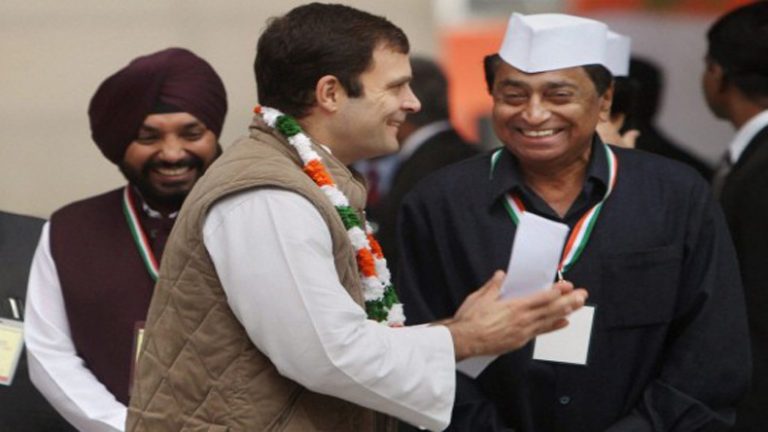
The Congress party and Rahul Gandhi specifically has been repeatedly promising that farmer loan waivers will be granted to all farmers within 10 days of Congress coming to power. In fact, Rahul Gandhi has touted this as one of his achievements through the campaigning for 2019 Lok Sabha elections. Now, Madhya Pradesh CM Kamal Nath, a senior leader of the Congress party has conceded that complete loan waiver for farmers is not possible in 10 days because nobody has a magic wand.
Today, Congress apparently handed over a list of 21 lakh farmers whose loans had been waived off by Congress state governments as BJP, in their ‘aarop patra’ had mentioned non-fulfilment of this promise as one of the accusations against the MP government.
In a press briefing held by Madhya Pradesh CM Kamal Nath, Nath mentioned that after promising the loan waiver, 21 lakh farmers’ loans had been waived off, however, a complete loan waiver is not possible within 10 days because the government does not have a magic wand.
He said there would be farmers who would say that their loans haven’t been waived off yet, but the fact remains that there would be some who would say that they have got the benefit from the Congress government of loan waiver. He also reiterated that the farmers whose loans have not been waived off would know that eventually, the Congress government would deliver because they can see that some of the farmers are saying that their loans have indeed been waived off.
Essentially, Kamal Nath drew a distinction between the Congress government’s intent to waive off loans of farmers and their intent to waive off loans. However, that is not how Congress or even Rahul Gandhi had projected the promise and its delivery.
Rahul Gandhi has repeated several times that as soon as the Congress government comes to power, all loans taken by all farmers would be waived off.
He has even taken to Twitter several times to claim that the promise has been fulfilled by Congress state governments in its entirety.
On 19th December 2018, Rahul Gandhi had taken to Twitter to say “It’s done! Rajasthan, Madhya Pradesh & Chhattisgarh have waived farm loans. We asked for 10 days. We did it in 2.
It’s done!
Rajasthan, Madhya Pradesh & Chhattisgarh have waived farm loans.
It is evident that Rahul Gandhi had declared in absolute terms that the Congress governments in the states have fulfiled their promise of loan waiver. While everyone knew that farmer loans have not been waived off by the governments in the states, Rahul Gandhi clearly kept lying to assert in absolute terms that Congress has fulfiled its promise. Now, Kamal Nath has conceded that full loan waiver in 10 days in an impossibility.
There have several incidents that prove the failure of the Congress government to deliver on its much-touted promise. In Madhya Pradesh, there have been several farmer suicides due to the failed promise. Several farmers had discovered fake loan waivers being registered in their names. The farmers had threatened to commit ‘mass suicide’ after their names appeared on the state government’s loan waiver list even though they do not have any dues or have loans far smaller than the ones that are listed.
While that would prove beyond a reasonable doubt that Rahul Gandhi’s promise was a mere “jumla”, one can expect Rahul Gandhi and the Congress to continue spreading this lie further.
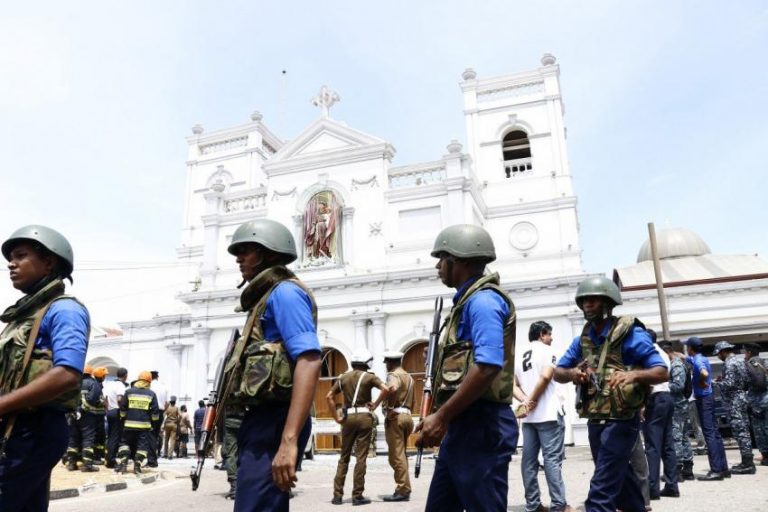
In a joint press conference, the three chief’s of Sri Lanka’s defence forces, along with the country’s police chief, released a statement on Monday, which read that all those Islamic terrorists who were involved in the Easter Sunday blast have either been killed or captured.
The top officials assured that the country is now safe and can get back to normalcy.
The tri-forces chiefs asserted that the security of the country, following the April 21 bombings that left hundreds of people dead and injured, has been ensured with adequate measures and steps have been taken to implement a special security plan.
Moreover, the acting Inspector General of police (IGP), Chandana Wickrematarne stated that all the explosives which were with the National Thowheeth Jama’ath (NTJ), the terror organisation which claimed responsibility for the attack, have also been seized.
“All explosives possessed by the terrorist group has been seized. Almost everyone identified with the group has been arrested. Two of their bomb experts have died in the clashes. The police can happily announce that everyone with direct links has been either arrested or killed by now,” the police chief said.
Recently, the country had expelled over 600 foreign nationals, which included about 200 Islamic clerics. The Sri Lankan Home Affairs Minister Vajira Abeywardena had confirmed that the clerics have been fined and expelled from the country for overstaying their visa.
Meanwhile, the Police spokesman Ruwan Gunasekera informed that a total of 73 people, including nine women, have been arrested and being interrogated by the CID and the Terrorist Investigation Department (TID).
Army chief Lt Gen Mahesh Senanayake, urging people not to get mislead by fears spread through social media and unverified reports, said that the military over the days has taken concrete steps to ensure national security under the emergency regulations.
The government has reopened schools on Monday and asked the citizens to return to their day-to-day activities.
If you are anti-Modi, chances are your freedom of speech will be freer than an average Indian because you will not only get support from Modi haters but will also get a platform to broadcast your violent tendencies.
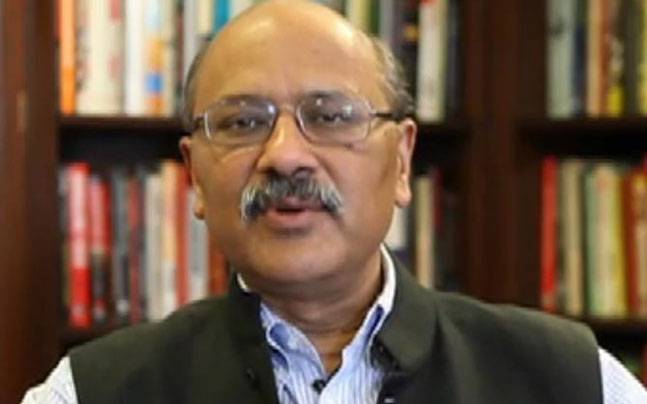
Shekhar Gupta’s ThePrint recently provided a platform to former Pakistani cricketer Shahid Afridi, who very casually mentions that when Pakistani cricketers are facing Indian cricketers on the ground, their orders are clear: “go and destroy them, almost like a suicide bomber does”. As an afterthought and to make light of it, Afridi mentions in brackets that he knows it doesn’t sound politically correct and that nobody ever gave such a direct order but “you know what I mean by that analogy!”.
No, Afridi, I don’t. You see, a 20-something man was trained by terrorists living in your country to blow himself up so that he could kill our soldiers. A bunch of suicide bombers bombed a few churches in our neighbouring country Sri Lanka and killed hundreds of families and left behind devastated families. Oh, and Islamists were celebrating that suicide bombing. So, no, your analogy is very problematic and I am not sure if I know what you mean by that analogy.
The article ThePrint had published was an excerpt from Shahid Afridi’s book, ‘Game Changer’ he co-authored with Wajahat Khan. The headline of the article shouts how Gautam Gambhir, former Indian cricketer and currently BJP’s candidate for East Delhi Lok Sabha seat, “has no personality or great records, just a lot of attitude.” That is how Afridi describes Indian cricketers ‘whom they had orders to destroy almost like a suicide bomber’.
Perhaps Gupta, as Editor of ThePrint, thought that anyone hating on a BJP candidate would be a good bet. So what if the person casually talks about terrorism? I’ll even stick my neck out and say that Gupta finds an element like this far more useful if that person is from Pakistan, a country which harbours and nurtures terrorism like a loving mother. You know what I mean by that analogy.
Afridi says how every game against India was an adventure, ‘a battle’. “Like good soldiers tend to do in combat, we took the lead from our seniors, from guys like Wasim Akram who, like good generals, led from the front and were themselves that much more motivated whenever we played India,” Afridi writes in his book. A friendly reminder, another one of their senior is now their country’s prime minister and is quite fondly called Taliban Khan due to his soft corner for the Taliban. Who is to take guarantee that Afridi’s analogy will not end up being his ideology if ever he decides to take the plunge in politics? After all, he doesn’t want his daughters to take up cricket professionally because of ‘social and religious reasons’. Sounds quite Taliban-esque to me.
Afridi likes to use the army lingo and even this short excerpt is peppered with phrases such as ‘we had a give-it-all and take-no-prisoners approach’ towards India and refers to matches against India as ‘mission’.
Shahid Afridi refers to Indian cricket team as ‘outfit’. I’m sorry, but our men in blue only play the sport, they do not really harbour dreams of blowing themselves up for a game of cricket. Cleverly Afridi refers to this ‘combative’ style as ‘trademark positive aggression’.
The attitude came easily and, no, we didn’t have to be ‘coached’ into beating India. Since we were kids, the whole India versus Pakistan thing had possessed us, all of us. Even if the seniors didn’t prep us with tactics for winning, we knew exactly how to defeat India on the field. The instinct to battle India was something we had internalized on our own.
So since childhood, Pakistanis are ‘possessed’ with the idea of ‘beating India’ in the ‘battle’. Remember, this is a cricket game being discussed, not the Battle of Tiger Hill.
Curiously, Afridi singles out Gautam Gambhir when talking about rivalries.
First is the curious case of Gautam Gambhir. Oh, poor Gautam. He and his attitude problem. He, who has no personality. He, who is barely a character in the great scheme of cricket. He, who has no great records, just a lot of attitude. He, who behaves like he’s a cross between Don Bradman and James Bond or something. In Karachi, we call guys like him saryal, burnt up.
Gautam Gambhir is the current favourite punching bag of the ‘liberals’ because he joined the BJP and has maintained that he is a nationalist. Being a nationalist itself is a trigger enough to get the Modi-haters to swoop in on you and demonise you. And in such a case if you end up formally joining the political party everyone loves to hate, you cannot escape the fire.
So it is no surprise Gupta and ThePrint published these portions of the excerpt of Afridi’s book. Afridi then clarifies that it was only Gambhir he didn’t like in the Indian cricket team. His relationship with other Indian players ‘has been great’ he says. Right. No wonder he dreams of destroying them like a suicide bomber.
This makes me wonder, what would have happened if one of the Indian players had said something similar. Why just any Indian player? What if Gautam Gambhir had said this? This is a sport, not a battlefield and should be treated as such.
It is shocking, to say the least, that the chief of Editors Guild would give space and legitimacy to such hateful vitriol against an Indian.
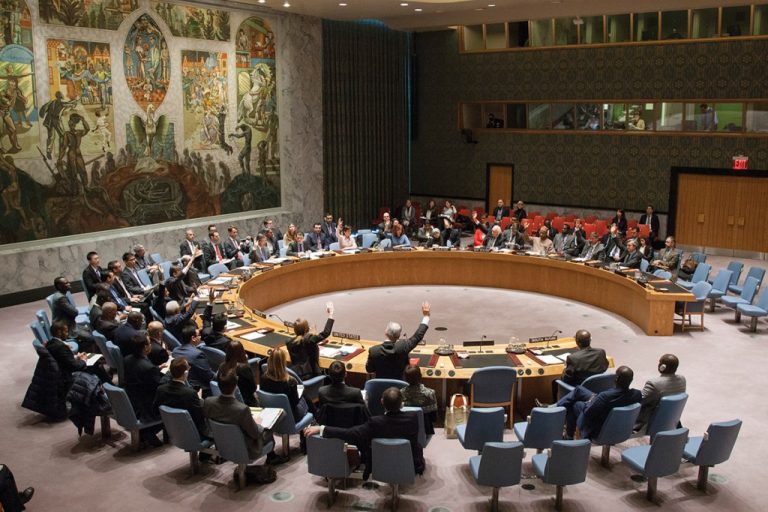
Batting for India’s candidature for the permanent membership of the United Nations Security Council, France’s permanent member to the United Nations said that India is “absolutely needed” as a permanent member of an enhanced Security Council. He said that it is a matter of “strategic priority” for them to get Japan, India, Germany, Brazil and fair representation from Africa on the reformed and enlarged UNSC.
France’s permanent representative to the UN Francois Delattre said, “The enlargement of UNSC is absolutely needed to better reflect the world as it is. Germany, India, Japan, Brazil and fair representation from Africa, in particular, is absolutely needed on the table to achieve a fairer representation of the UNSC.” French envoy was speaking beside the German envoy to the UN Christoph Heusgen at the end of Germany’s Presidency of the Council for April.
India has been at the forefront among nations in the UN pushing for reforms in its Security Council and emphasising the place it rightly deserves at the high-table as a permanent member.
India’s permanent representative to UN ambassador Syed Akbaruddin had earlier said that more than 90 per cent of written submissions in the document are in favour of expansion in both categories of membership specified in the Charter. He had stated in the informal meeting of the Plenary on the Intergovernmental negotiations on the question of fair representation and increase in the permanent membership of UNSC that 113 countries out of 122 have supported expansion.
Akbaruddin has also stated that the expansion of the UN Security Council is a process rather than an event and the impediments to moving forward remain the same.
Considering the crucial role the United Nations plays in acting as a mediator and resolving the issues having far-reaching consequences, the Fench envoy has stated that it only reinforces the need of having a reformed UN Security Council and thus they are of the firm belief of including Germany, India, Japan, Brazil and fair representation of African countries in the enlarged UNSC.
It is notable here that France has also strongly supported India’s bid to list Jaish-e-Mohammad founder Masood Azhar as a global terrorist by the UN.
A study by online visibility management and content marketing SaaS platform SEMrush, reveals that PM Narendra Modi has overtaken US President Donald Trump to become the second most popular politician globally.
India’s Prime Minister’ mass appeal, attributed to his classic ability to connect with the common people, has fetched him a social media audience of 110,912,648 on platforms including Facebook, Twitter, and Instagram. With over 110 million followers worldwide, Modi has overtaken US President Donald Trump who has 96 million followers globally.
The most sought after politician on social media platforms is the former US President, Barack Obama, who has 182,710,777 followers on his Facebook, Instagram, and Twitter accounts.
“The popularity of our PM Narendra Modi is immense and the study finding depicting him as the 2nd most followed person globally after former US President Barack Obama is a culmination of this fact,” Fernando Angulo, Head of International Partnership, SEMrush, said in a statement.
Meanwhile, Congress President, despite the fact that he keeps his audiences regularly entertained with his gaffes, accumulates 12 million followers from Facebook, Instagram and Twitter.
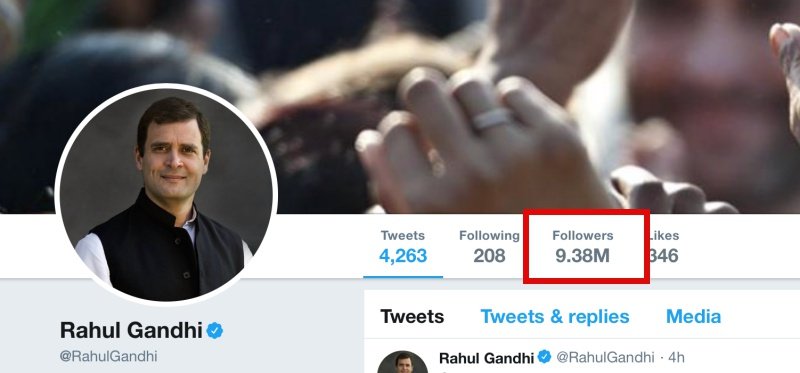
Amongst all the social media platforms, Twitter serves as the nest of the maximum number of active political audiences, both domestic and global, says the report by SEMrush. On Twitter, Rahul Gandhi has 9.4 million followers.
Rahul Gandhi’s followers on Twitter
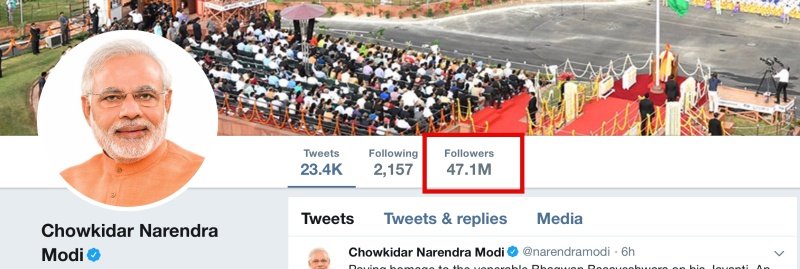
which as remarkably low as compared to Narendra Modi who has managed to accumulate 41.1 million followers on Twitter.
Prime Minister Modi’s followers on Twitter
Meanwhile, Prime Minister, Narendra Modi has been recognized umpteen number of times on various global platforms. While Russia decorated PM Modi with the highest state honour, South Korea accorded him with the prestigious Seoul Peace Prize.
Last year, PM Modi was honoured with United Nation’s prestigious, 2018 ‘Champions of the Earth Awards’. Similarly, the United Arab Emirates has awarded Prime Minister Modi with the highest civilian honour for boosting the relations between India and the Emirates.
In this series on the performance of various ministers in Modi government, today we look at the Railway minister. Piyush Goyal is another rising star in the BJP and one of the best performing ministers of the Modi cabinet. Ministry of Railways has undergone a sea change during the tenure of Narendra Modi government. The credit of which should be given to both, Piyush Goyal and Suresh Prabhu, the former Railways Minister. Piyush Goyal is Minister of Railways, Coal and was interim Finance Minister when Arun Jaitley was away due to medical reasons. Before this, he also held power portfolio for significant time and did a major transformation in the power sector.
Piyush Goyal is a Chartered Accountant (CA) by training. He was all India second rank holder in CA exams. He was also second rank holder in Law in Mumbai University. He was a well-known investment banker and has advised top corporates on management strategy and growth. He also served on the Board of India’s largest commercial bank, the State Bank of India and Bank of Baroda. He got the RSS training at home itself, as his father late Vedprakash Goyal was an active RSS and BJP member. His father served as Union Minister for Shipping in Vajpayee government and was also national treasurer of the BJP. His mother Chandrakanta Goyal was elected to Maharashtra Legislative Assembly thrice from Mumbai. Piyush Goyal was also nominated by the Vajpayee government to the prestigious Task Force for Interlinking of Rivers in 2002.
Following his father, Piyush Goyal also served BJP as national treasurer and member of the national executive. He headed the BJP’s information communication campaign committee and oversaw the publicity and advertising campaign of the party including the social media outreach for the Loksabha elections 2014. Post elections, at first he was inducted in the council of ministers and Minister of State (independent charge) for Power and Coal by Prime Minister Narendra Modi. Impressed by his performance, PM Modi later elevated him as cabinet minister for a crucial portfolio like Railways. Piyush Goyal is one of the best performing ministers in Modi in the government. Impressed by his star performance, PM Modi also entrusted him with all important finance portfolio in absence of Arun Jaitley, when he was away for his medical treatment. Piyush Goyal presented the last budget of Modi government in absence of Arun Jaitley. This budget was widely held as a very good budget due to several middle class, farmers and unorganized sector workers welfare schemes.
Let’s have a look at Piyush Goyal’s achievements as railway minister.
Bullet Train – Though the first MoU between India and Japan for Shinkansen popularly known as Bullet Train was signed in 2007 during UPA 1 government, things didn’t move an inch ahead till Narendra Modi took charge as Prime Minister. UPA government had finalized the route Mumbai – Ahmedabad for the first Bullet Train after a joint survey by Indian Railways and Shinkansen of Japan. Things moved fast, as NDA governments which are known for its infrastructure spending, fast-tracked the bullet train. Prime Minister Narendra Modi and Prime Minister of Japan, Shinzo Abe jointly laid the foundation stone of India’s first Bullet Train in September 2017 between Mumbai and Ahmedabad. Work has already started on the route, and Prime Minister Modi has given a target of August 2022 for its completion and first commercial run. Looking at the penchant of Modi government to complete projects on time, India would surely have its first Bullet Train on tracks by August 2022. Congress questioned the need for Bullet Train in a juvenile manner, termed it as misplaced priority of Modi and accused PM Modi of taking every project to Gujarat and developing Gujarat on Maharashtra money, despite the fact that it was UPA government which decided the first route, and both Maharashtra and Gujarat governments are equal partners in the Special Purpose Vehicle (SPV) established. Modi government executed it unlike Congress which just sat on the project.
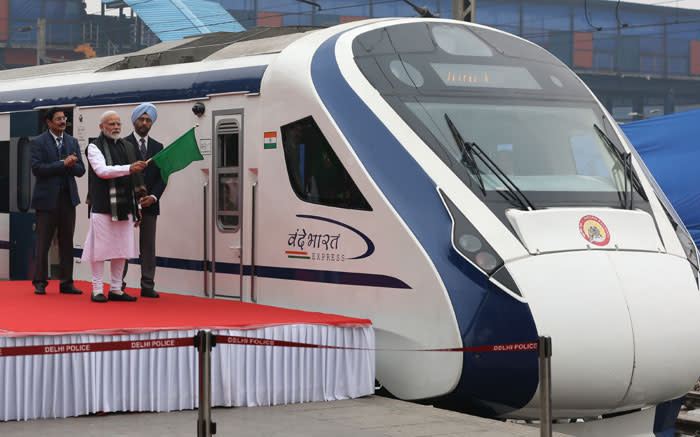
Train 18 – Train 18 which has now been renamed as Vande Bharat Express, is the first modern world class rolling stock produced indigenously under ‘Make in India’ initiative by Integral Coach Factory (ICF), Chennai at the cost of just Rs 100 crore. World over one rake of such train equipped with all modern amenities and features costs at least Rs 250 crore. Train 18 has been completely conceptualized and designed in India itself. It is designed to reach a top speed of 200 KMPH, conditions permitting making it fastest train in India. However since tracks in India are not designed for such high speed, its top speed has been capped at 160 KMPH by Commissioner of Railway Safety, still making it fastest train in India by a great margin. During trials, Train 18 regularly clocked speed of 180 KMPH. The entire train was conceptualized, planned and developed in the span of 18 months, meaning entire development happened during Modi government. Train 18 will eventually replace Shatabdi Express across all the routes.
Vande Bharat Express or Train 18
Piyush Goyal in the budget speech said, that this year ICF will produce 4 more such trains. Another Train 20 prototype is being readied, which would hit the tracks in 2020 and will replace Rajdhani Express. It would have some additional features like sleeper coaches etc. in addition to all features of Train 18 as it would be designed for longer journeys. Other countries from all across the globe have shown interest in importing Train 18 due to its lesser costs compared to its global peers. Piyush Goyal has said that once Train 18 achieves surplus production, it would be exported. This is the first time that even developed countries like Singapore have shown interest in buying train from India, although India in the past has been regularly exporting trains to developing countries. Train 18 is power packed with other features, which have been never seen in Indian Railways. Other features of Train 18 includes self-propelled engines from both sides of the train like a metro train, meaning there is no need of reversing the train at destination station for its return journey. Like metro coaches, the doors of Train 18 will open only after it stops.
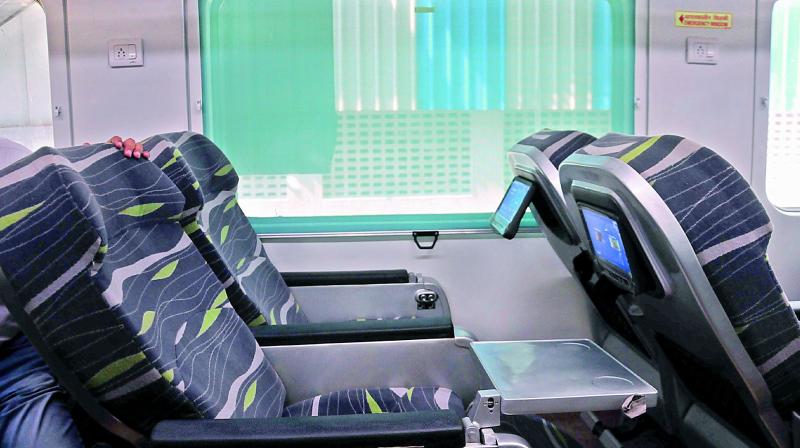
The train will have two executive compartments which will have 52 seats each, and trailer coaches will have 78 seats each. The executive class will have rotating seats to match the direction of the train. It also has diffused lighting, an onboard infotainment system with Wi-Fi, vacuum toilets and sliding doors, besides a GPS-based passenger information system. The footstep in a coach’s doorway slides outward when the train stops at a station to help passengers alight safely with comfort. Train 18 also has touch-free bio-vacuum toilets, LED lighting, mobile charging points, and a climate control system that adjusts the temperature according to occupancy and weather. It also features emergency talk-back units to contact train crew and CCTVs in all coaches for safe and secure travel. Passengers can also enter train drivers cockpit and have a look at it. First Train 18 has been flagged off between Delhi – Varanasi. It takes only 8 hours to cover this distance while stopping only at Kanpur and Prayagraj. Currently, the fastest trains between these two stations take 11.30–11.45 hours to cover this distance. Train 18 cuts it down further by 3.5 hours. This train has received rave reviews from the passengers in the last 2 months since it has been launched.
Unfortunately, this train is become a frequent target of antisocial elements, with the train being pelted with stones, shattering its glasses, several times. To check this problem, railways has installed cameras on the train to identify the areas where stones pelting is being reported. Even the veteran journalist Mark Tully has praised Vande Bharat Express in his column. While second such Vande Bharat Express is ready, its launch has been delayed due to model code of conduct in force due to general elections. Election Commission seriously needs to think if all the development activities can stop during elections, especially when the train has already been launched and there is nothing new in the train set which is different from the first.
Trains like Gatiman Express, Tejas Express, Mahamana Express, Humsafar Express launched – All the trains come with modern coaches and are equipped with better and modern features for the comfort of the passengers. Gatiman Train was the fastest train in India before Vande Bharat train (Train 18) started operations.
Anubhuti Coaches and Deendayalu Coaches – Railways have also started manufacturing Anubhuti coaches for the comfort of 1AC and Executive class passengers in Rajdhani Express. These coaches are modern and upgraded version of coaches for already premium class coaches like 1AC and Executive Class. These include aeroplane like features like LED lighting, bio vacuum toilets, reading lights, attendant call button etc. Famous author Chetan Bhagat was so impressed with Anubhuti Coaches that he urged travellers to chuck flights and travel in Anubhuti Coaches.
Anubhuti Coach
However, railways are not only about premium travellers. Common public also travels through railways as it is the only affordable and viable option to travel long distance for them. For the benefit of general bogie travellers, railways launched Deendayalu Coaches. All seats in Deendayalu coaches are cushioned, unlike regular second class non-reserved compartments. It also has Aquaguard fitted in each coach to provide potable drinking water to the passengers. It boasts of LED lights and more numbers of mobile charging sockets. 1000 such Deendayalu coaches have been manufactured.
Elimination of all unmanned railway level crossings – Indian Railways has eliminated all unmanned railway level crossings (UMRL) on its network on mission mode either by manning them or constructing over bridges, underpasses or diversions. UMRLs were the major cause of train accidents in the country as it provided unauthorised access to people on railway tracks. To get an idea about the speed at which they were eliminated, in April 2017, there were 4,943 UMRLs across the IR network, in April 2018, the number fell to 3,479 UMRLs, by November 2018, only 77 UMRLs were left and by December 2018 only 1 UMRL was left which was closed 1st February 2019, one year ahead of the target, making India completely UMRL free and eliminating a major reason of train accidents.
Best safety record in the history of Indian Railways – IR recorded its best-ever safety record in 2017-18 with the number of accidents at 73, which were recorded in double digits for the first time in the history of railways.
Rashtriya Rail Sanraksha Kosh (RRSK) fund of Rs 1 lakh crore introduced in 2017-18 to be spent exclusively on safety over five years (2017-18 to 2021-22). For the first time ever railways have seen such a huge allocation on safety.
Capital Expenditure in four years was more than 10 years of UPA government – Capital expenditure from April-2014 to March 2018 (4 years) was Rs 3.64 lakh crore which is more than the cumulative investment of Rs 3.54 lakh crore in railways during the entire tenure of UPA government from April 2004 to March 2014. This means while UPA spent an average of 35,000 crore on capital expenditure of railways, which is meant for creation of new infrastructure and modernize existing one, Modi government spent an average of Rs 91,000 crore towards it meaning it spent almost 3 times more per year than UPA government towards creating new infrastructure.
9,528 kilometers of new broad-gauge lines were built in 4 years compared 7,600 kilometers in previous 5 years meaning, while Congress government constructed an average of 1520 kilometers per year, Modi government constructed 2382 kilometers of new railway lines per year.
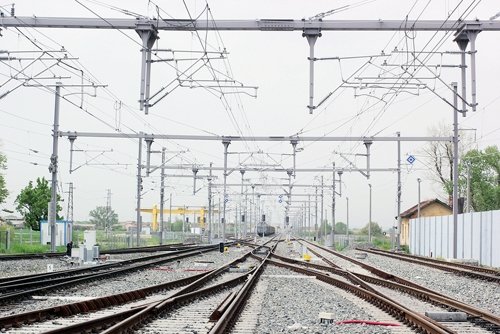
During 4 years of Modi government, 8,411 kilometers of railway track was electrified compared to 3,038 kilometers of 5 years of UPA 2 government, which is nearly 3 times more than UPA 2. Electrification ensures lesser diesel consumption, lesser emissions and cleaner environment.
50% increase in track renewal from 2,926 kilometers in 2013-14 to 4,405 kilometers in 2017-18 was also achieved.
All the existing railway lines in the northeast were converted to broad gauge while Meghalaya, Tripura and Mizoram were brought on railway map for the first time.
Wi-Fi at Railway Stations – All the major stations now have free Wi-Fi network for passengers in association with Google.
LED lights at all railway stations – All stations now have LED lightings which have resulted in the reduction of power bills of Rs 500 crore for Indian Railways and reduce the CO2 emission by 60,000 tonnes. All coaches are also being fitted with LED lights with 5000 coaches already fitted with LED lights.
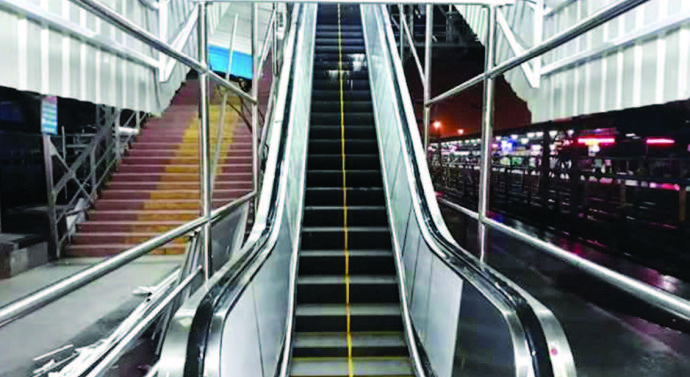
Escalators and lifts at railways stations – All major railway stations now have escalators and lift facility for the convenience of passengers, especially old and divyang passengers.
600 stations are being redeveloped with world-class facilities. Earlier during UPA government, only ‘Adarsh’ stations were announced but no real work happened. Habibganj station of Bhopal is being developed on the lines of Heidelberg railways station of Germany.
Ticketing on IRCTC website – IRCTC website had become a butt of the jokes for its slow speed ticketing. This government gave a facelift to IRCTC website as well as increased the capacity of its servers from 2,000 tickets per minute to 20,000 tickets per minute having 10 fold increase in the capacity.
Complete stopping of ICF designed coach – IR has completely stopped production of conventional railway coaches know as ICF coaches in railway parlance. It now only produces Linke Hoffman Busch (LHB) coaches which are generally used for Rajdhani and Shatabdi Express and are equipped with more safety features, which in case of accidents don’t climb on each other due to its strong coupling features, reducing fatality rates.
Antyodaya Train Service – All general class (unreserved) service for the benefit of common passengers with LHB coaches having additional facilities has been started. Currently, 15 such Antyodaya Trains are operational between different stations.
Project Swarn for upgradation of Rajdhani and Shatabdi Express Trains – Railways started the project Swarn to upgrade coaches of Rajdhani and Shatabdi Express. Under Project Swarn, coaches have an interior painting with an aesthetic international colour scheme and LED lighting to improve illumination, better hygiene by providing ‘auto janitor’ system in toilets. They also have health faucets, stainless steel wash basins, improved soap dispenser and better quality dustbins, at carefully chosen locations for ergonomic convenience. These coaches have night signage for easy identifications of berth number for en-route entraining passengers. Blanket covers for First AC passengers of two different colours to ensure separate covers in to and fro journey in these coaches.
First AC passengers also have built-in ladders for easy access to the upper berth. These coaches have CCTV cameras in the doorway area and aisles to monitor any suspicious activity. They also have newly designed magazine bags with an extra pocket for mobile to suit changing lifestyle, LED lighting over mirrors, vinyl wrapping of toilet doors for improved aesthetics and epoxy coating in toilets, provisioning of extra mats in the toilet to improve hygienic standards and to give a dry toilet to the passengers with improved cleanliness. Toilets also have polished commodes and basins to make them odour free on every trip. Real time feedback is also taken from passengers by dedicated railway staff.
Digital India, Digital Railways – Railways has embarked on increased passenger convenience and any help needed during the journey is just a tweet away. Many passengers have been helped in a medical emergency or otherwise, just on a tweet. There are examples of a train making an unscheduled stop to cater to a passenger in need. This service was started by Suresh Prabhu, when he personally started responding to tweets of needy passengers and directing the concerned officials for help. Later 24*7 a control room was set up to monitor IR twitter account and provide help to needy passengers.
Post demonetisation, railways also leapt forward to accept digital payments and more than 9,000 POS machines have been installed across the IR network to promote digital transactions. To promote digital transactions, railways withdrew service charges on online booking of tickets and on transactions against credit/debit cards for purchasing journey tickets at PRS/UTS counters. It also offered 5% discount on season tickets purchased through digital means and 5% discount on reserved counter ticket subject to a maximum discount of Rs. 50 for tickets of value of Rs. 100/- or more for payments made through UPI/BHIM.
Major thrust to suburban networks – An outlay of Rs 17,000 crore was approved for development Bengaluru Suburban System and Rs 65,000 crore for upgradation of Mumbai Suburban System in budget 2018-19. Never before Mumbai Suburban network got such huge outlay. Mumbai also got its first AC local train on its suburban network. Mumbai is set to get 12 more AC locals this year, greatly reducing the sufferings of Mumbai local passengers, where travelling in a local train is no less than fighting a war for Mumbaikars. According to the plan, Mumbai will get 210 AC locals making the local journey comfortable for Mumbaikars.
First all women station – Matunga station in Mumbai became the first station to be manned by all women staff. All the staff at this station including station incharge, ticket window operator, RPF personnel is women. Railways in planning 12 more such all women stations.
India’s first National Rail & Transportation University was set up in Vadodara. It has started its first academic session in 2018-19 with two undergraduate programs, B.Sc. in Transportation Technology and BBA in Transportation Management. Having such a university was a dream of PM Narendra Modi. He took a personal interest in the project. Its only third such university of the world, with other two in Russia and China, making India join the elite club of countries having such university.
Swachch Bharat, Swachch Railways – Those who have travelled in railway or been to railway stations in the last 5 years, would have seen a remarkable improvement in cleanliness in the railway stations and surrounding areas. Regular housekeeping, several times a day is done both in stations as well as moving trains. Those who have travelled in trains, especially in the long-distance ones, would be witness to how often housekeeping staff comes and cleans the entire compartment. Moreover, you can also request their services just on call/SMS/tweet.
Braille signage in trains – Train seat signages are now equipped with Braille for the benefit of blind passengers.
Vistadome Coach
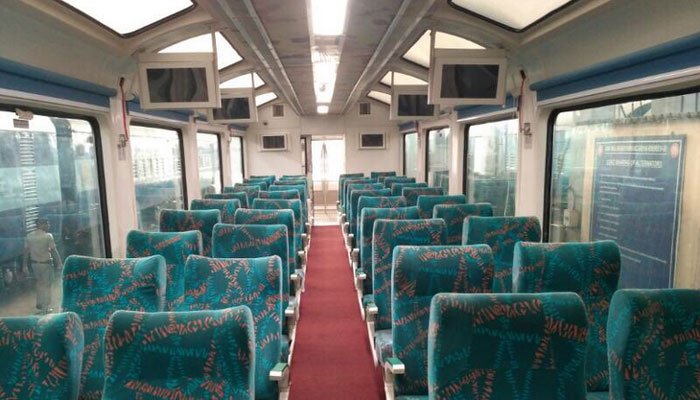
Vistadome Coaches – Vistadome coaches have been attached to trains running on scenic routes like Araku Vally, Mumbai – Goa (Konkan Railway) and Kalka – Shimla for tourists to be able to enjoy the natural beauty of the surroundings. Train routes in North East will soon get these coaches. These coaches are hit with tourists and they are demanding that railways introduce more Vistadome coaches in order to cater to the demand.
The author is journalism pass out from Indian Institute of Mass Communication, New Delhi. After dangerously flirting with the idea of left during his IIMC days, due to the proximity of the IIMC with JNU, a den of radical leftists, he became firmly aligned to right after realizing the futility of the left. He tweets at @kpophale.
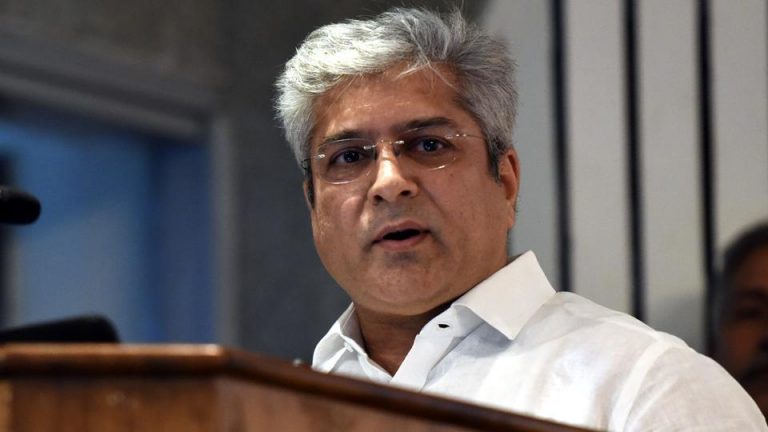
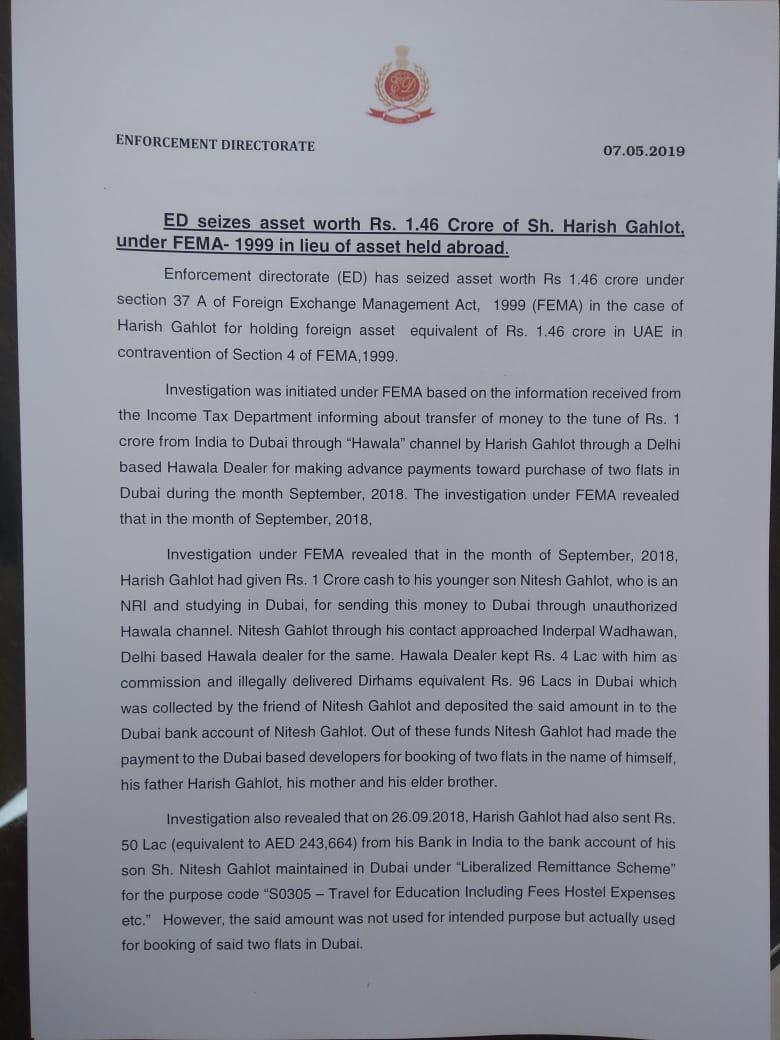
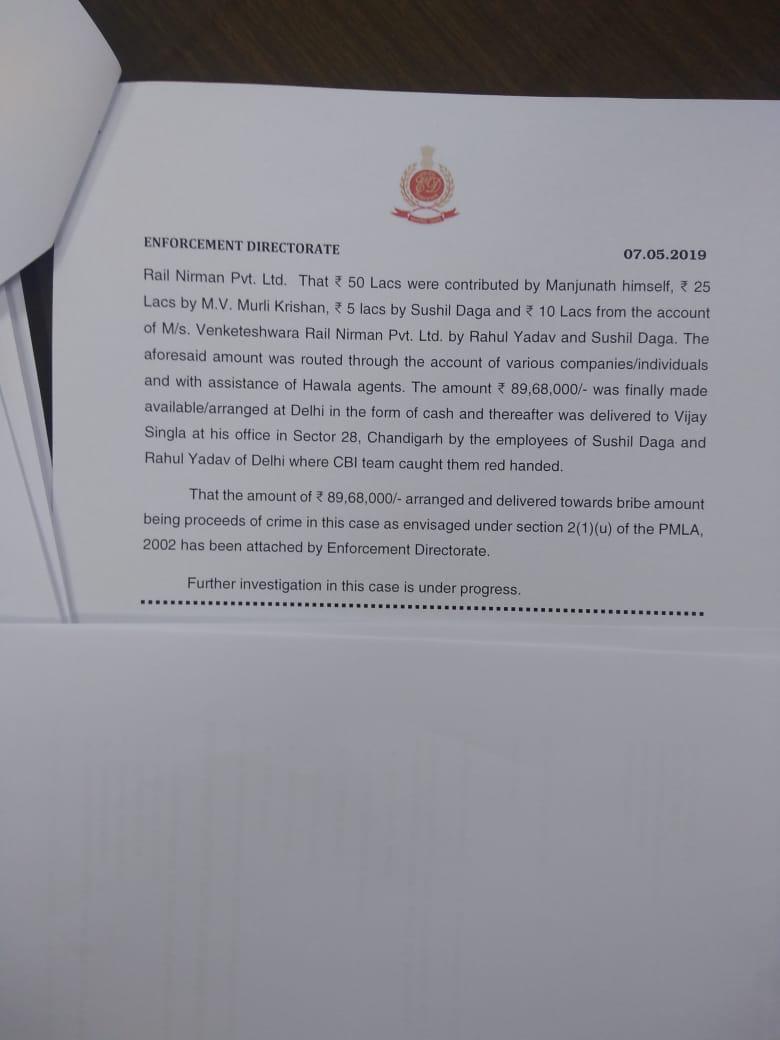
The Enforcement Directorate (ED) has seized assets worth Rs 1.46 crore under section 37A of Foreign Exchange Act (FEMA), 1999 belonging to Harish Gahlot, brother of Aam Admi Party (AAP) MLA Kailash Gahlot. As per the investigation initiated under FEMA, Harish Gehlot allegedly holds assets worth Rs 1.46 crore in the United Arab Emirates (UAE) which is in violation of section 4 of the FEMA.
It was revealed during investigation that in September 2018 Gahlot had transferred Rs 1 crore in cash to his younger son Nitesh Gahlot, who is an NRI studying in Dubai, through Hawala channels.
ED DocumentED Document
Nitesh contacted a Delhi based Hawala dealer named Inderpal Wadhawan in this regard. Out the 1 crore, Wadhawan allegedly kept 4 lacs as commission and got the equivalent amount of Rs 96 lacs in Dirham transferred to Dubai which was collected by a friend of Nitesh Gahlot and submitted in his account. Nitesh Gahlot utilised this amount to make payment to a Dubai based developer for booking two flats in the name of Harish Gahlot, himself, his mother and his elder brother.
It was revealed that Harish Gahlot also transferred an amount of Rs 50 lacs on September 29, 2018, from his own bank account in India to Nitesh Gahlot’s bank account in Dubai maintained under ‘Liberalised Remittance Scheme’ for the purpose code S0305-Travel for Education Including Fees Hostel Expenses, etc,” but the said amount was instead used for booking the above-mentioned flats. Further investigation in the case is underway.
Last year in the month of October, the I-T Department had seized assets worth Rs 2 crores which included unaccounted jewellery worth Rs 28 lakhs and Rs 37 lakh in cash from AAP MLA Kailash Gahlot and his wife.
A day after videos have emerged showing NewsX journalists attacked by TMC workers in West Bengal, another incident of attack on media personnel by TMC has come to light. Popular Bengali newspaper Sangbad Pratidin has reported that on Monday, a reporter and a cameraman working for the paper were attacked by TMC goons in Hooghly.
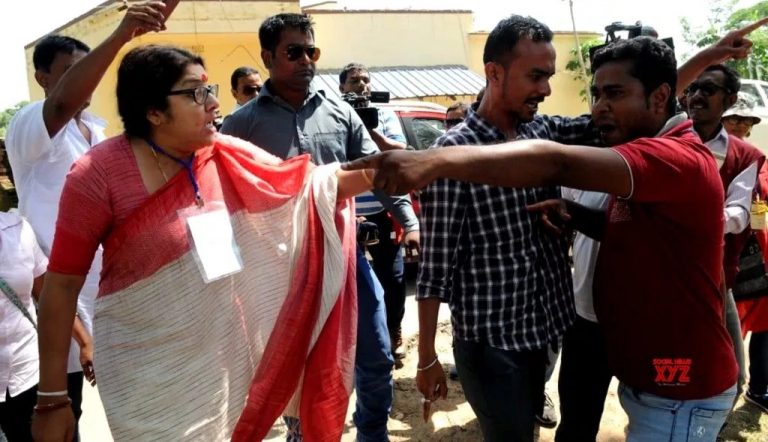
According to the report, journalist Nabyendu Hazra and cameraman Rajiv Dey were covering the day-long schedule of BJP candidate Locket Chatterjee on Monday. At around 1 PM, Locket Chatterjee had gone to a primary school where polling was going on. According to BJP, TMC workers had captured the booth, and they were casting the votes in place of genuine voters who were prevented from coming to the booth. The moment the BJP team entered the polling booth, TMC workers present there resisted them and this raised tension between the two sides. Seeing this, Locket came out of the booth, but the TMC workers started attacking the BJP workers. The vehicle of the BJP candidate was also smashed.
During this, the Sangbad Pratidin journalists covering the incident were also attacked by TMC goons. They were surrounded and beaten up. The photojournalist was pinned to the ground by the attackers, and his spectacles were also smashed. The camera was also destroyed by the goons.
According to the journalists, the role of security personnel during the incident was also questionable. They say that at least for soldiers of central armed forces were present when the journalists were being attacked, but they remained mute spectators. Nobody came forward to help the scribes, they allege.
Nabyendu said that he never had such an experience before when they were attacked for just being journalists. Photojournalist Rajiv Dey said that he was never beaten like this before. The journalists have lodged an FIR at the Dhanekhali police station about the incident.
Locket Chatterjee said that when she entered the booth, she saw that there were no voters there, and the booth was under the control of TMC workers. She also said that when she entered the booth, all votes in the booth were already cast, and the presiding officer was having his meal inside the booth itself. She said, “when they saw that media have come with me, they realised that the rigging done by them will be exposed and hence they attacked. They pulled my cloth, hair, hit me, smashed my vehicle. Somehow, we escaped from there, but the administration did not help us”.
A few days ago Sangbad Pratidin had published an interview with BJP president Amit Shah, and some people believe that people working with the paper may be specifically targeted by TMC for this reason.
Within days of publishing an interview of @AmitShah, the reporter & photographer of leading Bengali daily #SangbadPratidin were brutally beaten up while they were covering #LoksabhaElections2019
The press car was damaged Nobody’s saying a word. When will the reign of terror end? pic.twitter.com/1105SPKgpM
She added that media is working independently, not listening to the ruling party in the state, that’s why the media is being attacked by TMC workers. The BJP candidate said that she will ask for repoll in the booth, along with around 100 booths.