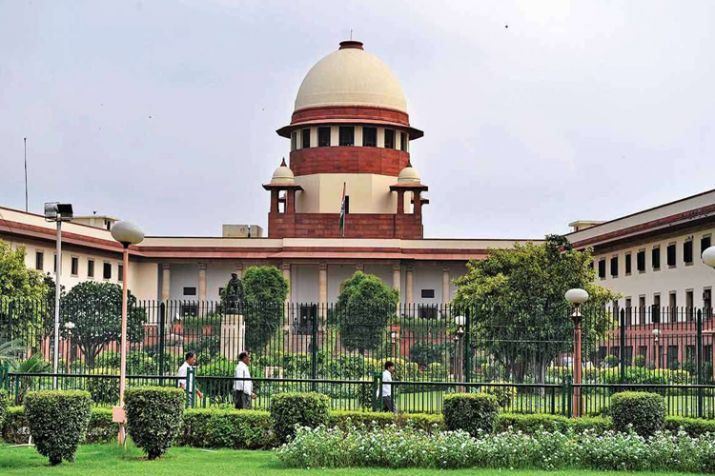
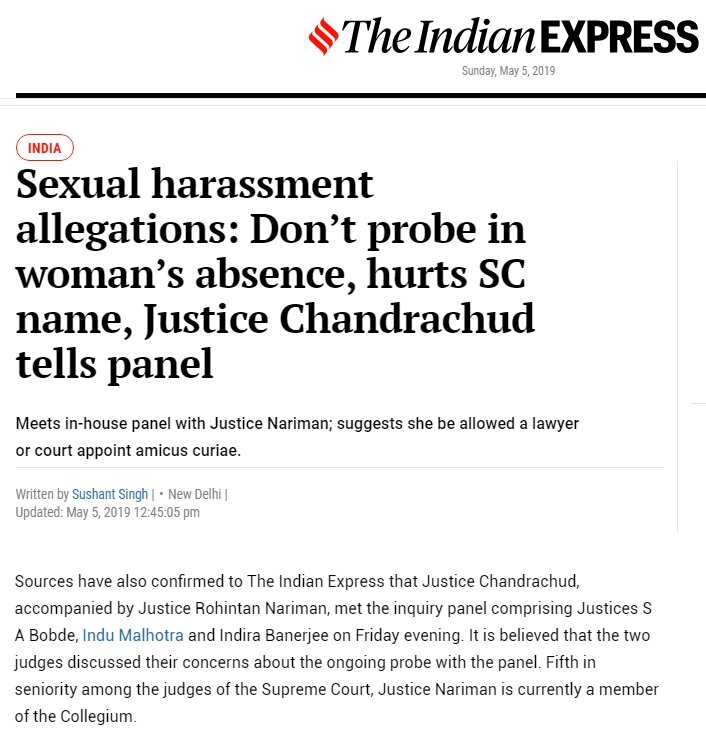
The Supreme Court of India has said that a report published by the Indian Express today is fake. On a report about the probe into sexual harassment charges levelled against Chief Justice of India Ranjan Gogoi, Indian Express had said that Supreme Court judges Justice D Y Chandrachud and Rohintan Nariman had met the inquiry panel comprising Justices S A Bobde, Indu Malhotra and Indira Banerjee on Friday evening. This in-house panel of Supreme Court is probing the allegations against CJI Gogoi.
Indian Express report saying that two judges met the SC probe panel
The report had said that Justice Chandrachud had asked the panel to not proceed with the inquiry “ex parte”. Indian Express reported that the two judges discussed their concerns about the ongoing inquiry with the panel.
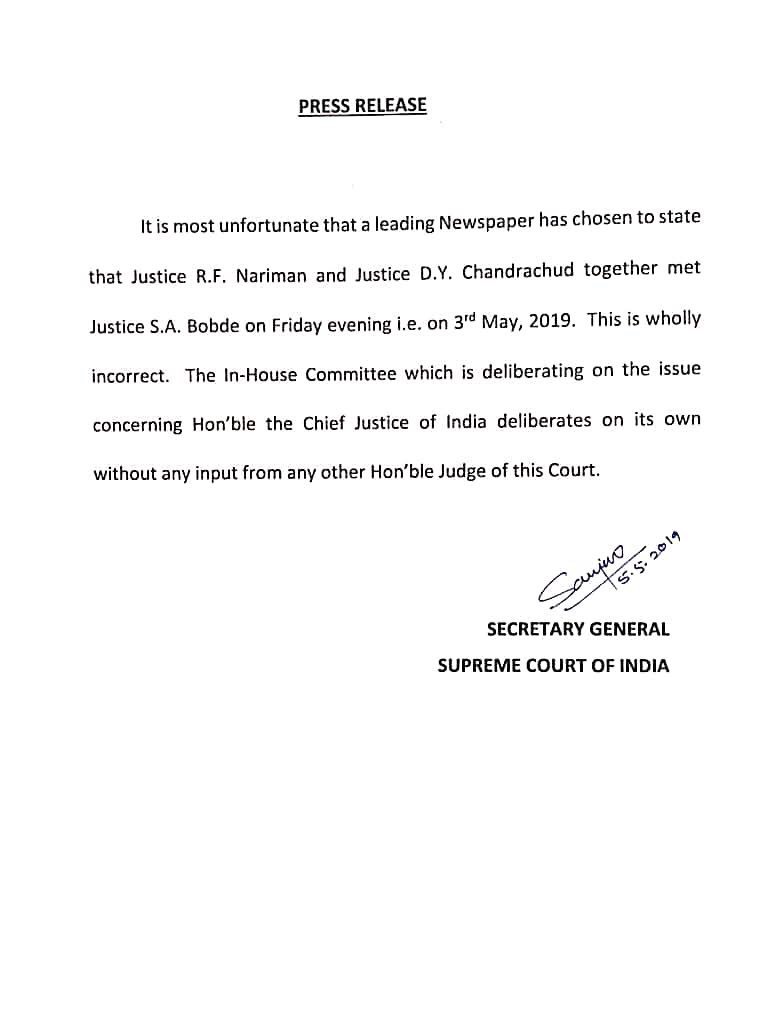
Reacting to the news report, the secretary general of Supreme Court of India has issued a clarification that no such meeting took place, and the entire report by Indian Express is false. The clarification said, “It is most unfortunate that a leading newspaper has chosen to state that Justice RF Nariman and Justice DY Chandrachud together met Justice SA Bobde on Friday evening i.e on 3rd May 2019. This is wholly incorrect. The in-House committee which is deliberating on the issue concerning Hon’ble Chief Justice of India deliberates on its own without any input from any other Hon’ble judge of this Court.”
SC clarifies that Indian Express report is fake
A former employee of the Supreme Court had levelled charges of sexual molestation against CJI Gogoi, which is being probed by the panel. A few days later, advocate Utsav Basin had alleged that the charges are part of a larger conspiracy involving disgruntled former employees, lawyers, judges and corporates to fix the Supreme Court, and another bench is hearing that allegation.
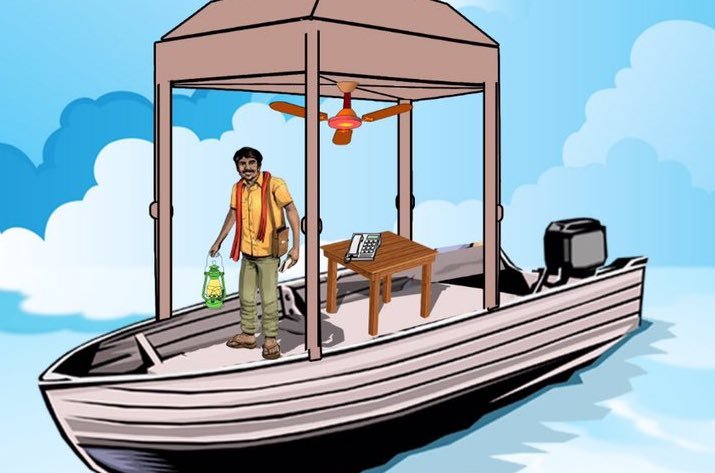
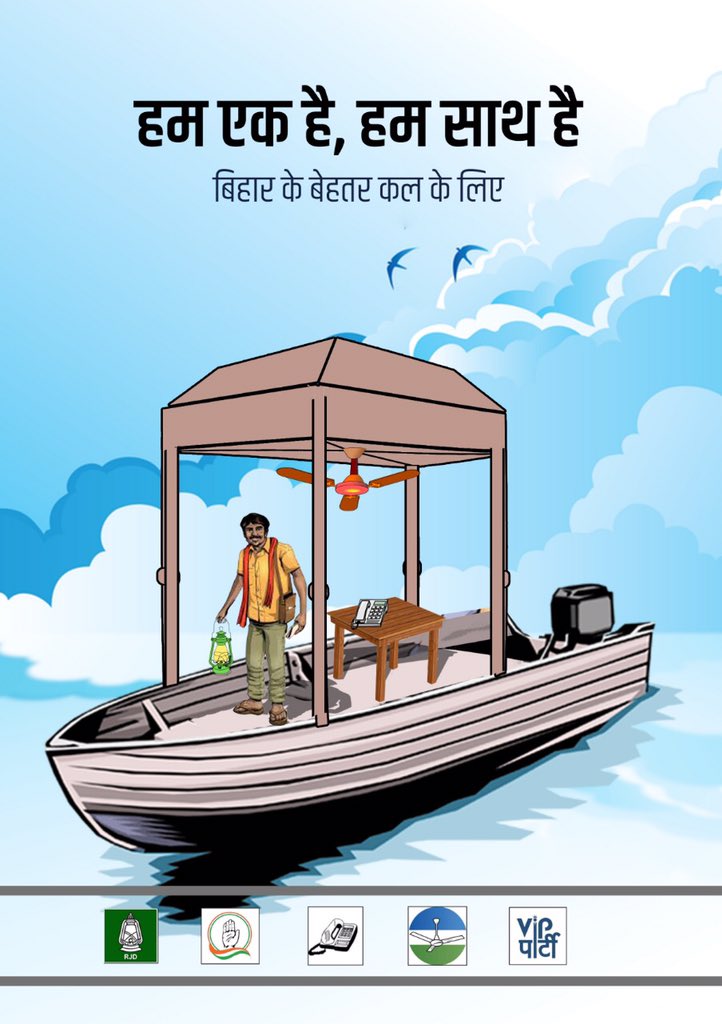
Rashtriya Janata Dal leader and former Bihar Deputy Chief Minister Tejashwi Yadav today took to Twitter to share a cartoon depicting election symbols of all alliance partners in one frame with a caption “सोचा है हमने और आगे जाएंगे, साथ मिलकर भाजपा हटाएंगे।” (We have thought we will go much ahead and together defeat the BJP.)
Cartoon posted by Tejashwi Yadav
The image shows election symbols of various alliance partners together. A boatsman is holding a lantern, which is the election symbol of RJD. On a table behind him, there’s a landline phone which is the election symbol of Hindustani Awam Morcha, a party floated by Jitan Ram Manjhi. Above the table is a ceiling fan which is the election symbol of Rashtriya Lok Samata Party (RLSP) and it is on a boat, which is the election symbol of Vikasshil Insan Party (VIP).
— Chowkidar Maithun RCB (@Being_Humor) May 5, 2019
Helpful Twitter users tried to explain it to Yadav how the cartoon does not really make sense.
इस फोटो को बनाने वाला दुनिया का बहुत बड़ा बेवकूफ होगा।
1.नाव पे पंखे की जरूरत ही नहीं होती क्योंकि नेचुरल हवा आलरेडी है।
2.लालटेन कौन जलाता है भाई नाव पर।
3.लैंडलाइन फोन नाव पर हद है।
और कांग्रेस कि जरूरत सिर्फ चोरो को है।
??????@BJP4India@INCIndia
— CHOWKIDAR DHIRAJ SMARTY. (@dhiraj_smarty) May 5, 2019
There’s a ceiling fan on a boat, which is not necessary because there will already be a natural breeze.
लालटेन और पंखा कभी एक दूसरे का पूरक नही हो सकता।
लालटेन है मतलब बिजली नही,बिजली नही तो पंखा किस काम का?
पंखा चल रहा मतलब बिजली है, बिजली है तो लालटेन किस काम का? https://t.co/ovDgl4vIsJ
This user pointed out how the lantern and ceiling fan do not compliment each other. Lantern suggests that there is no electricity. In which case, there is no use of the ceiling fan. And if there is a functional ceiling fan, there is no real use of the lantern.
Another user pointed out how there is a landline phone without any wires.
टेलीफोन की तार कहां है भाई??
उपर से ये पंखा? ??
बिना अंधेरे के लालटेन भी जला ली??
And most amusing of them all is the fact that the boat seems to be steered by a person who is made to dress up in clothes which resemble a watchman’s uniform.
Recently, the Yadav brothers have taken to sharing cartoons and caricatures to make a point. While Tejashwi’s cartoon defies all logic, his brother Tej Pratap Yadav’s cartoons are equally strange.
Rabri Devi and Misa Bharti depicted in the image above have strange black moustache-like thing protruding from near their noses. In another such image he had shared earlier last month also had such bizarre elements.
While it appears that Rabri Devi is set on fire in the above image, one is not able to understand why is Lalu wearing an extra pair of glasses around his neck when he’s already wearing one.
What nonsense Lalu is wearing spectacles and has another pair hanging down his neck also?? https://t.co/6Vl4xpC7Hm
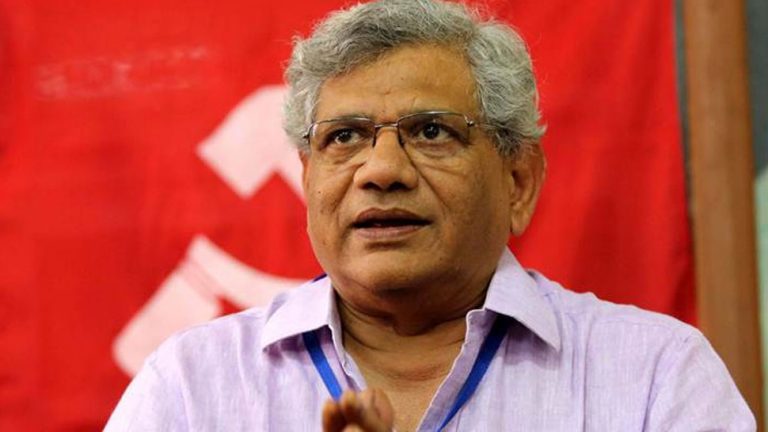
Yesterday, yoga guru Baba Ramdev and other seers lodged an FIR against CPM Leader Sitaram Yechury for his remarks on ‘Ramayana and Mahabharata’ with SSP Haridwar.
Uttarakhand: FIR registered in Haridwar, under multiple sec, against CPI(M) leader Sitaram Yechury for his statement, “Ramayana&Mahabharata are also filled with instances of violence&battles”. Yog Guru Ramdev & other saints had filed a complaint with SSP Haridwar earlier today. pic.twitter.com/eeCAZozNjP
“We have filed a complaint against Yechury, who has insulted our ancestors. It is an offence. He should be put behind the bars. We have demanded a strict investigation into the matter,” said Baba Ramdev after filing the complaint.
Speaking at an event, Sitaram Yechury had said, “Sadhvi Pragya Singh Thakur said that Hindus don’t believe in violence. Many kings and principalities have fought battles in the country. Even Ramayana and Mahabharata are also filled with instances of violence and battles. Being a pracharak, you narrate the epics but still claim Hindus can’t be violent? What is the logic behind saying there is a religion which engages in violence and we Hindus don’t.”
CPM General Secy Sitaram Yechury has stoked controversy, said that epics like Ramayana and Mahabharata prove that “even Hindus can be violent”@govindtimes with details. pic.twitter.com/dz2HkU8USK
This offensive statement by him generated a lot of criticism from the BJP and Shiv Sena. The Shiv Sena demanded that he drop his name ‘Sitaram’ and even demand CPM candidate Kanhaiya Kumar to change his name.
“Ramayana and Mahabharata conveyed one central message – victory of good over evil. Sitaram Yechury’s ideology is his own. His ideology has only one objective, which is to attack Hindus and make oneself the premier secular person,” Shiv Sena leader Sanjay Raut said.
The seers have demanded a strict investigation to be carried out as the CPM leaders remarks have hurt the sentiments of the Hindus.
The CPM leader had tried to reinforce the bogus idea of saffron terror and this time around he has sought to degrade the Ramayana and Mahabharata as well. Once again the Communists have shown their hatred towards the Hindus.
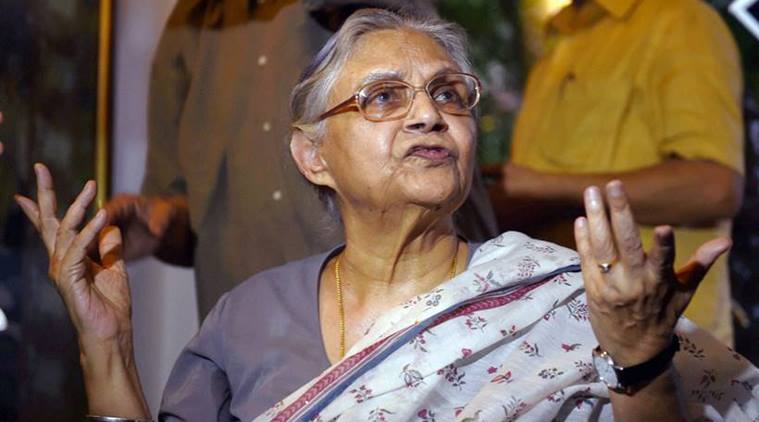
Former Chief Minister of Delhi Sheila Dikshit shocked all with her “I have no solution” remark in context to ‘women safety’ in Delhi. Ironically, Dikshit was the Chief Minister of Delhi between 1998-2013. Being a woman and the longest serving Chief Minister, her statement is not only shameful and ludicrous but appalling as well.
Dikshit, in conversation with Mirror Now, is seen to conveniently wash her hands off women safety. According to her, the Delhi government has no role to play in ensuring the safety of women as far as the police are concerned.
#EXCLUSIVE | ‘I have no solutions,’ Fmr Delhi CM, @SheilaDikshit on being asked what solutions she has to offer to the women of #Delhi to feel #safe in the city
In the video clip, which was shared by Mirror Now on its Twitter handle, Dikshit went on to downplay the Nirbhaya case that had united the entire nation in outrage over the heinous crime. She said this case was “blown out of proportion by the media” while other cases go unnoticed. She dumped the responsibility of ensuring women safety on Delhi Police, who she said falls under the ambit of the Government of India. Instead of responding to a question, she retaliated by asking the journalist, “I would like your solutions.”
The journalist suggested that streets should be lit, CCTV cameras should be installed and bus drivers should be properly licensed and identified. However, Dikshit was quick to shrug off the responsibility of the elected representatives of the state government. She chose to shift the blame on the police and the central government.
The journalist had to remind her that the Congress-led UPA government was in power when Nirbhaya case happened.
Through the interview, Dikshit reiterated the fact that “Solutions are with the Government of India and the Parliament of India.” She refused to offer any solutions about an issue that is under her purview. As the Congress candidate from Noth East Delhi, she said if elected to the Parliament, she would “speak about it, she would mention it because she would be representing Delhi.”
The senior Congress leader clearly appears to have a made up her mind of evading answers pertaining to the safety of women in Delhi, where she ruled for a decade and a half.
Her apparent views on offering solutions to women in the state have drawn flak. Here are some of the responses that she received.
Dixit can’t say ‘rape’ but uses alternatives instead. Ugh. She explicitly says state govt is not responsible to make #Delhi safer for women. Shameful. We’d like a representative who can act on solutions rather than asking a journalist for same. #SheilaDixit#Rape#Nirbhayacasehttps://t.co/EfumhBPIbG
#Sheiladixit says #Nirbhaya was blown out of proportion by the media. A shameful comment by a person who’s alleged personal corruption was kept in proportion by the same media. Expose awaited.
This is not the first time when Dikshit has passed a controversial remark. We had earlier reported how her comparison between Former PM Manmohan Singh and PM Narendra Modi in dealing with terrorism had irked her partymen.
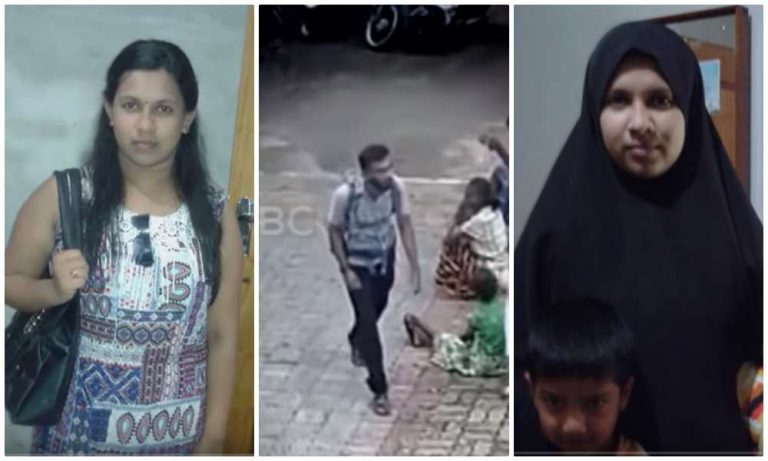
Sri Lankan suicide bomber Mohammad Hasthoon’s wife, Pulasthini Mahendran (some reports mention it as Pulasthini Rajendran) aka Sara who is believed to be an active participant in the recent Sri Lankan bombings, was born in a devout Hindu lower middle class family and was converted to Islam and radicalised, a report by popular Tamil channel IBC Tamizh has revealed.
As per the report, Pulasthini was born in a middle-class Hindu family in Thettativu, situated in Batticaloa district in Eastern Province in Sri Lanka and was allegedly abducted, converted to Islam and radicalised by Islamists groups.
IBC Tamizh’s interview with her mother, Kavitha Mahendran reveals that Pulasthini was a good student who was pursuing medical studies. She used to pursue traditional Tamil and Hindu religious studies in school. However, one Abdul Razik abducted Pulasthini when she was a student.
Kavitha claims that she tried to bring her daughter back, but Razik insisted that Pulasthini was ‘happy’ and that she had made an ‘informed adult decision’. A few months later, Razik called Kavitha to inform her that her daughter had ’embraced’ Islam and was married off to a man. Her husband is believed to the Mohammad Hasthoon, who was caught on camera at the St Sebastian Church bombing on Easter Sunday.
A devasted Kavitha cut off all ties with her daughter. A month after this, Kavitha claims she got a call from her distraught daughter who said she was unhappy in her life and she was on the verge of a complete breakdown. However, after this phone call, there was no contact from Pulasthini.
Around two weeks before the Easter Sunday attacks, Kavitha claims an unknown man, who identified himself as Sri Lankan intelligence officer had come looking for Pulasthini but didn’t divulge any information.
IBC report reveals that Abul Razik is actually a leader of the radical Islamic organisation, Sri Lankan Thowheed Jamaath (SLTJ) which has close ideological ties with the Tamil Nadu Thowheed Jamaath.
ISIS had claimed responsibility for the serial blasts that shook Sri Lanka last month claiming lives of over 200 people. The sons of one of the richest and politically well-connected man were found to be two of the suicide bombers. The family is under interrogation after the wife of one of the bombers triggered another suicide blast to kill policemen in their Colombo dwelling.
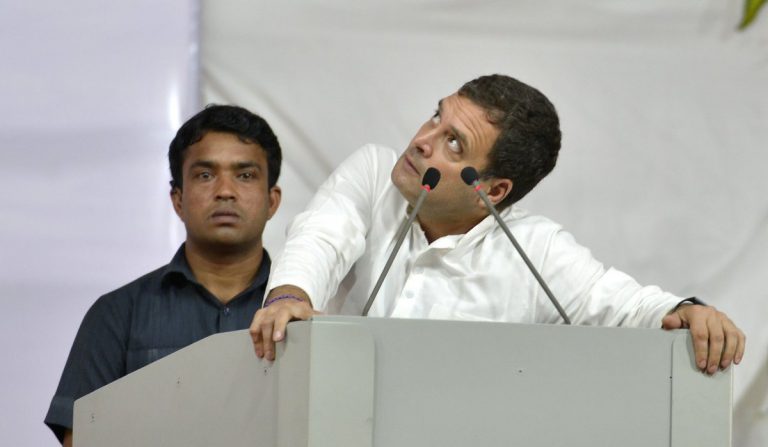
Mainstream media has finally woken up and questioned Rahul Gandhi’s ‘Modi gave Rs 30,000 crore to Anil Ambani’ lie. Rahul Gandhi, in his interview to Indian Express, was cornered on the specific figure he keeps on throwing around to allege that Prime Minister Modi gave away Rs 30,000 crore in the Rafale deal.
The Indian Expressed asked Rahul Gandhi that he keeps mentioning Rs 30,000 crore figure, whereas the total amount of the deal as per records is around Rs 60,000 crore. Rahul Gandhi cuts off the interview mid-question and says that there is enough documentation available to show that the benefit to Anil Ambani through the offset contract and other Rafale proceedings will come to Rs 30,000 crore.
The interviewers at Indian Express then question Rahul Gandhi that the offsets don’t quite add up to Rs 30,000 crore. Rahul Gandhi then shifted goal post and said how it is more about the procedure followed under which Anil Ambani got the deal.
Rahul Gandhi then lies, again. He says, “What is prima facie very clear, is that Mr Anil Ambani has no locus standi in making aircraft, is Rs 45,000 crore in debt and barely managed to stay out of jail. On the other hand, HAL has the experience in making aircraft and it’s been doing it for 70 years.” (relevant portion highlighted.)
The truth is, the 36 Rafales will not be made in India, so it’s a no-brainer that Reliance will not be making that. But the interesting point is, they are not even making parts for it. Yes, at present Dassault Reliance Aerospace is not even making parts for Rafale like HAL and some Indian companies will be doing, forget the whole plane. The company is making parts for the Falcon 2000 civil jet plane that is manufactured by Dassault Aviation. This company is now part of the global supply chain network of Dassault, and they have already started manufacturing parts and sending them to assembly plants. Dassault will be investing around € 100 million in the joint venture with Reliance as part of offset obligations related to the Rafale deal, which is less than 3% of the total offset obligation. Reliance is not getting US$20 billion or even US$4 billion as Rahul Gandhi seems to believe, the current investment is less than USD$ 120 million. Meanwhile, Snecma HAL Aerospace Ltd, a joint venture between Hindustan Aeronautics Ltd (HAL) and Snecma (Safran) of France, will make parts for Rafale jet’s Snecma M88 engine.
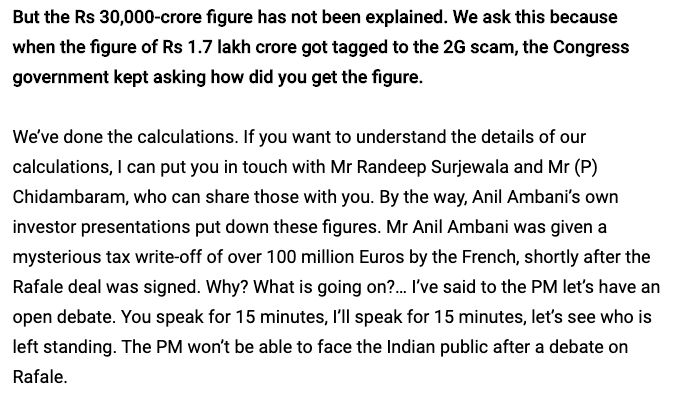
When the interviewer further probed Congress President Rahul Gandhi that the 30,000 figure is still not explained by Congress, Rahul Gandhi hits the ball out of the ground by saying how he does not really have the details, but if Indian Express wants to know where Congress got the figure, he could put them in touch with Randeep Surjewala and P Chidambaram, who is himself accused in various corruption scams, who could share the details with them.
Rahul Gandhi tells the interviewer to ask Randeep Surjewala and Chidambaram for details of the 30,000 crore figure
Go home, everybody. Rahul Gandhi has just accepted that he has no clue how the figure 30,000 crore he has been throwing around casually, accusing the Prime Minister despite clarifications from the French government as well as Dassault, has come from.
Wonder if the ‘debate’ he demands with the PM on Rafale, will be an open-book test with Randeep Surjewala and P Chidambaram passing him notes since Rahul Gandhi does not really know the calculations.
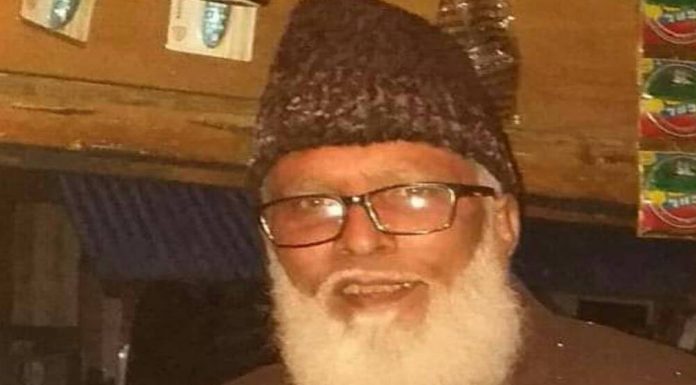
Terrorists killed Gul Mohammad Mir, BJP district Vice President on Saturday in Jammu and Kashmir’s Nowgam in South Kashmir. He was shot dead by terrorists at his home in Nowgam village. He sustained serious bullet injuries in the chest and abdomen and was declared brought dead to the hospital.
Mir had unsuccessfully contested the state assembly elections on the BJP ticket in 2008 and 2014 both. Terming the killing barbaric, BJP state spokesperson Atlaf Thakur said that despite threats from militants, Mir’s security was withdrawn by the government.
The terrorists’ attack on Mir came on a day former Jammu and Kashmir Chief Minister Mehbooba Mufti made a problematic appeal to the terrorists not to carry out any terror attacks ‘in the month ot Ramzan’.
Mehbooba Mufti, PDP: I would also like to appeal to the militants that Ramadan is a month of worship & prayers. They should not make any attacks during this time. https://t.co/nNPhwgWc0M
Mufti appealed to the terrorists to not carry out terror attacks during Ramzan. She also appealed to the government to not carry out search operations and crackdowns during the holy month of Ramzan ‘so that people of Jammu and Kashmir at least spend one month in relief’. Ramzan is likely to begin from 5th or 6th May, depending upon sighting the crescent of the moon.
Mufti’s statement drew a lot of flak on the social media where people condemned the implications of her appeal of ‘no terror attacks during Ramzan’.
@MehboobaMufti urging d militants not to attack during Ramadan…but after that chalega…??? omg!
Wah means they should plan and execute attacks after Ramadan?? What sort of chewwwtiya logic is this..this is how these people support militants and later cry fowl when they are called as traitors!!
In 2017, just a few days after Ramzan, terrorists had carried out an attack on the Hindu pilgrims returning from the Amarnath Yatra leaving as many as seven pilgrims dead.
Meanwhile, Pulwama and Shopian districts in Kashmir will go for polls on Monday, May 6, in the fifth phase of polling in the Lok Sabha elections. Due to security reasons, the polls in Anantnag Lok Sabha constituency which is composed of 16 assembly segments, is being held in 3 phases.
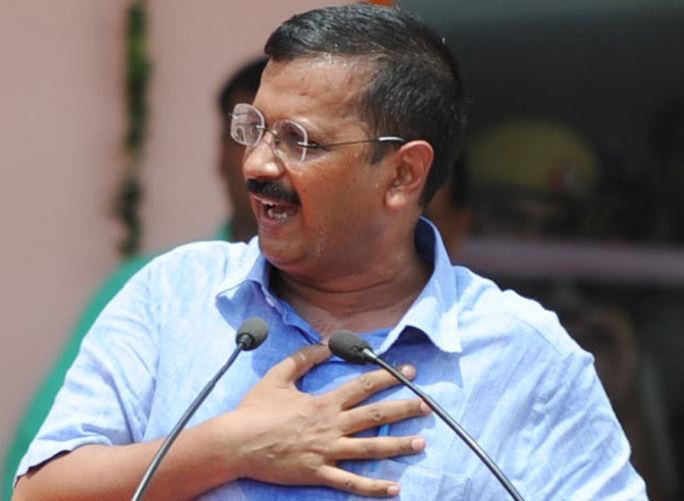
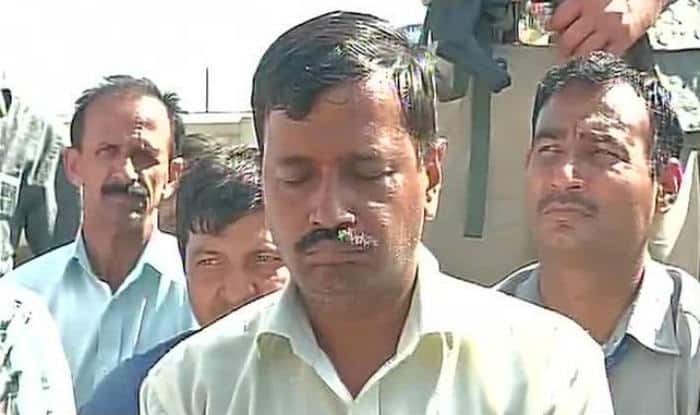
Delhi CM and Aam Aadmi Party (AAP) chief Arvind Kejriwal was assaulted again today by a person in Delhi’s Moti Nagar area during his election roadshow for the Lok Sabha 2019 elections.
Delhi CM Arvind Kejriwal was slapped by a man wearing a crimson coloured shirt while he was waving to the people gathered to see his roadshow in Delhi. The attacker lunged at the Delhi CM and delivered a resounding slap to him in the Moti Nagar of New Delhi as the AAP supremo was passing through the area in his roadshow.
DCP (West) Monica Bhardwaj has said that the assaulter has been identified as Suresh and he deals in spare parts in Kailash Park area.
It has now emerged that the man who assaulted Arvind Kejriwal has claimed that he is an AAP supporter. According to an India Today report, Suresh, the man who assaulted Kejriwal is in police custody and is being interrogated. During interrogation, Suresh has revealed that he is an AAP supporter.
Suresh has been taken to Moti Nagar police station and he, who slapped Arvind Kejriwal, told the police during interrogation that he is an AAP supporter.
This is not the first time that AAP chief has been assaulted in public. He has been assaulted in public several times in the past. The assaults on AAP chief particularly aggravates around election campaigning. In 2014 too, Kejriwal was attacked several times when he was campaigning for the Lok Sabha elections.
A few months ago, Kejriwal was attacked with chilli powder. However, the lawyer of the accused person had stated that the attack was orchestrated by AAP leaders. Recently, rumour had surfaced on social media that Arvind Kejriwal has been beaten up by his own MLAs in his residence.
The Congress party recently claimed that the Congress government, too, had conducted surgical strikes during its regime. It had attracted much mockery including comments by the Prime Minister who said that the Congress conducted surgical strikes that no one, the terrorists, the Army or the India people, had any clue about.
Former COAS General V.K. Singh, earlier today, chastised the Congress party today. Accusing them of lying, he demanded to know exactly which surgical strikes were they attributed to his tenure as COAS. General Bikram Singh, who was COAS between 2012-14, too, said in 2016 that such strikes had not happened earlier.
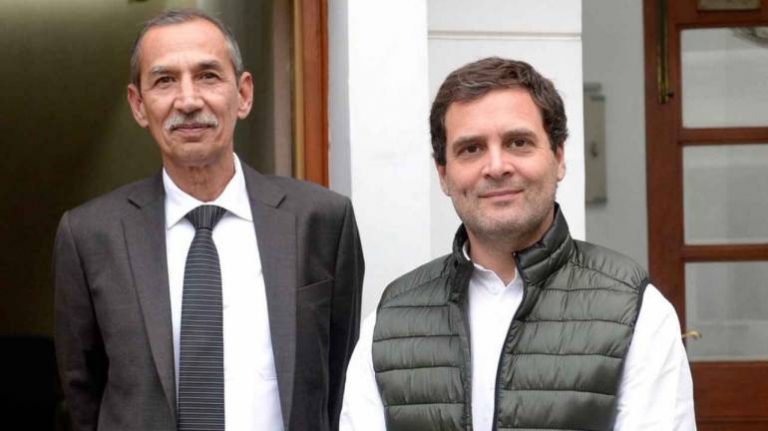
Lt. General (R) D.S. Hooda, who headed the Surgical Strikes and has been associated with the Congress party in recent times, has, however, claimed that cross border operations were carried out during the UPA regime. Lt Gen Hooda had recently joined hands with the Congress party to lead Rahul Gandhi’s ‘task force’ on ‘national security’.
Lt General (Retd) DS Hooda on Congress’s claim ‘6 surgical strikes were carried out during UPA tenure: Call it surgical strikes, call it cross border operations, they have been carried out in the past by the Army. I’m not aware of exact dates & areas that have been brought out. pic.twitter.com/5q499OSM9r
His statement today appears inconsistent with statements he had made during his interview with Arnab Goswami in 2017. He has specifically stated then that the Surgical Strikes weren’t normal cross border operations. “We need to do go ahead and do something … we need to do something larger than normal operation,” he had said then.
See, what Lt Gen DS Hooda said to Arnab about Uri terror attack & subsequent Army action
“we need to do go ahead & do something … we need to do something larger than normal operation …”
He had told Arnab about the Surgical Strikes, “In this case, we were looking at going a little deeper, we were looking at a much more comprehensive operation.” He added, “We were not going a hundred meters, hitting some forward posts, hitting some patrols of the Pak Army and come back. We had to go in and look at terrorist camps and terrorist camps were much deeper. Most of the actions that used to take place were military to military operations which were carried out at the Line of Control. But to go in and hit specifically terrorist camps and launch pads which are much deeper inside, for that detailed planning is required.”
Hope our surgical strike hero Lt Gen Hooda watches his own interview & revises his today’s statement pic.twitter.com/ihwFPna7nZ
Thus, from the Army Man’s own statements, it appears that although military operation did occur during the Congress regime, the Surgical Strikes were on an entirely different plane altogether that required much deeper planning, was much more comprehensive and the Armed Forces had to go much deeper into Pakistani occupied territory to achieve the desired goals.
Delhi CM and Aam Aadmi Party chief Arvind Kejriwal was assaulted again today by a person in Delhi’s Moti Nagar area during his election roadshow for the Lok Sabha 2019 elections.
#WATCH: A man slaps Delhi Chief Minister Arvind Kejriwal during his roadshow in Moti Nagar area. (Note: Abusive language) pic.twitter.com/laDndqOSL4
— Chowkidar Ankur Singh (@iAnkurSingh) May 4, 2019
As can be seen in the videos, the Delhi CM Arvind Kejriwal was slapped by a man wearing a crimson coloured shirt while he was waving to the people gathered to see his roadshow in Delhi. The attacker lunged at the Delhi CM and delivered a resounding slap to him in the Moti Nagar of New Delhi as the AAP supremo was passing through the area in his roadshow.
DCP (West) Monica Bhardwaj has said that the assaulter has been identified as Suresh and he deals in spare parts in Kailash Park area.
The incident comes after a video of AAP’s MP candidate Atishi Marlena went viral on social media where she is seen stating that the people should beat up useless politicians. After the AAP chief was slapped today, Twitter is full of reactions where people are asking whether some voter in Delhi has taken the AAP Lok Sabha candidate very seriously.
Yesterday @AtishiAAP advocated violence against politicians, some ardent fan of aatishi Marlena took her words very seriously. pic.twitter.com/831SJuztpH
This is not the first time that AAP chief has been assaulted in public. He has been assaulted in public several times in the past. The assaults on AAP chief particularly aggravates around election campaigning. In 2014 too, Kejriwal was attacked several times when he was campaigning for the Lok Sabha elections.
A few months ago, Kejriwal was attacked with chilli powder. However, the lawyer of the accused person had stated that the attack was orchestrated by AAP leaders. Recently, rumour had surfaced on social media that Arvind Kejriwal has been beaten up by his own MLAs in his residence.