In an affidavit to the Supreme Court, Bahujan Samaj Party (BSP) supremo Mayawati has justified the construction of statues of herself and the party symbol-the elephant in public places claiming that it was the will of the people to install them, reports ANI.
According to the reports, Mayawati on Tuesday filed an affidavit in compliance with the latest order of the Supreme Court, which had stated that prima facie, it seems that BSP Chief Mayawati needs to pay back the money spent on erecting statues of herself and the party symbol, the elephant, in public places in Lucknow and Noida.
She had filed the affidavit in compliance with the last order of the Supreme Court asking her that prima facie, it seems that she needs to pay back the money as she had spent a lot of public money on installation of many statutes of herself and elephants in UP. https://t.co/ipJ8dGGyMM
In her affidavit to the Supreme Court, Mayawati has stated that her statues built across Uttar Pradesh and those of other BSP leaders were built in public interest as a symbol of Dalit women’s struggle. The BSP chief also said there was a proper budgetary allocation to build the statues.
In an earlier hearing, the Supreme Court had observed that Mayawati should reimburse the public money spent on erecting statues of herself and the party symbol, the elephant, in public places.
“Madam Mayawati, reimburse to the exchequer the public money you have spent on the elephants. We are of the tentative view that you (Mayawati) should pay the public money from your pocket,” a bench led by Chief Justice of India Ranjan Gogoi said.
The Supreme Court is hearing a 2009 petition against the construction of statues of Mayawati, Kanshi Ram and BSP symbol elephants, which were built at parks in Lucknow and Noida with taxpayers’ money when she was chief minister between 2007 and 2012.
Filed in 2009 by an advocate Ravi Kant, the PIL sought a restraint order against the installations as he had claimed that it was being done at the cost of the state exchequer. He asked for a Central Bureau of Investigation (CBI) probe and also a directive to remove the statues.
Legal activist and senior BJP MP Subramanian Swamy has reiterated his sensational claims about the Nehru-Gandhi family at the ‘India Ka DNA’ event organised by Zee News.
In his interaction, he says, that he is confident that the BJP will form the government in 2019. Taking on Congress, he said that Congress President Rahul Gandhi along with his mother Sonia Gandhi, Sam Pitroda, Motilal Vohra and Oscar Fernandes will all go to jail once the charges he has levelled against him in the National Herald case are proven.
He reiterated that Rahul Gandhi had failed his M.Phil. exams in Economics and owns four passports. He says that his name is also not Rahul Gandhi but Raul Vinci in his mark sheet. Swamy further alleged that Rahul Gandhi also possesses a passport in the name of Raul Vinci.
He said he does not believe when Rahul Gandhi says he has Dattatrey Kaul Gotra. “He does not even know how to wear a Janeu. He wears it over his clothes,” Swamy mocked Rahul Gandhi. He even said that the Gandhis have a small church inside their house, a chapel, where a Malayali Bishop comes where they take part in ‘confessions’.
When questioned whether it was the BJP leaders like Swamy himself who put ideas into Rahul Gandhi’s head to show his Hindu side, Swamy quipped who is he to put things into Rahul’s head. “I don’t even know if he has a brain,” he said. Adding that the brother-sister duo are not ‘Brahmins’ by ‘guna’, Swamy said, “Firstly, they are not well educated. We don’t know how many exams they’ve failed in. And are not ‘tyagi’ by any stretch of the imagination. They enjoy a lot. They take foreign vacations and enjoy in night clubs. So neither they are ‘gyaani’ nor ‘tyagi’, so I cannot call them Brahmins.”
Elaborating further on the four-passport allegation, Swamy said, he had submitted the details to the Speaker, Sumitra Mahajan and later to the Home Ministry. He further alleged that Rahul Gandhi is also a British national as per documents uploaded on the British government website. He added that the Home Ministry has now forwarded the documents to the PMO for further inquiry.
After Congress President Rahul Gandhi proposed his new freebie scheme Nyuntam Aay Yojana (NYAY), economists around the world have expressed their skepticism over the fiscal prudence of the scheme.
Arvind Panagariya, a noted Economist and former Vice-Chairman of NITI Aayog, has viewed that the promise of the Congress party to implement a minimum income guarantee scheme would be “almost impossible”. Panagariya further added that NYAY scheme announced by the Congress president Rahul Gandhi will have a huge fiscal impact as it would cost about 13 percent of the Union Budget, even greater than the defence budget.
“If you are giving Rs 72,000 per annum to 5 crore families then there will be an expense of Rs 3.6 Lakh crore. This is 13 percent of the total budget of the central government. No one has given details of the scheme that how Rs 3.6 Lakh core will be arranged to implement it. It’s more than our defence budget. The fiscal situation is always tight. It’s almost impossible to take out 13 percent of the budget,” news agency ANI quoted Panagariya.
The Congress has promised to provide cash support to the poorest 20 percent households of the country if it is voted to power in the upcoming Lok Sabha elections. The party promised to target five crore families or 25 crore individuals as beneficiaries of the scheme.
Interestingly, Economist Abhijit Banerjee who is advising the Congress party on the formulation of the scheme had made some startling revelations regarding the rationale behind the scheme. In an interview with Times Now, Banerjee said that the NYAY will have to funded by new taxes. He said that at present India’s fiscal deficit is so large that the scheme is simply not sustainable without raising taxes.
Abhijit Banerjee also said that the implementation of NYAY will mean that lots of current welfare programs will have to be scrapped. He said that many of the current schemes have no purpose, and nobody knows what their purposes are, and they will be replaced by NYAY.
Those people definitely haven’t read Manusmriti who burn random books in the name of Manusmriti by pasting an A4 sheet on their covers with Manusmriti written on it. Leave aside reading it, if you do a random survey to check how many households have this book, you will find that this book is neither in trend now nor people follow it.
Besides, being a Smriti, about dozens of shlokas are missing from whatever is left of the book after reckless destruction by the ancestors of the Islamic terrorists i.e. the Muslim invaders, who set ablaze our libraries in order erase the traces our civilisation. Secondly, the biggest mistake that people tend to make while reading a Mahakavya having shlokas is that they tend to read a shloka in isolation with the context of the shlokas preceding and succeeding it.
For instance, even a person of ordinary intellect would know that a sentence like “Robert picked up a knife and stared at Gustav” will show Robert to be a barbarian while the two sentences preceding it might say that it was actually Gustav who attempted to attack Robert with a knife and the knife was picked up Robert in self defence after it accidentally fell down. And later one may find that it was actually a film shoot that was going on. Therefore, context is really important. So whenever a person quotes Manusmriti, one should ask him about the relevant shloka, the page number, the society at time and the ruler of that time and then try to understand the particular shloka in the context of all these things.
Starting from Ravan, Mayawati and Lalu to Akhilesh and all other Lal Salaam parties, the context is deliberately removed, and mere imagination is repeated like truth multiple times, the intellectuals are made to repeat the same so many times that the ordinary people believe it to be true, without doing any research or making any effort to ascertain its authenticity, and start a movement in which dozens of people lose their lives. These common people have nothing to do with anything, neither with Manusmriti nor with the fact that the government did not say anything about abolishing reservation.
This is how they strengthen their public support by inducting new people.The arrangements behind it are so apt that right from the petrol that is to be used in lighting the torch to evaluating the success of the movement based on the scale of ensuing violence to who would say what, everything is scripted. Violence is justified because in a democracy, slaying with words is considered as an exceptional quality. This is how the illegitimate children produced by such movements reach the Parliament treading on the corpses. These illegitimate children produced by mobs later consume their resources in building stone wallets and giant elephants on the pillars of parks.
Don’t you remember the garlands of thousand rupee notes? That garland around the neck of a Dalit, even if the notes are fake, gives out a huge message. That garland becomes an example of the superpower that progressed by trampling the spines of Dalits crushing them under its heels which tells that the leader of proletariat revolution travels in a Rolls Royce and then the biggest Dalit leader Mayawati becomes one of the richest in India.
The problem is not the riches of such leaders, the problem is what did they did for Dalits. What the social justice warriors of UP and Bihar did for this strata of society is evident from the fact that the parties like Congress are still running with variations of the slogan of “Gareebi Hatao” (Eradicate Poverty). The ruckus created by Lalu and the hooliganism prevalent during Maya-Mulayam rule have so filed the bellies of these leaders that they are sneezing out gold while having a meal of rice is still a luxury for the poor.
They have had fun for way too long by proclaiming themselves the Messiah of the lower strata in their respective States. But power recycles the society every 25-30 years. One generation passes, the next generation succeeds to the legacy of its forefathers not on the basis of public support but by the reason of being the son or daughter of these leaders.
Here a social disconnect is created. This disconnect becomes visible during transitional times when the people, who are known by the names of their fathers, fight for the monopoly of power after their fathers give up due to age. Then Akhilesh sulks, Tej Pratap goes on to declare his Lalu-Rabari Party and Mayawati suddenly becomes bua.
These times of transition are those times when the first blow in the fort of the Patriarch is inflicted by his own blood. Then some Ravan from another generation sensing this opportunity, starts seeing in himself Lalu, Mulayam or Kashiram. It does not matter that his modus operandi is old and familiar but with the help of better resources he is able to rise faster.
Now, he starts selling himself as hope personified; he drives a violent protest; he gets jailed; he gets sick; and he vehemently targets one leader as the cause of all the problems of the nation. He starts to speak the same words, over and over again, and one part of media tries to cash on this new glimmer of hope. He gets the tanks of 200 bikes full with petrol and fires up a rally of protesters. His followers go berserk and damage everything that comes in their way, not sparing even the poor vegetable vendors. A mob indulges in arson on the basis of a rumour spread by this leader and shoots personal enemies by entering their house, hiding behind a mod of protesters protesting for social justice! This makes one person the star!
This star becomes a thorn for the old leaders. It becomes a fight for survival for both but there is only one book that they can target, as the intellectuals didn’t have time to prop up a new one! It is due to this that the rising star of Dalit politics, updating himself from Ravan to Ra 2.0, calls Mayawati and Manuwaadi, the leader whose whole career is based on burning copies of Manusmriti!
This ‘ism’ (waad) is just one, the enemy to target is just one, the Brahmins who have non-existent land holding and survive on religious work, but you have to target someone! Also, the word in fashion is ‘Brahminism’ as it has been written and spoken about a number of times. No one ever thought of calculating their population percentage, nobody was ever interested in knowing their socio-economic status, but sins of 5000 years were directed towards a caste even when there is no such recorded instance dating back to those times.
It is also a fact that dailts are in poor condition, discriminated on several instances by the upper caste. However, those who fought and won elections in their name, while publicly abusing Brahmins for Dalit votes, never shied away in recruiting Brahmins for Brahmin votes. One must know that politics has its own colour that defies other identities, ideologies, religions, castes and even person enmity. How many Dalit leaders who abuse Brahmins publicly don’t have any contacts with such people?
That’s why the stale democracy is spiced up with this lahsun (garlic). When Ravan tries to become Ra2, he knows where he will be getting his votes from and who he needs to attack and how. He doesn’t have time to prop up a new adjective. He cannot come up with a new ‘ism’ 15 days before the elections. It is a desperate time for him. And then he claims Mayawati is ‘Manuwadi’.
He doesn’t go on proving it as he actually doesn’t need to prove it. There is no need to prove it as Dalit’s are still in same bad shape that they were a while ago. Any person from the lower stratum of society, who identifies with this adjective of Dalit/underprivileged, doesn’t need to speak what changes Mayawati has brought about in his life.
Selling hope to become a leader is the easiest thing to do. The product of hope is easier to sell when people are in despair. When people are in despair, and they have seen a generation of leaders doing nothing, the next generation of voters start to think if they need to try someone else. This is that transition phase, when between the next generation of leaders’ families and the new voters, a person identifying as Ravan incarnates and talks about doing good for them.
Today, ‘Manuwaad’ is again in vogue. Those who use it in an absurd manner and amount have no idea what it means, let alone the poor in villages. Is there even one percent among yourselves who have seen the book in your houses or your fathers, grandfathers talk about it? Where the hell is this shitty narrative coming from?
It comes from the same place which manufactures the one-way narrative. A person fighting for his/her existence tries to deal out everything that’s in his capacity, where morality often becomes a casualty. Even if one has to organise fake seminars, Sir William Jones wouldn’t hesitate organising several of them and he wouldn’t think twice while inviting pseudo-intellectuals like Ma Mueller (and the likes) to document their assumptions as historical facts and pass it on as history of India, on which all the historians of future would base their work on. It is then, when the conspiracy of Aryans and Dravidians is hatches, we are taught about the superiority of white skin over darker ones, and we are told about Noah and Ham while being injected with hatred.
That’s why you always see Rahim Chacha and Father this-that in Bollywood as generous and kind, while Brahmins will be shown as morally corrupt and Lalas will be projected as inhuman, interest-hungry people. This narrative never changes while the society functions in completely opposite ways!
That’s why loktantra becomes lahsuntantra. All its cloves, without any gap, hiding their inner truths with a white lamination, stick together all the time. All these thieves speak the same language. All these cloves of garlic, in every single narrative, in every speech, in every rally, in every discussion, in every panel, in every prime time show, speak the same words.
It is then when all the social crimes become political crimes. It is then when all the social crimes become religious crimes. It is then when a fight over seat becomes a fight over beef. It is then when only Muslim names are pulled out of mob lynching records. It’s then when every upper caste person becomes responsible for a stray act of violence against a Dalit. It’s then when whole of Hindu dharma becomes responsible for Kathua’s Asifa while no one talks about Gita’s rapists!
And then, the root cause of all such atrocities is directed towards one man whose existence is constantly denied but his words are flashed before cameras and people win election citing his shlokas. It’s then when Bhim Army’s Ravan targets dalit’s biggest leader with Manuwaad, and the ecosystem goes nuts.
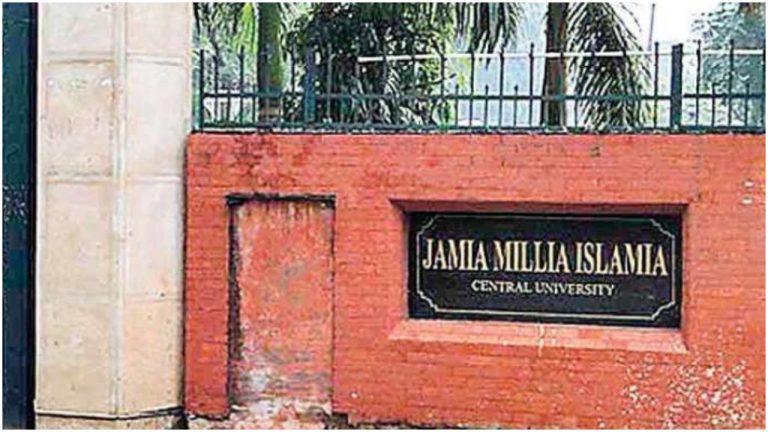
A fashion show organised by Jamia Millia Islamia’s Faculty of Engineering and Technology (FET) was cancelled on Saturday following severe protests from the students as they claimed it was against “Islamic ethos” and Jamia’s “Tehzeeb” (culture), reported Indian Express.
The fashion show, titled ‘Tarz e Libas’, was scheduled to be held on Saturday as part of FET’s annual fest Xtacy. However, a group of 12 students, under the banner of ‘Students of Jamia’, with the support of Aam Aadmi Party student wing protested against the event saying the fashion show was “un-Islamic” and “immoral”. The show was eventually canceled.
Arshad Warsi, a member of Students of Jamia, said they initially called the organisers to tell them the event was “against Islamic ethos”, but as there was no response, they reached the venue at 10 am. “Every university has its own ‘Tehzeeb’. Our culture is based on Islamic values. We told the organisers that foreign cultures should not be promoted,” Warsi.
Shockingly, AAP student wing CYSS supported the protest by joining hands with the radical group. Aqdas Sami, Delhi vice-president of AAP’s students’ wing CYSS, supported the protest. “Such events create disruption in the university and are not part of Jamia’s ethos,” said Sami.
As per reports, students have alleged that the 12-member group, Students of Jamia is known for their religious sermons and programmes on the campus. Many of the students are reportedly miffed about the fashion show being canceled and have stated that such instances will further enable the stereotyping of Jamia as a regressive organisation.
Reportedly, the CYSS has claimed the incident is being blown out of proportion but did not respond on why there were no protests in the past when similar incidents were conducted. CYSS Delhi general secretary Hariom Prabhakar said, “Our outfit is not against any fashion show but only against the objectification of women”.
One of the organisers, Sadaf Fatima said the protest was carried out by few outsiders, which led to the show getting cancelled due to time constraints. Reportedly, in a Facebook post, Syed Mohammad Mehdi Rizvi, another organiser said that it was not a peaceful gathering as we were being threatened by these people and the show had to be cancelled as it became a security issue.
Meanwhile, Jamia PRO Ahmed Azeem said he was unaware of the incident and added that he could not comment without knowing its details.
The long-standing YouTube subscriber battle between popular YouTuber PewDiePie and Indian music and film company T-Series came to an end when PewDiePie yesterday when he released a video conceding defeat and congratulating T-Series. However, the congratulatory message was filled with nasty and mean comments and casual racism towards Indians.
He starts off the video by congratulating T-Series for taking over him in terms of the number of subscribers and soon moves on to taking personal digs.
The four-minute long video, the Swedish YouTuber mocks T-Series for taking over for being a ‘corporation’ with ‘every song in Bollywood’. He then says, now that you (T-Series) is number one, hope you did nothing wrong, like starting off the business by selling pirated songs and other allegations like tax evasion and tries to ‘joke’ how they’ve had their run-ins with the mafia.
He then says how despite all the memes, he loves his ‘Indian bros from Bombay to Bangladesh’. He then says Indians have ‘poopoo’ in their brains and amidst his casual racism tries to take a dig on caste system and poverty in India. “India got YouTube figured out…How about next you figure how to fix the caste system… Maybe all those ads will solve your crippling poverty. But looking at T-Series’ past, I am guessing not probably,” he raps.
“Hope the #MeToo stuff doesn’t severely affect your bottom line,” he shouts towards the end of the rant.
CPM leader and former Chief Minister of Kerala V S Achuthanandan today attacked the Congress Party for fielding its President Rahul Gandhi from Wayanad Lok Sabha constituency in Kerala. Achuthanandan mocked the Congress President by calling him an “Amul Baby”, the famous name he had given Gandhi back in 2011.
CPM leader & former Kerala CM VS Achuthanandan in his Facebook post: I called Rahul Gandhi ‘Amul Baby’ earlier, because of his attitude of approaching situations without understanding them. What will happen in Wayanad if Rahul comes? Left parties will fight against Rahul & BJP.
Achuthanandan said that he had earlier called Gandhi “Amul Baby” because of his attitude of approaching situations without understanding them. In a Facebook post shared by him, Achuthanandan called Congress’ decision of fielding Gandhi from Wayanad seat as reflective of their political immaturity. He criticised the party for not realising the bigger enemy in the upcoming polls which is PM Modi and said that the Congress party is fighting with friendly parties.
CPM leader & former Kerala CM VS Achuthanandan in his Facebook post: But what will be the condition of Congress? Their argument that BJP is their main enemy will be proved wrong. That’s why I called him ‘Amul Baby’ which is relevant now also. https://t.co/L3EDywiBQf
Since the Congress party announced that Rahul Gandhi will contest from Wayanad in Kerala apart from Amethi in UP, the CPI(M) has been criticising the move. CPI(M) leader Prakash Karat and Kerala CM Pinarayi Vijayan have complained that by contesting in Kerala, Congress is contesting against the left instead of contesting against BJP.
The mouthpice of CPI(M) has also attacked the move by Congress party, mocking it by labelling it as a “Pappu Strike” in a an editorial published today. The editorial Titled ‘Congress Collapse to be Completed with this Pappu Strike’ in Deshabhimani said that the Congress chief’s decision to contest from Wayanad raises many questions and alleged that he is afraid of a defeat in Amethi.
The former Kerala CM had hit back at the Gandhi scion in 2011 by calling him an Amul Baby in retaliation to a remark made by Rahul Gandhi at the old age of Achuthanandan. Earlier in the day, CPI(M) mouthpiece Deshabhimani had mocked the Congress dynast after his candidature was declare from the Wayanad seat by calling him by his mock-name “Pappu” in an editorial titled as “This Pappu Strike Will Complete the Collapse of Congress”.
Although the tension between India and Pakistan has deescalated since the dramatic incidents in last week of February, the situation still remains volatile and Pakistan is still trying to avenge the demolition of terror camps in Balakot by Indian Air Force.
Sources: At 3 AM today, Indian radars detected a large sized UAV & package of 4 Pakistani F-16s flying close to Indian border in Khemkaran sector in Punjab. India scrambled Su-30MKIs & Mirage jets in response after which the Pakistani jets retreated further into their territory. pic.twitter.com/ZKTbw8zPZo
According to reports, several Pakistani aircraft were detected flying close to the Indian border in Punjab on the early hours of Monday. Indian radars detected a large-sized Unidentified Aerial Vehicle (UAV) and four F-16 jets of Pakistan Air Force near the Khemkaran sector in Punjab at around 3 AM in the morning.
As soon as enemy aircraft were detected, Indian Air Force scrambled Sukhoi Su-30 MKI and Mirage 2000 jets in response and forced the Pakistani jets to go back.
On February 27, several F-16 jets of Pakistan Air Force had tried to bomb Indian defence bases in Jammu and Kashmir, but they were chased away by Indian Air Force jets. In the process, one MiG-21 of IAF had crashed in Pakistan, after shooting down an F-16. After that, Pakistani drones have been detected by Indian Radars inside Indian territory, and several of them have been shot down by Indian defence forces. On March 4th, one such drone was shot down using an air to air missile by a Sukhoi MKI30 fighter. Before that on 26th February, one Pakistani drone was destroyed using a Derby missile of the Israeli Spyder air defence system, marking the first use of the system by India.
Rahul Gandhi’s decision to contest from Wayanad in Kerala has certainly not gone down well for the Congress party. After Kerala Chief Minister Pinarayi Vijayan admonished the Congress President for the move, CPI(M) mouthpiece published an editorial fired the ‘Pappu’ jibe at him.
The editorial titled ‘Congress Collapse to be Completed with this Pappu Strike’ asserted that the scion of the Nehru-Gandhi Parivar was afraid of a defeat in Amethi. “If the Congress wanted to fight fascism, then Rahul should contest against the BJP not Left Front. By contesting in Kerala which historically supports either Congress-led government or Left Front, Rahul is conveying a message that his party’s main opposition is Left government instead of BJP,” it said.
“The fight can be viewed as nothing but a wet cracker. To put it in a flowery manner, the Congress move is a Pappu strike. This will make the party’s destruction complete,” says the editorial’s conclusion.
The Congress party was outraged over the reference. Congress MLA from Kerala, V.T. Balaram, who had once posted a video of himself eating beef to show his solidarity towards cow slaughter, demanded an apology from the daily over the matter. He claimed that the reference had shamed Malayalam media as a whole. “The ‘Desabahimani’ article is on the lines of the BJP’s culture,” said AICC general secretary and former chief minister Oommen Chandy.
Meanwhile, P.M. Manoj, the editor, said that the reference does not reflect the CPI(M)’s culture on Facebook. “The ‘Pappu’ usage was improper and we will examine how it happened,” he wrote.
We at OpIndia are doing a series on the works done by the Modi government in last five years and why should India vote for Narendra Modi again. In the last article, we saw the achievements and initiatives of Prime Minister Narendra Modi. Today we’ll have a brief look at the achievements of Arun Jaitley, Minister of Finance and Corporate Affairs.
Arun Jaitley started his political career as Delhi University Students Union (DUSU) president in 1974 from ABVP, the student arm of RSS. Being a prominent student leader at that time, he was under preventive detention for 19 months during the emergency. After being released from jail, he joined Jan Sangh, the earlier avatar of BJP. He continued to practice law, rising as a senior advocate while continuing to hold different posts in BJP. When BJP government led by Atal Bihari Vajpayee assumed the office in 1999, he was made minister for state (independent charge) of Information and Broadcasting. Later he also held the charge of the ministry of disinvestment, when it was created for the first time during Vajpayee government. After Ram Jethmalani resigned as minister for law and justice in the July 2000, he held that ministry as an additional charge. He was elevated as a cabinet minister in November 2000 and made the minister of Law and Justice, Company Affairs and Shipping. He resigned in July 2002, to join BJP as its general secretary and national spokesperson, keeping in mind one man, one post principle of the party. He again rejoined the government as minister in January 2003, as minister for Commerce and Industry and Law and Justice, and continued till 2004, when Vajpayee government was voted out from the centre. He again returned to his legal career, and was given the post of General Secretary in BJP. After 2009 elections, he was chosen as leader of opposition in Rajya Sabha, the post he continued to hold till 2014 elections. After 2014 elections, he joined Narendra Modi government as the minister for Finance and Defence. He continued to hold the charge for Defence ministry for about six months, till Manohar Parrikar was appointed as full-time defence minister. He was on a brief sabbatical last year, due to his kidney replacement surgery, and Piyush Goyal officiated as finance minister in the interim. He returned to take charge of the finance ministry in August 2018. He was on sabbatical for the second time in this January and Piyush Goyal presented the last budget of this government.
Here are a few notable achievements of the Finance Ministry in the last five years:
GST – This government implemented long awaited one nation, one tax – GST which subsumed all other indirect taxes, except for few state-specific levies. This has resulted in increased compliance, formalization of the economy, more people coming into the tax net, and therefore more funding available to the government to spend for development and welfare activities. GST has also resulted in abolishing check posts at state borders, thereby reducing turnaround time in the transport sector and making our logistics industry more competitive. This has also substantially reduced pollution as trucks don’t have to stop at every state border. Just like Rafale, GST was also being discussed since the days of Atal Bihari Vajpayee government, however UPA government lost crucial decade on deciding both and country suffered due to non-decisiveness of the government. An entire book can be written on the benefits of GST, but in short, this is it.
Demonetisation –On 8th November 2016, the government of India suddenly withdrew old Rs 500 and Rs 1000 notes from the market. It did give time to people to exchange the notes. Though people have criticized this move, saying almost all the banknotes were returned to the Reserve Bank of India and therefore demonetisation had failed, we should remember that success of demonetisation can’t be judged from the number of banknotes returned. It was never the only stated objective of demonetisation. Though it temporarily slowed down the economy as former RBI governor Raghuram Rajan has rightly stated, such kind of shock treatment was necessary to get out of economic slumber we were in.
Demonetised banknotes of ₹500 and ₹1000
Please remember that it was done right before Uttar Pradesh State Assembly Elections, the biggest and politically most crucial state for any party. No other government would have dared to take such disrupting decision, just before the elections of the biggest state in India. Please read this article backed with official figures, to see the success of demonetisation.
Increase in taxpayers, returns and tax collection – Due to collective effect of Demonetisation and GST, tax base increased like never before and was the fastest to rise in 4 years period historically, where all the figures almost doubled in short time of 4 years.
Insolvency and Bankruptcy Code (IBC) – India long needed a proper bankruptcy and insolvency code. Earlier provisions in the law were not enough to deal with corporate loan defaulters. However, IBC has set a stringent and time-bound process to get NPA recovery done. Now no one can skirt the system like earlier, and it has seen the results with biggest NPA account worth almost 40,000 crores of Bhushan Steel settled, which was almost twice bigger compared to the infamous Vijay Mallya and Nirav Modi combined, resulting into Tata Steel taking over and lenders getting their money back. In short, IBC means pay up or lose your business. This law was immediately operationalized and cases were referred to it. The government even carried out amendments based on the feedback such as original promoters of defaulting companies can’t take over their companies at reduced prices through IBC. Arun Jaitley wrote a detailed blog on how cases are being resolved through IBC when it completed two years. It can be accessed here. Earlier such process to liquidate assets of defaulters used to take years. Even last law dealing with defaults (SARFAESI) was enacted by the last NDA government led by Atal Bihari Vajpayee. However, it was proving insufficient to deal with the current NPA mess which was inherited by the Modi government from the last UPA government.
Merger of Public Sector Banks – This was a long-discussed issue for at least last 10 years but the government was unsuccessful in merging the banks. Thought behind merging banks was, India doesn’t need many small banks but few big banks to reach effective lending to help the economy. Big banks can also absorb economic shocks better than their small counterparts. This government first merged all the remaining subsidiaries of State Bank of India in 2017, where the last merger happened way back in 2008-09 when it merged State Bank of Indore with itself. Now the government has set the ball rolling by announcing the merger of Dena Bank and Vijaya Bank with Bank of Baroda. From April 1st, Vijaya Bank and Dena Bank would be merged in Bank of Baroda.
Mudra Loans – Mudra Schemes offers to small businessman and self-employed people up to Rs 10 lakh without any collateral. This has helped a lot of people to be self-employed and also to create jobs. Till date, the banks have sanctioned Mudra loans worth Rs 8.25 lakh crore to 17 crore entrepreneurs. Though opposition keeps claiming that most of Mudra loans have turned NPAs by quoting absolute numbers a detailed analysis reveals that Mudra loan NPAs are in line with the banking sector average.
Today Congress alleged that Mudra loan NPAs have increased by 1120% by quoting absolute numbers but analysis shows otherwise. The latest publicly available figure of NPAs under Mudra scheme is Rs 11,000 crore which comes to 1.33% of total disbursement which is even below the average banking sector NPAs which range between 3-4 % is considered normal. During Modi government, banks were forced to come clean on NPA mess and they rose to staggering 12-13% for some banks, which were hidden all these years by window dressing.
Jan Dhan Yojana – Under this scheme, people not having any access to the formal banking system due to lack of bank accounts were covered. The scheme was operated in mission mode with over 35 crore accounts being opened in the scheme and nearly one lakh crore rupees being deposited in these accounts. In other words, a total of Rs 1 lakh crore which was lying unused at homes of these poor people have come into the formal banking system. The best part about this scheme was these were zero balance accounts. It was often observed that poor people didn’t have any bank account due to the requirement of minimum balance in the account, which these people wouldn’t be able to afford, and that’s why they were out of formal banking system. This scheme has resulted in almost all Indians, who were mostly poor, getting bank accounts, who further benefitted under the DBT scheme, where subsidies were directly transferred to their bank accounts.
Pradhanmantri Jeevan Jyoti and Suraksha Bima Yojana – Under these schemes, a person is insured for Rs 2 lakh for a small premium of Rs 350 per year and Rs 12 per year respectively. One can opt for these schemes easily through your bank. Jeevan Jyoti is life insurance scheme and Suraksha Beema Yojana is an accidental insurance scheme. More than 5.5 crore people have registered for Jeevan Jyoti Beema Yojna while more than 14.5 crore people have opted for Suraksha Beema Yojana. These schemes have increased India’s insurance coverage ratio, which was abysmally low before these schemes.
Atal Pension Yojna – Government launched this social security scheme primarily for the people from the unorganized sector to get them regular pension after the age of 60. Around 1.40 crore people have subscribed to APY.
Cracking down on shell companies – After demonetisation, the government has deregistered around 2.26 lakh companies and identified another 2.25 lakh companies for action and closed almost 1 deregistered over 1 lakh companies various non-compliances according to the latest data. Post deregistration these companies have been debarred from operating bank accounts until they come clean. Most of these companies are suspected to be shell companies acting as a conduit to route illegal black money. Out of already deregistered 2.26 lakh shell companies, only 1157 companies have applied to NCLT for restoration, effectively proving that all the companies deregistered were indeed shell companies. Further Central Board of Direct Taxes (CBDT) has asked income tax department to probe all these 3 lakh companies for money laundering, pointing out the rot in the system, which was continuing unabated before Modi government.
Separately, the government is considering making mandatory for companies to geo-tag their registered offices in statutory filings with the Registrar of Companies (RoC) in an attempt to tackle the black money menace. Geo-tagging means giving data on the exact location of the registered office. “This will help us identify instances of one building being used by hundreds of shell companies as their registered office or of companies citing vacant plots as their registered office address,” minister of state for corporate affairs PP Chaudhary told Mint newspaper.
Sukanya Samruddhi Yojna – Arun Jaitley launched Sukanya Samruddhi Yojana (SSY) as a part of Beti Bachao, Beti Padhao campaign of the government. Under this scheme, parents can open an SSY account in any bank, in the name of the girl child and can invest up to Rs 1.5 lakh per year which would be tax-free. The aim of this scheme is to encourage parents to save for the education and marriage expenses of girl, because of which most girls are aborted at the prenatal stage, even though it is a crime. Currently if parents invest Rs 1.5 lakh per year making total deposit of Rs 21 lakh in 14 years (maximum permissible under the scheme), at the current interest rates, maturity amount would be Rs 70,23,219 at the end of 21 years which is a huge amount, which can be only withdrawn by the girl child under whose name account has been opened.
Advancement of union budget date from 28th February to 1st February – Traditionally union budget was presented by the finance minister every year on 28th February. By advancing it to 1st February, the government now doesn’t require to take approval of parliament on a separate vote of account for the expenditure of first two months of the financial year by the time Lok Sabha approves the full budget, generally in the month of April or sometimes even May. As the financial year starts in April, if the budget is approved before the financial year ends, it would enable operationalizing the budget for new schemes/projects included in the budget right from the commencement of financial year and ministries can plan their expenditure allocations for the full year even better. By advancing the budget by 1 month, the government has made sure that all the ministries get the approval at the beginning of the new fiscal itself.
Arun Jaitley presenting the 2018 budget
This government also scrapped separate railway budget and merged it in general budget because, when the tradition of separate railway budget was introduced by the British, railways consisted a huge chunk of the government expenditure (84%) and therefore a separate budget was needed. Over a period of time, railway expenditure was in line with most other departments and therefore the basic reason for having a separate budget was non-existent. Also having separate railway budget paved way for increased politicization of railways. The government stopped the political football played in the railway budget where often, the state from which railway minister belonged, used to get preferential treatment much to the chagrin of the other states.
It is interesting to note here that during the tenure of Atal Bihari Vajpayee, the colonial tradition of presenting the budget at 5.30 PM was abolished and the time for presenting the budget was set at 11 AM. As there was a time difference of 5.30 hours between England and India, the British government used to present the budget at 5.30 PM in order to ensure that, the budget can be heard in England at 12 noon. This tradition was even continued even after independence, without giving much thought on why it existed. Due to the late presentation of the budget, newspapers used to scramble to gather the information. This advancement had brought much relief for media persons, who could now peacefully report on budget provisions.
Fugitive Economic Offenders Bill – Government also brought in a bill to take action against fugitives like Vijay Mallya who have left the country after committing financial fraud in order to evade arrest and prosecution. Under the provisions of this bill, properties of the people who have committed the bank fraud of at least Rs 100 crore and left the country to avoid arrest can be confiscated by the central government and would be free from all encumbrances, meaning the central government would have first right on such confiscated property. Recently a court in Mumbai declared Vijay Mallya as the first fugitive economic offender under the new act.
Benami Transactions (Prohibition) Act – This existed since 1988, but it wasn’t operationalised due to legal infirmities. Finance ministry moved an amendment bill to this act in 2016 and made the law operational. The amended law empowers the specified authorities to provisionally attach benami properties which can eventually be confiscated. Besides, if a person is found guilty of offence of benami transaction by the competent court, he shall be punishable with rigorous imprisonment for a term not less than one year but which may extend to 7 years and shall also be liable to fine which may extend to 25% of the fair market value of the property. this law came into the effect from 1st November 2016
This law makes difficult to own a benami property now. This is in line with Narendra Modi’s assurance on cracking down on corruption. Recently the I-T department challenged relief granted to actor Shahrukh Khan under the new law who allegedly owns a benami property in Alibaug as per the IT department.
Income tax relief for the middle class – In the tenure of this government, the middle class has got several reliefs in income tax. In four budgets presented till now, Finance Minister Jaitley has raised income tax exemption limit to Rs 2.5 lakh from Rs 2 lakh, income tax deduction limit under section 80C has been raised to Rs 1.5 lakh from Rs 1 lakh, also deduction limit on interest payable on home loans has been raised to Rs 2 lakh from Rs 1.5 lakh, health insurance deduction was raised to Rs 25,000 from Rs 15,000, transport allowance deduction. Further, the tax rate for the lowest bracket which is up to Rs 5 lakh was lowered to 5% from 10%. Overall, the middle class got substantial income tax relief in the tenure of Modi government. After taking progressive steps on income tax relief for the middle class for last 4 years, in the last budget, the government announced complete income tax relief for those who earn up to Rs 5 lakh per year benefitting crores of middle-class taxpayers.
In the last budget, the government announced that within two years, all IT returns would be processed within 24 hours after filing and refunds would be also issued simultaneously, meaning within 24 hours of filing returns, taxpayers will get the refund, the process which currently takes anywhere between 4-6 months.
UPI and BHIM app – National Payments Corporation of India (NPCI) introduced one-touch United Payment Interface in 2016, which can directly transfer funds real time into recipient bank accounts in one touch, obviating the need of using NEFT and RTGS for small amounts up to Rs 1 lakh per day. NPCI also launched UPI based BHIM app for fund transfer using mobile phones. Several banks also have launched UPI based fund transfer apps for their customers. Companies like Google and WhatsApp are also offering UPI based fund transfer now. Many independent UPI based apps like PhonPe, Google Pay are now available and has become hugely popular.
UPI Apps on Google Play Store
Bharatkosh Portal – Government launched Bharatkosh portal in February 2016, to collect non-tax receipts like dividend payments by RBI and other PSUs, spectrum fees paid telecom operators, royalties, license fee etc. According to an estimate, such non-tax revenue is over Rs 2 lakh crore for the central government and by completely digitizing it, the government took another historic step in its pursuit of Digital India and Digital Governance.
The author is journalism pass out from Indian Institute of Mass Communication, New Delhi. After dangerously flirting with the idea of left during his IIMC days, due to the proximity of the IIMC with JNU, a den of radical leftists, he became firmly aligned to right after realizing the futility of the left. He tweets at @kpophale.