Home Blog Page 6655

Congress party sacrifices national interest by trying to hyphenate Pakistan with India-Saudi relations

Attacking the Modi government for the red-carpet welcome accorded to Saudi crown prince Mohammed bin Salman, the Congress party said that PM Modi broke protocol to receive the crown prince at the airport after he had announced an investment of $20 billion in Pakistan. The party also accused that the PM Modi “forgot” to write the name of “terror nourisher” Pakistan in the joint statement issued by India and Saudi Arab after the meeting between Modi and Salman.


By making such statements, the Congress party has again displayed that opposition to Modi outweighs the national interests of India for the party.

Since the beginning of the India-Pakistan conflict, India has been consistently maintaining that it is a bilateral issue between the two nations and other countries have no role to play. India has rejected offers for mediation made by various countries, while Pakistan is trying hard to take the issue to international level. It is not in India’s interest to hyphenate the Pakistan issue with any other bilateral or multilateral relations. And this is not a new stand taken by the Modi government when Congress party was in power, the same approach was taken by the Indian government.

In that backdrop, it is a big surprise why Congress party would try to link the Saudi crown prince’s visit with Pakistan. The Indian government is so keen to delink the visit from Pakistan that they actually asked the crown prince to go back to Saudi from Pakistan and then coming to India, instead of travelling directly from Pakistan to India, which was accepted by Salman. Saudi Arabia is an important trade partner of India, and therefore it is in India’s interests to keep a healthy diplomatic relation with the country without linking it with any third country.

Congress party talks about Saudi proposal to invest $20 billion in India, but they forgot to mention that the same country also announced that they will invest in excess of $100 billion in India.

The Crown Prince also condemned the Pulwama terror attack in “strongest terms”. Moreover, the joint statement did talk about Pakistan, with the crown prince appreciating the consistent efforts by PM Modi to have a friendly relationship with Pakistan. The statement also read, “In this context, both sides agreed on the need for creation of conditions necessary for the resumption of the comprehensive dialogue between India and Pakistan”. The terms “need for creation of conditions necessary” is important here, because it implies that at present conditions are not right at present for talks between Indian and Pakistan.

The joint statement also said that “Both sides called upon all countries to renounce the use of terrorism as an instrument of state policy. They also called upon all states to deny access to weapons including missiles and drones to commit terrorist acts against other countries.” The statement also called for the dismantling of terrorist infrastructure, cut any kind of support and financing to terrorists, and bringing perpetrators of acts of terrorism to justice. Even without naming Pakistan, these are very significant statements coming from Saudi Arabia.

‘Tired of trying to convince’: Arvind Kejriwal pleads Congress to join hands with AAP in Delhi

Delhi Chief Minister and Aam Aadmi Party (AAP) chief Arvind Kejriwal on Wednesday pleaded with the Congress party to join hands with the AAP to defeat the BJP in all the seven Lok Sabha seats in Delhi. He claimed if the Congress agrees to the alliance offer, the Bharatiya Janata Party will lose all the seven Lok Sabha seats in Delhi.

Delhi CM Arvind Kejriwal stated that he was tired of trying to convince Congress party of an alliance and said that Congress party has refused to have an alliance with his Aam Aadmi Party in Delhi for Lok Sabha elections indicating at the desperation of the AAP to join hands with the Congress party ahead of the crucial elections.

“Tired of trying to convince Congress for alliance but they refuse to understand…If today our alliance with Congress is done, the BJP will lose all seven seats in Delhi,” said Kejriwal as saying at a public function in Chandni Chowk parliamentary constituency.

“There should be only one candidate against every BJP candidate. Votes must not be divided,” said Kejriwal, according to ANI.

Reportedly, the Congress party has been trying to strengthen its organisation in Delhi, where it had a government for three successive terms between 1998 and 2013. However, the AAP has been pushing for an alliance with the Congress party in Delhi to get few seats in the Lok Sabha elections to stay relevant in the national politics.

Earlier, Former Delhi Chief Minister Sheila Dixit had hinted about not joining hands with the AAP and had said that there was no question of aligning with them after what they have done to the Congress. She had further said that Congress must stay away from any alliance and fight on its own.

The coming together of Congress and the Aam Aadmi Party has also irked the senior leaders of both the party. Recently, senior Congress leader Ajay Maken had resigned as the party president after he had supposedly objected to any such pre-poll alliance between the Congress and the AAP. Similarly, HS Phoolka, a senior AAP leader had resigned after he knew that there were serious talks of AAP-Congress alliance ahead of the Lok Sabha polls.

IndiaSpend peddles fake narrative on ‘beef export’ that is busted by data quoted in its own reports

Since the past couple of years, after ‘neutral’ journalism was discredited, ‘neutral’ journalists have come up with a new method to peddle their propaganda, by posing as ‘neutral’ fact-checkers. IndiaSpend, an organization that runs factcheckers.in, is known to publish cooked up data and indulge in selective nitpicking to paint a picture where Hindus are always aggressors and Muslims are always victims, especially, in cases of cow protection. We at OpIndia.com have regularly reported on their biased ‘factchecking’ and ‘database’.

The Human Rights Watch, an International NGO, published a report where they claimed that the rise of Hindutva has “disrupted India’s cattle trade”. As per the report, exports have “mostly declined”. The cause for this ‘decline’ is attributed to “vigilante attacks” and “stricter laws on cow slaughter and transportation of cattle”.

However, HRW’s own data disproves its assertion that exports have ‘mostly declined’. The data shows that barring 2013-14, exports in the NDA era have been higher than any other year from 2010-11 to 2017-18. And the highest export in any given year during the mentioned time period occurred during the NDA regime, 2014-15.

Credit: HRW

The IndiaSpend report on the HRW report too agrees with the HRW’s initial conclusion that exports have mostly declined. However, merely a sentence later, the same report appears to contradict that conclusion. The IS report says that the growth of exports has declined, while the quantum of export has hovered around $4 billion.

It states, “In 2014-15, India registered $4.78 billion worth of buffalo beef exports–the highest since 2010–although growth declined by 26.05 percentage points from 35.93% in 2013-14 to 9.88% in 2014-15. Thereafter, the quantum of exports has hovered around $4 billion, declining 3.93% in 2016-17 and growing by a smaller 3.06% in 2017-18.” This is quite clearly a contradiction. A decline in growth rate cannot be translated to ‘exports have mostly declined’.

Then, the IS report goes on to quote its own faulty database to support a previously agreed upon narrative. It’s truly astonishing that both HRW and Indiaspend are trying to peddle a narrative that’s dispelled by the data they have mentioned in their own reports!

Even the leather exports, which both IndiaSpend and HRW have made a lot of hue and cry about in their reports show no evident signs of decline even according to data HRW has itself quoted.

Credit: HRW

Therefore, according to data that HRW has itself quoted in its report, there is no evident sign of decline at all. There may not have been much growth but to claim that there’s been some great decline is quite evidently preposterous.

The entire basis of the HRW and IS reports is that vigilantism against cattle smuggling and stricter laws on cow protection somehow affects India’s beef exports. However, no evidence has been provided to support the same. In fact, it appears rather obtuse to make such an assertion as export of cows is banned in the country by the government. India only exports buffalo meat. So, it’s unclear how would legal trading of buffaloes be affected by laws directed at protecting cows or cow related violence.

Moreover, the crackdown on illegal slaughterhouses is cited as a reason behind the ‘decline in exports’ that isn’t real. What does HRW and IS suggest? That the government should allow illegal slaughterhouses to operate without any consequences and thereby, break its own laws, with impunity? It’s important to note that the HRW and IS do not even mention that the government has been cracking down only on illegal slaughterhouses, not the legal ones.

The reports also fail to make any reference to the menace of cattle smuggling. It’s only to be expected from agenda driven propagandists masquerading as ‘neutral’ fact-checkers and ‘rights’ organizations.

The respect that liberals award to such portals of misinformation only goes on to show that in the world of liberalism, credibility isn’t earned by hard work, honest research and the objective quest for truth. It’s earned by toeing the ‘party line’. It doesn’t matter if your conclusions are wildly off target, if you toe the liberal line, liberals will fall at your feet and sing paeans to your credibility even if the only appropriate place for your ‘report’ and ‘database’ is the neighbourhood garbage dump.

Supreme Court accepts petition over alleged attacks on Kashmiri students post Pulwama blast

0

The apex court of the country has agreed to hear an appeal filed by an advocate against the alleged attacks on Kashmiri students across the country after the Pulwama attack.

The Supreme Court bench headed by CJI Ranjan Gogoi and comprising of Justice L N Rao and Justice Sanjiv Khanna took cognisance of the senior advocate Colin Gonsalves’ petition seeking an urgent hearing in the matter related to the safety and security of Kashmiri students. The court is slated to hear the plea tomorrow.

The petition alleges that students from Kashmir Valley are being assaulted at different educational institutions across the country following the Pulwama terror attack, seeking preventive action by the authorities concerned to stop such assaults.

Following the ghastly attack on the CRPF convoy in Pulwama on February 14, even as people across the country expressed grief and mourned the dead, there were a few who were busy celebrating the terror attack. The complaints raised by many social media users as well as the colleagues of those who were celebrating, many students and employees were suspended and arrested for their anti-national posts.

The attack on the CRPF convoy in Pulwama claimed 44 lives of the security personnel. The responsibility of the attack was taken by Pakistan-based terror outfit Jaish-e-Muhammad and was executed by a brainwashed terrorist of Kashmiri origin.

Also read: Scroll whitewashes celebrations of Pulwama attack, instead targets those who complained about celebrations

Rumours like the attack on Kashmiri students across India have been rife, even when the Police has clarified that these are rumours and no such incident has taken place. The usual suspects are busy whipping up the frenzy to accomplish their ulterior motive of fearmongering and attempting to deflect attention from the fact that many people in Kashmir, including journalists in Kashmir, were found celebrating the terror attack.

It is also notable here that last year, the SC had rejected a plea seeking probe and subsequent prosecution in the genocide of Kashmiri Pandits which took place during 1989-90.

Now, Congress and the Communists would not remember the summer of ’59

While Congress and Left roll together in the bed for the 2019 General Elections, the love birds of today bear little resemblance to the two fighting crows of 1959.

Prime Minister Jawaharlal Nehru had then dismissed the first elected government of Kerala scandalously, putting aside all norms of democratic conventions and as facts were to emerge later.

Kerala, with the coming together of taluk of Kasargod (South Kanara district of Madras), the Malabar district and Travancore-Cochin under the States Reorganisation Act became a state on November 1, 1956. State Elections were held next year and the Communist Party of India, under EMS Namboodripad, won a slim majority of two seats (65 out of 127 seats).

The trouble began when EMS introduced an education bill for better wages and working conditions for teachers in private schools and colleges. The Catholic Church in the state, which ran various educational institutions, saw it as interference. Schools were critical for Church’s missionary activities of conversion. They were supported by the Nair community, owners of many schools of its’ own. Congress, seething under election humiliation, pounced on this opportunity. It launched Vimochana Samaram (liberation struggle) and turned it into a statewide agitation.

Strikes and protests flooded the streets. Mob violence and rioting soon broke out. Thousands were jailed and a handful were killed. It was projected as a breakdown of law and order in the state. Centre’s intervention became an orchestrated cry.

The manner in which the President’s Rule was imposed in Kerala makes one cringe in dismay. As per Prakash Karat, a major CPI(M) leader: “Since the report of the governor was to come only a day later by air service via Madras, the Intelligence Bureau was asked to get the report from the plane in Madras and communicate the contents by telephone to New Delhi. The entire report was dictated over the telephone. It was this report that was used for the proclamation of President’s rule (July 31, 1959).”

The role of the CIA in this murder of democracy is well-documented. The United States hadn’t taken the formation of a Communist government in a state of India kindly. The US secretary of state, John Foster Dulles, had publicly termed it a “dangerous trend.” Karat, in a piece in Outlook India, claimed:

“That the US provided funds to the Congress leadership for the struggle to topple the Communist ministry was confirmed later. A later American ambassador to India, Daniel Patrick Moynihan, in his memoir A Dangerous Place confirmed that the CIA gave money to the Congress leadership on two occasions to fight the Communists – the first time in Kerala during the first Communist ministry and a second time in the 1960s for West Bengal.”

Ellsworth Bunker, then US ambassador to India, subsequent to Moynihan’s disclosure, admitted his own involvement. Bunker said the decision to provide funds was made “in Washington…but then I had leeways and discretion as to how it might be done and in what amounts.”

A biography of Feroze Gandhi later claimed that he had called Indira Gandhi, president of Congress during those turbulent days, as a “fascist” over the Kerala affair.

Feroze Gandhi went public. “Where are the principles of the Congress? Are we going to be dictated by a caste monster we have produced?”

Such has been the abuse of Article 356 (imposition of President’s Rule) that since 1950, there have been 113 instances of democratically-elected state governments being dismissed by the Centre, almost entirely under Congress rule.

So when the Congress and Left today exude abiding love, you smile. When they talk of protecting democratic institutions, you smile. When they call other fascists, you smile. When they project Jawaharlal Nehru as the patriarch of democracy, you smile. When they project governors as hand-picked maidens of Centre, you smile. And when Left snuggles up to Congress in the name of democracy, you can reserve your broadest smile for this sham.

Kashmir: Govt withdraws security cover of 18 separatists and 155 politicians and ‘activists’, calls it ‘wastage of resources’

Amidst the rising political and security tensions in Kashmir after the Pulwama attack, the government has decided to revoke the security cover of 18 separatists and 155 political persons.

This decision is in addition to the previous order in which the government had withdrawn the security cover given to the top Hurriyat leader Mirwaiz Umar Farooq and four others including Abdul Ghani Bhat, Bilal Lone, Hashim Qureshi, and Shabir Shah.

According to the spokesperson of the Home Department, in the security review meeting, which was held under the chairmanship of state chief secretary BVR Subrahmanyam, it was felt that providing security to these separatist leaders is a ‘wastage of scarce state resources’ which could be better utilised elsewhere.

Among the leaders whose security has been downgraded and withdrawn are, SAS Geelani, Aga Syed Mosvi, Maulvi Abbas Ansari, Yasin Malik, Saleem Geelani, Shahid ul Islam, Zaffar Akbar Bhat, Nayeem Ahmed Khan, Mukhtar Ahmad Waza, Farooq Ahmed Kichloo, Masroor Abbas Ansari, Aga Syed Abul Hussain, Abdul Gani Shah and Mohd Musadiq Bhat.

Earlier though, it was mentioned that SAS Geelani and Yasin Malik did not have any security cover, but according to latest updates, they were included, in the list of separatists who were entitled to the same. However, they too have been stripped off the security cover.

In addition, the security of 155 political persons and activists, including that of Shah Faesal, who resigned from the IAS and Wahid Parray, who did not require the security provided to them based on their threat assessment and their activities, was also withdrawn.

This measure taken by the government would free over 1000 police personnel and more than 100 vehicles to do regular police work.

In the last 10 years, the Jammu and Kashmir government has spent more than ₹10 crore in providing security to the so-called moderate Hurriyat leaders.

In the aftermath of the horrific attack on a CRPF convoy done by Pakistan based Jaish-e-Muhammad, Home Minister, Rajnath Singh, had announced in Srinagar, that the security provided to elements having links with terrorists will be reviewed. Rajnath Singh had said that separatists are hand in glove with terror organisations, terror forces & ISI across the border. They are involved in terror conspiracies too, he had added significantly.

The horrific Pulwama attack had left the entire nation in a state of shock and rage. The Indian government, resolute to discipline Pakistan has taken several measures against them. The most favoured nation status accorded to Pakistan under WTO norms were withdrawn, and then customs duty of 200% was imposed on all imports from Pakistan. Government is also working towards isolating Pakistan on the global front. PM Narendra Modi had announced after the Pulwama attacks that the Indian Army has been given a free rein to plan and execute a retaliatory action.

PM Modi to receive the prestigious Seoul Peace Prize during his two-day South Korea visit

Prime Minister Modi has embarked on a two-day visit to South Korea, from 21st to 22nd February. In addition to several bilateral meetings, PM Modi will be conferred with the prestigious Seoul Peace Prize.


Prime Minister Modi was announced to be the recipient of the award last year by The Seoul Peace Prize Cultural Foundation, for leader’s contribution “to high economic growth in India and world, through ‘Modinomics'”. The Award Committee had found PM Modi ‘perfect candidate’ for the award, after assessing around 1300 names.

The award also recognizes PM Modi’s efforts in changing lives of 1.25 billion people of India and promoting economic cooperation with other countries, in accordance with the ‘Modi Doctrine’ and the Act East Policy. The committee had also praised PM Modi’s diplomatic efforts in Asia-Pacific region, to promote international cooperation. The committee had also praised PM Modi’s anti-corruption initiatives like demonetization.

PM Modi will be presented with a plaque, award and an honorarium sum of $200,000.

PM Modi is the fourteenth recipient of the award. Past recipients include Kofi Annan the seventh secretary-general of the United Nations, Ban Ki-moon the eighth-secretary-general of the United Nations, German Chancellor Angela Merkel and organizations like Doctors without Borders. 

The Seoul Peace Prize was established in 1990, to emphasize the commitment of the Korean people towards maintaining peace in the Korean peninsula and the rest of the world. It is a biennial award given to people who make significant efforts for the harmony of mankind and promote reconciliation between the nation.

In January, this year, PM Modi was conferred with first ever Philip Kotler Presidential award for outstanding leadership. Last year, The United Nations had also awarded Prime Minister Narendra Modi and French President Emanuel Macron with 2018 ‘Champions of the Earth Awards’. PM Narendra Modi was lauded for his “unprecedented pledge to eliminate all single-use plastic in India by 2022.”

Article 35A: Time to get rid of this stain on India’s soul

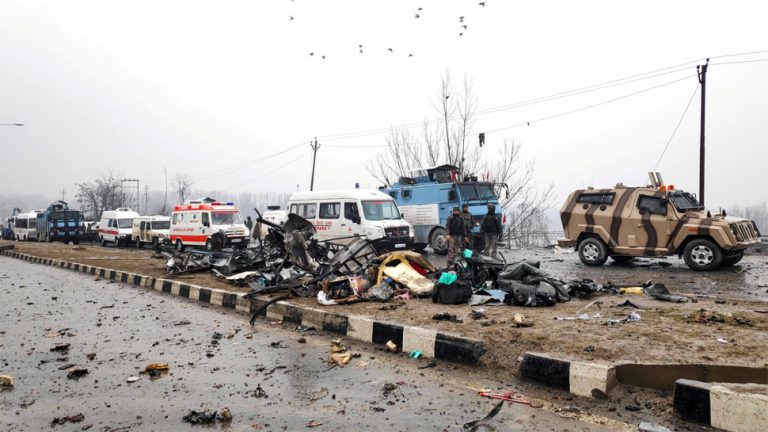
Last week a Kashmiri terrorist rammed a vehicle laden with more than 300 Kgs of explosives into one of the 70-vehicles convoy that was transporting around 2500 CRPF personnel to Srinagar. 44 soldiers lost their lives in the ghastly attack. The responsibility of the attack was later claimed by the Pakistan-based Jaish-e-Muhammad terror outfit.

The attack garnered widespread condemnation from across the world. Various heads of the states condemned the attack and expressed their solidarity with the bereaved families of the fallen soldiers as well as to a wounded India. It is, however, a sobering realisation that such battles are not won by accumulating denunciation from those who remain entirely unaffected from such attacks, they are won by formulating and implementing long-term policies meant to attain a permanent end to the conflict. Condemnation from powerful countries, hardly, in any way, act as a deterrence for the terror outfits.

One of the aching legacies of India’s first Prime-Minister Jawaharlal Nehru is the Kashmir imbroglio. When Maharaja Hari Singh signed a treaty with Indian Union, Nehru went overboard to grant the state a special status under the constitution. Article 370 deems the state of Jammu and Kashmir as an autonomous state, while the article 35A, enacted by Presidential order in 1954, empowers the state’s legislature to define “permanent residents” of the state and provide special rights and privileges to those permanent residents. The article 35A effectively proscribes Indians other than Kashmiris to acquire or hold land in the state.

As the terror attacks across the world including the Pulwama attack reveal, the terrorists are now employing audacious methods to execute their plans. Similarly, the Indian government will have to think beyond the conventional measures of tackling the menace of terrorism and adopt new-age methods. It is in this sense that India’s calibrated all-encompassing strategy to nail Pakistan and its terrorists down should include the abolition of article 35A as one of the weapons in its armoury.

The Pakistani establishment and the terror outfits based out of Pakistan have realised it a long time back the essentiality of article 35A to bolster their irredentist claims on J&K. Therefore, any attempts made by the Indian political parties to abolish or alter the article have been received with vehement protest by them through their sympathisers in the valley. The article 35A provides a guarantee of population homogeneity in the state. The demography of the Jammu and Kashmir is excessively skewed in the favour of Pakistan and its backed terror outfits. Its abolition may throw open the state for a variety of people not necessarily sympathising with their ideology.

Repealing article 35A, therefore, will not only provide Indians with the rights to acquire land in Kashmir and settle at the place of their choice anywhere in the state, but it will also deprive the terror groups the tactical advantage they currently enjoy in readily carrying out their nefarious activities in Kashmir. By effecting the demographic dividend of the state, the government will be able to dismantle the network of terror accomplices nurtured by Pakistan in Kashmir. The Hurriyat will be pushed into oblivion and stripped of its hegemony, as more number of nationalist Indians start residing in the valley.

In the aftermath of the attack, terror outfit JeM had released a video in which the terrorist who attacked the CRPF convoy could be seen spewing venom and addressing non-Muslims as “cow piss drinkers”. The Army has a herculean task eliminating such inordinately brainwashed terrorists and their over-ground supporters in Kashmir who come to their aide when these terrorists are holed up in an encounter site.

These supporters pelt stones at the Army formations to obstruct their proceedings and facilitate terrorists in escaping from the site. A large population of Army supporters in the valley will dissuade them from resorting to stone-pelting. Annulment of article 35A will also pave the way for the long-standing issue of rehabilitation of Kashmiri Pandits in Kashmir. They will feel much more secure inhabiting Kashmir under such a propitious situation.

It is, perhaps, an opportune moment that the country’s soul, which is ravaged by the stains of article 35A be finally relieved from it. The nature of terror attacks is changing, so is the need to change the nature of retaliation as well. A cogent message needs to be sent out to the adversaries that India will not only act against the terrorists wreaking havoc, it will also doggedly pursue those who aide them.

The attack in Pulwama claimed 44 lives of our soldiers. There have been countless casualties of our soldiers fighting terrorists in Kashmir. If India truly seeks to exact revenge for its martyred soldiers, it needs to shun palliative measures directed at achieving short-term goals but take steadfast decisions to completely eradicate the scourge of terrorism in Kashmir, and abolishing article 35A will be one such measure in that direction.

Pulwama attack: Women, children in Kashmir ferried expensive military grade RDX in small quantities for months

0

Women and children were hired to help Islamic terrorists to transport the deadly explosive RDX grade 5 (for military use) and ammonium nitrate from transit point in Tral, Pulwama district of south Kashmir to carry out a suicide attack on a CRPF convoy on February 14, reported Times Now.

According to the reports, the trigger for the explosive was manufactured locally and that ammonium nitrate was used as an oxidiser in the RDX explosive. The military grade A5 RDX was obtained from Pakistan and the device was assembled around 10 km from the blast site, the report said.

As per reports, the explosives were carried by women and children in the valley in small quantities over a period of several months. Military grade RDX is mixed with high quality stearic or octadecanoic acid. An A5 grade RDX reportedly denotes with a 98.5% to 99.5% purity and is very expensive.

As per a report in Zee News, the RDX used in Pulwama attack was mixed with Ammonium nitrate and shrapnel for maximum impact. It was carried in 3 drums in the SUV. It is because of the quality of the RDX and the expertise of handling the operation that the involvement of the Pakistani military is being suspected.

On February 14, a terrorist belonging to Pakistani Army backed Islamic terrorist outfit Jaish-e-Mohammad, identified as Adil Ahmad Dar, rammed an SUV laden with over 300 kg of explosives into the CRPF bus carrying about 40 personnel. The collision exploded the bus and the vehicle, causing the deaths of more than 40 CRPF soldiers.

Several other CRPF personnel who were present at the site during the incident had recounted the horror after they had revealed that there was intense stone pelting following the Pulwama terror attack. CRPF jawans in other vehicles had to rush to the spot to form a protective cordon around the blast site and to protect the injured jawans from stone pelting which began following the suicide attack.

More than 2,500 Central Reserve Police Force personnel, many of them returning from leave to rejoin duty in the Kashmir Valley, were traveling in the convoy of 78 vehicles when they were ambushed on the Srinagar-Jammu highway at Latoomode in Awantipora in south Kashmir around 3.15 pm on Thursday.

However, top Jaish-e-Mohammad commander linked with the recent Pulwama terror attack which claimed the lives of 40 CRPF personnel has been killed by the security forces after an encounter between the security forces and Jaish-e-Mohammad terrorists. Abdul Rasheed Ghazi, the mastermind of the Pulwama terror attack was also killed in an encounter with security forces on Monday. He was among three terrorists who were killed in the joint operation by security forces.

Hardik Patel’s close aide surrenders in Gujarat court, connected to cases of rioting and arson

Patidar Anamat Andolan Samiti (PAAS) leader and Congress backed Hardik Patel’s close aide, Nikhil Savani, surrendered in a local court of Surat, Gujarat, in connection to a 2016 case pertaining to rioting, damaged caused to public property and arson, following which he was sent to judicial custody, reports DeshGujarat.

A case was lodged in 2016 in Sarthana police station, Surat after Nikhil Savani was allegedly involved in ST bus torching case.


According to recent reports, Savani’s advocate, Yashwant Vala, confirmed that his client was willing to surrender before the Crime Branch but seeing the police’ unwillingness Savani had decided to surrender in the court of law.

Nikhil Savani, before surrendering alleged that the State government was planning to foil a conspiracy against him prior to the upcoming Lok Sabha elections. He furthered that before the government could devise a strategy and get him arrested in all the pending charges leveled against him, he decided to surrender before the court of law.

Advocate, Yashwant Vala also said that the court had sent a notice to the crime branch asking whether they wanted Nikhil’s custody for remand or not.

Coincidently, Nikhil Savani’s confidante, Hardik Patel also has two cases of sedition against him. One in Surat and the other in Ahmedabad. Last year during the same time, a sessions court in Ahmedabad has rejected the discharge plea filed by Hardik Patel. The Patidar Anamat Andolan Samiti (PAAS) leader had filed the discharge application seeking relief from the sedition charges against him. He was booked by the Crime Branch on sedition charges after he the large-scale violence in Gujrat in 2015 seeking reservation for Patidars.

Hardik had earlier suffered a major setback in the Surat case too when the Gujrat High Court had rejected his plea seeking to quash of the sedition case.

The Patidar Andolan in Gujrat had brought the state to a standstill in 2015 as widespread incidents of violence and clashes had caused intense law and order situations. A total of 9 people had died and the Army was deployed to maintain peace. A total of 5000 paramilitary personnel had to be posted in different cities to help control the situation. Then 22-year-old Hardik Patel had made several objectionable remarks in a rally that had turned violent.

Hardik Patel is now convicted for causing riots in Mehasana and has been found guilty of charges related to arson and creating a ruckus at the office of BJP MLA Rushikesh Patel.