Home Blog Page 7005

Fact Check: Journalist furthers lie about Mukesh Ambani being ‘mystery owner’ of Talcher Fertilizer Ltd

Prime Minister Narendra Modi on Saturday laid the foundation stone for the Talcher Fertilizer plant at Angul in Odisha which is expected to reduce dependence on gas and urea imports. The project is expected to be commissioned in 3 years time and Modi promised that he will be back after 3 years to inaugurate it.

A rumour has been floated on social media that Mukesh Ambani, the business tycoon, could be the ‘mystery owner’ of Talcher Fertilizer Plant (TFL) which is touted to be India’s first Coal Gasification based fertilizer plant.


The person does not offer entirely plausible reasons for his assumption. He says in his tweet, “Ambani proxies opened 2 companies, both named “TALCHER II TRANSMISSION COMPANY LIMITED” on the same date, long ago.”


The claims appeared too fantastical to be true. Therefore, we decided to investigate the matter.

After a casual glance at Talcher Fertilizer Ltd’s (TFL) website, it becomes clear that the person behind the claims lost sight of essential details in pursuit of a premeditated agenda. There doesn’t appear to be any scope for a ‘mystery owner’ as the TFL is a consortium of four state-run companies. Its website states, “Joint Venture Company was incorporated on 27.10.2015 with contributing equity of GAIL, CIL and RCF being 29.67% each while FCIL retaining 10.99% equity.”
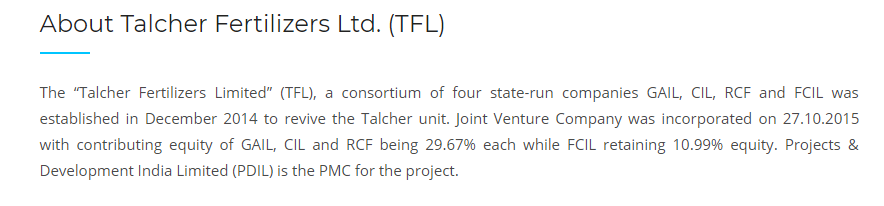
The person also appears to have reached the conclusion regarding the Licensor for the project without paying a single visit to TFL’s website. Their website clearly mentions that the Licensor for the Coal gasification was M/s Krupp Koppers.
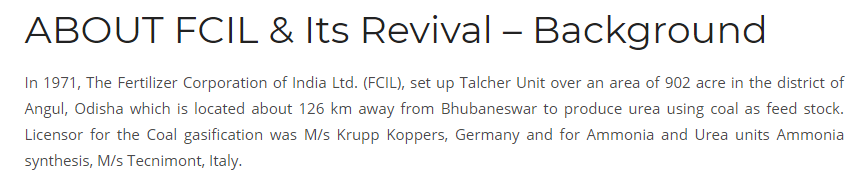
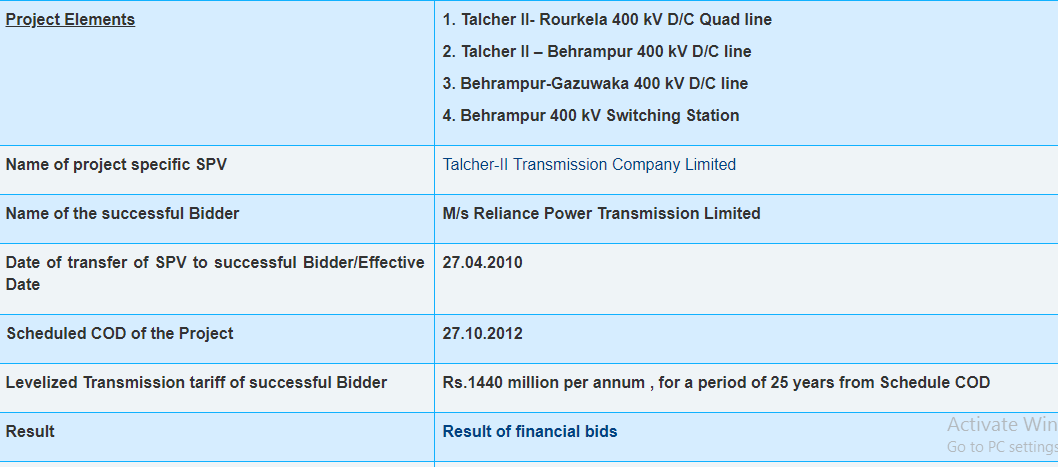
The person’s claim that Ambani opened companies named Talcher-II Transmission Company Limited also appears to be unfounded. A quick search reveals that the Talcher-II was “incorporated as a wholly owned subsidiary of REC Transmission Projects Company Limited, on 1 May 2007” as per its own website. It was only after a successful bidding process that the company, which is a project specific SPV, was acquired by Reliance Power Transmission Limited on 27.04.2010.

The point to be emphasised here is that Talcher II which was acquired by Reliance is a power company and has nothing do to with Talcher Fertilizers Ltd (TFL).
Thus, it is clear that the insinuation that Mukesh Ambani is somehow associated with TFL is clearly unfounded and based on the figments of an individual’s own imagination. Thus, it was only natural that numerous activists perceived it as gospel truth.

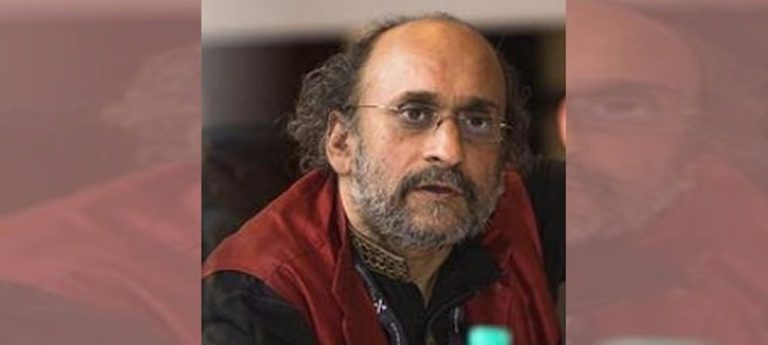
Paranjoy Guha Thakurta, a member of the governing council of the NGO Common Cause along with Prashant Bhushan and a journalist, was quick to conclude that the ‘mystery owner’ is India’s richest man. Common Cause is an NGO that receives funds from abroad and indulges in activism on contentious in India.


It appears now that a certain section of the political spectrum is so keen on proving that the tentacles of Ambani are behind every government deal, they are concocting facts out of their own imagination as evidence of ‘collusion’. It is also important to remember that even if Reliance was indeed the licensor, it wouldn’t have been any evidence of malpractice as Reliance has the right, like every other company, to participate in the bidding process if it meets the requirements.
Akhilesh Yadav’s government responsible for swindling 97,000 crore, CAG reports reveal

0

A report submitted by Comptroller and Auditor General (CAG) in August 2018 has revealed that the former Uttar Pradesh Samajwadi party government, led by Akhilesh Yadav was unable to account for around ₹97,000 crores in government funds which were apparently spent by them when in power. The report criticises the former government for syphoning off the money in the name of various government schemes during its regime.

According to the report, the Akhilesh government did not ever submit any documentary evidence to substantiate that the funds have been appropriately used. It furthered that out of the funds of ₹97,000, crores only ₹26,000 crores have been spent in Social Welfare, Education and Panchayat Department for which no utilisation certificate was provided either. The rest of the money also remained unaccounted, said the report.

In the report submitted in August 2018, it has been said that the previous government has not been able to deposit the ‘Utility Certificate’ of the amount. For this reason, the conjecture of misuse of such a large amount has emerged. It was said that from 2014 to 31st March 2017, the SP government has apparently spent crores on over 2.5 lac activities which remain unaccounted.

The report specified that whenever a particular budget is laid out for any department under a specific government scheme, the deadlines are also specified and every department is bound to submit a ‘utilisation report’ after the deadline concludes. It further stated that the onus also lies on the department sanctioning the budget as future budgeting would directly depend on how the previous money was utilised.

Yogi government spokesperson and Health Minister Siddhartha Nath Singh, lambasted saying that the CAG had exposed a  similar fraud during the UPA regime. Singh was quoted saying, “corruption and its foundation were started by Mayawati in this state, Akhilesh Yadav has brought that tree, on the basis of the report, the government will investigate. I can say that the answer can be difficult for Akhilesh .”

On the other hand, SP has described this issue as politically motivated. SP spokesperson Sunil Yadav said that the CAG report does not prove any point. It is just an estimate, said the Samajwadi party spokesperson, dismissing the report.

Samajwadi party supremo Akhilesh Yadav had left the media buzzing for quite sometime when the ‘Samajwad’ left his government accommodation in ruins after he was asked to vacate it on Supreme Court’s orders. Recently during an event by a TV Channel, Akhilesh had regretted not killing a journalist for calling him, Aurangzeb.

Rahul Gandhi’s latest gaffe: ‘Amit Shah called India a golden bird, this means he thinks India is a commodity’

0

Rahul Gandhi is no stranger to gaffes and outlandish comments. Today, his speech during an interaction with professors during a meet in Delhi was no different.

Rahul Gandhi started by saying that he has his views on the Indian education system, but he was talking to the professors as a student trying to understand the situation because it is the professors who are fighting the battle. He spoke about the importance of education in a country and how public schools are the backbone of any country. He also asserted that the government should invest heavily in the education sector.

After this, however, Rahul Gandhi couldn’t resist taking potshots at the BJP government. He urged the professors to give the Congress party ideas on what is to be included in their manifesto.

He then went on to say that there are two visions for India. The Congress party’s vision is the constitution of India.


He then proceeded to outline what Amit Shah and BJP’s vision for India said.

He went on to assert that RSS vision of India, like Amit Shah said, is that of a ‘golden bird’. They view it as a product, how it is to be utilised and they decide on who utilises it.


Perhaps Congress President Rahul Gandhi wasn’t aware that India is called “sone ki chidiya” or “golden bird” because it signifies the aspirations of millions and the opportunity the great land has to present. The sheer scale of wealth, both intellectual, financial and cultural.

Congress President Rahul Gandhi asserted that since Amit Shah called India a “golden bird” he views India as a “Product” which can be “utilised”. He said he is trying to fight the “attempted capture of this ‘golden bird’ by RSS”.

India made significant advancement in eliminating worst forms of Child Labour in 2017: US report

As per an official US report on the ‘Worst Forms of Child Labour’, India is one of the only 14 countries which has made significant progress towards eliminating child labour in 2017. The report is mandated by the Trade and Development Act of 2000 and is one of the most comprehensive works of research on the issue.

“Only 14 countries – including Colombia, Paraguay, and India – met the new criteria for “Significant Advancement”, which this year requires specific legal and policy labour standards to be met,” said the report. The Indian government has ratified both the ILO Convention 182 and Convention 138 and the Child Labour Act has been amended to prohibit children from working in hazardous areas. ILO Convention 182 is related to the elimination of the worst forms of child labour while ILO Convention 138 is related to minimum age.

The report adds, “the government also launched the Platform for Effective Enforcement for No Child Labor to more effectively enforce child labor laws and implement the National Child Labor Program. In addition, the government released a new National Plan of Action for Children that implements the National Policy for Children, which includes a focus on child laborers, trafficked children, and other vulnerable children”.

The report, however, rued the fact that children in India continue to work in the worst forms of child labour. “Ensure that the types of hazardous work prohibited for children under age 18 are comprehensive, especially in the sectors in which children work in unsafe and unhealthy conditions for long periods of time such as in spinning mills, garment production, carpet making and domestic work,” it urges the Indian government.

“These reports represent one of the Department of Labor’s key contributions to the global effort to protect workers in the United States and around the world by defending the rights of all people to live free of child labour, forced labour, human trafficking, and modern slavery,” said US Secretary of Labor Alexander Acosta.

The original report can be accessed here.

Rafale: Dassault had refused to partner with Bhandari headed OIS because of proximity to Robert Vadra

0

As the debate into the Rafale deal further heats with former French president claiming that Indian government proposed Reliance as offset partner, which both current French government and Dassault Aviation have denied now, there is a need to revisit some details about India’s effort to buy Medium Multi-Role Combat Aircraft (MMRCA) since the beginning.

We have already reported that during the first round of bidding for MMRCA, Dassault had chosen Mukesh Ambani led Reliance Industries are their offset partner and refused to take responsibility for planes made by Hindustan Aeronautics Limited (HAL), which ultimately led to the cancellation of the deal.

Although Reliance had signed a MoU with Dassault, reliance lost interest in defence and aviation business after some time, and they allowed the MoU lapse in 2014. At that time there was no clarity about the future of the deal as both Dassault and GOI were adamant on their position about HAL. When the MoU lapsed, company called Offsets India Solutions (OIS) approached Dassault for a possible tie-up. At that time OIS used to be present at all international events in the defence offset sector. An Economic Times report states that “There was considerable pressure to tie up for a partnership. Proposals were made several times and through several people.”

OIS promoter was Sanjay Bhandari, who was allegedly linked with Robert Vadra, Congress president Rahul Gandhi’s brother-in-law. As reported by Economic Times, Few rounds of talks had taken place between the two companies. But when Dassault came to know about Bhandari’s links with Vadra, they decided against partnering with his firm. Reportedly, the Vadra link was one of the main reasons Dassault refused the deal.

Bhandari was under investigation since 2010 in the charges of wrongly influencing defence deals. In May 2016, his offices were raided by Income Tax Department as part of an investigation in a tax evasion case against Bhandari and his company. During the raids, confidential defence ministry documents were found in his possession, which included documents related to India’s proposal to buy mid-air refuellers. The documents were allegedly related to defence purchases and proposals placed before the Defence Acquisition Council (DAC). There were also allegedly copies of minutes of the Contract Negotiation Committee meeting for purchasing refuellers. After this find, he was booked under the Official Secrets Act by Delhi Police. After that Bhandari managed to escape to London before he could be questioned further.

In the documents recovered during these raids, agencies had found some email exchanges between Bhandari and Robert Vadra. According to a report, when ED had confronted Bhandari with the emails, he had acknowledged the email exchanges between him and Vadra. Emails and phone calls scrutinised by investigators also reveal that Bhandari was in regular contact with bureaucrats and politicians apart from private companies in the defence sector. Sources reveal that Bhandari and Vadra were spotted together in social circles and arms expos in various part of the world.

On further investigation by Enforcement Directorate, he was also booked under PMLA and in December last year, ED had seized assets worth ₹26.61 crore belonging to Bhandari. The property was seized in lieu of undisclosed assets held aboard by him.

In January this year, Sanjay Bhandari was declared a ‘proclaimed offender’ by a Delhi court under the Official Secrets Act, due to failure to attend before the court. He is also under CBI investigation for his links with to alleged malpractices in the selection of a Swiss aircraft, Pilatus PC-7. The defence ministry has since suspended all dealings with OIS.

Taking a lead in inviting critics, RSS has initiated a new paradigm in the ‘Culture of Discourse’

0

At times, the perception created about a group or organisation is a well-orchestrated polemic which gets built over decades, largely on rubrics of ideology. For a long time, Rashtriya Swayam Sevak Sangh (RSS), a social and cultural organisation relentlessly working towards nation building has been judged on certain pre-conceived notions. However, the body of work developed and sustained by the organisation and its affiliates through their volunteers (called swayamsevaks) in various fields of national life in the post-independence era, has resulted in the ideological untouchability exhibited by its detractors losing moral ground. The three-day lecture series being held at New Delhi by the Sarsanghchalak of RSS, Mohan Bhagwat, sharing the perspective of RSS on the ‘Future of Bharat’ has set a milestone in reviving the Indian tradition of ‘Dialogue’ among those who are either unacquainted or have ostensibly a difference of opinion with RSS.

Taking a lead in rendering an invitation to critics, supporters and non-aligned so as to put forth the viewpoint of Sangh on social, cultural issues and deliberate, respond to their doubts, queries; a new paradigm has been initiated in the ‘Culture of Discourse’ in our country.

Those who have had an uncomfortable kinship with the nationalist perspective are unable to counter an invitation to build fraternity. An organisation, which has never placed an advertisement to publicise its work finds the most assertive and vocal within the society taking note of it; some in affirmative some otherwise. Though this has been perceived by some as a PR exercise, many are oblivious of the munificence in the spirit and character of this organisation.

In some of the darkest periods of its existence, RSS has never resorted to a reactionary campaign. When Mahatma Gandhi was killed in 1948, the contemporaneous RSS Chief Madhav Sadashiv Golwalkar, popularly known as Guruji and many RSS workers were put in the jail. Many were questioned, detained on the pretext of investigation. When no substantive evidence surfaced, they were released after a year.

There was anger among the cadres over the false charges framed on RSS and many wanted to react to the ill-treatment meted out on them. Guruji narrated to them from Mahabharat, an instance where Kaurav brothers were being defeated by Gandharv kings in the forest. Though Pandava’s were serving their exile period pronounced by the Kaurav brothers on them, Yudhishthira called upon his four brothers to help Kauravas. Yudhishthira said Vayam Panchadhikam Shatam, fighting among brothers (Kauravas and Pandavas) does not imply we do not help each other when attacked by an outsider. Guruji explained that when our tongue gets bitten in between our own teeth, we do not extract our teeth.

A similar incident can be recollected from the worst phase witnessed by our democracy, during the emergency. RSS was one of the first organisations to be banned during the emergency when nearly a lakh swayamsevaks were jailed including the RSS Chief Balasaheb Deoras. The atrocities inflicted on the RSS workers during that time had gashed their self-respect. When they looked for a direction from Balasahab, he told them to just ‘forgive and forget’. Such magnanimity in thoughts, inherited from the tolerance in our culture speaks volumes about the values imparted by RSS in their daily shakhas.

The swayamsevaks are perceived by many as those who live a life in isolation, away from the mainstream. On the contrary, they are an integral part of the social fabric of the country; contributing towards nation building, imparting the values imbibed in shakas in their professional and social lives. Many among them have been the unsung heroes of India. One example is of the teenage swayamsevak Arjun Tirki who was a tribal student in the border village of West Bengal. When Pakistan army was moving forward to attack from present-day Bangladesh in 1971, Arjun who was playing near the BSF post was asked by the soldiers to rush and inform the nearest BSF camp. He participated along with the BSF soldiers in carrying grenades and other supplies before reinforcement arrived. Arjun Triki laid down his life when shot by an enemy bullet. This Swayamsevak’s memorial statue still stands tall near Raiganj.

This initiation of ‘Samvad’ by RSS with the civil society, political and social organisations has shed many myths about RSS like conservatism, orthodox work culture, women participation etc. Its moral probity, simplicity in discourse and bearing has already won hearts of many. Those shying away from this ‘Culture of Discourse’ need to overcome their insecurities and prejudice to accept the diversity in ideologies and work towards the prime cause of nation-building.

(Dr Geeta Bhatt is an Associate Professor at University of Delhi and Member, Academic Council, University of Delhi)

US State Department report brands CPI (Maoist) as the fourth deadliest terror group in the world

0

The US State Department has released statistical data collected globally in its annual report on terrorism. The National Consortium for the Study of Terrorism and Responses to Terrorism (START) maintains a statistical dataset to include with the annual country report on terrorism. The START has maintained a Global Terror Database (GTD) since 2001 after the 9/11 attacks. It collects open source data from around the world to analyse and project in its annual comprehensive report. The 2017 report of the START has reflected some interesting developments and trends in terrorism globally.

  1. In 2017, the total number of terror attacks decreased globally by 23% and the total number of deaths decreased by 27% as compared to 2016.
  2. While the majority of the decline was due to the dwindling of ISIS powerbase in Iraq, as Iraq registers the highest numbers of terrorist attacks and deaths, countries like Kenya, Somalia and the United Kingdom showed a significant increase in the total number of terrorist attacks and deaths.
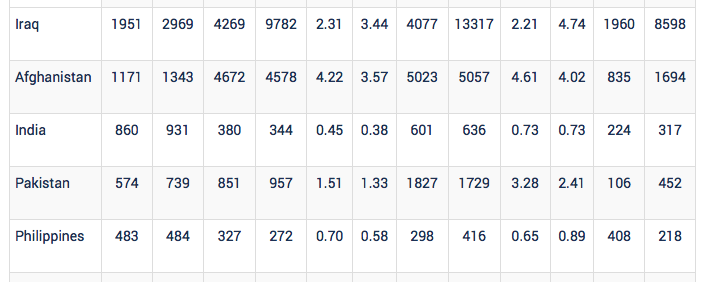
  3. 100 countries were the victims of terror attacks in 2017 according to the report. While 59% of the attacks were centred in 5 countries, namely, Iraq, Afganistan, India, Pakistan and the Philippines, 70% of the total deaths(due to terror attacks) were centred in Afganistan, Iraq, Syria, Nigeria and Somalia.

The report states that a total of 8,584 terrorist attacks have taken place worldwide in 2017.  A total of 18,700 deaths have occurred due to these attacks of which 24% deaths were that of the perpetrators themselves.

India, as per the report, ranks third globally in the number of deaths due to terror attacks with a total of 860 deaths due to terrorism. Iraq ranks the first with 1951 deaths and Afganistan follows with 1171 deaths.

2017 global terrorism report by US Department of State

On the terror attacks that had taken place in India in 2017, the report highlights the following points:

  1. Nearly 3/4ths of the total terrorist attacks in India were non-lethal. However, 4 attacks were such that more than 10 people were killed. One of the deadliest attacks was a train derailment in January 2017, where more than 30 people were killed.
  2. The number of people kidnapped or taken hostage declined 29% as compared to 2016.
  3. Though 43 different active terror groups were involved in the total number of attacks, the deadliest was the Communist Party of India (Maoist). It has been responsible for 53% of the total attacks.
  4. Bombings and blasts were the most common form of attack, registering 31% among all incidents. Attacks on infrastructure, property and facilities have increased significantly from 106 in 2016 to 198 in 2017.
  5. While the maximum number of attacks took place in Jammu and Kashmir (25%), Chhattisgarh and West Bengal were the next most attacked states with 15% and 10% share in the total attacks respectively.

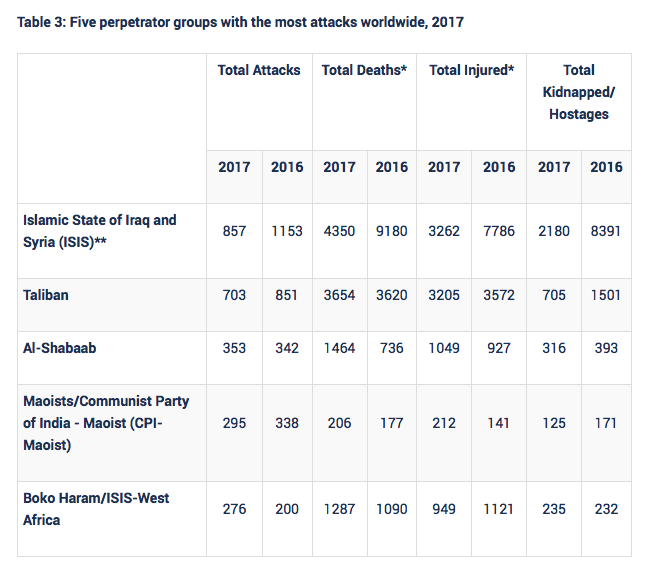
In a shocking development, while the ISIS was behind the most number of terrorism deaths and attacks globally, with a total of 857 attacks causing 4350 deaths, 3262 injuries and 2180 kidnappings, the Communist Party of India (Maoist) was ranked as the 4th deadliest terror organisation in the world with a total of 295 attacks causing 206 deaths, 212 injuries and 125 kidnappings.

What is even more surprising is that the CPI (Maoist) ranks higher than Boko Haram.

2017 report on global terror by the US State Department

Earlier, the State Department had praised the Indian government for its handling of terrorism and its efforts to tackle terror organisations in its Country Report on Terrorism. It had also slammed Pakistan for ‘not doing enough’ to curb the terror groups operating from its soil.


Congress and JD(S) led Karnataka govt turns down Centre’s proposal to declare western ghats eco-sensitive area

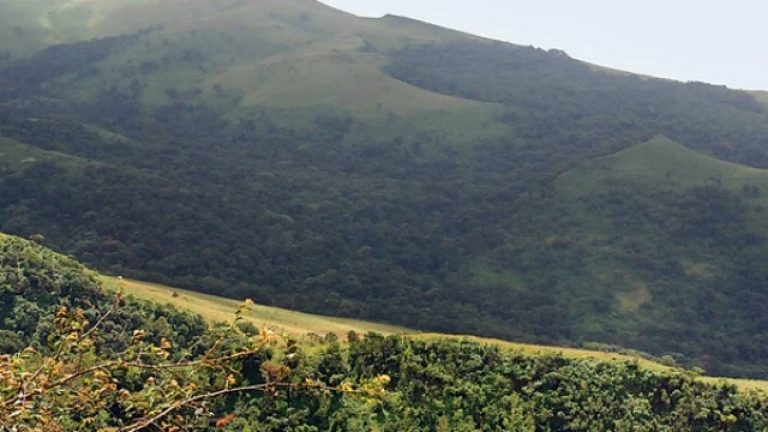
The Congress and JD(S) led Karnataka government on Wednesday rejected the recommendations by the Kasturirangan committee under the Union environment ministry on declaring the Western Ghats region an eco-sensitive zone.

The Union ministry will soon be issuing the second draft notification declaring the Western Ghats ESA (eco-sensitive area), after a similar draft expired in 2014, due to the lack of consensus between the affected States and Centre.

Citing that any further additions to the already existing regulations would have ‘an adverse effect on the State’s economy’ the Karnataka State, which is one of the six States to be affected, said it is resolute to urge the Centre to drop the recommendations.

The affected states that also include Tamil Nadu, Goa, Maharashtra, Kerala and Gujarat have 60 days to respond to the draft.

The Centre had on 27th February issued a fresh notification seeking a response from the states on the decision taken by the Kasturirangan-headed High-Level Working Group to further declare 20,666 sq km land in the state as an eco-sensitive zone in order to protect the environment.

The first draft notification had declared 56,825 sq km of the ghats in these six states as ESA.

The Karnataka State cabinet determined to reject the notification furthered that after receiving a unanimous disapproval from the 1,776 villages and gram panchayats that fall under the ESA category for not implementing further restrictions, the State had decided to reject the idea of adding further areas in the ESA category.

The state law minister T B Jayachandra said that Karnataka government’s stance would be unaltered as it was the previous two times the Centre issued notifications last year.

“The state government has diligently protected the eco-sensitive zone (ESZ) declared within the region’s national parks and forest reserves and there’s no need to declare habituated areas in 10 districts as ESZ and buffer zones. It will hurt people’s livelihood and restrict development in the region”, said the minister.

The Karnataka forest minister, Shankar R, furthered that the notification will have an adverse effect on the state’s economy as all ‘red category’ industries will be restricted in the Ghats, affecting livelihood.

Red category industries are heavily polluting industries like pesticides, petrochemicals, pulp and paper and cement. The ESA completely restricts mining, setting up new thermal power plants, polluting industries and all new large township and area development projects.

The declaration of Western Ghats ESA has assumed significance because of the massive Kerala floods in July. Distinguished ecologists like Madhav Gadgil have linked unprecedented rainfall, deforestation, mining, construction of dams and ecologically destructive activities to the intensification of floods.

Though keeping the Kerala floods in view the National Green Tribunal (NGT) too on 1st September had denied any reduction in the ESA area, the environment ministry had decided to give the state’s some further time to respond. Senior cabinet ministers, meanwhile, claimed that barring Karnataka, no other state has yet bothered responding to the Centre’s notification.

Rafale: NDTV journalist shows lack of comprehension skills again, floats strange theory about PM’s 2015 Paris visit

The Rafale deal has been turned into the Loch Ness monster by the opposition. They have time and again hurled allegations of a “scam” in the inter-governmental Rafale deal between the Indian government and the French government to buy 36 Rafale jets made by Dassault Aviation. Unfortunately for the Congress party, their allegations have failed to stick. Earlier, Rahul Gandhi, during the no-confidence motion in the parliament against the Modi government had alleged that he had personally spoken to French President Macron and he had told Gandhi that the Indian government was free to divulge details and the deal was not covered under the confidentiality clause. This claim too was promptly refuted by the French government.

On 21st September 2018, an interview of the former President Hollande surfaced in the French media where Hollande has allegedly claimed that the French government did not have any option but to go with Anil Ambani led Reliance as the service provider for Dassault in the mega Rafale deal. We reported how the French government and Dassault Aviation had refuted Hollande’s claims and asserted that the choice of partnering with Reliance was independently made by Dassault and the Indian government or the French government had no role to play.

Piggybacking on the discussion surrounding Hollande’s claims and the French government’s counterclaims, NDTV journalist Noopur Tiwari floated a wild conspiracy theory that revealed her lack of comprehension skills.

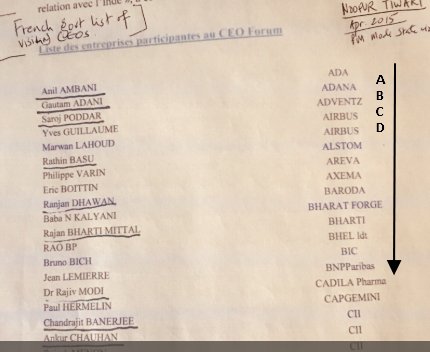
She claimed that while she was covering Prime Minister Modi’s Paris visit in 2015, where the “infamous” Rafale deal was announced, she noticed that in the list issued on the same day by the French government, the Ambani’s and Adani’s names were on top of the list. She insinuated, that since the Indian government’s list did not have the names on the top, the Indian government had perhaps hidden the fact that they were present.


Her lack of comprehension skills and zealousness to insinuate wrongdoing on the part of the government was soon called out by vigilant political observers on Social Media.

Deepak Singh who goes by the Twitter handle @smarket, pointed out that the French list was in alphabetical order while the Indian list was not. Hence, in the French list, the names of Ambani and Adani were on the top and in the Indian list, their names were not on top.


If one notices carefully, it is indeed true that the French list was in alphabetical order. This fact was missed, either deliberately or otherwise by the NDTV journalist who proceeded to insinuate wrongdoing on the part of the Indian government.

NDTV’s apparent bias against the Modi government and in favour of Congress is no secret. It was recently revealed by a senior journalist the NDTV used to take editorial orders from the PMO when the Congress was in power. Earlier in March, Supriya Prasad, the Managing Editor of the Aaj Tak and India Today news channels, too, had said that he never faced any kind of pressure from the government regarding news broadcasts or running ‘favourable news’. Amusingly, many ‘celebrity’ journalists, like NDTV’s Ravish Kumar and India Today group’s very own Rajdeep Sardesai, while trying to raise the bogey of ‘undeclared emergency’ or while commenting on CBI raids against NDTV promoters, have tried to insinuate that the Narendra Modi government was trying to muzzle voices in media by putting pressure.

NDTV is famous for its tabloid journalism and has earlier too been slammed for misreporting and concocting false news. Earlier, we had brought forward yet another attempt by NDTV of fabricating information to sensationalize news.

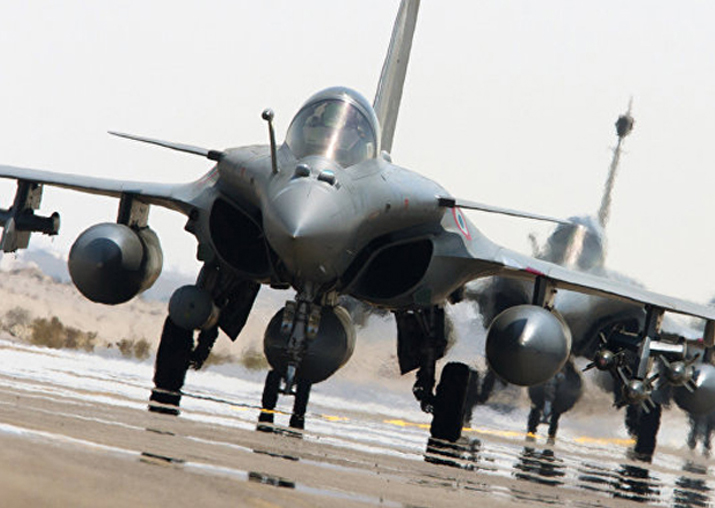
Rafale deal: French govt and Dassault both rubbish Hollande’s claim on Indian govt ‘suggesting’ Reliance

0

A fresh political slugfest had ensued in India after a statement from the former French president Francois Hollande that the Indian government had manipulated the Rafale deal to benefit Anil Ambani. Yesterday, an article in a French website Mediapart had quoted Hollande as saying that the government of India had proposed that the Anil Ambani owned Reliance Defence should be the service provider to Dassault in the mega-deal.

Following the controversy, Congress President Rahul Gandhi had taken a step forward and alleged that it was PM Modi himself who had personally negotiated and changed the deal behind closed doors so that the ‘bankrupt’ Anil Ambani can earn billions of dollars.

The Indian ministry of defence then had released a statement that the report that claims Hollande’s statement regarding the deal is being verified and insisted that neither the Indian or French governments had any parts to play in the commercial agreement between Dassault and Reliance Defence.


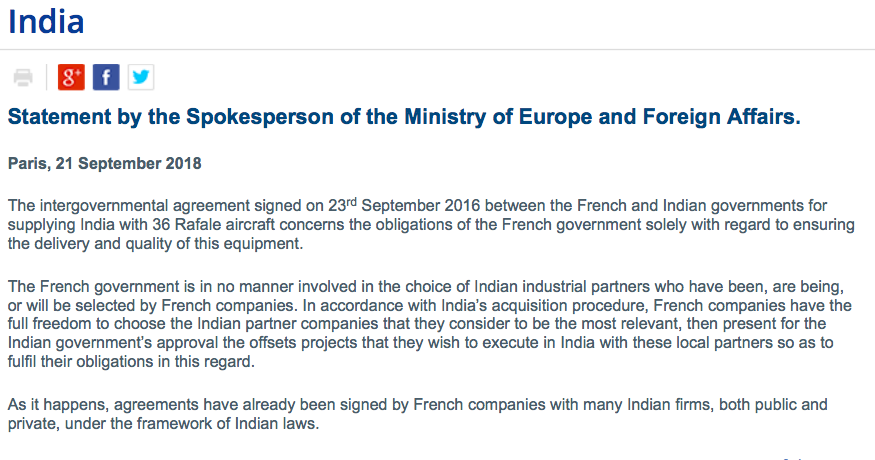
As the controversy began escalating in both French and Indian media, the government of France released a statement saying that the deal signed on 23 December 2016 between the French and Indian governments for 36 Rafale aircraft is concerned solely with ensuring the delivery and quality of the aircraft. It further clarified that the French government had no role to play in the choice of Indian industrial partners and French companies have the full freedom to choose the Indian company they want to partner with.

The French embassy in India

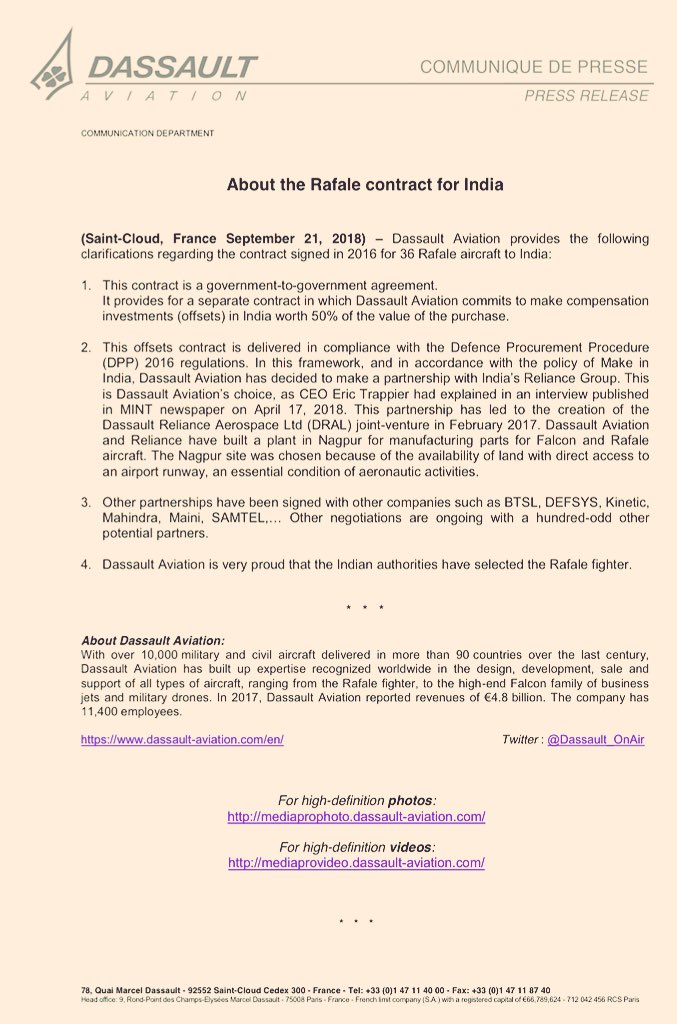
Following the statement by the French government, Dassault Aviation had also released a statement regarding the allegations. The statement asserts that the Rafale deal was a government to government contract and it provided for compensation investments in India (offsets) worth 50% of the purchase value. It further explained that the partnership with Reliance Group was Dassault’s choice. It further included that Dassault has also signed partnerships with other companies such as Mahindra, SAMTEL, Maini, BTSL, DEFSYS, Kinetic etc and is presently involved in negotiations with a hundred other companies. Finally, it added that Dassault Aviation is very proud that India has chosen the Rafale fighter jets.

Courtesy: Livefist

The Rafale deal is constantly being targeted as a political punching bag for opposition parties. Despite the government of India issuing several clarifications and the Defence Minister herself stating on record that no foul play has taken place during the deal, the issue just refuses to die down. The supreme court of India has accepted a petition over the scam allegations in the deal. Earlier, the government had stated that the details of the fighter aircraft and their specifications including pricing and other factors are a part of a confidentiality agreement and cannot be made public for the secrecy clause in the deal. However, the